Learner’s experiences
of TEL | OcTEL#2
Helen Beetham
twitter helenbeetham
blog design-4-learning.blogspot.com
http://bit.ly/octel2web
• Critiquing OcTEL #2:
‘Readiness’ to learn
‘What are we like?’ as learners
• What do we (really) know about
our learners?
Learners making sense of their own learning
Learner differences as resources for learning
• Digital literacy
Conceptual models
Developing successful digital learners
Towards a critical digital literacy?
I’ll be on about: you may be:
Completing polls
using chat, tweeting etc
Accessing resources
reading, thinking, using chat,
contributing your own ideas
Working in groups
using whiteboard, chat,
co-constructing outcomes
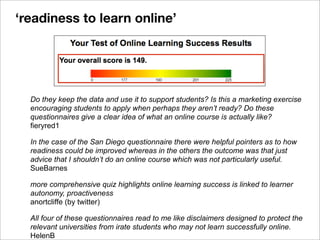
Do they keep the data and use it to support students? Is this a marketing exercise
encouraging students to apply when perhaps they aren’t ready? Do these
questionnaires give a clear idea of what an online course is actually like?
fieryred1
In the case of the San Diego questionnaire there were helpful pointers as to how
readiness could be improved whereas in the others the outcome was that just
advice that I shouldn’t do an online course which was not particularly useful.
SueBarnes
more comprehensive quiz highlights online learning success is linked to learner
autonomy, proactiveness
anortcliffe (by twitter)
All four of these questionnaires read to me like disclaimers designed to protect the
relevant universities from irate students who may not learn successfully online.
HelenB
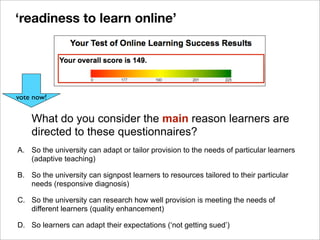
‘readiness to learn online’
What do you consider the main reason learners are
directed to these questionnaires?
A. So the university can adapt or tailor provision to the needs of particular learners
(adaptive teaching)
B. So the university can signpost learners to resources tailored to their particular
needs (responsive diagnosis)
C. So the university can research how well provision is meeting the needs of
different learners (quality enhancement)
D. So learners can adapt their expectations (‘not getting sued’)
vote now!
‘readiness to learn online’
... it matters what we do with the information:
• adapt?
• respond?
• offer strategies for
success?
• take responsibility for
learners’ development?
When we ask about learners’
needs/aptitudes/goals/preferences...
• technical competence ... ‘digital literacy’
• language and culture (including cultures
of learning)
• individual sensory, motor or cognitive
impairments
• learning preferences and disciplines,
such as the ability to schedule self-paced
learning
OcTEL week2 course materials
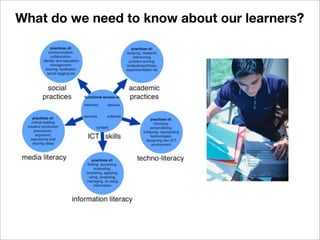
What do we need to know about our learners?
write in the chat box now!
What one question would you ask if you had
to predict success with online learning?
‘I learn pretty easily’
‘technology won’t make a bad teacher into a good teacher, and it won’t necessarily
make a good teacher any better either’
Liz Masterman, OcTEL #1 webinar
• ... but the
fundamentals of
successful
learning have not
• resources for
learning are still
unequally
distributed
• digital
technologies
break down some barriers to access but reinforce other kinds of
inequality (see refs) - they are not a magic leveller
• It’s what learners do with technology in a study setting that counts
Contexts and tools for learning have changed
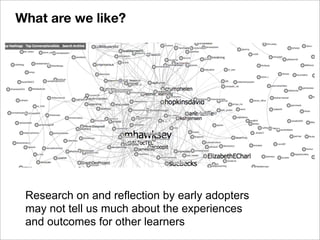
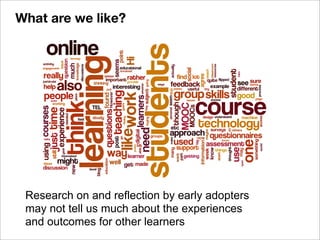
Research on and reflection by early adopters
may not tell us much about the experiences
and outcomes for other learners
What are we like?
Research on and reflection by early adopters
may not tell us much about the experiences
and outcomes for other learners
What are we like?
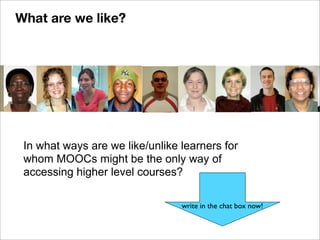
In what ways are we like/unlike learners for
whom MOOCs might be the only way of
accessing higher level courses?
write in the chat box now!
What are we like?
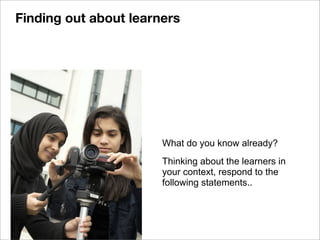
What do you know already?
Thinking about the learners in
your context, respond to the
following statements..
Finding out about learners
A. True of most learners
B. Not true of most learners
C. Learners are fundamentally
divided on this issue
Learners want more use to be made of digital
technologies in their formal learning
Learners like to integrate their social
(personal) and learning media
A. True of most learners
B. Not true of most learners
C. Learners are fundamentally
divided on this issue
A. True of most learners
B. Not true of most learners
C. Learners are fundamentally
divided on this issue
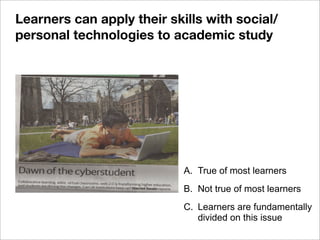
Learners can apply their skills with social/
personal technologies to academic study
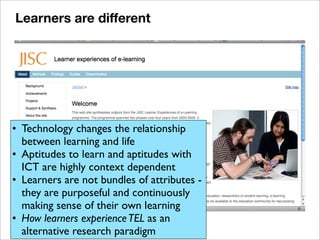
Learners are different
• Technology changes the relationship
between learning and life
• Aptitudes to learn and aptitudes with
ICT are highly context dependent
• Learners are not bundles of attributes -
they are purposeful and continuously
making sense of their own learning
• How learners experienceTEL as an
alternative research paradigm
Learners are different
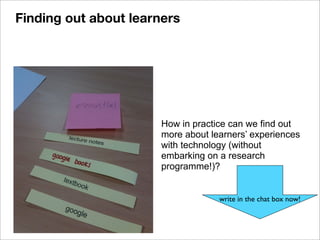
How in practice can we find out
more about learners’ experiences
with technology (without
embarking on a research
programme!)?
write in the chat box now!
Finding out about learners
Here you can download a checklist for thinking about
learners and some research findings (but no substitute
for doing your own)
Also a quiz designed to help learners understand their
digital capabilities and preferences
http://bit.ly/octel2web
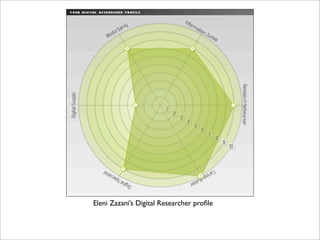
Eleni Zazani’s Digital Researcher profile
Questions and thoughts so far...
write in the chat box... or put up your hand and
use the mic
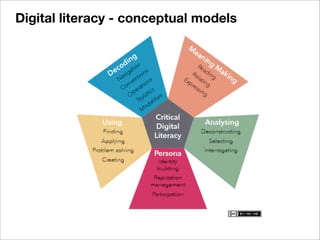
Digital literacy - conceptual models
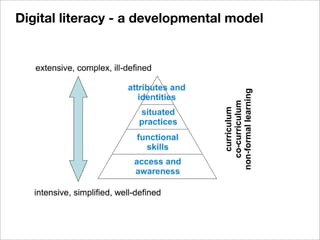
Digital literacy - a developmental model
access and
awareness
functional
skills
situated
practices
attributes and
identities
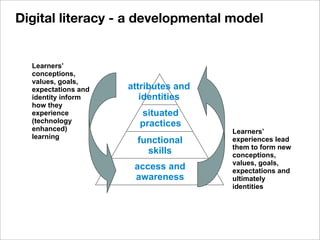
What experiences do learners need
to develop DLs?
Learners’
conceptions,
values, goals,
expectations and
identity inform
how they
experience
(technology
enhanced)
learning
Learners’
experiences lead
them to form new
conceptions,
values, goals,
expectations and
ultimately
identities
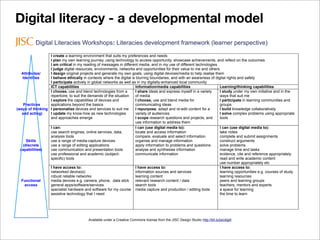
Digital literacy - a developmental model
Digital Literacies Workshops: Literacies development framework (learner perspective)
Attributes/
Identifies
I create a learning environment that suits my preferences and needs
I plan my own learning journey, using technology to access opportunity, showcase achievements, and reflect on the outcomes
I am critical in my reading of messages in different media, and in my use of different technologies
I judge digital resources, environments, networks and opportunities for their value to me and others
I design original projects and generate my own goals, using digital devices/media to help realise them
I behave ethically in contexts where the digital is blurring boundaries, and with an awareness of digital rights and safety
I participate actively in global networks as well as in my digitally-enhanced local community
ICT capabilities Information/media capabilities Learning/thinking capabilities
I choose, use and blend technologies from a
repertoire, to suit the demands of the situation
I explore the capabilities of devices and
applications beyond the basics
I personalise devices and services to suit me
I update my know-how as new technologies
and approaches emerge
I share ideas and express myself in a variety
of media
I choose, use and blend media for
communicating ideas
I repurpose, adapt and re-edit content for a
variety of audiences
I scope research questions and projects, and
use information to address them
I study under my own initiative and in the
ways that suit me
I participate in learning communities and
groups
I build knowledge collaboratively
I solve complex problems using appropriate
tools
Skills
(discrete
capabilities)
I can:
use search engines, online services, data,
analysis tools
use a range of media-capture devices
use a range of editing applications
use communication and presentation tools
use professional and academic (subject-
specific) tools
I can (use digital media to):
locate and access information
compare, evaluate and select information
organise and manage information
apply information to problems and questions
analyse and synthesise information
communicate information
I can (use digital media to):
take notes
complete and submit assignments
construct arguments
solve problems
manage time and tasks
evidence, cite and reference appropriately
read and write academic content
use number appropriately etc
Functional
access
I have access to:
networked device(s)
robust reliable networks
media devices e.g. camera, phone, data stick
general apps/software/services
specialist hardware and software for my course
assistive technology that I need
I have access to:
information sources and services
learning content
relevant research content / data
search tools
media capture and production / editing tools
I have access to:
learning opportunities e.g. courses of study
learning resources
peers and learning groups
teachers, mentors and experts
a space for learning
the time to learn
Available under a Creative Commons license from the JISC Design Studio http://bit.ly/jiscdiglit
Practices
(ways of thinking
and acting)
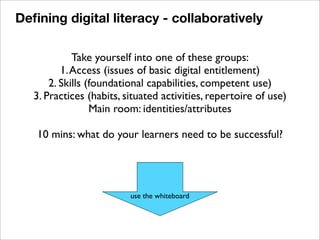
Take yourself into one of these groups:
1.Access (issues of basic digital entitlement)
2. Skills (foundational capabilities, competent use)
3. Practices (habits, situated activities, repertoire of use)
Main room: identities/attributes
10 mins: what do your learners need to be successful?
use the whiteboard
Defining digital literacy - collaboratively
Reporting back...
Defining digital literacy - collaboratively
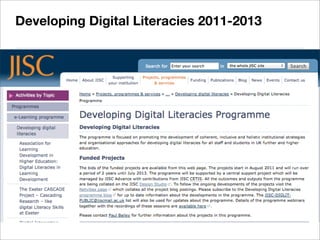
Developing Digital Literacies 2011-2013
http://bit.ly/octel2web
http://bit.ly/JISCDDL
Developing Digital Literacies 2011-2013
digital literacies (or successful digital learning practices)
are hybrid, subject-specific, embedded
staff worry about digitally capable learners: in fact
learners depend on staff for successful strategies
learners are often confused about the legitimacy of their
digital expertise, and it may be hidden
learners have diverse and situation-dependent attitudes
to digital technologies for learning
most learners flourish in a supportive BYOD environment
but issues of disadvantage must be addressed
What we have learned
Value learners’ digital know-how and treat it as a resource
e.g. through groupwork, flexible assessment options
Embed digital literacy into the curriculum via meaningful
learning activities
Address learners’ digital identities by helping them
progressively make their work more publicly visible
Try these: co- and reverse mentoring, students as
researchers, staff/student collaborations, using tech for
adaptive teaching, inter-disciplinary projects, using tech to
bridge on-off campus learning, student commissioning, self-
organised study/support groups, digital champions,
accredited awards...
What works

Oc tel mooc week 2

  • 1.
    Learner’s experiences of TEL| OcTEL#2 Helen Beetham twitter helenbeetham blog design-4-learning.blogspot.com http://bit.ly/octel2web
  • 2.
    • Critiquing OcTEL#2: ‘Readiness’ to learn ‘What are we like?’ as learners • What do we (really) know about our learners? Learners making sense of their own learning Learner differences as resources for learning • Digital literacy Conceptual models Developing successful digital learners Towards a critical digital literacy? I’ll be on about: you may be: Completing polls using chat, tweeting etc Accessing resources reading, thinking, using chat, contributing your own ideas Working in groups using whiteboard, chat, co-constructing outcomes
  • 3.
    Do they keepthe data and use it to support students? Is this a marketing exercise encouraging students to apply when perhaps they aren’t ready? Do these questionnaires give a clear idea of what an online course is actually like? fieryred1 In the case of the San Diego questionnaire there were helpful pointers as to how readiness could be improved whereas in the others the outcome was that just advice that I shouldn’t do an online course which was not particularly useful. SueBarnes more comprehensive quiz highlights online learning success is linked to learner autonomy, proactiveness anortcliffe (by twitter) All four of these questionnaires read to me like disclaimers designed to protect the relevant universities from irate students who may not learn successfully online. HelenB ‘readiness to learn online’
  • 4.
    What do youconsider the main reason learners are directed to these questionnaires? A. So the university can adapt or tailor provision to the needs of particular learners (adaptive teaching) B. So the university can signpost learners to resources tailored to their particular needs (responsive diagnosis) C. So the university can research how well provision is meeting the needs of different learners (quality enhancement) D. So learners can adapt their expectations (‘not getting sued’) vote now! ‘readiness to learn online’
  • 5.
    ... it matterswhat we do with the information: • adapt? • respond? • offer strategies for success? • take responsibility for learners’ development? When we ask about learners’ needs/aptitudes/goals/preferences...
  • 6.
    • technical competence... ‘digital literacy’ • language and culture (including cultures of learning) • individual sensory, motor or cognitive impairments • learning preferences and disciplines, such as the ability to schedule self-paced learning OcTEL week2 course materials What do we need to know about our learners?
  • 7.
    What do weneed to know about our learners?
  • 8.
    write in thechat box now! What one question would you ask if you had to predict success with online learning?
  • 9.
    ‘I learn prettyeasily’ ‘technology won’t make a bad teacher into a good teacher, and it won’t necessarily make a good teacher any better either’ Liz Masterman, OcTEL #1 webinar
  • 10.
    • ... butthe fundamentals of successful learning have not • resources for learning are still unequally distributed • digital technologies break down some barriers to access but reinforce other kinds of inequality (see refs) - they are not a magic leveller • It’s what learners do with technology in a study setting that counts Contexts and tools for learning have changed
  • 11.
    Research on andreflection by early adopters may not tell us much about the experiences and outcomes for other learners What are we like?
  • 12.
    Research on andreflection by early adopters may not tell us much about the experiences and outcomes for other learners What are we like?
  • 13.
    In what waysare we like/unlike learners for whom MOOCs might be the only way of accessing higher level courses? write in the chat box now! What are we like?
  • 14.
    What do youknow already? Thinking about the learners in your context, respond to the following statements.. Finding out about learners
  • 15.
    A. True ofmost learners B. Not true of most learners C. Learners are fundamentally divided on this issue Learners want more use to be made of digital technologies in their formal learning
  • 16.
    Learners like tointegrate their social (personal) and learning media A. True of most learners B. Not true of most learners C. Learners are fundamentally divided on this issue
  • 17.
    A. True ofmost learners B. Not true of most learners C. Learners are fundamentally divided on this issue Learners can apply their skills with social/ personal technologies to academic study
  • 18.
  • 19.
    • Technology changesthe relationship between learning and life • Aptitudes to learn and aptitudes with ICT are highly context dependent • Learners are not bundles of attributes - they are purposeful and continuously making sense of their own learning • How learners experienceTEL as an alternative research paradigm Learners are different
  • 20.
    How in practicecan we find out more about learners’ experiences with technology (without embarking on a research programme!)? write in the chat box now! Finding out about learners
  • 21.
    Here you candownload a checklist for thinking about learners and some research findings (but no substitute for doing your own) Also a quiz designed to help learners understand their digital capabilities and preferences http://bit.ly/octel2web
  • 22.
    Eleni Zazani’s DigitalResearcher profile
  • 23.
    Questions and thoughtsso far... write in the chat box... or put up your hand and use the mic
  • 24.
    Digital literacy -conceptual models
  • 25.
    Digital literacy -a developmental model
  • 26.
    Digital literacy -a developmental model access and awareness functional skills situated practices attributes and identities What experiences do learners need to develop DLs? Learners’ conceptions, values, goals, expectations and identity inform how they experience (technology enhanced) learning Learners’ experiences lead them to form new conceptions, values, goals, expectations and ultimately identities
  • 27.
    Digital literacy -a developmental model Digital Literacies Workshops: Literacies development framework (learner perspective) Attributes/ Identifies I create a learning environment that suits my preferences and needs I plan my own learning journey, using technology to access opportunity, showcase achievements, and reflect on the outcomes I am critical in my reading of messages in different media, and in my use of different technologies I judge digital resources, environments, networks and opportunities for their value to me and others I design original projects and generate my own goals, using digital devices/media to help realise them I behave ethically in contexts where the digital is blurring boundaries, and with an awareness of digital rights and safety I participate actively in global networks as well as in my digitally-enhanced local community ICT capabilities Information/media capabilities Learning/thinking capabilities I choose, use and blend technologies from a repertoire, to suit the demands of the situation I explore the capabilities of devices and applications beyond the basics I personalise devices and services to suit me I update my know-how as new technologies and approaches emerge I share ideas and express myself in a variety of media I choose, use and blend media for communicating ideas I repurpose, adapt and re-edit content for a variety of audiences I scope research questions and projects, and use information to address them I study under my own initiative and in the ways that suit me I participate in learning communities and groups I build knowledge collaboratively I solve complex problems using appropriate tools Skills (discrete capabilities) I can: use search engines, online services, data, analysis tools use a range of media-capture devices use a range of editing applications use communication and presentation tools use professional and academic (subject- specific) tools I can (use digital media to): locate and access information compare, evaluate and select information organise and manage information apply information to problems and questions analyse and synthesise information communicate information I can (use digital media to): take notes complete and submit assignments construct arguments solve problems manage time and tasks evidence, cite and reference appropriately read and write academic content use number appropriately etc Functional access I have access to: networked device(s) robust reliable networks media devices e.g. camera, phone, data stick general apps/software/services specialist hardware and software for my course assistive technology that I need I have access to: information sources and services learning content relevant research content / data search tools media capture and production / editing tools I have access to: learning opportunities e.g. courses of study learning resources peers and learning groups teachers, mentors and experts a space for learning the time to learn Available under a Creative Commons license from the JISC Design Studio http://bit.ly/jiscdiglit Practices (ways of thinking and acting)
  • 28.
    Take yourself intoone of these groups: 1.Access (issues of basic digital entitlement) 2. Skills (foundational capabilities, competent use) 3. Practices (habits, situated activities, repertoire of use) Main room: identities/attributes 10 mins: what do your learners need to be successful? use the whiteboard Defining digital literacy - collaboratively
  • 29.
    Reporting back... Defining digitalliteracy - collaboratively
  • 30.
  • 31.
  • 32.
    digital literacies (orsuccessful digital learning practices) are hybrid, subject-specific, embedded staff worry about digitally capable learners: in fact learners depend on staff for successful strategies learners are often confused about the legitimacy of their digital expertise, and it may be hidden learners have diverse and situation-dependent attitudes to digital technologies for learning most learners flourish in a supportive BYOD environment but issues of disadvantage must be addressed What we have learned
  • 33.
    Value learners’ digitalknow-how and treat it as a resource e.g. through groupwork, flexible assessment options Embed digital literacy into the curriculum via meaningful learning activities Address learners’ digital identities by helping them progressively make their work more publicly visible Try these: co- and reverse mentoring, students as researchers, staff/student collaborations, using tech for adaptive teaching, inter-disciplinary projects, using tech to bridge on-off campus learning, student commissioning, self- organised study/support groups, digital champions, accredited awards... What works