Online learner expectations and experiences of the
digital environment: a Jisc review
12 May 2016
Image source:
https://www.flickr.com/photos/yodelanecdotal/4092671749
Agenda
» Welcome and introductions
» Overview of two previous areas of work
» Observations from the literature review
» Discussion on research questions for the study
» Learner consultation/focus groups
» Institutional email survey
» AOB and date of next meeting
12/05/16 2
#digitalstudent
Digital Student http://digitalstudent.jiscinvolve.org12 May 2016
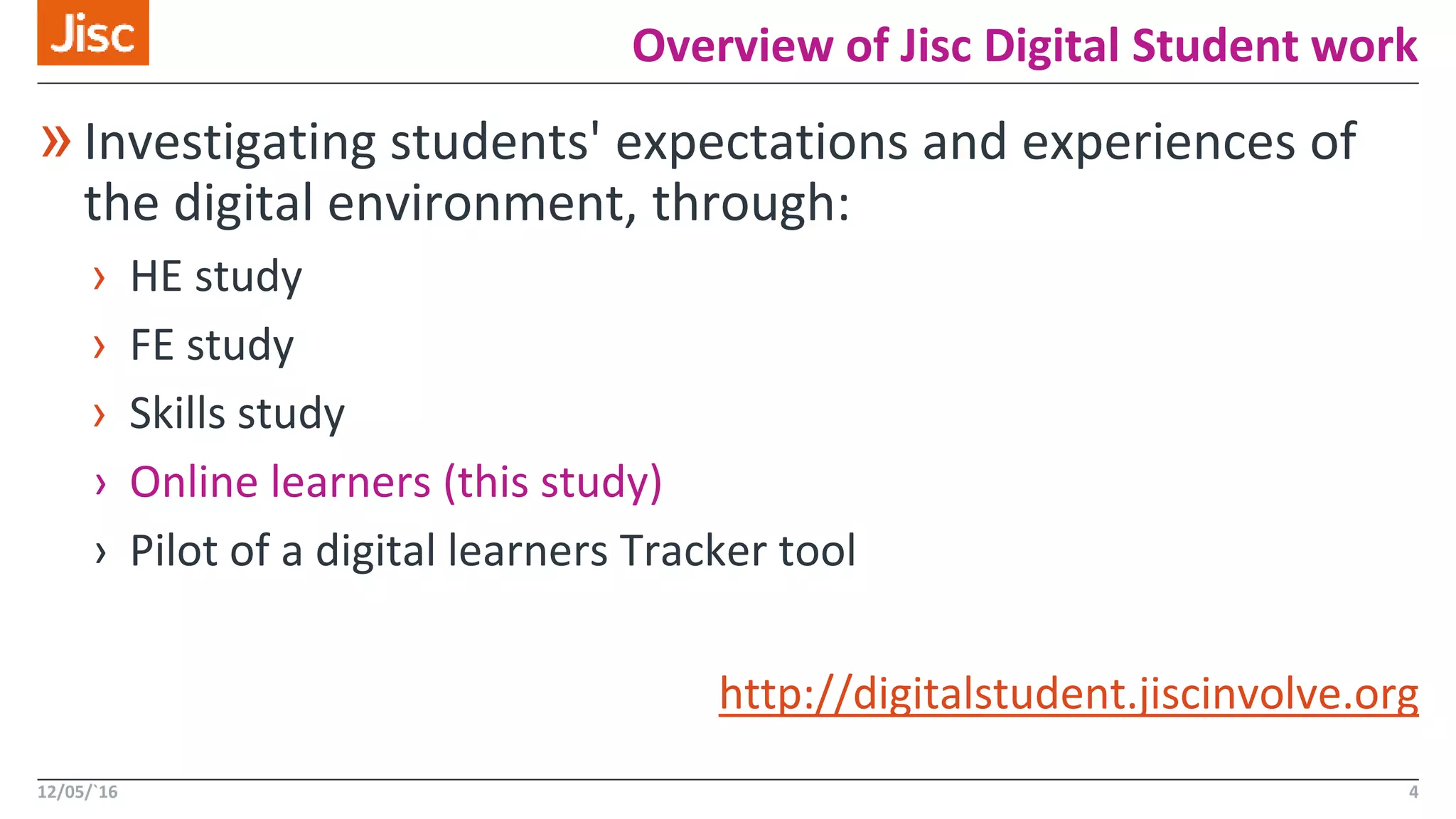
Overview of Jisc Digital Student work
12/05/`16 4
»Investigating students' expectations and experiences of
the digital environment, through:
› HE study
› FE study
› Skills study
› Online learners (this study)
› Pilot of a digital learners Tracker tool
http://digitalstudent.jiscinvolve.org
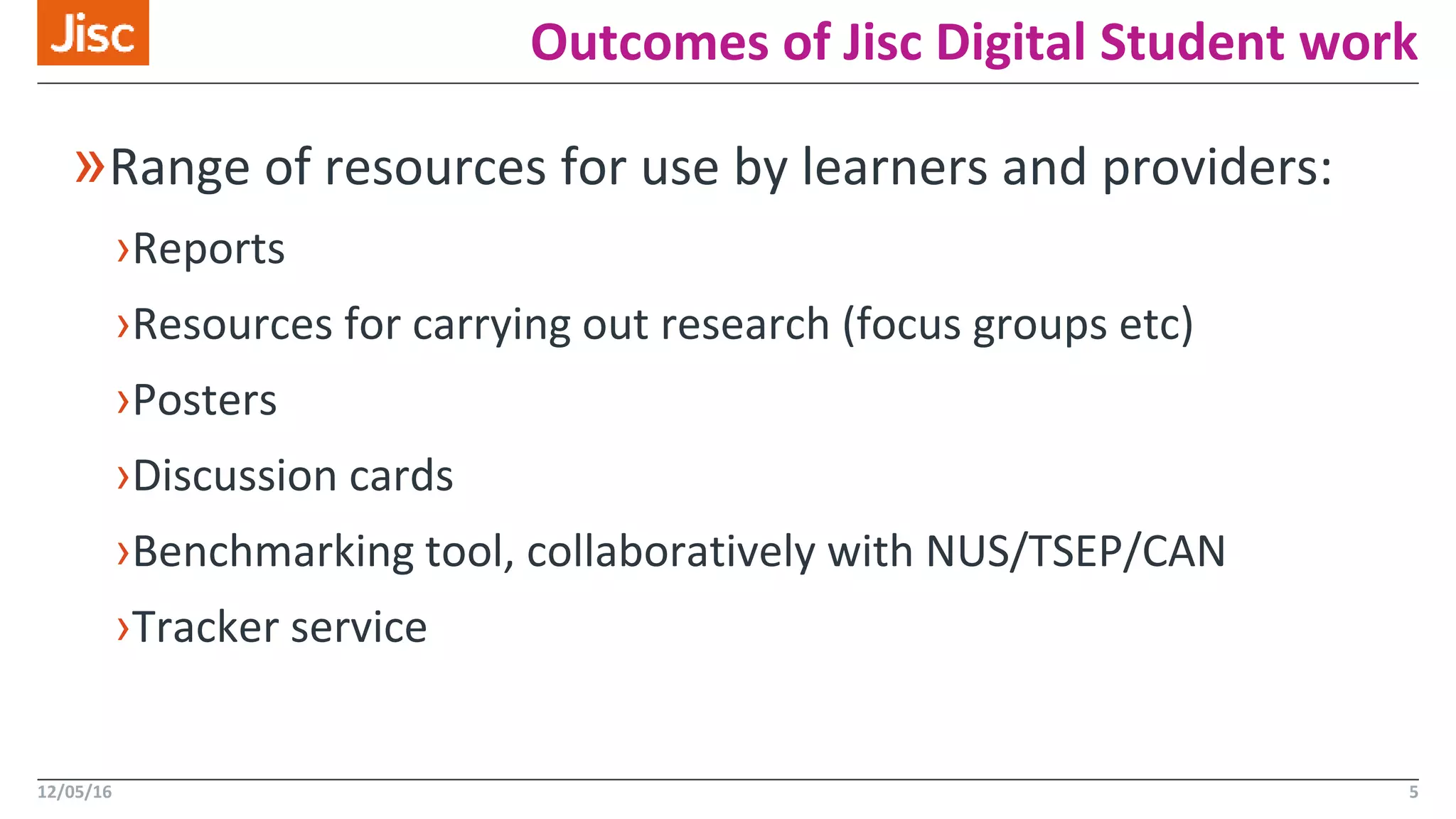
Outcomes of Jisc Digital Student work
»Range of resources for use by learners and providers:
›Reports
›Resources for carrying out research (focus groups etc)
›Posters
›Discussion cards
›Benchmarking tool, collaboratively with NUS/TSEP/CAN
›Tracker service
12/05/16 5
Benchmarking the student digital experience
»Jisc, NUS, TSEP
» bit.ly/digistudentexp
12/05/16 Student Experience Experts Group
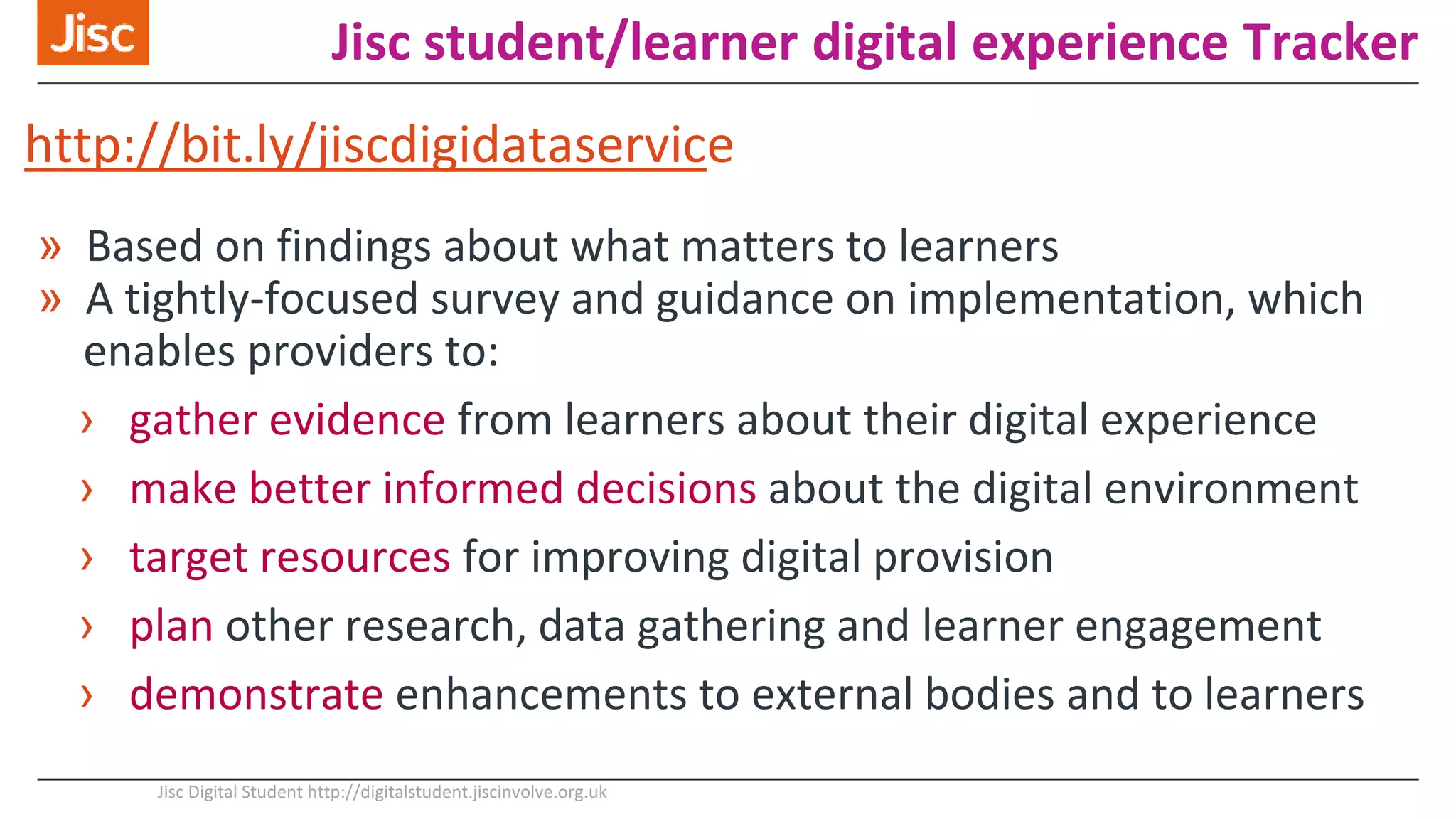
Jisc student/learner digital experience Tracker
» Based on findings about what matters to learners
» A tightly-focused survey and guidance on implementation, which
enables providers to:
› gather evidence from learners about their digital experience
› make better informed decisions about the digital environment
› target resources for improving digital provision
› plan other research, data gathering and learner engagement
› demonstrate enhancements to external bodies and to learners
Jisc Digital Student http://digitalstudent.jiscinvolve.org.uk
http://bit.ly/jiscdigidataservice
The Tracker pilot (ongoing)
» March-April 2016 learner engagement and data collection
» 8 FE colleges, 2 Training providers, 2 Specialist colleges, 13 HEIs
» 10,755 student responses collected through BOS
» Now: analysis of data, benchmarking against sector norms
» Key findings published late May
» Potential to develop a set of questions for online learners
12/05/16 Jisc Digital Student http://digitalstudent.jiscinvolve.org.uk
» Review of barriers to institutions creating more online courses and
possible solutions, leading to:
›Online guides – for institutions
–Scaling up (strategic focus)
–Curriculum design and support (course and learning focus)
–Technology and tools (environment focus)
›Diagnostic tool – for staff
Jisc Digital Student http://digitalstudent.jiscinvolve.org.uk
Overview of Scaling Up Online Learning
» Literature search and analysis
» Validation of findings with:
›Expert advisory group (you!)
›Email survey of other experts
›Online learners via online focus groups
» Report and briefing papers
Jisc Digital Student http://digitalstudent.jiscinvolve.org.uk
Overview of this study (Expectations and
Experiences of Online Learners)
Who are ‘online learners’?
For the purposes of this study,
online learning is defined as:
» exclusively online courses
» courses which are delivered largely
online, or have online elements to
support a variety of access and
attendance needs
» online learning which replaces some
face-to-face lecturing time in courses
that are otherwise delivered
traditionally
It is our assumption that most
learners in post-compulsory settings
will experience some online
component to their learning, and
that as they move into lifelong
learning/professional development
this component will form a larger
proportion of study time. Online
learners are not, then, a distinct
group of learners: they are post-
compulsory learners in particular
situations and/or with particular
preferences and needs.
Literature review - scope
factors influencing the outcomes of online learning using
measures such learners' engagement, progression, satisfaction,
successful completion and credits/grades achieved (46 refs)
comparative literature which contrasts online and offline
learning activities or experiences or contrasts differently
designed online learning components (16 refs)
case study evidence, largely conducted from the perspective of
teachers and online learning designers, and evaluation studies of
specific online courses or interventions (22 refs)
qualitative and mixed-method research studies which provide a
focused, theoretically informed and rich picture of online
learners' experiences from a variety of perspectives (33 refs)
feedback from learners - learner surveys carried out by
researchers, online learning providers, and some national bodies
(refs included in counts above)
Limits
» From 2012 onwards
» Involvement of learners, e.g.
via large-scale surveys and/or
detailed qualitative work
» Focus on the learning
experience, rather than
teaching, course design, or
organisational issues
Types
http://bit.ly/onlinescoping
(private URL: pls do not circulate)
Literature review - early observations
» Large number of studies (161
included so far)
» Predominance of quantitative
methods
› Ease of data collection by online
surveys and learning analytics
› Relatively low cost to collect
and analyse
› Quality and relevance??
» Emergence of MOOC studies, studies
of self-efficacy/self-regulation
» Some in-house work not publicly
available due to commercial value
We will have messages around
» Learners’: perceptions, engagement,
experiences, expectations, motivation,
retention, achievement, attitudes,
satisfaction, voice,
» Themes: trust, community, self-regulation/
self-efficacy, study habits, time
management, cultural differences, other
learner differences, transition,
metacognition
» Context:- type of learner, course design,
geographical location, mode of learning,
specific learning activities
Literature review - early headlines
Online learners are different!
» previous experience
» motivations and aspirations
» self-efficacy
» study habits
» gender/cultural issues
» beliefs about (online) learning
Context matters
» Rationale for online
» Design of online space
» On-boarding, preparation
» Interactions with others
(trust, community,
belonging)
» Time and timing
» Study setting
Questions/Observations?
Raise your hand or type in the chat window
Our tasks for you today
1.Help us define and refine our study questions
2.Help us identify learners for online focus groups
3.Help us identify experts for email survey - which we
will also send to you :-)
1. Research questions for the study
Identifying questions:
»Previous Digital
Student work
»Literature review
»Community input
09/09/2015 17
Contribute to our Trello Board
https://trello.com/b/AdD3yvkp/online-learner-study-key-research-questions
Which questions are most important?
» How does the experience of learning
online differ from the experience of
learning face to face in terms of the key
issues identified in the earlier studies?
» How do fully online learners rate their
transactional experiences e.g. how do
they experience systems for
enrolment, payment, assessment...?
» What online learning experiences are
transformational? Do these
experiences follow a pattern, e.g.
depending on the subjects studied or
the prior digital experiences of
learners?
» What learner-related factors have the
strongest influence on the quality of the
learning experience online (as reported
by learners)?
» What course design/teaching/pedagogic
factors have the strongest influence on
the quality of the learning experience
online?
» What features of the digital
environment have the strongest
influence on the quality of the learning
experience online?
» What do online learners like most about
the experience? What do they like least?
Which questions are most important?
Raise your hand or type in the chat window - and
please go to our Trello board to add your thoughts
2. Online learner consultation
09/09/2015 20
» Focus groups/social media conversations - based around
six key questions (framed for learners)
›Any existing student activities we can tap into?
›Twitter chats
›Timed webinars - mix of students on different courses
›Timed sessions within online courses
›Any other ideas…?
3. Expert email survey
Again, six key questions, framed in more expert terms
›Who else should we be talking to beyond this group?
›Any events/initiatives where we could quickly gather feedback?
›How do we encourage and reward participation?
Final questions/Observations?
Raise your hand or type in the chat window
Thank you for your time today!
What next
09/09/2015 23
https://digitalstudent.jiscinvolve.org/
wp/online-learners/
#suoll #digitalstudent
Except where otherwise noted, this
work is licensed under CC-BY-NC-ND

Advisory group webinar

  • 1.
    Online learner expectationsand experiences of the digital environment: a Jisc review 12 May 2016 Image source: https://www.flickr.com/photos/yodelanecdotal/4092671749
  • 2.
    Agenda » Welcome andintroductions » Overview of two previous areas of work » Observations from the literature review » Discussion on research questions for the study » Learner consultation/focus groups » Institutional email survey » AOB and date of next meeting 12/05/16 2
  • 3.
  • 4.
    Overview of JiscDigital Student work 12/05/`16 4 »Investigating students' expectations and experiences of the digital environment, through: › HE study › FE study › Skills study › Online learners (this study) › Pilot of a digital learners Tracker tool http://digitalstudent.jiscinvolve.org
  • 5.
    Outcomes of JiscDigital Student work »Range of resources for use by learners and providers: ›Reports ›Resources for carrying out research (focus groups etc) ›Posters ›Discussion cards ›Benchmarking tool, collaboratively with NUS/TSEP/CAN ›Tracker service 12/05/16 5
  • 6.
    Benchmarking the studentdigital experience »Jisc, NUS, TSEP » bit.ly/digistudentexp 12/05/16 Student Experience Experts Group
  • 7.
    Jisc student/learner digitalexperience Tracker » Based on findings about what matters to learners » A tightly-focused survey and guidance on implementation, which enables providers to: › gather evidence from learners about their digital experience › make better informed decisions about the digital environment › target resources for improving digital provision › plan other research, data gathering and learner engagement › demonstrate enhancements to external bodies and to learners Jisc Digital Student http://digitalstudent.jiscinvolve.org.uk http://bit.ly/jiscdigidataservice
  • 8.
    The Tracker pilot(ongoing) » March-April 2016 learner engagement and data collection » 8 FE colleges, 2 Training providers, 2 Specialist colleges, 13 HEIs » 10,755 student responses collected through BOS » Now: analysis of data, benchmarking against sector norms » Key findings published late May » Potential to develop a set of questions for online learners 12/05/16 Jisc Digital Student http://digitalstudent.jiscinvolve.org.uk
  • 9.
    » Review ofbarriers to institutions creating more online courses and possible solutions, leading to: ›Online guides – for institutions –Scaling up (strategic focus) –Curriculum design and support (course and learning focus) –Technology and tools (environment focus) ›Diagnostic tool – for staff Jisc Digital Student http://digitalstudent.jiscinvolve.org.uk Overview of Scaling Up Online Learning
  • 10.
    » Literature searchand analysis » Validation of findings with: ›Expert advisory group (you!) ›Email survey of other experts ›Online learners via online focus groups » Report and briefing papers Jisc Digital Student http://digitalstudent.jiscinvolve.org.uk Overview of this study (Expectations and Experiences of Online Learners)
  • 11.
    Who are ‘onlinelearners’? For the purposes of this study, online learning is defined as: » exclusively online courses » courses which are delivered largely online, or have online elements to support a variety of access and attendance needs » online learning which replaces some face-to-face lecturing time in courses that are otherwise delivered traditionally It is our assumption that most learners in post-compulsory settings will experience some online component to their learning, and that as they move into lifelong learning/professional development this component will form a larger proportion of study time. Online learners are not, then, a distinct group of learners: they are post- compulsory learners in particular situations and/or with particular preferences and needs.
  • 12.
    Literature review -scope factors influencing the outcomes of online learning using measures such learners' engagement, progression, satisfaction, successful completion and credits/grades achieved (46 refs) comparative literature which contrasts online and offline learning activities or experiences or contrasts differently designed online learning components (16 refs) case study evidence, largely conducted from the perspective of teachers and online learning designers, and evaluation studies of specific online courses or interventions (22 refs) qualitative and mixed-method research studies which provide a focused, theoretically informed and rich picture of online learners' experiences from a variety of perspectives (33 refs) feedback from learners - learner surveys carried out by researchers, online learning providers, and some national bodies (refs included in counts above) Limits » From 2012 onwards » Involvement of learners, e.g. via large-scale surveys and/or detailed qualitative work » Focus on the learning experience, rather than teaching, course design, or organisational issues Types http://bit.ly/onlinescoping (private URL: pls do not circulate)
  • 13.
    Literature review -early observations » Large number of studies (161 included so far) » Predominance of quantitative methods › Ease of data collection by online surveys and learning analytics › Relatively low cost to collect and analyse › Quality and relevance?? » Emergence of MOOC studies, studies of self-efficacy/self-regulation » Some in-house work not publicly available due to commercial value We will have messages around » Learners’: perceptions, engagement, experiences, expectations, motivation, retention, achievement, attitudes, satisfaction, voice, » Themes: trust, community, self-regulation/ self-efficacy, study habits, time management, cultural differences, other learner differences, transition, metacognition » Context:- type of learner, course design, geographical location, mode of learning, specific learning activities
  • 14.
    Literature review -early headlines Online learners are different! » previous experience » motivations and aspirations » self-efficacy » study habits » gender/cultural issues » beliefs about (online) learning Context matters » Rationale for online » Design of online space » On-boarding, preparation » Interactions with others (trust, community, belonging) » Time and timing » Study setting
  • 15.
    Questions/Observations? Raise your handor type in the chat window
  • 16.
    Our tasks foryou today 1.Help us define and refine our study questions 2.Help us identify learners for online focus groups 3.Help us identify experts for email survey - which we will also send to you :-)
  • 17.
    1. Research questionsfor the study Identifying questions: »Previous Digital Student work »Literature review »Community input 09/09/2015 17 Contribute to our Trello Board https://trello.com/b/AdD3yvkp/online-learner-study-key-research-questions
  • 18.
    Which questions aremost important? » How does the experience of learning online differ from the experience of learning face to face in terms of the key issues identified in the earlier studies? » How do fully online learners rate their transactional experiences e.g. how do they experience systems for enrolment, payment, assessment...? » What online learning experiences are transformational? Do these experiences follow a pattern, e.g. depending on the subjects studied or the prior digital experiences of learners? » What learner-related factors have the strongest influence on the quality of the learning experience online (as reported by learners)? » What course design/teaching/pedagogic factors have the strongest influence on the quality of the learning experience online? » What features of the digital environment have the strongest influence on the quality of the learning experience online? » What do online learners like most about the experience? What do they like least?
  • 19.
    Which questions aremost important? Raise your hand or type in the chat window - and please go to our Trello board to add your thoughts
  • 20.
    2. Online learnerconsultation 09/09/2015 20 » Focus groups/social media conversations - based around six key questions (framed for learners) ›Any existing student activities we can tap into? ›Twitter chats ›Timed webinars - mix of students on different courses ›Timed sessions within online courses ›Any other ideas…?
  • 21.
    3. Expert emailsurvey Again, six key questions, framed in more expert terms ›Who else should we be talking to beyond this group? ›Any events/initiatives where we could quickly gather feedback? ›How do we encourage and reward participation?
  • 22.
    Final questions/Observations? Raise yourhand or type in the chat window Thank you for your time today!
  • 23.
    What next 09/09/2015 23 https://digitalstudent.jiscinvolve.org/ wp/online-learners/ #suoll#digitalstudent Except where otherwise noted, this work is licensed under CC-BY-NC-ND