Part 2:Understanding Faculty Members and Learners and Web 2.0 Drs. Patricia McGee & Veronica Diaz
Asking the right question
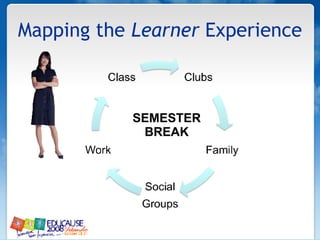
Mapping the  Learner  Experience SEMESTER BREAK
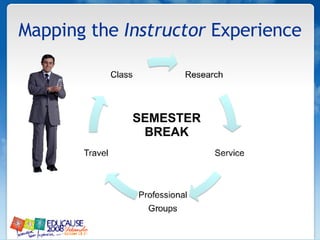
Mapping the  Instructor  Experience SEMESTER BREAK
People - Data - Things (P-D-T) Over the past 10 years, teachers and students have increasingly relied on technology to communicate. At the same time there is a perception that teacher’s time on campus has declined. There is an administrative concern that student needs outside of class are not being met, and that lack of campus presence is an indication of teacher apathy. What people should be included? What data should be analyzed? What things are involved?
Learners… Are intergenerational. May have expectations from prior experience, personal style/needs, disciplinary perspective. Have a range of technical abilities. Require just-in-need supports.
Informal and “non-traditional” A part of ubiquitous networks   Not so enamored of technology but believe tech skills may be an advantage (younger over older) learners are also …
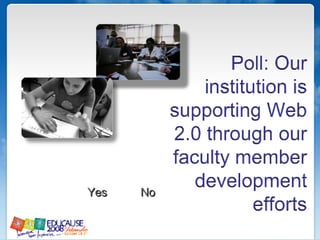
Poll We regularly survey students about technology use:  Yes No
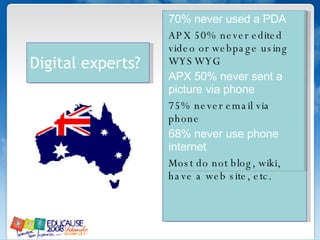
70% never used a PDA APX 50% never edited video or webpage using WYSWYG APX 50% never sent a picture via phone 75% never email via phone 68% never use phone internet Most do not blog, wiki, have a web site, etc. Digital experts?
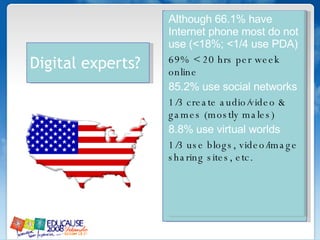
Alt hough 66.1% have Internet phone most do not use (<18%; <1/4 use PDA) 69% < 20 hrs per week online 85.2% use social networks 1/3 create audio/video & games (mostly males) 8.8% use virtual worlds 1/3 use blogs, video/image sharing sites, etc. Digital experts?
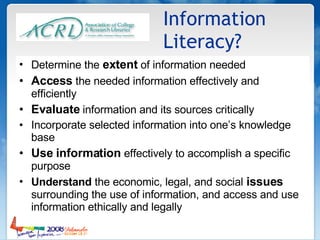
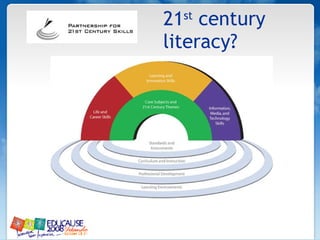
Information Literacy? Determine the  extent  of information needed Access  the needed information effectively and efficiently Evaluate  information and its sources critically Incorporate selected information into one’s knowledge base Use information  effectively to accomplish a specific purpose Understand  the economic, legal, and social  issues  surrounding the use of information, and access and use information ethically and legally
21 st  century literacy?
Poll My institution has literacy standards that all students must attain:  Yes No Only some departments
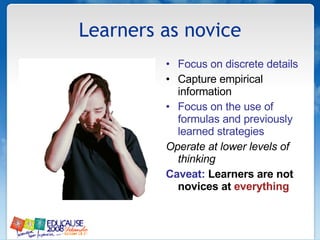
Learners as novice Focus on discrete details Capture empirical information Focus on the use of formulas and previously learned strategies Operate at lower levels of thinking Caveat:  Learners are not novices at  everything
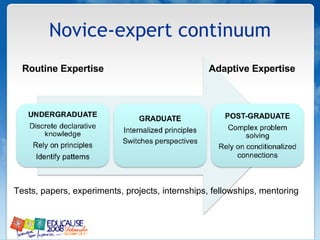
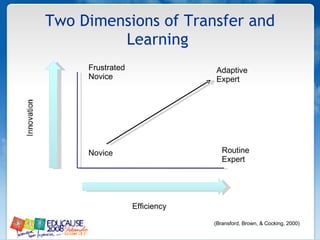
Novice-expert continuum Routine Expertise   Adaptive Expertise Tests, papers, experiments, projects, internships, fellowships, mentoring
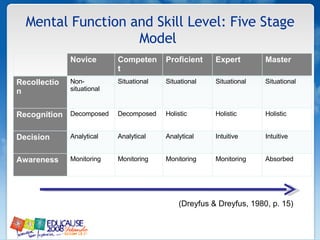
Mental Function and Skill Level: Five Stage Model  (Dreyfus & Dreyfus, 1980, p. 15)  Novice Competent Proficient Expert Master Recollection Non-situational Situational Situational Situational Situational Recognition Decomposed Decomposed Holistic Holistic Holistic Decision Analytical Analytical Analytical Intuitive Intuitive Awareness Monitoring Monitoring Monitoring Monitoring Absorbed
Two Dimensions of Transfer and Learning  Routine Expert Adaptive  Expert Novice Efficiency Frustrated Novice (Bransford, Brown, & Cocking, 2000)
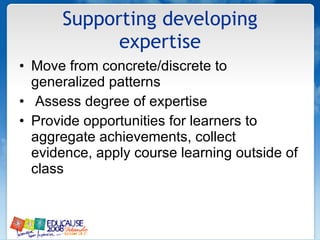
Supporting developing expertise Move from concrete/discrete to generalized patterns Assess degree of expertise Provide opportunities for learners to aggregate achievements, collect evidence, apply course learning outside of class
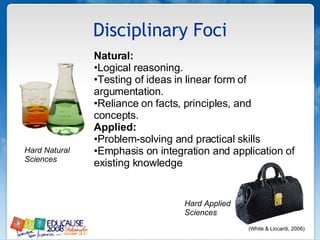
Disciplinary Foci Hard Natural Sciences Hard Applied Sciences Natural: Logical reasoning. Testing of ideas in linear form of argumentation. Reliance on facts, principles, and concepts. Applied: Problem-solving and practical skills  Emphasis on integration and application of existing knowledge (White & Liccardi, 2006)
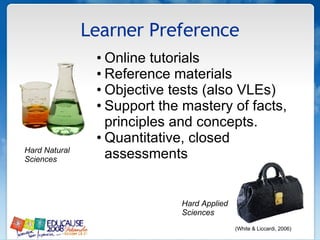
Learner Preference Hard Natural Sciences Hard Applied Sciences Online tutorials Reference materials Objective tests (also VLEs) Support the mastery of facts, principles and concepts.  Quantitative, closed assessments (White & Liccardi, 2006)
IMPLICATIONS FOR ASSESSMENT?
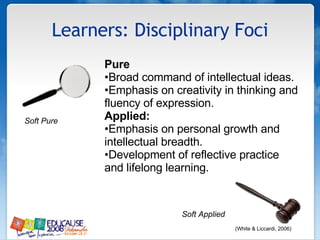
Learners: Disciplinary Foci Soft Pure Soft Applied Pure Broad command of intellectual ideas. Emphasis on creativity in thinking and fluency of expression. Applied: Emphasis on personal growth and intellectual breadth. Development of reflective practice and lifelong learning. (White & Liccardi, 2006)
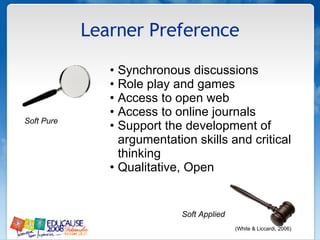
Learner Preference Soft Pure Soft Applied Synchronous discussions Role play and games Access to open web Access to online journals  Support the development of argumentation skills and critical thinking Qualitative, Open  (White & Liccardi, 2006)
What best supports novices?
Learning Readiness Are learners ready for: Online learning? Technology mediated interaction? Self-regulation? New course designs? Independent learning? Self-assessment
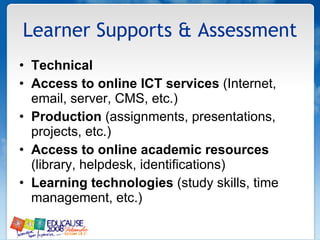
Learner Supports & Assessment Technical Access to online ICT services  (Internet, email, server, CMS, etc.) Production  (assignments, presentations, projects, etc.) Access to online academic resources  (library, helpdesk, identifications) Learning technologies  (study skills, time management, etc.)
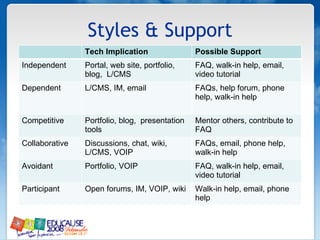
Styles & Support Tech Implication Possible Support Independent Portal, web site, portfolio, blog,  L/CMS  FAQ, walk-in help, email, video tutorial  Dependent L/CMS, IM, email  FAQs, help forum, phone help, walk-in help  Competitive Portfolio, blog,  presentation tools  Mentor others, contribute to FAQ  Collaborative Discussions, chat, wiki,  L/CMS, VOIP  FAQs, email, phone help, walk-in help  Avoidant Portfolio, VOIP  FAQ, walk-in help, email, video tutorial  Participant Open forums, IM, VOIP, wiki  Walk-in help, email, phone help
BREAK
EMERGING TECHNOLOGIES AND FACULTY DEVELOPMENT
No Yes
Emerging Technology Use Student and faculty surveys Use of tools Teaching approaches Demographic information (age, gender, years of study/employment, and program of study) Student and faculty focus groups or observation Classroom use of technology Use of course management systems Preferences, limitations, and needs Document analysis Annual reports Lesson plans Web pages PowerPoint presentations or course handouts can indicate areas of technology use and can reveal instructional styles
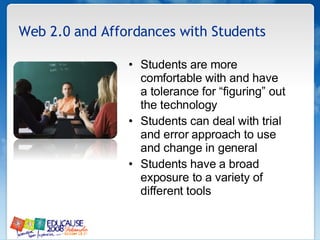
Web 2.0 and Affordances with Students Students are more comfortable with and have a tolerance for “figuring” out the technology  Students can deal with trial and error approach to use and change in general  Students have a broad exposure to a variety of different tools
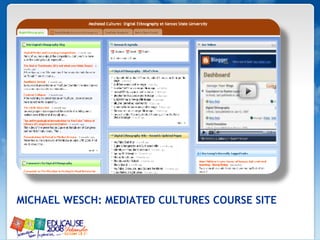
MICHAEL WESCH: MEDIATED CULTURES COURSE SITE
No Yes
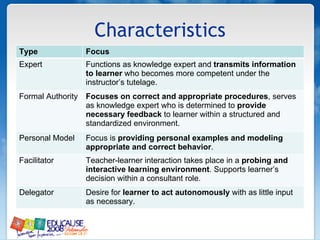
Characteristics Type Focus Expert Functions as knowledge expert and  transmits information to learner  who becomes more competent under the instructor’s tutelage.  Formal Authority Focuses on correct and appropriate procedures , serves as knowledge expert who is determined to  provide necessary feedback  to learner within a structured and standardized environment.  Personal Model Focus is  providing personal examples and modeling appropriate and correct behavior .  Facilitator Teacher-learner interaction takes place in a  probing and interactive learning environment . Supports learner’s decision within a consultant role.  Delegator Desire for  learner to act autonomously  with as little input as necessary.
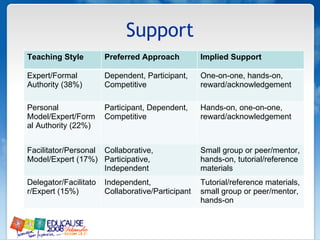
Support Teaching Style Preferred Approach Implied Support Expert/Formal Authority (38%)  Dependent, Participant, Competitive  One-on-one, hands-on, reward/acknowledgement  Personal Model/Expert/Formal Authority (22%)  Participant, Dependent, Competitive  Hands-on, one-on-one, reward/acknowledgement  Facilitator/Personal Model/Expert (17%)  Collaborative, Participative, Independent  Small group or peer/mentor, hands-on, tutorial/reference materials  Delegator/Facilitator/Expert (15%)  Independent, Collaborative/Participant  Tutorial/reference materials, small group or peer/mentor, hands-on
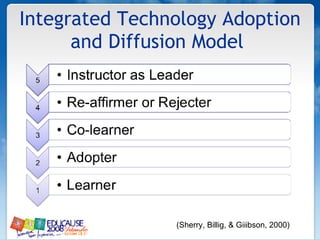
Integrated Technology Adoption and Diffusion Model  (Sherry, Billig, & Giiibson, 2000)
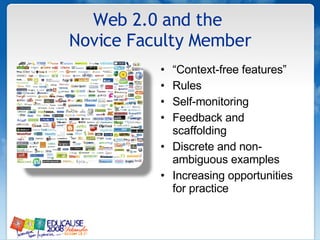
Web 2.0 and the  Novice Faculty Member “ Context-free features” Rules Self-monitoring Feedback and scaffolding Discrete and non-ambiguous examples Increasing opportunities for practice
 
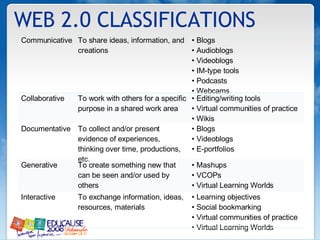
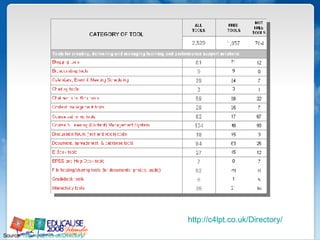
WEB 2.0 CLASSIFICATIONS Communicative To share ideas, information, and creations •  Blogs •  Audioblogs •  Videoblogs •  IM-type tools •  Podcasts •  Webcams Collaborative To work with others for a specific purpose in a shared work area •  Editing/writing tools •  Virtual communities of practice  •  Wikis Documentative To collect and/or present evidence of experiences, thinking over time, productions, etc. •  Blogs •  Videoblogs •  E-portfolios Generative To create something new that can be seen and/or used by others •  Mashups •  VCOPs •  Virtual Learning Worlds Interactive To exchange information, ideas, resources, materials •  Learning objectives •  Social bookmarking •  Virtual communities of practice  •  Virtual Learning Worlds
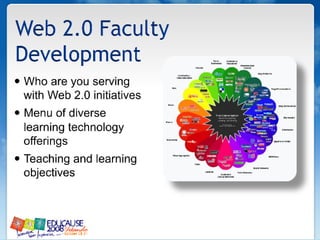
Source:  http://c4lpt.co.uk/Directory/   http://c4lpt.co.uk/Directory/
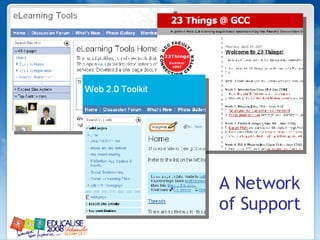
A Network of Support
 
 
Tools not necessarily developed for an educational audience No obligation to users  Ever-changing  Require separate logins/accounts/fragmentation No centralized institutional support (usually) Reliance on internet connection (high speed) Lack of security  Learning curve Variety of use and selection of tools could overwhelm students; lack of a common experience across courses Intellectual property/copyright issues
Instructional Technology Challenges  The technology-adoption cycle Lack of integrated technology tools  Learners’ changing expectations  Institutional changes to technology commitments
Activity: Data, Data, Data  Part I Given examples of students and faculty members, how can you best support their utilization and integration of Web 2.0 technologies?  Part II Given your responses, what kinds of services are needed At institutional level? At departmental level?

Educause 08 Part 2

  • 1.
    Part 2:Understanding FacultyMembers and Learners and Web 2.0 Drs. Patricia McGee & Veronica Diaz
  • 2.
  • 3.
    Mapping the Learner Experience SEMESTER BREAK
  • 4.
    Mapping the Instructor Experience SEMESTER BREAK
  • 5.
    People - Data- Things (P-D-T) Over the past 10 years, teachers and students have increasingly relied on technology to communicate. At the same time there is a perception that teacher’s time on campus has declined. There is an administrative concern that student needs outside of class are not being met, and that lack of campus presence is an indication of teacher apathy. What people should be included? What data should be analyzed? What things are involved?
  • 6.
    Learners… Are intergenerational.May have expectations from prior experience, personal style/needs, disciplinary perspective. Have a range of technical abilities. Require just-in-need supports.
  • 7.
    Informal and “non-traditional”A part of ubiquitous networks Not so enamored of technology but believe tech skills may be an advantage (younger over older) learners are also …
  • 8.
    Poll We regularlysurvey students about technology use: Yes No
  • 9.
    70% never useda PDA APX 50% never edited video or webpage using WYSWYG APX 50% never sent a picture via phone 75% never email via phone 68% never use phone internet Most do not blog, wiki, have a web site, etc. Digital experts?
  • 10.
    Alt hough 66.1%have Internet phone most do not use (<18%; <1/4 use PDA) 69% < 20 hrs per week online 85.2% use social networks 1/3 create audio/video & games (mostly males) 8.8% use virtual worlds 1/3 use blogs, video/image sharing sites, etc. Digital experts?
  • 11.
    Information Literacy? Determinethe extent of information needed Access the needed information effectively and efficiently Evaluate information and its sources critically Incorporate selected information into one’s knowledge base Use information effectively to accomplish a specific purpose Understand the economic, legal, and social issues surrounding the use of information, and access and use information ethically and legally
  • 12.
    21 st century literacy?
  • 13.
    Poll My institutionhas literacy standards that all students must attain: Yes No Only some departments
  • 14.
    Learners as noviceFocus on discrete details Capture empirical information Focus on the use of formulas and previously learned strategies Operate at lower levels of thinking Caveat: Learners are not novices at everything
  • 15.
    Novice-expert continuum RoutineExpertise Adaptive Expertise Tests, papers, experiments, projects, internships, fellowships, mentoring
  • 16.
    Mental Function andSkill Level: Five Stage Model (Dreyfus & Dreyfus, 1980, p. 15) Novice Competent Proficient Expert Master Recollection Non-situational Situational Situational Situational Situational Recognition Decomposed Decomposed Holistic Holistic Holistic Decision Analytical Analytical Analytical Intuitive Intuitive Awareness Monitoring Monitoring Monitoring Monitoring Absorbed
  • 17.
    Two Dimensions ofTransfer and Learning Routine Expert Adaptive Expert Novice Efficiency Frustrated Novice (Bransford, Brown, & Cocking, 2000)
  • 18.
    Supporting developing expertiseMove from concrete/discrete to generalized patterns Assess degree of expertise Provide opportunities for learners to aggregate achievements, collect evidence, apply course learning outside of class
  • 19.
    Disciplinary Foci HardNatural Sciences Hard Applied Sciences Natural: Logical reasoning. Testing of ideas in linear form of argumentation. Reliance on facts, principles, and concepts. Applied: Problem-solving and practical skills Emphasis on integration and application of existing knowledge (White & Liccardi, 2006)
  • 20.
    Learner Preference HardNatural Sciences Hard Applied Sciences Online tutorials Reference materials Objective tests (also VLEs) Support the mastery of facts, principles and concepts. Quantitative, closed assessments (White & Liccardi, 2006)
  • 21.
  • 22.
    Learners: Disciplinary FociSoft Pure Soft Applied Pure Broad command of intellectual ideas. Emphasis on creativity in thinking and fluency of expression. Applied: Emphasis on personal growth and intellectual breadth. Development of reflective practice and lifelong learning. (White & Liccardi, 2006)
  • 23.
    Learner Preference SoftPure Soft Applied Synchronous discussions Role play and games Access to open web Access to online journals Support the development of argumentation skills and critical thinking Qualitative, Open (White & Liccardi, 2006)
  • 24.
  • 25.
    Learning Readiness Arelearners ready for: Online learning? Technology mediated interaction? Self-regulation? New course designs? Independent learning? Self-assessment
  • 26.
    Learner Supports &Assessment Technical Access to online ICT services (Internet, email, server, CMS, etc.) Production (assignments, presentations, projects, etc.) Access to online academic resources (library, helpdesk, identifications) Learning technologies (study skills, time management, etc.)
  • 27.
    Styles & SupportTech Implication Possible Support Independent Portal, web site, portfolio, blog, L/CMS FAQ, walk-in help, email, video tutorial Dependent L/CMS, IM, email FAQs, help forum, phone help, walk-in help Competitive Portfolio, blog, presentation tools Mentor others, contribute to FAQ Collaborative Discussions, chat, wiki, L/CMS, VOIP FAQs, email, phone help, walk-in help Avoidant Portfolio, VOIP FAQ, walk-in help, email, video tutorial Participant Open forums, IM, VOIP, wiki Walk-in help, email, phone help
  • 28.
  • 29.
    EMERGING TECHNOLOGIES ANDFACULTY DEVELOPMENT
  • 30.
  • 31.
    Emerging Technology UseStudent and faculty surveys Use of tools Teaching approaches Demographic information (age, gender, years of study/employment, and program of study) Student and faculty focus groups or observation Classroom use of technology Use of course management systems Preferences, limitations, and needs Document analysis Annual reports Lesson plans Web pages PowerPoint presentations or course handouts can indicate areas of technology use and can reveal instructional styles
  • 32.
    Web 2.0 andAffordances with Students Students are more comfortable with and have a tolerance for “figuring” out the technology Students can deal with trial and error approach to use and change in general Students have a broad exposure to a variety of different tools
  • 33.
    MICHAEL WESCH: MEDIATEDCULTURES COURSE SITE
  • 34.
  • 35.
    Characteristics Type FocusExpert Functions as knowledge expert and transmits information to learner who becomes more competent under the instructor’s tutelage. Formal Authority Focuses on correct and appropriate procedures , serves as knowledge expert who is determined to provide necessary feedback to learner within a structured and standardized environment. Personal Model Focus is providing personal examples and modeling appropriate and correct behavior . Facilitator Teacher-learner interaction takes place in a probing and interactive learning environment . Supports learner’s decision within a consultant role. Delegator Desire for learner to act autonomously with as little input as necessary.
  • 36.
    Support Teaching StylePreferred Approach Implied Support Expert/Formal Authority (38%) Dependent, Participant, Competitive One-on-one, hands-on, reward/acknowledgement Personal Model/Expert/Formal Authority (22%) Participant, Dependent, Competitive Hands-on, one-on-one, reward/acknowledgement Facilitator/Personal Model/Expert (17%) Collaborative, Participative, Independent Small group or peer/mentor, hands-on, tutorial/reference materials Delegator/Facilitator/Expert (15%) Independent, Collaborative/Participant Tutorial/reference materials, small group or peer/mentor, hands-on
  • 37.
    Integrated Technology Adoptionand Diffusion Model (Sherry, Billig, & Giiibson, 2000)
  • 38.
    Web 2.0 andthe Novice Faculty Member “ Context-free features” Rules Self-monitoring Feedback and scaffolding Discrete and non-ambiguous examples Increasing opportunities for practice
  • 39.
  • 40.
    WEB 2.0 CLASSIFICATIONSCommunicative To share ideas, information, and creations • Blogs • Audioblogs • Videoblogs • IM-type tools • Podcasts • Webcams Collaborative To work with others for a specific purpose in a shared work area • Editing/writing tools • Virtual communities of practice • Wikis Documentative To collect and/or present evidence of experiences, thinking over time, productions, etc. • Blogs • Videoblogs • E-portfolios Generative To create something new that can be seen and/or used by others • Mashups • VCOPs • Virtual Learning Worlds Interactive To exchange information, ideas, resources, materials • Learning objectives • Social bookmarking • Virtual communities of practice • Virtual Learning Worlds
  • 41.
    Source: http://c4lpt.co.uk/Directory/ http://c4lpt.co.uk/Directory/
  • 42.
    A Network ofSupport
  • 43.
  • 44.
  • 45.
    Tools not necessarilydeveloped for an educational audience No obligation to users Ever-changing Require separate logins/accounts/fragmentation No centralized institutional support (usually) Reliance on internet connection (high speed) Lack of security Learning curve Variety of use and selection of tools could overwhelm students; lack of a common experience across courses Intellectual property/copyright issues
  • 46.
    Instructional Technology Challenges The technology-adoption cycle Lack of integrated technology tools Learners’ changing expectations Institutional changes to technology commitments
  • 47.
    Activity: Data, Data,Data Part I Given examples of students and faculty members, how can you best support their utilization and integration of Web 2.0 technologies? Part II Given your responses, what kinds of services are needed At institutional level? At departmental level?