Dr. Anoop Misra
Dr. Seema Gulati
Head, Nutrition Research Group
National Diabetes, Obesity and Cholesterol Foundation (N-DOC) &
Center for Nutrition & Metabolic Research (C-NET)
Chief Project Officer
Diabetes Foundation (India)
C-6/57,Safdarjung Development Area
Obesity:
The Indian Perspective
“You are talking of obesity,
while malnutrition is
everywhere”
The Myth
Reality: The Double Jeopardy
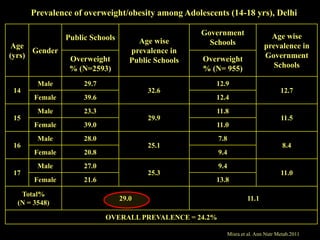
Prevalence of overweight/obesity among Adolescents (14-18 yrs), Delhi
Age
(yrs)
Gender
Public Schools Age wise
prevalence in
Public Schools
Government
Schools
Age wise
prevalence in
Government
Schools
Overweight
% (N=2593)
Overweight
% (N= 955)
14
Male 29.7
32.6
12.9
12.7
Female 39.6 12.4
15
Male 23.3
29.9
11.8
11.5
Female 39.0 11.0
16
Male 28.0
25.1
7.8
8.4
Female 20.8 9.4
17
Male 27.0
25.3
9.4
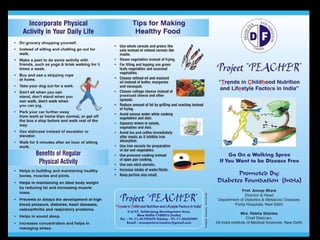
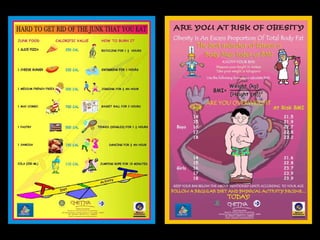
11.0
Female 21.6 13.8
Total%
(N = 3548)
29.0 11.1
OVERALL PREVALENCE = 24.2%
29.0
Misra et al. Ann Nutr Metab.2011
Country/City Year Prevalence
Global 2004 10
USA/UK 2000 20
Australia 1995 20
India/Chennai 2002 22
India/Delhi 2004 16
India/Delhi 2006 29
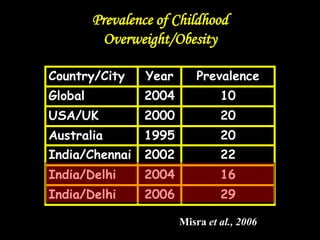
Prevalence of Childhood
Overweight/Obesity
India/Delhi 2004 16
India/Delhi 2006 29
Misra et al., 2006
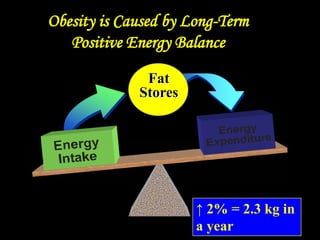
Obesity is Caused by Long-Term
Positive Energy Balance
Fat
Stores
↑ 2% = 2.3 kg in
a year
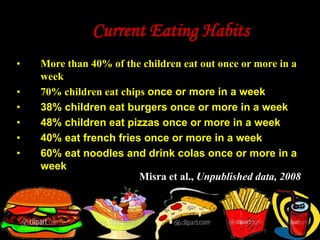
Current Eating Habits
• More than 40% of the children eat out once or more in a
week
• 70% children eat chips once or more in a week
• 38% children eat burgers once or more in a week
• 48% children eat pizzas once or more in a week
• 40% eat french fries once or more in a week
• 60% eat noodles and drink colas once or more in a
week
Misra et al., Unpublished data, 2008
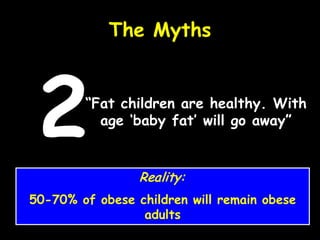
“Fat children are healthy. With
age ‘baby fat’ will go away”
The Myths
2
Reality:
50-70% of obese children will remain obese
adults
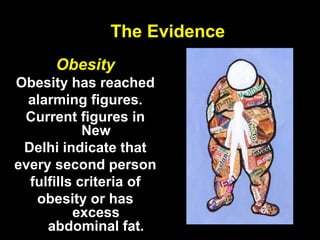
The Evidence
Obesity
Obesity has reached
alarming figures.
Current figures in
New
Delhi indicate that
every second person
fulfills criteria of
obesity or has
excess
abdominal fat.
“What will happen if a child is
fat. He/she will not have any
diseases”
The Myths
3 Reality:
• Diabetes may strike early
• Polycystic ovaries, excess facial hair and
infertility may occur in girls
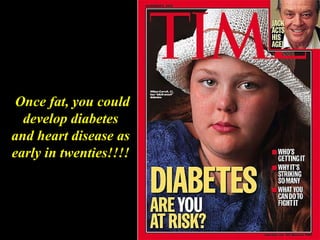
Once fat, you could
develop diabetes
and heart disease as
early in twenties!!!!
The Evidence
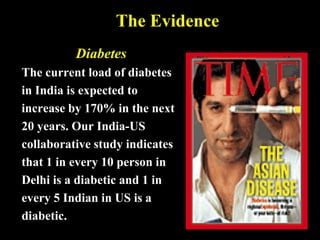
Diabetes
The current load of diabetes
in India is expected to
increase by 170% in the next
20 years. Our India-US
collaborative study indicates
that 1 in every 10 person in
Delhi is a diabetic and 1 in
every 5 Indian in US is a
diabetic.
“Heart Disease starts
at old age”
The Myths
4 Reality:
Hardening and blockage of the arteries
starts at 11 years in boys and 15 years
in girls
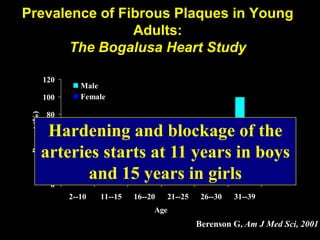
Prevalence of Fibrous Plaques in Young
Adults:
The Bogalusa Heart Study
0
20
40
60
80
100
120
2--10 11--15 16--20 21--25 26--30 31--39
Age
Percent
(%)
Male
Female
Berenson G, Am J Med Sci, 2001
Hardening and blockage of the
arteries starts at 11 years in boys
and 15 years in girls
The Evidence
High Blood Pressure
One in three urban
Indians have high
blood pressure. It is
predicted to increase
by 60% in next 20 years.
“A fat child is
otherwise healthy”
The Myths
5
Reality:
28% of urban children have syndrome X, one
step away from diabetes and 2 steps away
from heart disease
The Evidence
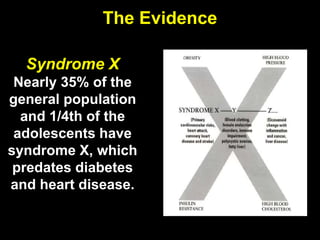
Syndrome X
Nearly 35% of the
general population
and 1/4th of the
adolescents have
syndrome X, which
predates diabetes
and heart disease.
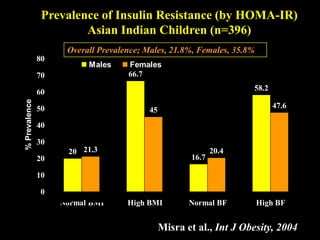
20
66.7
16.7
58.2
21.3
45
20.4
47.6
0
10
20
30
40
50
60
70
80
Normal BMI High BMI Normal BF High BF
%
Prevalence
Males Females
Prevalence of Insulin Resistance (by HOMA-IR)
Asian Indian Children (n=396)
Misra et al., Int J Obesity, 2004
Overall Prevalence; Males, 21.8%, Females, 35.8%
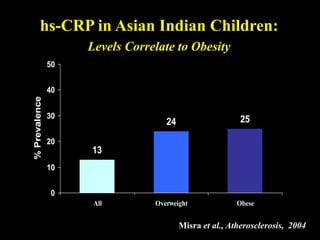
13
24 25
0
10
20
30
40
50
All Overweight Obese
%
Prevalence
hs-CRP in Asian Indian Children:
Levels Correlate to Obesity
Misra et al., Atherosclerosis, 2004
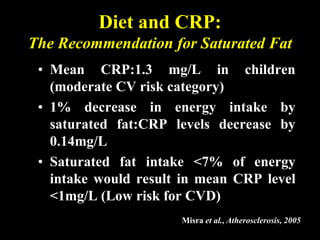
Diet and CRP:
The Recommendation for Saturated Fat
• Mean CRP:1.3 mg/L in children
(moderate CV risk category)
• 1% decrease in energy intake by
saturated fat:CRP levels decrease by
0.14mg/L
• Saturated fat intake <7% of energy
intake would result in mean CRP level
<1mg/L (Low risk for CVD)
Misra et al., Atherosclerosis, 2005
“A child does not
develop high blood
pressure or high
cholesterol”
The Myths
6
Reality:
Many children will have high blood pressure and
low good cholesterol
The Evidence
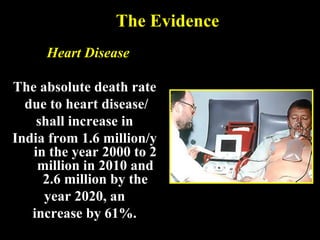
Heart Disease
The absolute death rate
due to heart disease/
shall increase in
India from 1.6 million/y
in the year 2000 to 2
million in 2010 and
2.6 million by the
year 2020, an
increase by 61%.
“A child should enjoy,
and eat and relax. Such
time will not come again
later”
The Myths
7
Reality:
Parents do not realize, but children are eating
junk food all the time.
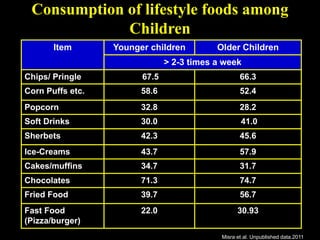
Item Younger children Older Children
> 2-3 times a week
Chips/ Pringle 67.5 66.3
Corn Puffs etc. 58.6 52.4
Popcorn 32.8 28.2
Soft Drinks 30.0 41.0
Sherbets 42.3 45.6
Ice-Creams 43.7 57.9
Cakes/muffins 34.7 31.7
Chocolates 71.3 74.7
Fried Food 39.7 56.7
Fast Food
(Pizza/burger)
22.0 30.93
Consumption of lifestyle foods among
Children
Misra et al. Unpublished data.2011
The Evidence
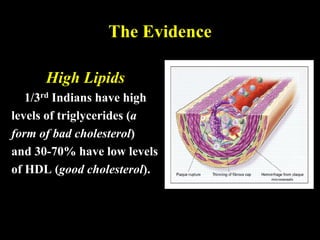
High Lipids
1/3rd Indians have high
levels of triglycerides (a
form of bad cholesterol)
and 30-70% have low levels
of HDL (good cholesterol).
“All children are doing
required physical
activity”
The Myths
8 Reality:
Time on TV, internet and studies leaves little
time for play. Even in pd assigned for physical
activity, many do not participate
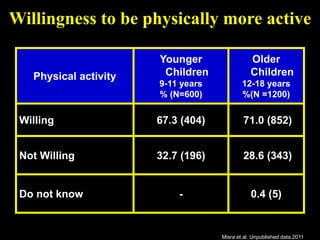
Physical activity
Younger
Children
9-11 years
% (N=600)
Older
Children
12-18 years
%(N =1200)
Willing 67.3 (404) 71.0 (852)
Not Willing 32.7 (196) 28.6 (343)
Do not know - 0.4 (5)
Willingness to be physically more active
Misra et al. Unpublished data.2011
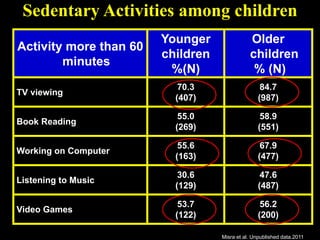
Activity more than 60
minutes
Younger
children
%(N)
Older
children
% (N)
TV viewing
70.3
(407)
84.7
(987)
Book Reading
55.0
(269)
58.9
(551)
Working on Computer
55.6
(163)
67.9
(477)
Listening to Music
30.6
(129)
47.6
(487)
Video Games
53.7
(122)
56.2
(200)
Sedentary Activities among children
Misra et al. Unpublished data.2011
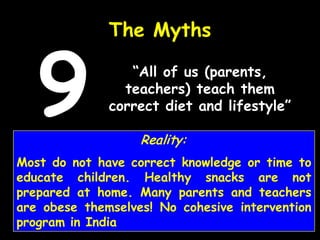
“All of us (parents,
teachers) teach them
correct diet and lifestyle”
The Myths
9 Reality:
Most do not have correct knowledge or time to
educate children. Healthy snacks are not
prepared at home. Many parents and teachers
are obese themselves! No cohesive intervention
program in India
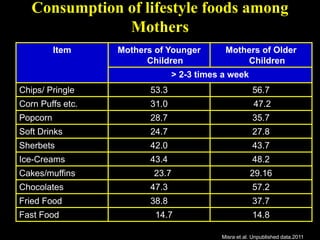
Item Mothers of Younger
Children
Mothers of Older
Children
> 2-3 times a week
Chips/ Pringle 53.3 56.7
Corn Puffs etc. 31.0 47.2
Popcorn 28.7 35.7
Soft Drinks 24.7 27.8
Sherbets 42.0 43.7
Ice-Creams 43.4 48.2
Cakes/muffins 23.7 29.16
Chocolates 47.3 57.2
Fried Food 38.8 37.7
Fast Food 14.7 14.8
Consumption of lifestyle foods among
Mothers
Misra et al. Unpublished data.2011
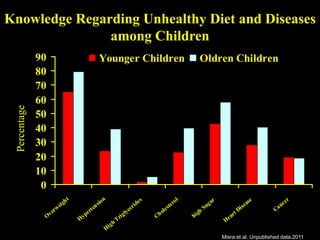
0
10
20
30
40
50
60
70
80
90
Overweight
Hypertension
High Triglycerides
Cholesterol
high
Sugar
Heart Disease
Cancer
Younger Children Oldren Children
Knowledge Regarding Unhealthy Diet and Diseases
among Children
Percentage
Misra et al. Unpublished data.2011
0
10
20
30
40
50
60
70
80
90
O
v
e
r
w
e
i
g
h
t
a
n
d
O
b
e
s
i
t
y
H
y
p
e
r
t
e
n
s
i
o
n
H
i
g
h
T
r
i
g
l
y
c
e
r
i
d
e
s
H
i
g
h
t
C
h
o
l
e
s
t
e
r
o
l
H
i
g
h
s
u
g
a
r
H
e
a
r
t
D
i
s
e
a
s
e
c
a
n
c
e
r
Yes No
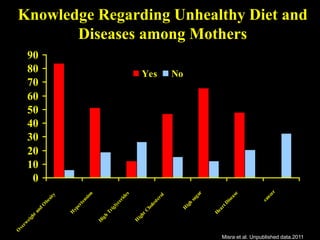
Knowledge Regarding Unhealthy Diet and
Diseases among Mothers
Misra et al. Unpublished data.2011
Relationship Between Food Consumption Pattern
of Mother and Children
Correlation analysis was done for food consumption of
mothers and children. A very high order correlation was
found for the following food items:
-cereals
-pulses
-vegetables
-Milk and Milk products
-Meat and Poultry
-Fruits and fruit juices
-Nuts
Misra et al. Unpublished data.2011
“So what if there are
metabolic abnormalities
or diseases, these can
be easily treated”
The Myths
10
Reality:
Most of these diseases are catastrophic
and have complications that cannot be
reversed. Most will shorten lifespan
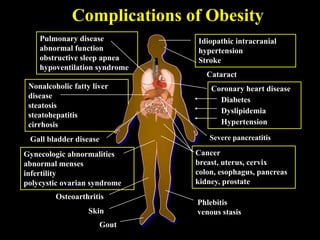
Pulmonary disease
abnormal function
obstructive sleep apnea
hypoventilation syndrome
Nonalcoholic fatty liver
disease
steatosis
steatohepatitis
cirrhosis
Coronary heart disease
Diabetes
Dyslipidemia
Hypertension
Gynecologic abnormalities
abnormal menses
infertility
polycystic ovarian syndrome
Osteoarthritis
Skin
Gall bladder disease
Cancer
breast, uterus, cervix
colon, esophagus, pancreas
kidney, prostate
Phlebitis
venous stasis
Gout
Complications of Obesity
obstructive sleep apnea
hypoventilation syndrome
polycystic ovarian syndrome
Cancer
breast, uterus, cervix
colon, esophagus, pancreas
kidney, prostate
Phlebitis
venous stasis
Gout
Idiopathic intracranial
hypertension
Stroke
Cataract
Severe pancreatitis
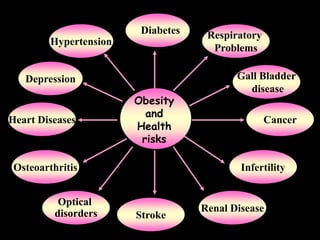
Hypertension
Obesity
and
Health
risks
Diabetes
Heart Diseases
Osteoarthritis
Stroke
Renal Disease
Cancer
Gall Bladder
disease
Optical
disorders
Depression
Respiratory
Problems
Infertility
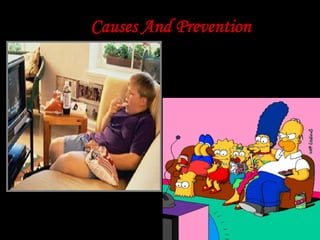
Causes And Prevention
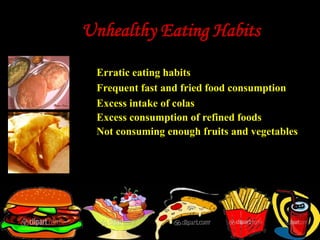
Unhealthy Eating Habits
Erratic eating habits
Frequent fast and fried food consumption
Excess intake of colas
Excess consumption of refined foods
Not consuming enough fruits and vegetables
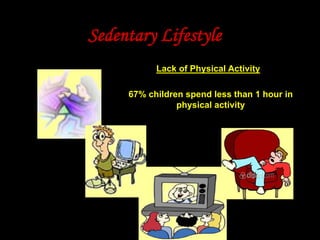
Sedentary Lifestyle
Lack of Physical Activity :
67% children spend less than 1 hour in
physical activity
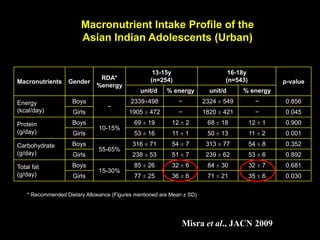
Macronutrients Gender
RDA*
%energy
13-15y
(n=254)
16-18y
(n=543) p-value
unit/d % energy unit/d % energy
Energy
(kcal/day)
Boys
−
2339±498 − 2324 ± 549 − 0.856
Girls 1905 ± 472 − 1820 ± 421 − 0.045
Protein
(g/day)
Boys
10-15%
69 ± 19 12 ± 2 68 ± 18 12 ± 1 0.900
Girls 53 ± 16 11 ± 1 50 ± 13 11 ± 2 0.001
Carbohydrate
(g/day)
Boys
55-65%
316 ± 71 54 ± 7 313 ± 77 54 ± 8 0.352
Girls 238 ± 53 51 ± 7 239 ± 62 53 ± 6 0.892
Total fat
(g/day)
Boys
15-30%
85 ± 26 32 ± 6 84 ± 30 32 ± 7 0.681
Girls 77 ± 25 36 ± 6 71 ± 21 35 ± 6 0.030
Macronutrient Intake Profile of the
Asian Indian Adolescents (Urban)
* Recommended Dietary Allowance (Figures mentioned are Mean ± SD)
Misra et al., JACN 2009
Health and Nutrition Education Initiatives
by Diabetes Foundation (India)
Diabetes Foundation (India) has pioneered in
launching Health and Nutrition Education
initiatives, the first of their kinds in the whole of
South Asia to spread the awareness of Obesity and
Diabetes prevention amongst the youth
March 5, 2011
Initiative of National Diabetes, Obesity, and Cholesterol Diseases Foundation
Diabetes and Obesity Awareness for Children/Adolescents &
Adults
A 50 city country wide awareness and education program
March 5, 2011
Initiative of National Diabetes, Obesity, and Cholesterol Diseases Foundation
& Emcure Pharmaceutical (India) Pvt. Ltd
Objectives
Overall Aim:
To create mass awareness about diabetes
and obesity among children and adults
and to thus act as change agents for better
lifestyles and prevention of diabetes
March 5, 2011
Initiative of National Diabetes, Obesity, and Cholesterol Diseases Foundation
& Emcure Pharmaceutical (India) Pvt. Ltd
Objectives
• To enhance awareness among school children, and
adults about diabetes and obesity through
– Lectures on “Diabetes: Causes, Consequences, Prevention
& Care”
– School Health Camps
– Public Awareness Campaign:
• Public Health Lectures on “Diabetes: Causes, Consequences,
Prevention and Care”
• Diabetes Health Camps
• Walk for Awareness about Diabetes Prevention on November
14, 2011 – World Diabetes Day
• Distribution of printed education material to children and
adults
• Message dissemination through media
Specific Objectives
March 5, 2011
Initiative of National Diabetes, Obesity, and Cholesterol Diseases Foundation
& Emcure Pharmaceutical (India) Pvt. Ltd
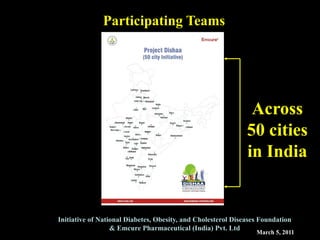
Participating Teams
Across
50 cities
in India
Initiatives being implemented in
various cities of India
New Delhi Dehradun
Mumbai Allahabad
Jaipur Bangalore
Agra Pantnagar
Chandigarh Pune
Vadodara Lucknow
Noida Bhubaneshwar
A Project of
Diabetes Foundation (India)
Funded by: World Diabetes Foundation
(Denmark)
“MARG” (The Path)
Medical education for children/
Adolescents for Realistic prevention of
obesity and diabetes and for healthy aGing
The initiatives are organizing activities to focus on:
1. changing the individual
(children, family, teachers)
2. changing the environment
(school, home)
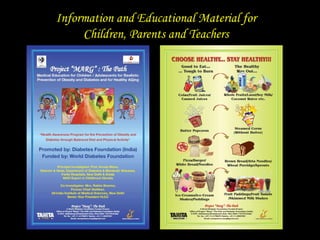
Information and Educational Material for
Children, Parents and Teachers
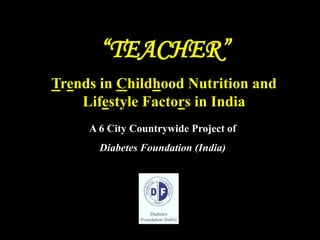
“TEACHER””
A 6 City Countrywide Project of
Diabetes Foundation (India)
Trends in Childhood Nutrition and
Lifestyle Factors in India
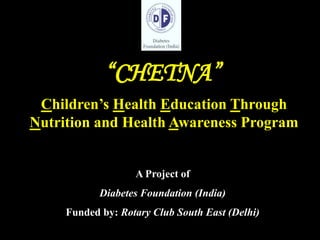
A Project of
Diabetes Foundation (India)
Funded by: Rotary Club South East (Delhi)
“CHETNA”
Children’s Health Education Through
Nutrition and Health Awareness Program
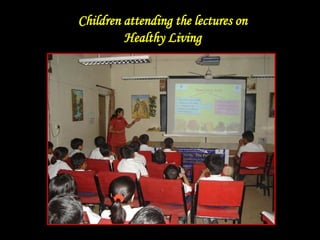
Children attending the lectures on
Healthy Living
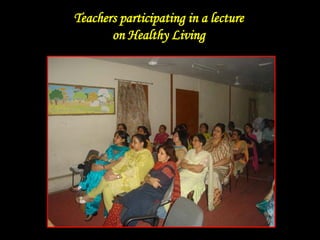
Teachers participating in a lecture
on Healthy Living
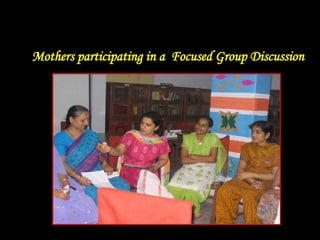
Mothers participating in a Focused Group Discussion
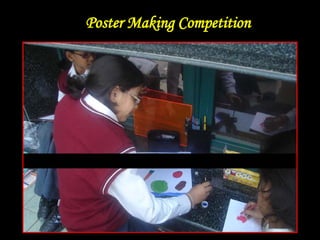
Poster Making Competition
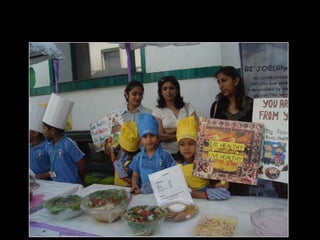
Cooking Competition
Skit Competition
Extempore Competition
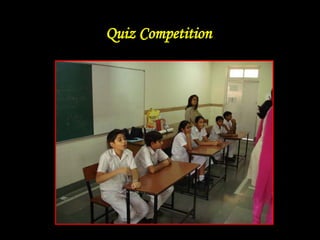
Quiz Competition
Other Activities
• Card Making
• Collage Making
• Health Board setup
• Mask Making
• Cartoon strip making
• Poem writing
• Healthy recipe writing
• Healthy Tiffin Day
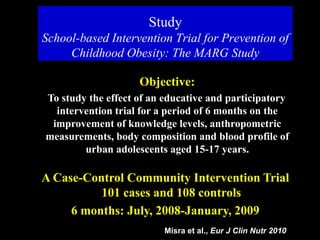
Study
School-based Intervention Trial for Prevention of
Childhood Obesity: The MARG Study
Objective:
To study the effect of an educative and participatory
intervention trial for a period of 6 months on the
improvement of knowledge levels, anthropometric
measurements, body composition and blood profile of
urban adolescents aged 15-17 years.
A Case-Control Community Intervention Trial
101 cases and 108 controls
6 months: July, 2008-January, 2009
Misra et al., Eur J Clin Nutr 2010
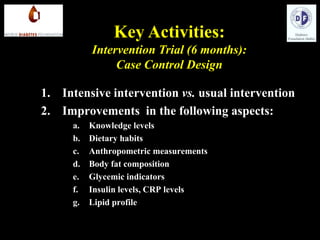
1. Intensive intervention vs. usual intervention
2. Improvements in the following aspects:
a. Knowledge levels
b. Dietary habits
c. Anthropometric measurements
d. Body fat composition
e. Glycemic indicators
f. Insulin levels, CRP levels
g. Lipid profile
Key Activities:
Intervention Trial (6 months):
Case Control Design
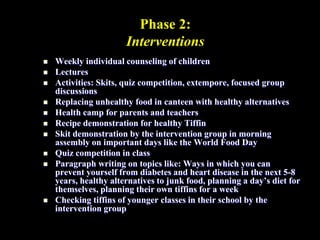
Phase 2:
Interventions
 Weekly individual counseling of children
 Lectures
 Activities: Skits, quiz competition, extempore, focused group
discussions
 Replacing unhealthy food in canteen with healthy alternatives
 Health camp for parents and teachers
 Recipe demonstration for healthy Tiffin
 Skit demonstration by the intervention group in morning
assembly on important days like the World Food Day
 Quiz competition in class
 Paragraph writing on topics like: Ways in which you can
prevent yourself from diabetes and heart disease in the next 5-8
years, healthy alternatives to junk food, planning a day’s diet for
themselves, planning their own tiffins for a week
 Checking tiffins of younger classes in their school by the
intervention group
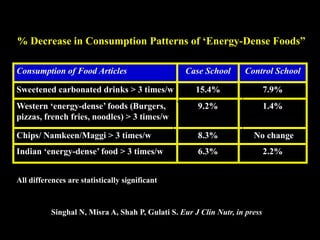
% Decrease in Consumption Patterns of ‘Energy-Dense Foods”
Consumption of Food Articles Case School Control School
Sweetened carbonated drinks > 3 times/w 15.4% 7.9%
Western ‘energy-dense’ foods (Burgers,
pizzas, french fries, noodles) > 3 times/w
9.2% 1.4%
Chips/ Namkeen/Maggi > 3 times/w 8.3% No change
Indian ‘energy-dense’ food > 3 times/w 6.3% 2.2%
All differences are statistically significant
Singhal N, Misra A, Shah P, Gulati S. Eur J Clin Nutr, in press
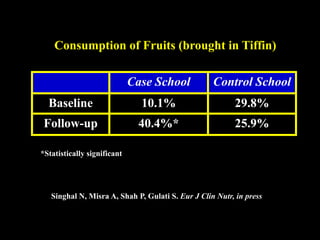
Case School Control School
Baseline 10.1% 29.8%
Follow-up 40.4%* 25.9%
Consumption of Fruits (brought in Tiffin)
*Statistically significant
Singhal N, Misra A, Shah P, Gulati S. Eur J Clin Nutr, in press
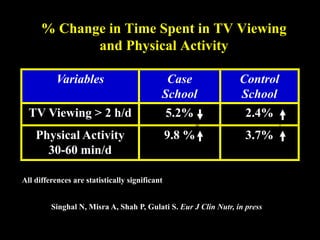
% Change in Time Spent in TV Viewing
and Physical Activity
Variables Case
School
Control
School
TV Viewing > 2 h/d 5.2% 2.4%
Physical Activity
30-60 min/d
9.8 % 3.7%
All differences are statistically significant
Singhal N, Misra A, Shah P, Gulati S. Eur J Clin Nutr, in press
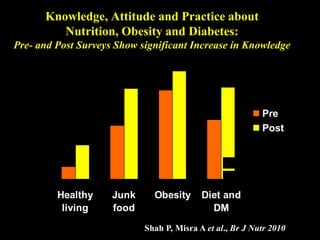
Knowledge, Attitude and Practice about
Nutrition, Obesity and Diabetes:
Pre- and Post Surveys Show significant Increase in Knowledge
0
10
20
30
40
50
60
70
80
Healthy
living
Junk
food
Obesity Diet and
DM
Pre
Post
Shah P, Misra A et al., Br J Nutr 2010
-14%
-12%
-10%
-8%
-6%
-4%
-2%
0%
2%
4%
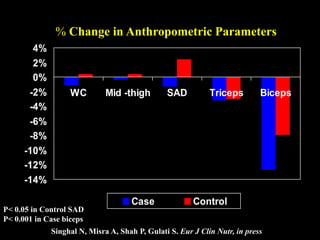
WC Mid -thigh SAD Triceps Biceps
Case Control
% Change in Anthropometric Parameters
P< 0.05 in Control SAD
P< 0.001 in Case biceps
Singhal N, Misra A, Shah P, Gulati S. Eur J Clin Nutr, in press
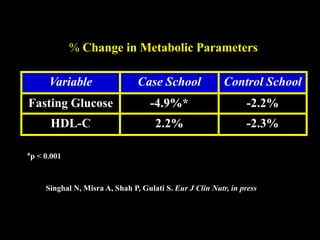
Variable Case School Control School
Fasting Glucose -4.9%* -2.2%
HDL-C 2.2% -2.3%
% Change in Metabolic Parameters
*p < 0.001
Singhal N, Misra A, Shah P, Gulati S. Eur J Clin Nutr, in press
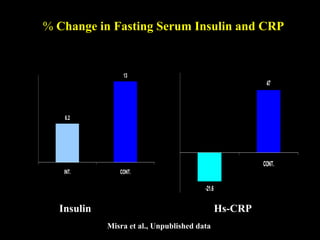
6.2
13
INT. CONT.
-21.6
47
CONT.
Insulin Hs-CRP
% Change in Fasting Serum Insulin and CRP
Misra et al., Unpublished data
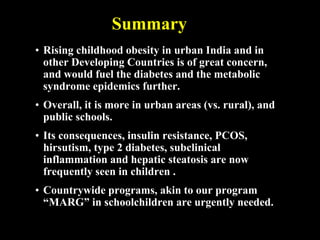
• Rising childhood obesity in urban India and in
other Developing Countries is of great concern,
and would fuel the diabetes and the metabolic
syndrome epidemics further.
• Overall, it is more in urban areas (vs. rural), and
public schools.
• Its consequences, insulin resistance, PCOS,
hirsutism, type 2 diabetes, subclinical
inflammation and hepatic steatosis are now
frequently seen in children .
• Countrywide programs, akin to our program
“MARG” in schoolchildren are urgently needed.
Summary
Thank You…
Thank You
seemagulati2007@gmail.com

Obesity - India

  • 1.
    Dr. Anoop Misra Dr.Seema Gulati Head, Nutrition Research Group National Diabetes, Obesity and Cholesterol Foundation (N-DOC) & Center for Nutrition & Metabolic Research (C-NET) Chief Project Officer Diabetes Foundation (India) C-6/57,Safdarjung Development Area Obesity: The Indian Perspective
  • 2.
    “You are talkingof obesity, while malnutrition is everywhere” The Myth
  • 3.
  • 4.
    Prevalence of overweight/obesityamong Adolescents (14-18 yrs), Delhi Age (yrs) Gender Public Schools Age wise prevalence in Public Schools Government Schools Age wise prevalence in Government Schools Overweight % (N=2593) Overweight % (N= 955) 14 Male 29.7 32.6 12.9 12.7 Female 39.6 12.4 15 Male 23.3 29.9 11.8 11.5 Female 39.0 11.0 16 Male 28.0 25.1 7.8 8.4 Female 20.8 9.4 17 Male 27.0 25.3 9.4 11.0 Female 21.6 13.8 Total% (N = 3548) 29.0 11.1 OVERALL PREVALENCE = 24.2% 29.0 Misra et al. Ann Nutr Metab.2011
  • 5.
    Country/City Year Prevalence Global2004 10 USA/UK 2000 20 Australia 1995 20 India/Chennai 2002 22 India/Delhi 2004 16 India/Delhi 2006 29 Prevalence of Childhood Overweight/Obesity India/Delhi 2004 16 India/Delhi 2006 29 Misra et al., 2006
  • 7.
    Obesity is Causedby Long-Term Positive Energy Balance Fat Stores ↑ 2% = 2.3 kg in a year
  • 8.
    Current Eating Habits •More than 40% of the children eat out once or more in a week • 70% children eat chips once or more in a week • 38% children eat burgers once or more in a week • 48% children eat pizzas once or more in a week • 40% eat french fries once or more in a week • 60% eat noodles and drink colas once or more in a week Misra et al., Unpublished data, 2008
  • 9.
    “Fat children arehealthy. With age ‘baby fat’ will go away” The Myths 2 Reality: 50-70% of obese children will remain obese adults
  • 10.
    The Evidence Obesity Obesity hasreached alarming figures. Current figures in New Delhi indicate that every second person fulfills criteria of obesity or has excess abdominal fat.
  • 11.
    “What will happenif a child is fat. He/she will not have any diseases” The Myths 3 Reality: • Diabetes may strike early • Polycystic ovaries, excess facial hair and infertility may occur in girls
  • 13.
    Once fat, youcould develop diabetes and heart disease as early in twenties!!!!
  • 14.
    The Evidence Diabetes The currentload of diabetes in India is expected to increase by 170% in the next 20 years. Our India-US collaborative study indicates that 1 in every 10 person in Delhi is a diabetic and 1 in every 5 Indian in US is a diabetic.
  • 15.
    “Heart Disease starts atold age” The Myths 4 Reality: Hardening and blockage of the arteries starts at 11 years in boys and 15 years in girls
  • 16.
    Prevalence of FibrousPlaques in Young Adults: The Bogalusa Heart Study 0 20 40 60 80 100 120 2--10 11--15 16--20 21--25 26--30 31--39 Age Percent (%) Male Female Berenson G, Am J Med Sci, 2001 Hardening and blockage of the arteries starts at 11 years in boys and 15 years in girls
  • 17.
    The Evidence High BloodPressure One in three urban Indians have high blood pressure. It is predicted to increase by 60% in next 20 years.
  • 18.
    “A fat childis otherwise healthy” The Myths 5 Reality: 28% of urban children have syndrome X, one step away from diabetes and 2 steps away from heart disease
  • 19.
    The Evidence Syndrome X Nearly35% of the general population and 1/4th of the adolescents have syndrome X, which predates diabetes and heart disease.
  • 20.
    20 66.7 16.7 58.2 21.3 45 20.4 47.6 0 10 20 30 40 50 60 70 80 Normal BMI HighBMI Normal BF High BF % Prevalence Males Females Prevalence of Insulin Resistance (by HOMA-IR) Asian Indian Children (n=396) Misra et al., Int J Obesity, 2004 Overall Prevalence; Males, 21.8%, Females, 35.8%
  • 21.
    13 24 25 0 10 20 30 40 50 All OverweightObese % Prevalence hs-CRP in Asian Indian Children: Levels Correlate to Obesity Misra et al., Atherosclerosis, 2004
  • 22.
    Diet and CRP: TheRecommendation for Saturated Fat • Mean CRP:1.3 mg/L in children (moderate CV risk category) • 1% decrease in energy intake by saturated fat:CRP levels decrease by 0.14mg/L • Saturated fat intake <7% of energy intake would result in mean CRP level <1mg/L (Low risk for CVD) Misra et al., Atherosclerosis, 2005
  • 23.
    “A child doesnot develop high blood pressure or high cholesterol” The Myths 6 Reality: Many children will have high blood pressure and low good cholesterol
  • 24.
    The Evidence Heart Disease Theabsolute death rate due to heart disease/ shall increase in India from 1.6 million/y in the year 2000 to 2 million in 2010 and 2.6 million by the year 2020, an increase by 61%.
  • 25.
    “A child shouldenjoy, and eat and relax. Such time will not come again later” The Myths 7 Reality: Parents do not realize, but children are eating junk food all the time.
  • 26.
    Item Younger childrenOlder Children > 2-3 times a week Chips/ Pringle 67.5 66.3 Corn Puffs etc. 58.6 52.4 Popcorn 32.8 28.2 Soft Drinks 30.0 41.0 Sherbets 42.3 45.6 Ice-Creams 43.7 57.9 Cakes/muffins 34.7 31.7 Chocolates 71.3 74.7 Fried Food 39.7 56.7 Fast Food (Pizza/burger) 22.0 30.93 Consumption of lifestyle foods among Children Misra et al. Unpublished data.2011
  • 27.
    The Evidence High Lipids 1/3rdIndians have high levels of triglycerides (a form of bad cholesterol) and 30-70% have low levels of HDL (good cholesterol).
  • 28.
    “All children aredoing required physical activity” The Myths 8 Reality: Time on TV, internet and studies leaves little time for play. Even in pd assigned for physical activity, many do not participate
  • 29.
    Physical activity Younger Children 9-11 years %(N=600) Older Children 12-18 years %(N =1200) Willing 67.3 (404) 71.0 (852) Not Willing 32.7 (196) 28.6 (343) Do not know - 0.4 (5) Willingness to be physically more active Misra et al. Unpublished data.2011
  • 30.
    Activity more than60 minutes Younger children %(N) Older children % (N) TV viewing 70.3 (407) 84.7 (987) Book Reading 55.0 (269) 58.9 (551) Working on Computer 55.6 (163) 67.9 (477) Listening to Music 30.6 (129) 47.6 (487) Video Games 53.7 (122) 56.2 (200) Sedentary Activities among children Misra et al. Unpublished data.2011
  • 31.
    “All of us(parents, teachers) teach them correct diet and lifestyle” The Myths 9 Reality: Most do not have correct knowledge or time to educate children. Healthy snacks are not prepared at home. Many parents and teachers are obese themselves! No cohesive intervention program in India
  • 32.
    Item Mothers ofYounger Children Mothers of Older Children > 2-3 times a week Chips/ Pringle 53.3 56.7 Corn Puffs etc. 31.0 47.2 Popcorn 28.7 35.7 Soft Drinks 24.7 27.8 Sherbets 42.0 43.7 Ice-Creams 43.4 48.2 Cakes/muffins 23.7 29.16 Chocolates 47.3 57.2 Fried Food 38.8 37.7 Fast Food 14.7 14.8 Consumption of lifestyle foods among Mothers Misra et al. Unpublished data.2011
  • 33.
    0 10 20 30 40 50 60 70 80 90 Overweight Hypertension High Triglycerides Cholesterol high Sugar Heart Disease Cancer YoungerChildren Oldren Children Knowledge Regarding Unhealthy Diet and Diseases among Children Percentage Misra et al. Unpublished data.2011
  • 34.
  • 35.
    Relationship Between FoodConsumption Pattern of Mother and Children Correlation analysis was done for food consumption of mothers and children. A very high order correlation was found for the following food items: -cereals -pulses -vegetables -Milk and Milk products -Meat and Poultry -Fruits and fruit juices -Nuts Misra et al. Unpublished data.2011
  • 36.
    “So what ifthere are metabolic abnormalities or diseases, these can be easily treated” The Myths 10 Reality: Most of these diseases are catastrophic and have complications that cannot be reversed. Most will shorten lifespan
  • 37.
    Pulmonary disease abnormal function obstructivesleep apnea hypoventilation syndrome Nonalcoholic fatty liver disease steatosis steatohepatitis cirrhosis Coronary heart disease Diabetes Dyslipidemia Hypertension Gynecologic abnormalities abnormal menses infertility polycystic ovarian syndrome Osteoarthritis Skin Gall bladder disease Cancer breast, uterus, cervix colon, esophagus, pancreas kidney, prostate Phlebitis venous stasis Gout Complications of Obesity obstructive sleep apnea hypoventilation syndrome polycystic ovarian syndrome Cancer breast, uterus, cervix colon, esophagus, pancreas kidney, prostate Phlebitis venous stasis Gout Idiopathic intracranial hypertension Stroke Cataract Severe pancreatitis
  • 38.
    Hypertension Obesity and Health risks Diabetes Heart Diseases Osteoarthritis Stroke Renal Disease Cancer GallBladder disease Optical disorders Depression Respiratory Problems Infertility
  • 39.
  • 40.
    Unhealthy Eating Habits Erraticeating habits Frequent fast and fried food consumption Excess intake of colas Excess consumption of refined foods Not consuming enough fruits and vegetables
  • 43.
    Sedentary Lifestyle Lack ofPhysical Activity : 67% children spend less than 1 hour in physical activity
  • 44.
    Macronutrients Gender RDA* %energy 13-15y (n=254) 16-18y (n=543) p-value unit/d% energy unit/d % energy Energy (kcal/day) Boys − 2339±498 − 2324 ± 549 − 0.856 Girls 1905 ± 472 − 1820 ± 421 − 0.045 Protein (g/day) Boys 10-15% 69 ± 19 12 ± 2 68 ± 18 12 ± 1 0.900 Girls 53 ± 16 11 ± 1 50 ± 13 11 ± 2 0.001 Carbohydrate (g/day) Boys 55-65% 316 ± 71 54 ± 7 313 ± 77 54 ± 8 0.352 Girls 238 ± 53 51 ± 7 239 ± 62 53 ± 6 0.892 Total fat (g/day) Boys 15-30% 85 ± 26 32 ± 6 84 ± 30 32 ± 7 0.681 Girls 77 ± 25 36 ± 6 71 ± 21 35 ± 6 0.030 Macronutrient Intake Profile of the Asian Indian Adolescents (Urban) * Recommended Dietary Allowance (Figures mentioned are Mean ± SD) Misra et al., JACN 2009
  • 45.
    Health and NutritionEducation Initiatives by Diabetes Foundation (India)
  • 46.
    Diabetes Foundation (India)has pioneered in launching Health and Nutrition Education initiatives, the first of their kinds in the whole of South Asia to spread the awareness of Obesity and Diabetes prevention amongst the youth
  • 47.
    March 5, 2011 Initiativeof National Diabetes, Obesity, and Cholesterol Diseases Foundation Diabetes and Obesity Awareness for Children/Adolescents & Adults A 50 city country wide awareness and education program
  • 48.
    March 5, 2011 Initiativeof National Diabetes, Obesity, and Cholesterol Diseases Foundation & Emcure Pharmaceutical (India) Pvt. Ltd Objectives Overall Aim: To create mass awareness about diabetes and obesity among children and adults and to thus act as change agents for better lifestyles and prevention of diabetes
  • 49.
    March 5, 2011 Initiativeof National Diabetes, Obesity, and Cholesterol Diseases Foundation & Emcure Pharmaceutical (India) Pvt. Ltd Objectives • To enhance awareness among school children, and adults about diabetes and obesity through – Lectures on “Diabetes: Causes, Consequences, Prevention & Care” – School Health Camps – Public Awareness Campaign: • Public Health Lectures on “Diabetes: Causes, Consequences, Prevention and Care” • Diabetes Health Camps • Walk for Awareness about Diabetes Prevention on November 14, 2011 – World Diabetes Day • Distribution of printed education material to children and adults • Message dissemination through media Specific Objectives
  • 50.
    March 5, 2011 Initiativeof National Diabetes, Obesity, and Cholesterol Diseases Foundation & Emcure Pharmaceutical (India) Pvt. Ltd Participating Teams Across 50 cities in India
  • 51.
    Initiatives being implementedin various cities of India New Delhi Dehradun Mumbai Allahabad Jaipur Bangalore Agra Pantnagar Chandigarh Pune Vadodara Lucknow Noida Bhubaneshwar
  • 52.
    A Project of DiabetesFoundation (India) Funded by: World Diabetes Foundation (Denmark) “MARG” (The Path) Medical education for children/ Adolescents for Realistic prevention of obesity and diabetes and for healthy aGing
  • 53.
    The initiatives areorganizing activities to focus on: 1. changing the individual (children, family, teachers) 2. changing the environment (school, home)
  • 54.
    Information and EducationalMaterial for Children, Parents and Teachers
  • 55.
    “TEACHER”” A 6 CityCountrywide Project of Diabetes Foundation (India) Trends in Childhood Nutrition and Lifestyle Factors in India
  • 57.
    A Project of DiabetesFoundation (India) Funded by: Rotary Club South East (Delhi) “CHETNA” Children’s Health Education Through Nutrition and Health Awareness Program
  • 59.
    Children attending thelectures on Healthy Living
  • 60.
    Teachers participating ina lecture on Healthy Living
  • 61.
    Mothers participating ina Focused Group Discussion
  • 62.
  • 63.
  • 64.
  • 65.
  • 66.
  • 67.
  • 69.
    Other Activities • CardMaking • Collage Making • Health Board setup • Mask Making • Cartoon strip making • Poem writing • Healthy recipe writing • Healthy Tiffin Day
  • 70.
    Study School-based Intervention Trialfor Prevention of Childhood Obesity: The MARG Study Objective: To study the effect of an educative and participatory intervention trial for a period of 6 months on the improvement of knowledge levels, anthropometric measurements, body composition and blood profile of urban adolescents aged 15-17 years. A Case-Control Community Intervention Trial 101 cases and 108 controls 6 months: July, 2008-January, 2009 Misra et al., Eur J Clin Nutr 2010
  • 71.
    1. Intensive interventionvs. usual intervention 2. Improvements in the following aspects: a. Knowledge levels b. Dietary habits c. Anthropometric measurements d. Body fat composition e. Glycemic indicators f. Insulin levels, CRP levels g. Lipid profile Key Activities: Intervention Trial (6 months): Case Control Design
  • 72.
    Phase 2: Interventions  Weeklyindividual counseling of children  Lectures  Activities: Skits, quiz competition, extempore, focused group discussions  Replacing unhealthy food in canteen with healthy alternatives  Health camp for parents and teachers  Recipe demonstration for healthy Tiffin  Skit demonstration by the intervention group in morning assembly on important days like the World Food Day  Quiz competition in class  Paragraph writing on topics like: Ways in which you can prevent yourself from diabetes and heart disease in the next 5-8 years, healthy alternatives to junk food, planning a day’s diet for themselves, planning their own tiffins for a week  Checking tiffins of younger classes in their school by the intervention group
  • 73.
    % Decrease inConsumption Patterns of ‘Energy-Dense Foods” Consumption of Food Articles Case School Control School Sweetened carbonated drinks > 3 times/w 15.4% 7.9% Western ‘energy-dense’ foods (Burgers, pizzas, french fries, noodles) > 3 times/w 9.2% 1.4% Chips/ Namkeen/Maggi > 3 times/w 8.3% No change Indian ‘energy-dense’ food > 3 times/w 6.3% 2.2% All differences are statistically significant Singhal N, Misra A, Shah P, Gulati S. Eur J Clin Nutr, in press
  • 74.
    Case School ControlSchool Baseline 10.1% 29.8% Follow-up 40.4%* 25.9% Consumption of Fruits (brought in Tiffin) *Statistically significant Singhal N, Misra A, Shah P, Gulati S. Eur J Clin Nutr, in press
  • 75.
    % Change inTime Spent in TV Viewing and Physical Activity Variables Case School Control School TV Viewing > 2 h/d 5.2% 2.4% Physical Activity 30-60 min/d 9.8 % 3.7% All differences are statistically significant Singhal N, Misra A, Shah P, Gulati S. Eur J Clin Nutr, in press
  • 76.
    Knowledge, Attitude andPractice about Nutrition, Obesity and Diabetes: Pre- and Post Surveys Show significant Increase in Knowledge 0 10 20 30 40 50 60 70 80 Healthy living Junk food Obesity Diet and DM Pre Post Shah P, Misra A et al., Br J Nutr 2010
  • 77.
    -14% -12% -10% -8% -6% -4% -2% 0% 2% 4% WC Mid -thighSAD Triceps Biceps Case Control % Change in Anthropometric Parameters P< 0.05 in Control SAD P< 0.001 in Case biceps Singhal N, Misra A, Shah P, Gulati S. Eur J Clin Nutr, in press
  • 78.
    Variable Case SchoolControl School Fasting Glucose -4.9%* -2.2% HDL-C 2.2% -2.3% % Change in Metabolic Parameters *p < 0.001 Singhal N, Misra A, Shah P, Gulati S. Eur J Clin Nutr, in press
  • 79.
    6.2 13 INT. CONT. -21.6 47 CONT. Insulin Hs-CRP %Change in Fasting Serum Insulin and CRP Misra et al., Unpublished data
  • 80.
    • Rising childhoodobesity in urban India and in other Developing Countries is of great concern, and would fuel the diabetes and the metabolic syndrome epidemics further. • Overall, it is more in urban areas (vs. rural), and public schools. • Its consequences, insulin resistance, PCOS, hirsutism, type 2 diabetes, subclinical inflammation and hepatic steatosis are now frequently seen in children . • Countrywide programs, akin to our program “MARG” in schoolchildren are urgently needed. Summary
  • 81.