OBESITY
Prevalence, Complications &
Treatment
Dr. Mohammed Feros.
A good medical quote.
Obesity is not because it runs in the
family!!!!!!!!!
It is because, no one runs in the family!!!!!!
What is Obesity ?
It is an abnormal accumulation of body fat, usually 20% or more over
an individuals ideal body weight.
In its simplest terms, obesity can be considered to result from an
imbalance between the amount of energy consumed in the diet and
the amount of energy expended through exercise and bodily
functions.
EVALUATION AND
MANAGEMENT OF
OBESITY.
 Obesity is associated with an increased risk of
multiple health problems including hypertension, type
2 diabetes, dyslipedemia, obstructive sleep apnea,
nonalcoholic fatty liver disease, degenerative joint
disease and some malignancies.
 Thus it is important for physicians to identify, evaluate
and treat patients for obesity and associated comorbid
conditions.
Evaluation.
Physicians should screen patients in obesity and offer
intensive counseling and behavioral interventions to
promote sustained weight loss
The five main steps in the
evaluation of obesity are:
i. A focused obesity-related history.
ii. A physical examination to determine the degree and
type of obesity.
iii. Assessment of comorbid conditions.
iv. Determination of fitness level.
v. Assessment of the patients readiness to adopt
lifestyle changes.
The Obesity-Focused
History.
 Information from the history should address the
following seven questions.
I. What factors contribute to the patients obesity?
II. How is the obesity affecting the patients health?
III. What is the patients level of risk from obesity?
IV. What does the patient find difficulty about managing
the weight?
V. What are the patients goal and expectations?
VI. Is the patient motivated to begin a weight management
programme?
VII. What kind of a help does the patient need?
Body Mass Index (BMI) And
Waist Circumference.
 Three anthropometric measurements are important in
evaluating the degree of obesity
 Height
 Weight
 Waist circumference
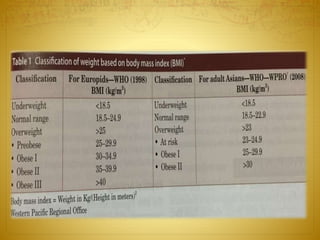
 BMI is calculated using the formula
Weight (kg)/Height (m²)
Or
Weight (lbs)/Height (inches)² * 703
 BMI provides an estimate of body fat and is related to
disease risk.
 Excess abdominal fat, assessed by measurement of waist
circumference or waist-to-hip ratio, is independently
associated with a higher risk for DM and Cardiovascular
disease.
Physical Fitness.
 Several prospective studies have demonstrated that
physical fitness, reported by questionnaire or
measured by a maximal treadmill exercise test, is an
important predictor of all–cause mortality rate
independent of BMI and body composition.
 These observation highlights the importance of taking
a physical activity and exercise history during
examination as well as emphasizing physical activity
as a treatment approach.
Obesity Associated
Comorbid Conditions.
 The evaluation of comorbid conditions should be
based on presenting symptoms and index of
suspicion.
 For all the patient’s a fasting lipid panel should be
performed and a fasting blood glucose level and blood
pressure is to be determined.
 Although individuals vary, the severity and number of
organ specific comorbid conditions usually rise with
increasing levels of obesity.
Assessing the Patient’s
Readiness to Change.
 An attempt to initiate lifestyle changes when the
patient is not ready usually leads to frustration and
may hamper future weight-loss effort.
 Assessment includes :
 Patient motivation and support,
 Stressful life events,
 Psychiatric status,
 Time availability and constraints
 Appropriateness of goals and operations
 Readiness can be viewed as the balance of two
opposing factors
o Motivation or The patient’s desire to change
&
o Resistance or The patient’s resistance to change.
o Anchoring method of interviewing technique is a
helpful method to begin a readiness assessment.
PREVALENCE
 INDIA, with 41 million obese people, ranks third after
the U.S and CHINA in having the highest number of
overweight people in the world say a study.
 Together, INDIA and CHINA represent 15% of the
worlds obese population.
1 Out Of 2 Indians Are Obese – India Needs
To Lose Weight.
 Indians people typically believe that the Indian diet is
healthier as compare to Western diets. While this may
be true if we compare average the Indian diet with say
eating burgers, but despite this ‘healthier diet’, Indians
are gaining weight, just like people in some of the
developed countries like the US, Australia and others.
 And this trend is extremely pronounced in urban India,
where over the last 20 years, incomes have risen
significantly, along with spending on food and
entertainment. This, coupled with sedentary lifestyle is
increasing waistlines. And this is not our theory, but
data is showing this.
 Multiple surveys over the last few years have been pointing
to this.
 Fitho recently did a survey, which included over 4000
people – who read the daily newspaper, mostly in urban
India: metros, Tier 1 and Tier 2 towns, and the data was
surprising –
 Almost 3 out of 4 participants (i.e. 73%) were overweight.
 46% (almost half) of the participants were obese, i.e. a
BMI more than 25 kg/m2.
 Men and women were both equally obese.
 Women have a tendency to become overweight, up to
2 years before men.
 The average BMI of a participant was 25.5 kg/m2,
which puts them in the obese category.
 The problem with increasing waistlines is not one of
aesthetics, but of the multiple health disorders that are
associated with it. And Indians actually have it worse-
Indians are genetically prone to storing fat around the
belly, which is directly related to lifestyle disorders like
diabetes, heart disease, and a lot more.
 As a result, WHO has predicted India to be the
diabetes capital of the world. Keeping this high risk of
Indians in mind, the Indian Health Ministry in 2012
released lower BMI guidelines for a health weight.
 The survey data showed some interesting trend
 The average person goes from a healthy weight at 26
years to an obese BMI at 38 years.
 The average weight loss needed was approximately
11 kg.
 It takes about 12 years to gain the weight.
 To lose the weight through a healthy diet program
requires approximately 3 months.
 So, India’s weight and obesity problems are not out of
control, but it’s important for Indians to take control of
their health.
 According to World Health Organization (WHO),
obesity is one of the most common yet among the
most neglected public health problem in both
developing and developed countries.
 According to the WHO World Health Statistics Report
2012, globally one in six adults is obese and nearly
2.8 million individuals die each year due to either over
weight or obesity.
Obesity is common,
serious and costly in U.S.
 More than one-third (34.9% or 78.6 million) of U.S
adults are obese.
 U.S stands the first in the case of obesity
 The estimated annual medical cost of obesity in U.S
was $147 billion dollars in 2008.
 The medical cost for people who were obese were
$1429 higher than those of normal weight.
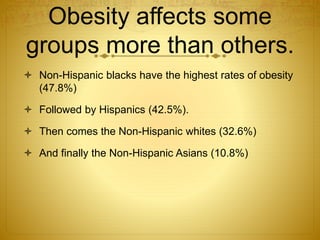
Obesity affects some
groups more than others.
 Non-Hispanic blacks have the highest rates of obesity
(47.8%)
 Followed by Hispanics (42.5%).
 Then comes the Non-Hispanic whites (32.6%)
 And finally the Non-Hispanic Asians (10.8%)
Obesity and socio-
economic status.
 Men with higher income are more likely to have
obesity than those with low income.
 Higher income women are less likely to have obesity
than low income women.
 There is no significant relationship with obesity and
education among men.
 Among women there is a trend, those with college
degrees are less likely to have obesity compared with
less educated women.
Around the world.
COMPLICATIONS OF
OBESITY
 90% of people who develop type 2 diabetes will have
a body mass index (BMI) greater than 23.
 The risk of getting type 2 diabetes is highest if the
weight is gained during childhood and there is a family
h/o diabetes caused by obesity.
 If a person is obese at the age of 40 then, his life is
shortened by 7 years .
 If you have obesity, the chance of developing high blood
pressure is up to 5 times greater compared to someone
with a normal weight.
 85% of those diagnosed with high blood pressure have a
BMI >25
 Increasing cholesterol levels are associated with weight
increase, above a BMI of as little as 21.
 High cholesterol, elevated blood pressure and the
presence of diabetes in turn lead to increased heart
disease
Even fertility is
decreased by
obesity
• In women, 6% of those who are
obese have trouble to conceiving.
• When a pregnancy occurs, the
chance of a serious event
requiring hospitalization is 4-7
times more in an obese women.
• Gestational DM, Pre-eclampsia,
Difficulties in labor and delivery,
higher c-section rates, and more
death of the mother and/or fetus,
are all associated with obesity.
• Men are also affected, i.e. erectile
dysfunction (impotence) and lower
fertility. They also have low amount
of testosterone because of excess
abdominal fat.
• Joints that carry excessive
weight, such as the hips and
knees, arthritis tends to be a
problem and it affects other
joints such as ones in hands.
• Gout is also more common
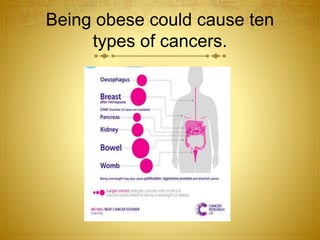
Being obese could cause ten
types of cancers.
TREATMENT OF
OBESITY
The Goal Of Therapy.
 The Primary Goals :
 Improve obesity-related comorbid
conditions,
 Reduce the risk of developing future
comorbidities.
 Information obtained from the history,
physical examination and diagnostic
tests is used to determine risk and
develop a treatment plan
 this treatment plan depends upon the risk
status, expectation and available
resources.
 Patients who present with obesity-related
comorbidities and who would benefit from
weightloss intervention should be
managed proactively.
 Therapy begins with lifestyle management
and may include pharmacotherapy or
surgery, depending upon BMI and risk
factors.
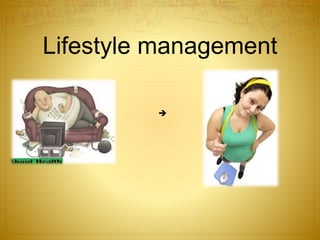
Lifestyle management

 Behavioural modification to avoid some of
the effects of the ‘obsogenic’ environment
is the cornerstone of long-term control of
weight.
 Regular eating patterns and maximising
physical activity are advised, with reference
to the modest extra activity required to
increase physical activity level (PAL) ratios
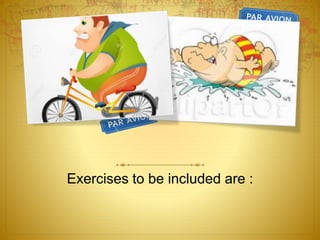
Exercises to be included are :
food selection ,
portion size control,
avoidance of
snackling regular
meals to encourage
satiety and
substitution of sugar
with artificial
sweeteners should be
discussed with the
patient.
Regular support from
a dietitian or
attendance at a
weight loss group may
be helpful.
DUNK THE JUNK!!
Drugs.
 Anti-obesity medication or weight loss drugs are all
pharmacological agents that reduce or control weight.
 These drugs alter one of the fundamental processes of the
human body, weight regulation, by altering either appetite,
or absorption of calories.
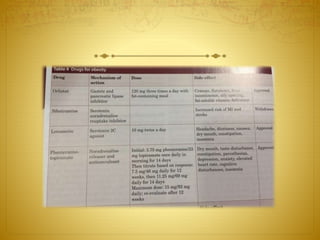
 ORLISTAT is the only drug currently licensed for long-term
use.
 A no.of other drugs are in development, so the situation
could change rapidly over the next few years.
 Sibutramine , is a drug that was recently withdrawn due to
cardiovascular side-effects
Mode of action.
 Orlistat inhibits pancreatic and gastric lipases and
thereby decreases the hydrolysis of ingested
triglycerides, reducing dietary fat absorption by
approximately 30%
 The drug is not absorbed.
Side-Effects
 Adverse side-effects relate to the effect of the
resultant fat malabsorption on the gut namely:
 Loose stools
 Oily spotting
 Faecal urgency
 Flatus
 The potential for malabsorption of fat-soluble vitamins
Dosage.
 It is taken with each of the three meals of the day.
 Dose can be adjusted (60-120mg) to minimise side-
effects.
 Some patients who continue to take anti-obesity drugs
tend to regain weight with time.
 This may partly reflect age-related weight gain, but
significant weight gain should prompt reinforcement of
lifestyle advice and, if this is unsucessful, drug therapy
should be discontinued.
Surgery.
 Bariatric surgery is by far the most effective
long-term treatment for obesity and is the only
anti-obesity intervention that has been
associated with reduced mortality.
 it is usually reserved for those with severe
obesity (BMI >40kg/m) or for those with a BMI
>30kg/m and significant complications such
as, type 2 diabetes, hyperlipidemia or
obstructive sleep apnea.
 A doctor-patient discussion of surgical options should
include the long-term side effects, such as possible
need for reoperation, gallbladder disease, and
malabsorption.
 Long-term studies show the procedures cause
significant long-term lose of weight, recovery from
diabetes, improvement in cardiovascular risk factors,
and a reduction in mortality of 23% from 40%.
Procedures in
Bariatric surgery.
A : laproscopic adjustable
gastric binding.
B : Laproscopical sleeve
gastrectomy.
C : The Roux-en-Y gastric
bypass.
D : Biliopancreatic
diversion with duodenal
switch.
E : Biliopancreatic
diversion.
PUTTING IT ALL
TOGETHER.
 Obesity is a disease because it causes problems with
you physical, mental and metabolic health.
 If you are unable to loose weight on your own, get
help from your doctor.
 Chances are that it is not just the weight, chances are
you do have complications of obesity.
 Everyone who has obesity deserves a thorough
medical checkup at least yearly.
 Clearly, the risk of many medical complications is
increased with obesity
 Even Hippocrates wrote so many years ago:
“corpulence is not only a disease itself, but the harbinger
of others”
Obesity
Obesity

Obesity

  • 1.
  • 2.
    A good medicalquote. Obesity is not because it runs in the family!!!!!!!!! It is because, no one runs in the family!!!!!!
  • 3.
    What is Obesity? It is an abnormal accumulation of body fat, usually 20% or more over an individuals ideal body weight. In its simplest terms, obesity can be considered to result from an imbalance between the amount of energy consumed in the diet and the amount of energy expended through exercise and bodily functions.
  • 4.
    EVALUATION AND MANAGEMENT OF OBESITY. Obesity is associated with an increased risk of multiple health problems including hypertension, type 2 diabetes, dyslipedemia, obstructive sleep apnea, nonalcoholic fatty liver disease, degenerative joint disease and some malignancies.  Thus it is important for physicians to identify, evaluate and treat patients for obesity and associated comorbid conditions.
  • 5.
    Evaluation. Physicians should screenpatients in obesity and offer intensive counseling and behavioral interventions to promote sustained weight loss
  • 6.
    The five mainsteps in the evaluation of obesity are: i. A focused obesity-related history. ii. A physical examination to determine the degree and type of obesity. iii. Assessment of comorbid conditions. iv. Determination of fitness level. v. Assessment of the patients readiness to adopt lifestyle changes.
  • 7.
    The Obesity-Focused History.  Informationfrom the history should address the following seven questions. I. What factors contribute to the patients obesity? II. How is the obesity affecting the patients health? III. What is the patients level of risk from obesity? IV. What does the patient find difficulty about managing the weight? V. What are the patients goal and expectations?
  • 8.
    VI. Is thepatient motivated to begin a weight management programme? VII. What kind of a help does the patient need?
  • 9.
    Body Mass Index(BMI) And Waist Circumference.  Three anthropometric measurements are important in evaluating the degree of obesity  Height  Weight  Waist circumference
  • 10.
     BMI iscalculated using the formula Weight (kg)/Height (m²) Or Weight (lbs)/Height (inches)² * 703  BMI provides an estimate of body fat and is related to disease risk.  Excess abdominal fat, assessed by measurement of waist circumference or waist-to-hip ratio, is independently associated with a higher risk for DM and Cardiovascular disease.
  • 12.
    Physical Fitness.  Severalprospective studies have demonstrated that physical fitness, reported by questionnaire or measured by a maximal treadmill exercise test, is an important predictor of all–cause mortality rate independent of BMI and body composition.  These observation highlights the importance of taking a physical activity and exercise history during examination as well as emphasizing physical activity as a treatment approach.
  • 13.
    Obesity Associated Comorbid Conditions. The evaluation of comorbid conditions should be based on presenting symptoms and index of suspicion.  For all the patient’s a fasting lipid panel should be performed and a fasting blood glucose level and blood pressure is to be determined.  Although individuals vary, the severity and number of organ specific comorbid conditions usually rise with increasing levels of obesity.
  • 14.
    Assessing the Patient’s Readinessto Change.  An attempt to initiate lifestyle changes when the patient is not ready usually leads to frustration and may hamper future weight-loss effort.  Assessment includes :  Patient motivation and support,  Stressful life events,  Psychiatric status,  Time availability and constraints  Appropriateness of goals and operations
  • 15.
     Readiness canbe viewed as the balance of two opposing factors o Motivation or The patient’s desire to change & o Resistance or The patient’s resistance to change. o Anchoring method of interviewing technique is a helpful method to begin a readiness assessment.
  • 16.
  • 18.
     INDIA, with41 million obese people, ranks third after the U.S and CHINA in having the highest number of overweight people in the world say a study.  Together, INDIA and CHINA represent 15% of the worlds obese population.
  • 19.
    1 Out Of2 Indians Are Obese – India Needs To Lose Weight.  Indians people typically believe that the Indian diet is healthier as compare to Western diets. While this may be true if we compare average the Indian diet with say eating burgers, but despite this ‘healthier diet’, Indians are gaining weight, just like people in some of the developed countries like the US, Australia and others.
  • 20.
     And thistrend is extremely pronounced in urban India, where over the last 20 years, incomes have risen significantly, along with spending on food and entertainment. This, coupled with sedentary lifestyle is increasing waistlines. And this is not our theory, but data is showing this.
  • 21.
     Multiple surveysover the last few years have been pointing to this.  Fitho recently did a survey, which included over 4000 people – who read the daily newspaper, mostly in urban India: metros, Tier 1 and Tier 2 towns, and the data was surprising –  Almost 3 out of 4 participants (i.e. 73%) were overweight.  46% (almost half) of the participants were obese, i.e. a BMI more than 25 kg/m2.
  • 22.
     Men andwomen were both equally obese.  Women have a tendency to become overweight, up to 2 years before men.  The average BMI of a participant was 25.5 kg/m2, which puts them in the obese category.
  • 23.
     The problemwith increasing waistlines is not one of aesthetics, but of the multiple health disorders that are associated with it. And Indians actually have it worse- Indians are genetically prone to storing fat around the belly, which is directly related to lifestyle disorders like diabetes, heart disease, and a lot more.
  • 24.
     As aresult, WHO has predicted India to be the diabetes capital of the world. Keeping this high risk of Indians in mind, the Indian Health Ministry in 2012 released lower BMI guidelines for a health weight.
  • 25.
     The surveydata showed some interesting trend  The average person goes from a healthy weight at 26 years to an obese BMI at 38 years.  The average weight loss needed was approximately 11 kg.
  • 26.
     It takesabout 12 years to gain the weight.  To lose the weight through a healthy diet program requires approximately 3 months.  So, India’s weight and obesity problems are not out of control, but it’s important for Indians to take control of their health.
  • 28.
     According toWorld Health Organization (WHO), obesity is one of the most common yet among the most neglected public health problem in both developing and developed countries.  According to the WHO World Health Statistics Report 2012, globally one in six adults is obese and nearly 2.8 million individuals die each year due to either over weight or obesity.
  • 30.
    Obesity is common, seriousand costly in U.S.  More than one-third (34.9% or 78.6 million) of U.S adults are obese.  U.S stands the first in the case of obesity  The estimated annual medical cost of obesity in U.S was $147 billion dollars in 2008.  The medical cost for people who were obese were $1429 higher than those of normal weight.
  • 31.
    Obesity affects some groupsmore than others.  Non-Hispanic blacks have the highest rates of obesity (47.8%)  Followed by Hispanics (42.5%).  Then comes the Non-Hispanic whites (32.6%)  And finally the Non-Hispanic Asians (10.8%)
  • 32.
    Obesity and socio- economicstatus.  Men with higher income are more likely to have obesity than those with low income.  Higher income women are less likely to have obesity than low income women.  There is no significant relationship with obesity and education among men.  Among women there is a trend, those with college degrees are less likely to have obesity compared with less educated women.
  • 34.
  • 35.
  • 38.
     90% ofpeople who develop type 2 diabetes will have a body mass index (BMI) greater than 23.  The risk of getting type 2 diabetes is highest if the weight is gained during childhood and there is a family h/o diabetes caused by obesity.  If a person is obese at the age of 40 then, his life is shortened by 7 years .
  • 40.
     If youhave obesity, the chance of developing high blood pressure is up to 5 times greater compared to someone with a normal weight.  85% of those diagnosed with high blood pressure have a BMI >25  Increasing cholesterol levels are associated with weight increase, above a BMI of as little as 21.  High cholesterol, elevated blood pressure and the presence of diabetes in turn lead to increased heart disease
  • 41.
    Even fertility is decreasedby obesity • In women, 6% of those who are obese have trouble to conceiving. • When a pregnancy occurs, the chance of a serious event requiring hospitalization is 4-7 times more in an obese women. • Gestational DM, Pre-eclampsia, Difficulties in labor and delivery, higher c-section rates, and more death of the mother and/or fetus, are all associated with obesity. • Men are also affected, i.e. erectile dysfunction (impotence) and lower fertility. They also have low amount of testosterone because of excess abdominal fat.
  • 43.
    • Joints thatcarry excessive weight, such as the hips and knees, arthritis tends to be a problem and it affects other joints such as ones in hands. • Gout is also more common
  • 44.
    Being obese couldcause ten types of cancers.
  • 46.
  • 48.
    The Goal OfTherapy.  The Primary Goals :  Improve obesity-related comorbid conditions,  Reduce the risk of developing future comorbidities.  Information obtained from the history, physical examination and diagnostic tests is used to determine risk and develop a treatment plan
  • 49.
     this treatmentplan depends upon the risk status, expectation and available resources.  Patients who present with obesity-related comorbidities and who would benefit from weightloss intervention should be managed proactively.  Therapy begins with lifestyle management and may include pharmacotherapy or surgery, depending upon BMI and risk factors.
  • 51.
  • 53.
     Behavioural modificationto avoid some of the effects of the ‘obsogenic’ environment is the cornerstone of long-term control of weight.  Regular eating patterns and maximising physical activity are advised, with reference to the modest extra activity required to increase physical activity level (PAL) ratios
  • 54.
    Exercises to beincluded are :
  • 55.
    food selection , portionsize control, avoidance of snackling regular meals to encourage satiety and substitution of sugar with artificial sweeteners should be discussed with the patient. Regular support from a dietitian or attendance at a weight loss group may be helpful.
  • 56.
  • 57.
  • 58.
     Anti-obesity medicationor weight loss drugs are all pharmacological agents that reduce or control weight.  These drugs alter one of the fundamental processes of the human body, weight regulation, by altering either appetite, or absorption of calories.  ORLISTAT is the only drug currently licensed for long-term use.  A no.of other drugs are in development, so the situation could change rapidly over the next few years.  Sibutramine , is a drug that was recently withdrawn due to cardiovascular side-effects
  • 59.
    Mode of action. Orlistat inhibits pancreatic and gastric lipases and thereby decreases the hydrolysis of ingested triglycerides, reducing dietary fat absorption by approximately 30%  The drug is not absorbed.
  • 60.
    Side-Effects  Adverse side-effectsrelate to the effect of the resultant fat malabsorption on the gut namely:  Loose stools  Oily spotting  Faecal urgency  Flatus  The potential for malabsorption of fat-soluble vitamins
  • 61.
    Dosage.  It istaken with each of the three meals of the day.  Dose can be adjusted (60-120mg) to minimise side- effects.
  • 63.
     Some patientswho continue to take anti-obesity drugs tend to regain weight with time.  This may partly reflect age-related weight gain, but significant weight gain should prompt reinforcement of lifestyle advice and, if this is unsucessful, drug therapy should be discontinued.
  • 65.
  • 66.
     Bariatric surgeryis by far the most effective long-term treatment for obesity and is the only anti-obesity intervention that has been associated with reduced mortality.  it is usually reserved for those with severe obesity (BMI >40kg/m) or for those with a BMI >30kg/m and significant complications such as, type 2 diabetes, hyperlipidemia or obstructive sleep apnea.
  • 67.
     A doctor-patientdiscussion of surgical options should include the long-term side effects, such as possible need for reoperation, gallbladder disease, and malabsorption.  Long-term studies show the procedures cause significant long-term lose of weight, recovery from diabetes, improvement in cardiovascular risk factors, and a reduction in mortality of 23% from 40%.
  • 68.
    Procedures in Bariatric surgery. A: laproscopic adjustable gastric binding. B : Laproscopical sleeve gastrectomy. C : The Roux-en-Y gastric bypass. D : Biliopancreatic diversion with duodenal switch. E : Biliopancreatic diversion.
  • 72.
    PUTTING IT ALL TOGETHER. Obesity is a disease because it causes problems with you physical, mental and metabolic health.  If you are unable to loose weight on your own, get help from your doctor.  Chances are that it is not just the weight, chances are you do have complications of obesity.  Everyone who has obesity deserves a thorough medical checkup at least yearly.
  • 73.
     Clearly, therisk of many medical complications is increased with obesity  Even Hippocrates wrote so many years ago: “corpulence is not only a disease itself, but the harbinger of others”