APPROACH
TO
CHILDHOOD OBESITY
Speaker:
Abhinav Agarwal
Moderator:
Prof. Rajniti Prasad
Date:
01st April 2016
DEFINITION:
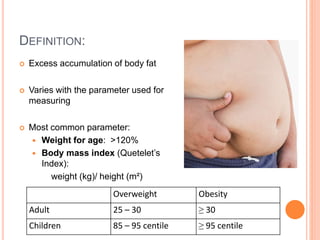
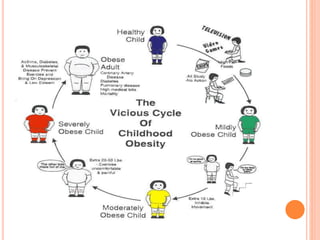
 Excess accumulation of body fat
 Varies with the parameter used for
measuring
 Most common parameter:
 Weight for age: >120%
 Body mass index (Quetelet’s
Index):
weight (kg)/ height (m²)
Overweight Obesity
Adult 25 – 30 ≥ 30
Children 85 – 95 centile ≥ 95 centile
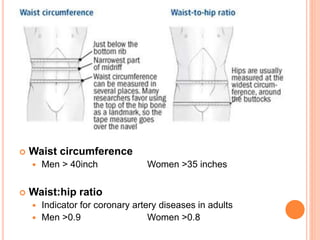
 Waist circumference
 Men > 40inch Women >35 inches
 Waist:hip ratio
 Indicator for coronary artery diseases in adults
 Men >0.9 Women >0.8
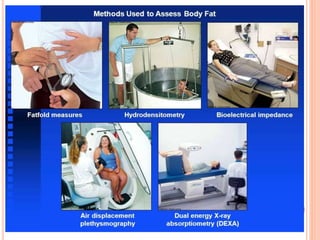
OTHER PARAMETERS:
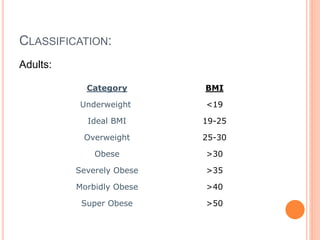
CLASSIFICATION:
Adults:
Category BMI
Underweight <19
Ideal BMI 19-25
Overweight 25-30
Obese >30
Severely Obese >35
Morbidly Obese >40
Super Obese >50
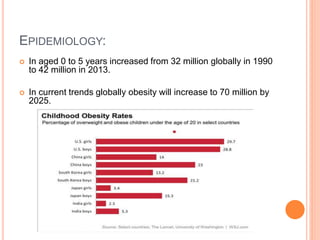
EPIDEMIOLOGY:
 In aged 0 to 5 years increased from 32 million globally in 1990
to 42 million in 2013.
 In current trends globally obesity will increase to 70 million by
2025.
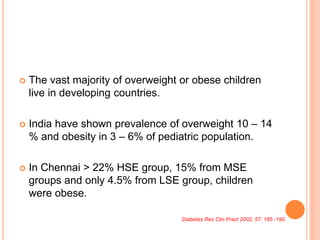
 The vast majority of overweight or obese children
live in developing countries.
 India have shown prevalence of overweight 10 – 14
% and obesity in 3 – 6% of pediatric population.
 In Chennai > 22% HSE group, 15% from MSE
groups and only 4.5% from LSE group, children
were obese.
Diabetes Res Clin Pract 2002; 57: 185 -190.
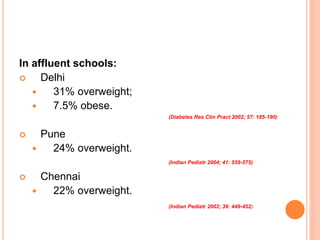
In affluent schools:
 Delhi
 31% overweight;
 7.5% obese.
 Pune
 24% overweight.
 Chennai
 22% overweight.
(Indian Pediatr 2002; 39: 449-452)
(Indian Pediatr 2004; 41: 559-575)
(Diabetes Res Clin Pract 2002; 57: 185-190)
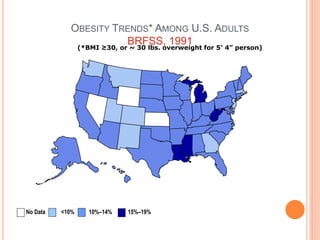
OBESITY TRENDS* AMONG U.S. ADULTS
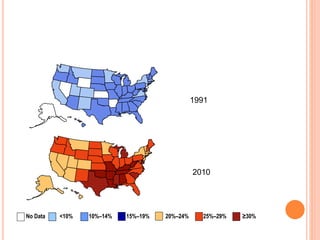
BRFSS, 1991(*BMI ≥30, or ~ 30 lbs. overweight for 5’ 4” person)
No Data <10% 10%–14% 15%–19%
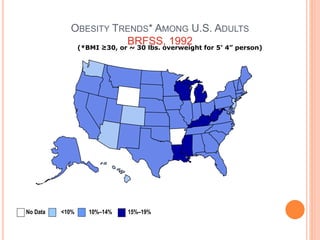
OBESITY TRENDS* AMONG U.S. ADULTS
BRFSS, 1992(*BMI ≥30, or ~ 30 lbs. overweight for 5’ 4” person)
No Data <10% 10%–14% 15%–19%
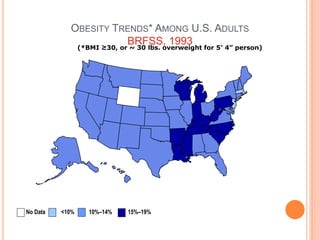
OBESITY TRENDS* AMONG U.S. ADULTS
BRFSS, 1993(*BMI ≥30, or ~ 30 lbs. overweight for 5’ 4” person)
No Data <10% 10%–14% 15%–19%
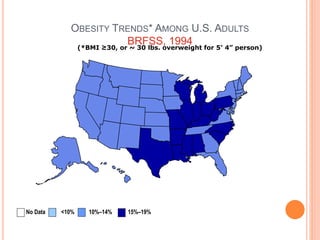
OBESITY TRENDS* AMONG U.S. ADULTS
BRFSS, 1994(*BMI ≥30, or ~ 30 lbs. overweight for 5’ 4” person)
No Data <10% 10%–14% 15%–19%
OBESITY TRENDS* AMONG U.S. ADULTS
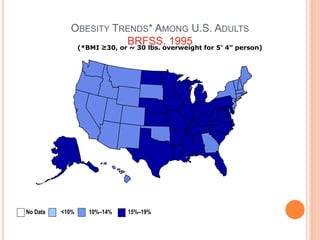
BRFSS, 1995(*BMI ≥30, or ~ 30 lbs. overweight for 5’ 4” person)
No Data <10% 10%–14% 15%–19%
OBESITY TRENDS* AMONG U.S. ADULTS
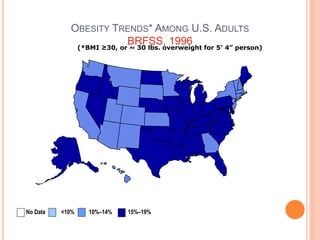
BRFSS, 1996(*BMI ≥30, or ~ 30 lbs. overweight for 5’ 4” person)
No Data <10% 10%–14% 15%–19%
OBESITY TRENDS* AMONG U.S. ADULTS
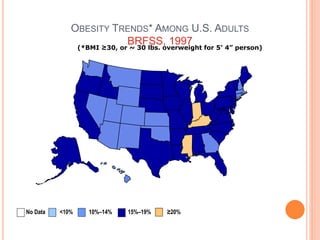
BRFSS, 1997(*BMI ≥30, or ~ 30 lbs. overweight for 5’ 4” person)
No Data <10% 10%–14% 15%–19% ≥20%
OBESITY TRENDS* AMONG U.S. ADULTS
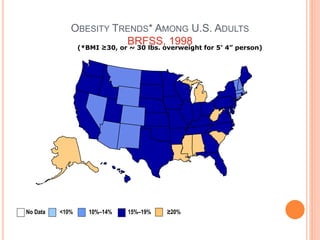
BRFSS, 1998(*BMI ≥30, or ~ 30 lbs. overweight for 5’ 4” person)
No Data <10% 10%–14% 15%–19% ≥20%
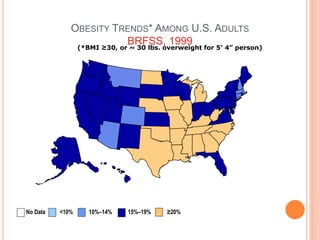
OBESITY TRENDS* AMONG U.S. ADULTS
BRFSS, 1999(*BMI ≥30, or ~ 30 lbs. overweight for 5’ 4” person)
No Data <10% 10%–14% 15%–19% ≥20%
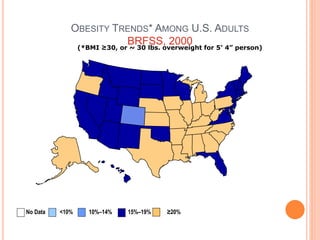
OBESITY TRENDS* AMONG U.S. ADULTS
BRFSS, 2000(*BMI ≥30, or ~ 30 lbs. overweight for 5’ 4” person)
No Data <10% 10%–14% 15%–19% ≥20%
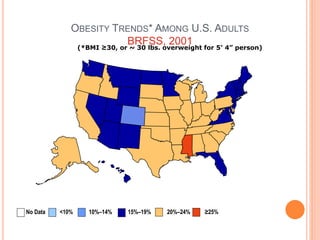
OBESITY TRENDS* AMONG U.S. ADULTS
BRFSS, 2001(*BMI ≥30, or ~ 30 lbs. overweight for 5’ 4” person)
No Data <10% 10%–14% 15%–19% 20%–24% ≥25%
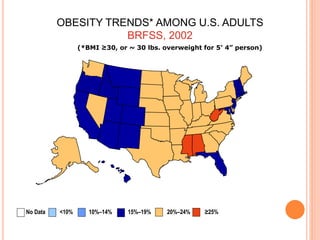
(*BMI ≥30, or ~ 30 lbs. overweight for 5’ 4” person)
OBESITY TRENDS* AMONG U.S. ADULTS
BRFSS, 2002
No Data <10% 10%–14% 15%–19% 20%–24% ≥25%
OBESITY TRENDS* AMONG U.S. ADULTS
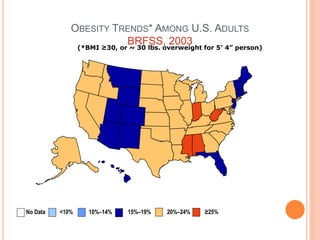
BRFSS, 2003(*BMI ≥30, or ~ 30 lbs. overweight for 5’ 4” person)
No Data <10% 10%–14% 15%–19% 20%–24% ≥25%
OBESITY TRENDS* AMONG U.S. ADULTS
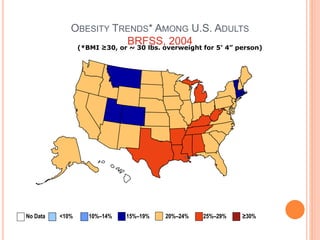
BRFSS, 2004(*BMI ≥30, or ~ 30 lbs. overweight for 5’ 4” person)
No Data <10% 10%–14% 15%–19% 20%–24% 25%–29% ≥30%
OBESITY TRENDS* AMONG U.S. ADULTS
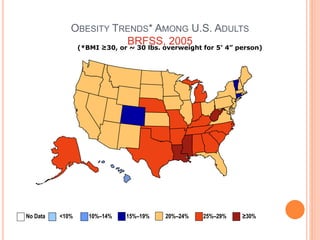
BRFSS, 2005(*BMI ≥30, or ~ 30 lbs. overweight for 5’ 4” person)
No Data <10% 10%–14% 15%–19% 20%–24% 25%–29% ≥30%
OBESITY TRENDS* AMONG U.S. ADULTS
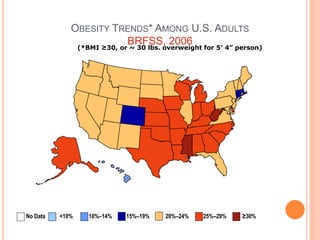
BRFSS, 2006(*BMI ≥30, or ~ 30 lbs. overweight for 5’ 4” person)
No Data <10% 10%–14% 15%–19% 20%–24% 25%–29% ≥30%
OBESITY TRENDS* AMONG U.S. ADULTS
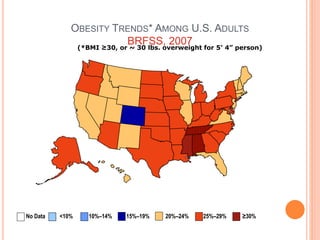
BRFSS, 2007(*BMI ≥30, or ~ 30 lbs. overweight for 5’ 4” person)
No Data <10% 10%–14% 15%–19% 20%–24% 25%–29% ≥30%
OBESITY TRENDS* AMONG U.S. ADULTS
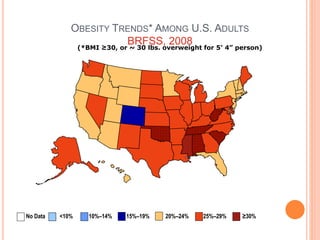
BRFSS, 2008(*BMI ≥30, or ~ 30 lbs. overweight for 5’ 4” person)
No Data <10% 10%–14% 15%–19% 20%–24% 25%–29% ≥30%
OBESITY TRENDS* AMONG U.S. ADULTS
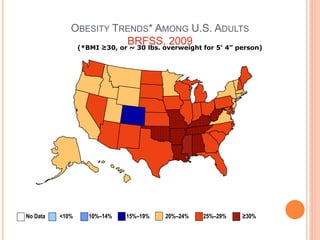
BRFSS, 2009(*BMI ≥30, or ~ 30 lbs. overweight for 5’ 4” person)
No Data <10% 10%–14% 15%–19% 20%–24% 25%–29% ≥30%
OBESITY TRENDS* AMONG U.S. ADULTS
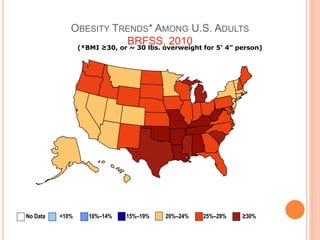
BRFSS, 2010(*BMI ≥30, or ~ 30 lbs. overweight for 5’ 4” person)
No Data <10% 10%–14% 15%–19% 20%–24% 25%–29% ≥30%
1991
2010
No Data <10% 10%–14% 15%–19% 20%–24% 25%–29% ≥30%
RISK FACTORS:
 Crucial periods
 prenatal period
 age 5 – 7 years
 adolescence.
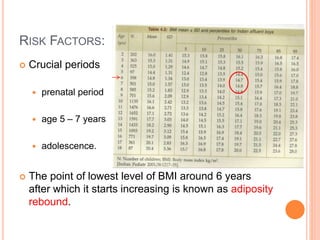
 The point of lowest level of BMI around 6 years
after which it starts increasing is known as adiposity
rebound.
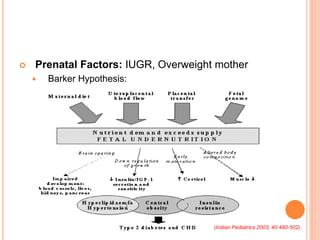
 Prenatal Factors: IUGR, Overweight mother
 Barker Hypothesis:
(Indian Pediatrics 2003; 40:480-502)
 Early feeding practices: Lack of breastfeeding,
increased formula feeds, complementary feeding
before 4 months
 Demographic: parental overweight, low parental
education
 Medication: Antipsychotics ( olanzapine,
resperidone), Antiepiletics (Carbamazepine,
Valproate), Steroids
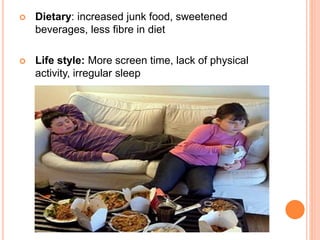
 Dietary: increased junk food, sweetened
beverages, less fibre in diet
 Life style: More screen time, lack of physical
activity, irregular sleep
CLASSIFICATION:
 Primary/ Constitutional Obesity: No secondary
cause (>95% cases)
 Secondary/ Organic/ Exogenous obesity:
 Genetic Syndromes: Prader willi, Down’s,
Bradet-Biedl, Cohen, Carpenter
 Hypothalamic: Infectious (TBM, Post meningitic
sequelae), ICSOL, Radiation, Surgery, Head
trauma, Hypothalamic Hamartoma
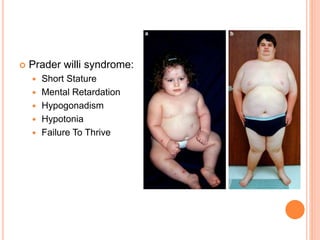
 Prader willi syndrome:
 Short Stature
 Mental Retardation
 Hypogonadism
 Hypotonia
 Failure To Thrive
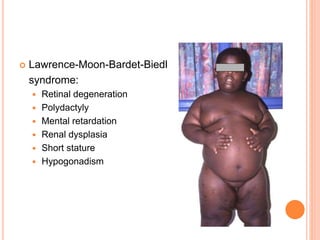
 Lawrence-Moon-Bardet-Biedl
syndrome:
 Retinal degeneration
 Polydactyly
 Mental retardation
 Renal dysplasia
 Short stature
 Hypogonadism
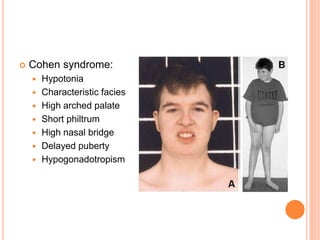
 Cohen syndrome:
 Hypotonia
 Characteristic facies
 High arched palate
 Short philtrum
 High nasal bridge
 Delayed puberty
 Hypogonadotropism
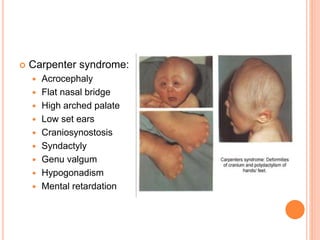
 Carpenter syndrome:
 Acrocephaly
 Flat nasal bridge
 High arched palate
 Low set ears
 Craniosynostosis
 Syndactyly
 Genu valgum
 Hypogonadism
 Mental retardation
 Endocrine: Cushing, hypothyroidism,
pseudohypoparathyroidism, PCOS
 Drugs: Antiepileptics, Antipsychotics, Steroids
 Psychological Factors: depression, attention
seeking, bulimia
 Handicapped children with sedentary life style.
PATHOPHYSIOLOGY:
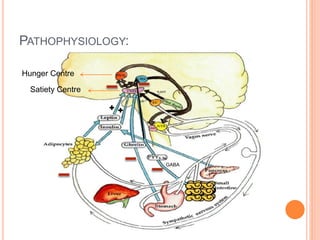
++
Satiety Centre
Hunger Centre
GABA
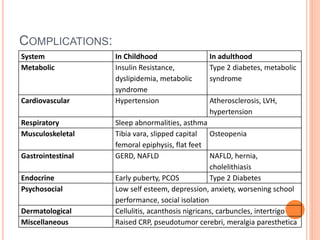
COMPLICATIONS:
System In Childhood In adulthood
Metabolic Insulin Resistance,
dyslipidemia, metabolic
syndrome
Type 2 diabetes, metabolic
syndrome
Cardiovascular Hypertension Atherosclerosis, LVH,
hypertension
Respiratory Sleep abnormalities, asthma
Musculoskeletal Tibia vara, slipped capital
femoral epiphysis, flat feet
Osteopenia
Gastrointestinal GERD, NAFLD NAFLD, hernia,
cholelithiasis
Endocrine Early puberty, PCOS Type 2 Diabetes
Psychosocial Low self esteem, depression, anxiety, worsening school
performance, social isolation
Dermatological Cellulitis, acanthosis nigricans, carbuncles, intertrigo
Miscellaneous Raised CRP, pseudotumor cerebri, meralgia paresthetica
EVALUATION:
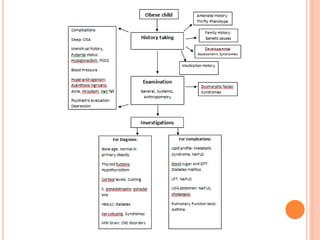
 Main aim is to ascertain whether primary or
secondary obesity.
 History:
 Antenatal history
 Birth weight
 Weight gain
 Sleep pattern
 Family history
 Medications
 Developmental assessment
 Menstrual history.
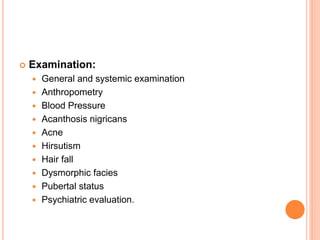
 Examination:
 General and systemic examination
 Anthropometry
 Blood Pressure
 Acanthosis nigricans
 Acne
 Hirsutism
 Hair fall
 Dysmorphic facies
 Pubertal status
 Psychiatric evaluation.
 Investigations: Routine +
 Lipid profile
 Glucose tolerance test
 Thyroid function
 Gonadal axis – serum LH, FSH, testosterone
 Bone age assessment
 Growth hormone
 Serum Parathyroid/ Vitamin D
 Serum insulin, Glycosylated Hemoglobin
(HbA1C)
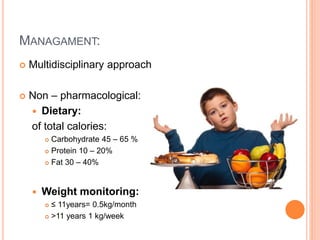
MANAGAMENT:
 Multidisciplinary approach
 Non – pharmacological:
 Dietary:
of total calories:
 Carbohydrate 45 – 65 %
 Protein 10 – 20%
 Fat 30 – 40%
 Weight monitoring:
 ≤ 11years= 0.5kg/month
 >11 years 1 kg/week
 Physical activity: safe, interesting and practical
 Pharmacological:
 Antiobesity drugs still being evaluated in children.
 Advised only in children >16 years with obesity related
complications.
 Only drug approved is Orlistat.
 Can be used in ≥12 years
 120 mg TDS with each meal or within 1 hour
 Same as adult
 Surgical:
 BMI >50 kg/m² without comorbidity
 >40 kg/m² with comorbidities.
 Techniques:
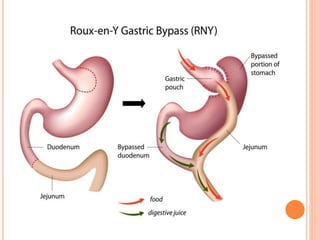
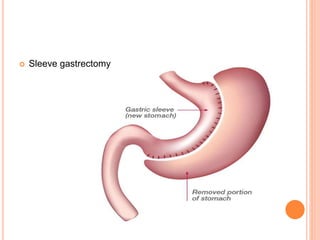
 Laparoscopic adjustable gastric banding (LAGB)
 Roux-en-Y gastric bypass (RYGB)
 Sleeve gastrectomy
 Laparoscopic adjustable gastric banding (LAGB)
 Sleeve gastrectomy
PREVENTION:
 Diet:
 Exclusive breast feeding
 Timely complementary feeding
 Healthy feeding practices
 No fat restriction to be done in infants < 2 years
 For > 2yr, fat contributes 20 – 30 % of calories
 Fiber in diet = age + 5g
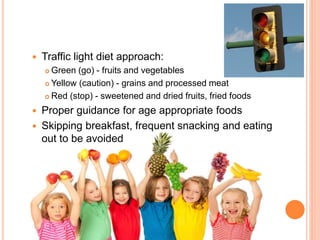
 Traffic light diet approach:
 Green (go) - fruits and vegetables
 Yellow (caution) - grains and processed meat
 Red (stop) - sweetened and dried fruits, fried foods
 Proper guidance for age appropriate foods
 Skipping breakfast, frequent snacking and eating
out to be avoided
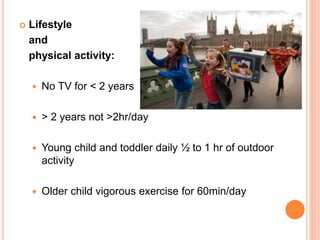
 Lifestyle
and
physical activity:
 No TV for < 2 years
 > 2 years not >2hr/day
 Young child and toddler daily ½ to 1 hr of outdoor
activity
 Older child vigorous exercise for 60min/day
 Behaviour:
 Parental motivation
and commitment
 No stacking of unhealthy food in house
 Setting realistic goals for exercise
 Positive reinforcement
 Timely monitoring.
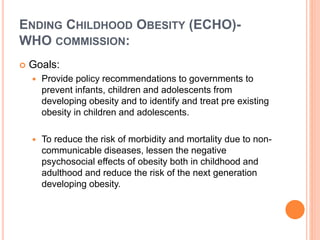
ENDING CHILDHOOD OBESITY (ECHO)-
WHO COMMISSION:
 Goals:
 Provide policy recommendations to governments to
prevent infants, children and adolescents from
developing obesity and to identify and treat pre existing
obesity in children and adolescents.
 To reduce the risk of morbidity and mortality due to non-
communicable diseases, lessen the negative
psychosocial effects of obesity both in childhood and
adulthood and reduce the risk of the next generation
developing obesity.
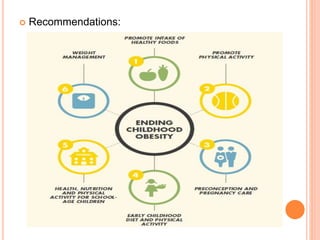
 Recommendations:
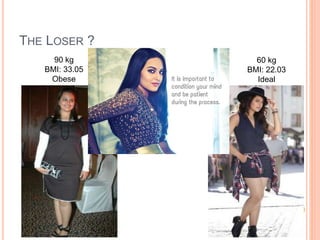
THE LOSER ?
90 kg
BMI: 33.05
Obese
60 kg
BMI: 22.03
Ideal
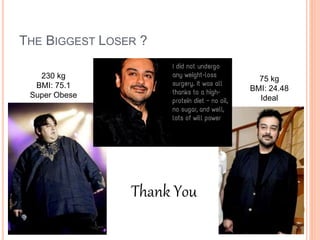
THE BIGGEST LOSER ?
230 kg
BMI: 75.1
Super Obese
75 kg
BMI: 24.48
Ideal
Thank You
REFERENCES:
 Gahagan S. Overweight and obesity. In: Nelson textbook of pediatrics. Eds. Kliegman RM,
Stanton BF, Schor NF, Geme JWS, Behrman RE. 20th Edn. Elsevier, Philadelphia, USA. 2015: pp.
307-16.
 Ravikumar KG. Acute and chronic complications of Diabetes Mellitus. In: PG Textbook of
Pediatrics. Eds. Gupta P, Menon PSN, Ramji S, Lodha R. 1st Edn. Jaypee, New Delhi, India 2015:
pp. 2384-8
 Agarwal KN. Obesity and thinness. In: The Growth: infancy to adolescence. Eds. Agarwal KN. 3rd
Edn. CBS, New Delhi, India 2015: pp 53–72.
 Ramachandran A, Snehalatha C, Vinitha R, Thayyil M, Kumar CK, Sheeba L, Joseph S, Vijay V.
Prevalence of overweight in urban Indian adolescent school children. Diabetes Res Clin Pract.
2002; 57(3):185-90.
 Bhave S, Bavdekar A, Otiv M. IAP National Task Force for Childhood Prevention of Adult
Diseases: Childhood Obesity. Indian Pediatr. 2004; 41(6):559-75.
 Kapil U, Singh P, Pathak P, Dwivedi SN, Bhasin S. Prevalence of obesity amongst affluent
adolescent school children in delhi. Indian Pediatr. 2002;39(5):449-52.
 The Behavioral Risk Factor Surveillance System (BRFSS) 1991 to 2010
 Fall CH. The fetal and early life origins of adult disease. Indian Pediatr. 2003; 40(5):480-502.
 Lustig RH. Hypothalamic obesity after craniopharyngioma: mechanisms, diagnosis, and
treatment. Front Endocrinol 2011;2:60.
 Report of the WHO commission on Ending Childhood Obesity (ECHO) published January 2016.<
http://apps.who.int/iris/bitstream/10665/204176/1/9789241510066_eng.pdf?ua=1>

Pediatric Obesity

  • 1.
  • 2.
    DEFINITION:  Excess accumulationof body fat  Varies with the parameter used for measuring  Most common parameter:  Weight for age: >120%  Body mass index (Quetelet’s Index): weight (kg)/ height (m²) Overweight Obesity Adult 25 – 30 ≥ 30 Children 85 – 95 centile ≥ 95 centile
  • 3.
     Waist circumference Men > 40inch Women >35 inches  Waist:hip ratio  Indicator for coronary artery diseases in adults  Men >0.9 Women >0.8
  • 4.
  • 5.
    CLASSIFICATION: Adults: Category BMI Underweight <19 IdealBMI 19-25 Overweight 25-30 Obese >30 Severely Obese >35 Morbidly Obese >40 Super Obese >50
  • 6.
    EPIDEMIOLOGY:  In aged0 to 5 years increased from 32 million globally in 1990 to 42 million in 2013.  In current trends globally obesity will increase to 70 million by 2025.
  • 7.
     The vastmajority of overweight or obese children live in developing countries.  India have shown prevalence of overweight 10 – 14 % and obesity in 3 – 6% of pediatric population.  In Chennai > 22% HSE group, 15% from MSE groups and only 4.5% from LSE group, children were obese. Diabetes Res Clin Pract 2002; 57: 185 -190.
  • 8.
    In affluent schools: Delhi  31% overweight;  7.5% obese.  Pune  24% overweight.  Chennai  22% overweight. (Indian Pediatr 2002; 39: 449-452) (Indian Pediatr 2004; 41: 559-575) (Diabetes Res Clin Pract 2002; 57: 185-190)
  • 9.
    OBESITY TRENDS* AMONGU.S. ADULTS BRFSS, 1991(*BMI ≥30, or ~ 30 lbs. overweight for 5’ 4” person) No Data <10% 10%–14% 15%–19%
  • 10.
    OBESITY TRENDS* AMONGU.S. ADULTS BRFSS, 1992(*BMI ≥30, or ~ 30 lbs. overweight for 5’ 4” person) No Data <10% 10%–14% 15%–19%
  • 11.
    OBESITY TRENDS* AMONGU.S. ADULTS BRFSS, 1993(*BMI ≥30, or ~ 30 lbs. overweight for 5’ 4” person) No Data <10% 10%–14% 15%–19%
  • 12.
    OBESITY TRENDS* AMONGU.S. ADULTS BRFSS, 1994(*BMI ≥30, or ~ 30 lbs. overweight for 5’ 4” person) No Data <10% 10%–14% 15%–19%
  • 13.
    OBESITY TRENDS* AMONGU.S. ADULTS BRFSS, 1995(*BMI ≥30, or ~ 30 lbs. overweight for 5’ 4” person) No Data <10% 10%–14% 15%–19%
  • 14.
    OBESITY TRENDS* AMONGU.S. ADULTS BRFSS, 1996(*BMI ≥30, or ~ 30 lbs. overweight for 5’ 4” person) No Data <10% 10%–14% 15%–19%
  • 15.
    OBESITY TRENDS* AMONGU.S. ADULTS BRFSS, 1997(*BMI ≥30, or ~ 30 lbs. overweight for 5’ 4” person) No Data <10% 10%–14% 15%–19% ≥20%
  • 16.
    OBESITY TRENDS* AMONGU.S. ADULTS BRFSS, 1998(*BMI ≥30, or ~ 30 lbs. overweight for 5’ 4” person) No Data <10% 10%–14% 15%–19% ≥20%
  • 17.
    OBESITY TRENDS* AMONGU.S. ADULTS BRFSS, 1999(*BMI ≥30, or ~ 30 lbs. overweight for 5’ 4” person) No Data <10% 10%–14% 15%–19% ≥20%
  • 18.
    OBESITY TRENDS* AMONGU.S. ADULTS BRFSS, 2000(*BMI ≥30, or ~ 30 lbs. overweight for 5’ 4” person) No Data <10% 10%–14% 15%–19% ≥20%
  • 19.
    OBESITY TRENDS* AMONGU.S. ADULTS BRFSS, 2001(*BMI ≥30, or ~ 30 lbs. overweight for 5’ 4” person) No Data <10% 10%–14% 15%–19% 20%–24% ≥25%
  • 20.
    (*BMI ≥30, or~ 30 lbs. overweight for 5’ 4” person) OBESITY TRENDS* AMONG U.S. ADULTS BRFSS, 2002 No Data <10% 10%–14% 15%–19% 20%–24% ≥25%
  • 21.
    OBESITY TRENDS* AMONGU.S. ADULTS BRFSS, 2003(*BMI ≥30, or ~ 30 lbs. overweight for 5’ 4” person) No Data <10% 10%–14% 15%–19% 20%–24% ≥25%
  • 22.
    OBESITY TRENDS* AMONGU.S. ADULTS BRFSS, 2004(*BMI ≥30, or ~ 30 lbs. overweight for 5’ 4” person) No Data <10% 10%–14% 15%–19% 20%–24% 25%–29% ≥30%
  • 23.
    OBESITY TRENDS* AMONGU.S. ADULTS BRFSS, 2005(*BMI ≥30, or ~ 30 lbs. overweight for 5’ 4” person) No Data <10% 10%–14% 15%–19% 20%–24% 25%–29% ≥30%
  • 24.
    OBESITY TRENDS* AMONGU.S. ADULTS BRFSS, 2006(*BMI ≥30, or ~ 30 lbs. overweight for 5’ 4” person) No Data <10% 10%–14% 15%–19% 20%–24% 25%–29% ≥30%
  • 25.
    OBESITY TRENDS* AMONGU.S. ADULTS BRFSS, 2007(*BMI ≥30, or ~ 30 lbs. overweight for 5’ 4” person) No Data <10% 10%–14% 15%–19% 20%–24% 25%–29% ≥30%
  • 26.
    OBESITY TRENDS* AMONGU.S. ADULTS BRFSS, 2008(*BMI ≥30, or ~ 30 lbs. overweight for 5’ 4” person) No Data <10% 10%–14% 15%–19% 20%–24% 25%–29% ≥30%
  • 27.
    OBESITY TRENDS* AMONGU.S. ADULTS BRFSS, 2009(*BMI ≥30, or ~ 30 lbs. overweight for 5’ 4” person) No Data <10% 10%–14% 15%–19% 20%–24% 25%–29% ≥30%
  • 28.
    OBESITY TRENDS* AMONGU.S. ADULTS BRFSS, 2010(*BMI ≥30, or ~ 30 lbs. overweight for 5’ 4” person) No Data <10% 10%–14% 15%–19% 20%–24% 25%–29% ≥30%
  • 29.
    1991 2010 No Data <10%10%–14% 15%–19% 20%–24% 25%–29% ≥30%
  • 30.
    RISK FACTORS:  Crucialperiods  prenatal period  age 5 – 7 years  adolescence.  The point of lowest level of BMI around 6 years after which it starts increasing is known as adiposity rebound.
  • 31.
     Prenatal Factors:IUGR, Overweight mother  Barker Hypothesis: (Indian Pediatrics 2003; 40:480-502)
  • 32.
     Early feedingpractices: Lack of breastfeeding, increased formula feeds, complementary feeding before 4 months  Demographic: parental overweight, low parental education  Medication: Antipsychotics ( olanzapine, resperidone), Antiepiletics (Carbamazepine, Valproate), Steroids
  • 33.
     Dietary: increasedjunk food, sweetened beverages, less fibre in diet  Life style: More screen time, lack of physical activity, irregular sleep
  • 34.
    CLASSIFICATION:  Primary/ ConstitutionalObesity: No secondary cause (>95% cases)  Secondary/ Organic/ Exogenous obesity:  Genetic Syndromes: Prader willi, Down’s, Bradet-Biedl, Cohen, Carpenter  Hypothalamic: Infectious (TBM, Post meningitic sequelae), ICSOL, Radiation, Surgery, Head trauma, Hypothalamic Hamartoma
  • 35.
     Prader willisyndrome:  Short Stature  Mental Retardation  Hypogonadism  Hypotonia  Failure To Thrive
  • 36.
     Lawrence-Moon-Bardet-Biedl syndrome:  Retinaldegeneration  Polydactyly  Mental retardation  Renal dysplasia  Short stature  Hypogonadism
  • 37.
     Cohen syndrome: Hypotonia  Characteristic facies  High arched palate  Short philtrum  High nasal bridge  Delayed puberty  Hypogonadotropism
  • 38.
     Carpenter syndrome: Acrocephaly  Flat nasal bridge  High arched palate  Low set ears  Craniosynostosis  Syndactyly  Genu valgum  Hypogonadism  Mental retardation
  • 39.
     Endocrine: Cushing,hypothyroidism, pseudohypoparathyroidism, PCOS  Drugs: Antiepileptics, Antipsychotics, Steroids  Psychological Factors: depression, attention seeking, bulimia  Handicapped children with sedentary life style.
  • 40.
  • 41.
    COMPLICATIONS: System In ChildhoodIn adulthood Metabolic Insulin Resistance, dyslipidemia, metabolic syndrome Type 2 diabetes, metabolic syndrome Cardiovascular Hypertension Atherosclerosis, LVH, hypertension Respiratory Sleep abnormalities, asthma Musculoskeletal Tibia vara, slipped capital femoral epiphysis, flat feet Osteopenia Gastrointestinal GERD, NAFLD NAFLD, hernia, cholelithiasis Endocrine Early puberty, PCOS Type 2 Diabetes Psychosocial Low self esteem, depression, anxiety, worsening school performance, social isolation Dermatological Cellulitis, acanthosis nigricans, carbuncles, intertrigo Miscellaneous Raised CRP, pseudotumor cerebri, meralgia paresthetica
  • 42.
    EVALUATION:  Main aimis to ascertain whether primary or secondary obesity.  History:  Antenatal history  Birth weight  Weight gain  Sleep pattern  Family history  Medications  Developmental assessment  Menstrual history.
  • 43.
     Examination:  Generaland systemic examination  Anthropometry  Blood Pressure  Acanthosis nigricans  Acne  Hirsutism  Hair fall  Dysmorphic facies  Pubertal status  Psychiatric evaluation.
  • 44.
     Investigations: Routine+  Lipid profile  Glucose tolerance test  Thyroid function  Gonadal axis – serum LH, FSH, testosterone  Bone age assessment  Growth hormone  Serum Parathyroid/ Vitamin D  Serum insulin, Glycosylated Hemoglobin (HbA1C)
  • 45.
    MANAGAMENT:  Multidisciplinary approach Non – pharmacological:  Dietary: of total calories:  Carbohydrate 45 – 65 %  Protein 10 – 20%  Fat 30 – 40%  Weight monitoring:  ≤ 11years= 0.5kg/month  >11 years 1 kg/week
  • 46.
     Physical activity:safe, interesting and practical
  • 47.
     Pharmacological:  Antiobesitydrugs still being evaluated in children.  Advised only in children >16 years with obesity related complications.  Only drug approved is Orlistat.  Can be used in ≥12 years  120 mg TDS with each meal or within 1 hour  Same as adult
  • 48.
     Surgical:  BMI>50 kg/m² without comorbidity  >40 kg/m² with comorbidities.  Techniques:  Laparoscopic adjustable gastric banding (LAGB)  Roux-en-Y gastric bypass (RYGB)  Sleeve gastrectomy
  • 49.
     Laparoscopic adjustablegastric banding (LAGB)
  • 51.
  • 52.
    PREVENTION:  Diet:  Exclusivebreast feeding  Timely complementary feeding  Healthy feeding practices  No fat restriction to be done in infants < 2 years  For > 2yr, fat contributes 20 – 30 % of calories  Fiber in diet = age + 5g
  • 53.
     Traffic lightdiet approach:  Green (go) - fruits and vegetables  Yellow (caution) - grains and processed meat  Red (stop) - sweetened and dried fruits, fried foods  Proper guidance for age appropriate foods  Skipping breakfast, frequent snacking and eating out to be avoided
  • 55.
     Lifestyle and physical activity: No TV for < 2 years  > 2 years not >2hr/day  Young child and toddler daily ½ to 1 hr of outdoor activity  Older child vigorous exercise for 60min/day
  • 56.
     Behaviour:  Parentalmotivation and commitment  No stacking of unhealthy food in house  Setting realistic goals for exercise  Positive reinforcement  Timely monitoring.
  • 59.
    ENDING CHILDHOOD OBESITY(ECHO)- WHO COMMISSION:  Goals:  Provide policy recommendations to governments to prevent infants, children and adolescents from developing obesity and to identify and treat pre existing obesity in children and adolescents.  To reduce the risk of morbidity and mortality due to non- communicable diseases, lessen the negative psychosocial effects of obesity both in childhood and adulthood and reduce the risk of the next generation developing obesity.
  • 60.
  • 61.
    THE LOSER ? 90kg BMI: 33.05 Obese 60 kg BMI: 22.03 Ideal
  • 62.
    THE BIGGEST LOSER? 230 kg BMI: 75.1 Super Obese 75 kg BMI: 24.48 Ideal Thank You
  • 63.
    REFERENCES:  Gahagan S.Overweight and obesity. In: Nelson textbook of pediatrics. Eds. Kliegman RM, Stanton BF, Schor NF, Geme JWS, Behrman RE. 20th Edn. Elsevier, Philadelphia, USA. 2015: pp. 307-16.  Ravikumar KG. Acute and chronic complications of Diabetes Mellitus. In: PG Textbook of Pediatrics. Eds. Gupta P, Menon PSN, Ramji S, Lodha R. 1st Edn. Jaypee, New Delhi, India 2015: pp. 2384-8  Agarwal KN. Obesity and thinness. In: The Growth: infancy to adolescence. Eds. Agarwal KN. 3rd Edn. CBS, New Delhi, India 2015: pp 53–72.  Ramachandran A, Snehalatha C, Vinitha R, Thayyil M, Kumar CK, Sheeba L, Joseph S, Vijay V. Prevalence of overweight in urban Indian adolescent school children. Diabetes Res Clin Pract. 2002; 57(3):185-90.  Bhave S, Bavdekar A, Otiv M. IAP National Task Force for Childhood Prevention of Adult Diseases: Childhood Obesity. Indian Pediatr. 2004; 41(6):559-75.  Kapil U, Singh P, Pathak P, Dwivedi SN, Bhasin S. Prevalence of obesity amongst affluent adolescent school children in delhi. Indian Pediatr. 2002;39(5):449-52.  The Behavioral Risk Factor Surveillance System (BRFSS) 1991 to 2010  Fall CH. The fetal and early life origins of adult disease. Indian Pediatr. 2003; 40(5):480-502.  Lustig RH. Hypothalamic obesity after craniopharyngioma: mechanisms, diagnosis, and treatment. Front Endocrinol 2011;2:60.  Report of the WHO commission on Ending Childhood Obesity (ECHO) published January 2016.< http://apps.who.int/iris/bitstream/10665/204176/1/9789241510066_eng.pdf?ua=1>