




OBESITY AND ITSOBESITY AND ITS
MANAGEMENTMANAGEMENT
Maj Neamatullah AhmedMaj Neamatullah Ahmed
PBGMS,MPH,MCPSPBGMS,MPH,MCPS
INTRODUCTIONINTRODUCTION
It produces many complications
like hypertension, Diabetes
Mellitus, IHD,Stroke etc.
Deadly DiseasesDeadly Diseases
Causing Death of MillionsCausing Death of Millions
of People worldwideof People worldwide
 In 20th CenturyIn 20th Century
 Deadly infections,i.e.Deadly infections,i.e.
 CholeraCholera
 Small poxSmall pox
 TuberculosisTuberculosis
 TetanusTetanus
 MeaslesMeasles
 PneumoniaPneumonia
 Bird fluBird flu
 Other viral & bacterialOther viral & bacterial
infectionsinfections
 In 21In 21stst
CenturyCentury
 Hypertension-CVAHypertension-CVA
 Heart DiseasesHeart Diseases
 DiabetesDiabetes
 CancerCancer
 ObesityObesity
 Man made Disaster-Man made Disaster-
RTA, War etcRTA, War etc
Projected prevalence of obesity in adults by 2025
AIMAIM
My aim is to orient youMy aim is to orient you
about :about : Definition of obesityDefinition of obesity
 PrevalencePrevalence
 Reversible causes of weight gainReversible causes of weight gain
 Obesogenic environmentObesogenic environment
 Food value chartFood value chart
 Different exercise value chartDifferent exercise value chart
 Prevention strategies for obesityPrevention strategies for obesity
 Balanced DietBalanced Diet
 Therapeutic options for obesityTherapeutic options for obesity
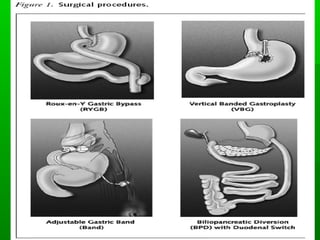
 Surgical options for obesitySurgical options for obesity
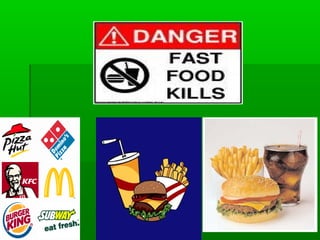
 Danger FoodsDanger Foods
 Fitness PledgeFitness Pledge
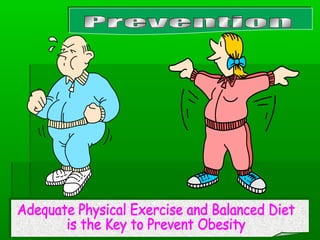
 Prevention of obesityPrevention of obesity
 RecommendationsRecommendations
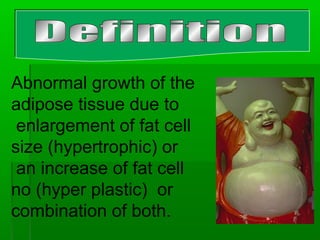
Abnormal growth of the
adipose tissue due to
enlargement of fat cell
size (hypertrophic) or
an increase of fat cell
no (hyper plastic) or
combination of both.
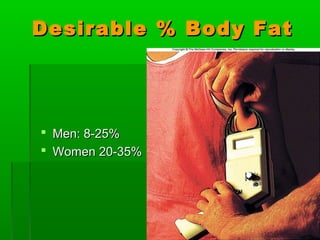
Desirable % Body FatDesirable % Body Fat
 Men: 8-25%Men: 8-25%
 Women 20-35%Women 20-35%
Prevalence ofPrevalence of
ObesityObesity
What is Prevalence?What is Prevalence?
New Obese / Incidence + Old ObeseNew Obese / Incidence + Old Obese
No of Total Obese PersonsNo of Total Obese Persons
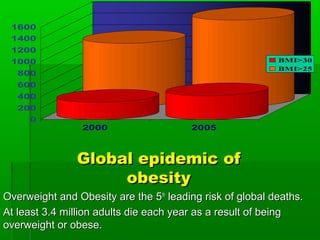
Global epidemic ofGlobal epidemic of
obesityobesity
0
200
400
600
800
1000
1200
1400
1600
2000 2005
BMI>30
BMI>25
Overweight and Obesity are the 5Overweight and Obesity are the 5thth
leading risk of global deaths.leading risk of global deaths.
At least 3.4 million adults die each year as a result of beingAt least 3.4 million adults die each year as a result of being
overweight or obese.overweight or obese.
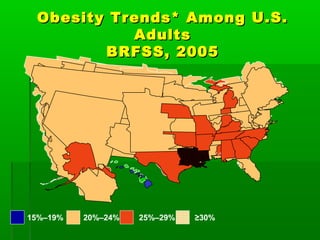
Obesity Trends* Among U.S.Obesity Trends* Among U.S.
AdultsAdults
BRFSS, 2005BRFSS, 2005
15%–19% 20%–24% 25%–29% ≥30%
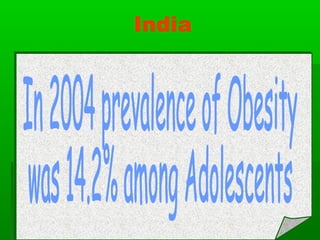
India
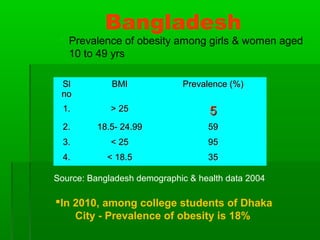
Bangladesh
 Prevalence of obesity among girls & women aged
10 to 49 yrs
SlSl
nono
BMIBMI Prevalence (%)Prevalence (%)
1.1. > 25> 25 55
2.2. 18.5- 24.9918.5- 24.99 5959
3.3. < 25< 25 9595
4.4. < 18.5< 18.5 3535
Source: Bangladesh demographic & health data 2004
In 2010, among college students of Dhaka
City - Prevalence of obesity is 18%
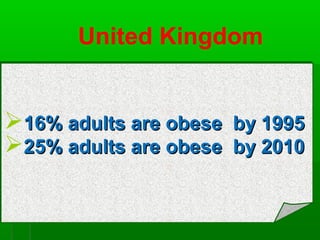
United Kingdom
16% adults are obese by 199516% adults are obese by 1995
25% adults are obese by 201025% adults are obese by 2010
16% adults are obese by 199516% adults are obese by 1995
25% adults are obese by 201025% adults are obese by 2010
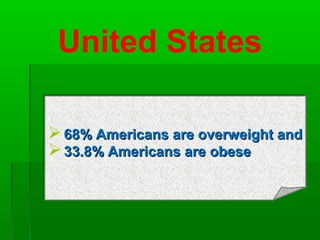
United States
68% Americans are overweight and68% Americans are overweight and
33.8% Americans are obese33.8% Americans are obese
68% Americans are overweight and68% Americans are overweight and
33.8% Americans are obese33.8% Americans are obese
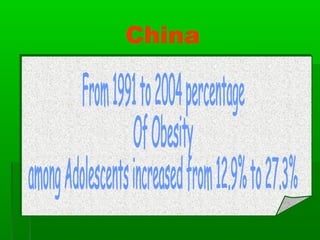
China
Potential reversible causes ofPotential reversible causes of
weight gainweight gain
 Endocrine FactorsEndocrine Factors
HypothyroidismHypothyroidism
Cushing’s SyndromeCushing’s Syndrome
Hypothalamic Tumors / injuryHypothalamic Tumors / injury
InsulinomaInsulinoma
 Drug TreatmentsDrug Treatments
Tricyclic antidepressantTricyclic antidepressant
SulphonylureasSulphonylureas
Oestrogen-containing contraceptive pillOestrogen-containing contraceptive pill
CorticosteroidsCorticosteroids
Sodium valproateSodium valproate
ß-blockersß-blockers
NSAIDSNSAIDS
 Pathological Eating BehaviourPathological Eating Behaviour
Binge eatingBinge eating
Nocturnal eating/BulimiaNocturnal eating/Bulimia
 Alcohol consumptionAlcohol consumption Davidson/22ndDavidson/22nd
Reasons for the increase prevalence ofReasons for the increase prevalence of
obesity-The ‘Obesogenic’ Environmentobesity-The ‘Obesogenic’ Environment
 Increasing energy intakeIncreasing energy intake
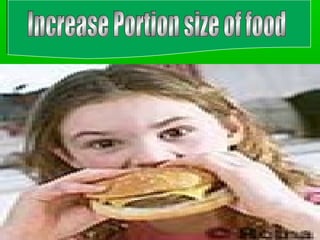
↑↑Portion sizesPortion sizes
↑↑Snacking and loss of regular mealsSnacking and loss of regular meals
↑↑Energy-dense food (mainly fat)Energy-dense food (mainly fat)
↑↑AffluenceAffluence
Late night sleepLate night sleep
 Decreasing energy expenditureDecreasing energy expenditure
↑↑Car ownershipCar ownership
↓↓Walking to school/workWalking to school/work
↑↑Automation; ↓manual labourAutomation; ↓manual labour
↓↓Sports in schoolsSports in schools
↑↑Time spent on video games and watching TVTime spent on video games and watching TV
↑↑Central heating( Air ConditioningCentral heating( Air Conditioning))
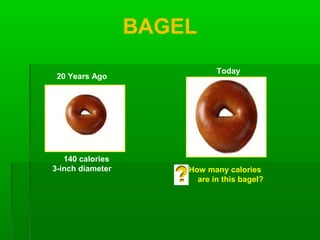
BAGEL
20 Years Ago
Today
140 calories
3-inch diameter How many calories
are in this bagel?
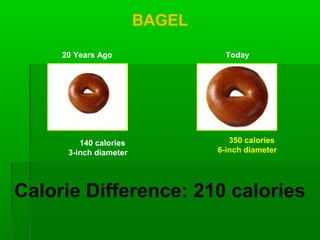
BAGEL
20 Years Ago Today
140 calories
3-inch diameter
350 calories
6-inch diameter
Calorie Difference: 210 calories
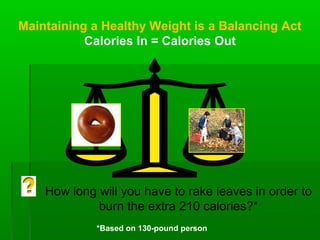
Maintaining a Healthy Weight is a Balancing Act
Calories In = Calories Out
How long will you have to rake leaves in order to
burn the extra 210 calories?*
*Based on 130-pound person
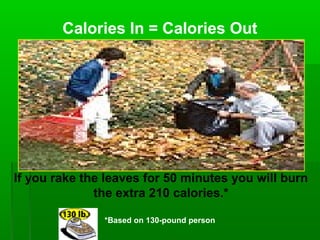
Calories In = Calories Out
If you rake the leaves for 50 minutes you will burn
the extra 210 calories.*
*Based on 130-pound person
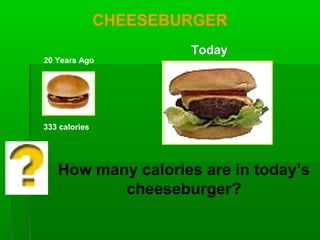
CHEESEBURGER
20 Years Ago
Today
333 calories
How many calories are in today’s
cheeseburger?
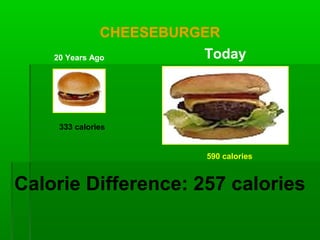
CHEESEBURGER
20 Years Ago Today
590 calories
333 calories
Calorie Difference: 257 calories
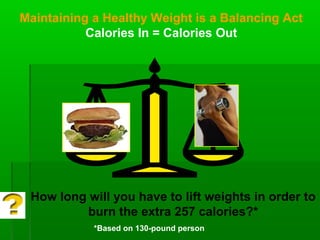
Maintaining a Healthy Weight is a Balancing Act
Calories In = Calories Out
How long will you have to lift weights in order to
burn the extra 257 calories?*
*Based on 130-pound person
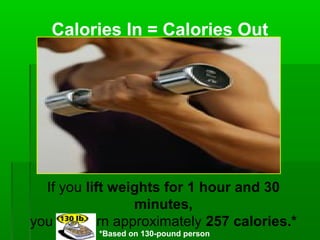
Calories In = Calories Out
If you lift weights for 1 hour and 30
minutes,
you will burn approximately 257 calories.*
*Based on 130-pound person
Calories In = Calories Out
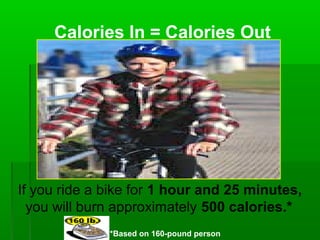
If you ride a bike for 1 hour and 25 minutes,
you will burn approximately 500 calories.*
*Based on 160-pound person
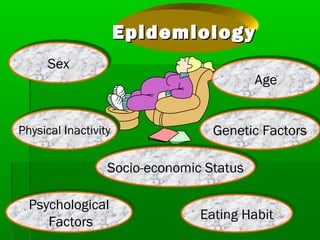
EpidemiologyEpidemiology
SexSex
AgeAge
Physical InactivityPhysical Inactivity Genetic FactorsGenetic Factors
Socio-economic StatusSocio-economic Status
Eating HabitEating Habit
Psychological
Factors
Psychological
Factors
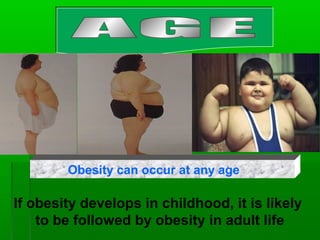
Obesity can occur at any age
If obesity develops in childhood, it is likely
to be followed by obesity in adult life
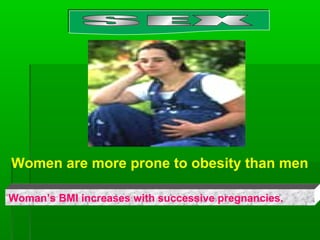
Women are more prone to obesity than men
Woman’s BMI increases with successive pregnancies.
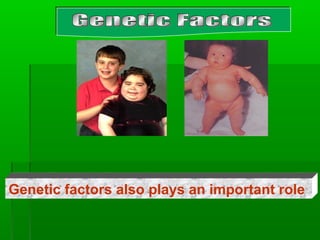
Genetic factors also plays an important role
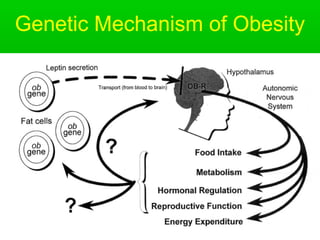
Genetic Mechanism of Obesity
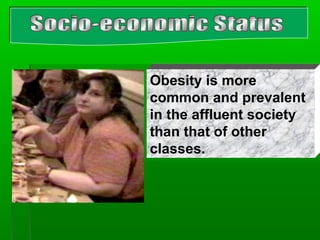
Obesity is more
common and prevalent
in the affluent society
than that of other
classes.
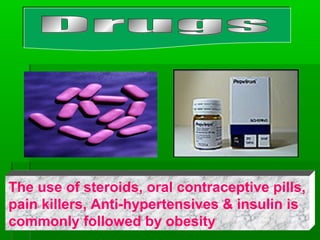
The use of steroids, oral contraceptive pills,
pain killers, Anti-hypertensives & insulin is
commonly followed by obesity
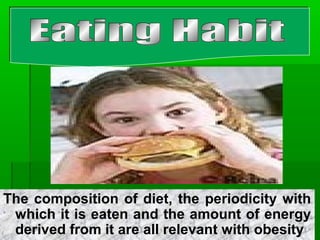
The composition of diet, the periodicity with
which it is eaten and the amount of energy
derived from it are all relevant with obesity
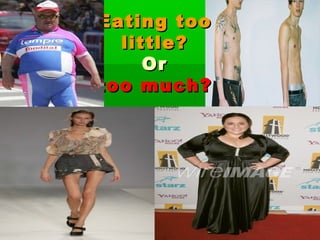
Eating tooEating too
little?little?
OrOr
too much?too much?
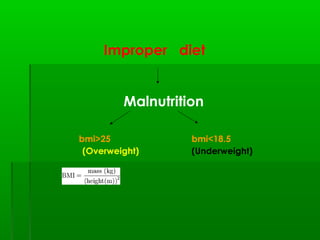
Improper   diet
Malnutrition
bmi>25  bmi<18.5
(Overweight)                     (Underweight)
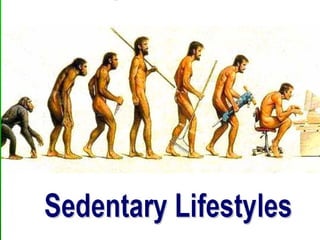
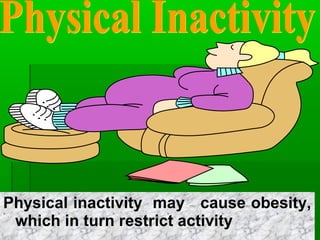
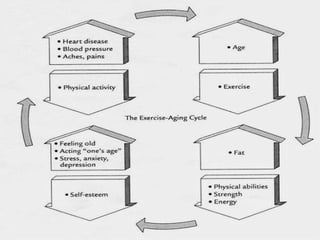
Physical inactivity may cause obesity,
which in turn restrict activity
Types ofTypes of
ObesityObesity
 Apple Shape obesityApple Shape obesity
 Pear Shaped ObesityPear Shaped Obesity
Partners in Global Health Education
1. How to use this
module
2. Learning
outcomes
3. Definition
4. Classification
5. Section 1 quiz
6. Global burden of
obesity
7. Section 2 quiz
8. Pathogenesis
9. Section 3 quiz
10. Effects of obesity
11. Section 4 quiz
12. Childhood obesity
13. Section 5 quiz
14. Management of
obesity
15. Section 6 quiz
16. Summary
17. Information
sources
tio n1
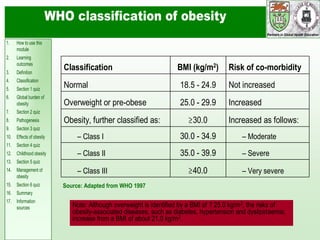
Note: Although overweight is identified by a BMI of ? 25.0 kg/m2, the risks of
obesity-associated diseases, such as diabetes, hypertension and dyslipidaemia,
increase from a BMI of about 21.0 kg/m2.
Increased as follows:≥30.0Obesity, further classified as:
– Very severe
– Severe
– Moderate
Increased
Not increased
Risk of co-morbidity
≥40.0– Class III
35.0 - 39.9– Class II
30.0 - 34.9– Class I
25.0 - 29.9Overweight or pre-obese
18.5 - 24.9Normal
BMI (kg/m2)Classification
Source: Adapted from WHO 1997
WHO classification of obesity
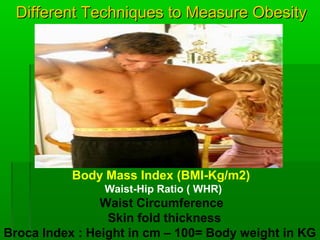
Different Techniques to Measure ObesityDifferent Techniques to Measure Obesity
Body Mass Index (BMI-Kg/m2)
Waist-Hip Ratio ( WHR)
Waist Circumference
Skin fold thickness
Broca Index : Height in cm – 100= Body weight in KG
Body Mass IndexBody Mass Index
The new vital sign!The new vital sign!
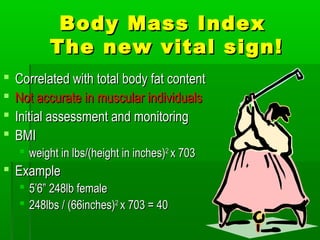
 Correlated with total body fat contentCorrelated with total body fat content
 Not accurate in muscular individualsNot accurate in muscular individuals
 Initial assessment and monitoringInitial assessment and monitoring
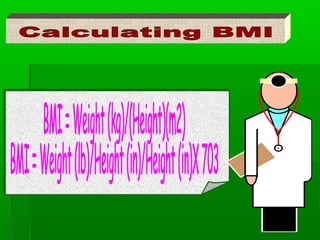
 BMIBMI
 weight in lbs/(height in inches)weight in lbs/(height in inches)22
x 703x 703
 ExampleExample
 5’6” 248lb female5’6” 248lb female
 248lbs / (66inches)248lbs / (66inches)22
x 703 = 40x 703 = 40
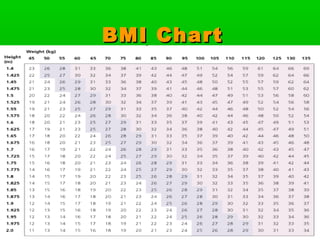
BMI ChartBMI Chart
Disadvantages of BMIDisadvantages of BMI
(a)
1.72
metre
Ht 1.72
metre
84
Kg
Wt 84
Kg
28.4 BMI 28.4
(b)
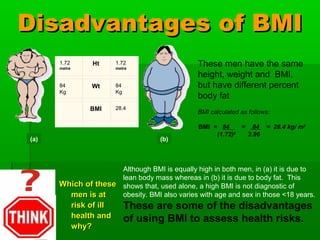
These men have the same
height, weight and BMI,
but have different percent
body fat
BMI calculated as follows:
BMI = 84 = 84 = 28.4 kg/ m2
(1.72)2
2.96
Which of theseWhich of these
men is atmen is at
risk of illrisk of ill
health andhealth and
why?why?
Although BMI is equally high in both men, in (a) it is due to
lean body mass whereas in (b) it is due to body fat. This
shows that, used alone, a high BMI is not diagnostic of
obesity. BMI also varies with age and sex in those <18 years.
These are some of the disadvantages
of using BMI to assess health risks.
Answer to QuestionAnswer to Question
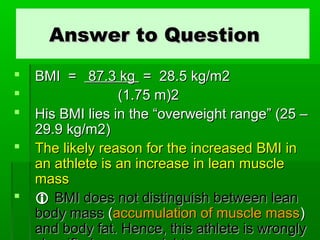
 BMI =BMI = 87.387.3 kgkg == 28.28.55 kg/m2kg/m2
 (1.(1.7575 m)2m)2
 HHis BMI lies in the “overweight range” (25 –is BMI lies in the “overweight range” (25 –
29.9 kg/m229.9 kg/m2))
 The likely reason for the increased BMI inThe likely reason for the increased BMI in
an athlete is an increase in lean musclean athlete is an increase in lean muscle
massmass
  BMI does not distinguish between leanBMI does not distinguish between lean
body massbody mass ((accumulation of muscle massaccumulation of muscle mass))
and body fat. Hence, this athlete is wronglyand body fat. Hence, this athlete is wrongly
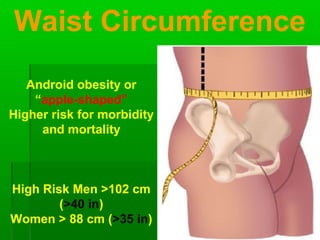
Waist Circumference
Android obesity or
“apple-shaped”
Higher risk for morbidity
and mortality
High Risk Men >102 cm
(>40 in)
Women > 88 cm (>35 in)
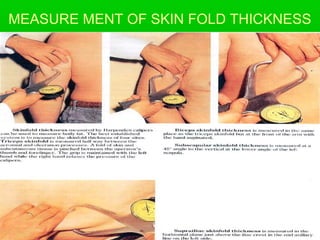
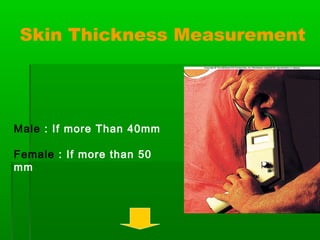
MEASURE MENT OF SKIN FOLD THICKNESS
Skin Thickness Measurement
Male : If more Than 40mm
Female : If more than 50
mm
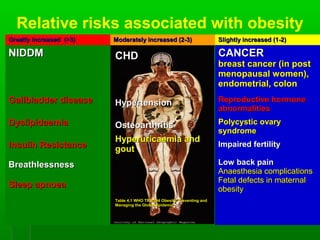
Relative risks associated with obesity
Greatly increased (>3)Greatly increased (>3) Moderately increased (2-3)Moderately increased (2-3) Slightly increased (1-2)Slightly increased (1-2)
NIDDMNIDDM CHDCHD CANCERCANCER
breast cancer (in postbreast cancer (in post
menopausal women),menopausal women),
endometrial, colonendometrial, colon
Gallbladder diseaseGallbladder disease HypertensionHypertension Reproductive hormoneReproductive hormone
abnormalitiesabnormalities
DyslipidaemiaDyslipidaemia OsteoarthritisOsteoarthritis Polycystic ovaryPolycystic ovary
syndromesyndrome
Insulin ResistanceInsulin Resistance
BreathlessnessBreathlessness
Sleep apnoeaSleep apnoea
Hyperuricaemia andHyperuricaemia and
goutgout
Table 4.1 WHO TRS 894 Obesity: Preventing andTable 4.1 WHO TRS 894 Obesity: Preventing and
Managing the Global EpidemicManaging the Global Epidemic
Impaired fertilityImpaired fertility
Low back painLow back pain
Anaesthesia complicationsAnaesthesia complications
Fetal defects in maternalFetal defects in maternal
obesityobesity
CHDCHD
HypertensionHypertension
OsteoarthritisOsteoarthritis
Hyperuricaemia andHyperuricaemia and
goutgout
Table 4.1 WHO TRS 894 Obesity: Preventing andTable 4.1 WHO TRS 894 Obesity: Preventing and
Managing the Global EpidemicManaging the Global Epidemic
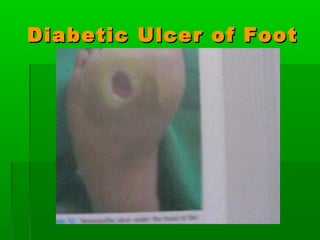
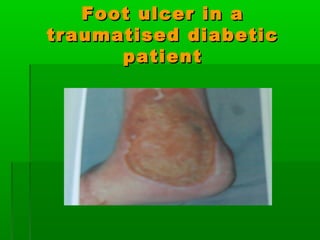
Diabetic Ulcer of FootDiabetic Ulcer of Foot
Foot ulcer in aFoot ulcer in a
traumatised diabetictraumatised diabetic
patientpatient
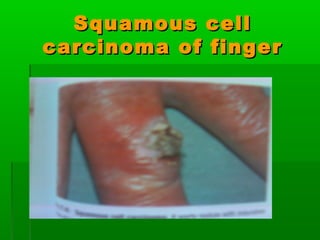
Squamous cellSquamous cell
carcinoma of fingercarcinoma of finger
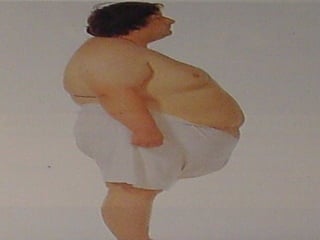
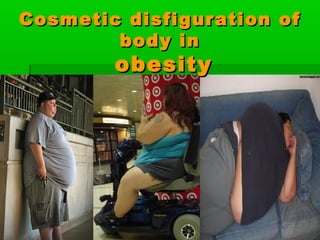
Cosmetic disfiguration ofCosmetic disfiguration of
body inbody in
obesityobesity
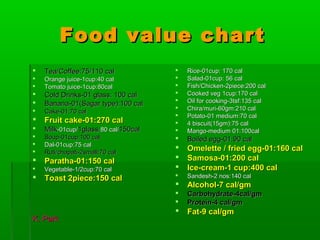
Food value chartFood value chart
 Tea/Coffee:75/110 calTea/Coffee:75/110 cal
 Orange juice-1cup:40 calOrange juice-1cup:40 cal
 Tomato juice-1cup:80calTomato juice-1cup:80cal
 Cold Drinks-01 glass: 100 calCold Drinks-01 glass: 100 cal
 Banana-01(Sagar type):100 calBanana-01(Sagar type):100 cal
 Cake-01:70 calCake-01:70 cal
 Fruit cake-01:270 calFruit cake-01:270 cal
 MilkMilk-01cup/-01cup/1glass:1glass:80 cal/80 cal/150cal150cal
 Soup-01cup:100 calSoup-01cup:100 cal
 Dal-01cup:75 calDal-01cup:75 cal
 Ruti/chapati-2small:70 calRuti/chapati-2small:70 cal
 Paratha-01:150 calParatha-01:150 cal
 Vegetable-1/2cup:70 calVegetable-1/2cup:70 cal
 Toast 2piece:150 calToast 2piece:150 cal
K. ParkK. Park
 Rice-01cup: 170 calRice-01cup: 170 cal
 Salad-01cup: 56 calSalad-01cup: 56 cal
 Fish/Chicken-2piece:200 calFish/Chicken-2piece:200 cal
 Cooked veg 1cup:170 calCooked veg 1cup:170 cal
 Oil for cooking-3tsf:135 calOil for cooking-3tsf:135 cal
 Chira/muri-60gm:210 calChira/muri-60gm:210 cal
 Potato-01 medium:70 calPotato-01 medium:70 cal
 4 biscuit(15gm):75 cal4 biscuit(15gm):75 cal
 Mango-medium 01:100calMango-medium 01:100cal
 Boiled egg-01:90 calBoiled egg-01:90 cal
 Omelette / fried egg-01:160 calOmelette / fried egg-01:160 cal
 Samosa-01:200 calSamosa-01:200 cal
 Ice-cream-1 cup:400 calIce-cream-1 cup:400 cal
 Sandesh-2 nos:140 calSandesh-2 nos:140 cal
 Alcohol-7 cal/gmAlcohol-7 cal/gm
 Carbohydrate-4cal/gmCarbohydrate-4cal/gm
 Protein-4 cal/gmProtein-4 cal/gm
 Fat-9 cal/gmFat-9 cal/gm
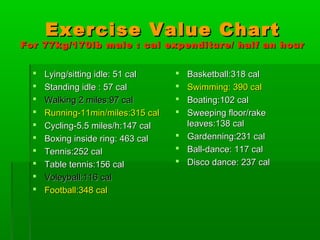
Exercise Value ChartExercise Value Chart
For 77kg/170lb male : cal expenditure/ half an hourFor 77kg/170lb male : cal expenditure/ half an hour
 Lying/sitting idle: 51 calLying/sitting idle: 51 cal
 Standing idle : 57 calStanding idle : 57 cal
 Walking 2 miles:97 calWalking 2 miles:97 cal
 Running-11min/miles:315 calRunning-11min/miles:315 cal
 Cycling-5.5 miles/h:147 calCycling-5.5 miles/h:147 cal
 Boxing inside ring: 463 calBoxing inside ring: 463 cal
 Tennis:252 calTennis:252 cal
 Table tennis:156 calTable tennis:156 cal
 Voleyball:116 calVoleyball:116 cal
 Football:348 calFootball:348 cal
 Basketball:318 calBasketball:318 cal
 Swimming: 390 calSwimming: 390 cal
 Boating:102 calBoating:102 cal
 Sweeping floor/rakeSweeping floor/rake
leaves:138 calleaves:138 cal
 Gardenning:231 calGardenning:231 cal
 Ball-dance: 117 calBall-dance: 117 cal
 Disco dance: 237 calDisco dance: 237 cal
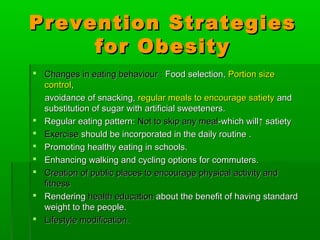
Prevention StrategiesPrevention Strategies
for Obesityfor Obesity
 Changes in eating behaviour :Changes in eating behaviour : Food selection,Food selection, Portion sizePortion size
controlcontrol,,
avoidance of snacking,avoidance of snacking, regular meals to encourage satietyregular meals to encourage satiety andand
substitution of sugar with artificial sweeteners.substitution of sugar with artificial sweeteners.
 Regular eating pattern:Regular eating pattern: Not to skip any mealNot to skip any meal-which will-which will↑ satiety↑ satiety
 ExerciseExercise should be incorporated in the daily routine .should be incorporated in the daily routine .
 Promoting healthy eating in schools.Promoting healthy eating in schools.
 Enhancing walking and cycling options for commuters.Enhancing walking and cycling options for commuters.
 Creation of public places to encourage physical activity andCreation of public places to encourage physical activity and
fitnessfitness
 RenderingRendering health educationhealth education about the benefit of having standardabout the benefit of having standard
weight to the people.weight to the people.
 Lifestyle modification.Lifestyle modification.
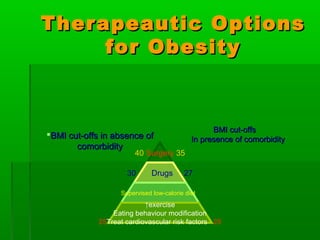
Therapeautic OptionsTherapeautic Options
for Obesityfor Obesity
40 Surgery 35
30 Drugs 27
Supervised low-calorie diet
↑exercise
Eating behaviour modification
25Treat cardiovascular risk factors 25
BMI cut-offs in absence ofBMI cut-offs in absence of
comorbiditycomorbidity
BMI cut-offsBMI cut-offs
In presence of comorbidityIn presence of comorbidity
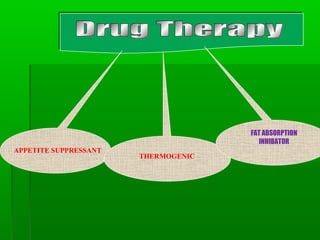
APPETITE SUPPRESSANT
THERMOGENIC
FAT ABSORPTION
INHIBATOR
DrugDrug
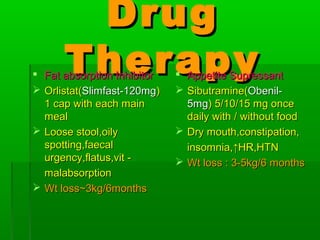
TherapyTherapy Fat absorption InhibitorFat absorption Inhibitor
 Orlistat(Orlistat(Slimfast-120mgSlimfast-120mg))
1 cap with each main1 cap with each main
mealmeal
 Loose stool,oilyLoose stool,oily
spotting,faecalspotting,faecal
urgency,flatus,vit -urgency,flatus,vit -
malabsorptionmalabsorption
 Wt lossWt loss~3kg/6months~3kg/6months
 Appetite SupressantAppetite Supressant
 Sibutramine(Sibutramine(Obenil-Obenil-
5mg5mg) 5/10/15 mg once) 5/10/15 mg once
daily with / without fooddaily with / without food
 Dry mouth,constipation,Dry mouth,constipation,
insomnia,insomnia,↑HR,HTN↑HR,HTN
 Wt loss : 3-5kg/6 monthsWt loss : 3-5kg/6 months
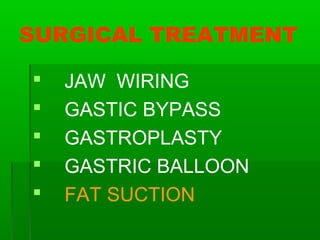
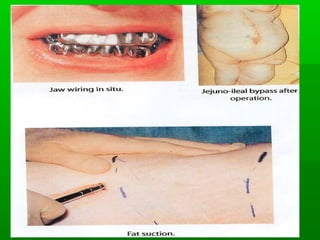
 JAW WIRING
 GASTIC BYPASS
 GASTROPLASTY
 GASTRIC BALLOON
 FAT SUCTION
SURGICAL TREATMENT
Types OfTypes Of
ExerciseExercise
 Aerobic ExerciseAerobic Exercise : running, swimming,: running, swimming,
walking etc.walking etc.
 Anaerobic ExerciseAnaerobic Exercise : Weight lifting,: Weight lifting,
sketing ,Yoga, exercise with dumble etc.sketing ,Yoga, exercise with dumble etc.
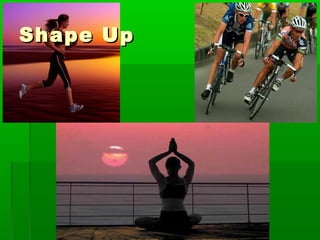
Shape UpShape Up
Find out more at http://www.Powerhealths.com
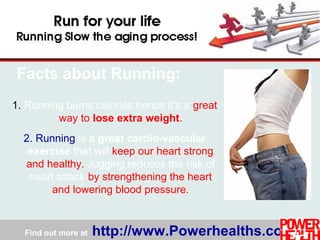
1. Running burns calories hence it’s a great
way to lose extra weight.
2. Running is a great cardio-vascular
exercise that will keep our heart strong
and healthy. Jogging reduces the risk of
heart attack by strengthening the heart
and lowering blood pressure.
Facts about Running:
Find out more at http://www.Powerhealths.com
3. Running if done regularly,
according to Mayo Clinic, can
ease symptoms of depression
and anxiety.
Find out more at http://www.Powerhealths.com
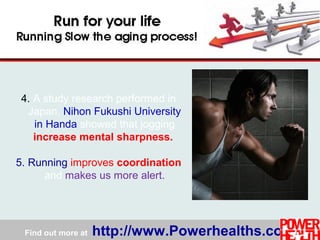
4. A study research performed in
Japan, Nihon Fukushi University
in Handa showed that jogging
increase mental sharpness.
5. Running improves coordination
and makes us more alert.
Find out more at http://www.Powerhealths.com
6. Running makes us happier.
While running the body
released a hormone known as
endorphins that create a
sense of euphoria.
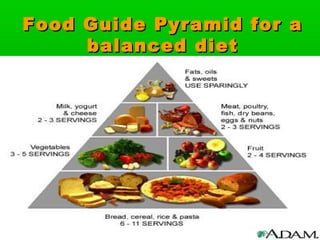
Food Guide Pyramid for aFood Guide Pyramid for a
balanced dietbalanced diet
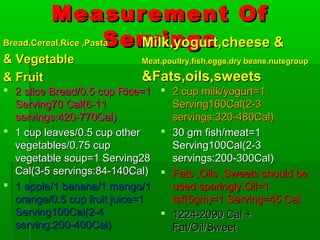
Measurement OfMeasurement Of
ServingsServingsBread,Cereal,Rice ,PastaBread,Cereal,Rice ,Pasta
& Vegetable& Vegetable
& Fruit& Fruit
 2 slice Bread/0.5 cup Rice=12 slice Bread/0.5 cup Rice=1
Serving70 Cal(6-11Serving70 Cal(6-11
servings:420-770Cal)servings:420-770Cal)
 1 cup leaves/0.5 cup other1 cup leaves/0.5 cup other
vegetables/0.75 cupvegetables/0.75 cup
vegetable soup=1 Serving28vegetable soup=1 Serving28
Cal(3-5 servings:84-140Cal)Cal(3-5 servings:84-140Cal)
 1 apple/1 banana/1 mango/11 apple/1 banana/1 mango/1
orange/0.5 cup fruit juice=1orange/0.5 cup fruit juice=1
Serving100Cal(2-4Serving100Cal(2-4
serving:200-400Cal)serving:200-400Cal)
Milk,yogurt,cheese &Milk,yogurt,cheese &
Meat,poultry,fish,eggs,dry beans,nutsgroupMeat,poultry,fish,eggs,dry beans,nutsgroup
&Fats,oils,sweets&Fats,oils,sweets
 2 cup milk/yogurt=12 cup milk/yogurt=1
Serving160Cal(2-3Serving160Cal(2-3
servings:320-480Cal)servings:320-480Cal)
 30 gm fish/meat=130 gm fish/meat=1
Serving100Cal(2-3Serving100Cal(2-3
servings:200-300Cal)servings:200-300Cal)
 Fats ,Oils ,Sweets should beFats ,Oils ,Sweets should be
used sparingly.Oil=1used sparingly.Oil=1
tsf(5gm)=1 Serving=45 Caltsf(5gm)=1 Serving=45 Cal
 1224-2090 Cal +1224-2090 Cal +
Fat/Oil/SweetFat/Oil/Sweet
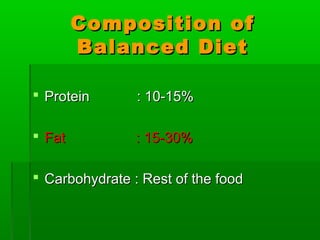
Composition ofComposition of
Balanced DietBalanced Diet
 Protein : 10-15%Protein : 10-15%
 Fat : 15-30%Fat : 15-30%
 Carbohydrate : Rest of the foodCarbohydrate : Rest of the food
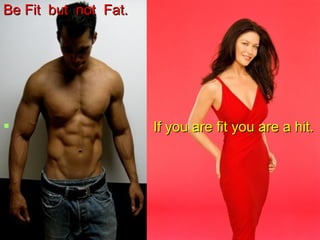
Be Fit but not Fat.Be Fit but not Fat.
 If you are fit you are a hit.If you are fit you are a hit.
Fitness PledgeFitness Pledge
 My body is the only place I have to live.My body is the only place I have to live.
 I am proud to be gifted this wonderful creation.I am proud to be gifted this wonderful creation.
 I shall always strive to keep it healthy and fit.I shall always strive to keep it healthy and fit.
 I shall give all my body systems respect and treatI shall give all my body systems respect and treat
them with courtesy.them with courtesy.
 To my body and my health , I pledge my care andTo my body and my health , I pledge my care and
consideration.consideration.
 In body’s well-being and fitness - lies my happiness.In body’s well-being and fitness - lies my happiness.
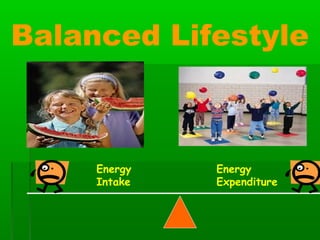
Balanced Lifestyle
Energy
Intake
Energy
Expenditure
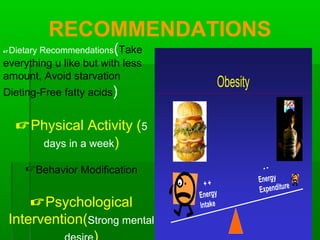
RECOMMENDATIONS
- -
Energy
Expenditure+ +
Energy
Intake
Obesity
Dietary Recommendations(Take
everything u like but with less
amount, Avoid starvation
Dieting-Free fatty acids)
Physical Activity (5
days in a week)
Behavior Modification
Psychological
Intervention(Strong mental
??
Interaction with others atInteraction with others at
meetings like this, is one ofmeetings like this, is one of
thethe best waysbest ways to be updatedto be updated
ReferencesReferences
 www.powerhealth.comwww.powerhealth.com
 www.pubmed.comwww.pubmed.com
 Murtagh’s general practice 5Murtagh’s general practice 5thth
EditionEdition
 Davidson’s principles & practice of Medicine, 22Davidson’s principles & practice of Medicine, 22ndnd
EditionEdition
 Current Medical Diagnosis & Treatment-2015Current Medical Diagnosis & Treatment-2015
 Park’s Textbook of Preventive & Social Medicine-23Park’s Textbook of Preventive & Social Medicine-23rdrd
EditionEdition
 Kumar & Clark’s Clinical Medicine -8Kumar & Clark’s Clinical Medicine -8thth
EditionEdition
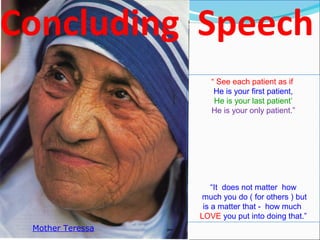
“ See each patient as if
He is your first patient,
He is your last patient’
He is your only patient.”
“It does not matter how
much you do ( for others ) but
is a matter that - how much
LOVE you put into doing that.”
Mother Teressa
This presentation is available at :

Obesity and its management 2016

  • 2.
    OBESITY AND ITSOBESITYAND ITS MANAGEMENTMANAGEMENT Maj Neamatullah AhmedMaj Neamatullah Ahmed PBGMS,MPH,MCPSPBGMS,MPH,MCPS
  • 3.
    INTRODUCTIONINTRODUCTION It produces manycomplications like hypertension, Diabetes Mellitus, IHD,Stroke etc.
  • 4.
    Deadly DiseasesDeadly Diseases CausingDeath of MillionsCausing Death of Millions of People worldwideof People worldwide  In 20th CenturyIn 20th Century  Deadly infections,i.e.Deadly infections,i.e.  CholeraCholera  Small poxSmall pox  TuberculosisTuberculosis  TetanusTetanus  MeaslesMeasles  PneumoniaPneumonia  Bird fluBird flu  Other viral & bacterialOther viral & bacterial infectionsinfections  In 21In 21stst CenturyCentury  Hypertension-CVAHypertension-CVA  Heart DiseasesHeart Diseases  DiabetesDiabetes  CancerCancer  ObesityObesity  Man made Disaster-Man made Disaster- RTA, War etcRTA, War etc
  • 5.
    Projected prevalence ofobesity in adults by 2025
  • 6.
  • 7.
    My aim isto orient youMy aim is to orient you about :about : Definition of obesityDefinition of obesity  PrevalencePrevalence  Reversible causes of weight gainReversible causes of weight gain  Obesogenic environmentObesogenic environment  Food value chartFood value chart  Different exercise value chartDifferent exercise value chart  Prevention strategies for obesityPrevention strategies for obesity  Balanced DietBalanced Diet  Therapeutic options for obesityTherapeutic options for obesity  Surgical options for obesitySurgical options for obesity  Danger FoodsDanger Foods  Fitness PledgeFitness Pledge  Prevention of obesityPrevention of obesity  RecommendationsRecommendations
  • 8.
    Abnormal growth ofthe adipose tissue due to enlargement of fat cell size (hypertrophic) or an increase of fat cell no (hyper plastic) or combination of both.
  • 9.
    Desirable % BodyFatDesirable % Body Fat  Men: 8-25%Men: 8-25%  Women 20-35%Women 20-35%
  • 10.
  • 11.
    What is Prevalence?Whatis Prevalence? New Obese / Incidence + Old ObeseNew Obese / Incidence + Old Obese No of Total Obese PersonsNo of Total Obese Persons
  • 12.
    Global epidemic ofGlobalepidemic of obesityobesity 0 200 400 600 800 1000 1200 1400 1600 2000 2005 BMI>30 BMI>25 Overweight and Obesity are the 5Overweight and Obesity are the 5thth leading risk of global deaths.leading risk of global deaths. At least 3.4 million adults die each year as a result of beingAt least 3.4 million adults die each year as a result of being overweight or obese.overweight or obese.
  • 13.
    Obesity Trends* AmongU.S.Obesity Trends* Among U.S. AdultsAdults BRFSS, 2005BRFSS, 2005 15%–19% 20%–24% 25%–29% ≥30%
  • 14.
  • 15.
    Bangladesh  Prevalence ofobesity among girls & women aged 10 to 49 yrs SlSl nono BMIBMI Prevalence (%)Prevalence (%) 1.1. > 25> 25 55 2.2. 18.5- 24.9918.5- 24.99 5959 3.3. < 25< 25 9595 4.4. < 18.5< 18.5 3535 Source: Bangladesh demographic & health data 2004 In 2010, among college students of Dhaka City - Prevalence of obesity is 18%
  • 16.
    United Kingdom 16% adultsare obese by 199516% adults are obese by 1995 25% adults are obese by 201025% adults are obese by 2010 16% adults are obese by 199516% adults are obese by 1995 25% adults are obese by 201025% adults are obese by 2010
  • 17.
    United States 68% Americansare overweight and68% Americans are overweight and 33.8% Americans are obese33.8% Americans are obese 68% Americans are overweight and68% Americans are overweight and 33.8% Americans are obese33.8% Americans are obese
  • 18.
  • 19.
    Potential reversible causesofPotential reversible causes of weight gainweight gain  Endocrine FactorsEndocrine Factors HypothyroidismHypothyroidism Cushing’s SyndromeCushing’s Syndrome Hypothalamic Tumors / injuryHypothalamic Tumors / injury InsulinomaInsulinoma  Drug TreatmentsDrug Treatments Tricyclic antidepressantTricyclic antidepressant SulphonylureasSulphonylureas Oestrogen-containing contraceptive pillOestrogen-containing contraceptive pill CorticosteroidsCorticosteroids Sodium valproateSodium valproate ß-blockersß-blockers NSAIDSNSAIDS  Pathological Eating BehaviourPathological Eating Behaviour Binge eatingBinge eating Nocturnal eating/BulimiaNocturnal eating/Bulimia  Alcohol consumptionAlcohol consumption Davidson/22ndDavidson/22nd
  • 20.
    Reasons for theincrease prevalence ofReasons for the increase prevalence of obesity-The ‘Obesogenic’ Environmentobesity-The ‘Obesogenic’ Environment  Increasing energy intakeIncreasing energy intake ↑↑Portion sizesPortion sizes ↑↑Snacking and loss of regular mealsSnacking and loss of regular meals ↑↑Energy-dense food (mainly fat)Energy-dense food (mainly fat) ↑↑AffluenceAffluence Late night sleepLate night sleep  Decreasing energy expenditureDecreasing energy expenditure ↑↑Car ownershipCar ownership ↓↓Walking to school/workWalking to school/work ↑↑Automation; ↓manual labourAutomation; ↓manual labour ↓↓Sports in schoolsSports in schools ↑↑Time spent on video games and watching TVTime spent on video games and watching TV ↑↑Central heating( Air ConditioningCentral heating( Air Conditioning))
  • 22.
    BAGEL 20 Years Ago Today 140calories 3-inch diameter How many calories are in this bagel?
  • 23.
    BAGEL 20 Years AgoToday 140 calories 3-inch diameter 350 calories 6-inch diameter Calorie Difference: 210 calories
  • 24.
    Maintaining a HealthyWeight is a Balancing Act Calories In = Calories Out How long will you have to rake leaves in order to burn the extra 210 calories?* *Based on 130-pound person
  • 25.
    Calories In =Calories Out If you rake the leaves for 50 minutes you will burn the extra 210 calories.* *Based on 130-pound person
  • 26.
    CHEESEBURGER 20 Years Ago Today 333calories How many calories are in today’s cheeseburger?
  • 27.
    CHEESEBURGER 20 Years AgoToday 590 calories 333 calories Calorie Difference: 257 calories
  • 28.
    Maintaining a HealthyWeight is a Balancing Act Calories In = Calories Out How long will you have to lift weights in order to burn the extra 257 calories?* *Based on 130-pound person
  • 29.
    Calories In =Calories Out If you lift weights for 1 hour and 30 minutes, you will burn approximately 257 calories.* *Based on 130-pound person
  • 30.
    Calories In =Calories Out If you ride a bike for 1 hour and 25 minutes, you will burn approximately 500 calories.* *Based on 160-pound person
  • 31.
    EpidemiologyEpidemiology SexSex AgeAge Physical InactivityPhysical InactivityGenetic FactorsGenetic Factors Socio-economic StatusSocio-economic Status Eating HabitEating Habit Psychological Factors Psychological Factors
  • 32.
    Obesity can occurat any age If obesity develops in childhood, it is likely to be followed by obesity in adult life
  • 33.
    Women are moreprone to obesity than men Woman’s BMI increases with successive pregnancies.
  • 34.
    Genetic factors alsoplays an important role
  • 35.
  • 37.
    Obesity is more commonand prevalent in the affluent society than that of other classes.
  • 39.
    The use ofsteroids, oral contraceptive pills, pain killers, Anti-hypertensives & insulin is commonly followed by obesity
  • 40.
    The composition ofdiet, the periodicity with which it is eaten and the amount of energy derived from it are all relevant with obesity
  • 41.
  • 42.
  • 43.
    Physical inactivity maycause obesity, which in turn restrict activity
  • 44.
    Types ofTypes of ObesityObesity Apple Shape obesityApple Shape obesity  Pear Shaped ObesityPear Shaped Obesity
  • 46.
    Partners in GlobalHealth Education 1. How to use this module 2. Learning outcomes 3. Definition 4. Classification 5. Section 1 quiz 6. Global burden of obesity 7. Section 2 quiz 8. Pathogenesis 9. Section 3 quiz 10. Effects of obesity 11. Section 4 quiz 12. Childhood obesity 13. Section 5 quiz 14. Management of obesity 15. Section 6 quiz 16. Summary 17. Information sources tio n1 Note: Although overweight is identified by a BMI of ? 25.0 kg/m2, the risks of obesity-associated diseases, such as diabetes, hypertension and dyslipidaemia, increase from a BMI of about 21.0 kg/m2. Increased as follows:≥30.0Obesity, further classified as: – Very severe – Severe – Moderate Increased Not increased Risk of co-morbidity ≥40.0– Class III 35.0 - 39.9– Class II 30.0 - 34.9– Class I 25.0 - 29.9Overweight or pre-obese 18.5 - 24.9Normal BMI (kg/m2)Classification Source: Adapted from WHO 1997 WHO classification of obesity
  • 47.
    Different Techniques toMeasure ObesityDifferent Techniques to Measure Obesity Body Mass Index (BMI-Kg/m2) Waist-Hip Ratio ( WHR) Waist Circumference Skin fold thickness Broca Index : Height in cm – 100= Body weight in KG
  • 49.
    Body Mass IndexBodyMass Index The new vital sign!The new vital sign!  Correlated with total body fat contentCorrelated with total body fat content  Not accurate in muscular individualsNot accurate in muscular individuals  Initial assessment and monitoringInitial assessment and monitoring  BMIBMI  weight in lbs/(height in inches)weight in lbs/(height in inches)22 x 703x 703  ExampleExample  5’6” 248lb female5’6” 248lb female  248lbs / (66inches)248lbs / (66inches)22 x 703 = 40x 703 = 40
  • 50.
  • 51.
    Disadvantages of BMIDisadvantagesof BMI (a) 1.72 metre Ht 1.72 metre 84 Kg Wt 84 Kg 28.4 BMI 28.4 (b) These men have the same height, weight and BMI, but have different percent body fat BMI calculated as follows: BMI = 84 = 84 = 28.4 kg/ m2 (1.72)2 2.96 Which of theseWhich of these men is atmen is at risk of illrisk of ill health andhealth and why?why? Although BMI is equally high in both men, in (a) it is due to lean body mass whereas in (b) it is due to body fat. This shows that, used alone, a high BMI is not diagnostic of obesity. BMI also varies with age and sex in those <18 years. These are some of the disadvantages of using BMI to assess health risks.
  • 52.
    Answer to QuestionAnswerto Question  BMI =BMI = 87.387.3 kgkg == 28.28.55 kg/m2kg/m2  (1.(1.7575 m)2m)2  HHis BMI lies in the “overweight range” (25 –is BMI lies in the “overweight range” (25 – 29.9 kg/m229.9 kg/m2))  The likely reason for the increased BMI inThe likely reason for the increased BMI in an athlete is an increase in lean musclean athlete is an increase in lean muscle massmass   BMI does not distinguish between leanBMI does not distinguish between lean body massbody mass ((accumulation of muscle massaccumulation of muscle mass)) and body fat. Hence, this athlete is wronglyand body fat. Hence, this athlete is wrongly
  • 53.
    Waist Circumference Android obesityor “apple-shaped” Higher risk for morbidity and mortality High Risk Men >102 cm (>40 in) Women > 88 cm (>35 in)
  • 54.
    MEASURE MENT OFSKIN FOLD THICKNESS
  • 55.
    Skin Thickness Measurement Male: If more Than 40mm Female : If more than 50 mm
  • 57.
    Relative risks associatedwith obesity Greatly increased (>3)Greatly increased (>3) Moderately increased (2-3)Moderately increased (2-3) Slightly increased (1-2)Slightly increased (1-2) NIDDMNIDDM CHDCHD CANCERCANCER breast cancer (in postbreast cancer (in post menopausal women),menopausal women), endometrial, colonendometrial, colon Gallbladder diseaseGallbladder disease HypertensionHypertension Reproductive hormoneReproductive hormone abnormalitiesabnormalities DyslipidaemiaDyslipidaemia OsteoarthritisOsteoarthritis Polycystic ovaryPolycystic ovary syndromesyndrome Insulin ResistanceInsulin Resistance BreathlessnessBreathlessness Sleep apnoeaSleep apnoea Hyperuricaemia andHyperuricaemia and goutgout Table 4.1 WHO TRS 894 Obesity: Preventing andTable 4.1 WHO TRS 894 Obesity: Preventing and Managing the Global EpidemicManaging the Global Epidemic Impaired fertilityImpaired fertility Low back painLow back pain Anaesthesia complicationsAnaesthesia complications Fetal defects in maternalFetal defects in maternal obesityobesity CHDCHD HypertensionHypertension OsteoarthritisOsteoarthritis Hyperuricaemia andHyperuricaemia and goutgout Table 4.1 WHO TRS 894 Obesity: Preventing andTable 4.1 WHO TRS 894 Obesity: Preventing and Managing the Global EpidemicManaging the Global Epidemic
  • 58.
    Diabetic Ulcer ofFootDiabetic Ulcer of Foot
  • 59.
    Foot ulcer inaFoot ulcer in a traumatised diabetictraumatised diabetic patientpatient
  • 60.
    Squamous cellSquamous cell carcinomaof fingercarcinoma of finger
  • 61.
    Cosmetic disfiguration ofCosmeticdisfiguration of body inbody in obesityobesity
  • 63.
    Food value chartFoodvalue chart  Tea/Coffee:75/110 calTea/Coffee:75/110 cal  Orange juice-1cup:40 calOrange juice-1cup:40 cal  Tomato juice-1cup:80calTomato juice-1cup:80cal  Cold Drinks-01 glass: 100 calCold Drinks-01 glass: 100 cal  Banana-01(Sagar type):100 calBanana-01(Sagar type):100 cal  Cake-01:70 calCake-01:70 cal  Fruit cake-01:270 calFruit cake-01:270 cal  MilkMilk-01cup/-01cup/1glass:1glass:80 cal/80 cal/150cal150cal  Soup-01cup:100 calSoup-01cup:100 cal  Dal-01cup:75 calDal-01cup:75 cal  Ruti/chapati-2small:70 calRuti/chapati-2small:70 cal  Paratha-01:150 calParatha-01:150 cal  Vegetable-1/2cup:70 calVegetable-1/2cup:70 cal  Toast 2piece:150 calToast 2piece:150 cal K. ParkK. Park  Rice-01cup: 170 calRice-01cup: 170 cal  Salad-01cup: 56 calSalad-01cup: 56 cal  Fish/Chicken-2piece:200 calFish/Chicken-2piece:200 cal  Cooked veg 1cup:170 calCooked veg 1cup:170 cal  Oil for cooking-3tsf:135 calOil for cooking-3tsf:135 cal  Chira/muri-60gm:210 calChira/muri-60gm:210 cal  Potato-01 medium:70 calPotato-01 medium:70 cal  4 biscuit(15gm):75 cal4 biscuit(15gm):75 cal  Mango-medium 01:100calMango-medium 01:100cal  Boiled egg-01:90 calBoiled egg-01:90 cal  Omelette / fried egg-01:160 calOmelette / fried egg-01:160 cal  Samosa-01:200 calSamosa-01:200 cal  Ice-cream-1 cup:400 calIce-cream-1 cup:400 cal  Sandesh-2 nos:140 calSandesh-2 nos:140 cal  Alcohol-7 cal/gmAlcohol-7 cal/gm  Carbohydrate-4cal/gmCarbohydrate-4cal/gm  Protein-4 cal/gmProtein-4 cal/gm  Fat-9 cal/gmFat-9 cal/gm
  • 64.
    Exercise Value ChartExerciseValue Chart For 77kg/170lb male : cal expenditure/ half an hourFor 77kg/170lb male : cal expenditure/ half an hour  Lying/sitting idle: 51 calLying/sitting idle: 51 cal  Standing idle : 57 calStanding idle : 57 cal  Walking 2 miles:97 calWalking 2 miles:97 cal  Running-11min/miles:315 calRunning-11min/miles:315 cal  Cycling-5.5 miles/h:147 calCycling-5.5 miles/h:147 cal  Boxing inside ring: 463 calBoxing inside ring: 463 cal  Tennis:252 calTennis:252 cal  Table tennis:156 calTable tennis:156 cal  Voleyball:116 calVoleyball:116 cal  Football:348 calFootball:348 cal  Basketball:318 calBasketball:318 cal  Swimming: 390 calSwimming: 390 cal  Boating:102 calBoating:102 cal  Sweeping floor/rakeSweeping floor/rake leaves:138 calleaves:138 cal  Gardenning:231 calGardenning:231 cal  Ball-dance: 117 calBall-dance: 117 cal  Disco dance: 237 calDisco dance: 237 cal
  • 65.
    Prevention StrategiesPrevention Strategies forObesityfor Obesity  Changes in eating behaviour :Changes in eating behaviour : Food selection,Food selection, Portion sizePortion size controlcontrol,, avoidance of snacking,avoidance of snacking, regular meals to encourage satietyregular meals to encourage satiety andand substitution of sugar with artificial sweeteners.substitution of sugar with artificial sweeteners.  Regular eating pattern:Regular eating pattern: Not to skip any mealNot to skip any meal-which will-which will↑ satiety↑ satiety  ExerciseExercise should be incorporated in the daily routine .should be incorporated in the daily routine .  Promoting healthy eating in schools.Promoting healthy eating in schools.  Enhancing walking and cycling options for commuters.Enhancing walking and cycling options for commuters.  Creation of public places to encourage physical activity andCreation of public places to encourage physical activity and fitnessfitness  RenderingRendering health educationhealth education about the benefit of having standardabout the benefit of having standard weight to the people.weight to the people.  Lifestyle modification.Lifestyle modification.
  • 66.
    Therapeautic OptionsTherapeautic Options forObesityfor Obesity 40 Surgery 35 30 Drugs 27 Supervised low-calorie diet ↑exercise Eating behaviour modification 25Treat cardiovascular risk factors 25 BMI cut-offs in absence ofBMI cut-offs in absence of comorbiditycomorbidity BMI cut-offsBMI cut-offs In presence of comorbidityIn presence of comorbidity
  • 67.
  • 68.
    DrugDrug TherapyTherapy Fat absorptionInhibitorFat absorption Inhibitor  Orlistat(Orlistat(Slimfast-120mgSlimfast-120mg)) 1 cap with each main1 cap with each main mealmeal  Loose stool,oilyLoose stool,oily spotting,faecalspotting,faecal urgency,flatus,vit -urgency,flatus,vit - malabsorptionmalabsorption  Wt lossWt loss~3kg/6months~3kg/6months  Appetite SupressantAppetite Supressant  Sibutramine(Sibutramine(Obenil-Obenil- 5mg5mg) 5/10/15 mg once) 5/10/15 mg once daily with / without fooddaily with / without food  Dry mouth,constipation,Dry mouth,constipation, insomnia,insomnia,↑HR,HTN↑HR,HTN  Wt loss : 3-5kg/6 monthsWt loss : 3-5kg/6 months
  • 69.
     JAW WIRING GASTIC BYPASS  GASTROPLASTY  GASTRIC BALLOON  FAT SUCTION SURGICAL TREATMENT
  • 73.
    Types OfTypes Of ExerciseExercise Aerobic ExerciseAerobic Exercise : running, swimming,: running, swimming, walking etc.walking etc.  Anaerobic ExerciseAnaerobic Exercise : Weight lifting,: Weight lifting, sketing ,Yoga, exercise with dumble etc.sketing ,Yoga, exercise with dumble etc.
  • 74.
  • 75.
    Find out moreat http://www.Powerhealths.com 1. Running burns calories hence it’s a great way to lose extra weight. 2. Running is a great cardio-vascular exercise that will keep our heart strong and healthy. Jogging reduces the risk of heart attack by strengthening the heart and lowering blood pressure. Facts about Running:
  • 76.
    Find out moreat http://www.Powerhealths.com 3. Running if done regularly, according to Mayo Clinic, can ease symptoms of depression and anxiety.
  • 77.
    Find out moreat http://www.Powerhealths.com 4. A study research performed in Japan, Nihon Fukushi University in Handa showed that jogging increase mental sharpness. 5. Running improves coordination and makes us more alert.
  • 78.
    Find out moreat http://www.Powerhealths.com 6. Running makes us happier. While running the body released a hormone known as endorphins that create a sense of euphoria.
  • 79.
    Food Guide Pyramidfor aFood Guide Pyramid for a balanced dietbalanced diet
  • 80.
    Measurement OfMeasurement Of ServingsServingsBread,Cereal,Rice,PastaBread,Cereal,Rice ,Pasta & Vegetable& Vegetable & Fruit& Fruit  2 slice Bread/0.5 cup Rice=12 slice Bread/0.5 cup Rice=1 Serving70 Cal(6-11Serving70 Cal(6-11 servings:420-770Cal)servings:420-770Cal)  1 cup leaves/0.5 cup other1 cup leaves/0.5 cup other vegetables/0.75 cupvegetables/0.75 cup vegetable soup=1 Serving28vegetable soup=1 Serving28 Cal(3-5 servings:84-140Cal)Cal(3-5 servings:84-140Cal)  1 apple/1 banana/1 mango/11 apple/1 banana/1 mango/1 orange/0.5 cup fruit juice=1orange/0.5 cup fruit juice=1 Serving100Cal(2-4Serving100Cal(2-4 serving:200-400Cal)serving:200-400Cal) Milk,yogurt,cheese &Milk,yogurt,cheese & Meat,poultry,fish,eggs,dry beans,nutsgroupMeat,poultry,fish,eggs,dry beans,nutsgroup &Fats,oils,sweets&Fats,oils,sweets  2 cup milk/yogurt=12 cup milk/yogurt=1 Serving160Cal(2-3Serving160Cal(2-3 servings:320-480Cal)servings:320-480Cal)  30 gm fish/meat=130 gm fish/meat=1 Serving100Cal(2-3Serving100Cal(2-3 servings:200-300Cal)servings:200-300Cal)  Fats ,Oils ,Sweets should beFats ,Oils ,Sweets should be used sparingly.Oil=1used sparingly.Oil=1 tsf(5gm)=1 Serving=45 Caltsf(5gm)=1 Serving=45 Cal  1224-2090 Cal +1224-2090 Cal + Fat/Oil/SweetFat/Oil/Sweet
  • 81.
    Composition ofComposition of BalancedDietBalanced Diet  Protein : 10-15%Protein : 10-15%  Fat : 15-30%Fat : 15-30%  Carbohydrate : Rest of the foodCarbohydrate : Rest of the food
  • 83.
    Be Fit butnot Fat.Be Fit but not Fat.  If you are fit you are a hit.If you are fit you are a hit.
  • 84.
    Fitness PledgeFitness Pledge My body is the only place I have to live.My body is the only place I have to live.  I am proud to be gifted this wonderful creation.I am proud to be gifted this wonderful creation.  I shall always strive to keep it healthy and fit.I shall always strive to keep it healthy and fit.  I shall give all my body systems respect and treatI shall give all my body systems respect and treat them with courtesy.them with courtesy.  To my body and my health , I pledge my care andTo my body and my health , I pledge my care and consideration.consideration.  In body’s well-being and fitness - lies my happiness.In body’s well-being and fitness - lies my happiness.
  • 85.
  • 86.
    RECOMMENDATIONS - - Energy Expenditure+ + Energy Intake Obesity DietaryRecommendations(Take everything u like but with less amount, Avoid starvation Dieting-Free fatty acids) Physical Activity (5 days in a week) Behavior Modification Psychological Intervention(Strong mental
  • 87.
  • 88.
    Interaction with othersatInteraction with others at meetings like this, is one ofmeetings like this, is one of thethe best waysbest ways to be updatedto be updated
  • 90.
    ReferencesReferences  www.powerhealth.comwww.powerhealth.com  www.pubmed.comwww.pubmed.com Murtagh’s general practice 5Murtagh’s general practice 5thth EditionEdition  Davidson’s principles & practice of Medicine, 22Davidson’s principles & practice of Medicine, 22ndnd EditionEdition  Current Medical Diagnosis & Treatment-2015Current Medical Diagnosis & Treatment-2015  Park’s Textbook of Preventive & Social Medicine-23Park’s Textbook of Preventive & Social Medicine-23rdrd EditionEdition  Kumar & Clark’s Clinical Medicine -8Kumar & Clark’s Clinical Medicine -8thth EditionEdition
  • 92.
    “ See eachpatient as if He is your first patient, He is your last patient’ He is your only patient.” “It does not matter how much you do ( for others ) but is a matter that - how much LOVE you put into doing that.” Mother Teressa
  • 93.
    This presentation isavailable at :