Obesity
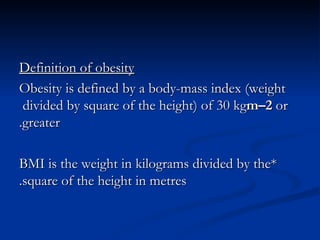
Definition of obesity Obesity is defined by a body-mass index (weight divided by square of the height) of 30 kg  m–2  or greater. *BMI is the weight in kilograms divided by the square of the height in metres.
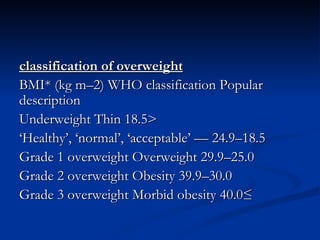
classification of overweight BMI* (kg m–2) WHO classification Popular description <18.5 Underweight Thin 18.5–24.9 — ‘Healthy’, ‘normal’, ‘acceptable’ 25.0–29.9 Grade 1 overweight Overweight 30.0–39.9 Grade 2 overweight Obesity ≥ 40.0 Grade 3 overweight Morbid obesity
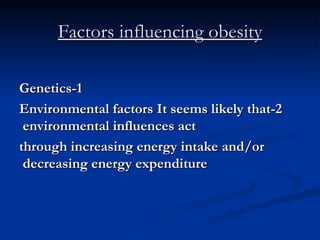
Factors influencing obesity 1-Genetics 2-Environmental factors It seems likely that environmental influences act  through increasing energy intake and/or decreasing energy expenditure
3- Energy expenditure . The most variable component of energy expenditure is  hysical activity, representing 20–50% of total energy expenditure. 4 - Energy intake  There is some evidence that high-fat diets are associated with  an increased risk of obesity within populations
5 - Culture   6-  Fetal nutrition . Evidence indicates that undernutrition of the fetus during intrauterine development may determine the later onset of obesity
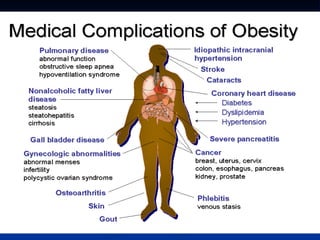
Effect of obesity on the body  1- Obesity leads to type 2 diabetes mellitus 2- The effects of obesity Cardiovascular function The increase in circulatory preload and afterload lead to left ventricular (LV) dilatation and hypertrophy.
3-  Sleep-breathing abnormalities in obesity During sleep, there is alveolar hypoventilation and transient episodes of apnea that are accompanied by a fall in arterial oxygen saturation (hypoxia) and a rise in arterial carbon dioxide (hypercapnia). In some individuals, these factors lead to daytime sleepiness (hypersomnolence) with persistent hypoxia and hypercapnia accompanied by the development of pulmonary hypertension, heart failure and eventually, respiratory failure.
4- Cerebrovascular disease Obesity is linked to an increased risk of stroke in both men and women  5- Gastrointestinal system  gastroesophageal reflux
-Hepatobiliary disease Obesity is associated with cholelithiasis. In the Nurses’ Health Study, women with BMI <24 kg/m2 had an incidence of symptomatic gallstones of approximately 250 per 100 000 person-years of follow-up. Women with BMI >45 kg/m2 had a seven-fold increase in risk for gallstones
-Osteoarthritis -Cancer --Psychosocial function -Gynaecological and obstetric complications   - Surgical and anesthetic complications
 
Management of obesity 1-Dieting 2-Exercise 3-Weight loss programs 4-   Medication 5-Surgery

Obesity

  • 1.
  • 2.
    Definition of obesityObesity is defined by a body-mass index (weight divided by square of the height) of 30 kg m–2 or greater. *BMI is the weight in kilograms divided by the square of the height in metres.
  • 3.
    classification of overweightBMI* (kg m–2) WHO classification Popular description <18.5 Underweight Thin 18.5–24.9 — ‘Healthy’, ‘normal’, ‘acceptable’ 25.0–29.9 Grade 1 overweight Overweight 30.0–39.9 Grade 2 overweight Obesity ≥ 40.0 Grade 3 overweight Morbid obesity
  • 4.
    Factors influencing obesity1-Genetics 2-Environmental factors It seems likely that environmental influences act through increasing energy intake and/or decreasing energy expenditure
  • 5.
    3- Energy expenditure. The most variable component of energy expenditure is hysical activity, representing 20–50% of total energy expenditure. 4 - Energy intake There is some evidence that high-fat diets are associated with an increased risk of obesity within populations
  • 6.
    5 - Culture 6- Fetal nutrition . Evidence indicates that undernutrition of the fetus during intrauterine development may determine the later onset of obesity
  • 7.
    Effect of obesityon the body 1- Obesity leads to type 2 diabetes mellitus 2- The effects of obesity Cardiovascular function The increase in circulatory preload and afterload lead to left ventricular (LV) dilatation and hypertrophy.
  • 8.
    3- Sleep-breathingabnormalities in obesity During sleep, there is alveolar hypoventilation and transient episodes of apnea that are accompanied by a fall in arterial oxygen saturation (hypoxia) and a rise in arterial carbon dioxide (hypercapnia). In some individuals, these factors lead to daytime sleepiness (hypersomnolence) with persistent hypoxia and hypercapnia accompanied by the development of pulmonary hypertension, heart failure and eventually, respiratory failure.
  • 9.
    4- Cerebrovascular diseaseObesity is linked to an increased risk of stroke in both men and women 5- Gastrointestinal system gastroesophageal reflux
  • 10.
    -Hepatobiliary disease Obesityis associated with cholelithiasis. In the Nurses’ Health Study, women with BMI <24 kg/m2 had an incidence of symptomatic gallstones of approximately 250 per 100 000 person-years of follow-up. Women with BMI >45 kg/m2 had a seven-fold increase in risk for gallstones
  • 11.
    -Osteoarthritis -Cancer --Psychosocialfunction -Gynaecological and obstetric complications - Surgical and anesthetic complications
  • 12.
  • 13.
    Management of obesity1-Dieting 2-Exercise 3-Weight loss programs 4- Medication 5-Surgery