OBESITY MANAGEMENT
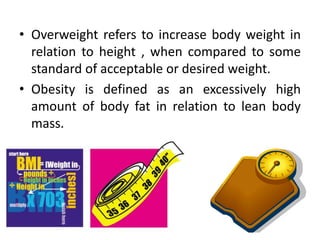
• Overweight refers to increase body weight in
relation to height , when compared to some
standard of acceptable or desired weight.
• Obesity is defined as an excessively high
amount of body fat in relation to lean body
mass.
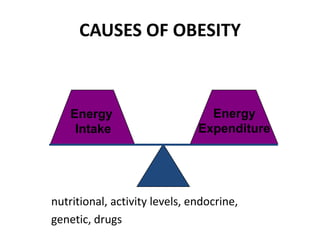
CAUSES OF OBESITY
Energy
Expenditure
Energy
Intake
nutritional, activity levels, endocrine,
genetic, drugs
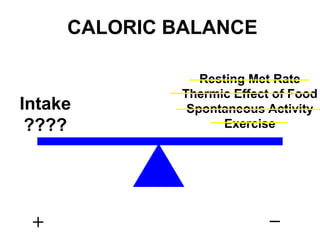
CALORIC BALANCE
Intake
????
Resting Met Rate
Thermic Effect of Food
Spontaneous Activity
Exercise
+
_
Energy Imbalance
What is it?
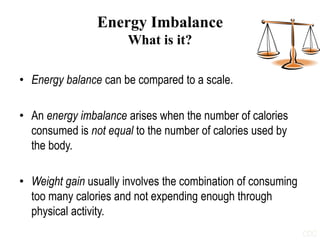
• Energy balance can be compared to a scale.
• An energy imbalance arises when the number of calories
consumed is not equal to the number of calories used by
the body.
• Weight gain usually involves the combination of consuming
too many calories and not expending enough through
physical activity.
CDC
2009
Energy Imbalance
Effects in the Body
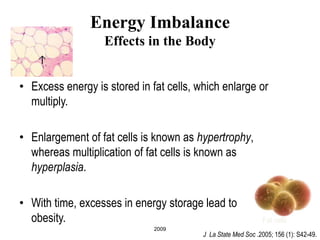
• Excess energy is stored in fat cells, which enlarge or
multiply.
• Enlargement of fat cells is known as hypertrophy,
whereas multiplication of fat cells is known as
hyperplasia.
• With time, excesses in energy storage lead to
obesity. Fat cells
J La State Med Soc .2005; 156 (1): S42-49.
Fat Cell Enlargement
Hypertrophy
• Enlarged fat cells produce the
clinical problems associated with
obesity, due to the following:
– The weight or mass of the extra
fat
– The increased secretion of free
fatty acids and peptides from
enlarged fat cells.
Factors Contributing to Obesity
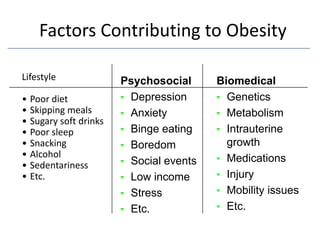
Lifestyle
• Poor diet
• Skipping meals
• Sugary soft drinks
• Poor sleep
• Snacking
• Alcohol
• Sedentariness
• Etc.
Psychosocial
• Depression
• Anxiety
• Binge eating
• Boredom
• Social events
• Low income
• Stress
• Etc.
Biomedical
• Genetics
• Metabolism
• Intrauterine
growth
• Medications
• Injury
• Mobility issues
• Etc.
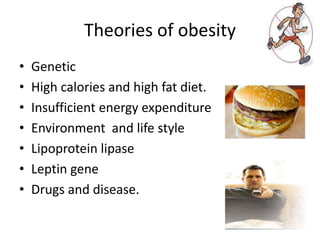
Theories of obesity
• Genetic
• High calories and high fat diet.
• Insufficient energy expenditure
• Environment and life style
• Lipoprotein lipase
• Leptin gene
• Drugs and disease.
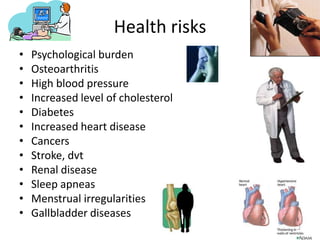
Health risks
• Psychological burden
• Osteoarthritis
• High blood pressure
• Increased level of cholesterol
• Diabetes
• Increased heart disease
• Cancers
• Stroke, dvt
• Renal disease
• Sleep apneas
• Menstrual irregularities
• Gallbladder diseases
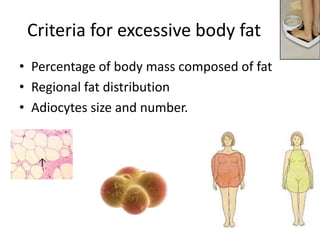
Criteria for excessive body fat
• Percentage of body mass composed of fat
• Regional fat distribution
• Adiocytes size and number.
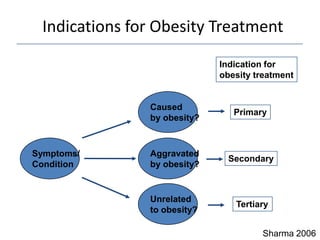
Indications for Obesity Treatment
Symptoms/
Condition
Caused
by obesity?
Aggravated
by obesity?
Unrelated
to obesity?
Indication for
obesity treatment
Primary
Secondary
Tertiary
Sharma 2006
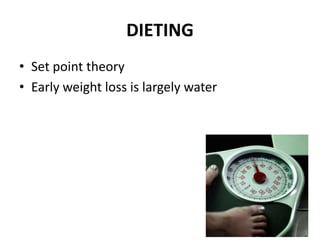
DIETING
• Set point theory
• Early weight loss is largely water
SETPOINT THEORY
• A weight-regulating mechanism, located in the
hypothalamus of the brain, regulates how much
the body should weigh
• Setpoint sets the amount of body fat it considers
necessary and works tirelessly to maintain it
• Setpoint functions like a thermostat: it detects
fluctuations in weight and makes adjustments in
energy metabolism and appetite
SETPOINT THEORY
• The setpoint has a profound effect on amount of
food you eat
– As you lose weight, it signals _______
– As you gain weight, it _______ appetite
– As you overeat, triggers body to “waste”
– As you don’t eat enough, triggers body to “conserve”
Exercise prescription
FIIT principle.
• Type –aerobic exercise and resistance training
• Duration- 40 min
• Frequency- 4-5 days
• Intensity-EHR=(DI x H.R.R)+R.H.R
• where E.H.R.=exercise heart rate in beats per minute;
D.I. = desired exercise intensity or desired percentage
of VO2max expressed as a decimal (e.g., 40% = 0.40);
H.R.R.=heart rate range or maximal heart rate minus
resting heart rate; and R.H.R. = resting heart rate.
Maximal heart rate for the obese can be estimated by
the formula:200 -(0.5 x age)
• High intensity vs low intensity
Before Beginning an Exercise
Program
• Are a man older than age 40 or
a woman older than age 50
• Have had a heart attack
• Have a family history of heart-
related problems before age 55
• Have heart, lung, liver or kidney
disease
• Feel pain in your chest, joints, or
muscles during physical activity
• Have high blood pressure, high
cholesterol, diabetes, arthritis,
osteoporosis, or asthma
• Have had joint replacement
surgery
• Smoke
• Are overweight or obese
• Tale medication to manage a
chronic condition
• Have an untreated joint or
muscle injury, or persistent
symptoms after a joint or
muscle injury
• Unsure of your health status
• Are pregnant
• .
You should check with your doctor before beginning an exercise program if you:
EFFECT OF EXERCISE ON FAT
METABOLISM
• 2 main source of energy- fats and
carbohydrates.
• At rest body metabolizes only about 30% of
FFA.
• During exercise only 25% of FFA converted
back into fat.
• During light exercises (30-50% of VO2
max)about 50 %to 70% of energy will come
from FFA.
EFFECT OF EXERCISE
• A large percentage of the FFA is used a source
of energy.
• Lactic acid threshold will be higher.
• Resting metabolic rate increases.
• Increased level of epinephrine and non
epinephrine.
Specific exercise consideration
• Non weight bearing activities.
• Recreational activities.
• Planned vs incidental
• Supervised vs nonsupervised
Health Benefits of Exercise Training with
or Without Substantial Weight Loss
• 1. Maintenance of reduced body weight and body fat
content
• 2. Prevention of weight/fat regain
• 3. Reduced systolic and diastolic blood pressure,
• control of hypertension
• 4. Decreased resting heart rate, increased stroke volume,
• increased cardiac output
• 5. Reduced blood lipids: LDL cholesterol, VLDL cholesterol,
triglycerides, free fatty acids
• 6. Increased blood high-density lipoproteins
• 7. Reduced cardiovascular disease risk
• 8.Increased blood glucose control, reduction in oral
hypoglycemic medications, reduction in insulin dosage,
increased insulin sensitivity
• 9. Decreased cancer risk: colon, breast, prostrate, lung
• 10. Decreased bone and joint problems
• 11. Increased aerobic capacity
• 12. Increased functional capacity
• 13. Increased muscular function
• 14. Increased psychological profile: decreased stress,
decreased depression, increased self-esteem,
decreased body image disparagement, decreased
eating pathology
• 15. Decreased mortality risk
• 16. Increased immunity
• 17. Increased pulmonary function
• 18. Increased or maintenance of bone mineral
density
• 19. Decreased risk of stroke
• 20. Maintenance or increase in lean body
mass
• 21. Augmentation in RMR and/or 24-hr energy
expenditure (dependent upon changes in
body composition, exercise protocol, and
accompanying diet)
Facts on exercise in obesity tx.
• Exercise alone only leads to slight weight loss, if any,
but marked reduction in mortality.
• Adding moderate/vigorous aerobic exercise to dieting
slightly increases weight loss.
• Aerobic exercise during weight loss lessens loss of
FFM.
• Resistance exercise during weight loss preserves FFM
and may help maintain wt loss.
• Any type of exercise helps maintain weight loss, but
duration must be 4-10 hours/week.
• Compliance may be better with multiple short-bout
sessions.
Preventing Weight Regain After Weight
Loss
• Extended Treatment/Professional Contact.
• Skills Training
• Food Provision/Monetary Incentives
• Peer Support
• Exercise/Physical Activity
Behavioral Modification
• Self-monitoring
• Stimulus control
• Body image and self-esteem counseling
• Stress management
• Social support

Obesity management

  • 1.
  • 2.
    • Overweight refersto increase body weight in relation to height , when compared to some standard of acceptable or desired weight. • Obesity is defined as an excessively high amount of body fat in relation to lean body mass.
  • 3.
    CAUSES OF OBESITY Energy Expenditure Energy Intake nutritional,activity levels, endocrine, genetic, drugs
  • 4.
    CALORIC BALANCE Intake ???? Resting MetRate Thermic Effect of Food Spontaneous Activity Exercise + _
  • 5.
    Energy Imbalance What isit? • Energy balance can be compared to a scale. • An energy imbalance arises when the number of calories consumed is not equal to the number of calories used by the body. • Weight gain usually involves the combination of consuming too many calories and not expending enough through physical activity. CDC
  • 6.
    2009 Energy Imbalance Effects inthe Body • Excess energy is stored in fat cells, which enlarge or multiply. • Enlargement of fat cells is known as hypertrophy, whereas multiplication of fat cells is known as hyperplasia. • With time, excesses in energy storage lead to obesity. Fat cells J La State Med Soc .2005; 156 (1): S42-49.
  • 7.
    Fat Cell Enlargement Hypertrophy •Enlarged fat cells produce the clinical problems associated with obesity, due to the following: – The weight or mass of the extra fat – The increased secretion of free fatty acids and peptides from enlarged fat cells.
  • 8.
    Factors Contributing toObesity Lifestyle • Poor diet • Skipping meals • Sugary soft drinks • Poor sleep • Snacking • Alcohol • Sedentariness • Etc. Psychosocial • Depression • Anxiety • Binge eating • Boredom • Social events • Low income • Stress • Etc. Biomedical • Genetics • Metabolism • Intrauterine growth • Medications • Injury • Mobility issues • Etc.
  • 9.
    Theories of obesity •Genetic • High calories and high fat diet. • Insufficient energy expenditure • Environment and life style • Lipoprotein lipase • Leptin gene • Drugs and disease.
  • 10.
    Health risks • Psychologicalburden • Osteoarthritis • High blood pressure • Increased level of cholesterol • Diabetes • Increased heart disease • Cancers • Stroke, dvt • Renal disease • Sleep apneas • Menstrual irregularities • Gallbladder diseases
  • 11.
    Criteria for excessivebody fat • Percentage of body mass composed of fat • Regional fat distribution • Adiocytes size and number.
  • 12.
    Indications for ObesityTreatment Symptoms/ Condition Caused by obesity? Aggravated by obesity? Unrelated to obesity? Indication for obesity treatment Primary Secondary Tertiary Sharma 2006
  • 13.
    DIETING • Set pointtheory • Early weight loss is largely water
  • 14.
    SETPOINT THEORY • Aweight-regulating mechanism, located in the hypothalamus of the brain, regulates how much the body should weigh • Setpoint sets the amount of body fat it considers necessary and works tirelessly to maintain it • Setpoint functions like a thermostat: it detects fluctuations in weight and makes adjustments in energy metabolism and appetite
  • 15.
    SETPOINT THEORY • Thesetpoint has a profound effect on amount of food you eat – As you lose weight, it signals _______ – As you gain weight, it _______ appetite – As you overeat, triggers body to “waste” – As you don’t eat enough, triggers body to “conserve”
  • 17.
    Exercise prescription FIIT principle. •Type –aerobic exercise and resistance training • Duration- 40 min • Frequency- 4-5 days • Intensity-EHR=(DI x H.R.R)+R.H.R • where E.H.R.=exercise heart rate in beats per minute; D.I. = desired exercise intensity or desired percentage of VO2max expressed as a decimal (e.g., 40% = 0.40); H.R.R.=heart rate range or maximal heart rate minus resting heart rate; and R.H.R. = resting heart rate. Maximal heart rate for the obese can be estimated by the formula:200 -(0.5 x age) • High intensity vs low intensity
  • 18.
    Before Beginning anExercise Program • Are a man older than age 40 or a woman older than age 50 • Have had a heart attack • Have a family history of heart- related problems before age 55 • Have heart, lung, liver or kidney disease • Feel pain in your chest, joints, or muscles during physical activity • Have high blood pressure, high cholesterol, diabetes, arthritis, osteoporosis, or asthma • Have had joint replacement surgery • Smoke • Are overweight or obese • Tale medication to manage a chronic condition • Have an untreated joint or muscle injury, or persistent symptoms after a joint or muscle injury • Unsure of your health status • Are pregnant • . You should check with your doctor before beginning an exercise program if you:
  • 19.
    EFFECT OF EXERCISEON FAT METABOLISM • 2 main source of energy- fats and carbohydrates. • At rest body metabolizes only about 30% of FFA. • During exercise only 25% of FFA converted back into fat. • During light exercises (30-50% of VO2 max)about 50 %to 70% of energy will come from FFA.
  • 20.
    EFFECT OF EXERCISE •A large percentage of the FFA is used a source of energy. • Lactic acid threshold will be higher. • Resting metabolic rate increases. • Increased level of epinephrine and non epinephrine.
  • 21.
    Specific exercise consideration •Non weight bearing activities. • Recreational activities. • Planned vs incidental • Supervised vs nonsupervised
  • 22.
    Health Benefits ofExercise Training with or Without Substantial Weight Loss • 1. Maintenance of reduced body weight and body fat content • 2. Prevention of weight/fat regain • 3. Reduced systolic and diastolic blood pressure, • control of hypertension • 4. Decreased resting heart rate, increased stroke volume, • increased cardiac output • 5. Reduced blood lipids: LDL cholesterol, VLDL cholesterol, triglycerides, free fatty acids • 6. Increased blood high-density lipoproteins • 7. Reduced cardiovascular disease risk
  • 23.
    • 8.Increased bloodglucose control, reduction in oral hypoglycemic medications, reduction in insulin dosage, increased insulin sensitivity • 9. Decreased cancer risk: colon, breast, prostrate, lung • 10. Decreased bone and joint problems • 11. Increased aerobic capacity • 12. Increased functional capacity • 13. Increased muscular function • 14. Increased psychological profile: decreased stress, decreased depression, increased self-esteem, decreased body image disparagement, decreased eating pathology • 15. Decreased mortality risk
  • 24.
    • 16. Increasedimmunity • 17. Increased pulmonary function • 18. Increased or maintenance of bone mineral density • 19. Decreased risk of stroke • 20. Maintenance or increase in lean body mass • 21. Augmentation in RMR and/or 24-hr energy expenditure (dependent upon changes in body composition, exercise protocol, and accompanying diet)
  • 25.
    Facts on exercisein obesity tx. • Exercise alone only leads to slight weight loss, if any, but marked reduction in mortality. • Adding moderate/vigorous aerobic exercise to dieting slightly increases weight loss. • Aerobic exercise during weight loss lessens loss of FFM. • Resistance exercise during weight loss preserves FFM and may help maintain wt loss. • Any type of exercise helps maintain weight loss, but duration must be 4-10 hours/week. • Compliance may be better with multiple short-bout sessions.
  • 26.
    Preventing Weight RegainAfter Weight Loss • Extended Treatment/Professional Contact. • Skills Training • Food Provision/Monetary Incentives • Peer Support • Exercise/Physical Activity
  • 27.
    Behavioral Modification • Self-monitoring •Stimulus control • Body image and self-esteem counseling • Stress management • Social support