OBESITY
*Is a condition of excess body weight i.e
when a person is 20% or above the ideal
body weight
*Body fat comprises of essential and
storage fat
*Essential fat is present in small amount
and is required for normal functioning of
the body
*Storage fat is the energy reserve stored as
adipose tissue and is expandable
TYPES OF OBESITY
• ANDROID OBESITY:- Bodys extra fat gets
deposited over the abdominal region and
gives the body an apple shaped appearance
• GYNECOID OBESITY:- Deposits of fat around
hips and thighs and gives the body pear
shaped appearance
ASSESSMENT OF BODY WEIGHT
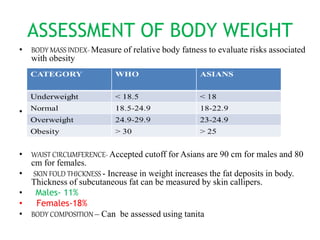
• BODY MASS INDEX- Measure of relative body fatness to evaluate risks associated
with obesity
•
• WAIST CIRCUMFERENCE- Accepted cutoff for Asians are 90 cm for males and 80
cm for females.
• SKIN FOLD THICKNESS - Increase in weight increases the fat deposits in body.
Thickness of subcutaneous fat can be measured by skin callipers.
• Males- 11%
• Females-18%
• BODY COMPOSITION – Can be assessed using tanita
HAZARDS OF OBESITY
• PSYCHOLOGICAL PROBLEMS
• Obese people often feel neglected and unhappy due to which
they resort to food for solace which further aggrevates the
problem
• Mechanical disabilities
• May cause flat feet or arthritis leading to pain in hips, knees,
spine and joints
• May cause VERICOS VEIN
• ABDOMINAL HERNEA
• Due to adipose tissue deposition in the chest region under
the diaphragm interferes with normal respiration
• Predisposes an individual to bronchitis
• Also causes co2 retention in the body leading to drowsiness
Pre-disposition to other
diseases
• Mortality increases with increase in body weight
• CVD’S: Ishemic heart disease ,stroke ,hypertension
• CANCER: breast cancer ,ovary cancer, colon cancer ,
kidney cancer
• ENDOCRINE DISORDERS : NIDDN( Non –insulin dependent
diabetes melitis), Infertility, PCOD, Breathlessness
• METABOLIC DISORDERS: Dislipidtimya , Gall stones ,
Inflammation
• MENARCHE generally occurs at a younger age in obese
girls and they sometimes experience irregular
menstrual cycle
ETIOLOGY
• Involve an interplay of both genetic and environmental factors:
Genetic Factors
• - The hormonal factors that regulate weight are determined genetically.
- Pattern of fat distribution is also heritable.
- Obesity therefore runs in the family and there are chances a child being
born obese, if both parents are suffering from obesity.
Psychological Factors
- These may be the cause as well as aggravating factors for obesity.
- Tension and anxiety may further makes a person resort to food for
emotional satisfaction and this again leads to increasing the intake.
• (C) Behavioral Factors
• (a) Physical Inactivity
• (b) Eating Habits
• (c) Social Aspects
(D) Physiological Factors
• (a) Age and Gender- critical period of
development of obesity are early childhood and
adulthood when no diet adjustment is made
for reduced physical activity.
(b) Endocrine Factor - In women, obesity
commonly occurs during pregnancy and after
menopause because of involvement of certain
hormone .
DIETARY MANAGEMENT
• DEFINE - known as food service management , is the practice of
providing nutritional options for individuals and groups with diet
concerns through supervision.
• OBJECTIVE
• Bring gradual weight loss
• Maintain good nutritional status..
• Bring lifestyle modification to maintain desirable body weight.
• Dietary modification need to be suitably adjusted.
• ENERGY
• Loss of 500 -1000Kcal daily to lose 1 – 1.5kg / week.
• PROTEIN
• Should provide 10-15% of total daily energy required.
• FAT
• Should provide 20% or less of total daily energy
required.
• Emphasis made on use of unsaturated fat consumption
to reduce heart disease.
• Hydrogenated and TAG should be avoided.
• CARBOHYDRATES
• Should provide 60% of total daily energy required.
• Includes complex carbohydrates and dietary fiber.
• VITAMINS AND MINERALS
• Reducing diets should provide adequate amount of
nutrients.
• ALCOHOL
• Should be taken in min. amount.
• Energy contribution is adjusted in total energy.
• Diet And Feeling Pattern
- The satiety value of diet is extremely imp. So as to give a feeling of
satisfaction and well being.
- Adequate amount of protein foods , fiber fruit and vegetable , whole
cereals and pulses provide satiety and thus helps cut down food intake.
• - Beverage agents like Methyl cellulose and Isabgol helps in adding bulk
to the diet thus helps in wt. management.
• Foods to be used in Restricted Amounts
or Avoided are:
(a) High fat foods – like butter, processed cheese , chocolate etc.
(b) High Carbs foods – breads , cookies.
(c) Carbonated and malted beverages , alcoholic drinks and sweetened
juice.
Criteria of Weight Reducing Diet
(a) Deficient in Energy
(b) Adequate in other nutrient.
(c) Sufficient bulk to provide satiety.
(d) Easily adapted from family meals.
(e) East to follow when eating out.
(f) Reasonable in cost.
(g) Must modify dietary behavior.
ROLE OF EXERCISING IN REDUCING
WEIGHT
• Physical activity involving increase in heart
rate for 30 minutes at least 5 days a week.
• Aerobic activities that draw on body reserves.
• Aerobic exercises reduce weight by
suppressing appetite, increasing the BMR and
increasing the energy expenditure
Problems in weight
management
• PLATEAU EFFECT
Condition when weight management remains at
the same level during a weight reduction
program and finally weight loss stops
• YOYO EFFECT
Yoyo effect also known as weight cycling .It is a
condition in which there is a loss and gain of
weight and then an individual gains weight
again .the reasons are not clear it may be
metabolic or behavioural
RISK FACTOR FOR NON –
COMMUNICABLE DISEASE
• DEFINE An individual attribute or expoaure that is
positively or negatively associated with
occurrence of diseases.
• Risk factor can be modifiable or non- modifiable.
• UNHEALTHYDIETHigh dietary intake of saturated
fat,trans fat ,cholesterol and salt when
accompanied with low intake of fruits and
vegetables are linked to CVDs.
• HFSS foods inc. risk of developing NCDs
PHYSICAL INACTIVITY
• Insufficient physical activity leads people to
higher risk of NCD’s
• Even moderate physical activity have reduced
heart diseases,diabetes,strokes and other NCD’S
in people
• Participation for 150 min of physical activity for 5
days a week is enough for a healthy life
• ALCOHOl:-
• Is harmful for health if consumed beyond limit
• Significant contributor to the global burden of
NCD’s and premature deaths
OVERWEIGHT AND OBESITY
• Is a risk factor for CHD(Coronary heart
disease),cancers,stroke and type 2 diabetes
• Leads to adverse metabolic effects or blood
pressure,cholesterol levels,TG level and insulin
resistance
• Recent studies shows that indians have
higheer proportion of body fat than western
counterparts

OBESITY

  • 1.
    OBESITY *Is a conditionof excess body weight i.e when a person is 20% or above the ideal body weight *Body fat comprises of essential and storage fat *Essential fat is present in small amount and is required for normal functioning of the body *Storage fat is the energy reserve stored as adipose tissue and is expandable
  • 2.
    TYPES OF OBESITY •ANDROID OBESITY:- Bodys extra fat gets deposited over the abdominal region and gives the body an apple shaped appearance • GYNECOID OBESITY:- Deposits of fat around hips and thighs and gives the body pear shaped appearance
  • 3.
    ASSESSMENT OF BODYWEIGHT • BODY MASS INDEX- Measure of relative body fatness to evaluate risks associated with obesity • • WAIST CIRCUMFERENCE- Accepted cutoff for Asians are 90 cm for males and 80 cm for females. • SKIN FOLD THICKNESS - Increase in weight increases the fat deposits in body. Thickness of subcutaneous fat can be measured by skin callipers. • Males- 11% • Females-18% • BODY COMPOSITION – Can be assessed using tanita
  • 4.
    HAZARDS OF OBESITY •PSYCHOLOGICAL PROBLEMS • Obese people often feel neglected and unhappy due to which they resort to food for solace which further aggrevates the problem • Mechanical disabilities • May cause flat feet or arthritis leading to pain in hips, knees, spine and joints • May cause VERICOS VEIN • ABDOMINAL HERNEA • Due to adipose tissue deposition in the chest region under the diaphragm interferes with normal respiration • Predisposes an individual to bronchitis • Also causes co2 retention in the body leading to drowsiness
  • 5.
    Pre-disposition to other diseases •Mortality increases with increase in body weight • CVD’S: Ishemic heart disease ,stroke ,hypertension • CANCER: breast cancer ,ovary cancer, colon cancer , kidney cancer • ENDOCRINE DISORDERS : NIDDN( Non –insulin dependent diabetes melitis), Infertility, PCOD, Breathlessness • METABOLIC DISORDERS: Dislipidtimya , Gall stones , Inflammation • MENARCHE generally occurs at a younger age in obese girls and they sometimes experience irregular menstrual cycle
  • 6.
    ETIOLOGY • Involve aninterplay of both genetic and environmental factors: Genetic Factors • - The hormonal factors that regulate weight are determined genetically. - Pattern of fat distribution is also heritable. - Obesity therefore runs in the family and there are chances a child being born obese, if both parents are suffering from obesity. Psychological Factors - These may be the cause as well as aggravating factors for obesity. - Tension and anxiety may further makes a person resort to food for emotional satisfaction and this again leads to increasing the intake. • (C) Behavioral Factors • (a) Physical Inactivity • (b) Eating Habits
  • 7.
    • (c) SocialAspects (D) Physiological Factors • (a) Age and Gender- critical period of development of obesity are early childhood and adulthood when no diet adjustment is made for reduced physical activity. (b) Endocrine Factor - In women, obesity commonly occurs during pregnancy and after menopause because of involvement of certain hormone .
  • 8.
    DIETARY MANAGEMENT • DEFINE- known as food service management , is the practice of providing nutritional options for individuals and groups with diet concerns through supervision. • OBJECTIVE • Bring gradual weight loss • Maintain good nutritional status.. • Bring lifestyle modification to maintain desirable body weight. • Dietary modification need to be suitably adjusted. • ENERGY • Loss of 500 -1000Kcal daily to lose 1 – 1.5kg / week. • PROTEIN • Should provide 10-15% of total daily energy required.
  • 9.
    • FAT • Shouldprovide 20% or less of total daily energy required. • Emphasis made on use of unsaturated fat consumption to reduce heart disease. • Hydrogenated and TAG should be avoided. • CARBOHYDRATES • Should provide 60% of total daily energy required. • Includes complex carbohydrates and dietary fiber. • VITAMINS AND MINERALS • Reducing diets should provide adequate amount of nutrients. • ALCOHOL • Should be taken in min. amount. • Energy contribution is adjusted in total energy.
  • 10.
    • Diet AndFeeling Pattern - The satiety value of diet is extremely imp. So as to give a feeling of satisfaction and well being. - Adequate amount of protein foods , fiber fruit and vegetable , whole cereals and pulses provide satiety and thus helps cut down food intake. • - Beverage agents like Methyl cellulose and Isabgol helps in adding bulk to the diet thus helps in wt. management. • Foods to be used in Restricted Amounts or Avoided are: (a) High fat foods – like butter, processed cheese , chocolate etc. (b) High Carbs foods – breads , cookies. (c) Carbonated and malted beverages , alcoholic drinks and sweetened juice.
  • 11.
    Criteria of WeightReducing Diet (a) Deficient in Energy (b) Adequate in other nutrient. (c) Sufficient bulk to provide satiety. (d) Easily adapted from family meals. (e) East to follow when eating out. (f) Reasonable in cost. (g) Must modify dietary behavior.
  • 12.
    ROLE OF EXERCISINGIN REDUCING WEIGHT • Physical activity involving increase in heart rate for 30 minutes at least 5 days a week. • Aerobic activities that draw on body reserves. • Aerobic exercises reduce weight by suppressing appetite, increasing the BMR and increasing the energy expenditure
  • 13.
    Problems in weight management •PLATEAU EFFECT Condition when weight management remains at the same level during a weight reduction program and finally weight loss stops • YOYO EFFECT Yoyo effect also known as weight cycling .It is a condition in which there is a loss and gain of weight and then an individual gains weight again .the reasons are not clear it may be metabolic or behavioural
  • 14.
    RISK FACTOR FORNON – COMMUNICABLE DISEASE • DEFINE An individual attribute or expoaure that is positively or negatively associated with occurrence of diseases. • Risk factor can be modifiable or non- modifiable. • UNHEALTHYDIETHigh dietary intake of saturated fat,trans fat ,cholesterol and salt when accompanied with low intake of fruits and vegetables are linked to CVDs. • HFSS foods inc. risk of developing NCDs
  • 15.
    PHYSICAL INACTIVITY • Insufficientphysical activity leads people to higher risk of NCD’s • Even moderate physical activity have reduced heart diseases,diabetes,strokes and other NCD’S in people • Participation for 150 min of physical activity for 5 days a week is enough for a healthy life • ALCOHOl:- • Is harmful for health if consumed beyond limit • Significant contributor to the global burden of NCD’s and premature deaths
  • 16.
    OVERWEIGHT AND OBESITY •Is a risk factor for CHD(Coronary heart disease),cancers,stroke and type 2 diabetes • Leads to adverse metabolic effects or blood pressure,cholesterol levels,TG level and insulin resistance • Recent studies shows that indians have higheer proportion of body fat than western counterparts