
OBESITY AND
OVERWEIGHT
By:
Mohabbat Ali
AKHU
OBESITY AND
OVERWEIGHT
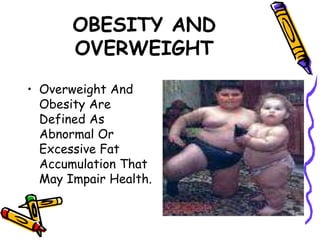
• Overweight And
Obesity Are
Defined As
Abnormal Or
Excessive Fat
Accumulation That
May Impair Health.
Obesity and overweight
The World Health Organization
(WHO) defines:
• Overweight as a BMI equal to or more than
25
• Obesity as a BMI equal to or more than 30
Obesity and overweight
• WHO’s latest projections indicate
that globally in 2008:
Approximately 1.8 billion adults were
overweight.
At least 400 million adults were
obese.
Causes
1. Energy Balance
• Energy balance means that your energy in
equals your energy out
• The same amount of energy in and energy
out over time = weight stays the same
• More in than out over time = weight gain
• More out than in over time = weight loss
Causes
2. Physical Inactivity
• Relying on cars instead of walking
• Modern technology and conveniences reduce
the need to burn calories
• More than 2 hours a day of regular TV viewing
time has been linked to overweight and
obesity.
Causes
3.Environment
• Work schedules.
• Oversized food portions
Causes
4.Genes and Family History
• Overweight and obesity tend to run in families.
• Chances of being overweight are greater if one
or both of parents are overweight or obese.
• Genes also may affect the amount of fat store in
body and where on body carry the extra fat.
Causes
5.Health Conditions
• Hypothyroidism
Lack of thyroid hormone will slow down the
metabolism and cause weight gain.
Causes
• Cushing’s syndrome.
A condition in which the body’s adrenal
glands make too much of the hormone
cortisol.
People with cushing’s syndrome gain
weight, have upper-body obesity, a
rounded face, fat around the neck, and
thin arms and legs.
Causes
• Polycystic Ovarian Syndrome (PCOS).
• Condition that affects about 5 to 10
percent of women of childbearing age
due to high levels of hormones called
androgens
Causes
6. Medicines
 Corticosteroids
 Antidepressants
 Medicines for seizures
These medicines can slow the rate at
which your body burns calories, increase
your appetite, or cause your body to
hold on to extra water—all of which can
lead to weight gain
Causes
7. Emotional Factors
Some people eat more than usual when
they are:
– bored
– angry
– stressed etc
Causes
8. Smoking
Some people gain weight when they
stop smoking because nicotine raises
the rate at which body burns
calories, so burn fewer calories when
stop smoking.
Causes
9. Age
As you get older, you tend to lose muscle,
especially if you’re less active.
Muscle loss can slow down the rate at which
your body burns calories
Women gain around 5 pounds during
menopause and have more fat around the
waist than they did before
Causes
10. Pregnancy
Women gain weight so that the baby gets
proper nourishment and develops
normally.
Causes
11. Lack of Sleep
People who don’t get enough sleep on a
regular basis seem to have high levels of
a hormone called ghrelin (which causes
hunger) and low levels of a hormone
called leptin (which normally helps to
curb hunger).
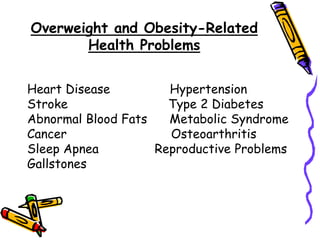
Overweight and Obesity-Related
Health Problems
Heart Disease Hypertension
Stroke Type 2 Diabetes
Abnormal Blood Fats Metabolic Syndrome
Cancer Osteoarthritis
Sleep Apnea Reproductive Problems
Gallstones
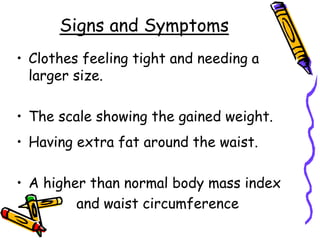
Signs and Symptoms
• Clothes feeling tight and needing a
larger size.
• The scale showing the gained weight.
• Having extra fat around the waist.
• A higher than normal body mass index
and waist circumference
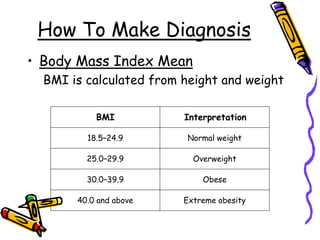
How To Make Diagnosis
• Body Mass Index Mean
BMI is calculated from height and weight
BMI Interpretation
18.5–24.9 Normal weight
25.0–29.9 Overweight
30.0–39.9 Obese
40.0 and above Extreme obesity
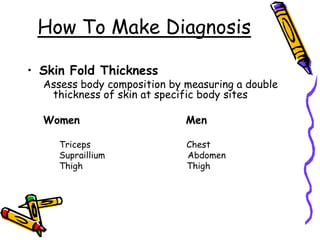
How To Make Diagnosis
• Skin Fold Thickness
Assess body composition by measuring a double
thickness of skin at specific body sites
Women Men
Triceps Chest
Supraillium Abdomen
Thigh Thigh
Management
• The best way to lose weight is slowly
• Lose just 5 to 10 percent of current
weight over 6 months. This will lower
your risk for heart disease and other
conditions
• A weight loss of 1 to 2 pounds a week
is do-able, safe, and will help you
keep off the weight.
Management
• Lifestyle Changes
– Focus on energy IN (calories from food
and drinks) and energy OUT (physical
activity)
– Follow a healthy eating plan
– Learn how to adopt more healthful
lifestyle habits
Management
• Calories
To lose 1 to 2 pounds a week, adults should
cut back their calorie intake by 500 to 1,000
calories a day.
Women
 1,000 to 1,200 calories a day
Men
 1,200 to 1,600 calories a day
Management
• Healthy Eating Plan
– Healthful foods include:
• Fat-free and low-fat milk and milk products
– low-fat yogurt, cheese, and milk.
• Lean meat, fish, poultry, cooked beans, and peas.
• Whole grain foods
– whole wheat bread, oatmeal, and brown rice.
• Other grain foods
– pasta, cereal, bagels, bread
• Fruits.
• Vegetables,
Management
• Foods to limit.
• Fatty cuts of meat such as ground beef,
sausage, and processed meats etc.
• High-fat milk and milk products like
– whole-milk cheeses, whole milk, cream, butter,
and ice cream
Management
• Physical Activity
Physical activity will burn the calories and also will
benefit you in other ways:
– Lower the risk of heart disease, diabetes, and
cancers (such as breast, uterus, and colon)
– Strengthen lungs and help them to work better
– Strengthen muscles and keep joints in good
condition
– Slow bone loss
– Give more energy
– Help to relax and cope better with stress
– Give an enjoyable way to share time with
friends and family
Management
• Behavioral Changes
– Instead of watching TV and listening breaking
news do some exercises.
– Put a note on your calendar /diary to remind
yourself to take a walk or go to your activity
class
Management
• Surgical Management
Weight loss surgery may be an option for people
with extreme obesity (BMI of 40 or greater)
when other treatments have failed
People with a BMI of 35 or greater who have
life-threatening conditions such as:
• Obesity-related cardiomyopathy (diseases of the
heart muscle)
• Severe sleep apnea (a condition in which your
breathing stops or gets very shallow while you're
sleeping)
• Severe type 2 diabetes
Management
• Surgical Management
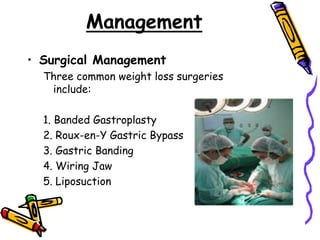
Three common weight loss surgeries
include:
1. Banded Gastroplasty
2. Roux-en-Y Gastric Bypass
3. Gastric Banding
4. Wiring Jaw
5. Liposuction
Management
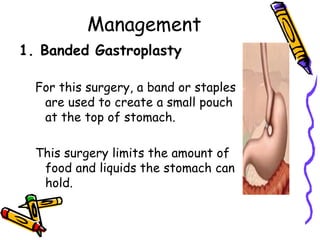
1. Banded Gastroplasty
For this surgery, a band or staples
are used to create a small pouch
at the top of stomach.
This surgery limits the amount of
food and liquids the stomach can
hold.
Management
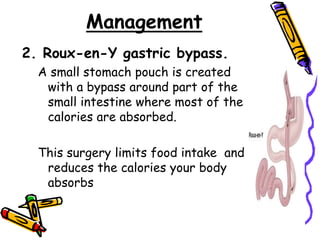
2. Roux-en-Y gastric bypass.
A small stomach pouch is created
with a bypass around part of the
small intestine where most of the
calories are absorbed.
This surgery limits food intake and
reduces the calories your body
absorbs
Management
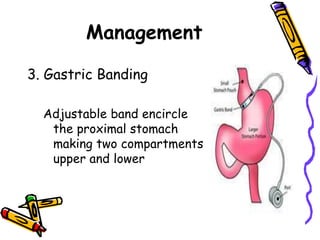
3. Gastric Banding
Adjustable band encircle
the proximal stomach
making two compartments
upper and lower
Management
3. Liposuction
• Surgical procedure designed to remove small packets of
excess fat that are resistant to diet and exercise.
• A Small tube called a cannula, connected to a vacuum
machine, is inserted into the fatty tissue through tiny
incisions placed in inconspicuous locations on the skin.
• The most frequent areas treated
– In men In women
Chest area, abdomen Thighs, hips, buttocks,
stomach, and neckline. knees, lower leg, cheeks
and double chins
Prevention
• A healthy eating plan
• Be active
• Keep track of weight and other
measurements
36
THANK YOU
In Conclusion…Take some time from your busy schedule for
exercises

Obesity & overweight

  • 1.
  • 2.
    OBESITY AND OVERWEIGHT • OverweightAnd Obesity Are Defined As Abnormal Or Excessive Fat Accumulation That May Impair Health.
  • 3.
    Obesity and overweight TheWorld Health Organization (WHO) defines: • Overweight as a BMI equal to or more than 25 • Obesity as a BMI equal to or more than 30
  • 4.
    Obesity and overweight •WHO’s latest projections indicate that globally in 2008: Approximately 1.8 billion adults were overweight. At least 400 million adults were obese.
  • 5.
    Causes 1. Energy Balance •Energy balance means that your energy in equals your energy out • The same amount of energy in and energy out over time = weight stays the same • More in than out over time = weight gain • More out than in over time = weight loss
  • 6.
    Causes 2. Physical Inactivity •Relying on cars instead of walking • Modern technology and conveniences reduce the need to burn calories • More than 2 hours a day of regular TV viewing time has been linked to overweight and obesity.
  • 7.
  • 8.
    Causes 4.Genes and FamilyHistory • Overweight and obesity tend to run in families. • Chances of being overweight are greater if one or both of parents are overweight or obese. • Genes also may affect the amount of fat store in body and where on body carry the extra fat.
  • 9.
    Causes 5.Health Conditions • Hypothyroidism Lackof thyroid hormone will slow down the metabolism and cause weight gain.
  • 10.
    Causes • Cushing’s syndrome. Acondition in which the body’s adrenal glands make too much of the hormone cortisol. People with cushing’s syndrome gain weight, have upper-body obesity, a rounded face, fat around the neck, and thin arms and legs.
  • 11.
    Causes • Polycystic OvarianSyndrome (PCOS). • Condition that affects about 5 to 10 percent of women of childbearing age due to high levels of hormones called androgens
  • 12.
    Causes 6. Medicines  Corticosteroids Antidepressants  Medicines for seizures These medicines can slow the rate at which your body burns calories, increase your appetite, or cause your body to hold on to extra water—all of which can lead to weight gain
  • 13.
    Causes 7. Emotional Factors Somepeople eat more than usual when they are: – bored – angry – stressed etc
  • 14.
    Causes 8. Smoking Some peoplegain weight when they stop smoking because nicotine raises the rate at which body burns calories, so burn fewer calories when stop smoking.
  • 15.
    Causes 9. Age As youget older, you tend to lose muscle, especially if you’re less active. Muscle loss can slow down the rate at which your body burns calories Women gain around 5 pounds during menopause and have more fat around the waist than they did before
  • 16.
    Causes 10. Pregnancy Women gainweight so that the baby gets proper nourishment and develops normally.
  • 17.
    Causes 11. Lack ofSleep People who don’t get enough sleep on a regular basis seem to have high levels of a hormone called ghrelin (which causes hunger) and low levels of a hormone called leptin (which normally helps to curb hunger).
  • 18.
    Overweight and Obesity-Related HealthProblems Heart Disease Hypertension Stroke Type 2 Diabetes Abnormal Blood Fats Metabolic Syndrome Cancer Osteoarthritis Sleep Apnea Reproductive Problems Gallstones
  • 19.
    Signs and Symptoms •Clothes feeling tight and needing a larger size. • The scale showing the gained weight. • Having extra fat around the waist. • A higher than normal body mass index and waist circumference
  • 20.
    How To MakeDiagnosis • Body Mass Index Mean BMI is calculated from height and weight BMI Interpretation 18.5–24.9 Normal weight 25.0–29.9 Overweight 30.0–39.9 Obese 40.0 and above Extreme obesity
  • 21.
    How To MakeDiagnosis • Skin Fold Thickness Assess body composition by measuring a double thickness of skin at specific body sites Women Men Triceps Chest Supraillium Abdomen Thigh Thigh
  • 22.
    Management • The bestway to lose weight is slowly • Lose just 5 to 10 percent of current weight over 6 months. This will lower your risk for heart disease and other conditions • A weight loss of 1 to 2 pounds a week is do-able, safe, and will help you keep off the weight.
  • 23.
    Management • Lifestyle Changes –Focus on energy IN (calories from food and drinks) and energy OUT (physical activity) – Follow a healthy eating plan – Learn how to adopt more healthful lifestyle habits
  • 24.
    Management • Calories To lose1 to 2 pounds a week, adults should cut back their calorie intake by 500 to 1,000 calories a day. Women  1,000 to 1,200 calories a day Men  1,200 to 1,600 calories a day
  • 25.
    Management • Healthy EatingPlan – Healthful foods include: • Fat-free and low-fat milk and milk products – low-fat yogurt, cheese, and milk. • Lean meat, fish, poultry, cooked beans, and peas. • Whole grain foods – whole wheat bread, oatmeal, and brown rice. • Other grain foods – pasta, cereal, bagels, bread • Fruits. • Vegetables,
  • 26.
    Management • Foods tolimit. • Fatty cuts of meat such as ground beef, sausage, and processed meats etc. • High-fat milk and milk products like – whole-milk cheeses, whole milk, cream, butter, and ice cream
  • 27.
    Management • Physical Activity Physicalactivity will burn the calories and also will benefit you in other ways: – Lower the risk of heart disease, diabetes, and cancers (such as breast, uterus, and colon) – Strengthen lungs and help them to work better – Strengthen muscles and keep joints in good condition – Slow bone loss – Give more energy – Help to relax and cope better with stress – Give an enjoyable way to share time with friends and family
  • 28.
    Management • Behavioral Changes –Instead of watching TV and listening breaking news do some exercises. – Put a note on your calendar /diary to remind yourself to take a walk or go to your activity class
  • 29.
    Management • Surgical Management Weightloss surgery may be an option for people with extreme obesity (BMI of 40 or greater) when other treatments have failed People with a BMI of 35 or greater who have life-threatening conditions such as: • Obesity-related cardiomyopathy (diseases of the heart muscle) • Severe sleep apnea (a condition in which your breathing stops or gets very shallow while you're sleeping) • Severe type 2 diabetes
  • 30.
    Management • Surgical Management Threecommon weight loss surgeries include: 1. Banded Gastroplasty 2. Roux-en-Y Gastric Bypass 3. Gastric Banding 4. Wiring Jaw 5. Liposuction
  • 31.
    Management 1. Banded Gastroplasty Forthis surgery, a band or staples are used to create a small pouch at the top of stomach. This surgery limits the amount of food and liquids the stomach can hold.
  • 32.
    Management 2. Roux-en-Y gastricbypass. A small stomach pouch is created with a bypass around part of the small intestine where most of the calories are absorbed. This surgery limits food intake and reduces the calories your body absorbs
  • 33.
    Management 3. Gastric Banding Adjustableband encircle the proximal stomach making two compartments upper and lower
  • 34.
    Management 3. Liposuction • Surgicalprocedure designed to remove small packets of excess fat that are resistant to diet and exercise. • A Small tube called a cannula, connected to a vacuum machine, is inserted into the fatty tissue through tiny incisions placed in inconspicuous locations on the skin. • The most frequent areas treated – In men In women Chest area, abdomen Thighs, hips, buttocks, stomach, and neckline. knees, lower leg, cheeks and double chins
  • 35.
    Prevention • A healthyeating plan • Be active • Keep track of weight and other measurements
  • 36.
    36 THANK YOU In Conclusion…Takesome time from your busy schedule for exercises