OBESITY
DR C.VANKHUMA
Associate Professor of
Community Medicine
PRESENTATION OVERVIEW
• Definition
• Criteria for classification.
• Epidemiology and diseases associated with obesity
• Morbidity/mortality associated with it.
• Assessment & measurements of obesity
• Prevention & Management
• Addressing barriers and efforts by stakeholders
SESSION LEARNING OBJECTIVES
▪ To enable the learner to define , describe and discuss the
epidemiological features of Obesity.
▪ To enable the learner to enumerate and prescribe the various
assessment methods and measurements and laboratory test
of obesity and its management at a primary care level.
▪ To enable the learner to understand and discuss the
preventive and epidemiological control measures.
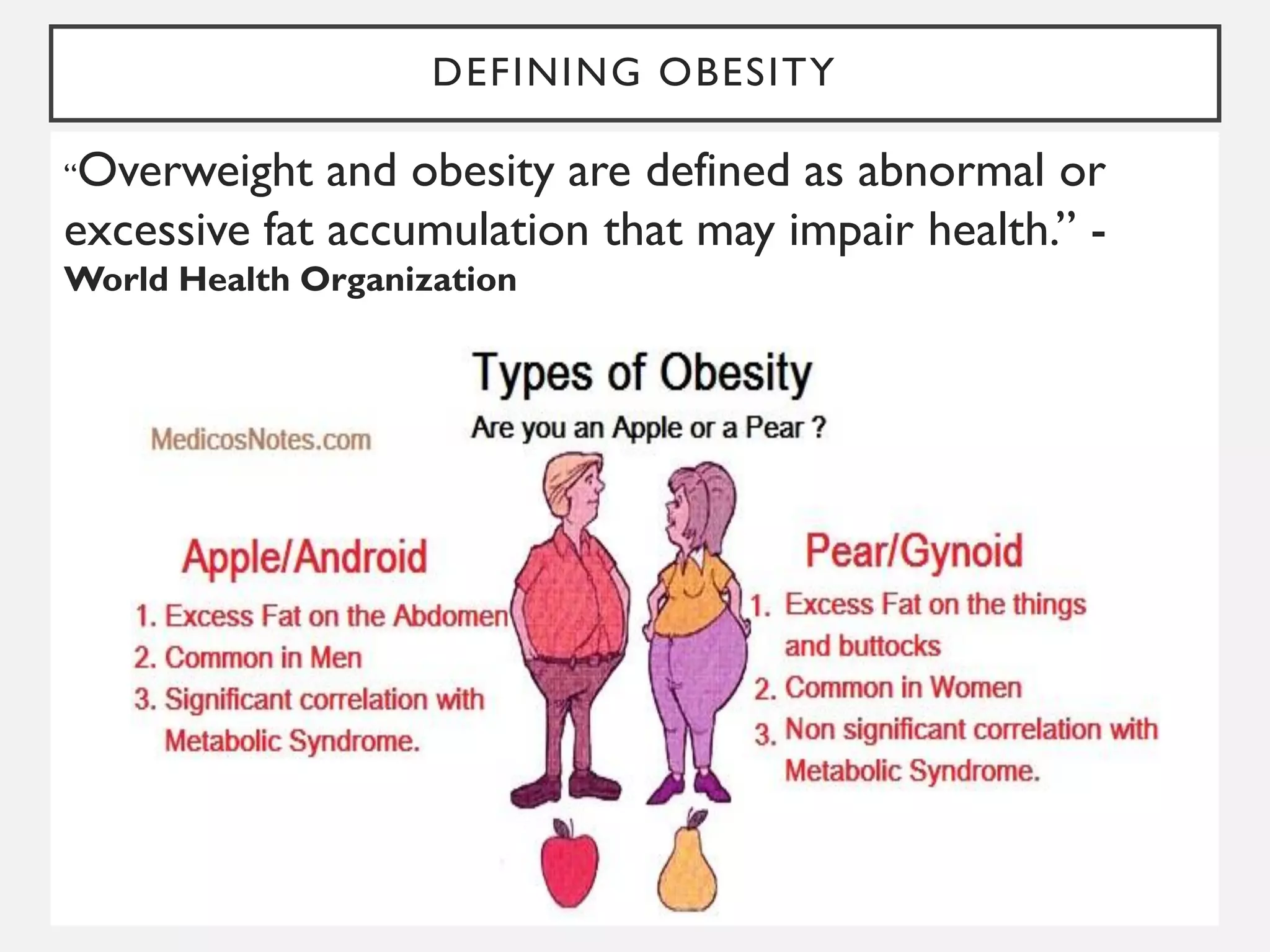
DEFINING OBESITY
“Overweight and obesity are defined as abnormal or
excessive fat accumulation that may impair health.” -
World Health Organization
DEFINING OBESITY
AMA debate: Is obesity a disease or a condition/risk factor?
“…recognize obesity as a disease state with multiple
pathophysiological aspects requiring a range of interventions
to advance obesity treatment and prevention.”
– American Medical Association
CLASSIFICATION BASED ON WORLD HEALTH
ORGANIZATION
CLASSIFICATION OF OBESITY IN CHILDREN
Children/Adolescents CDC
Growth Charts (2-19 yrs)
• Sex/age-specific BMI
• BMI ≥ 95th percentile is obese
• 85th to less than 95th
percentile is overweight
Children under 5 years of age (WHO) :
•Overweight is weight-for-height greater than 2
standard deviations aboveWHO Child Growth
Standards median;
•Obesity is weight-for-height greater than 3
standard deviations above theWHO Child Growth
Standards median.
Children aged between 5–19 years(WHO) :
•Overweight is BMI-for-age greater than 1
standard deviation above the WHO Growth
Reference median;
•Obesity is greater than 2 standard deviations
above theWHO Growth Reference median.
AETIOLOGY
GLOBAL BURDEN
• 4 million people dying each year as a result of being overweight or
obese in 2017 according to the global burden of disease.
• From 1975 to 2016( 40 yrs), the prevalence of overweight or obese
children and adolescents aged 5–19 years increased more than four-fold
from 4% to 18%
• 39% of adults aged 18 years and over were overweight in 2016, and
13% were obese.
• 39 million children under the age of 5 were overweight or obese in
2020
• INDIA : In NFHS-5, the percentage of overweight or obese women is
24%, up from 20.6 % and 19% to 23% among men in NFHS-4 (2015-
16)
RAISED BMI AND NON-COMMUNICABLE
DISEASES
Raised BMI is a major risk for
• Heart Disease
• Stroke
• Diabetes
• Musculoskeletal disorders (especially osteoarthritis – a highly
disabling degenerative disease of the joints)
• Some cancers (including endometrial, breast, ovarian, prostate,
liver, gallbladder, kidney, and colon)
MORBIDITY ASSOCIATED WITH OBESITY
• Type 2 Diabetes
• Cardiovascular Disease
• Stroke
• Hypertension
• Nonalcoholic fatty liver
disease
• Osteoarthritis
• Some cancers
MORBIDITY FROM CHILDHOOD OBESITY
• Preschoolers who are overweight or obese are 5 times
as likely to be overweight or obese as adults
• Obesity in children associated with high cholesterol and
blood sugar, asthma, mental health problems,
cardiovascular disease risk factors
• ~50% ofType 2 diabetes incidence in adolescence versus
3% a few decades ago
• Effective obesity treatments can decrease risks of developing
such diseases.
ASSESSMENT &
MEASUREMENTS OF OBESITY
• BODY MASS INDEX- BMI was first used in 1835 as a way to
estimate the proportion of body fat based on height and weight
• BMI has low sensitivity, especially below 30
• Cannot discern fat vs. muscle content or metabolic risk factors
• Validity?
BMI + WAIST CIRCUMFERENCE
MEASUREMENTS OF OBESITY
• PONDERAL INDEX:
• (<40 Overweight)
• BROCA INDEX:
• LORENTZ FORMULA:
• CORPULENCE INDEX
• (normal < 1.10)
• ,>1.10 Overweight ,
• >1.2 Obese)
MEASUREMENTS OF OBESITY
SKIN FOLD THICKNESS (SFT):
• Rapid & non-invasive method of fat assessment
• –‘Herpenden skin calipers' are good for estimation of SFT
• –Main drawback: Poor repeatability (Poor precision)
• –Measurement at 4 sites: Mid-triceps, biceps, sub-scapular, supra-iliac
regions.
• Sum > 50 mm in girls indicate obesity
• Sum > 40 mm in boys indicate obesity
• Single best measurement site of skin fold thickness: Mid triceps
• - 18 mm in boys indicate obesity
• - 32 mm in girls indicate obesity
ASSESSMENT & MEASUREMENTS OF OBESITY
Herpenden skin calipers
ASSESSMENT & MEASUREMENTS OF OBESITY
• WAIST CIRCUMFERENCE (WC) :
• Good predictor of risk of
cardiovascular diseases
• WAIST: HIP RATIO (WHR):
• High WHR indicates abdominal fat
accumulation
• -WHR > 1.0 in men indicate
obesity
• WHR > 0.85 in women indicate
obesity
Cut-offs for waist circumference in India:
ASSESSMENT & MEASUREMENTS OF OBESITY
• How to Measure Your Waist to Hip Ratio
• Measure at the smallest point. Wrap a tape measure around your waist
at the smallest point, usually around your belly button. This is your waist
circumference. Record the number.
• Measure your hips. Next, wrap the tape measure around your hips at the
widest part. This is your hip circumference. Record the number.
• Divide. Use a calculator to divide your waist size by your hip size. This is
your waist-to-hip ratio.
ASSESSMENT & MEASUREMENTS OF OBESITY
WEIGHT: HEIGHT RATIO (WHTR) :
• WHO has declared WHt Ratio as ‘best indicator of cardiovascular risk’
• WHtR is ‘age and sex independent’
• Cut-off for WHtR: 0.5
• CVD risk increase if WHtR >0.5
[NEW INDICATOR OF CV RISK by WHO]
OTHER INDICATORS:
• Total body water
• Total body potassium
• Body density
• Measurement of fat cells in the
body.
PREVENTION & MANAGEMENT
PREVENTION & MANAGMENT
• Weight Reduction - 5 - 10 % of body weight over 6 months.
• Reduce Intake of Calories - Proposed limits are :
• 1000 - 1200 calories for a woman and
• 1200 - 1600 calories for a man per day.
• Eating small frequent meals, and reducing portion sizes are other
ways to reduce calories.
• Eating healthy - high in fiber and low in saturated and trans fat,
cholesterol, sodium and added sugar especially high fructose
syrup.
PREVENTION & MANAGMENT
• Moderate but regular aerobic exercises such as stretching
,walking, swimming, gardening and dancing provided it
does not exceed their cardiovascular capacity as well as
bone and muscle strength.
• Promotion of exercise &
physical activity
PREVENTION & MANAGMENT
• Counseling & behavior therapy
• Weight-loss medicines are used if it is not possible
to lose 1 pound per week after 6 months of lifestyle
changes.
• They have to be taken along with other methods like
diet and exercise.
• Doctors have to monitor the person continuously while
taking weight-loss medications.
PREVENTION & MANAGMENT
Weight-loss surgeries may be an option, usually as a last resort, and are only
recommended in case of morbid or gross obesity for adults with a BMI of 35
or above. or for those who have a life-threatening condition.
ADDRESSING THE BARRIERS TO HEALTHY DIET
• Access to healthy food
• Food advertising
• Avoid large portion sizes
• Affordability of healthy food
• Time constraints
• Established behaviors
ADDRESSING BARRIERS TO PHYSICAL ACTIVITY
• Safety issues
• Areas non-conducive to
physical activity or exercise
• Time constraints
• Established behaviors
• Sedentary lifestyle
COMMUNITY LEVEL INTERVENTION
• STATE AND LOCAL PROGRAMS
• Resources are available to help disseminate consistent
public health recommendations and evidence-based
practices for state, District and local public health
organizations and practitioners.
• “ Fit India Movement’
• COMMUNITY EFFORTS
• To reverse the obesity epidemic, community efforts should
focus on supporting healthy eating and active living in a
variety of settings. Learn about different efforts that can be
used in early childhood care, hospitals, schools,
and food service venues.
NATIONAL LEVEL INTERVENTION
• India’s flagship nutrition
programme – Poshan Abhiyaan,
which was launched in 2018
• The program has also
identified obesity as a
concerning factor in India.
• The third annual report of
Poshan Abhiyan said that “the
nation needs to mobilize solid
efforts to address the emerging
and cross-cutting challenges of
urbanization and Overweight-
Obesity ”.
• Health promotion, awareness generation and
promotion of healthy lifestyle
• Screening and early detection
• Timely, affordable and accurate diagnosis
• Access to affordable treatment,
• Rehabilitation
CHECK YOUR PROGRESS
• What do you understand by Obesity, its causes , classification and
mention the preventive and control measures.
• What are the complications arising out of obesity or Morbidity and
Mortality associated with Obesity.
• How will you assess an obese patient/ What are the various tools for
measurements for obesity.
• Write Short notes on Epidemic of Childhood Obesity.
REFERENCES
1. Park'sTextbook of Preventive And Social Medicine
2. IAPSM’sTextbook of Community Medicine
3. Obesity - WHO | World Health Organization
4. Health service delivery framework for prevention and
management of obesity -WHO

Obesity.pdf

  • 1.
  • 2.
    PRESENTATION OVERVIEW • Definition •Criteria for classification. • Epidemiology and diseases associated with obesity • Morbidity/mortality associated with it. • Assessment & measurements of obesity • Prevention & Management • Addressing barriers and efforts by stakeholders
  • 3.
    SESSION LEARNING OBJECTIVES ▪To enable the learner to define , describe and discuss the epidemiological features of Obesity. ▪ To enable the learner to enumerate and prescribe the various assessment methods and measurements and laboratory test of obesity and its management at a primary care level. ▪ To enable the learner to understand and discuss the preventive and epidemiological control measures.
  • 4.
    DEFINING OBESITY “Overweight andobesity are defined as abnormal or excessive fat accumulation that may impair health.” - World Health Organization
  • 5.
    DEFINING OBESITY AMA debate:Is obesity a disease or a condition/risk factor? “…recognize obesity as a disease state with multiple pathophysiological aspects requiring a range of interventions to advance obesity treatment and prevention.” – American Medical Association
  • 6.
    CLASSIFICATION BASED ONWORLD HEALTH ORGANIZATION
  • 7.
    CLASSIFICATION OF OBESITYIN CHILDREN Children/Adolescents CDC Growth Charts (2-19 yrs) • Sex/age-specific BMI • BMI ≥ 95th percentile is obese • 85th to less than 95th percentile is overweight Children under 5 years of age (WHO) : •Overweight is weight-for-height greater than 2 standard deviations aboveWHO Child Growth Standards median; •Obesity is weight-for-height greater than 3 standard deviations above theWHO Child Growth Standards median. Children aged between 5–19 years(WHO) : •Overweight is BMI-for-age greater than 1 standard deviation above the WHO Growth Reference median; •Obesity is greater than 2 standard deviations above theWHO Growth Reference median.
  • 8.
  • 9.
    GLOBAL BURDEN • 4million people dying each year as a result of being overweight or obese in 2017 according to the global burden of disease. • From 1975 to 2016( 40 yrs), the prevalence of overweight or obese children and adolescents aged 5–19 years increased more than four-fold from 4% to 18% • 39% of adults aged 18 years and over were overweight in 2016, and 13% were obese. • 39 million children under the age of 5 were overweight or obese in 2020 • INDIA : In NFHS-5, the percentage of overweight or obese women is 24%, up from 20.6 % and 19% to 23% among men in NFHS-4 (2015- 16)
  • 12.
    RAISED BMI ANDNON-COMMUNICABLE DISEASES Raised BMI is a major risk for • Heart Disease • Stroke • Diabetes • Musculoskeletal disorders (especially osteoarthritis – a highly disabling degenerative disease of the joints) • Some cancers (including endometrial, breast, ovarian, prostate, liver, gallbladder, kidney, and colon)
  • 13.
    MORBIDITY ASSOCIATED WITHOBESITY • Type 2 Diabetes • Cardiovascular Disease • Stroke • Hypertension • Nonalcoholic fatty liver disease • Osteoarthritis • Some cancers
  • 15.
    MORBIDITY FROM CHILDHOODOBESITY • Preschoolers who are overweight or obese are 5 times as likely to be overweight or obese as adults • Obesity in children associated with high cholesterol and blood sugar, asthma, mental health problems, cardiovascular disease risk factors • ~50% ofType 2 diabetes incidence in adolescence versus 3% a few decades ago • Effective obesity treatments can decrease risks of developing such diseases.
  • 16.
  • 17.
    MEASUREMENTS OF OBESITY •BODY MASS INDEX- BMI was first used in 1835 as a way to estimate the proportion of body fat based on height and weight • BMI has low sensitivity, especially below 30 • Cannot discern fat vs. muscle content or metabolic risk factors • Validity?
  • 18.
    BMI + WAISTCIRCUMFERENCE MEASUREMENTS OF OBESITY
  • 19.
    MEASUREMENTS OF OBESITY •PONDERAL INDEX: • (<40 Overweight) • BROCA INDEX: • LORENTZ FORMULA: • CORPULENCE INDEX • (normal < 1.10) • ,>1.10 Overweight , • >1.2 Obese)
  • 20.
    MEASUREMENTS OF OBESITY SKINFOLD THICKNESS (SFT): • Rapid & non-invasive method of fat assessment • –‘Herpenden skin calipers' are good for estimation of SFT • –Main drawback: Poor repeatability (Poor precision) • –Measurement at 4 sites: Mid-triceps, biceps, sub-scapular, supra-iliac regions. • Sum > 50 mm in girls indicate obesity • Sum > 40 mm in boys indicate obesity • Single best measurement site of skin fold thickness: Mid triceps • - 18 mm in boys indicate obesity • - 32 mm in girls indicate obesity
  • 21.
    ASSESSMENT & MEASUREMENTSOF OBESITY Herpenden skin calipers
  • 22.
  • 23.
    ASSESSMENT & MEASUREMENTSOF OBESITY • WAIST CIRCUMFERENCE (WC) : • Good predictor of risk of cardiovascular diseases • WAIST: HIP RATIO (WHR): • High WHR indicates abdominal fat accumulation • -WHR > 1.0 in men indicate obesity • WHR > 0.85 in women indicate obesity Cut-offs for waist circumference in India:
  • 24.
    ASSESSMENT & MEASUREMENTSOF OBESITY • How to Measure Your Waist to Hip Ratio • Measure at the smallest point. Wrap a tape measure around your waist at the smallest point, usually around your belly button. This is your waist circumference. Record the number. • Measure your hips. Next, wrap the tape measure around your hips at the widest part. This is your hip circumference. Record the number. • Divide. Use a calculator to divide your waist size by your hip size. This is your waist-to-hip ratio.
  • 25.
    ASSESSMENT & MEASUREMENTSOF OBESITY WEIGHT: HEIGHT RATIO (WHTR) : • WHO has declared WHt Ratio as ‘best indicator of cardiovascular risk’ • WHtR is ‘age and sex independent’ • Cut-off for WHtR: 0.5 • CVD risk increase if WHtR >0.5 [NEW INDICATOR OF CV RISK by WHO] OTHER INDICATORS: • Total body water • Total body potassium • Body density • Measurement of fat cells in the body.
  • 26.
  • 27.
    PREVENTION & MANAGMENT •Weight Reduction - 5 - 10 % of body weight over 6 months. • Reduce Intake of Calories - Proposed limits are : • 1000 - 1200 calories for a woman and • 1200 - 1600 calories for a man per day. • Eating small frequent meals, and reducing portion sizes are other ways to reduce calories. • Eating healthy - high in fiber and low in saturated and trans fat, cholesterol, sodium and added sugar especially high fructose syrup.
  • 28.
    PREVENTION & MANAGMENT •Moderate but regular aerobic exercises such as stretching ,walking, swimming, gardening and dancing provided it does not exceed their cardiovascular capacity as well as bone and muscle strength. • Promotion of exercise & physical activity
  • 29.
    PREVENTION & MANAGMENT •Counseling & behavior therapy • Weight-loss medicines are used if it is not possible to lose 1 pound per week after 6 months of lifestyle changes. • They have to be taken along with other methods like diet and exercise. • Doctors have to monitor the person continuously while taking weight-loss medications.
  • 30.
  • 31.
    PREVENTION & MANAGMENT Weight-losssurgeries may be an option, usually as a last resort, and are only recommended in case of morbid or gross obesity for adults with a BMI of 35 or above. or for those who have a life-threatening condition.
  • 32.
    ADDRESSING THE BARRIERSTO HEALTHY DIET • Access to healthy food • Food advertising • Avoid large portion sizes • Affordability of healthy food • Time constraints • Established behaviors
  • 33.
    ADDRESSING BARRIERS TOPHYSICAL ACTIVITY • Safety issues • Areas non-conducive to physical activity or exercise • Time constraints • Established behaviors • Sedentary lifestyle
  • 34.
    COMMUNITY LEVEL INTERVENTION •STATE AND LOCAL PROGRAMS • Resources are available to help disseminate consistent public health recommendations and evidence-based practices for state, District and local public health organizations and practitioners. • “ Fit India Movement’ • COMMUNITY EFFORTS • To reverse the obesity epidemic, community efforts should focus on supporting healthy eating and active living in a variety of settings. Learn about different efforts that can be used in early childhood care, hospitals, schools, and food service venues.
  • 35.
    NATIONAL LEVEL INTERVENTION •India’s flagship nutrition programme – Poshan Abhiyaan, which was launched in 2018 • The program has also identified obesity as a concerning factor in India. • The third annual report of Poshan Abhiyan said that “the nation needs to mobilize solid efforts to address the emerging and cross-cutting challenges of urbanization and Overweight- Obesity ”.
  • 36.
    • Health promotion,awareness generation and promotion of healthy lifestyle • Screening and early detection • Timely, affordable and accurate diagnosis • Access to affordable treatment, • Rehabilitation
  • 37.
    CHECK YOUR PROGRESS •What do you understand by Obesity, its causes , classification and mention the preventive and control measures. • What are the complications arising out of obesity or Morbidity and Mortality associated with Obesity. • How will you assess an obese patient/ What are the various tools for measurements for obesity. • Write Short notes on Epidemic of Childhood Obesity.
  • 38.
    REFERENCES 1. Park'sTextbook ofPreventive And Social Medicine 2. IAPSM’sTextbook of Community Medicine 3. Obesity - WHO | World Health Organization 4. Health service delivery framework for prevention and management of obesity -WHO