ACUTE ENCEPHALITIS: INDIAN
SCENARIO
 Dr.Suresh kumar
INTRODUCTION
 Acute encephalitis is a group of similar neurologic manifestation caused by
several different viruses, bacteria, fungus, parasites, spirochetes ,
chemicals/toxins.
 WHO introduced the term AES(Acute Encephalitis Syndrome) in order to
get more number of cases.
 DEFINTION
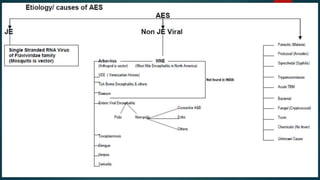
 ETIOLOGY
 EPIDEMIOLOGY
 CLINICAL FEATURES
 DIAGNOSIS
 MANAGEMENT
 PREVENTION AND CONTROL
DEFINITION
 Encephalitis : Acute, diffuse, inflammatory process affecting brain
parenchyma – Most commonly viral
 Encephalopathy : Clinical syndrome of altered mental status, manifesting
as reduced consciousness or altered behaviour – Many causes, incl. viral
encephalitis
 Acute Encephalitis Syndrome : Defined as a person of any age, at any
time of year with the acute onset of fever and a change in mental
status(confusion, disorientation, coma, or inability to talk) and/ or new
onset of seizures ( excluding simple febrile sz.)
 AES is a spectrum of diseases with equal contribution of JE and non JE
etiology.
 Till date, Japanese encephalitis is the leading cause of AES all over India,
both in pediatric and adult population.
EPIDEMIOLOGY OF JE
 Agent
 Geographical Distribution
 Hosts
 Transmission
 Morbidity and Mortality
 Definition: JE is an inapparent to acute arboviral infection of horses, pigs
and humans. It’s a zoonotic disease i.e. infecting mainly animals and
incidentally man.
AGENT
 Flavivirus related to St. Louis encephalitis
 Most important cause of arboviral encephalitis worldwide, with over
45,000 cases reported annually
 Transmitted by culex mosquito, which breeds in rice fields
 Mosquitoes become infected by feeding on domestic pigs and wild birds
infected with Japanese encephalitis virus. Infected mosquitoes transmit
virus to humans and animals during the feeding process.
History of Japanese Encephalitis
 1800s – recognized in Japan
 1924 – Japan epidemic. 6125 cases, 3797 deaths
 1935 – virus isolated in brain of Japanese patient who died of encephalitis
 1938 – virus isolated from Culex mosquitoes in Japan
 Today – extremely prevalent in South East Asia. 30,000-50,000 cases
reported each year.
FOUR GENOTYPES OF JE
 Genotype 3 is mostly found in panindia
 Genotype 1 is found in UP and west Bengal
 Genotypes 2 and 4 rarely found in India
 The JE virus is mainly isolated in ardied birds (cattle egrets and pond
herons) – natural reservoirs
 The JE virus multiply in the body of some animals particularly pigs –
amplifying host
NATURAL RESERVOIRS
Mosquito Vectors
 C. Tritaeniorhynchus
 C. Vishnui
 C. Gelidus
 Anopheles
PATHOGENESIS
Virus enters the body through the bite of the insect vector – mosquito
After multiplication in local and regional lymph nodes,viremia of varying
duration ensues
Virus is transported to target organ (brain) via blood
Virus proliferate and damage the neuronal tissue, thereby elicits nervous
manifestations
CLINICAL FEATURES
 Incubation Period - 5 to 15 days
 Only 1 in 300 to 1 in 1000 infections develop into encephalitis, rest
asymptomatic
 Course of disease- 3 stages
 Prodromal stage
 Acute encephalitic stage
 Late stage and sequelae
PRODROMAL STAGE
 Fever
 Headache
 Nausea,Vomiting
 Diarrhea
 Myalgia
 Lasts for 1 to 5 days
ACUTE ENCEPHALITIS STAGE
 Fever
 Irritability
 Altered behaviour
 Convulsions
 Coma
 Signs of increased intracranial tension
LATE STAGE
 Aphasis or Dysarthria
 Ocular palsies
 Pyrimidal and extra pyramidal signs in the form of hemiplegia,
quadriplegia, dystonia , choreoathetosis and coarse tremors.
SEQUELAE
 Full recovery
 Recovery with residual complications
 Death
Morbidity/Mortality
 Swine
– High mortality in piglets – Death rare in adult pigs
 Equine
– Morbidity: 2%, during an outbreak – Mortality: 5%
 Humans
– Mortality: 5-35% – Serious neurologic sequelae: 33-50%
 30-50% of the people that survive the infection develop paralysis, brain
damage, or other serious permanent sequelae
 Average period between the onset of illness & death is about 9 days
 In utero infection possible: Abortion of fetus
DIFFERENTIATION OF JE AND NON JE,
AES
 Acute fever with altered sensorium persisting for more than 2 hours with
focal seizures of any part of body, suggestive of encephalitis
 Rash with fever excludes encephalitis
 AES with symmetrical neurological signs likely to be cerebral malaria
DIAGNOSIS OF AES
 Imaging
 EEG
 CSF fluid analysis
IMAGING
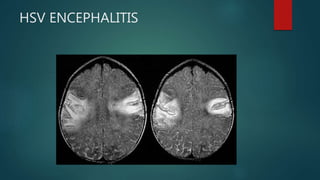
HSV ENCEPHALITIS
JE
JE
EEG
 EEG usually shows abnormal spikes in acute encephalitis.
 Spikes in temporal lobe region suggestive of HSV Encephalitis
CSF STUDY
 High CSF pressure
 Increased WBC count ( usually < 250/cu mm ;predominantly lymphocytes)
 Elevated protein concentration (usually < 150 mg/dl)
 Normal glucose concentration
 Specific diagnostic tests – PCR tests for viruses, culture for bacteria, fungi
and mycobacteria, serology for arboviruses.
SEROLOGY
 Detection of virus specific IgM antibody – provide definitive diagnosis
 IgM antibody is present only for 1 to 3 months and hence denote acute
encephalitis
TREATMENT OF AES
 A broad spectrum antibiotic such as ceftriaxone – can be stopped when
investigations does not reveal bacterial meningitis
 Acyclovir must be started in all cases of sporadic viral encephalitis – should
be stopped when an alternate diagnosis has been made or HSV PCR is
negative
PREVENTION AND CONTROL OF AES
 Surveillance for cases of AES
 Vector control
 Reduction in man vector contact
 Vaccination
JE VACCINATION – TWO TYPES
 Inacivated vaccine derived from vero cell prepared from an Indian strain of
JE virus (JENVAC)
 Very safe and effective
 2 doses given 1 month apart
 The recently introduced Chinese live attenuated SA 14 14 2 JE vaccine
 Now available in routine immunization in children under universal
immunization program in 181 endemic districts of India since 2011
 NVBDCP has identified 20 hyperendemic districts in assam, UP and west
Bengal for introduction of adult JE vaccination (>15 to 65 yrs)
 Till now, 8 districts have been covered by adult vaccination programme
 In 3rd july 2014, the GOI had announced the introduction the single dose
of JE vaccine for adults in endemic districts
RECENT TRENDS OF AES IN INDIA
 In recent years, investigations into large outbreaks of AES have been
negative for JEV
 Instead outbreaks were found to be due to a rhabdovirus (Chandipura
virus) or water borne entero viruses
 Factor might account for Entero viruses replacing JEV as the major cause of
AES is JE vaccination campaigns launched in endemic districts
 A multisector approach involving health, water resources, sanitation and
rural development departments is needed for designing and implementing
novel preventive strategies that would focus on containment of water
borne entero viruses and vectors for chandipura virus
 We also need to move from JE surveillance to surveillance for the entire
spectrum of AES
THANK YOU

Acute encephalitis suresh ppt

  • 1.
  • 2.
    INTRODUCTION  Acute encephalitisis a group of similar neurologic manifestation caused by several different viruses, bacteria, fungus, parasites, spirochetes , chemicals/toxins.  WHO introduced the term AES(Acute Encephalitis Syndrome) in order to get more number of cases.
  • 3.
     DEFINTION  ETIOLOGY EPIDEMIOLOGY  CLINICAL FEATURES  DIAGNOSIS  MANAGEMENT  PREVENTION AND CONTROL
  • 4.
    DEFINITION  Encephalitis :Acute, diffuse, inflammatory process affecting brain parenchyma – Most commonly viral  Encephalopathy : Clinical syndrome of altered mental status, manifesting as reduced consciousness or altered behaviour – Many causes, incl. viral encephalitis  Acute Encephalitis Syndrome : Defined as a person of any age, at any time of year with the acute onset of fever and a change in mental status(confusion, disorientation, coma, or inability to talk) and/ or new onset of seizures ( excluding simple febrile sz.)
  • 5.
     AES isa spectrum of diseases with equal contribution of JE and non JE etiology.  Till date, Japanese encephalitis is the leading cause of AES all over India, both in pediatric and adult population.
  • 7.
    EPIDEMIOLOGY OF JE Agent  Geographical Distribution  Hosts  Transmission  Morbidity and Mortality
  • 8.
     Definition: JEis an inapparent to acute arboviral infection of horses, pigs and humans. It’s a zoonotic disease i.e. infecting mainly animals and incidentally man.
  • 9.
    AGENT  Flavivirus relatedto St. Louis encephalitis  Most important cause of arboviral encephalitis worldwide, with over 45,000 cases reported annually  Transmitted by culex mosquito, which breeds in rice fields  Mosquitoes become infected by feeding on domestic pigs and wild birds infected with Japanese encephalitis virus. Infected mosquitoes transmit virus to humans and animals during the feeding process.
  • 10.
    History of JapaneseEncephalitis  1800s – recognized in Japan  1924 – Japan epidemic. 6125 cases, 3797 deaths  1935 – virus isolated in brain of Japanese patient who died of encephalitis  1938 – virus isolated from Culex mosquitoes in Japan  Today – extremely prevalent in South East Asia. 30,000-50,000 cases reported each year.
  • 11.
    FOUR GENOTYPES OFJE  Genotype 3 is mostly found in panindia  Genotype 1 is found in UP and west Bengal  Genotypes 2 and 4 rarely found in India  The JE virus is mainly isolated in ardied birds (cattle egrets and pond herons) – natural reservoirs  The JE virus multiply in the body of some animals particularly pigs – amplifying host
  • 13.
  • 14.
    Mosquito Vectors  C.Tritaeniorhynchus  C. Vishnui  C. Gelidus  Anopheles
  • 16.
    PATHOGENESIS Virus enters thebody through the bite of the insect vector – mosquito After multiplication in local and regional lymph nodes,viremia of varying duration ensues Virus is transported to target organ (brain) via blood Virus proliferate and damage the neuronal tissue, thereby elicits nervous manifestations
  • 17.
    CLINICAL FEATURES  IncubationPeriod - 5 to 15 days  Only 1 in 300 to 1 in 1000 infections develop into encephalitis, rest asymptomatic  Course of disease- 3 stages  Prodromal stage  Acute encephalitic stage  Late stage and sequelae
  • 18.
    PRODROMAL STAGE  Fever Headache  Nausea,Vomiting  Diarrhea  Myalgia  Lasts for 1 to 5 days
  • 20.
    ACUTE ENCEPHALITIS STAGE Fever  Irritability  Altered behaviour  Convulsions  Coma  Signs of increased intracranial tension
  • 21.
    LATE STAGE  Aphasisor Dysarthria  Ocular palsies  Pyrimidal and extra pyramidal signs in the form of hemiplegia, quadriplegia, dystonia , choreoathetosis and coarse tremors.
  • 23.
    SEQUELAE  Full recovery Recovery with residual complications  Death
  • 24.
    Morbidity/Mortality  Swine – Highmortality in piglets – Death rare in adult pigs  Equine – Morbidity: 2%, during an outbreak – Mortality: 5%  Humans – Mortality: 5-35% – Serious neurologic sequelae: 33-50%
  • 25.
     30-50% ofthe people that survive the infection develop paralysis, brain damage, or other serious permanent sequelae  Average period between the onset of illness & death is about 9 days  In utero infection possible: Abortion of fetus
  • 26.
    DIFFERENTIATION OF JEAND NON JE, AES  Acute fever with altered sensorium persisting for more than 2 hours with focal seizures of any part of body, suggestive of encephalitis  Rash with fever excludes encephalitis  AES with symmetrical neurological signs likely to be cerebral malaria
  • 27.
    DIAGNOSIS OF AES Imaging  EEG  CSF fluid analysis
  • 28.
  • 29.
  • 30.
  • 31.
  • 32.
    EEG  EEG usuallyshows abnormal spikes in acute encephalitis.  Spikes in temporal lobe region suggestive of HSV Encephalitis
  • 33.
    CSF STUDY  HighCSF pressure  Increased WBC count ( usually < 250/cu mm ;predominantly lymphocytes)  Elevated protein concentration (usually < 150 mg/dl)  Normal glucose concentration  Specific diagnostic tests – PCR tests for viruses, culture for bacteria, fungi and mycobacteria, serology for arboviruses.
  • 34.
    SEROLOGY  Detection ofvirus specific IgM antibody – provide definitive diagnosis  IgM antibody is present only for 1 to 3 months and hence denote acute encephalitis
  • 35.
    TREATMENT OF AES A broad spectrum antibiotic such as ceftriaxone – can be stopped when investigations does not reveal bacterial meningitis  Acyclovir must be started in all cases of sporadic viral encephalitis – should be stopped when an alternate diagnosis has been made or HSV PCR is negative
  • 37.
    PREVENTION AND CONTROLOF AES  Surveillance for cases of AES  Vector control  Reduction in man vector contact  Vaccination
  • 38.
    JE VACCINATION –TWO TYPES  Inacivated vaccine derived from vero cell prepared from an Indian strain of JE virus (JENVAC)  Very safe and effective  2 doses given 1 month apart
  • 39.
     The recentlyintroduced Chinese live attenuated SA 14 14 2 JE vaccine  Now available in routine immunization in children under universal immunization program in 181 endemic districts of India since 2011  NVBDCP has identified 20 hyperendemic districts in assam, UP and west Bengal for introduction of adult JE vaccination (>15 to 65 yrs)  Till now, 8 districts have been covered by adult vaccination programme  In 3rd july 2014, the GOI had announced the introduction the single dose of JE vaccine for adults in endemic districts
  • 40.
    RECENT TRENDS OFAES IN INDIA  In recent years, investigations into large outbreaks of AES have been negative for JEV  Instead outbreaks were found to be due to a rhabdovirus (Chandipura virus) or water borne entero viruses  Factor might account for Entero viruses replacing JEV as the major cause of AES is JE vaccination campaigns launched in endemic districts
  • 41.
     A multisectorapproach involving health, water resources, sanitation and rural development departments is needed for designing and implementing novel preventive strategies that would focus on containment of water borne entero viruses and vectors for chandipura virus  We also need to move from JE surveillance to surveillance for the entire spectrum of AES
  • 42.