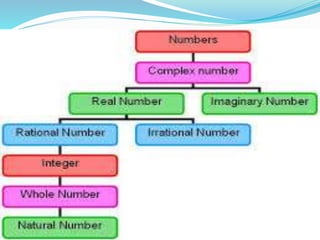
Topic:- Number System
Presented
by:-
Mohammed
Shoyeb
Submitted to:-
Mrs. Priyanka
ma’am
Objective
1. Understand the concept of number systems.
2. Distinguish between non-positional and positional
number systems.
3. Describe the decimal, binary, OCTAL and HEXADECIMAL
system.
4. Convert a number in binary, octal or hexadecimal to a
number in the decimal system.
5. Convert a number in the decimal system to a number in
binary, octal and hexadecimal.
6. Convert a number in binary to octal and vice versa.
7. Convert a number in binary to hexadecimal and vice versa.
Introduction
 A Number System (or system of numeration) is a writing
system for expressing numbers, that is a mathematical
notation for representing numbers of a given set,
using digits or other symbols in a consistent manner.
 Ideally, a numeral system will Represent a useful set of
numbers (e.g. all integers, or rational numbers) Give
every number represented a unique representation (or at
least a standard representation)
 Reflect the algebraic and arithmetic structure of the
numbers.
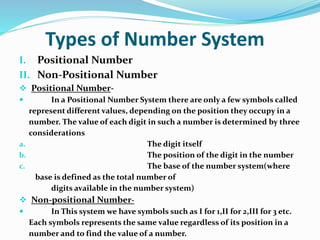
Types of Number System
I. Positional Number
II. Non-Positional Number
 Positional Number-
 In a Positional Number System there are only a few symbols called
represent different values, depending on the position they occupy in a
number. The value of each digit in such a number is determined by three
considerations
a. The digit itself
b. The position of the digit in the number
c. The base of the number system(where
base is defined as the total number of
digits available in the number system)
 Non-positional Number-
 In This system we have symbols such as I for 1,II for 2,III for 3 etc.
Each symbols represents the same value regardless of its position in a
number and to find the value of a number.
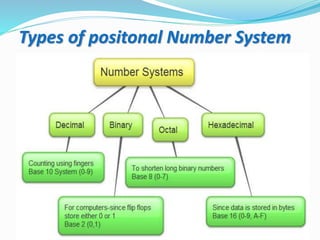
Types of positonal Number System
The Binary System(base 2)
 The word binary is derived from the Latin root
bini (or two by two). In this system the base b
= 2 and we use only two symbols
S ={1,0}
 The symbols in this system are often
referred to as binary digits or bits (binary
digit).
The Decimal System(base 10)
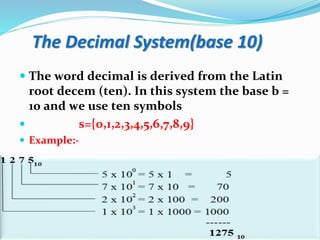
 The word decimal is derived from the Latin
root decem (ten). In this system the base b =
10 and we use ten symbols
 s={0,1,2,3,4,5,6,7,8,9}
 Example:-
The Octal System(base 8)
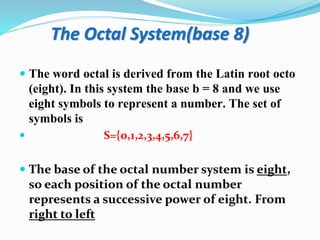
 The word octal is derived from the Latin root octo
(eight). In this system the base b = 8 and we use
eight symbols to represent a number. The set of
symbols is
 S={0,1,2,3,4,5,6,7}
 The base of the octal number system is eight,
so each position of the octal number
represents a successive power of eight. From
right to left
The Hexadecimal System(base 16)
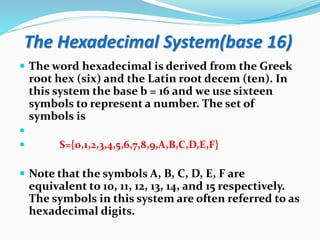
 The word hexadecimal is derived from the Greek
root hex (six) and the Latin root decem (ten). In
this system the base b = 16 and we use sixteen
symbols to represent a number. The set of
symbols is

 S={0,1,2,3,4,5,6,7,8,9,A,B,C,D,E,F}
 Note that the symbols A, B, C, D, E, F are
equivalent to 10, 11, 12, 13, 14, and 15 respectively.
The symbols in this system are often referred to as
hexadecimal digits.
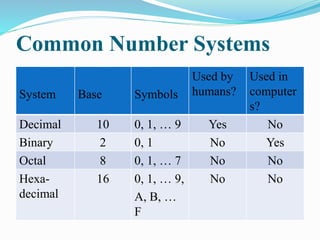
Common Number Systems
System Base Symbols
Used by
humans?
Used in
computer
s?
Decimal 10 0, 1, … 9 Yes No
Binary 2 0, 1 No Yes
Octal 8 0, 1, … 7 No No
Hexa-
decimal
16 0, 1, … 9,
A, B, …
F
No No
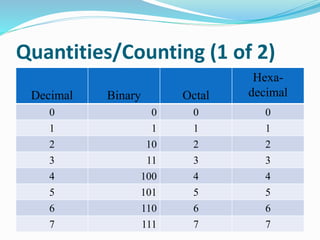
Quantities/Counting (1 of 2)
Decimal Binary Octal
Hexa-
decimal
0 0 0 0
1 1 1 1
2 10 2 2
3 11 3 3
4 100 4 4
5 101 5 5
6 110 6 6
7 111 7 7
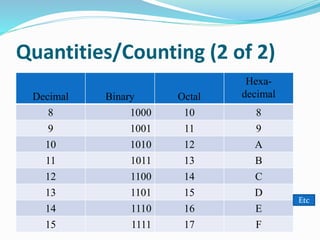
Quantities/Counting (2 of 2)
Decimal Binary Octal
Hexa-
decimal
8 1000 10 8
9 1001 11 9
10 1010 12 A
11 1011 13 B
12 1100 14 C
13 1101 15 D
14 1110 16 E
15 1111 17 F
Etc
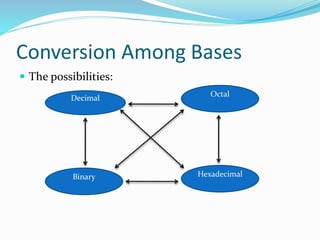
Conversion Among Bases
 The possibilities:
Decimal
Octal
Binary Hexadecimal
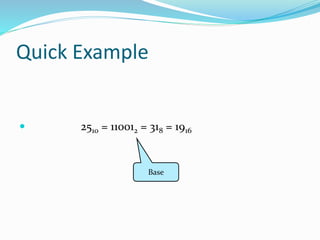
Quick Example
 2510 = 110012 = 318 = 1916
Base
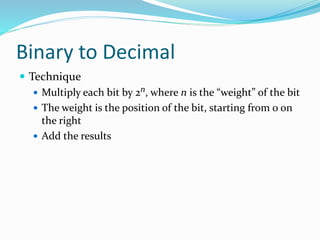
Binary to Decimal
 Technique
 Multiply each bit by 2n, where n is the “weight” of the bit
 The weight is the position of the bit, starting from 0 on
the right
 Add the results
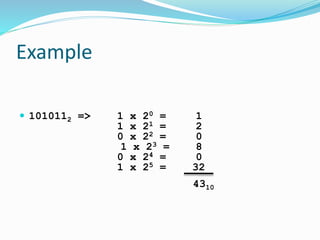
Example
 1010112 => 1 x 20 = 1
1 x 21 = 2
0 x 22 = 0
1 x 23 = 8
0 x 24 = 0
1 x 25 = 32
4310
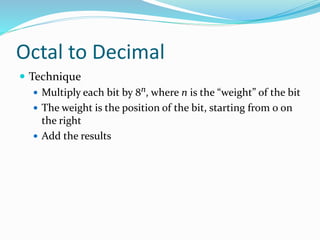
Octal to Decimal
 Technique
 Multiply each bit by 8n, where n is the “weight” of the bit
 The weight is the position of the bit, starting from 0 on
the right
 Add the results
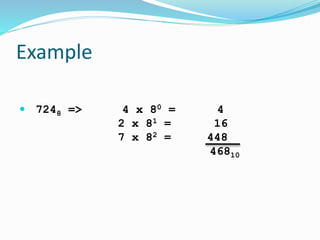
Example
 7248 => 4 x 80 = 4
2 x 81 = 16
7 x 82 = 448
46810
Hexadecimal to Decimal
 Technique
 Multiply each bit by 16n, where n is the “weight” of the
bit
 The weight is the position of the bit, starting from 0 on
the right
 Add the results
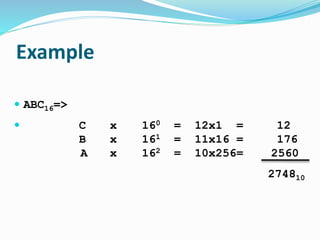
Example
 ABC16=>
 C x 160 = 12x1 = 12
B x 161 = 11x16 = 176
A x 162 = 10x256= 2560
274810
Decimal to Binary
 Technique
 Divide by two, keep track of the remainder
 First remainder is bit 0 (LSB, least-significant bit)
 Second remainder is bit 1
 Etc.
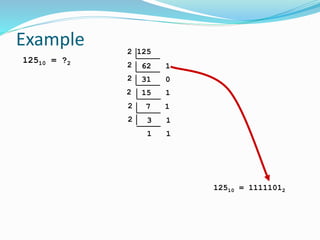
Example
12510 = ?2
2 125
62 12
31 02
15 12
7 12
3 12
1 1
2
1 1
12510 = 11111012
Octal to Binary
 Technique
 Convert each octal digit to a 3-bit equivalent binary
representation
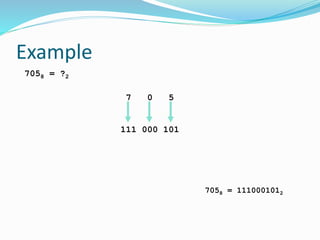
Example
7058 = ?2
7 0 5
111 000 101
7058 = 1110001012
Hexadecimal to Binary
 Technique
 Convert each hexadecimal digit to a 4-bit equivalent
binary representation
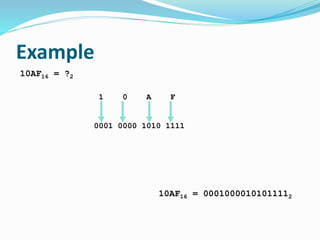
Example
10AF16 = ?2
1 0 A F
0001 0000 1010 1111
10AF16 = 00010000101011112
Decimal to Octal
 Technique
 Divide by 8
 Keep track of the remainder
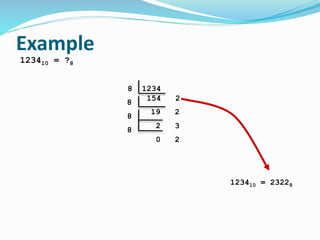
Example
123410 = ?8
8 1234
154 2
8
19 2
8
2 3
8
0 2
123410 = 23228
Decimal to Hexadecimal
 Technique
 Divide by 16
 Keep track of the remainder
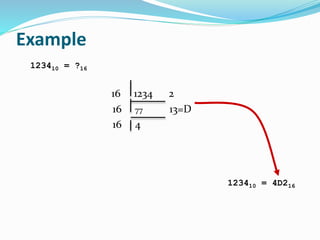
Example
16 1234 2
16 77 13=D
16 4
123410 = ?16
123410 = 4D216
Binary to Octal
 Technique
 Group bits in threes, starting on right
 Convert to octal digits
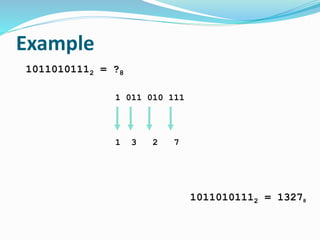
Example
10110101112 = ?8
1 011 010 111
1 3 2 7
10110101112 = 13278
Binary to Hexadecimal
 Technique
 Group bits in fours, starting on right
 Convert to hexadecimal digits
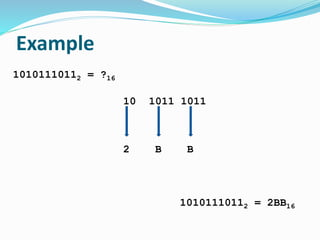
Example
10101110112 = ?16
10 1011 1011
2 B B
10101110112 = 2BB16
Octal to Hexadecimal
 Technique
 Use binary as an intermediary
Example
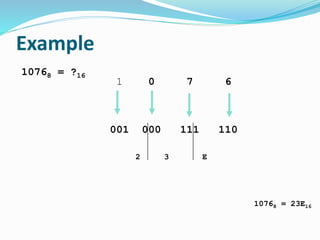
10768 = ?16
1 0 7 6
001 000 111 110
2 3 E
10768 = 23E16
Hexadecimal to Octal
 Technique
 Use binary as an intermediary
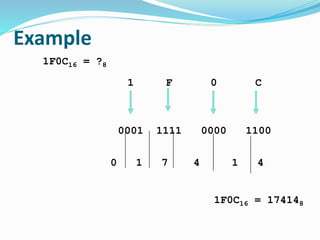
Example
1F0C16 = ?8
1 F 0 C
0001 1111 0000 1100
0 1 7 4 1 4
1F0C16 = 174148
Fractions
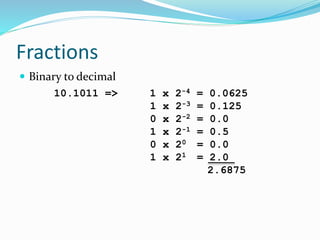
 Binary to decimal
10.1011 => 1 x 2-4 = 0.0625
1 x 2-3 = 0.125
0 x 2-2 = 0.0
1 x 2-1 = 0.5
0 x 20 = 0.0
1 x 21 = 2.0
2.6875
Fractions
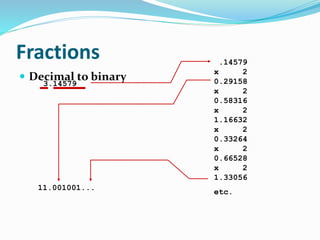
 Decimal to binary
3.14579
.14579
x 2
0.29158
x 2
0.58316
x 2
1.16632
x 2
0.33264
x 2
0.66528
x 2
1.33056
etc.
11.001001...
Thankyou…………

Number system....

  • 1.
  • 2.
    Objective 1. Understand theconcept of number systems. 2. Distinguish between non-positional and positional number systems. 3. Describe the decimal, binary, OCTAL and HEXADECIMAL system. 4. Convert a number in binary, octal or hexadecimal to a number in the decimal system. 5. Convert a number in the decimal system to a number in binary, octal and hexadecimal. 6. Convert a number in binary to octal and vice versa. 7. Convert a number in binary to hexadecimal and vice versa.
  • 3.
    Introduction  A NumberSystem (or system of numeration) is a writing system for expressing numbers, that is a mathematical notation for representing numbers of a given set, using digits or other symbols in a consistent manner.  Ideally, a numeral system will Represent a useful set of numbers (e.g. all integers, or rational numbers) Give every number represented a unique representation (or at least a standard representation)  Reflect the algebraic and arithmetic structure of the numbers.
  • 5.
    Types of NumberSystem I. Positional Number II. Non-Positional Number  Positional Number-  In a Positional Number System there are only a few symbols called represent different values, depending on the position they occupy in a number. The value of each digit in such a number is determined by three considerations a. The digit itself b. The position of the digit in the number c. The base of the number system(where base is defined as the total number of digits available in the number system)  Non-positional Number-  In This system we have symbols such as I for 1,II for 2,III for 3 etc. Each symbols represents the same value regardless of its position in a number and to find the value of a number.
  • 6.
    Types of positonalNumber System
  • 7.
    The Binary System(base2)  The word binary is derived from the Latin root bini (or two by two). In this system the base b = 2 and we use only two symbols S ={1,0}  The symbols in this system are often referred to as binary digits or bits (binary digit).
  • 8.
    The Decimal System(base10)  The word decimal is derived from the Latin root decem (ten). In this system the base b = 10 and we use ten symbols  s={0,1,2,3,4,5,6,7,8,9}  Example:-
  • 9.
    The Octal System(base8)  The word octal is derived from the Latin root octo (eight). In this system the base b = 8 and we use eight symbols to represent a number. The set of symbols is  S={0,1,2,3,4,5,6,7}  The base of the octal number system is eight, so each position of the octal number represents a successive power of eight. From right to left
  • 10.
    The Hexadecimal System(base16)  The word hexadecimal is derived from the Greek root hex (six) and the Latin root decem (ten). In this system the base b = 16 and we use sixteen symbols to represent a number. The set of symbols is   S={0,1,2,3,4,5,6,7,8,9,A,B,C,D,E,F}  Note that the symbols A, B, C, D, E, F are equivalent to 10, 11, 12, 13, 14, and 15 respectively. The symbols in this system are often referred to as hexadecimal digits.
  • 11.
    Common Number Systems SystemBase Symbols Used by humans? Used in computer s? Decimal 10 0, 1, … 9 Yes No Binary 2 0, 1 No Yes Octal 8 0, 1, … 7 No No Hexa- decimal 16 0, 1, … 9, A, B, … F No No
  • 12.
    Quantities/Counting (1 of2) Decimal Binary Octal Hexa- decimal 0 0 0 0 1 1 1 1 2 10 2 2 3 11 3 3 4 100 4 4 5 101 5 5 6 110 6 6 7 111 7 7
  • 13.
    Quantities/Counting (2 of2) Decimal Binary Octal Hexa- decimal 8 1000 10 8 9 1001 11 9 10 1010 12 A 11 1011 13 B 12 1100 14 C 13 1101 15 D 14 1110 16 E 15 1111 17 F Etc
  • 14.
    Conversion Among Bases The possibilities: Decimal Octal Binary Hexadecimal
  • 15.
    Quick Example  2510= 110012 = 318 = 1916 Base
  • 16.
    Binary to Decimal Technique  Multiply each bit by 2n, where n is the “weight” of the bit  The weight is the position of the bit, starting from 0 on the right  Add the results
  • 17.
    Example  1010112 =>1 x 20 = 1 1 x 21 = 2 0 x 22 = 0 1 x 23 = 8 0 x 24 = 0 1 x 25 = 32 4310
  • 18.
    Octal to Decimal Technique  Multiply each bit by 8n, where n is the “weight” of the bit  The weight is the position of the bit, starting from 0 on the right  Add the results
  • 19.
    Example  7248 =>4 x 80 = 4 2 x 81 = 16 7 x 82 = 448 46810
  • 20.
    Hexadecimal to Decimal Technique  Multiply each bit by 16n, where n is the “weight” of the bit  The weight is the position of the bit, starting from 0 on the right  Add the results
  • 21.
    Example  ABC16=>  Cx 160 = 12x1 = 12 B x 161 = 11x16 = 176 A x 162 = 10x256= 2560 274810
  • 22.
    Decimal to Binary Technique  Divide by two, keep track of the remainder  First remainder is bit 0 (LSB, least-significant bit)  Second remainder is bit 1  Etc.
  • 23.
    Example 12510 = ?2 2125 62 12 31 02 15 12 7 12 3 12 1 1 2 1 1 12510 = 11111012
  • 24.
    Octal to Binary Technique  Convert each octal digit to a 3-bit equivalent binary representation
  • 25.
    Example 7058 = ?2 70 5 111 000 101 7058 = 1110001012
  • 26.
    Hexadecimal to Binary Technique  Convert each hexadecimal digit to a 4-bit equivalent binary representation
  • 27.
    Example 10AF16 = ?2 10 A F 0001 0000 1010 1111 10AF16 = 00010000101011112
  • 28.
    Decimal to Octal Technique  Divide by 8  Keep track of the remainder
  • 29.
    Example 123410 = ?8 81234 154 2 8 19 2 8 2 3 8 0 2 123410 = 23228
  • 30.
    Decimal to Hexadecimal Technique  Divide by 16  Keep track of the remainder
  • 31.
    Example 16 1234 2 1677 13=D 16 4 123410 = ?16 123410 = 4D216
  • 32.
    Binary to Octal Technique  Group bits in threes, starting on right  Convert to octal digits
  • 33.
    Example 10110101112 = ?8 1011 010 111 1 3 2 7 10110101112 = 13278
  • 34.
    Binary to Hexadecimal Technique  Group bits in fours, starting on right  Convert to hexadecimal digits
  • 35.
    Example 10101110112 = ?16 101011 1011 2 B B 10101110112 = 2BB16
  • 36.
    Octal to Hexadecimal Technique  Use binary as an intermediary
  • 37.
    Example 10768 = ?16 10 7 6 001 000 111 110 2 3 E 10768 = 23E16
  • 38.
    Hexadecimal to Octal Technique  Use binary as an intermediary
  • 39.
    Example 1F0C16 = ?8 1F 0 C 0001 1111 0000 1100 0 1 7 4 1 4 1F0C16 = 174148
  • 40.
    Fractions  Binary todecimal 10.1011 => 1 x 2-4 = 0.0625 1 x 2-3 = 0.125 0 x 2-2 = 0.0 1 x 2-1 = 0.5 0 x 20 = 0.0 1 x 21 = 2.0 2.6875
  • 41.
    Fractions  Decimal tobinary 3.14579 .14579 x 2 0.29158 x 2 0.58316 x 2 1.16632 x 2 0.33264 x 2 0.66528 x 2 1.33056 etc. 11.001001...
  • 42.