1. Number Systems Chapt. 2 Location in course textbook
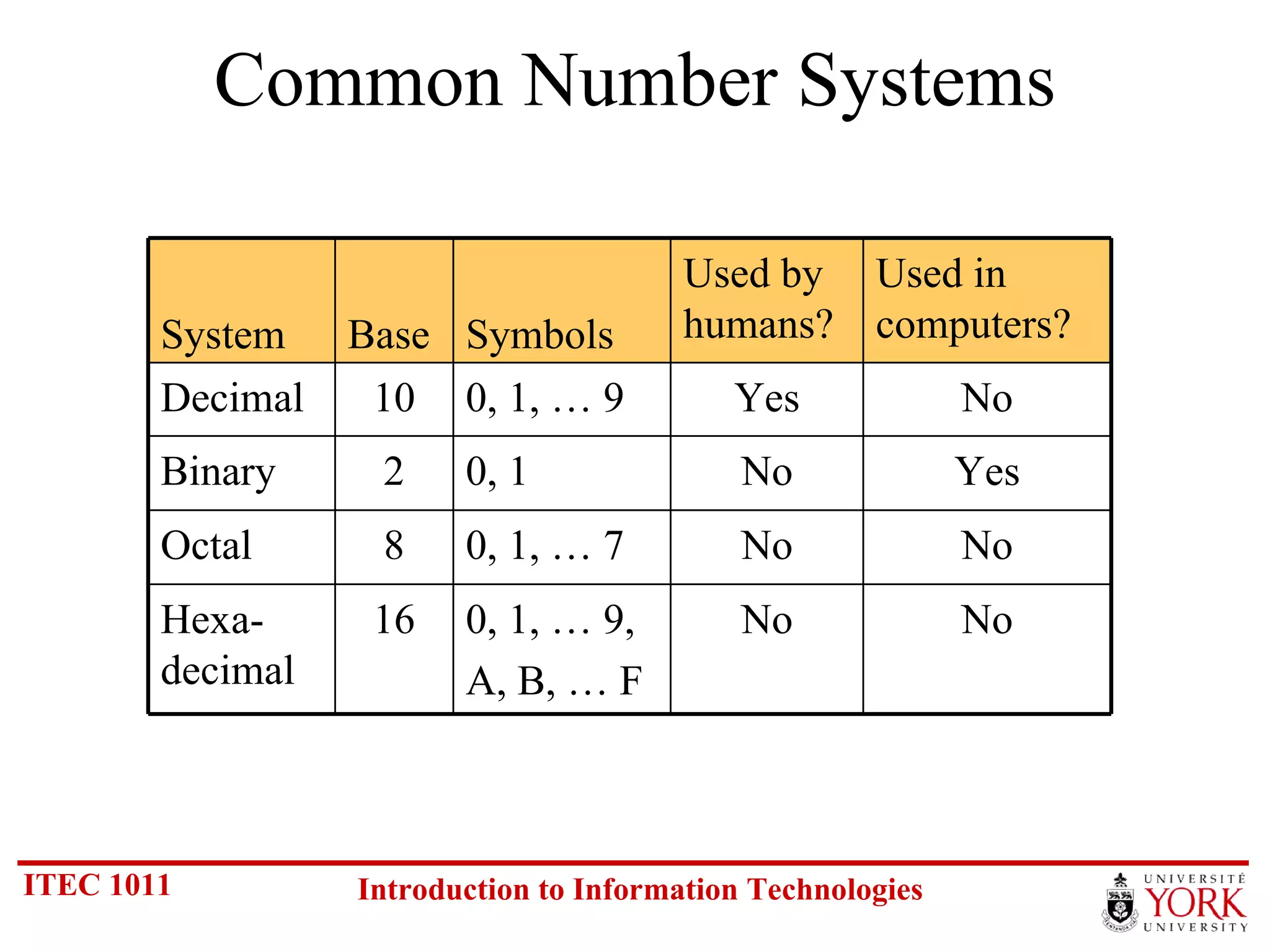
Common Number Systems No No 0, 1, … 9, A, B, … F 16 Hexa- decimal No No 0, 1, … 7 8 Octal Yes No 0, 1 2 Binary No Yes 0, 1, … 9 10 Decimal Used in computers? Used by humans? Symbols Base System
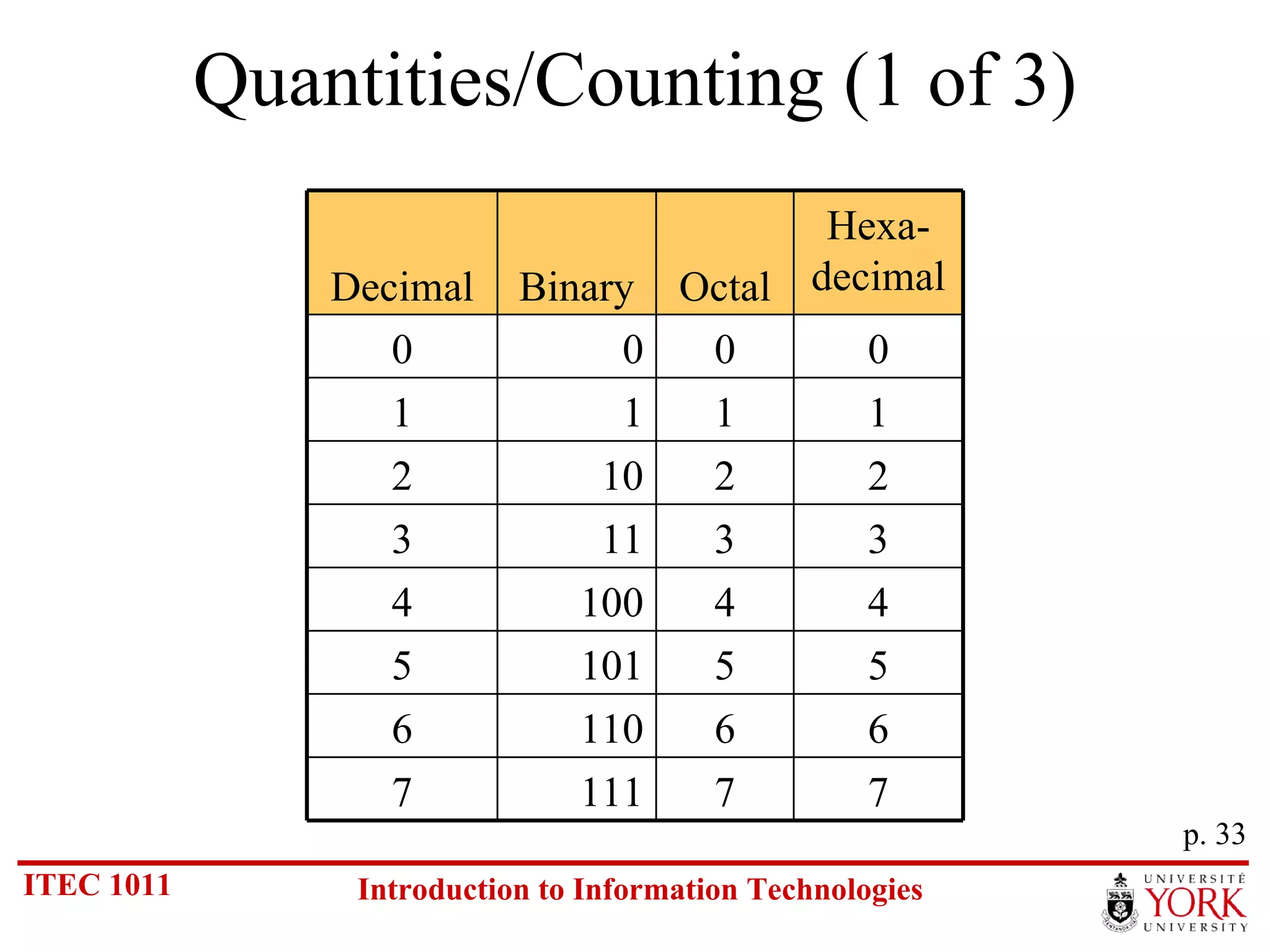
Quantities/Counting (1 of 3) p. 33 7 7 111 7 6 6 110 6 5 5 101 5 4 4 100 4 3 3 11 3 2 2 10 2 1 1 1 1 0 0 0 0 Hexa- decimal Octal Binary Decimal
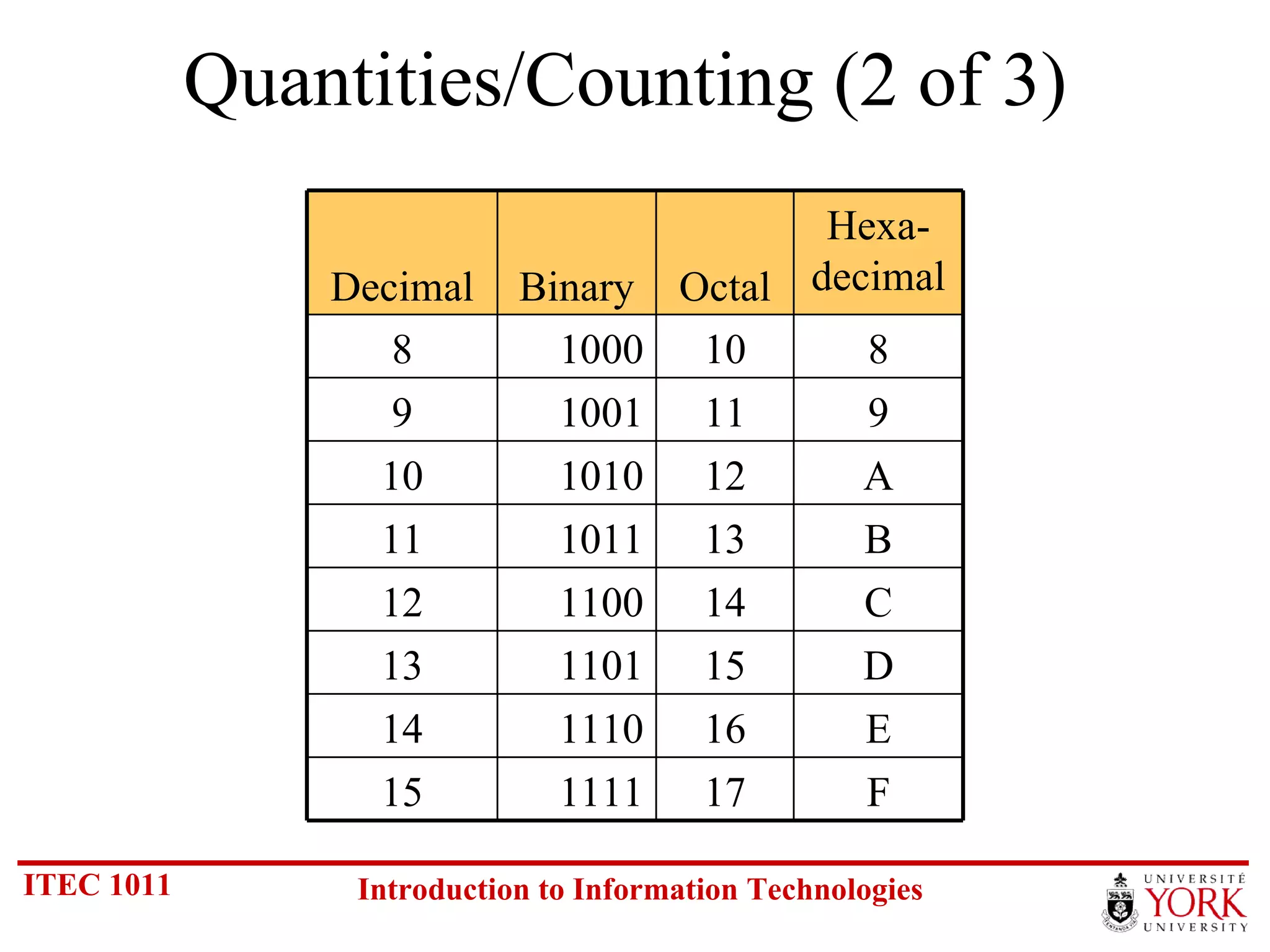
Quantities/Counting (2 of 3)  F 17 1111 15 E 16 1110 14 D 15 1101 13 C 14 1100 12 B 13 1011 11 A 12 1010 10 9 11 1001 9 8 10 1000 8 Hexa- decimal Octal Binary Decimal
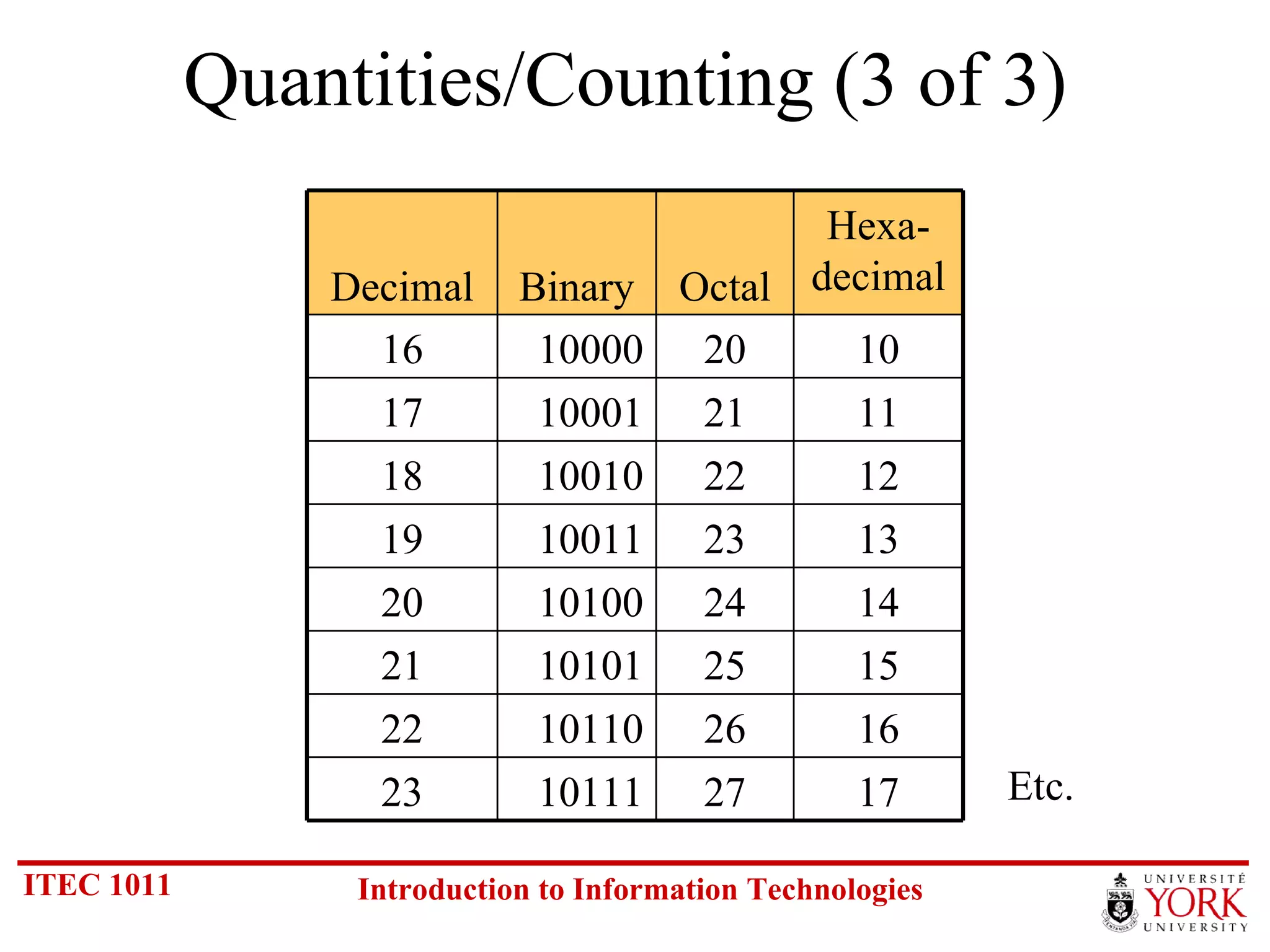
Quantities/Counting (3 of 3)  Etc. 17 27 10111 23 16 26 10110 22 15 25 10101 21 14 24 10100 20 13 23 10011 19 12 22 10010 18 11 21 10001 17 10 20 10000 16 Hexa- decimal Octal Binary Decimal
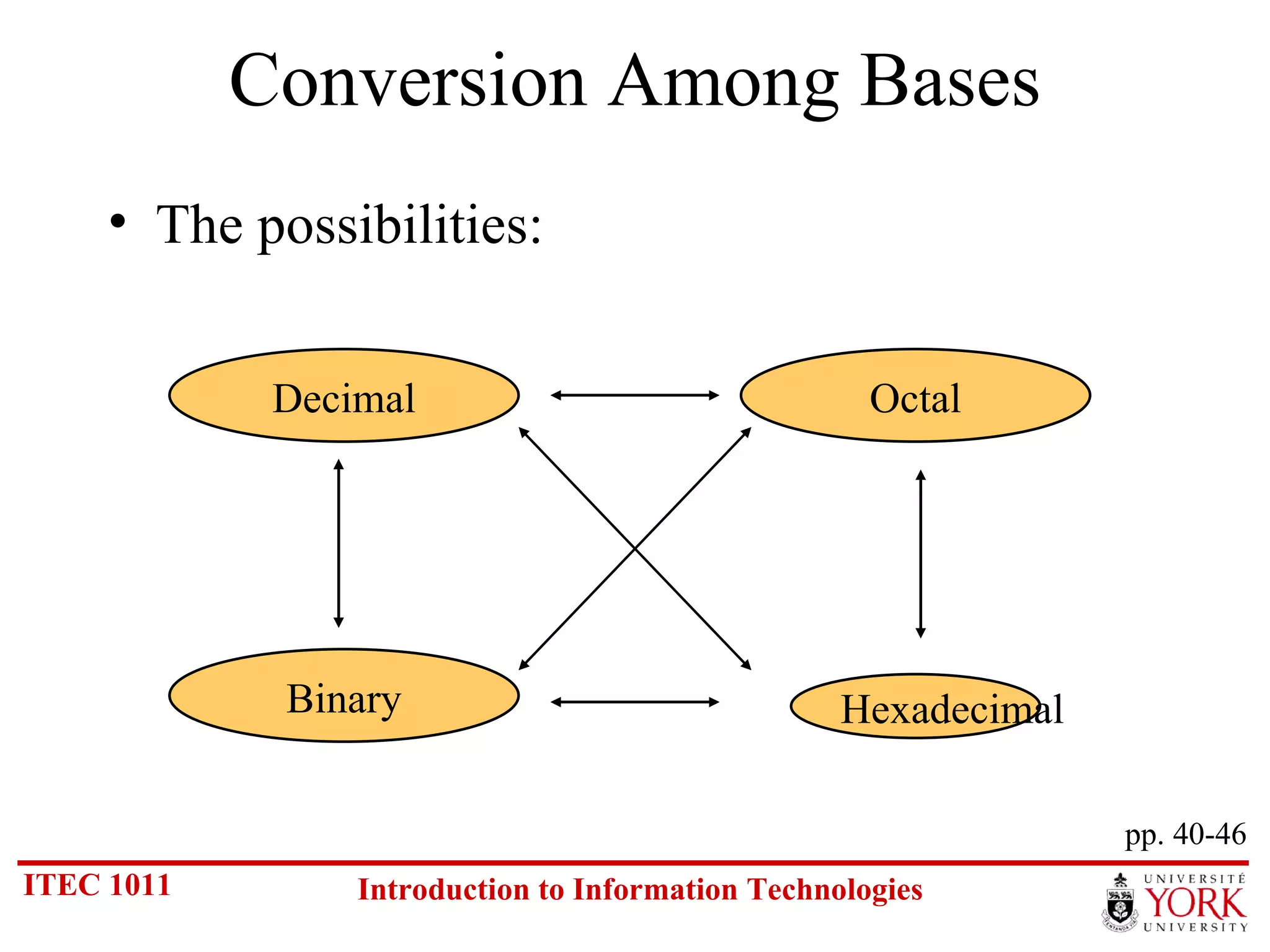
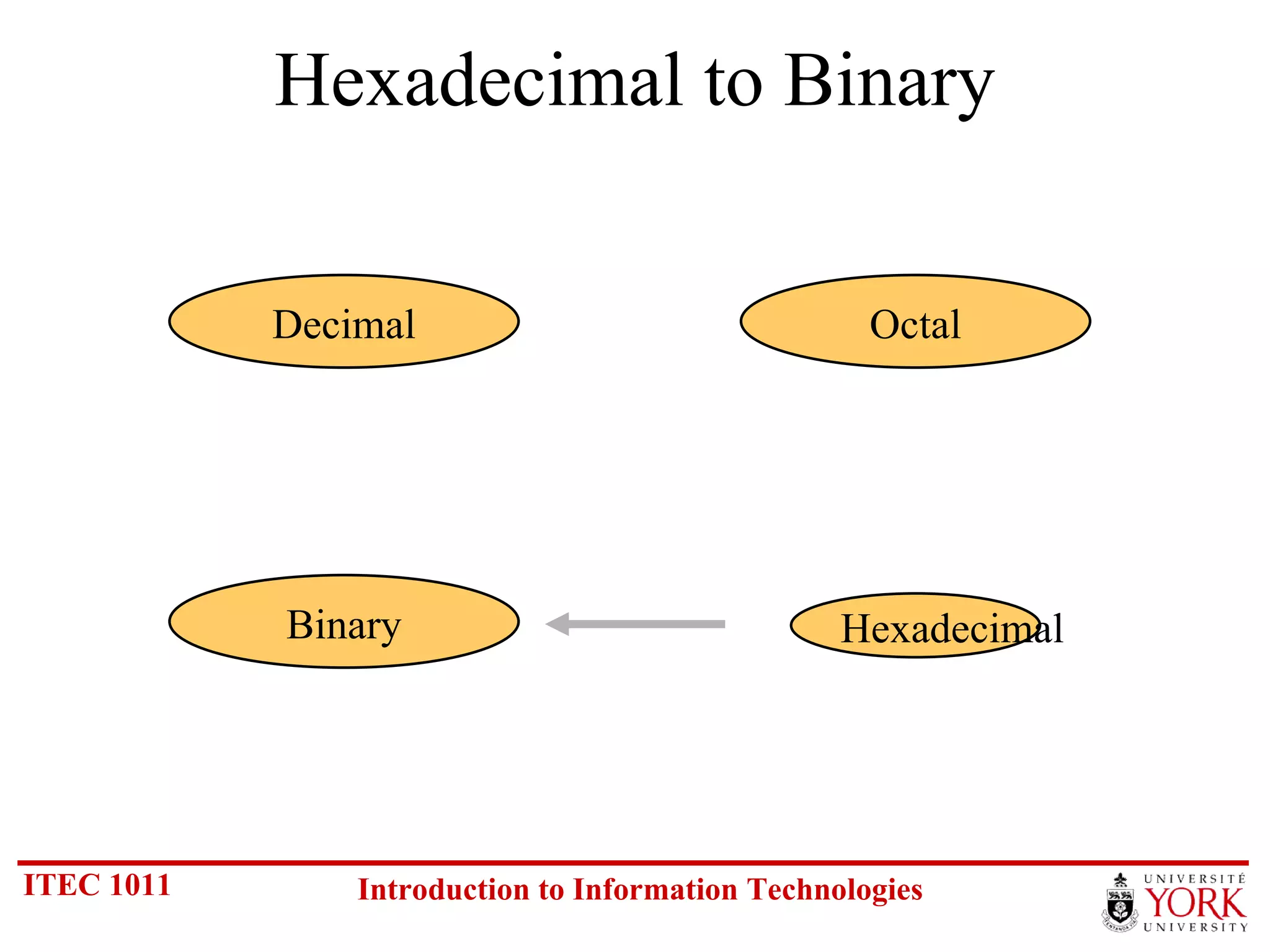
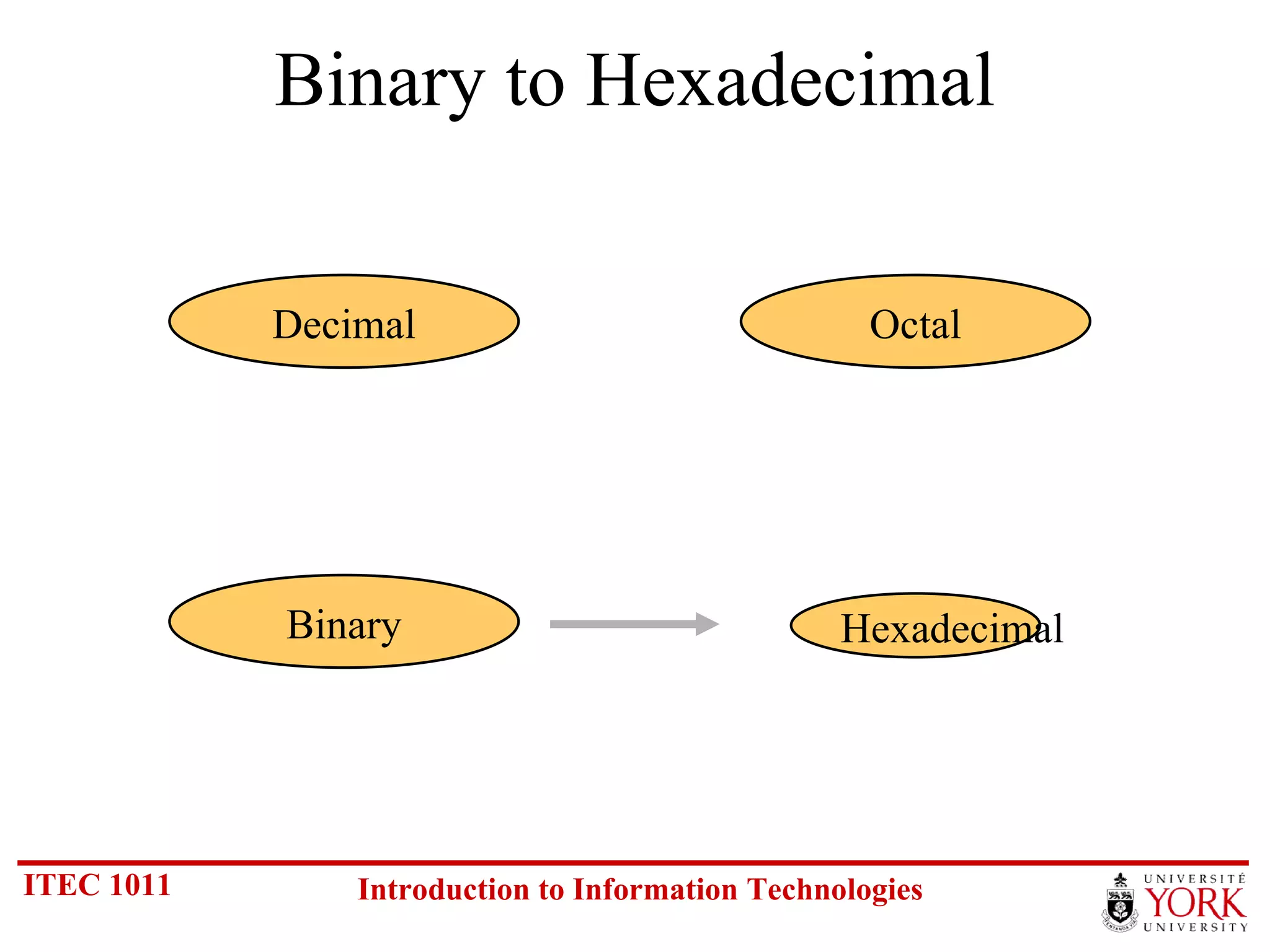
Conversion Among Bases The possibilities: Hexadecimal Decimal Octal Binary pp. 40-46
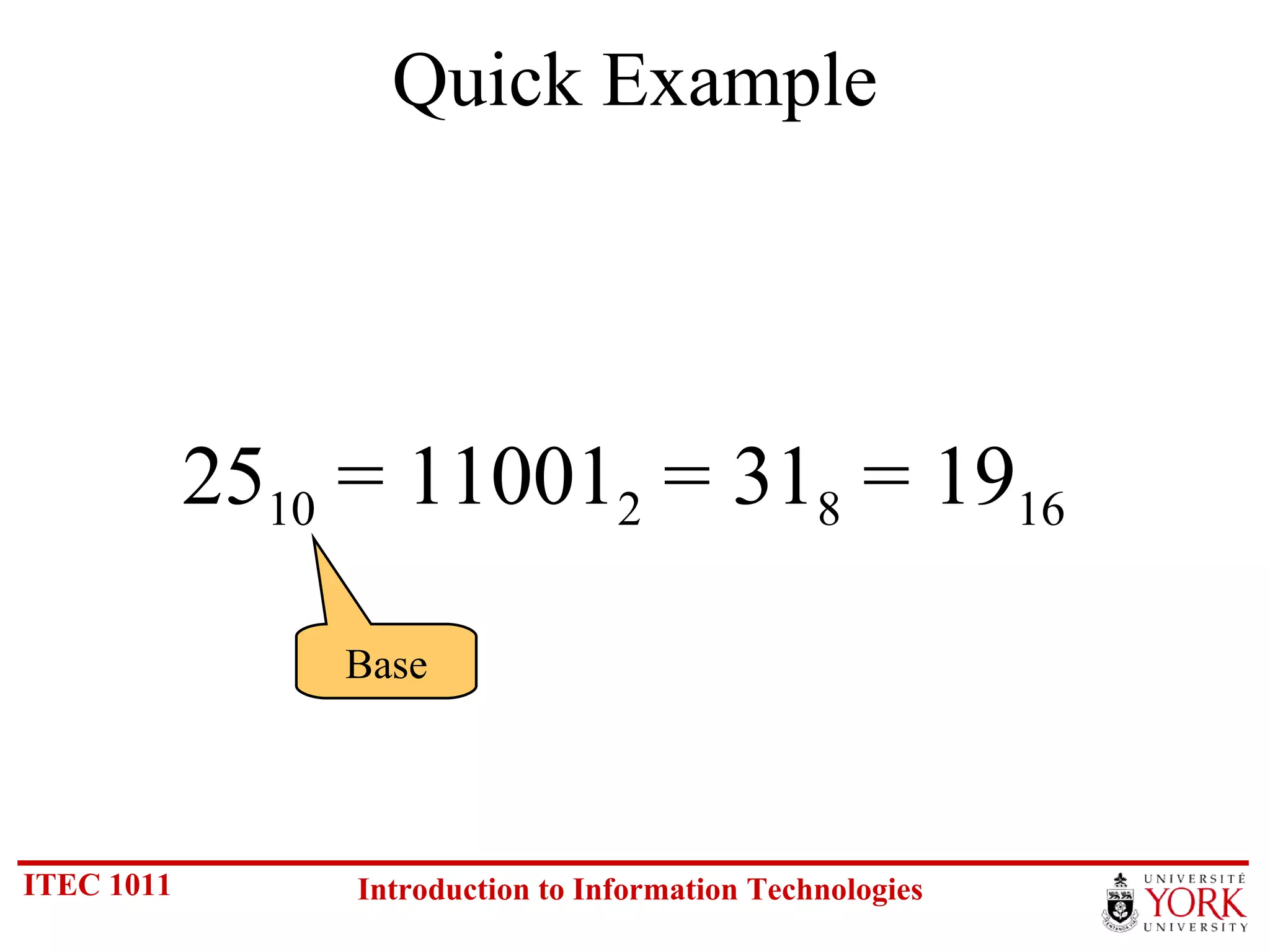
Quick Example 25 10  = 11001 2  = 31 8  = 19 16 Base
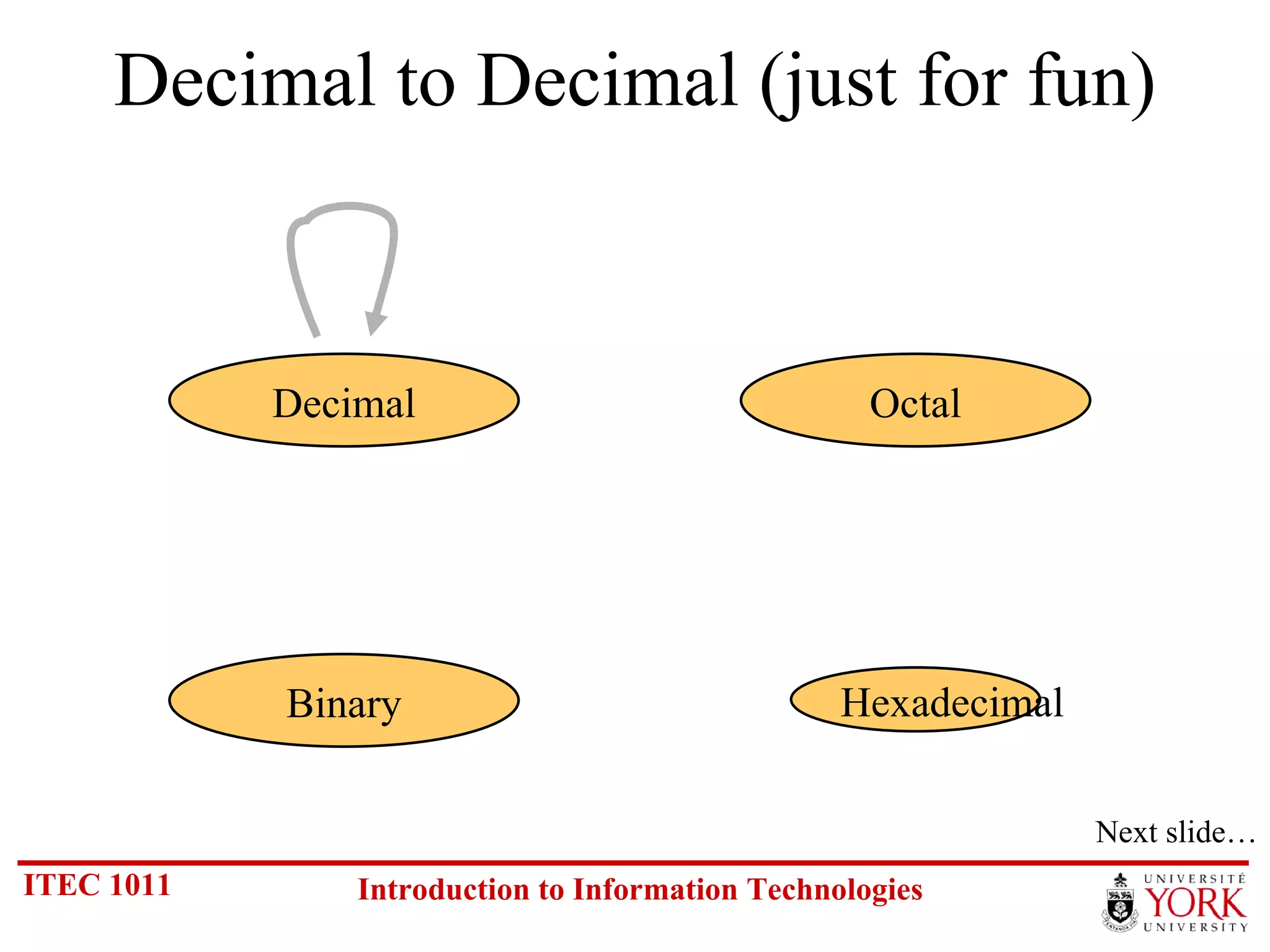
Decimal to Decimal (just for fun) Hexadecimal Decimal Octal Binary Next slide…
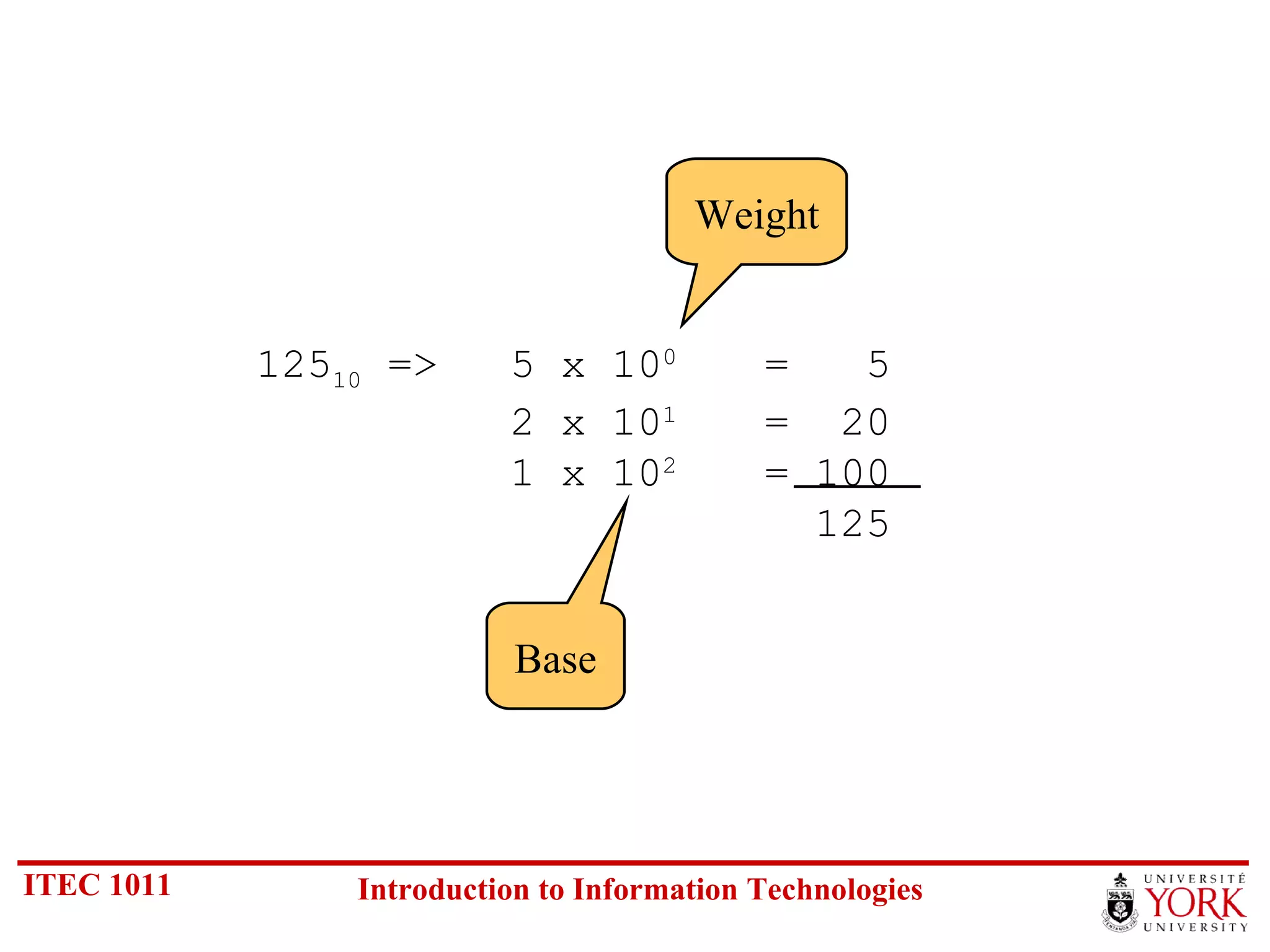
125 10  => 5 x 10 0 =  5 2 x 10 1 =  20 1 x 10 2 = 100   125 Base Weight
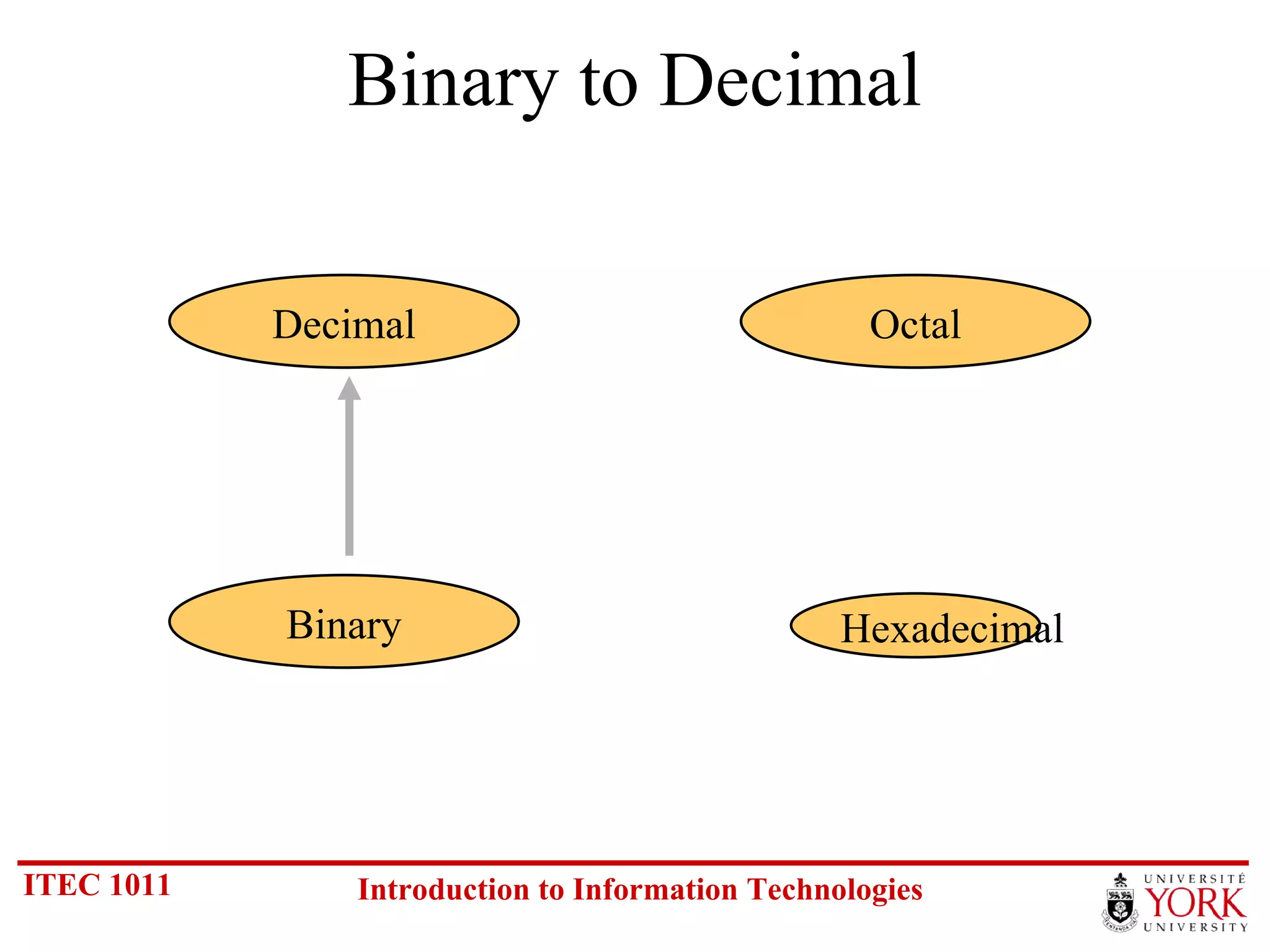
Binary to Decimal Hexadecimal Decimal Octal Binary
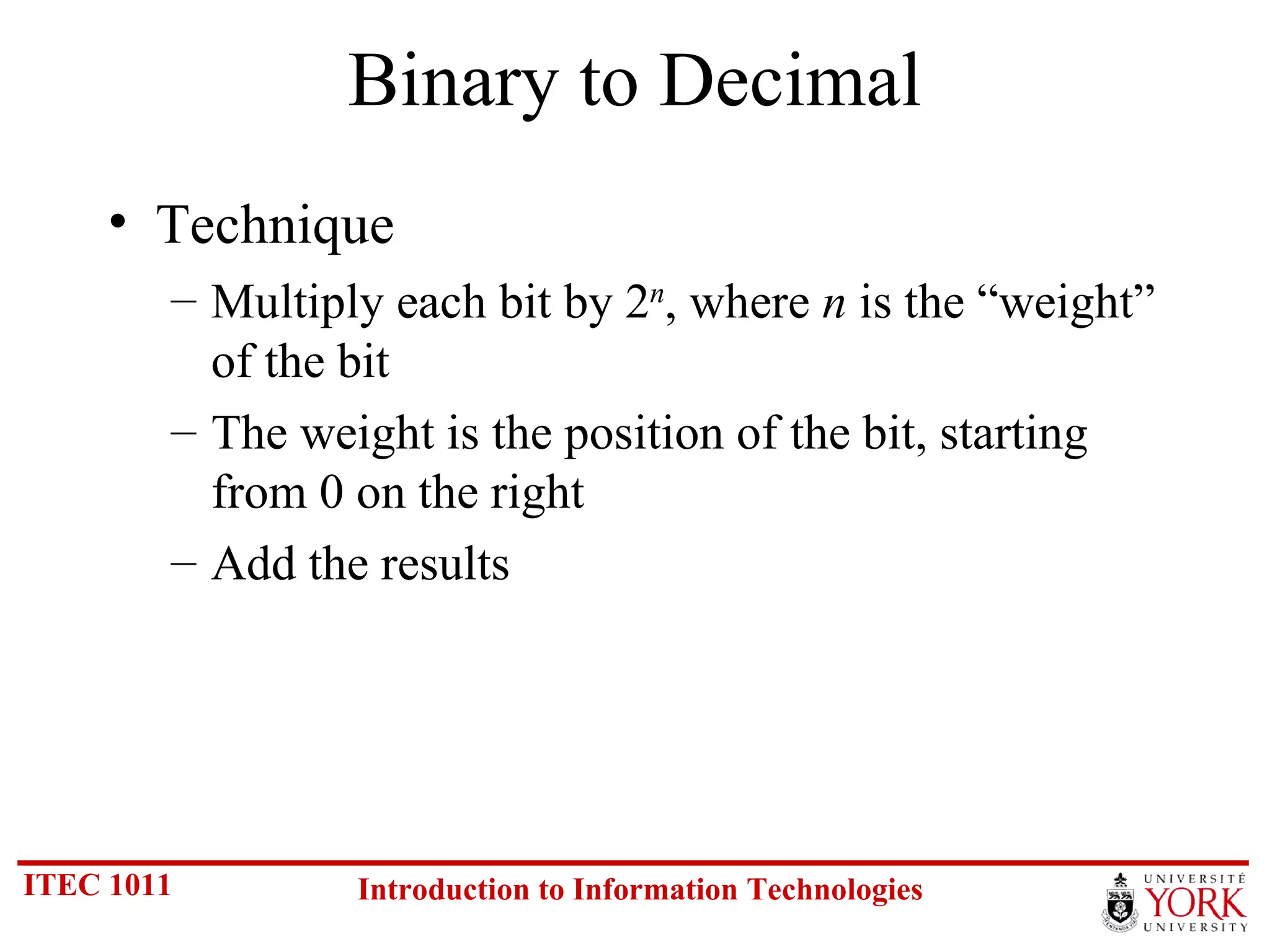
Binary to Decimal Technique Multiply each bit by 2 n , where  n  is the “weight” of the bit The weight is the position of the bit, starting from 0 on the right Add the results
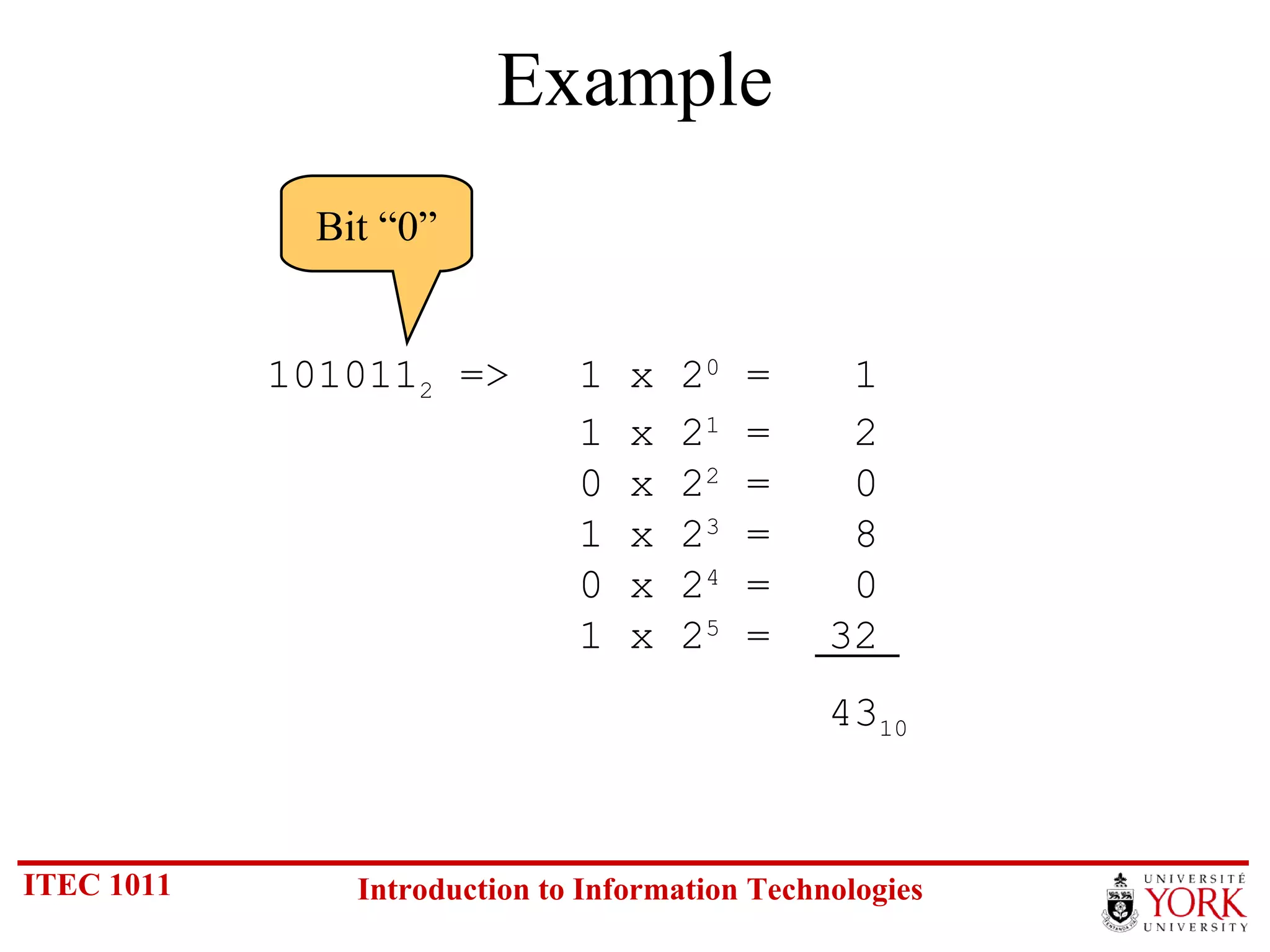
Example 101011 2  =>  1 x 2 0  =   1 1 x 2 1  =  2 0 x 2 2  =   0 1 x 2 3  =   8 0 x 2 4  =  0 1 x 2 5  =  32 43 10 Bit “0”
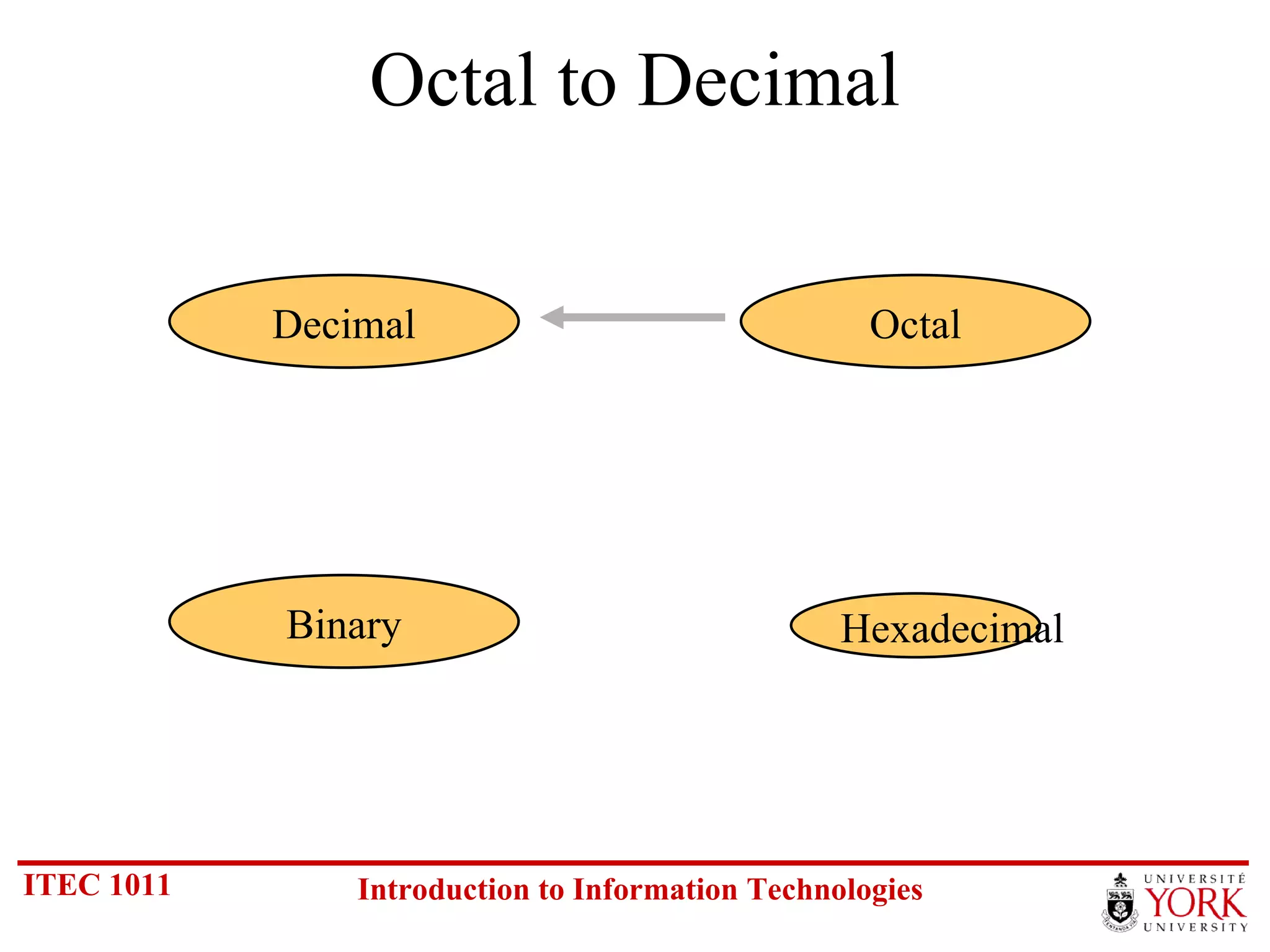
Octal to Decimal Hexadecimal Decimal Octal Binary
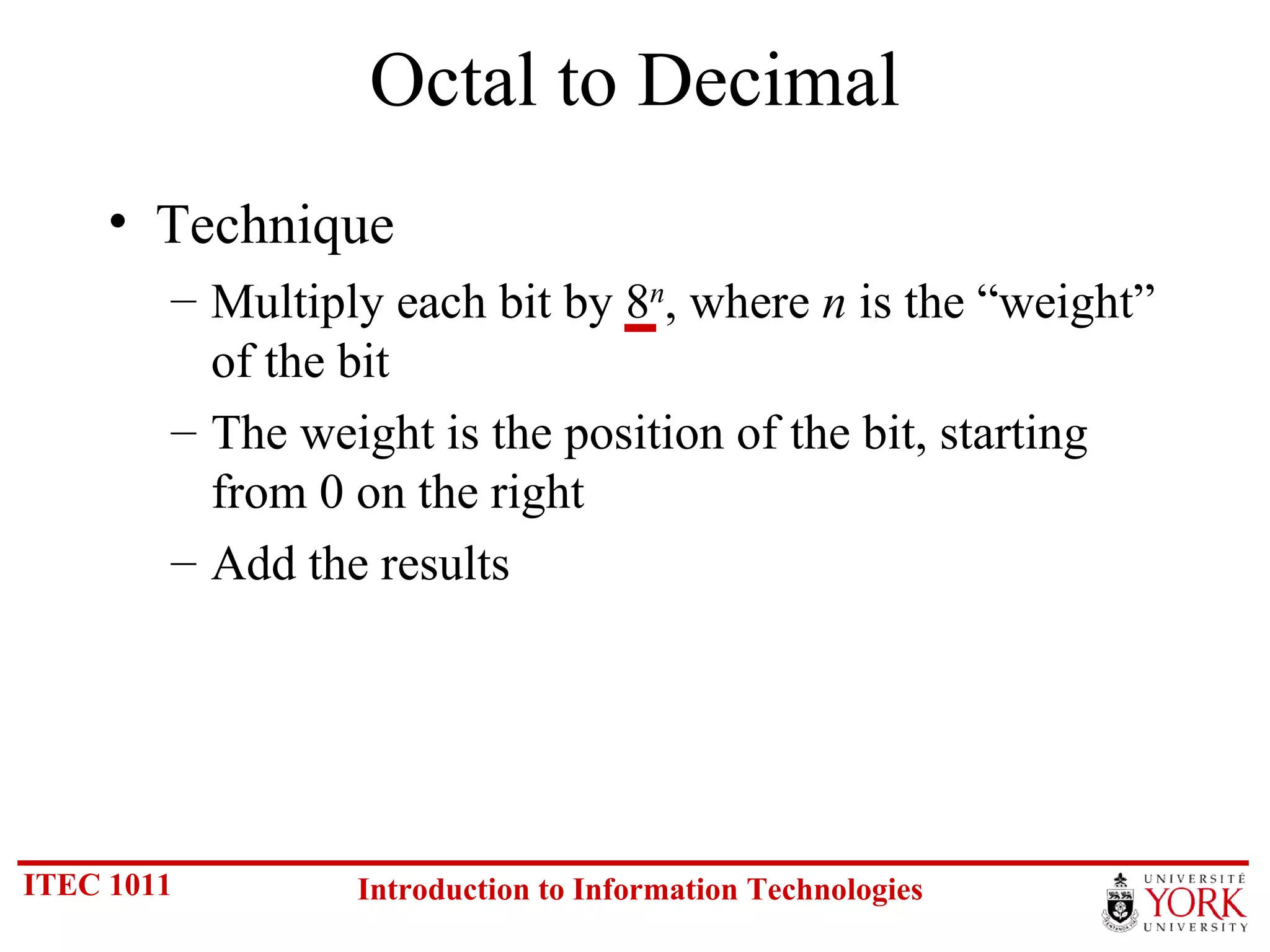
Octal to Decimal Technique Multiply each bit by 8 n , where  n  is the “weight” of the bit The weight is the position of the bit, starting from 0 on the right Add the results
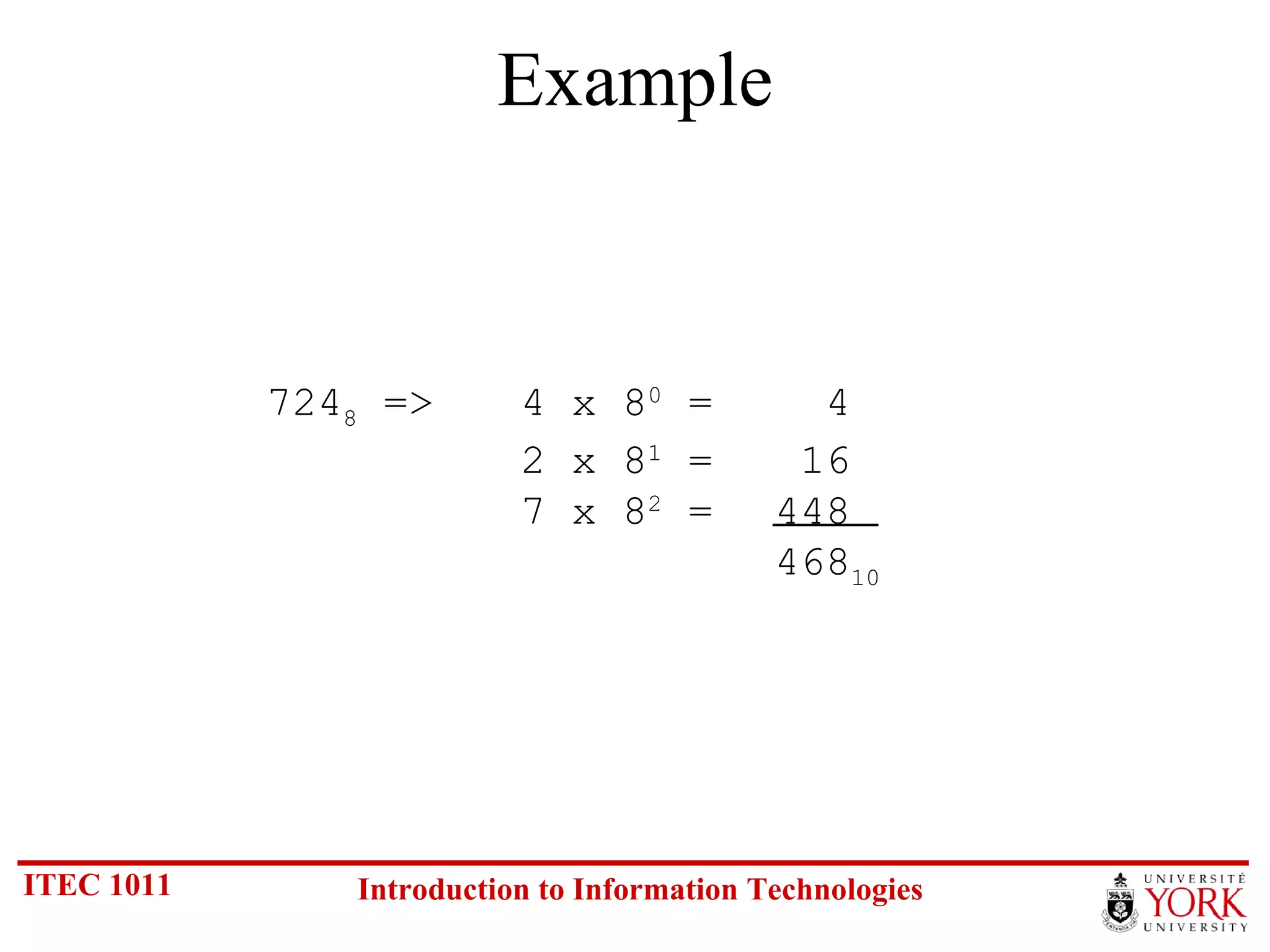
Example 724 8  =>  4 x 8 0  =    4 2 x 8 1  =   16 7 x 8 2  =  448 468 10
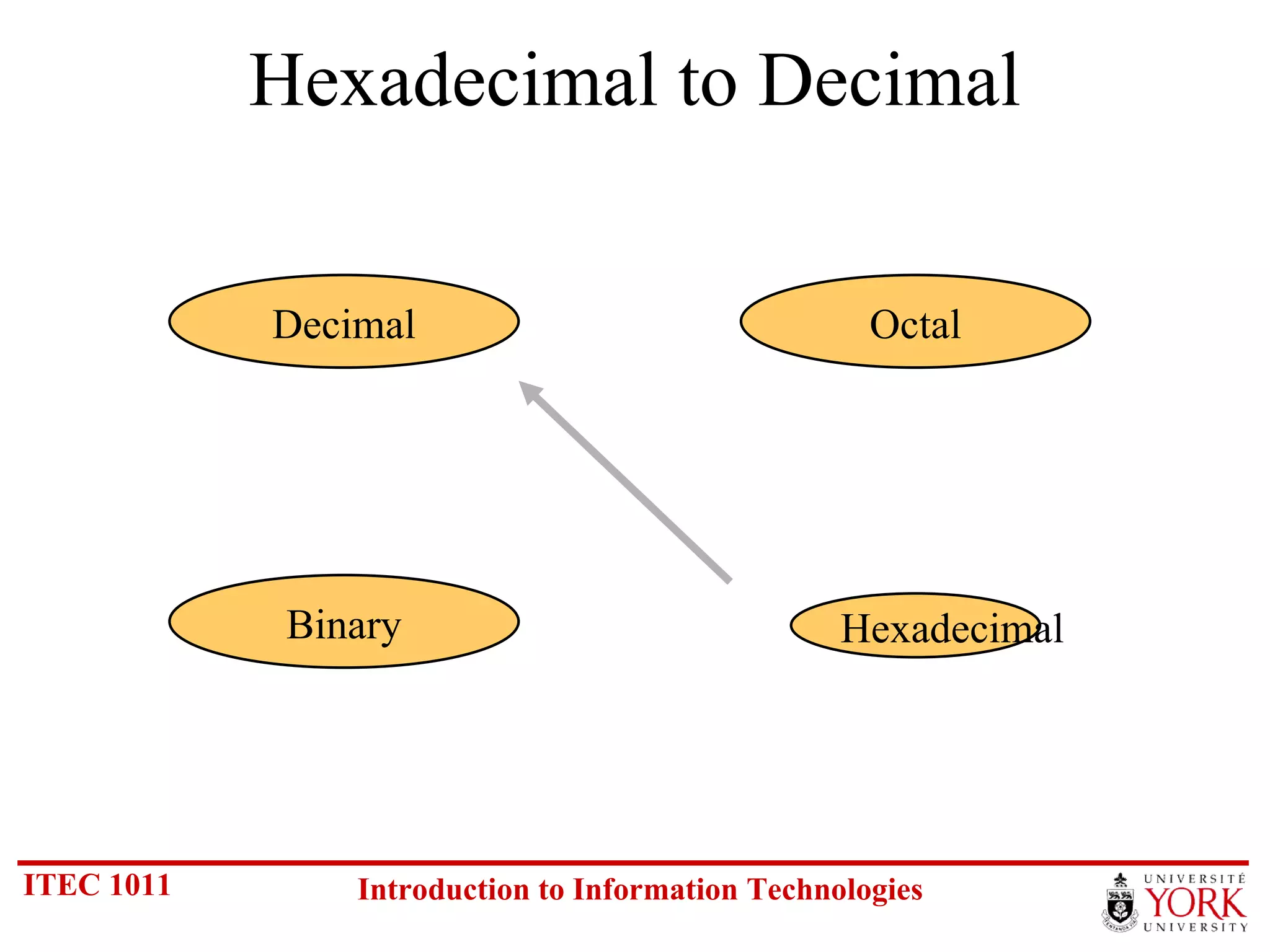
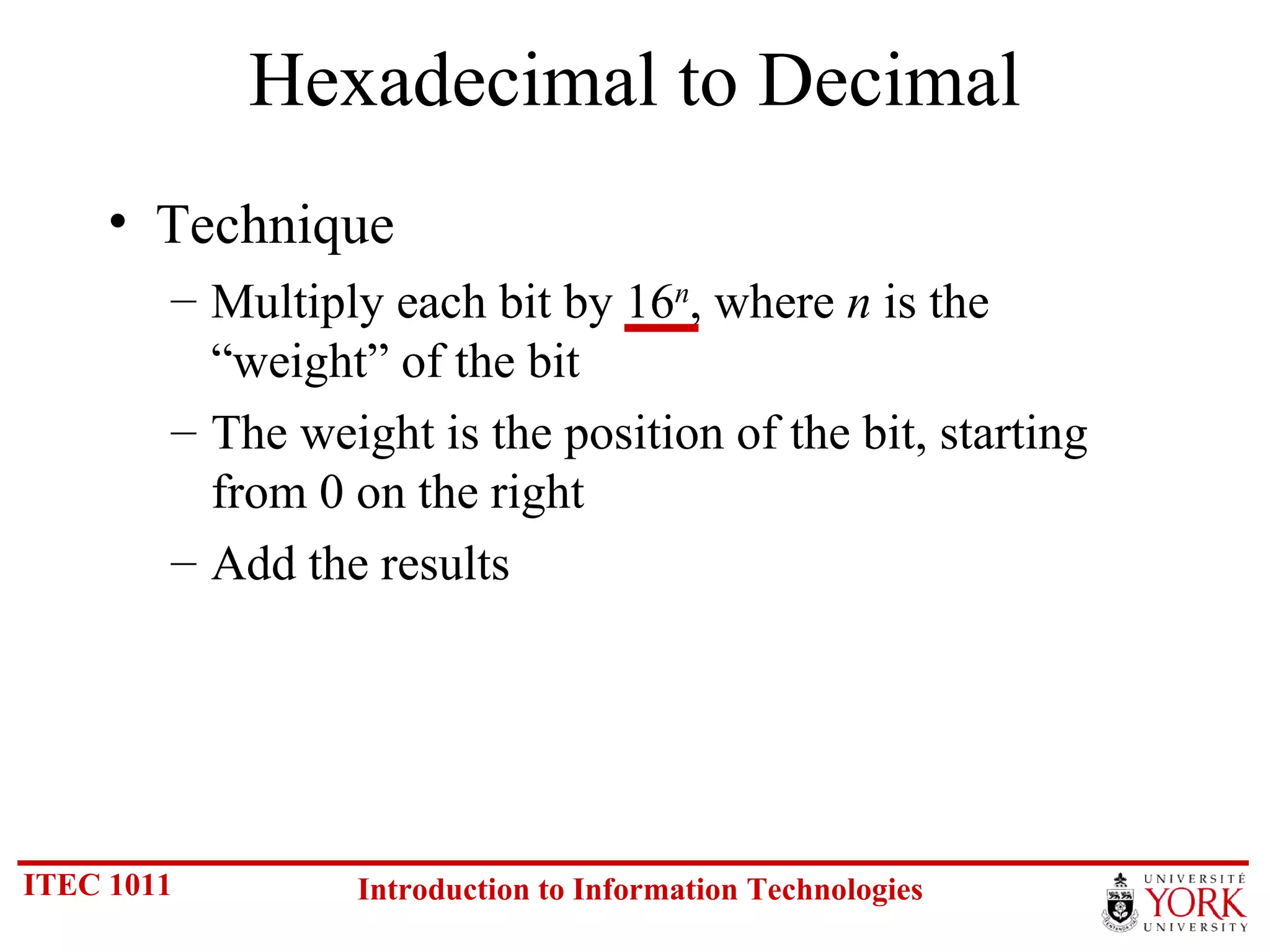
Hexadecimal to Decimal Hexadecimal Decimal Octal Binary
Hexadecimal to Decimal Technique Multiply each bit by 16 n , where  n  is the “weight” of the bit The weight is the position of the bit, starting from 0 on the right Add the results
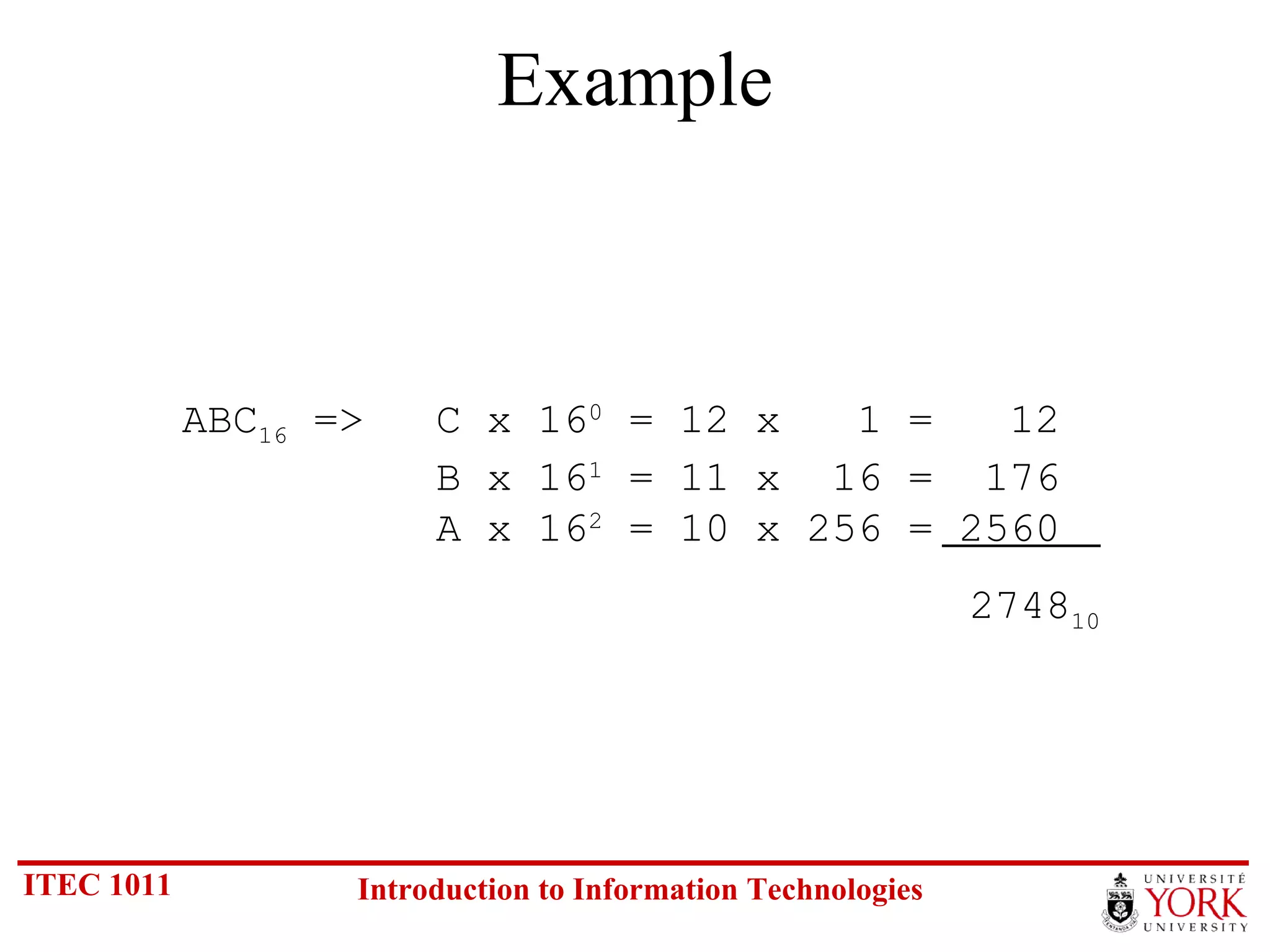
Example ABC 16  => C x 16 0  = 12 x  1 =  12   B x 16 1  = 11 x  16 =  176   A x 16 2  = 10 x 256 = 2560   2748 10
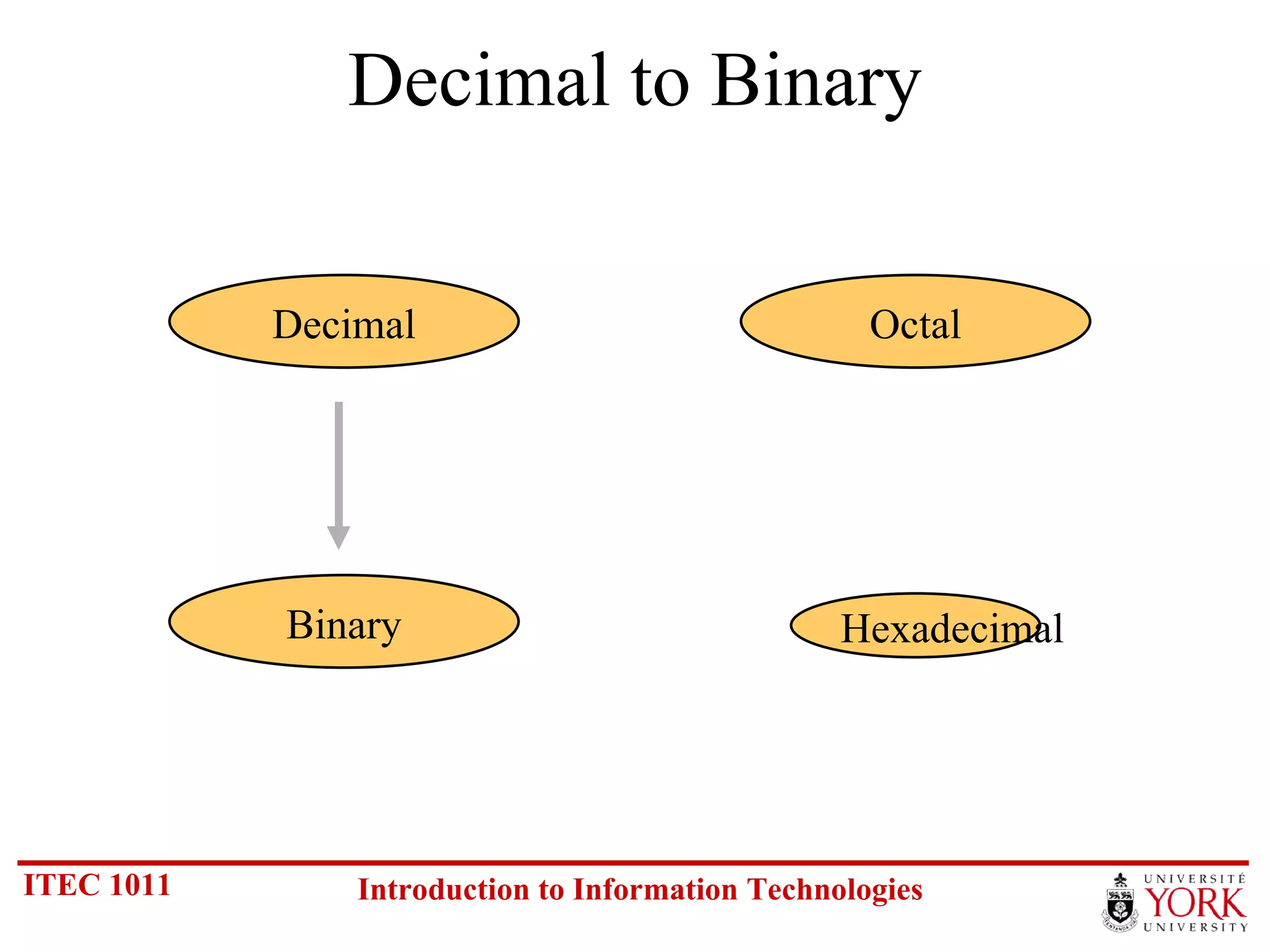
Decimal to Binary Hexadecimal Decimal Octal Binary
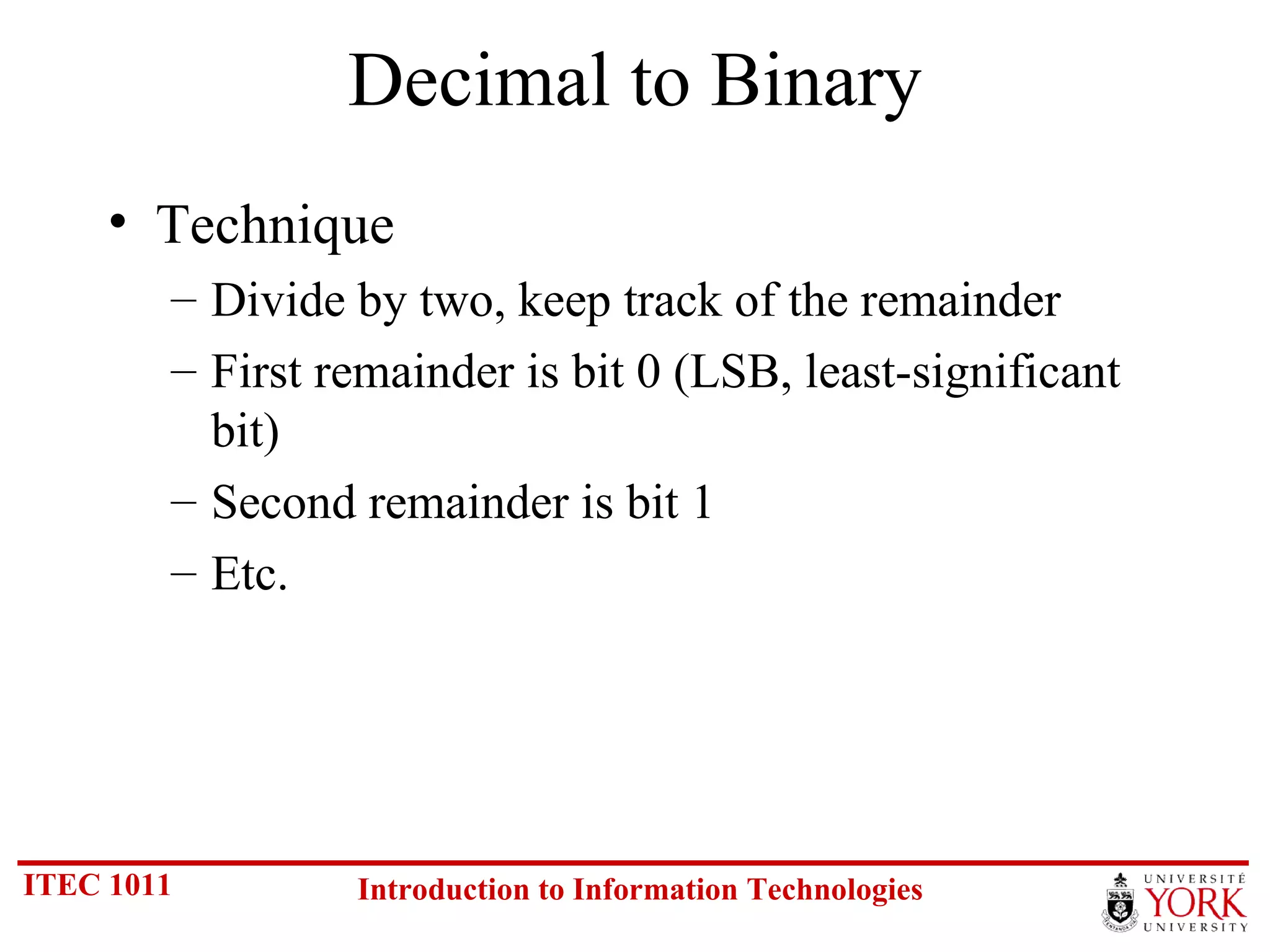
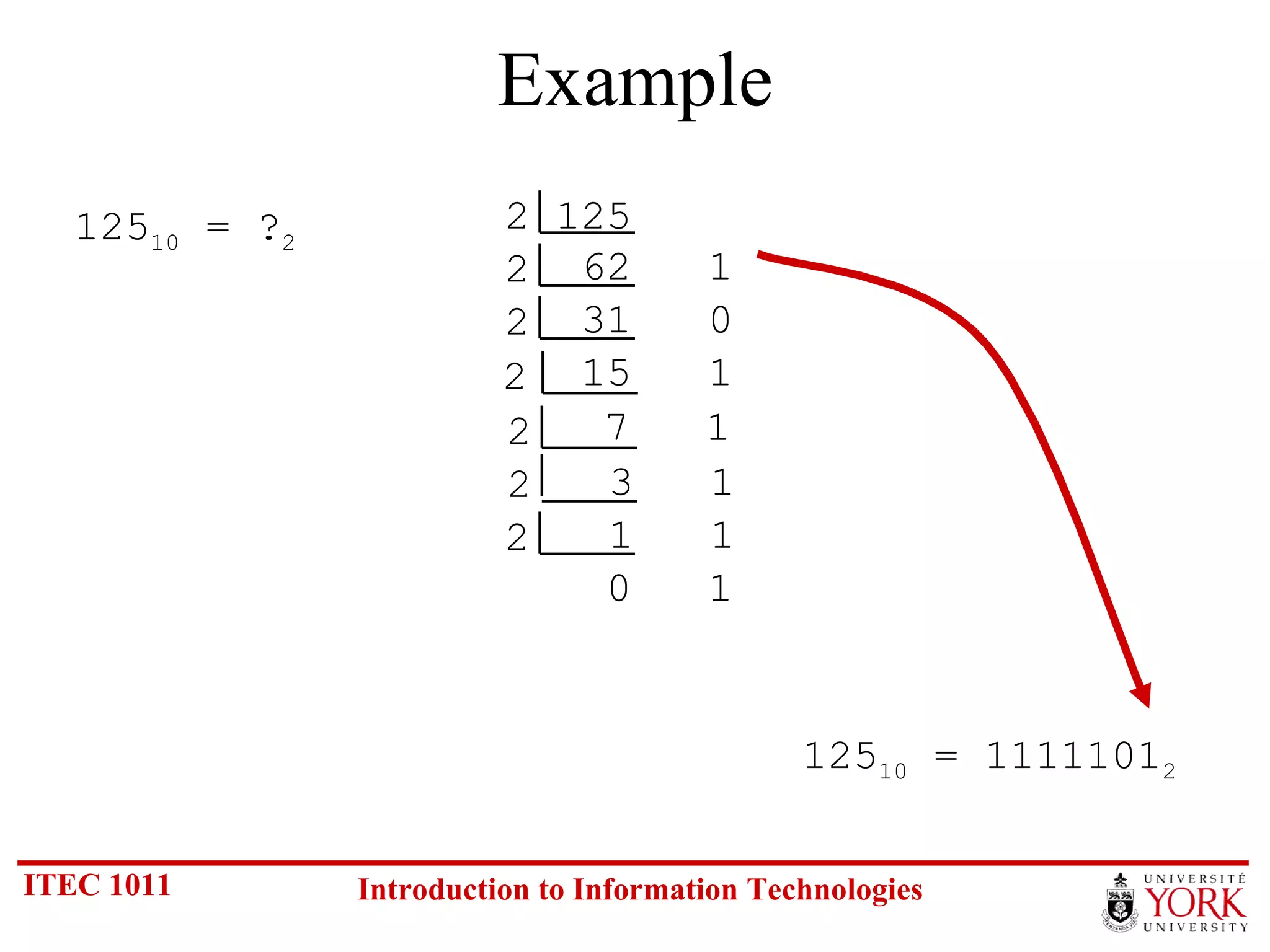
Decimal to Binary Technique Divide by two, keep track of the remainder First remainder is bit 0 (LSB, least-significant bit) Second remainder is bit 1 Etc.
Example 125 10  = ? 2 125 10  = 1111101 2 2 125   62  1 2    31  0 2    15  1 2    7  1 2    3  1 2    1  1 2    0  1
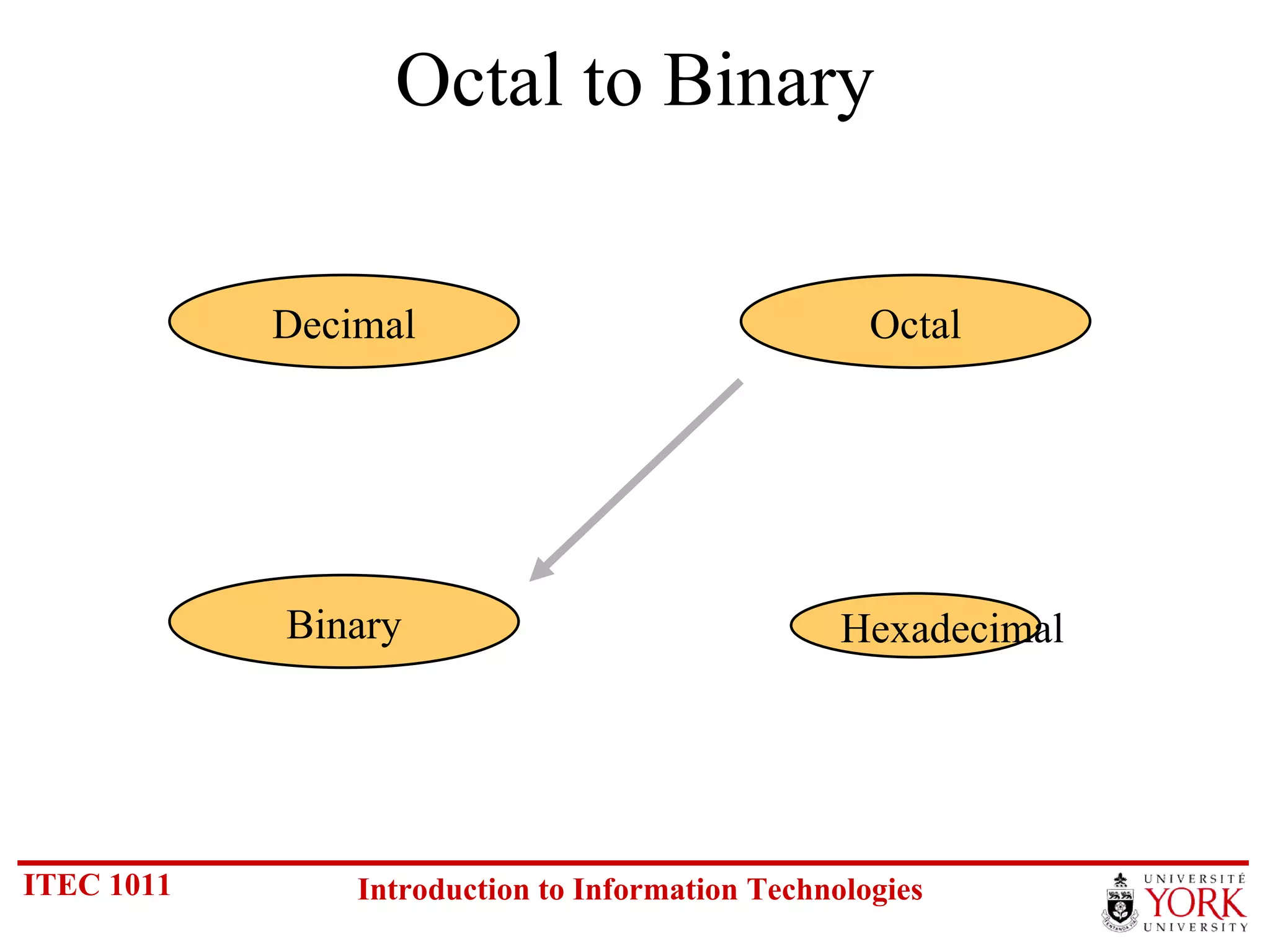
Octal to Binary Hexadecimal Decimal Octal Binary
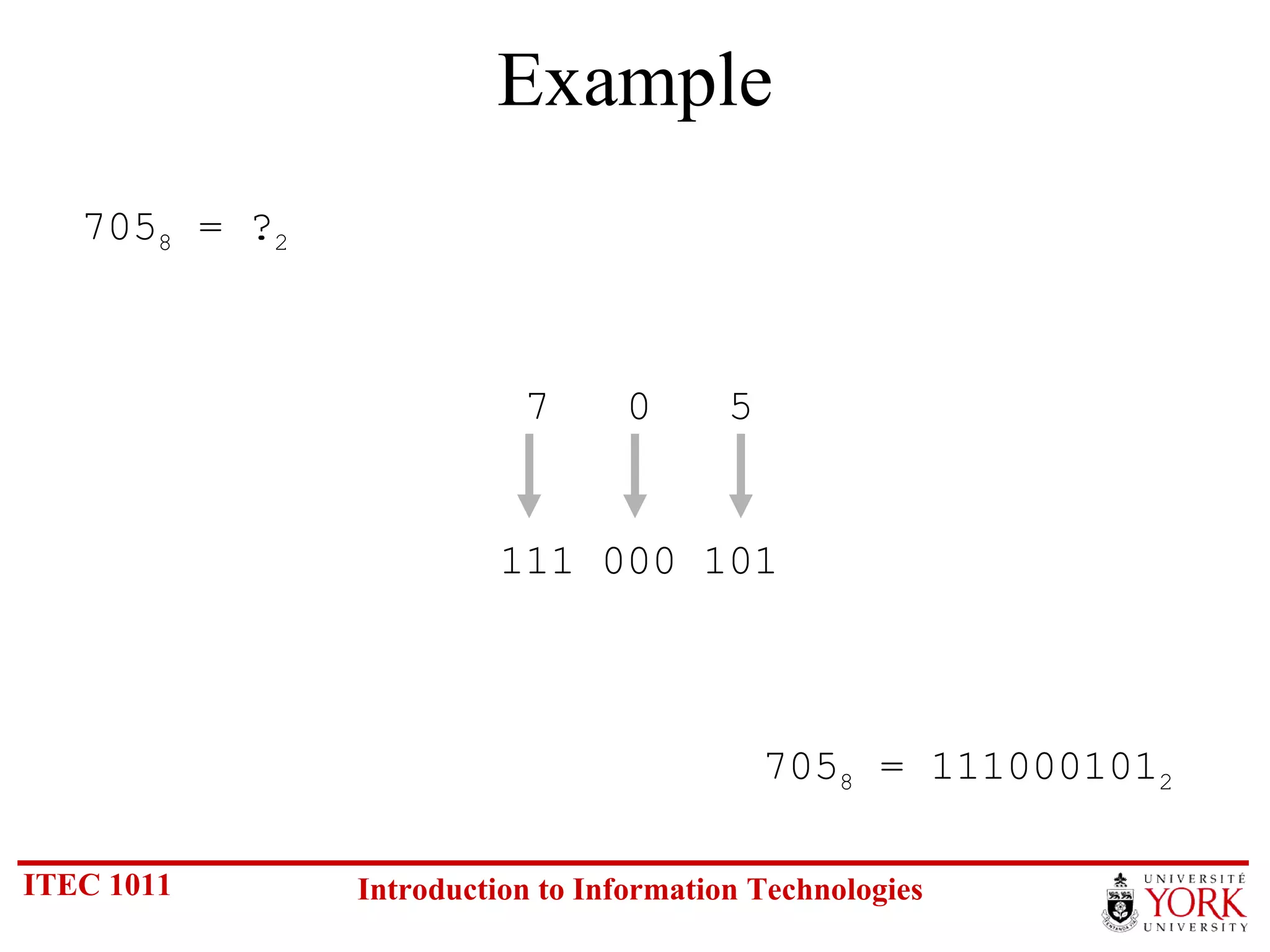
Octal to Binary Technique Convert each octal digit to a 3-bit equivalent binary representation
Example 705 8  = ? 2 705 8  = 111000101 2 7  0  5 111 000 101
Hexadecimal to Binary Hexadecimal Decimal Octal Binary
Hexadecimal to Binary Technique Convert each hexadecimal digit to a 4-bit equivalent binary representation
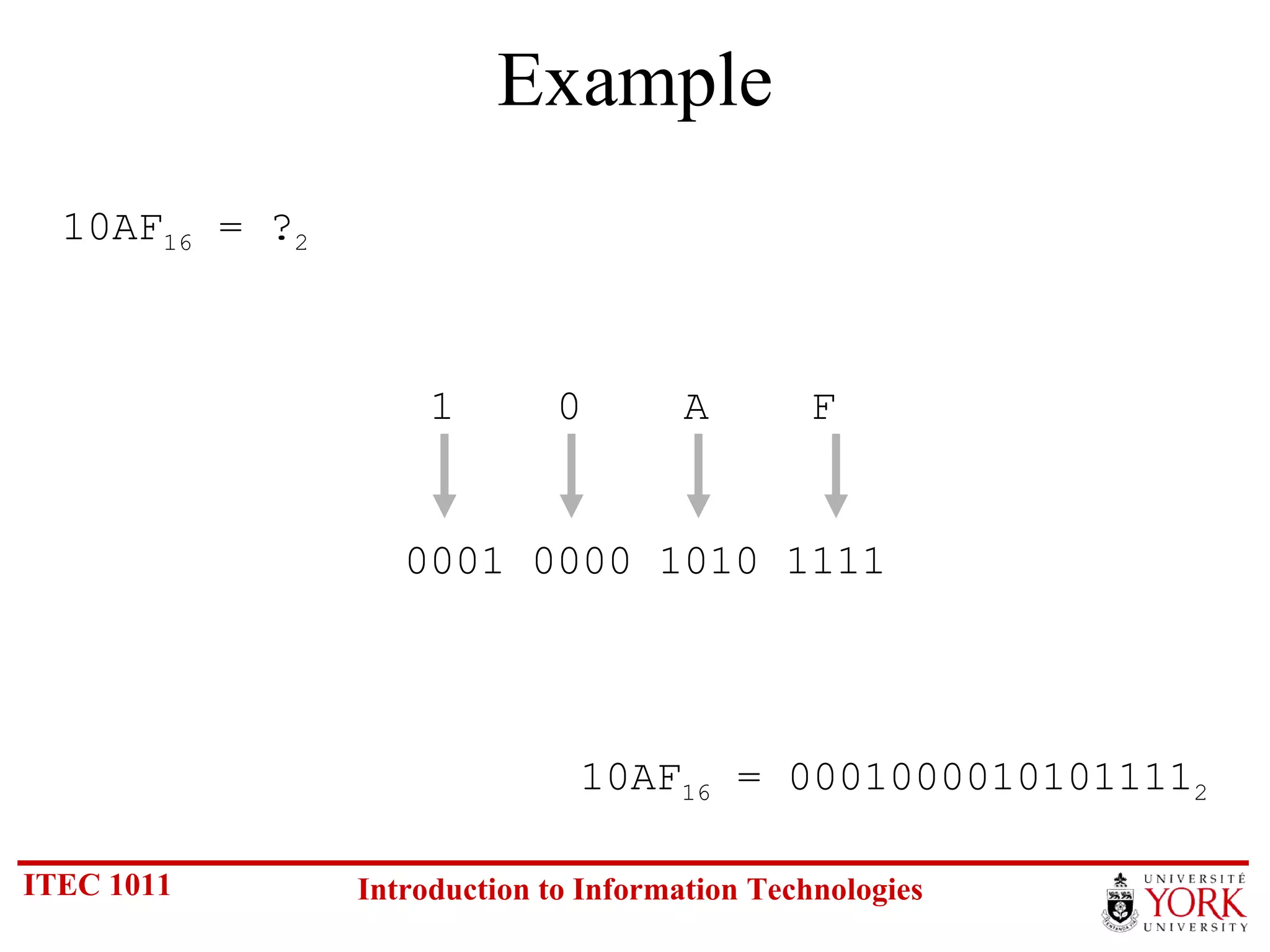
Example 10AF 16  = ? 2 10AF 16  = 0001000010101111 2 1  0  A  F 0001 0000 1010 1111
Decimal to Octal Hexadecimal Decimal Octal Binary
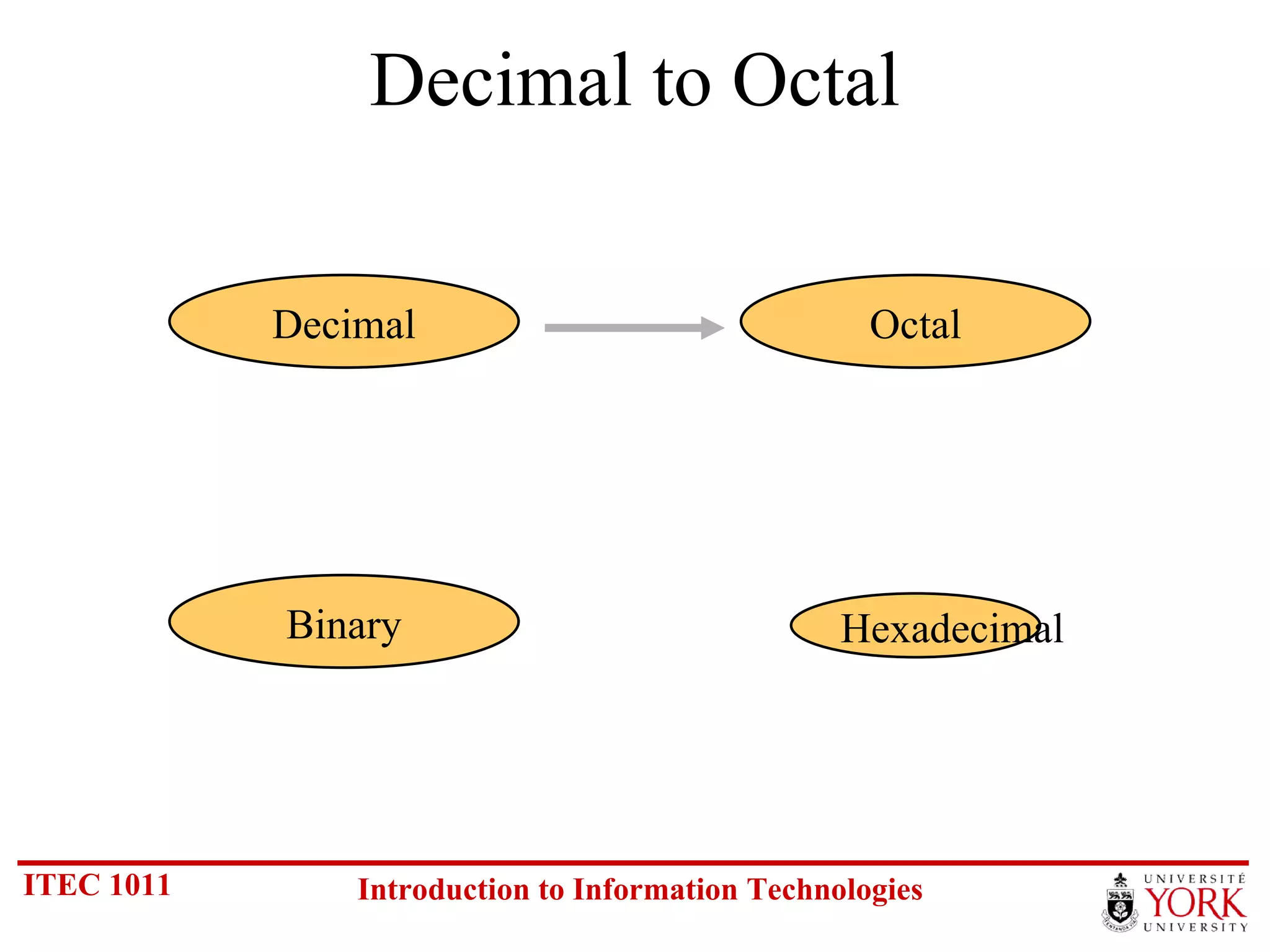
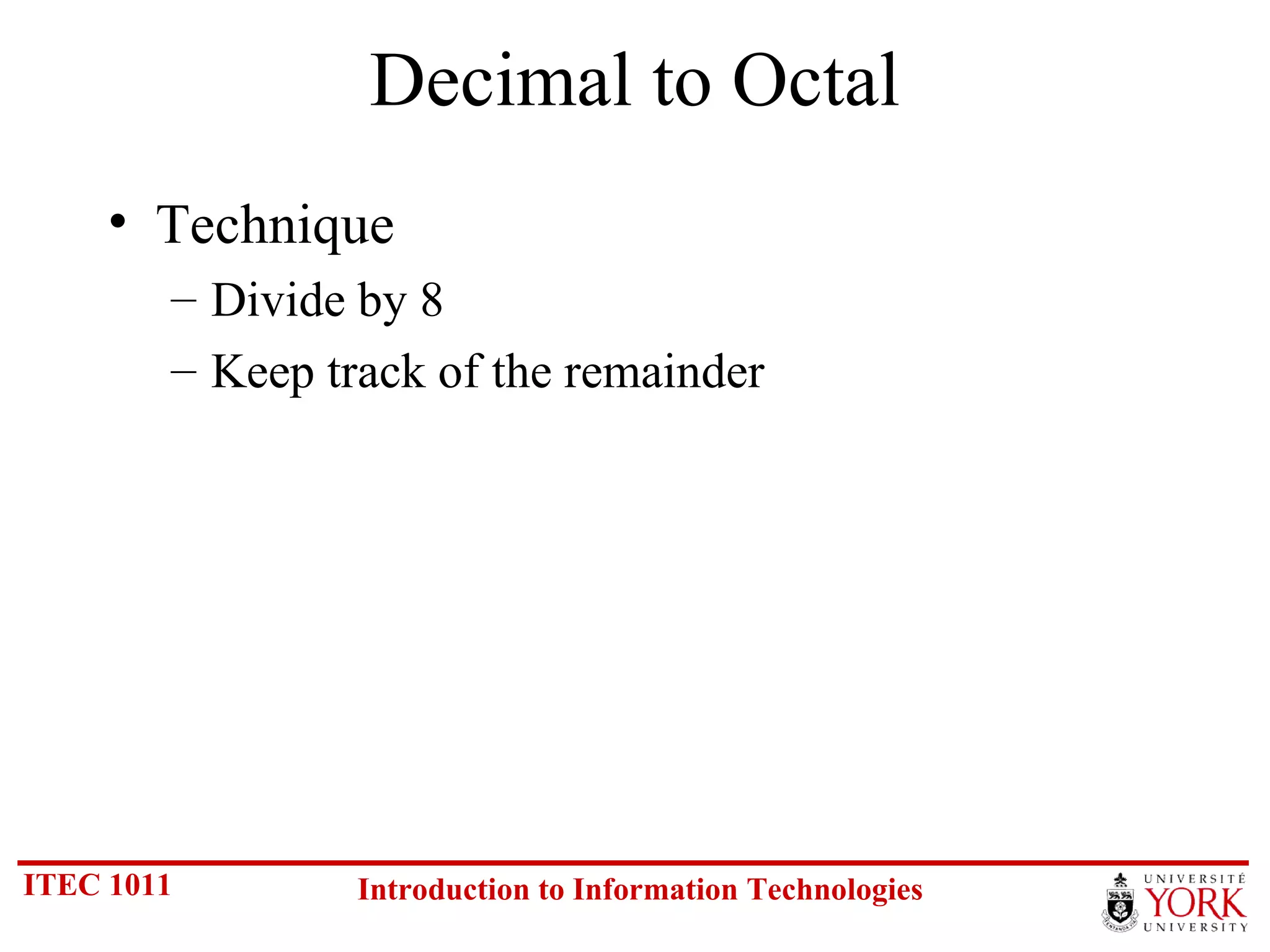
Decimal to Octal Technique Divide by 8 Keep track of the remainder
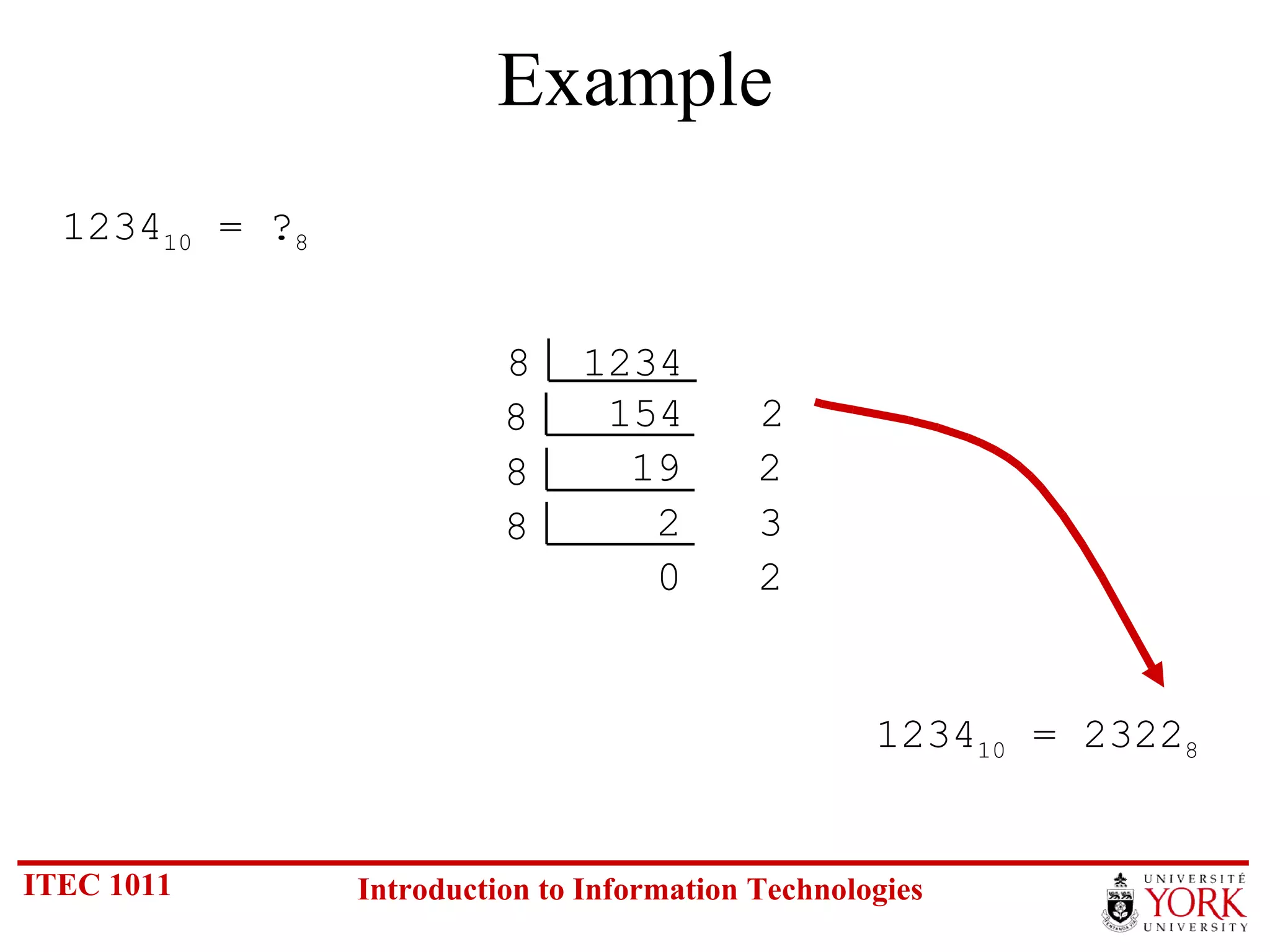
Example 1234 10  = ? 8 8  1234 154  2 1234 10  = 2322 8 8 19  2 8 2  3 8 0  2
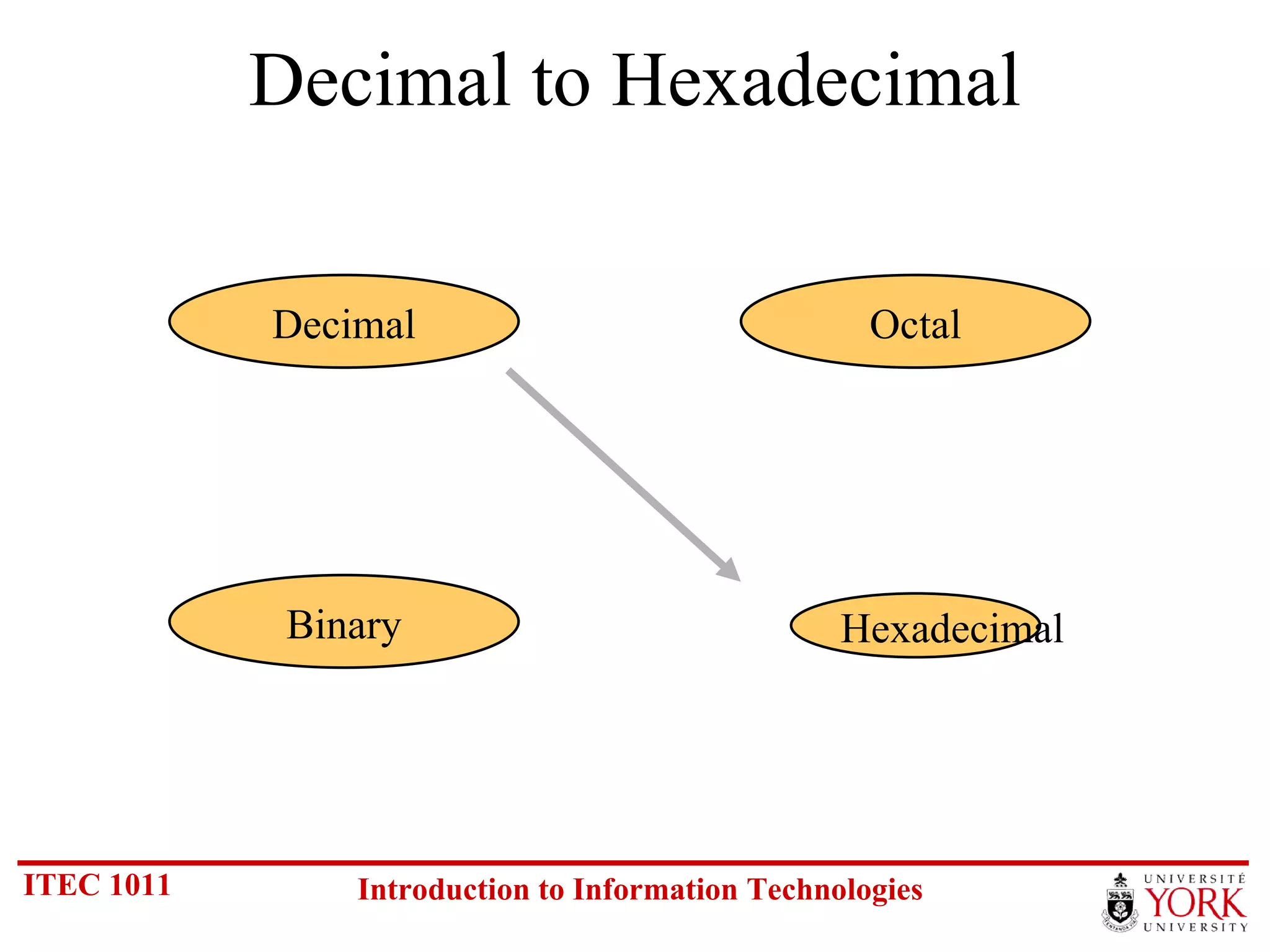
Decimal to Hexadecimal Hexadecimal Decimal Octal Binary
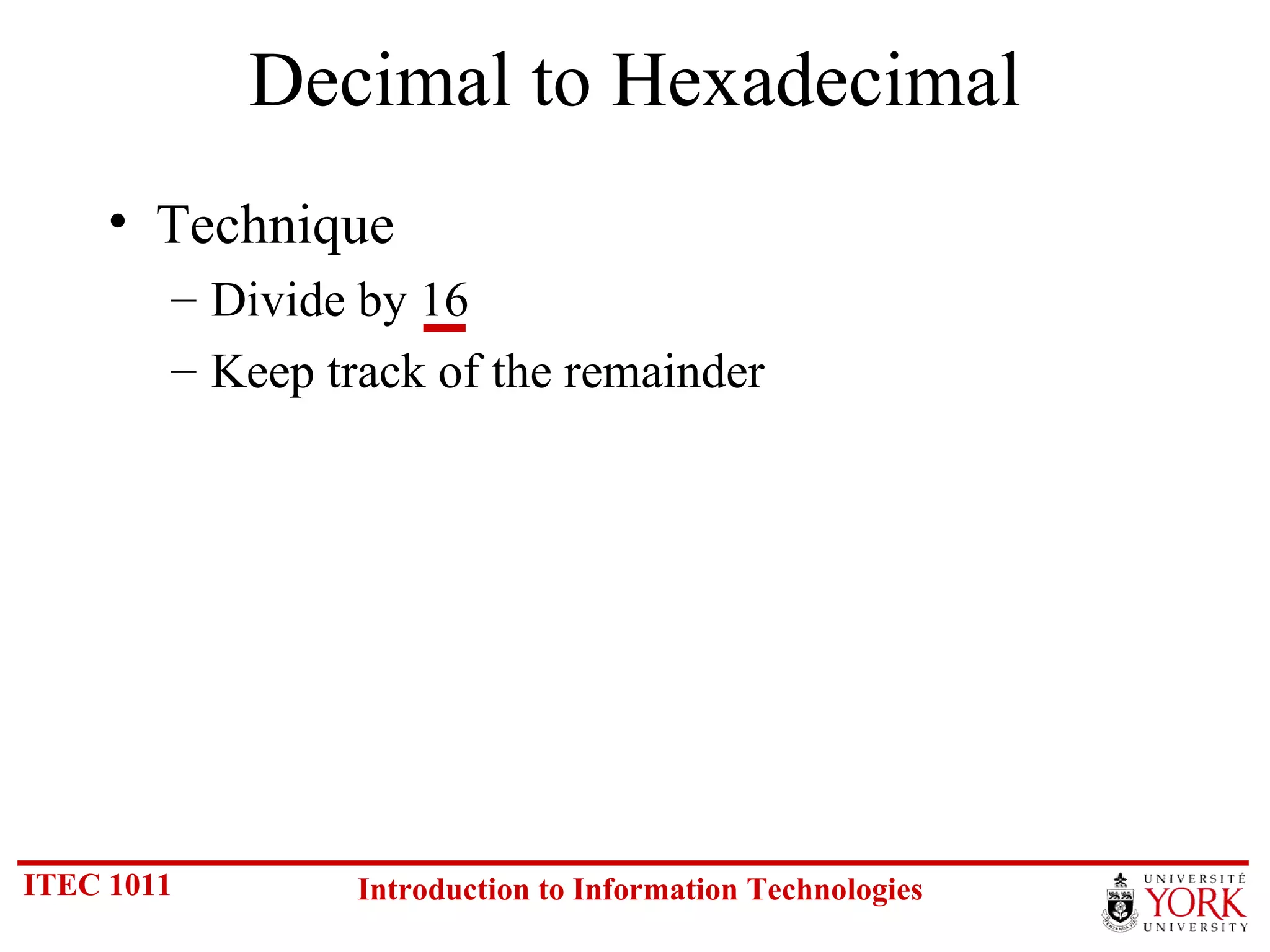
Decimal to Hexadecimal Technique Divide by 16 Keep track of the remainder
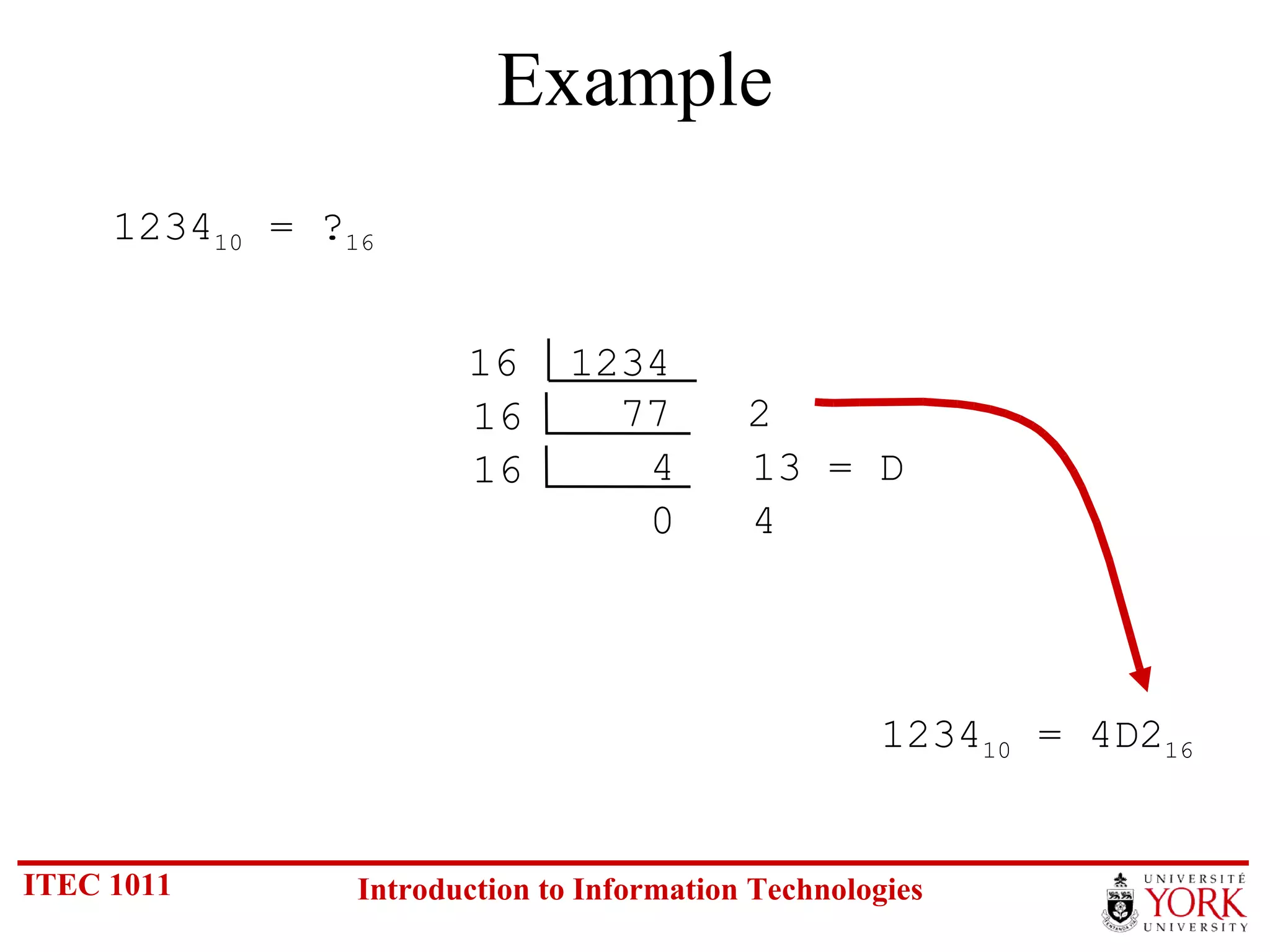
Example 1234 10  = ? 16 1234 10  = 4D2 16 16  1234 77  2 16 4  13 = D 16 0  4
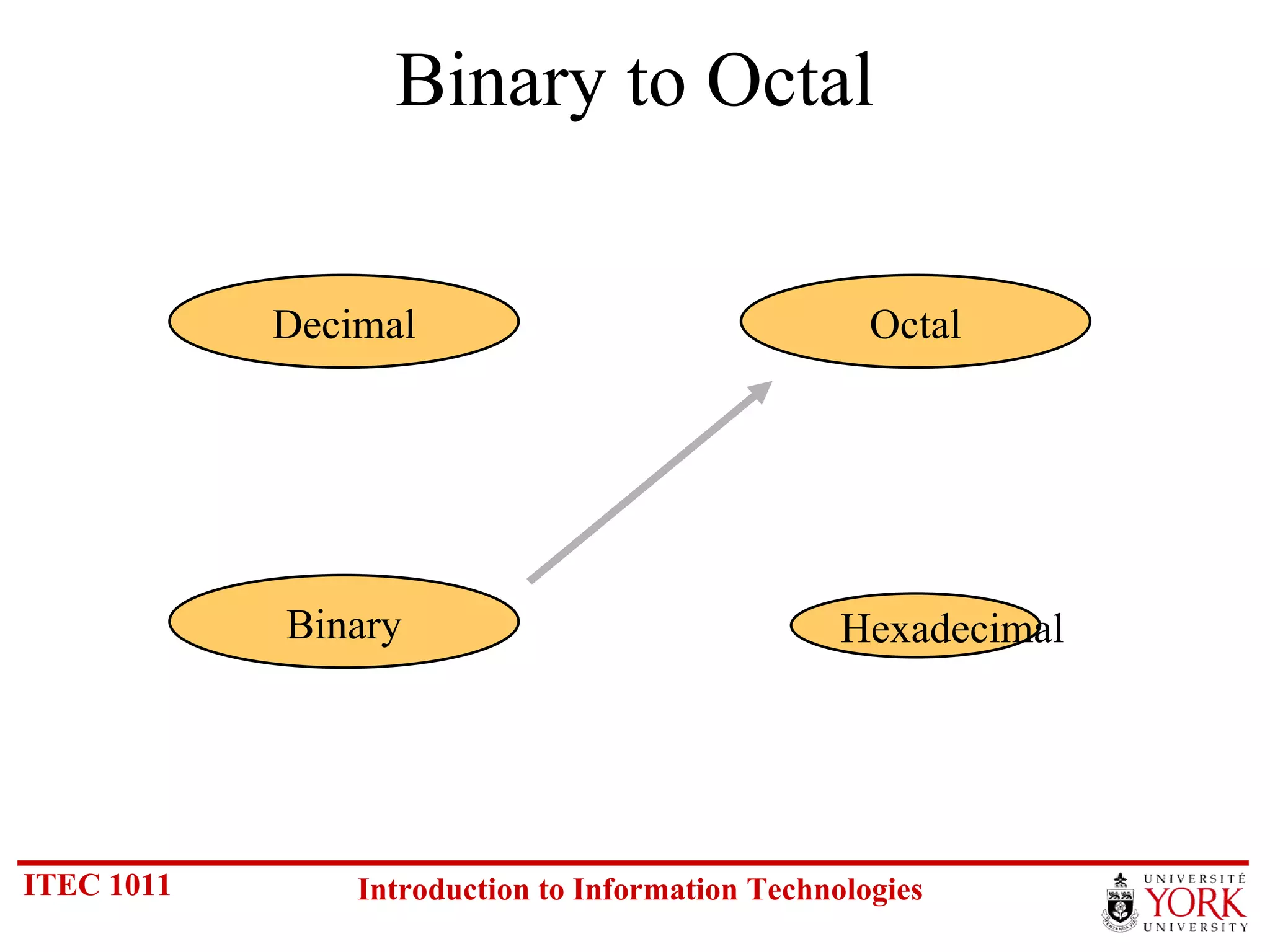
Binary to Octal Hexadecimal Decimal Octal Binary
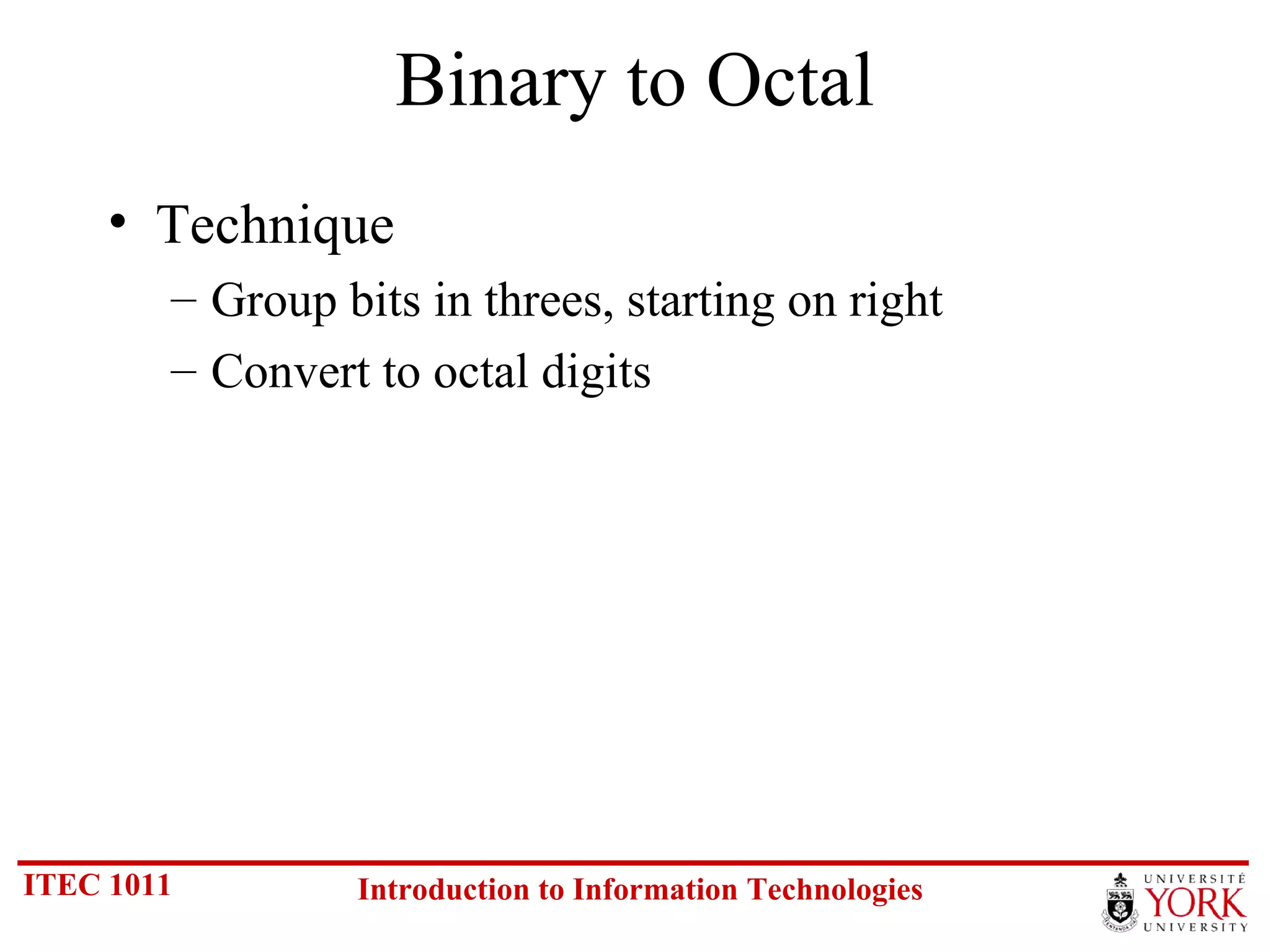
Binary to Octal Technique Group bits in threes, starting on right Convert to octal digits
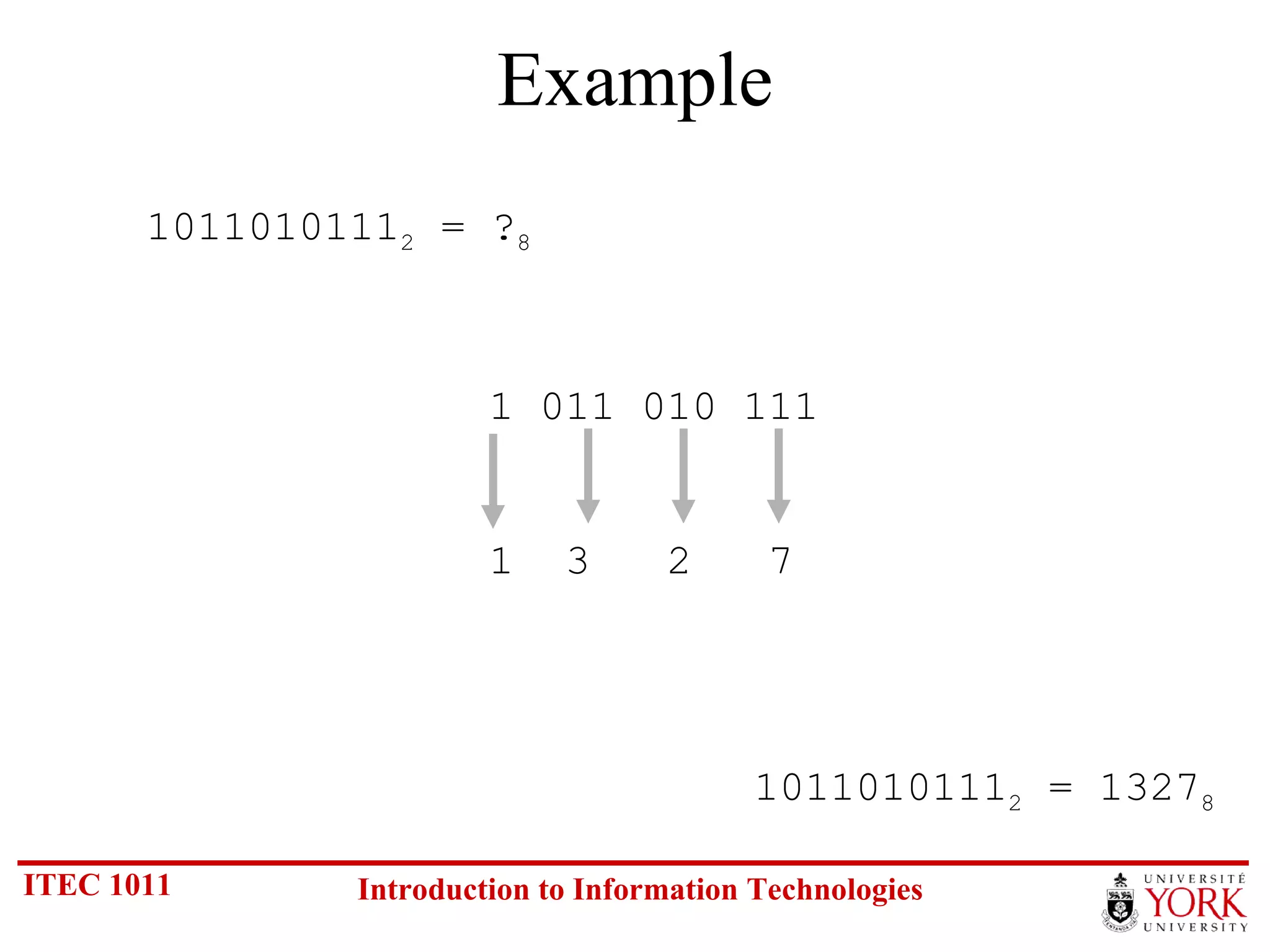
Example 1011010111 2  = ? 8 1011010111 2  = 1327 8 1 011 010 111 1  3  2  7
Binary to Hexadecimal Hexadecimal Decimal Octal Binary
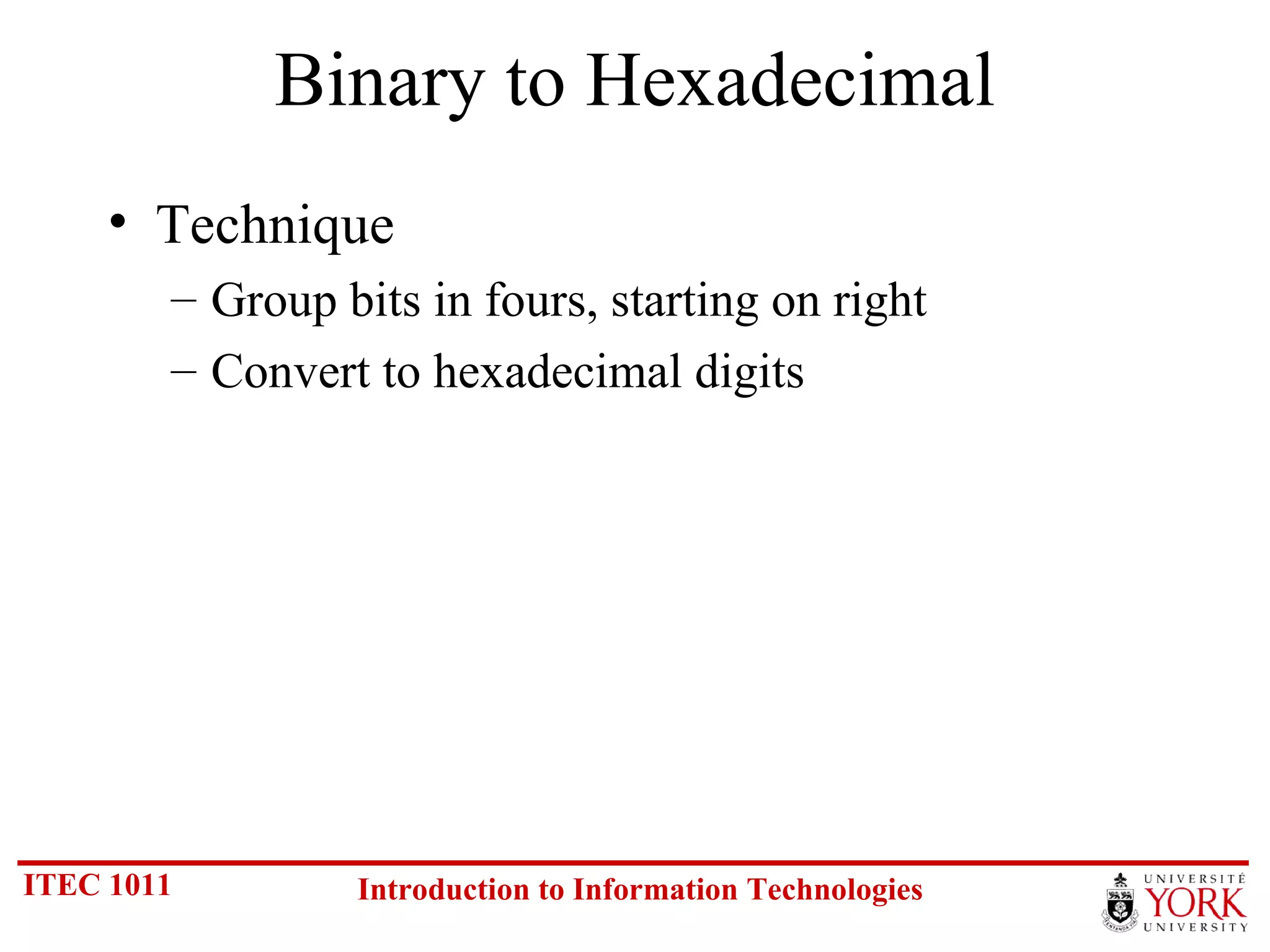
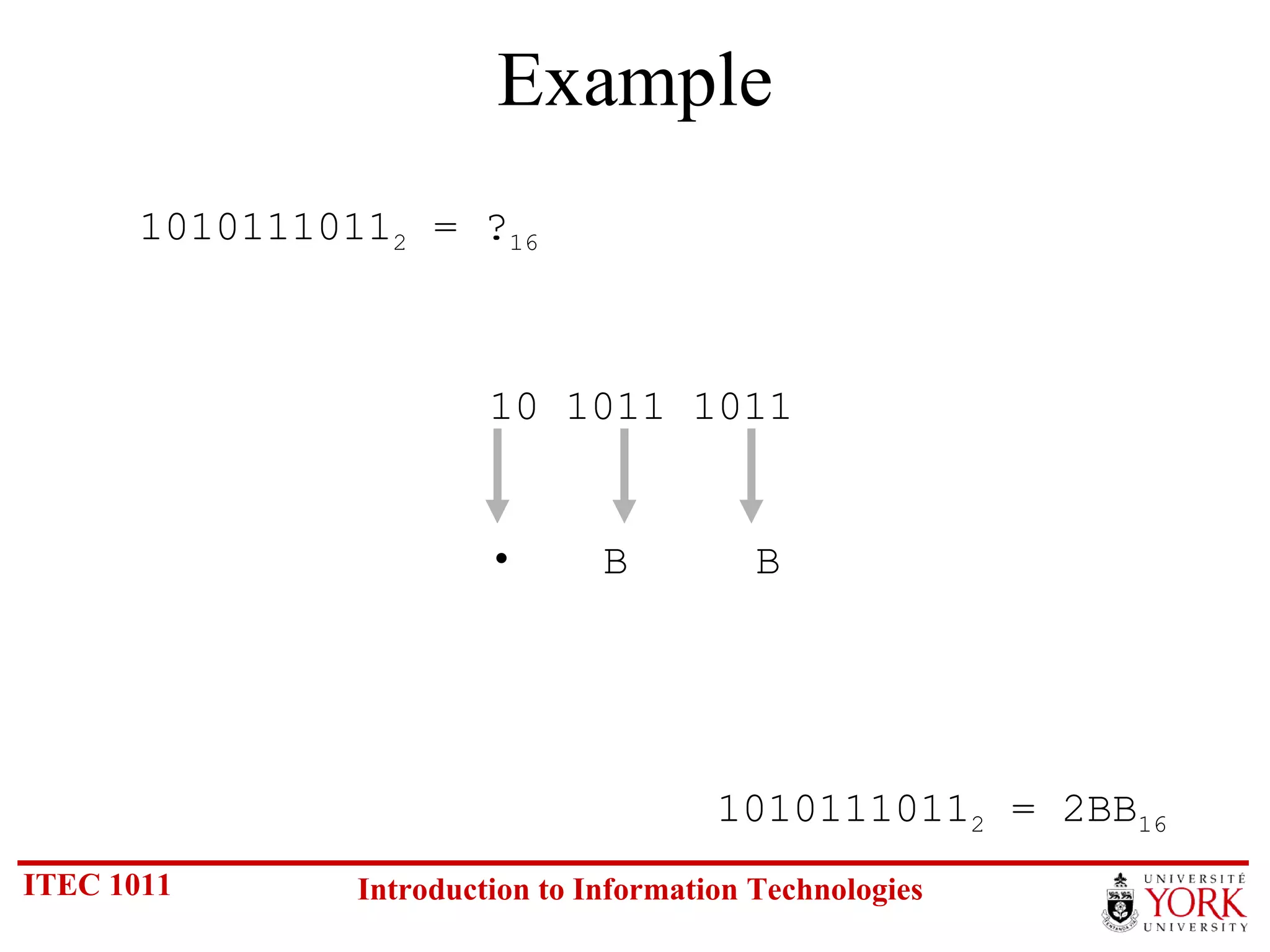
Binary to Hexadecimal Technique Group bits in fours, starting on right Convert to hexadecimal digits
Example 1010111011 2  = ? 16 10 1011 1011 B  B   1010111011 2  = 2BB 16
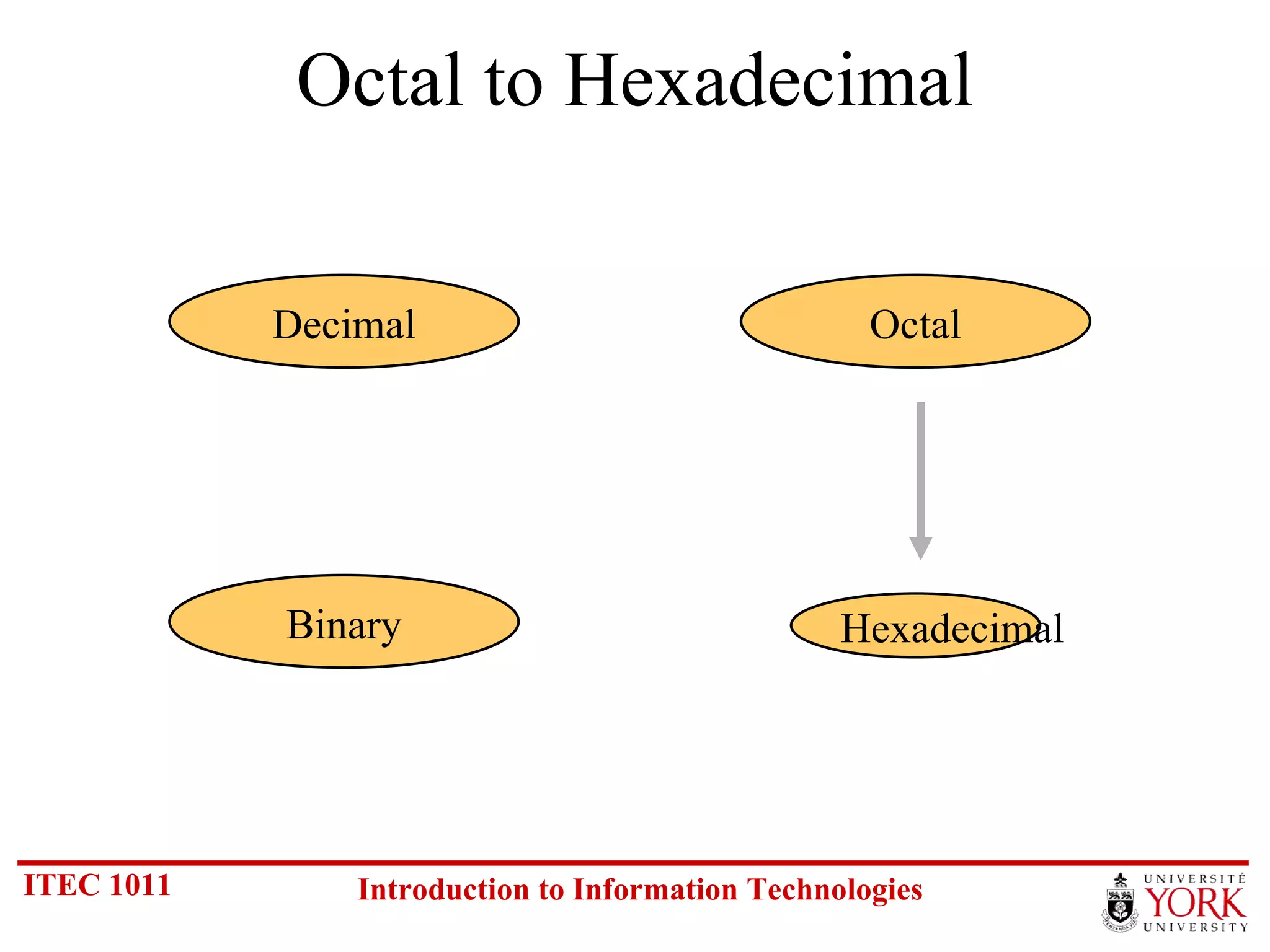
Octal to Hexadecimal Hexadecimal Decimal Octal Binary
Octal to Hexadecimal Technique Use binary as an intermediary
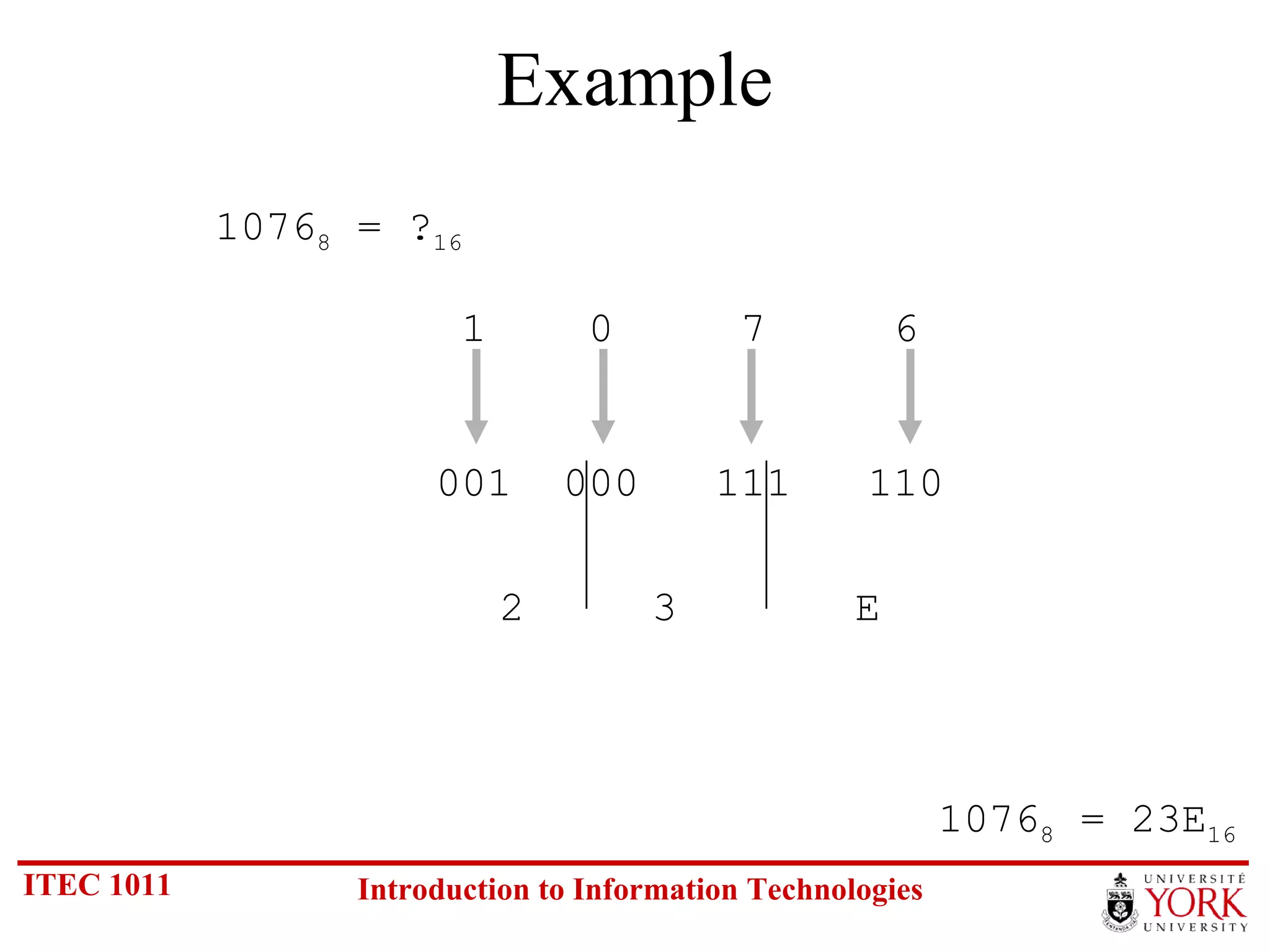
Example 1076 8  = ? 16 1076 8  = 23E 16 1  0  7  6 001  000  111  110 2  3  E
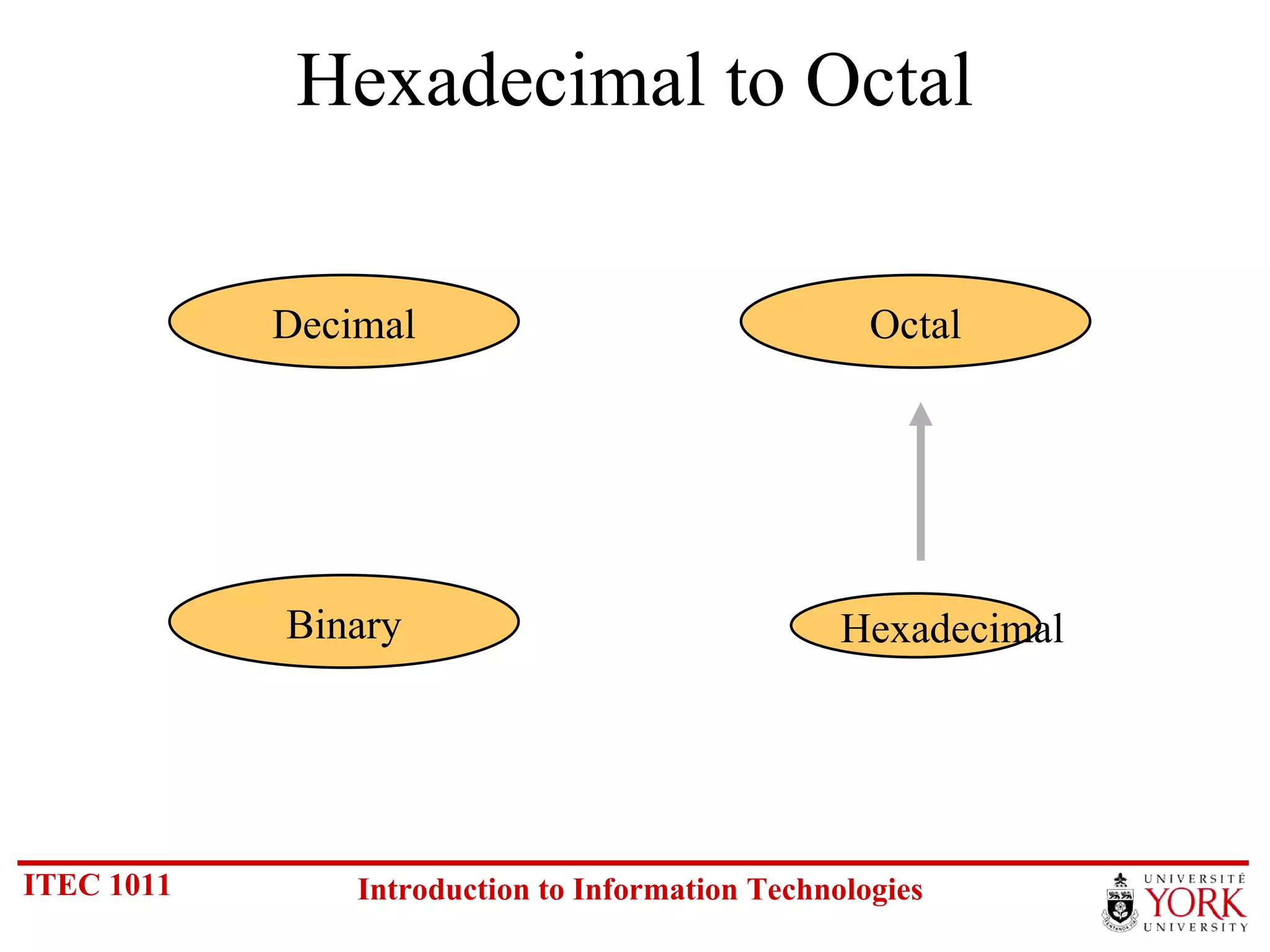
Hexadecimal to Octal Hexadecimal Decimal Octal Binary
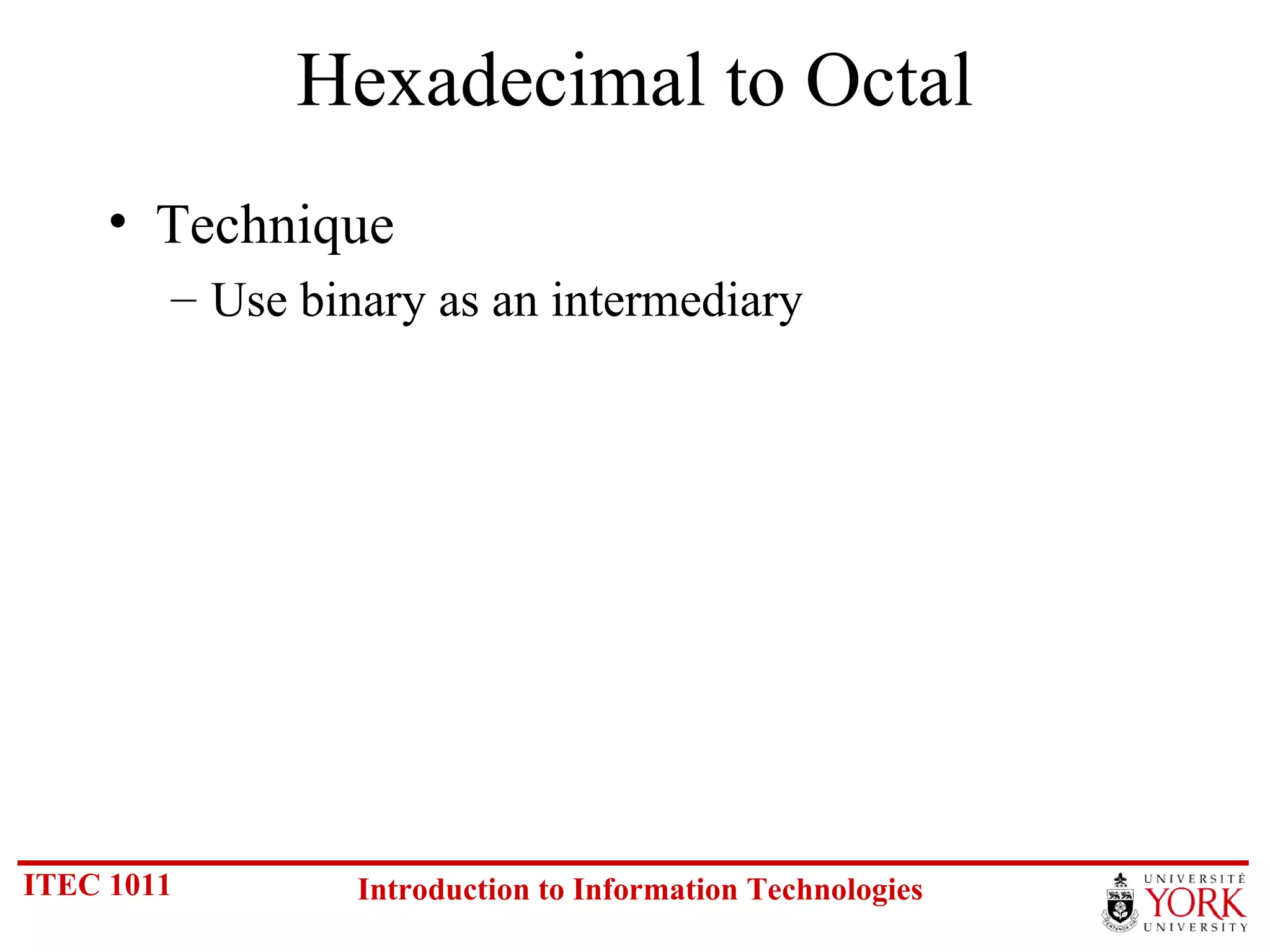
Hexadecimal to Octal Technique Use binary as an intermediary
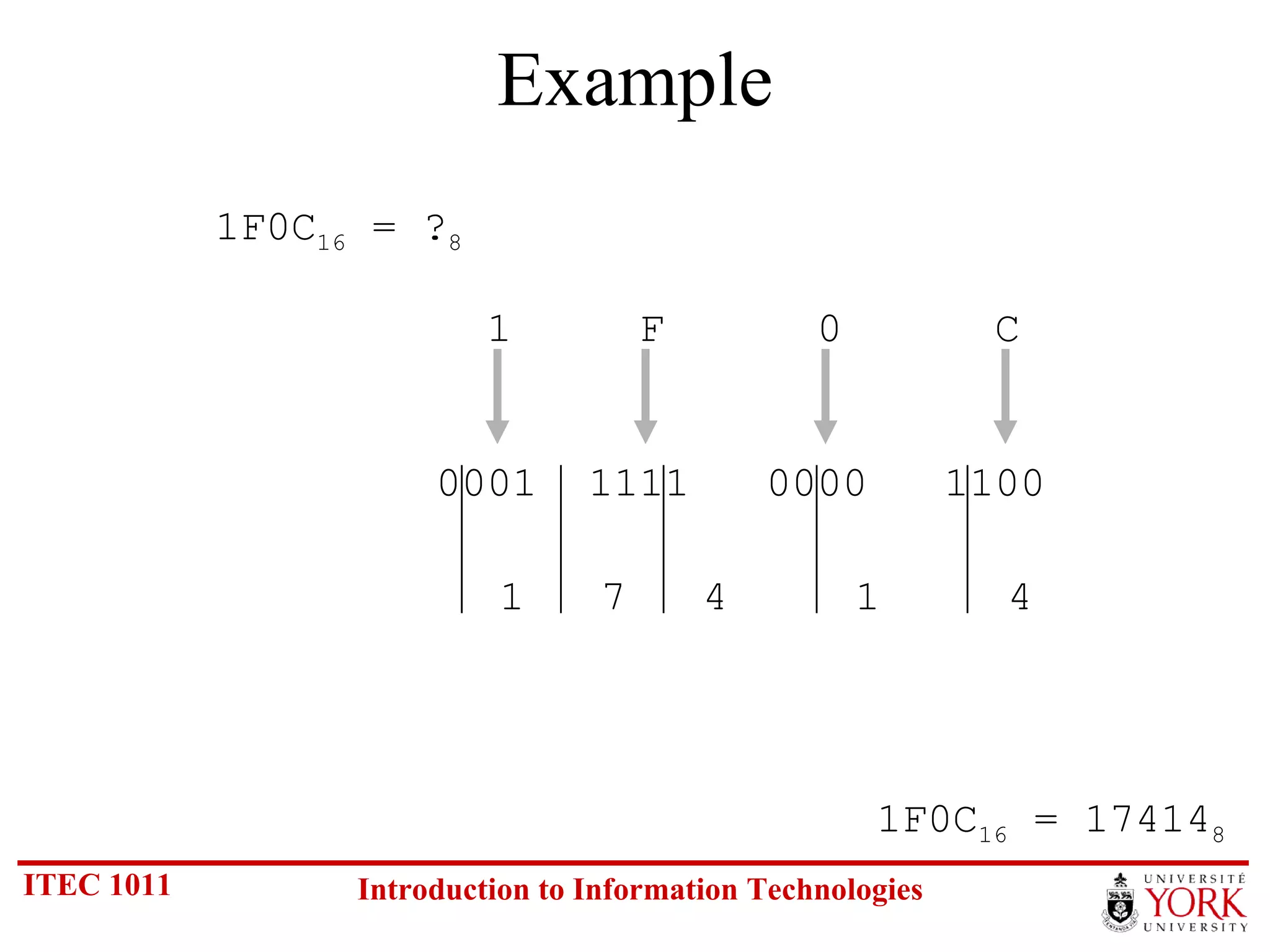
Example 1F0C 16  = ? 8 1F0C 16  = 17414 8 1  F  0  C 0001  1111  0000  1100 1  7  4  1  4
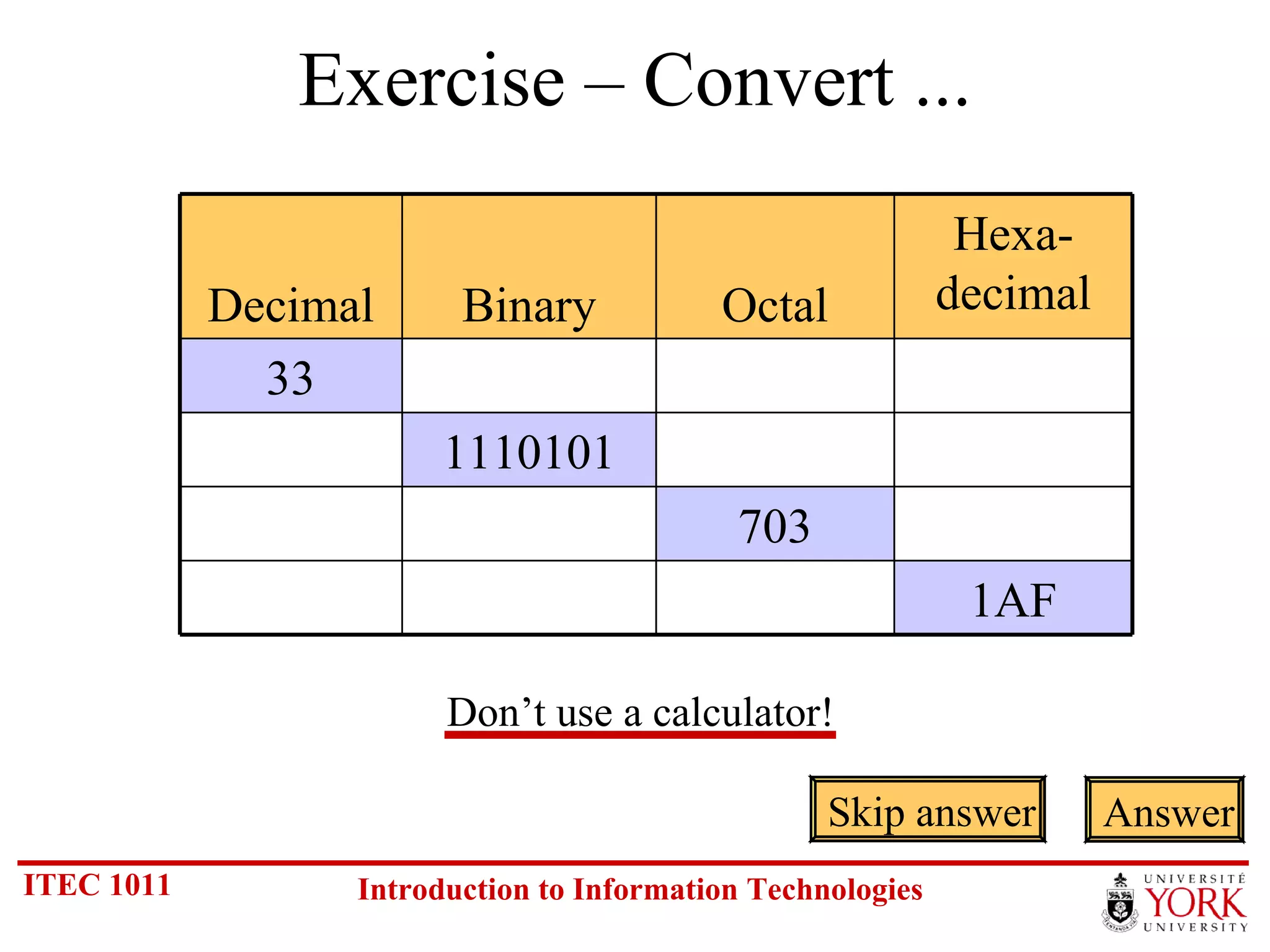
Exercise – Convert ... Skip answer Answer Don’t use a calculator! 1AF 703 1110101 33 Hexa- decimal Octal Binary Decimal
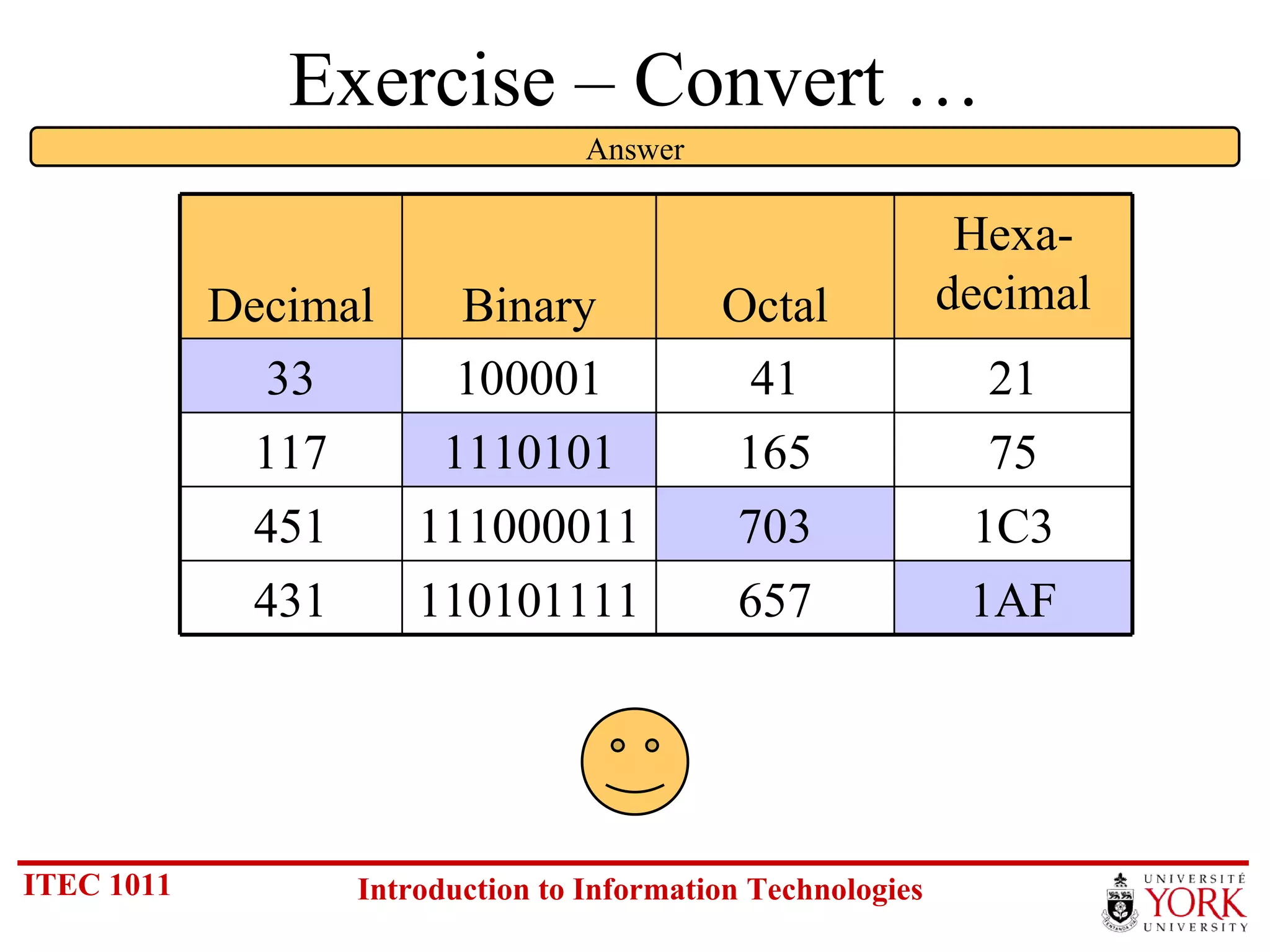
Exercise – Convert … Answer 1AF 657 110101111 431 1C3 703 111000011 451 75 165 1110101 117 21 41 100001 33 Hexa- decimal Octal Binary Decimal
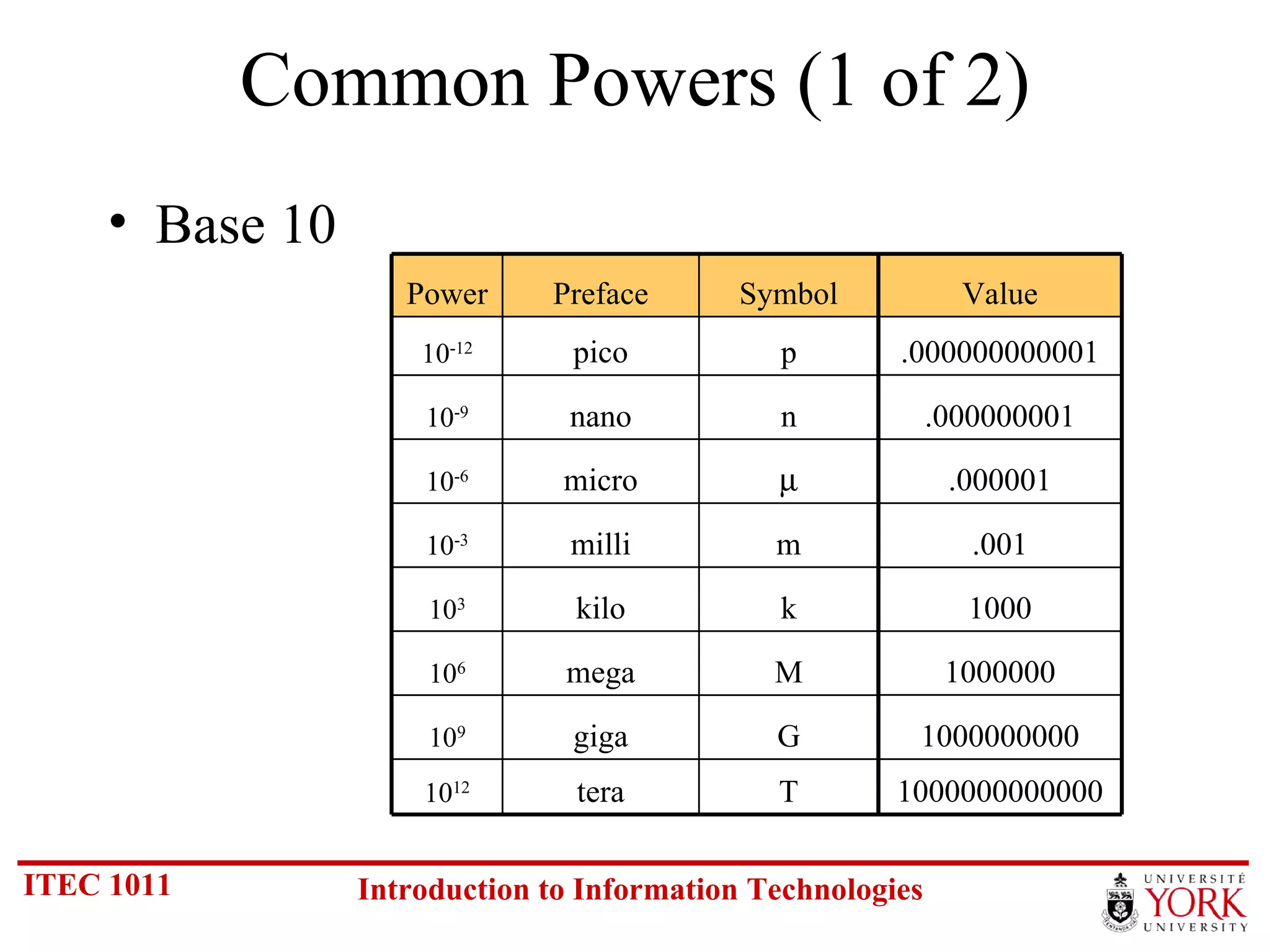
Common Powers (1 of 2) Base 10 T tera 10 12 G giga 10 9 M mega 10 6 k kilo 10 3 m milli 10 -3  micro 10 -6 n nano 10 -9 p pico 10 -12 Symbol Preface Power 1000000000000 1000000000 1000000 1000 .001 .000001 .000000001 .000000000001 Value
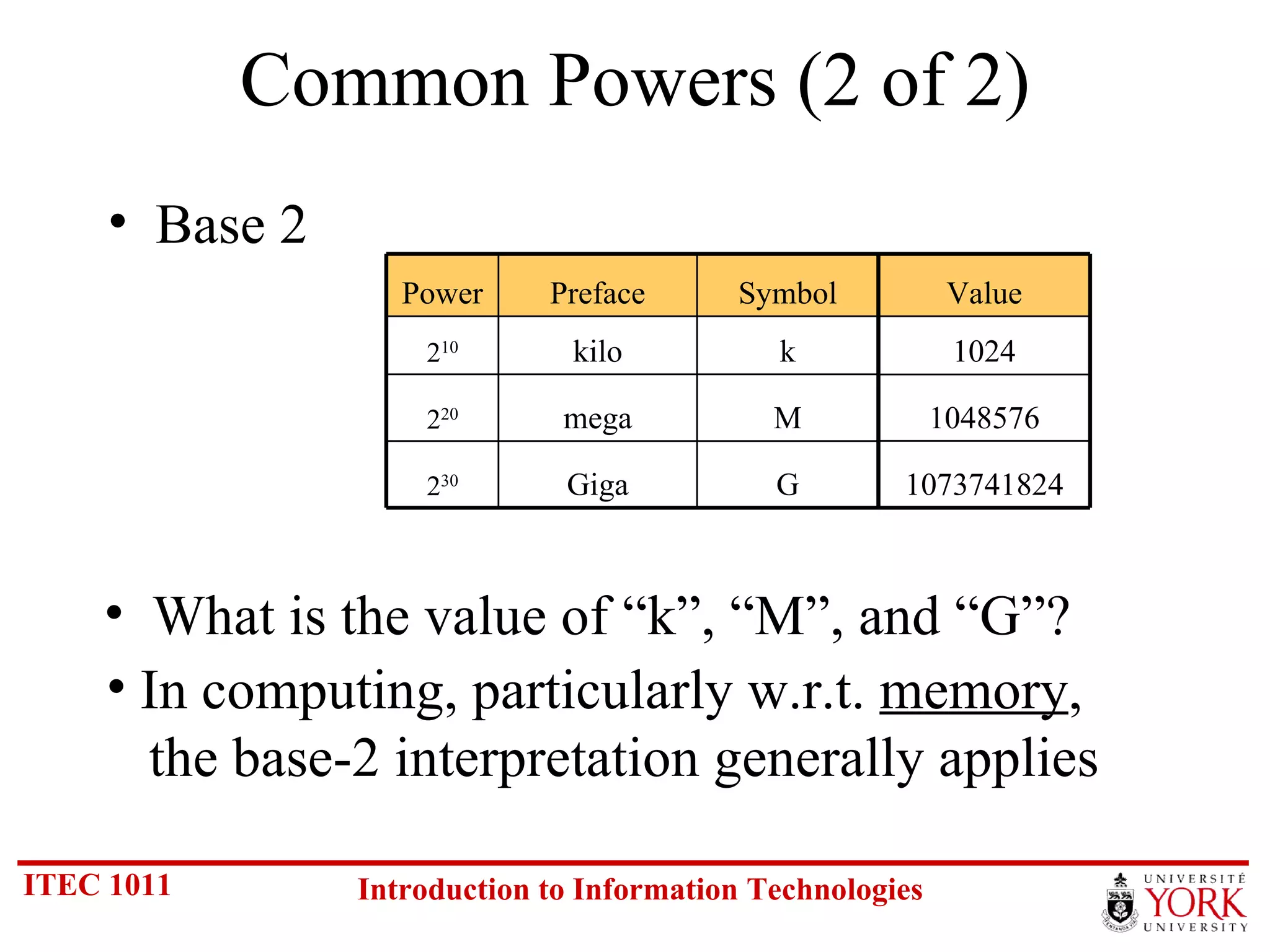
Common Powers (2 of 2) Base 2 What is the value of “k”, “M”, and “G”? In computing, particularly w.r.t.  memory ,   the base-2 interpretation generally applies G Giga 2 30 M mega 2 20 k kilo 2 10 Symbol Preface Power 1073741824 1048576 1024 Value
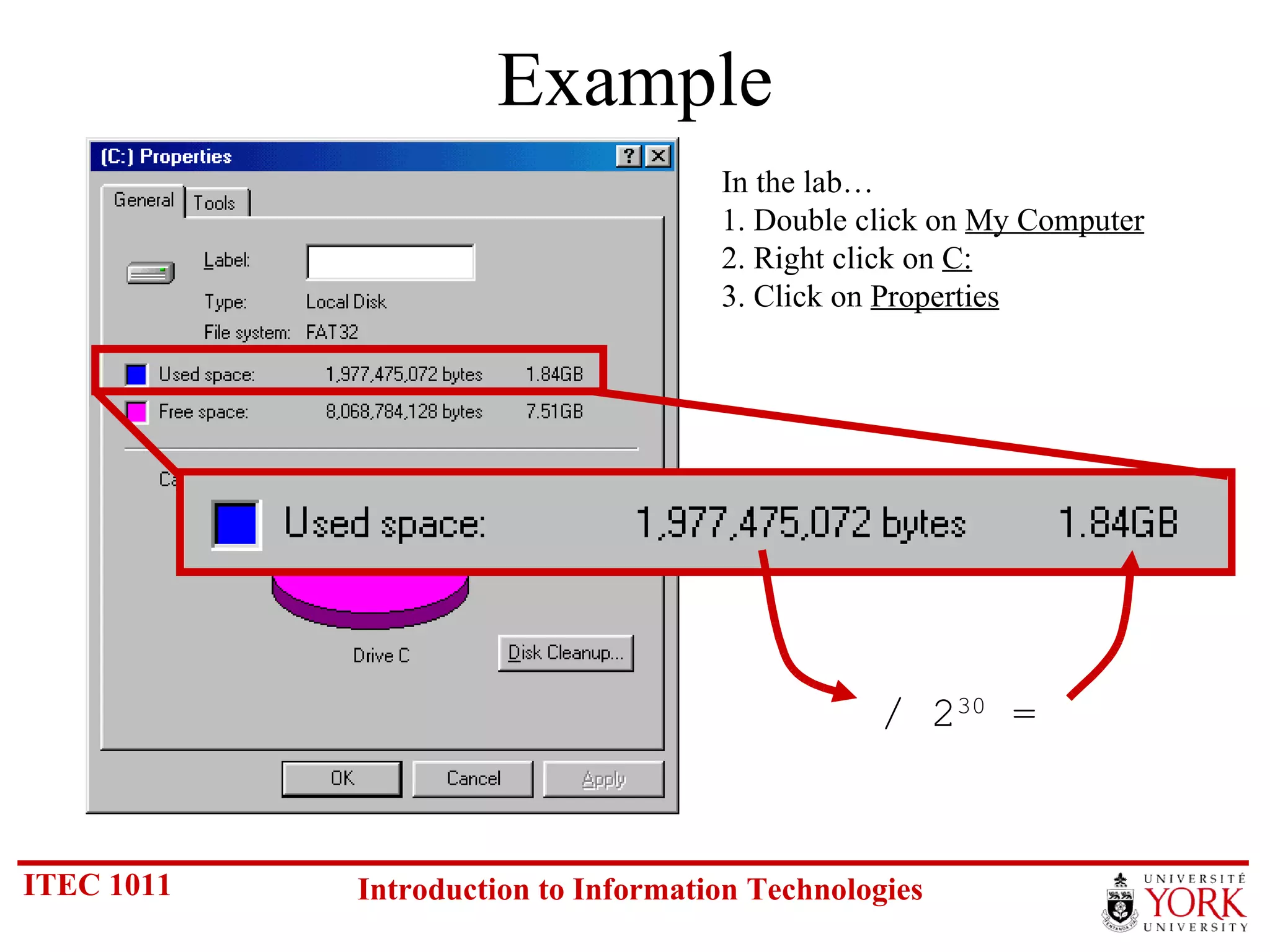
Example In the lab… 1. Double click on  My Computer 2. Right click on  C: 3. Click on  Properties / 2 30  =
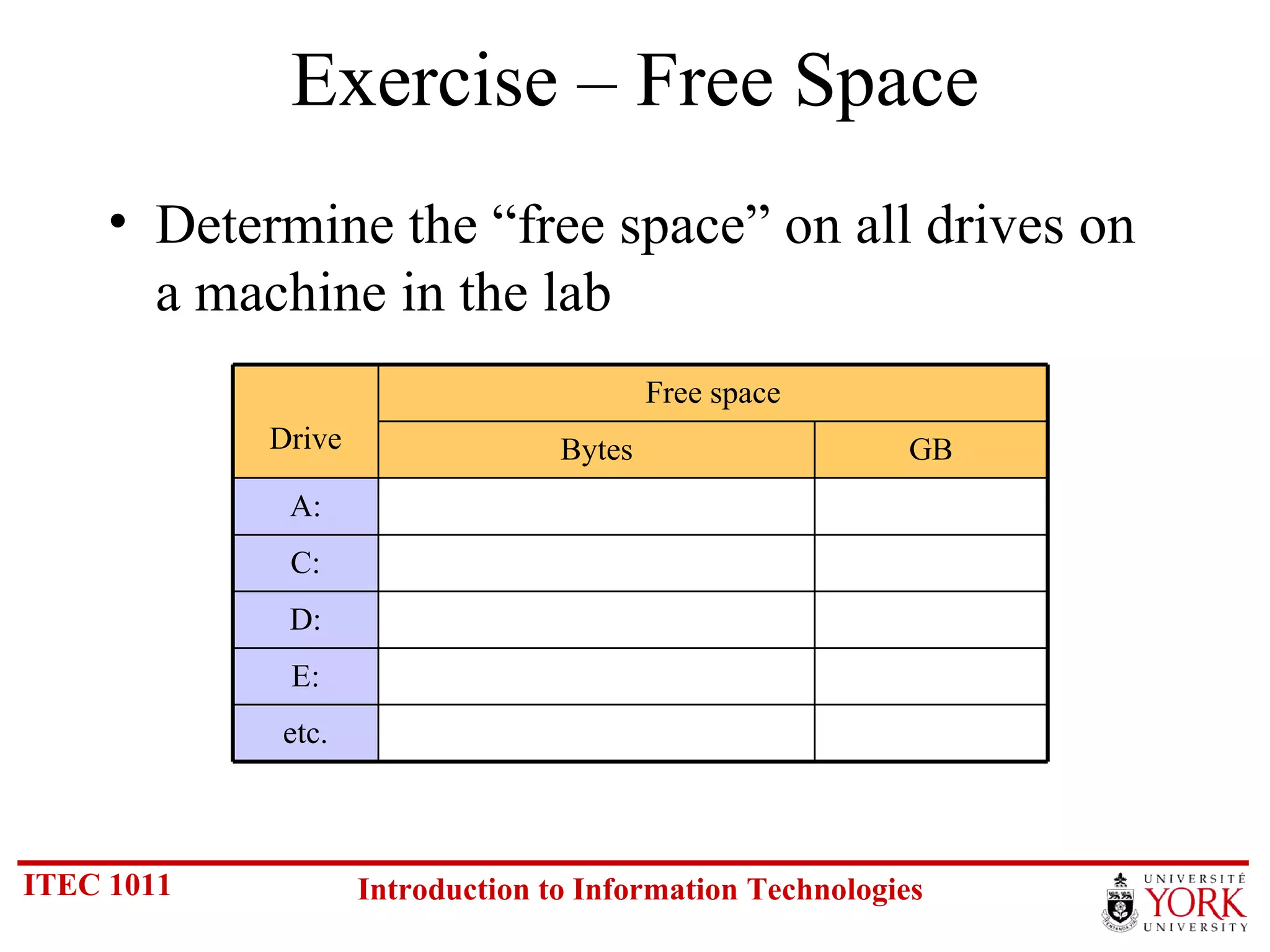
Exercise – Free Space Determine the “free space” on all drives on a machine in the lab etc. E: D: C: A: GB Bytes Drive Free space
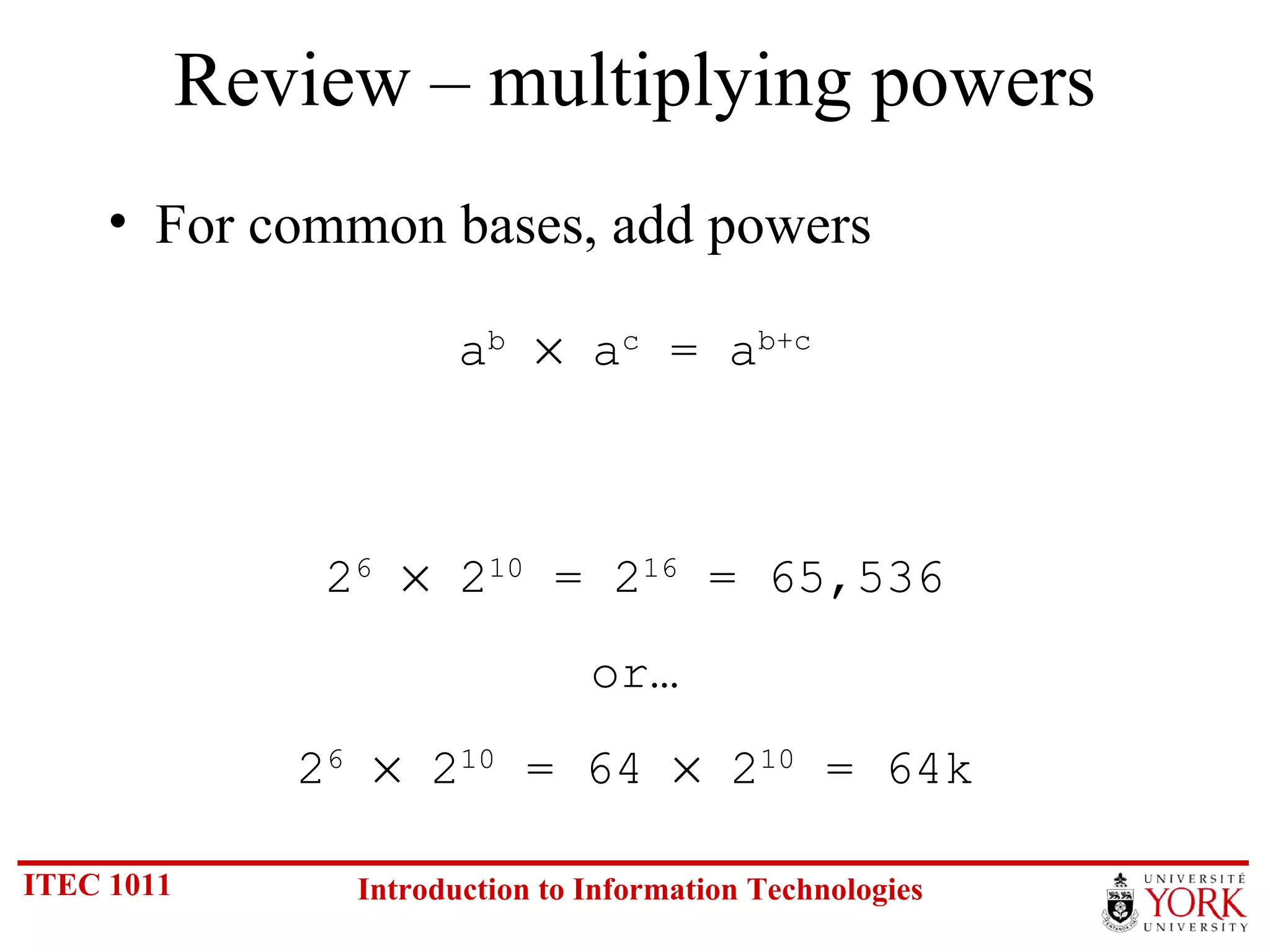
Review – multiplying powers For common bases, add powers 2 6     2 10  = 2 16  = 65,536 or… 2 6     2 10  = 64    2 10  = 64k a b     a c  = a b+c
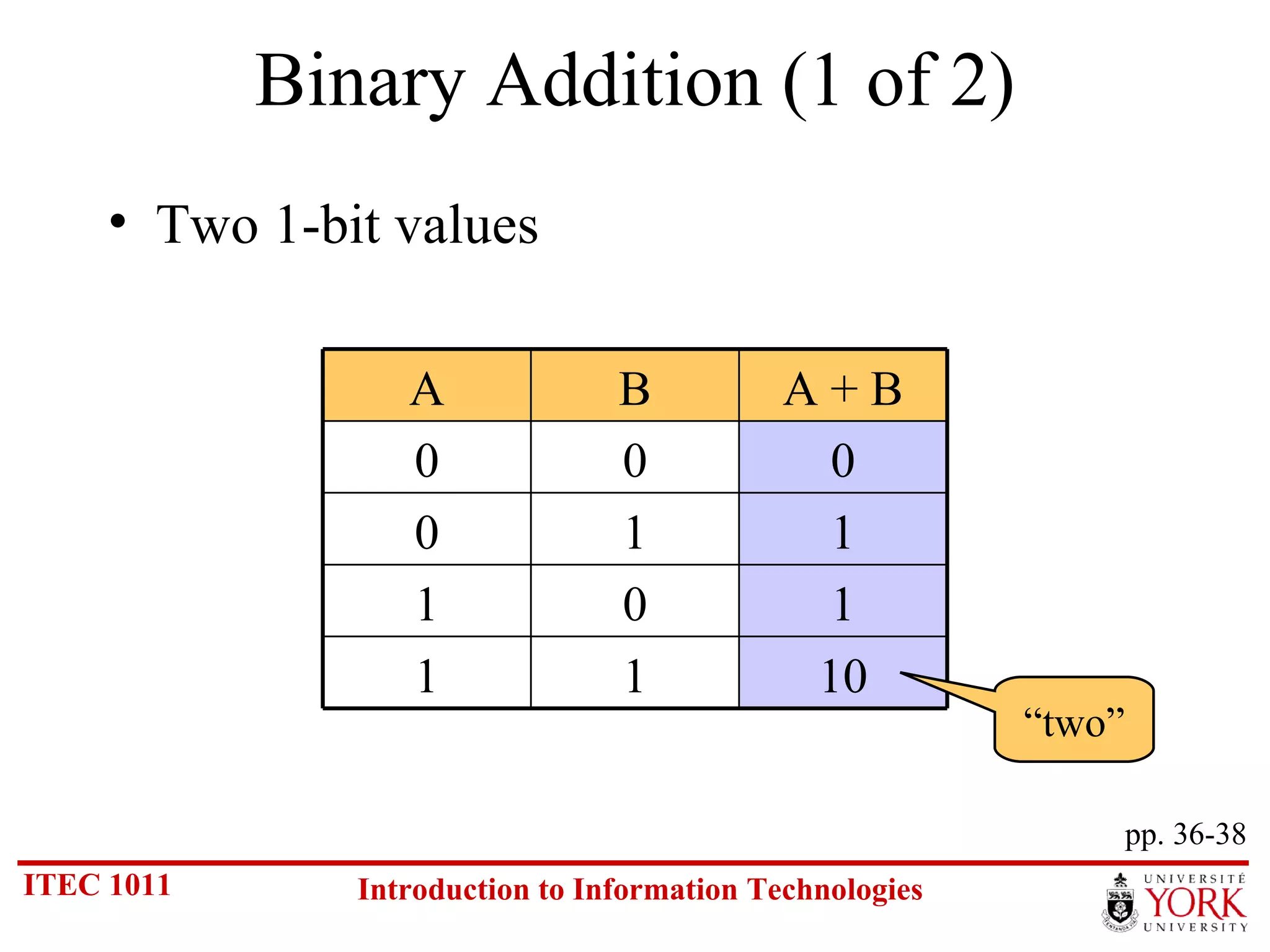
Binary Addition (1 of 2) Two 1-bit values pp. 36-38 “two” 10 1 1 1 0 1 1 1 0 0 0 0 A + B B A
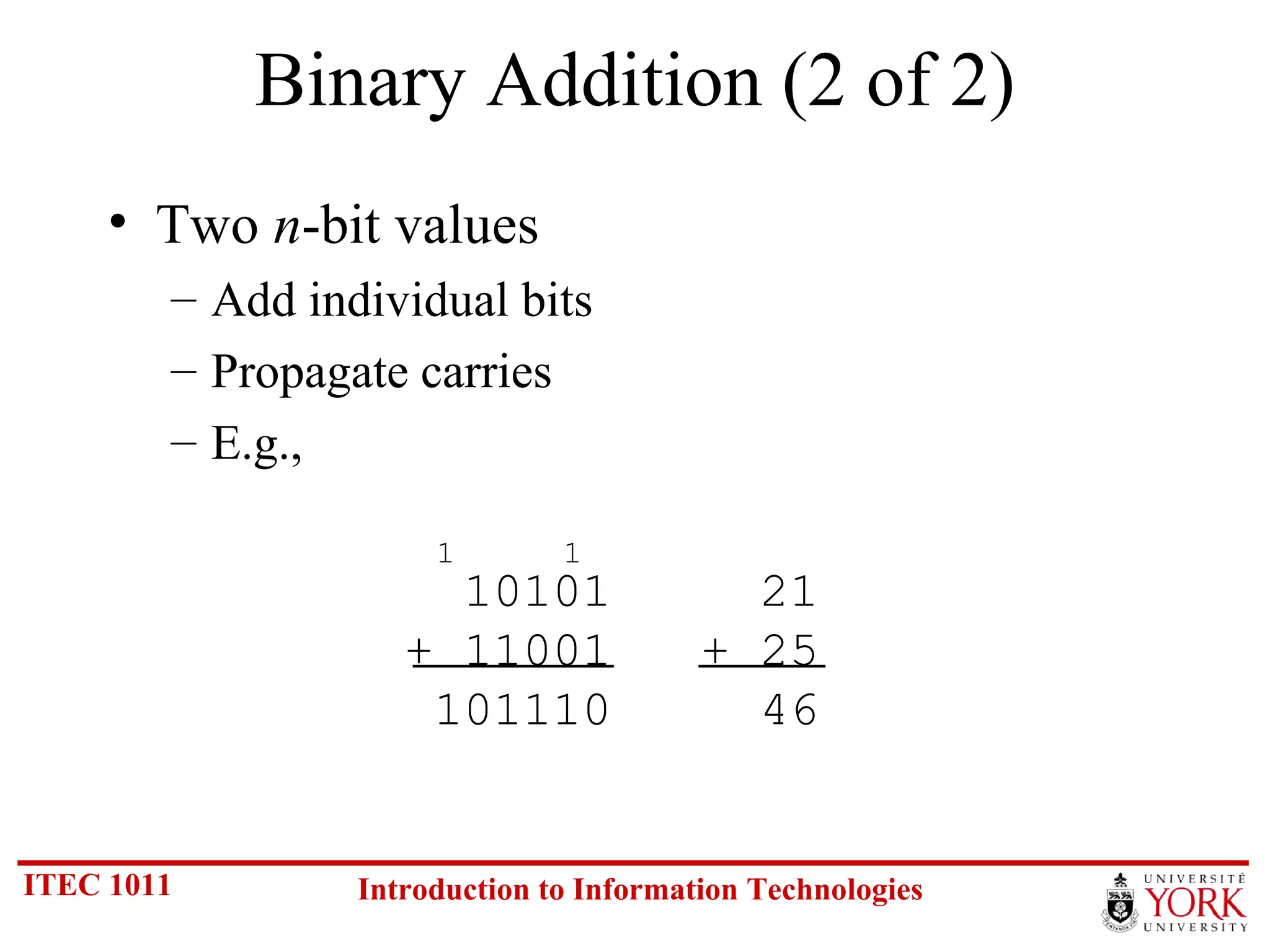
Binary Addition (2 of 2) Two  n -bit values Add individual bits Propagate carries E.g., 10101  21 + 11001  + 25  101110  46 1 1
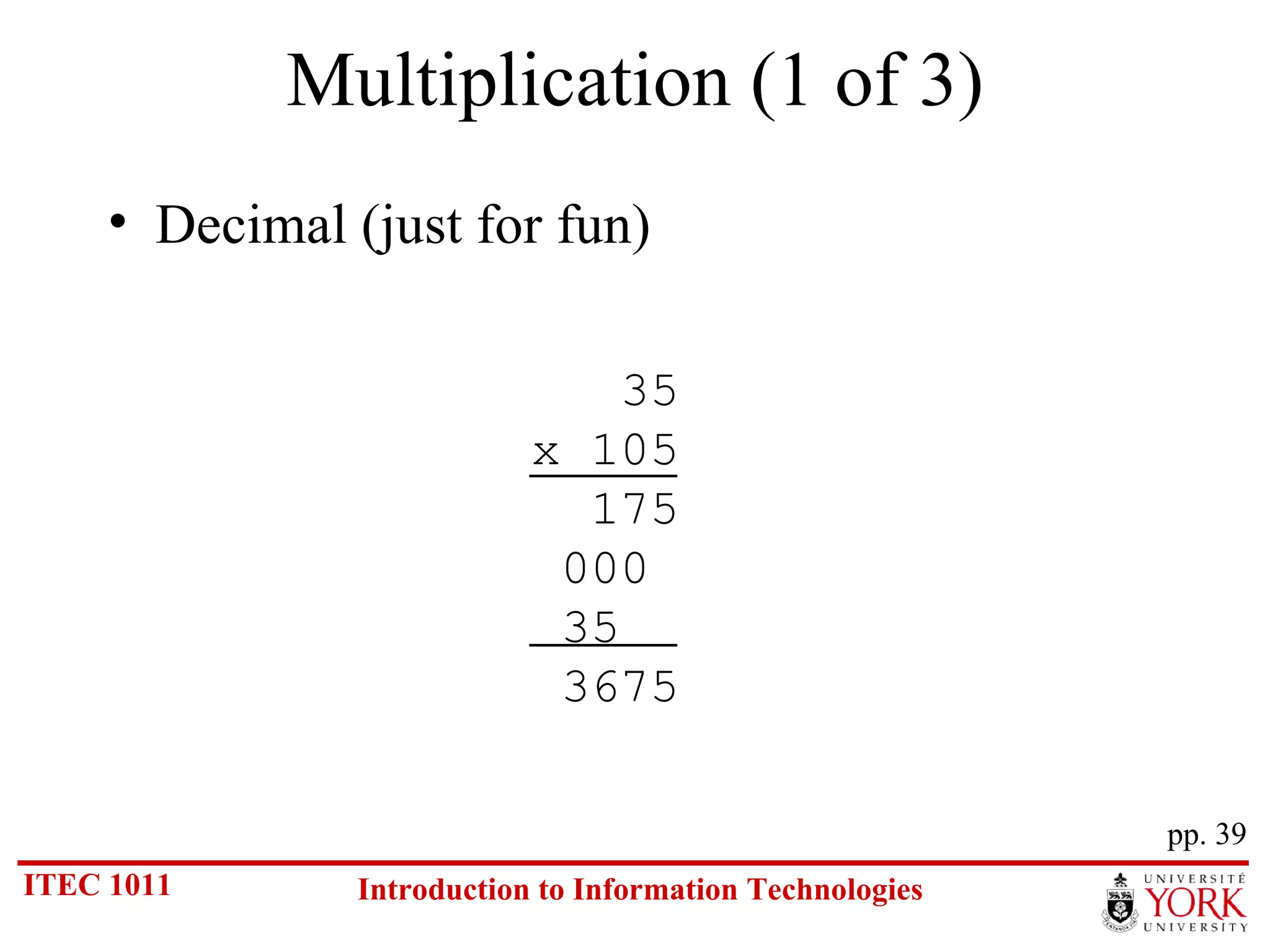
Multiplication (1 of 3) Decimal (just for fun) pp. 39 35 x 105   175  000  35  3675
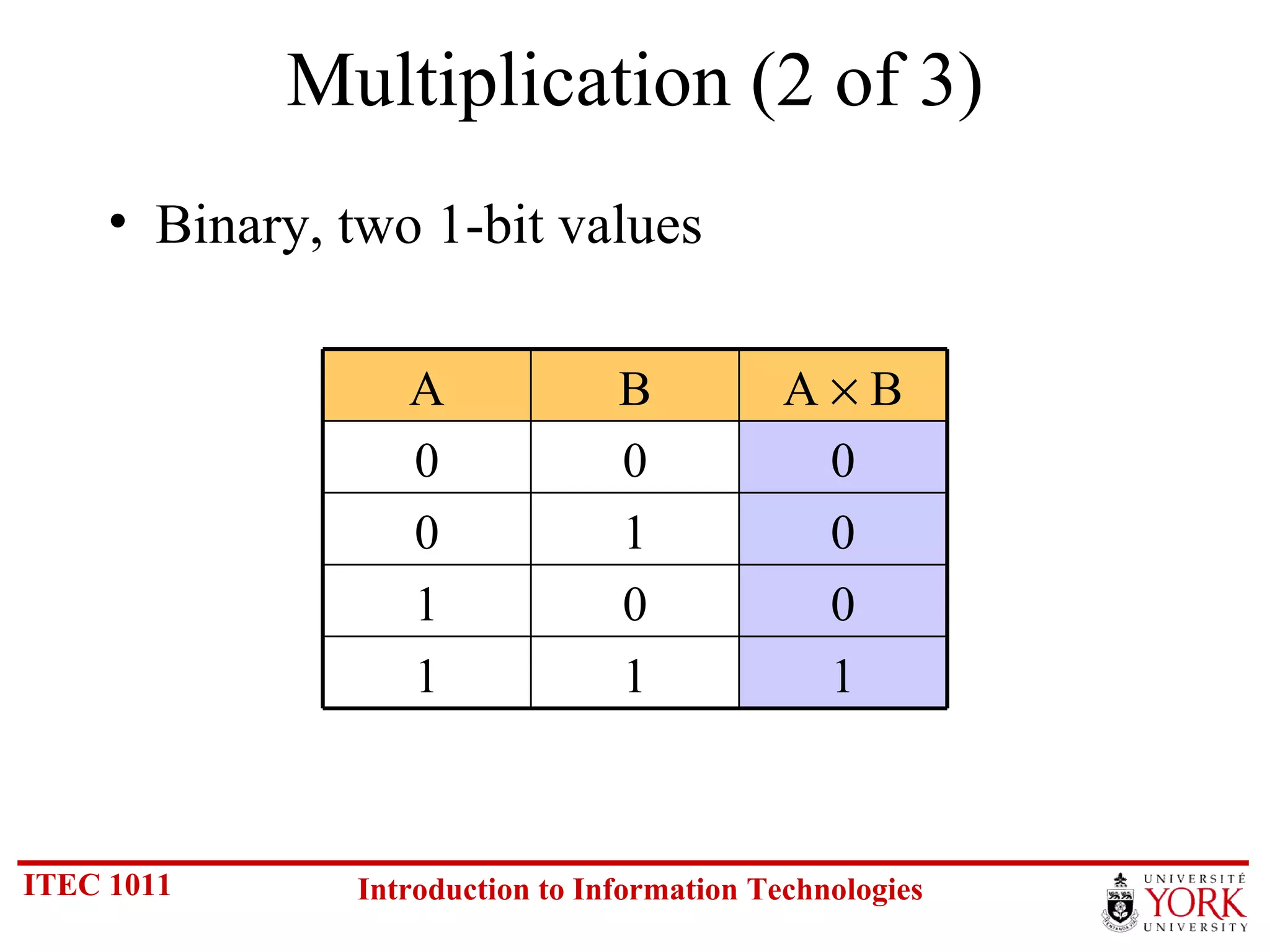
Multiplication (2 of 3) Binary, two 1-bit values 1 1 1 0 0 1 0 1 0 0 0 0 A    B B A
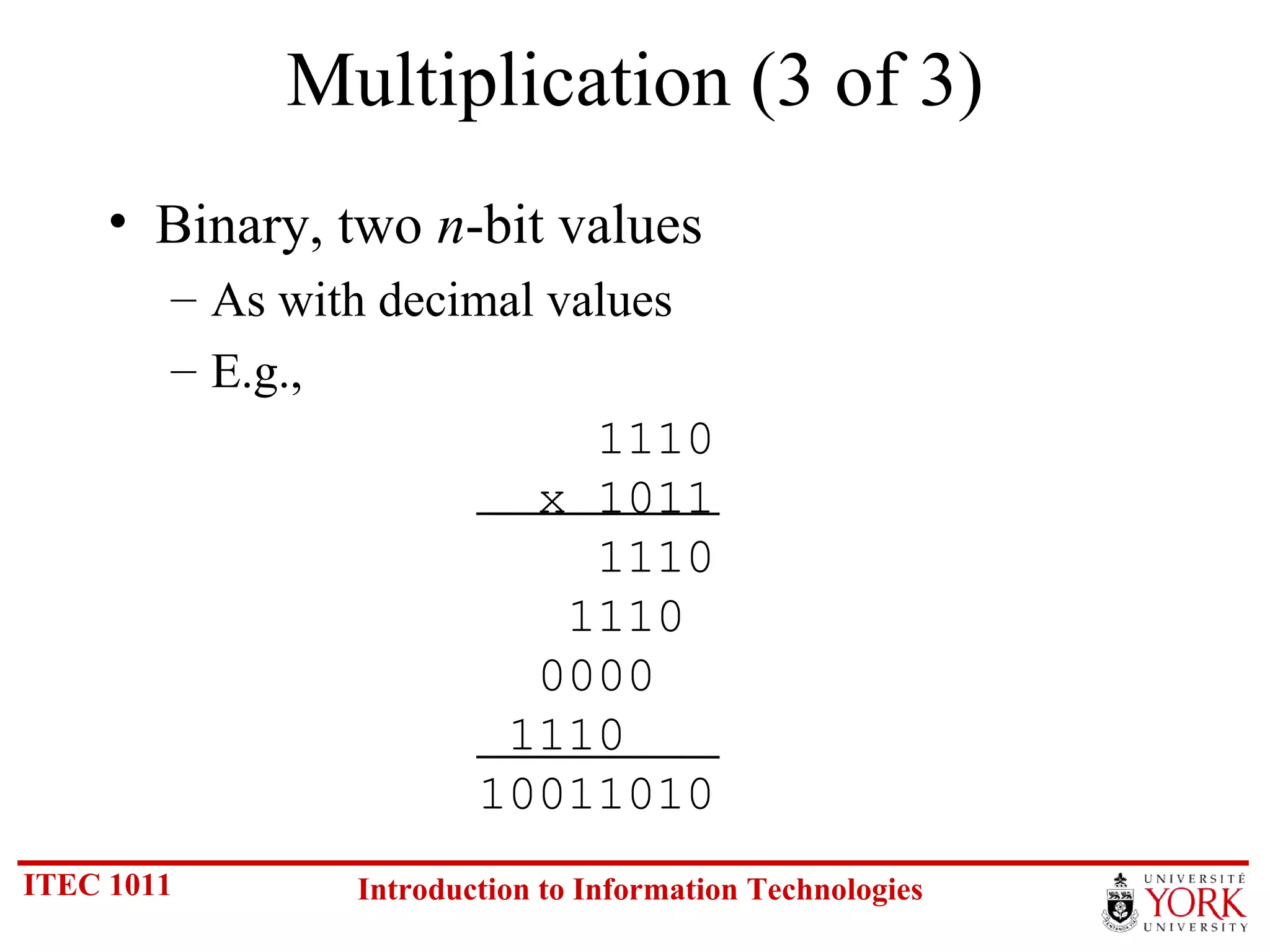
Multiplication (3 of 3) Binary, two  n -bit values As with decimal values E.g.,  1110   x 1011   1110   1110   0000  1110 10011010
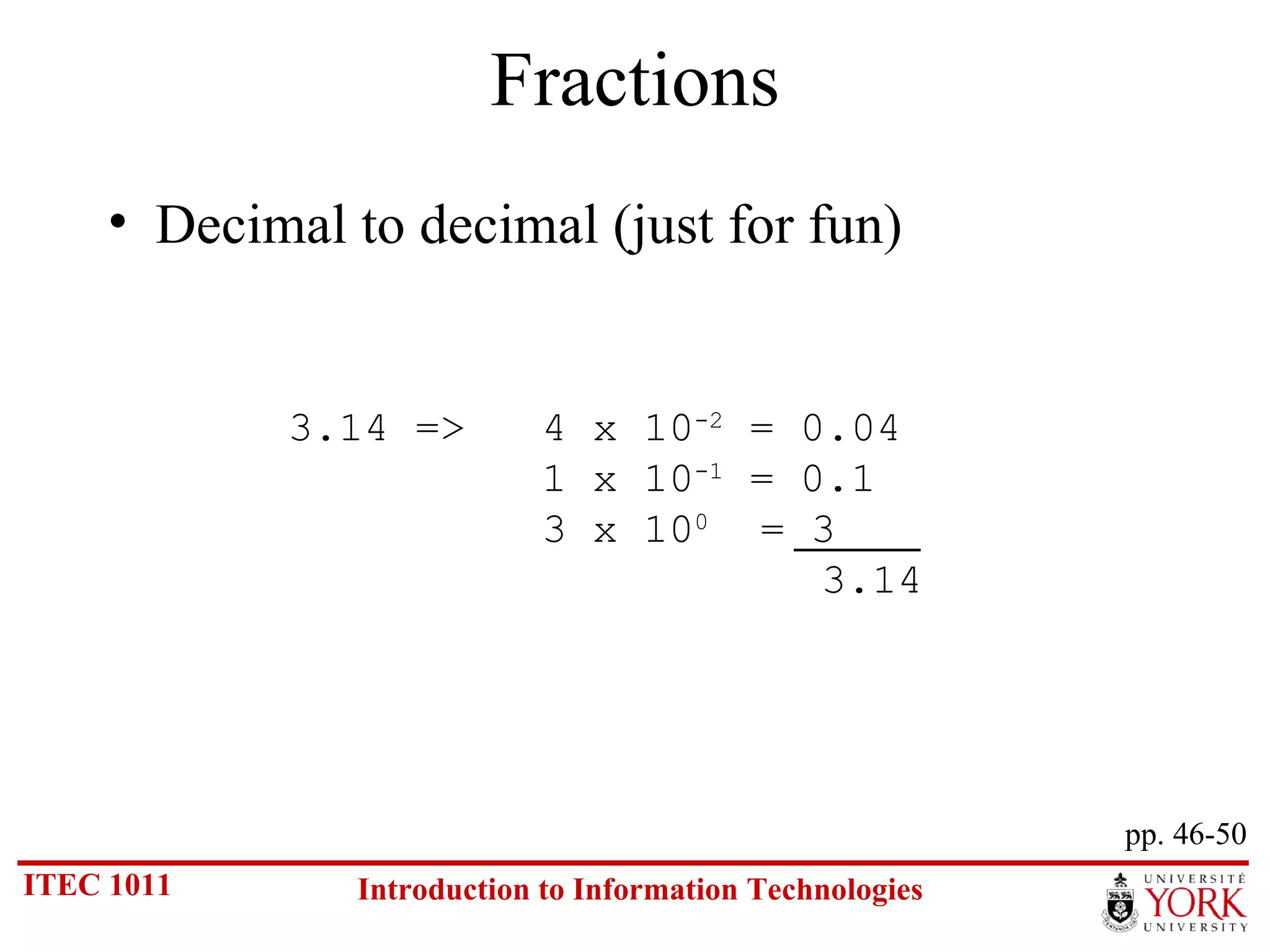
Fractions Decimal to decimal (just for fun) pp. 46-50 3.14 => 4 x 10 -2  = 0.04 1 x 10 -1  = 0.1   3 x 10 0   = 3   3.14
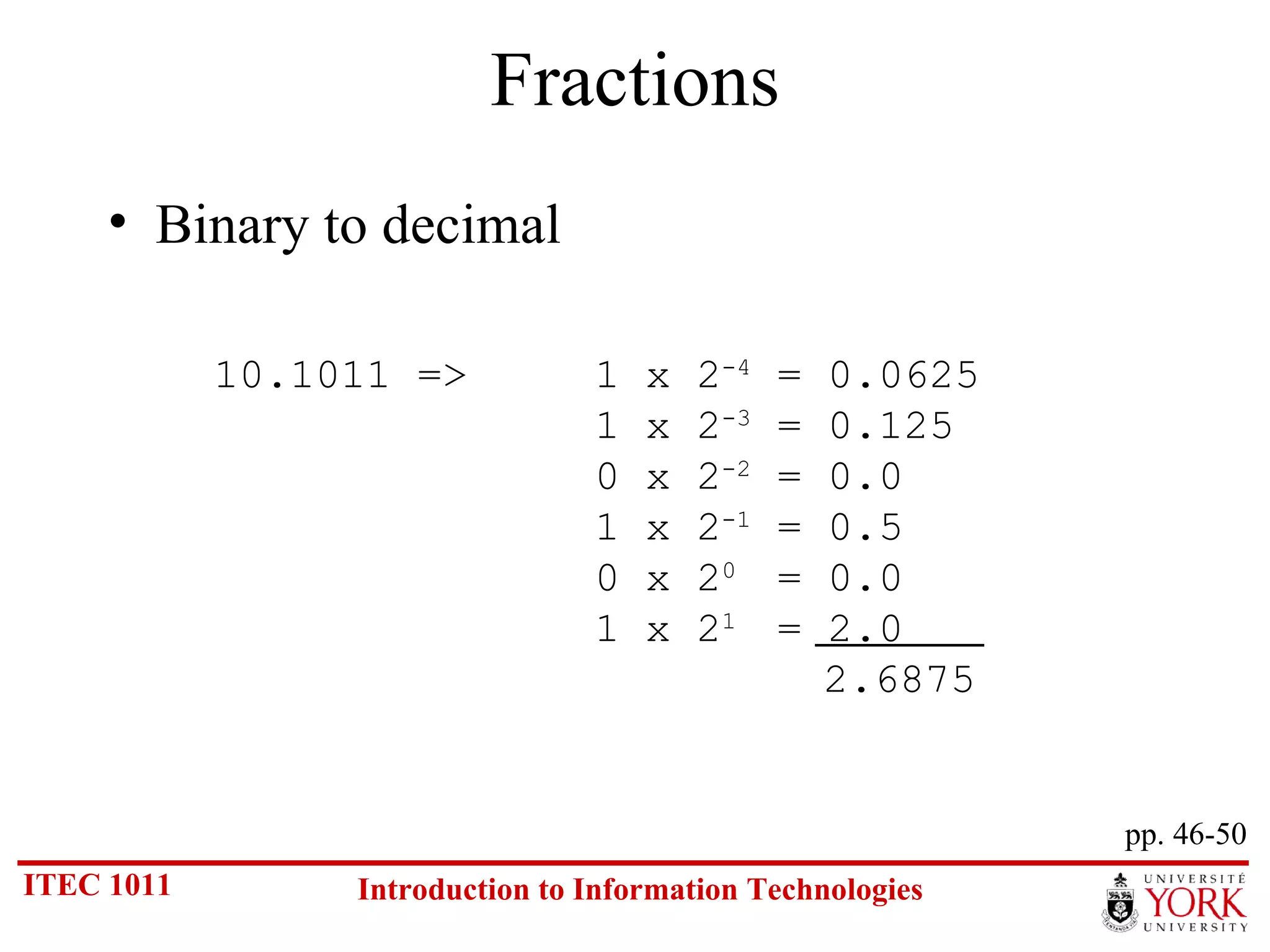
Fractions Binary to decimal pp. 46-50 10.1011 =>  1 x 2 -4  = 0.0625 1 x 2 -3  = 0.125 0 x 2 -2  = 0.0 1 x 2 -1  = 0.5 0 x 2 0  = 0.0 1 x 2 1  = 2.0   2.6875
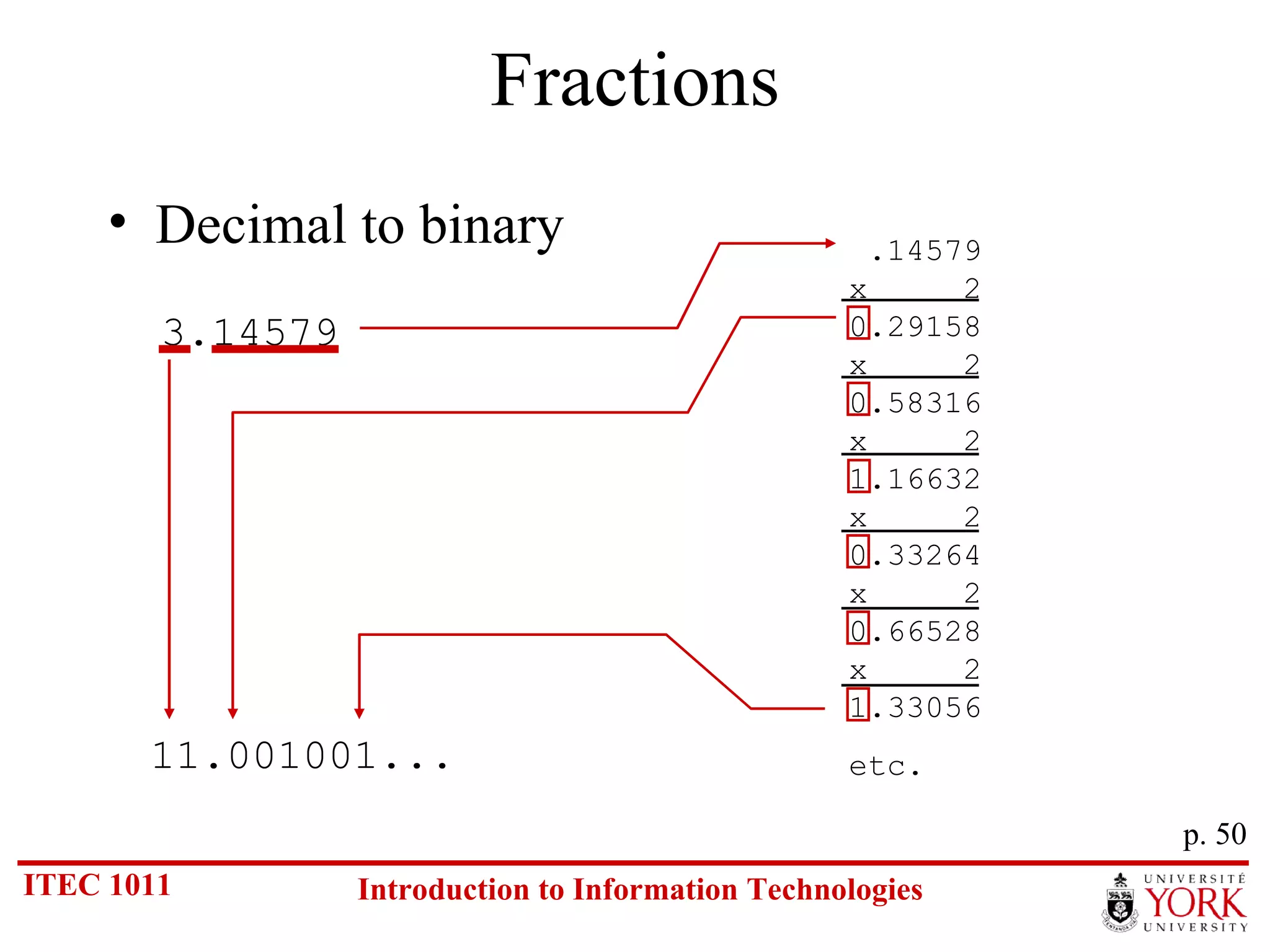
Fractions Decimal to binary p. 50 3.14579 .14579 x  2 0.29158 x  2 0.58316 x  2 1.16632 x  2 0.33264 x  2 0.66528 x  2 1.33056 etc. 11.001001...
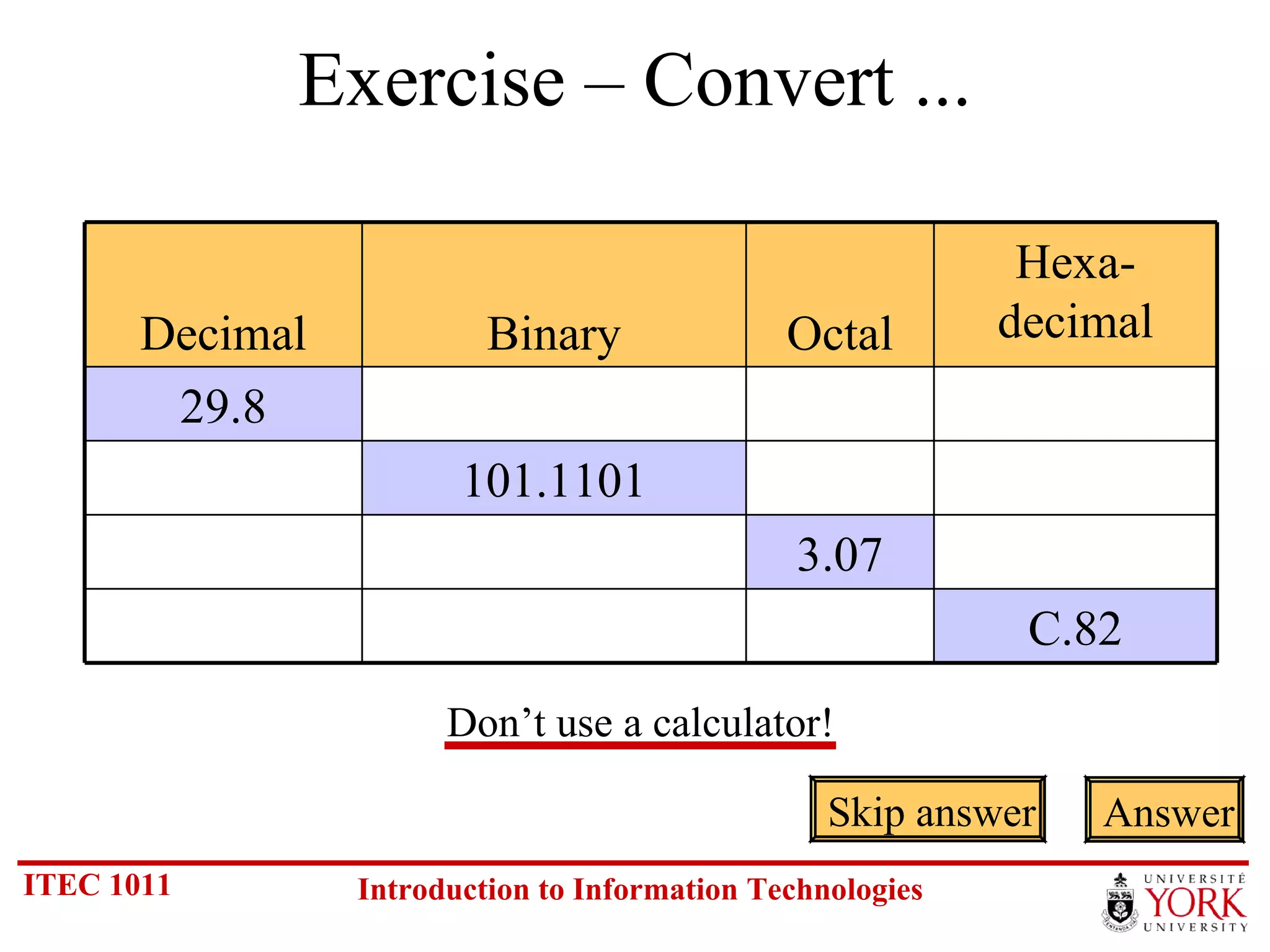
Exercise – Convert ... Skip answer Answer Don’t use a calculator! C.82 3.07 101.1101 29.8 Hexa- decimal Octal Binary Decimal
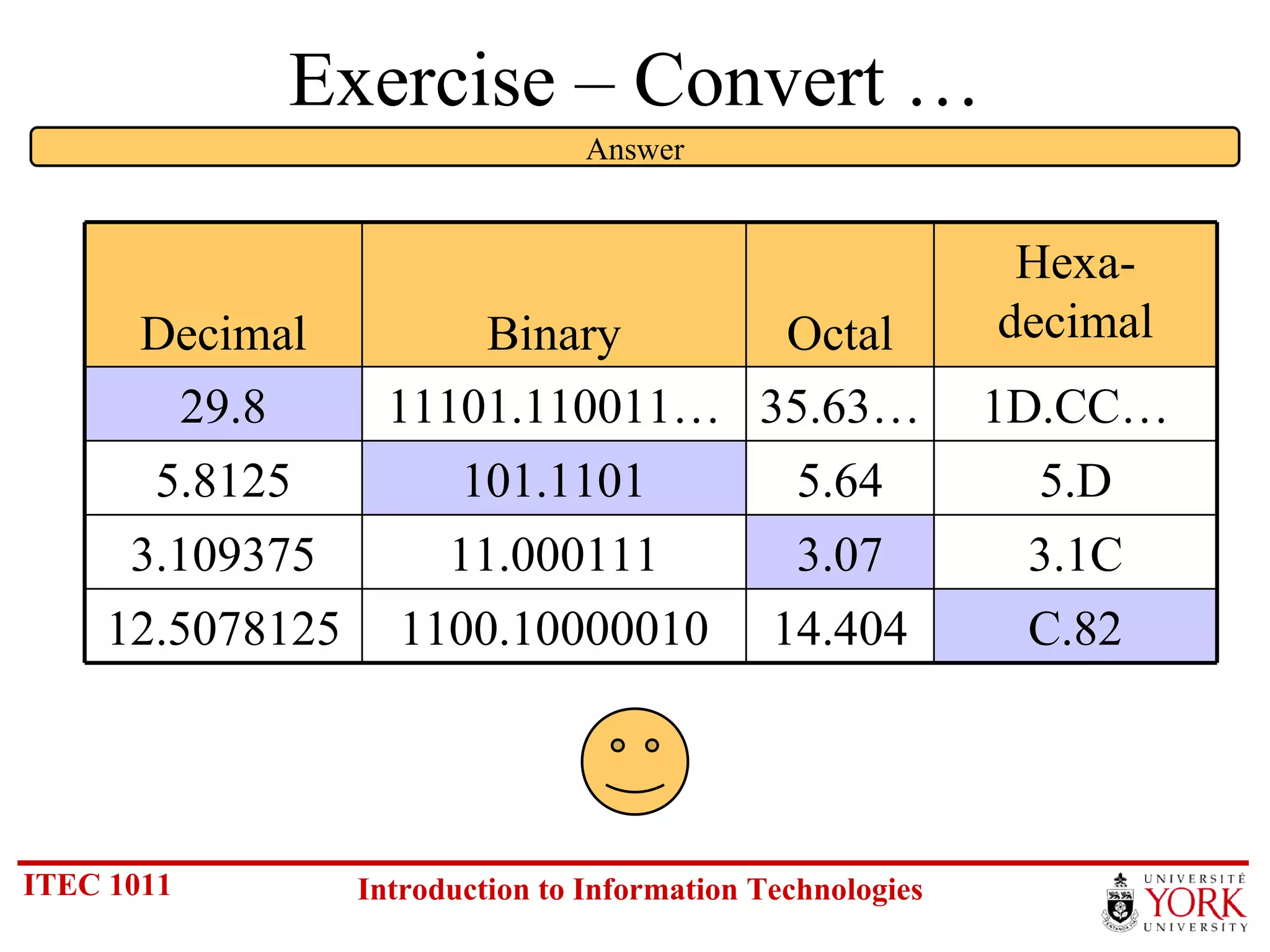
Exercise – Convert … Answer C.82 14.404 1100.10000010 12.5078125 3.1C 3.07 11.000111 3.109375 5.D 5.64 101.1101 5.8125 1D.CC… 35.63… 11101.110011… 29.8 Hexa- decimal Octal Binary Decimal
Thank you Next topic

01.number systems

  • 1.
    1. Number SystemsChapt. 2 Location in course textbook
  • 2.
    Common Number SystemsNo No 0, 1, … 9, A, B, … F 16 Hexa- decimal No No 0, 1, … 7 8 Octal Yes No 0, 1 2 Binary No Yes 0, 1, … 9 10 Decimal Used in computers? Used by humans? Symbols Base System
  • 3.
    Quantities/Counting (1 of3) p. 33 7 7 111 7 6 6 110 6 5 5 101 5 4 4 100 4 3 3 11 3 2 2 10 2 1 1 1 1 0 0 0 0 Hexa- decimal Octal Binary Decimal
  • 4.
    Quantities/Counting (2 of3) F 17 1111 15 E 16 1110 14 D 15 1101 13 C 14 1100 12 B 13 1011 11 A 12 1010 10 9 11 1001 9 8 10 1000 8 Hexa- decimal Octal Binary Decimal
  • 5.
    Quantities/Counting (3 of3) Etc. 17 27 10111 23 16 26 10110 22 15 25 10101 21 14 24 10100 20 13 23 10011 19 12 22 10010 18 11 21 10001 17 10 20 10000 16 Hexa- decimal Octal Binary Decimal
  • 6.
    Conversion Among BasesThe possibilities: Hexadecimal Decimal Octal Binary pp. 40-46
  • 7.
    Quick Example 2510 = 11001 2 = 31 8 = 19 16 Base
  • 8.
    Decimal to Decimal(just for fun) Hexadecimal Decimal Octal Binary Next slide…
  • 9.
    125 10 => 5 x 10 0 = 5 2 x 10 1 = 20 1 x 10 2 = 100 125 Base Weight
  • 10.
    Binary to DecimalHexadecimal Decimal Octal Binary
  • 11.
    Binary to DecimalTechnique Multiply each bit by 2 n , where n is the “weight” of the bit The weight is the position of the bit, starting from 0 on the right Add the results
  • 12.
    Example 101011 2 => 1 x 2 0 = 1 1 x 2 1 = 2 0 x 2 2 = 0 1 x 2 3 = 8 0 x 2 4 = 0 1 x 2 5 = 32 43 10 Bit “0”
  • 13.
    Octal to DecimalHexadecimal Decimal Octal Binary
  • 14.
    Octal to DecimalTechnique Multiply each bit by 8 n , where n is the “weight” of the bit The weight is the position of the bit, starting from 0 on the right Add the results
  • 15.
    Example 724 8 => 4 x 8 0 = 4 2 x 8 1 = 16 7 x 8 2 = 448 468 10
  • 16.
    Hexadecimal to DecimalHexadecimal Decimal Octal Binary
  • 17.
    Hexadecimal to DecimalTechnique Multiply each bit by 16 n , where n is the “weight” of the bit The weight is the position of the bit, starting from 0 on the right Add the results
  • 18.
    Example ABC 16 => C x 16 0 = 12 x 1 = 12 B x 16 1 = 11 x 16 = 176 A x 16 2 = 10 x 256 = 2560 2748 10
  • 19.
    Decimal to BinaryHexadecimal Decimal Octal Binary
  • 20.
    Decimal to BinaryTechnique Divide by two, keep track of the remainder First remainder is bit 0 (LSB, least-significant bit) Second remainder is bit 1 Etc.
  • 21.
    Example 125 10 = ? 2 125 10 = 1111101 2 2 125 62 1 2 31 0 2 15 1 2 7 1 2 3 1 2 1 1 2 0 1
  • 22.
    Octal to BinaryHexadecimal Decimal Octal Binary
  • 23.
    Octal to BinaryTechnique Convert each octal digit to a 3-bit equivalent binary representation
  • 24.
    Example 705 8 = ? 2 705 8 = 111000101 2 7 0 5 111 000 101
  • 25.
    Hexadecimal to BinaryHexadecimal Decimal Octal Binary
  • 26.
    Hexadecimal to BinaryTechnique Convert each hexadecimal digit to a 4-bit equivalent binary representation
  • 27.
    Example 10AF 16 = ? 2 10AF 16 = 0001000010101111 2 1 0 A F 0001 0000 1010 1111
  • 28.
    Decimal to OctalHexadecimal Decimal Octal Binary
  • 29.
    Decimal to OctalTechnique Divide by 8 Keep track of the remainder
  • 30.
    Example 1234 10 = ? 8 8 1234 154 2 1234 10 = 2322 8 8 19 2 8 2 3 8 0 2
  • 31.
    Decimal to HexadecimalHexadecimal Decimal Octal Binary
  • 32.
    Decimal to HexadecimalTechnique Divide by 16 Keep track of the remainder
  • 33.
    Example 1234 10 = ? 16 1234 10 = 4D2 16 16 1234 77 2 16 4 13 = D 16 0 4
  • 34.
    Binary to OctalHexadecimal Decimal Octal Binary
  • 35.
    Binary to OctalTechnique Group bits in threes, starting on right Convert to octal digits
  • 36.
    Example 1011010111 2 = ? 8 1011010111 2 = 1327 8 1 011 010 111 1 3 2 7
  • 37.
    Binary to HexadecimalHexadecimal Decimal Octal Binary
  • 38.
    Binary to HexadecimalTechnique Group bits in fours, starting on right Convert to hexadecimal digits
  • 39.
    Example 1010111011 2 = ? 16 10 1011 1011 B B 1010111011 2 = 2BB 16
  • 40.
    Octal to HexadecimalHexadecimal Decimal Octal Binary
  • 41.
    Octal to HexadecimalTechnique Use binary as an intermediary
  • 42.
    Example 1076 8 = ? 16 1076 8 = 23E 16 1 0 7 6 001 000 111 110 2 3 E
  • 43.
    Hexadecimal to OctalHexadecimal Decimal Octal Binary
  • 44.
    Hexadecimal to OctalTechnique Use binary as an intermediary
  • 45.
    Example 1F0C 16 = ? 8 1F0C 16 = 17414 8 1 F 0 C 0001 1111 0000 1100 1 7 4 1 4
  • 46.
    Exercise – Convert... Skip answer Answer Don’t use a calculator! 1AF 703 1110101 33 Hexa- decimal Octal Binary Decimal
  • 47.
    Exercise – Convert… Answer 1AF 657 110101111 431 1C3 703 111000011 451 75 165 1110101 117 21 41 100001 33 Hexa- decimal Octal Binary Decimal
  • 48.
    Common Powers (1of 2) Base 10 T tera 10 12 G giga 10 9 M mega 10 6 k kilo 10 3 m milli 10 -3  micro 10 -6 n nano 10 -9 p pico 10 -12 Symbol Preface Power 1000000000000 1000000000 1000000 1000 .001 .000001 .000000001 .000000000001 Value
  • 49.
    Common Powers (2of 2) Base 2 What is the value of “k”, “M”, and “G”? In computing, particularly w.r.t. memory , the base-2 interpretation generally applies G Giga 2 30 M mega 2 20 k kilo 2 10 Symbol Preface Power 1073741824 1048576 1024 Value
  • 50.
    Example In thelab… 1. Double click on My Computer 2. Right click on C: 3. Click on Properties / 2 30 =
  • 51.
    Exercise – FreeSpace Determine the “free space” on all drives on a machine in the lab etc. E: D: C: A: GB Bytes Drive Free space
  • 52.
    Review – multiplyingpowers For common bases, add powers 2 6  2 10 = 2 16 = 65,536 or… 2 6  2 10 = 64  2 10 = 64k a b  a c = a b+c
  • 53.
    Binary Addition (1of 2) Two 1-bit values pp. 36-38 “two” 10 1 1 1 0 1 1 1 0 0 0 0 A + B B A
  • 54.
    Binary Addition (2of 2) Two n -bit values Add individual bits Propagate carries E.g., 10101 21 + 11001 + 25 101110 46 1 1
  • 55.
    Multiplication (1 of3) Decimal (just for fun) pp. 39 35 x 105 175 000 35 3675
  • 56.
    Multiplication (2 of3) Binary, two 1-bit values 1 1 1 0 0 1 0 1 0 0 0 0 A  B B A
  • 57.
    Multiplication (3 of3) Binary, two n -bit values As with decimal values E.g., 1110 x 1011 1110 1110 0000 1110 10011010
  • 58.
    Fractions Decimal todecimal (just for fun) pp. 46-50 3.14 => 4 x 10 -2 = 0.04 1 x 10 -1 = 0.1 3 x 10 0 = 3 3.14
  • 59.
    Fractions Binary todecimal pp. 46-50 10.1011 => 1 x 2 -4 = 0.0625 1 x 2 -3 = 0.125 0 x 2 -2 = 0.0 1 x 2 -1 = 0.5 0 x 2 0 = 0.0 1 x 2 1 = 2.0 2.6875
  • 60.
    Fractions Decimal tobinary p. 50 3.14579 .14579 x 2 0.29158 x 2 0.58316 x 2 1.16632 x 2 0.33264 x 2 0.66528 x 2 1.33056 etc. 11.001001...
  • 61.
    Exercise – Convert... Skip answer Answer Don’t use a calculator! C.82 3.07 101.1101 29.8 Hexa- decimal Octal Binary Decimal
  • 62.
    Exercise – Convert… Answer C.82 14.404 1100.10000010 12.5078125 3.1C 3.07 11.000111 3.109375 5.D 5.64 101.1101 5.8125 1D.CC… 35.63… 11101.110011… 29.8 Hexa- decimal Octal Binary Decimal
  • 63.