Digital System Design
DIGITAL DESIGN
What is digital ?
• Digital camera, Digital TV, Digital Watch, Digital
• Radio, Digital City (e city), Digital Photo Frame …etc
‐
• Which gives the things in countable form
• Scene (analog) to Image (digital)
Why is digital ?
• Countable form, makes easy to manage.accuracy
• Easy management makes more useful and versatile
NUMBER SYSTEM TYPES
It is a system for representing numeric values or quantities using different symbols
Famous Number System: Decimal , Roman, Binary
Decimal System: 0 9
‐
May evolves: because human have 10 finger
Roman System
May evolves to make easy to look and feel
Pre/Post Concept: (IV, V & VI) is (5 1, 5 & 5+1)
‐
Binary System, Others (Oct, Hex)
One can cut an apple in to two
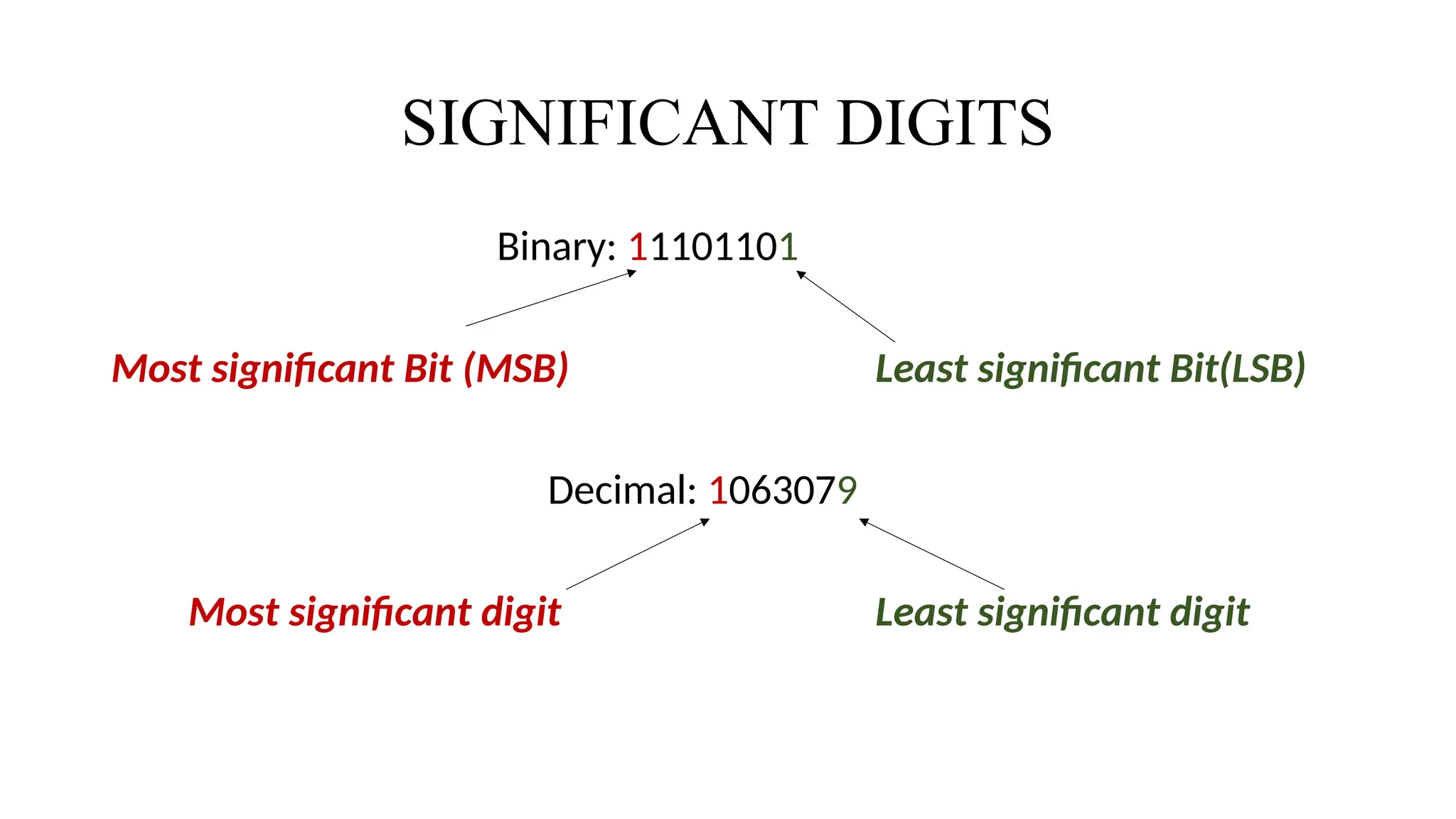
SIGNIFICANT DIGITS
Binary: 11101101
Most significant Bit (MSB) Least significant Bit(LSB)
Decimal: 1063079
Most significant digit Least significant digit
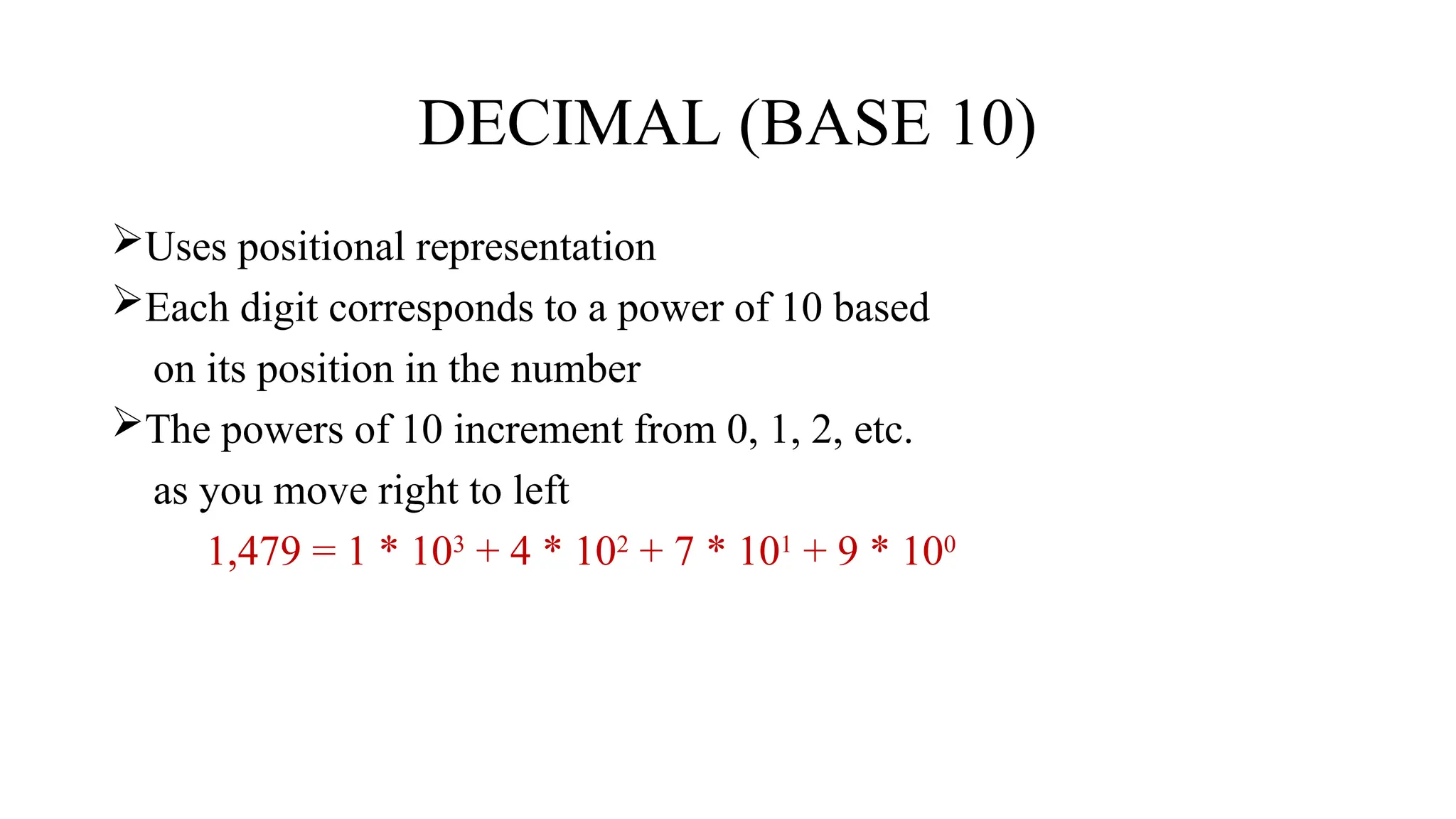
DECIMAL (BASE 10)
Uses positional representation
Each digit corresponds to a power of 10 based
on its position in the number
The powers of 10 increment from 0, 1, 2, etc.
as you move right to left
1,479 = 1 * 103
+ 4 * 102
+ 7 * 101
+ 9 * 100
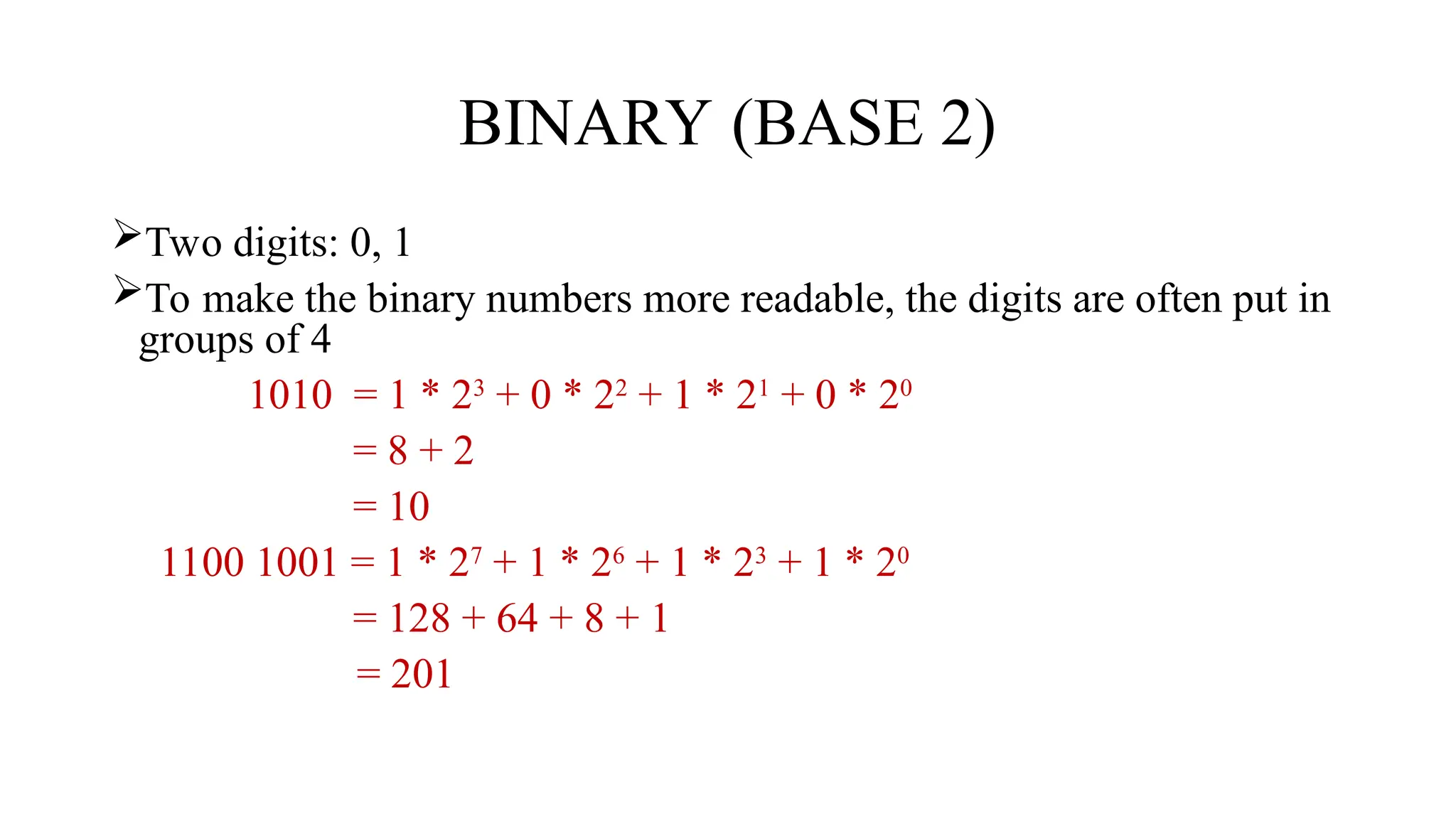
BINARY (BASE 2)
Two digits: 0, 1
To make the binary numbers more readable, the digits are often put in
groups of 4
1010 = 1 * 23
+ 0 * 22
+ 1 * 21
+ 0 * 20
= 8 + 2
= 10
1100 1001 = 1 * 27
+ 1 * 26
+ 1 * 23
+ 1 * 20
= 128 + 64 + 8 + 1
= 201
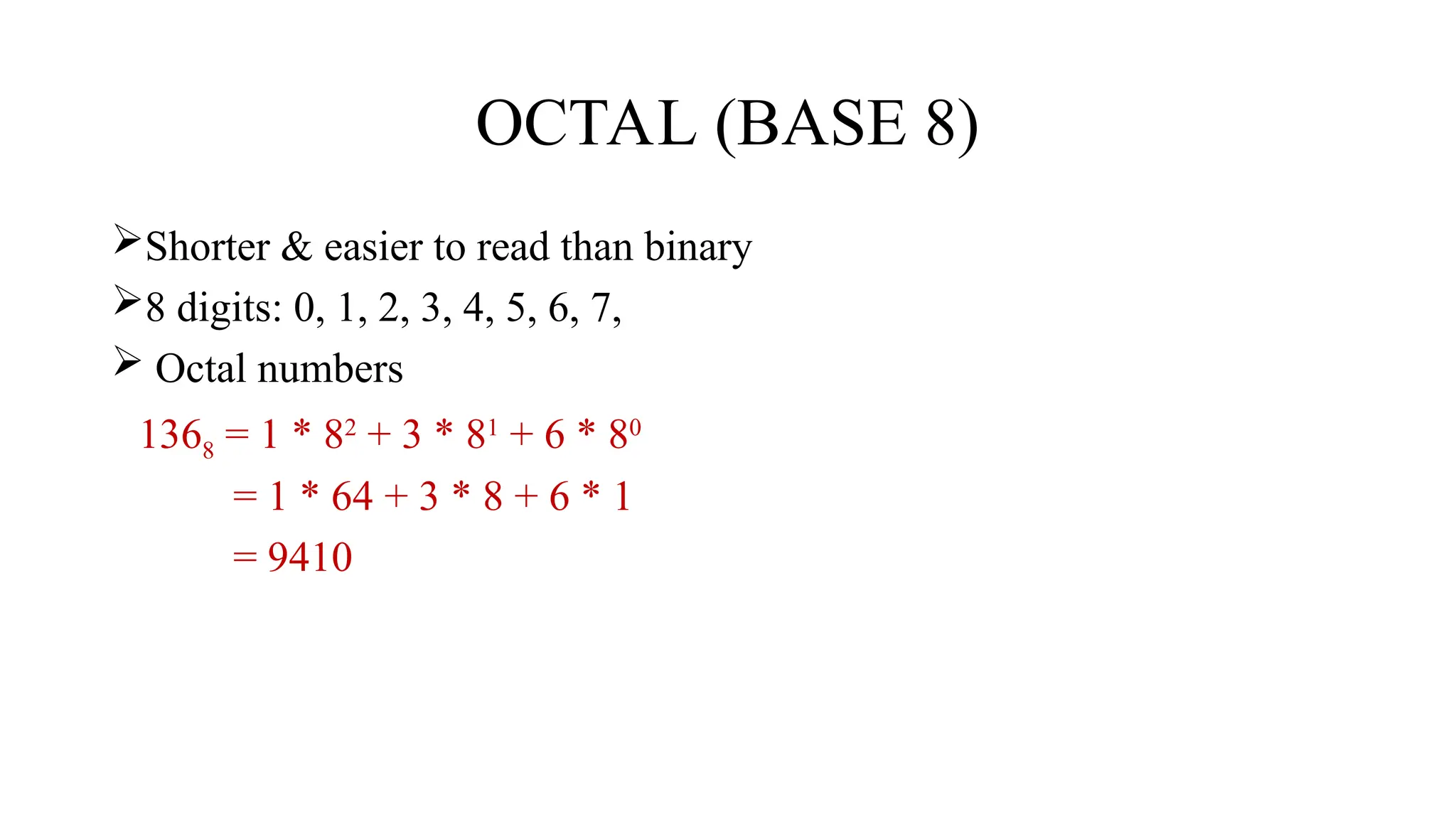
OCTAL (BASE 8)
Shorter & easier to read than binary
8 digits: 0, 1, 2, 3, 4, 5, 6, 7,
 Octal numbers
1368 = 1 * 82
+ 3 * 81
+ 6 * 80
= 1 * 64 + 3 * 8 + 6 * 1
= 9410
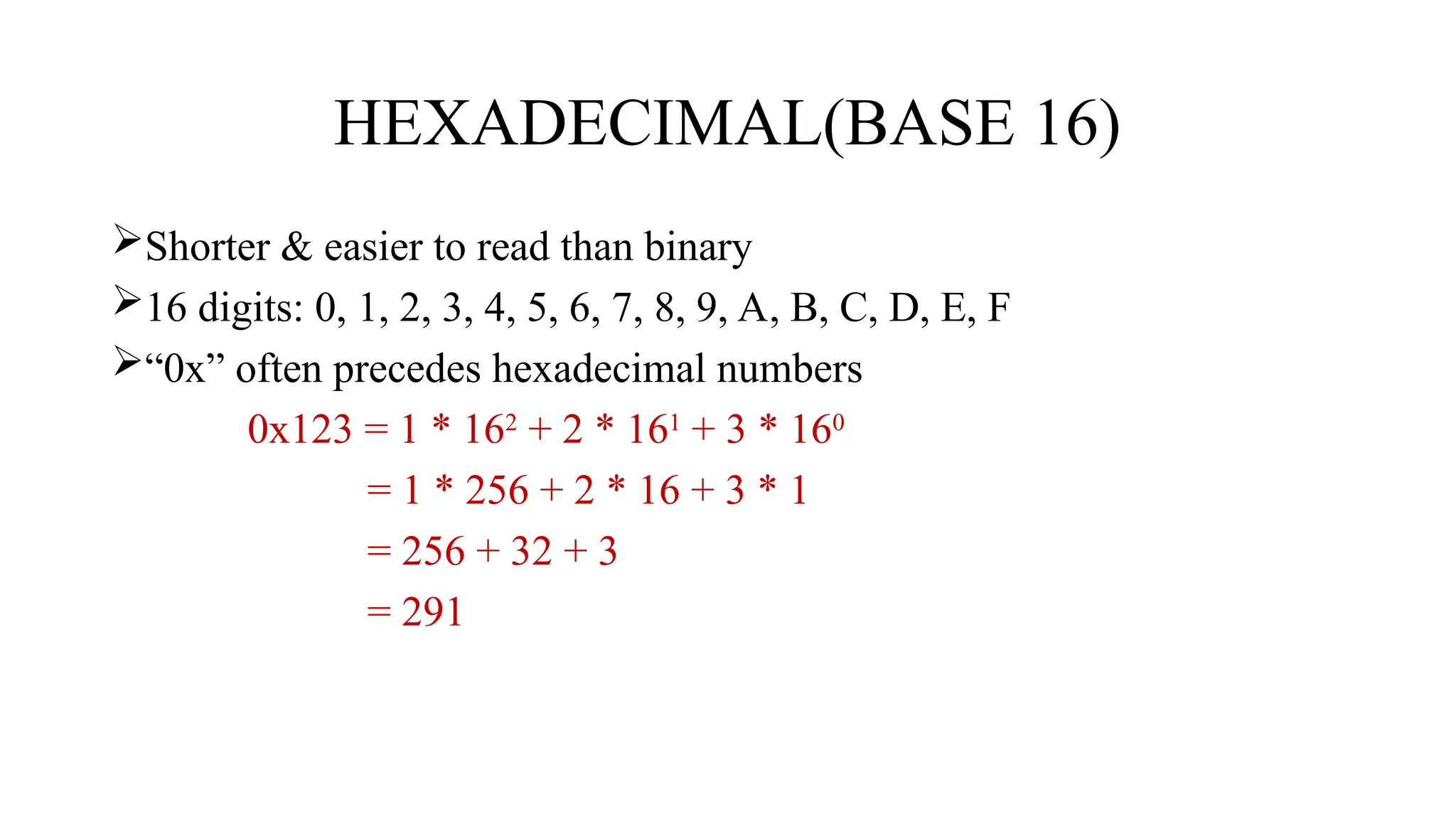
HEXADECIMAL(BASE 16)
Shorter & easier to read than binary
16 digits: 0, 1, 2, 3, 4, 5, 6, 7, 8, 9, A, B, C, D, E, F
“0x” often precedes hexadecimal numbers
0x123 = 1 * 162
+ 2 * 161
+ 3 * 160
= 1 * 256 + 2 * 16 + 3 * 1
= 256 + 32 + 3
= 291
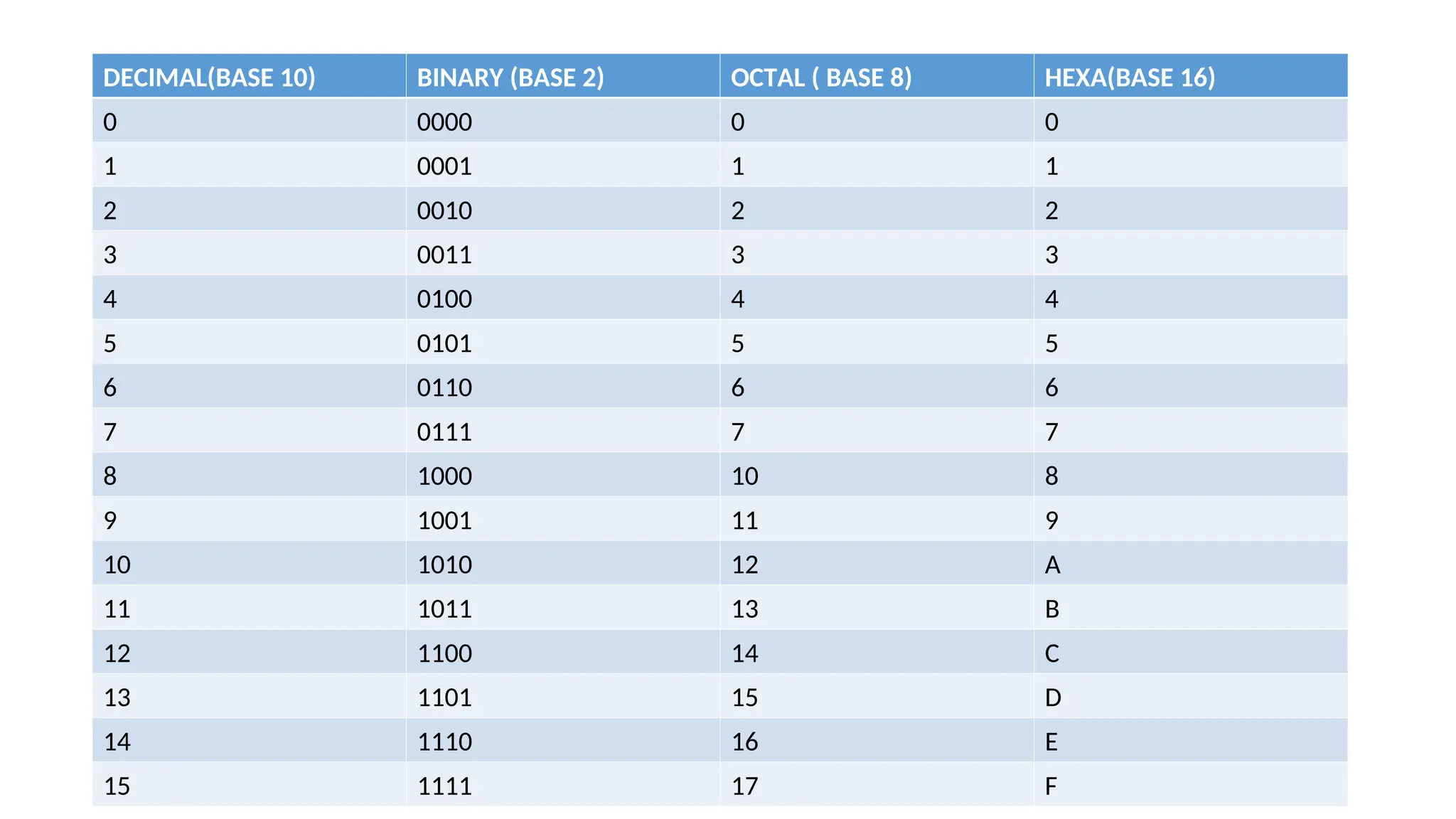
DECIMAL(BASE 10) BINARY (BASE 2) OCTAL ( BASE 8) HEXA(BASE 16)
0 0000 0 0
1 0001 1 1
2 0010 2 2
3 0011 3 3
4 0100 4 4
5 0101 5 5
6 0110 6 6
7 0111 7 7
8 1000 10 8
9 1001 11 9
10 1010 12 A
11 1011 13 B
12 1100 14 C
13 1101 15 D
14 1110 16 E
15 1111 17 F
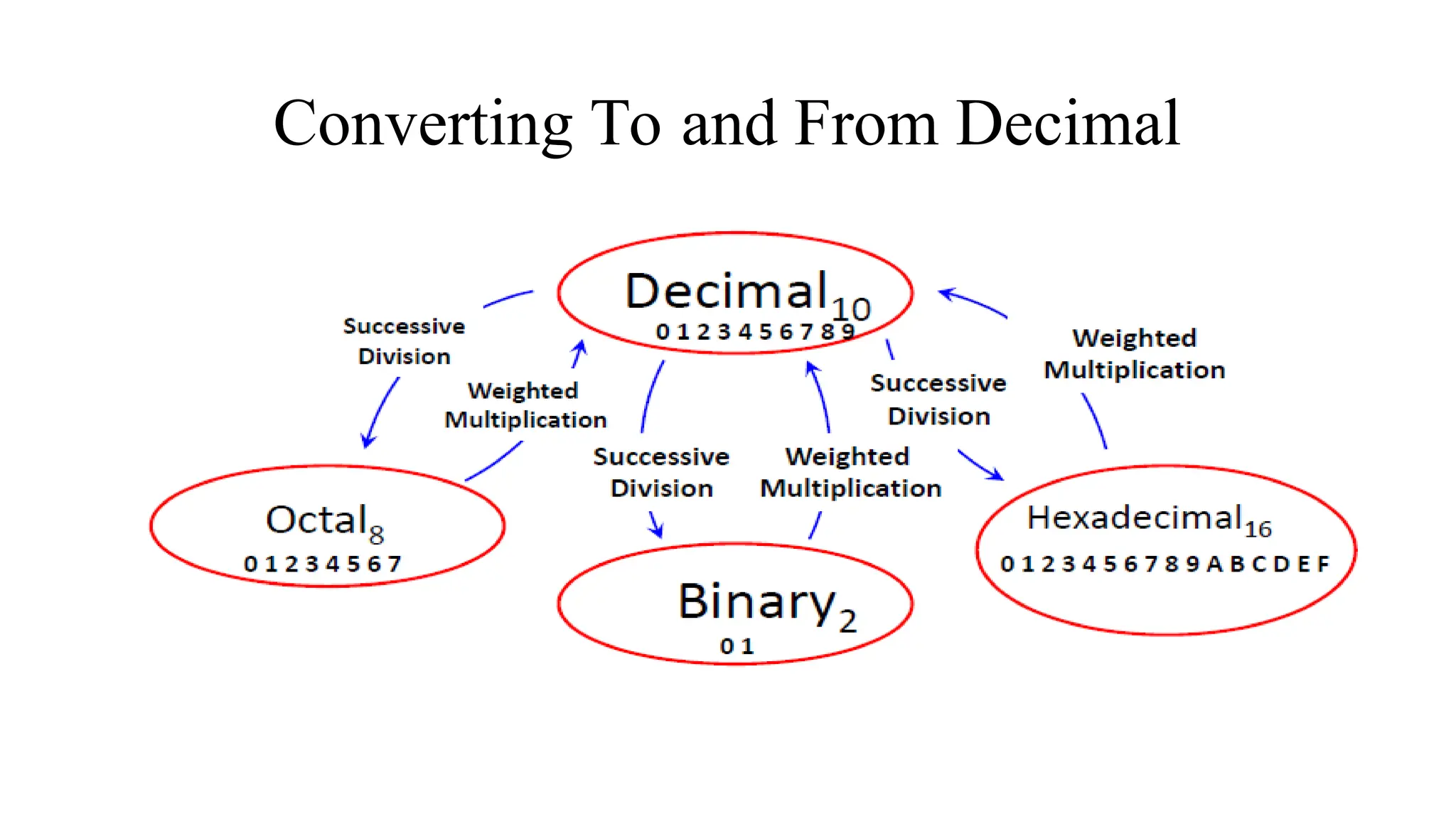
Converting To and From Decimal
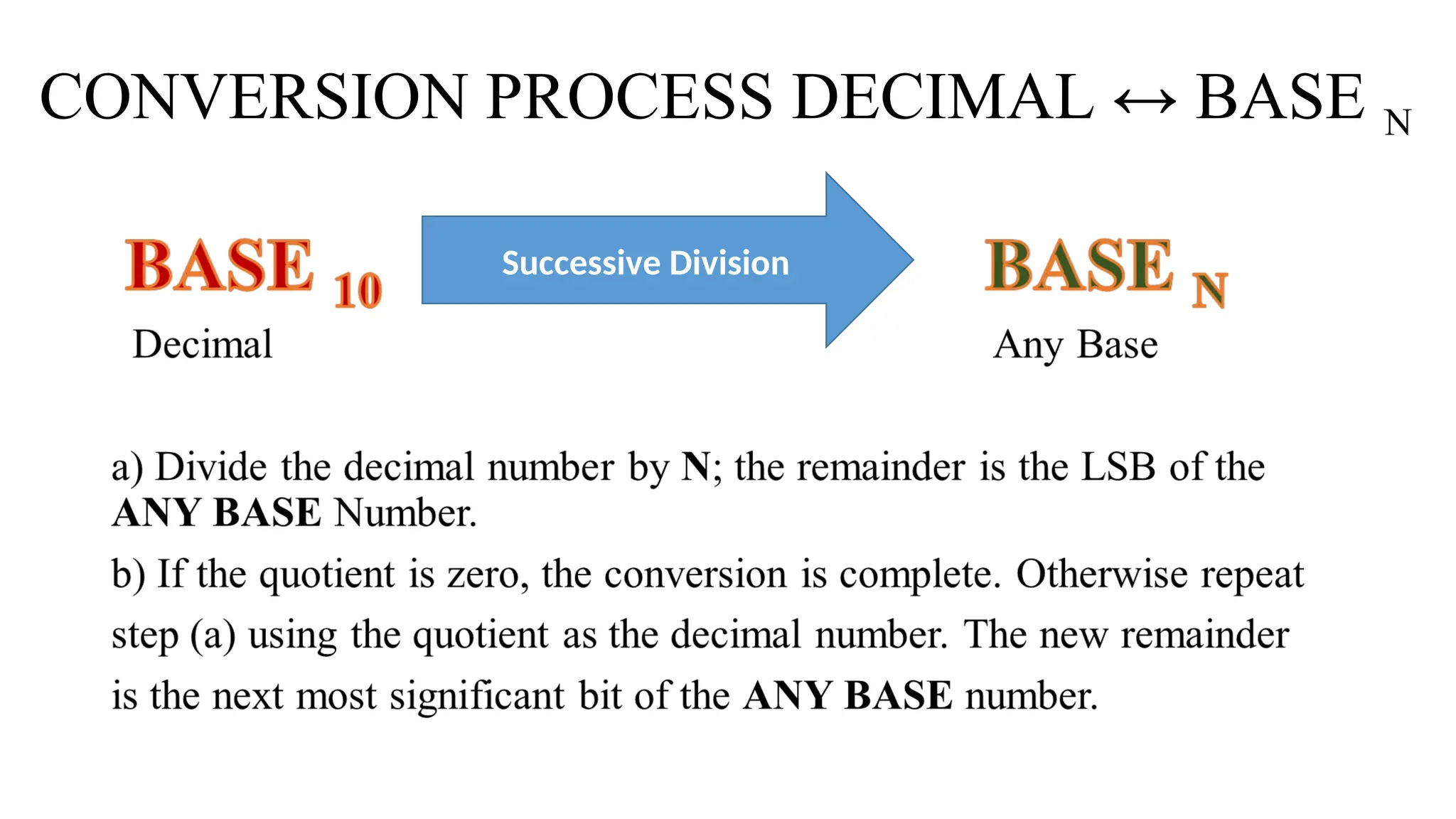
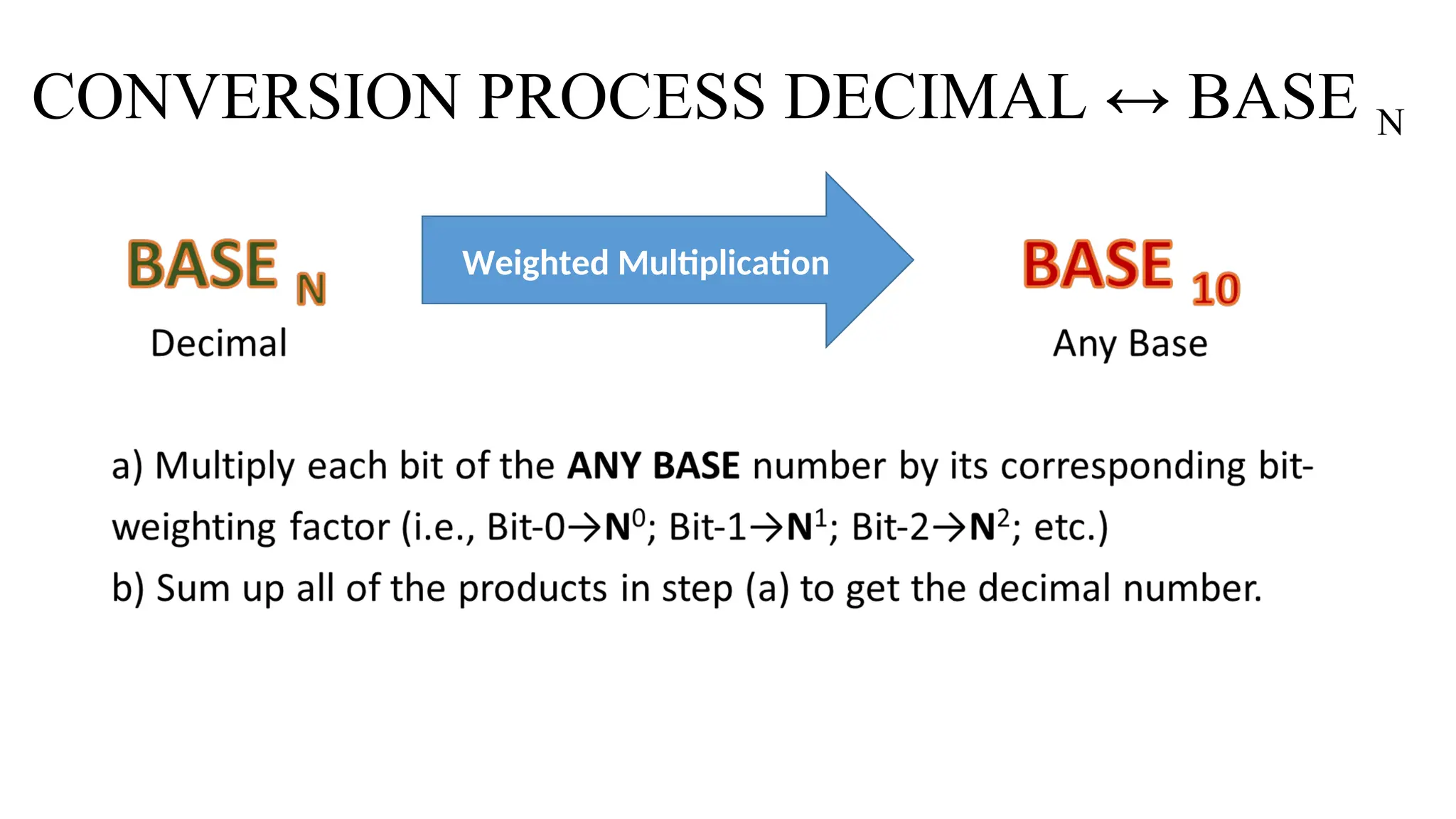
CONVERSION PROCESS DECIMAL ↔ BASE N
Successive Division
CONVERSION PROCESS DECIMAL ↔ BASE N
Weighted Multiplication
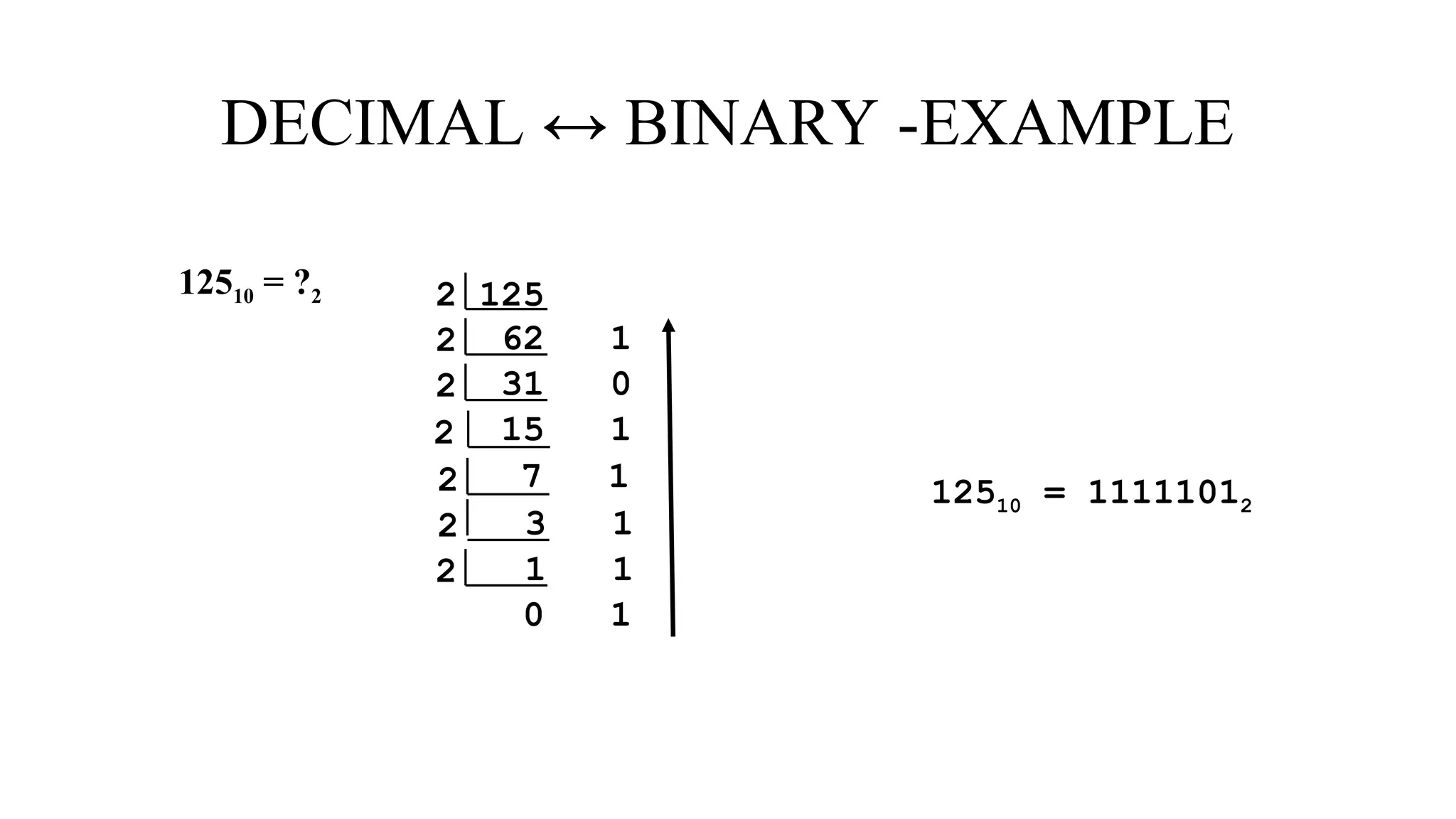
DECIMAL ↔ BINARY -EXAMPLE
12510 = ?2 2 125
62 1
2
31 0
2
15 1
2
7 1
2
3 1
2
1 1
2
0 1
12510 = 11111012
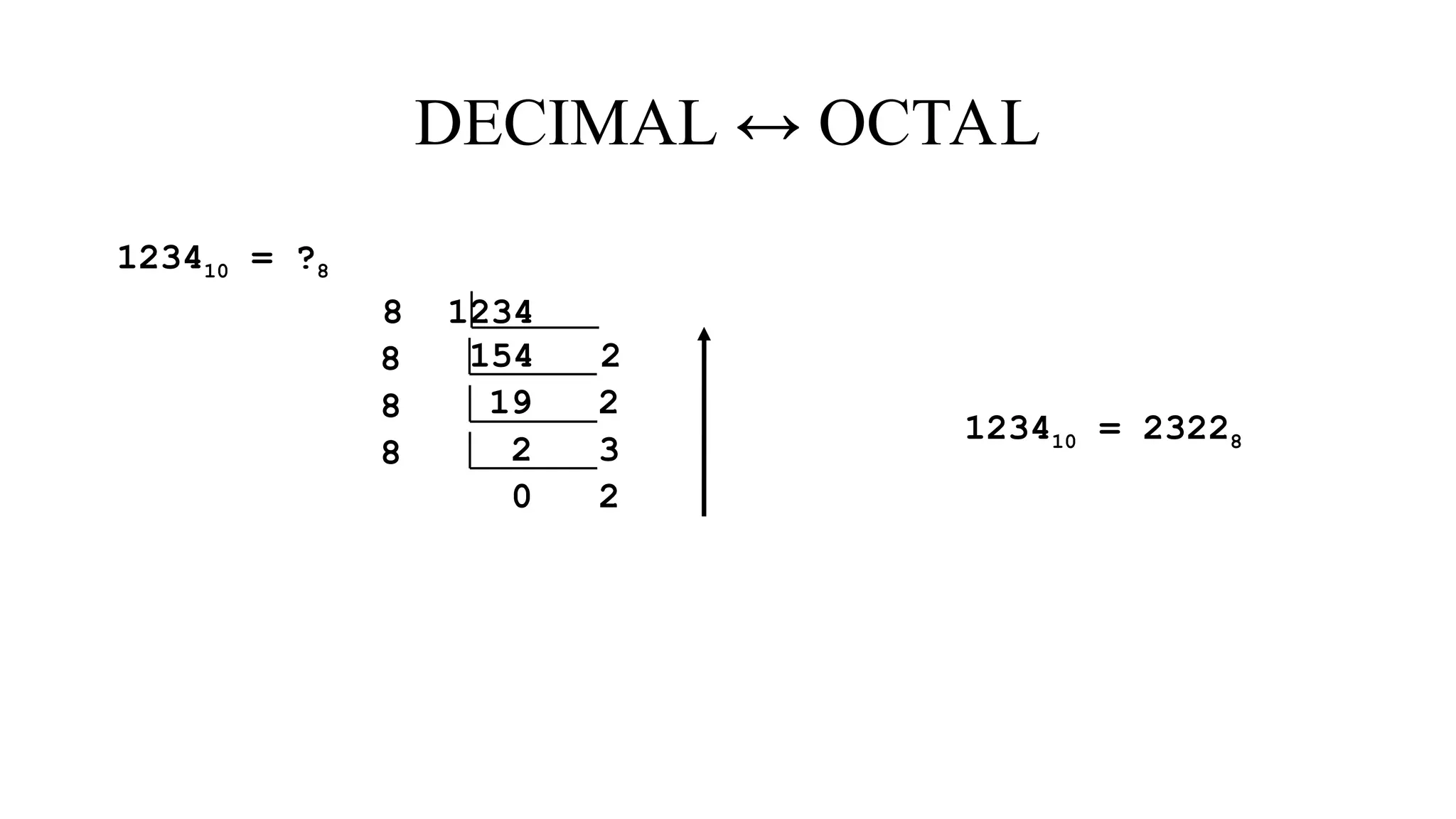
DECIMAL ↔ OCTAL
123410 = ?8
8 1234
154 2
8
19 2
8
2 3
8
0 2
123410 = 23228
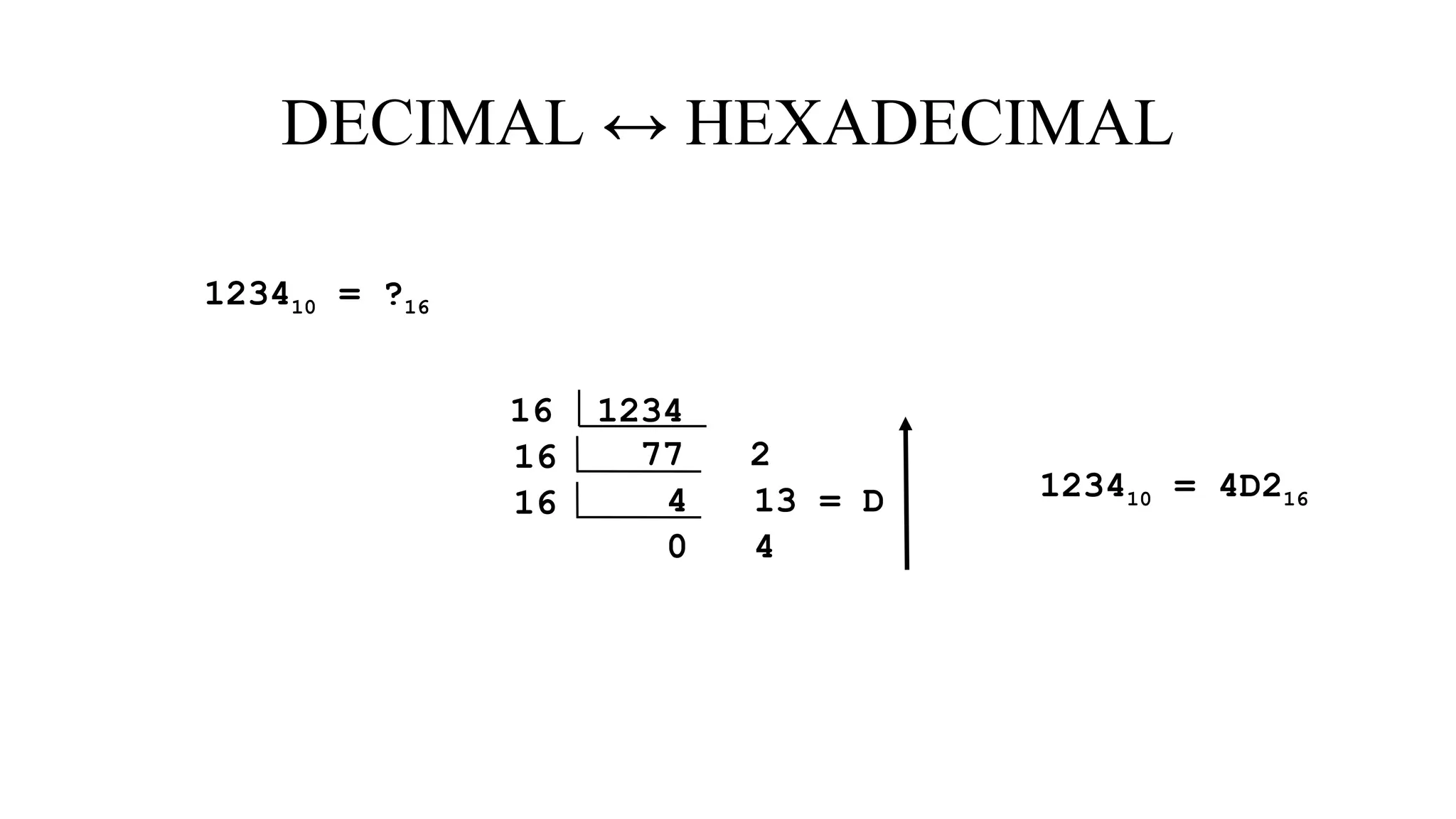
DECIMAL ↔ HEXADECIMAL
123410 = ?16
123410 = 4D216
16 1234
77 2
16
4 13 = D
16
0 4
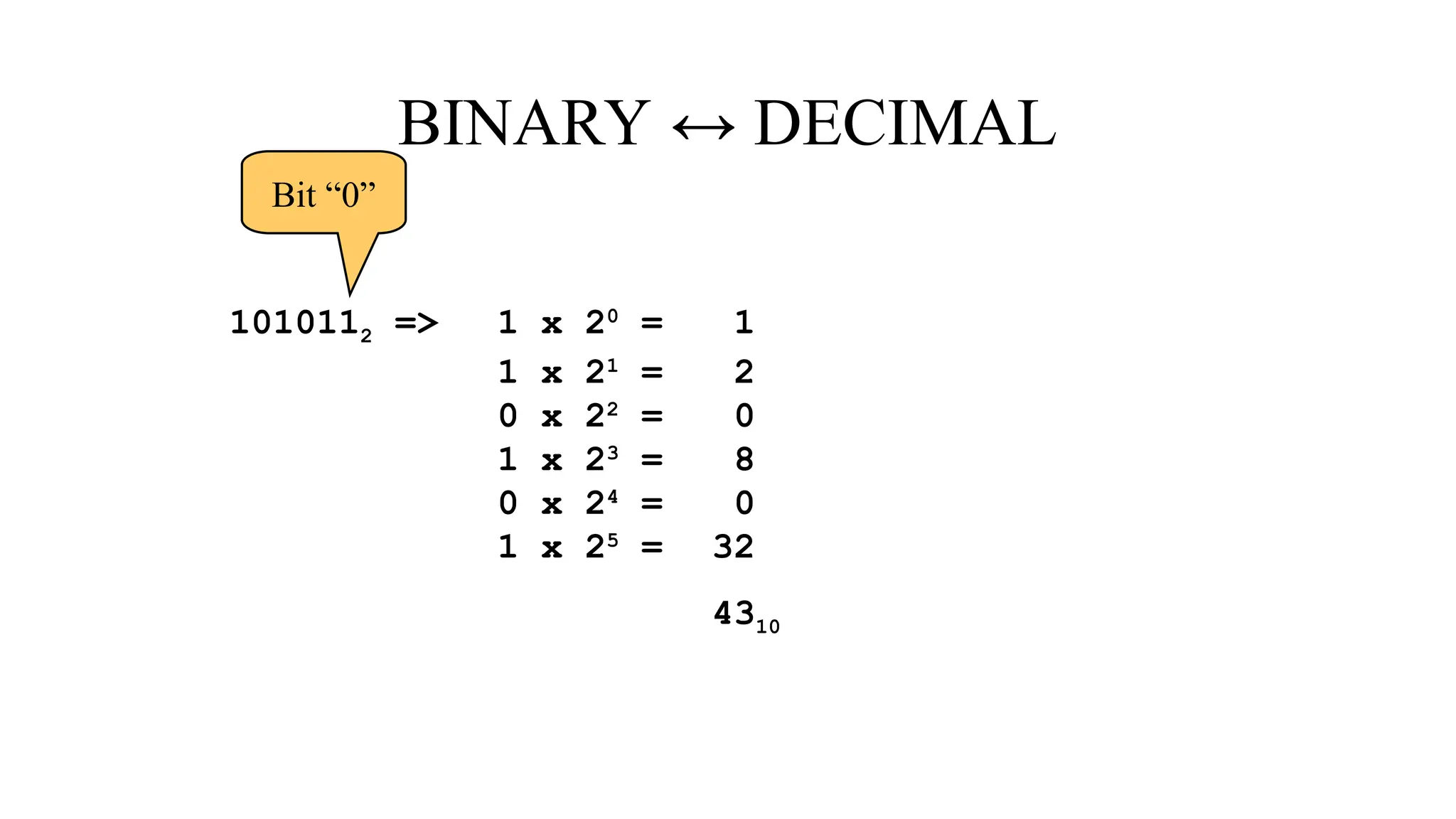
BINARY ↔ DECIMAL
1010112 => 1 x 20
= 1
1 x 21
= 2
0 x 22
= 0
1 x 23
= 8
0 x 24
= 0
1 x 25
= 32
4310
Bit “0”
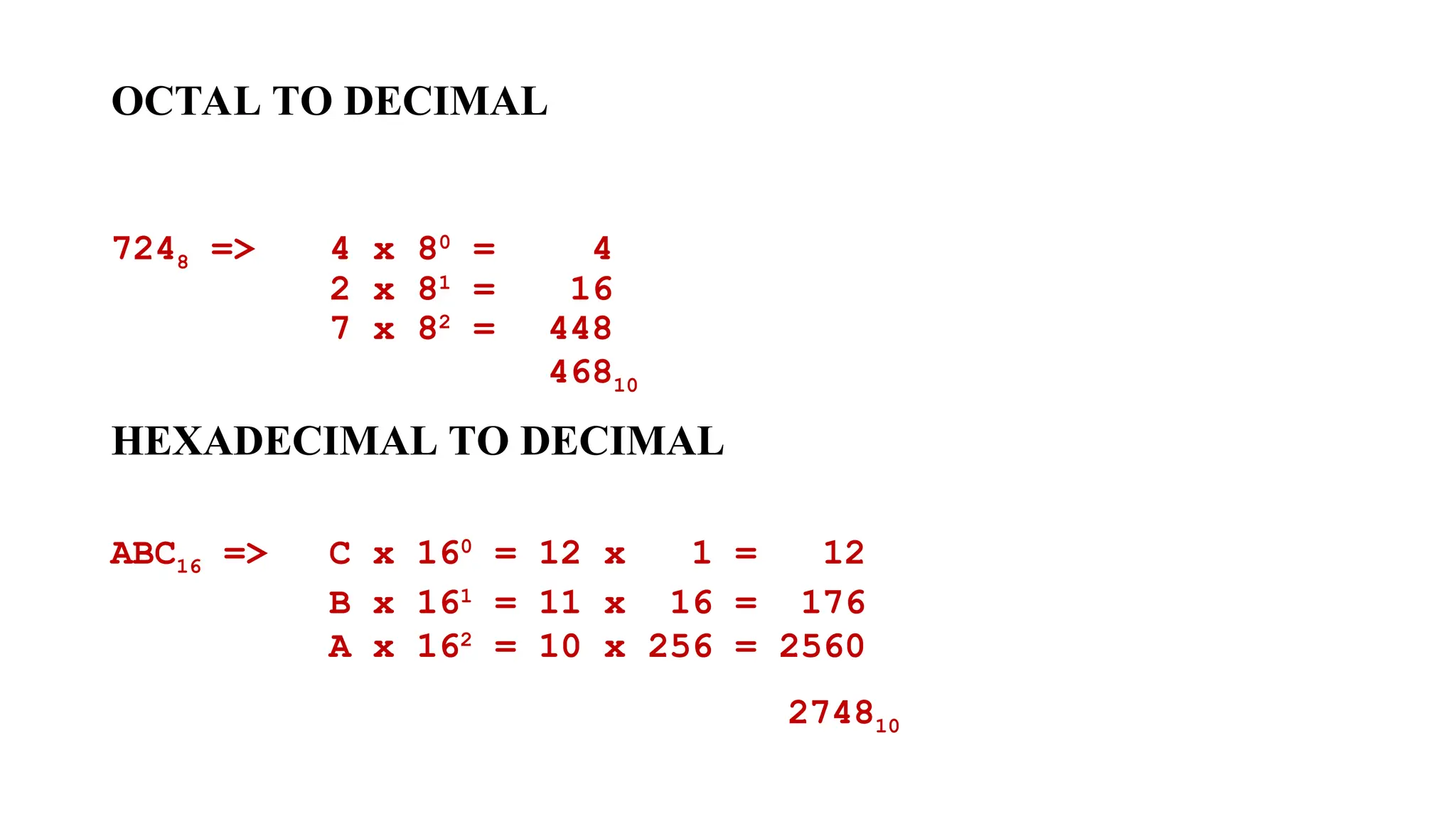
OCTAL TO DECIMAL
7248 => 4 x 80
= 4
2 x 81
= 16
7 x 82
= 448
46810
HEXADECIMAL TO DECIMAL
ABC16 => C x 160
= 12 x 1 = 12
B x 161
= 11 x 16 = 176
A x 162
= 10 x 256 = 2560
274810
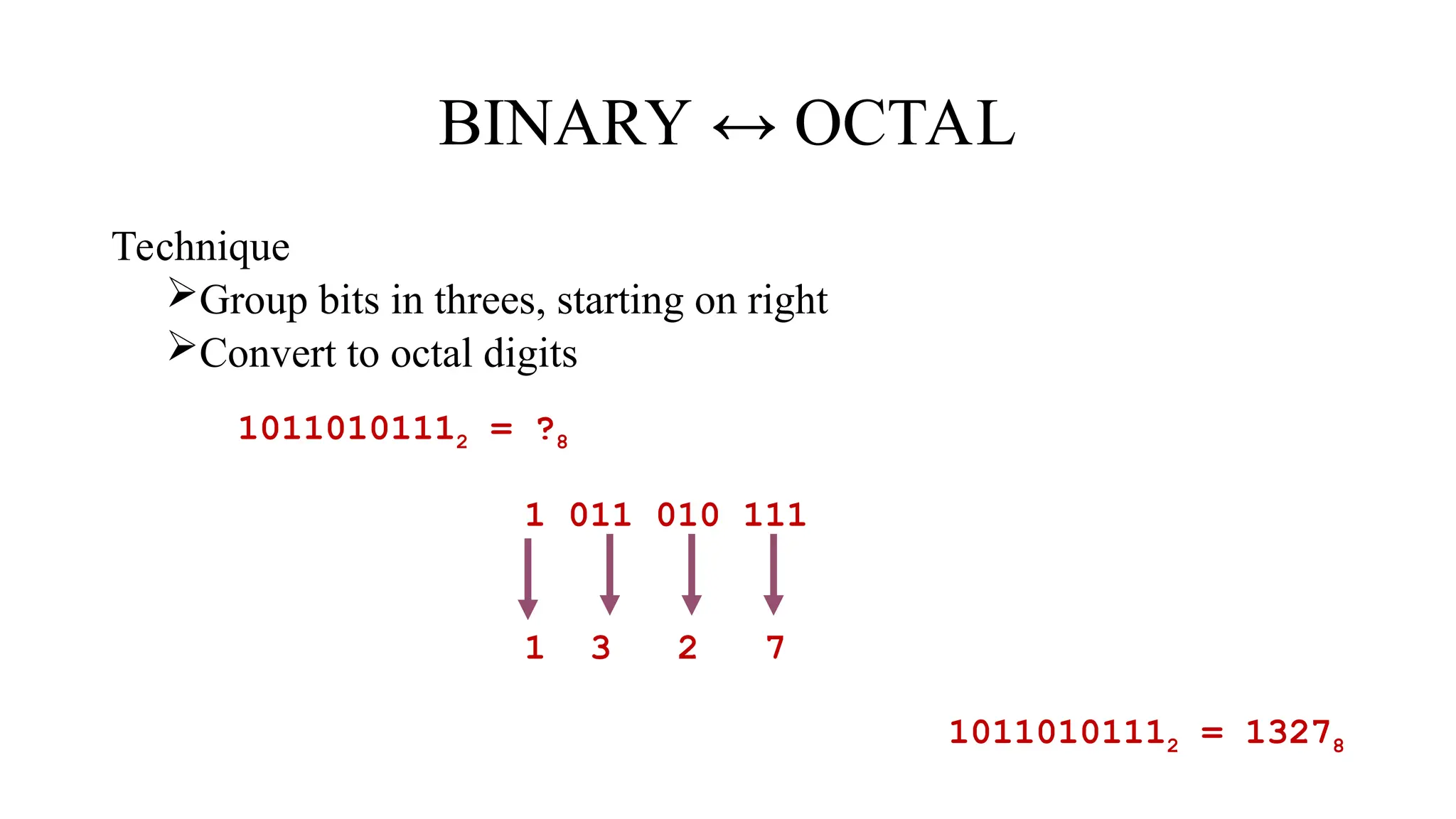
BINARY ↔ OCTAL
Technique
Group bits in threes, starting on right
Convert to octal digits
10110101112 = ?8
1 011 010 111
1 3 2 7
10110101112 = 13278
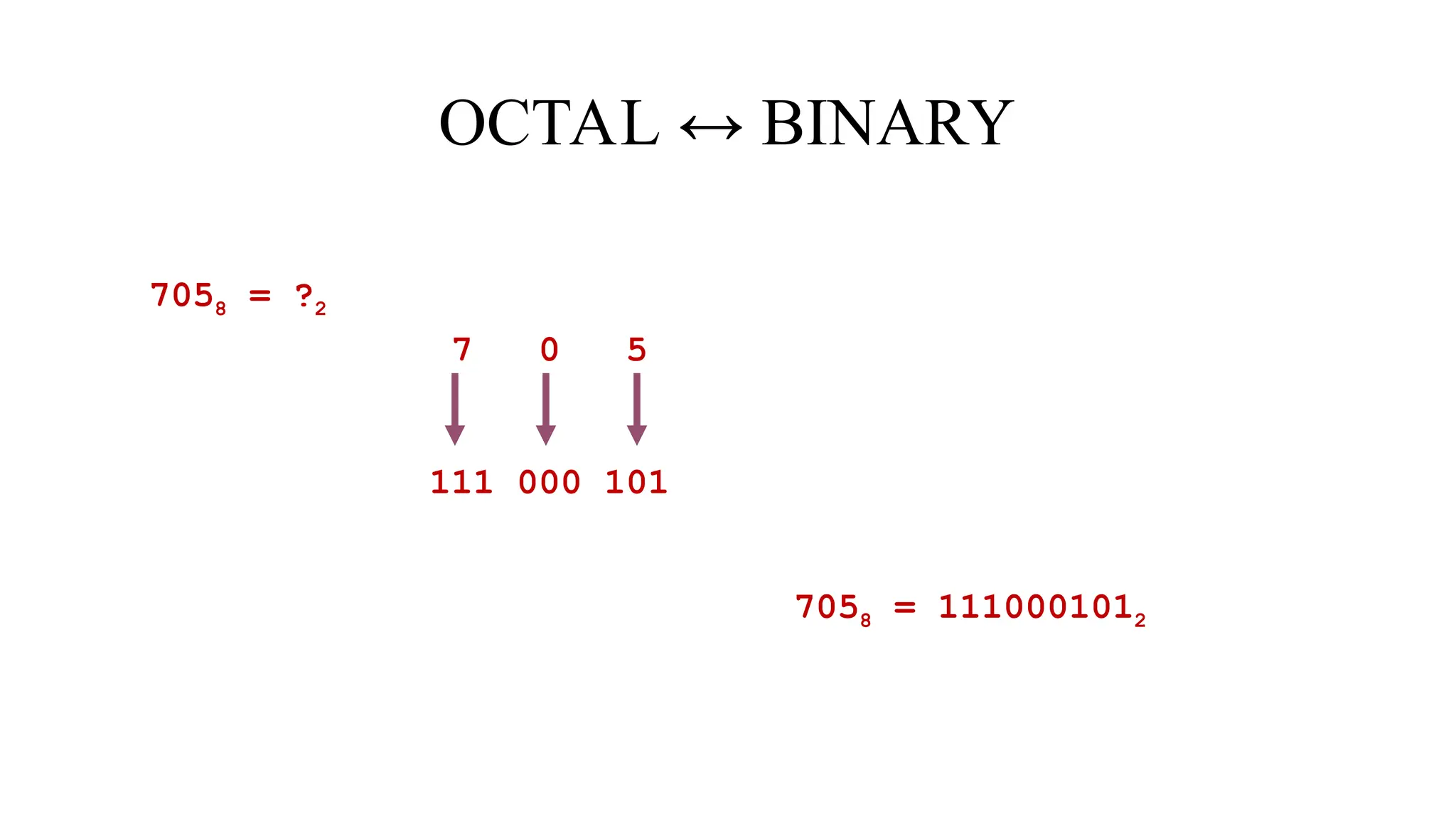
OCTAL ↔ BINARY
7058 = ?2
7 0 5
111 000 101
7058 = 1110001012
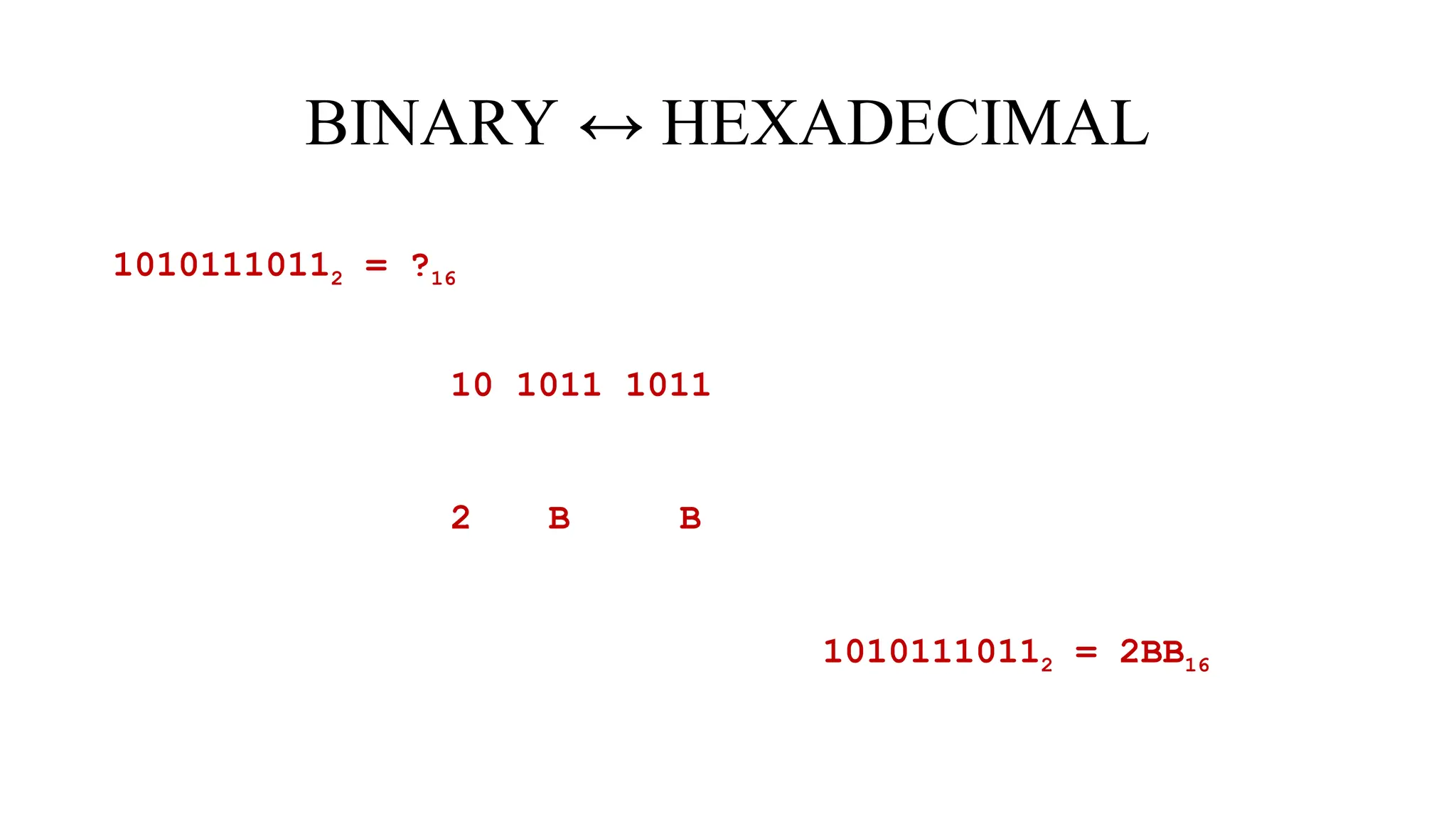
BINARY ↔ HEXADECIMAL
10101110112 = ?16
10 1011 1011
2 B B
10101110112 = 2BB16
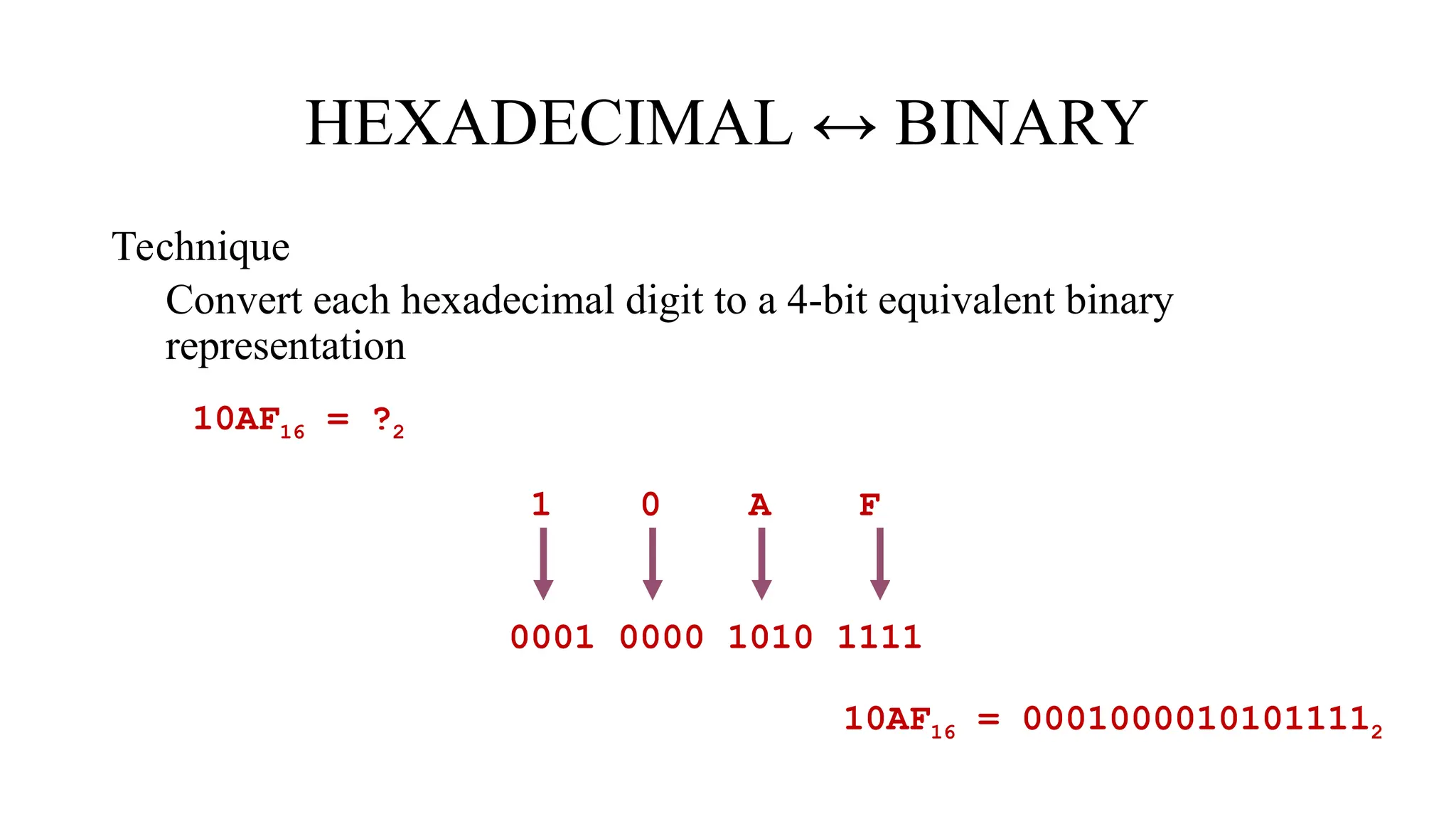
HEXADECIMAL ↔ BINARY
Technique
Convert each hexadecimal digit to a 4-bit equivalent binary
representation
10AF16 = ?2
1 0 A F
0001 0000 1010 1111
10AF16 = 00010000101011112
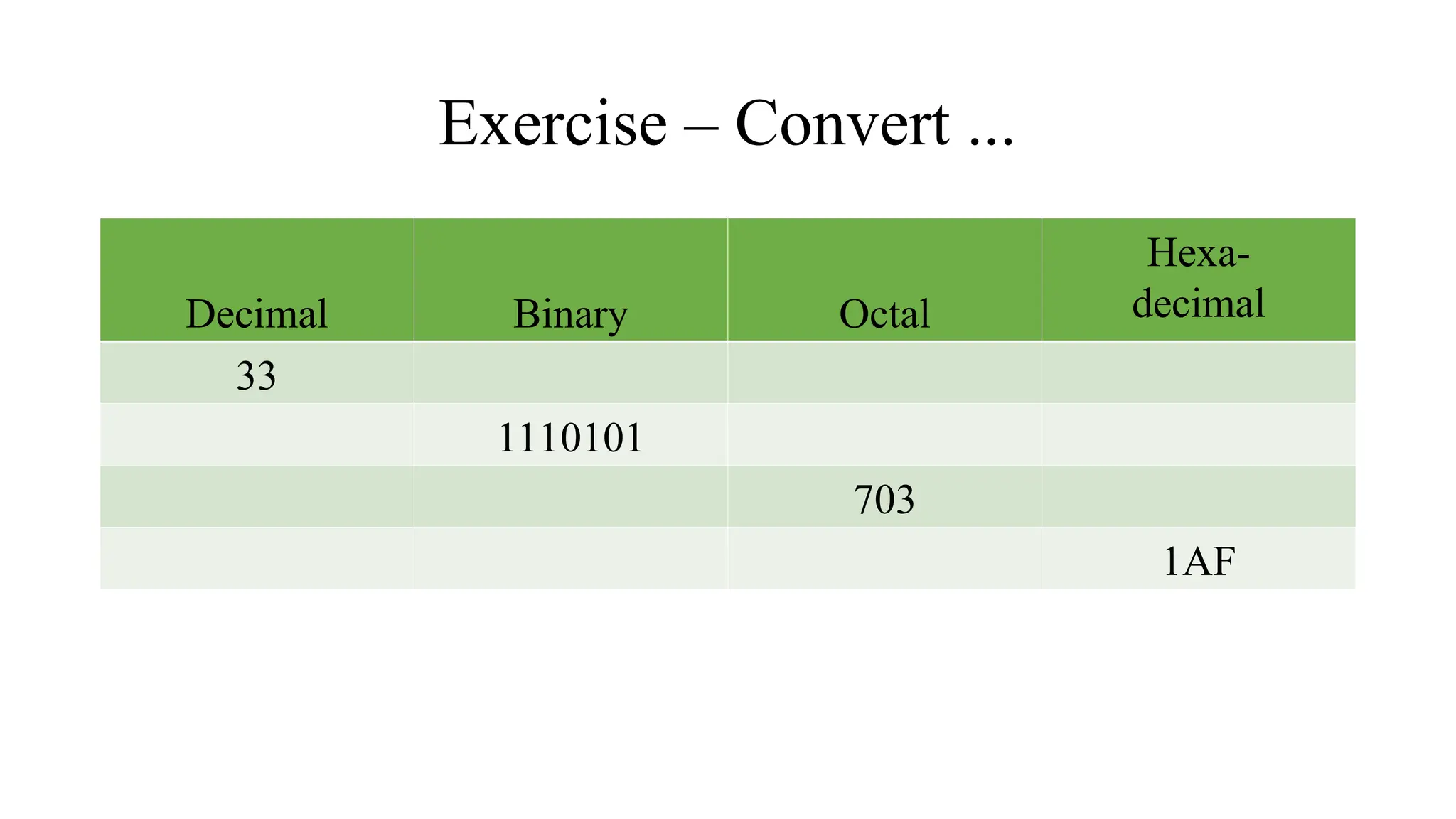
Exercise – Convert ...
Decimal Binary Octal
Hexa-
decimal
33
1110101
703
1AF
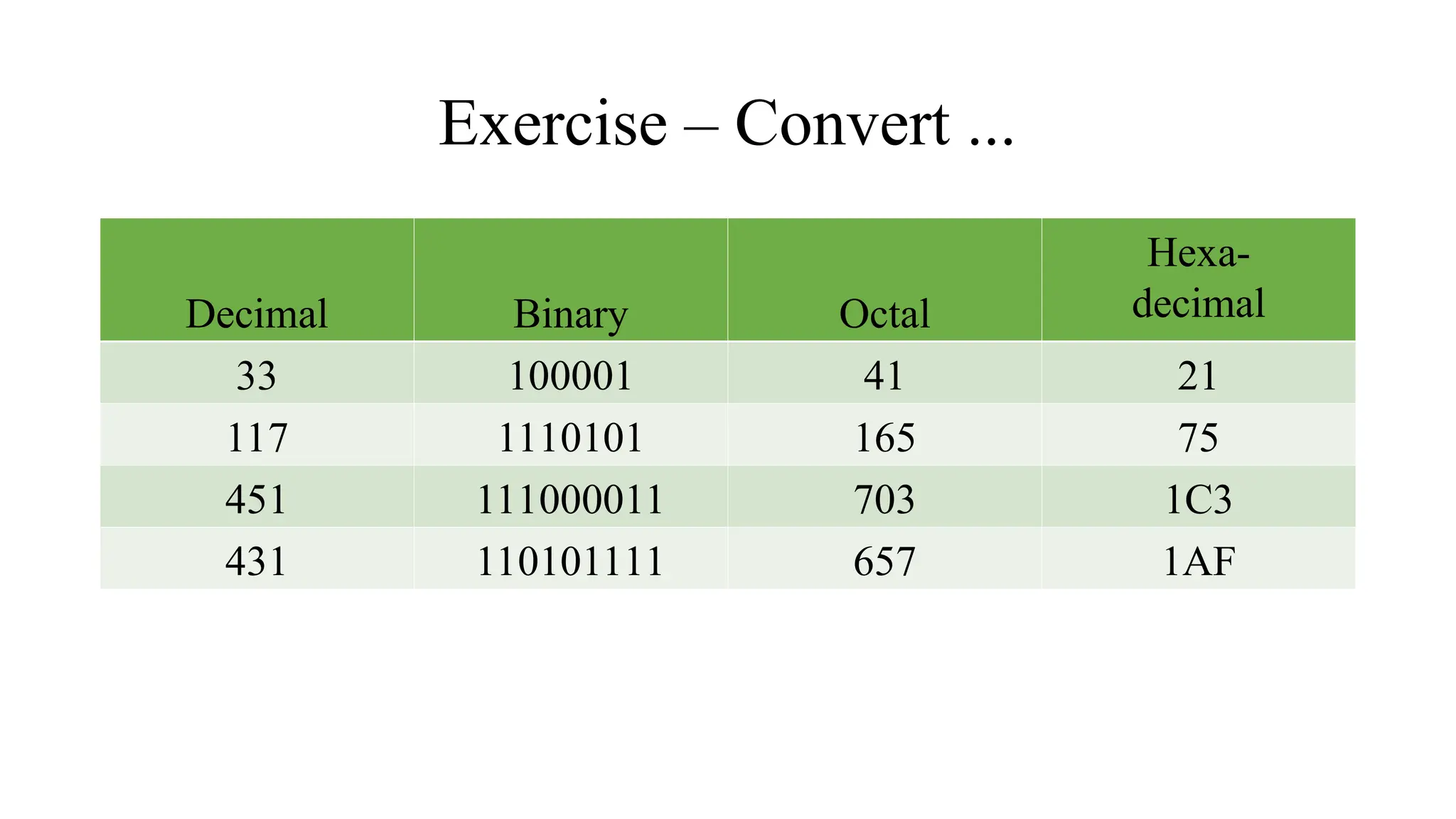
Exercise – Convert ...
Decimal Binary Octal
Hexa-
decimal
33 100001 41 21
117 1110101 165 75
451 111000011 703 1C3
431 110101111 657 1AF
FRACTIONS
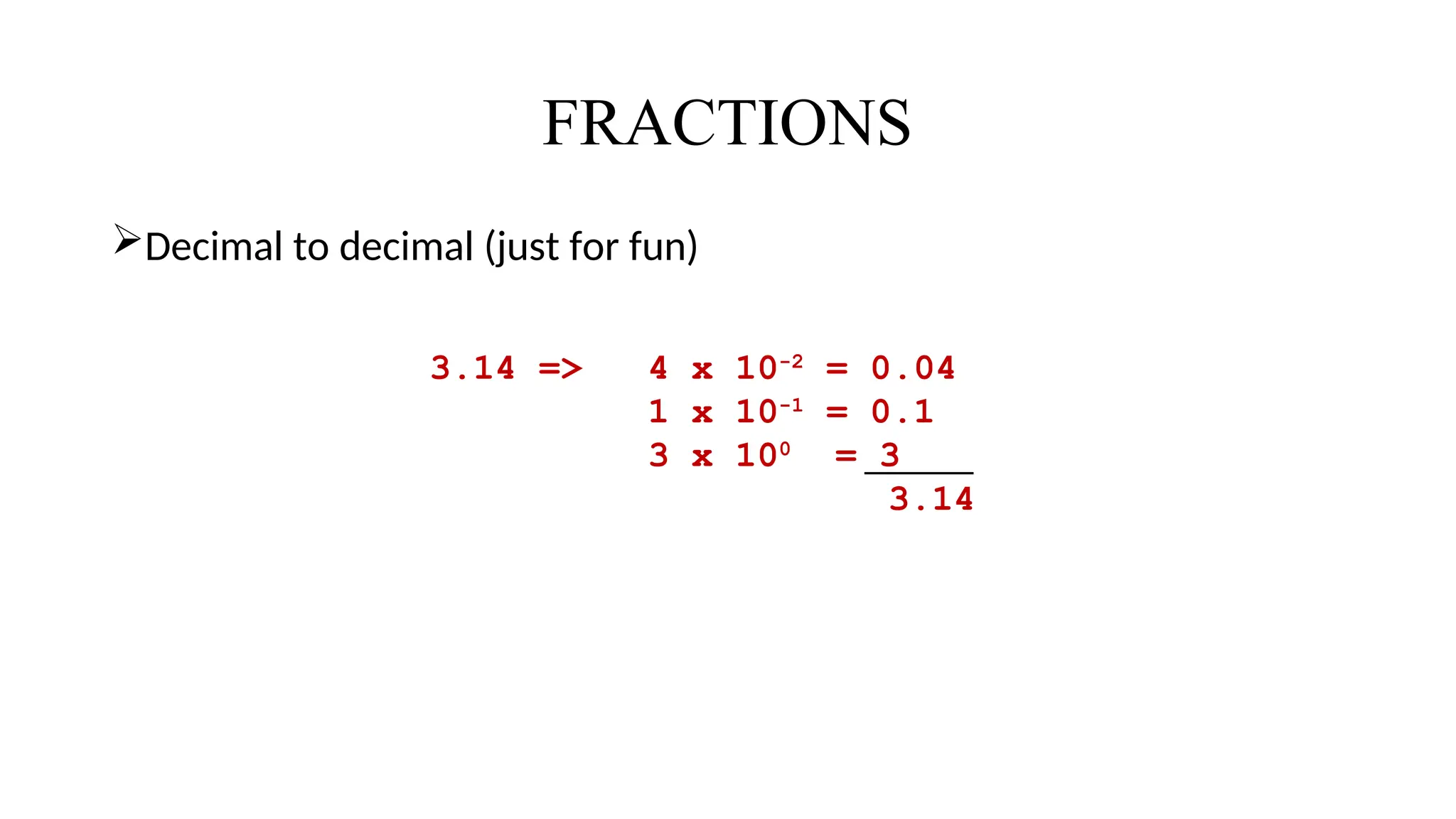
Decimal to decimal (just for fun)
3.14 => 4 x 10-2
= 0.04
1 x 10-1
= 0.1
3 x 100
= 3
3.14
FRACTIONS
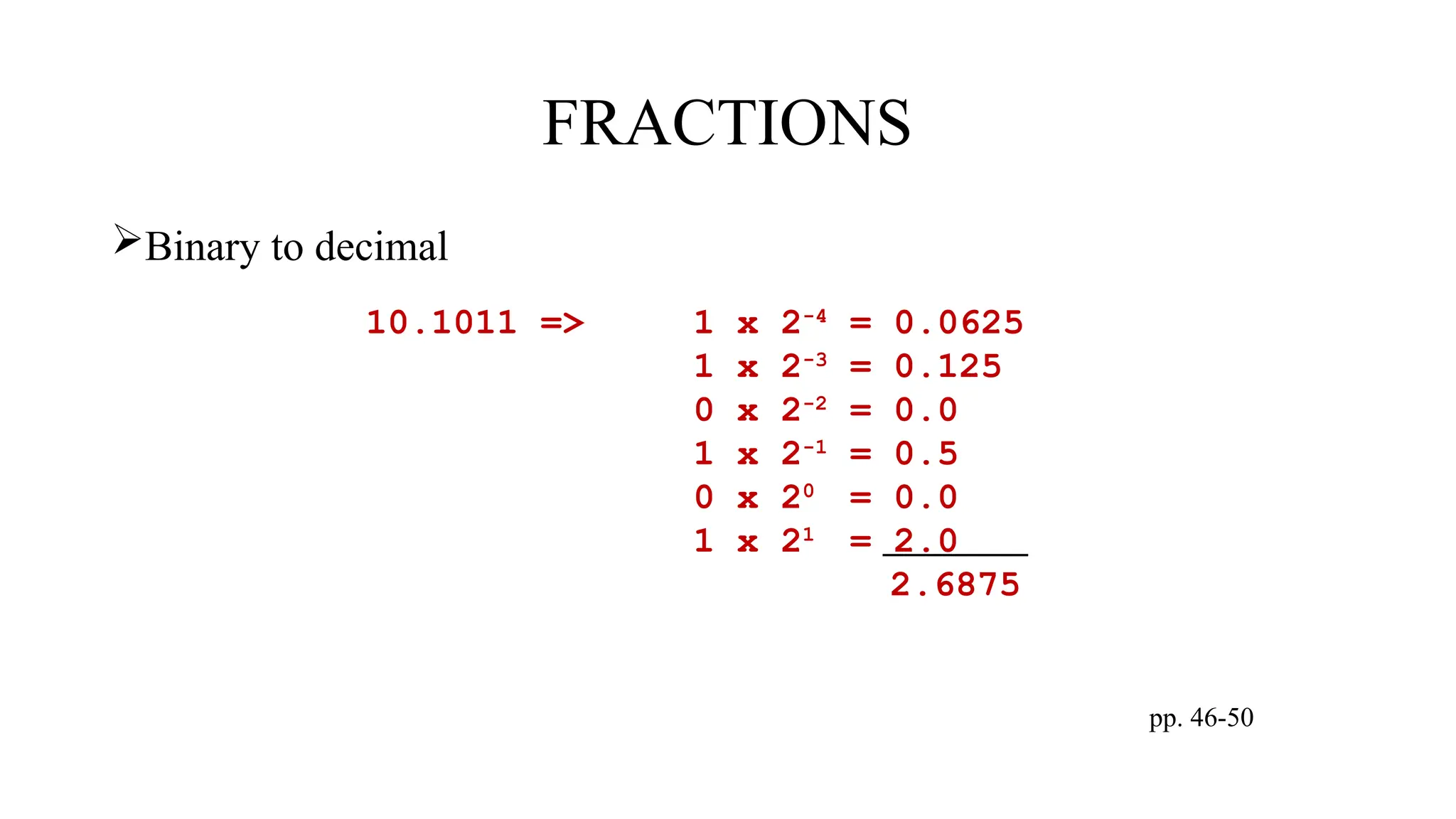
Binary to decimal
pp. 46-50
10.1011 => 1 x 2-4
= 0.0625
1 x 2-3
= 0.125
0 x 2-2
= 0.0
1 x 2-1
= 0.5
0 x 20
= 0.0
1 x 21
= 2.0
2.6875
FRACTIONS
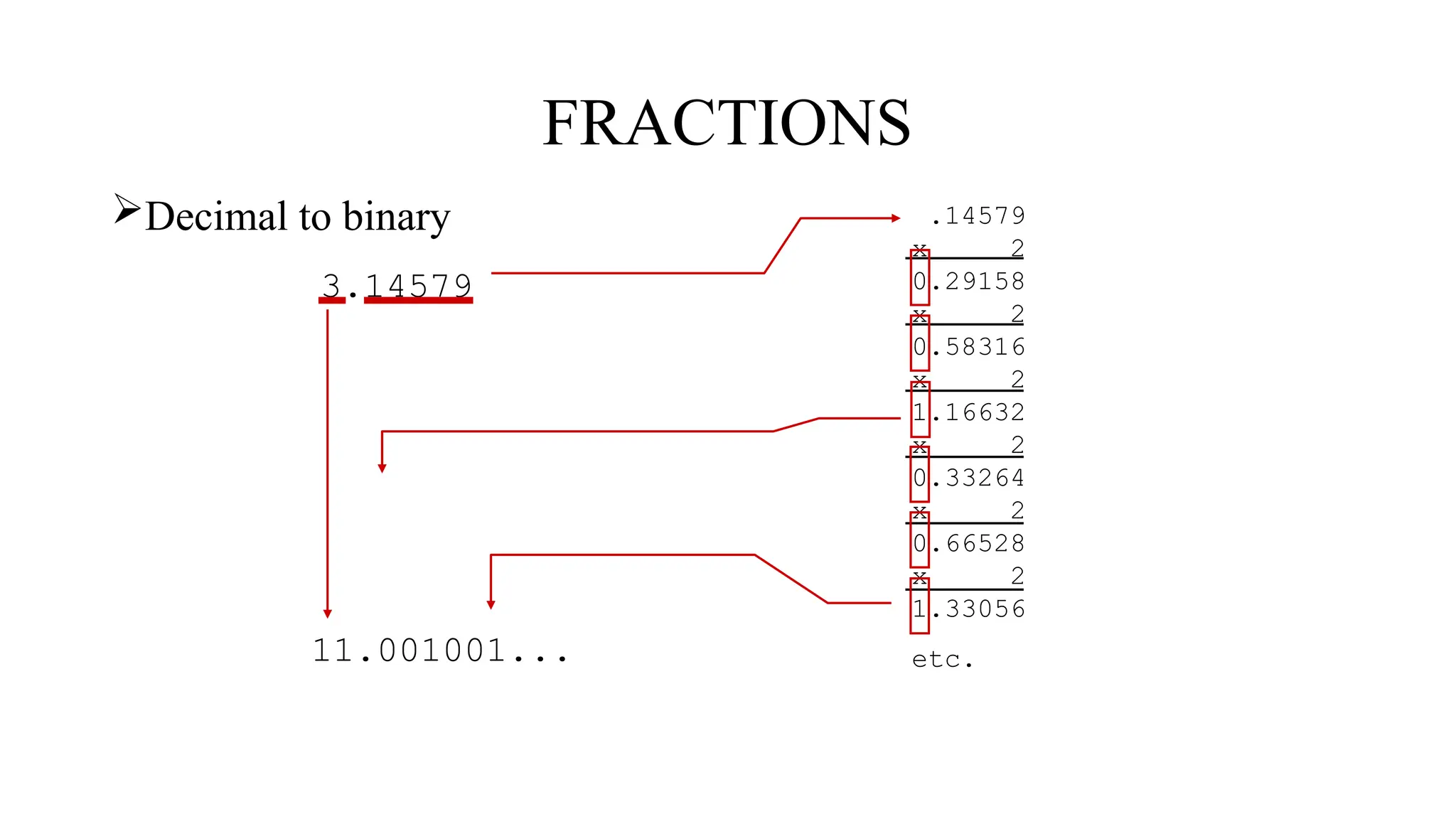
Decimal to binary
3.14579
.14579
x 2
0.29158
x 2
0.58316
x 2
1.16632
x 2
0.33264
x 2
0.66528
x 2
1.33056
etc.
11.001001...
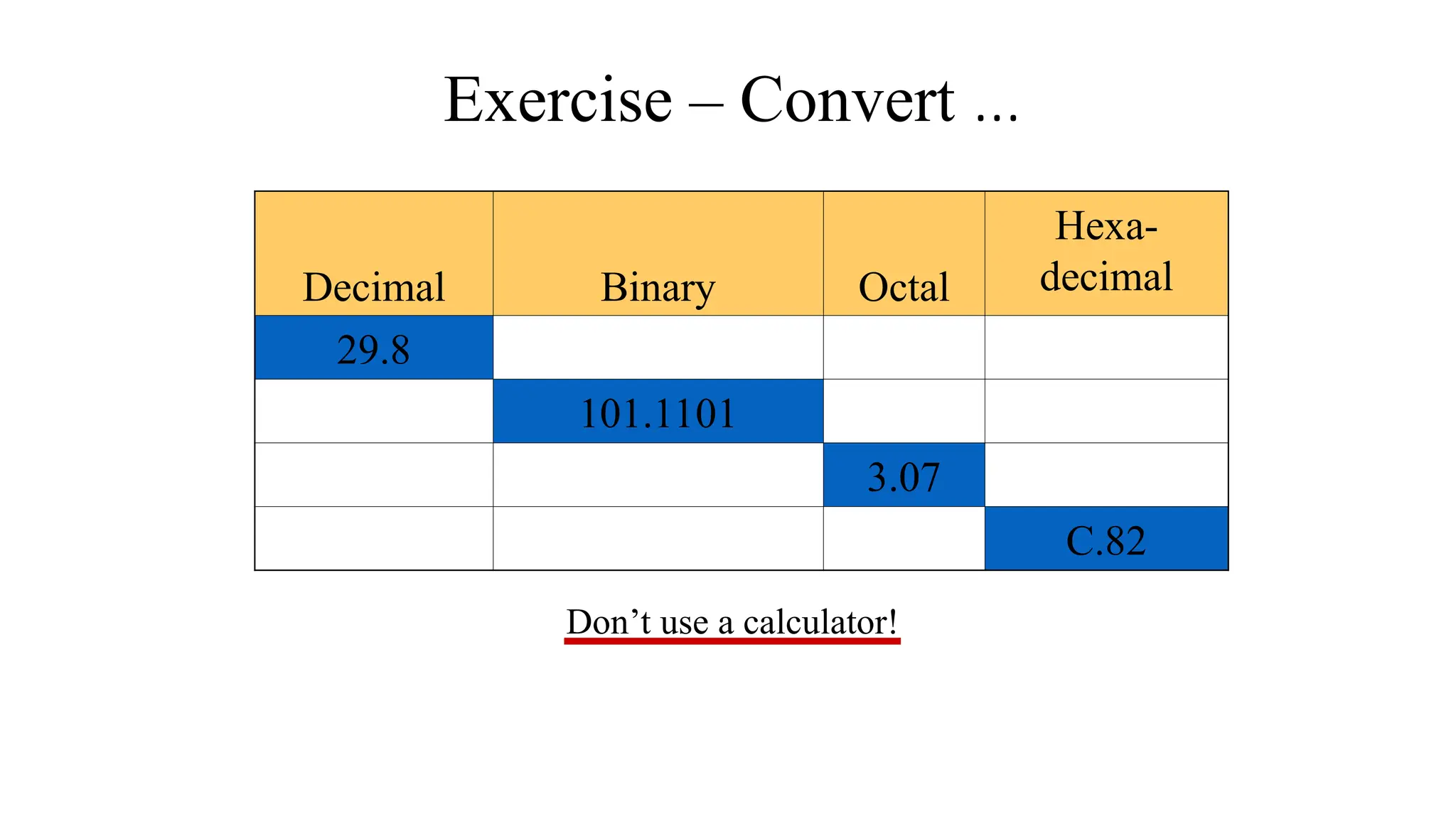
Exercise – Convert ...
Don’t use a calculator!
Decimal Binary Octal
Hexa-
decimal
29.8
101.1101
3.07
C.82
Exercise – Convert …
Decimal Binary Octal
Hexa-
decimal
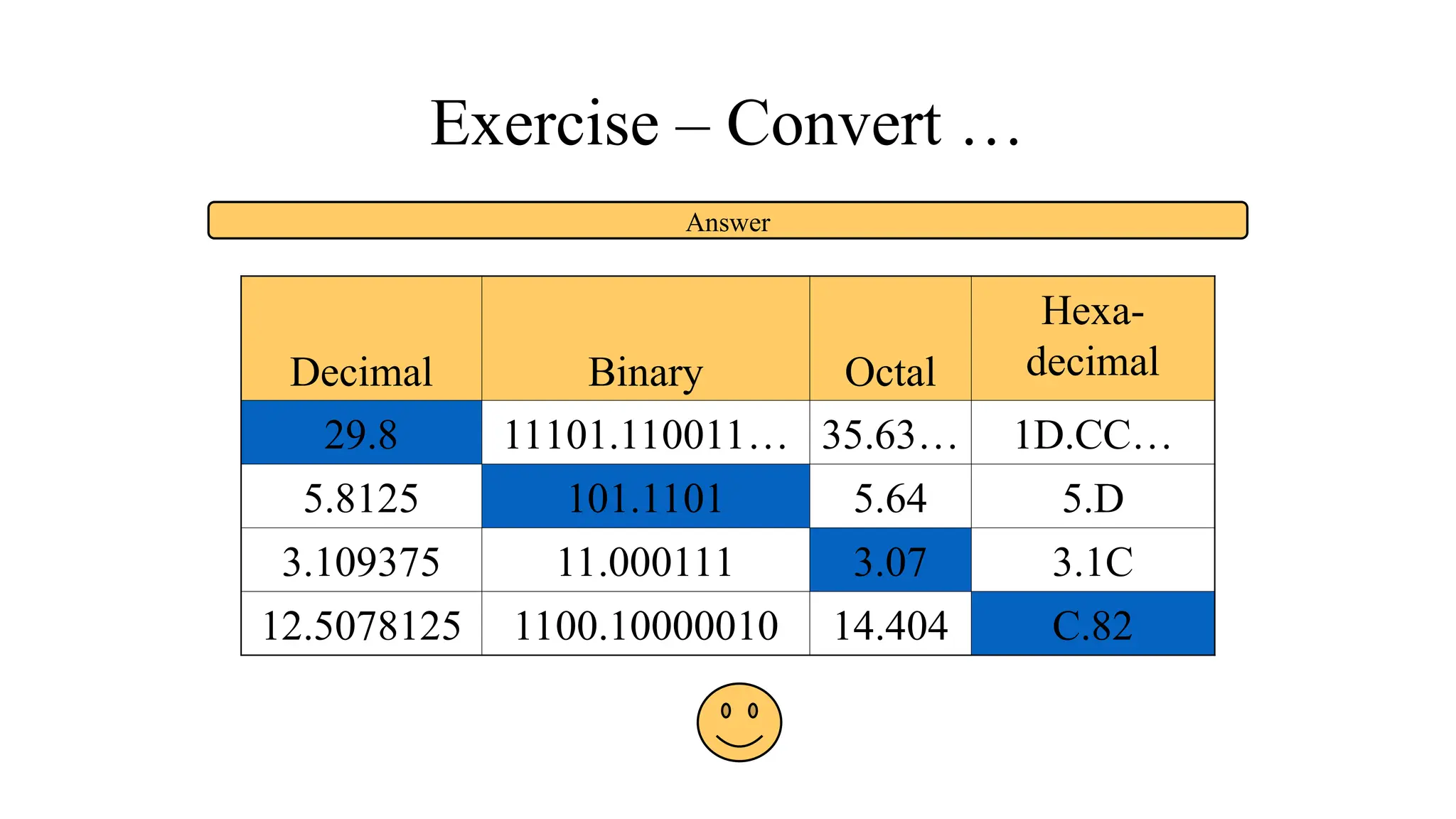
29.8 11101.110011… 35.63… 1D.CC…
5.8125 101.1101 5.64 5.D
3.109375 11.000111 3.07 3.1C
12.5078125 1100.10000010 14.404 C.82
Answer
Binary addition (1 of 2)
Two 1-bit values
A B A + B
0 0 0
0 1 1
1 0 1
1 1 10
“two”
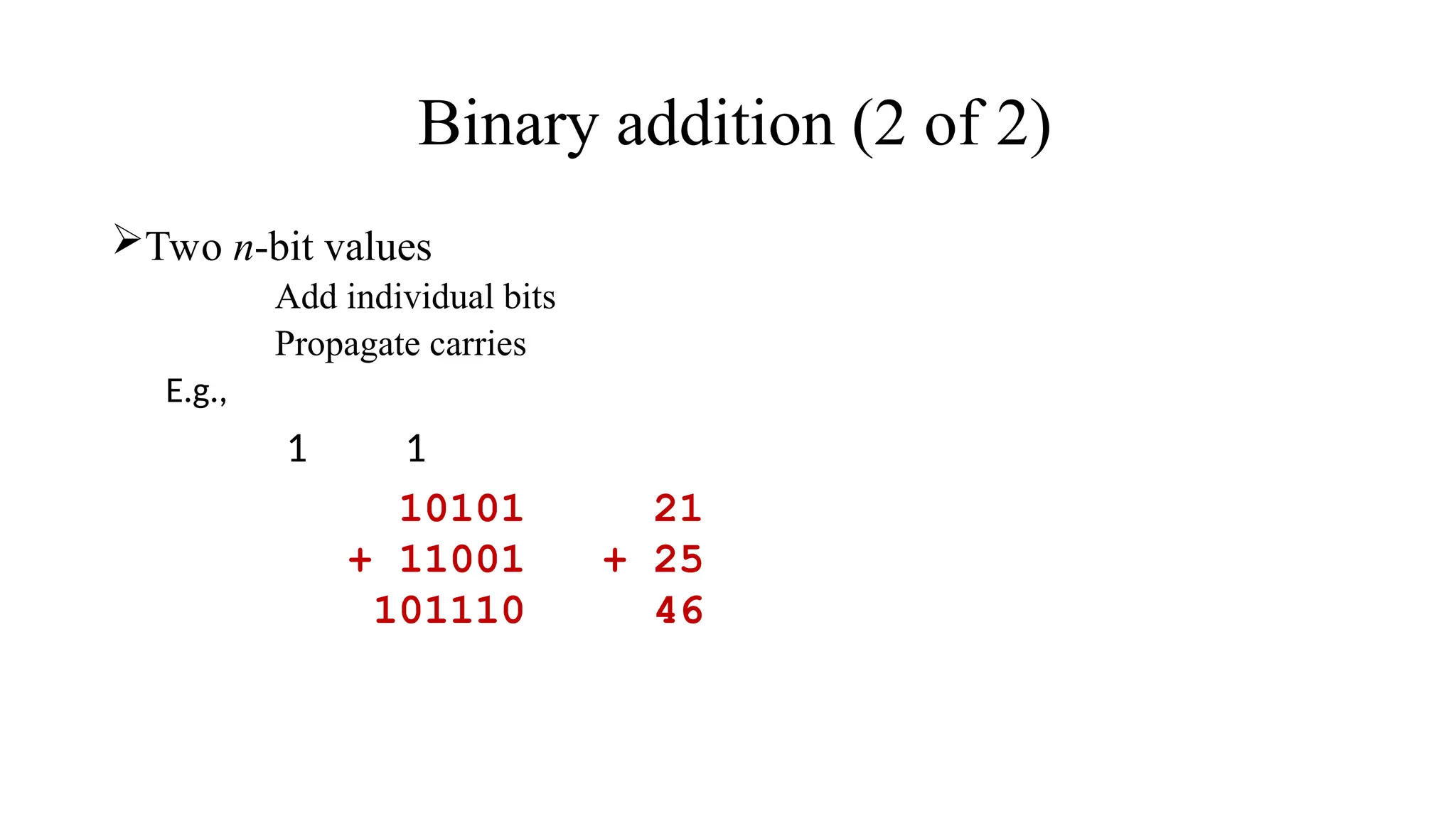
Binary addition (2 of 2)
Two n-bit values
Add individual bits
Propagate carries
E.g.,
1 1
10101 21
+ 11001 + 25
101110 46
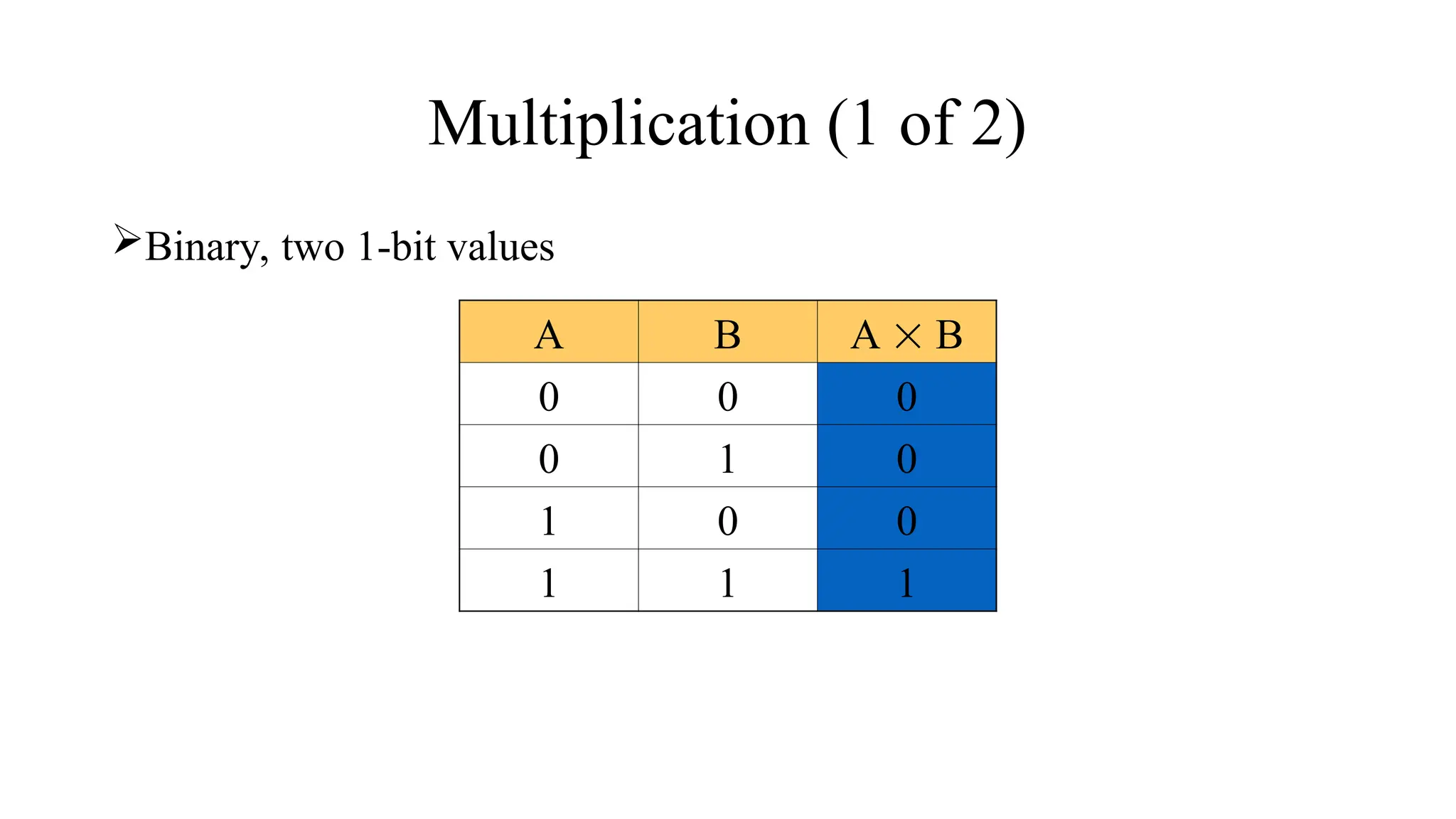
Multiplication (1 of 2)
Binary, two 1-bit values
A B A  B
0 0 0
0 1 0
1 0 0
1 1 1
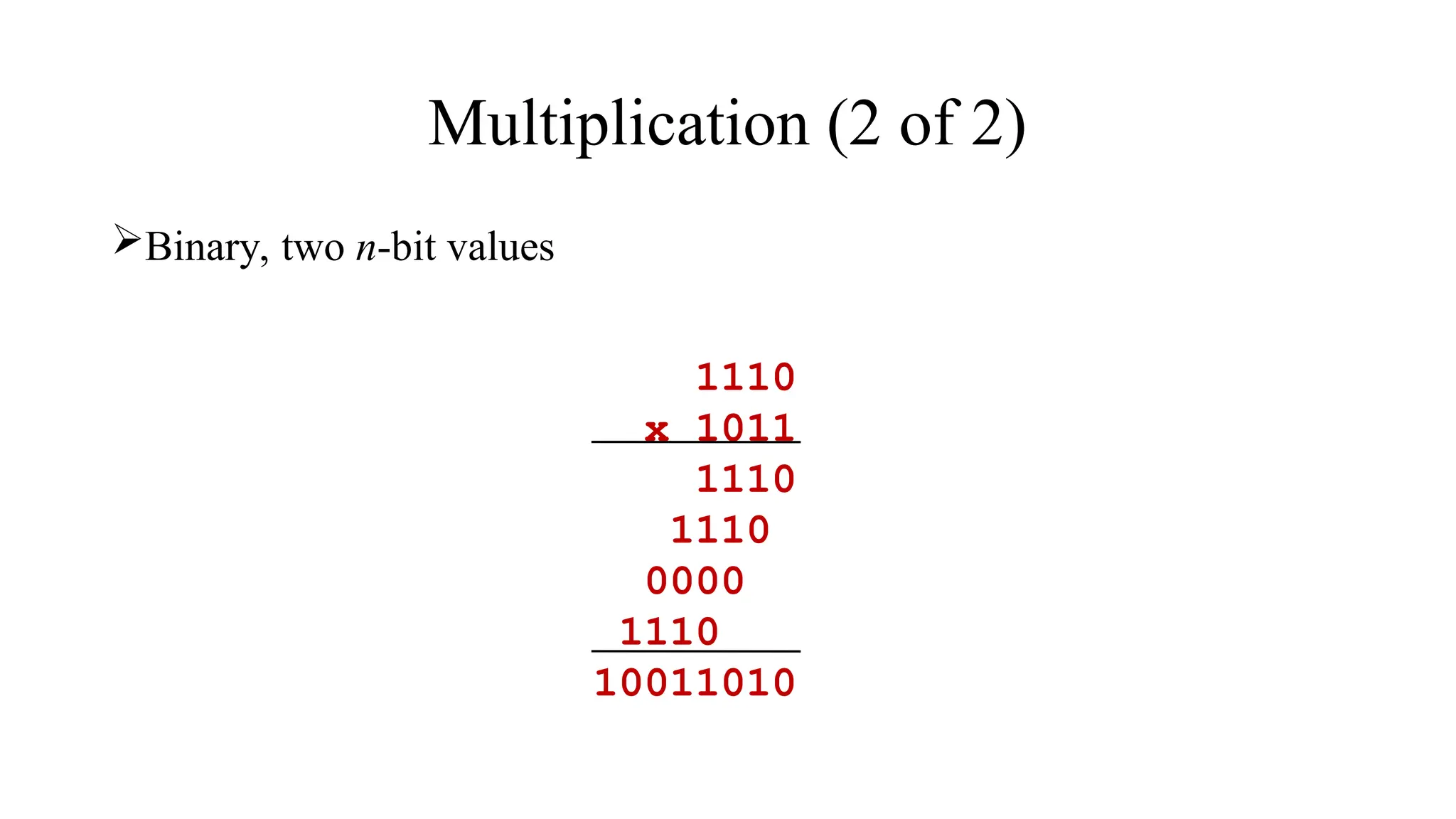
Multiplication (2 of 2)
Binary, two n-bit values
1110
x 1011
1110
1110
0000
1110
10011010
Common Powers (1 of 2)
Base 10 Power Preface Symbol
10-12 pico p
10-9 nano n
10-6 micro 
10-3 milli m
103 kilo k
106 mega M
109
giga G
1012 tera T
Value
.000000000001
.000000001
.000001
.001
1000
1000000
1000000000
1000000000000
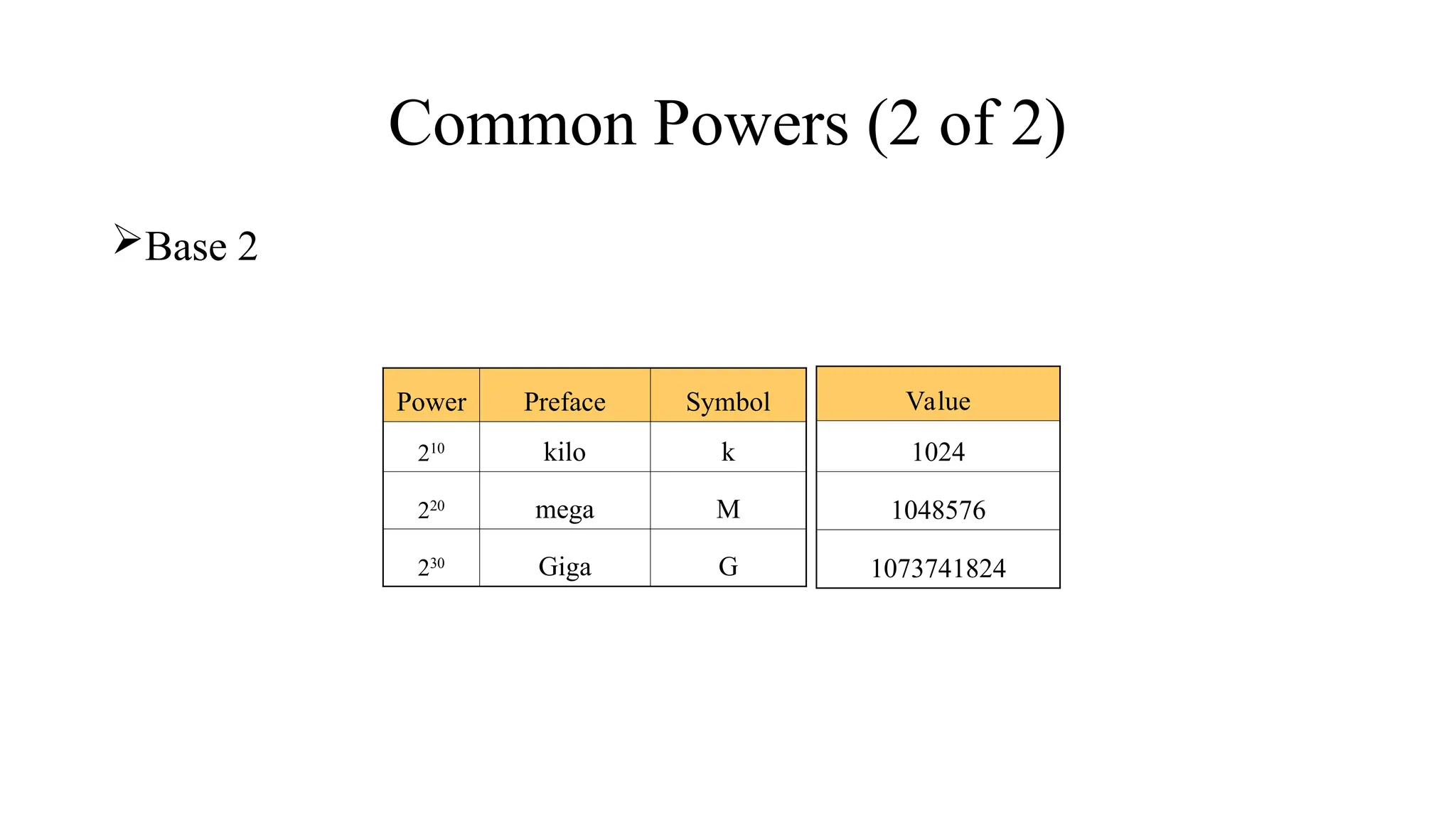
Common Powers (2 of 2)
Base 2
Power Preface Symbol
210 kilo k
220 mega M
230 Giga G
Value
1024
1048576
1073741824

Number Systems-Number conversion -Arithmetic Operations

  • 1.
  • 3.
    DIGITAL DESIGN What isdigital ? • Digital camera, Digital TV, Digital Watch, Digital • Radio, Digital City (e city), Digital Photo Frame …etc ‐ • Which gives the things in countable form • Scene (analog) to Image (digital) Why is digital ? • Countable form, makes easy to manage.accuracy • Easy management makes more useful and versatile
  • 4.
    NUMBER SYSTEM TYPES Itis a system for representing numeric values or quantities using different symbols Famous Number System: Decimal , Roman, Binary Decimal System: 0 9 ‐ May evolves: because human have 10 finger Roman System May evolves to make easy to look and feel Pre/Post Concept: (IV, V & VI) is (5 1, 5 & 5+1) ‐ Binary System, Others (Oct, Hex) One can cut an apple in to two
  • 5.
    SIGNIFICANT DIGITS Binary: 11101101 Mostsignificant Bit (MSB) Least significant Bit(LSB) Decimal: 1063079 Most significant digit Least significant digit
  • 6.
    DECIMAL (BASE 10) Usespositional representation Each digit corresponds to a power of 10 based on its position in the number The powers of 10 increment from 0, 1, 2, etc. as you move right to left 1,479 = 1 * 103 + 4 * 102 + 7 * 101 + 9 * 100
  • 7.
    BINARY (BASE 2) Twodigits: 0, 1 To make the binary numbers more readable, the digits are often put in groups of 4 1010 = 1 * 23 + 0 * 22 + 1 * 21 + 0 * 20 = 8 + 2 = 10 1100 1001 = 1 * 27 + 1 * 26 + 1 * 23 + 1 * 20 = 128 + 64 + 8 + 1 = 201
  • 8.
    OCTAL (BASE 8) Shorter& easier to read than binary 8 digits: 0, 1, 2, 3, 4, 5, 6, 7,  Octal numbers 1368 = 1 * 82 + 3 * 81 + 6 * 80 = 1 * 64 + 3 * 8 + 6 * 1 = 9410
  • 9.
    HEXADECIMAL(BASE 16) Shorter &easier to read than binary 16 digits: 0, 1, 2, 3, 4, 5, 6, 7, 8, 9, A, B, C, D, E, F “0x” often precedes hexadecimal numbers 0x123 = 1 * 162 + 2 * 161 + 3 * 160 = 1 * 256 + 2 * 16 + 3 * 1 = 256 + 32 + 3 = 291
  • 10.
    DECIMAL(BASE 10) BINARY(BASE 2) OCTAL ( BASE 8) HEXA(BASE 16) 0 0000 0 0 1 0001 1 1 2 0010 2 2 3 0011 3 3 4 0100 4 4 5 0101 5 5 6 0110 6 6 7 0111 7 7 8 1000 10 8 9 1001 11 9 10 1010 12 A 11 1011 13 B 12 1100 14 C 13 1101 15 D 14 1110 16 E 15 1111 17 F
  • 11.
    Converting To andFrom Decimal
  • 12.
    CONVERSION PROCESS DECIMAL↔ BASE N Successive Division
  • 13.
    CONVERSION PROCESS DECIMAL↔ BASE N Weighted Multiplication
  • 14.
    DECIMAL ↔ BINARY-EXAMPLE 12510 = ?2 2 125 62 1 2 31 0 2 15 1 2 7 1 2 3 1 2 1 1 2 0 1 12510 = 11111012
  • 15.
    DECIMAL ↔ OCTAL 123410= ?8 8 1234 154 2 8 19 2 8 2 3 8 0 2 123410 = 23228
  • 16.
    DECIMAL ↔ HEXADECIMAL 123410= ?16 123410 = 4D216 16 1234 77 2 16 4 13 = D 16 0 4
  • 17.
    BINARY ↔ DECIMAL 1010112=> 1 x 20 = 1 1 x 21 = 2 0 x 22 = 0 1 x 23 = 8 0 x 24 = 0 1 x 25 = 32 4310 Bit “0”
  • 18.
    OCTAL TO DECIMAL 7248=> 4 x 80 = 4 2 x 81 = 16 7 x 82 = 448 46810 HEXADECIMAL TO DECIMAL ABC16 => C x 160 = 12 x 1 = 12 B x 161 = 11 x 16 = 176 A x 162 = 10 x 256 = 2560 274810
  • 19.
    BINARY ↔ OCTAL Technique Groupbits in threes, starting on right Convert to octal digits 10110101112 = ?8 1 011 010 111 1 3 2 7 10110101112 = 13278
  • 20.
    OCTAL ↔ BINARY 7058= ?2 7 0 5 111 000 101 7058 = 1110001012
  • 21.
    BINARY ↔ HEXADECIMAL 10101110112= ?16 10 1011 1011 2 B B 10101110112 = 2BB16
  • 22.
    HEXADECIMAL ↔ BINARY Technique Converteach hexadecimal digit to a 4-bit equivalent binary representation 10AF16 = ?2 1 0 A F 0001 0000 1010 1111 10AF16 = 00010000101011112
  • 23.
    Exercise – Convert... Decimal Binary Octal Hexa- decimal 33 1110101 703 1AF
  • 24.
    Exercise – Convert... Decimal Binary Octal Hexa- decimal 33 100001 41 21 117 1110101 165 75 451 111000011 703 1C3 431 110101111 657 1AF
  • 25.
    FRACTIONS Decimal to decimal(just for fun) 3.14 => 4 x 10-2 = 0.04 1 x 10-1 = 0.1 3 x 100 = 3 3.14
  • 26.
    FRACTIONS Binary to decimal pp.46-50 10.1011 => 1 x 2-4 = 0.0625 1 x 2-3 = 0.125 0 x 2-2 = 0.0 1 x 2-1 = 0.5 0 x 20 = 0.0 1 x 21 = 2.0 2.6875
  • 27.
    FRACTIONS Decimal to binary 3.14579 .14579 x2 0.29158 x 2 0.58316 x 2 1.16632 x 2 0.33264 x 2 0.66528 x 2 1.33056 etc. 11.001001...
  • 28.
    Exercise – Convert... Don’t use a calculator! Decimal Binary Octal Hexa- decimal 29.8 101.1101 3.07 C.82
  • 29.
    Exercise – Convert… Decimal Binary Octal Hexa- decimal 29.8 11101.110011… 35.63… 1D.CC… 5.8125 101.1101 5.64 5.D 3.109375 11.000111 3.07 3.1C 12.5078125 1100.10000010 14.404 C.82 Answer
  • 30.
    Binary addition (1of 2) Two 1-bit values A B A + B 0 0 0 0 1 1 1 0 1 1 1 10 “two”
  • 31.
    Binary addition (2of 2) Two n-bit values Add individual bits Propagate carries E.g., 1 1 10101 21 + 11001 + 25 101110 46
  • 32.
    Multiplication (1 of2) Binary, two 1-bit values A B A  B 0 0 0 0 1 0 1 0 0 1 1 1
  • 33.
    Multiplication (2 of2) Binary, two n-bit values 1110 x 1011 1110 1110 0000 1110 10011010
  • 34.
    Common Powers (1of 2) Base 10 Power Preface Symbol 10-12 pico p 10-9 nano n 10-6 micro  10-3 milli m 103 kilo k 106 mega M 109 giga G 1012 tera T Value .000000000001 .000000001 .000001 .001 1000 1000000 1000000000 1000000000000
  • 35.
    Common Powers (2of 2) Base 2 Power Preface Symbol 210 kilo k 220 mega M 230 Giga G Value 1024 1048576 1073741824