Pune Vidyarthi Griha’s
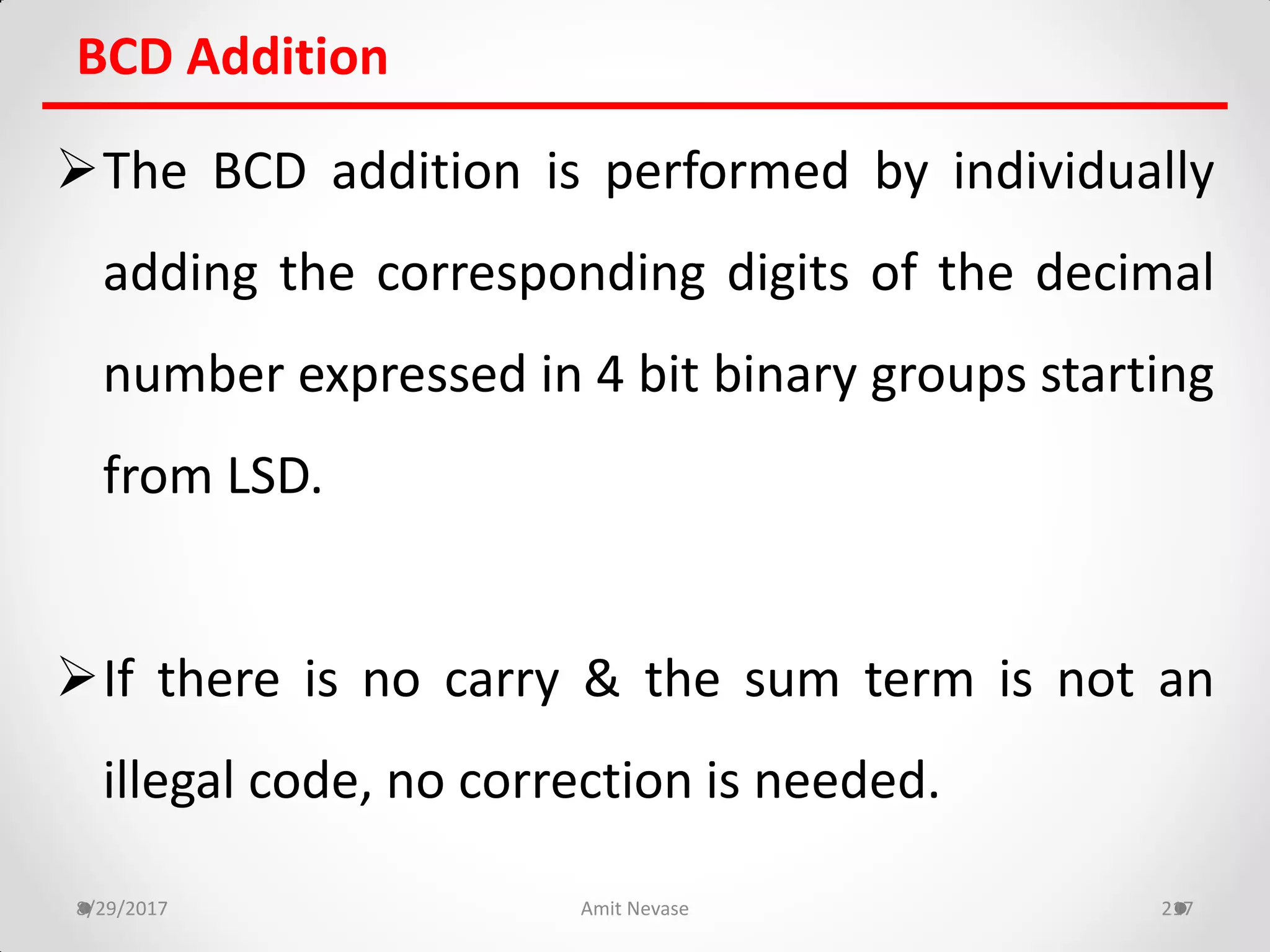
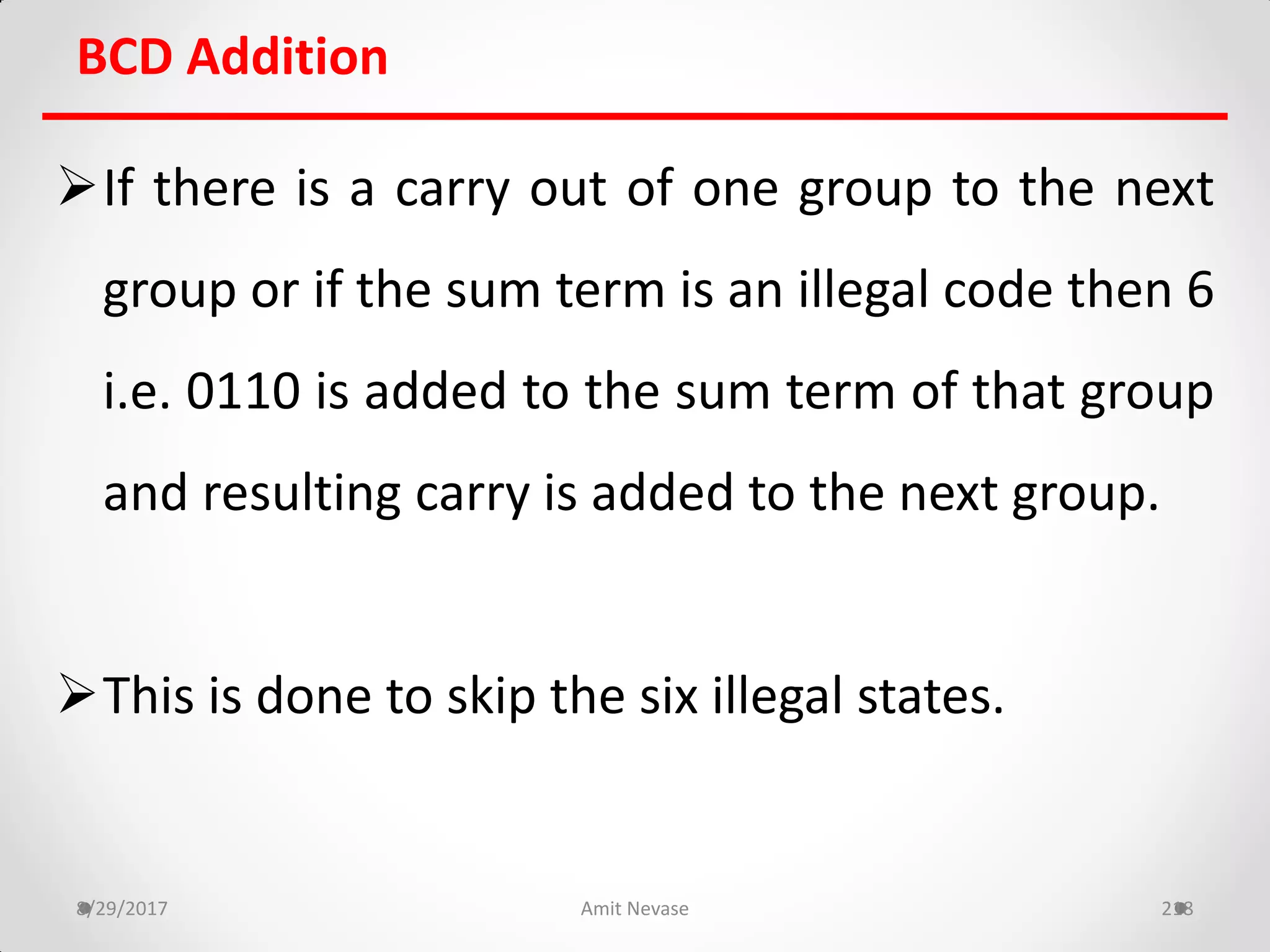
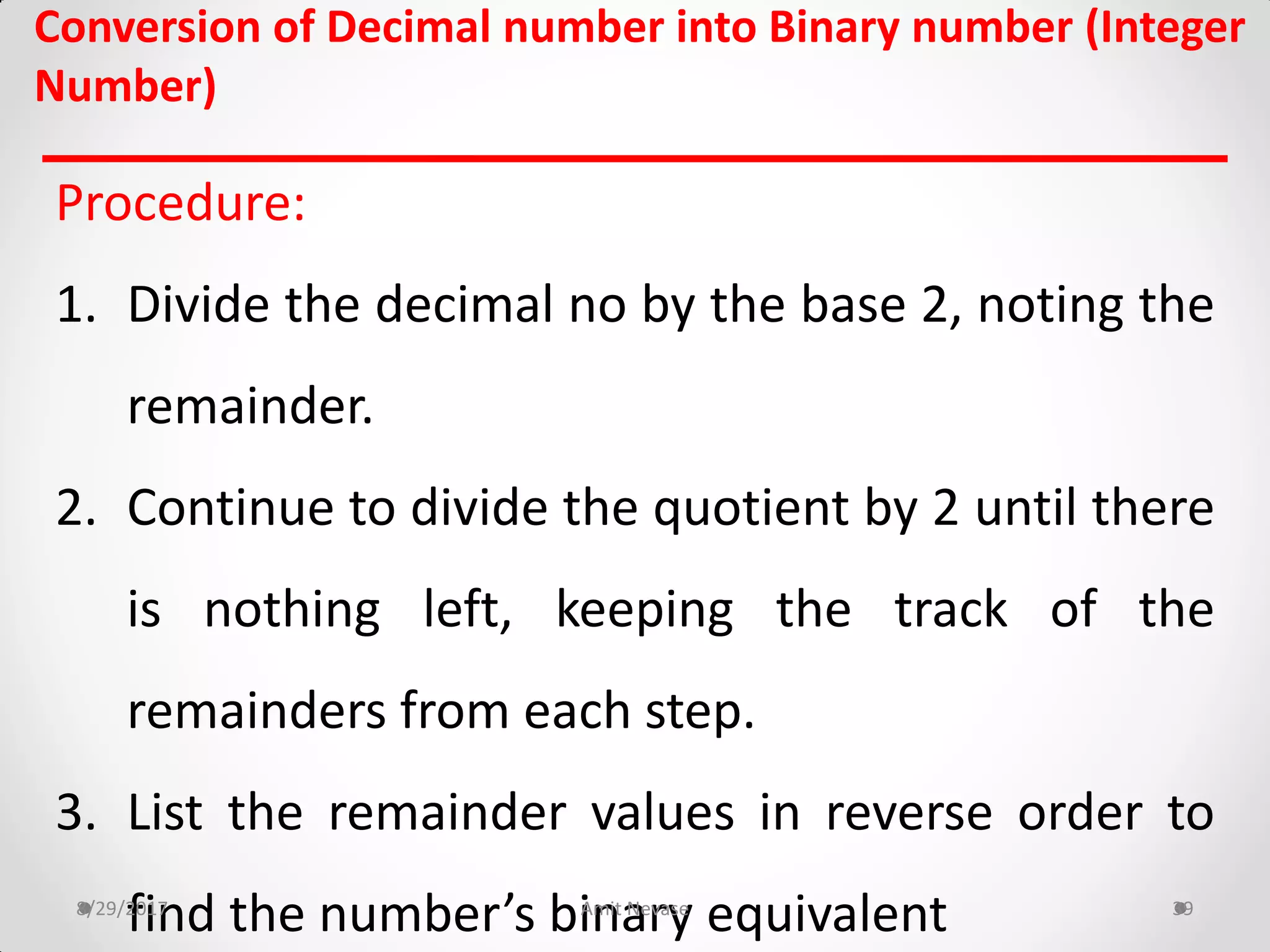
COLLEGE OF ENGINEERING, NASHIK – 3.
“Number System”
By
Prof. Anand N. Gharu
(Assistant Professor)
PVGCOE Computer Dept.
30th June 2017
.
Chapter I – Number System
 Introduction to digital signal, Advantages of Digital System
over analog systems
 Number Systems: Different types of number systems( Binary,
Octal, Hexadecimal ), conversion of number systems,
 Binary arithmetic: Addition, Subtraction, Multiplication, Division.
 Subtraction using 1’s complement and 2’s complement
 Codes
 Codes -BCD, Gray Code, Excess-3, ASCII code
 BCD addition, BCD subtraction using 9’s and 10’ complement
 (Numericals based on above topic).
8/29/2017 2
Chapter - I
Number System
8/29/2017 Amit Nevase 3
Chapter I – Number System
 Introduction to digital signal, Advantages of Digital System
over analog systems (8 Marks)
 Number Systems: Different types of number systems( Binary,
Octal, Hexadecimal ), conversion of number systems,
 Binary arithmetic: Addition, Subtraction, Multiplication, Division.
 Subtraction using 1’s complement and 2’s complement
 Codes (4 Marks)
 Codes -BCD, Gray Code, Excess-3, ASCII code
 BCD addition, BCD subtraction using 9’s and 10’ complement
 (Numericals based on above topic).
8/29/2017 Amit Nevase 4
Analog Vs Digital
Analog system
The physical quantities or signals may vary
continuously over a specified range.
Digital system
The physical quantities or signals can assume only
discrete values.
Greater accuracy
8/29/2017 Amit Nevase 5
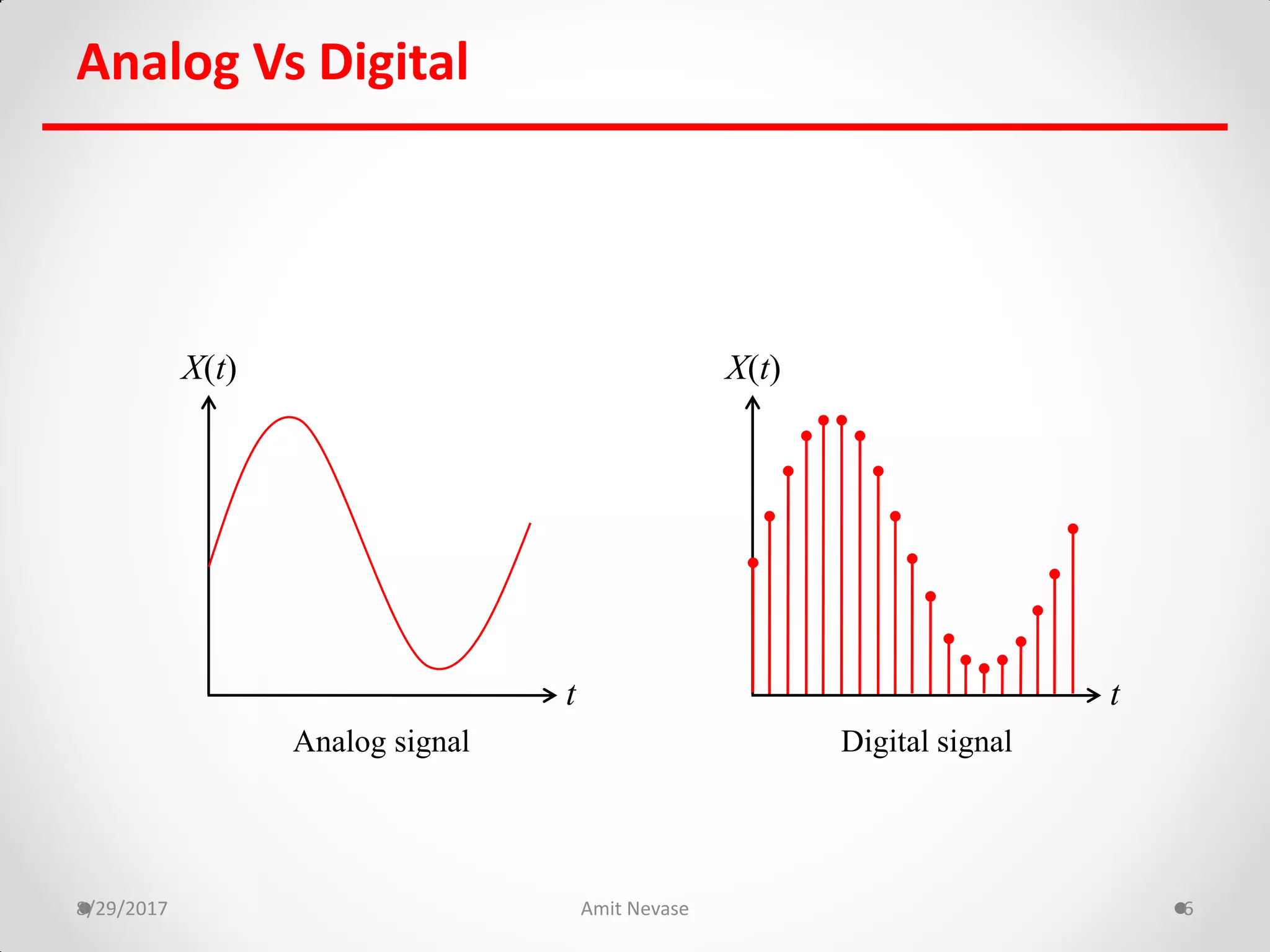
8/29/2017 Amit Nevase 6
t
X(t)
Analog signal
t
X(t)
Digital signal
Analog Vs Digital
Advantages of Digital System over Analog System
8/29/2017 Amit Nevase 7
Digital Systems are easier to design
Information storage is easy
Accuracy & Precision are greater
Digital systems are more versatile
Digital circuits are less affected by noise
More digital circuitry can be fabricated on IC
chips
Chapter I – Number System
 Introduction to digital signal, Advantages of Digital System
over analog systems
 Number Systems: Different types of number systems(
Binary, Octal, Hexadecimal ), conversion of number systems,
 Binary arithmetic: Addition, Subtraction, Multiplication, Division.
 Subtraction using 1’s complement and 2’s complement
 Codes
 Codes -BCD, Gray Code, Excess-3, ASCII code
 BCD addition, BCD subtraction using 9’s and 10’ complement
 (Numericals based on above topic).
8/29/2017 Amit Nevase 8
Number System
A number system defines a set of values used
to represent quantity.
8/29/2017 Amit Nevase 9
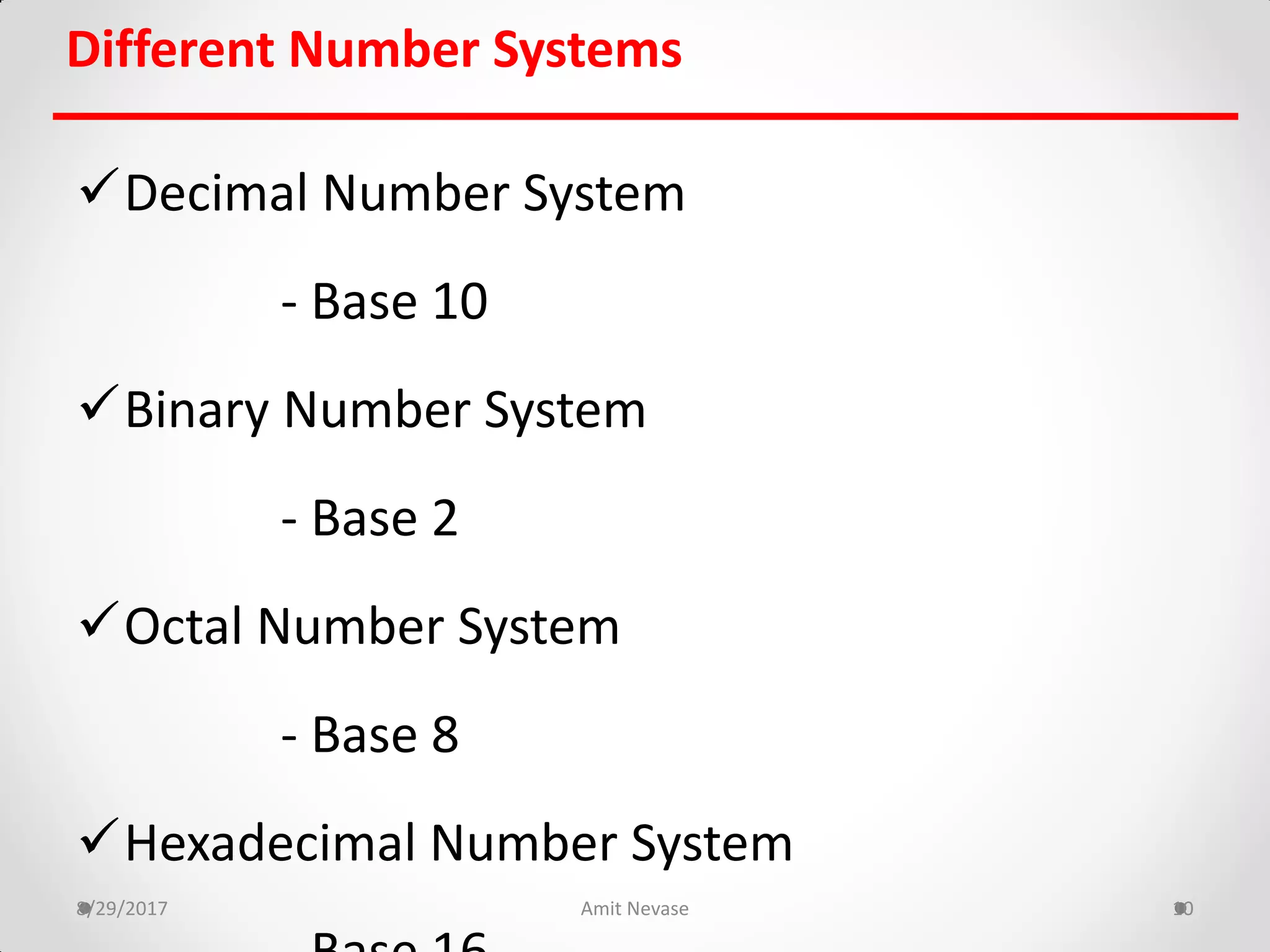
Different Number Systems
Decimal Number System
- Base 10
Binary Number System
- Base 2
Octal Number System
- Base 8
Hexadecimal Number System
8/29/2017 Amit Nevase 10
Decimal Number System
Decimal number system contains ten unique
symbols 0,1,2,3,4,5,6,7,8 and 9
Since counting in decimal involves ten symbols,
we can say that its base or radix is ten.
It is a positional weighted system
8/29/2017 Amit Nevase 11
Decimal Number System
8/29/2017 Amit Nevase 12
In this system, any number (integer, fraction or
mixed) of any magnitude can be represented
by the use of these ten symbols only
Each symbols in the number is called a “Digit”
Decimal Number System
8/29/2017 Amit Nevase 13
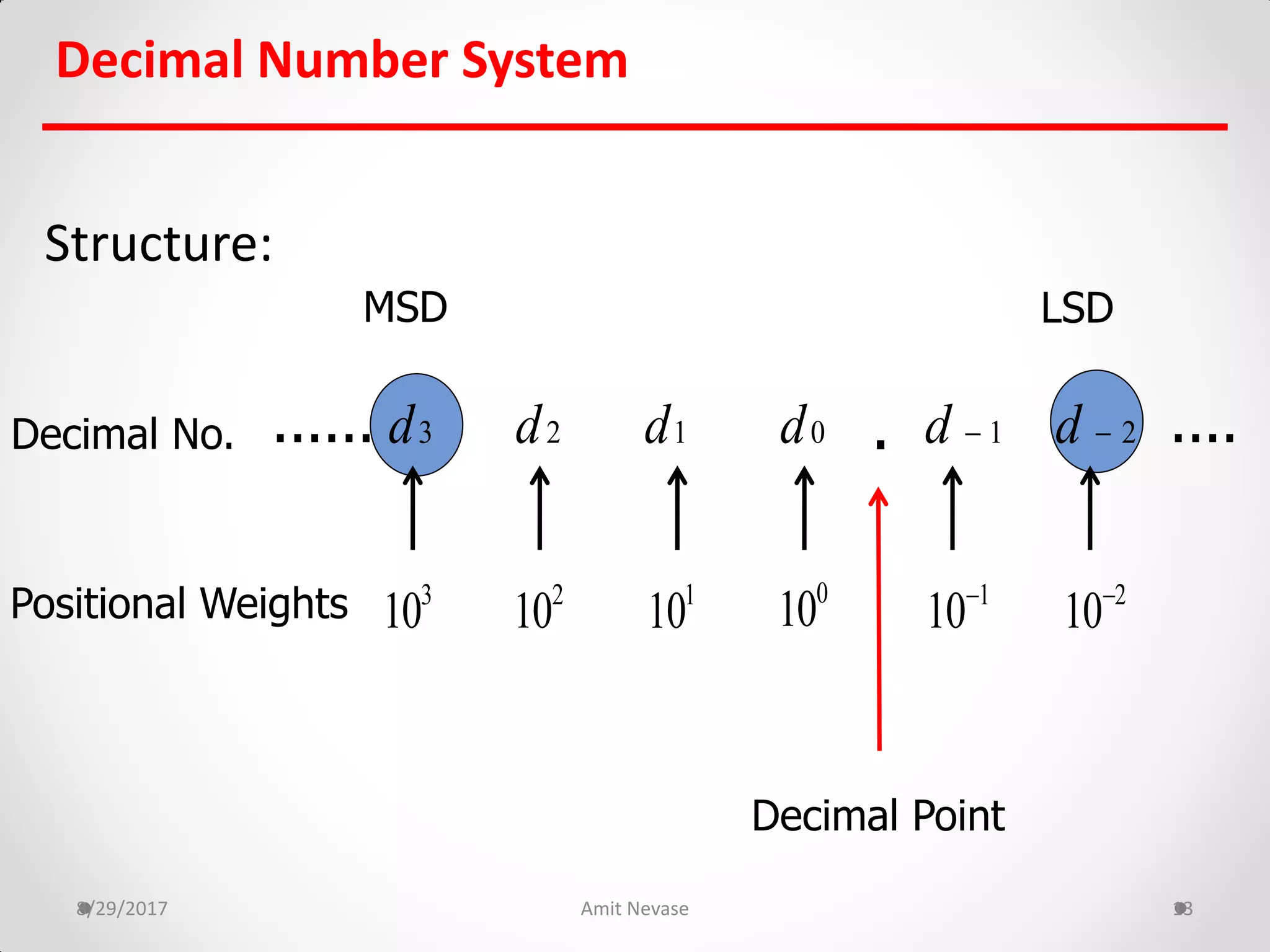
Structure:
Decimal No.
Positional Weights
....... ....
Decimal Point
MSD LSD
1d2d3d 1d  2d 0d
0
101
102
103
10 1
10 2
10
Decimal Number System
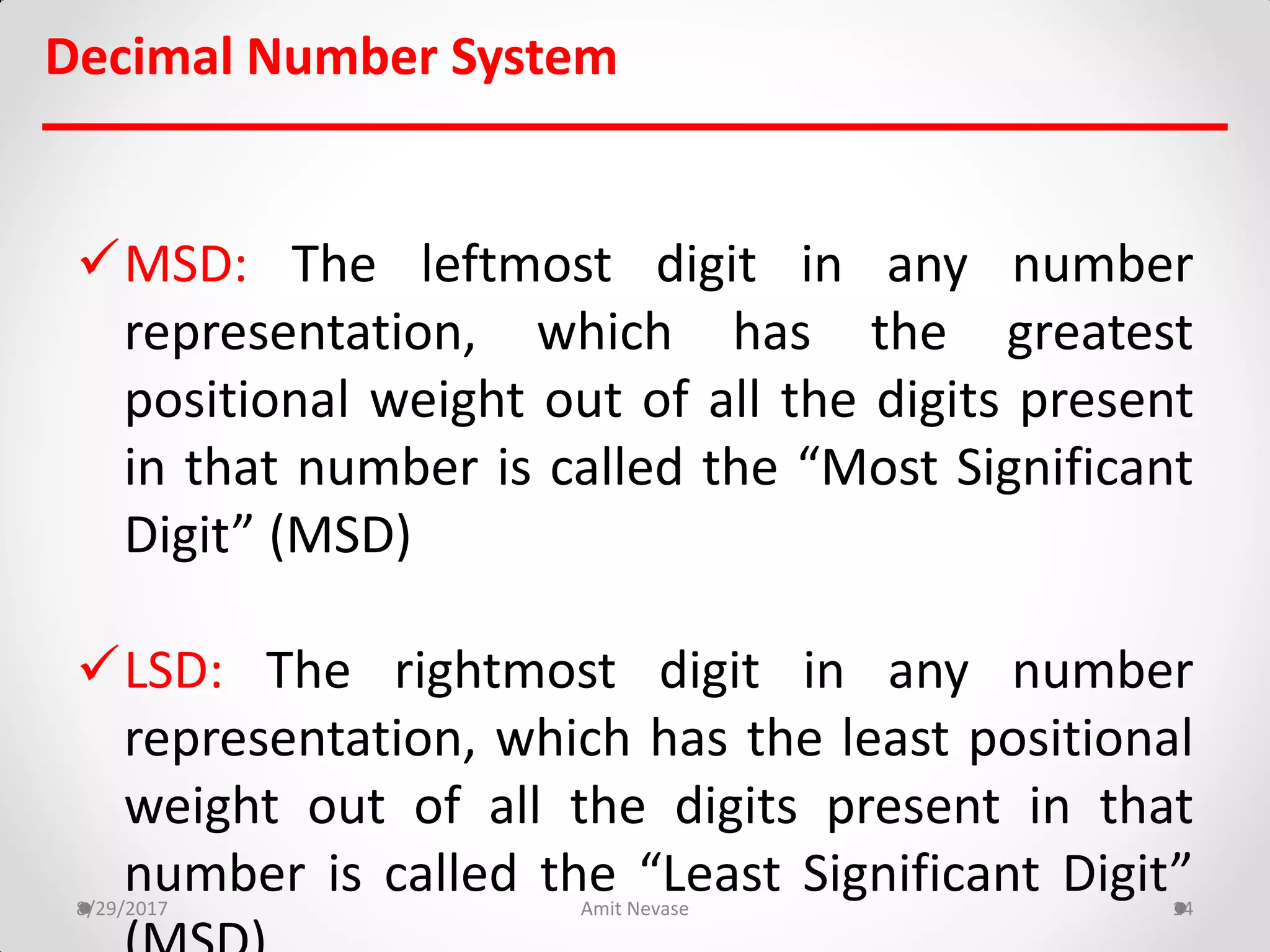
MSD: The leftmost digit in any number
representation, which has the greatest
positional weight out of all the digits present
in that number is called the “Most Significant
Digit” (MSD)
LSD: The rightmost digit in any number
representation, which has the least positional
weight out of all the digits present in that
number is called the “Least Significant Digit”8/29/2017 Amit Nevase 14
Decimal Number System
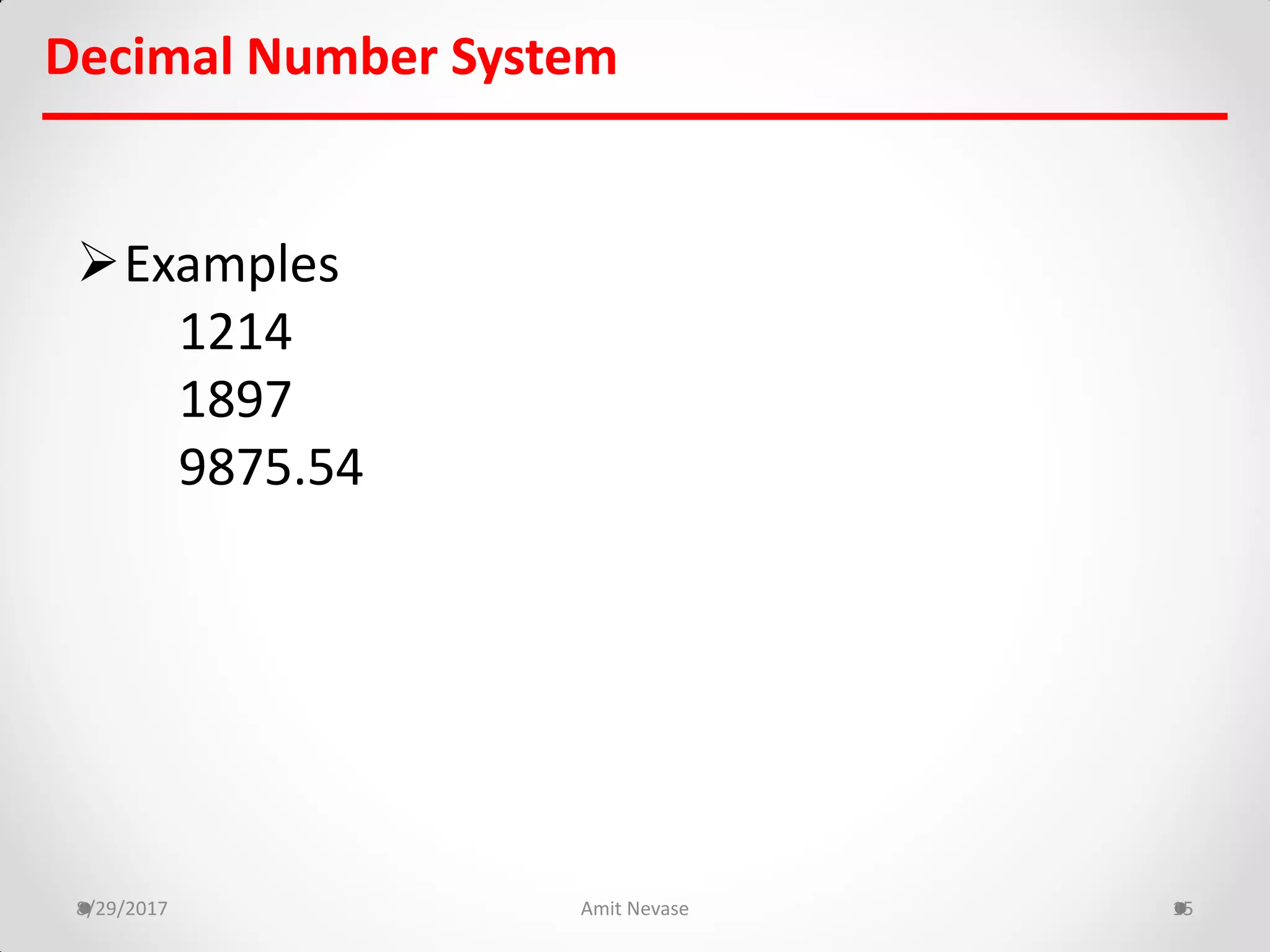
Examples
1214
1897
9875.54
8/29/2017 Amit Nevase 15
Binary Number System
Binary number system is a positional weighted
system
It contains two unique symbols 0 and 1
Since counting in binary involves two symbols,
we can say that its base or radix is two.
8/29/2017 Amit Nevase 16
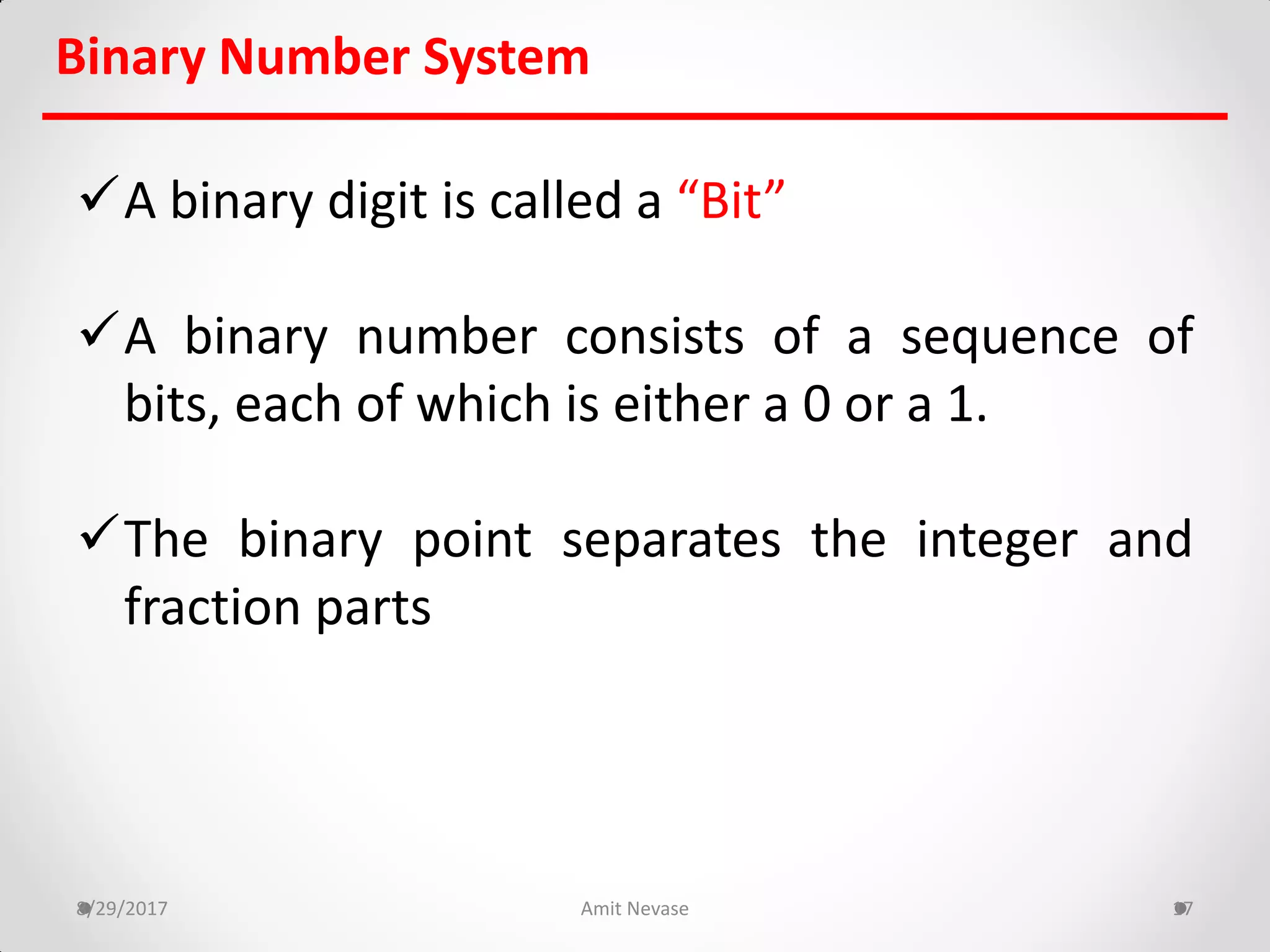
A binary digit is called a “Bit”
A binary number consists of a sequence of
bits, each of which is either a 0 or a 1.
The binary point separates the integer and
fraction parts
8/29/2017 Amit Nevase 17
Binary Number System
8/29/2017 Amit Nevase 18
Binary Number System
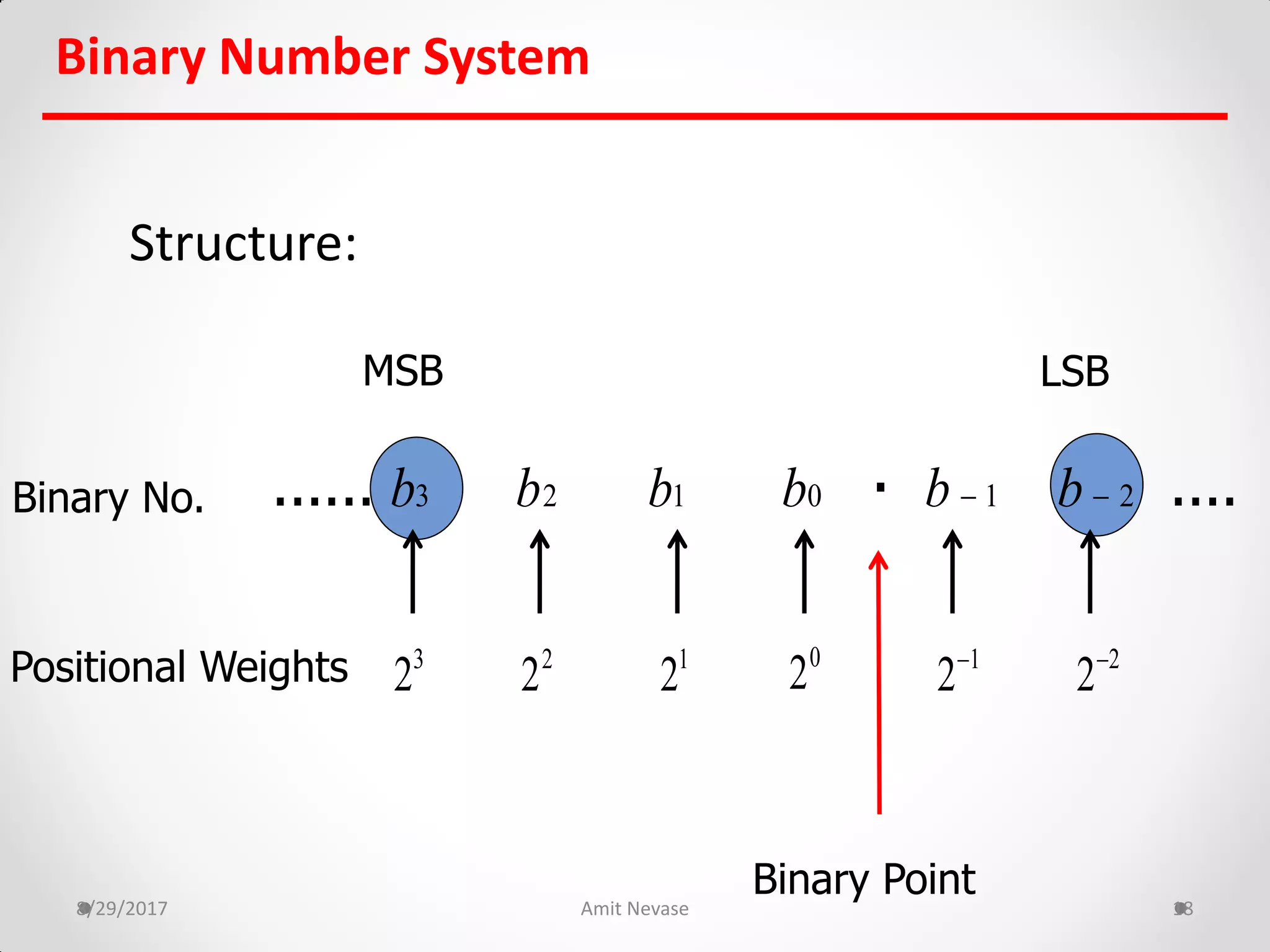
Structure:
Binary No.
Positional Weights
....... ....
Binary Point
MSB LSB
1b2b3b 1b  2b 0b
0
21
22
23
2 1
2 2
2
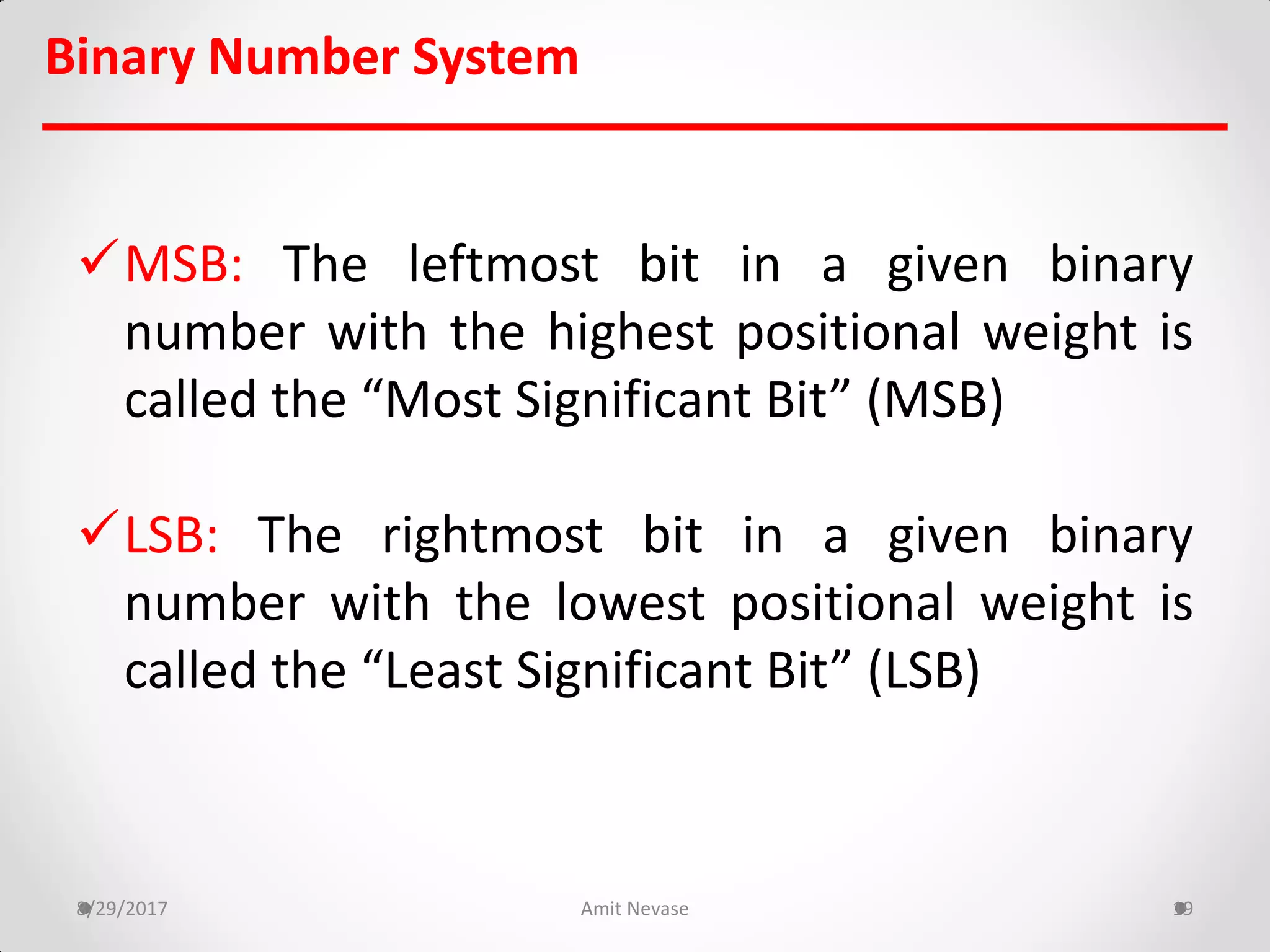
MSB: The leftmost bit in a given binary
number with the highest positional weight is
called the “Most Significant Bit” (MSB)
LSB: The rightmost bit in a given binary
number with the lowest positional weight is
called the “Least Significant Bit” (LSB)
8/29/2017 Amit Nevase 19
Binary Number System
8/29/2017 Amit Nevase 20
Binary Number System
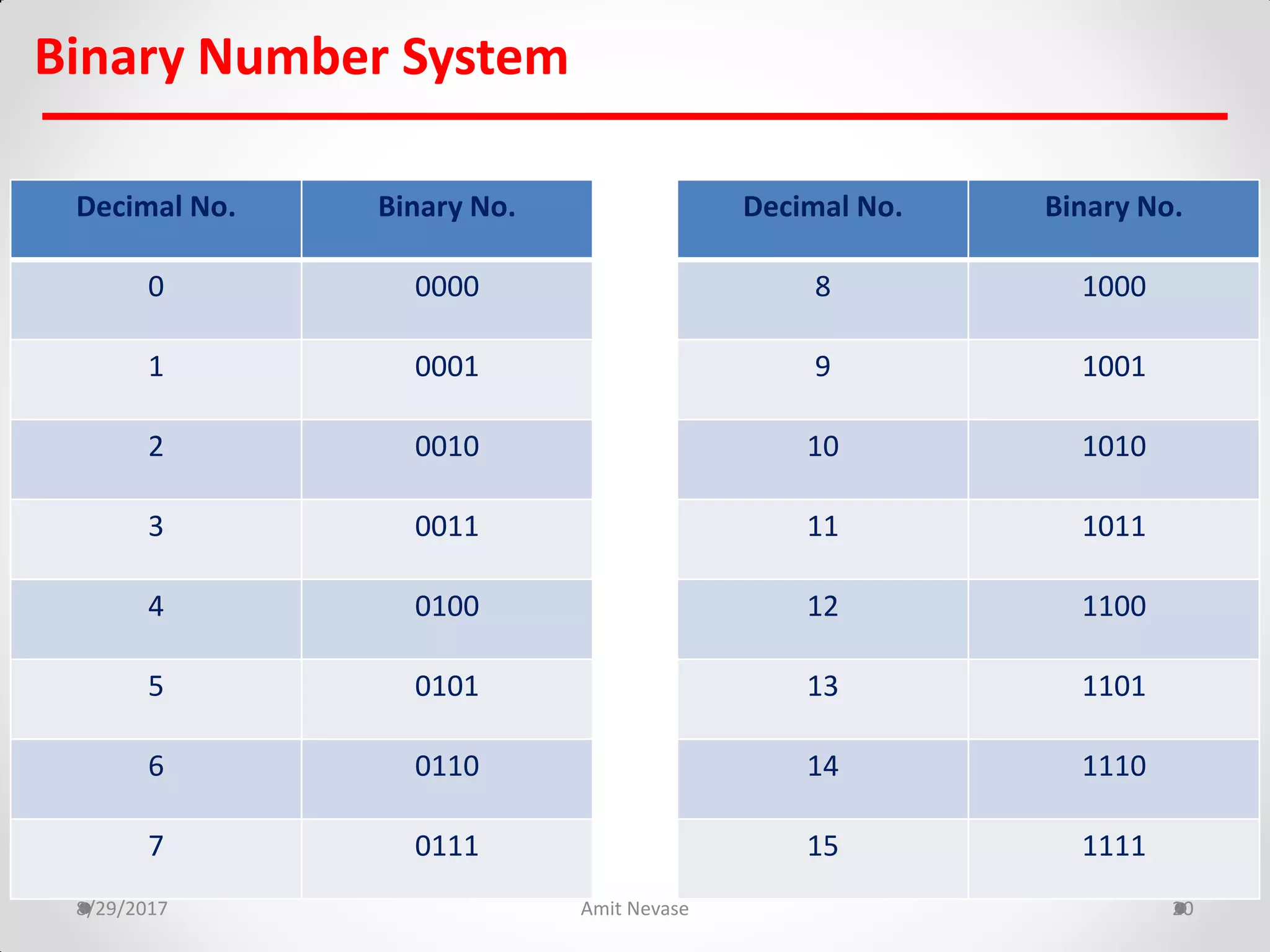
Decimal No. Binary No.
0 0000
1 0001
2 0010
3 0011
4 0100
5 0101
6 0110
7 0111
Decimal No. Binary No.
8 1000
9 1001
10 1010
11 1011
12 1100
13 1101
14 1110
15 1111
BIT: The binary digits (0 and 1) are called bits.
- Single unit in binary digit is called “Bit”
- Example 1
0
8/29/2017 Amit Nevase 21
Terms related to Binary Numbers
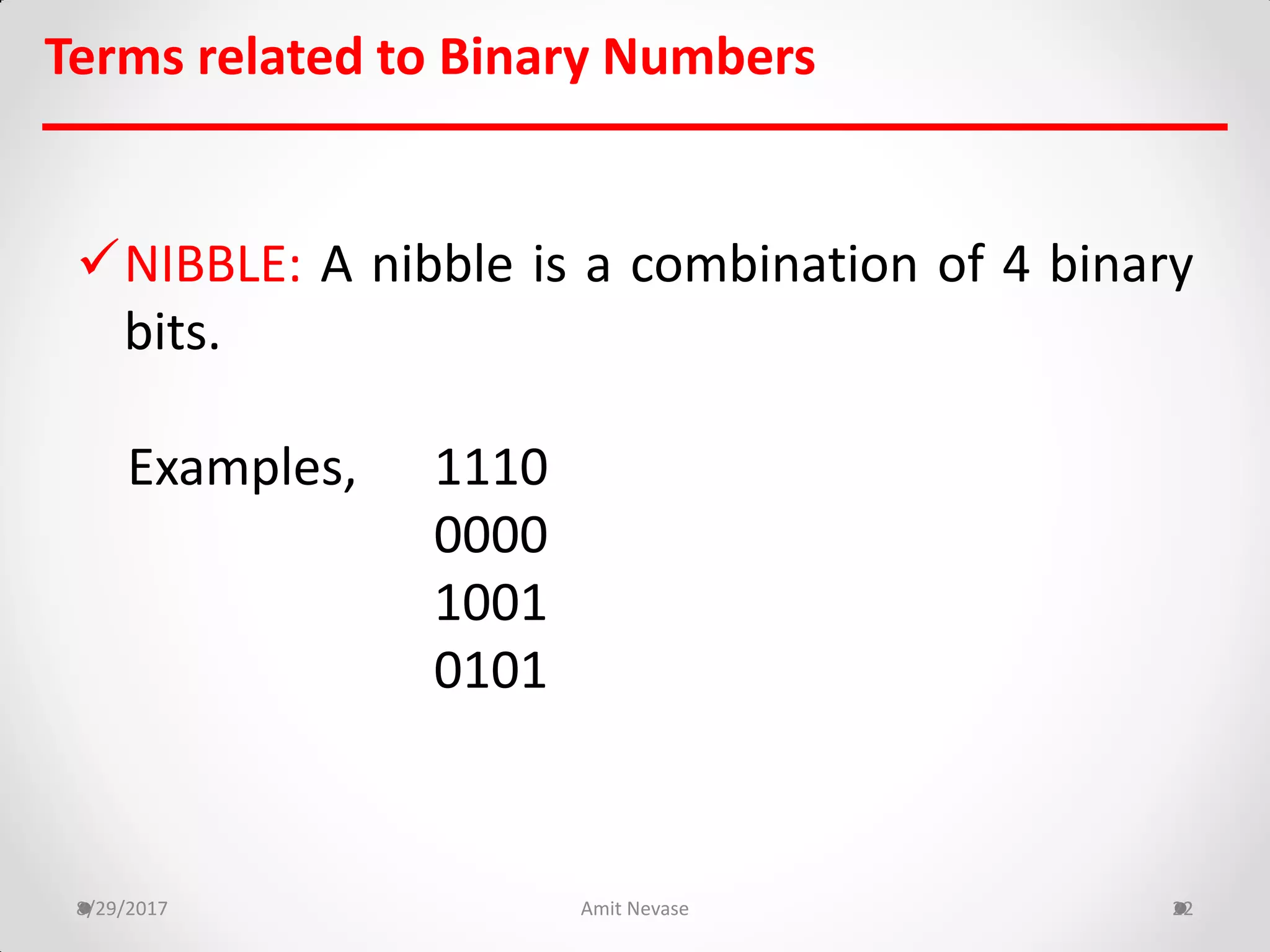
NIBBLE: A nibble is a combination of 4 binary
bits.
Examples, 1110
0000
1001
0101
8/29/2017 Amit Nevase 22
Terms related to Binary Numbers
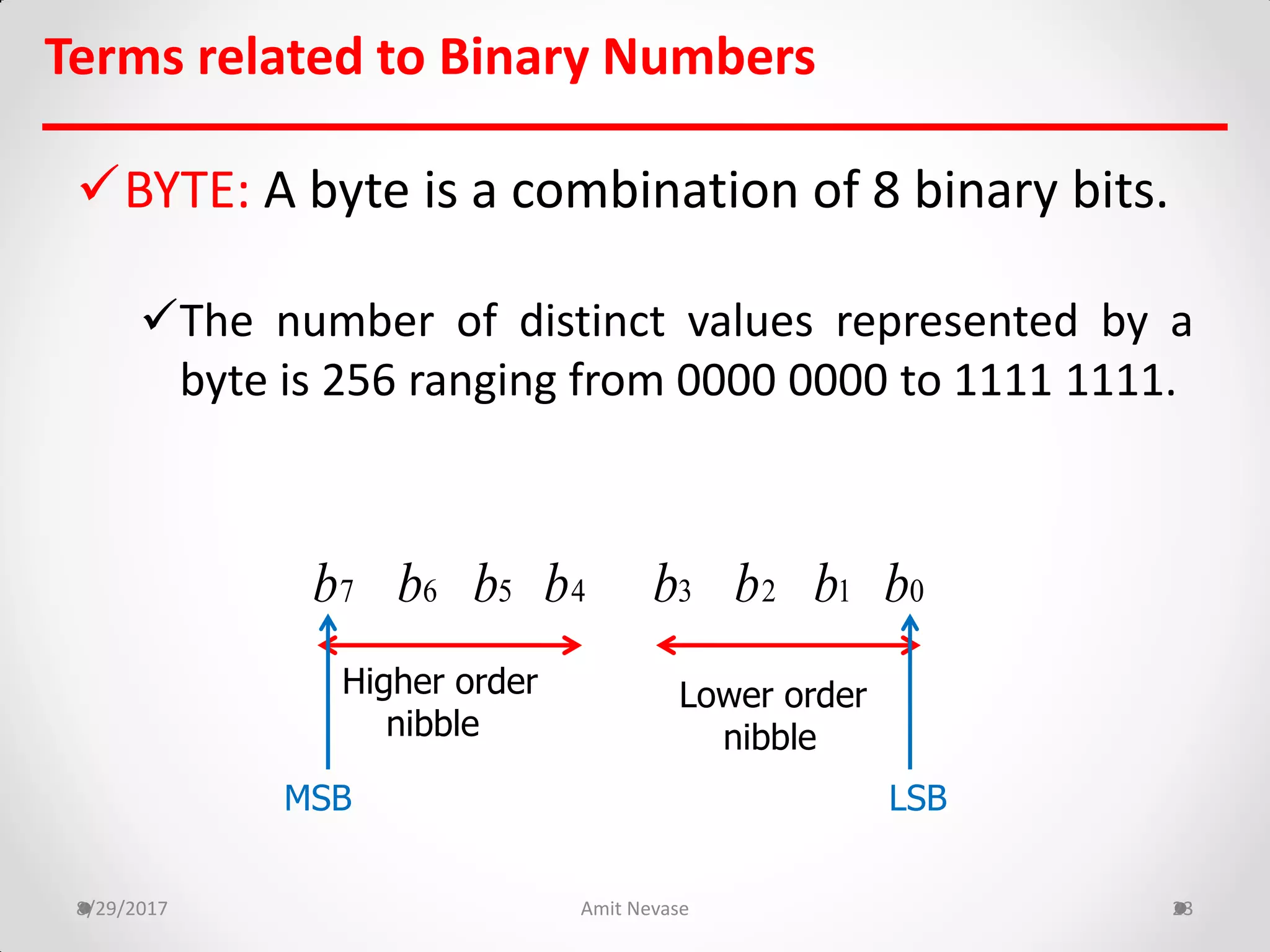
BYTE: A byte is a combination of 8 binary bits.
The number of distinct values represented by a
byte is 256 ranging from 0000 0000 to 1111 1111.
8/29/2017 Amit Nevase 23
Terms related to Binary Numbers
MSB LSB
Higher order
nibble
Lower order
nibble
0b1b2b3b7b 6b 5b 4b
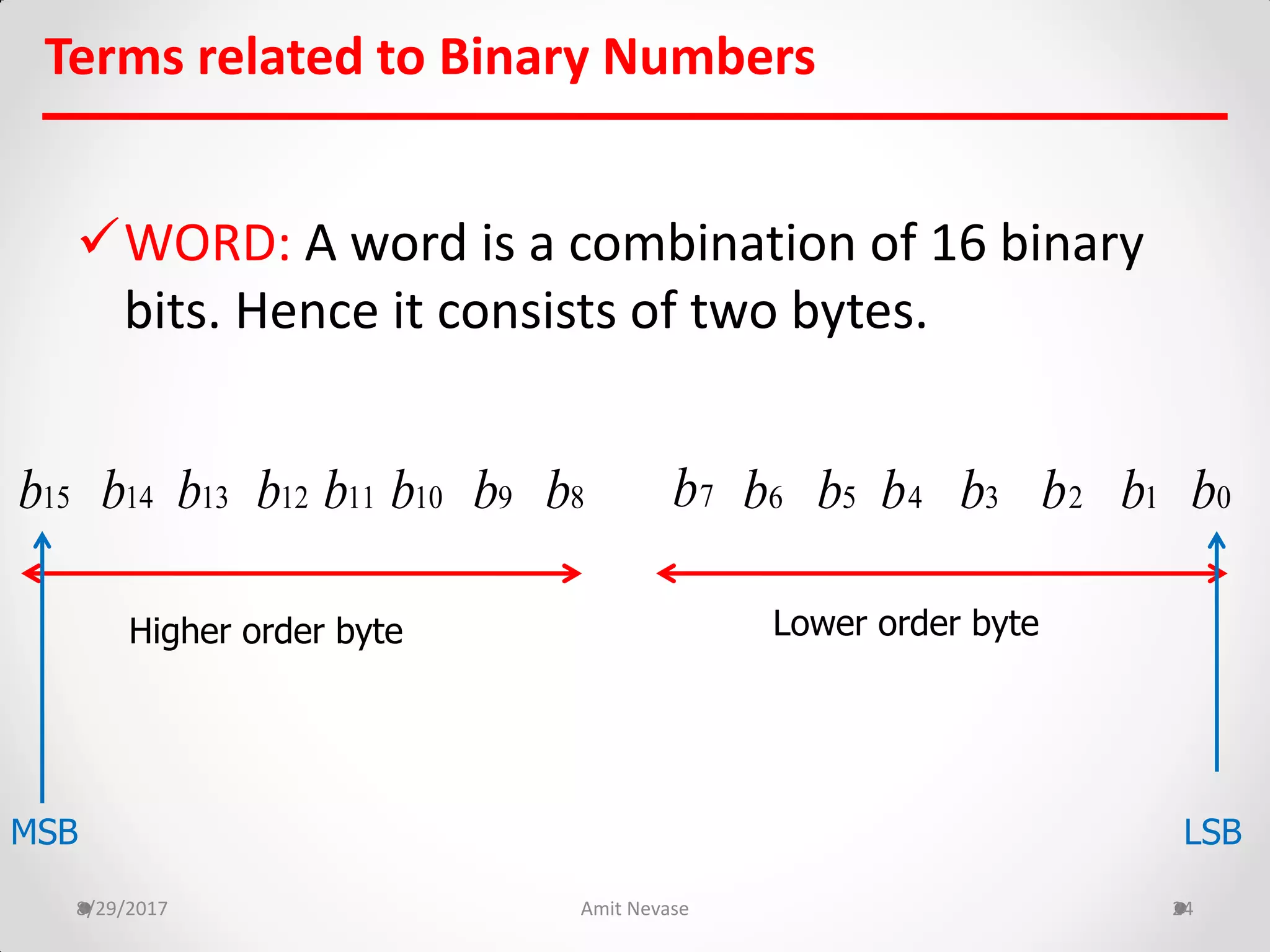
WORD: A word is a combination of 16 binary
bits. Hence it consists of two bytes.
8/29/2017 Amit Nevase 24
Terms related to Binary Numbers
MSB LSB
Higher order byte Lower order byte
0b1b2b3b6b 5b15b 14b 13b 12b 11b 10b 9b 8b 7b 4b
DOUBLE WORD: A double word is exactly what
its name implies, two words
-It is a combination of 32 binary bits.
8/29/2017 Amit Nevase 25
Terms related to Binary Numbers
Octal Number System
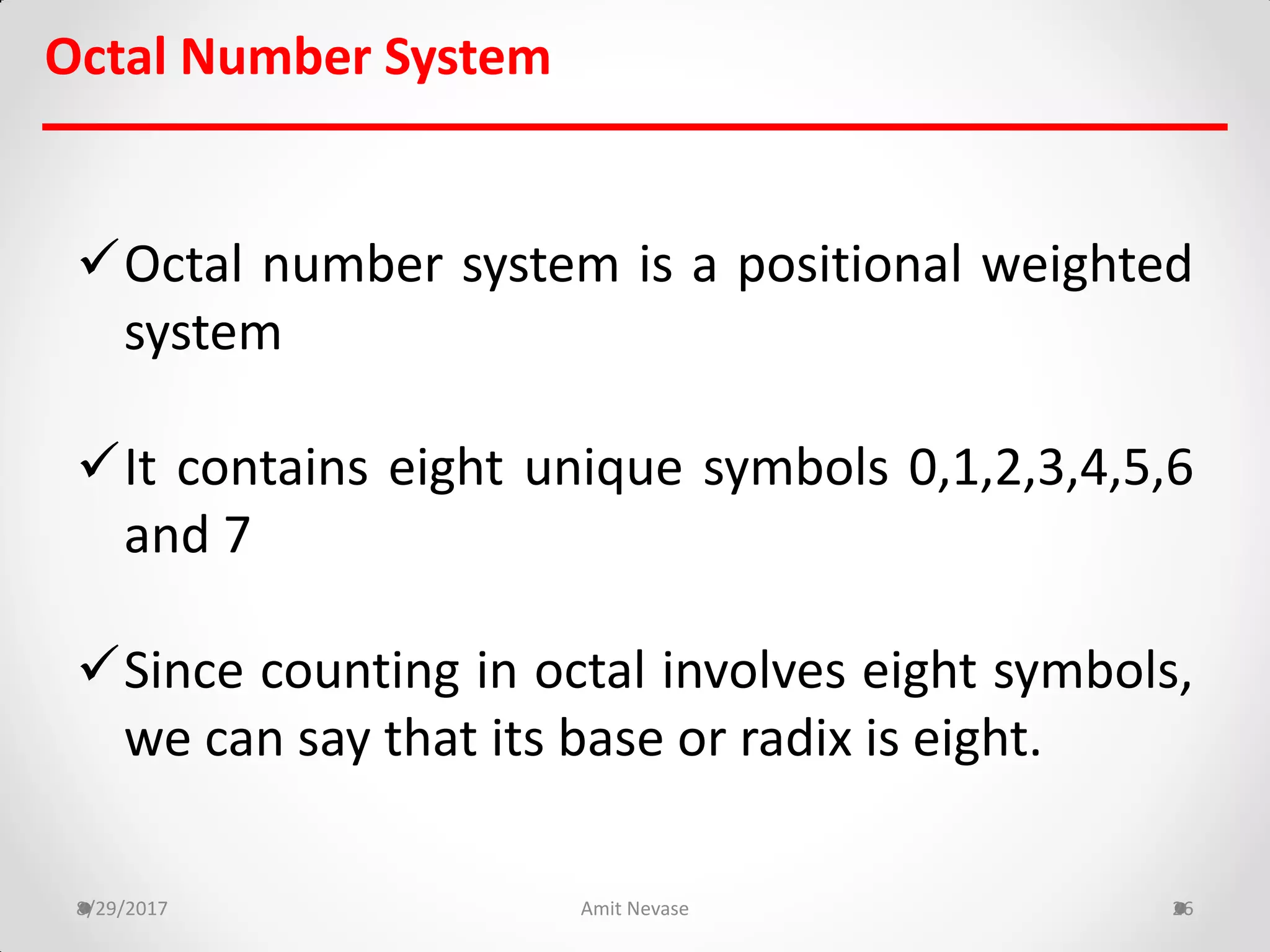
Octal number system is a positional weighted
system
It contains eight unique symbols 0,1,2,3,4,5,6
and 7
Since counting in octal involves eight symbols,
we can say that its base or radix is eight.
8/29/2017 Amit Nevase 26
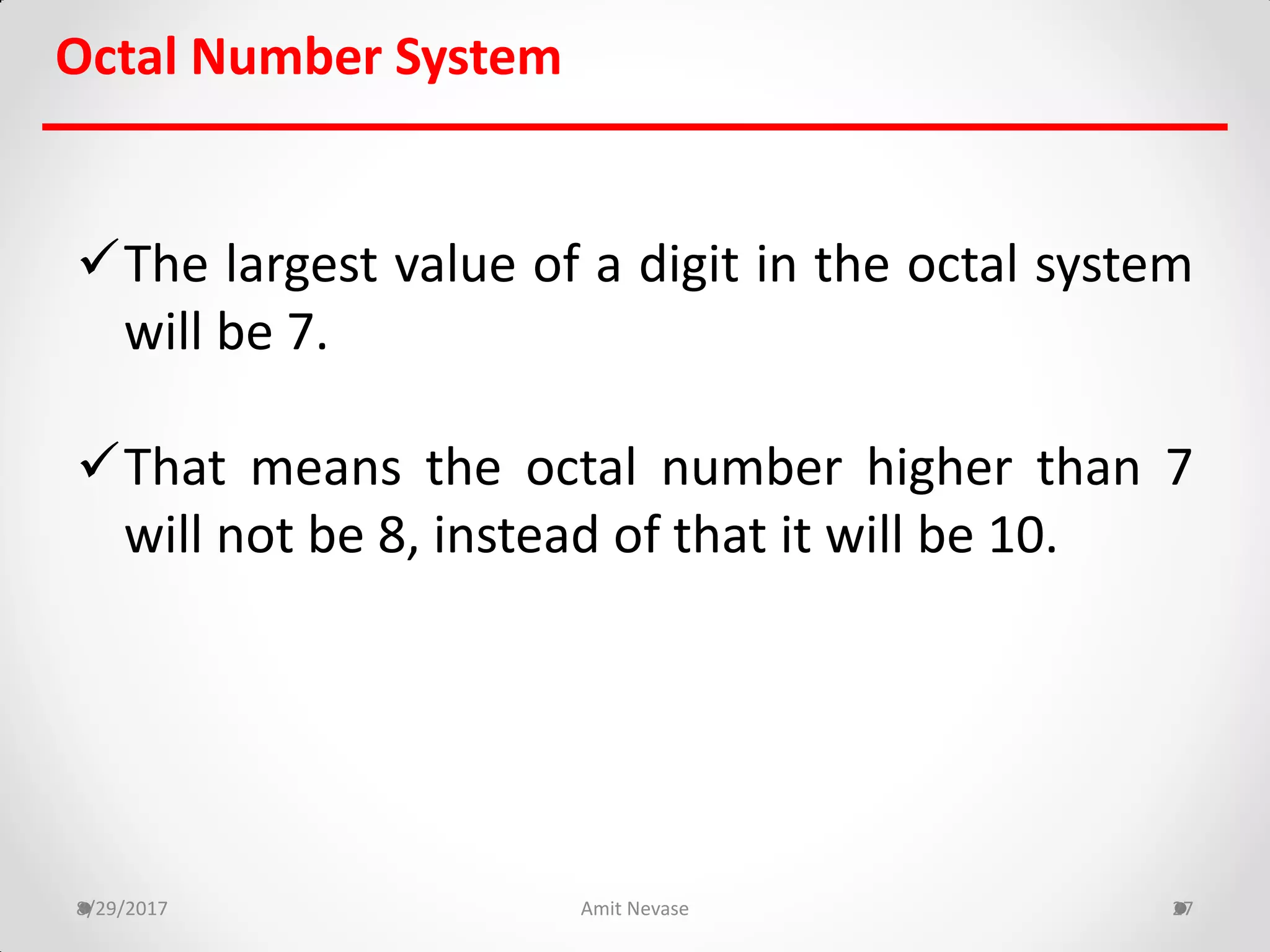
The largest value of a digit in the octal system
will be 7.
That means the octal number higher than 7
will not be 8, instead of that it will be 10.
8/29/2017 Amit Nevase 27
Octal Number System
8/29/2017 Amit Nevase 28
Octal Number System
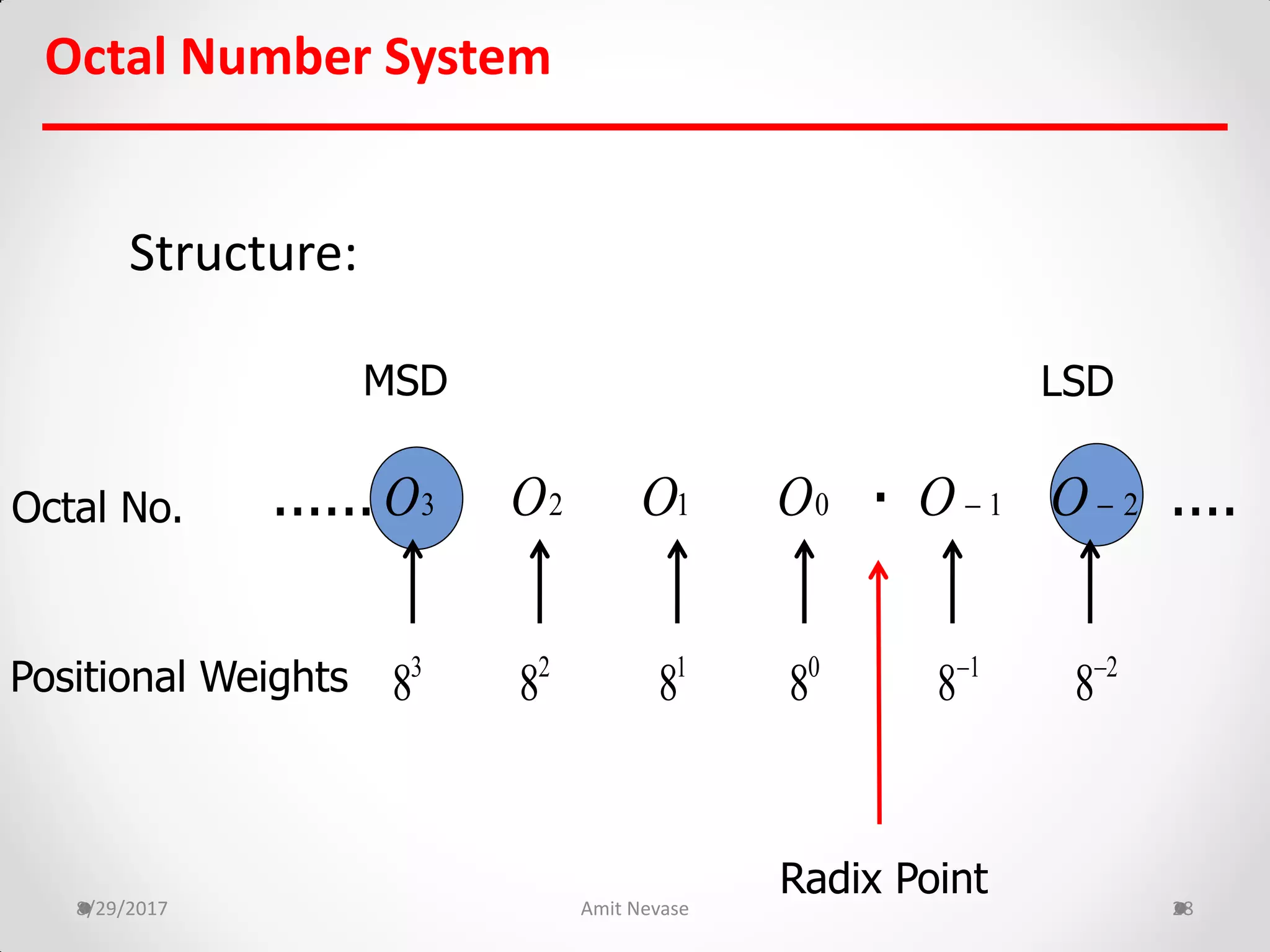
Structure:
Octal No.
Positional Weights
....... ....
Radix Point
MSD LSD
1O2O3O 1O  2O 0O
0
81
82
83
8 1
8 2
8
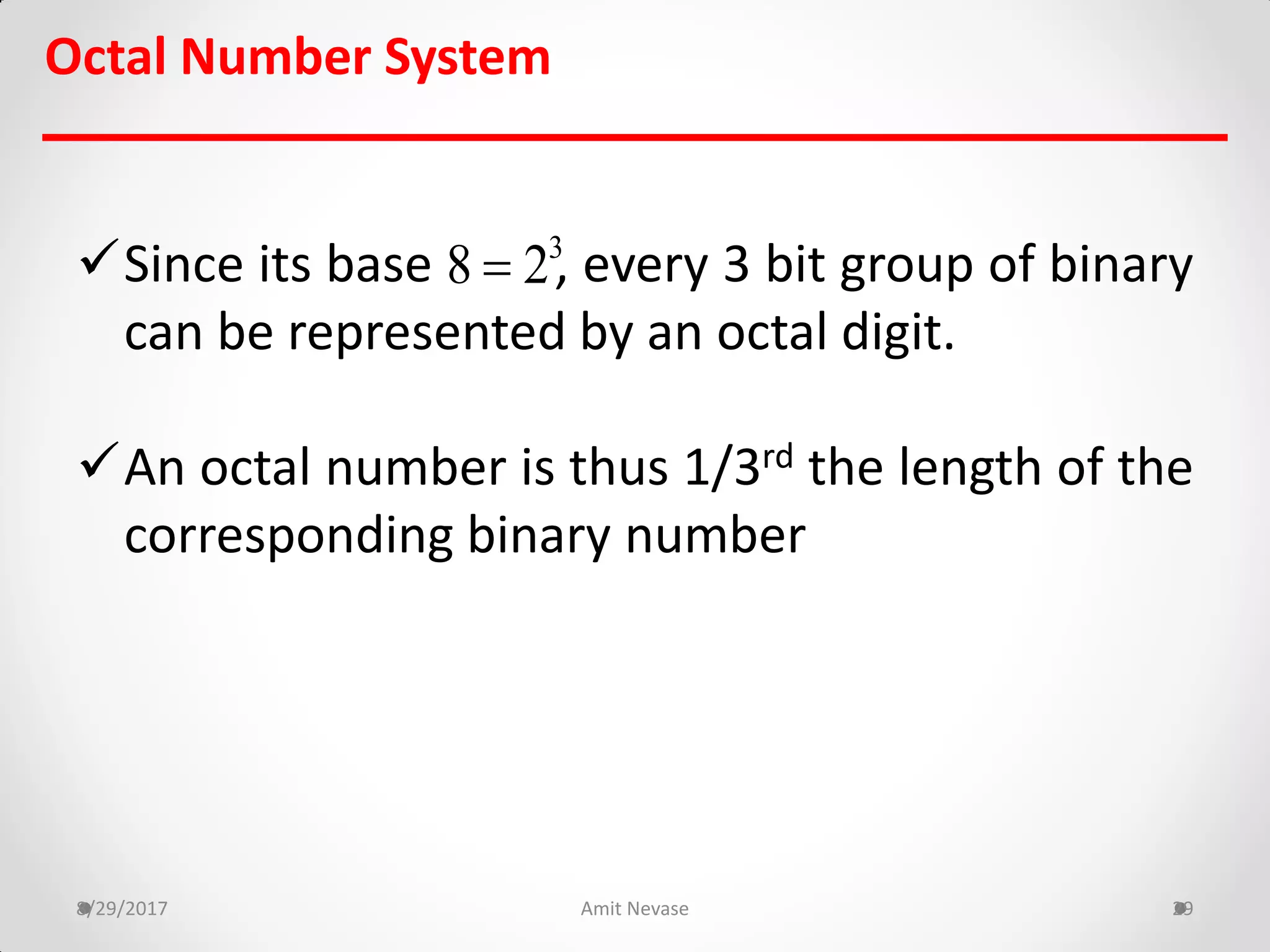
Since its base , every 3 bit group of binary
can be represented by an octal digit.
An octal number is thus 1/3rd the length of the
corresponding binary number
8/29/2017 Amit Nevase 29
Octal Number System
3
8 2
8/29/2017 Amit Nevase 30
Octal Number System
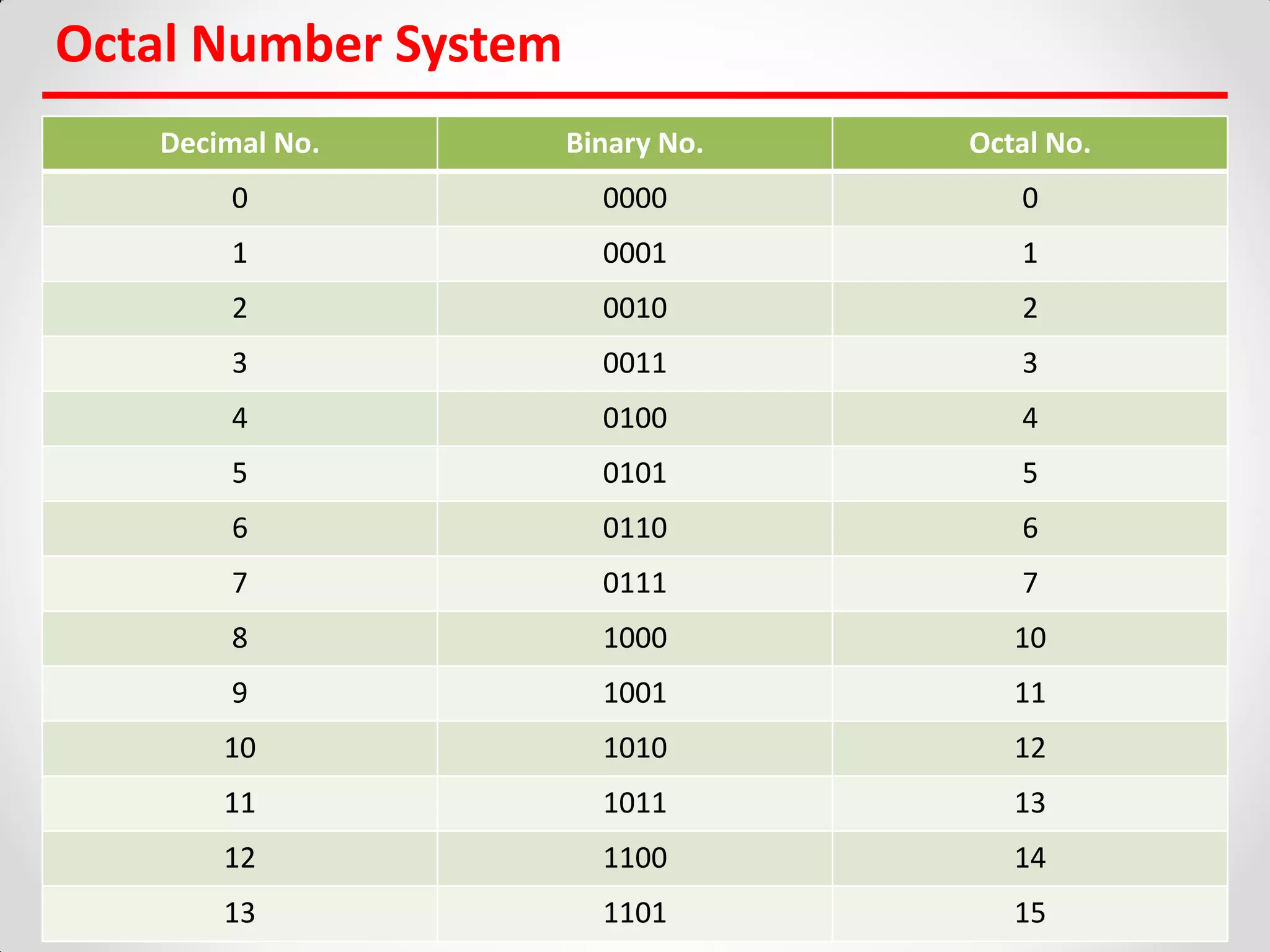
Decimal No. Binary No. Octal No.
0 0000 0
1 0001 1
2 0010 2
3 0011 3
4 0100 4
5 0101 5
6 0110 6
7 0111 7
8 1000 10
9 1001 11
10 1010 12
11 1011 13
12 1100 14
13 1101 15
Hexadecimal Number System (HEX)
Binary numbers are long. These numbers are
fine for machines but are too lengthy to be
handled by human beings. So there is a need to
represent the binary numbers concisely.
One number system developed with this
objective is the hexadecimal number system (or
Hex)
8/29/2017 Amit Nevase 31
Hex number system is a positional weighted
system
It contains sixteen unique symbols
0,1,2,3,4,5,6,7,8,9,A,B,C,D,E and F.
Since counting in hex involves sixteen symbols,
we can say that its base or radix is sixteen.
8/29/2017 Amit Nevase 32
Hexadecimal Number System (HEX)
8/29/2017 Amit Nevase 33
Hexadecimal Number System (HEX)
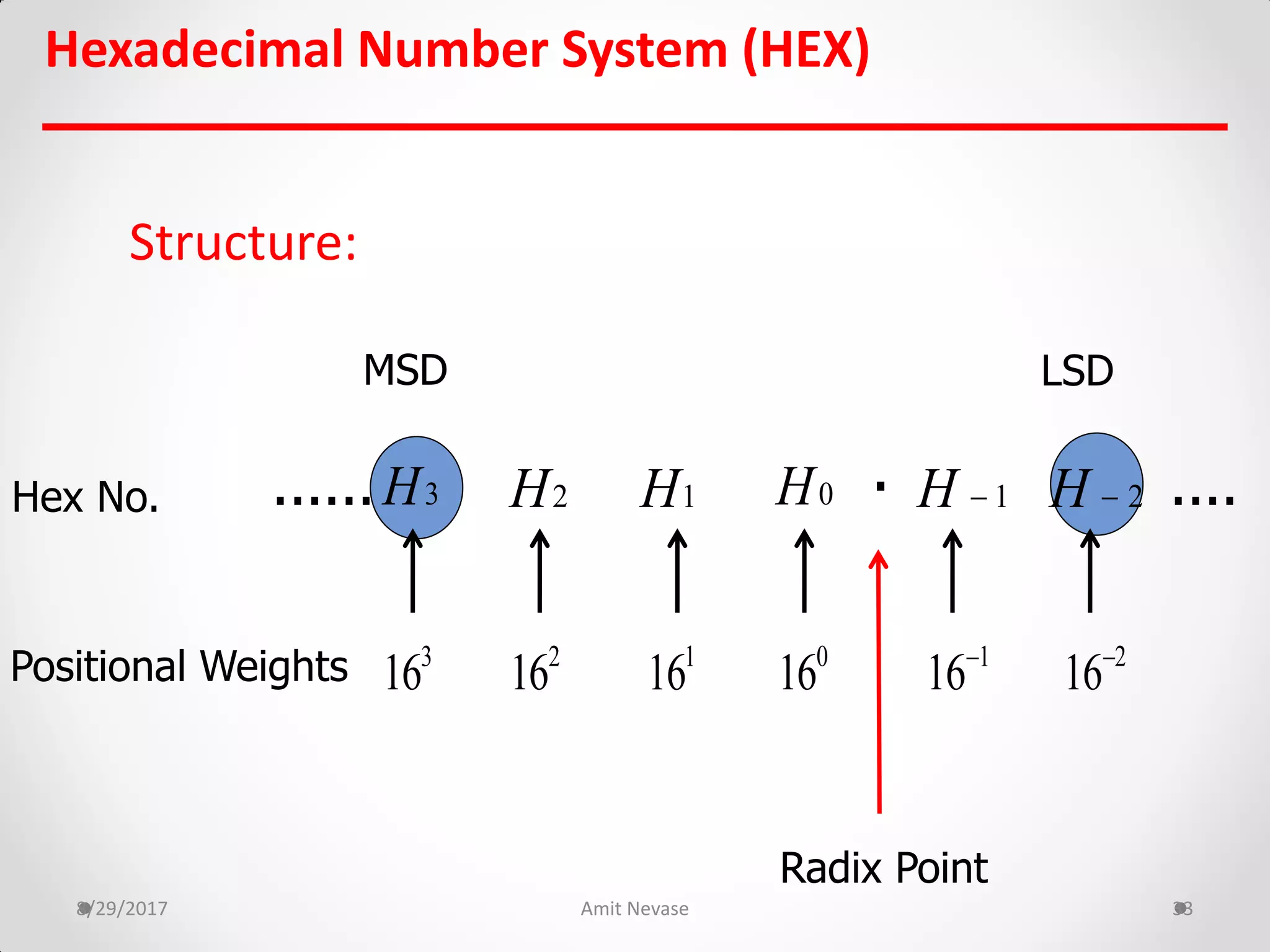
Structure:
Hex No.
Positional Weights
....... ....
Radix Point
MSD LSD
1H2H3H 1H  2H 0H
0
161
162
163
16 1
16 2
16
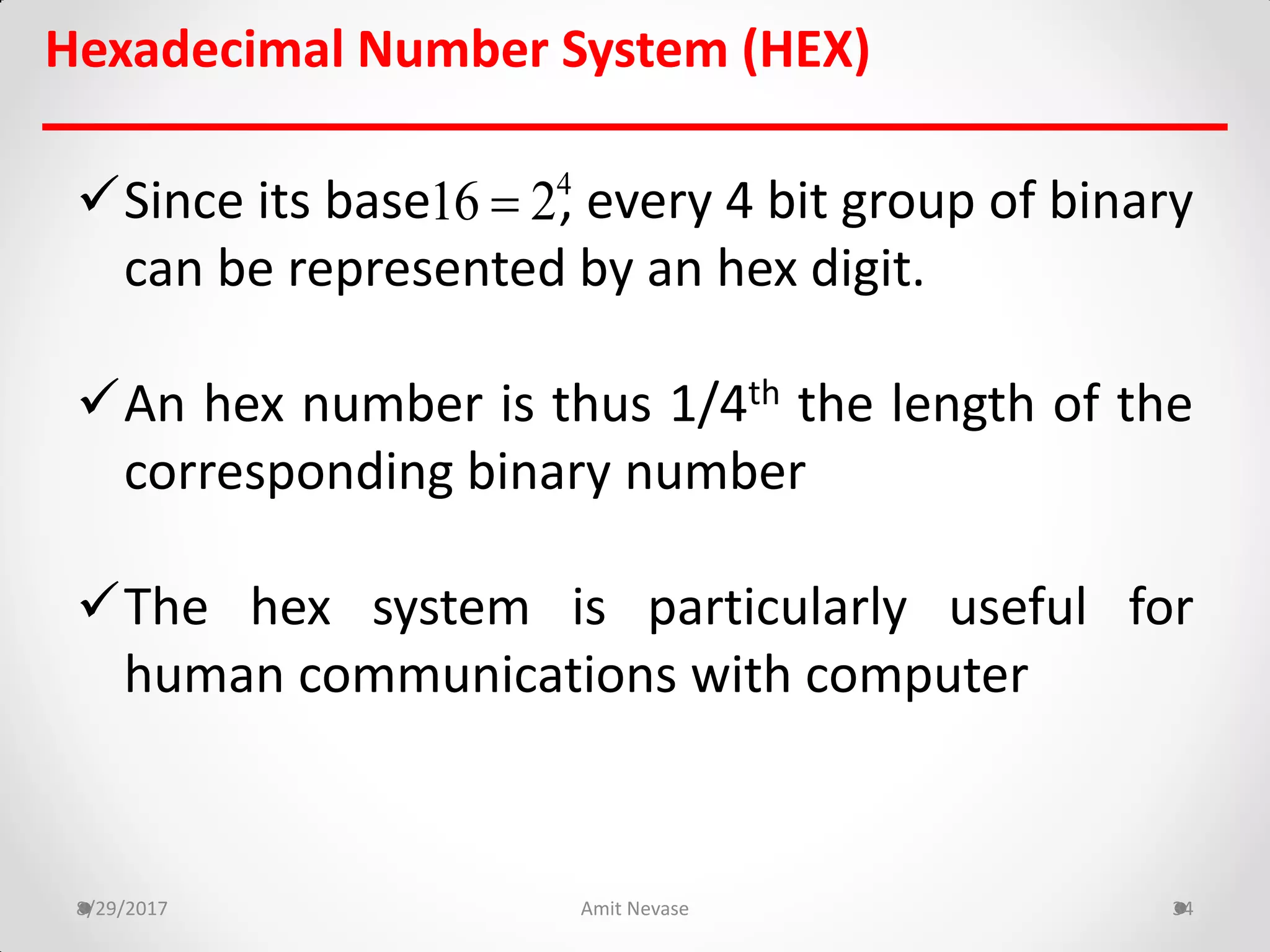
Since its base , every 4 bit group of binary
can be represented by an hex digit.
An hex number is thus 1/4th the length of the
corresponding binary number
The hex system is particularly useful for
human communications with computer
8/29/2017 Amit Nevase 34
Hexadecimal Number System (HEX)
4
16 2
8/29/2017 Amit Nevase 35
Hexadecimal Number System (HEX)
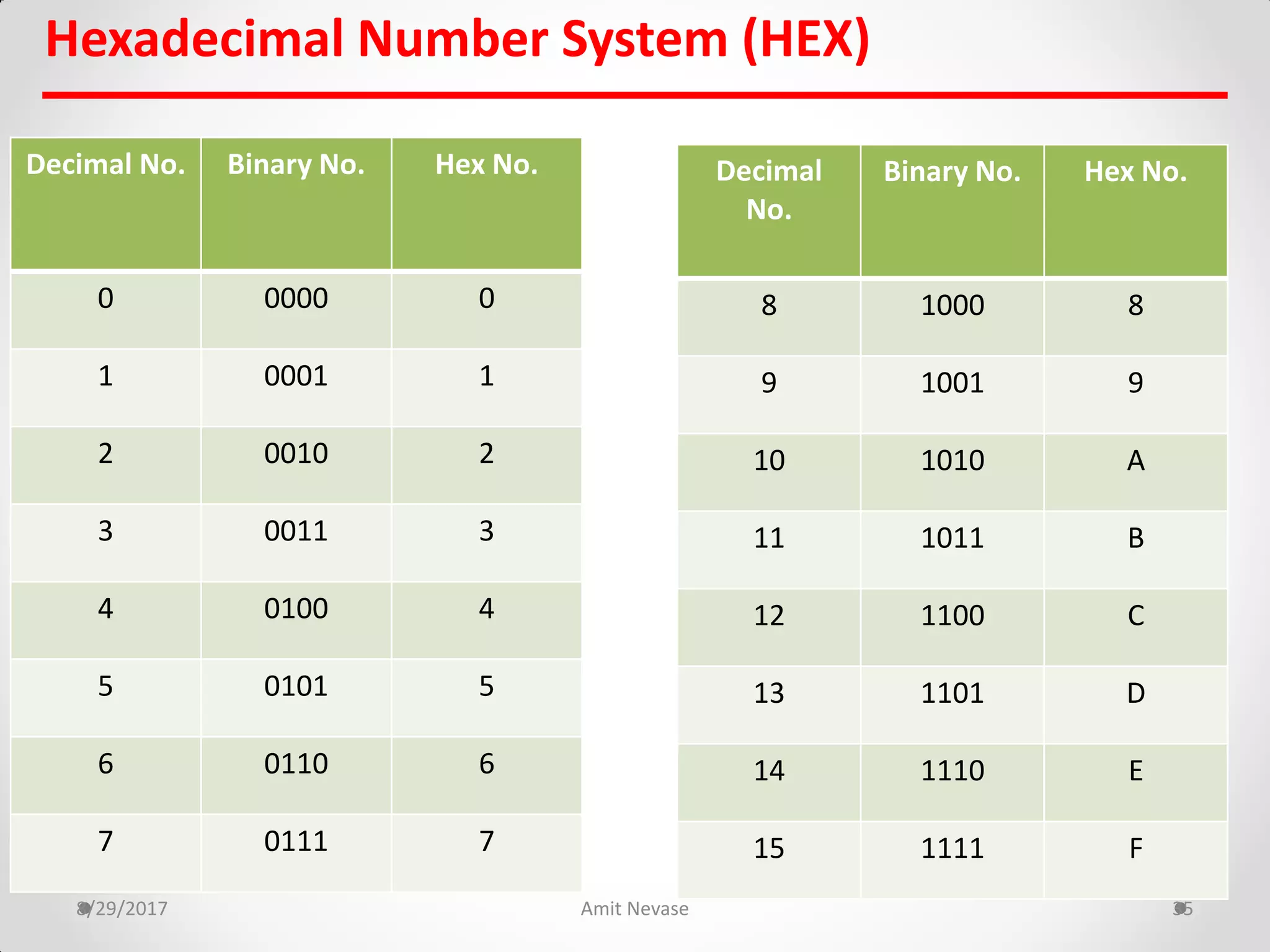
Decimal No. Binary No. Hex No.
0 0000 0
1 0001 1
2 0010 2
3 0011 3
4 0100 4
5 0101 5
6 0110 6
7 0111 7
Decimal
No.
Binary No. Hex No.
8 1000 8
9 1001 9
10 1010 A
11 1011 B
12 1100 C
13 1101 D
14 1110 E
15 1111 F
Chapter I – Number System
 Introduction to digital signal, Advantages of Digital System
over analog systems
 Number Systems: Different types of number systems( Binary, Octal,
Hexadecimal ), Conversion of number systems,
 Binary arithmetic: Addition, Subtraction, Multiplication, Division.
 Subtraction using 1’s complement and 2’s complement
 Codes
 Codes -BCD, Gray Code, Excess-3, ASCII code
 BCD addition, BCD subtraction using 9’s and 10’ complement
 (Numericals based on above topic).
8/29/2017 Amit Nevase 36
8/29/2017 Amit Nevase 37
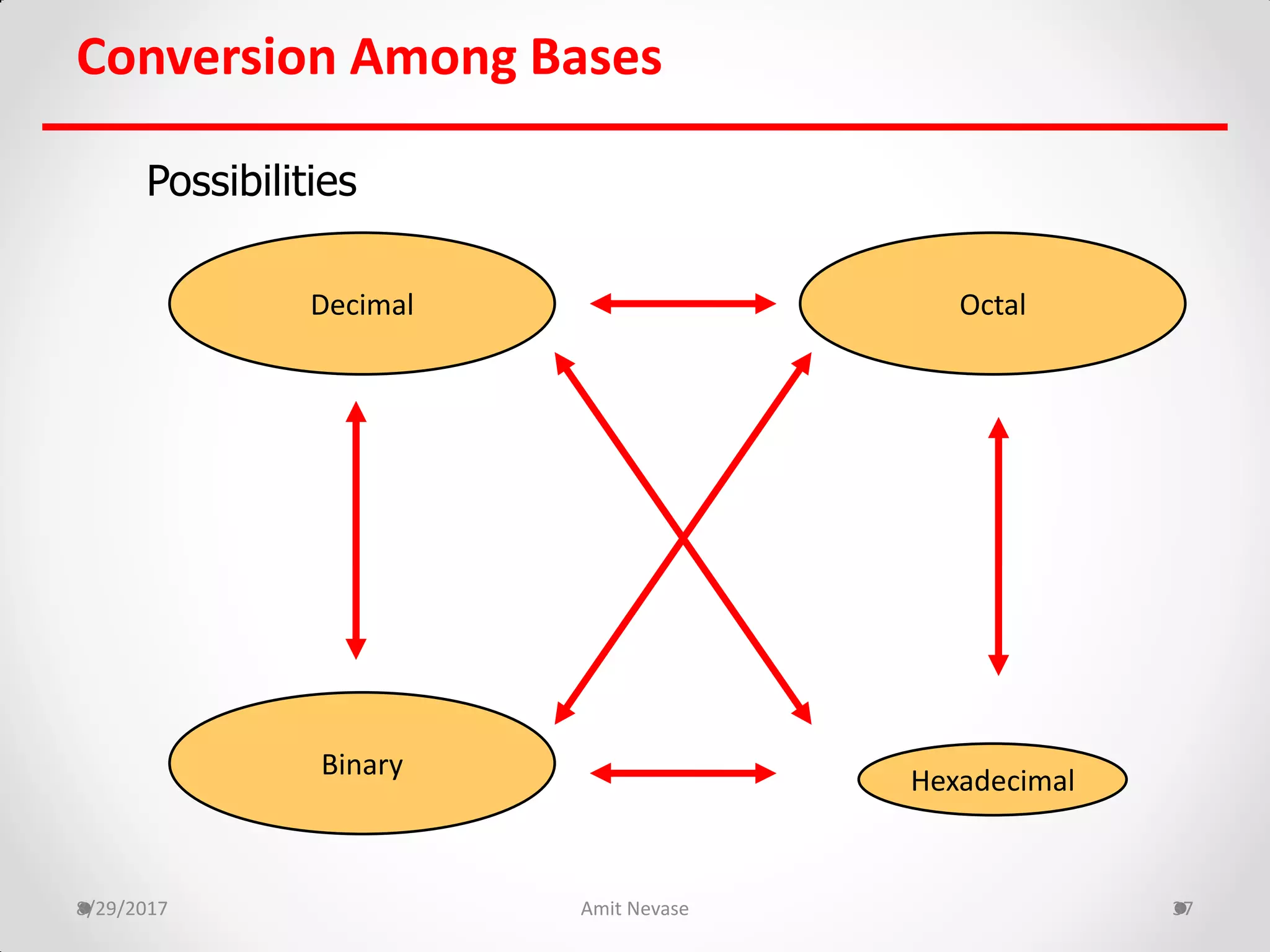
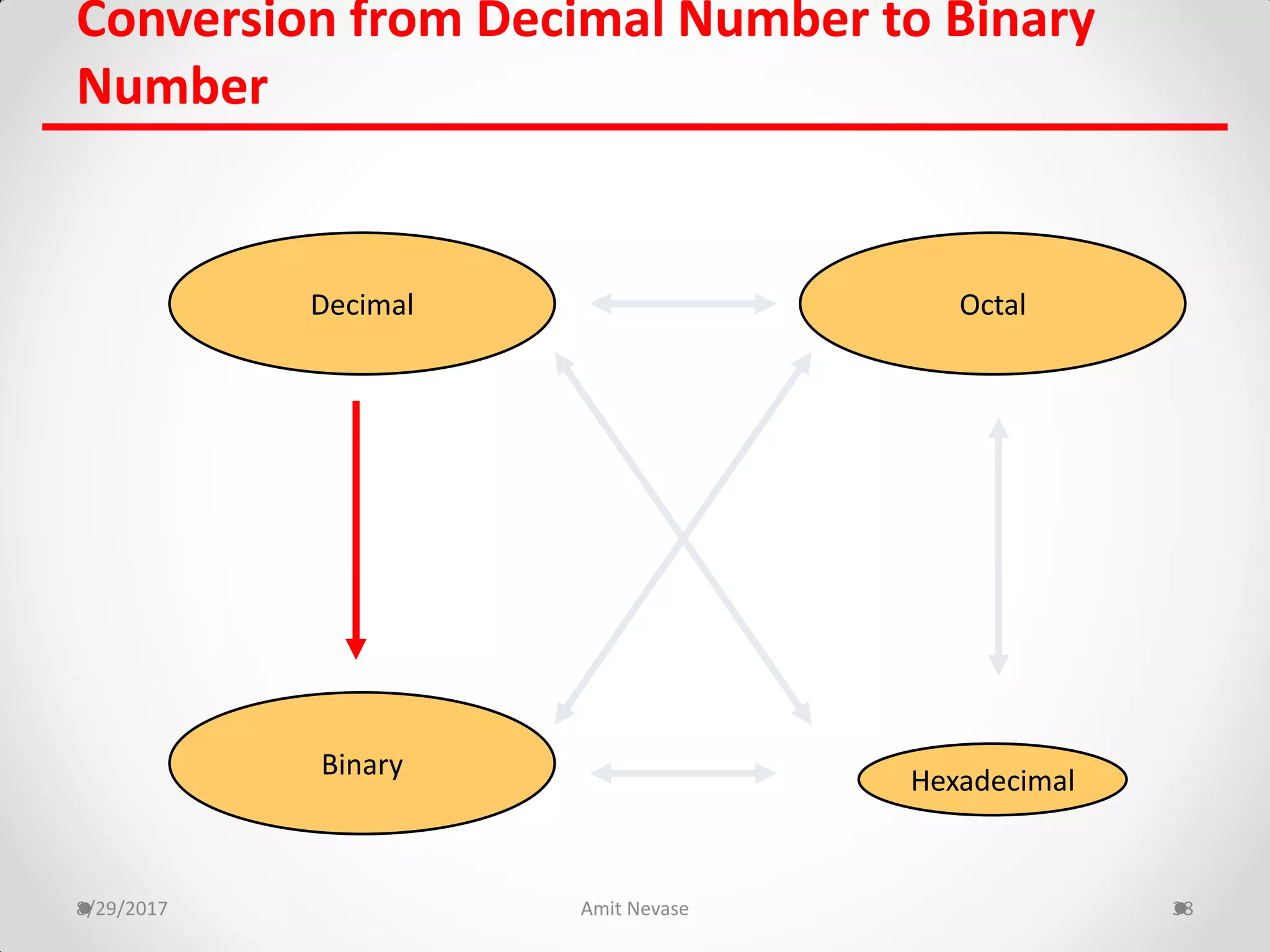
Conversion Among Bases
Hexadecimal
Decimal Octal
Binary
Possibilities
8/29/2017 Amit Nevase 38
Conversion from Decimal Number to Binary
Number
Hexadecimal
Decimal Octal
Binary
Conversion of Decimal number into Binary number (Integer
Number)
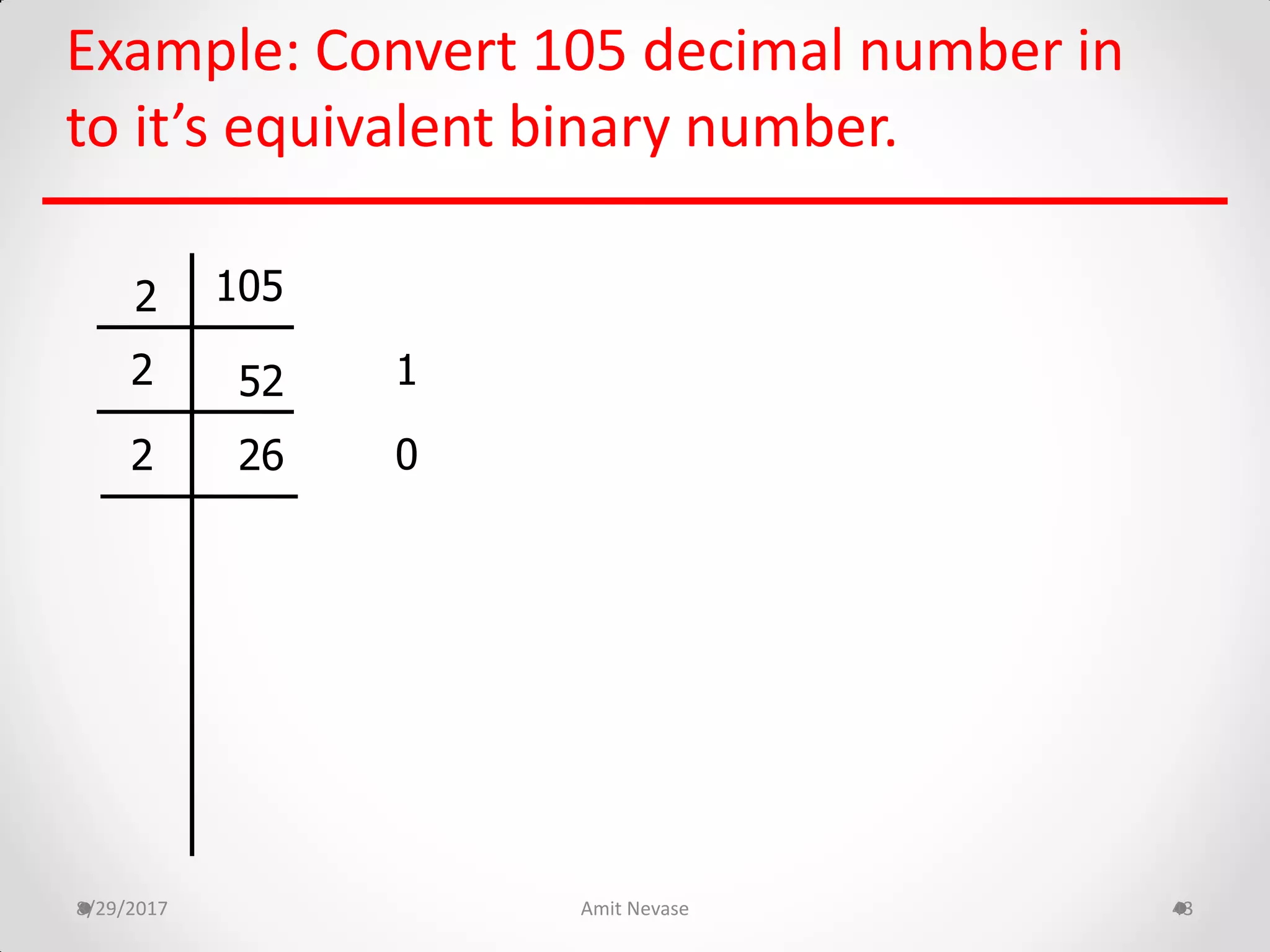
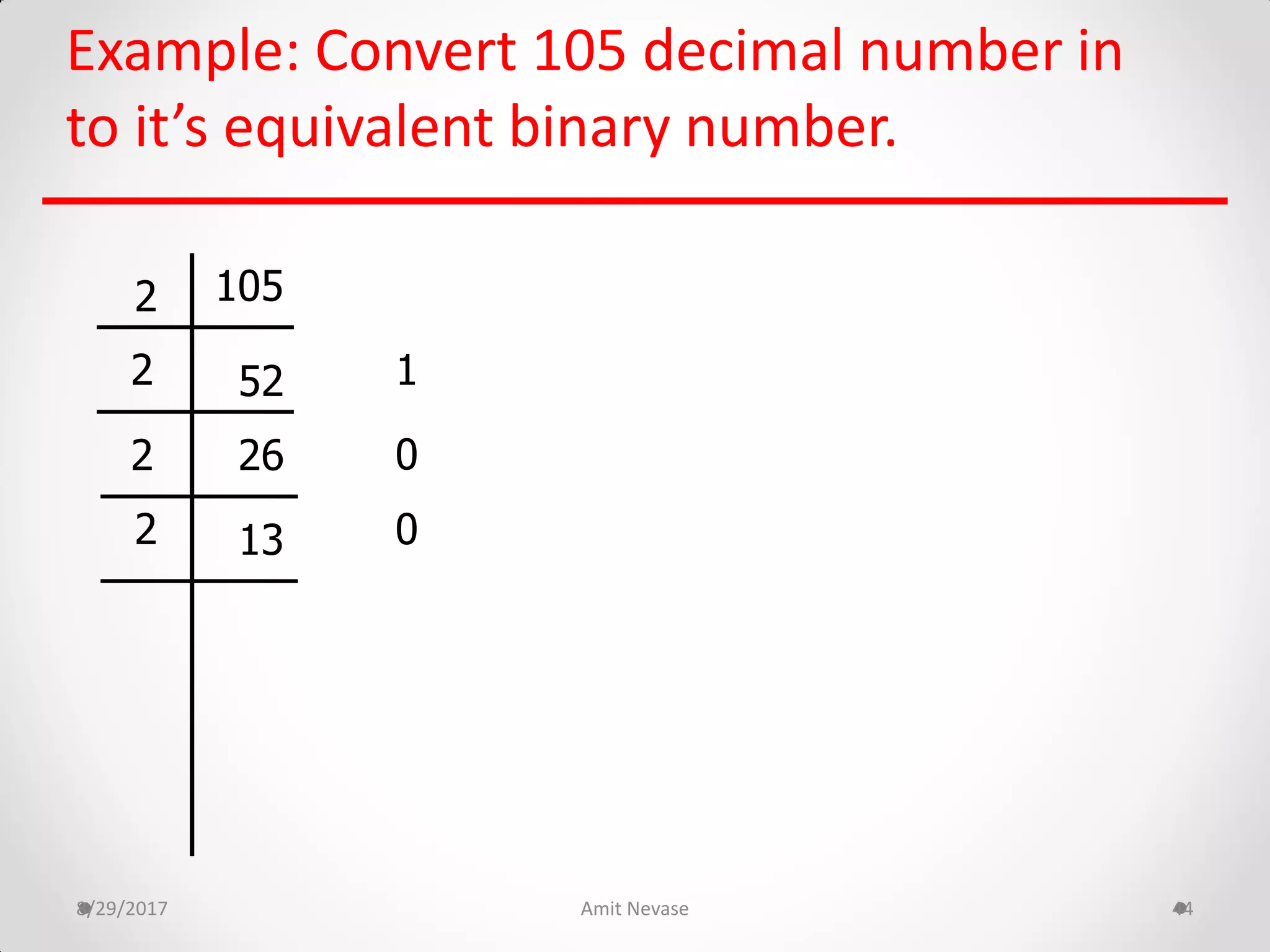
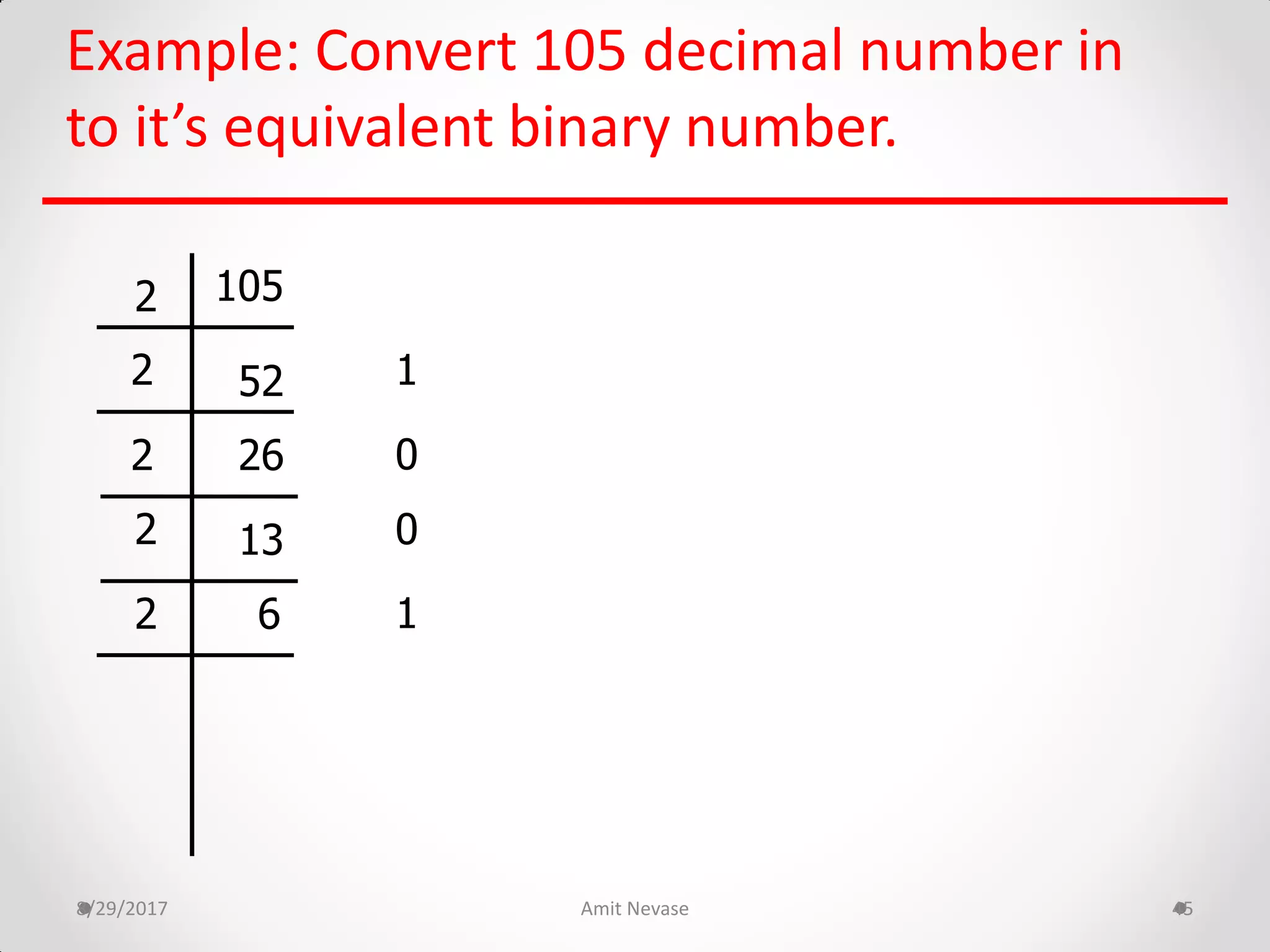
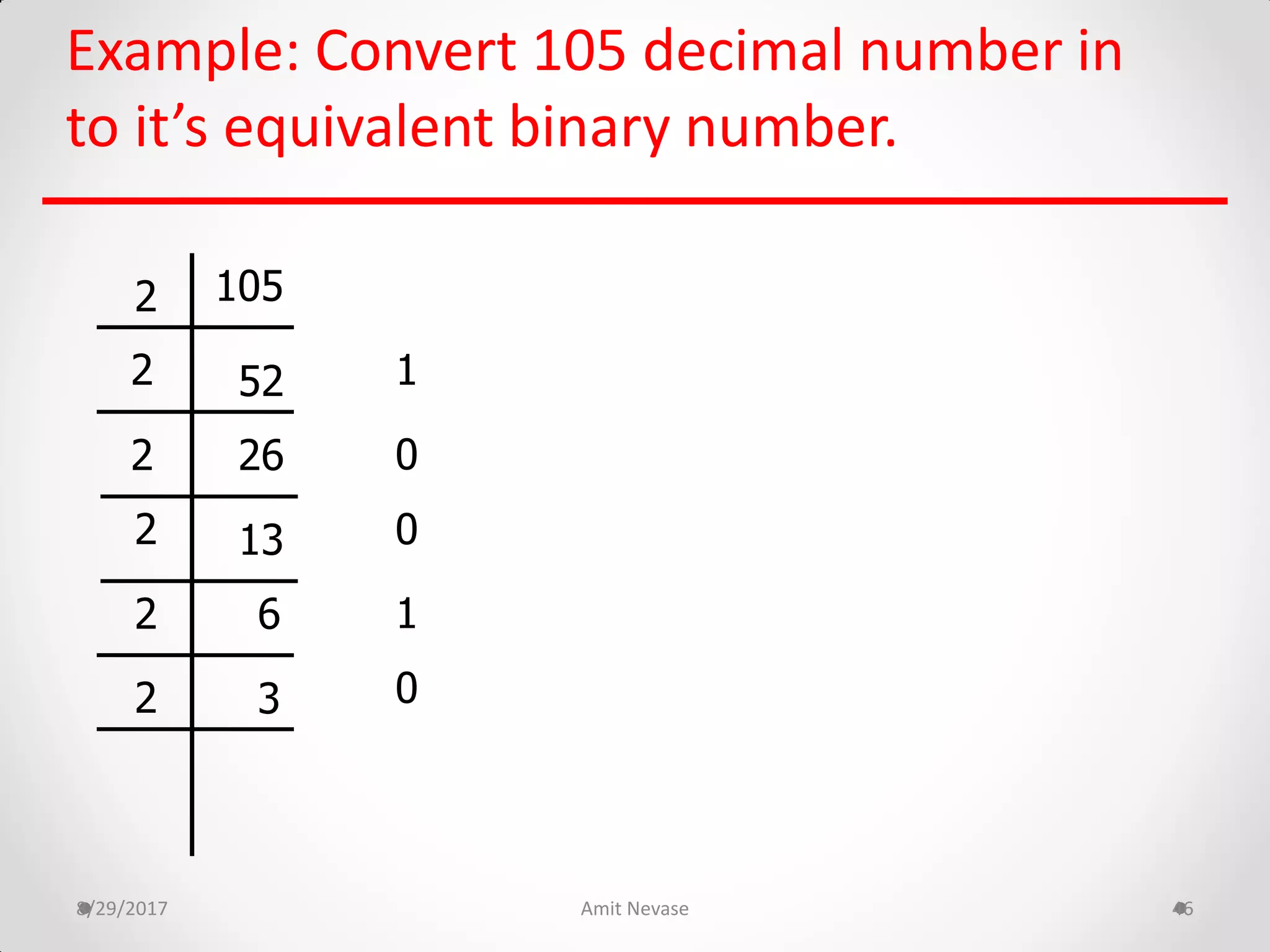
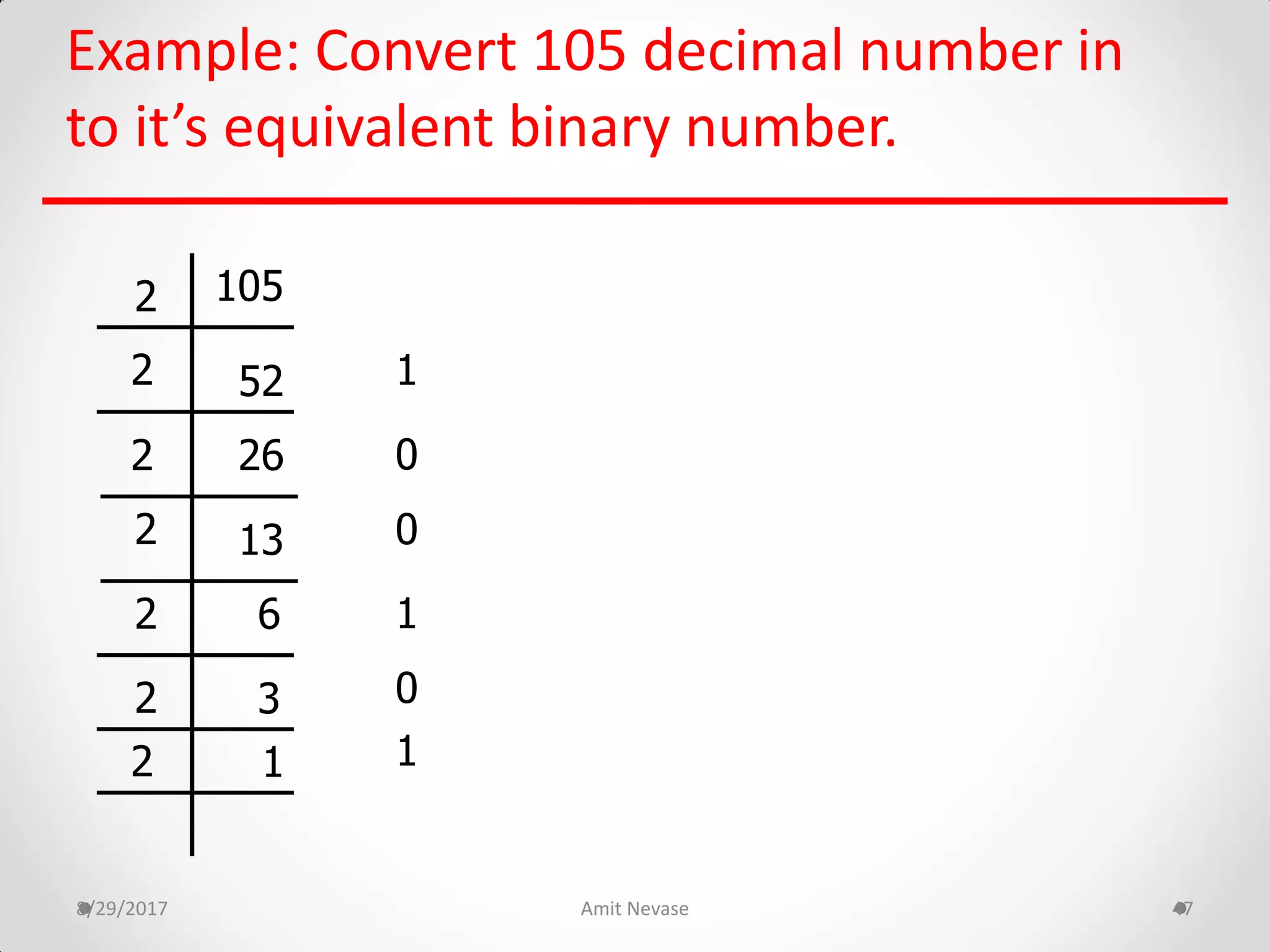
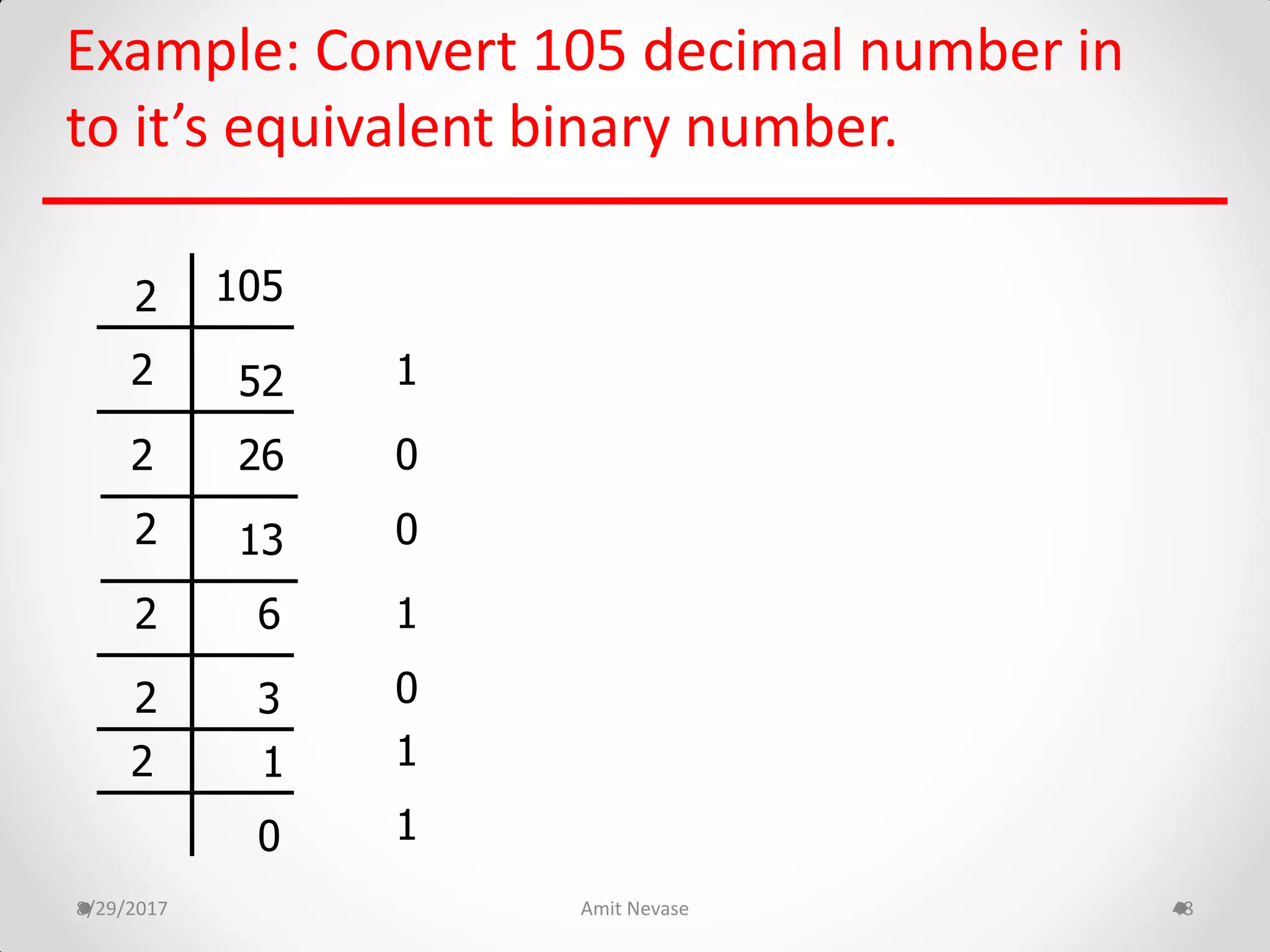
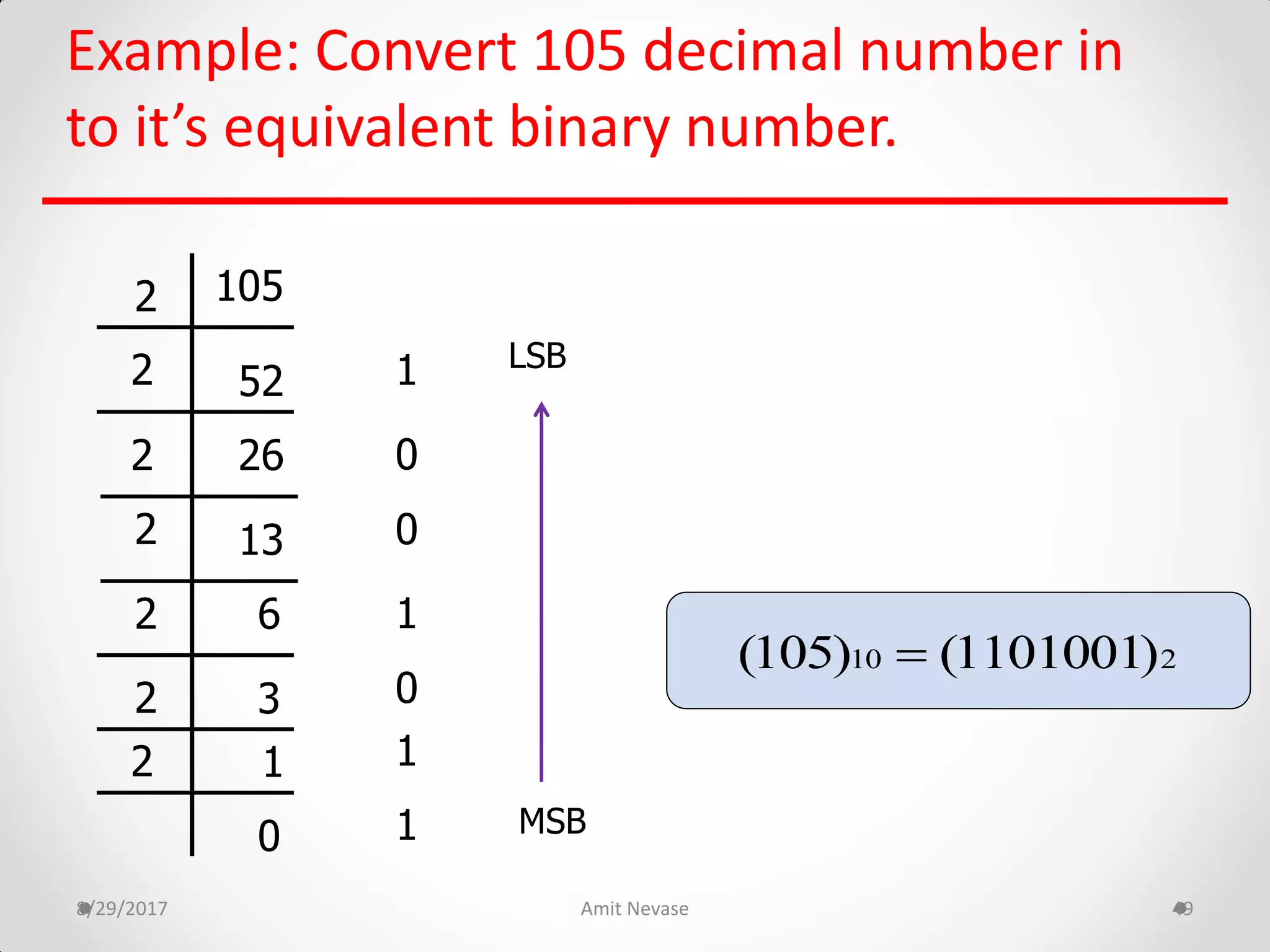
Procedure:
1. Divide the decimal no by the base 2, noting the
remainder.
2. Continue to divide the quotient by 2 until there
is nothing left, keeping the track of the
remainders from each step.
3. List the remainder values in reverse order to
find the number’s binary equivalent8/29/2017 Amit Nevase 39
Example: Convert 105 decimal number in
to it’s equivalent binary number.
8/29/2017 Amit Nevase 40
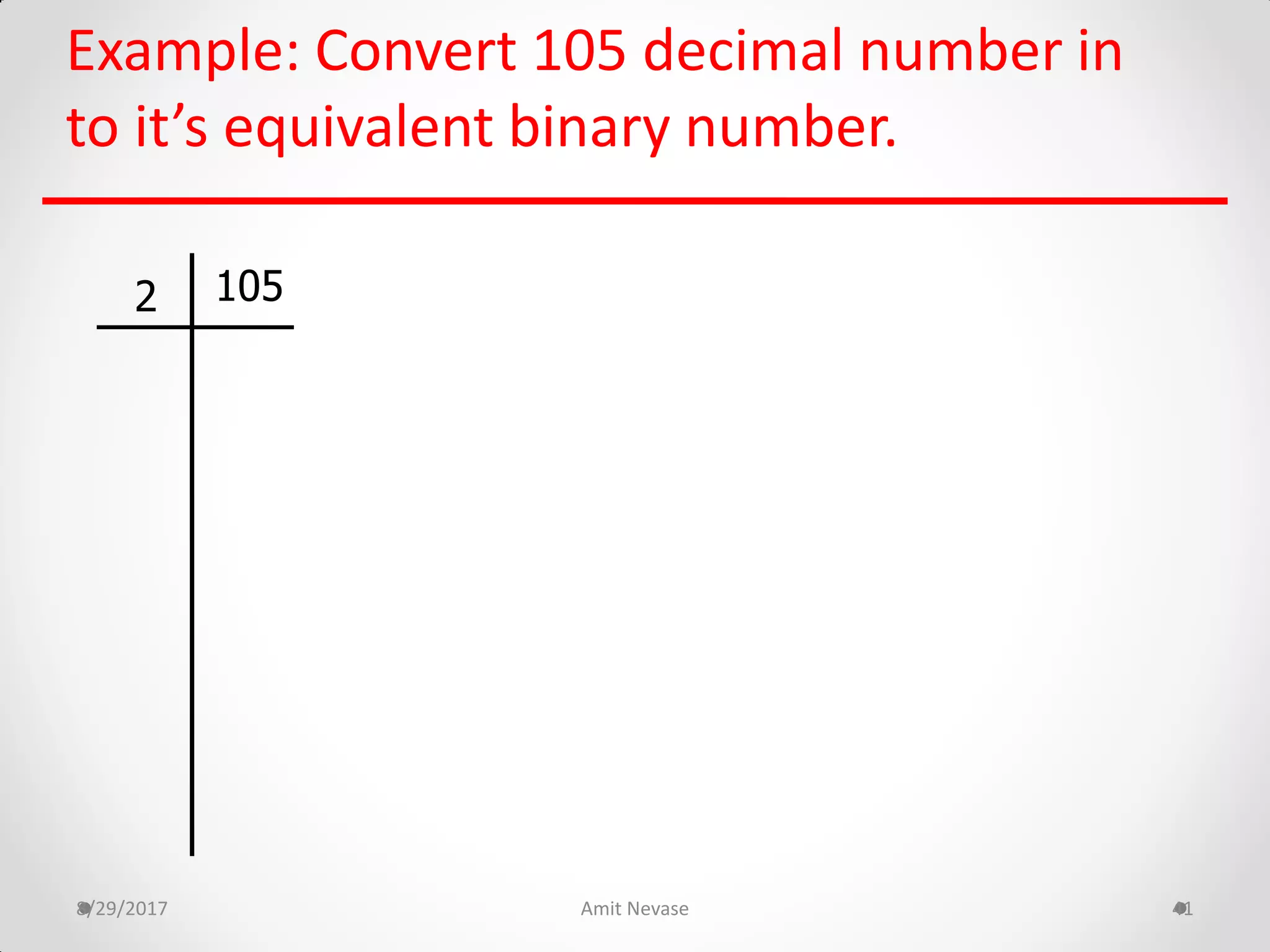
Example: Convert 105 decimal number in
to it’s equivalent binary number.
8/29/2017 Amit Nevase 41
1052
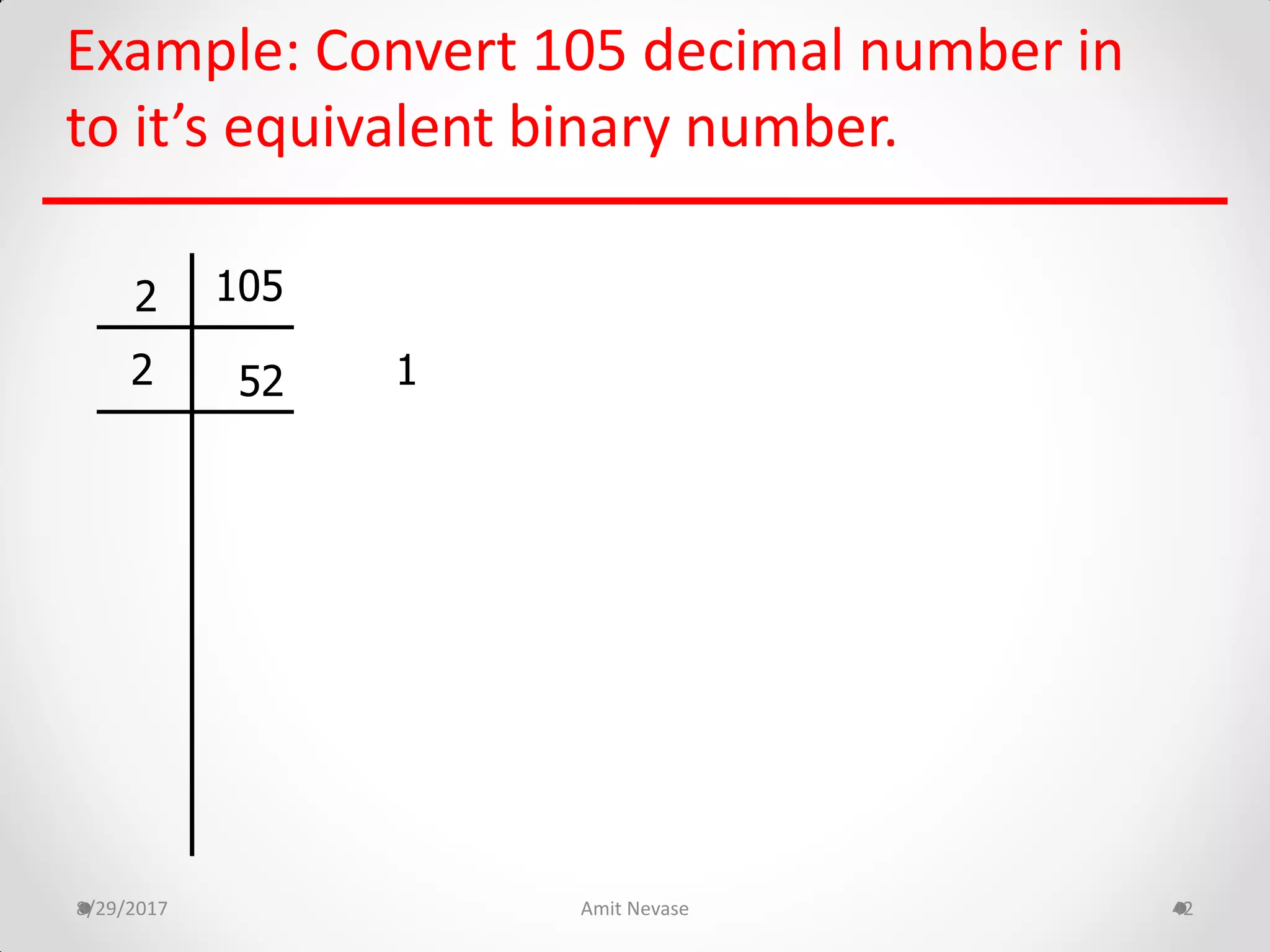
Example: Convert 105 decimal number in
to it’s equivalent binary number.
8/29/2017 Amit Nevase 42
105
52
2
2 1
Example: Convert 105 decimal number in
to it’s equivalent binary number.
8/29/2017 Amit Nevase 43
105
52
26
2
2
2
1
0
Example: Convert 105 decimal number in
to it’s equivalent binary number.
8/29/2017 Amit Nevase 44
105
52
26
13
2
2
2
2
1
0
0
Example: Convert 105 decimal number in
to it’s equivalent binary number.
8/29/2017 Amit Nevase 45
105
52
26
13
6
2
2
2
2
2
1
0
0
1
Example: Convert 105 decimal number in
to it’s equivalent binary number.
8/29/2017 Amit Nevase 46
105
52
26
13
6
3
2
2
2
2
2
2
1
0
0
0
1
Example: Convert 105 decimal number in
to it’s equivalent binary number.
8/29/2017 Amit Nevase 47
105
52
26
13
6
3
1
2
2
2
2
2
2
2
1
0
0
0
1
1
Example: Convert 105 decimal number in
to it’s equivalent binary number.
8/29/2017 Amit Nevase 48
105
52
26
13
6
3
1
0
2
2
2
2
2
2
2
1
0
0
0
1
1
1
Example: Convert 105 decimal number in
to it’s equivalent binary number.
8/29/2017 Amit Nevase 49
105
52
26
13
6
3
1
0
2
2
2
2
2
2
2
1
0
0
0
1
1
1
LSB
MSB
10 2(105) (1101001)
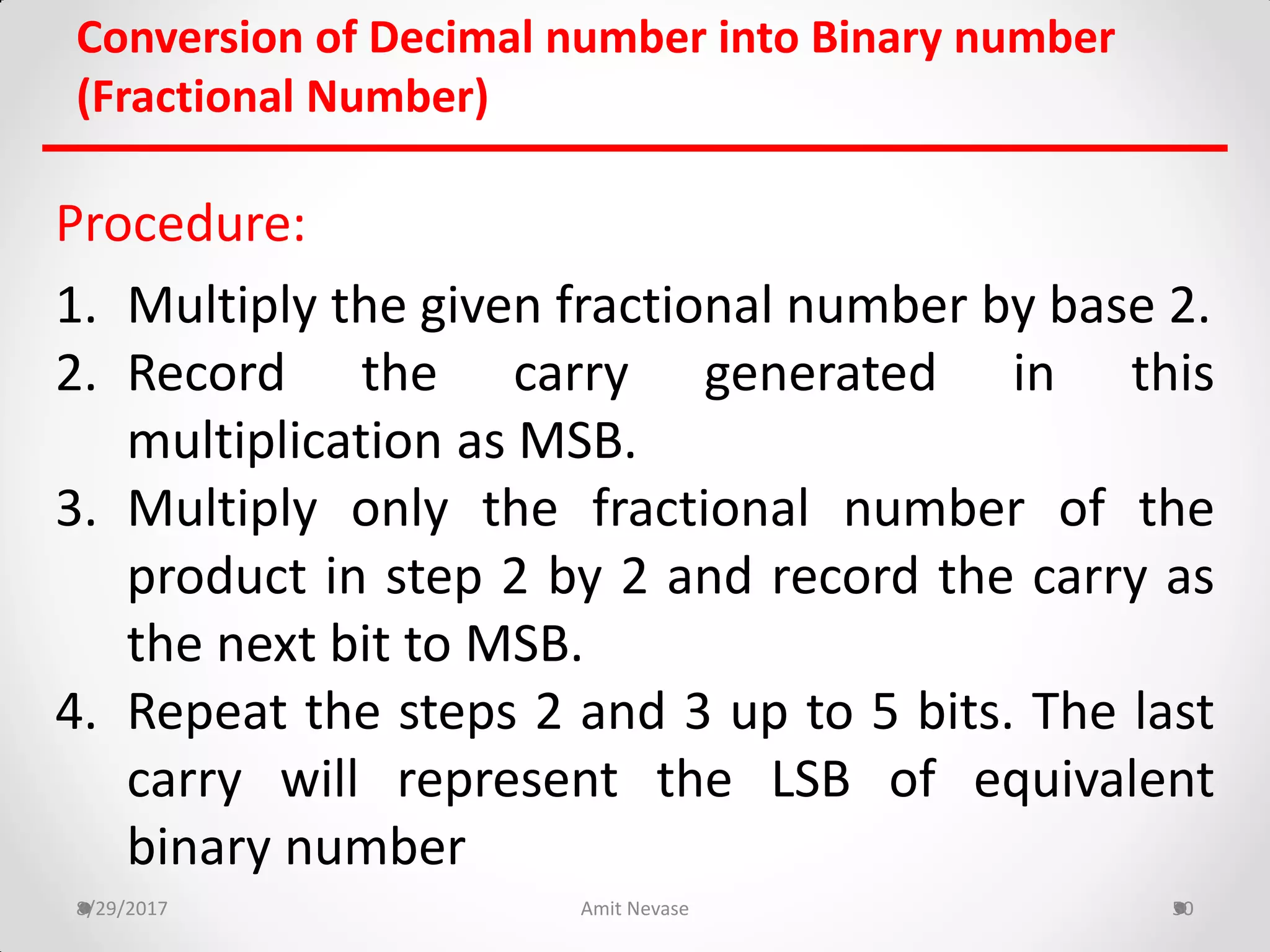
Procedure:
1. Multiply the given fractional number by base 2.
2. Record the carry generated in this
multiplication as MSB.
3. Multiply only the fractional number of the
product in step 2 by 2 and record the carry as
the next bit to MSB.
4. Repeat the steps 2 and 3 up to 5 bits. The last
carry will represent the LSB of equivalent
binary number
8/29/2017 Amit Nevase 50
Conversion of Decimal number into Binary number
(Fractional Number)
8/29/2017 Amit Nevase 51
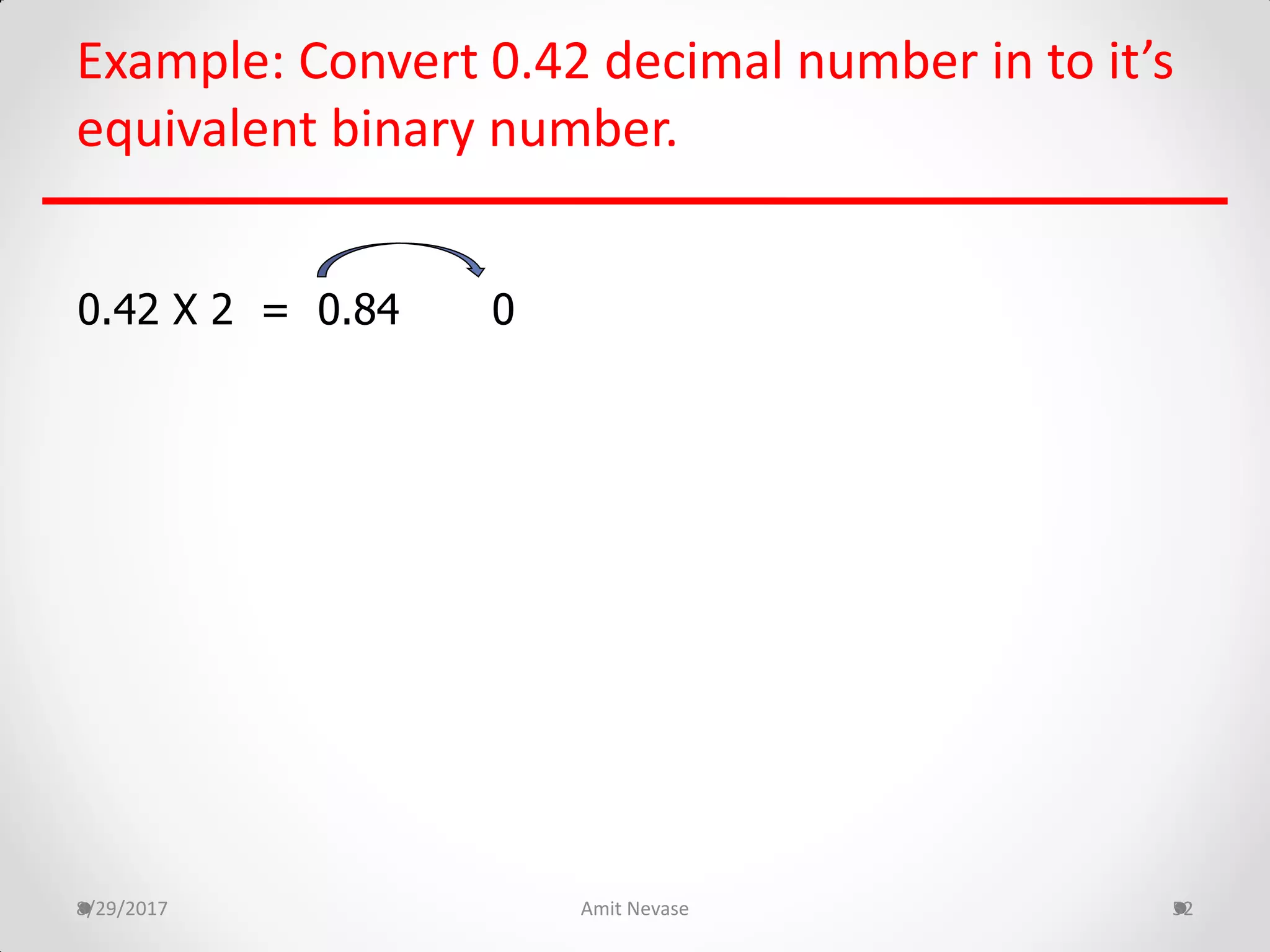
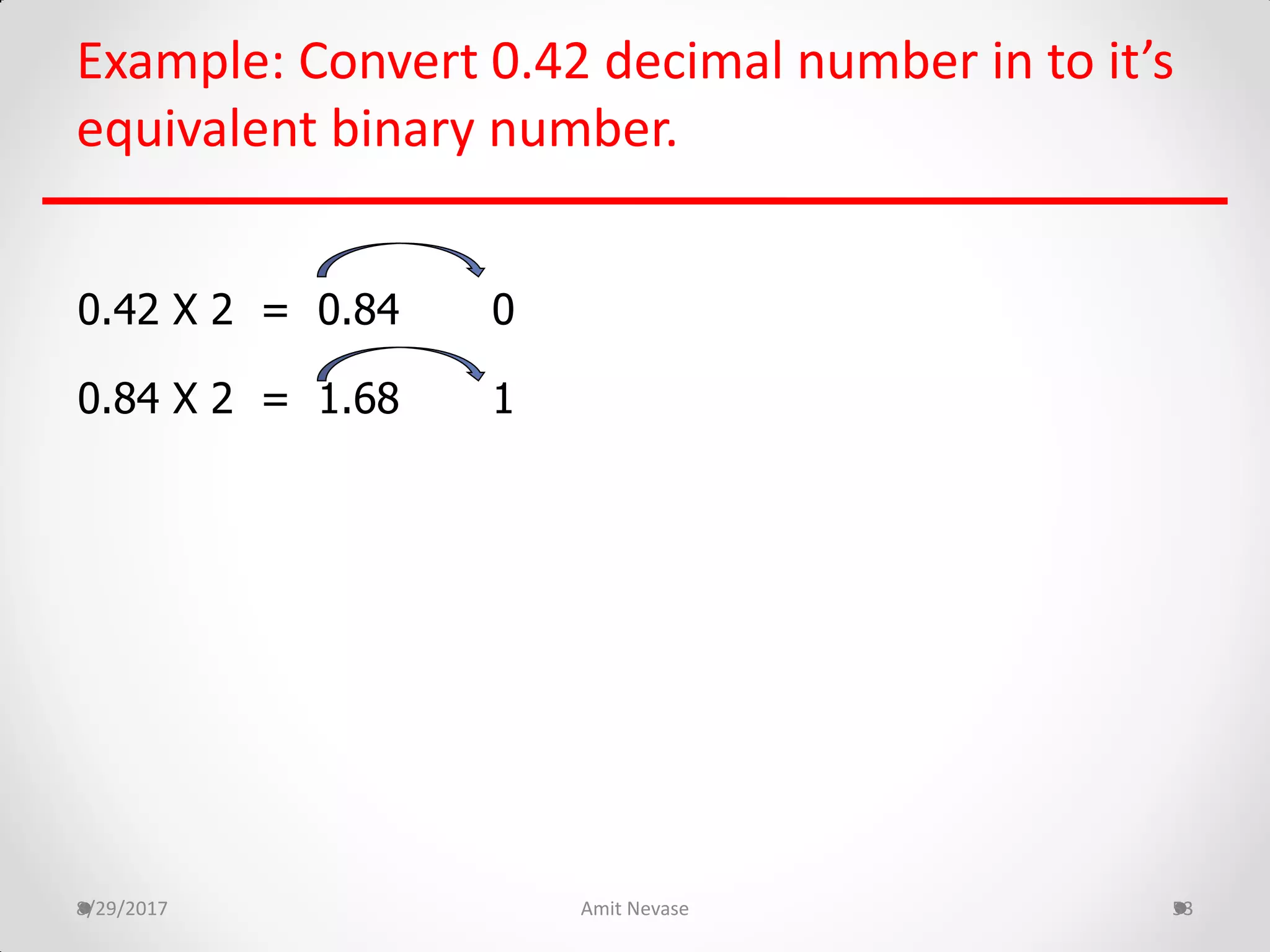
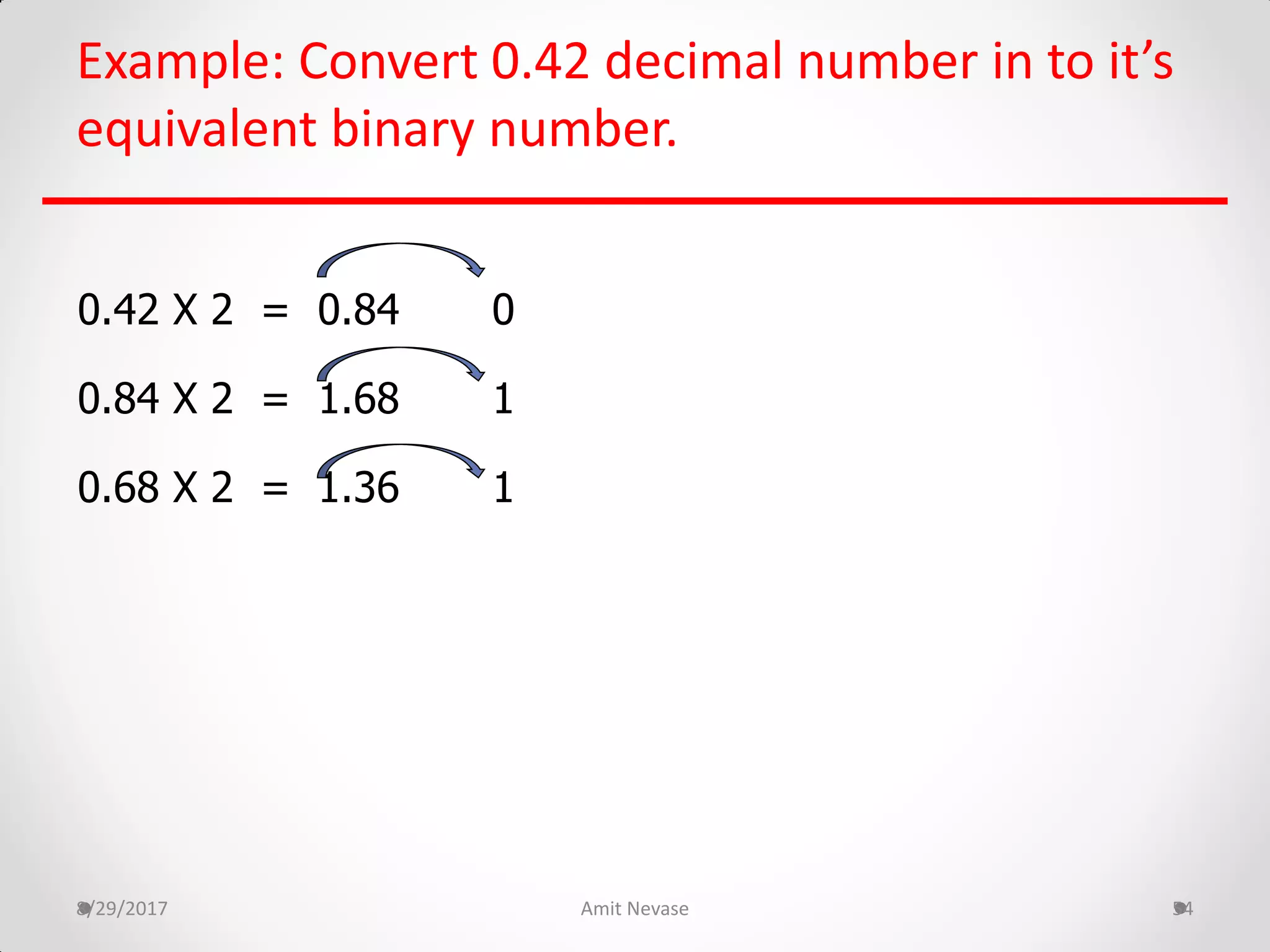
Example: Convert 0.42 decimal number in to it’s
equivalent binary number.
8/29/2017 Amit Nevase 52
Example: Convert 0.42 decimal number in to it’s
equivalent binary number.
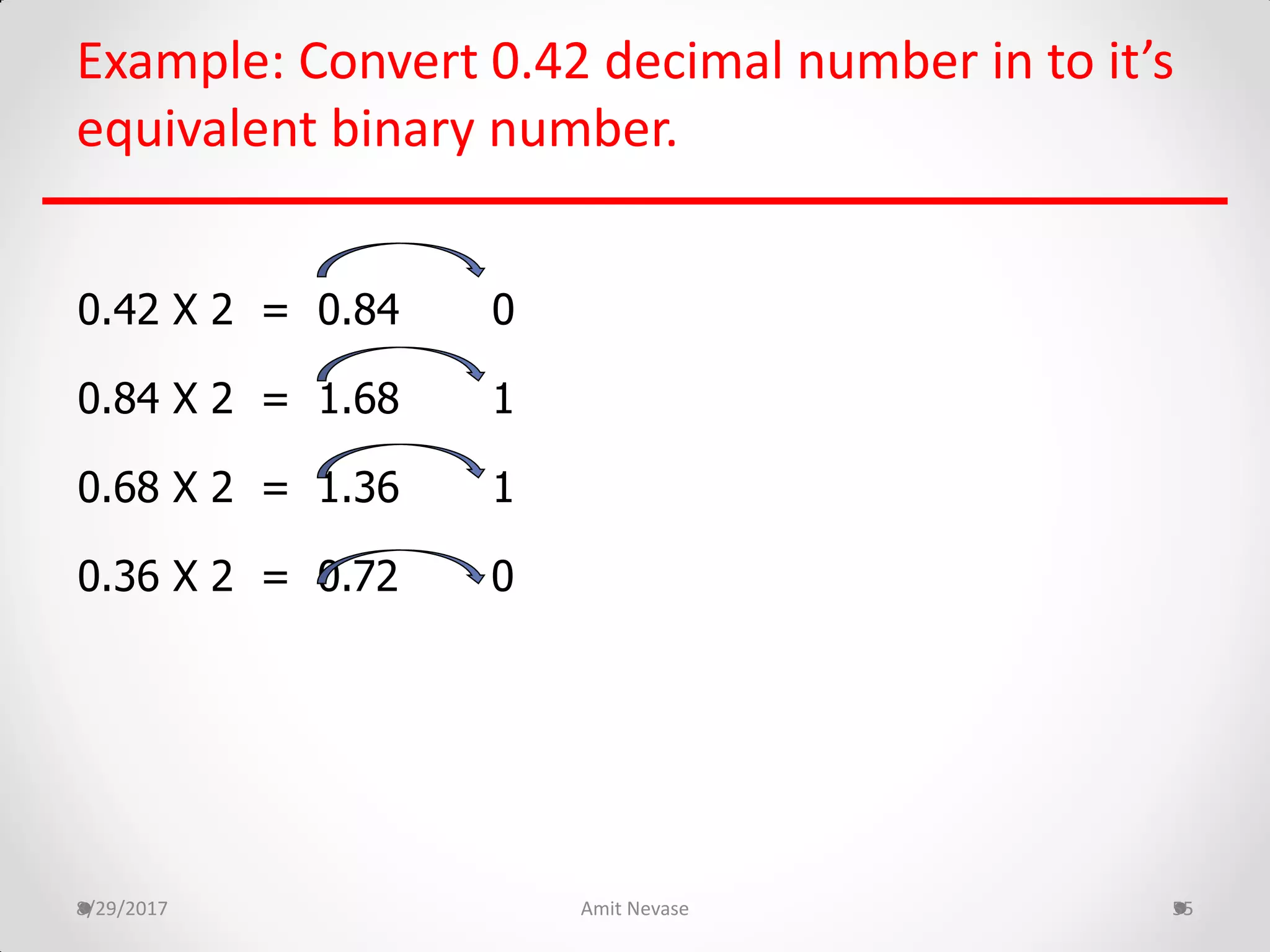
0.42 X 2 = 0.84 0
8/29/2017 Amit Nevase 53
Example: Convert 0.42 decimal number in to it’s
equivalent binary number.
0.42 X 2 = 0.84 0
0.84 X 2 = 1.68 1
8/29/2017 Amit Nevase 54
Example: Convert 0.42 decimal number in to it’s
equivalent binary number.
0.42 X 2 = 0.84 0
0.84 X 2 = 1.68 1
0.68 X 2 = 1.36 1
8/29/2017 Amit Nevase 55
Example: Convert 0.42 decimal number in to it’s
equivalent binary number.
0.42 X 2 = 0.84 0
0.84 X 2 = 1.68 1
0.68 X 2 = 1.36 1
0.36 X 2 = 0.72 0
8/29/2017 Amit Nevase 56
Example: Convert 0.42 decimal number in to it’s
equivalent binary number.
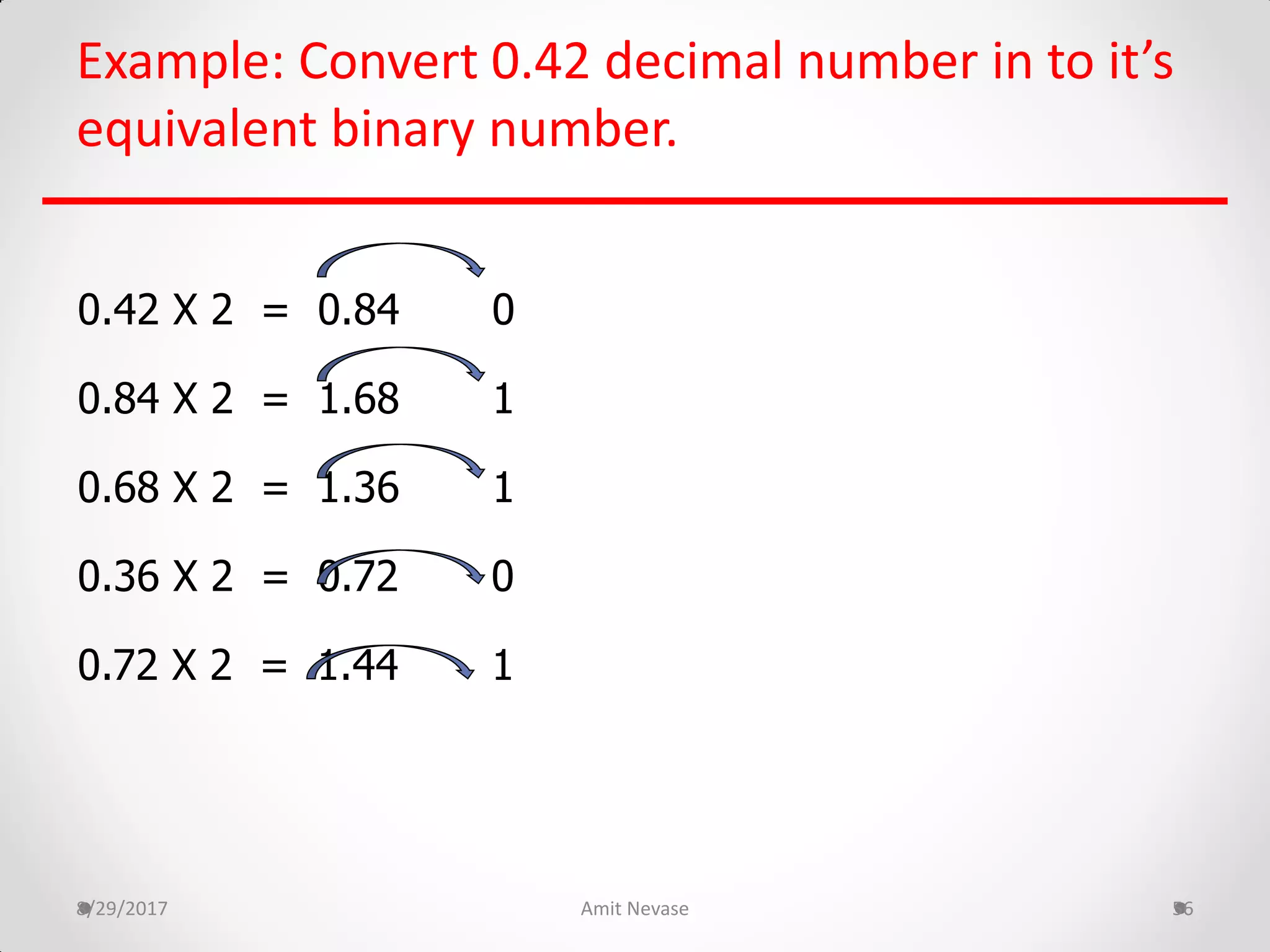
0.42 X 2 = 0.84 0
0.84 X 2 = 1.68 1
0.68 X 2 = 1.36 1
0.36 X 2 = 0.72 0
0.72 X 2 = 1.44 1
8/29/2017 Amit Nevase 57
Example: Convert 0.42 decimal number in to it’s
equivalent binary number.
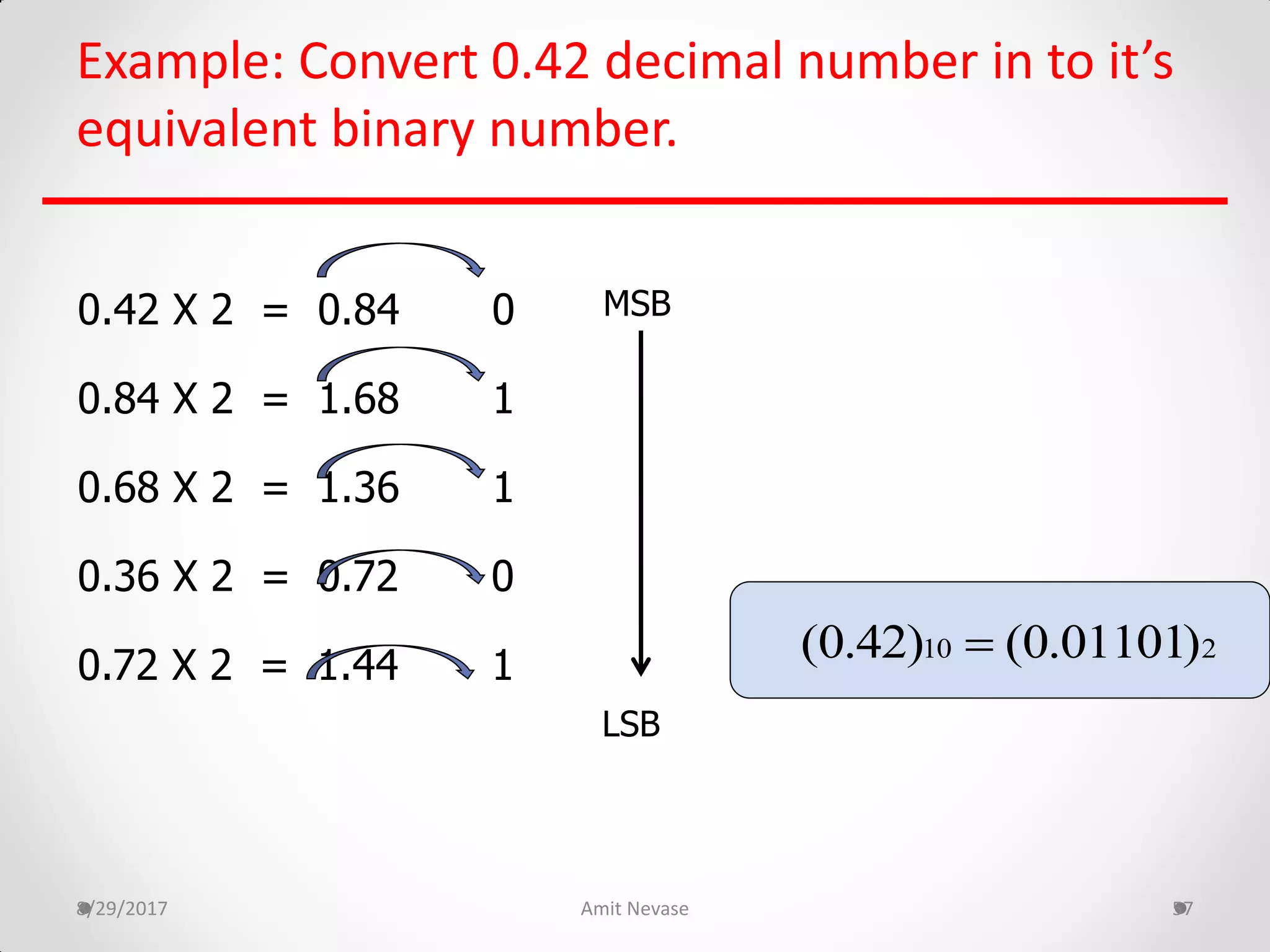
0.42 X 2 = 0.84 0
0.84 X 2 = 1.68 1
0.68 X 2 = 1.36 1
0.36 X 2 = 0.72 0
0.72 X 2 = 1.44 1
LSB
MSB
10 2(0.42) (0.01101)
8/29/2017 Amit Nevase 58
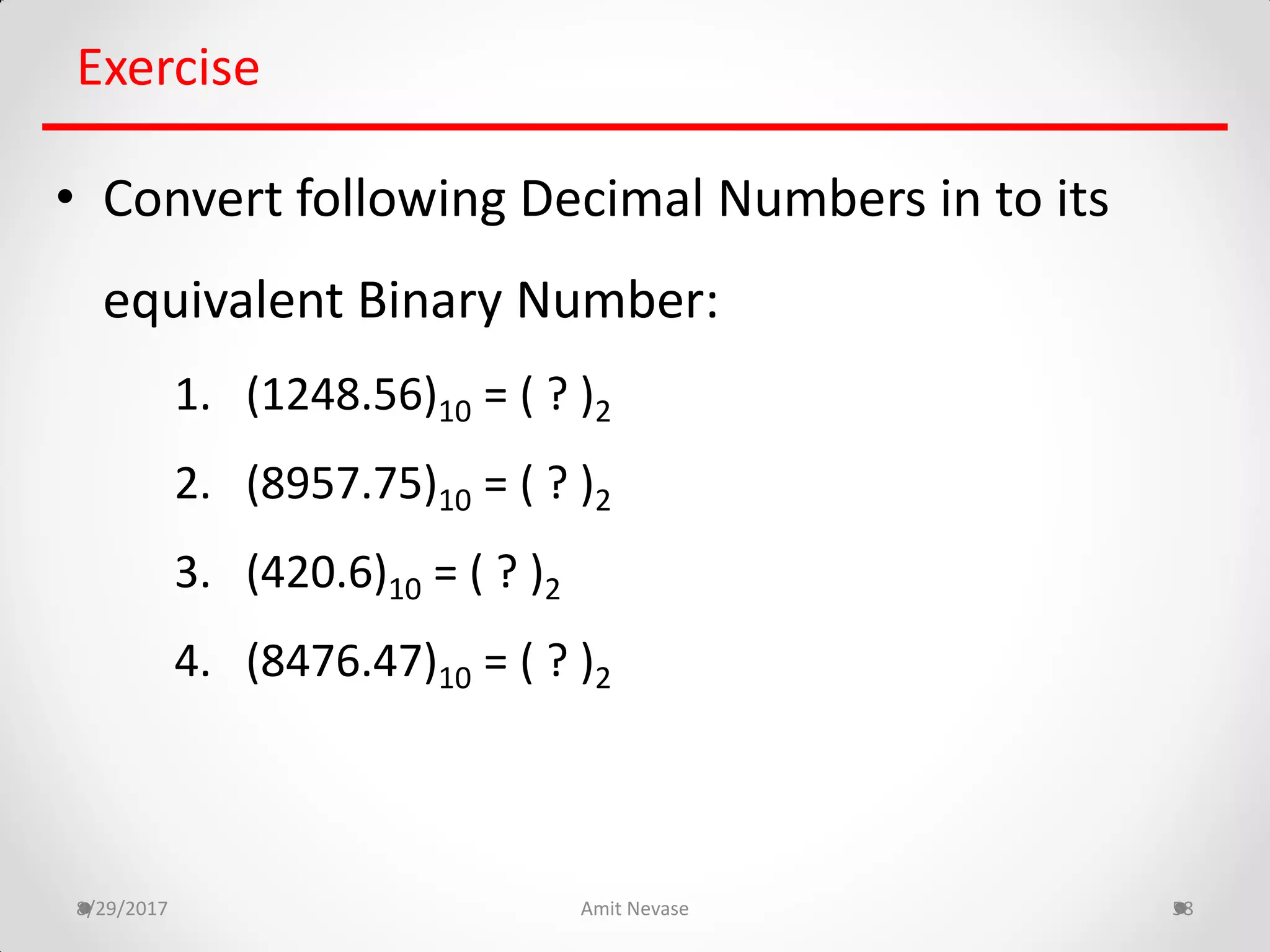
Exercise
• Convert following Decimal Numbers in to its
equivalent Binary Number:
1. (1248.56)10 = ( ? )2
2. (8957.75)10 = ( ? )2
3. (420.6)10 = ( ? )2
4. (8476.47)10 = ( ? )2
8/29/2017 Amit Nevase 59
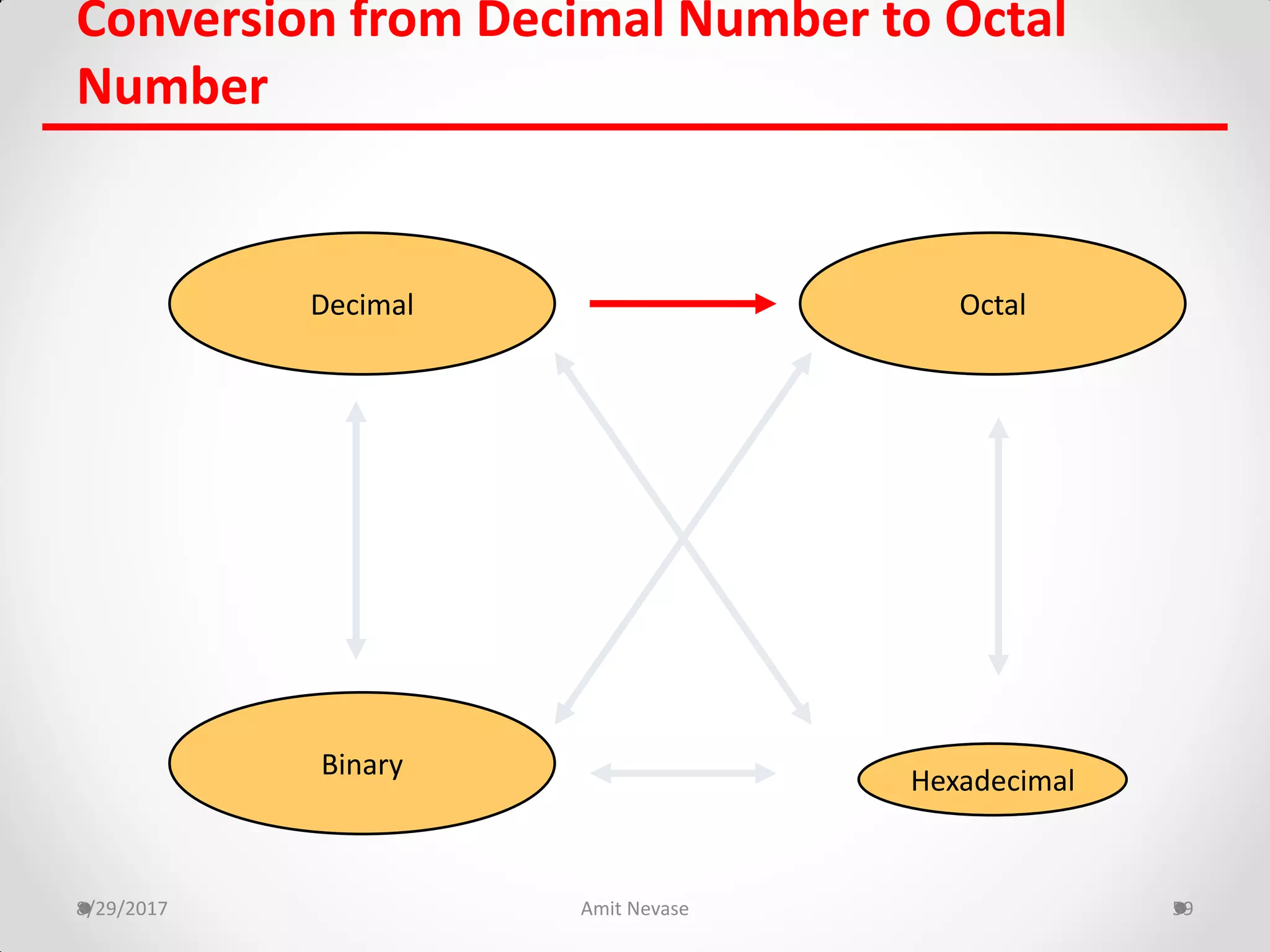
Conversion from Decimal Number to Octal
Number
Hexadecimal
Decimal Octal
Binary
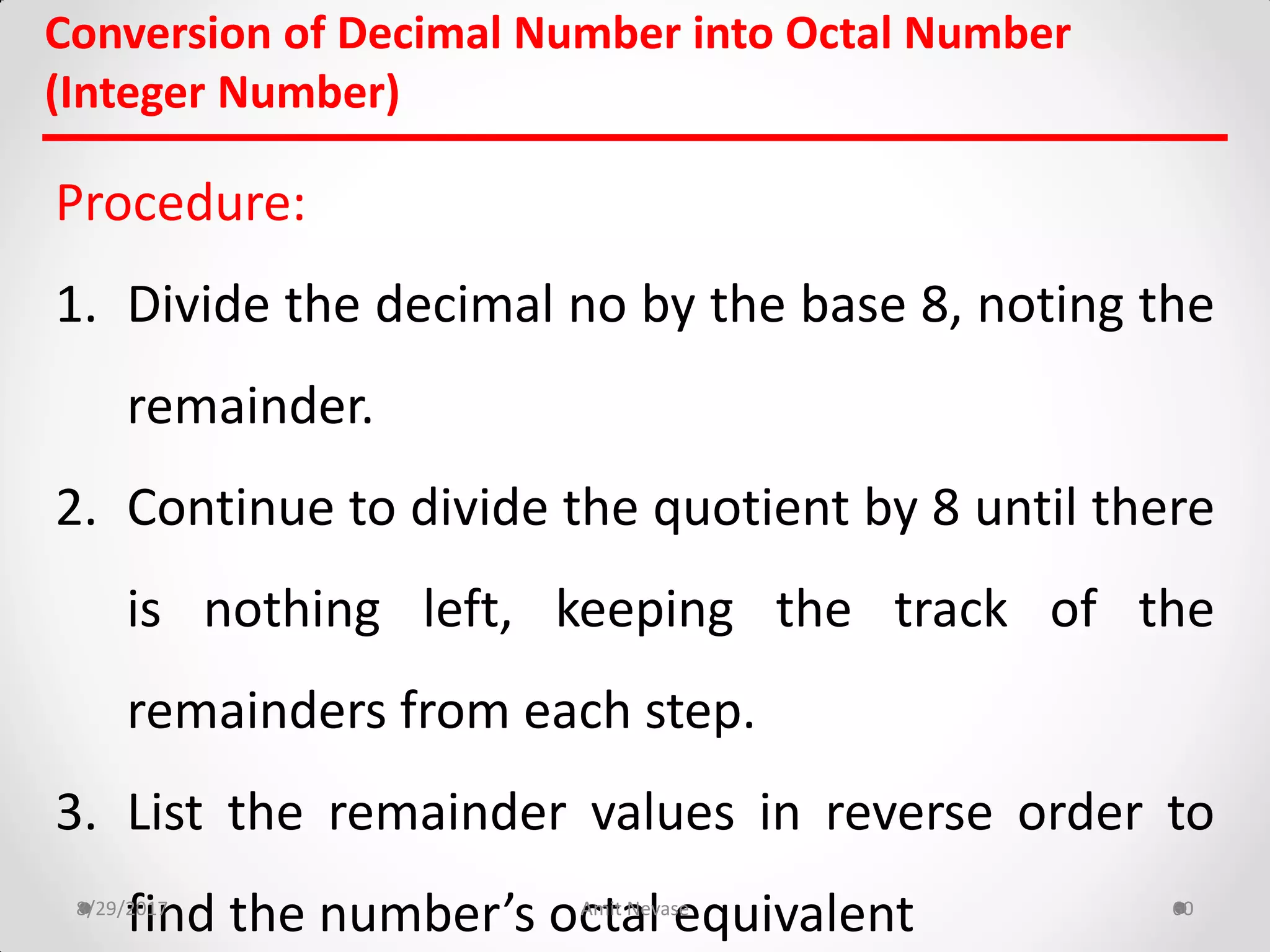
Conversion of Decimal Number into Octal Number
(Integer Number)
Procedure:
1. Divide the decimal no by the base 8, noting the
remainder.
2. Continue to divide the quotient by 8 until there
is nothing left, keeping the track of the
remainders from each step.
3. List the remainder values in reverse order to
find the number’s octal equivalent8/29/2017 Amit Nevase 60
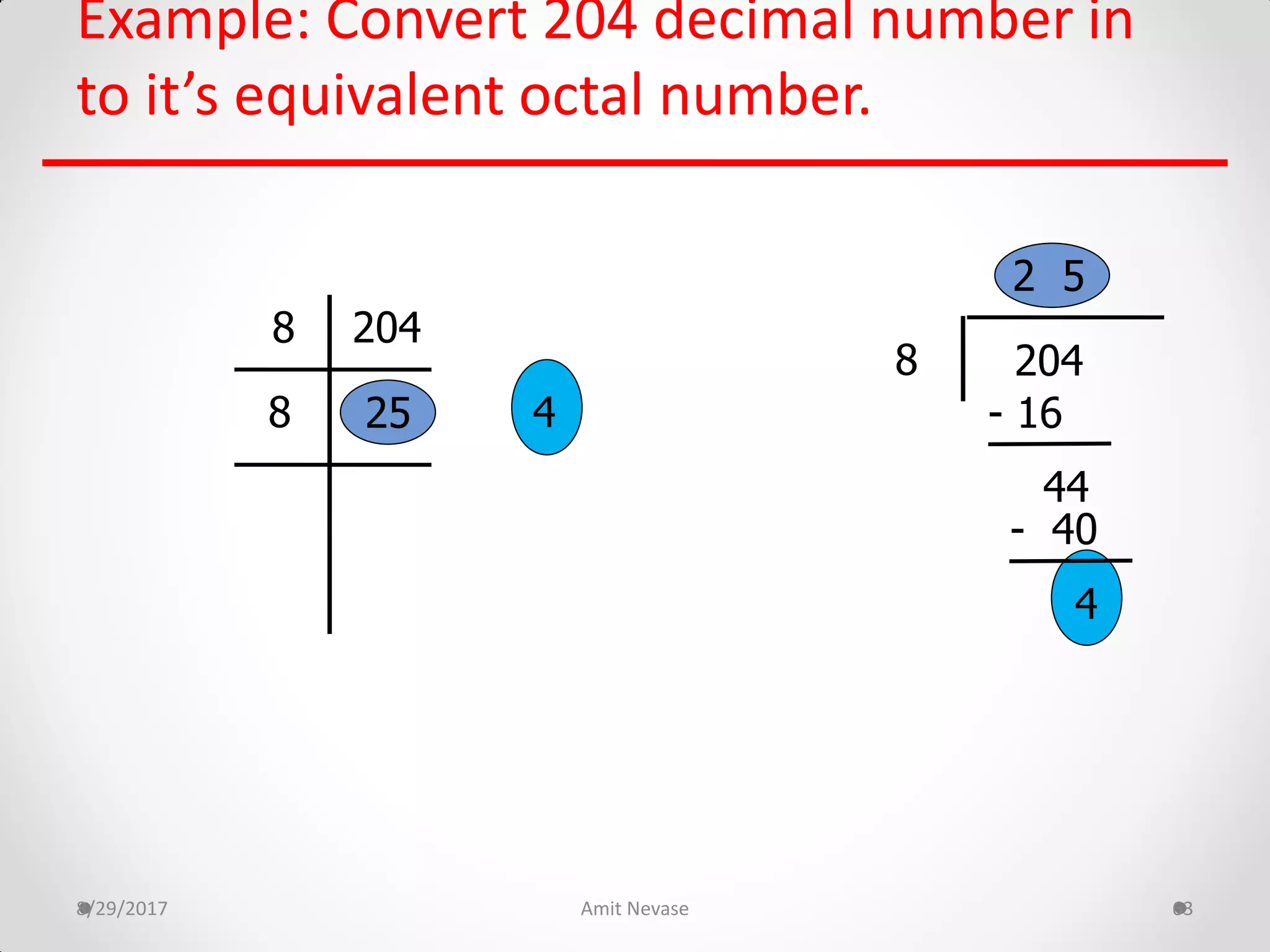
Example: Convert 204 decimal number in
to it’s equivalent octal number.
8/29/2017 Amit Nevase 61
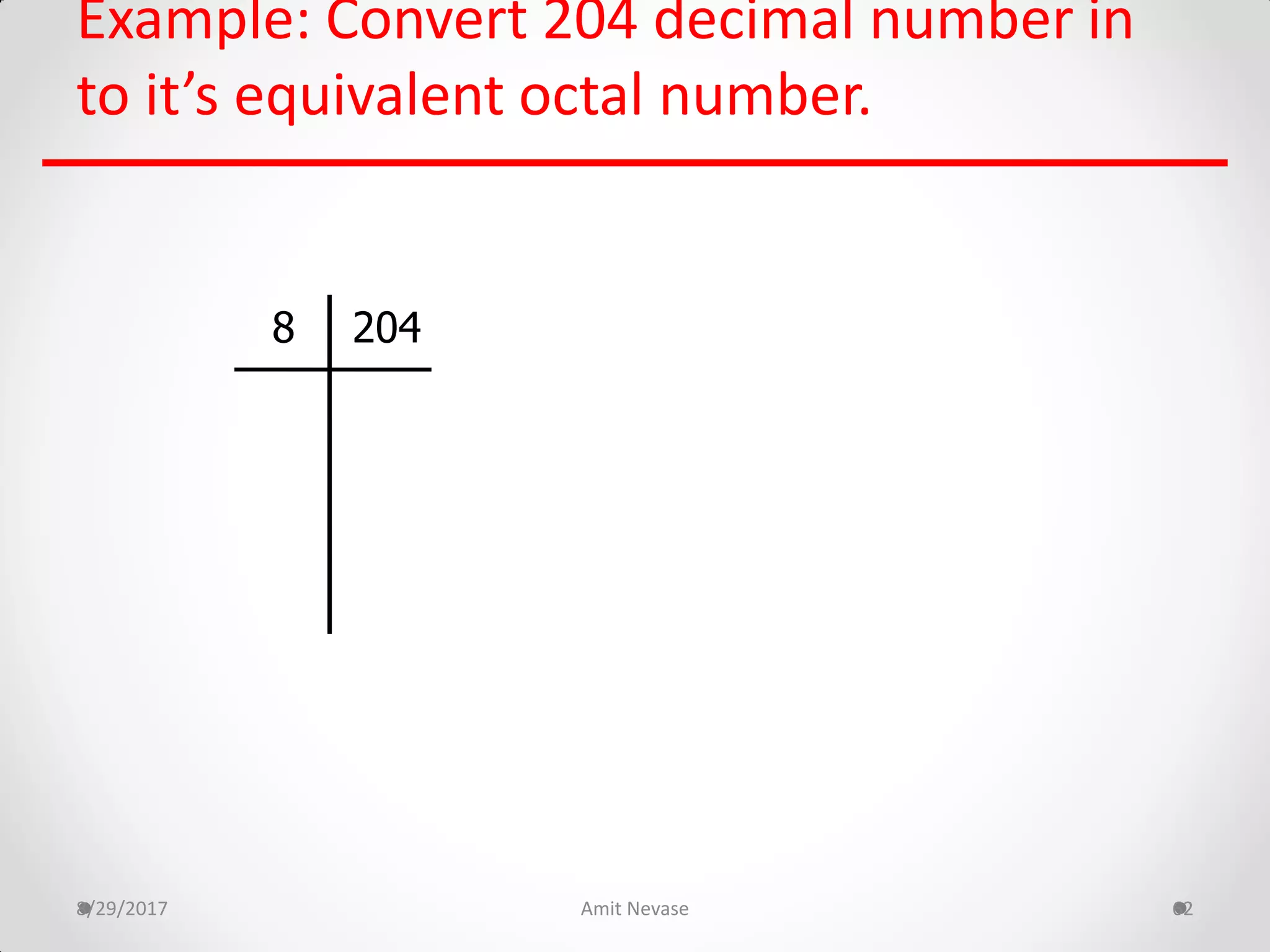
Example: Convert 204 decimal number in
to it’s equivalent octal number.
8/29/2017 Amit Nevase 62
2048
Example: Convert 204 decimal number in
to it’s equivalent octal number.
8/29/2017 Amit Nevase 63
2048
48 25
2048
2 5
- 16
44
- 40
4
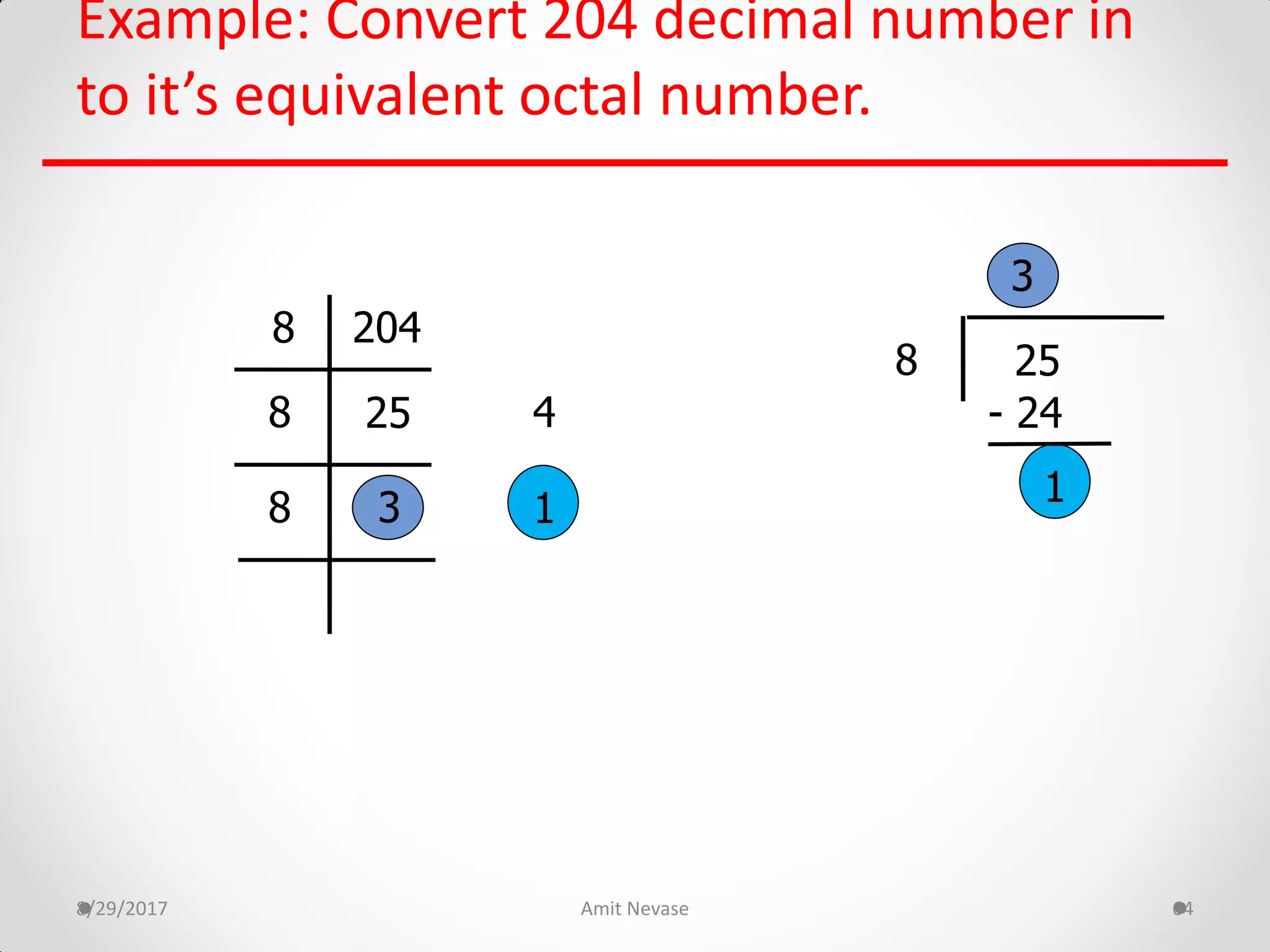
Example: Convert 204 decimal number in
to it’s equivalent octal number.
8/29/2017 Amit Nevase 64
2048
4
1
8
8
25
3
258
3
- 24
1
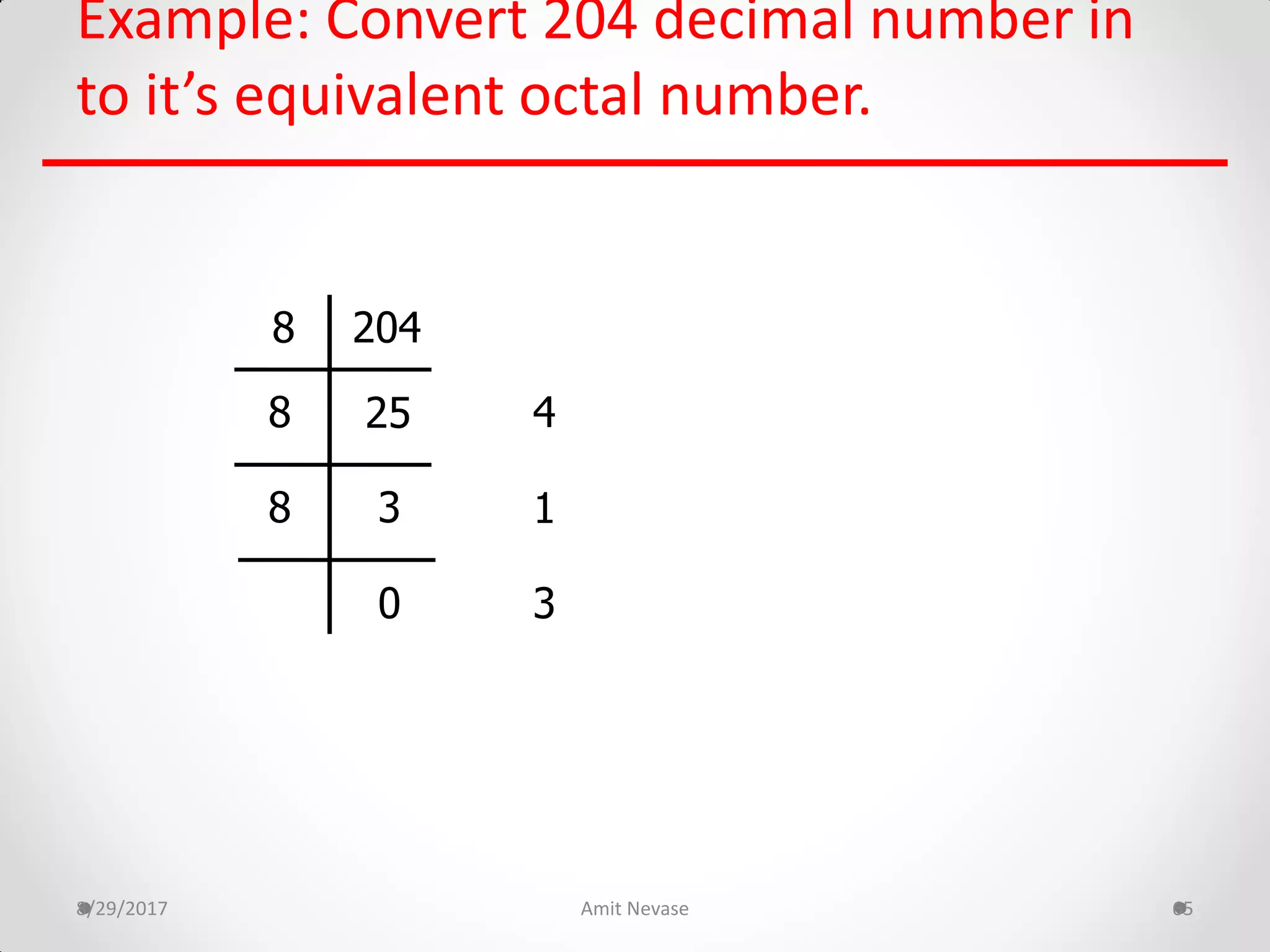
Example: Convert 204 decimal number in
to it’s equivalent octal number.
8/29/2017 Amit Nevase 65
2048
4
3
1
8
8
25
3
0
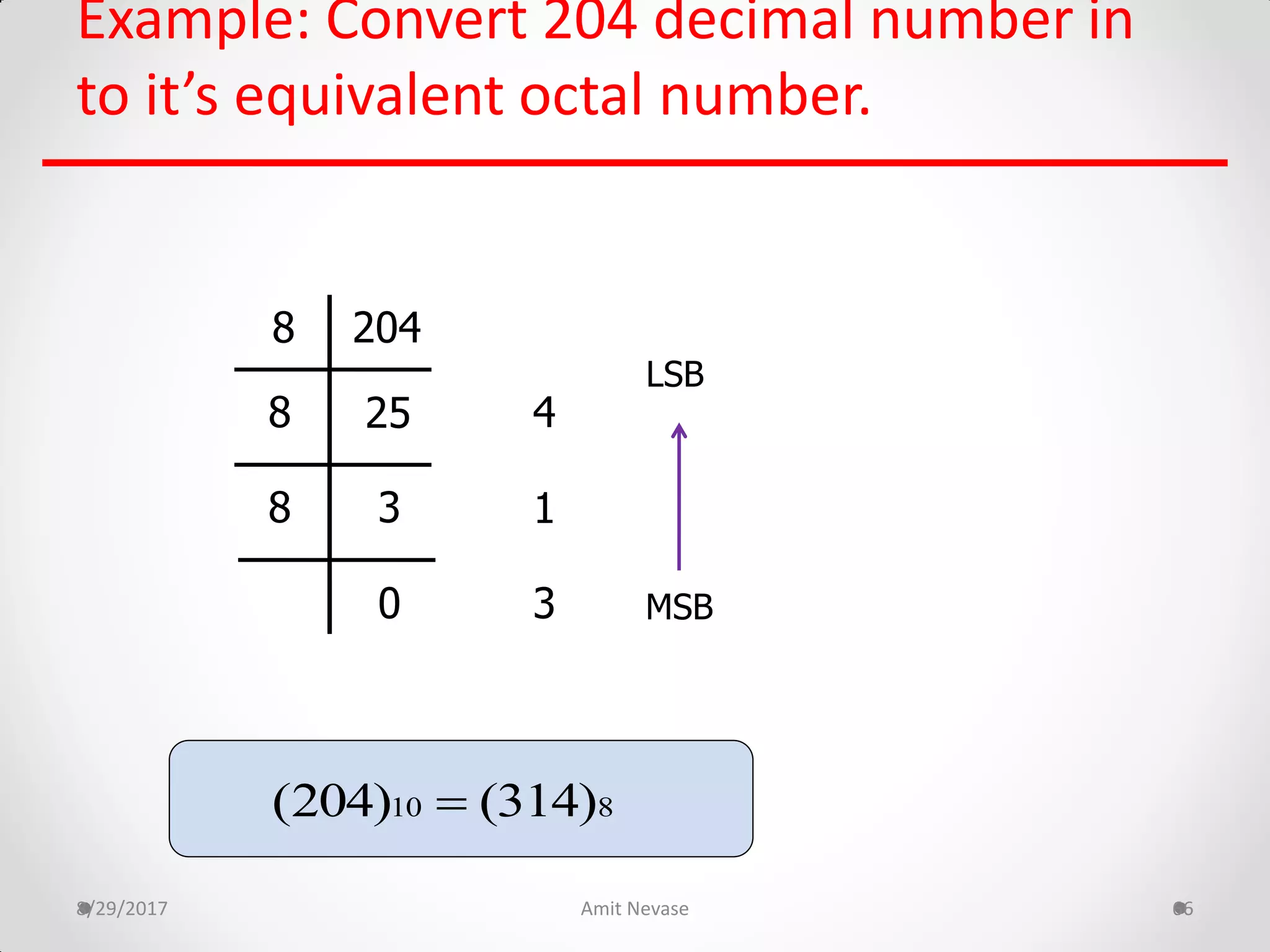
Example: Convert 204 decimal number in
to it’s equivalent octal number.
8/29/2017 Amit Nevase 66
2048
4
3
1
LSB
MSB
8
8
25
3
0
10 8(204) (314)
Procedure:
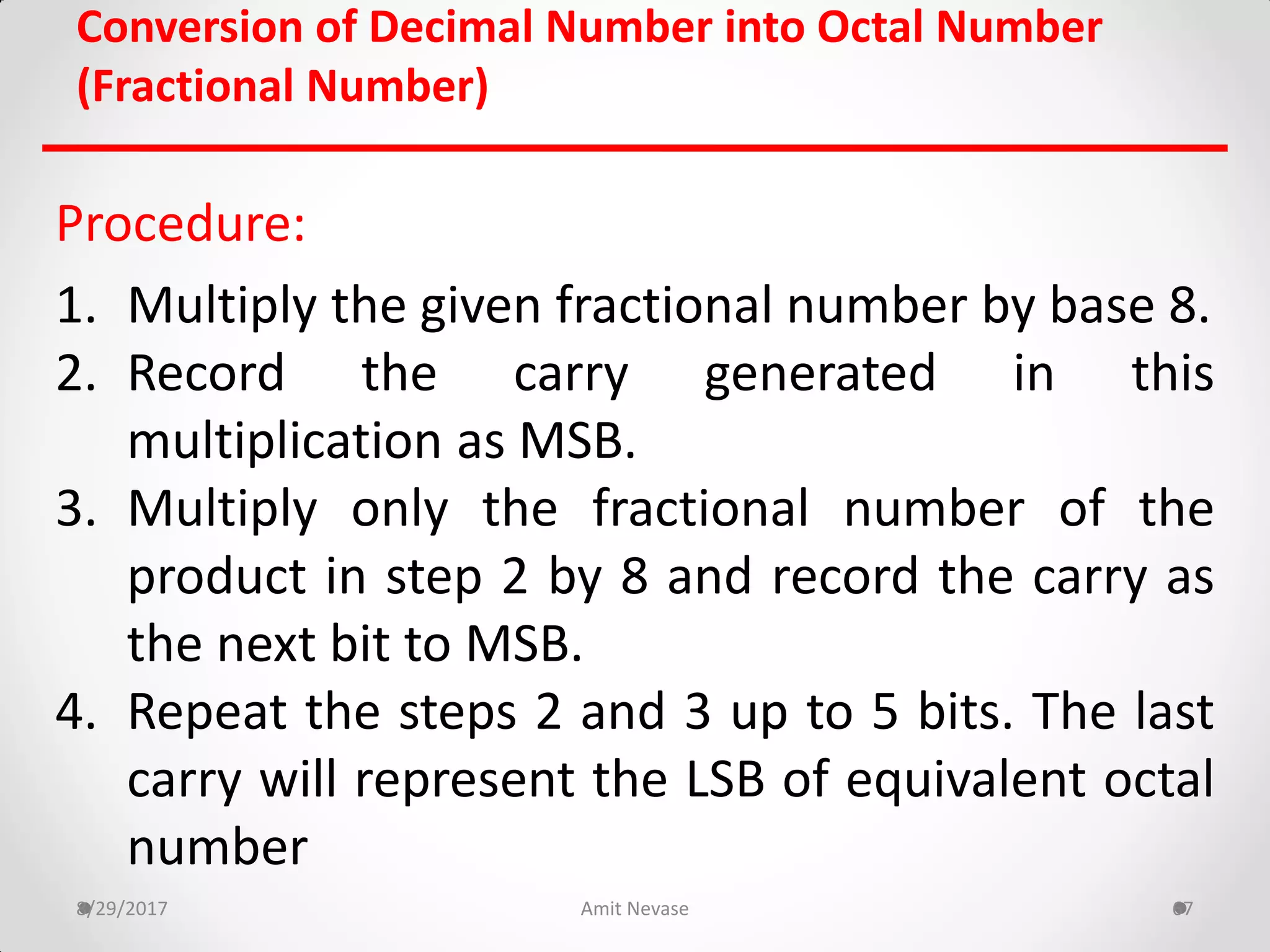
1. Multiply the given fractional number by base 8.
2. Record the carry generated in this
multiplication as MSB.
3. Multiply only the fractional number of the
product in step 2 by 8 and record the carry as
the next bit to MSB.
4. Repeat the steps 2 and 3 up to 5 bits. The last
carry will represent the LSB of equivalent octal
number
8/29/2017 Amit Nevase 67
Conversion of Decimal Number into Octal Number
(Fractional Number)
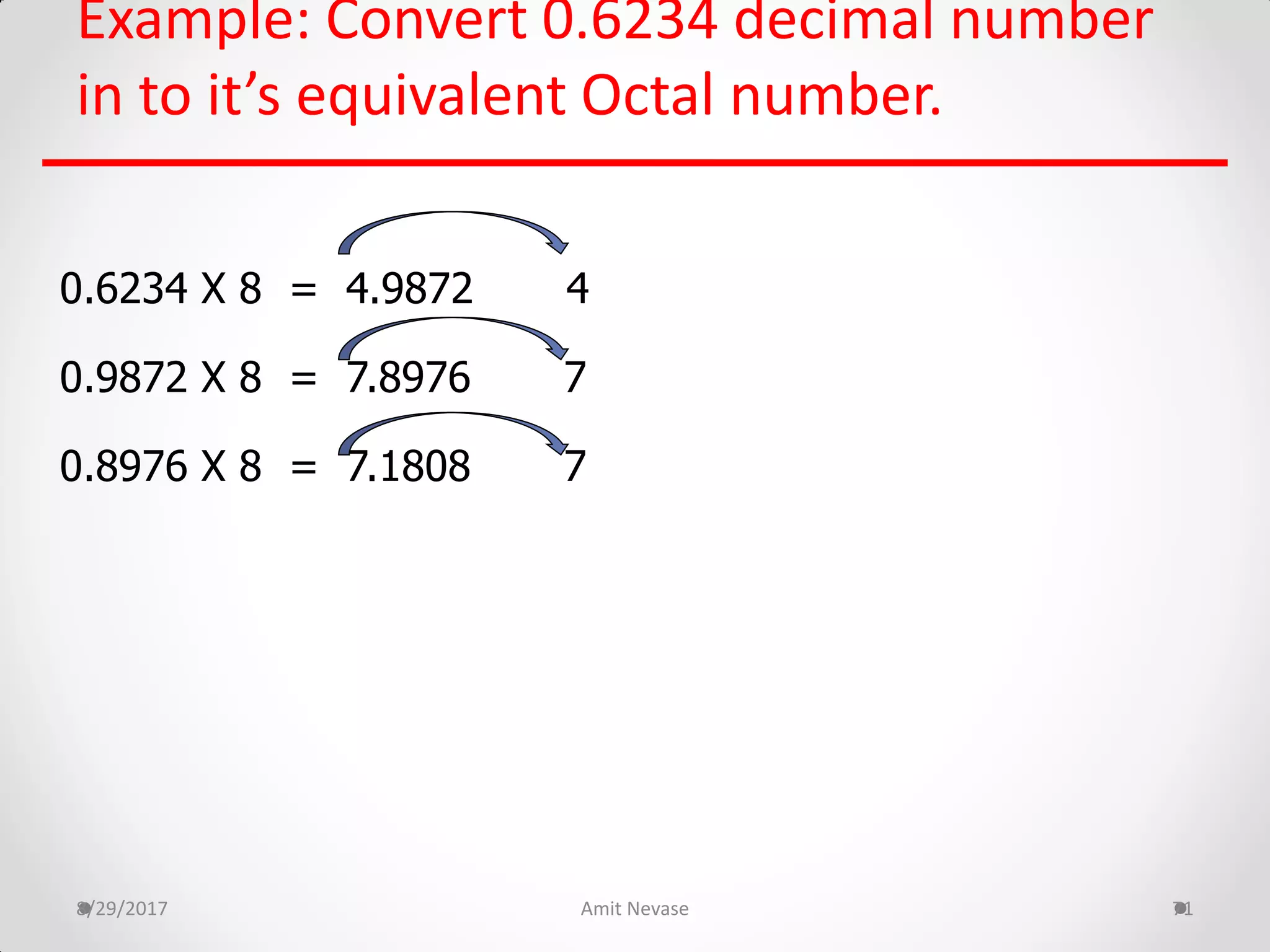
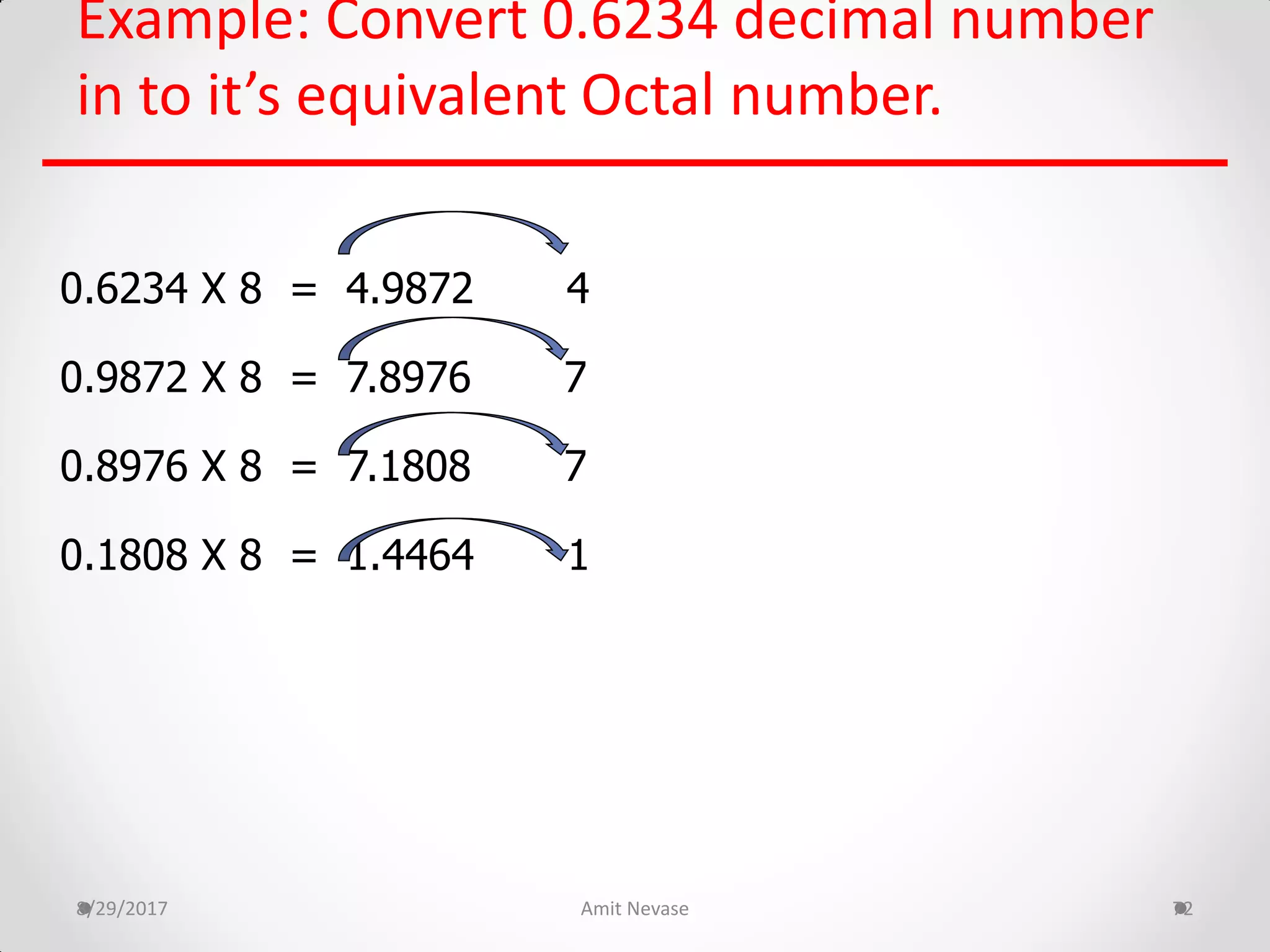
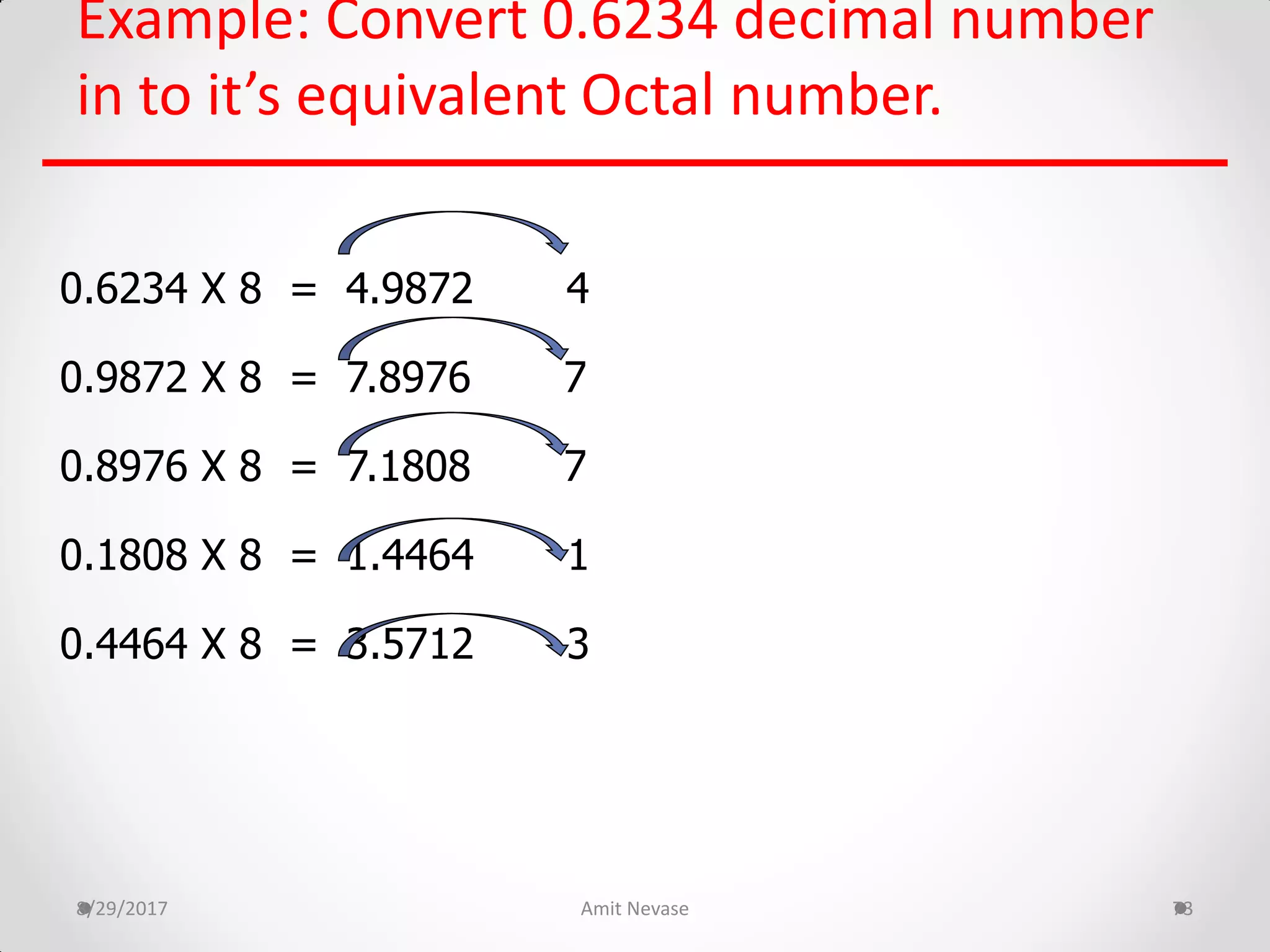
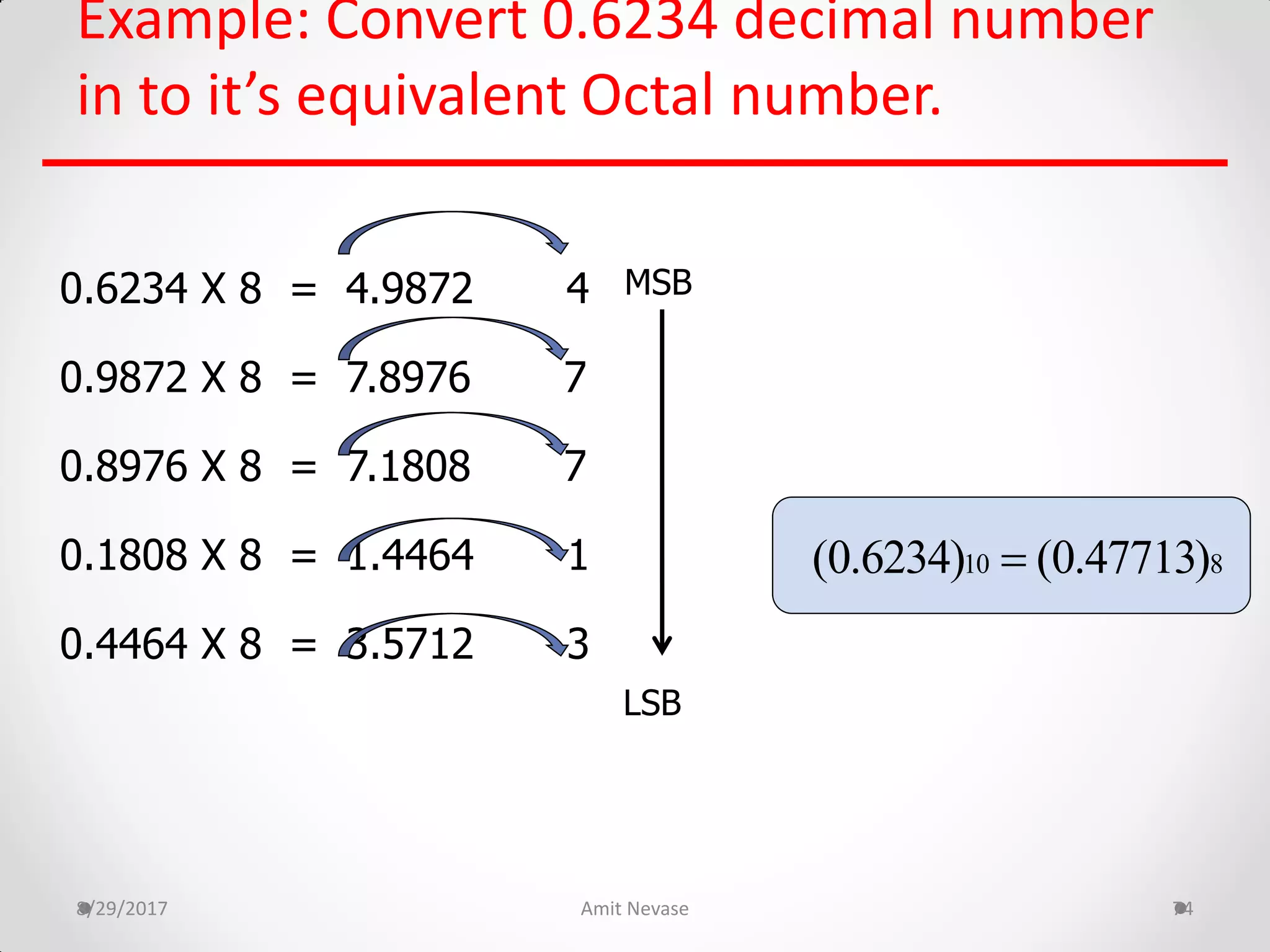
Example: Convert 0.6234 decimal number
in to it’s equivalent Octal number.
8/29/2017 Amit Nevase 68
Example: Convert 0.6234 decimal number
in to it’s equivalent Octal number.
8/29/2017 Amit Nevase 69
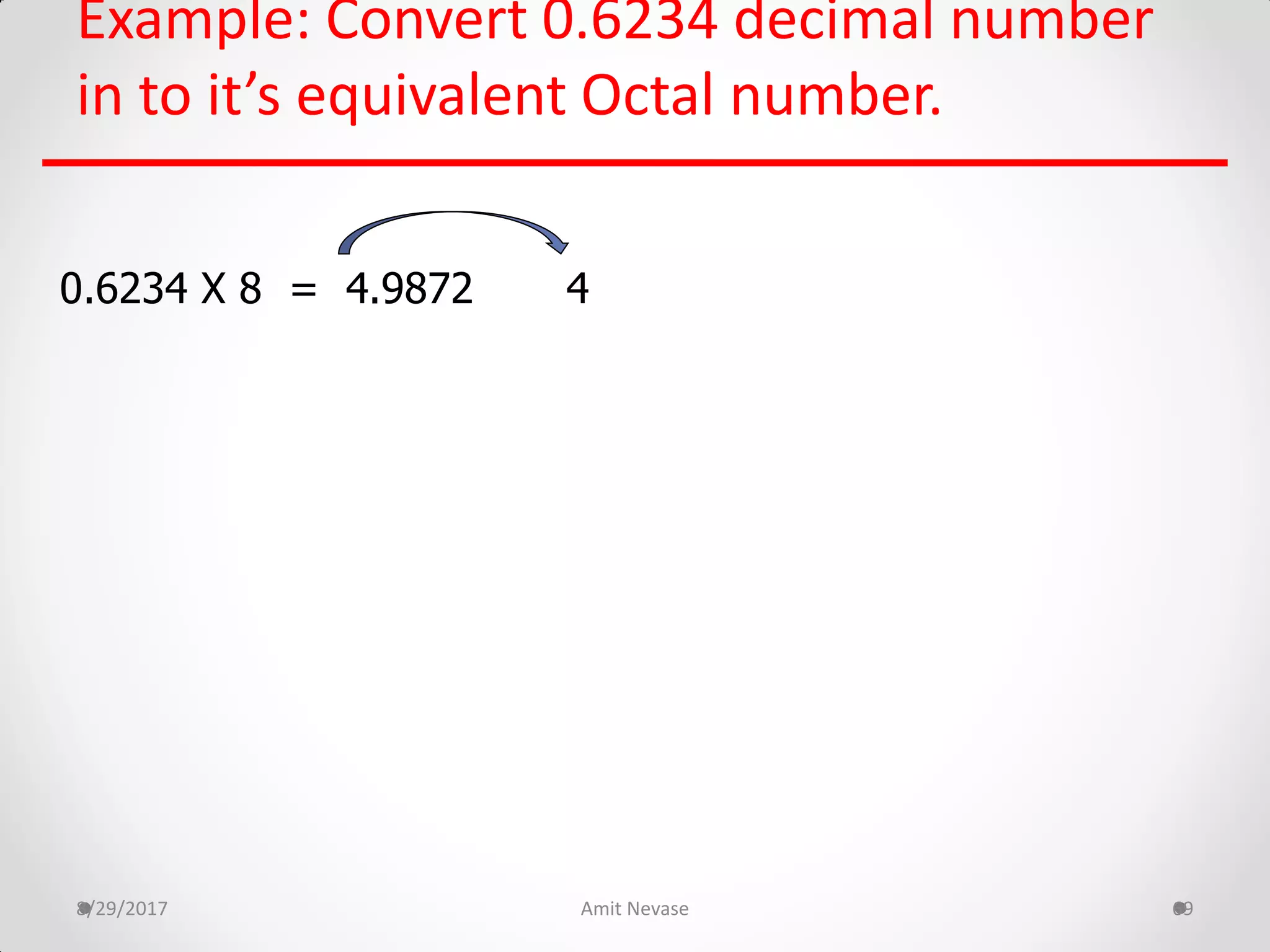
0.6234 X 8 = 4.9872 4
Example: Convert 0.6234 decimal number
in to it’s equivalent Octal number.
8/29/2017 Amit Nevase 70
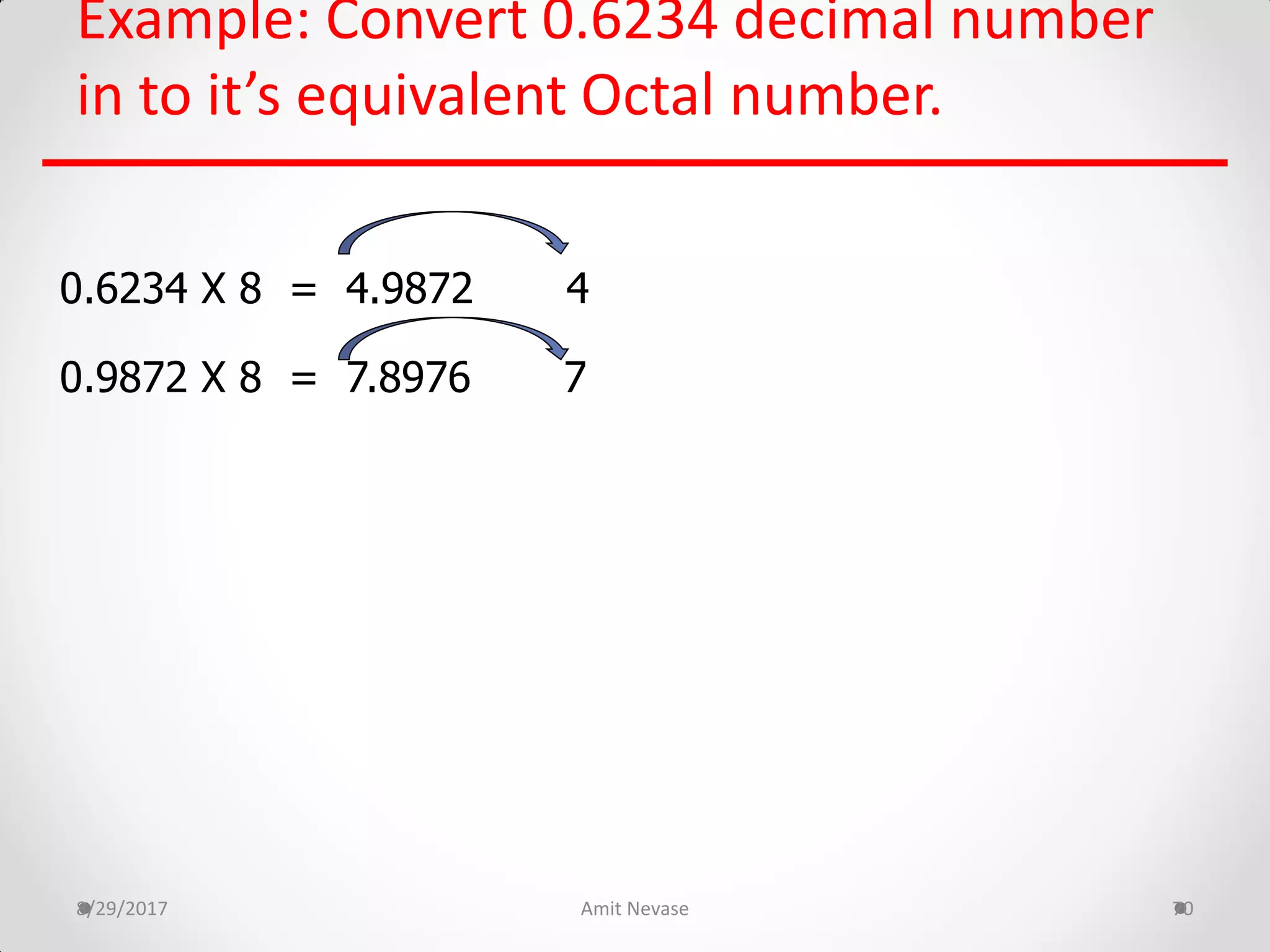
0.6234 X 8 = 4.9872 4
0.9872 X 8 = 7.8976 7
Example: Convert 0.6234 decimal number
in to it’s equivalent Octal number.
8/29/2017 Amit Nevase 71
0.6234 X 8 = 4.9872 4
0.9872 X 8 = 7.8976 7
0.8976 X 8 = 7.1808 7
Example: Convert 0.6234 decimal number
in to it’s equivalent Octal number.
8/29/2017 Amit Nevase 72
0.6234 X 8 = 4.9872 4
0.9872 X 8 = 7.8976 7
0.8976 X 8 = 7.1808 7
0.1808 X 8 = 1.4464 1
Example: Convert 0.6234 decimal number
in to it’s equivalent Octal number.
8/29/2017 Amit Nevase 73
0.6234 X 8 = 4.9872 4
0.9872 X 8 = 7.8976 7
0.8976 X 8 = 7.1808 7
0.1808 X 8 = 1.4464 1
0.4464 X 8 = 3.5712 3
Example: Convert 0.6234 decimal number
in to it’s equivalent Octal number.
8/29/2017 Amit Nevase 74
0.6234 X 8 = 4.9872 4
0.9872 X 8 = 7.8976 7
0.8976 X 8 = 7.1808 7
0.1808 X 8 = 1.4464 1
0.4464 X 8 = 3.5712 3
LSB
MSB
10 8(0.6234) (0.47713)
8/29/2017 Amit Nevase 75
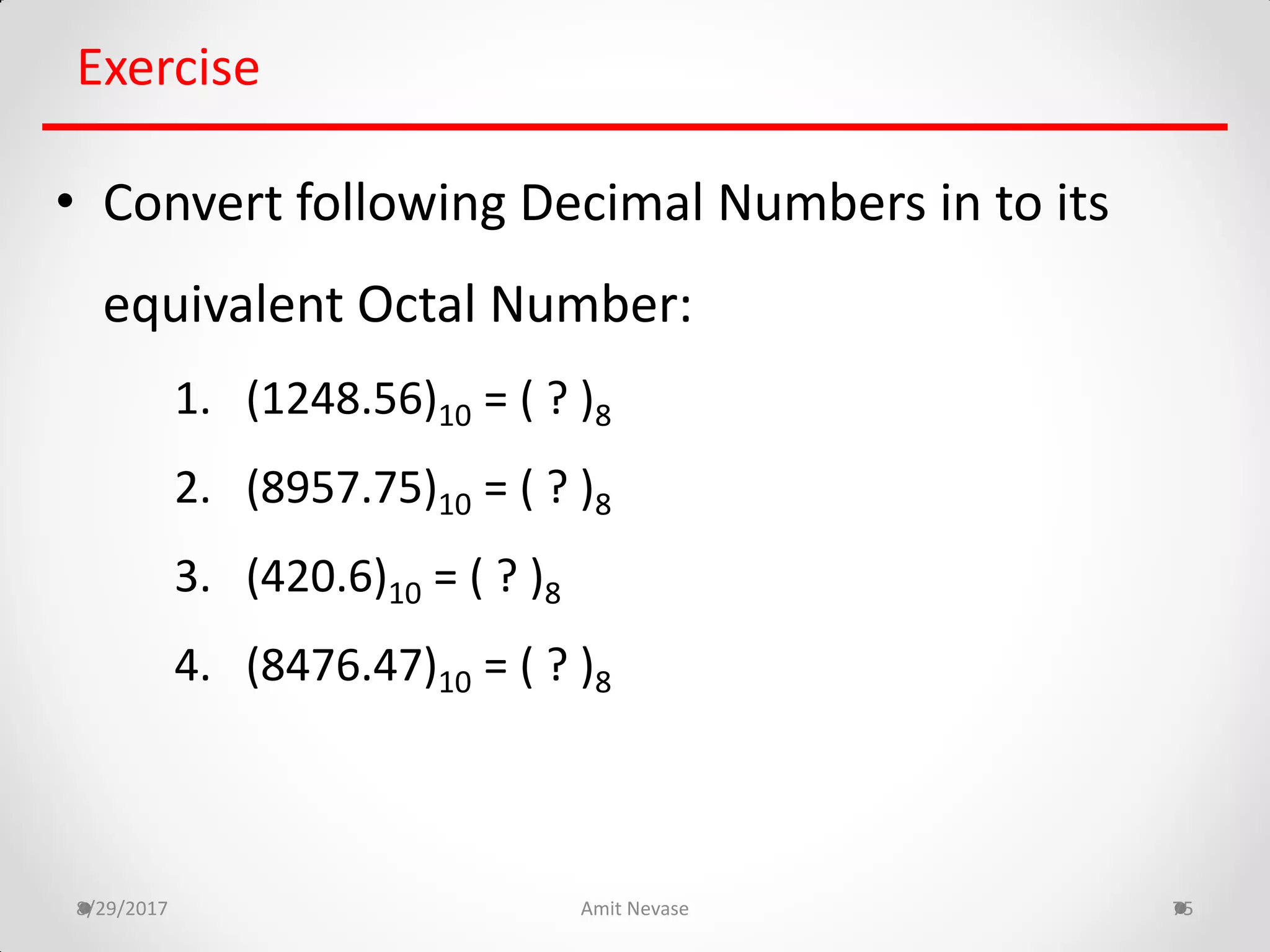
Exercise
• Convert following Decimal Numbers in to its
equivalent Octal Number:
1. (1248.56)10 = ( ? )8
2. (8957.75)10 = ( ? )8
3. (420.6)10 = ( ? )8
4. (8476.47)10 = ( ? )8
8/29/2017 Amit Nevase 76
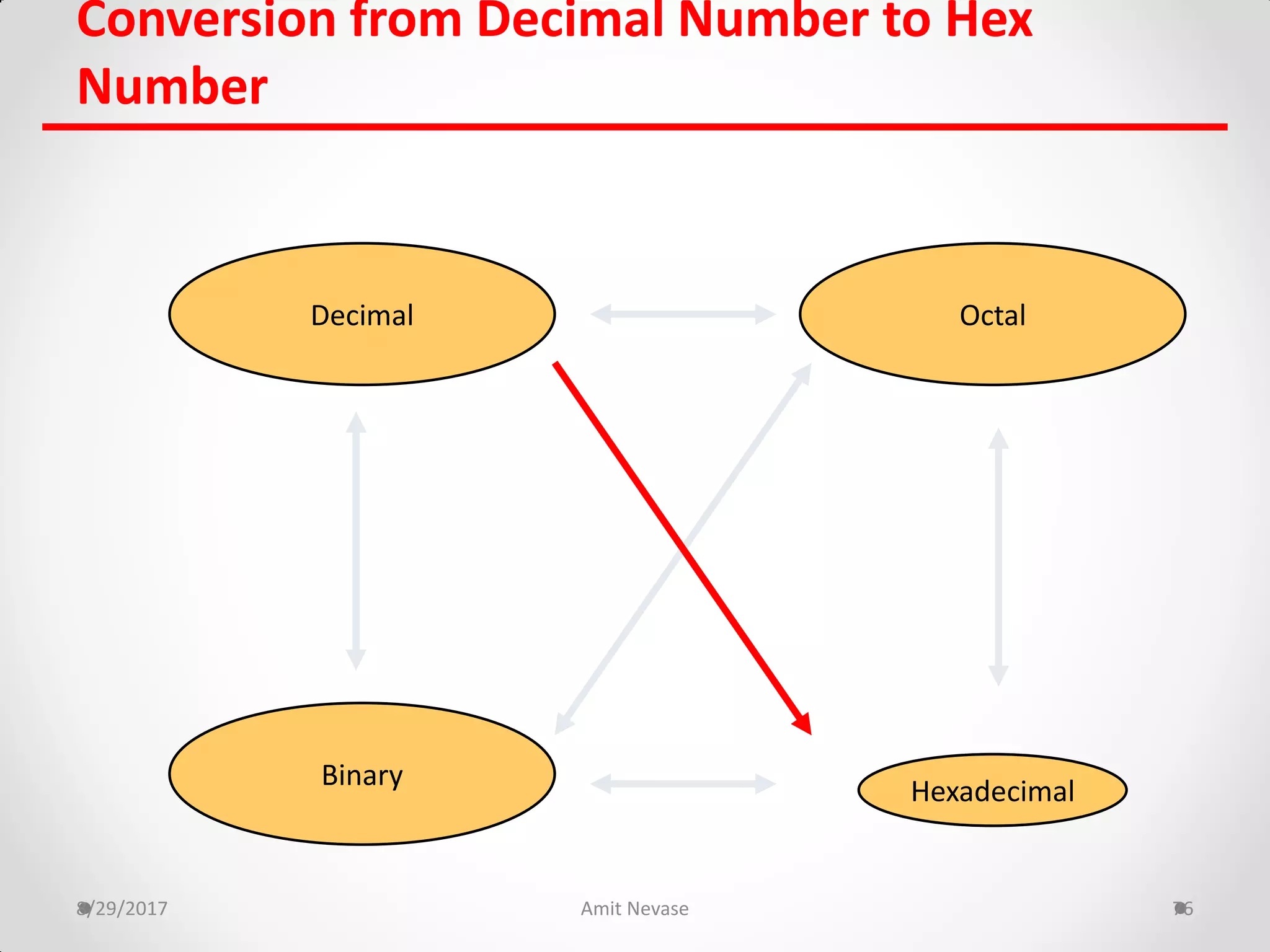
Conversion from Decimal Number to Hex
Number
Hexadecimal
Decimal Octal
Binary
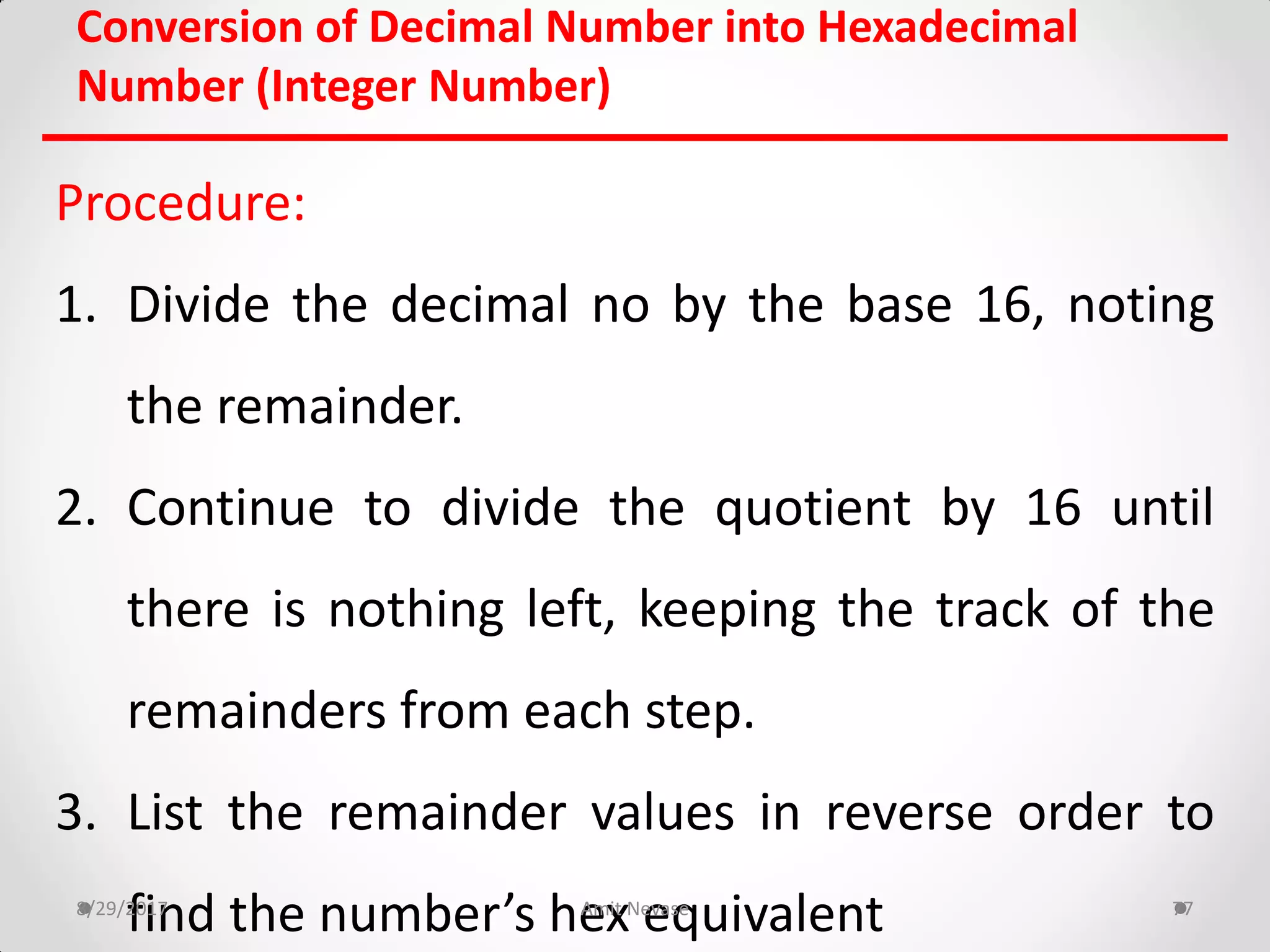
Conversion of Decimal Number into Hexadecimal
Number (Integer Number)
Procedure:
1. Divide the decimal no by the base 16, noting
the remainder.
2. Continue to divide the quotient by 16 until
there is nothing left, keeping the track of the
remainders from each step.
3. List the remainder values in reverse order to
find the number’s hex equivalent8/29/2017 Amit Nevase 77
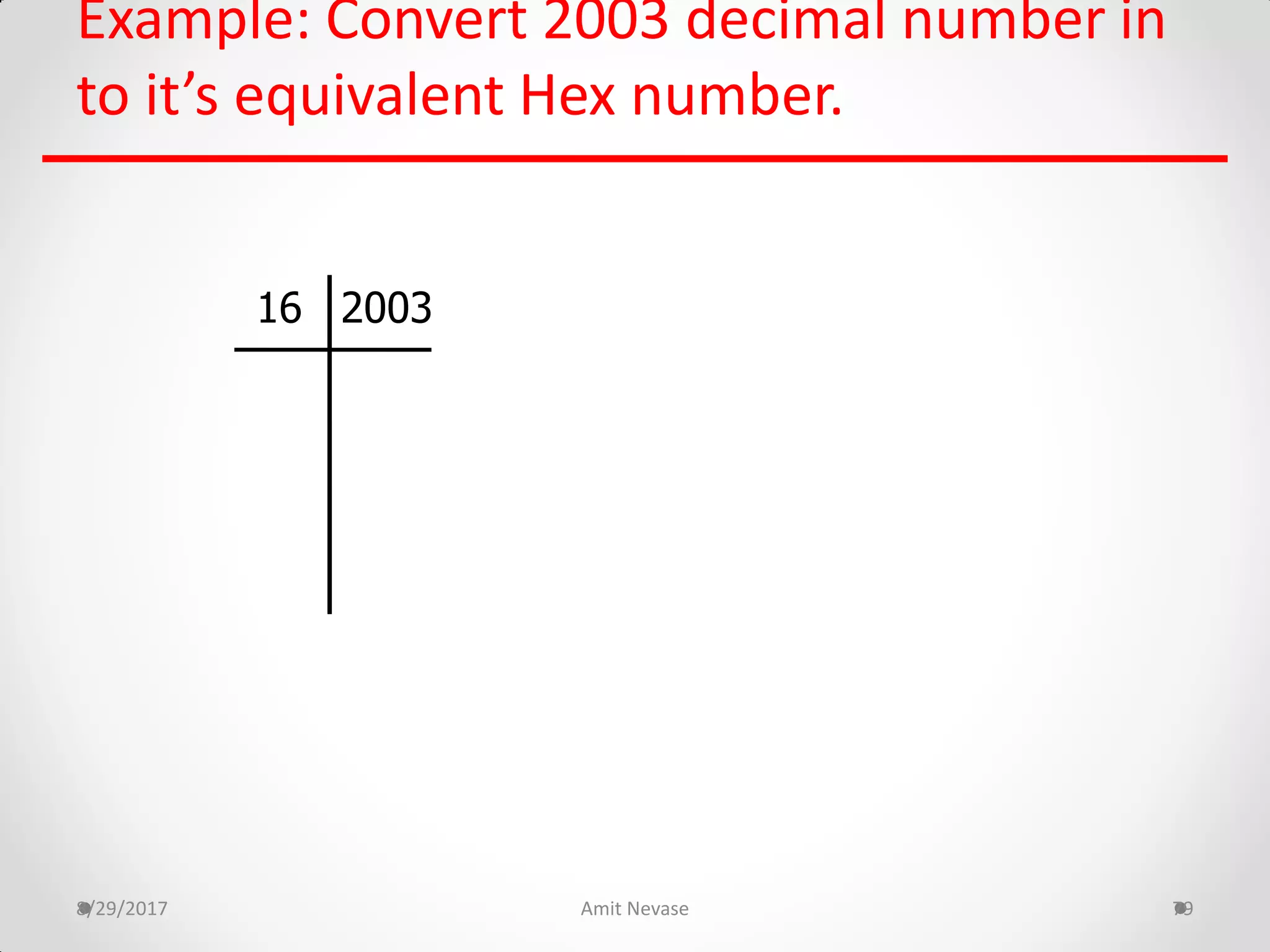
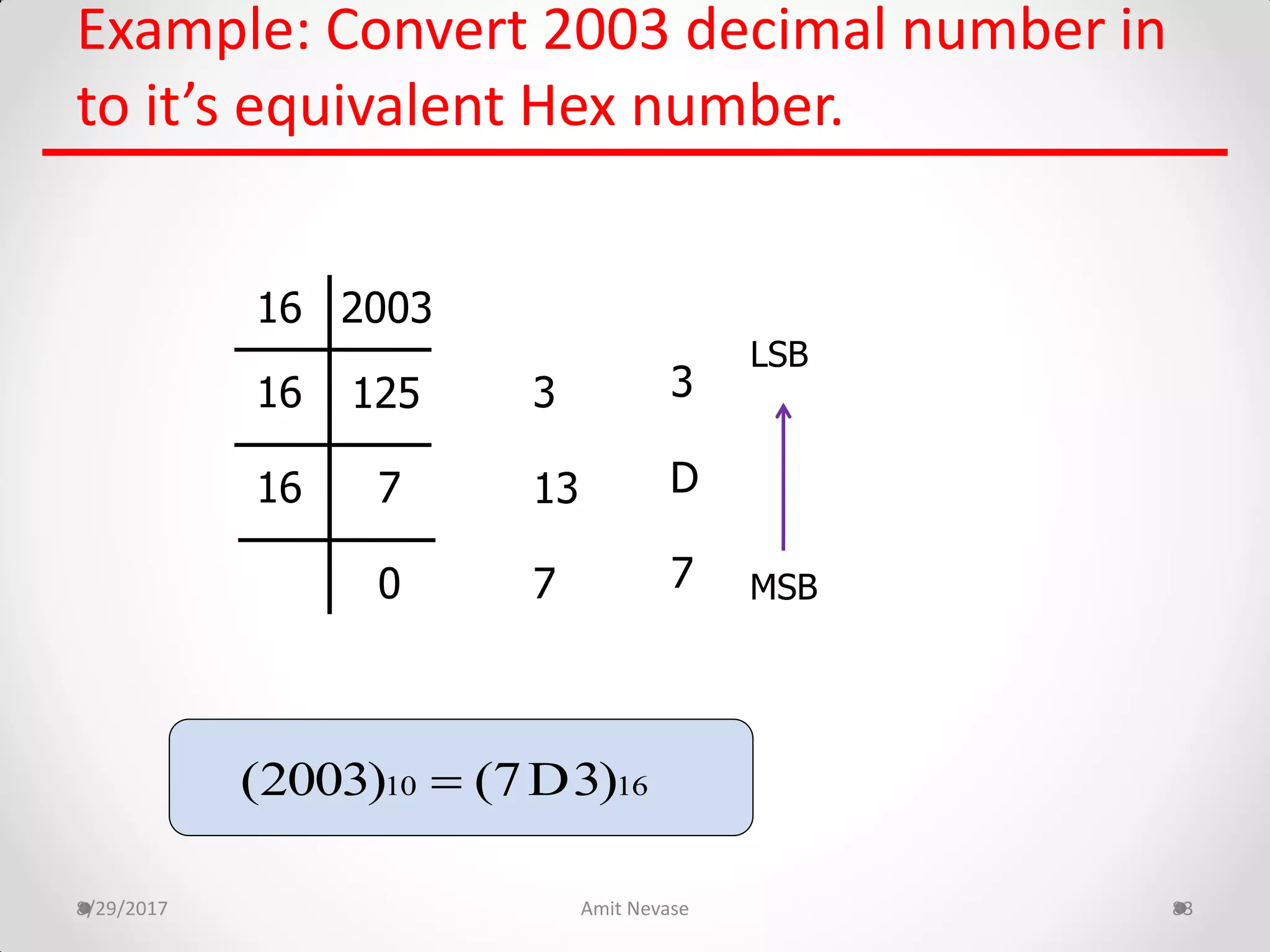
Example: Convert 2003 decimal number in
to it’s equivalent Hex number.
8/29/2017 Amit Nevase 78
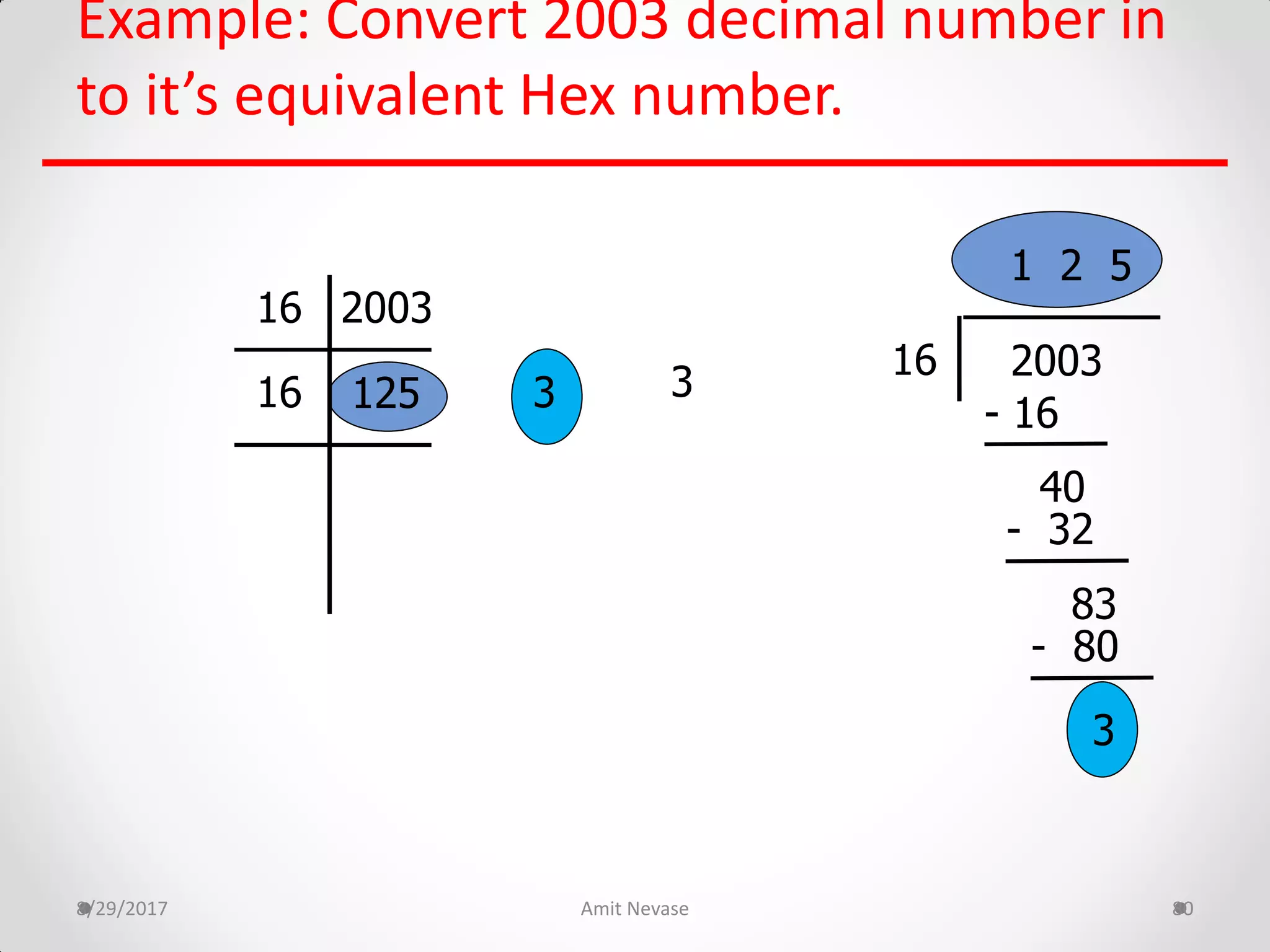
Example: Convert 2003 decimal number in
to it’s equivalent Hex number.
8/29/2017 Amit Nevase 79
200316
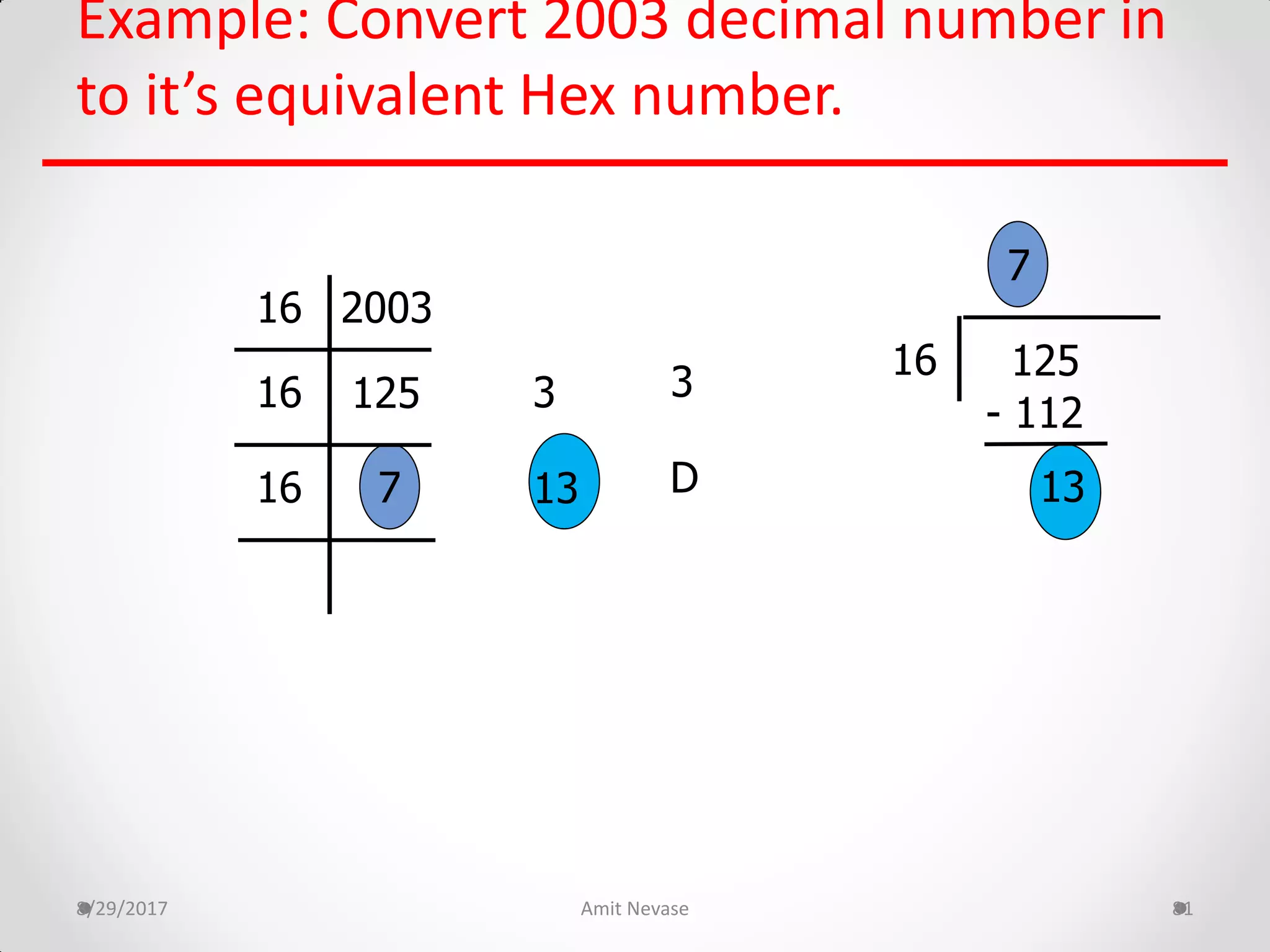
Example: Convert 2003 decimal number in
to it’s equivalent Hex number.
8/29/2017 Amit Nevase 80
200316
316 125 3 200316
1 2 5
- 16
40
- 32
83
- 80
3
Example: Convert 2003 decimal number in
to it’s equivalent Hex number.
8/29/2017 Amit Nevase 81
200316
3
13
16
16
125
7
3
D
12516
7
- 112
13
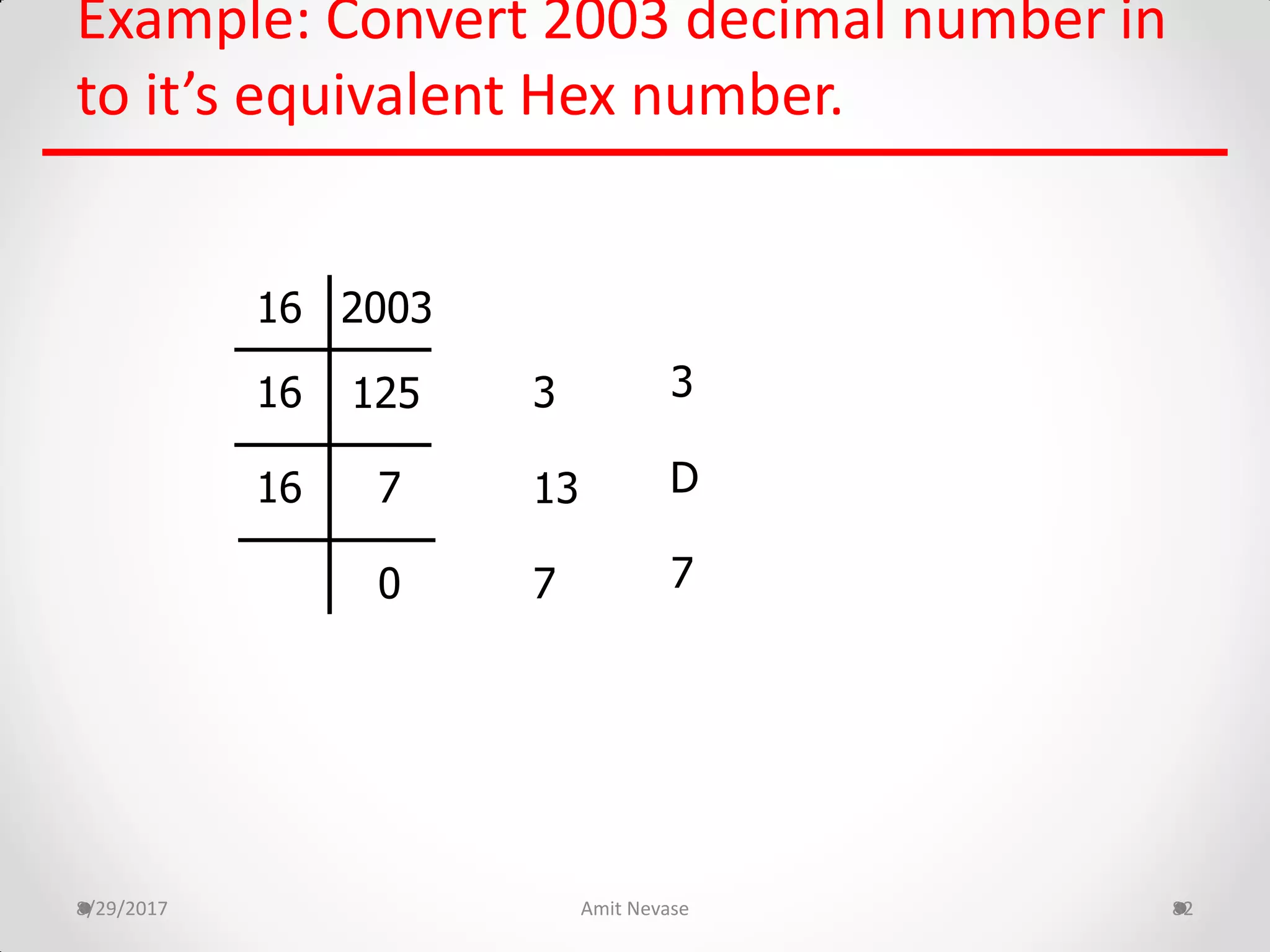
Example: Convert 2003 decimal number in
to it’s equivalent Hex number.
8/29/2017 Amit Nevase 82
200316
3
7
13
16
16
125
7
0
3
7
D
Example: Convert 2003 decimal number in
to it’s equivalent Hex number.
8/29/2017 Amit Nevase 83
200316
3
7
13
LSB
MSB
16
16
125
7
0
3
7
D
10 16(2003) (7D3)
Conversion of Decimal Number into Hexadecimal
Number (Fractional Number)
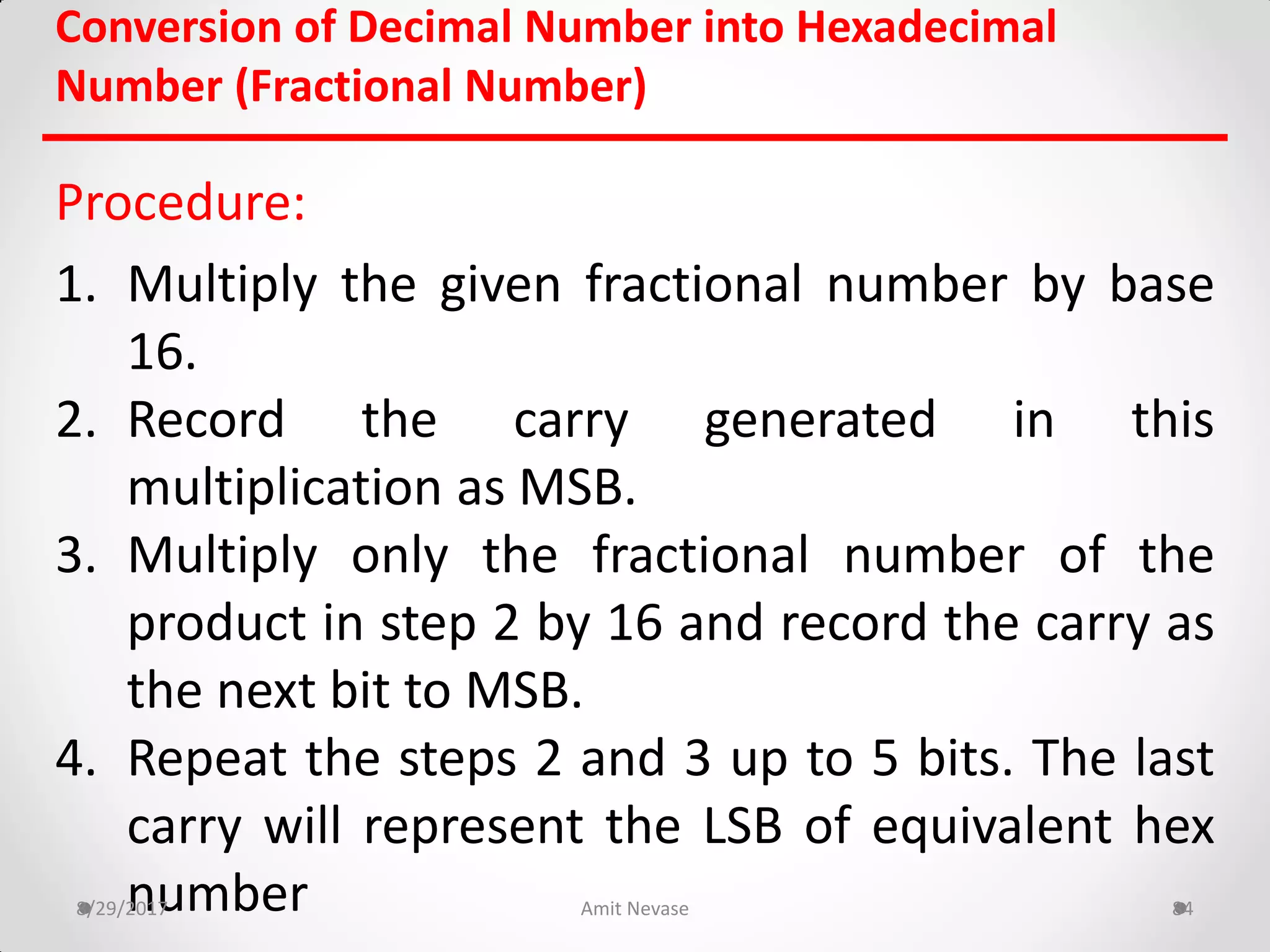
Procedure:
1. Multiply the given fractional number by base
16.
2. Record the carry generated in this
multiplication as MSB.
3. Multiply only the fractional number of the
product in step 2 by 16 and record the carry as
the next bit to MSB.
4. Repeat the steps 2 and 3 up to 5 bits. The last
carry will represent the LSB of equivalent hex
number8/29/2017 Amit Nevase 84
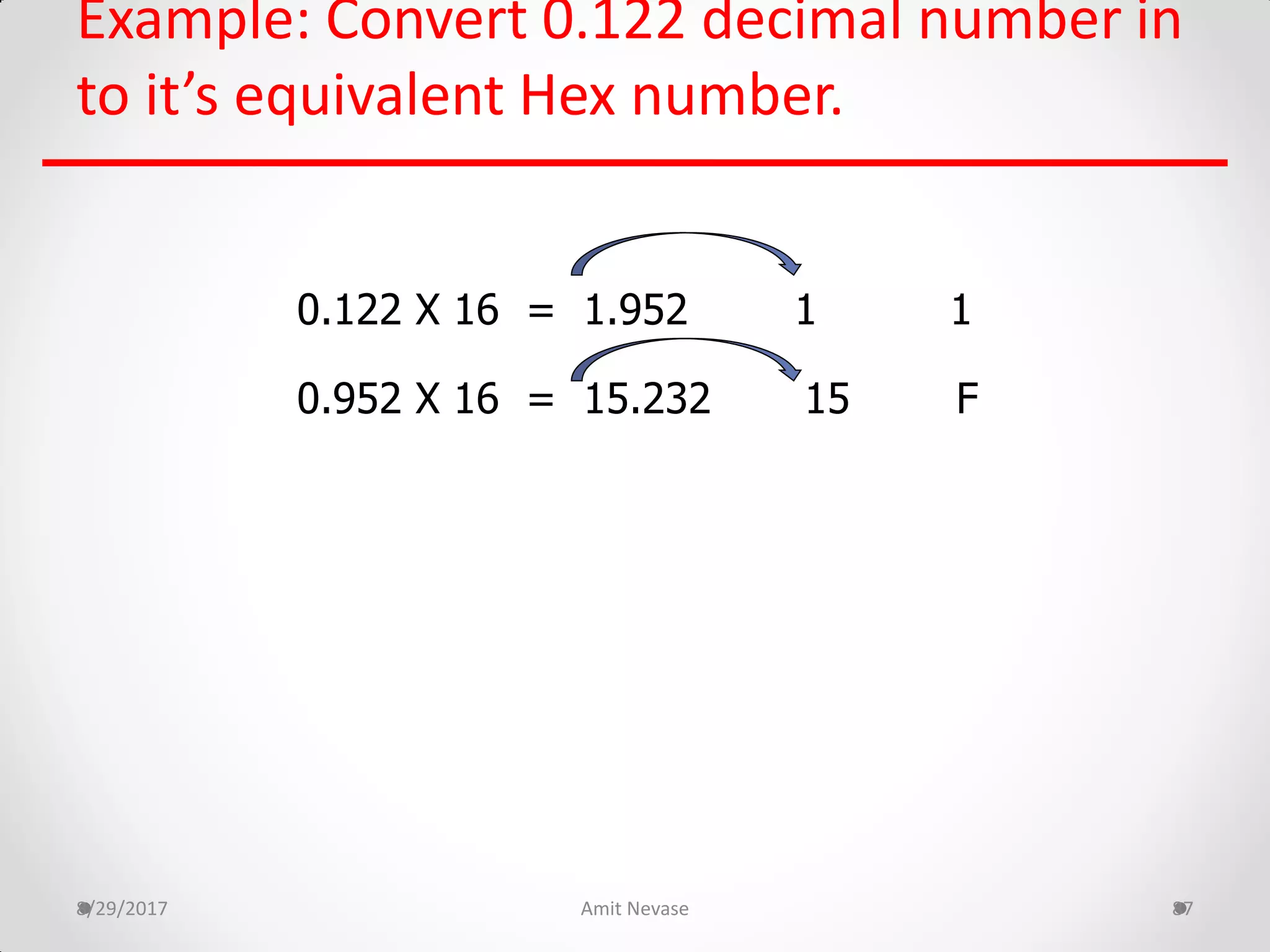
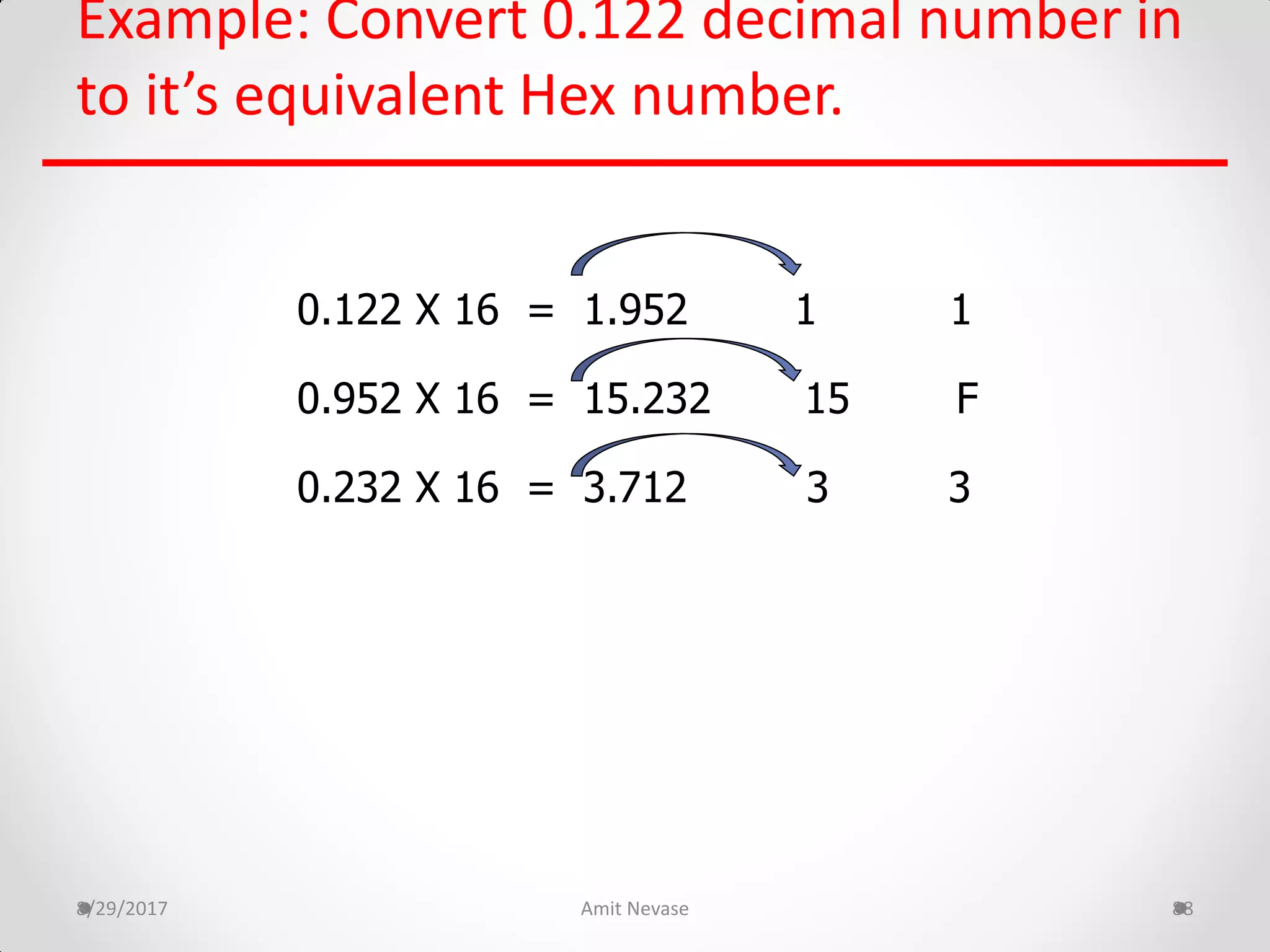
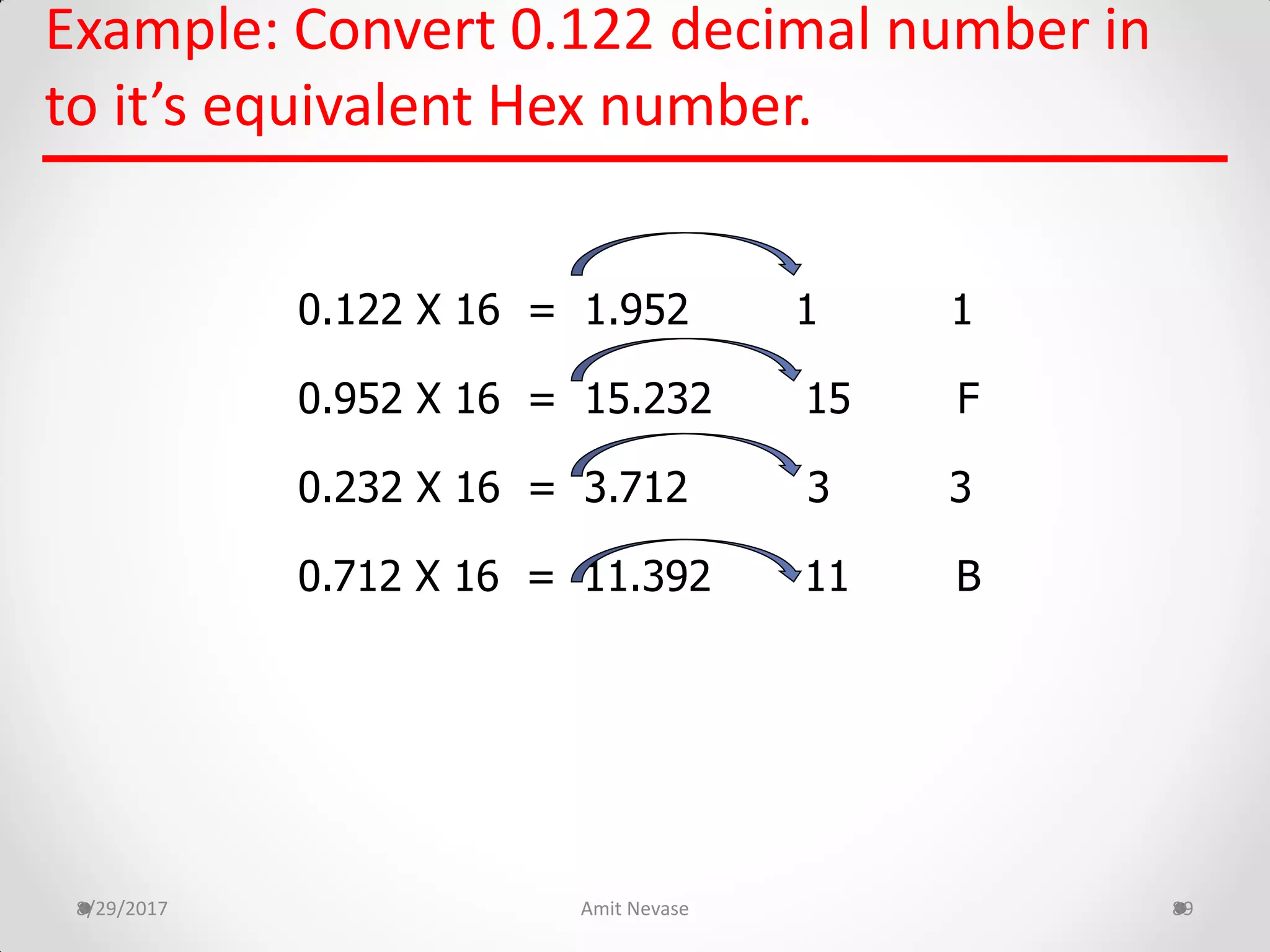
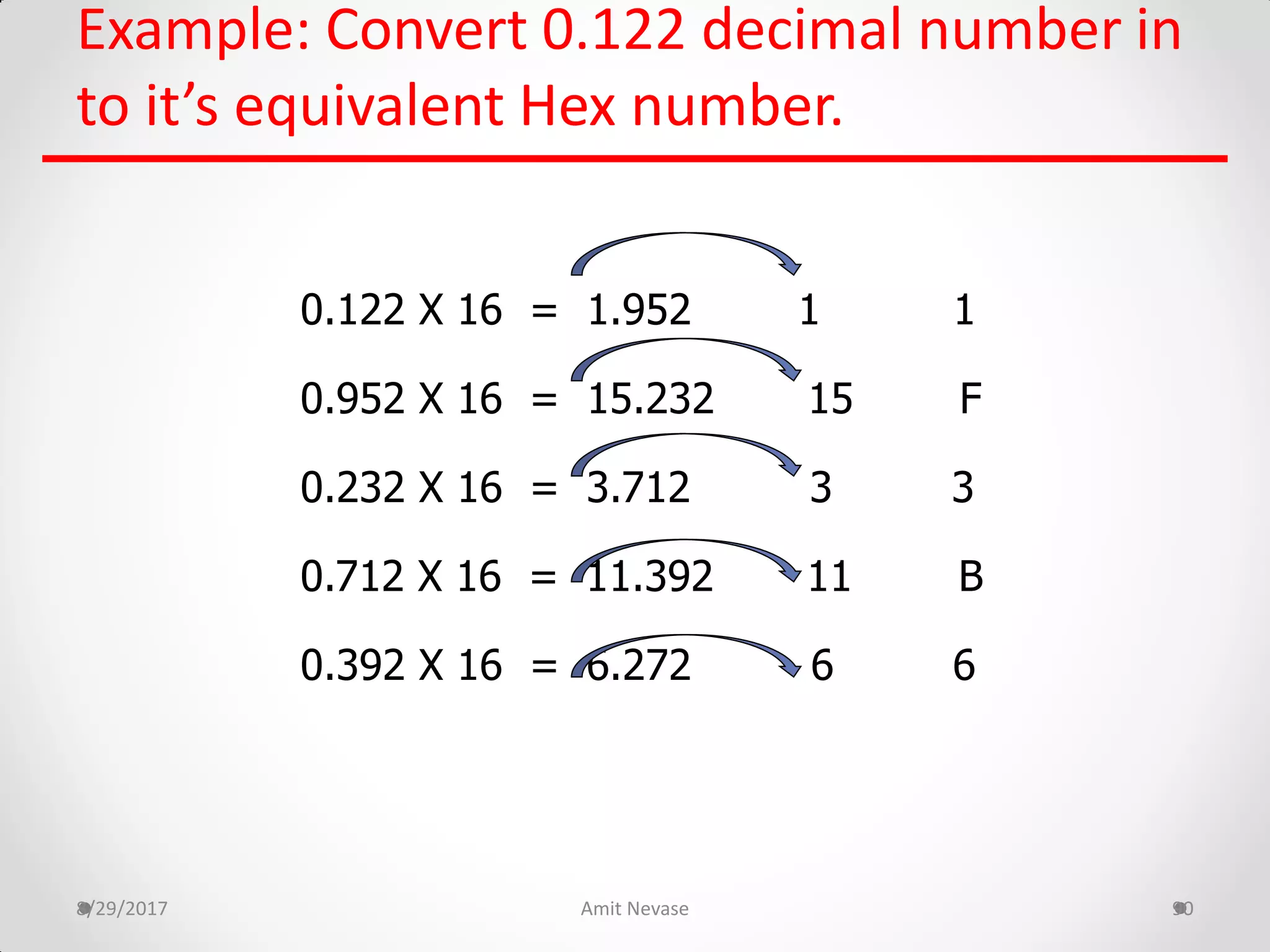
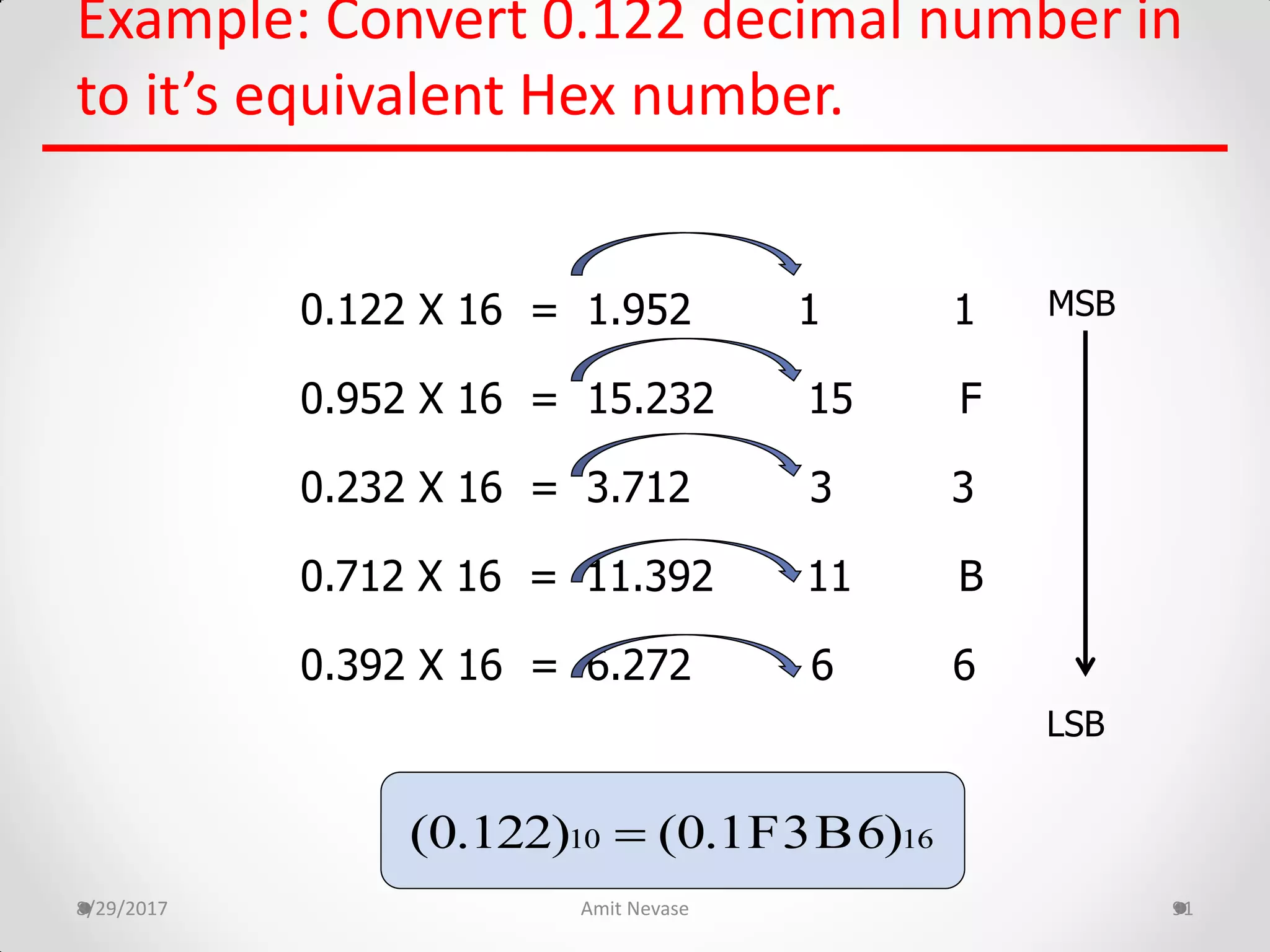
Example: Convert 0.122 decimal number in
to it’s equivalent Hex number.
8/29/2017 Amit Nevase 85
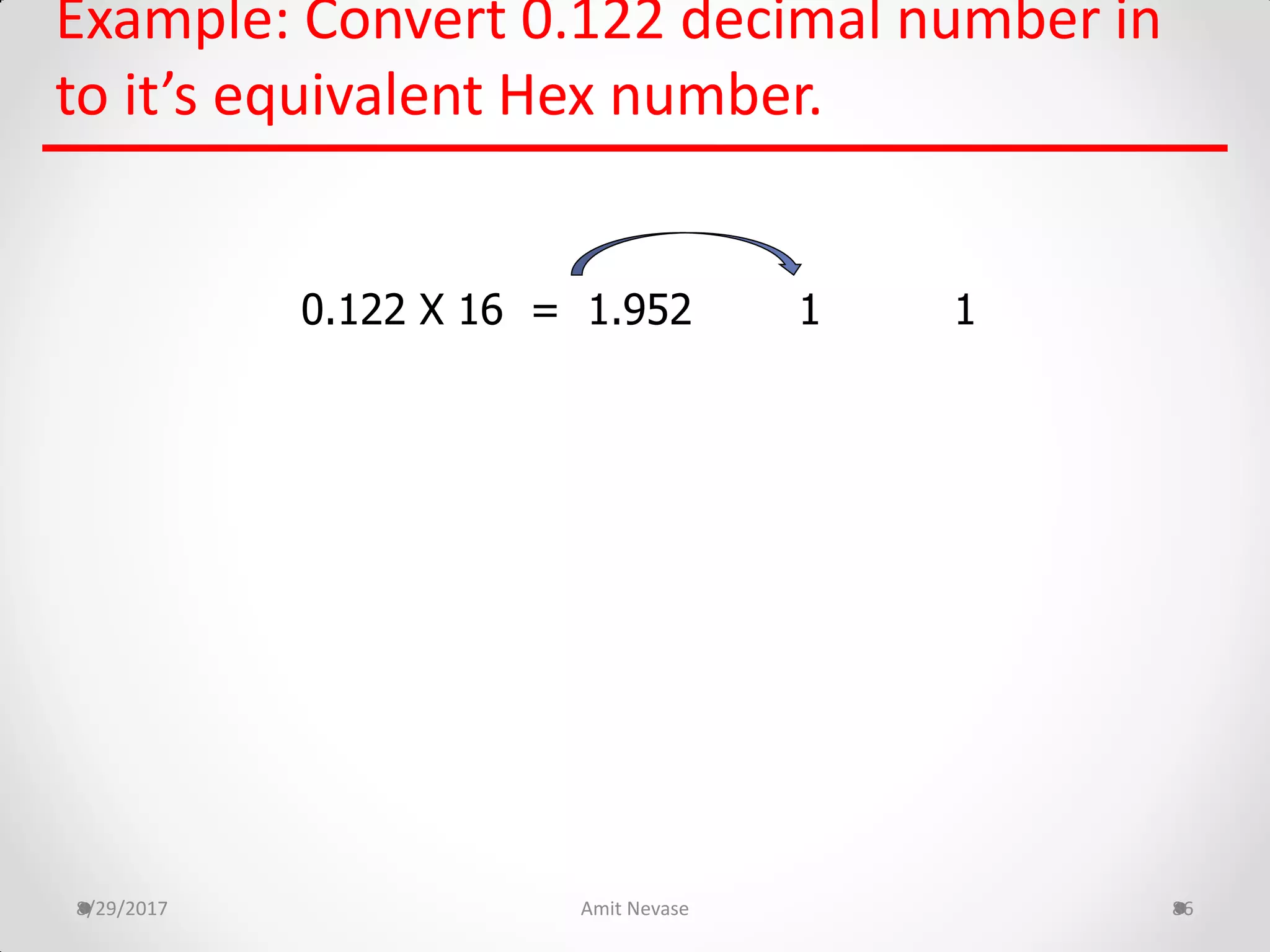
Example: Convert 0.122 decimal number in
to it’s equivalent Hex number.
8/29/2017 Amit Nevase 86
0.122 X 16 = 1.952 1 1
Example: Convert 0.122 decimal number in
to it’s equivalent Hex number.
8/29/2017 Amit Nevase 87
0.122 X 16 = 1.952 1 1
0.952 X 16 = 15.232 15 F
Example: Convert 0.122 decimal number in
to it’s equivalent Hex number.
8/29/2017 Amit Nevase 88
0.122 X 16 = 1.952 1 1
0.952 X 16 = 15.232 15 F
0.232 X 16 = 3.712 3 3
Example: Convert 0.122 decimal number in
to it’s equivalent Hex number.
8/29/2017 Amit Nevase 89
0.122 X 16 = 1.952 1 1
0.952 X 16 = 15.232 15 F
0.232 X 16 = 3.712 3 3
0.712 X 16 = 11.392 11 B
Example: Convert 0.122 decimal number in
to it’s equivalent Hex number.
8/29/2017 Amit Nevase 90
0.122 X 16 = 1.952 1 1
0.952 X 16 = 15.232 15 F
0.232 X 16 = 3.712 3 3
0.712 X 16 = 11.392 11 B
0.392 X 16 = 6.272 6 6
Example: Convert 0.122 decimal number in
to it’s equivalent Hex number.
8/29/2017 Amit Nevase 91
0.122 X 16 = 1.952 1 1
0.952 X 16 = 15.232 15 F
0.232 X 16 = 3.712 3 3
0.712 X 16 = 11.392 11 B
0.392 X 16 = 6.272 6 6
LSB
MSB
10 16(0.122) (0.1F3B6)
8/29/2017 Amit Nevase 92
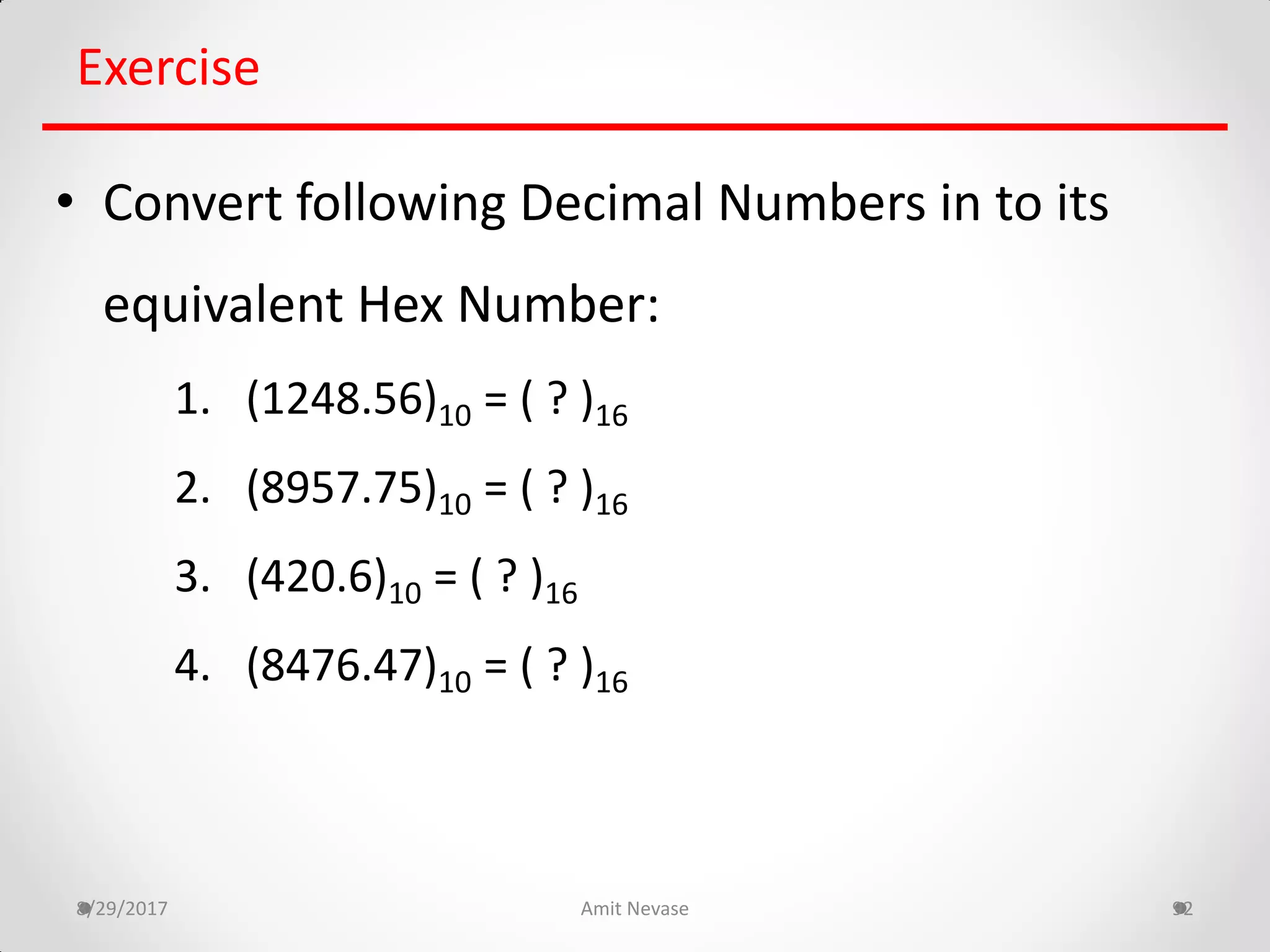
Exercise
• Convert following Decimal Numbers in to its
equivalent Hex Number:
1. (1248.56)10 = ( ? )16
2. (8957.75)10 = ( ? )16
3. (420.6)10 = ( ? )16
4. (8476.47)10 = ( ? )16
8/29/2017 Amit Nevase 93
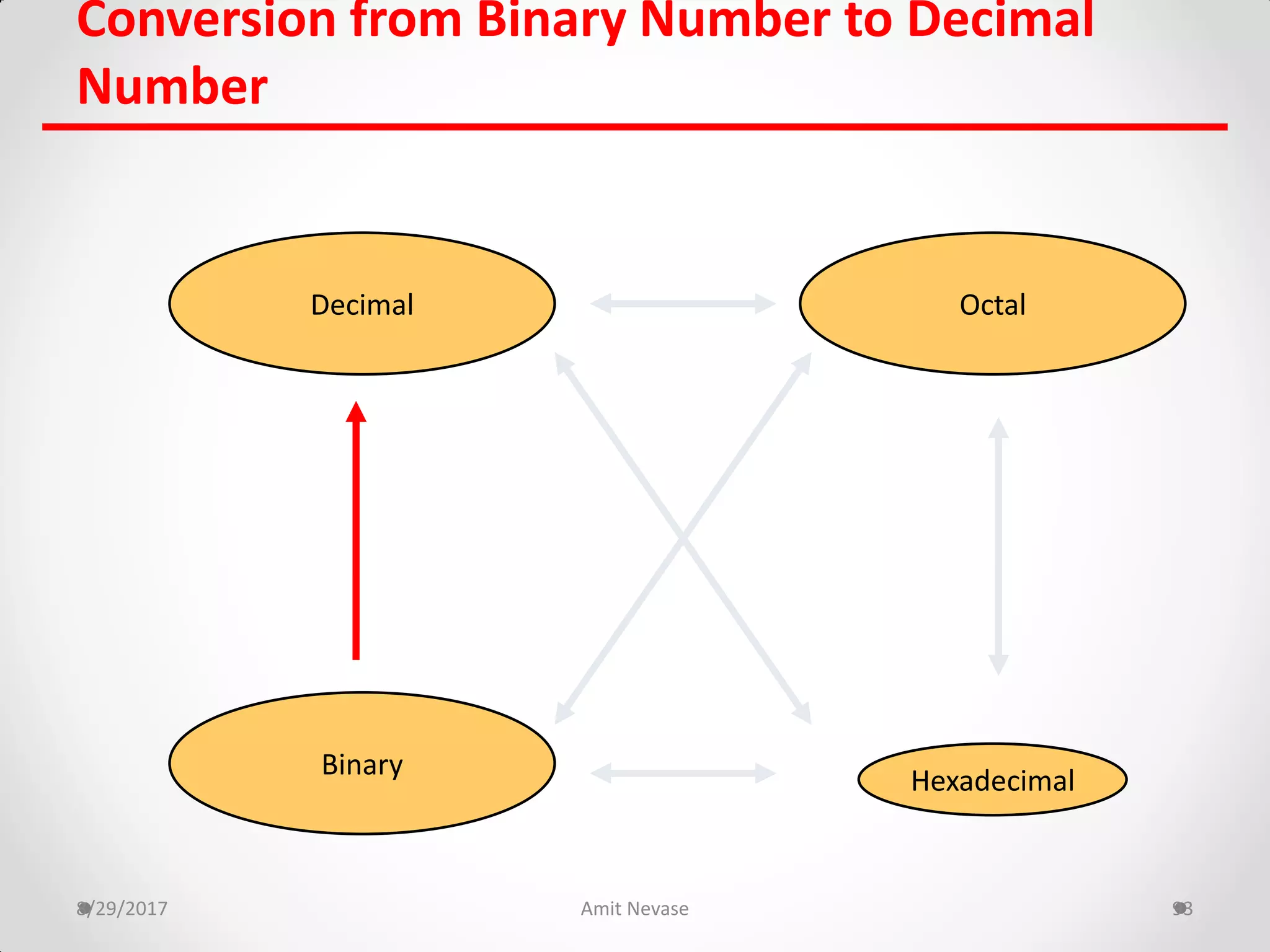
Conversion from Binary Number to Decimal
Number
Hexadecimal
Decimal Octal
Binary
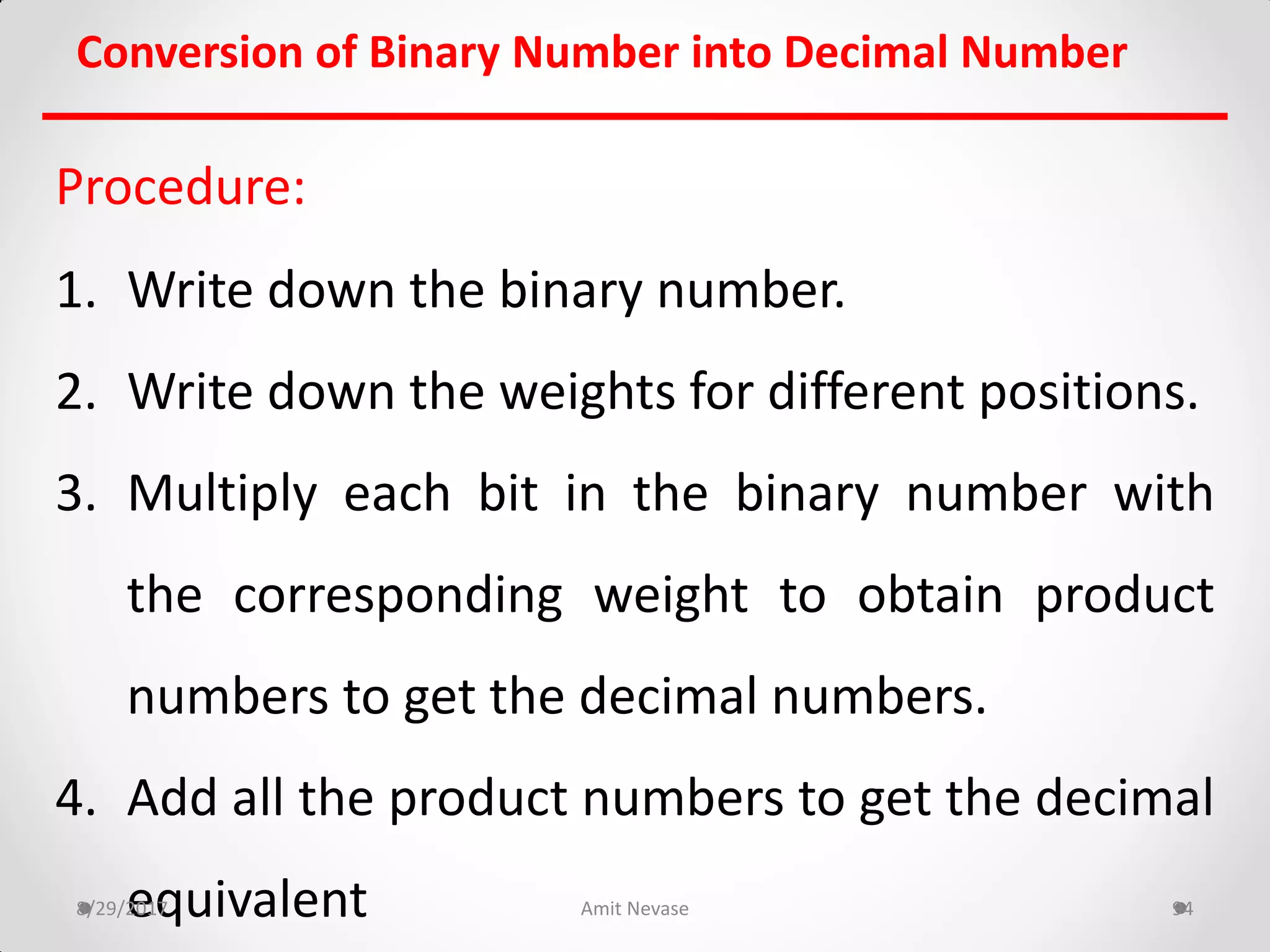
Procedure:
1. Write down the binary number.
2. Write down the weights for different positions.
3. Multiply each bit in the binary number with
the corresponding weight to obtain product
numbers to get the decimal numbers.
4. Add all the product numbers to get the decimal
equivalent8/29/2017 Amit Nevase 94
Conversion of Binary Number into Decimal Number
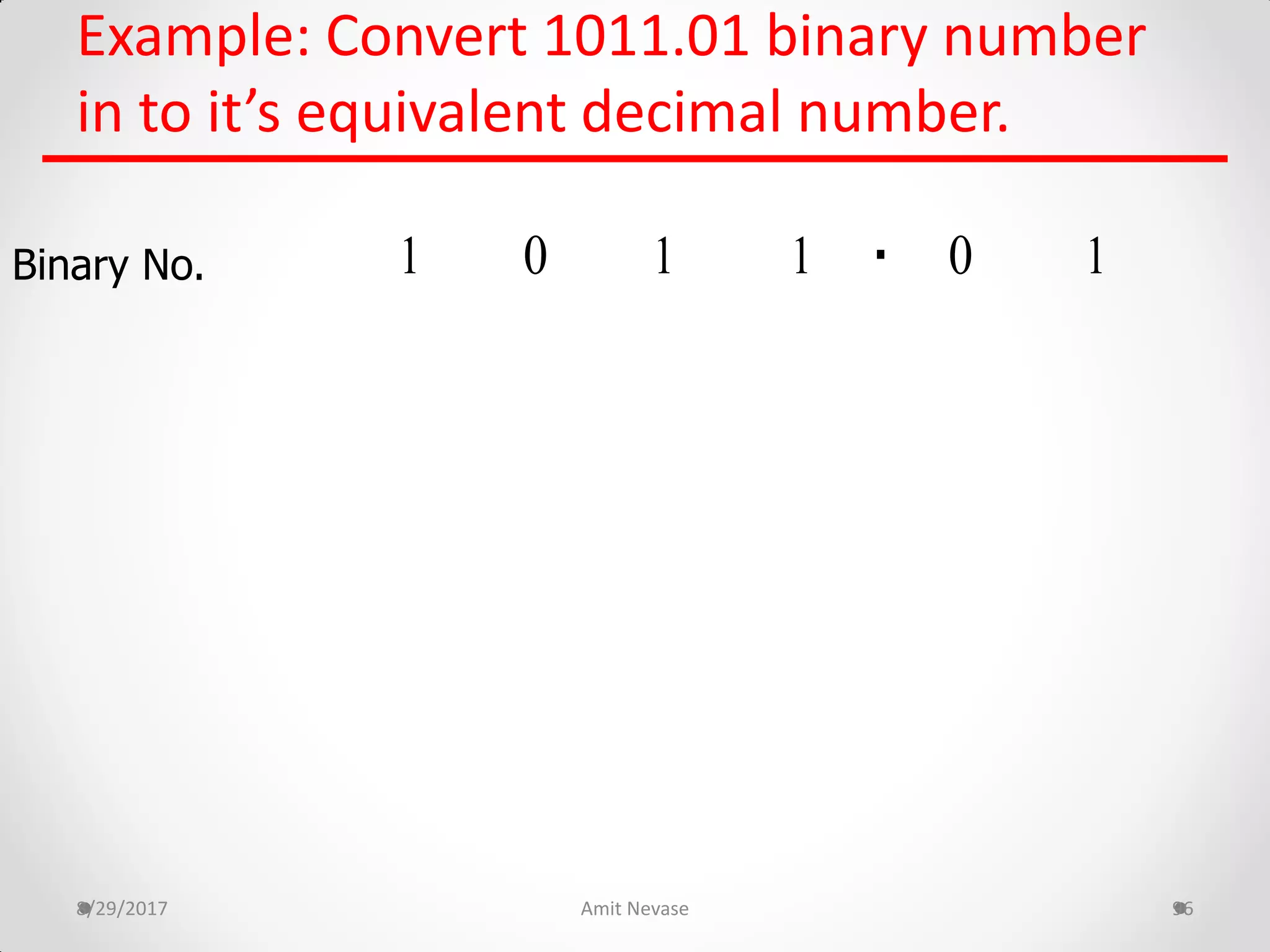
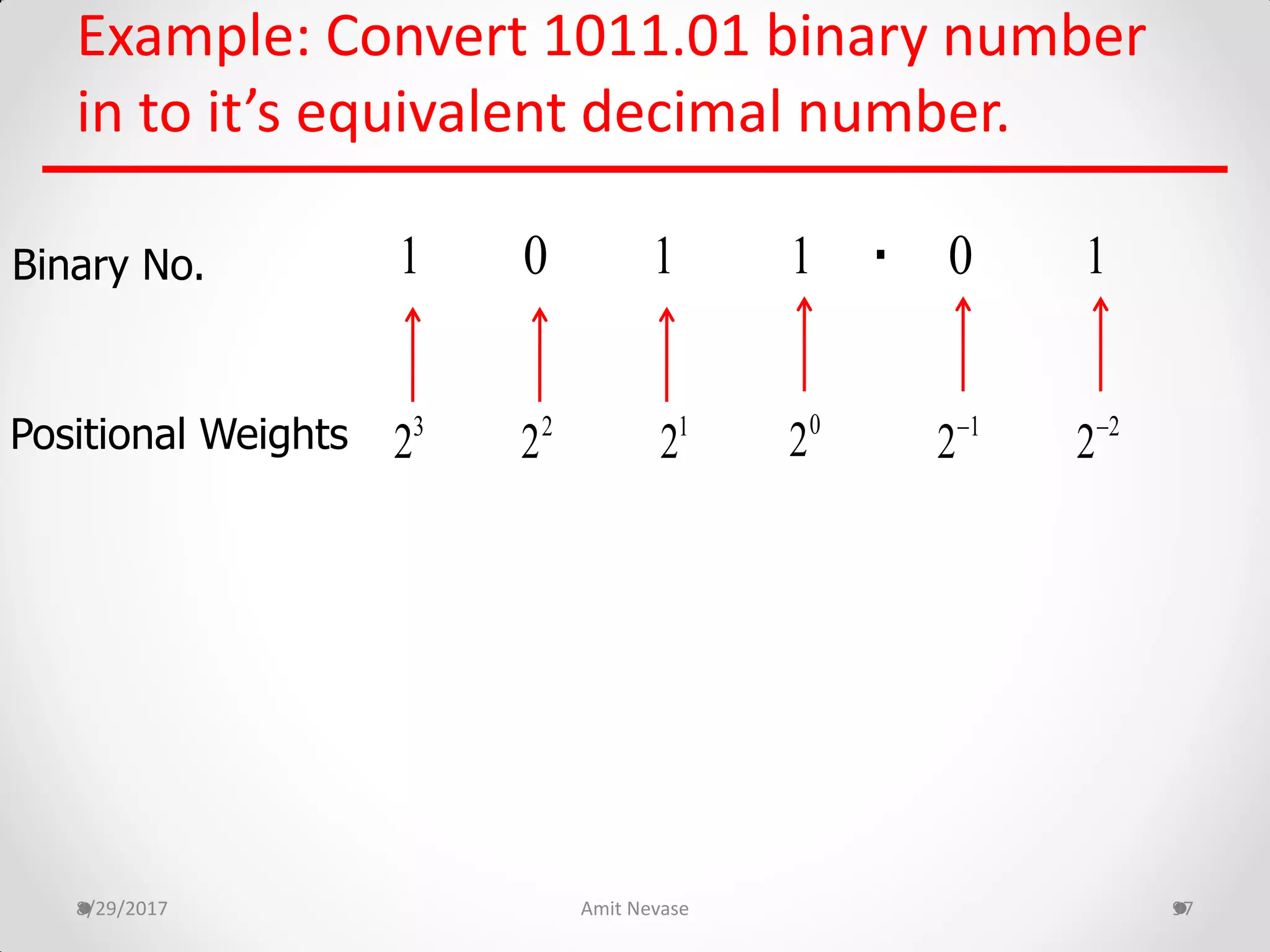
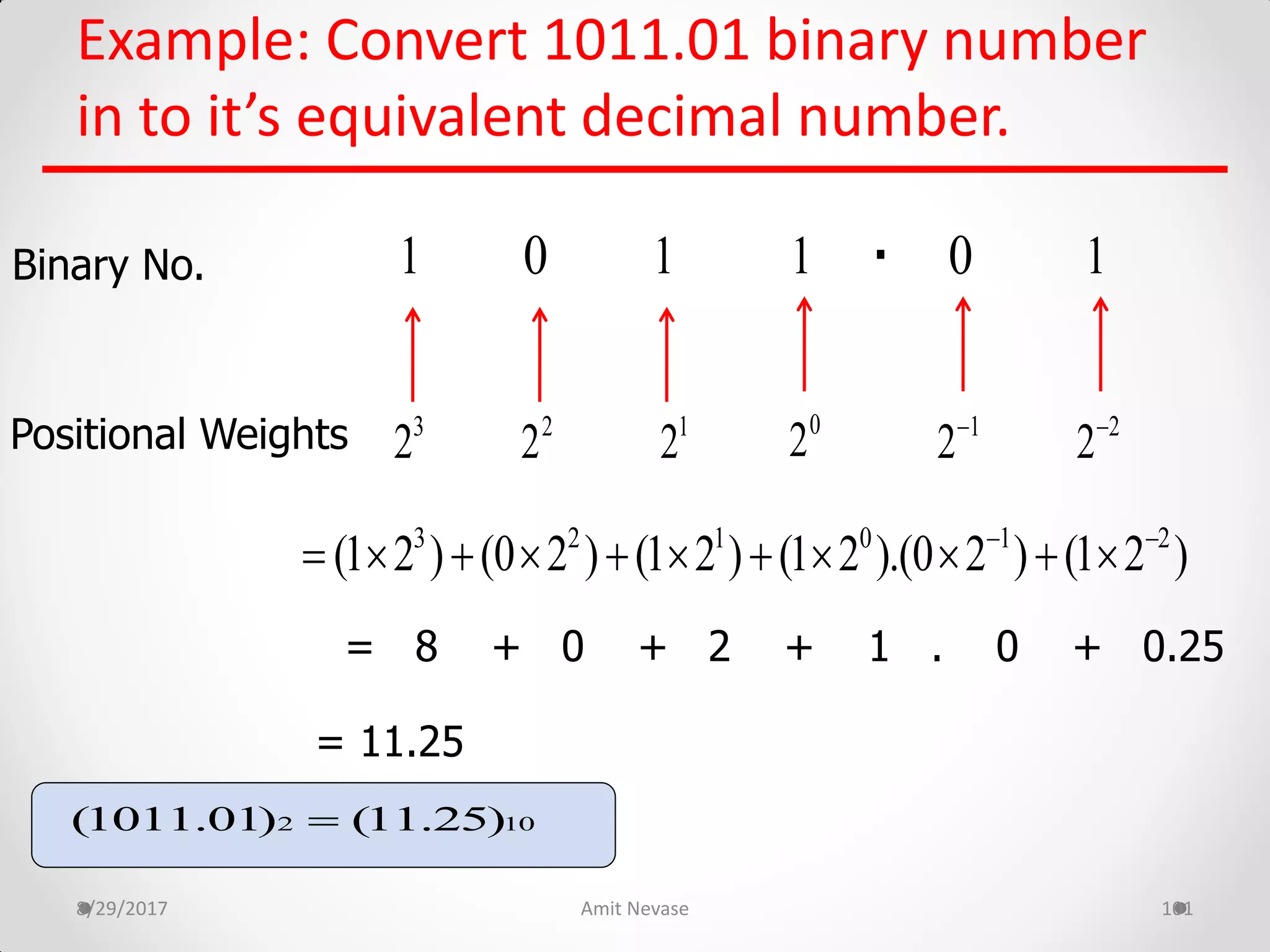
Example: Convert 1011.01 binary number
in to it’s equivalent decimal number.
8/29/2017 Amit Nevase 95
Example: Convert 1011.01 binary number
in to it’s equivalent decimal number.
8/29/2017 Amit Nevase 96
Binary No. .101 0 11
Example: Convert 1011.01 binary number
in to it’s equivalent decimal number.
8/29/2017 Amit Nevase 97
Binary No.
Positional Weights
.101 0 11
0
21
22
23
2 1
2 2
2
Example: Convert 1011.01 binary number
in to it’s equivalent decimal number.
8/29/2017 Amit Nevase 98
Binary No.
Positional Weights
.101 0 11
0
21
22
23
2 1
2 2
2
3 2 1 0 1 2
(1 2 ) (0 2 ) (1 2 ) (1 2 ).(0 2 ) (1 2 ) 
          
Example: Convert 1011.01 binary number
in to it’s equivalent decimal number.
8/29/2017 Amit Nevase 99
Binary No.
Positional Weights
.
= 8 + 0 + 2 + 1 . 0 + 0.25
101 0 11
0
21
22
23
2 1
2 2
2
3 2 1 0 1 2
(1 2 ) (0 2 ) (1 2 ) (1 2 ).(0 2 ) (1 2 ) 
          
Example: Convert 1011.01 binary number
in to it’s equivalent decimal number.
8/29/2017 Amit Nevase 100
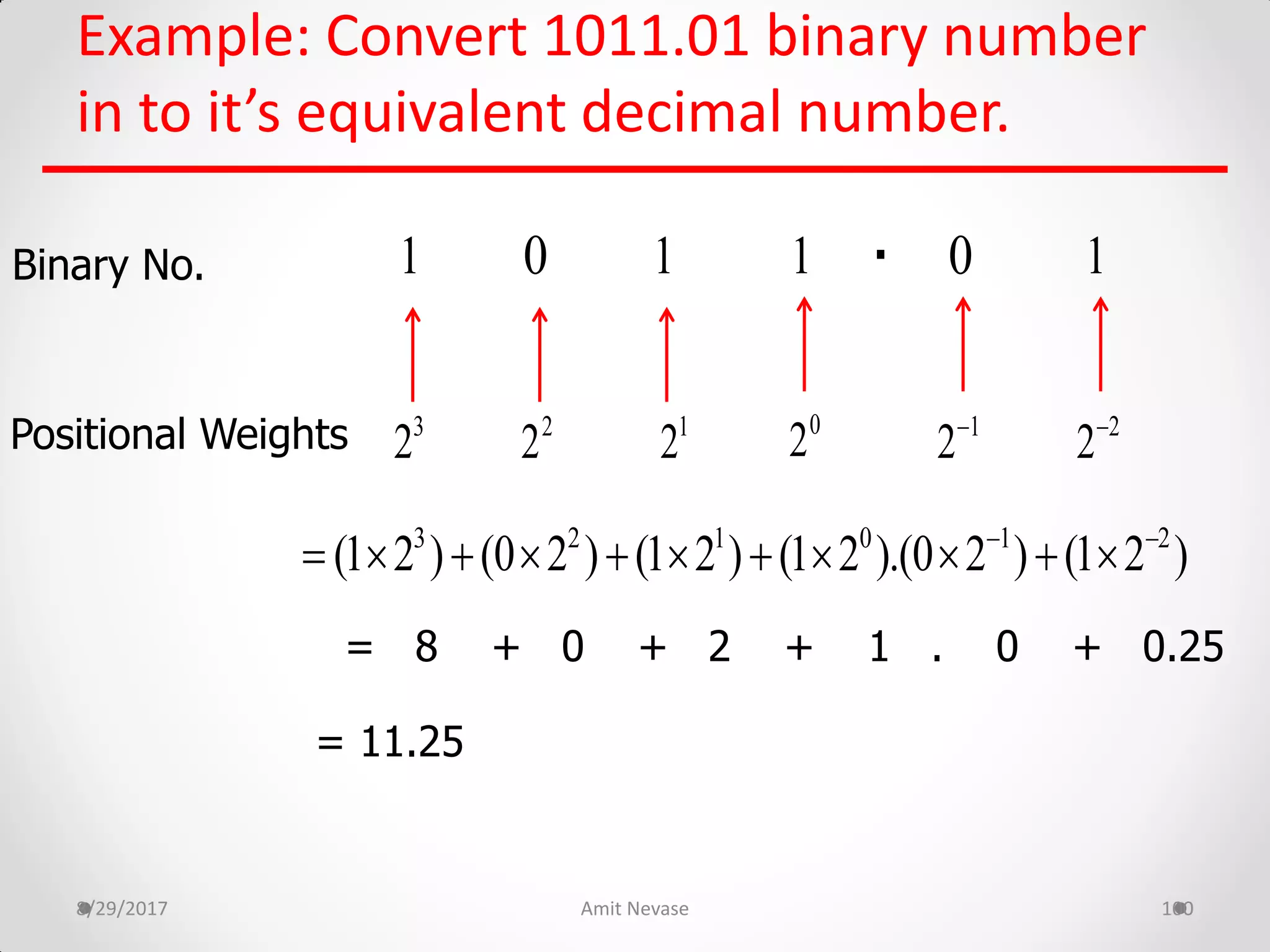
Binary No.
Positional Weights
.
= 8 + 0 + 2 + 1 . 0 + 0.25
= 11.25
101 0 11
0
21
22
23
2 1
2 2
2
3 2 1 0 1 2
(1 2 ) (0 2 ) (1 2 ) (1 2 ).(0 2 ) (1 2 ) 
          
Example: Convert 1011.01 binary number
in to it’s equivalent decimal number.
8/29/2017 Amit Nevase 101
Binary No.
Positional Weights
.
= 8 + 0 + 2 + 1 . 0 + 0.25
= 11.25
101 0 11
0
21
22
23
2 1
2 2
2
3 2 1 0 1 2
(1 2 ) (0 2 ) (1 2 ) (1 2 ).(0 2 ) (1 2 ) 
          
2 10(1011.01) (11.25)
8/29/2017 Amit Nevase 102
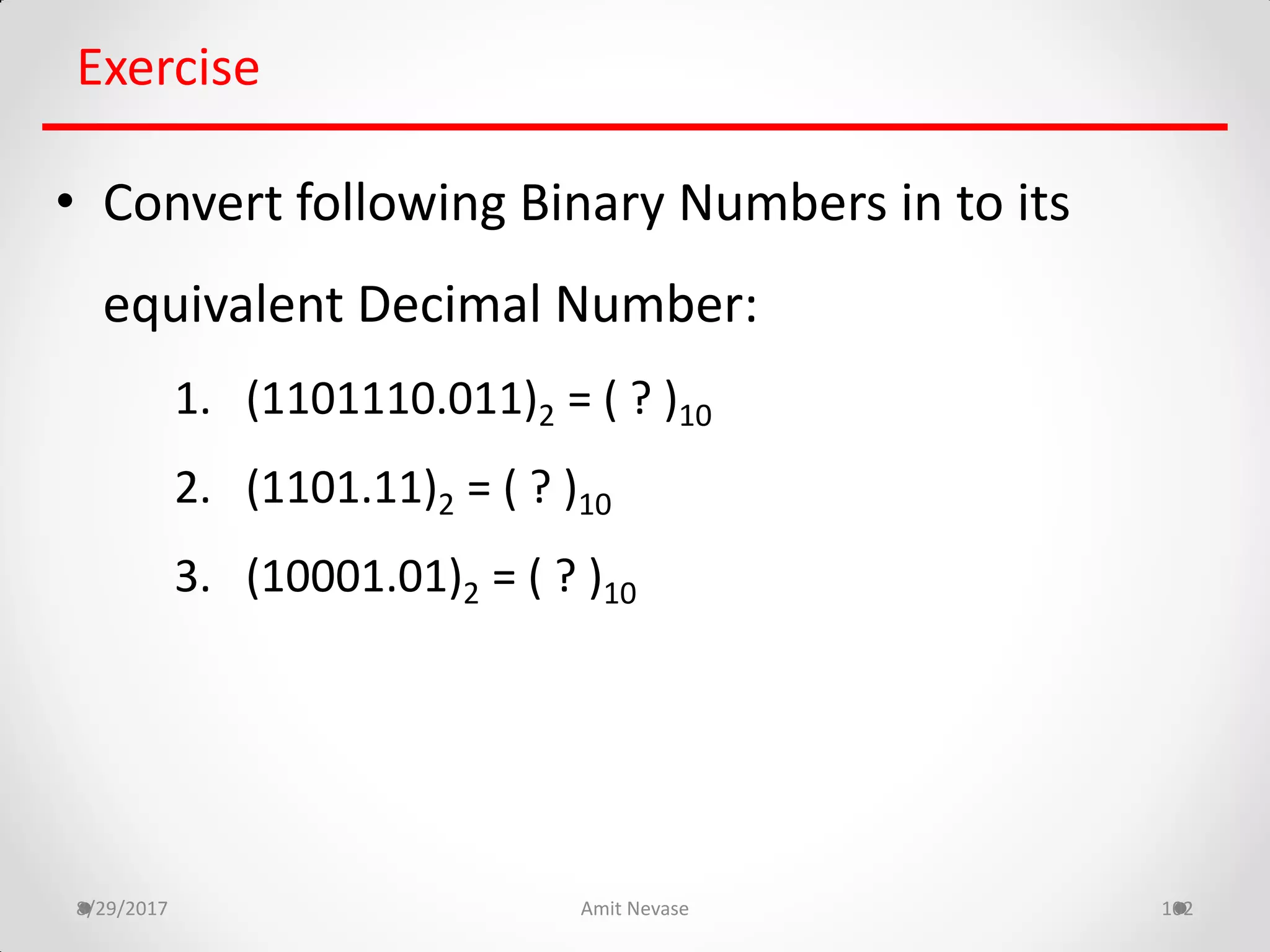
Exercise
• Convert following Binary Numbers in to its
equivalent Decimal Number:
1. (1101110.011)2 = ( ? )10
2. (1101.11)2 = ( ? )10
3. (10001.01)2 = ( ? )10
8/29/2017 Amit Nevase 103
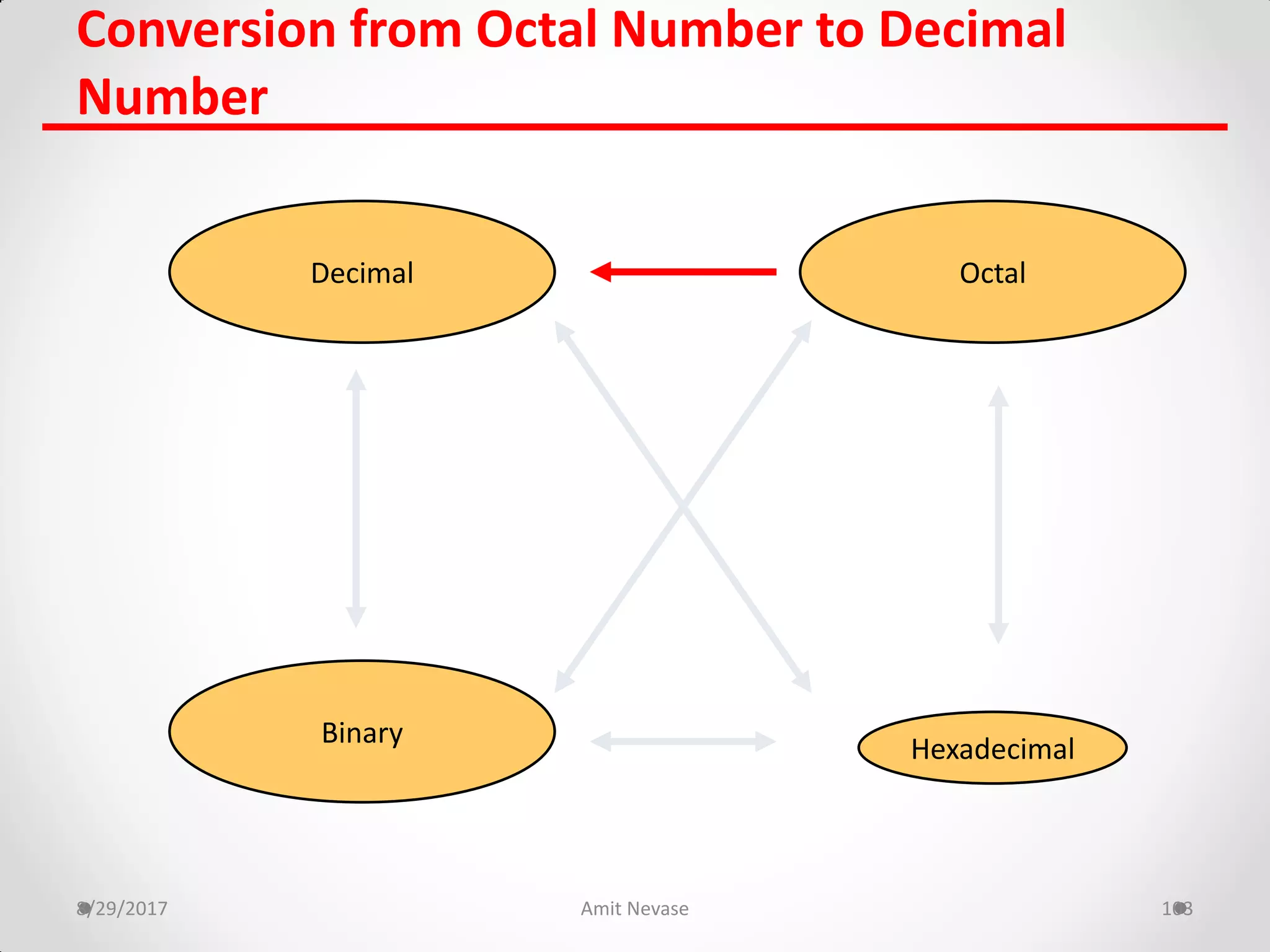
Conversion from Octal Number to Decimal
Number
Hexadecimal
Decimal Octal
Binary
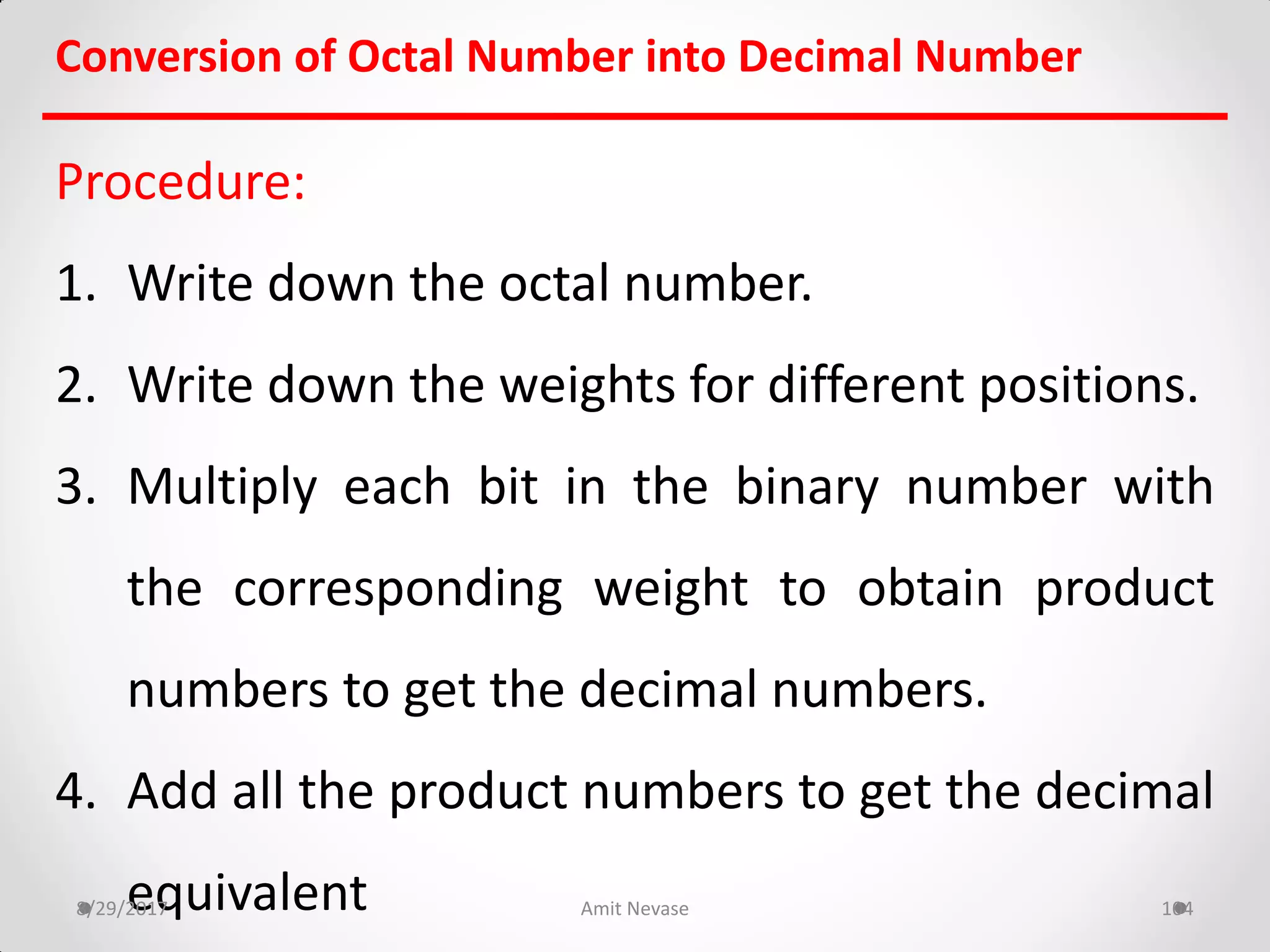
Procedure:
1. Write down the octal number.
2. Write down the weights for different positions.
3. Multiply each bit in the binary number with
the corresponding weight to obtain product
numbers to get the decimal numbers.
4. Add all the product numbers to get the decimal
equivalent8/29/2017 Amit Nevase 104
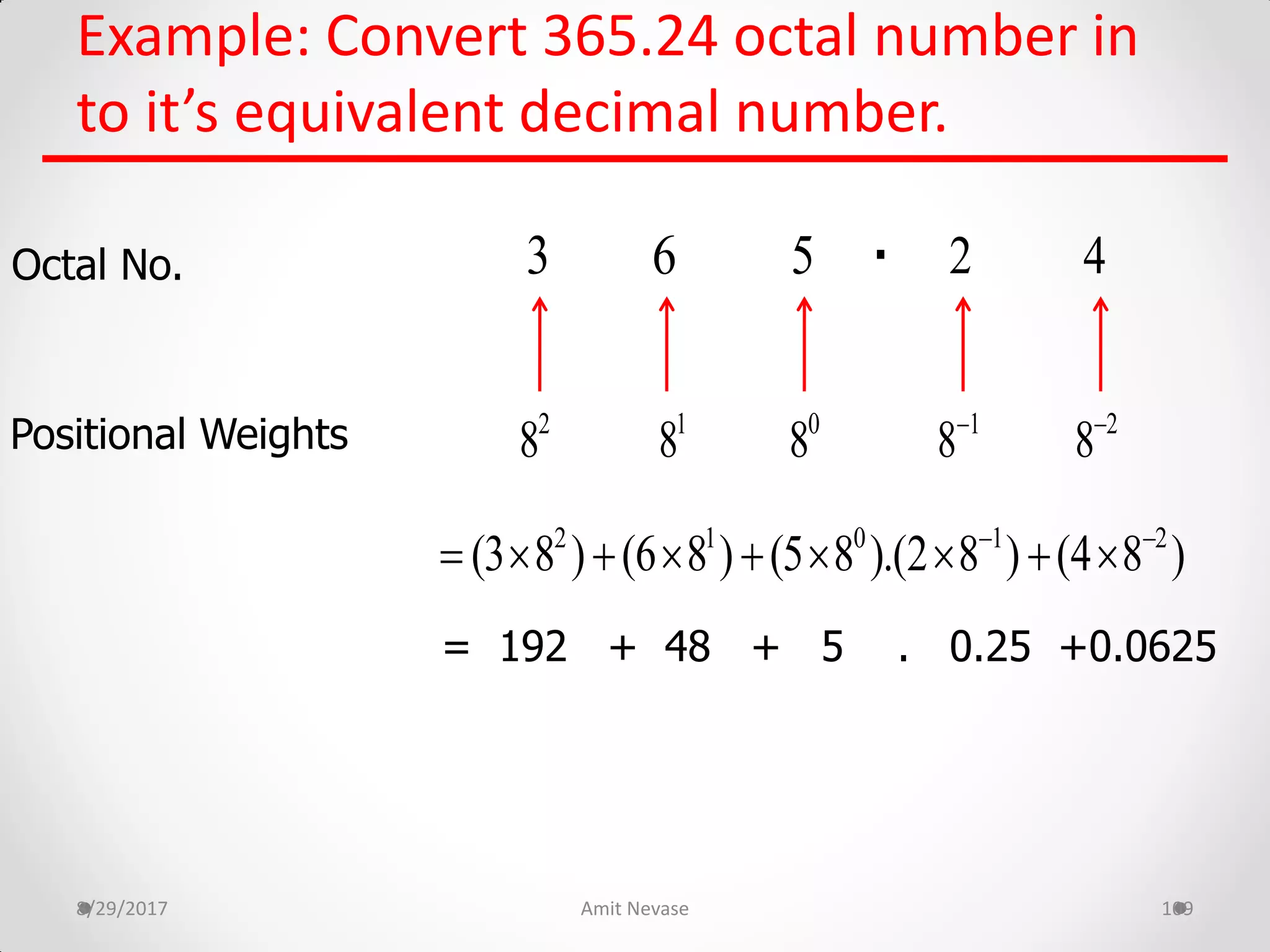
Conversion of Octal Number into Decimal Number
Example: Convert 365.24 octal number in
to it’s equivalent decimal number.
8/29/2017 Amit Nevase 105
Example: Convert 365.24 octal number in
to it’s equivalent decimal number.
8/29/2017 Amit Nevase 106
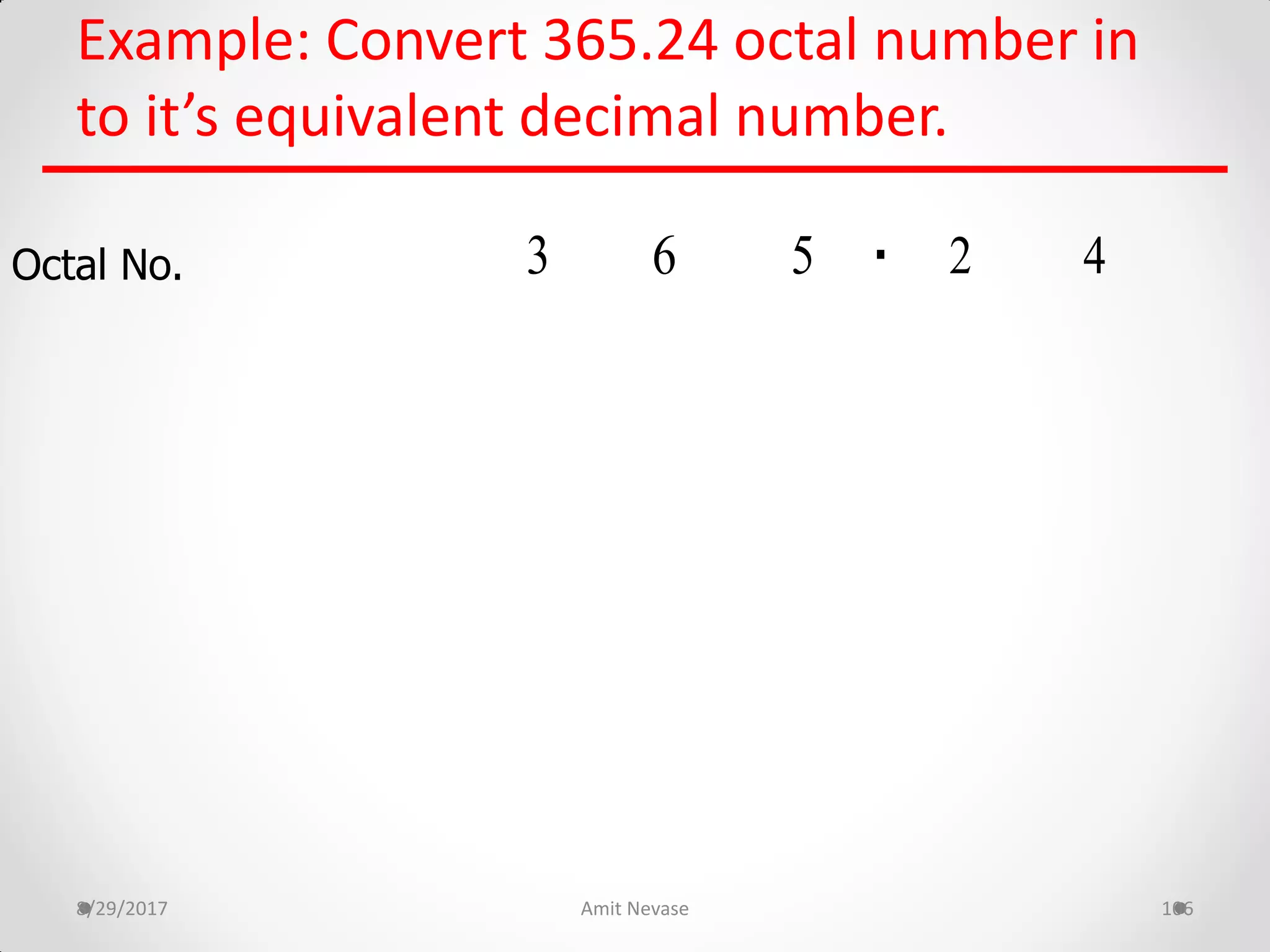
Octal No. .63 2 45
Example: Convert 365.24 octal number in
to it’s equivalent decimal number.
8/29/2017 Amit Nevase 107
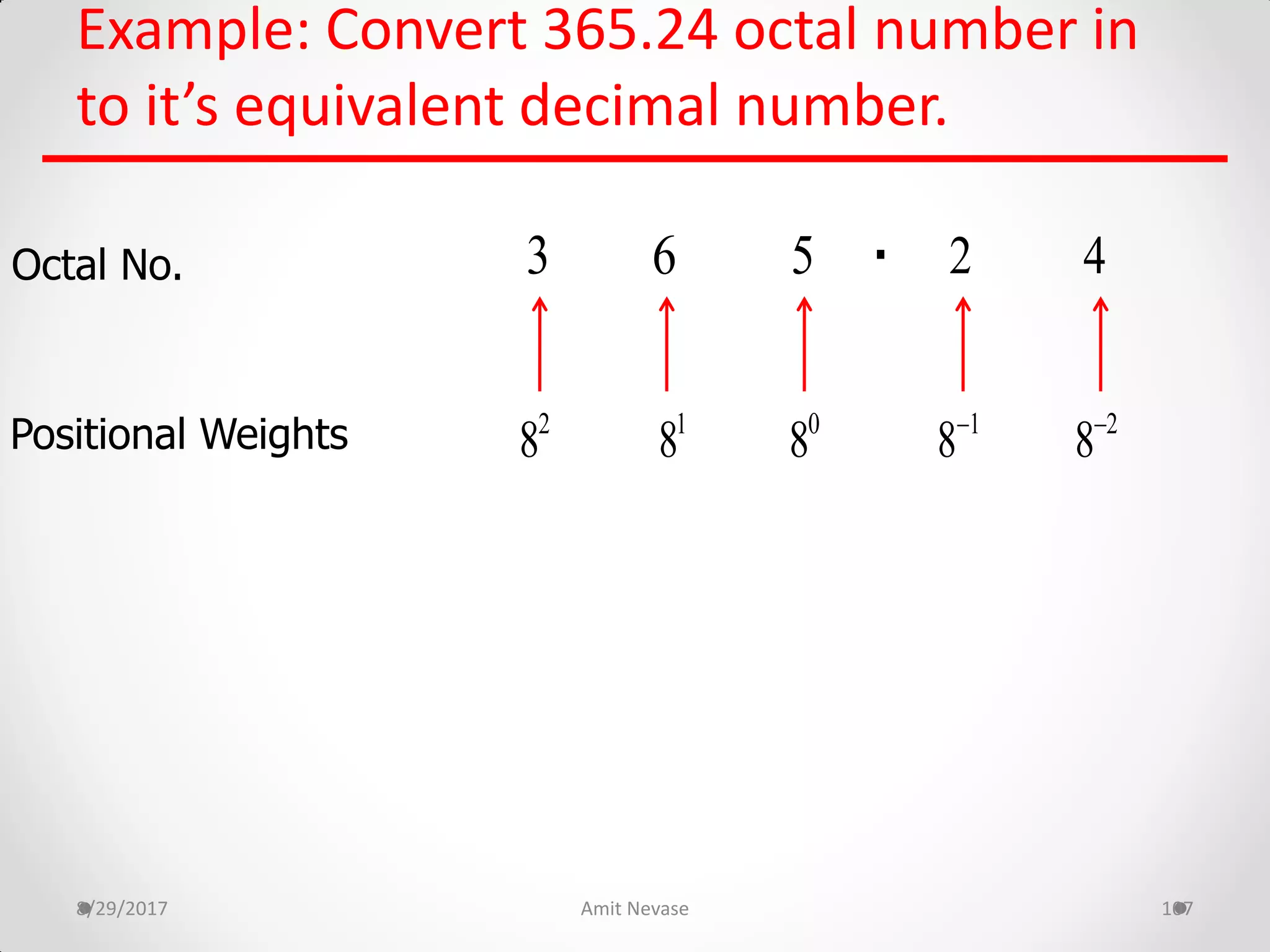
Octal No.
Positional Weights
.63 2 45
0
81
82
8 1
8 2
8
Example: Convert 365.24 octal number in
to it’s equivalent decimal number.
8/29/2017 Amit Nevase 108
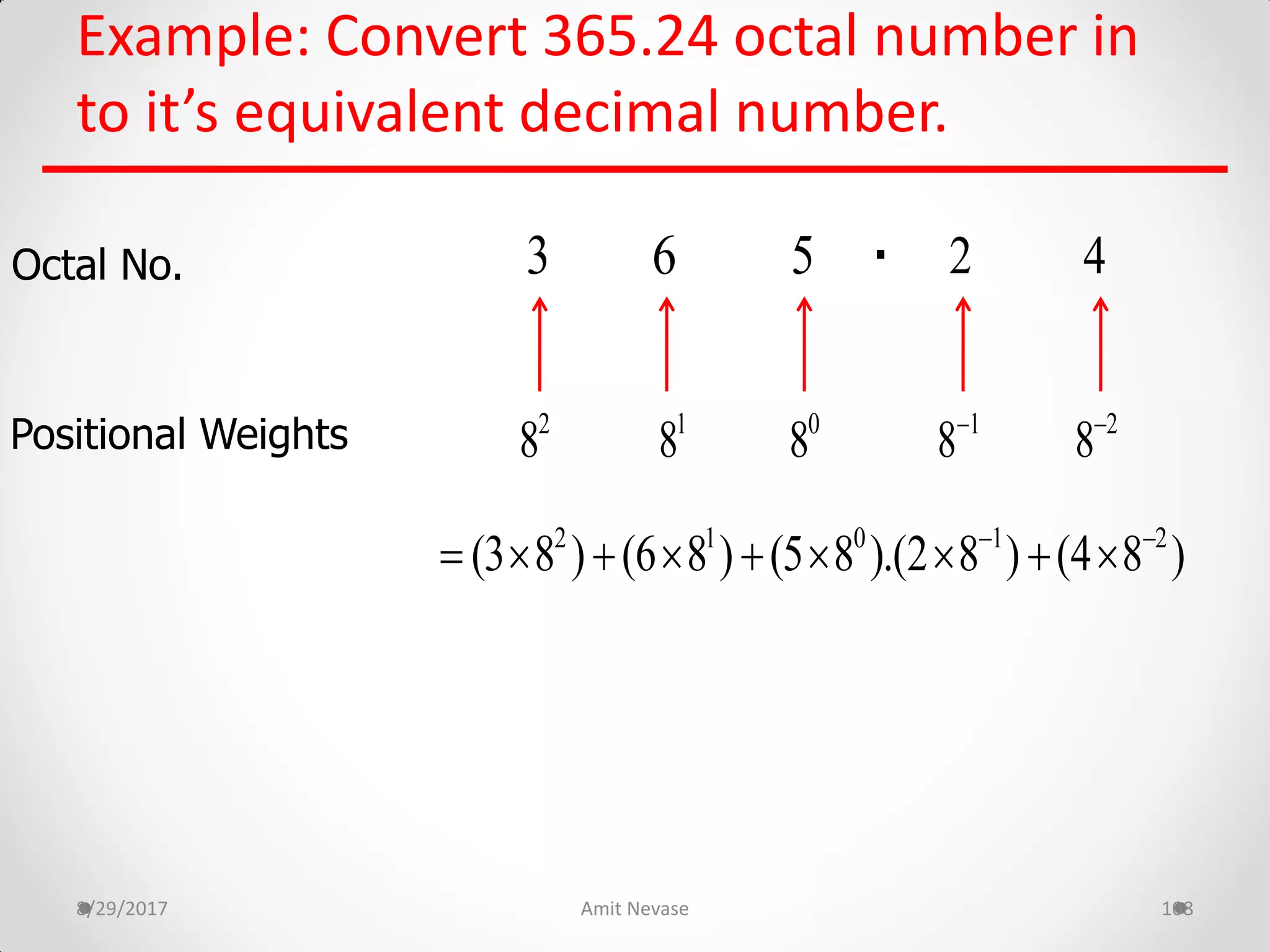
Octal No.
Positional Weights
.63 2 45
0
81
82
8 1
8 2
8
2 1 0 1 2
(3 8 ) (6 8 ) (5 8 ).(2 8 ) (4 8 ) 
        
Example: Convert 365.24 octal number in
to it’s equivalent decimal number.
8/29/2017 Amit Nevase 109
Octal No.
Positional Weights
.
= 192 + 48 + 5 . 0.25 +0.0625
63 2 45
0
81
82
8 1
8 2
8
2 1 0 1 2
(3 8 ) (6 8 ) (5 8 ).(2 8 ) (4 8 ) 
        
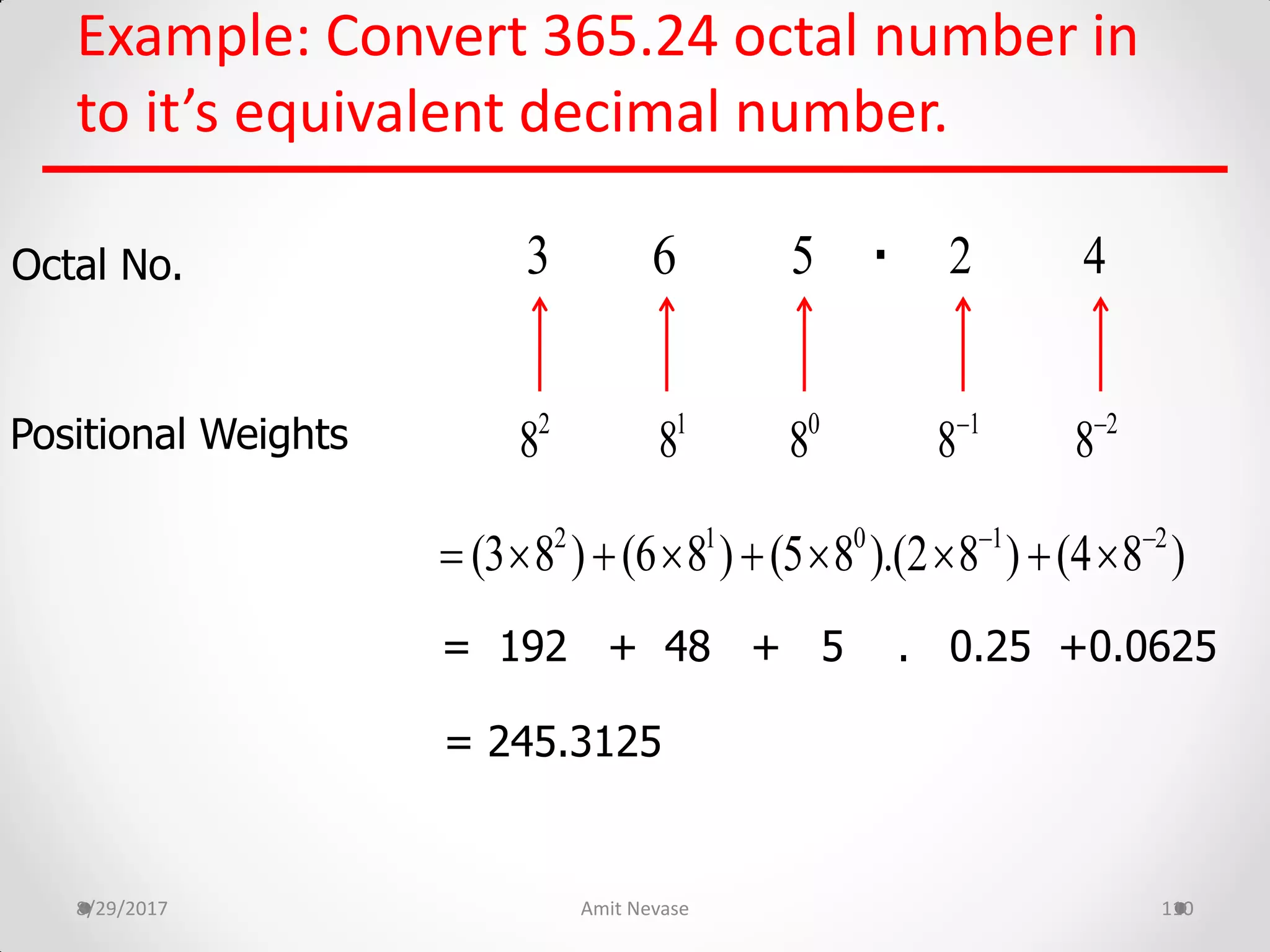
Example: Convert 365.24 octal number in
to it’s equivalent decimal number.
8/29/2017 Amit Nevase 110
Octal No.
Positional Weights
.
= 192 + 48 + 5 . 0.25 +0.0625
= 245.3125
63 2 45
0
81
82
8 1
8 2
8
2 1 0 1 2
(3 8 ) (6 8 ) (5 8 ).(2 8 ) (4 8 ) 
        
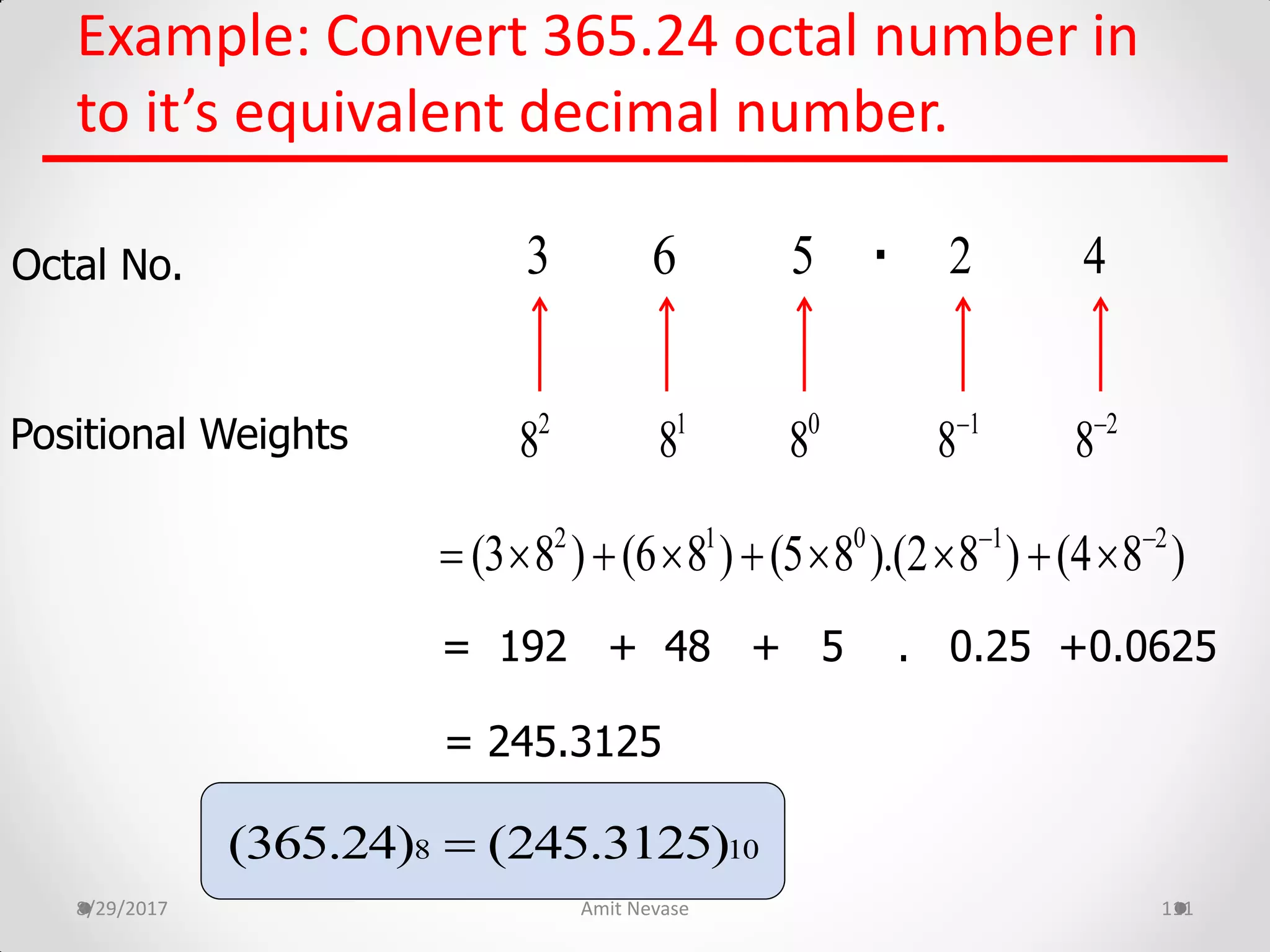
Example: Convert 365.24 octal number in
to it’s equivalent decimal number.
8/29/2017 Amit Nevase 111
Octal No.
Positional Weights
.
= 192 + 48 + 5 . 0.25 +0.0625
= 245.3125
63 2 45
0
81
82
8 1
8 2
8
2 1 0 1 2
(3 8 ) (6 8 ) (5 8 ).(2 8 ) (4 8 ) 
        
8 10(365.24) (245.3125)
8/29/2017 Amit Nevase 112
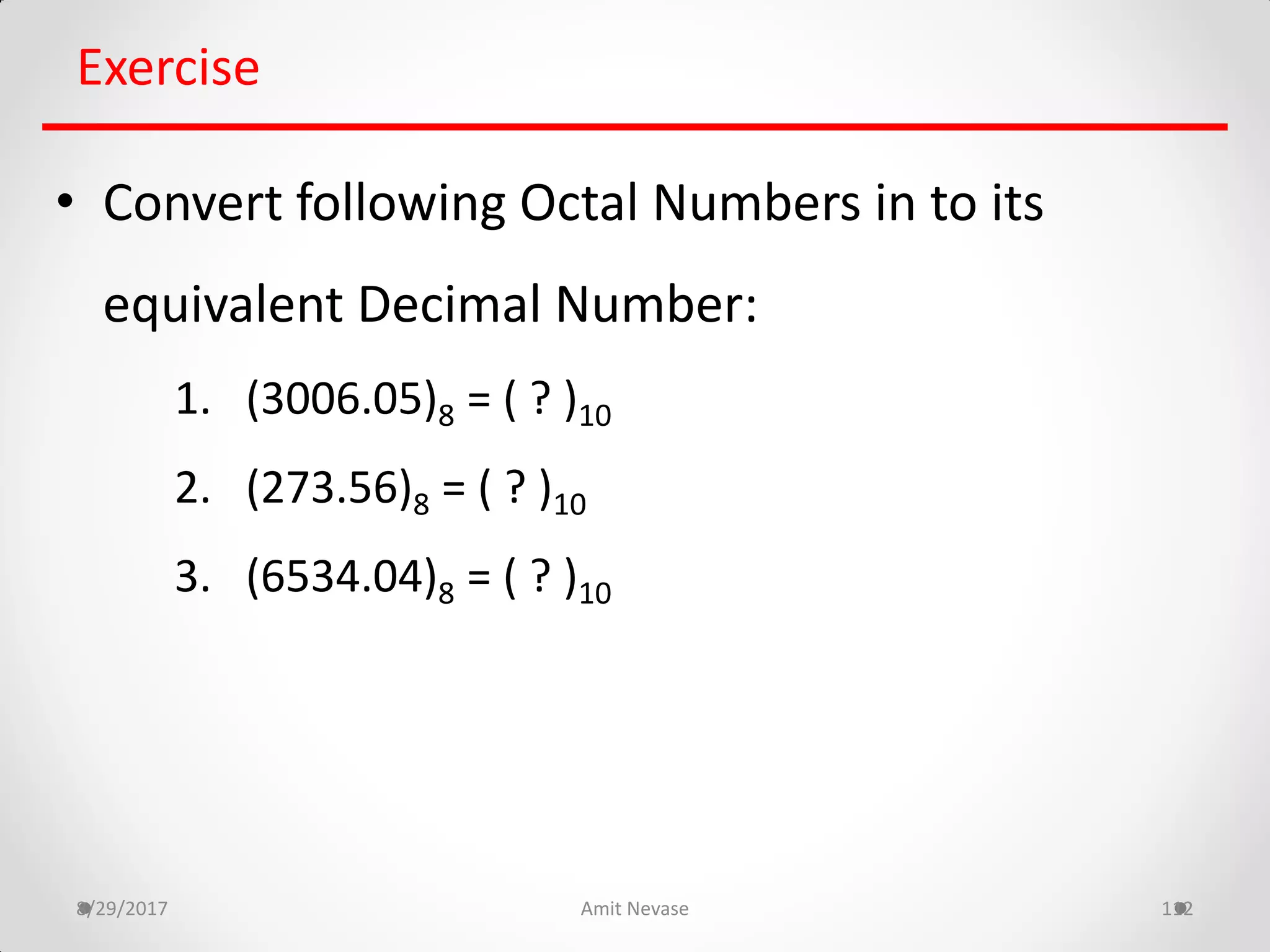
Exercise
• Convert following Octal Numbers in to its
equivalent Decimal Number:
1. (3006.05)8 = ( ? )10
2. (273.56)8 = ( ? )10
3. (6534.04)8 = ( ? )10
8/29/2017 Amit Nevase 113
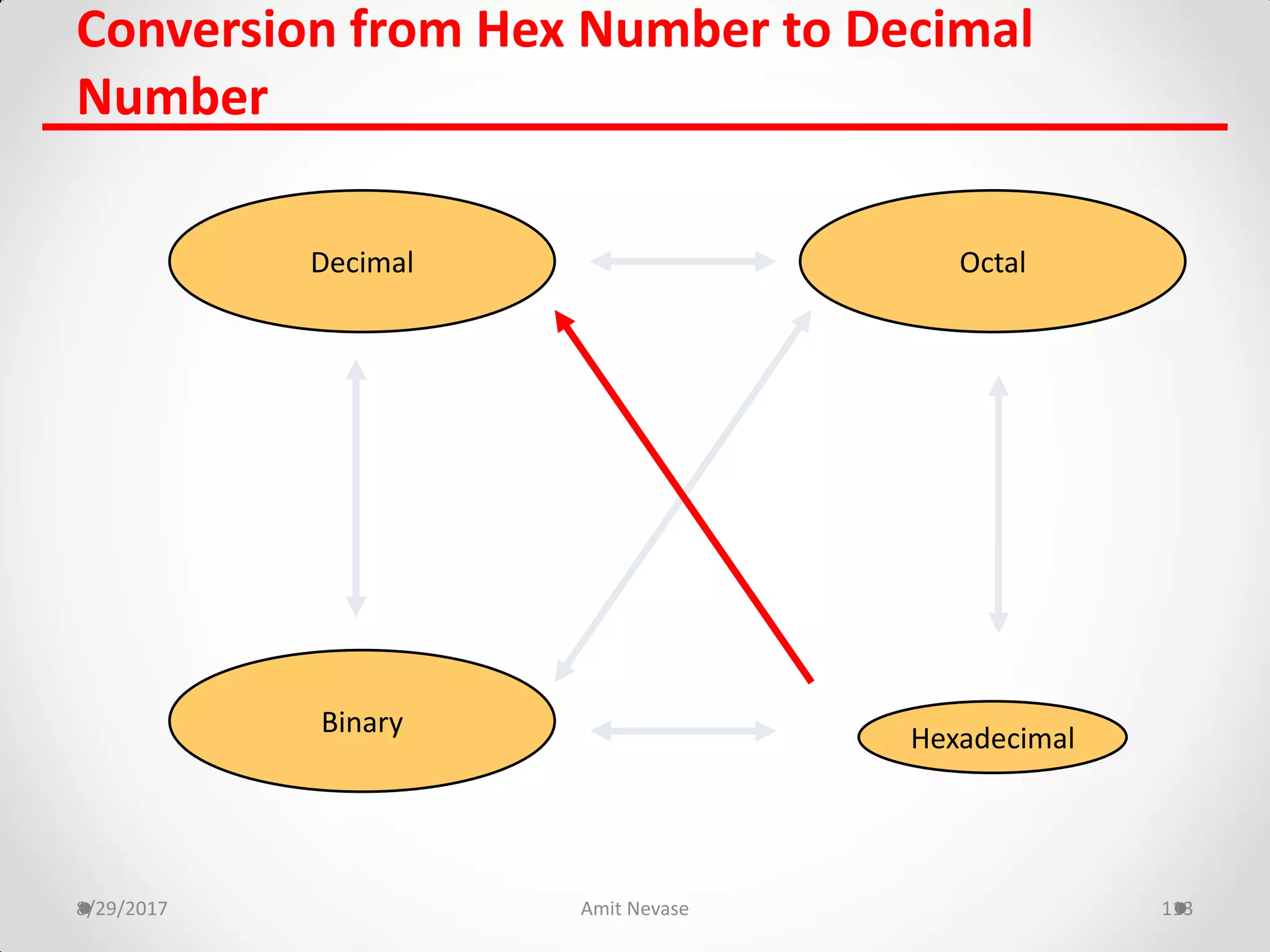
Conversion from Hex Number to Decimal
Number
Hexadecimal
Decimal Octal
Binary
Procedure:
1. Write down the hex number.
2. Write down the weights for different positions.
3. Multiply each bit in the binary number with
the corresponding weight to obtain product
numbers to get the decimal numbers.
4. Add all the product numbers to get the
8/29/2017 Amit Nevase 114
Conversion of Hexadecimal Number into Decimal Number
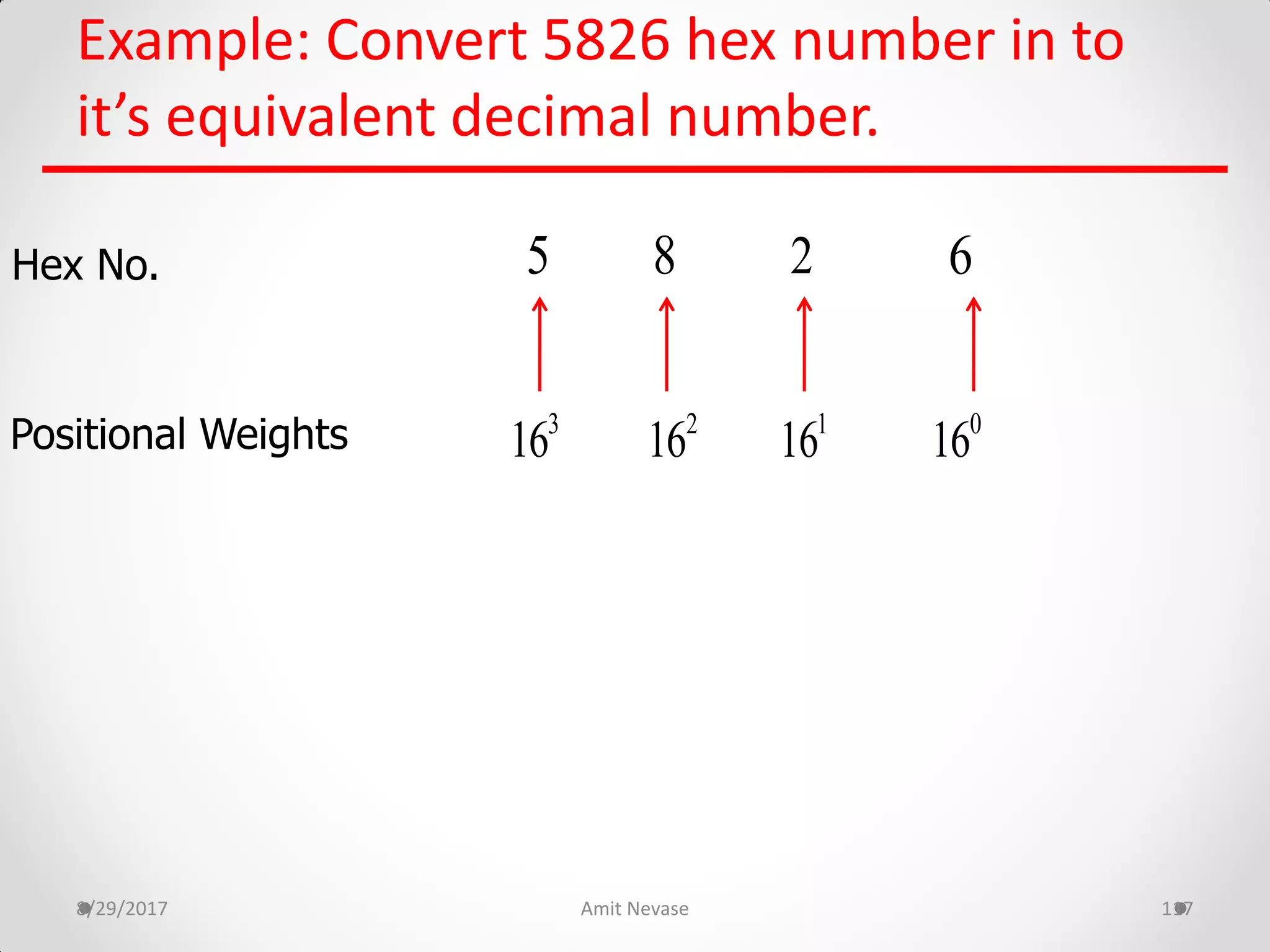
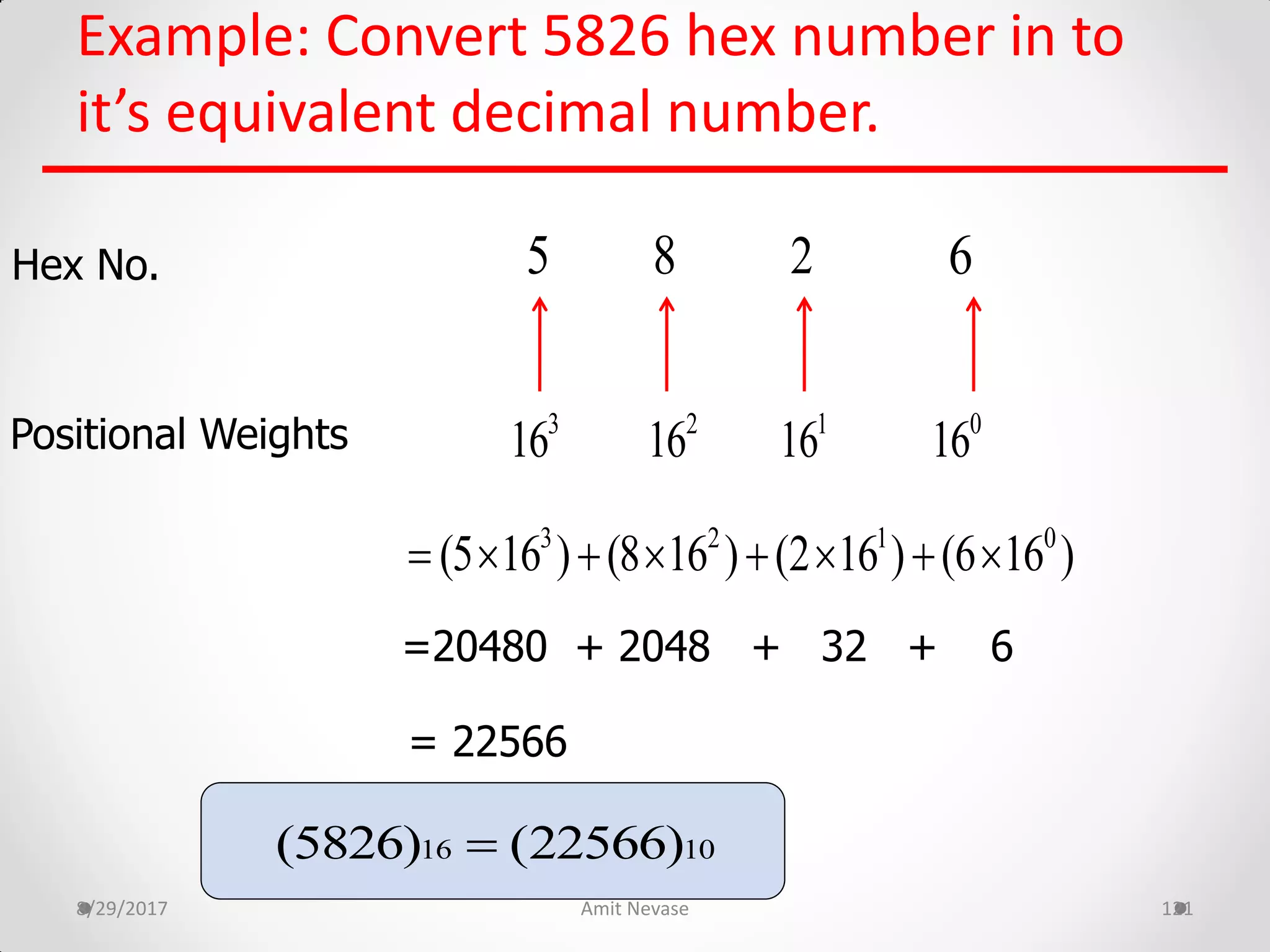
Example: Convert 5826 hex number in to
it’s equivalent decimal number.
8/29/2017 Amit Nevase 115
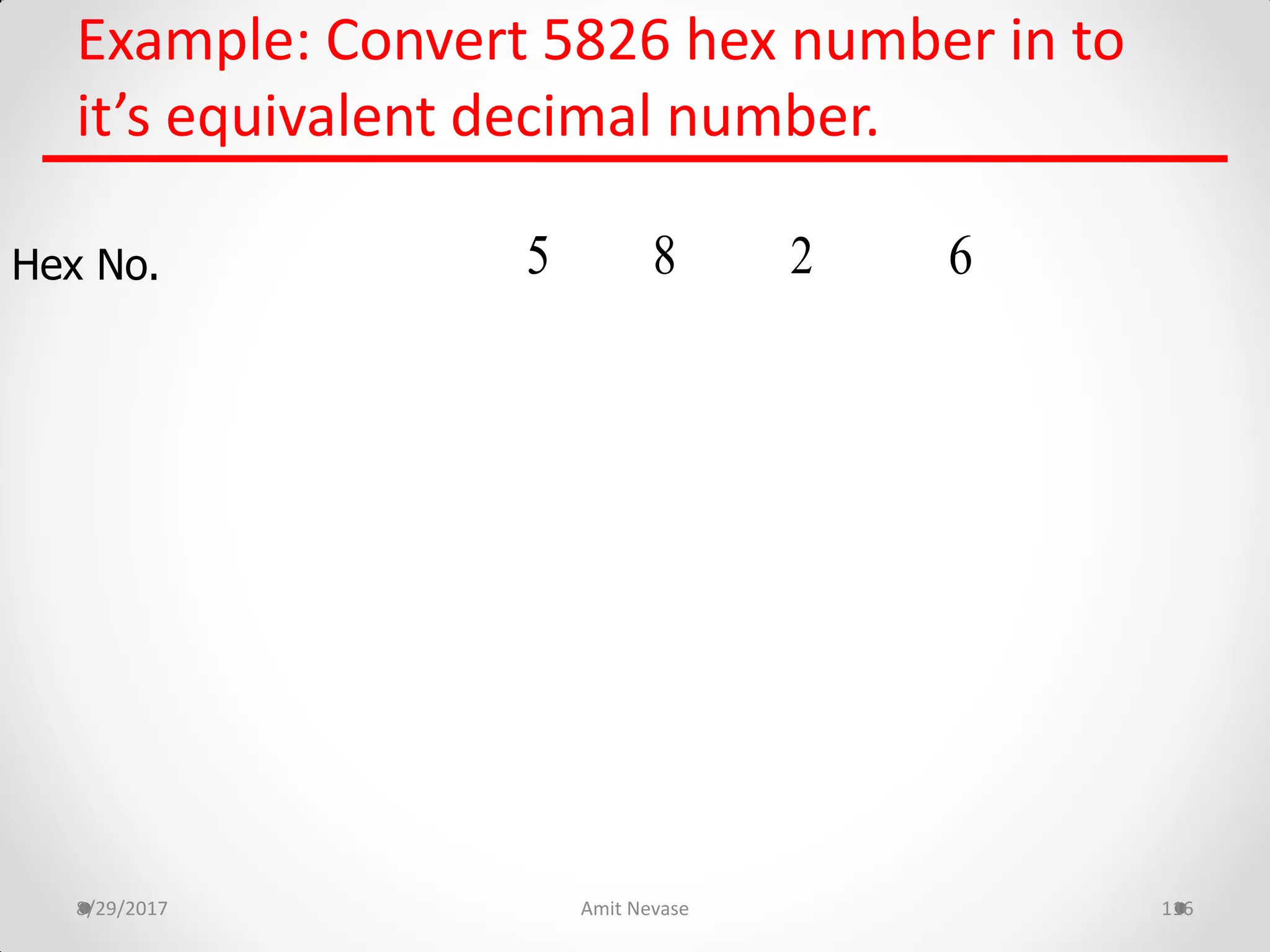
Example: Convert 5826 hex number in to
it’s equivalent decimal number.
8/29/2017 Amit Nevase 116
Hex No. 85 62
Example: Convert 5826 hex number in to
it’s equivalent decimal number.
8/29/2017 Amit Nevase 117
Hex No.
Positional Weights
85 62
1
162
163
16 0
16
Example: Convert 5826 hex number in to
it’s equivalent decimal number.
8/29/2017 Amit Nevase 118
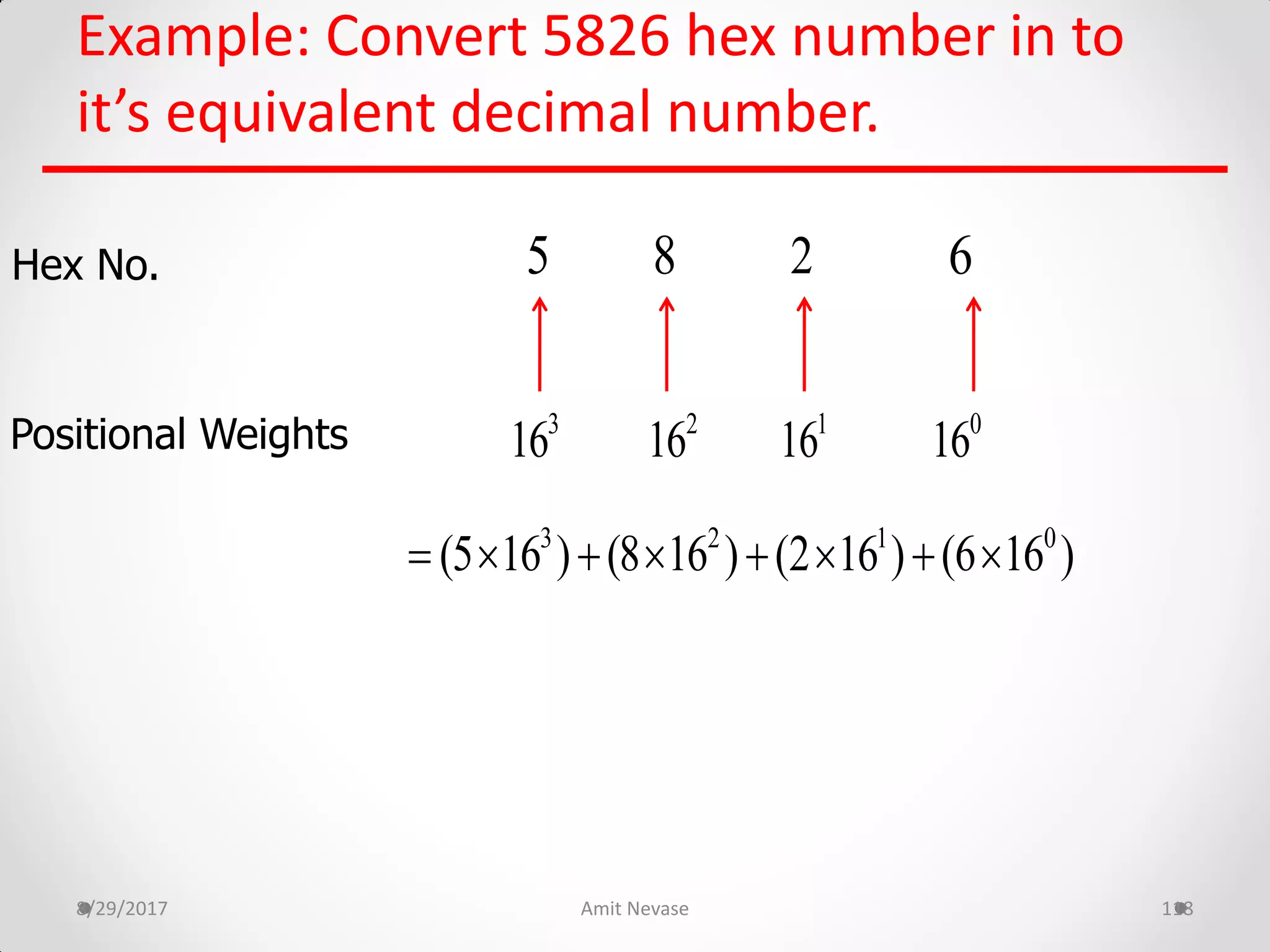
Hex No.
Positional Weights
85 62
1
162
163
16 0
16
3 2 1 0
(5 16 ) (8 16 ) (2 16 ) (6 16 )       
Example: Convert 5826 hex number in to
it’s equivalent decimal number.
8/29/2017 Amit Nevase 119
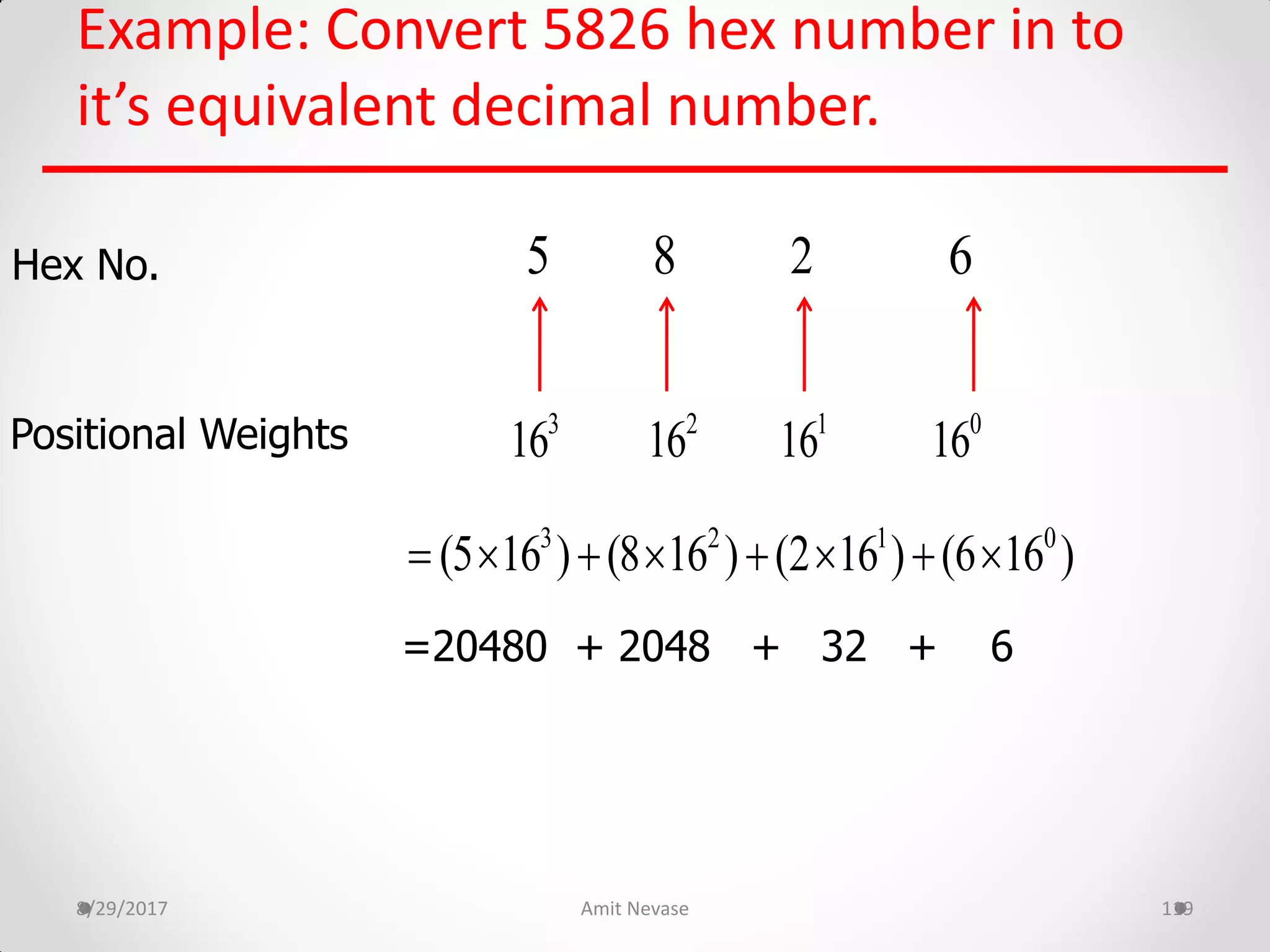
Hex No.
Positional Weights
=20480 + 2048 + 32 + 6
85 62
1
162
163
16 0
16
3 2 1 0
(5 16 ) (8 16 ) (2 16 ) (6 16 )       
Example: Convert 5826 hex number in to
it’s equivalent decimal number.
8/29/2017 Amit Nevase 120
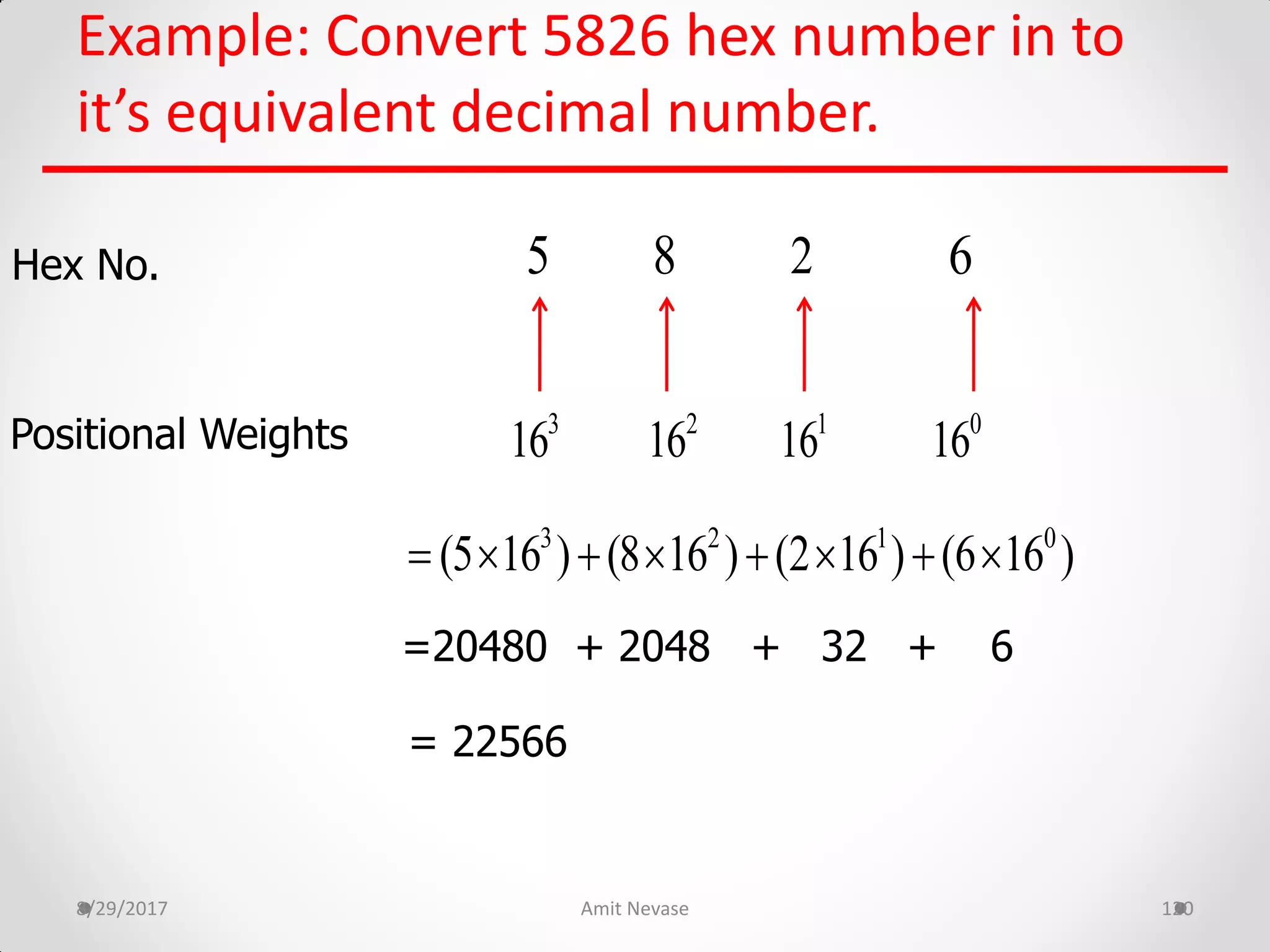
Hex No.
Positional Weights
=20480 + 2048 + 32 + 6
= 22566
85 62
1
162
163
16 0
16
3 2 1 0
(5 16 ) (8 16 ) (2 16 ) (6 16 )       
Example: Convert 5826 hex number in to
it’s equivalent decimal number.
8/29/2017 Amit Nevase 121
Hex No.
Positional Weights
=20480 + 2048 + 32 + 6
= 22566
85 62
1
162
163
16 0
16
3 2 1 0
(5 16 ) (8 16 ) (2 16 ) (6 16 )       
16 10(5826) (22566)
8/29/2017 Amit Nevase 122
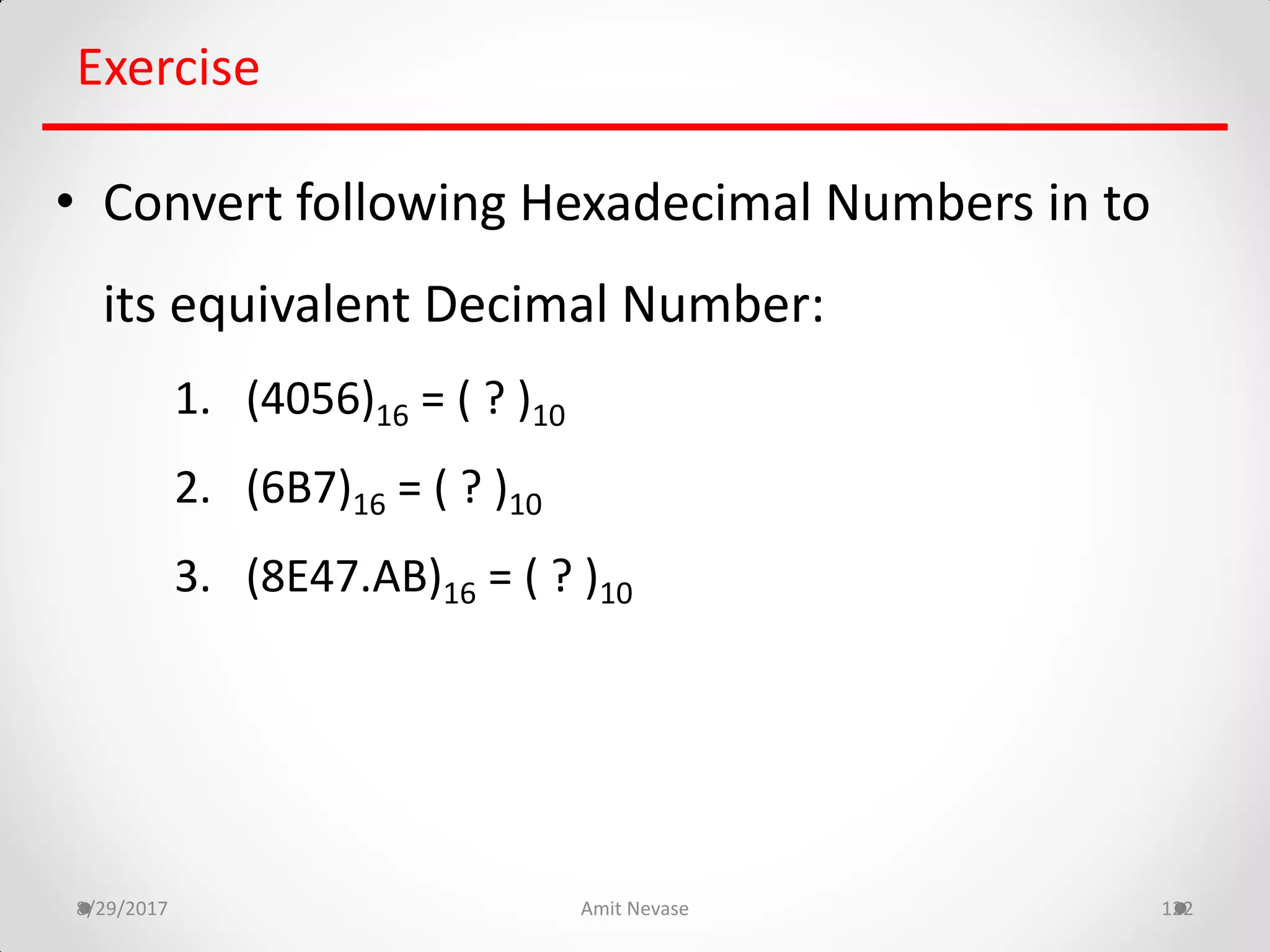
Exercise
• Convert following Hexadecimal Numbers in to
its equivalent Decimal Number:
1. (4056)16 = ( ? )10
2. (6B7)16 = ( ? )10
3. (8E47.AB)16 = ( ? )10
8/29/2017 Amit Nevase 123
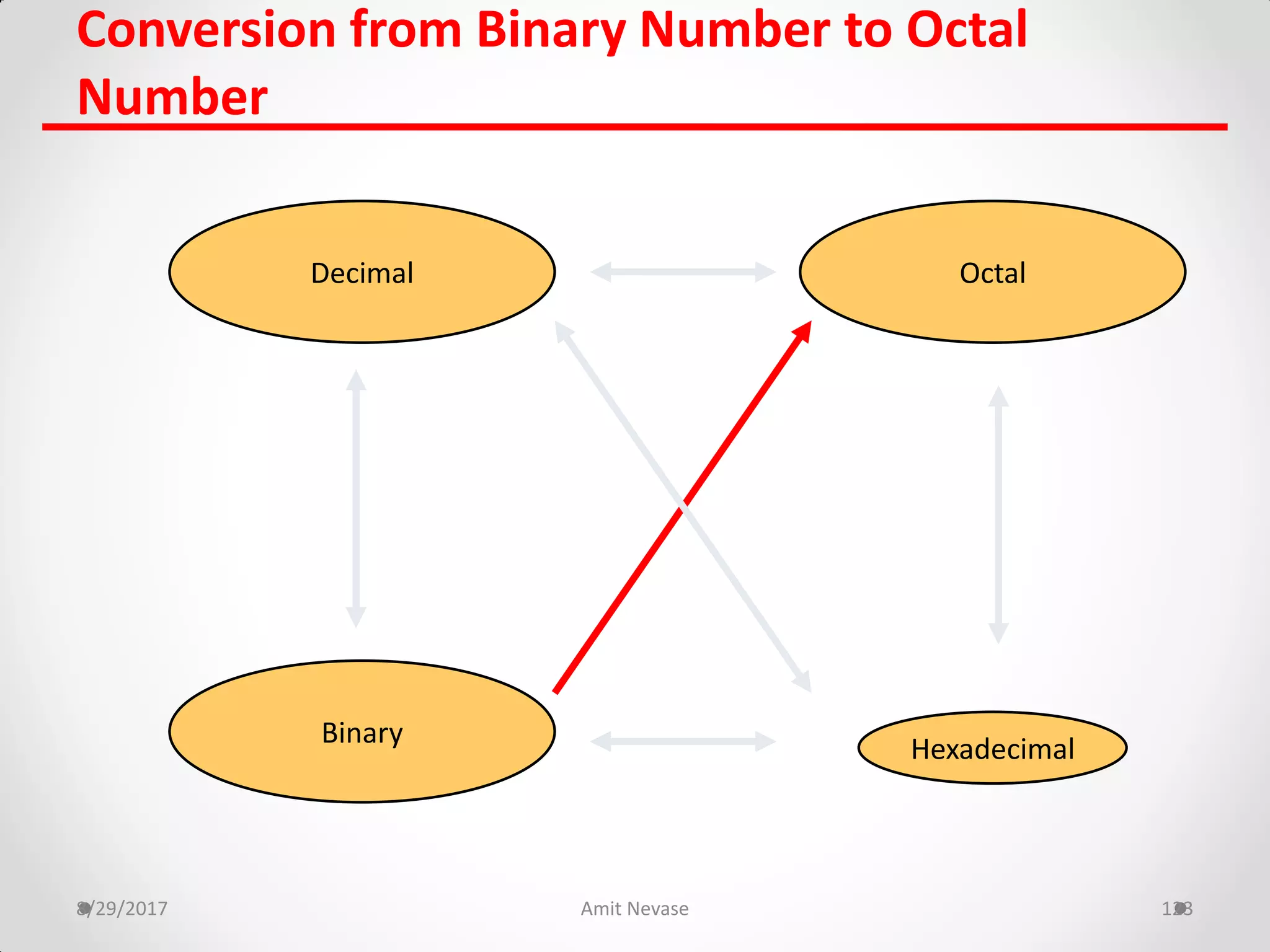
Conversion from Binary Number to Octal
Number
Hexadecimal
Decimal Octal
Binary
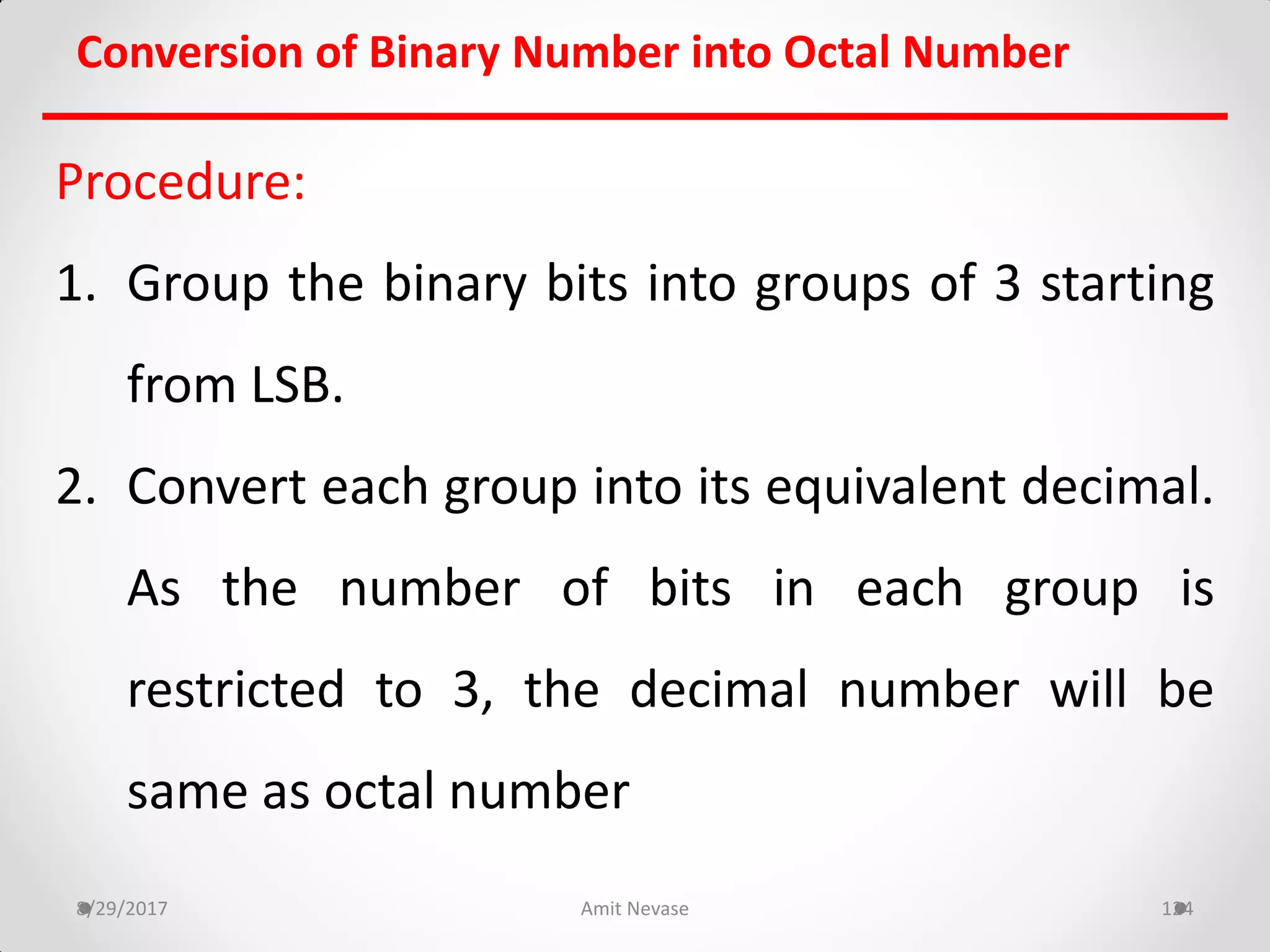
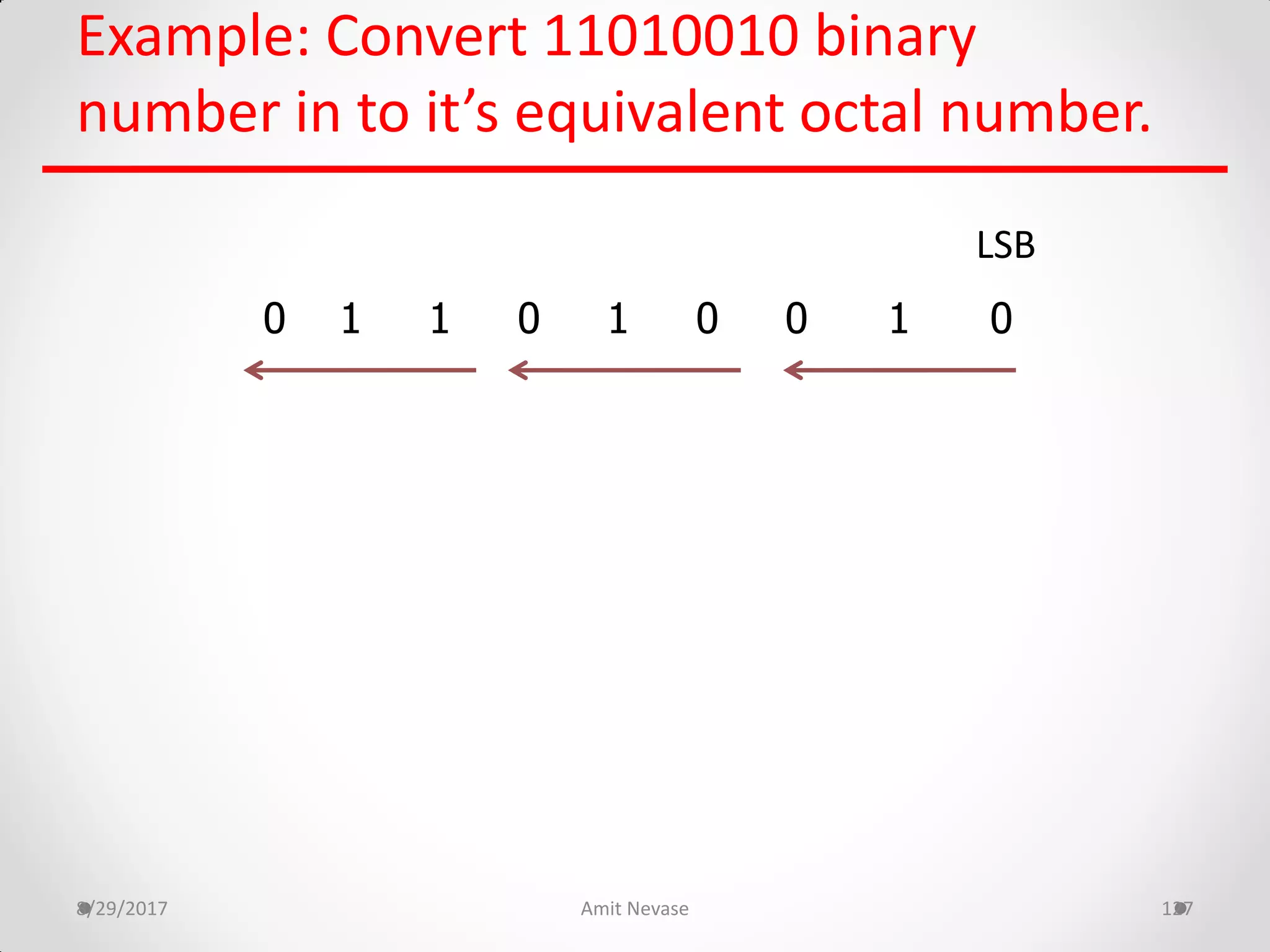
Procedure:
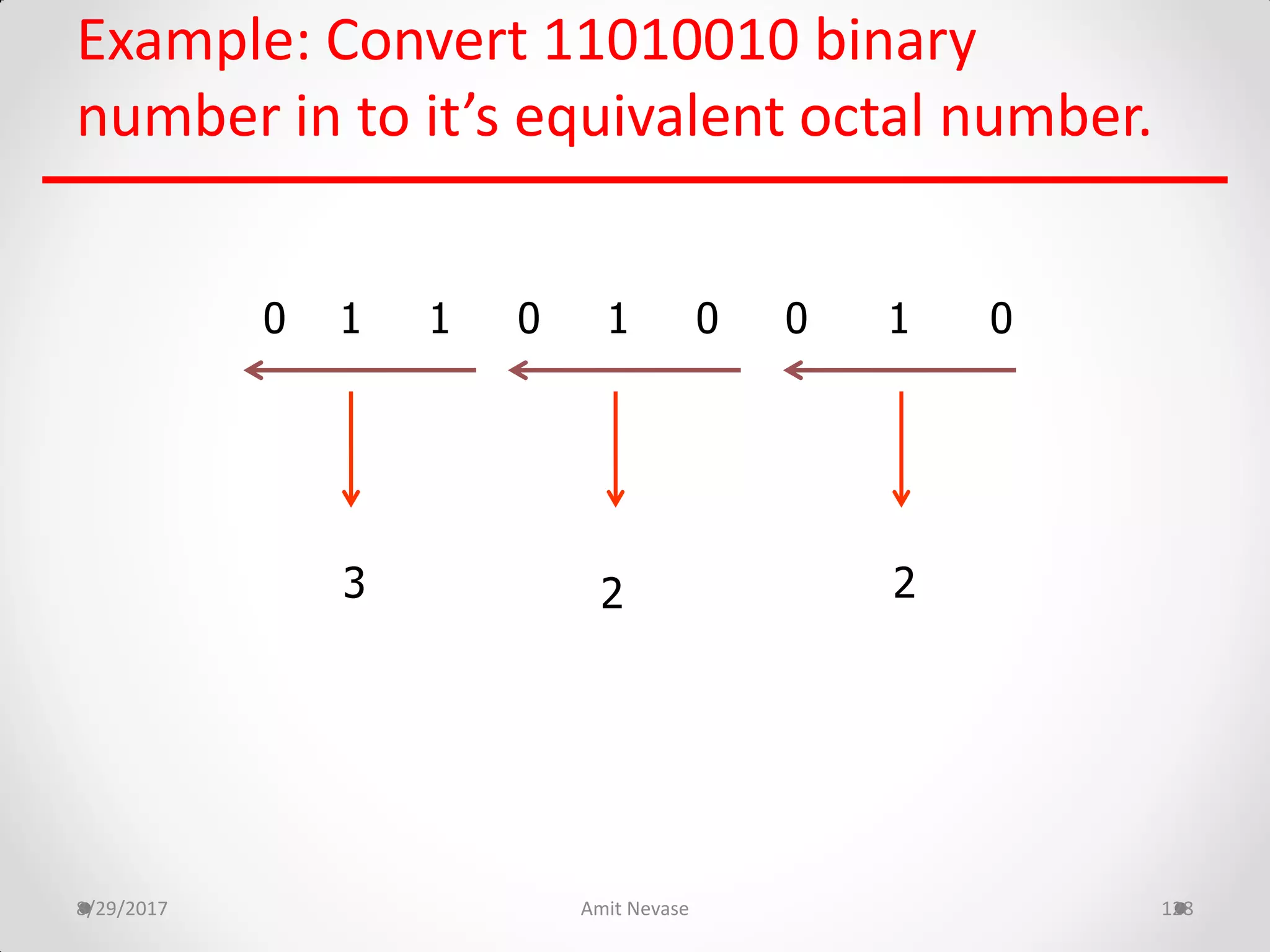
1. Group the binary bits into groups of 3 starting
from LSB.
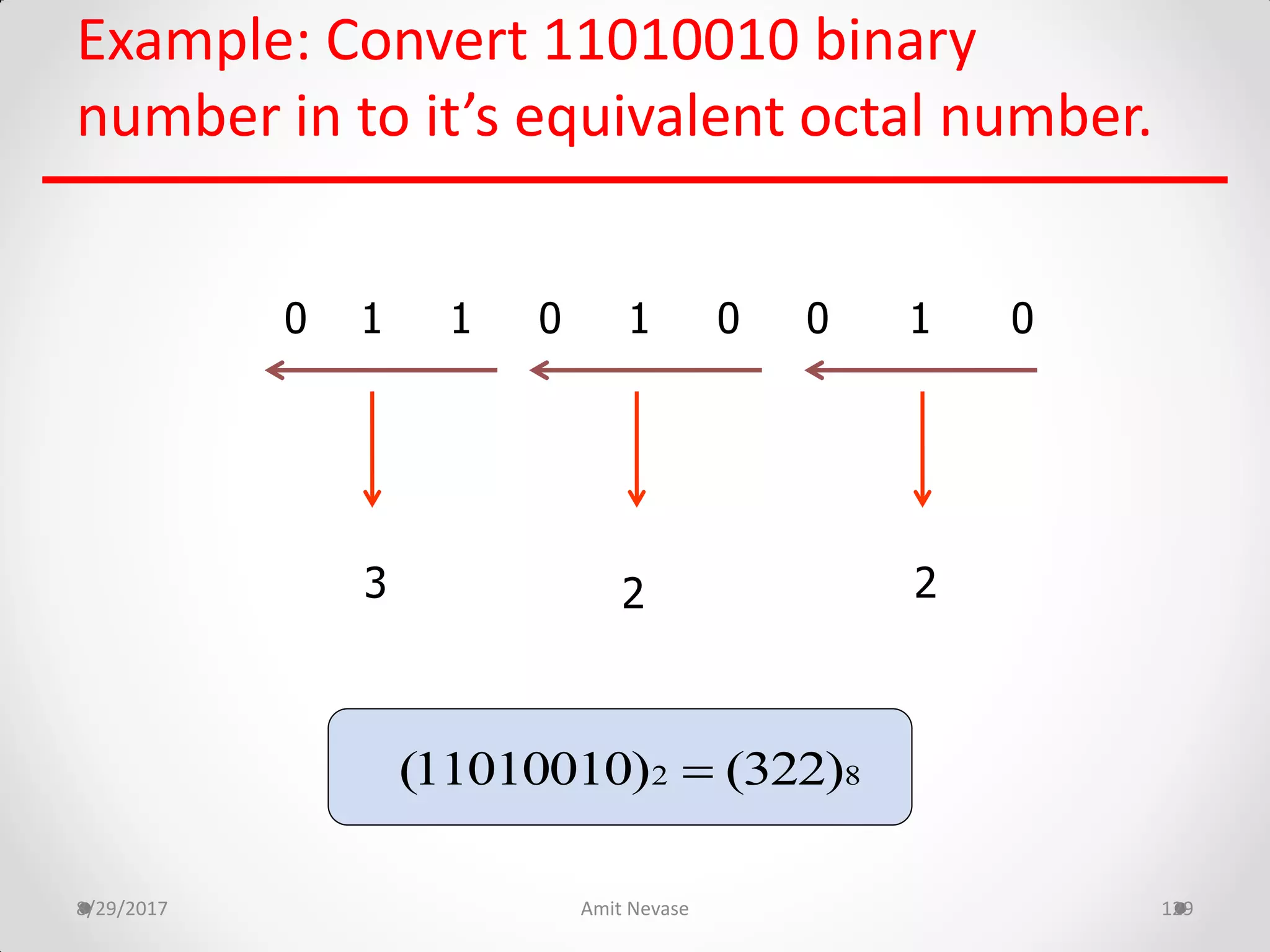
2. Convert each group into its equivalent decimal.
As the number of bits in each group is
restricted to 3, the decimal number will be
same as octal number
8/29/2017 Amit Nevase 124
Conversion of Binary Number into Octal Number
Example: Convert 11010010 binary
number in to it’s equivalent octal number.
8/29/2017 Amit Nevase 125
Example: Convert 11010010 binary
number in to it’s equivalent octal number.
8/29/2017 Amit Nevase 126
0 1 1 0 1 0 0 1 0
Example: Convert 11010010 binary
number in to it’s equivalent octal number.
8/29/2017 Amit Nevase 127
0 1 1 0 1 0 0 1 0
LSB
Example: Convert 11010010 binary
number in to it’s equivalent octal number.
8/29/2017 Amit Nevase 128
0 1 1 0 1 0 0 1 0
3 2 2
8/29/2017 Amit Nevase 129
Example: Convert 11010010 binary
number in to it’s equivalent octal number.
0 1 1 0 1 0 0 1 0
3 2 2
2 8(11010010) (322)
8/29/2017 Amit Nevase 130
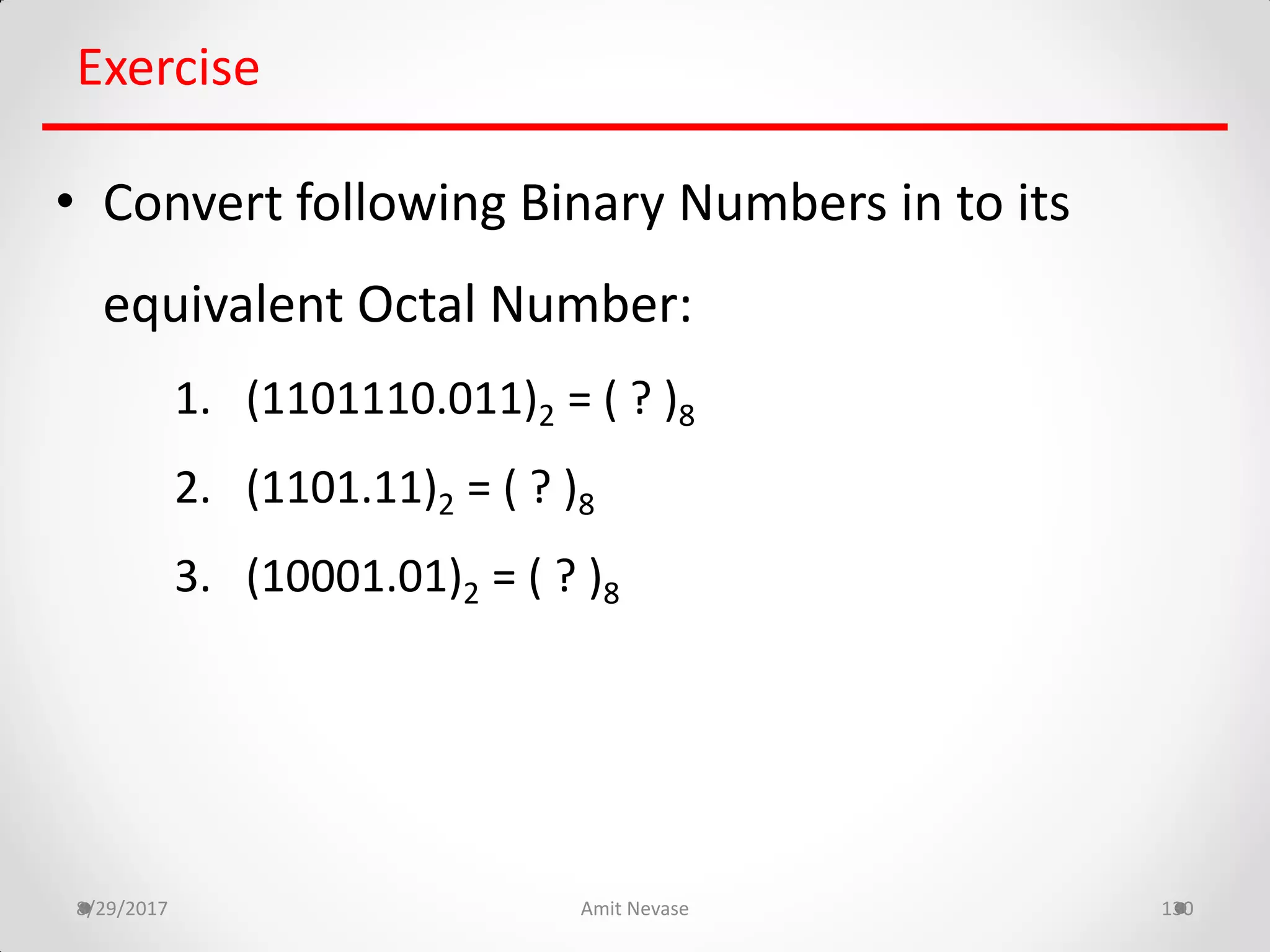
Exercise
• Convert following Binary Numbers in to its
equivalent Octal Number:
1. (1101110.011)2 = ( ? )8
2. (1101.11)2 = ( ? )8
3. (10001.01)2 = ( ? )8
8/29/2017 Amit Nevase 131
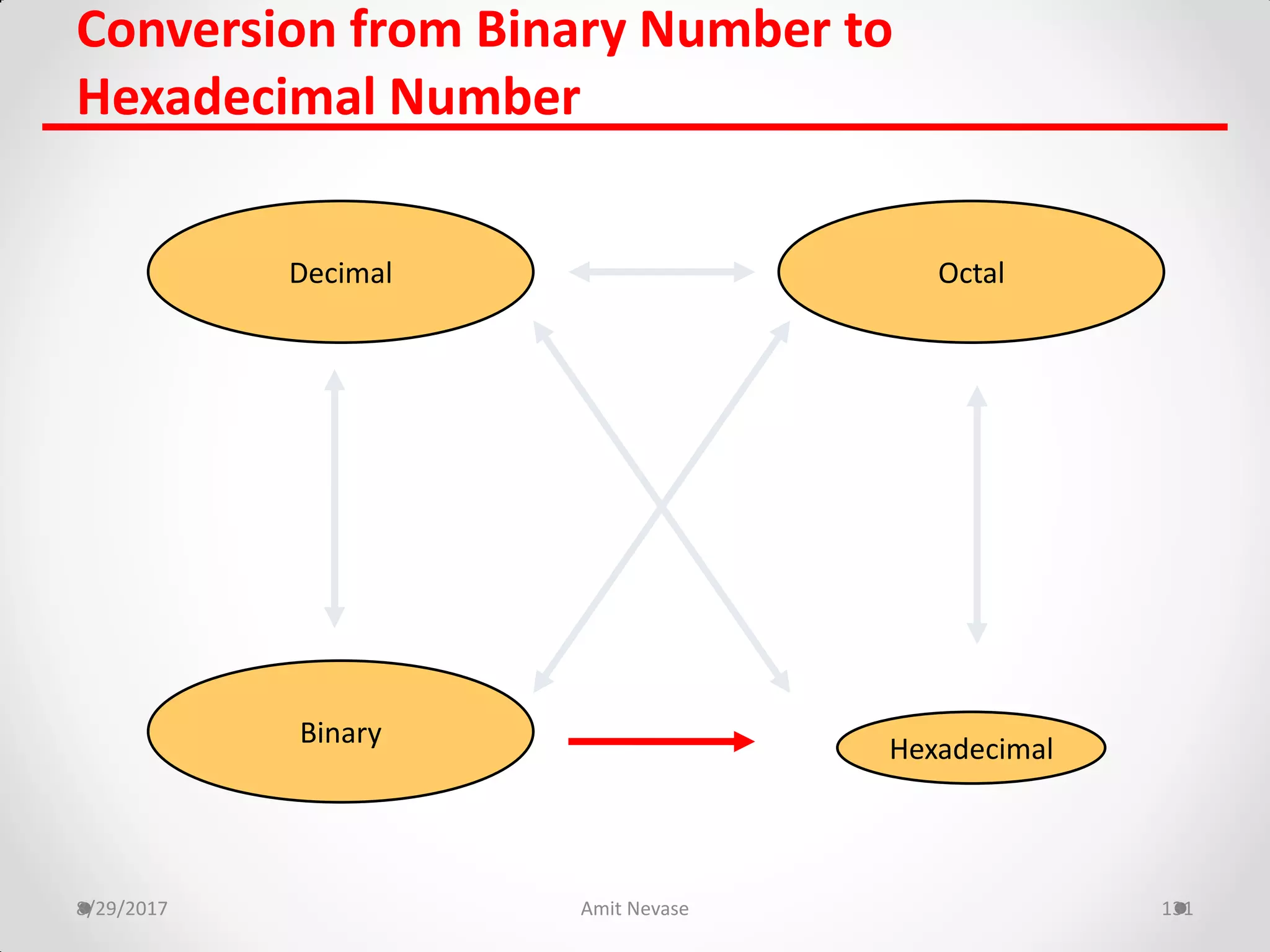
Conversion from Binary Number to
Hexadecimal Number
Hexadecimal
Decimal Octal
Binary
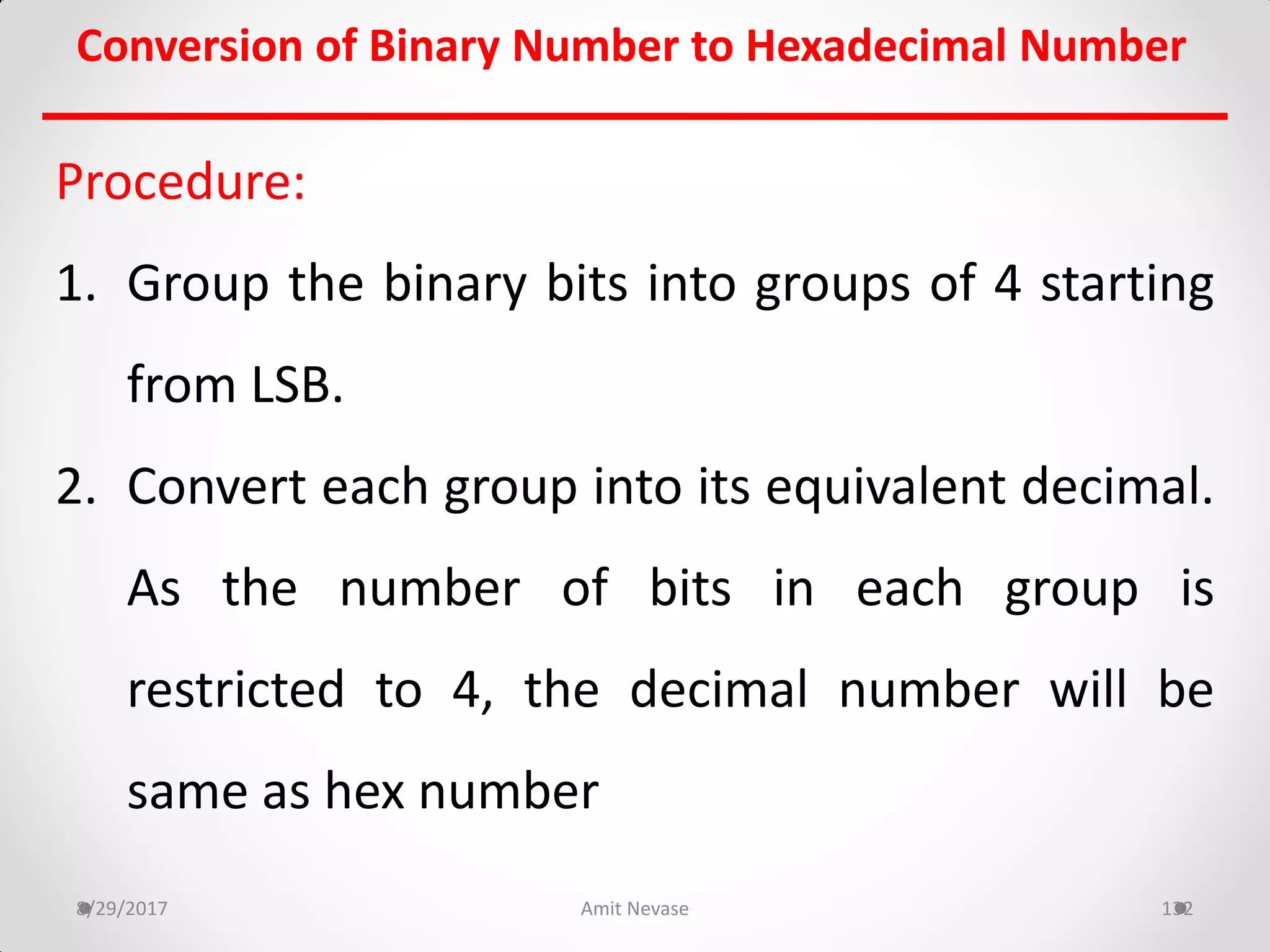
Procedure:
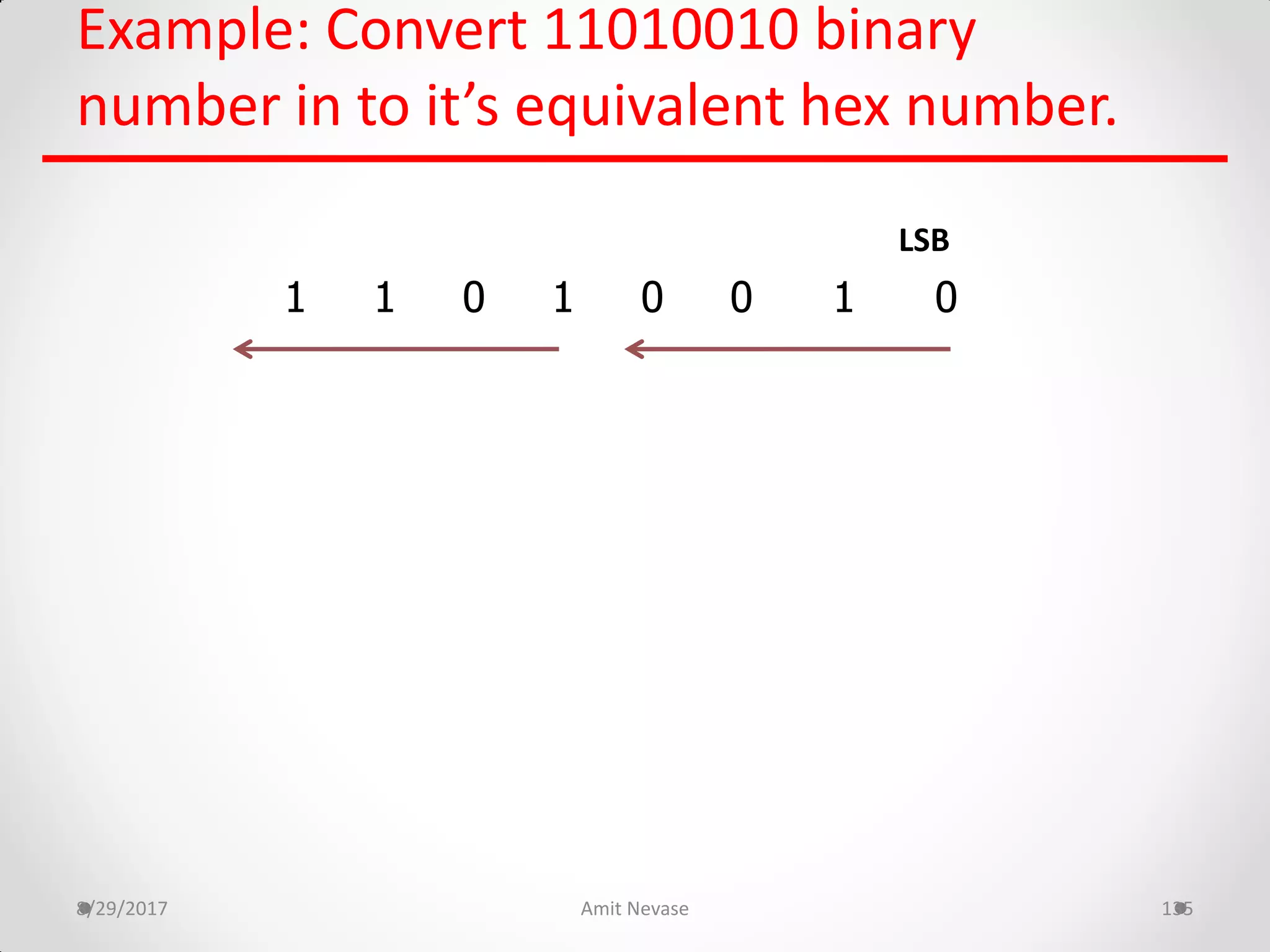
1. Group the binary bits into groups of 4 starting
from LSB.
2. Convert each group into its equivalent decimal.
As the number of bits in each group is
restricted to 4, the decimal number will be
same as hex number
8/29/2017 Amit Nevase 132
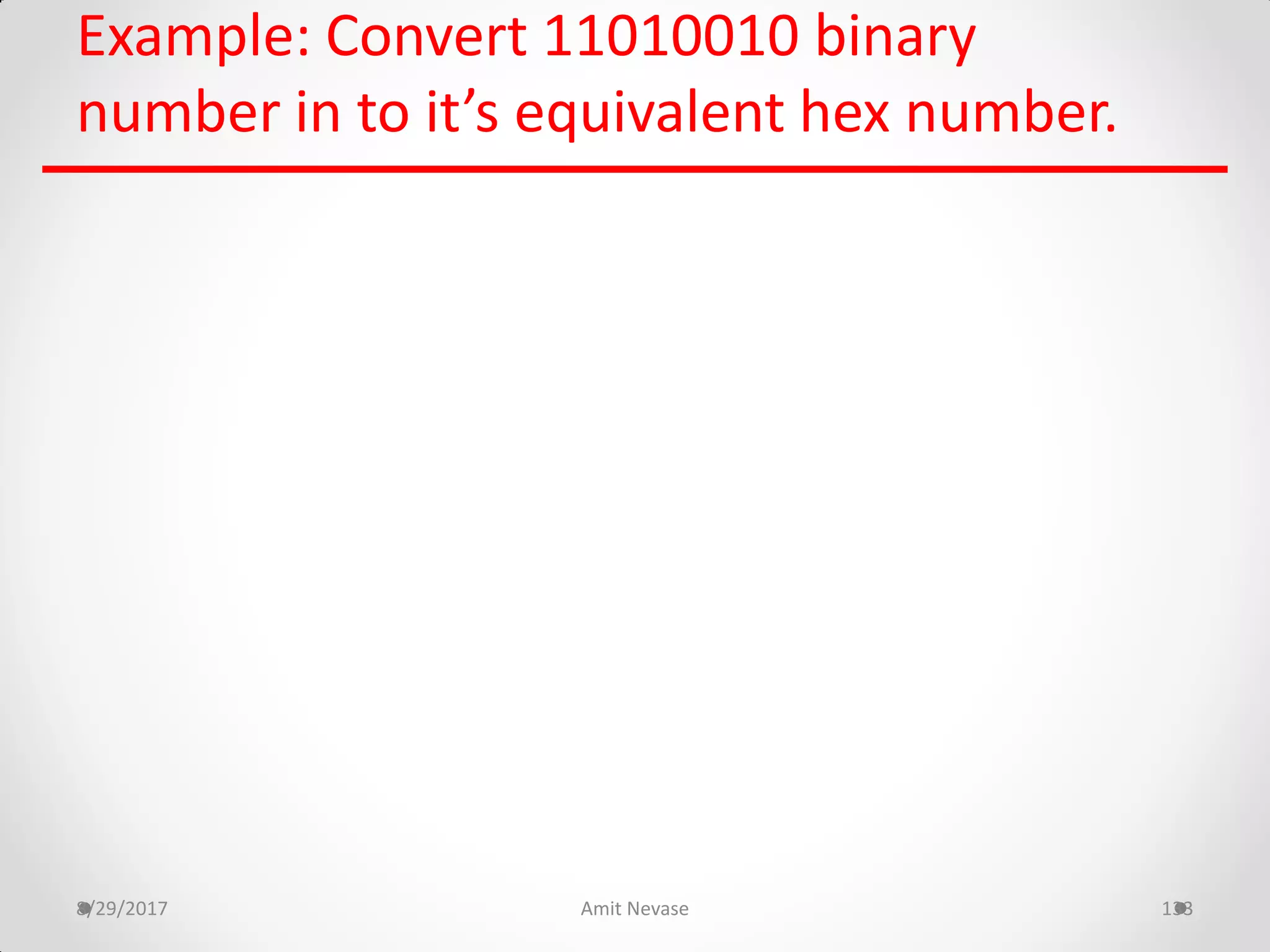
Conversion of Binary Number to Hexadecimal Number
Example: Convert 11010010 binary
number in to it’s equivalent hex number.
8/29/2017 Amit Nevase 133
Example: Convert 11010010 binary
number in to it’s equivalent hex number.
8/29/2017 Amit Nevase 134
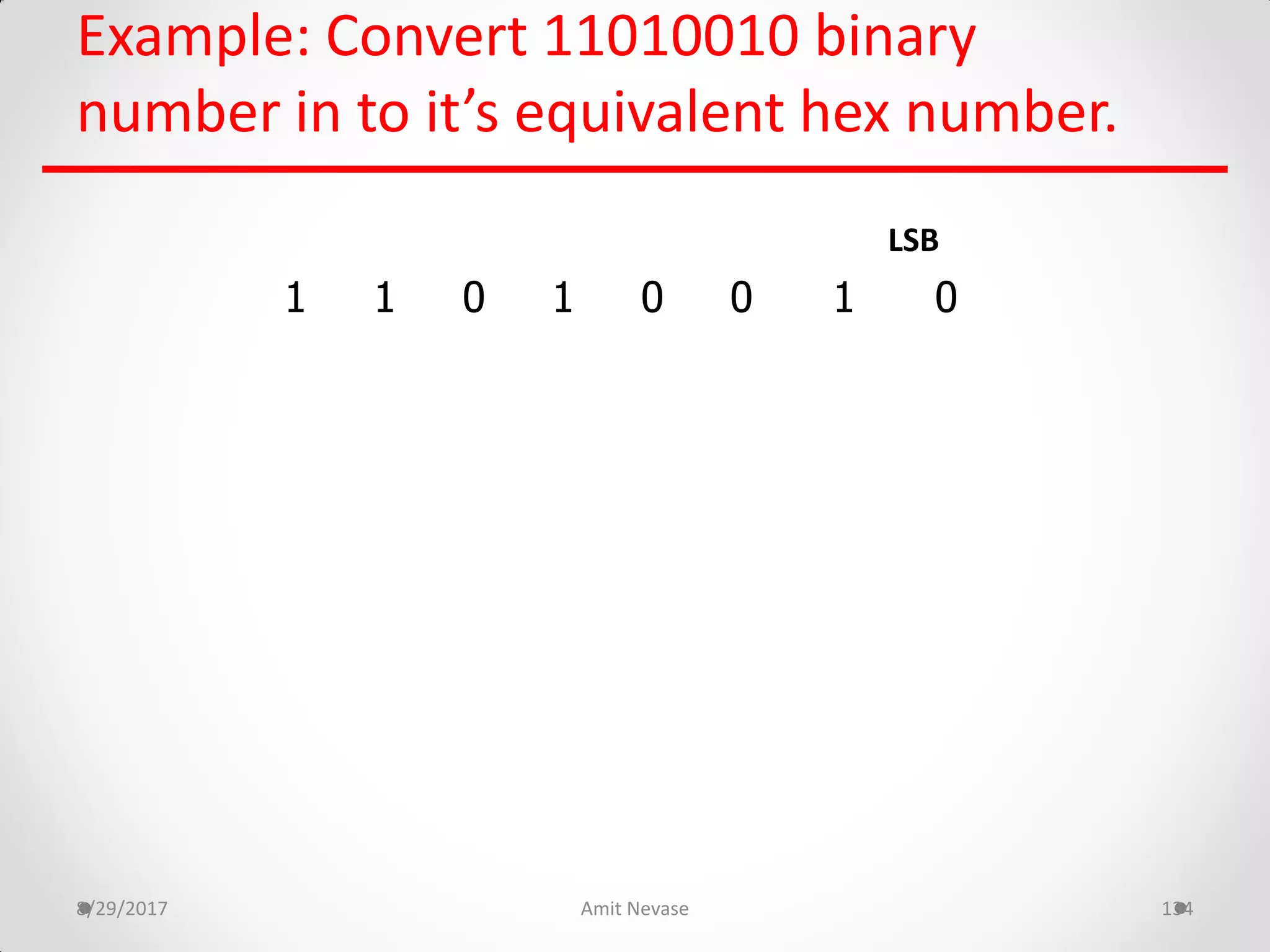
1 1 0 1 0 0 1 0
LSB
Example: Convert 11010010 binary
number in to it’s equivalent hex number.
8/29/2017 Amit Nevase 135
1 1 0 1 0 0 1 0
LSB
Example: Convert 11010010 binary
number in to it’s equivalent hex number.
8/29/2017 Amit Nevase 136
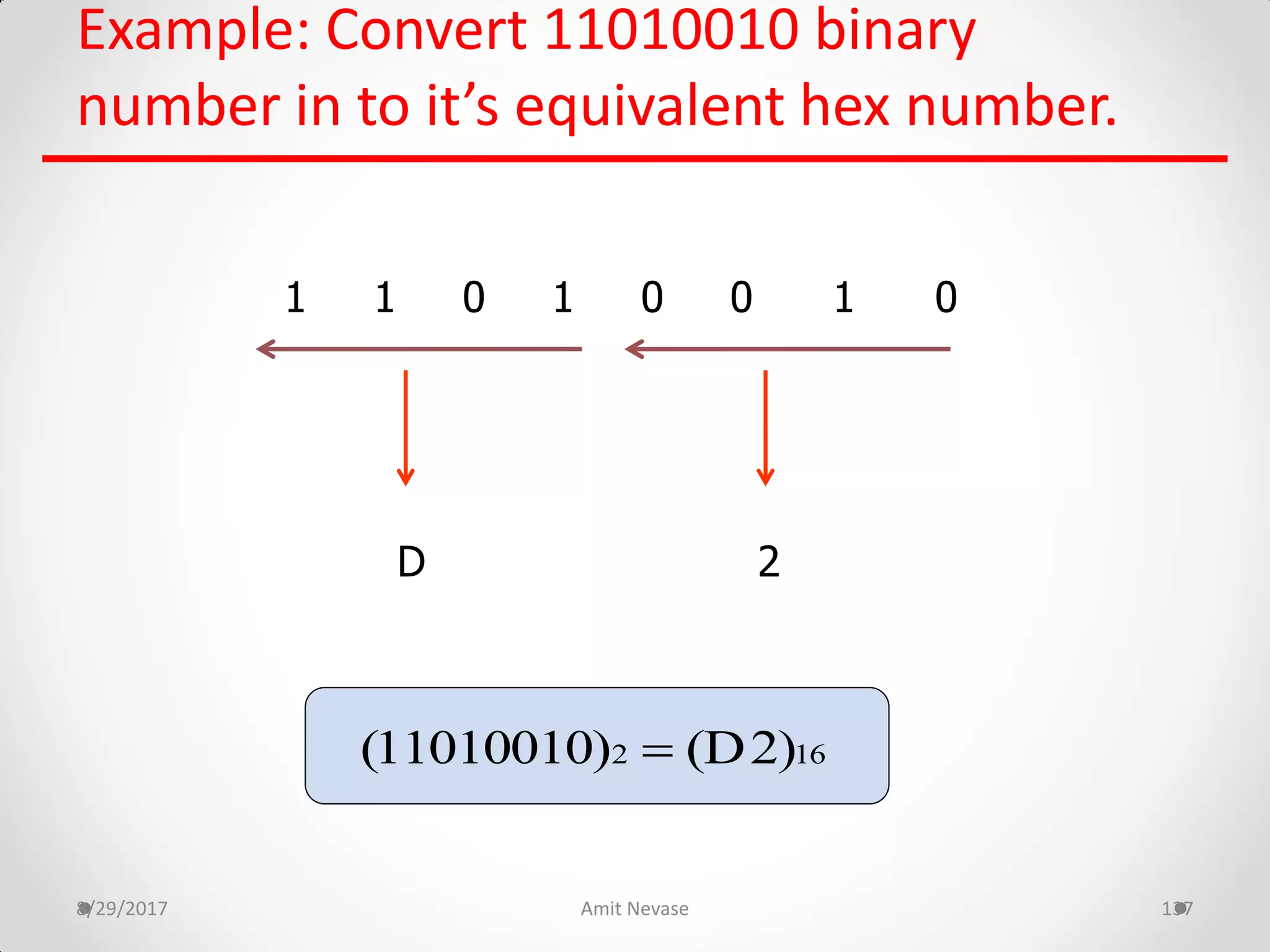
1 1 0 1 0 0 1 0
D 2
Example: Convert 11010010 binary
number in to it’s equivalent hex number.
8/29/2017 Amit Nevase 137
1 1 0 1 0 0 1 0
D 2
2 16(11010010) (D2)
8/29/2017 Amit Nevase 138
Exercise
• Convert following Binary Numbers in to its
equivalent Hexadecimal Number:
1. (1101110.011)2 = ( ? )16
2. (1101.11)2 = ( ? )16
3. (10001.01)2 = ( ? )16
8/29/2017 Amit Nevase 139
Conversion from Octal Number to Binary
Number
Hexadecimal
Decimal Octal
Binary
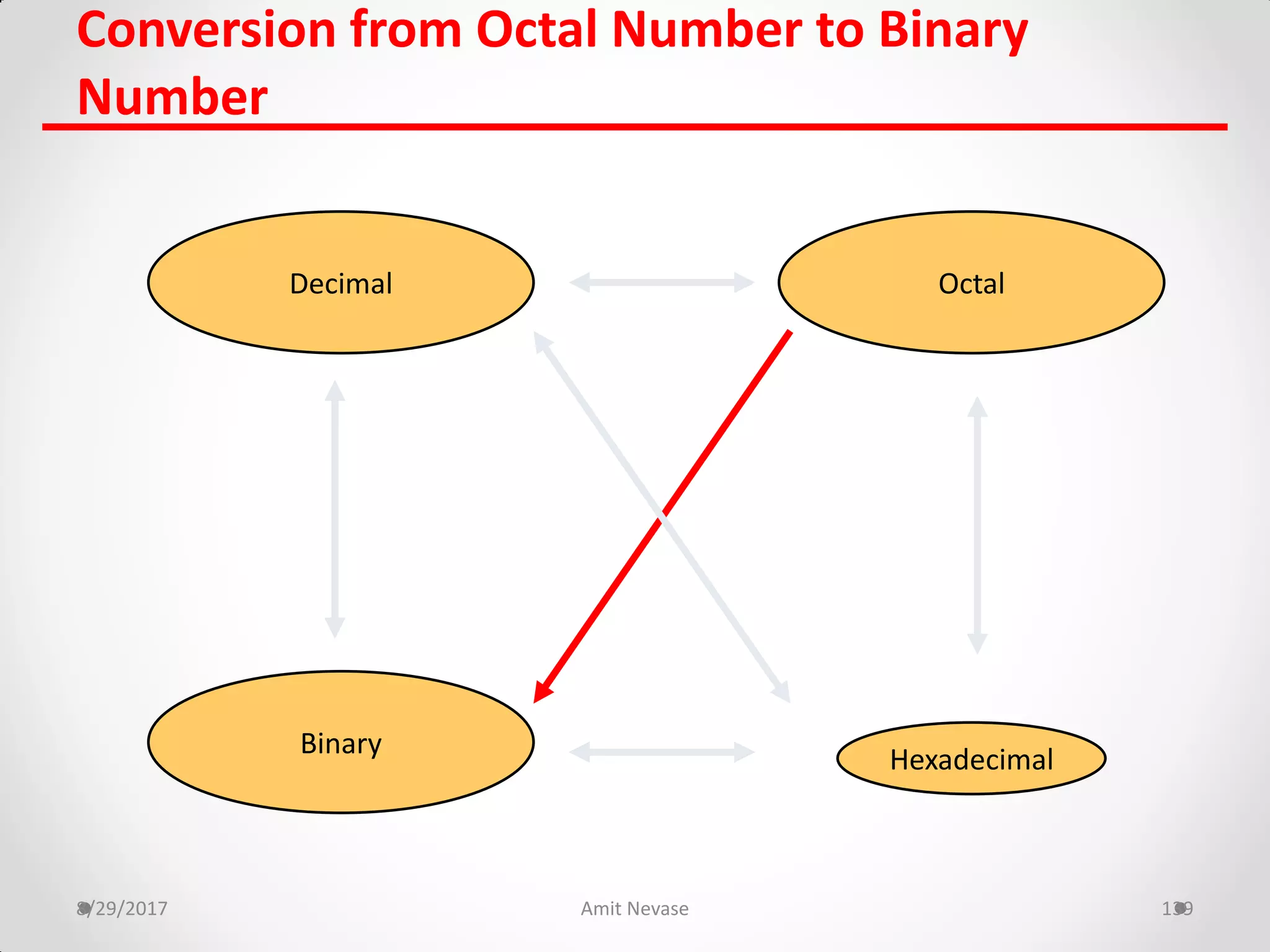
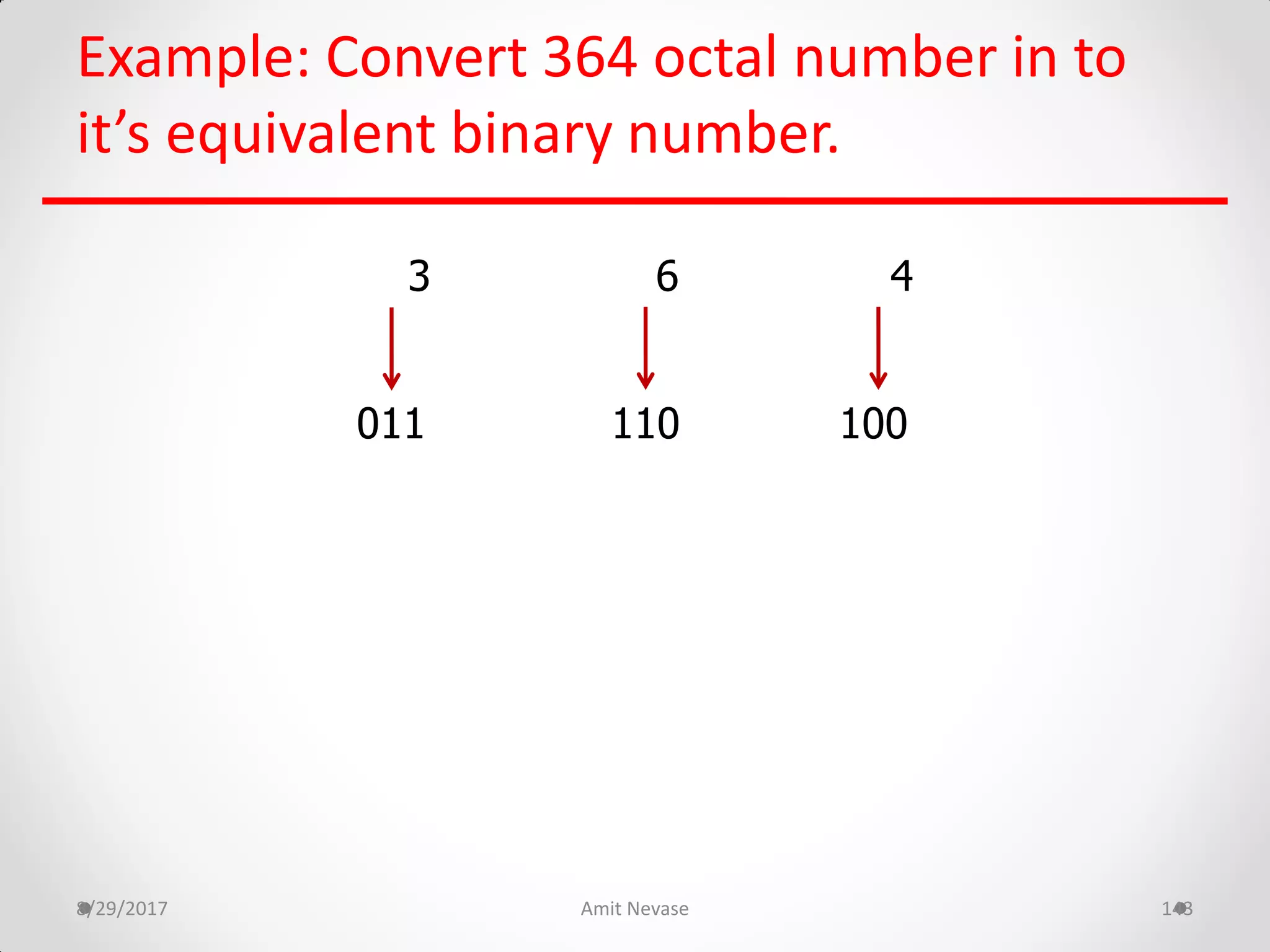
To get the binary equivalent of the given octal
number we have to convert each octal digit
into its equivalent 3 bit binary number
8/29/2017 Amit Nevase 140
Conversion of Octal Number into Binary Number
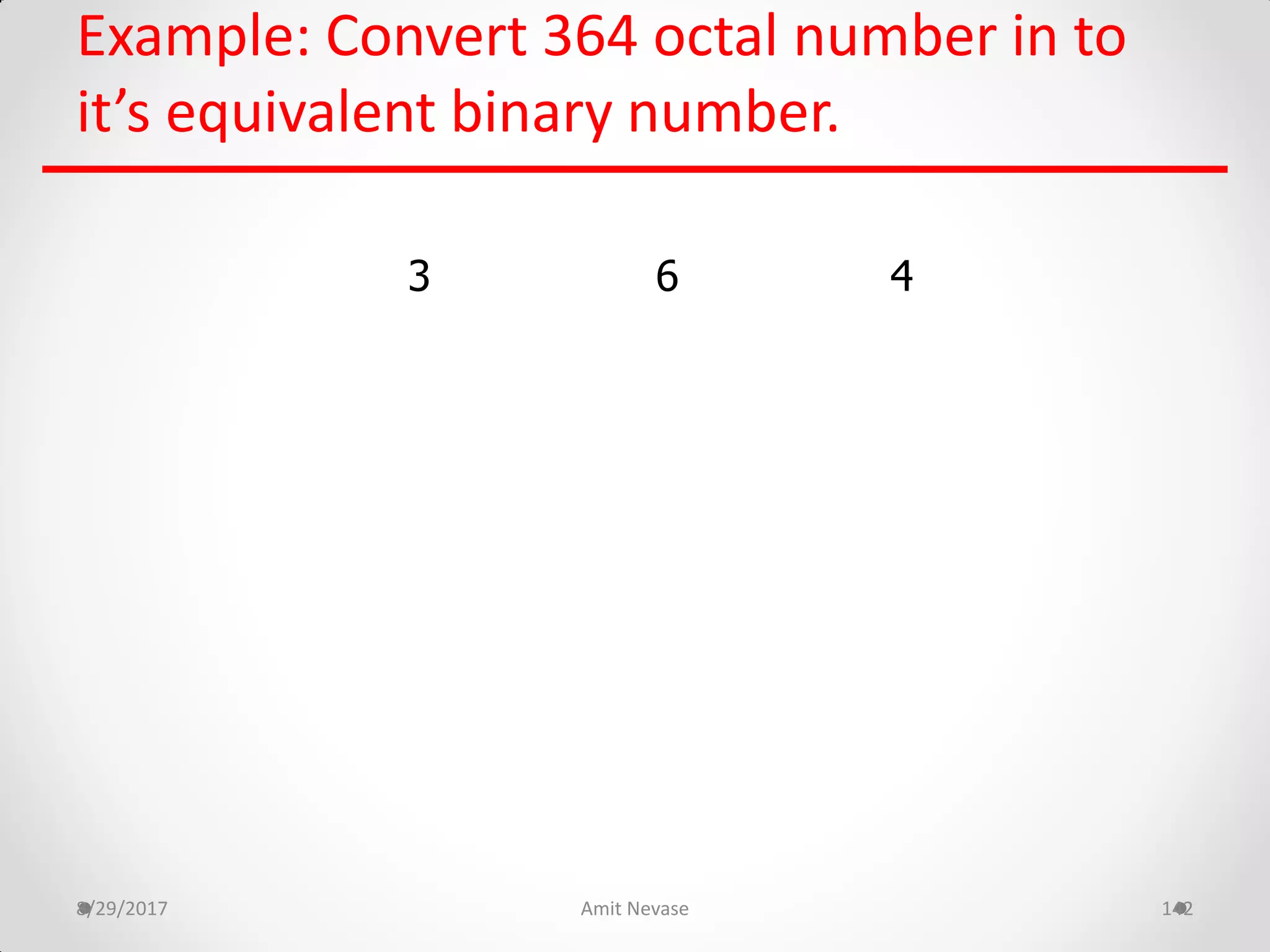
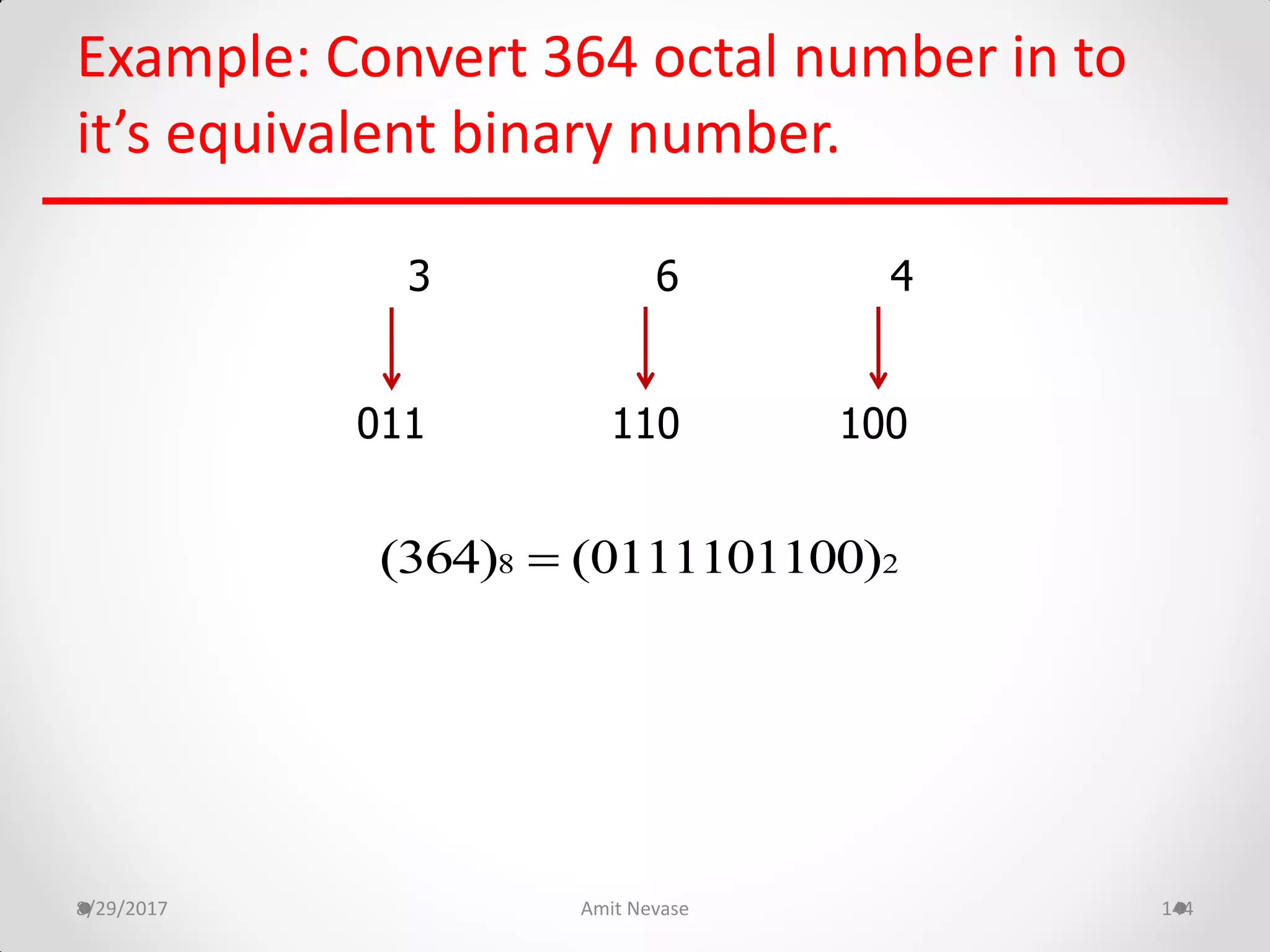
Example: Convert 364 octal number in to
it’s equivalent binary number.
8/29/2017 Amit Nevase 141
Example: Convert 364 octal number in to
it’s equivalent binary number.
8/29/2017 Amit Nevase 142
3 6 4
Example: Convert 364 octal number in to
it’s equivalent binary number.
8/29/2017 Amit Nevase 143
3 6 4
011 110 100
Example: Convert 364 octal number in to
it’s equivalent binary number.
8/29/2017 Amit Nevase 144
3 6 4
011 110 100
8 2(364) (0111101100)
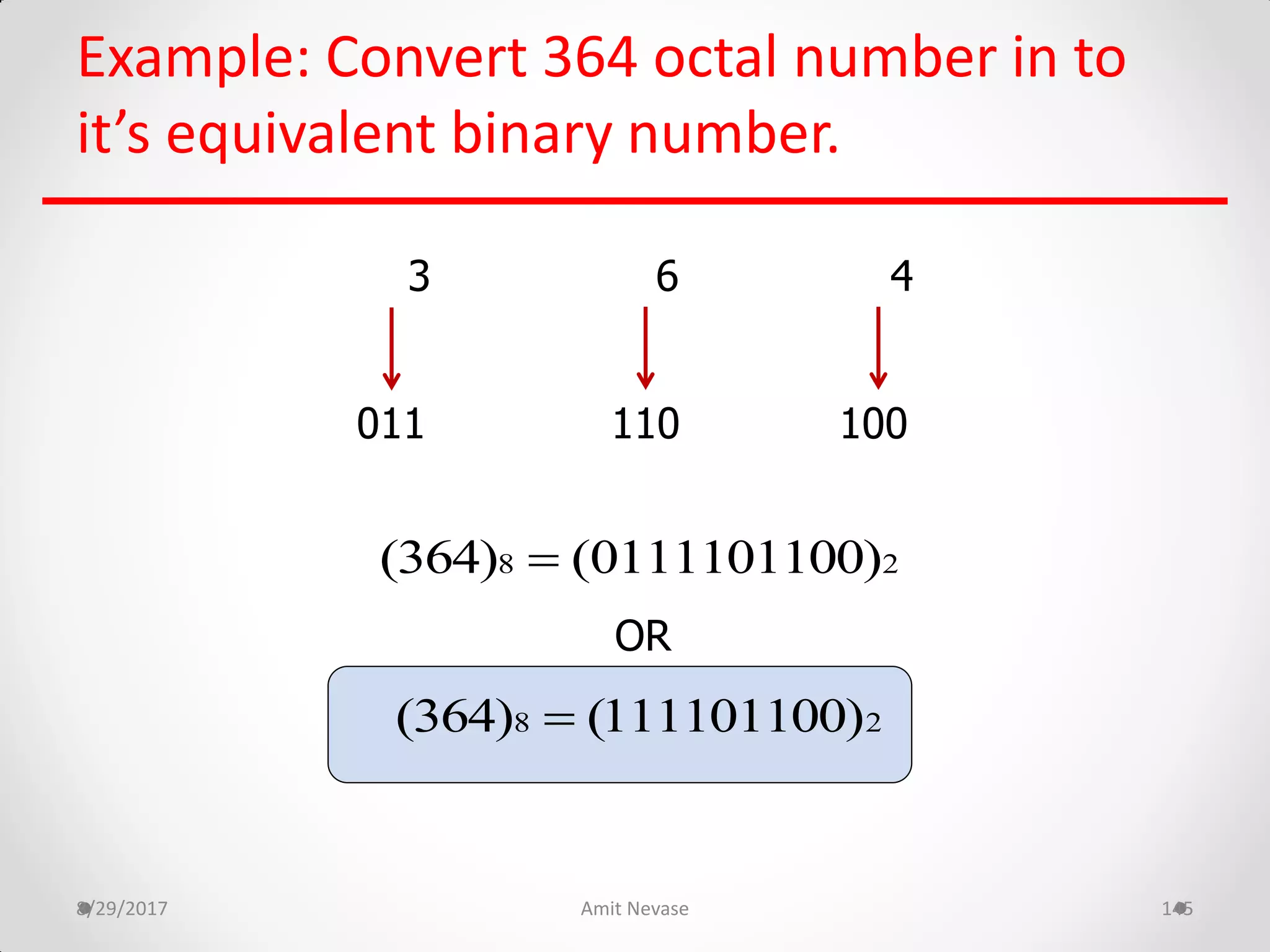
Example: Convert 364 octal number in to
it’s equivalent binary number.
8/29/2017 Amit Nevase 145
3 6 4
011 110 100
OR
8 2(364) (0111101100)
8 2(364) (111101100)
8/29/2017 Amit Nevase 146
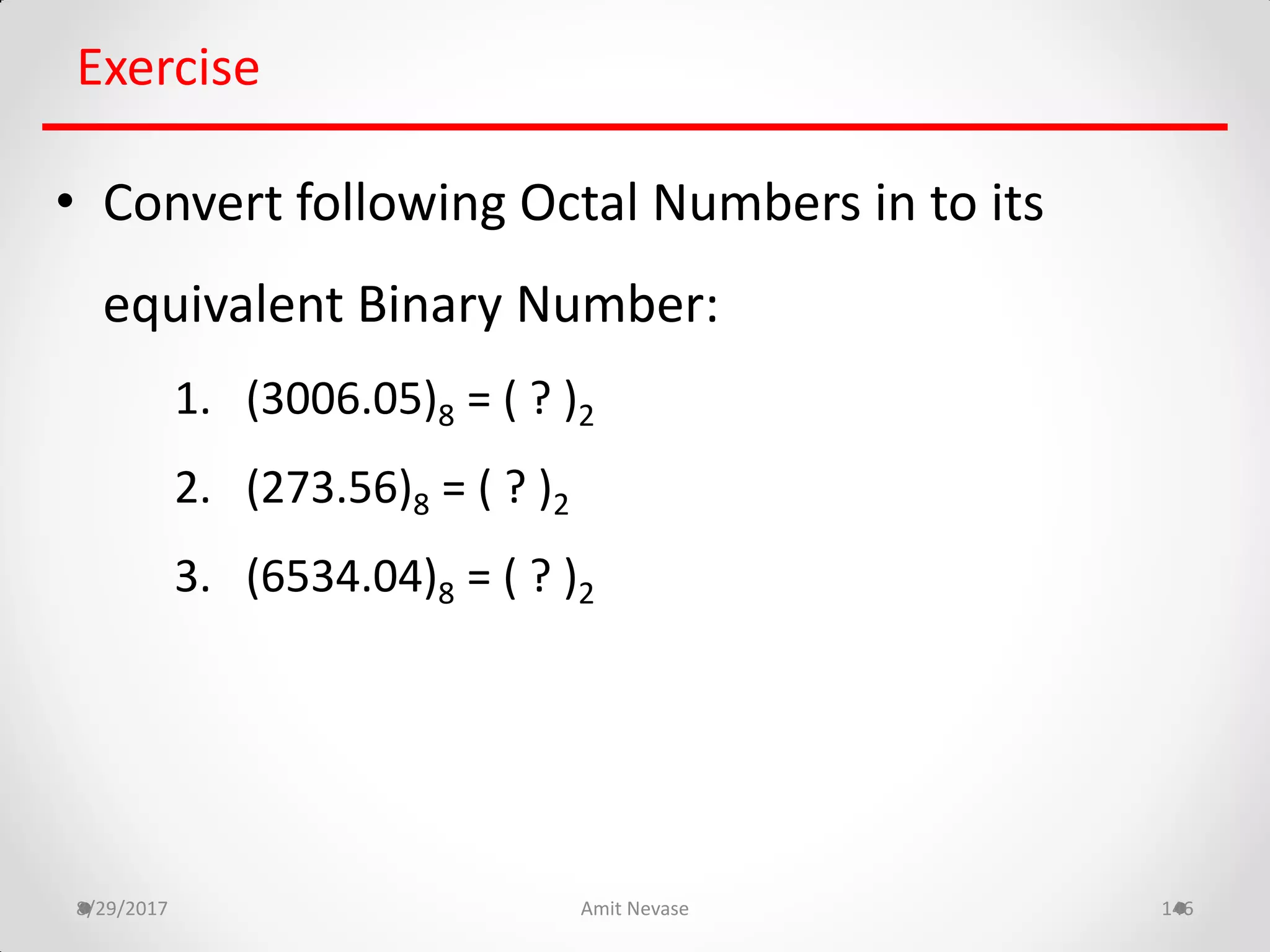
Exercise
• Convert following Octal Numbers in to its
equivalent Binary Number:
1. (3006.05)8 = ( ? )2
2. (273.56)8 = ( ? )2
3. (6534.04)8 = ( ? )2
8/29/2017 Amit Nevase 147
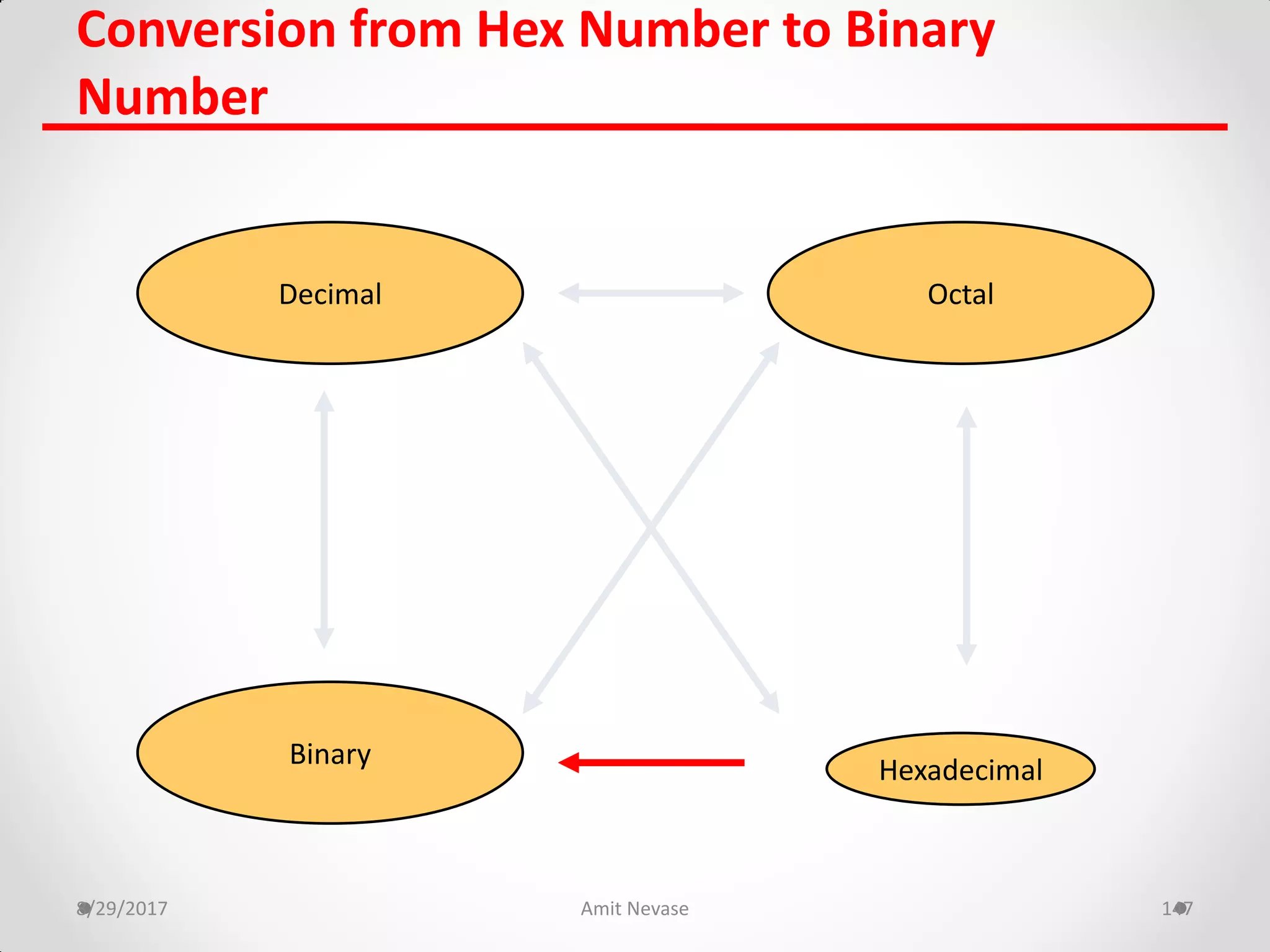
Conversion from Hex Number to Binary
Number
Hexadecimal
Decimal Octal
Binary
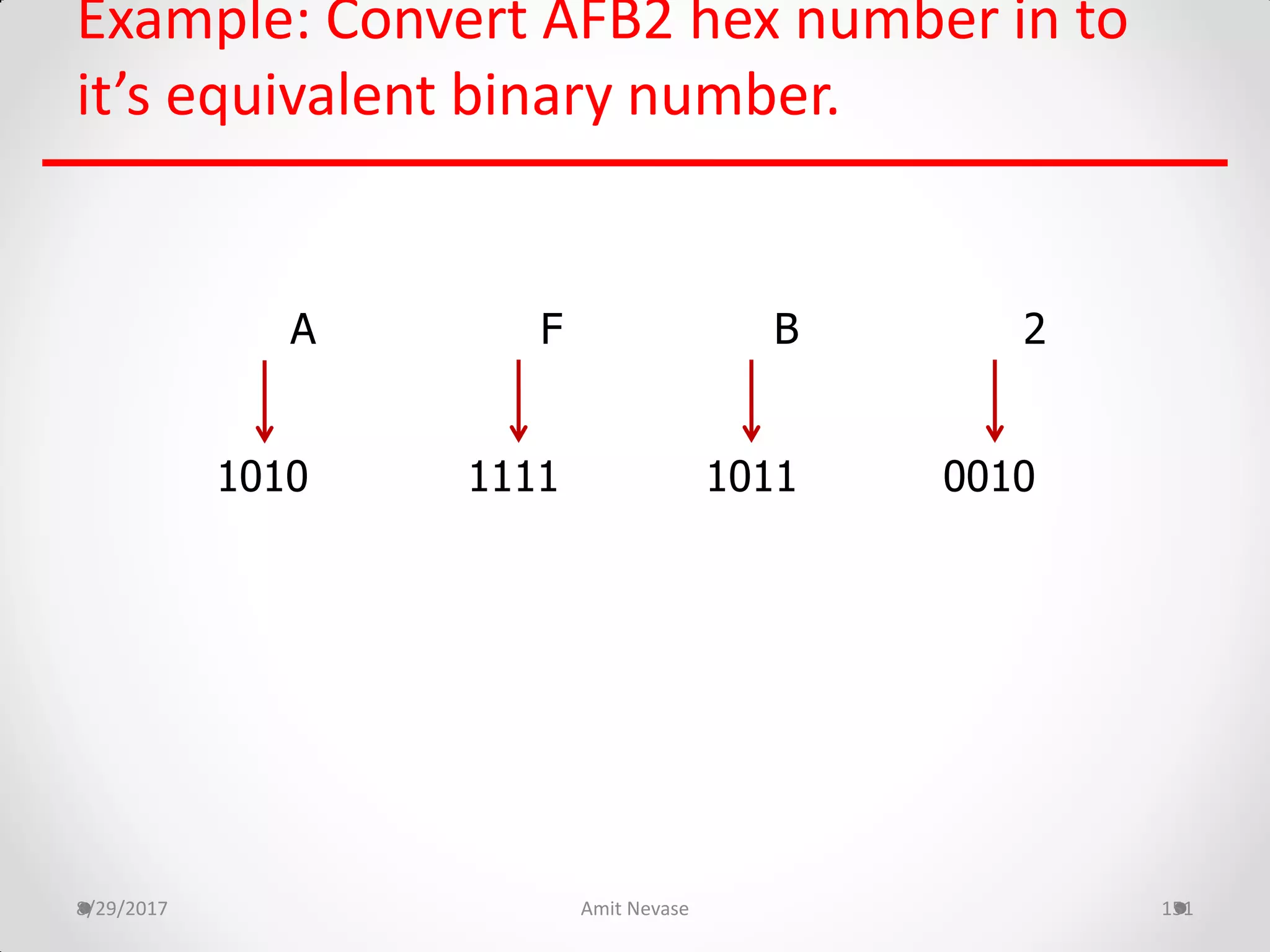
To get the binary equivalent of the given hex
number we have to convert each hex digit into
its equivalent 4 bit binary number
8/29/2017 Amit Nevase 148
Conversion of Hexadecimal Number into Binary Number
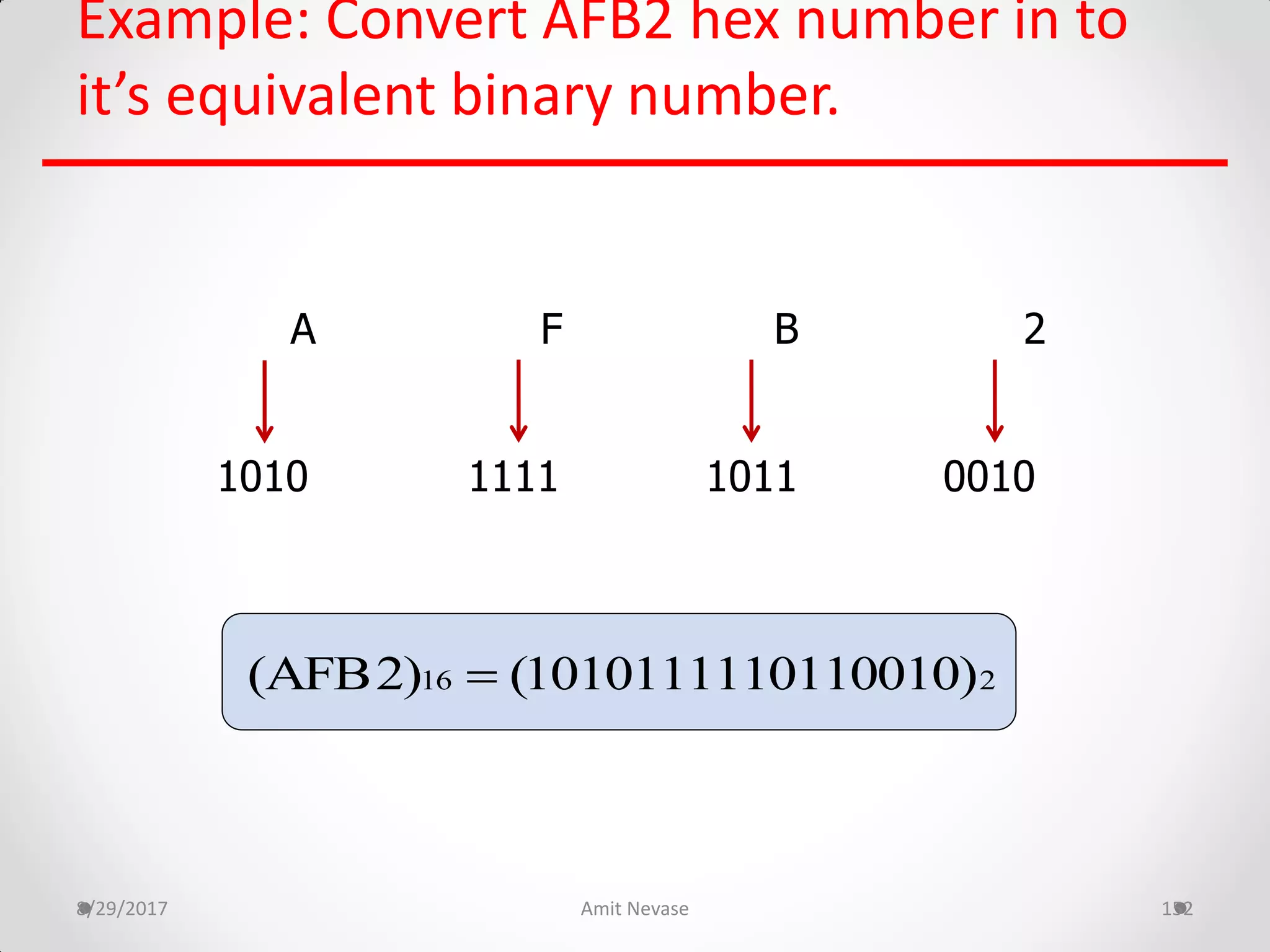
Example: Convert AFB2 hex number in to
it’s equivalent binary number.
8/29/2017 Amit Nevase 149
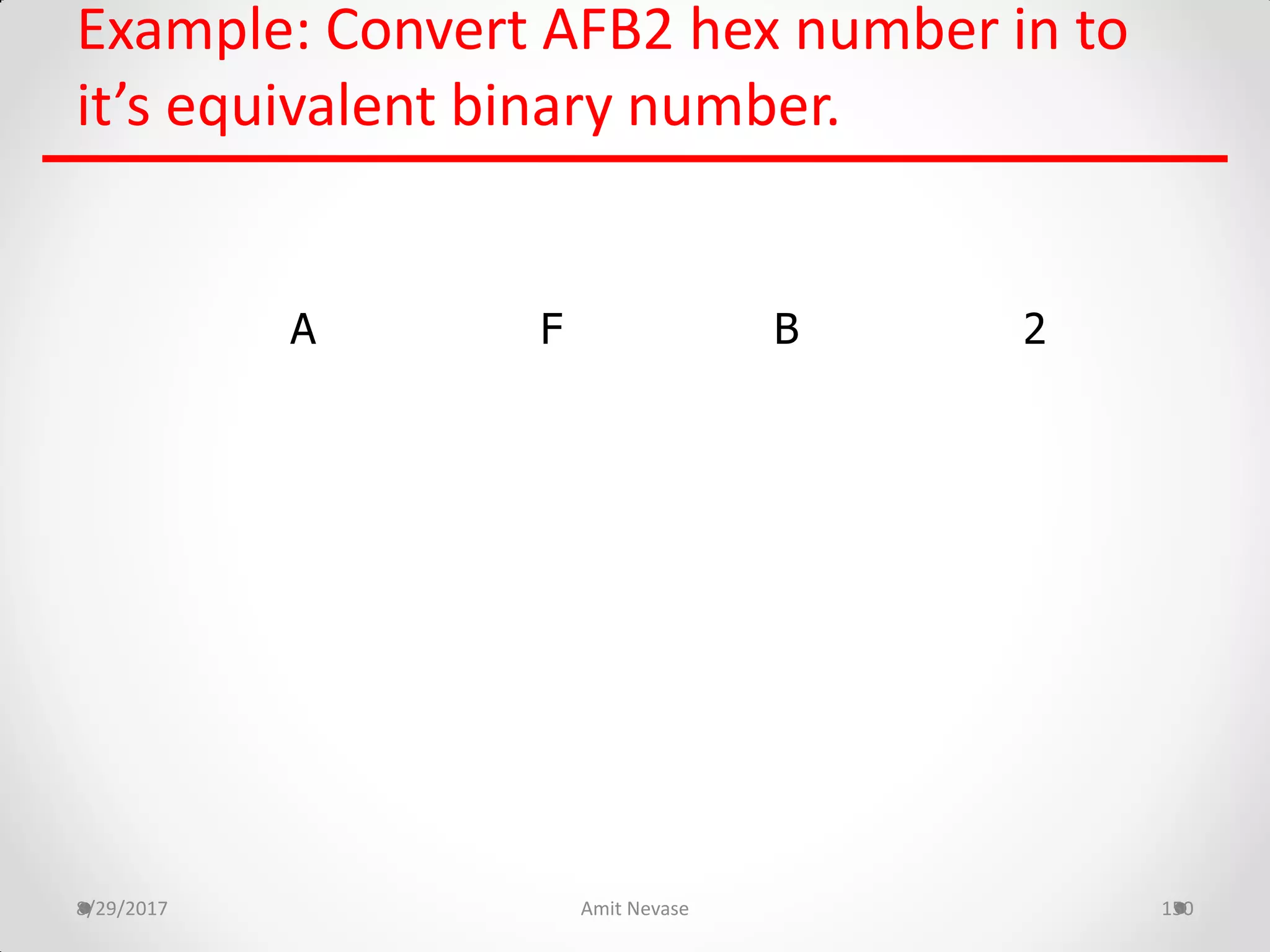
Example: Convert AFB2 hex number in to
it’s equivalent binary number.
8/29/2017 Amit Nevase 150
A F B 2
Example: Convert AFB2 hex number in to
it’s equivalent binary number.
8/29/2017 Amit Nevase 151
A F B 2
1010 1111 1011 0010
Example: Convert AFB2 hex number in to
it’s equivalent binary number.
8/29/2017 Amit Nevase 152
A F B 2
1010 1111 1011 0010
16 2(AFB2) (1010111110110010)
8/29/2017 Amit Nevase 153
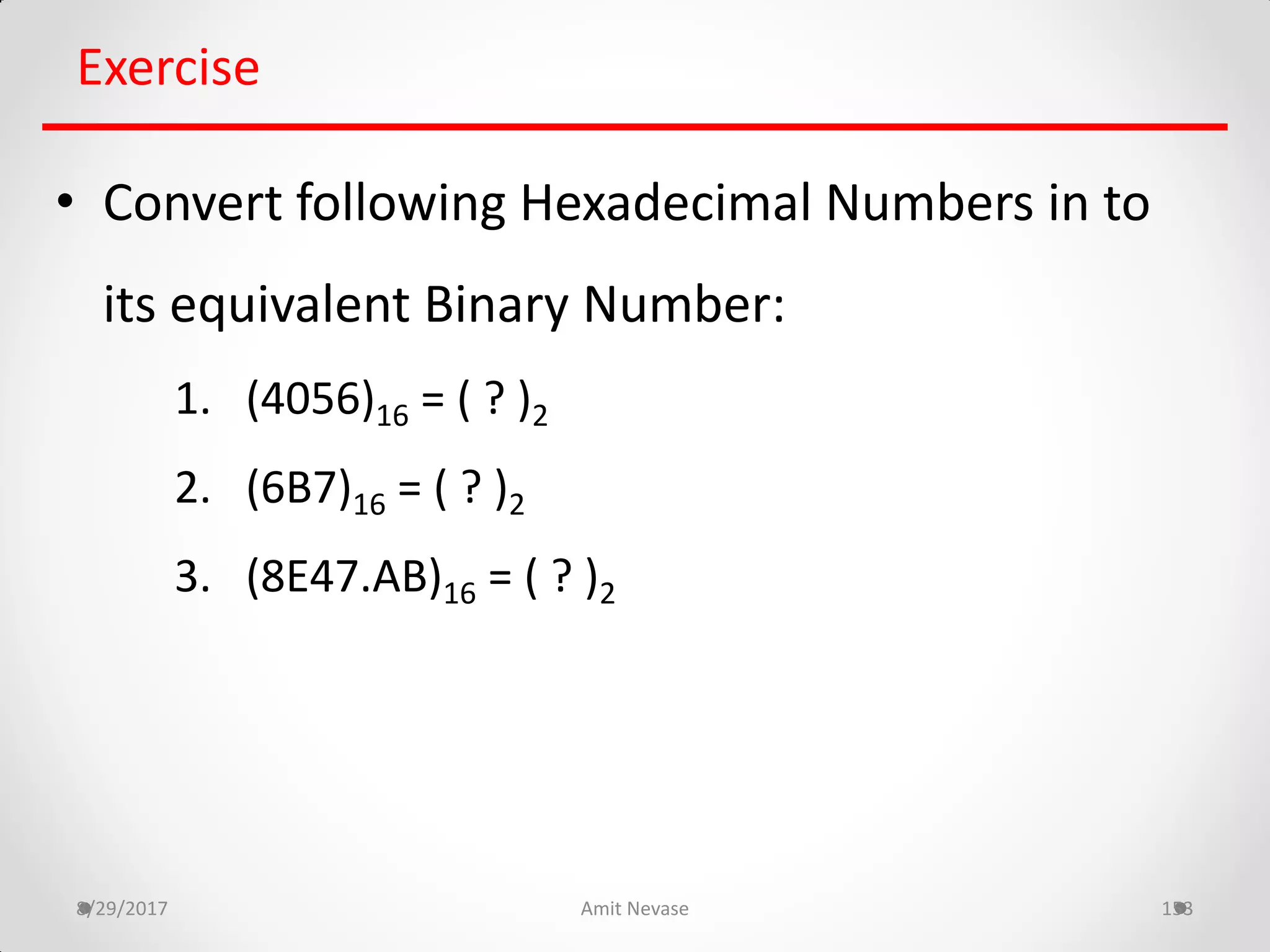
Exercise
• Convert following Hexadecimal Numbers in to
its equivalent Binary Number:
1. (4056)16 = ( ? )2
2. (6B7)16 = ( ? )2
3. (8E47.AB)16 = ( ? )2
8/29/2017 Amit Nevase 154
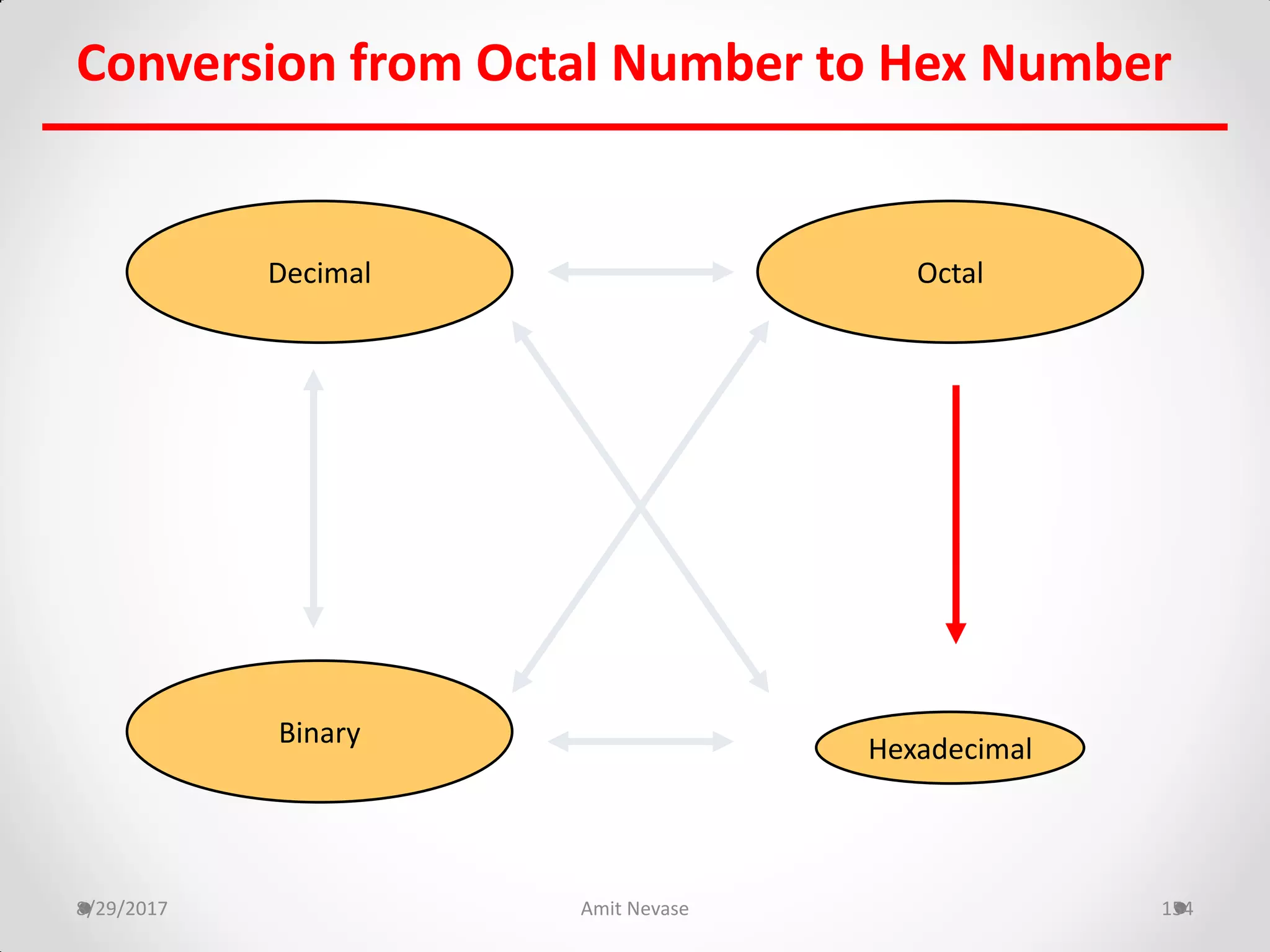
Conversion from Octal Number to Hex Number
Hexadecimal
Decimal Octal
Binary
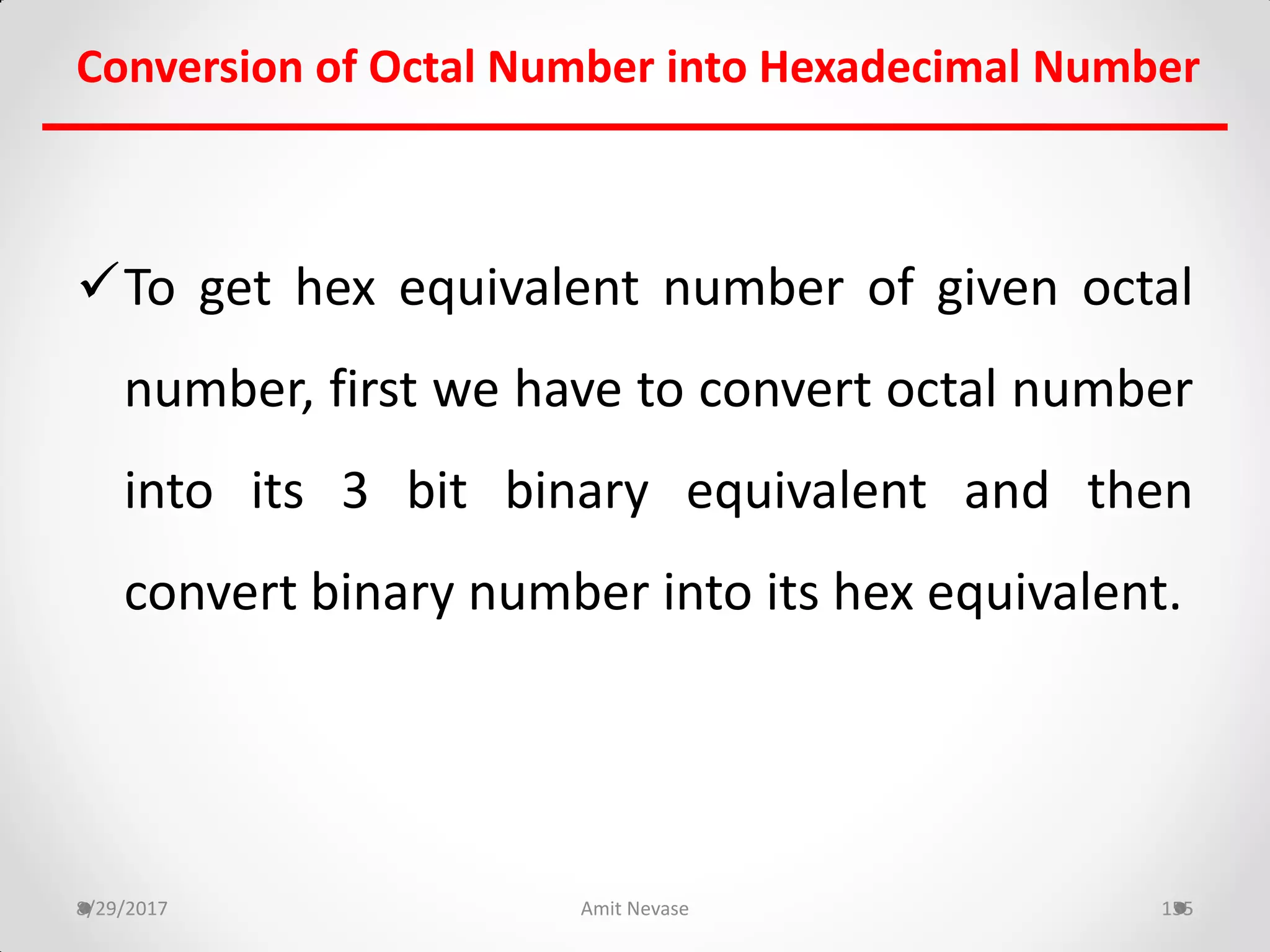
To get hex equivalent number of given octal
number, first we have to convert octal number
into its 3 bit binary equivalent and then
convert binary number into its hex equivalent.
8/29/2017 Amit Nevase 155
Conversion of Octal Number into Hexadecimal Number
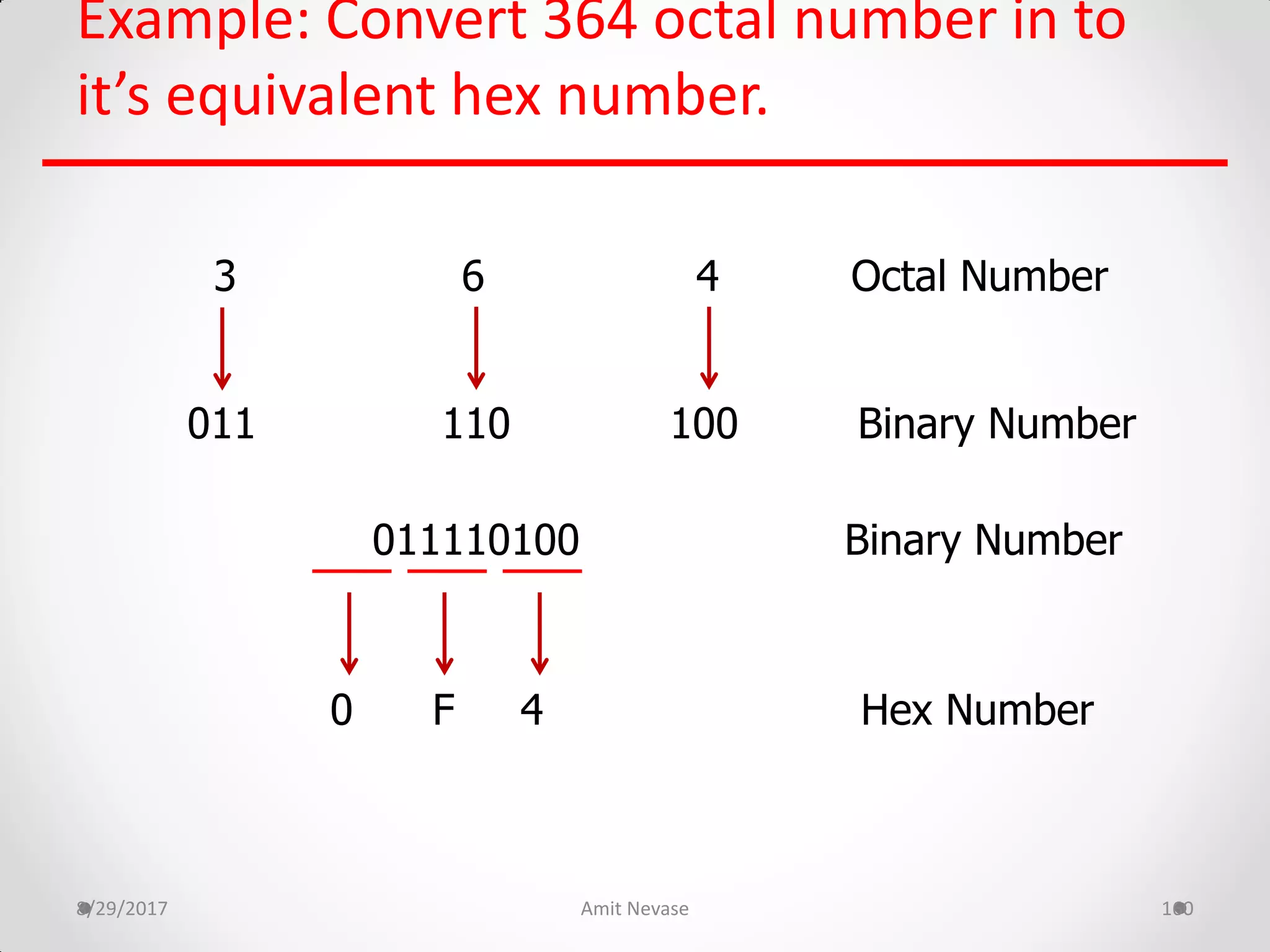
Example: Convert 364 octal number in to
it’s equivalent hex number.
8/29/2017 Amit Nevase 156
Example: Convert 364 octal number in to
it’s equivalent hex number.
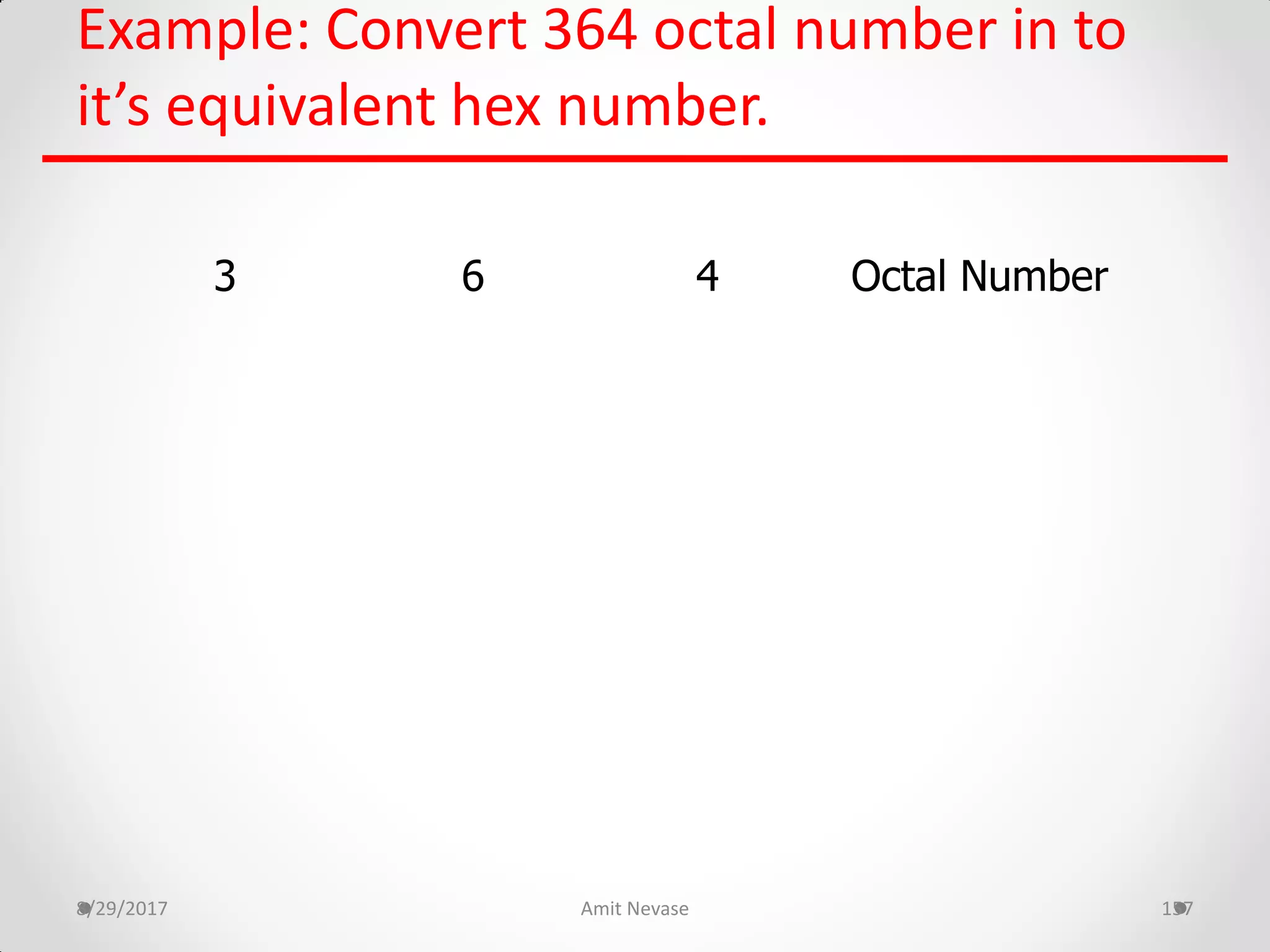
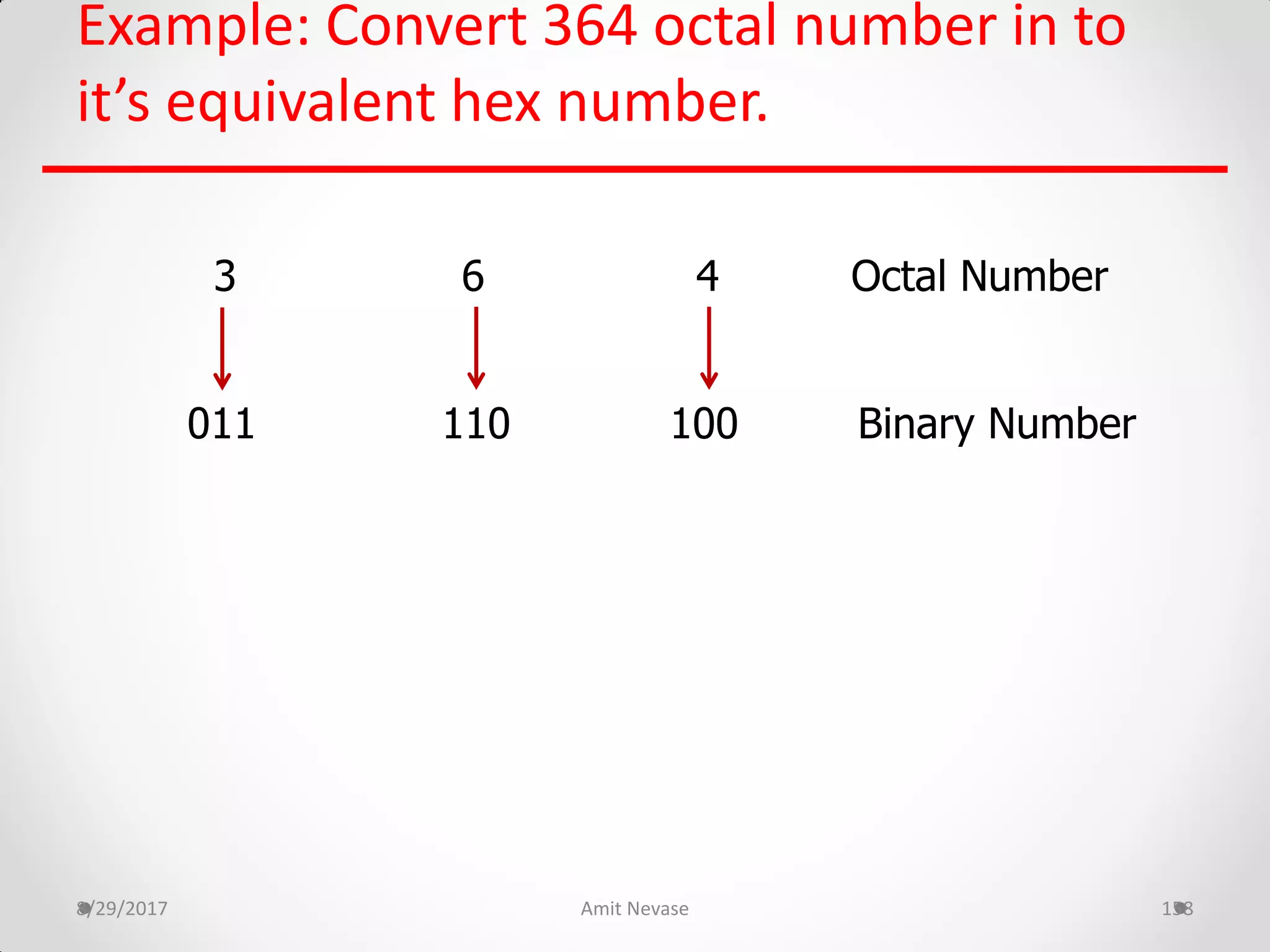
8/29/2017 Amit Nevase 157
3 6 4 Octal Number
Example: Convert 364 octal number in to
it’s equivalent hex number.
8/29/2017 Amit Nevase 158
3 6 4 Octal Number
011 110 100 Binary Number
Example: Convert 364 octal number in to
it’s equivalent hex number.
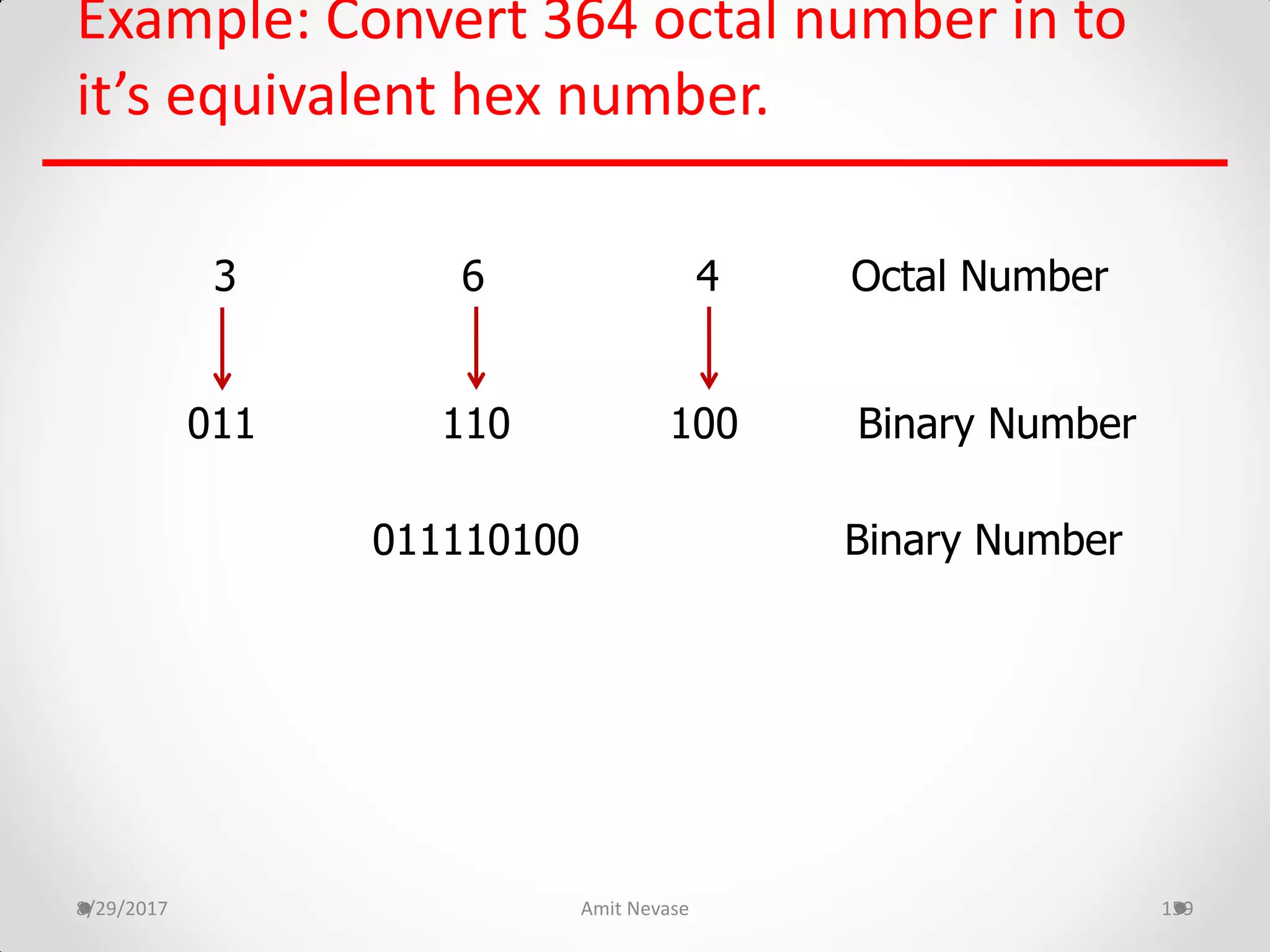
8/29/2017 Amit Nevase 159
3 6 4 Octal Number
011 110 100 Binary Number
011110100 Binary Number
Example: Convert 364 octal number in to
it’s equivalent hex number.
8/29/2017 Amit Nevase 160
3 6 4 Octal Number
011 110 100 Binary Number
011110100 Binary Number
0 F 4 Hex Number
Example: Convert 364 octal number in to
it’s equivalent hex number.
8/29/2017 Amit Nevase 161
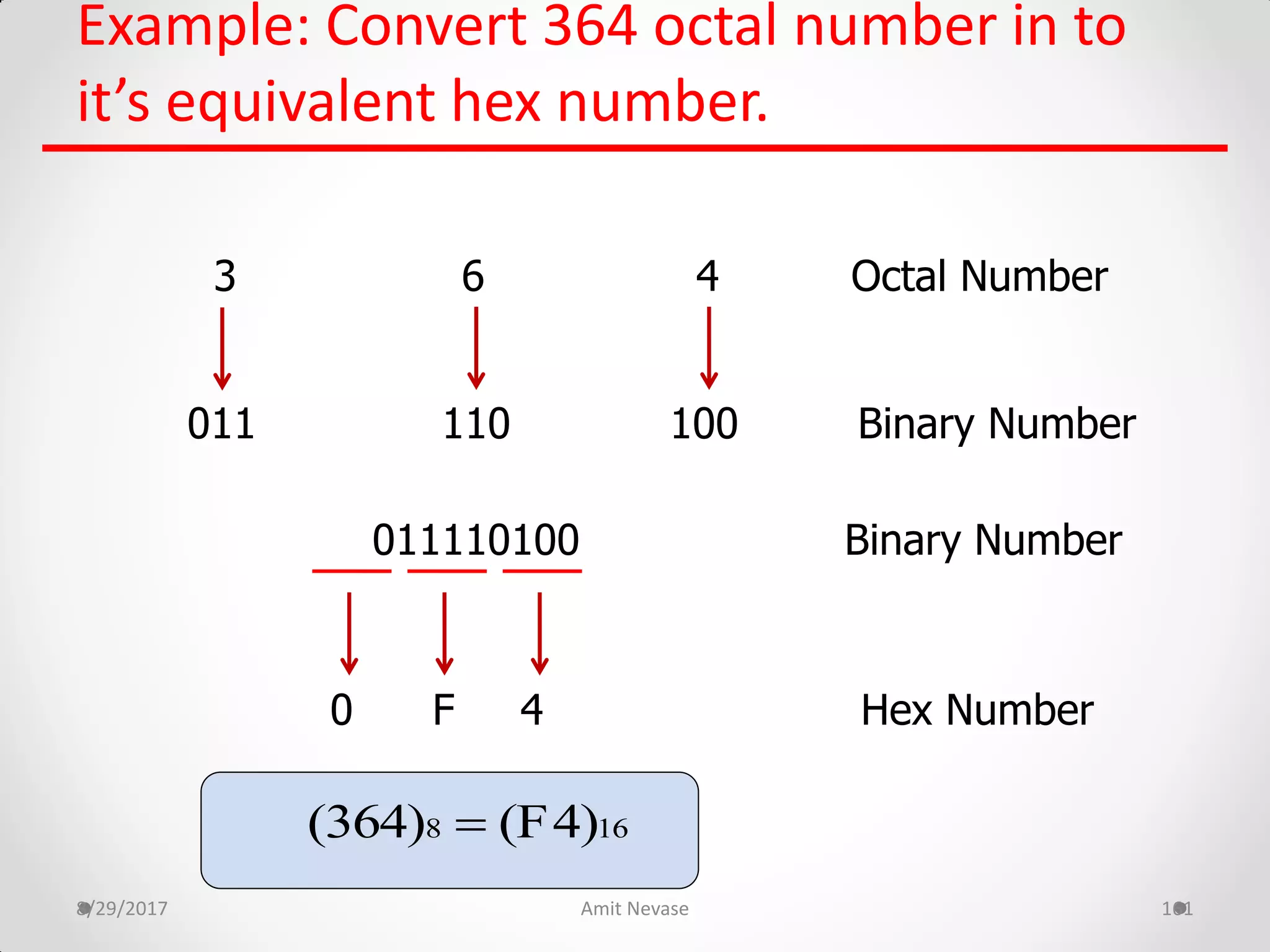
3 6 4 Octal Number
011 110 100 Binary Number
011110100 Binary Number
0 F 4 Hex Number
8 16(364) (F4)
8/29/2017 Amit Nevase 162
Exercise
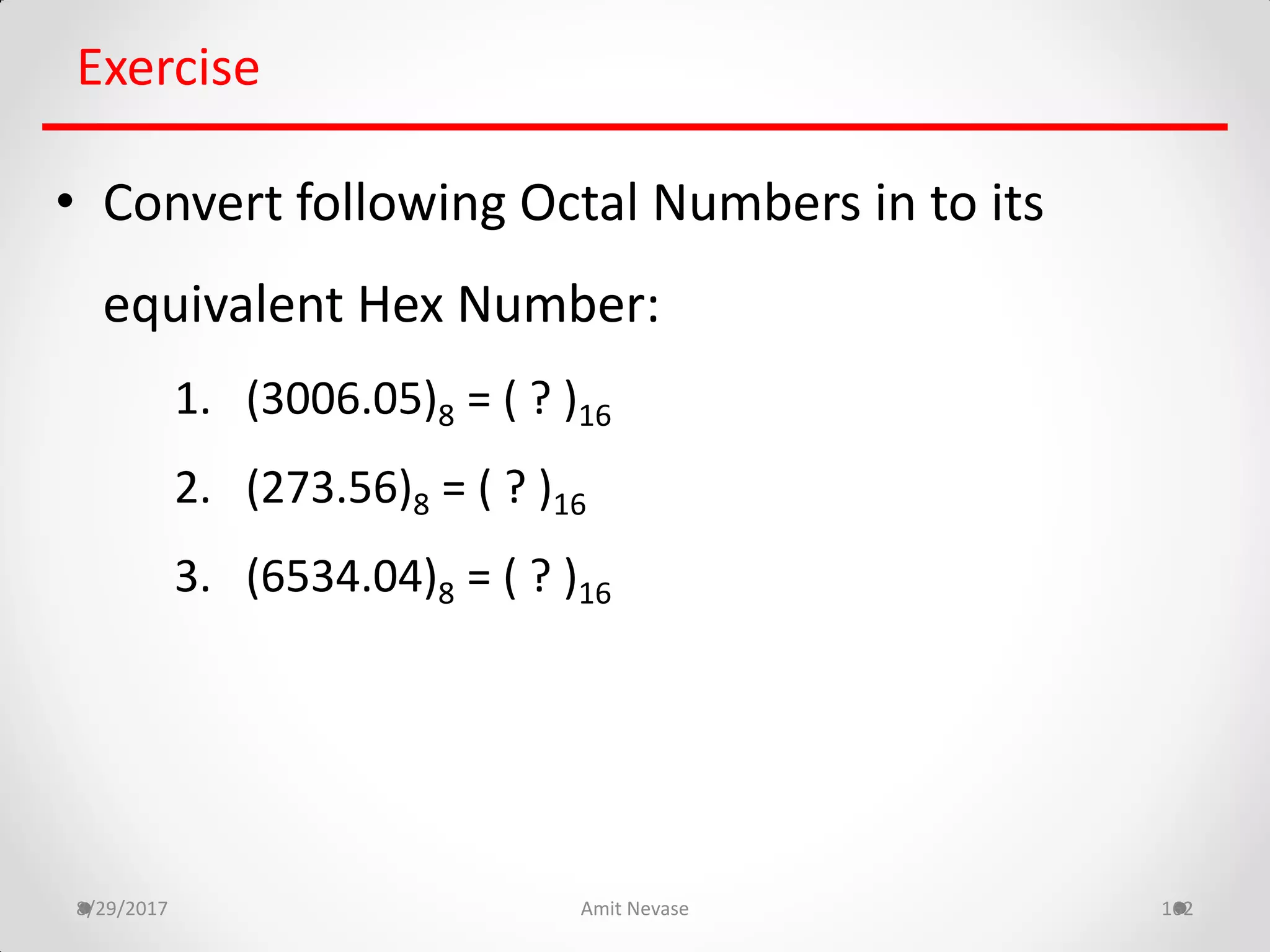
• Convert following Octal Numbers in to its
equivalent Hex Number:
1. (3006.05)8 = ( ? )16
2. (273.56)8 = ( ? )16
3. (6534.04)8 = ( ? )16
8/29/2017 Amit Nevase 163
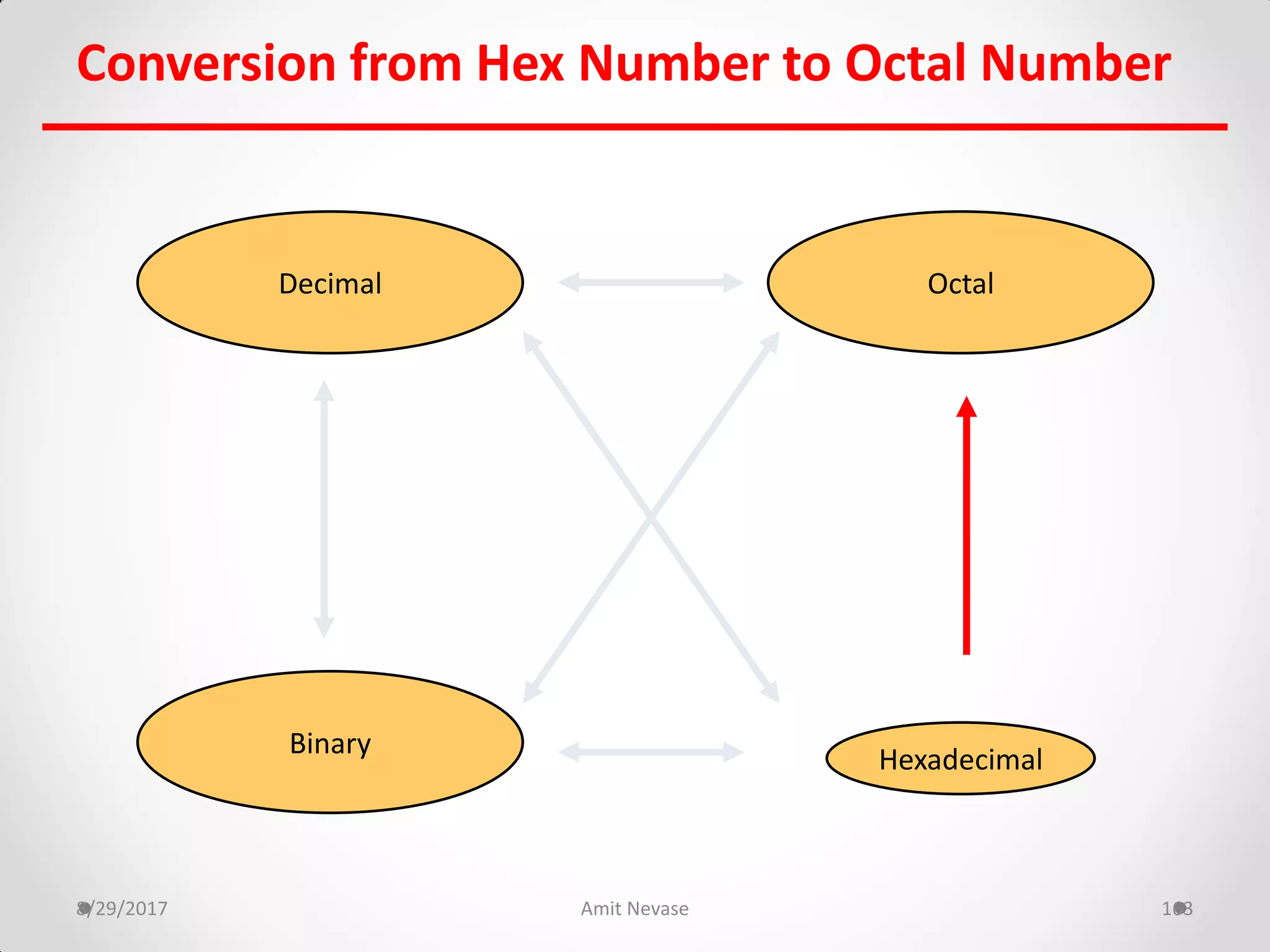
Conversion from Hex Number to Octal Number
Hexadecimal
Decimal Octal
Binary
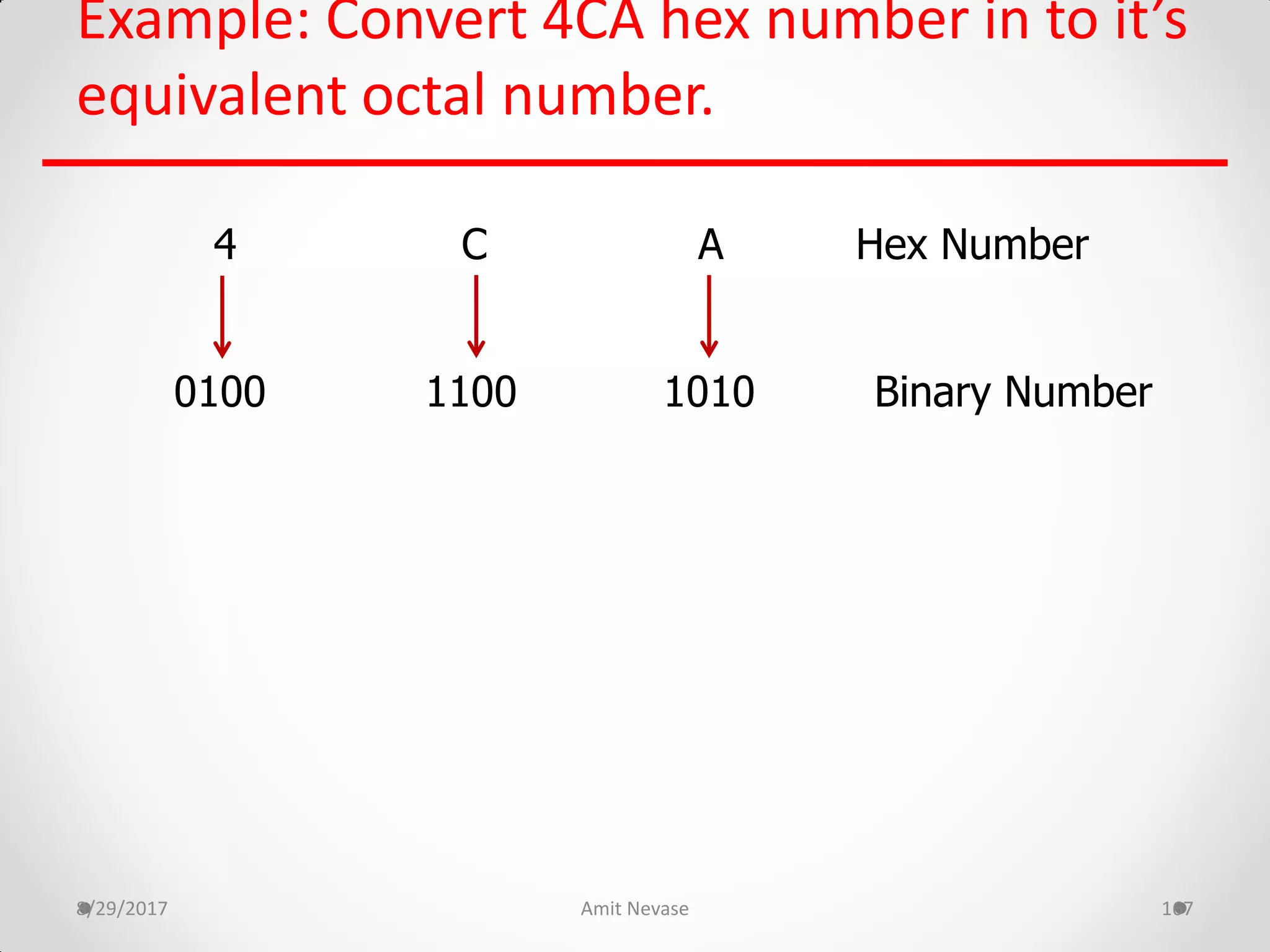
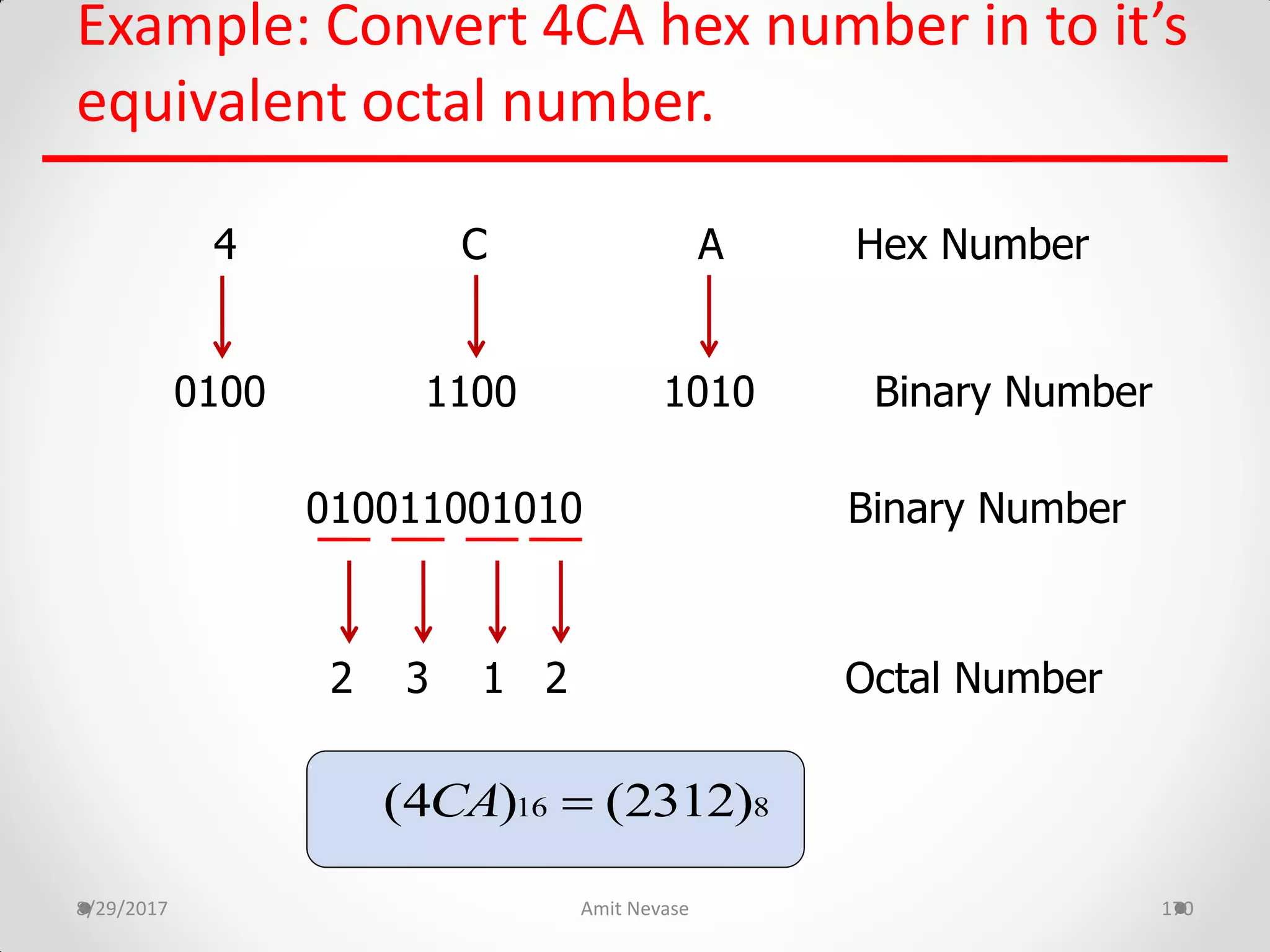
To get octal equivalent number of given hex
number, first we have to convert hex number
into its 4 bit binary equivalent and then
convert binary number into its octal
equivalent.
8/29/2017 Amit Nevase 164
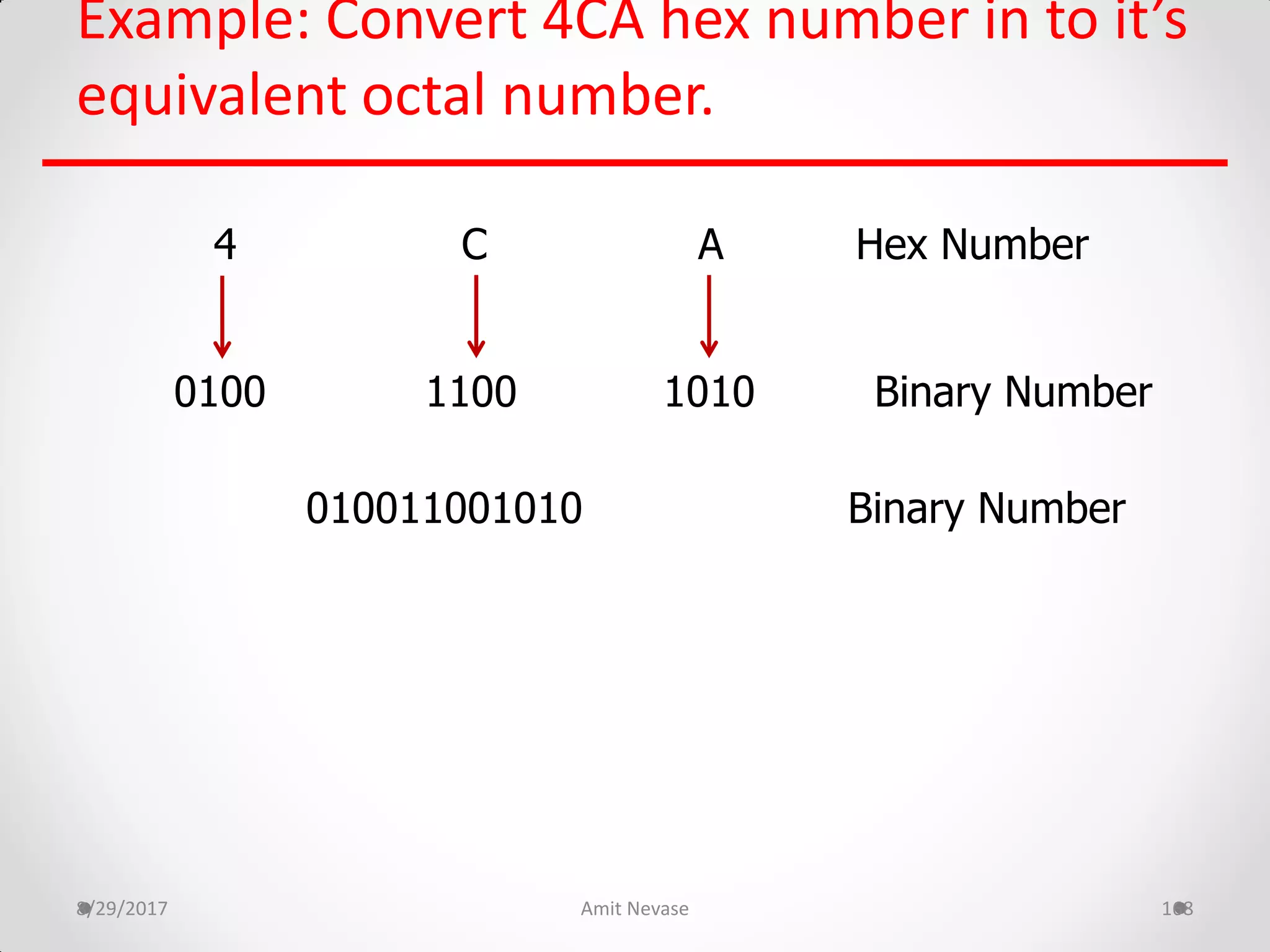
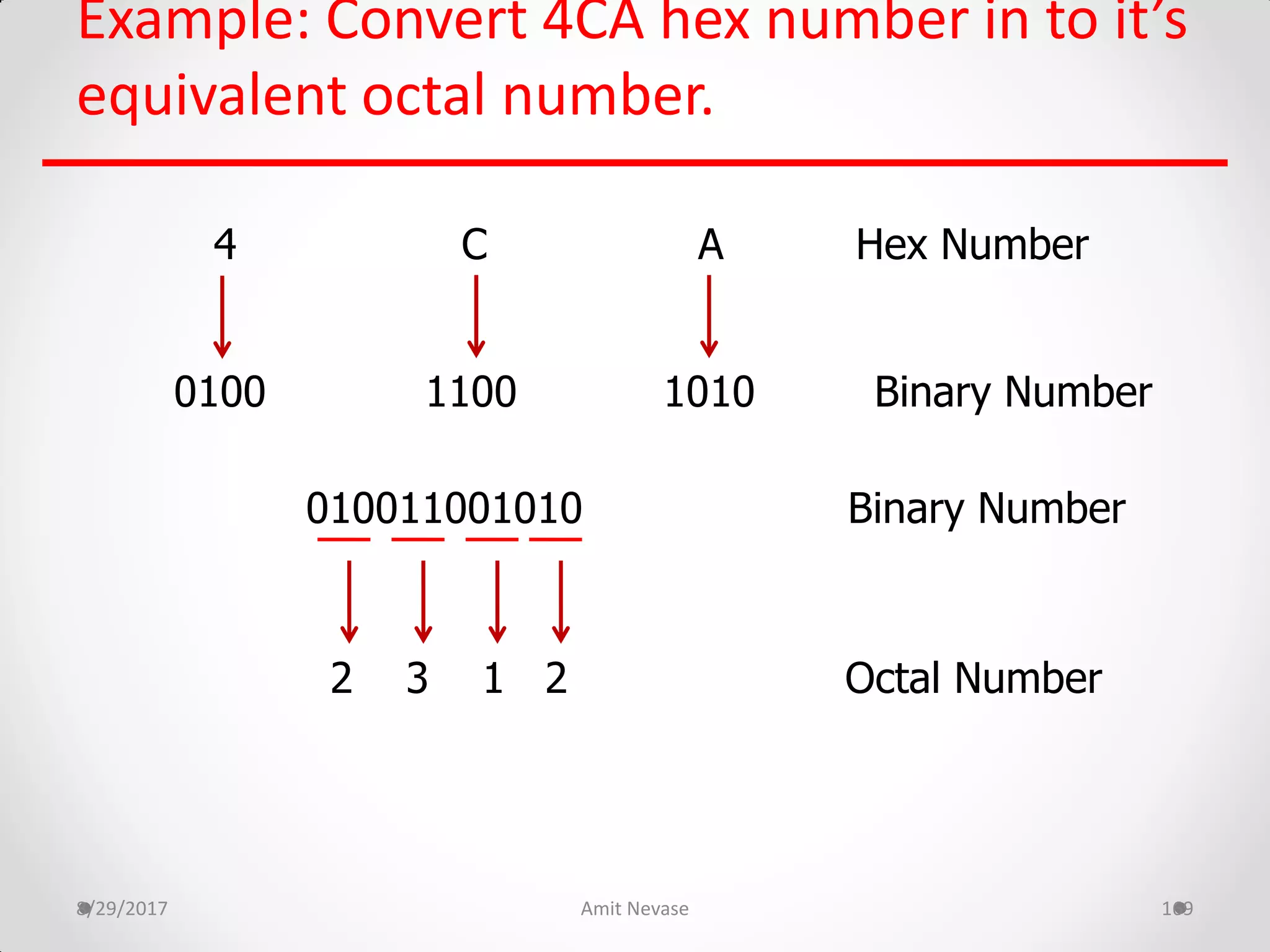
Conversion of Hexadecimal Number into Octal Number
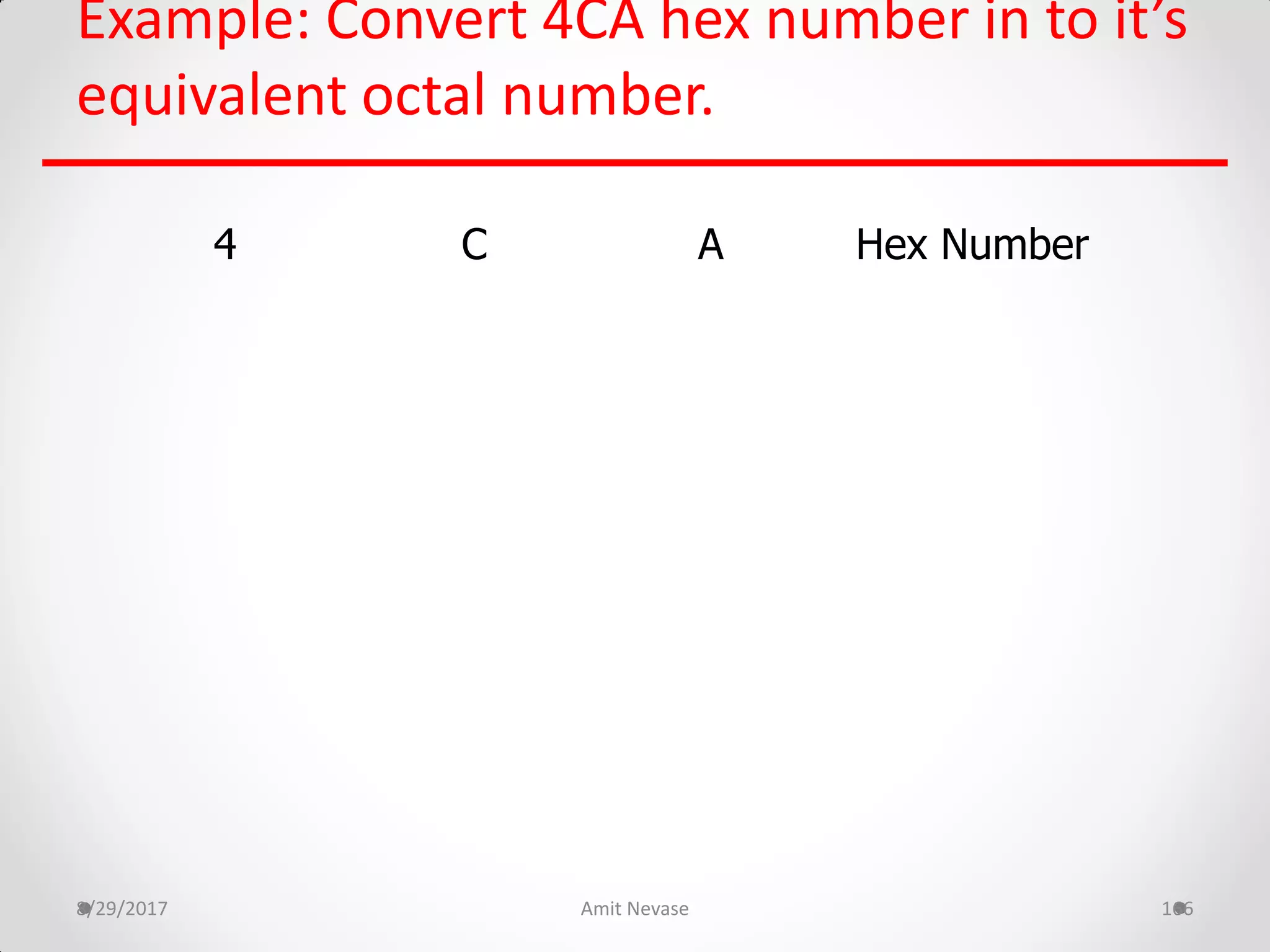
Example: Convert 4CA hex number in to it’s
equivalent octal number.
8/29/2017 Amit Nevase 165
Example: Convert 4CA hex number in to it’s
equivalent octal number.
8/29/2017 Amit Nevase 166
4 C A Hex Number
Example: Convert 4CA hex number in to it’s
equivalent octal number.
8/29/2017 Amit Nevase 167
4 C A Hex Number
0100 1100 1010 Binary Number
Example: Convert 4CA hex number in to it’s
equivalent octal number.
8/29/2017 Amit Nevase 168
4 C A Hex Number
0100 1100 1010 Binary Number
010011001010 Binary Number
Example: Convert 4CA hex number in to it’s
equivalent octal number.
8/29/2017 Amit Nevase 169
4 C A Hex Number
0100 1100 1010 Binary Number
010011001010 Binary Number
2 3 1 2 Octal Number
Example: Convert 4CA hex number in to it’s
equivalent octal number.
8/29/2017 Amit Nevase 170
4 C A Hex Number
0100 1100 1010 Binary Number
010011001010 Binary Number
2 3 1 2 Octal Number
16 8(4 ) (2312)CA 
8/29/2017 Amit Nevase 171
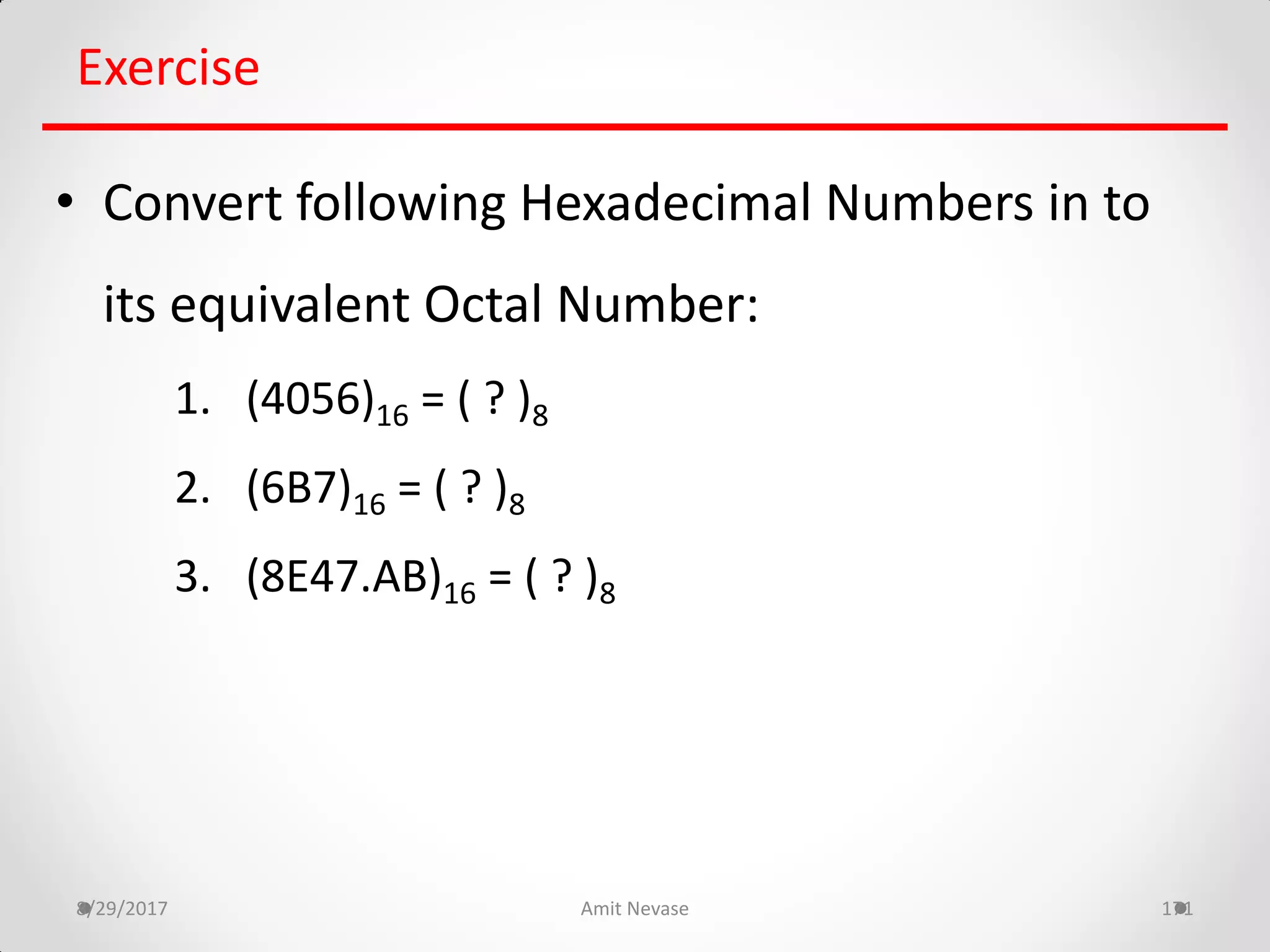
Exercise
• Convert following Hexadecimal Numbers in to
its equivalent Octal Number:
1. (4056)16 = ( ? )8
2. (6B7)16 = ( ? )8
3. (8E47.AB)16 = ( ? )8
Chapter I – Number System
 Introduction to digital signal, Advantages of Digital System
over analog systems)Number Systems: Different types of number
systems( Binary, Octal, Hexadecimal ), Conversion of number systems,
Binary arithmetic: Addition, Subtraction,
Multiplication, Division.
 Subtraction using 1’s complement and 2’s complement
 Codes
 Codes -BCD, Gray Code, Excess-3, ASCII code
 BCD addition, BCD subtraction using 9’s and 10’ complement
 (Numericals based on above topic).
8/29/2017 Amit Nevase 172
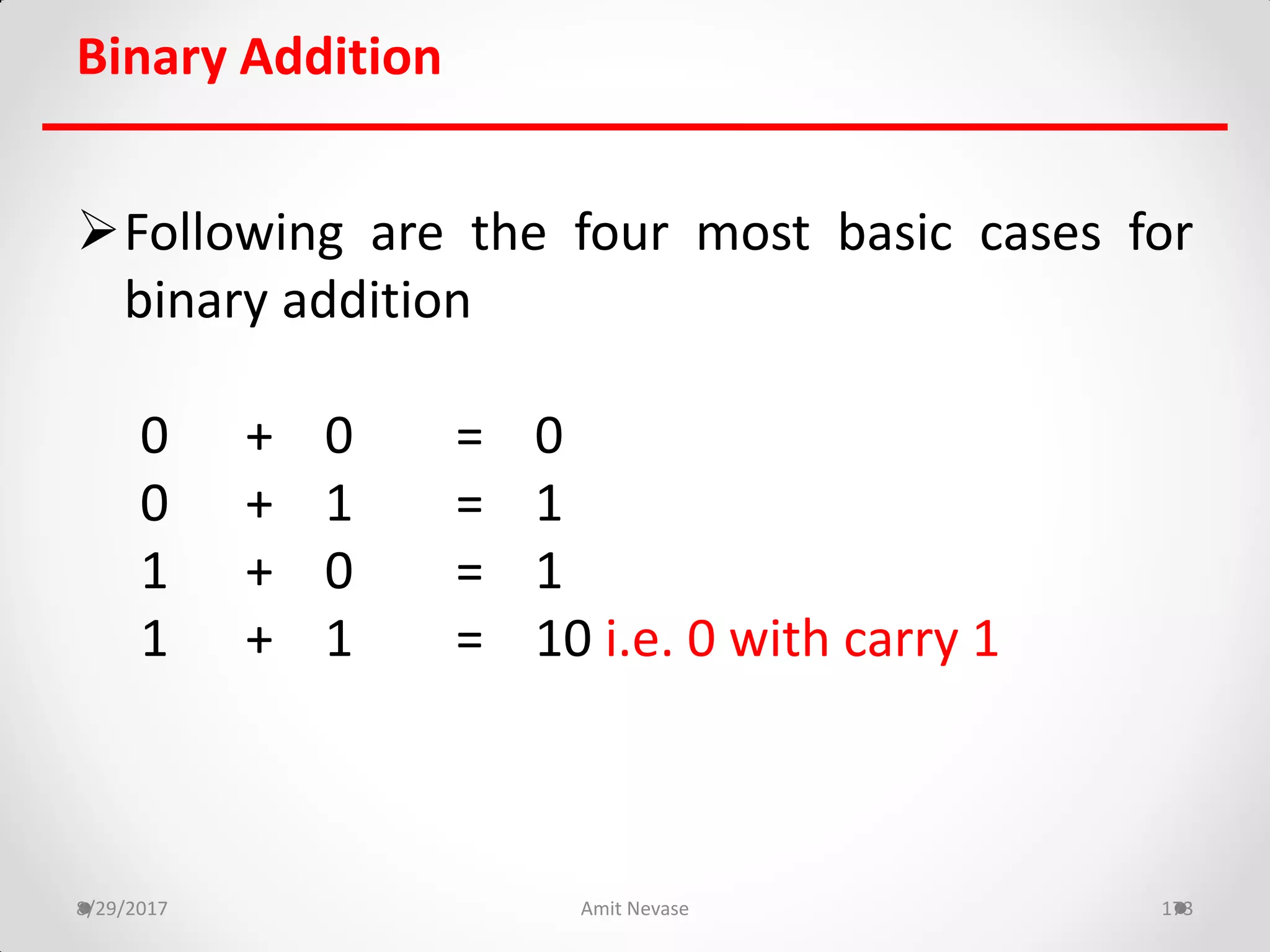
Binary Addition
Following are the four most basic cases for
binary addition
0 + 0 = 0
0 + 1 = 1
1 + 0 = 1
1 + 1 = 10 i.e. 0 with carry 1
8/29/2017 Amit Nevase 173
Binary Addition
8/29/2017 Amit Nevase 174
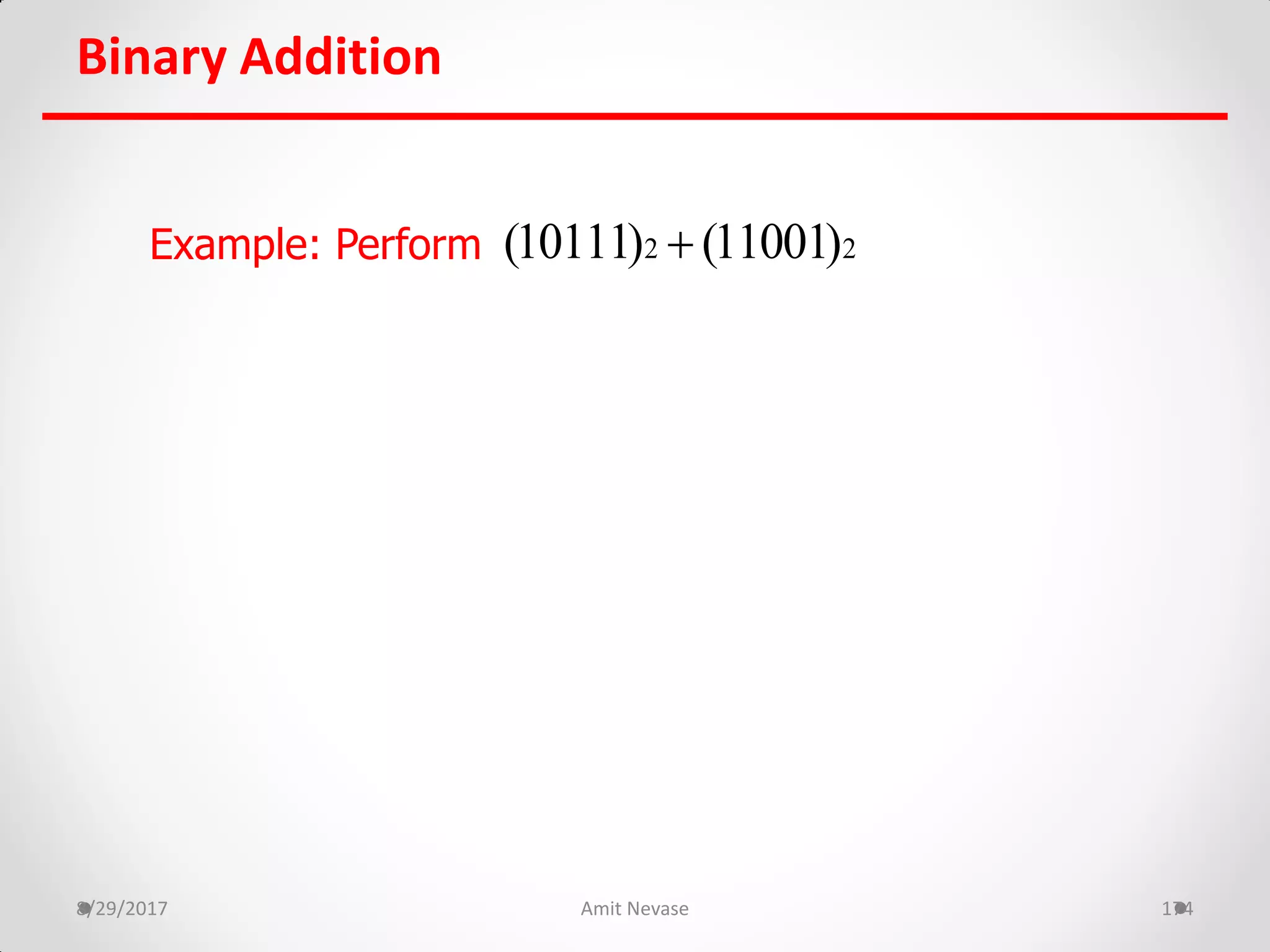
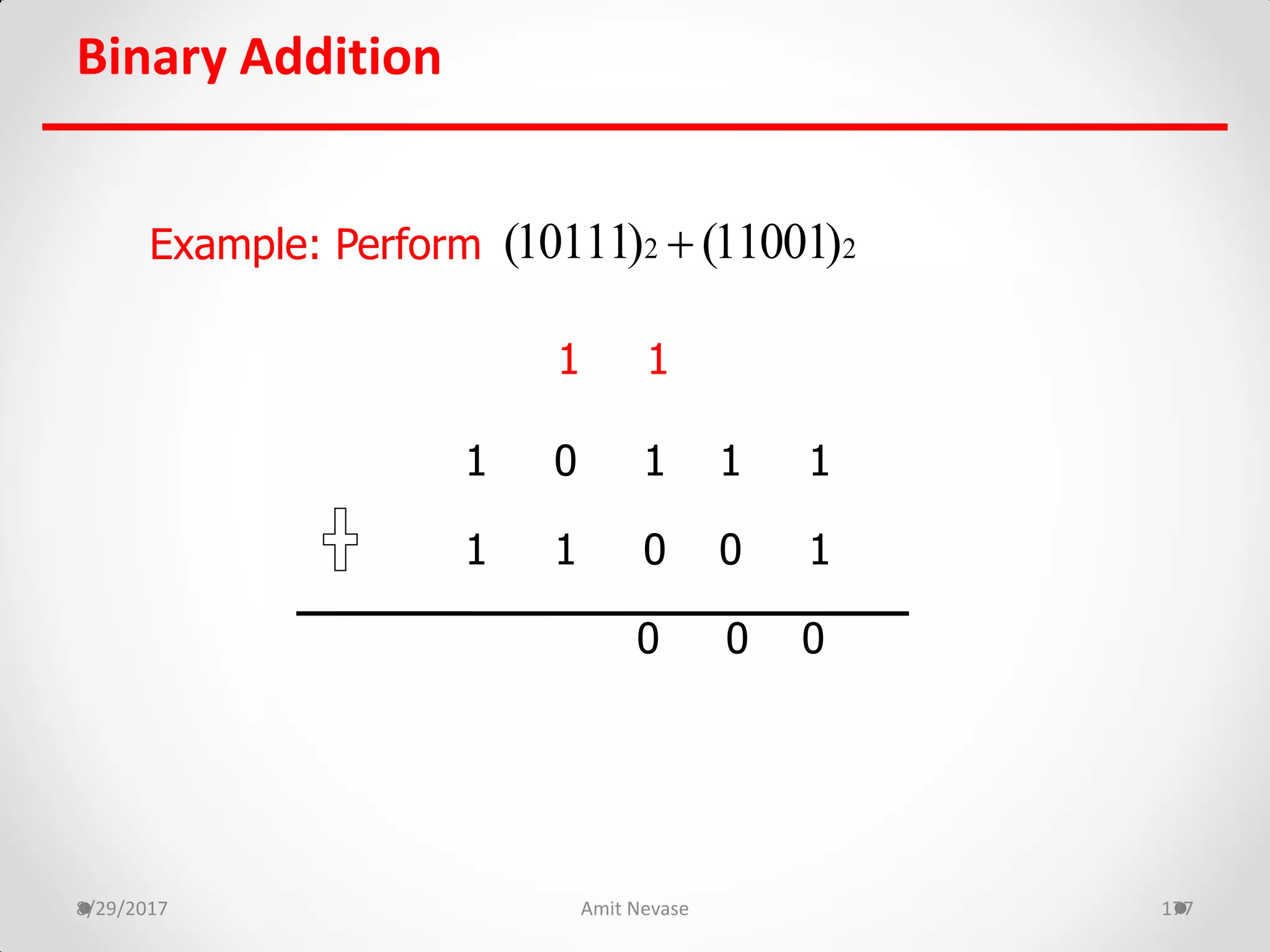
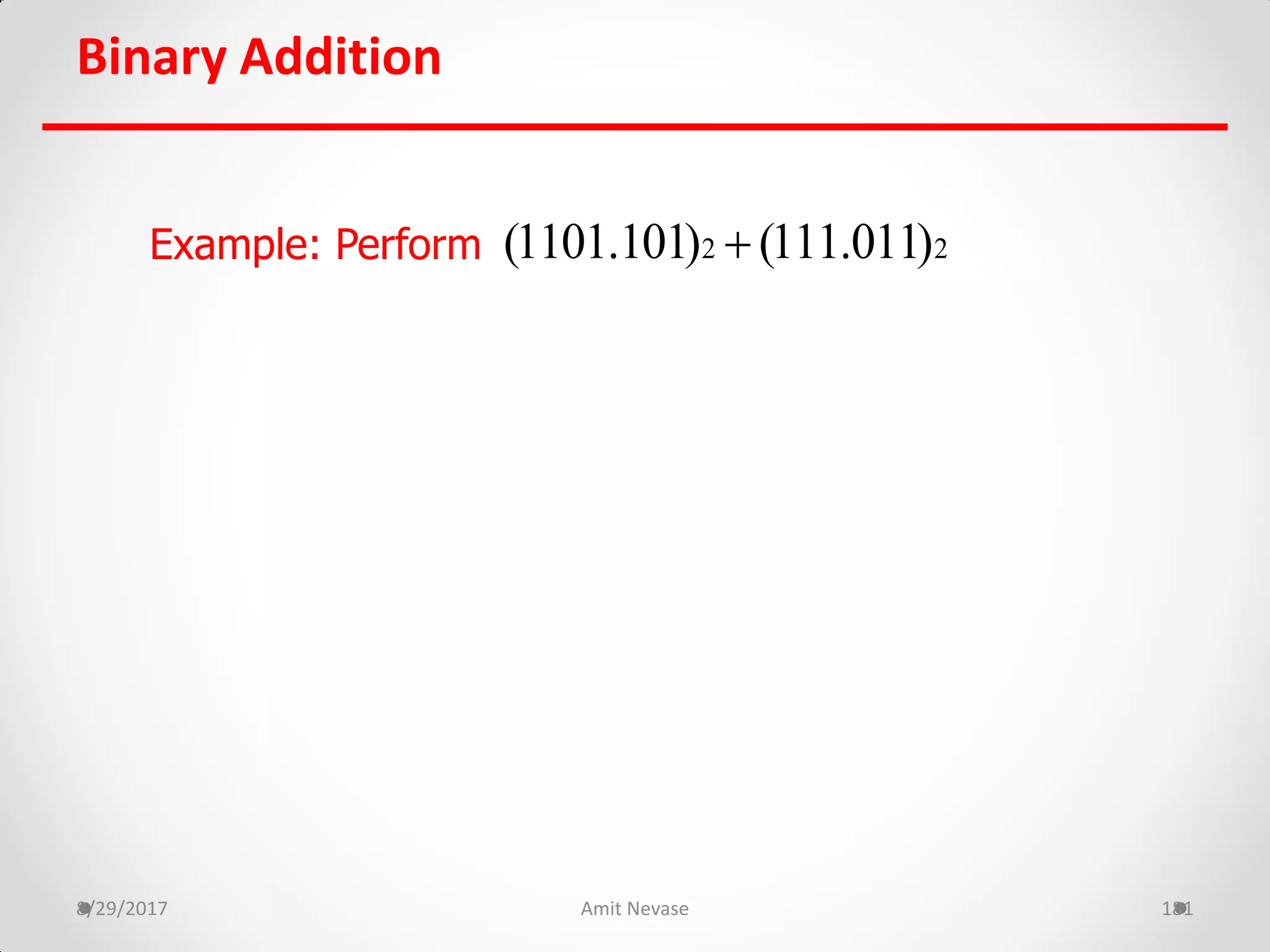
Example: Perform 2 2(10111) (11001)
Binary Addition
8/29/2017 Amit Nevase 175
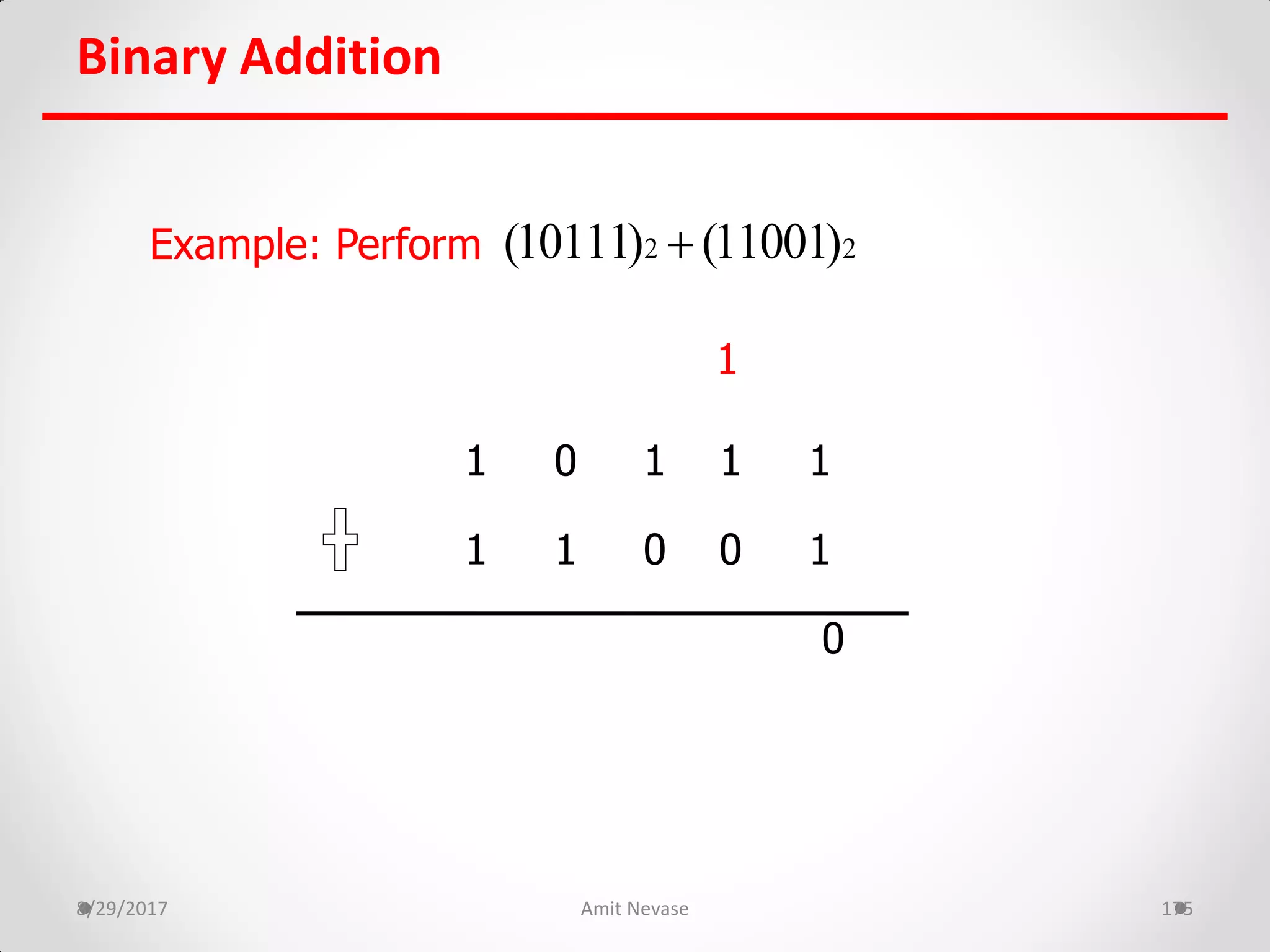
Example: Perform
1
1 0 1 1 1
1 1 0 0 1
0
2 2(10111) (11001)
Binary Addition
8/29/2017 Amit Nevase 176
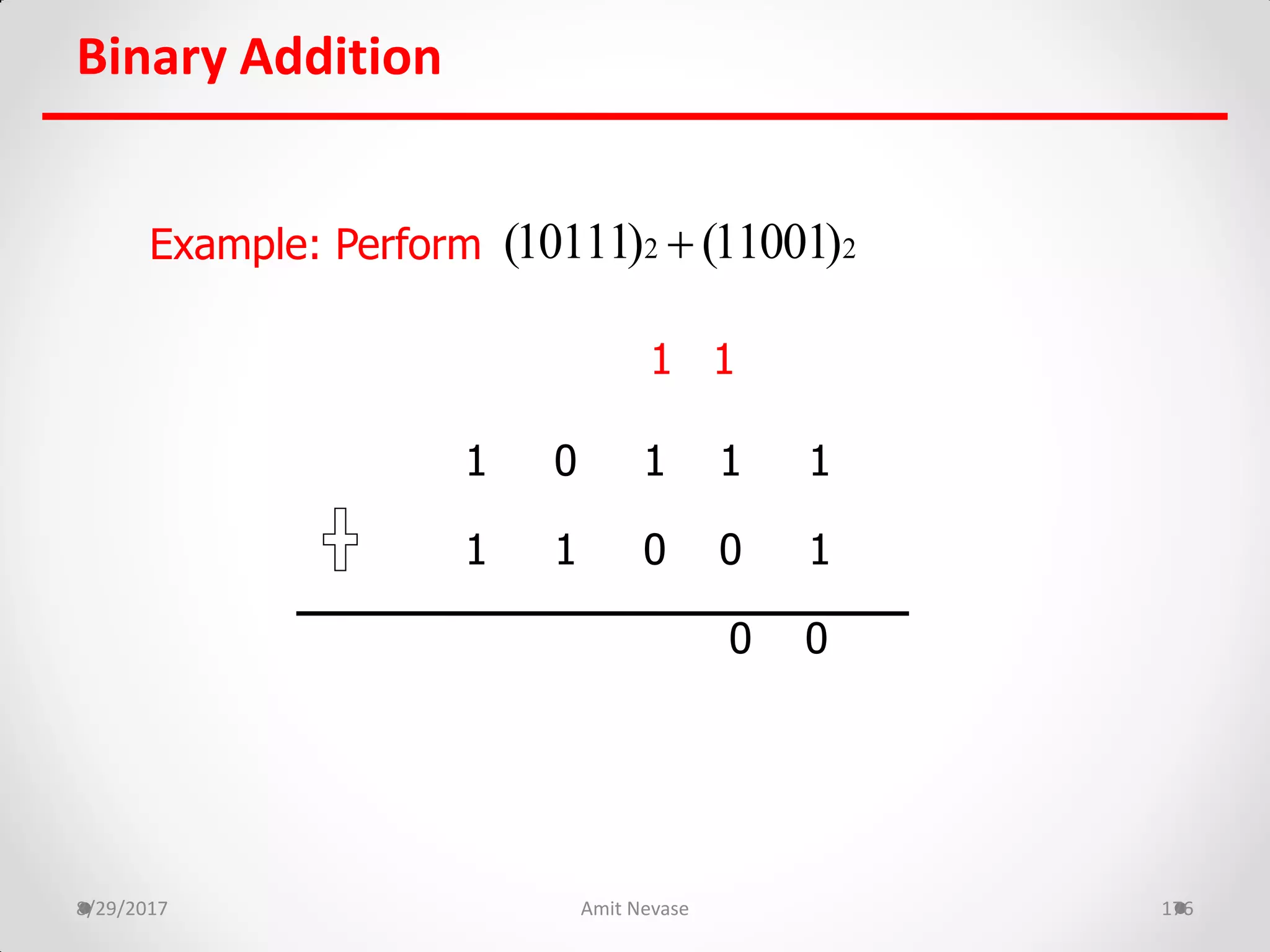
Example: Perform
1 1
1 0 1 1 1
1 1 0 0 1
0 0
2 2(10111) (11001)
Binary Addition
8/29/2017 Amit Nevase 177
Example: Perform
1 1
1 0 1 1 1
1 1 0 0 1
0 0 0
2 2(10111) (11001)
Binary Addition
8/29/2017 Amit Nevase 178
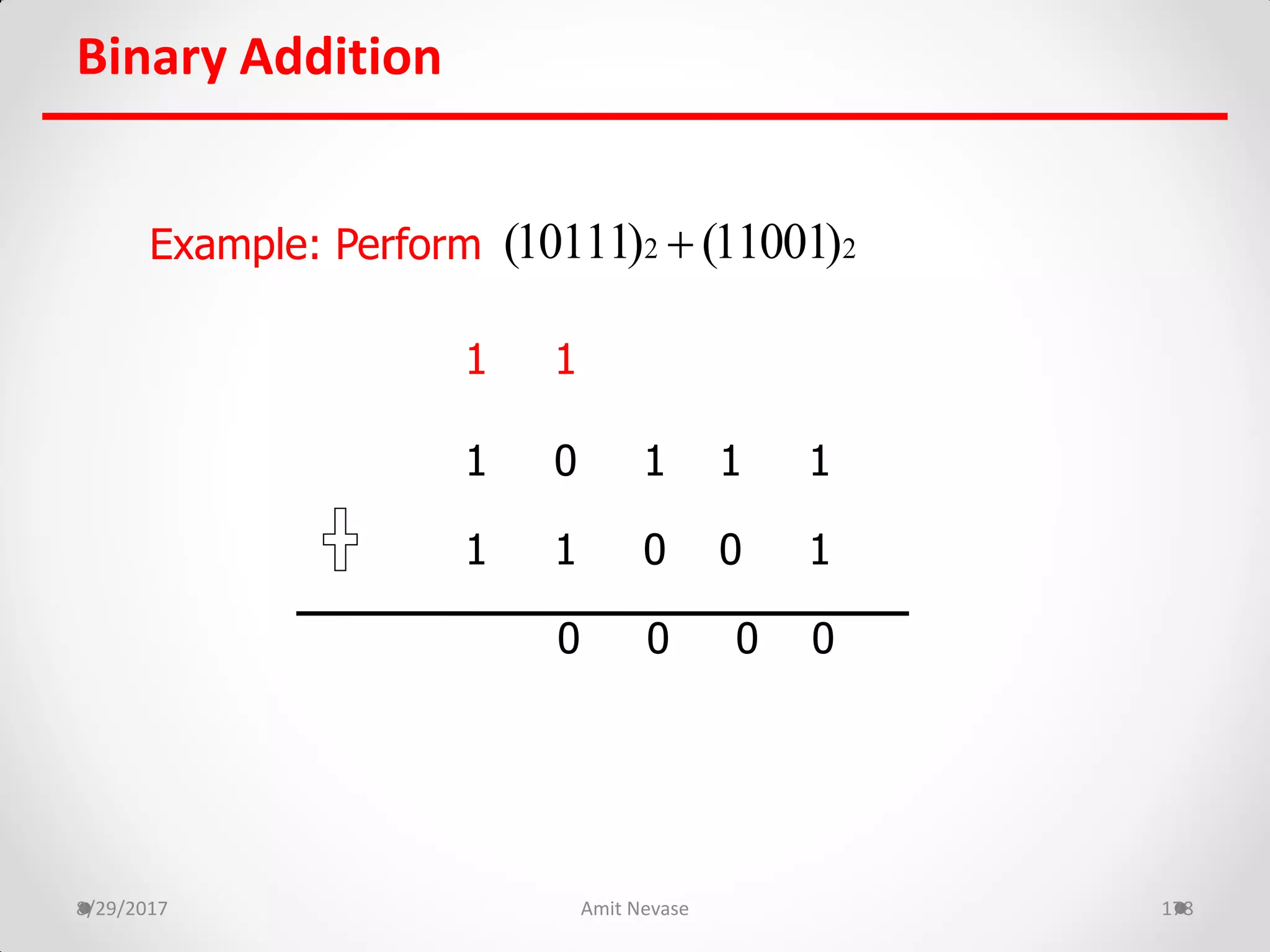
Example: Perform
1 1
1 0 1 1 1
1 1 0 0 1
0 0 0 0
2 2(10111) (11001)
Binary Addition
8/29/2017 Amit Nevase 179
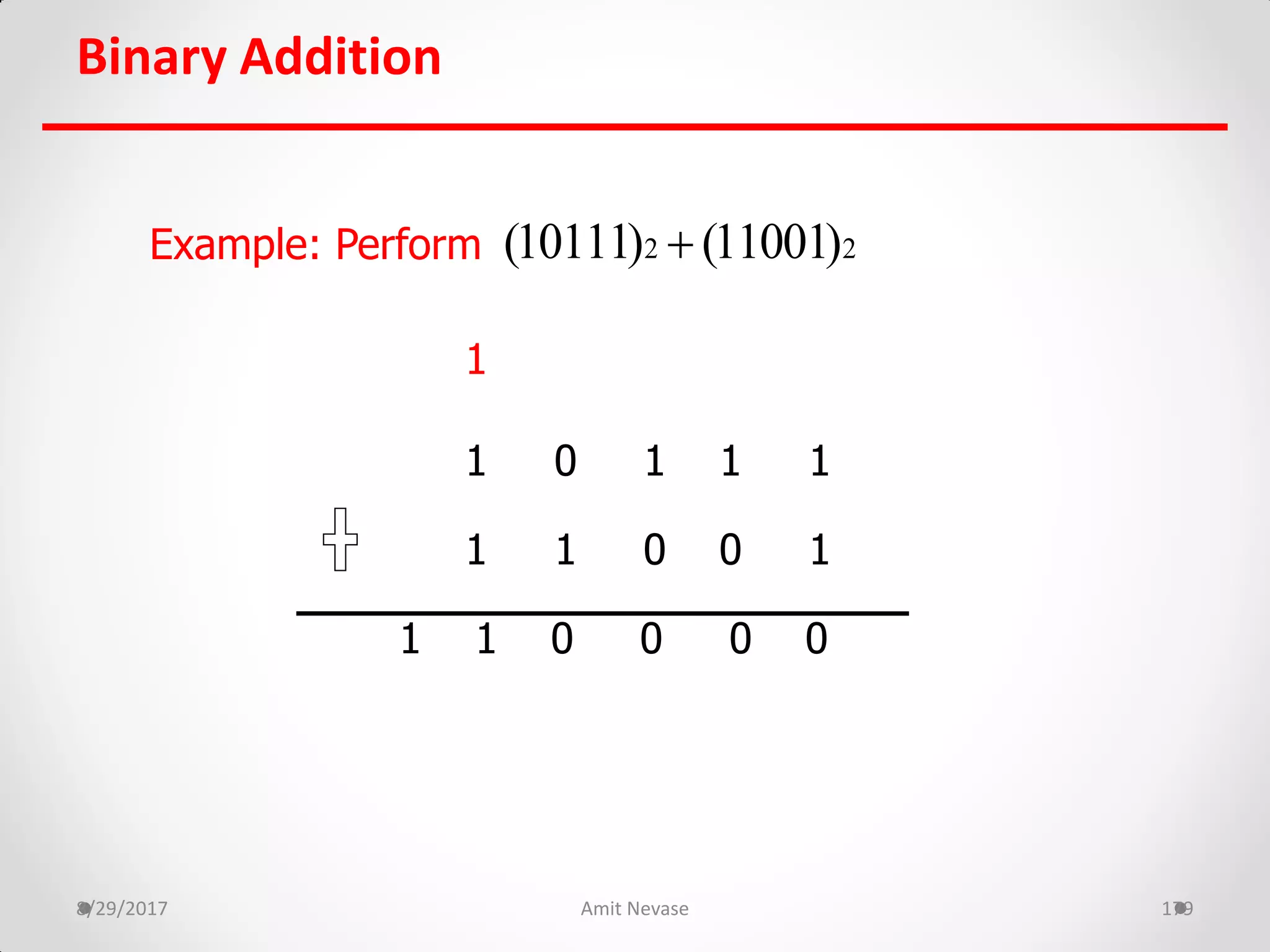
Example: Perform
1
1 0 1 1 1
1 1 0 0 1
1 1 0 0 0 0
2 2(10111) (11001)
Binary Addition
8/29/2017 Amit Nevase 180
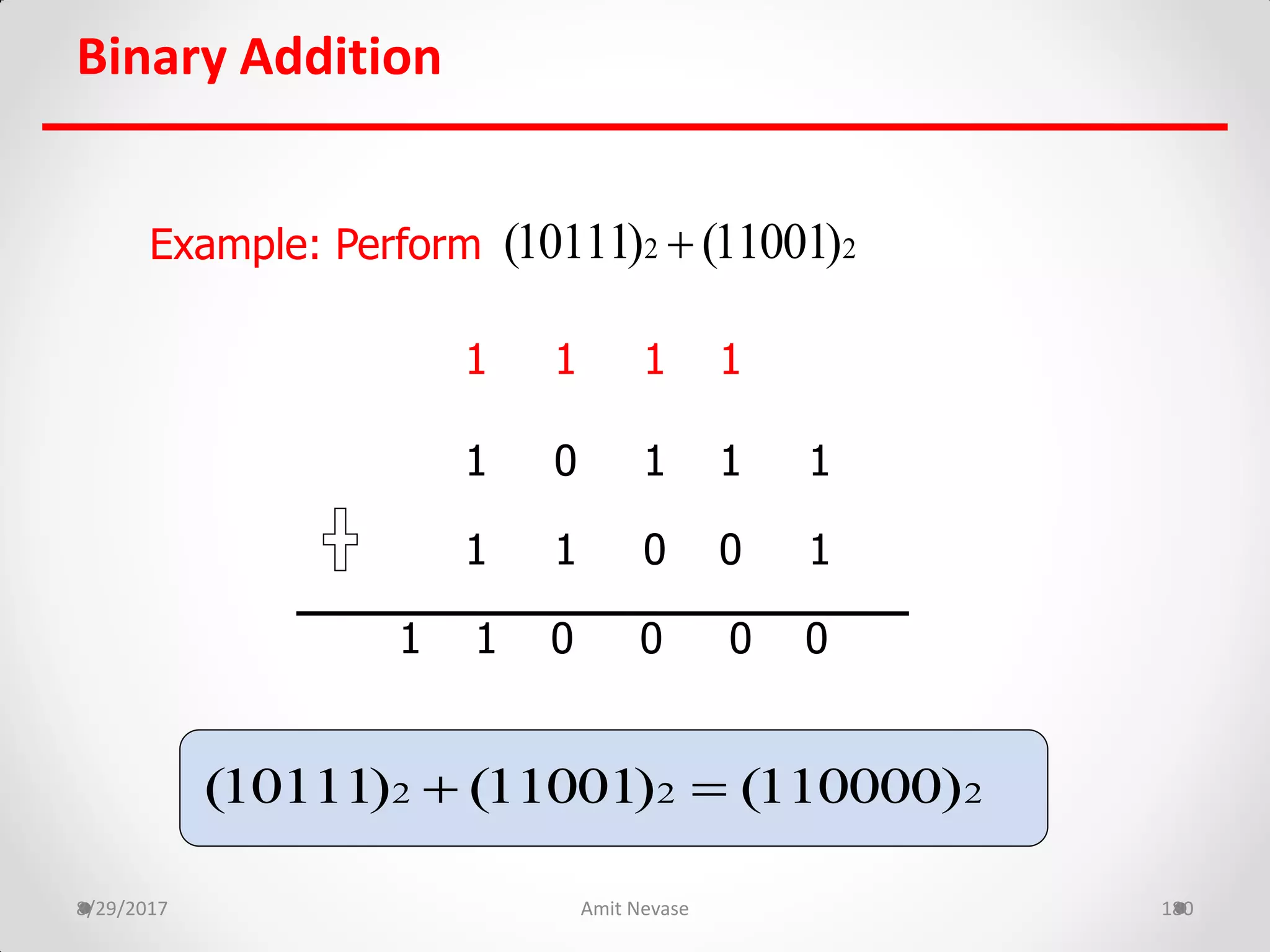
Example: Perform
1 1 1 1
1 0 1 1 1
1 1 0 0 1
1 1 0 0 0 0
2 2(10111) (11001)
2 2 2(10111) (11001) (110000) 
Binary Addition
8/29/2017 Amit Nevase 181
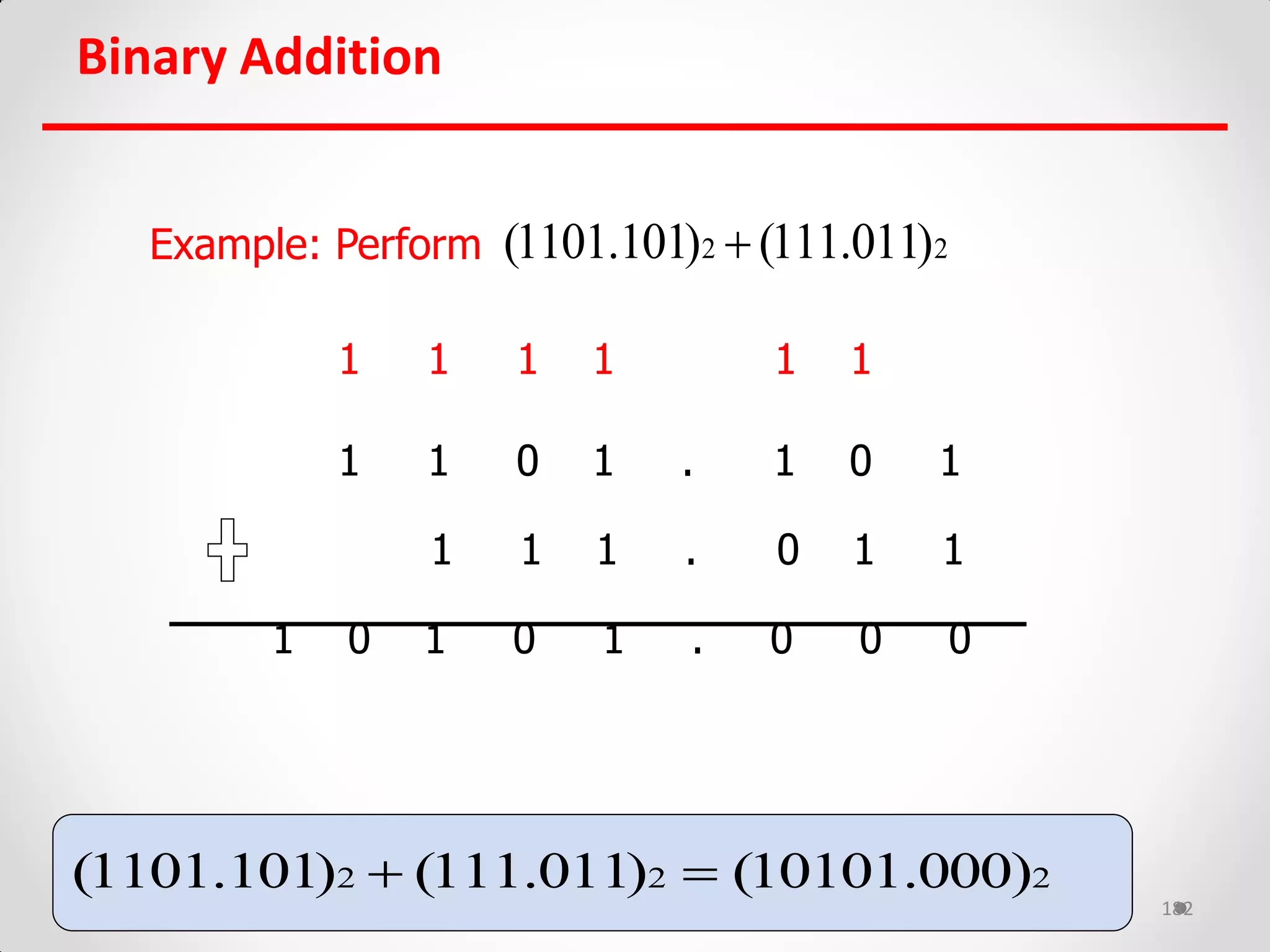
Example: Perform 2 2(1101.101) (111.011)
Binary Addition
8/29/2017 Amit Nevase 182
Example: Perform
1 1 1 1 1 1
1 1 0 1 . 1 0 1
1 1 1 . 0 1 1
1 0 1 0 1 . 0 0 0
2 2(1101.101) (111.011)
2 2 2(1101.101) (111.011) (10101.000) 
8/29/2017 Amit Nevase 183
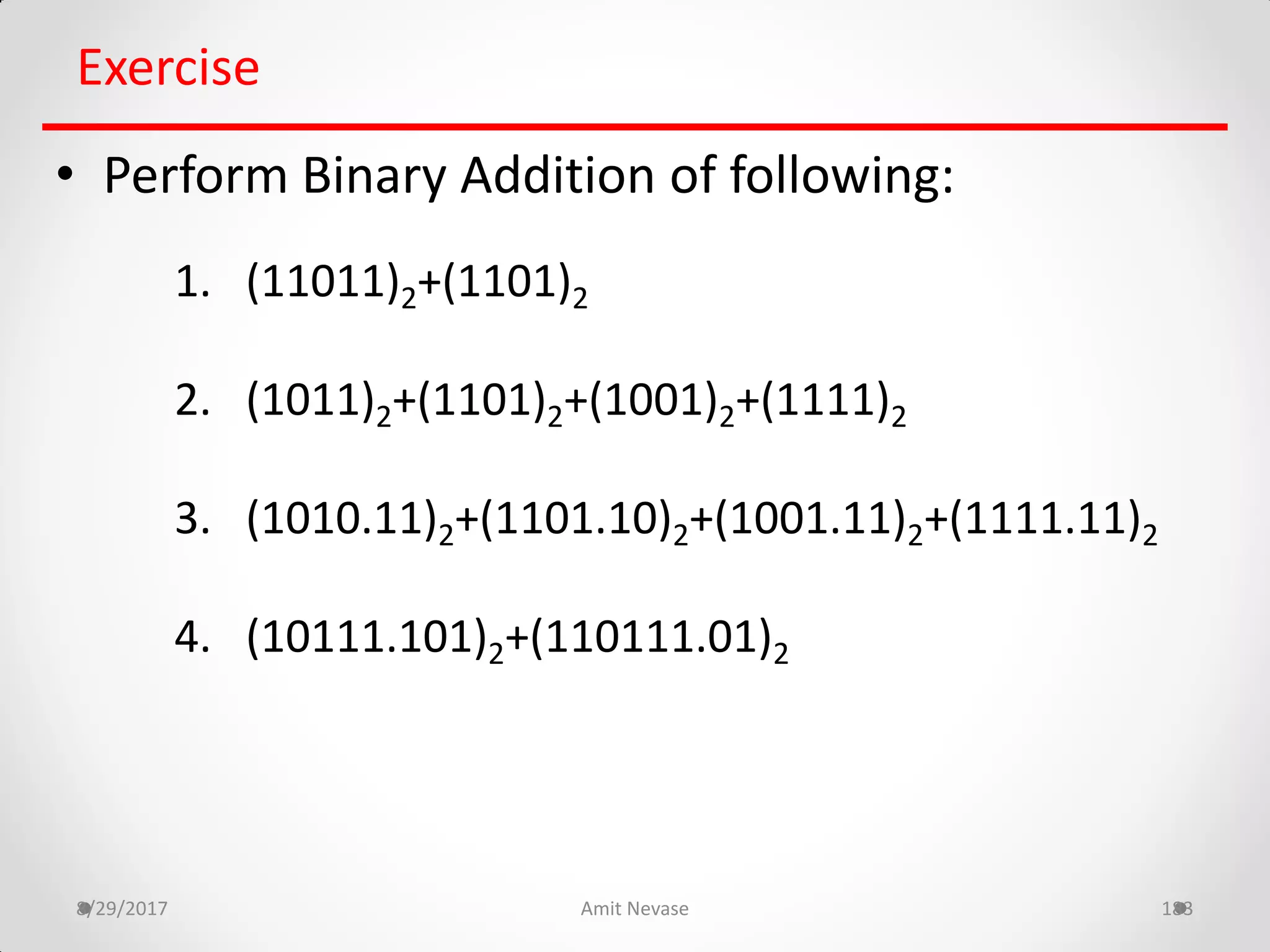
Exercise
• Perform Binary Addition of following:
1. (11011)2+(1101)2
2. (1011)2+(1101)2+(1001)2+(1111)2
3. (1010.11)2+(1101.10)2+(1001.11)2+(1111.11)2
4. (10111.101)2+(110111.01)2
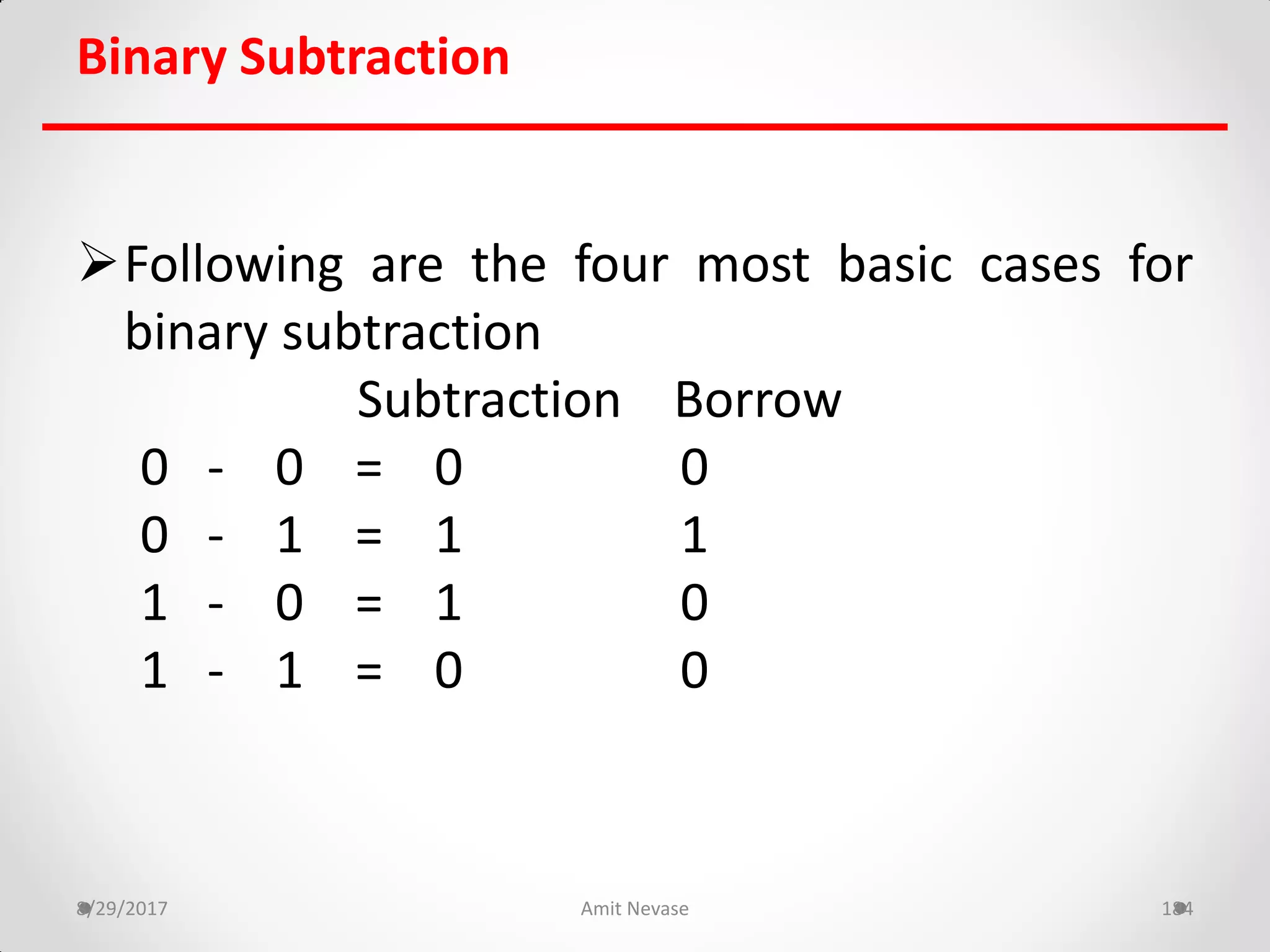
Binary Subtraction
Following are the four most basic cases for
binary subtraction
Subtraction Borrow
0 - 0 = 0 0
0 - 1 = 1 1
1 - 0 = 1 0
1 - 1 = 0 0
8/29/2017 Amit Nevase 184
Binary Subtraction
8/29/2017 Amit Nevase 185
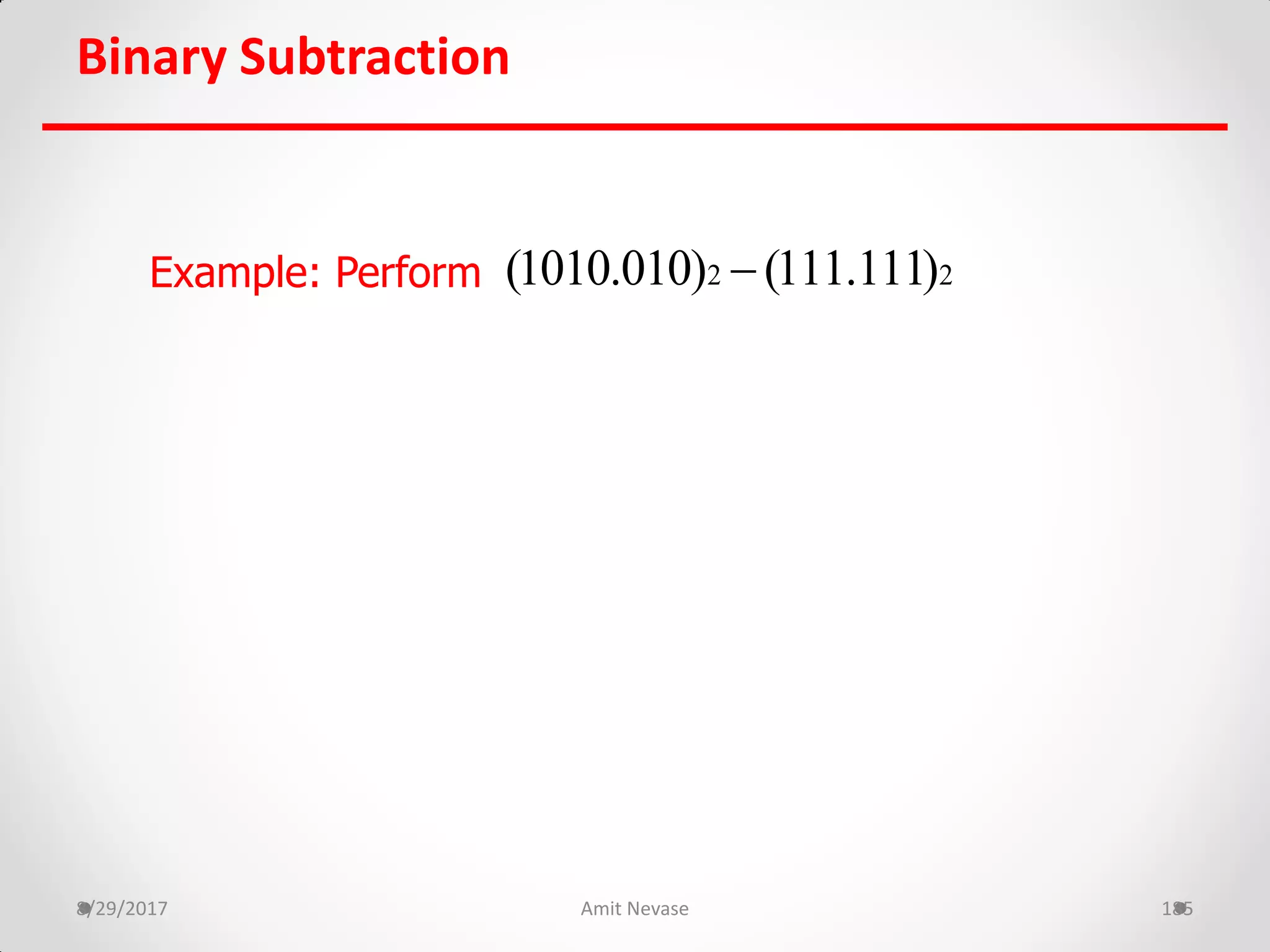
Example: Perform 2 2(1010.010) (111.111)
Binary Subtraction
8/29/2017 Amit Nevase 186
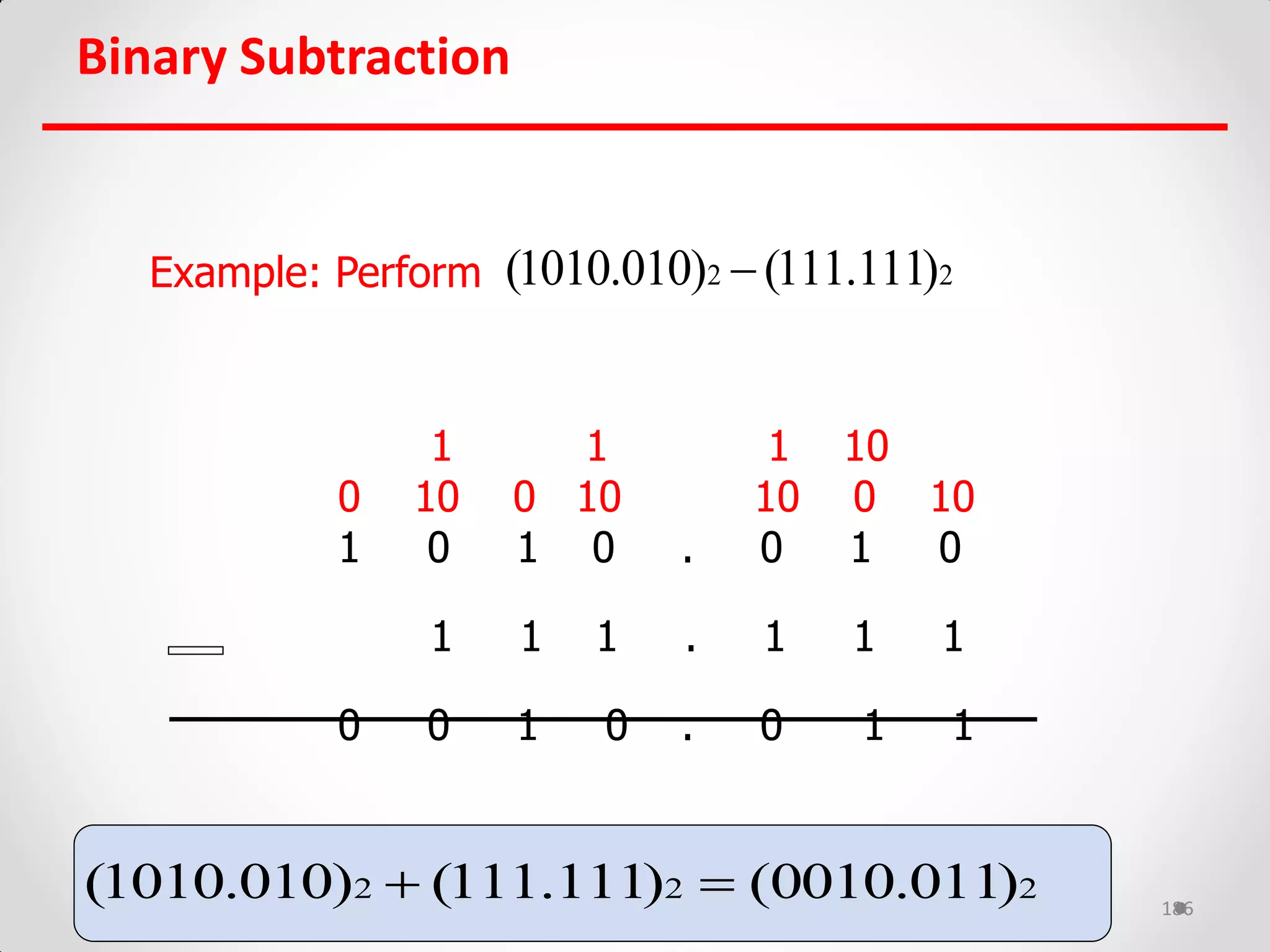
Example: Perform
1 1 1 10
0 10 0 10 10 0 10
1 0 1 0 . 0 1 0
1 1 1 . 1 1 1
0 0 1 0 . 0 1 1
2 2(1010.010) (111.111)
2 2 2(1010.010) (111.111) (0010.011) 
8/29/2017 Amit Nevase 187
Exercise
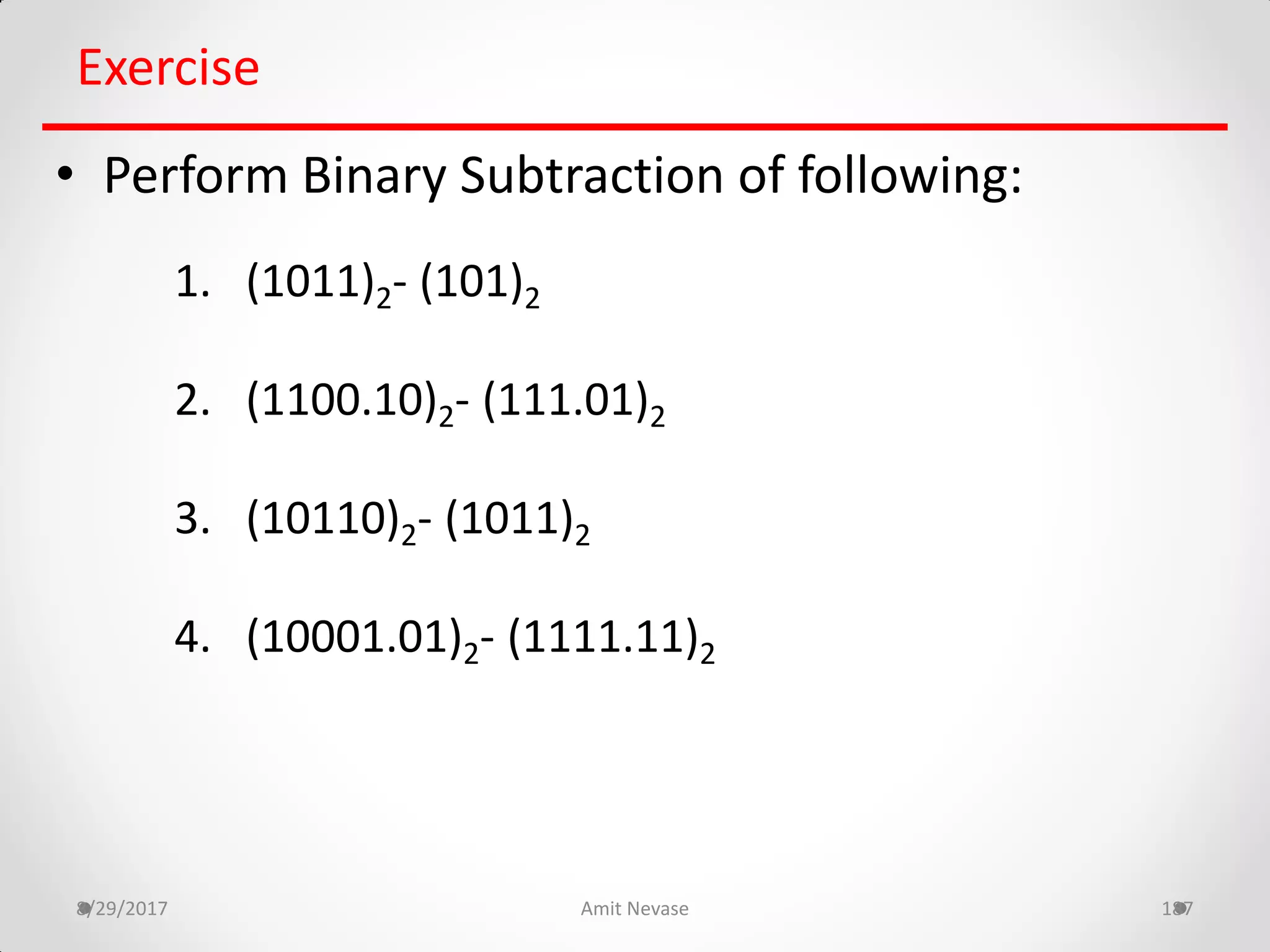
• Perform Binary Subtraction of following:
1. (1011)2- (101)2
2. (1100.10)2- (111.01)2
3. (10110)2- (1011)2
4. (10001.01)2- (1111.11)2
Binary Multiplication
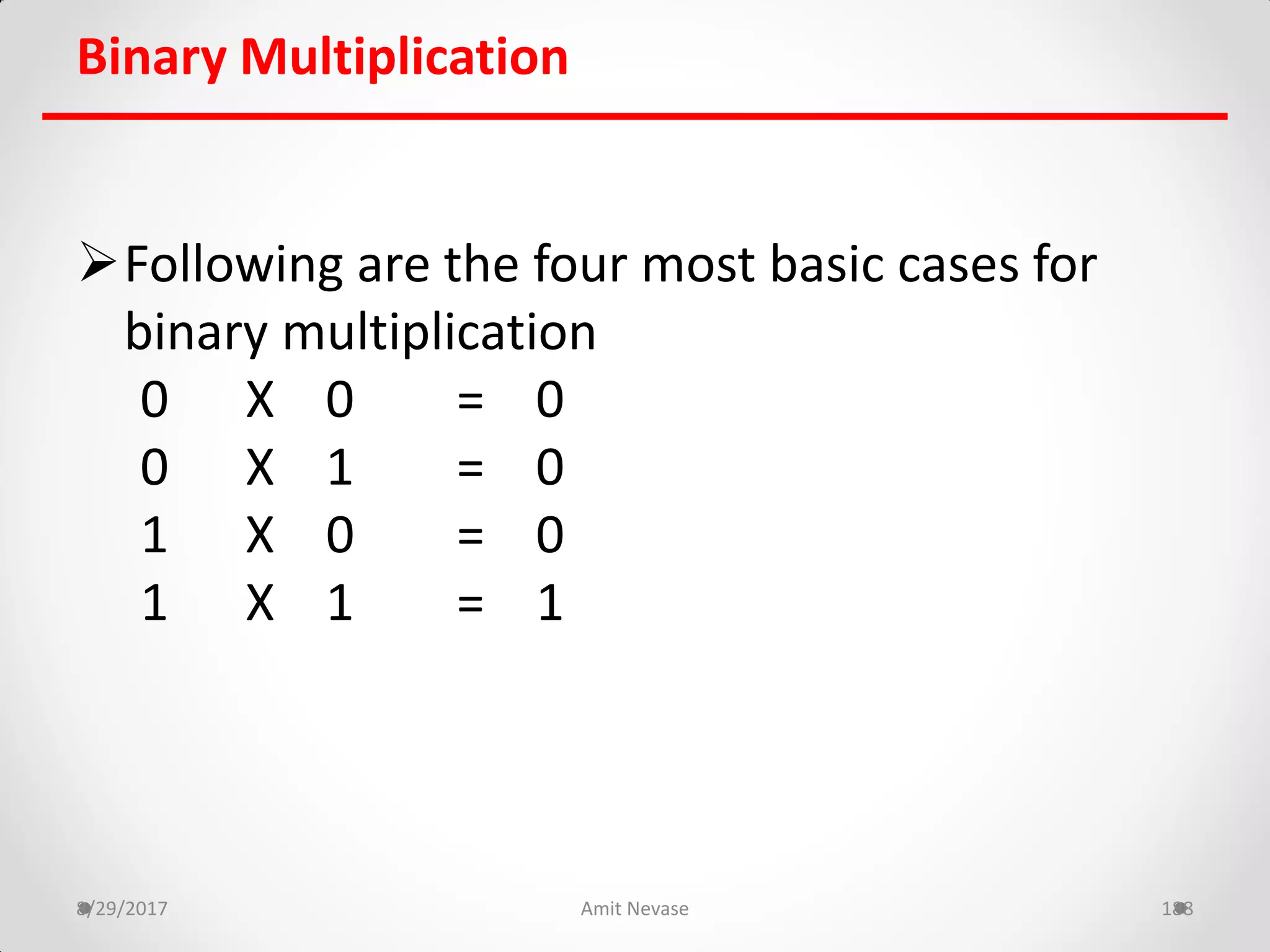
Following are the four most basic cases for
binary multiplication
0 X 0 = 0
0 X 1 = 0
1 X 0 = 0
1 X 1 = 1
8/29/2017 Amit Nevase 188
Binary Multiplication
8/29/2017 Amit Nevase 189
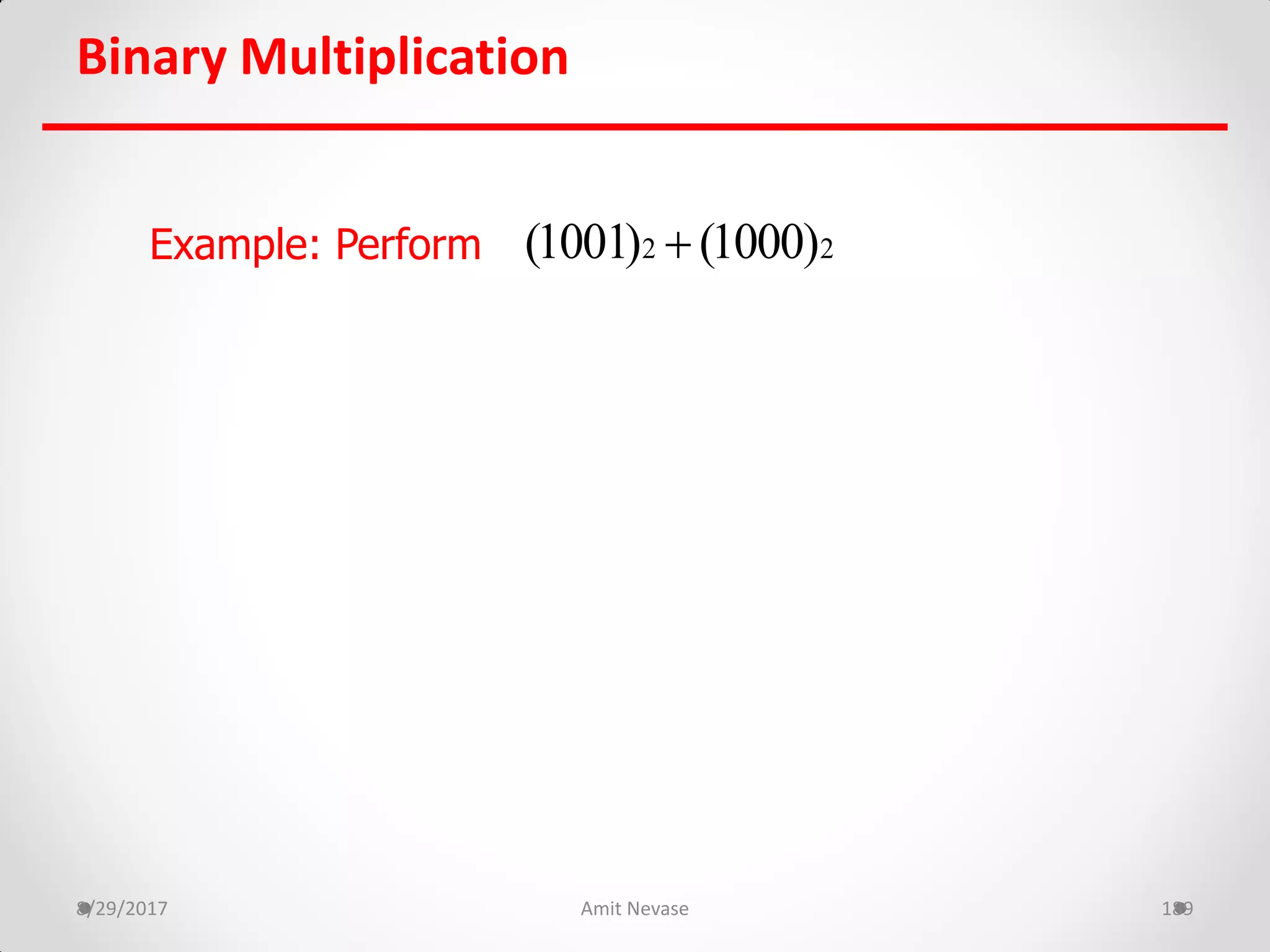
Example: Perform 2 2(1001) (1000)
Binary Multiplication
8/29/2017 Amit Nevase 190
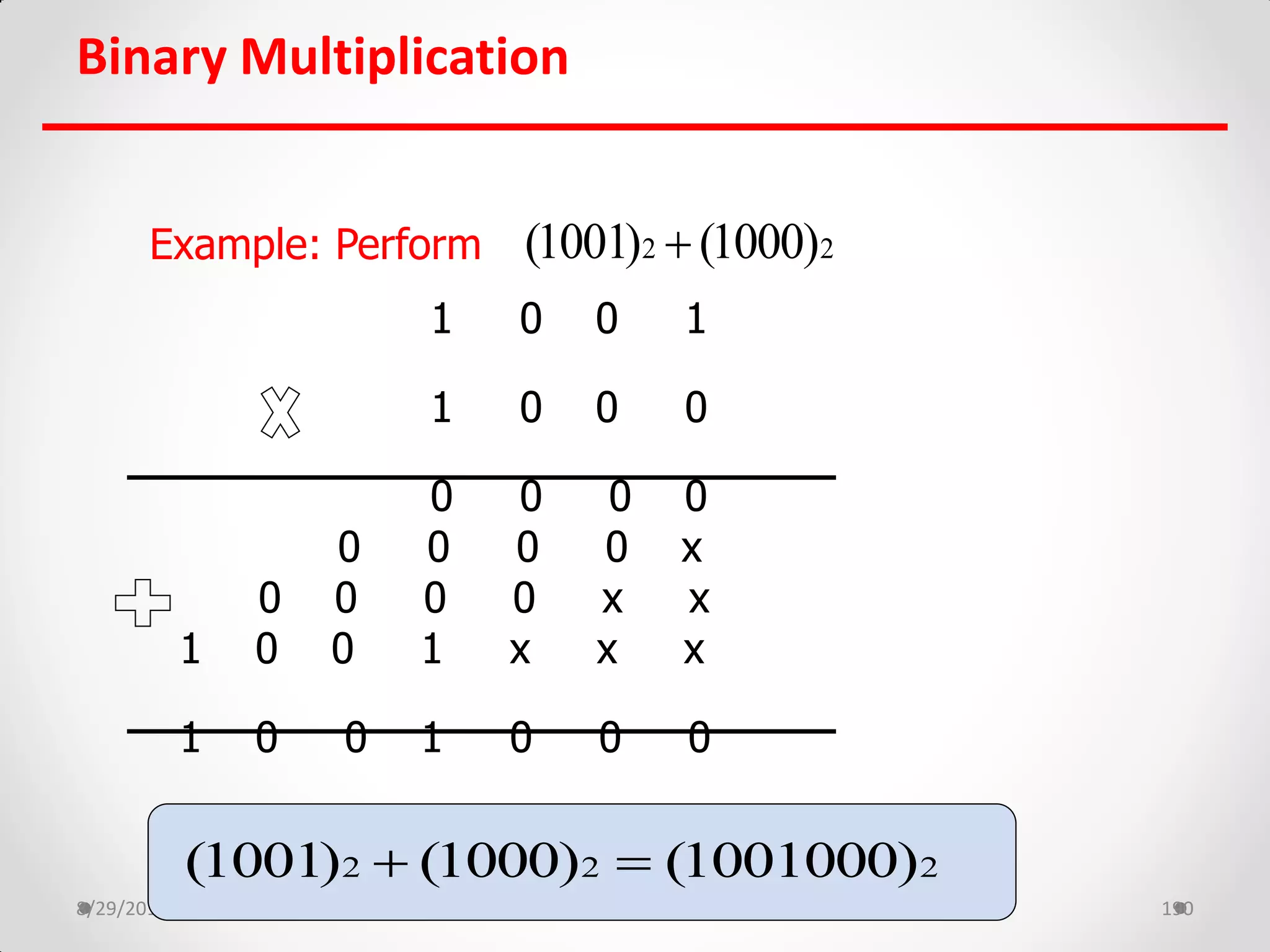
Example: Perform
1 0 0 1
1 0 0 0
0 0 0 0
0 0 0 0 x
0 0 0 0 x x
1 0 0 1 x x x
1 0 0 1 0 0 0
2 2(1001) (1000)
2 2 2(1001) (1000) (1001000) 
8/29/2017 Amit Nevase 191
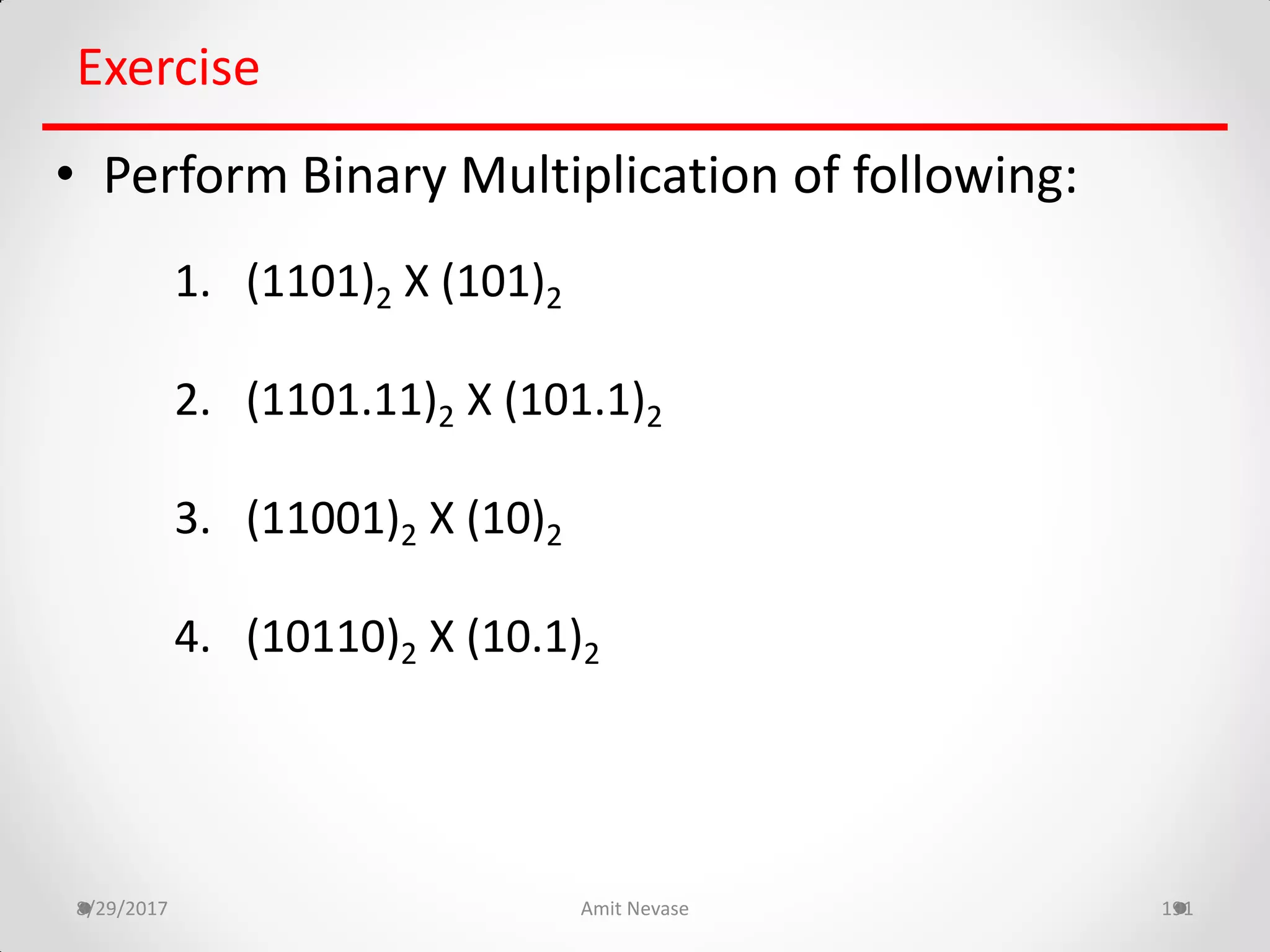
Exercise
• Perform Binary Multiplication of following:
1. (1101)2 X (101)2
2. (1101.11)2 X (101.1)2
3. (11001)2 X (10)2
4. (10110)2 X (10.1)2
Binary Division
8/29/2017 Amit Nevase 192
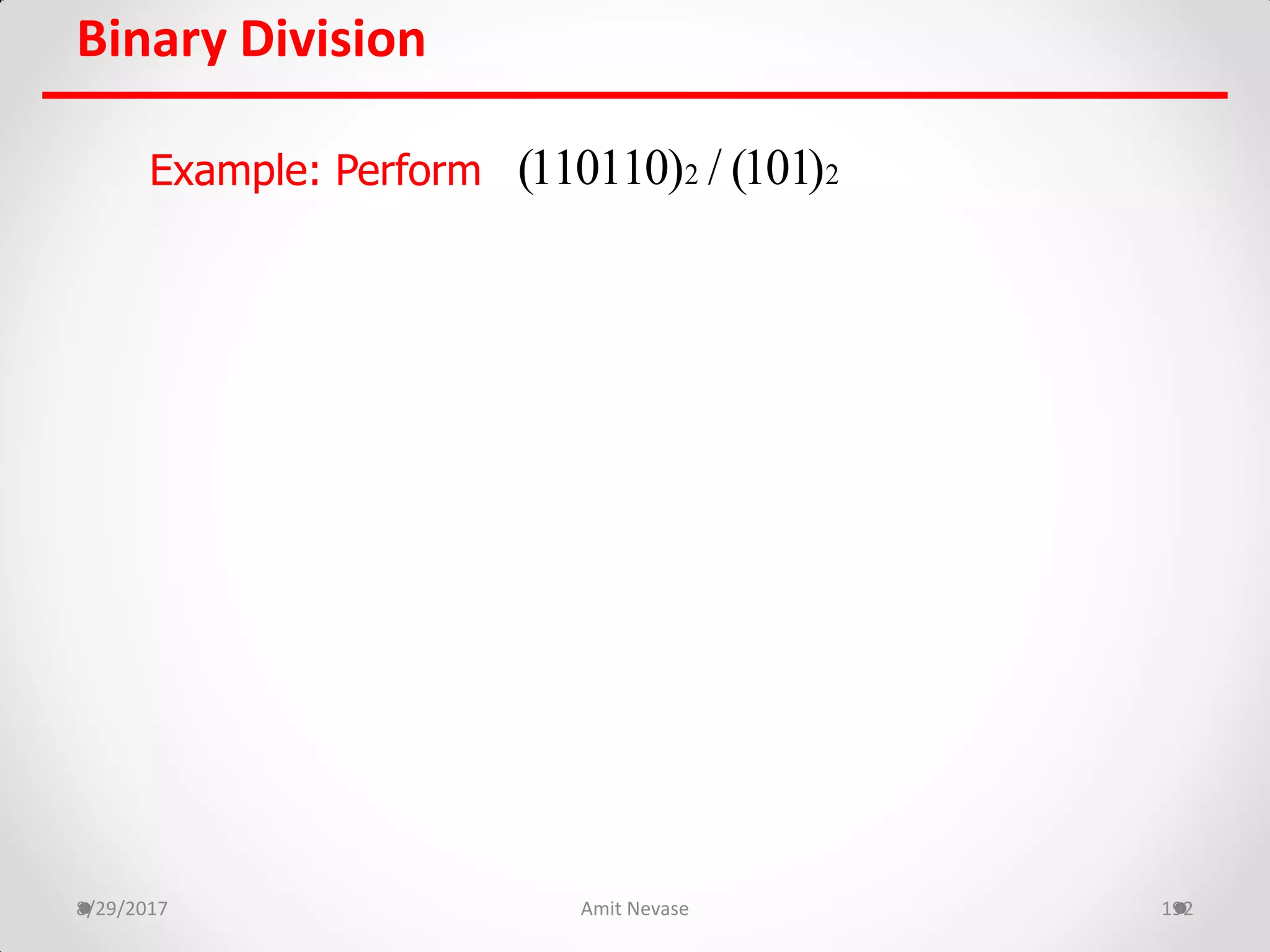
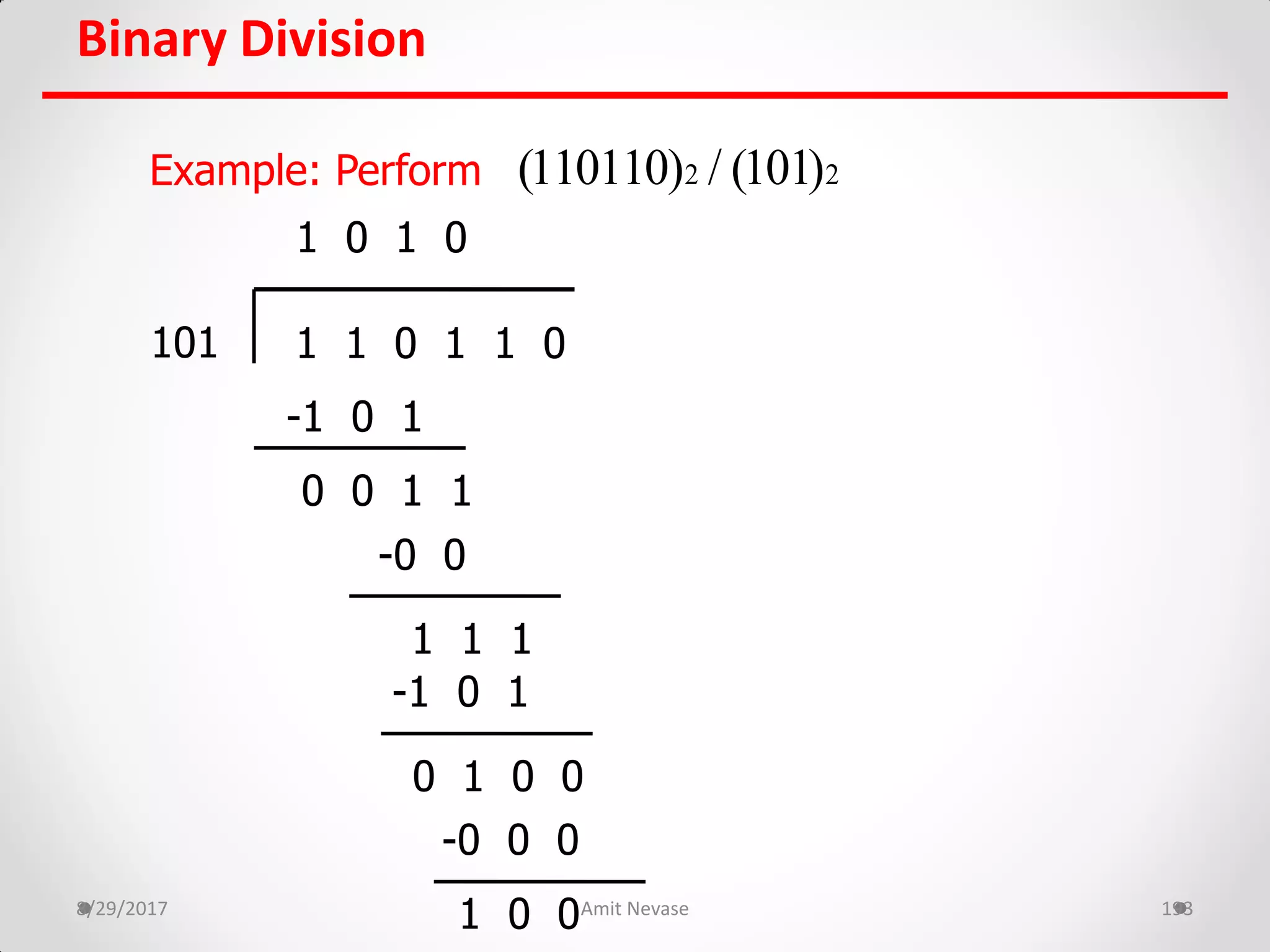
Example: Perform 2 2(110110) / (101)
Binary Division
8/29/2017 Amit Nevase 193
Example: Perform
1 1 0 1 1 0101
-1 0 1
0 0 1 1
-0 0
1 1 1
-1 0 1
0 1 0 0
-0 0 0
1 0 0
1 0 1 0
2 2(110110) / (101)
8/29/2017 Amit Nevase 194
Exercise
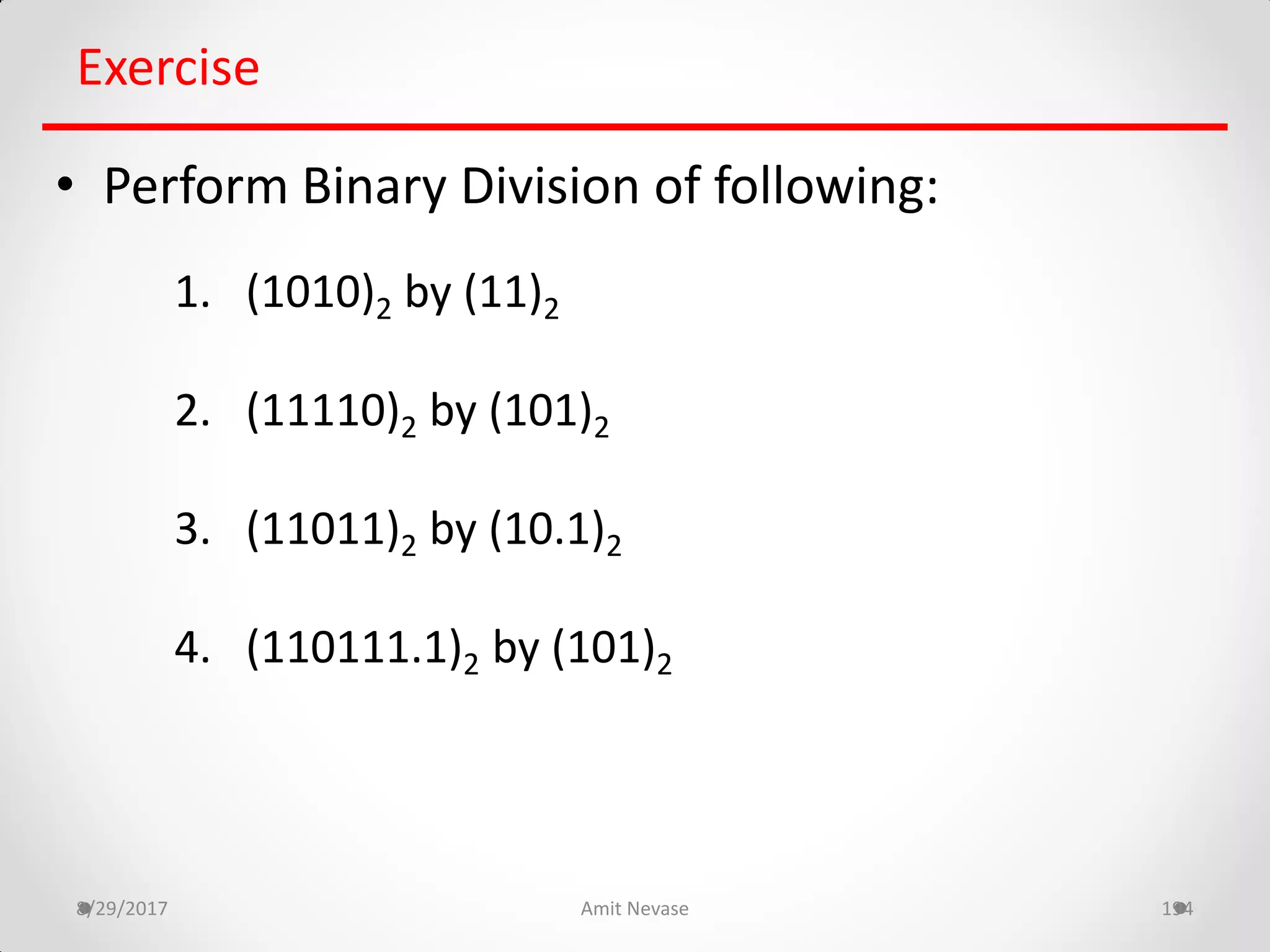
• Perform Binary Division of following:
1. (1010)2 by (11)2
2. (11110)2 by (101)2
3. (11011)2 by (10.1)2
4. (110111.1)2 by (101)2
Chapter I – Number System
 Introduction to digital signal, Advantages of Digital System
over analog systems
 Number Systems: Different types of number systems( Binary,
Octal, Hexadecimal ), Conversion of number systems,
 Binary arithmetic: Addition, Subtraction, Multiplication, Division.
Subtraction using 1’s complement and 2’s
complement
 Codes
 Codes -BCD, Gray Code, Excess-3, ASCII code
 BCD addition, BCD subtraction using 9’s and 10’ complement
 (Numericals based on above topic).
8/29/2017 Amit Nevase 195
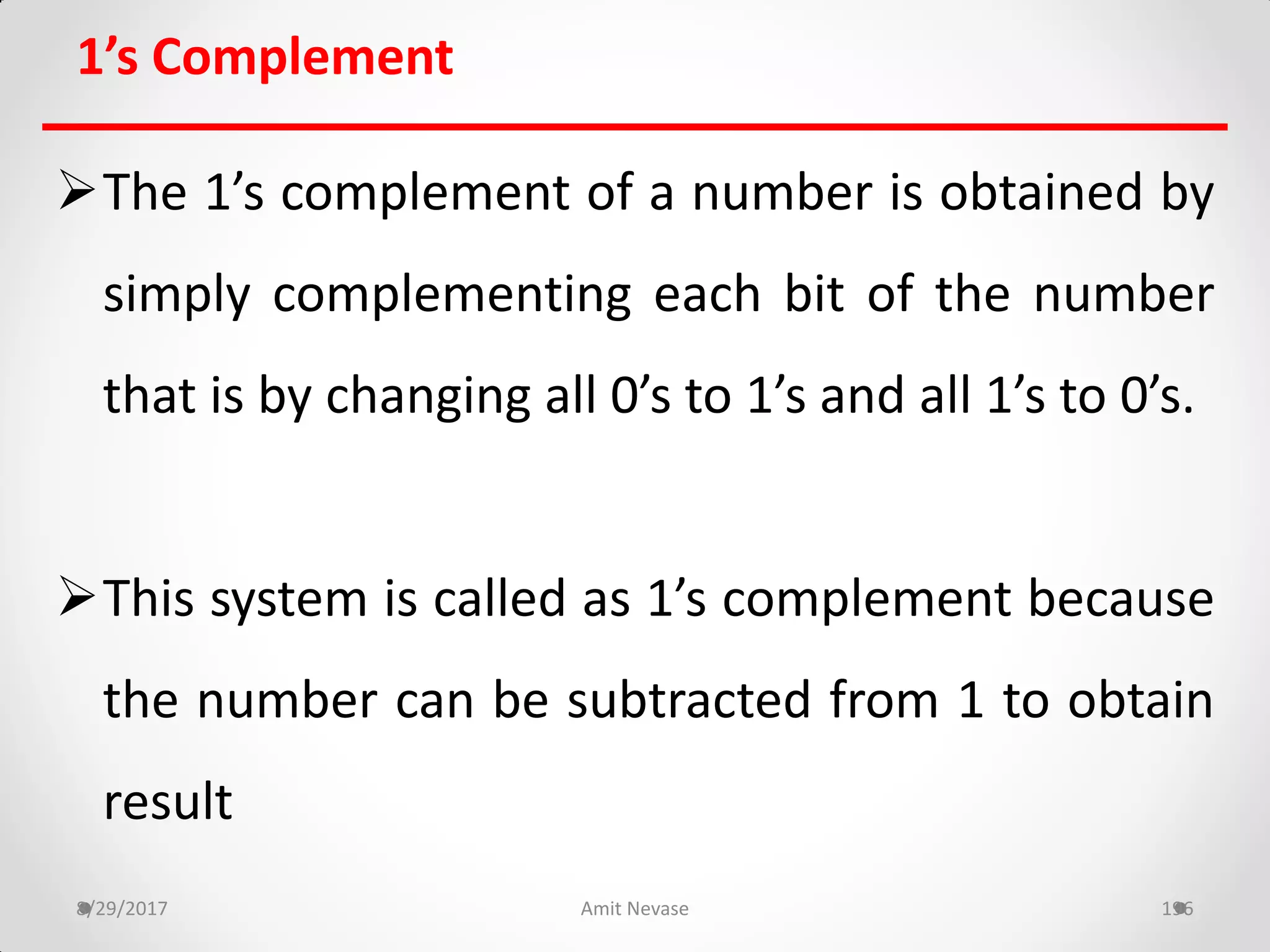
1’s Complement
The 1’s complement of a number is obtained by
simply complementing each bit of the number
that is by changing all 0’s to 1’s and all 1’s to 0’s.
This system is called as 1’s complement because
the number can be subtracted from 1 to obtain
result
8/29/2017 Amit Nevase 196
1’s Complement
8/29/2017 Amit Nevase 197
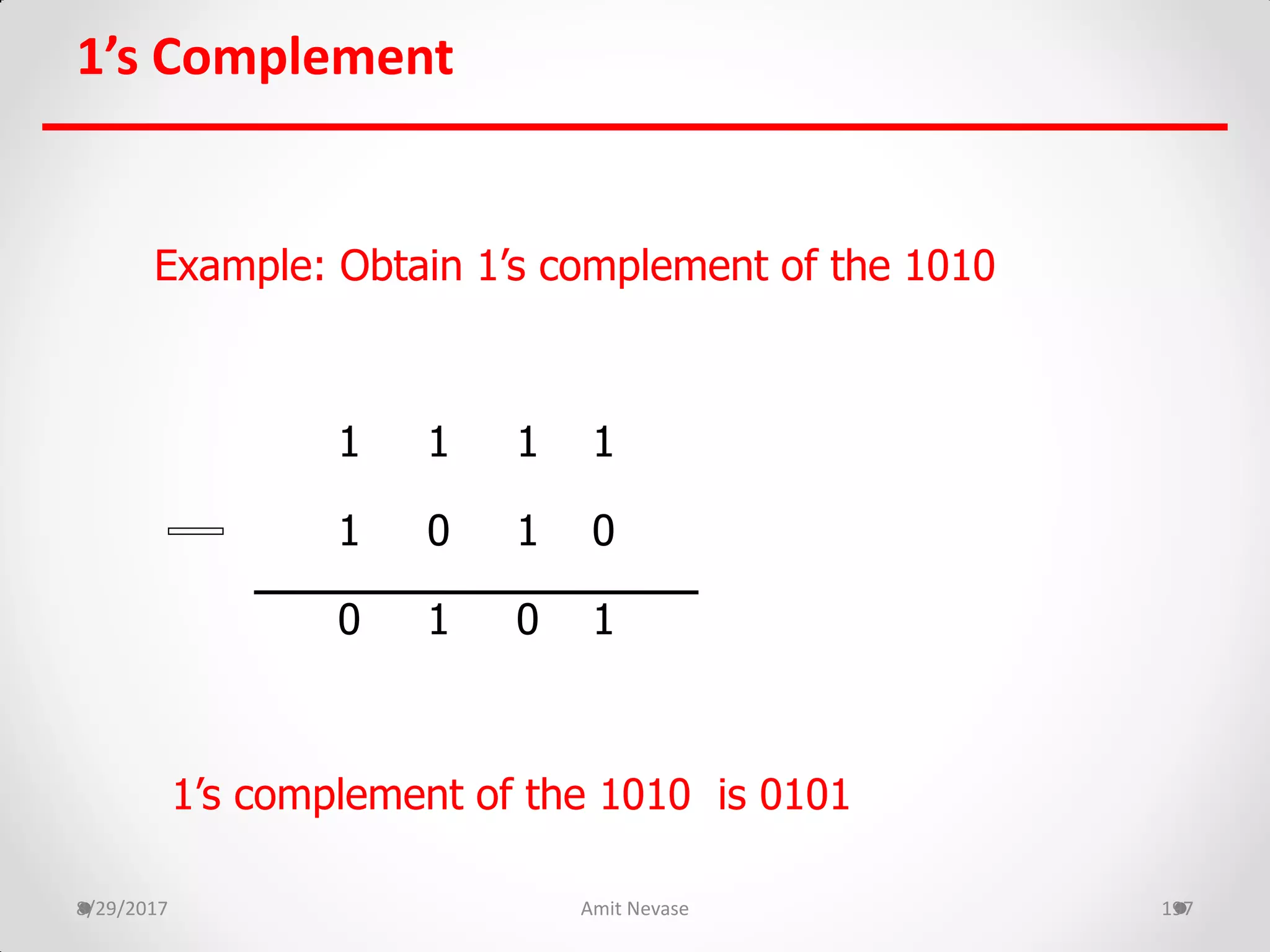
Example: Obtain 1’s complement of the 1010
1 1 1 1
1 0 1 0
0 1 0 1
1’s complement of the 1010 is 0101
1’s Complement
8/29/2017 Amit Nevase 198
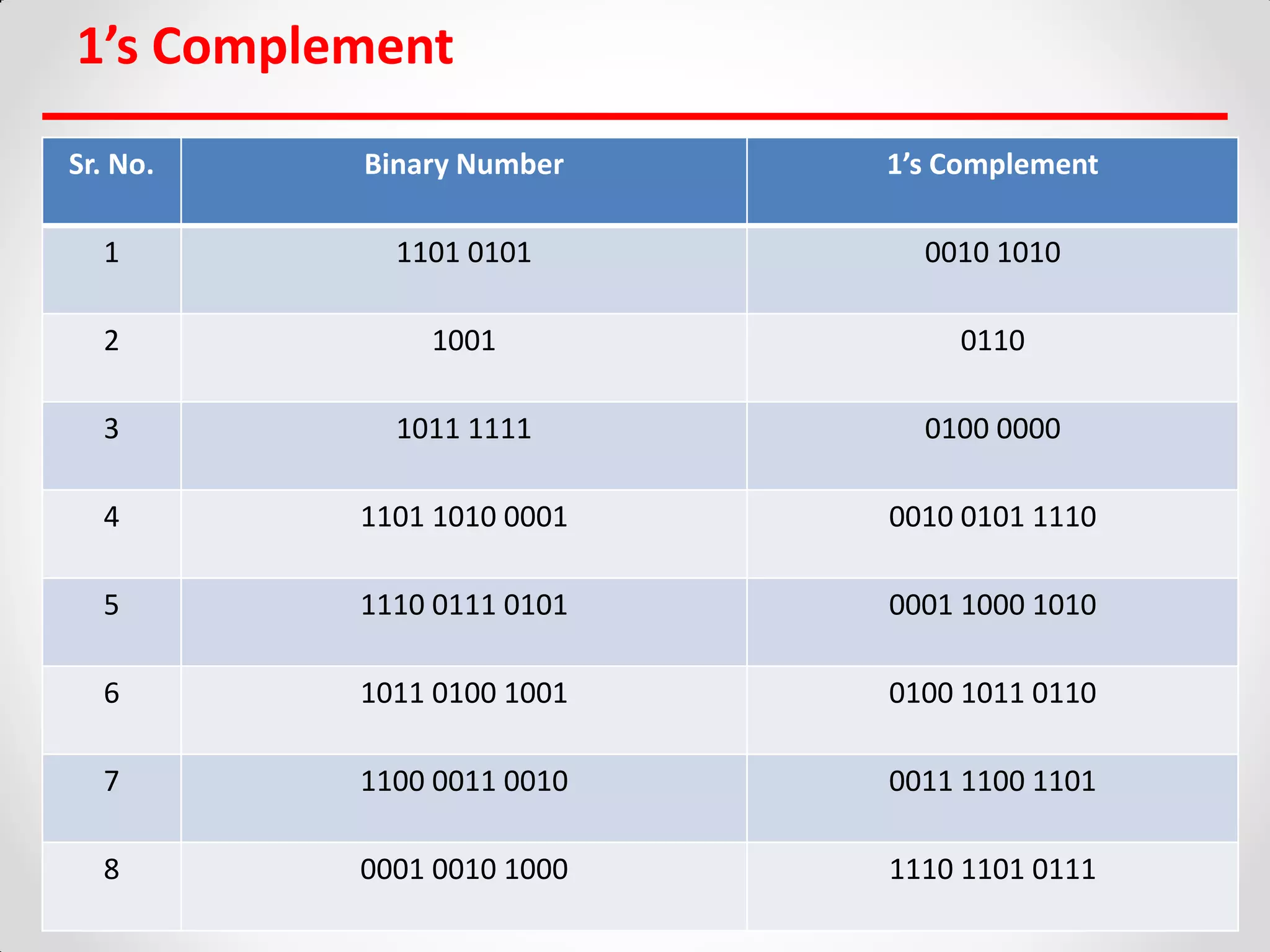
Sr. No. Binary Number 1’s Complement
1 1101 0101 0010 1010
2 1001 0110
3 1011 1111 0100 0000
4 1101 1010 0001 0010 0101 1110
5 1110 0111 0101 0001 1000 1010
6 1011 0100 1001 0100 1011 0110
7 1100 0011 0010 0011 1100 1101
8 0001 0010 1000 1110 1101 0111
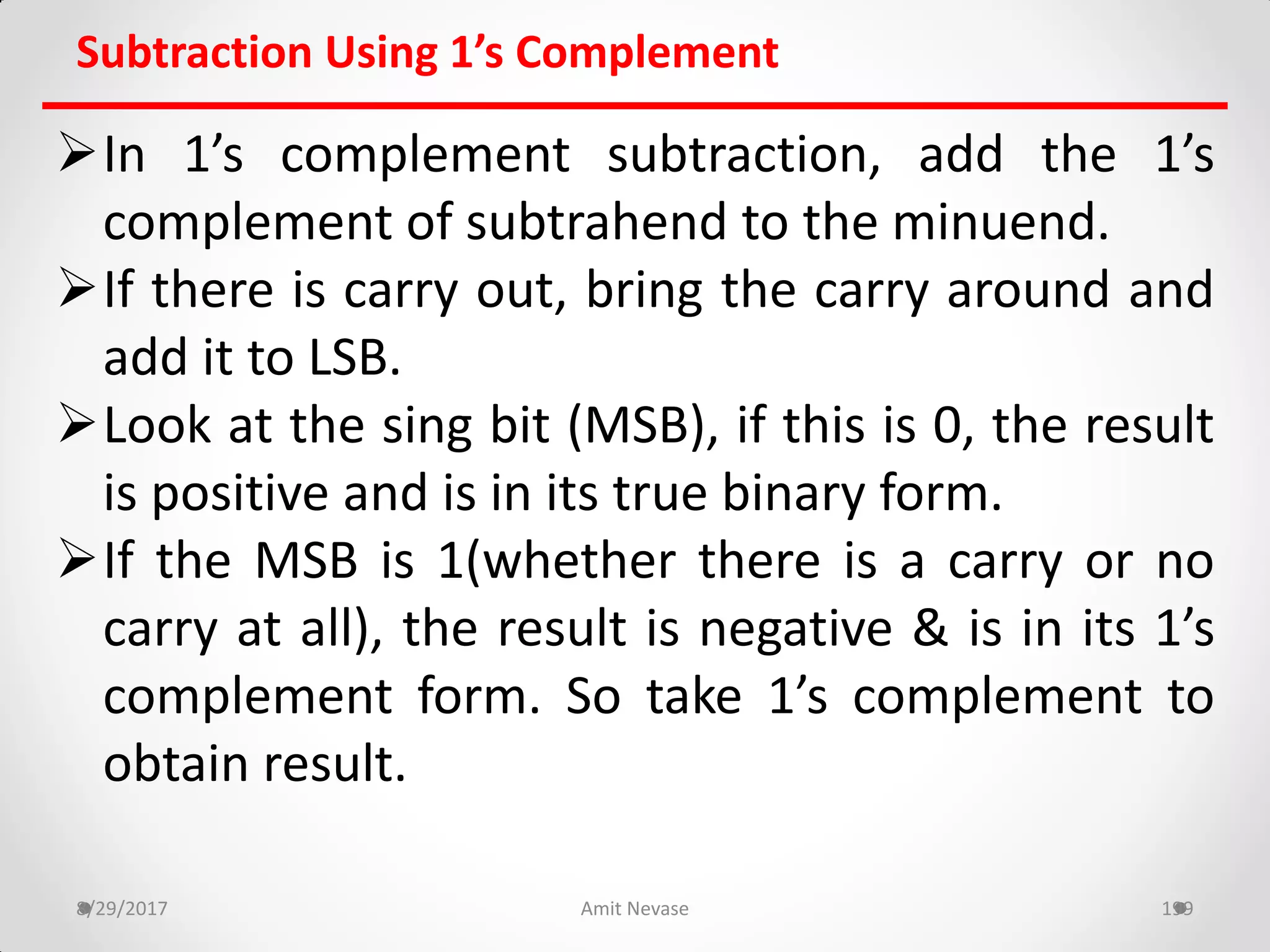
Subtraction Using 1’s Complement
In 1’s complement subtraction, add the 1’s
complement of subtrahend to the minuend.
If there is carry out, bring the carry around and
add it to LSB.
Look at the sing bit (MSB), if this is 0, the result
is positive and is in its true binary form.
If the MSB is 1(whether there is a carry or no
carry at all), the result is negative & is in its 1’s
complement form. So take 1’s complement to
obtain result.
8/29/2017 Amit Nevase 199
Subtraction using 1’s Complement
8/29/2017 Amit Nevase 200
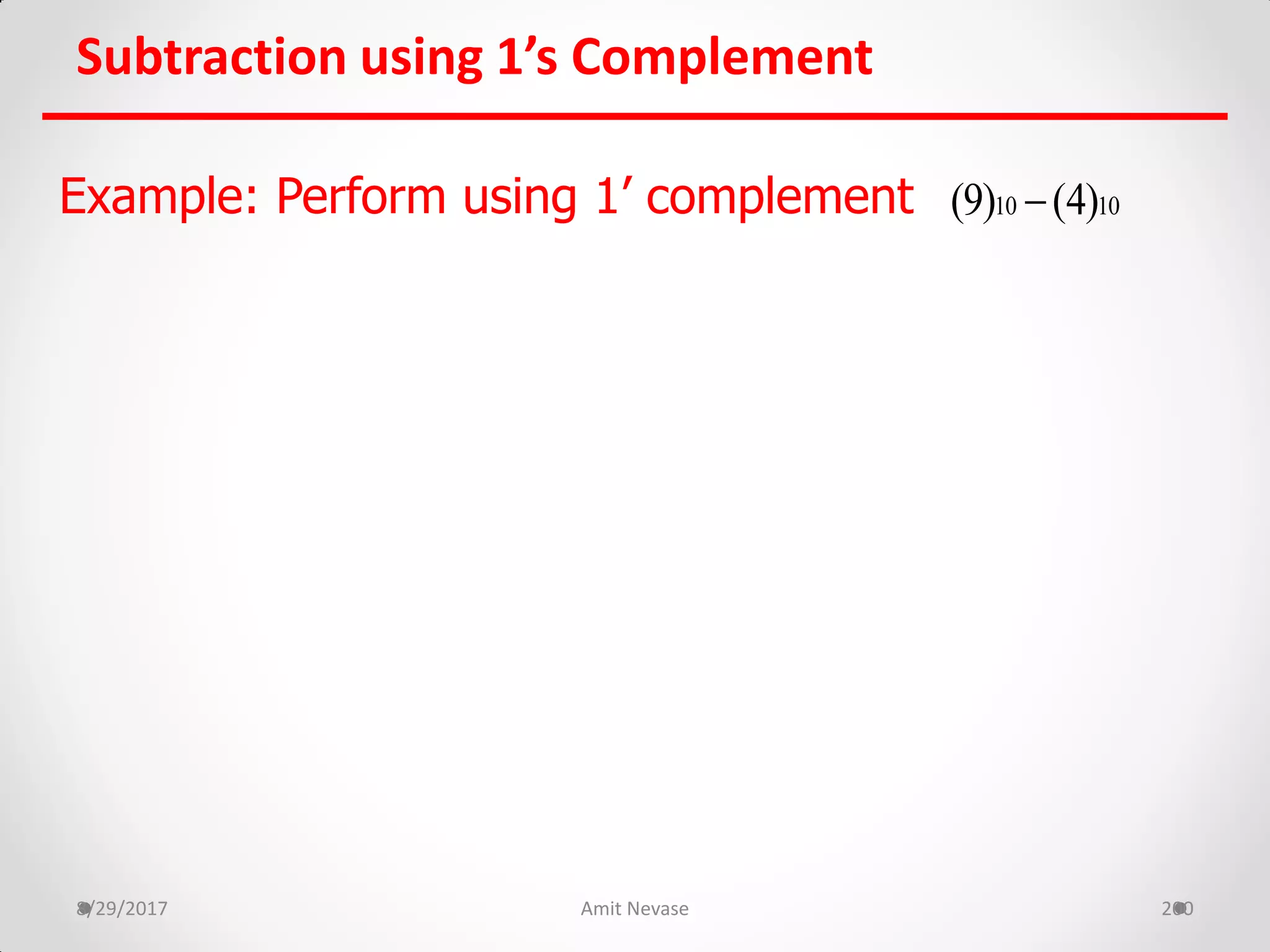
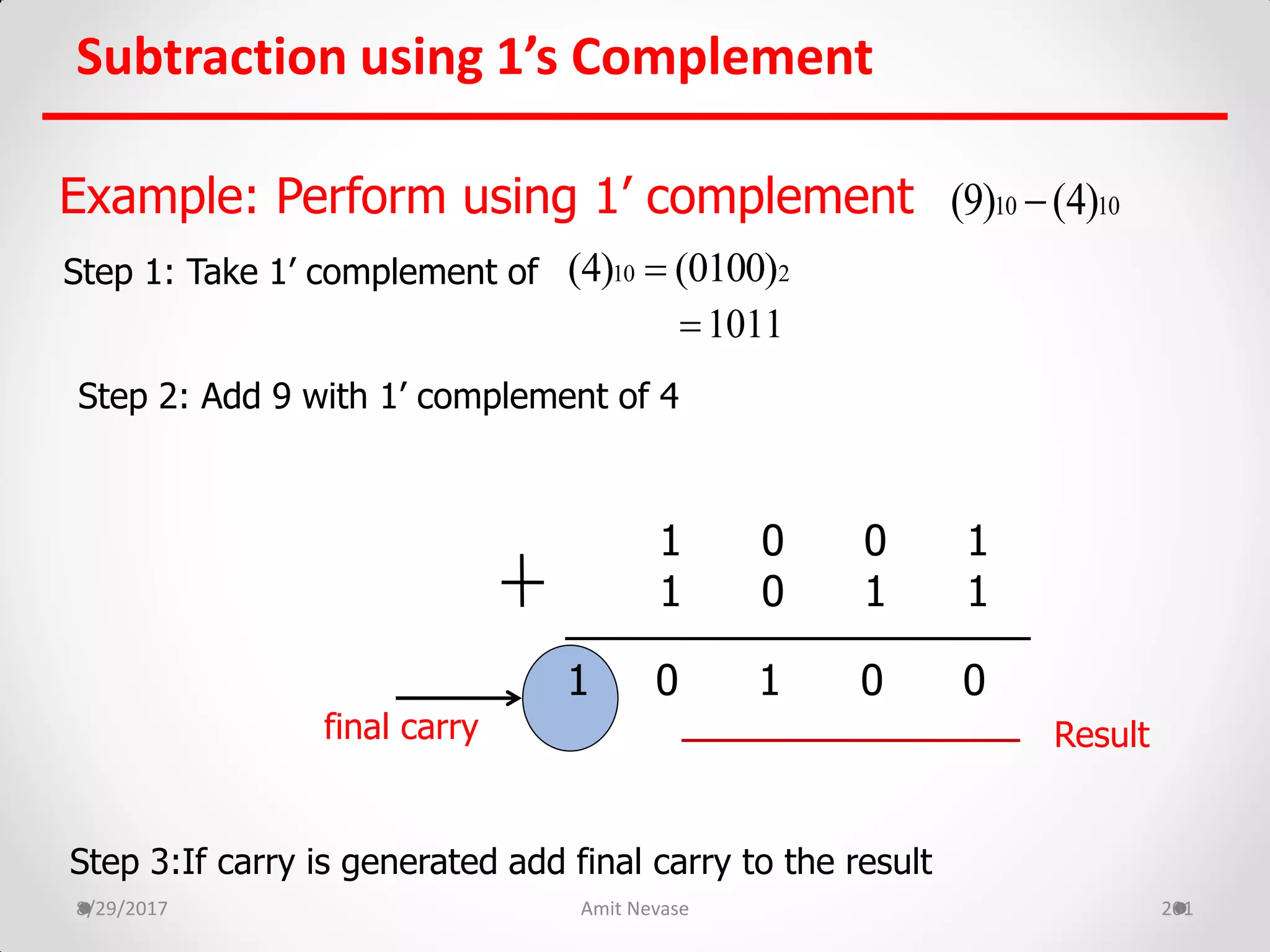
Example: Perform using 1’ complement 10 10(9) (4)
Subtraction using 1’s Complement
8/29/2017 Amit Nevase 201
Example: Perform using 1’ complement
Step 1: Take 1’ complement of
Step 2: Add 9 with 1’ complement of 4
1 0 0 1
1 0 1 1
1 0 1 0 0
Step 3:If carry is generated add final carry to the result
final carry Result
10 10(9) (4)
10 2(4) (0100)
1011
Example
Continue
8/29/2017 Amit Nevase 202
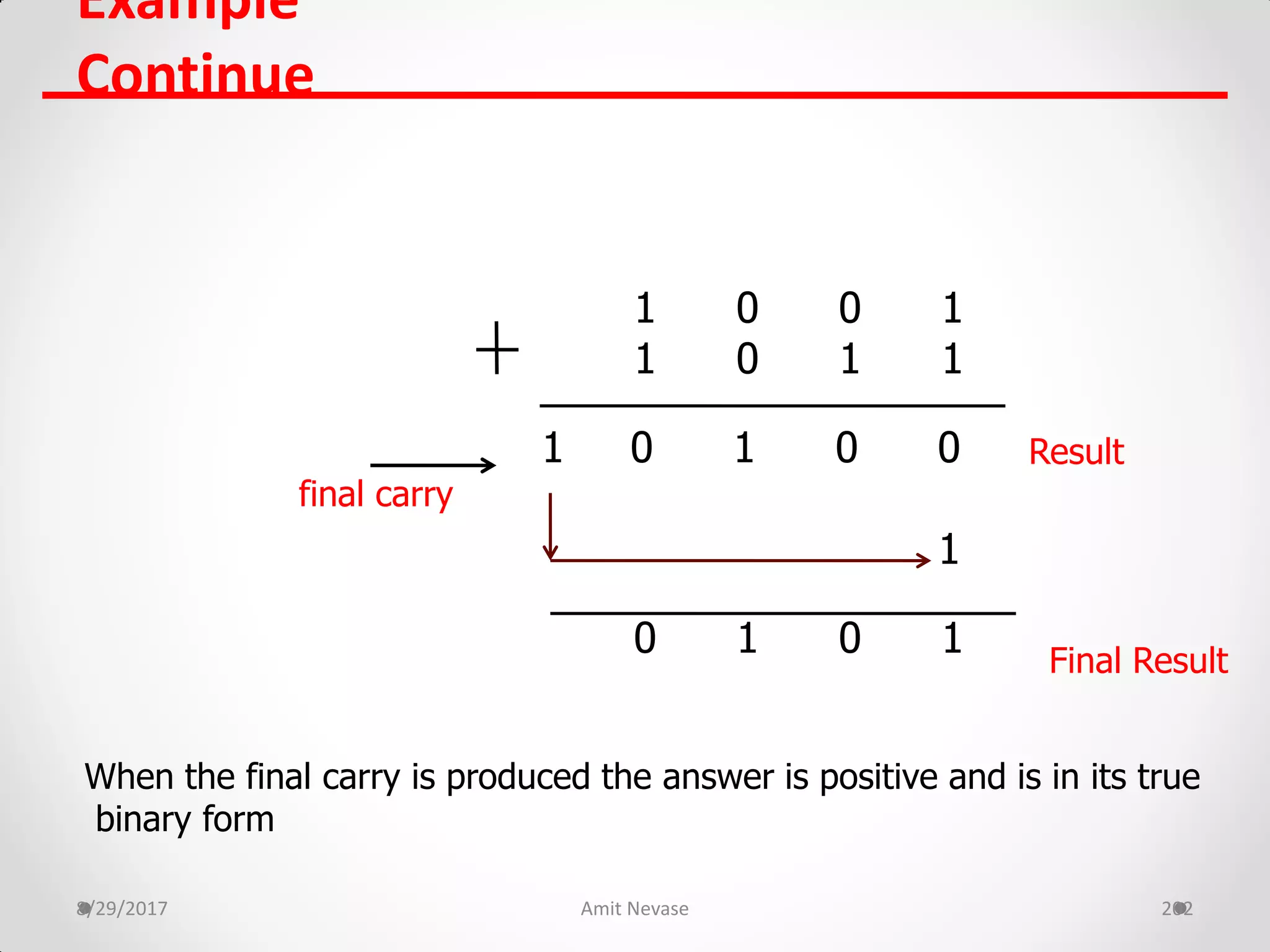
1 0 0 1
1 0 1 1
1 0 1 0 0
1
0 1 0 1
When the final carry is produced the answer is positive and is in its true
binary form
final carry
Result
Final Result
8/29/2017 Amit Nevase 203
Exercise
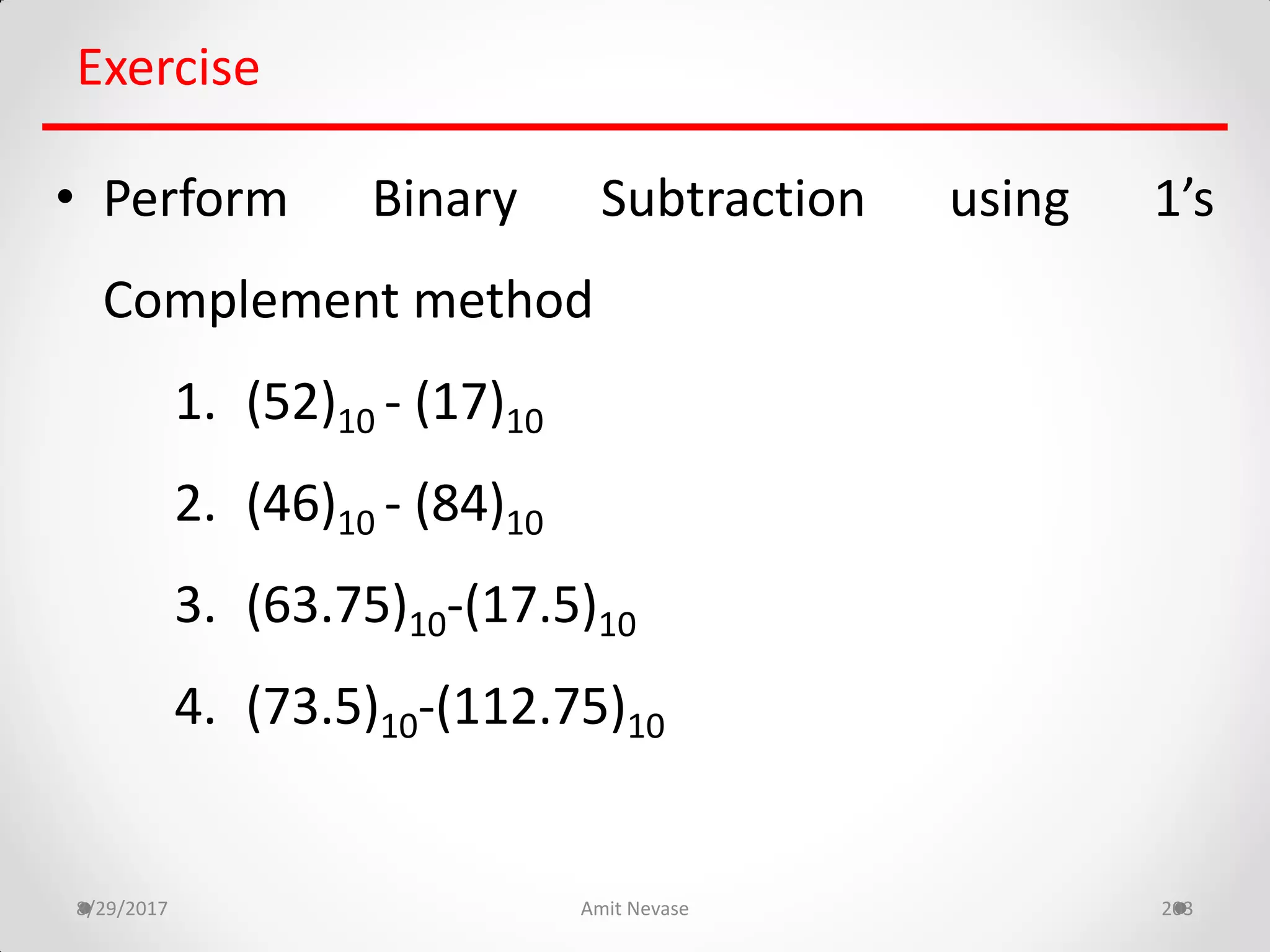
• Perform Binary Subtraction using 1’s
Complement method
1. (52)10 - (17)10
2. (46)10 - (84)10
3. (63.75)10-(17.5)10
4. (73.5)10-(112.75)10
2’s Complement
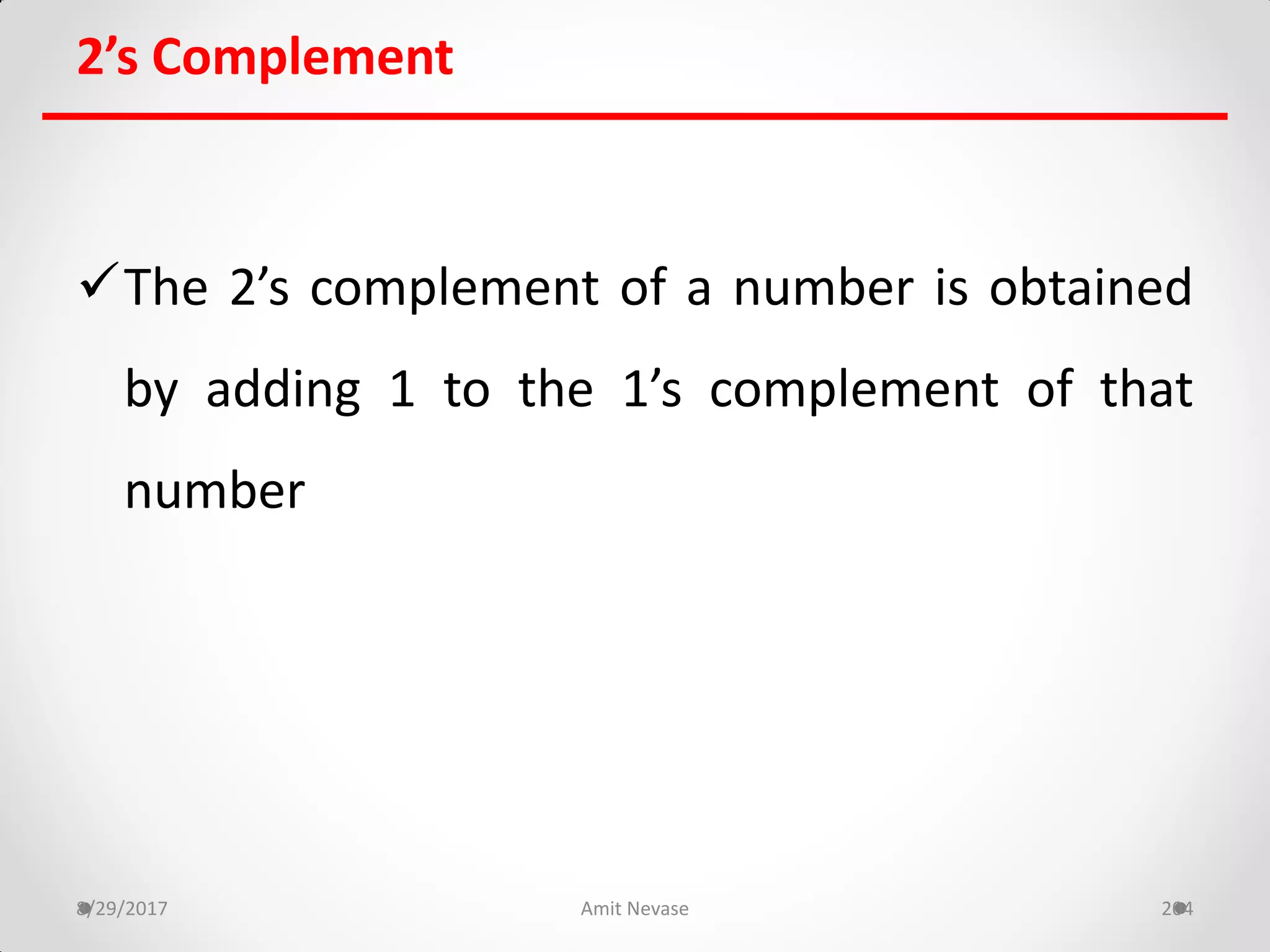
The 2’s complement of a number is obtained
by adding 1 to the 1’s complement of that
number
8/29/2017 Amit Nevase 204
2’s Complement
8/29/2017 Amit Nevase 205
Example: Obtain 2’s complement of the 1010
2’s Complement
8/29/2017 Amit Nevase 206
Example: Obtain 2’s complement of the 1010
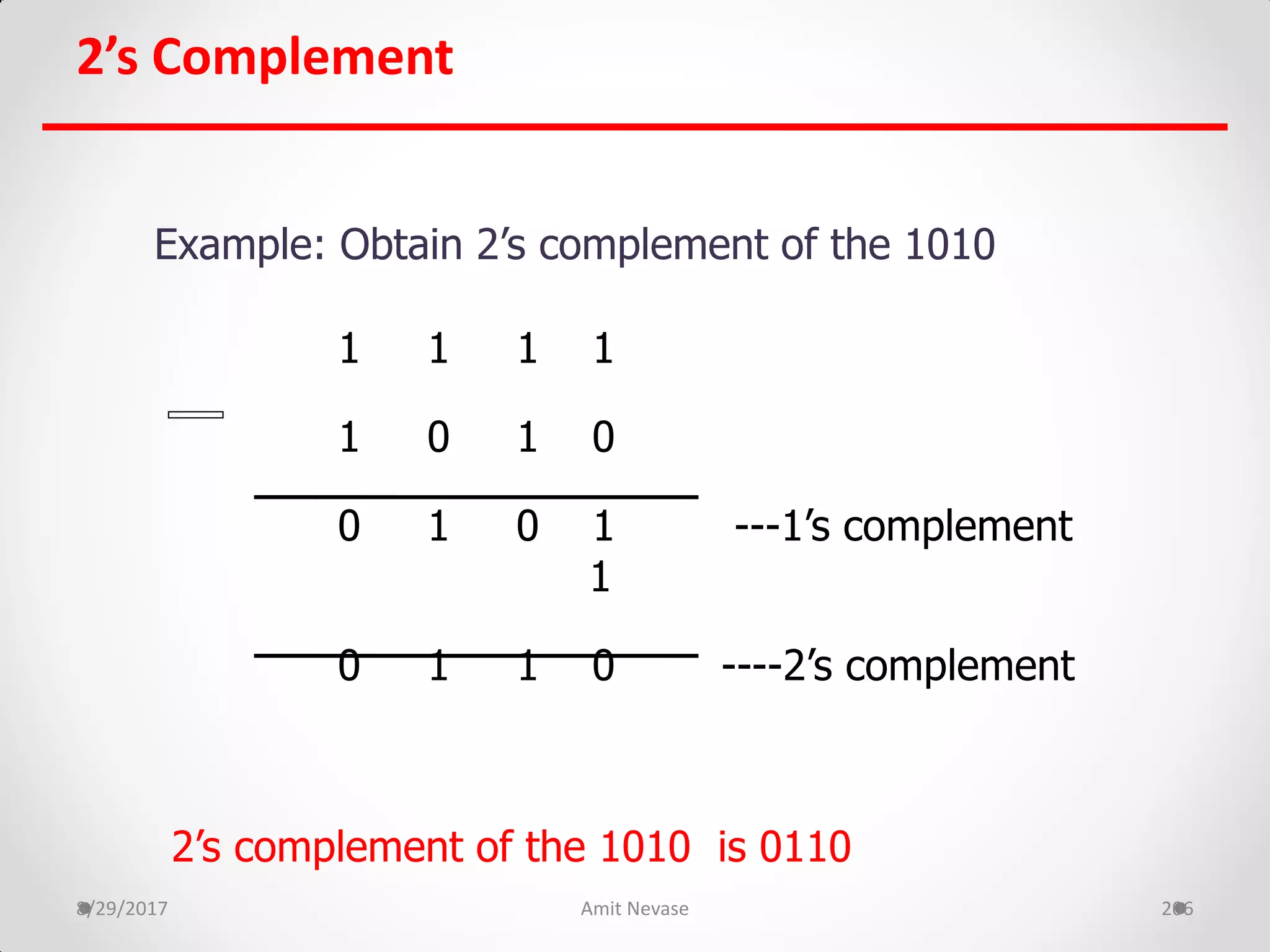
1 1 1 1
1 0 1 0
0 1 0 1 ---1’s complement
1
0 1 1 0 ----2’s complement
2’s complement of the 1010 is 0110
2’s Complement
8/29/2017 Amit Nevase 207
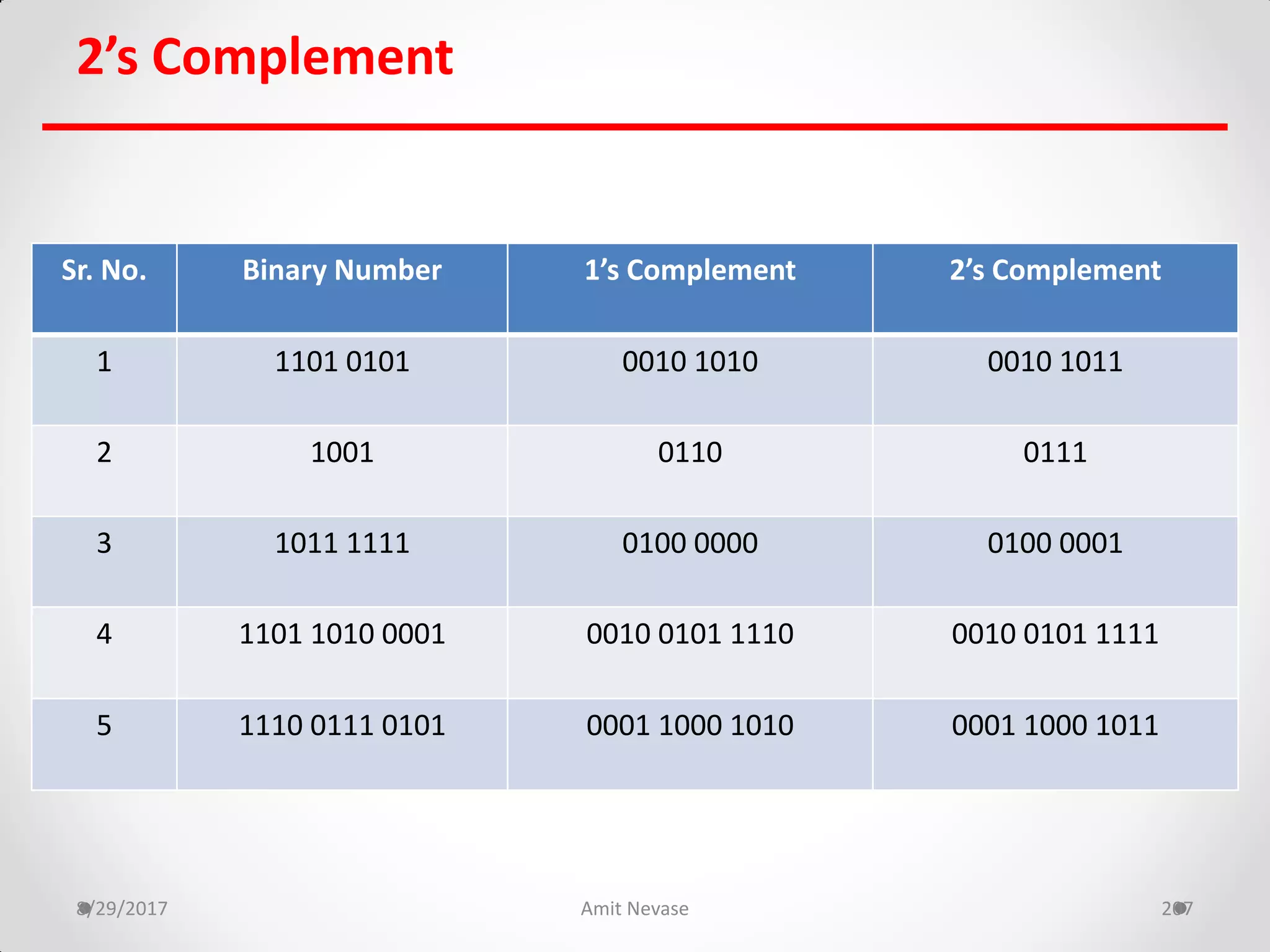
Sr. No. Binary Number 1’s Complement 2’s Complement
1 1101 0101 0010 1010 0010 1011
2 1001 0110 0111
3 1011 1111 0100 0000 0100 0001
4 1101 1010 0001 0010 0101 1110 0010 0101 1111
5 1110 0111 0101 0001 1000 1010 0001 1000 1011
Subtraction Using 2’s Complement
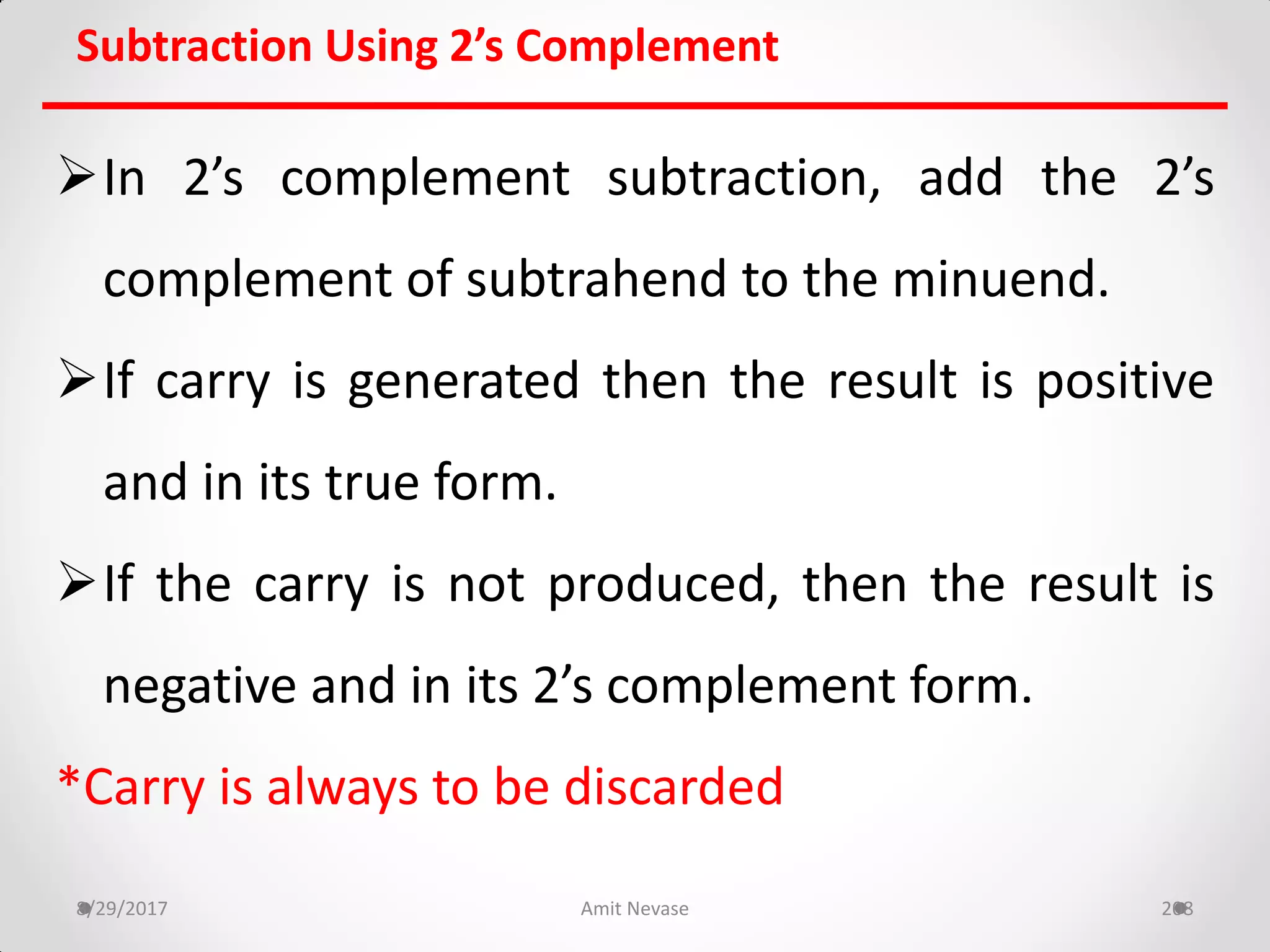
In 2’s complement subtraction, add the 2’s
complement of subtrahend to the minuend.
If carry is generated then the result is positive
and in its true form.
If the carry is not produced, then the result is
negative and in its 2’s complement form.
*Carry is always to be discarded
8/29/2017 Amit Nevase 208
Subtraction Using 2’s Complement
8/29/2017 Amit Nevase 209
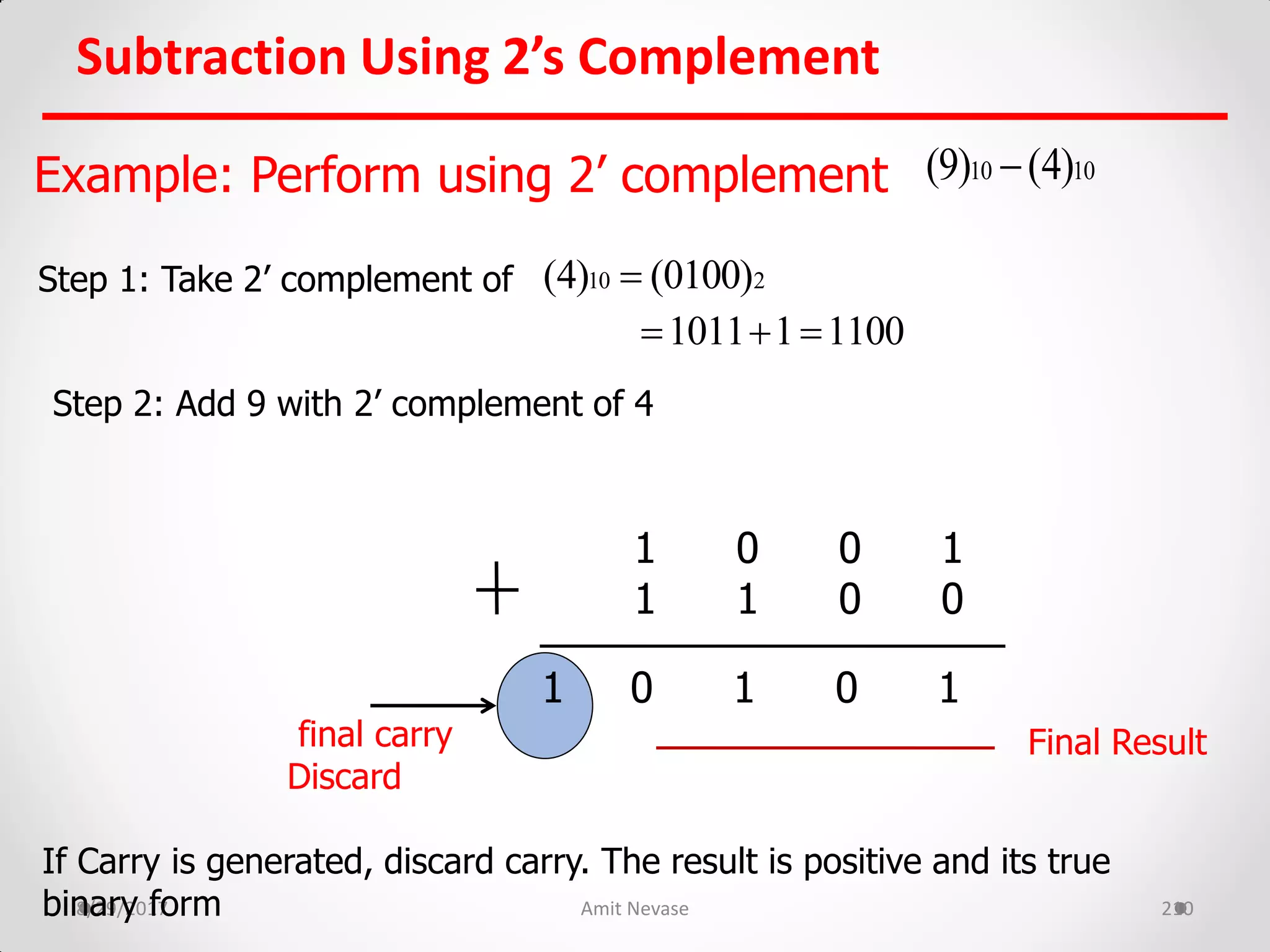
Example: Perform using 2’ complement 10 10(9) (4)
Subtraction Using 2’s Complement
8/29/2017 Amit Nevase 210
Example: Perform using 2’ complement
Step 1: Take 2’ complement of
Step 2: Add 9 with 2’ complement of 4
1 0 0 1
1 1 0 0
1 0 1 0 1
If Carry is generated, discard carry. The result is positive and its true
binary form
final carry
Discard
Final Result
10 10(9) (4)
10 2(4) (0100)
1011 1 1100  
8/29/2017 Amit Nevase 211
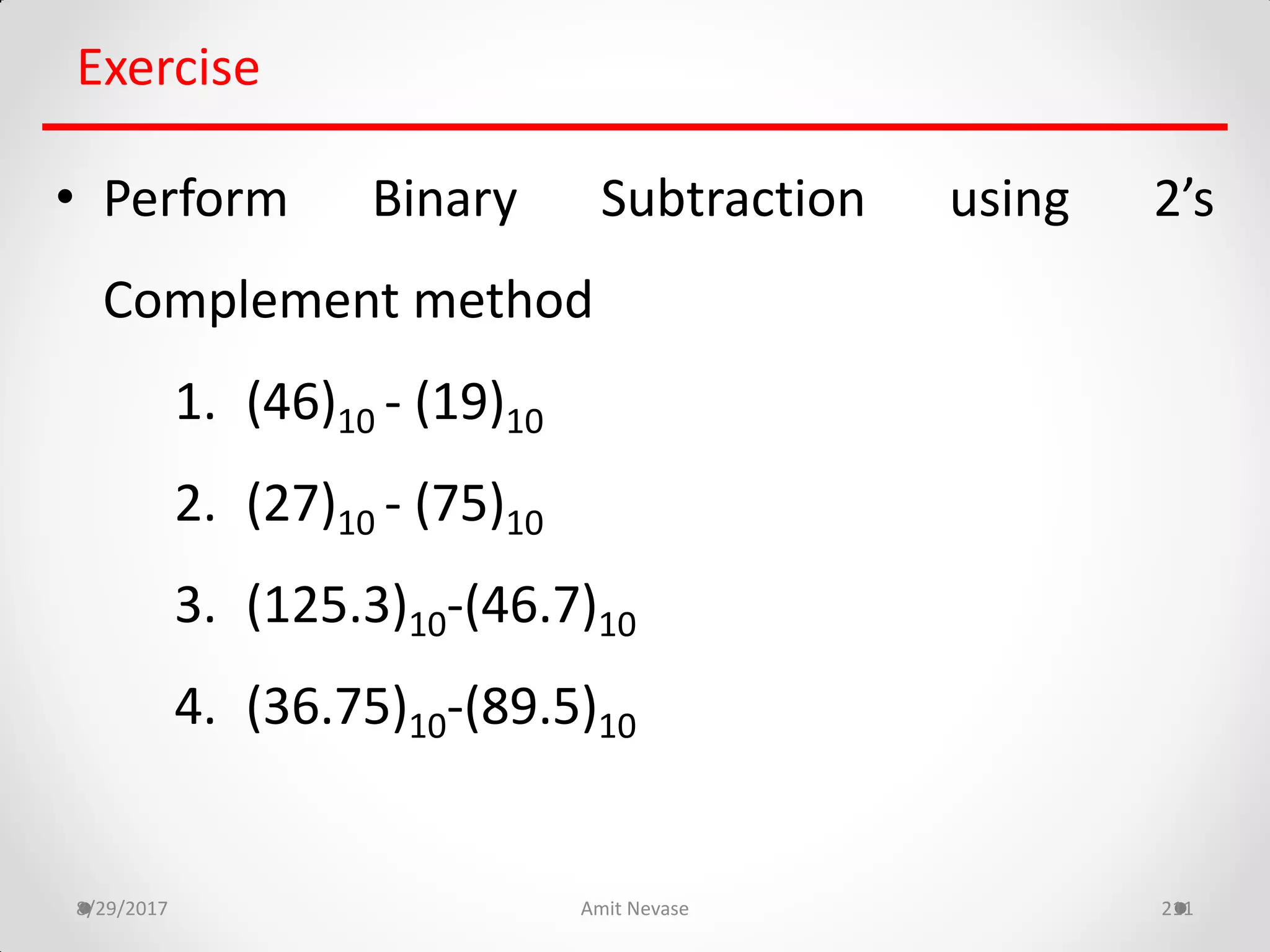
Exercise
• Perform Binary Subtraction using 2’s
Complement method
1. (46)10 - (19)10
2. (27)10 - (75)10
3. (125.3)10-(46.7)10
4. (36.75)10-(89.5)10
Chapter I – Number System
 Introduction to digital signal, Advantages of Digital System
over analog systems
 Number Systems: Different types of number systems( Binary,
Octal, Hexadecimal ), Conversion of number systems,
 Binary arithmetic: Addition, Subtraction, Multiplication, Division.
 Subtraction using 1’s complement and 2’s complement
 Codes
Codes -BCD, Gray Code, Excess-3, ASCII code
 BCD addition, BCD subtraction using 9’s and 10’ complement
 (Numericals based on above topic).
8/29/2017 Amit Nevase 212
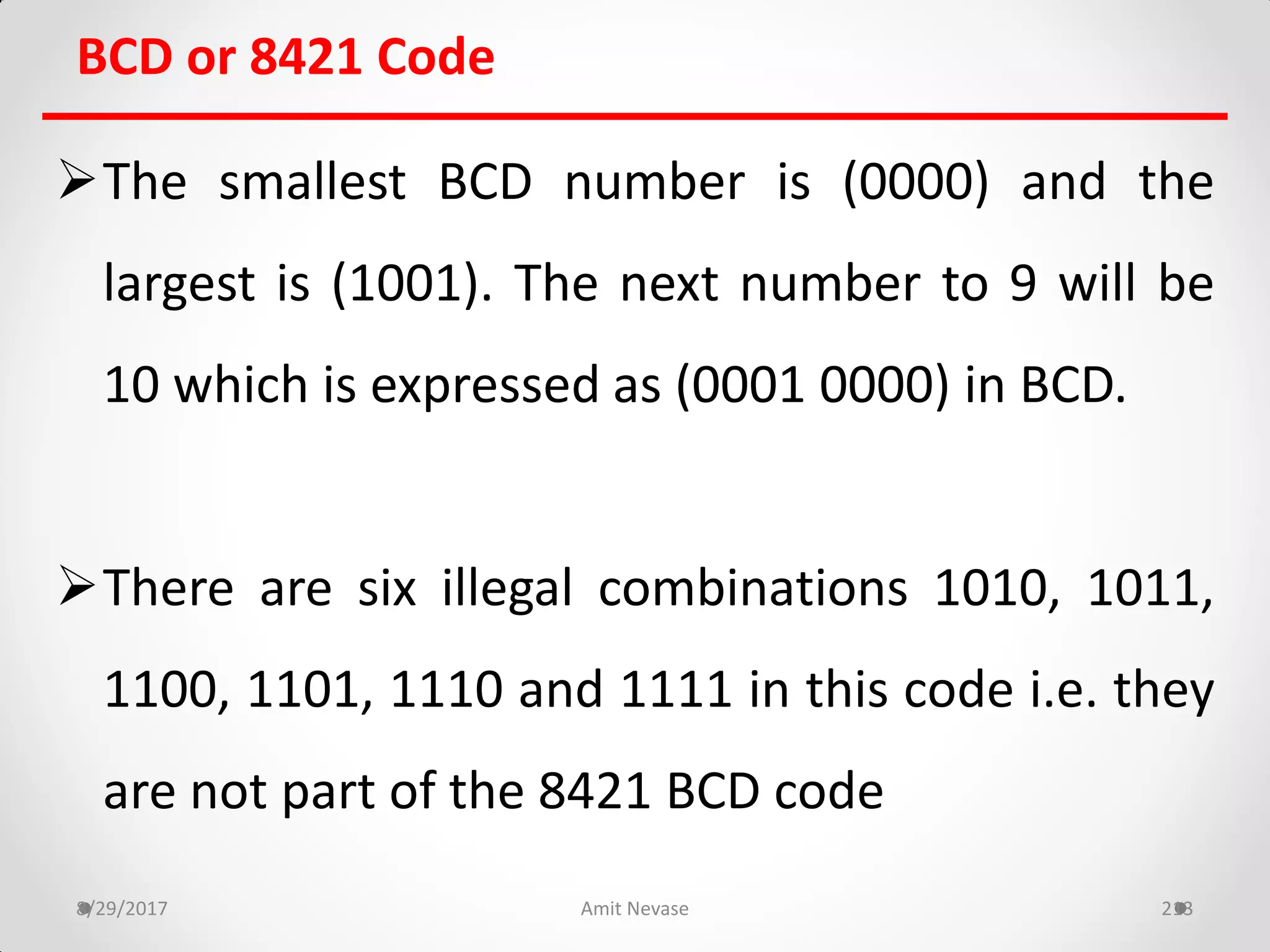
BCD or 8421 Code
The smallest BCD number is (0000) and the
largest is (1001). The next number to 9 will be
10 which is expressed as (0001 0000) in BCD.
There are six illegal combinations 1010, 1011,
1100, 1101, 1110 and 1111 in this code i.e. they
are not part of the 8421 BCD code
8/29/2017 Amit Nevase 213
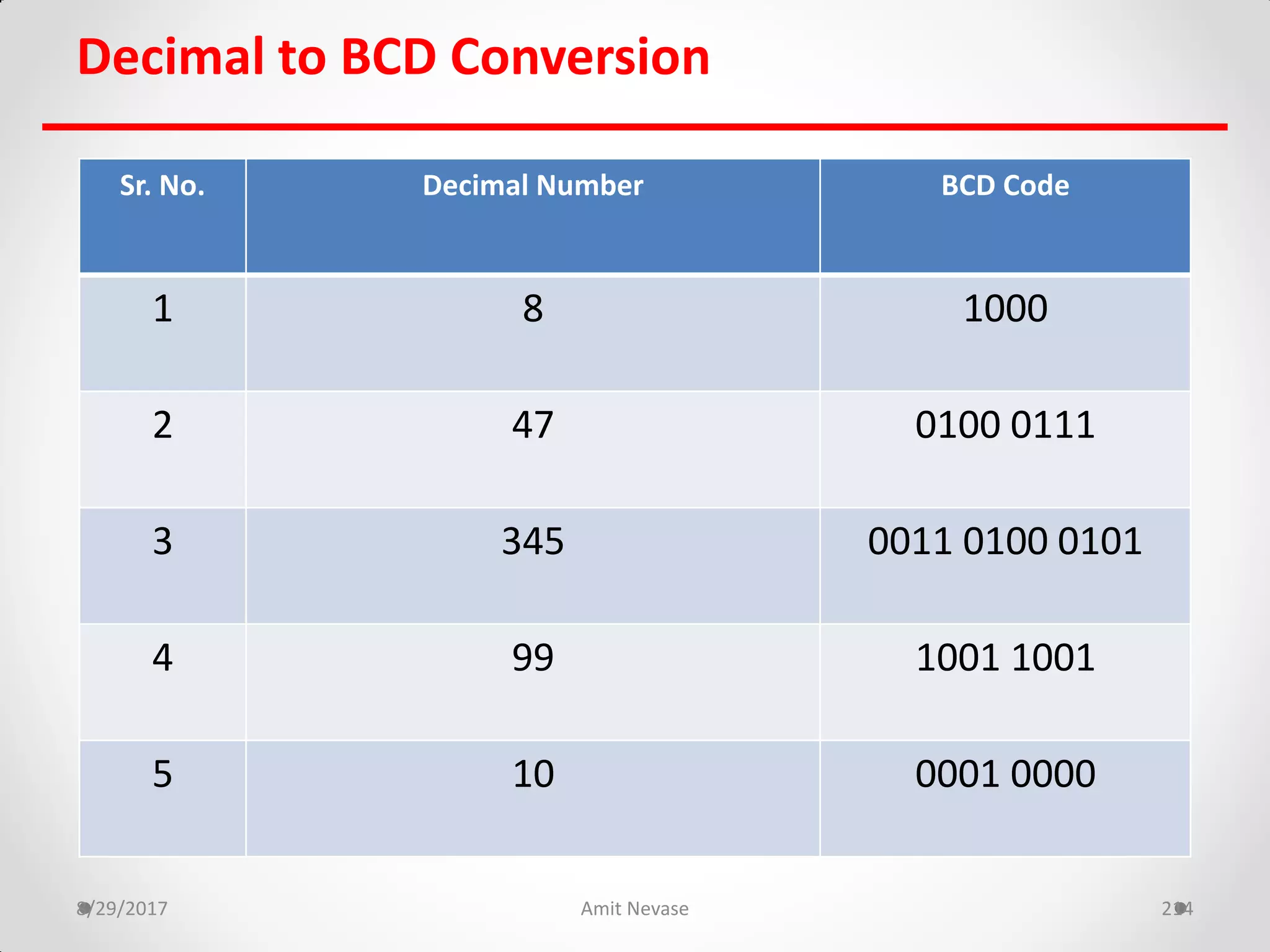
Decimal to BCD Conversion
8/29/2017 Amit Nevase 214
Sr. No. Decimal Number BCD Code
1 8 1000
2 47 0100 0111
3 345 0011 0100 0101
4 99 1001 1001
5 10 0001 0000
8/29/2017 Amit Nevase 215
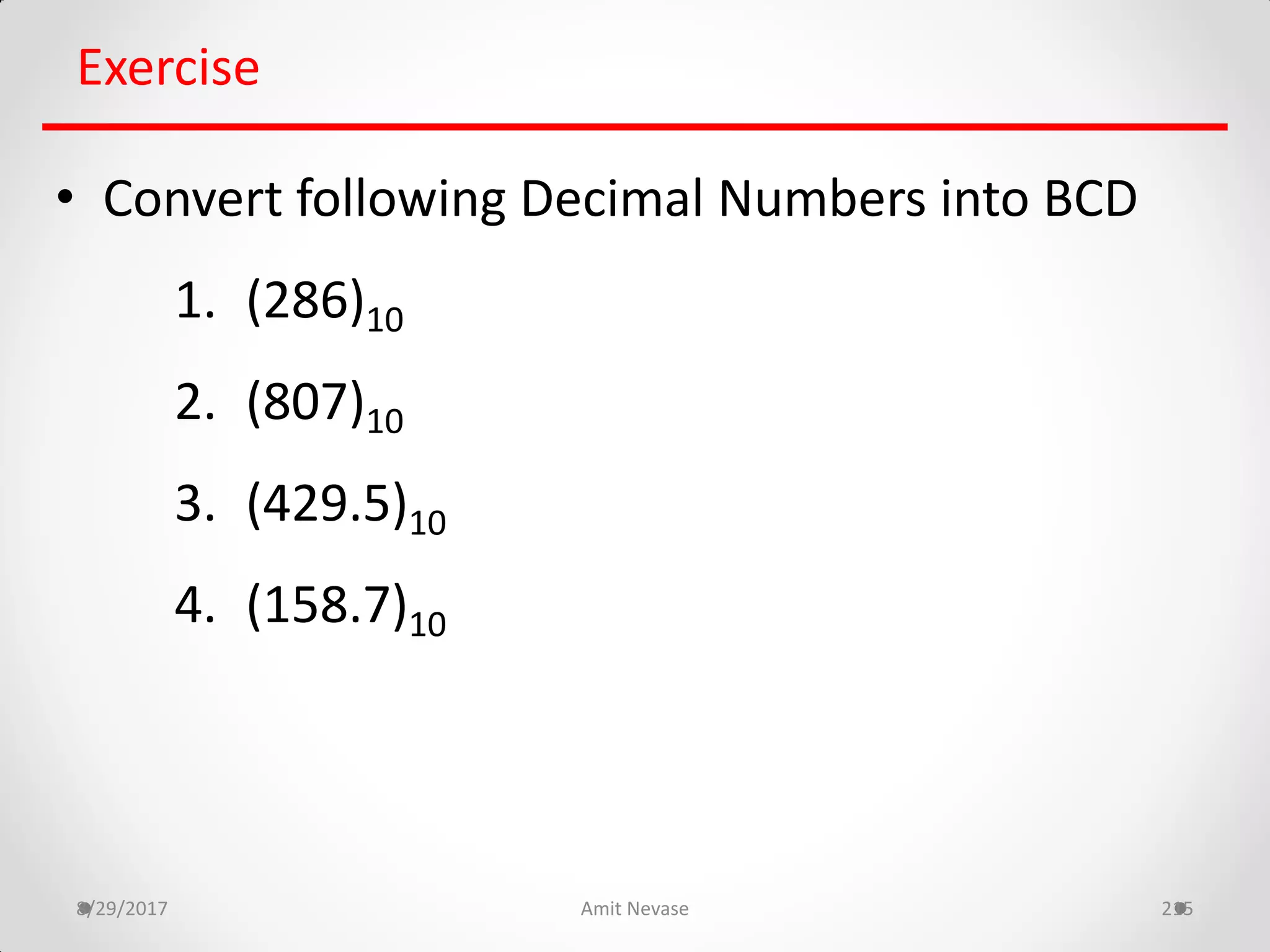
Exercise
• Convert following Decimal Numbers into BCD
1. (286)10
2. (807)10
3. (429.5)10
4. (158.7)10
Chapter I – Number System
 Introduction to digital signal, Advantages of Digital System
over analog systems
 Number Systems: Different types of number systems( Binary,
Octal, Hexadecimal ), Conversion of number systems,
 Binary arithmetic: Addition, Subtraction, Multiplication, Division.
 Subtraction using 1’s complement and 2’s complement
 Codes
Codes -BCD, Gray Code, Excess-3, ASCII code
BCD addition, BCD subtraction using 9’s and 10’
complement
 (Numericals based on above topic).
8/29/2017 Amit Nevase 216
BCD Addition
The BCD addition is performed by individually
adding the corresponding digits of the decimal
number expressed in 4 bit binary groups starting
from LSD.
If there is no carry & the sum term is not an
illegal code, no correction is needed.
8/29/2017 Amit Nevase 217
BCD Addition
If there is a carry out of one group to the next
group or if the sum term is an illegal code then 6
i.e. 0110 is added to the sum term of that group
and resulting carry is added to the next group.
This is done to skip the six illegal states.
8/29/2017 Amit Nevase 218
BCD Addition
8/29/2017 Amit Nevase 219
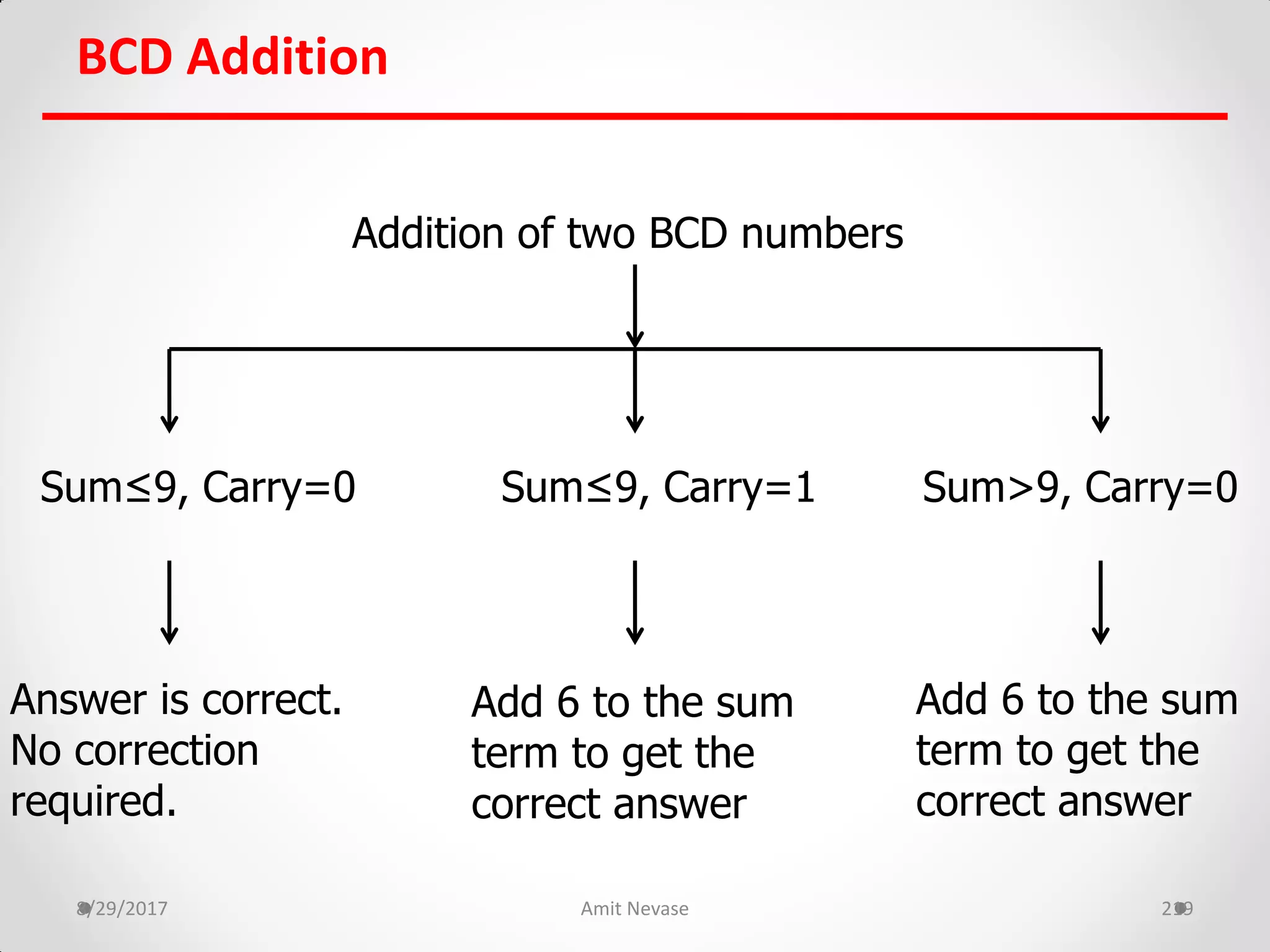
Addition of two BCD numbers
Sum≤9, Carry=0 Sum≤9, Carry=1 Sum>9, Carry=0
Answer is correct.
No correction
required.
Add 6 to the sum
term to get the
correct answer
Add 6 to the sum
term to get the
correct answer
BCD Addition
8/29/2017 Amit Nevase 220
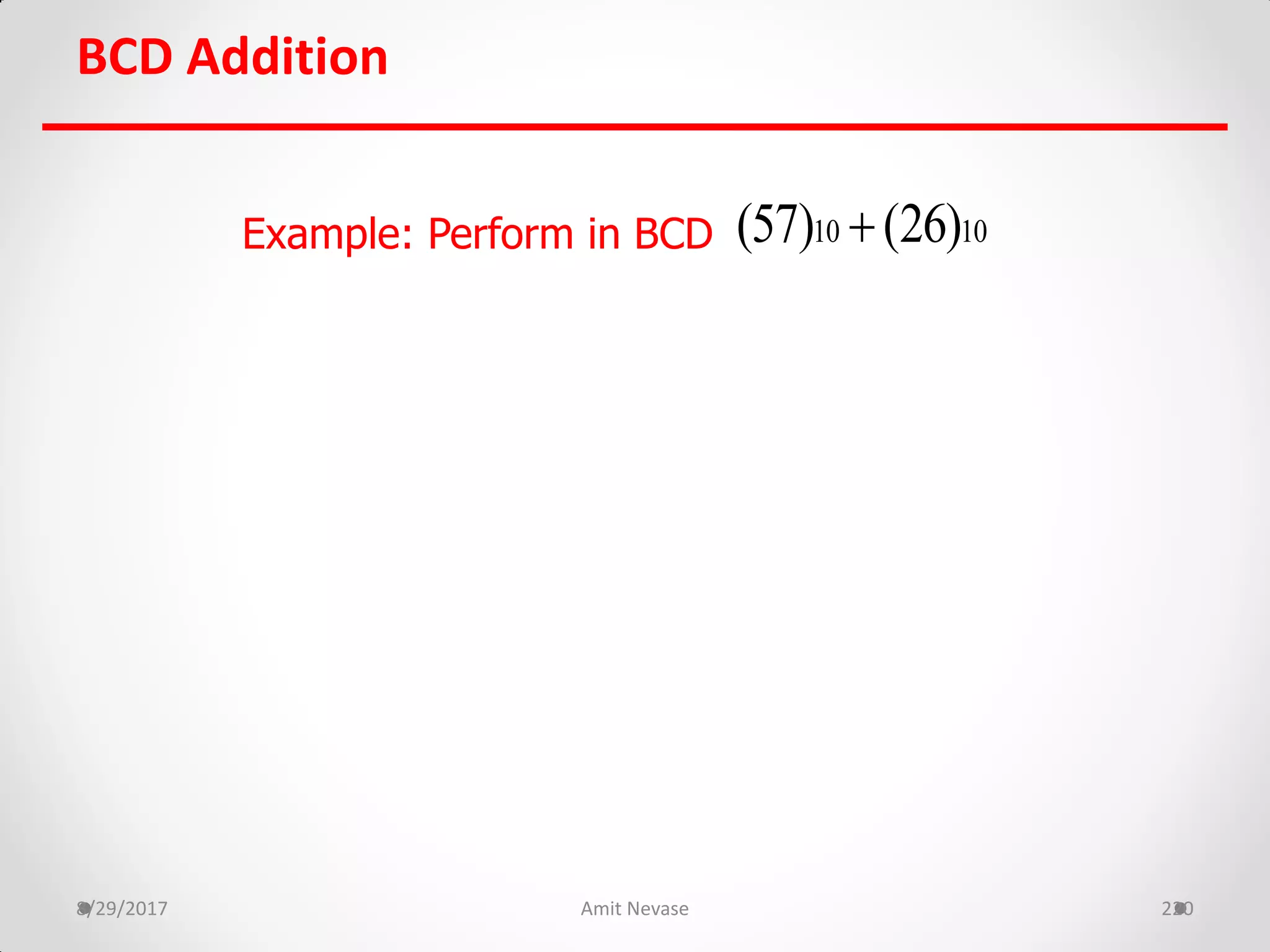
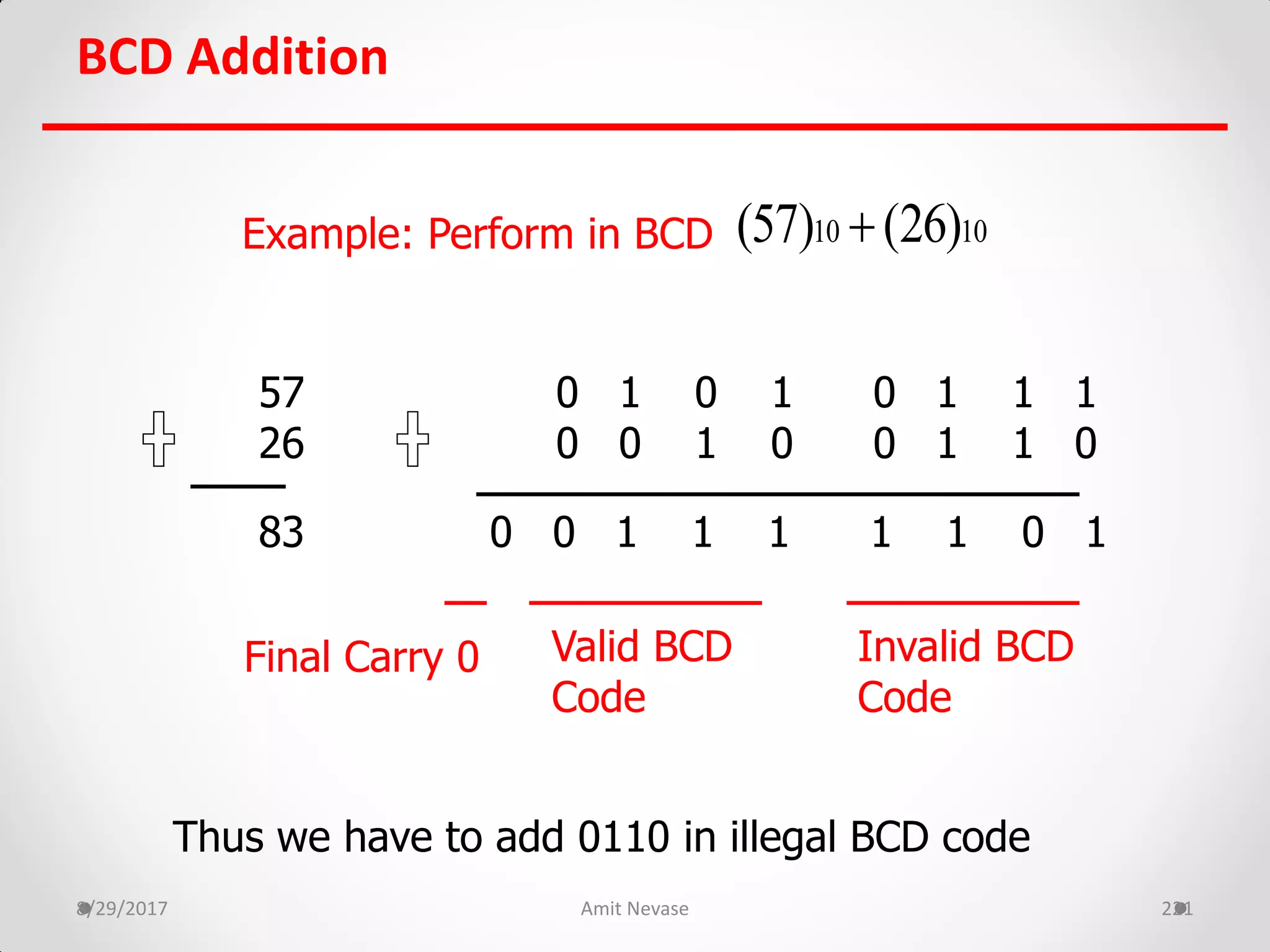
Example: Perform in BCD 10 10(57) (26)
BCD Addition
8/29/2017 Amit Nevase 221
Example: Perform in BCD
57 0 1 0 1 0 1 1 1
26 0 0 1 0 0 1 1 0
83 0 0 1 1 1 1 1 0 1
Invalid BCD
Code
Valid BCD
Code
Final Carry 0
Thus we have to add 0110 in illegal BCD code
10 10(57) (26)
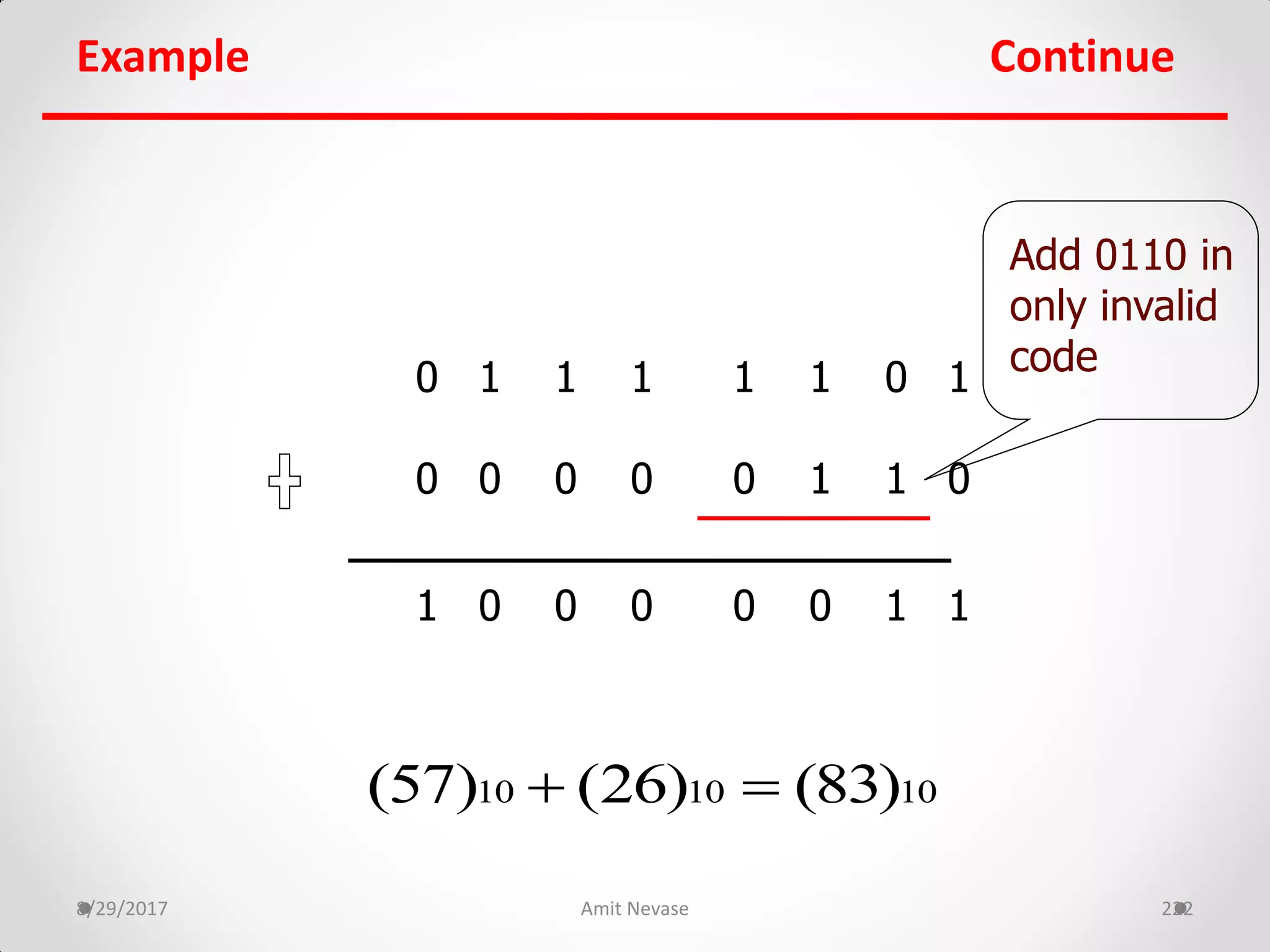
Example Continue
8/29/2017 Amit Nevase 222
0 1 1 1 1 1 0 1
0 0 0 0 0 1 1 0
1 0 0 0 0 0 1 1
Add 0110 in
only invalid
code
10 10 10(57) (26) (83) 
8/29/2017 Amit Nevase 223
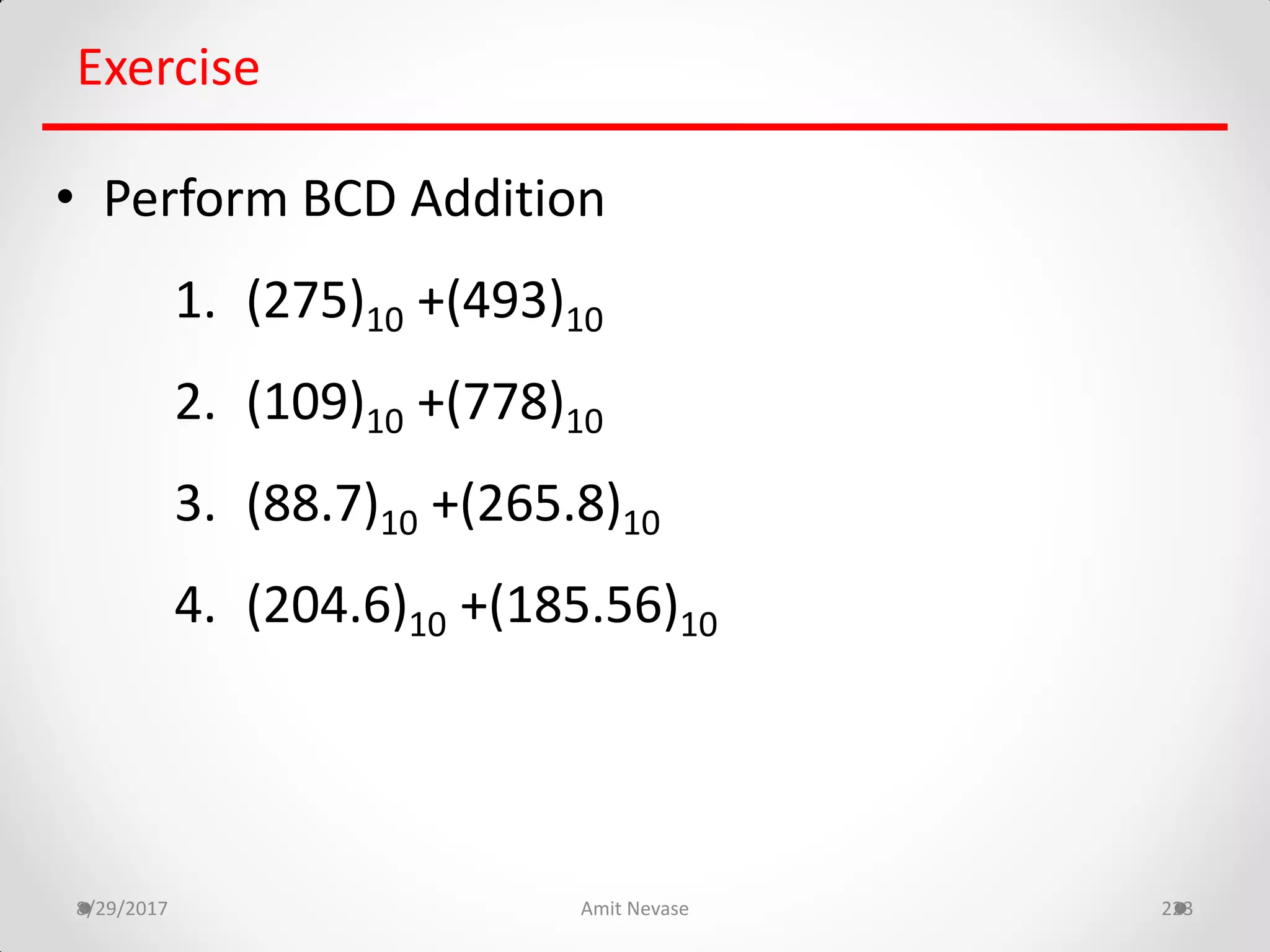
Exercise
• Perform BCD Addition
1. (275)10 +(493)10
2. (109)10 +(778)10
3. (88.7)10 +(265.8)10
4. (204.6)10 +(185.56)10
BCD Subtraction
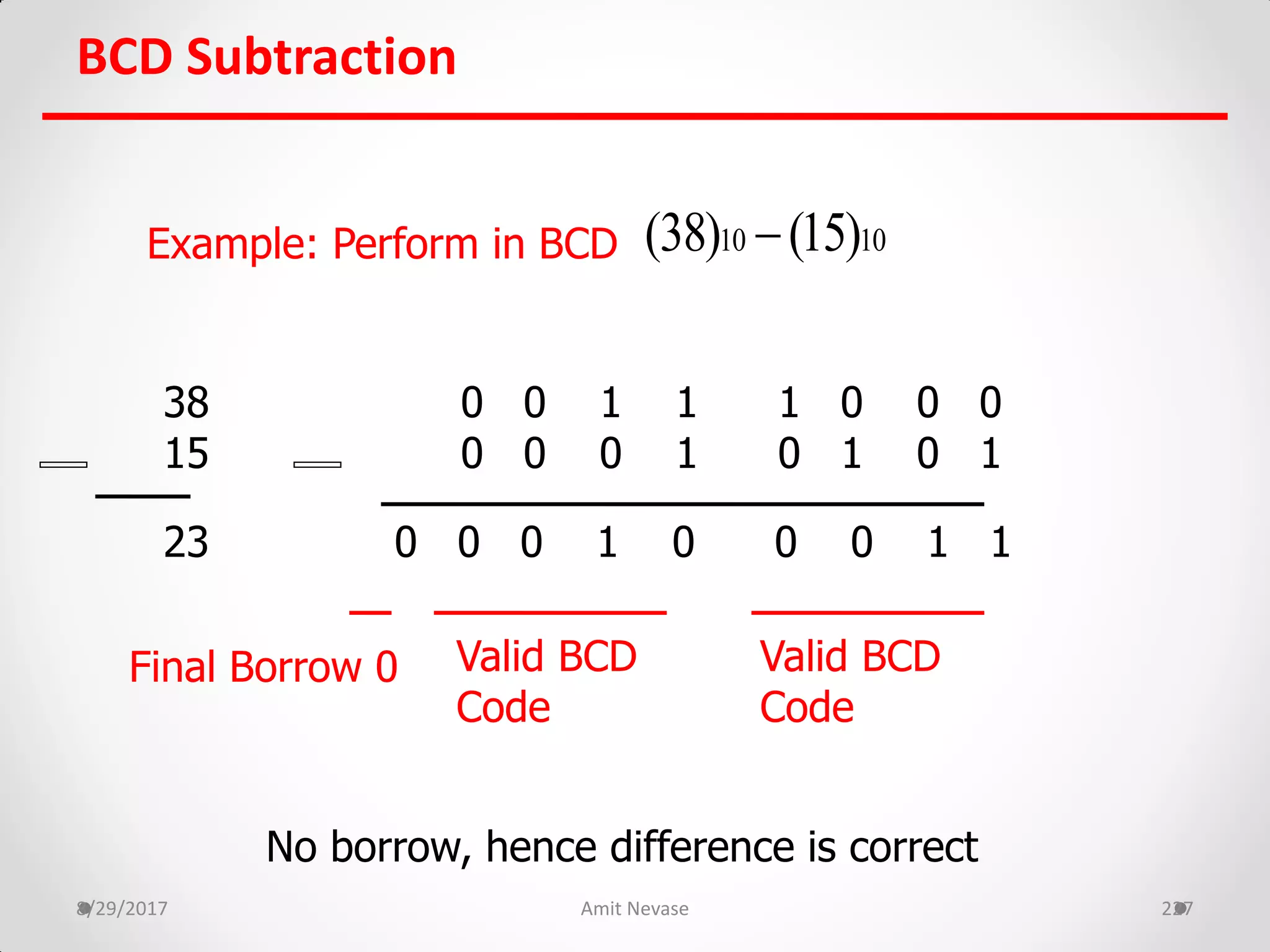
The BCD subtraction is performed by
subtracting the digits of each 4 bit group of
the subtrahend from the corresponding 4 bit
group of the minuend in binary starting from
the LSD.
8/29/2017 Amit Nevase 224
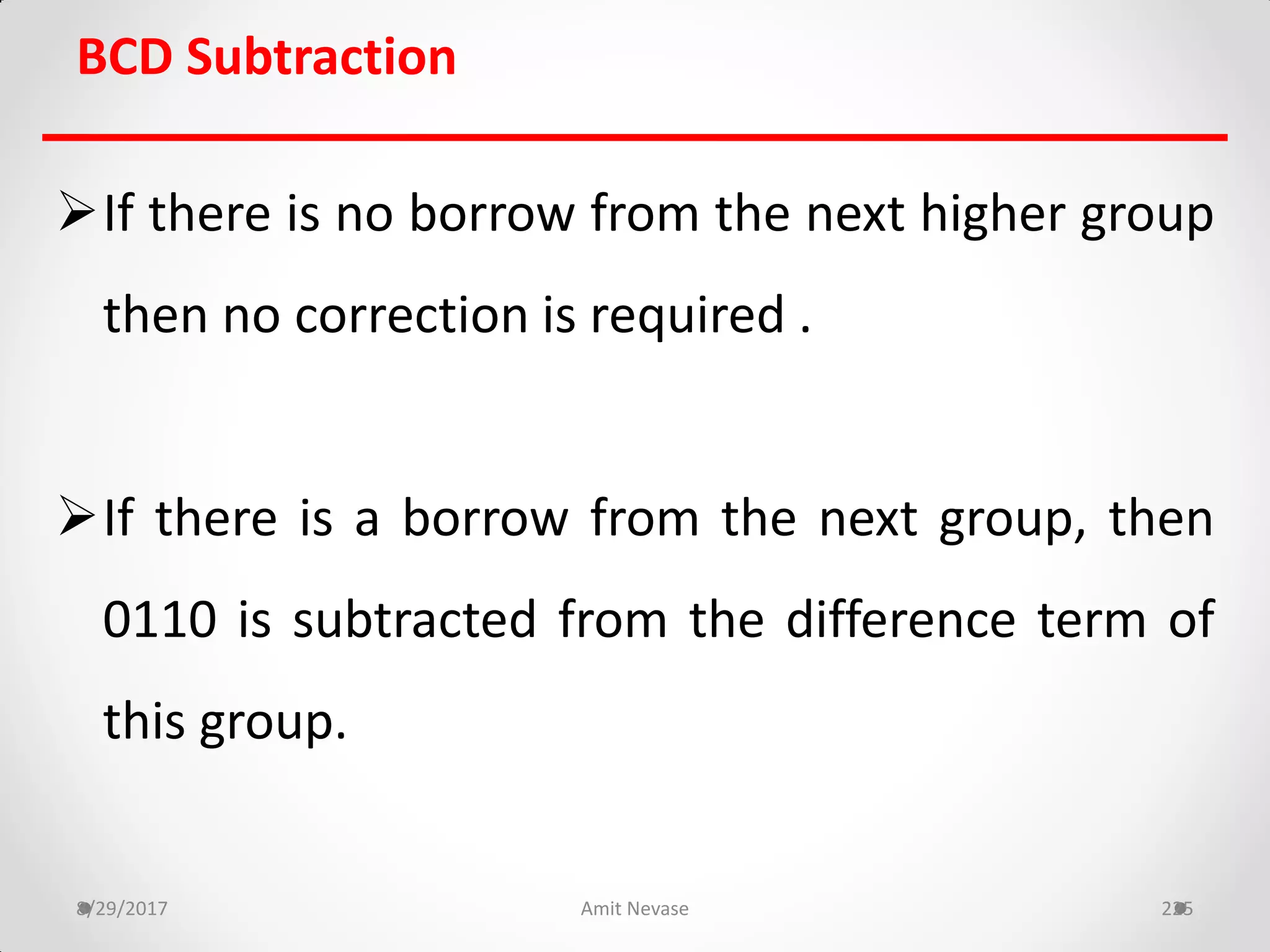
BCD Subtraction
If there is no borrow from the next higher group
then no correction is required .
If there is a borrow from the next group, then
0110 is subtracted from the difference term of
this group.
8/29/2017 Amit Nevase 225
BCD Subtraction
8/29/2017 Amit Nevase 226
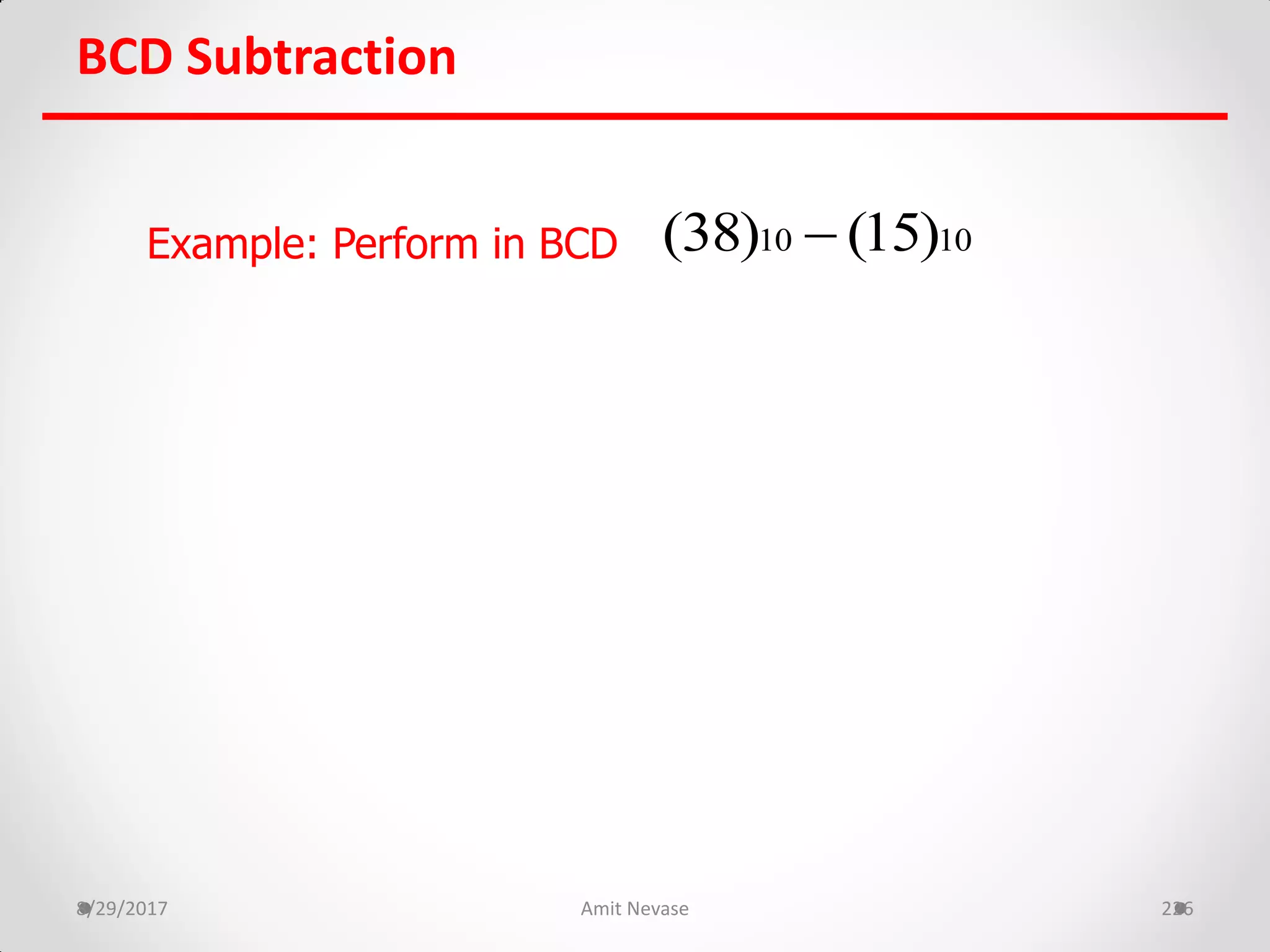
Example: Perform in BCD 10 10(38) (15)
BCD Subtraction
8/29/2017 Amit Nevase 227
Example: Perform in BCD
38 0 0 1 1 1 0 0 0
15 0 0 0 1 0 1 0 1
23 0 0 0 1 0 0 0 1 1
Valid BCD
Code
Valid BCD
Code
Final Borrow 0
No borrow, hence difference is correct
10 10(38) (15)
8/29/2017 Amit Nevase 228
Exercise
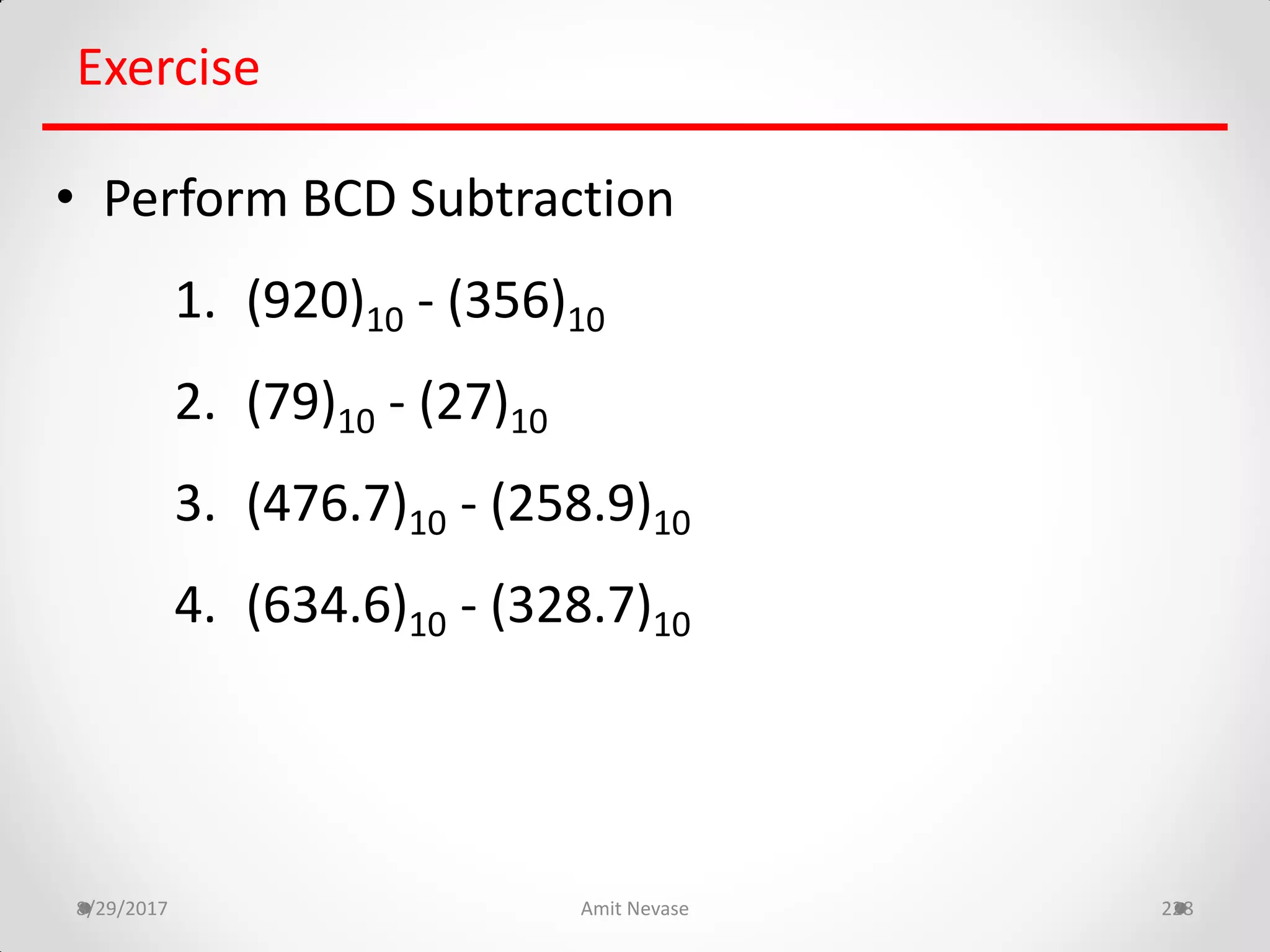
• Perform BCD Subtraction
1. (920)10 - (356)10
2. (79)10 - (27)10
3. (476.7)10 - (258.9)10
4. (634.6)10 - (328.7)10
9’s Complement
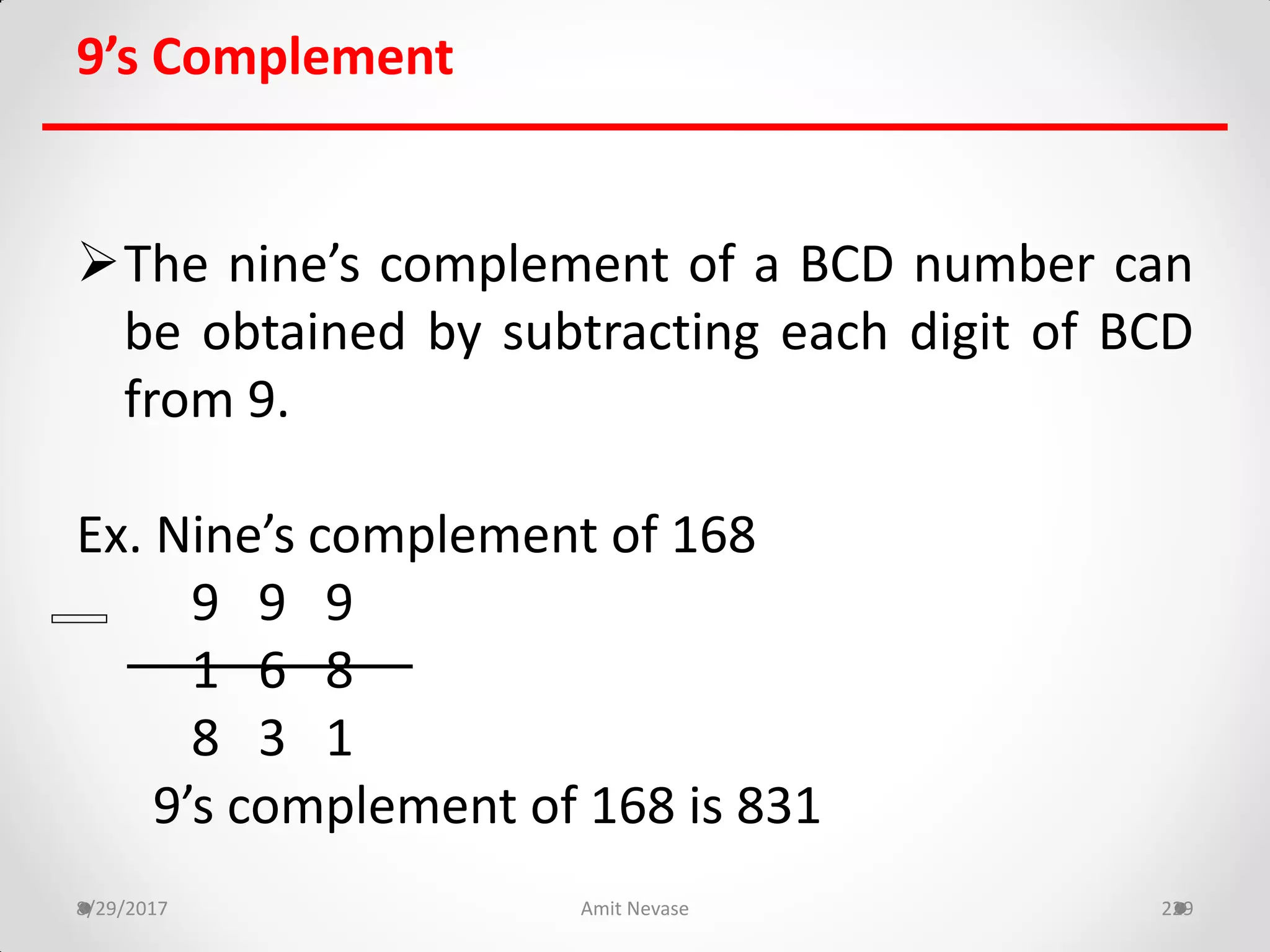
The nine’s complement of a BCD number can
be obtained by subtracting each digit of BCD
from 9.
Ex. Nine’s complement of 168
9 9 9
1 6 8
8 3 1
9’s complement of 168 is 831
8/29/2017 Amit Nevase 229
BCD Subtraction using 9’sComplement
Obtain 9’s complement of subtrahend
Add minuend with 9’s complement of
subtrahend
If a carry is generated then add it to the sum to
obtain the final result.
If a carry is not produced then the result is
negative hence take the 9’s complement of the
result.8/29/2017 Amit Nevase 230
BCD Subtraction using 9’s Complement
8/29/2017 Amit Nevase 231
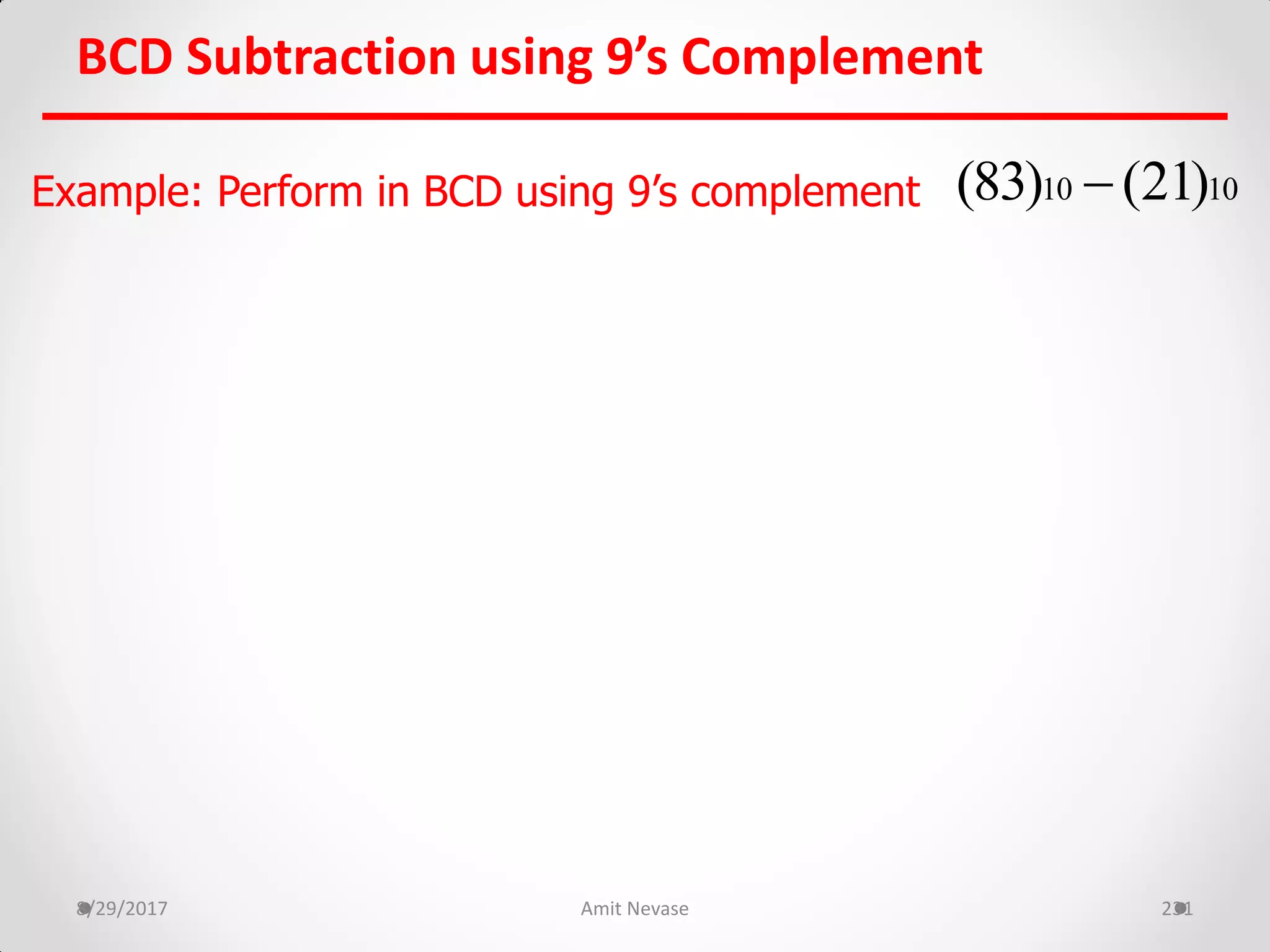
Example: Perform in BCD using 9’s complement 10 10(83) (21)
BCD Subtraction using 9’s Complement
8/29/2017 Amit Nevase 232
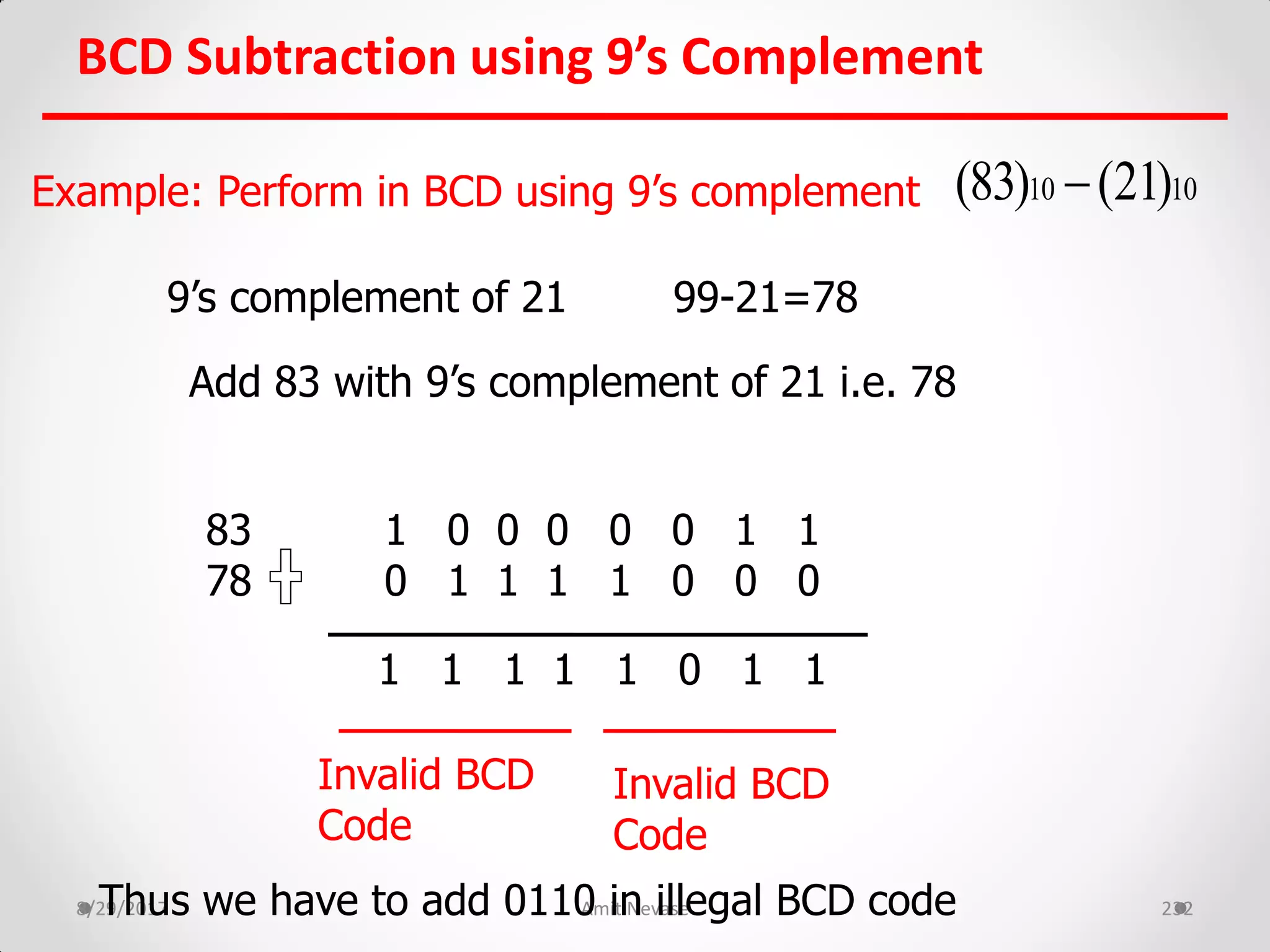
Example: Perform in BCD using 9’s complement
9’s complement of 21 99-21=78
Add 83 with 9’s complement of 21 i.e. 78
83 1 0 0 0 0 0 1 1
78 0 1 1 1 1 0 0 0
1 1 1 1 1 0 1 1
Invalid BCD
Code
Invalid BCD
Code
Thus we have to add 0110 in illegal BCD code
10 10(83) (21)
8/29/2017 Amit Nevase 233
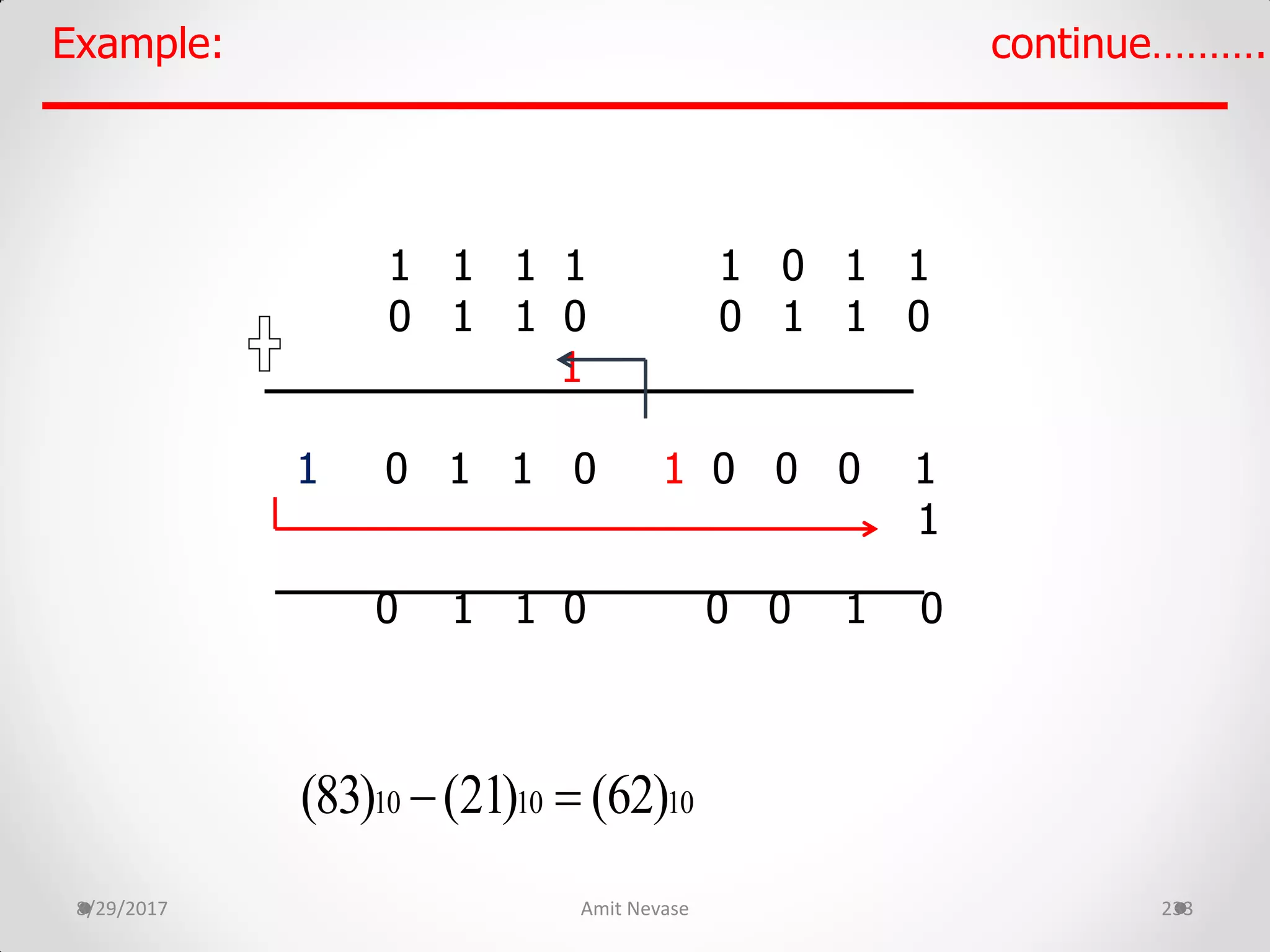
Example: continue……….
1 1 1 1 1 0 1 1
0 1 1 0 0 1 1 0
1
1 0 1 1 0 1 0 0 0 1
1
0 1 1 0 0 0 1 0
10 10 10(83) (21) (62) 
8/29/2017 Amit Nevase 234
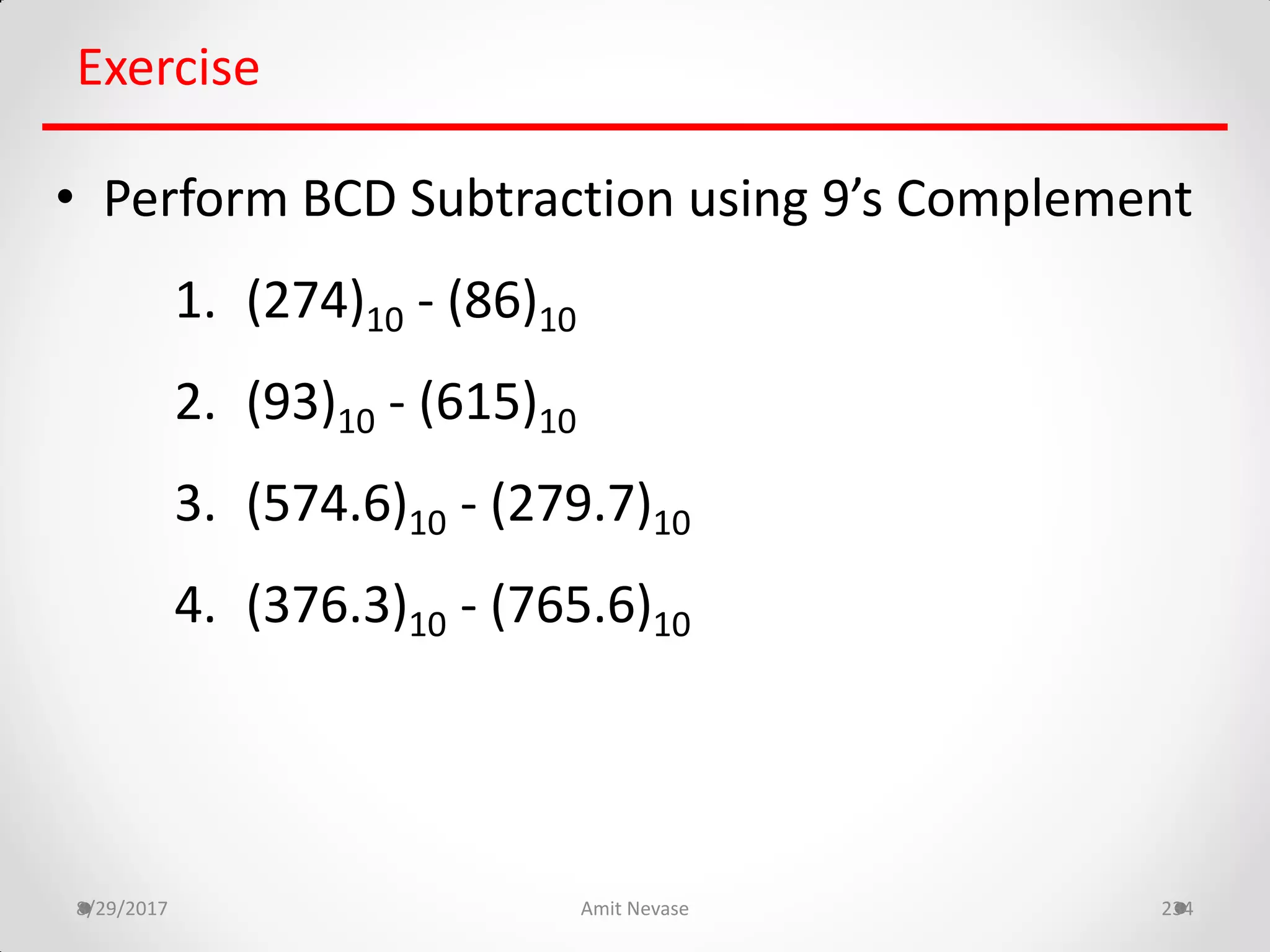
Exercise
• Perform BCD Subtraction using 9’s Complement
1. (274)10 - (86)10
2. (93)10 - (615)10
3. (574.6)10 - (279.7)10
4. (376.3)10 - (765.6)10
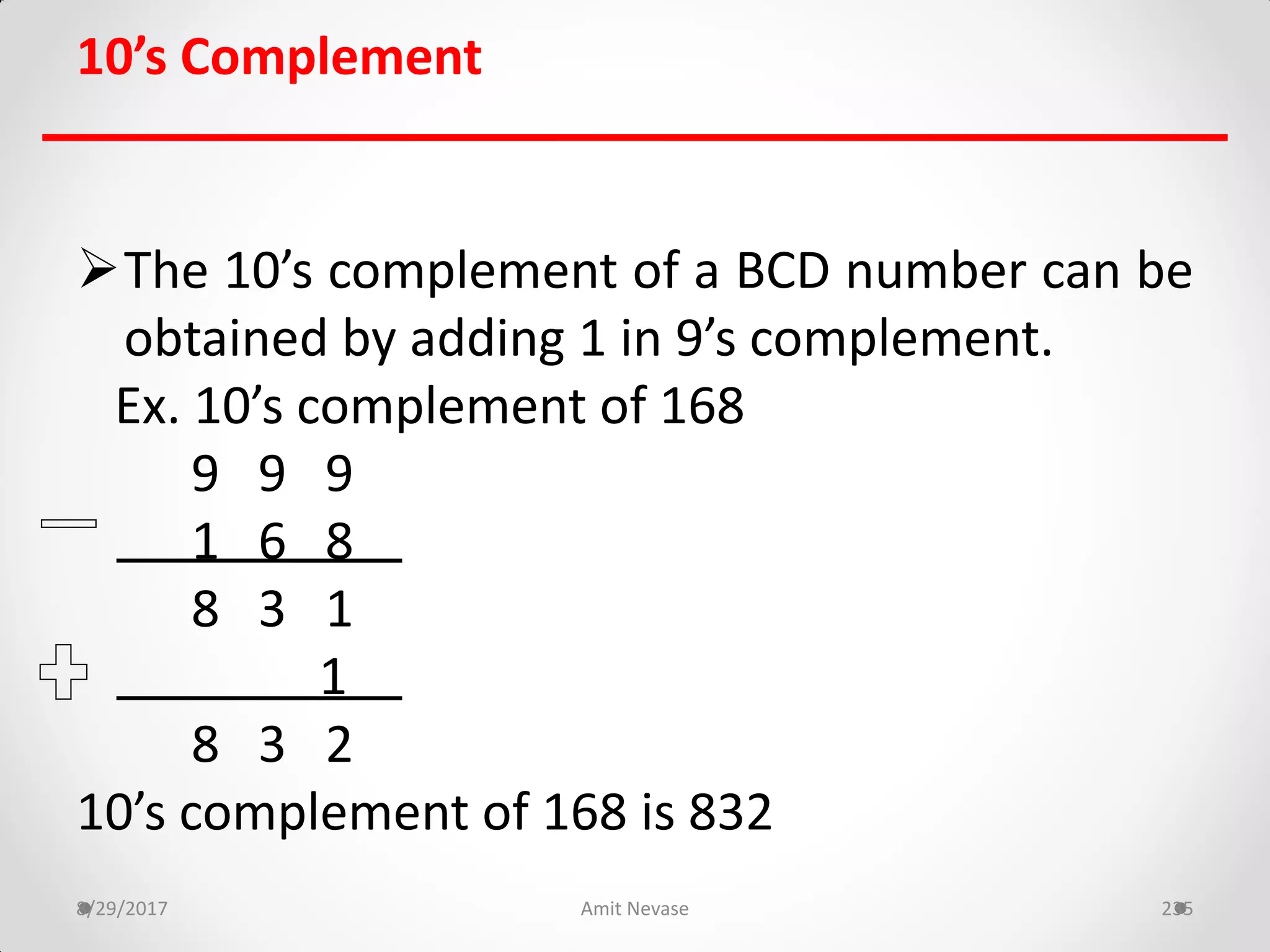
10’s Complement
The 10’s complement of a BCD number can be
obtained by adding 1 in 9’s complement.
Ex. 10’s complement of 168
9 9 9
1 6 8
8 3 1
1
8 3 2
10’s complement of 168 is 832
8/29/2017 Amit Nevase 235
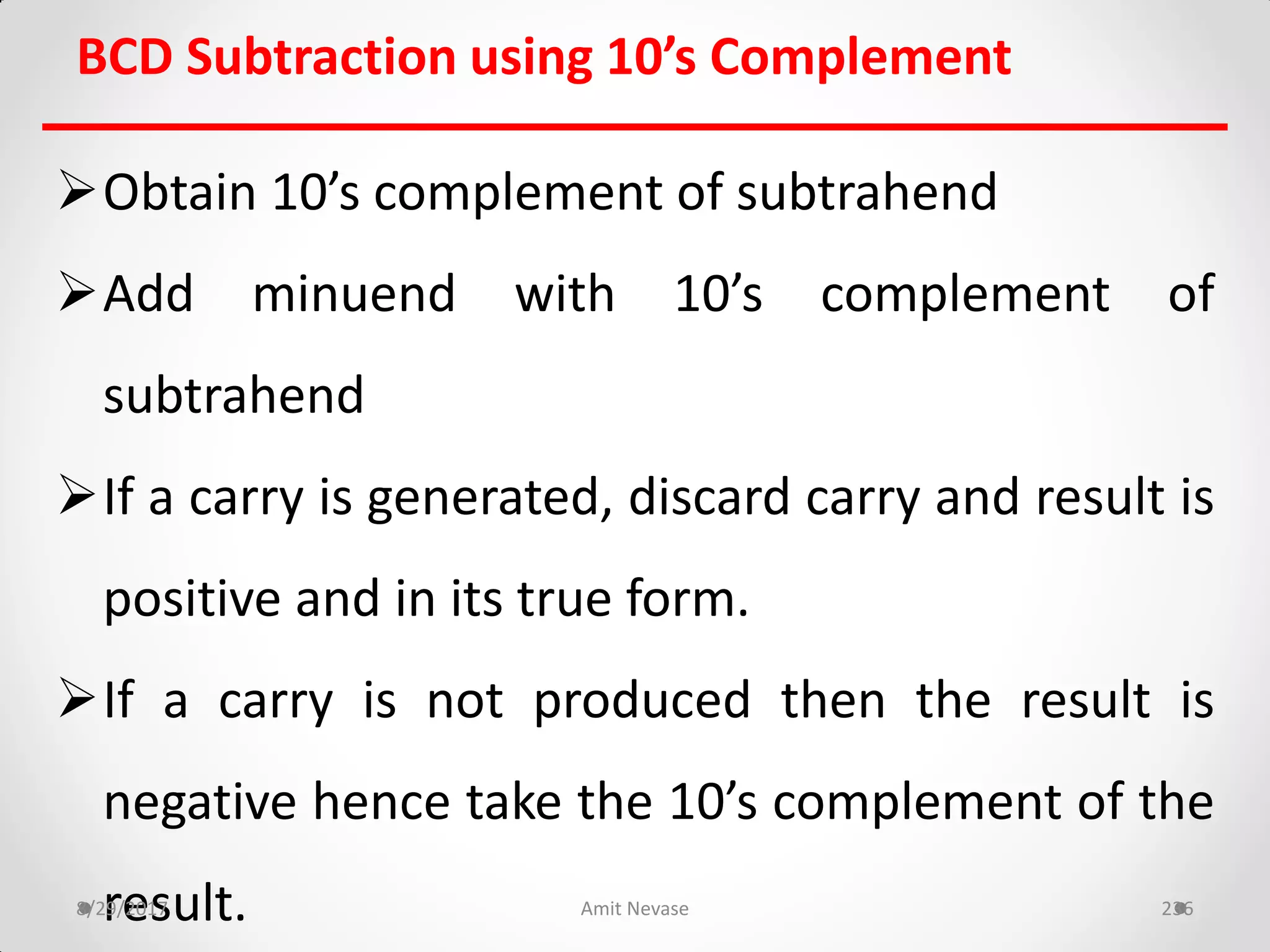
BCD Subtraction using 10’s Complement
Obtain 10’s complement of subtrahend
Add minuend with 10’s complement of
subtrahend
If a carry is generated, discard carry and result is
positive and in its true form.
If a carry is not produced then the result is
negative hence take the 10’s complement of the
result.8/29/2017 Amit Nevase 236
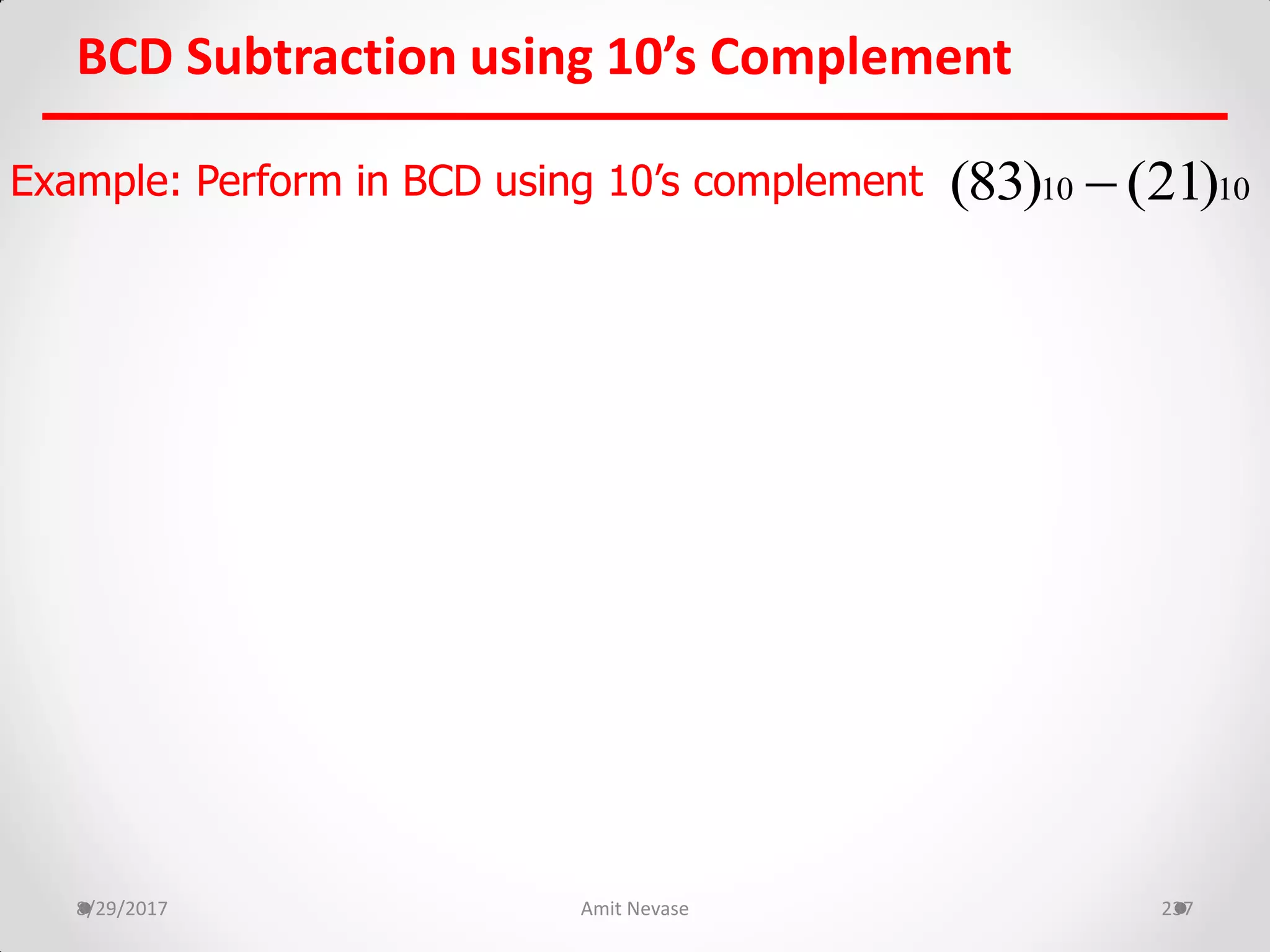
BCD Subtraction using 10’s Complement
8/29/2017 Amit Nevase 237
Example: Perform in BCD using 10’s complement 10 10(83) (21)
BCD Subtraction using 10’s Complement
8/29/2017 Amit Nevase 238
Example: Perform in BCD using 10’s complement
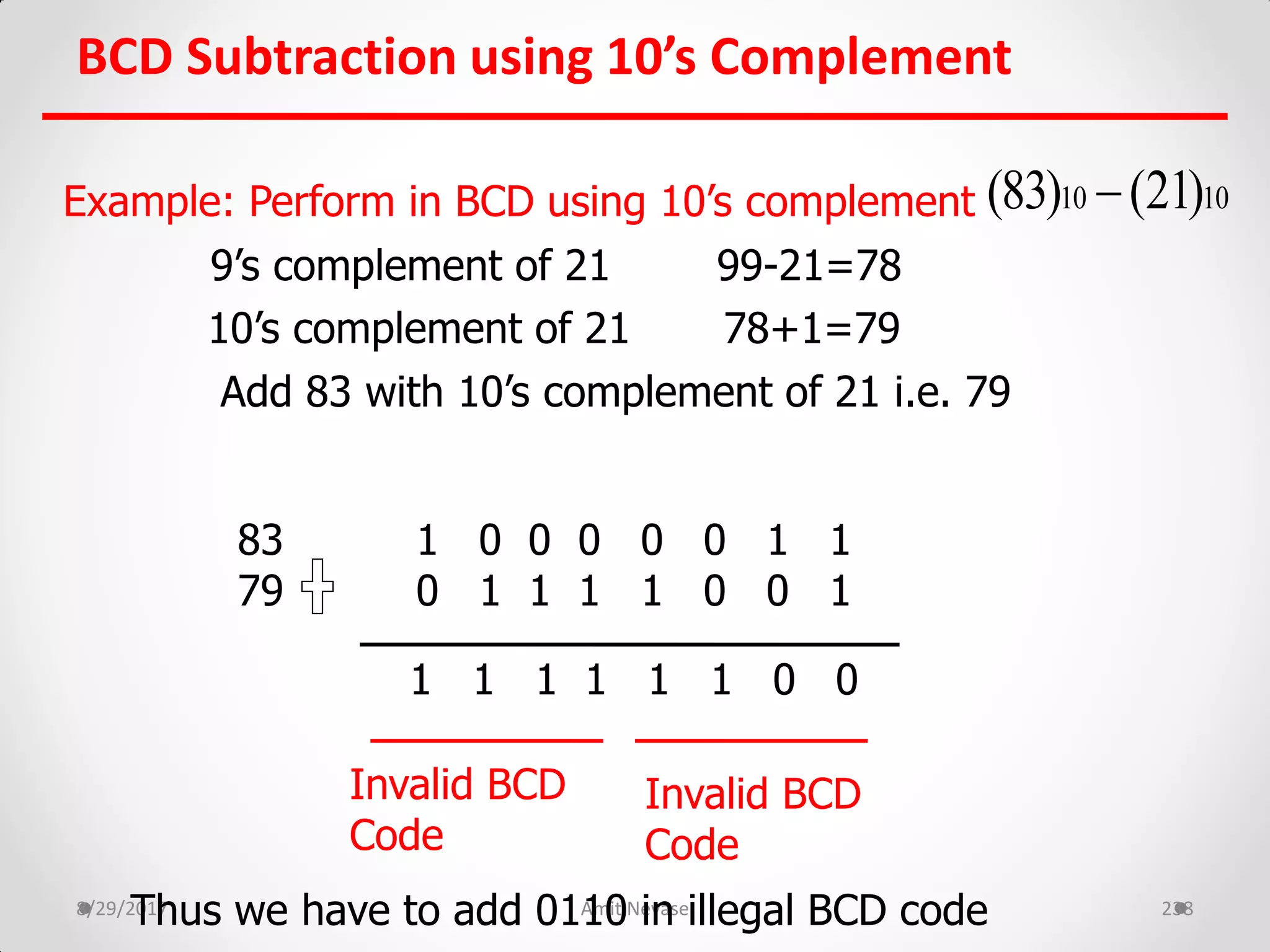
9’s complement of 21 99-21=78
Add 83 with 10’s complement of 21 i.e. 79
83 1 0 0 0 0 0 1 1
79 0 1 1 1 1 0 0 1
1 1 1 1 1 1 0 0
Invalid BCD
Code
Invalid BCD
Code
Thus we have to add 0110 in illegal BCD code
10’s complement of 21 78+1=79
10 10(83) (21)
8/29/2017 Amit Nevase 239
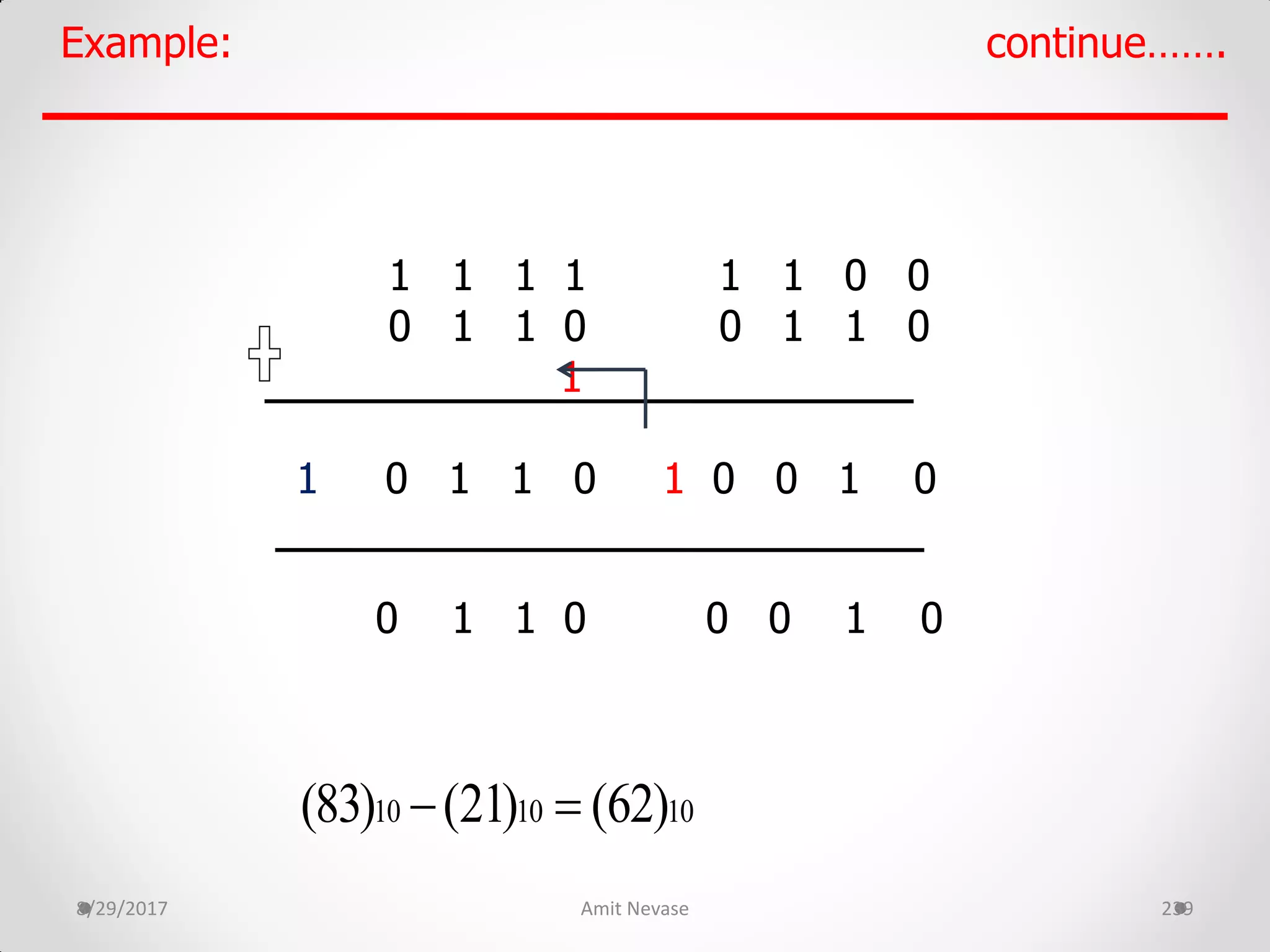
Example: continue…….
1 1 1 1 1 1 0 0
0 1 1 0 0 1 1 0
1
1 0 1 1 0 1 0 0 1 0
0 1 1 0 0 0 1 0
10 10 10(83) (21) (62) 
8/29/2017 Amit Nevase 240
Exercise
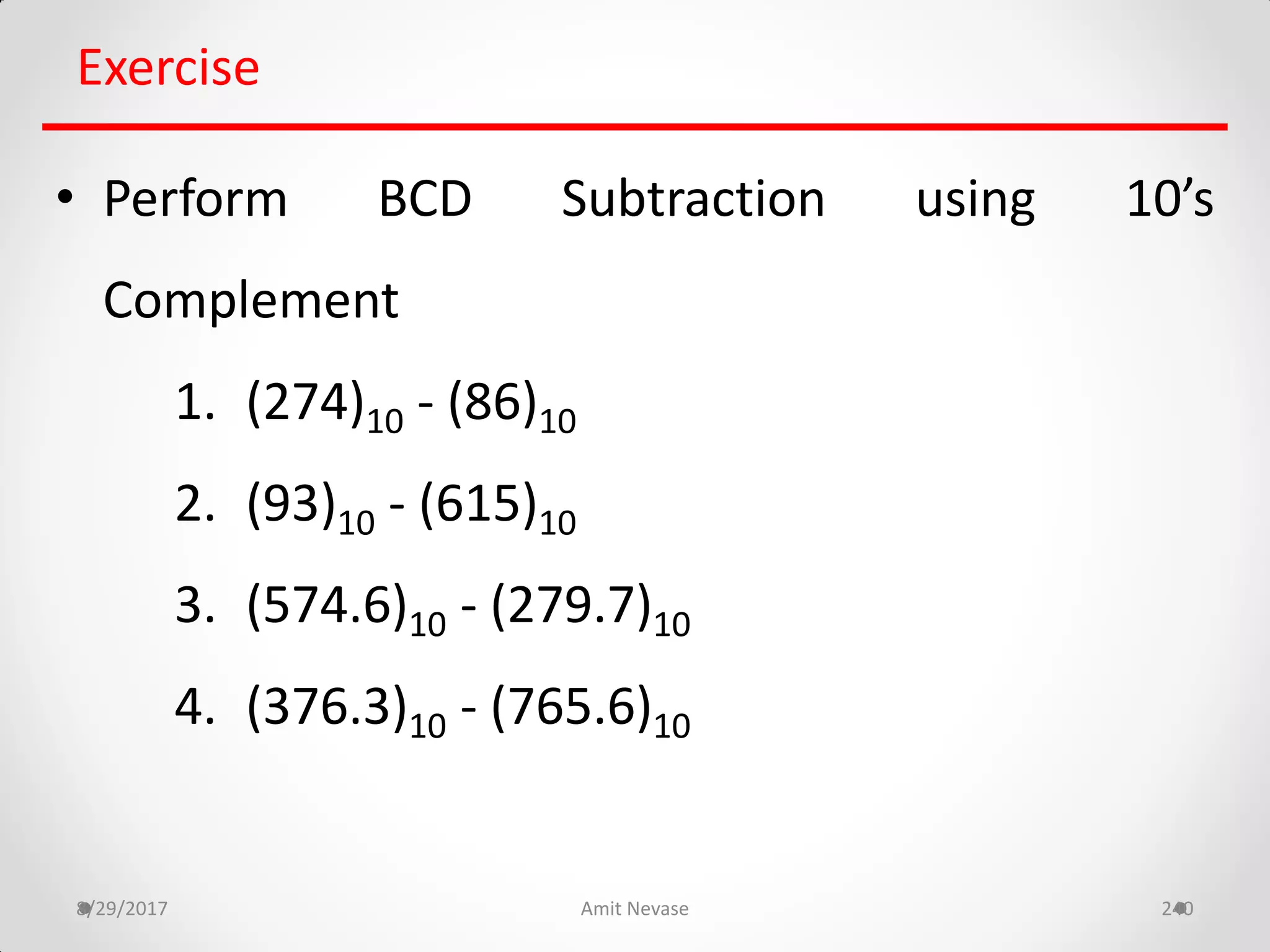
• Perform BCD Subtraction using 10’s
Complement
1. (274)10 - (86)10
2. (93)10 - (615)10
3. (574.6)10 - (279.7)10
4. (376.3)10 - (765.6)10
Chapter I – Number System
 Introduction to digital signal, Advantages of Digital System
over analog systems
 Number Systems: Different types of number systems( Binary,
Octal, Hexadecimal ), Conversion of number systems,
 Binary arithmetic: Addition, Subtraction, Multiplication, Division.
 Subtraction using 1’s complement and 2’s complement
 Codes
Codes -BCD, Gray Code, Excess-3, ASCII code
 BCD addition, BCD subtraction using 9’s and 10’ complement
 (Numericals based on above topic).
8/29/2017 Amit Nevase 241
Gray Code
The gray code is non-weighted code.
It is not suitable for arithmetic operations.
It is a cyclic code because successive code words
in this code differ in one bit position only i.e.
unit distance code
8/29/2017 Amit Nevase 242
Binary to Gray Code Conversion
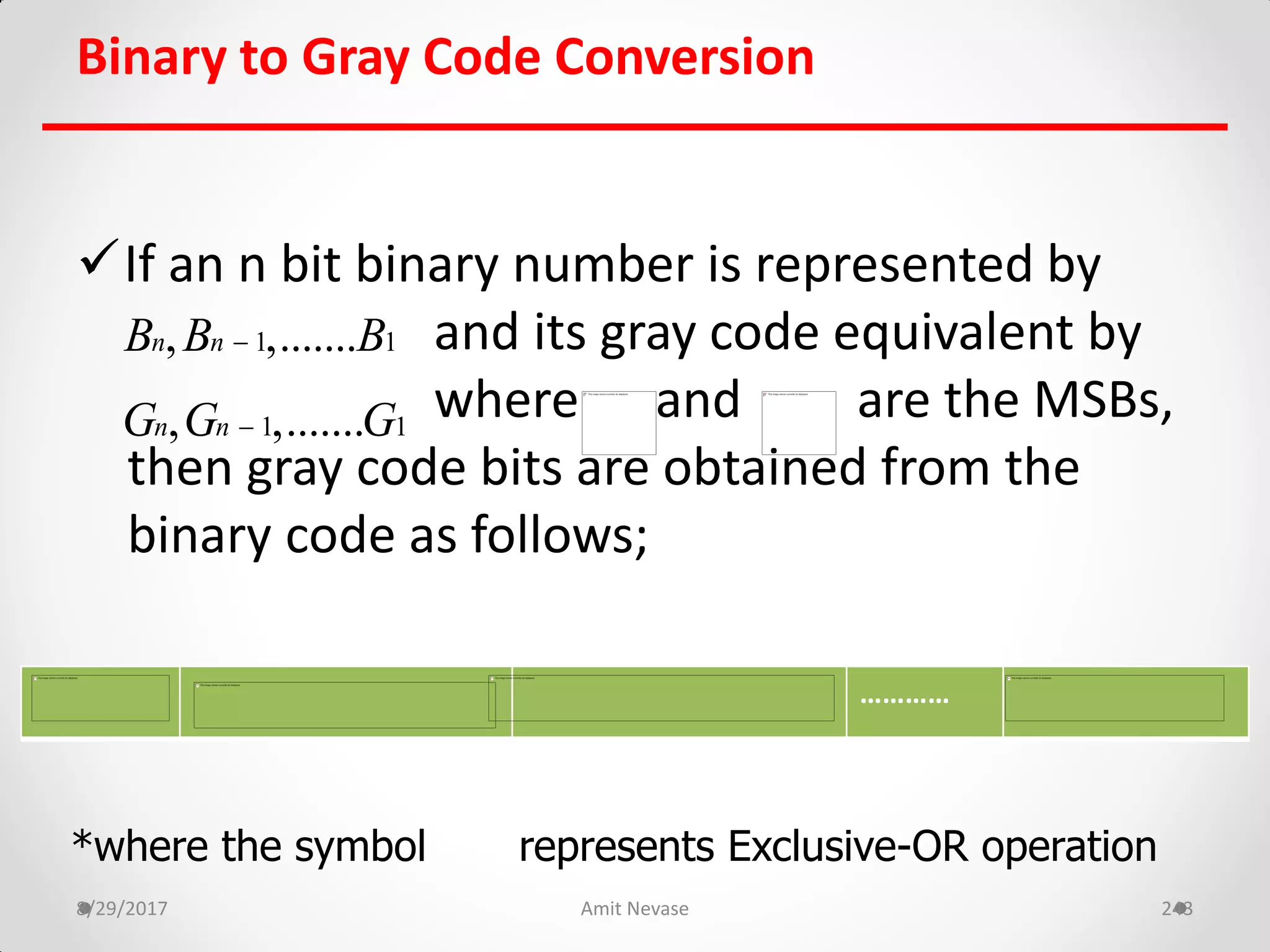
If an n bit binary number is represented by
and its gray code equivalent by
where and are the MSBs,
then gray code bits are obtained from the
binary code as follows;
8/29/2017 Amit Nevase 243
…………
*where the symbol represents Exclusive-OR operation
1 1, ,.......n nB B B
1 1, ,.......n nG G G
8/29/2017 Amit Nevase 244
Binary to Gray Code Conversion
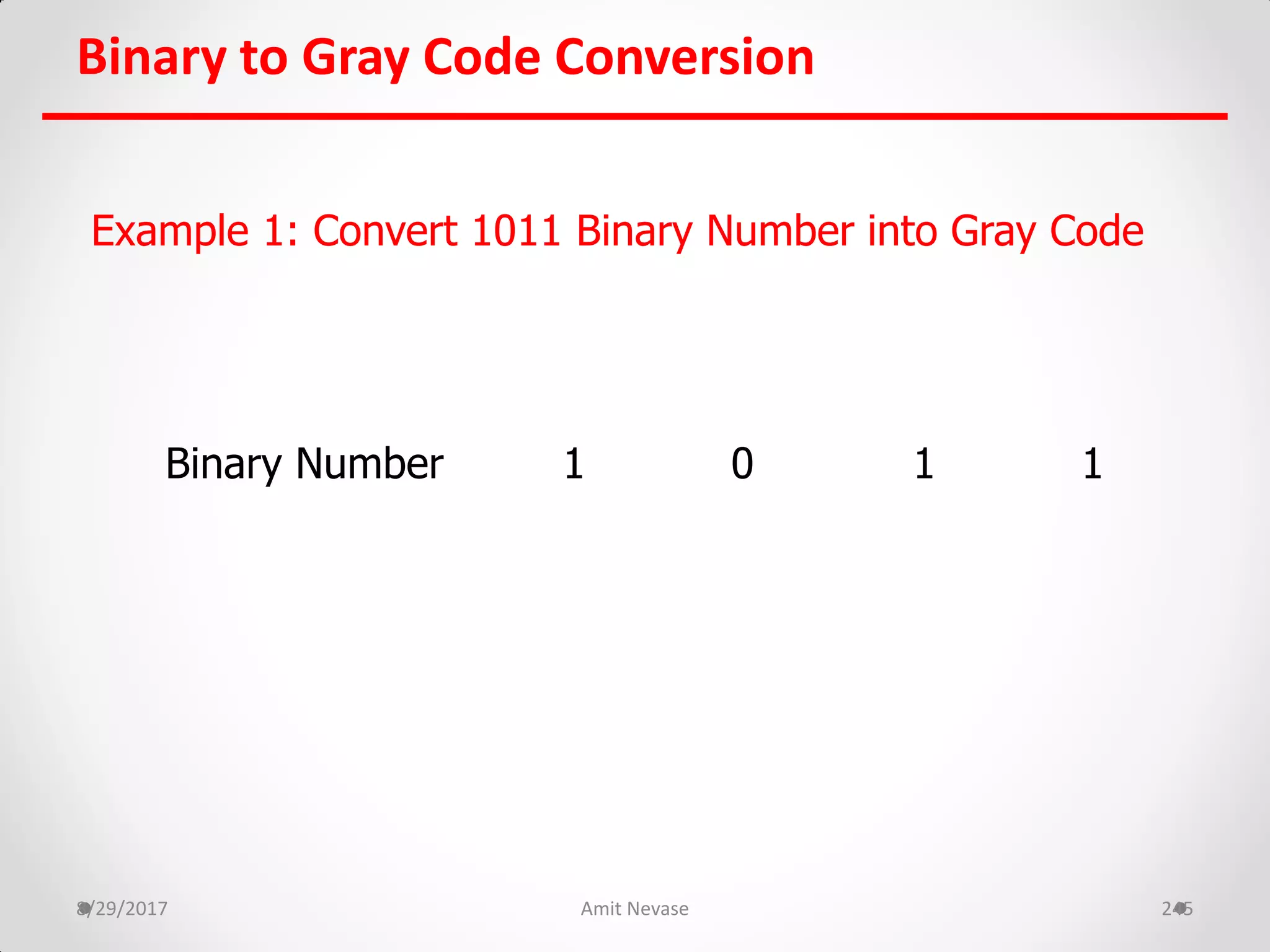
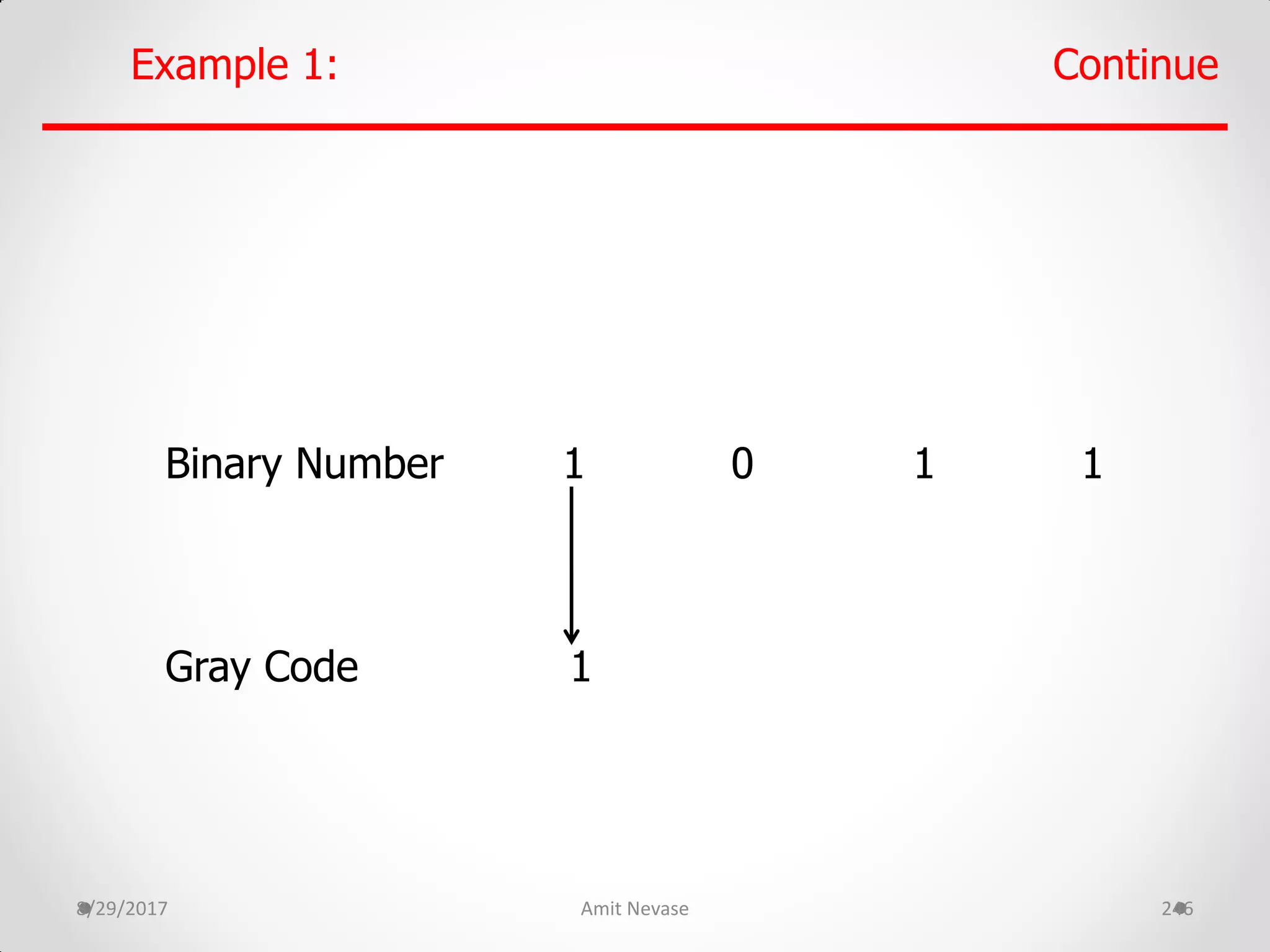
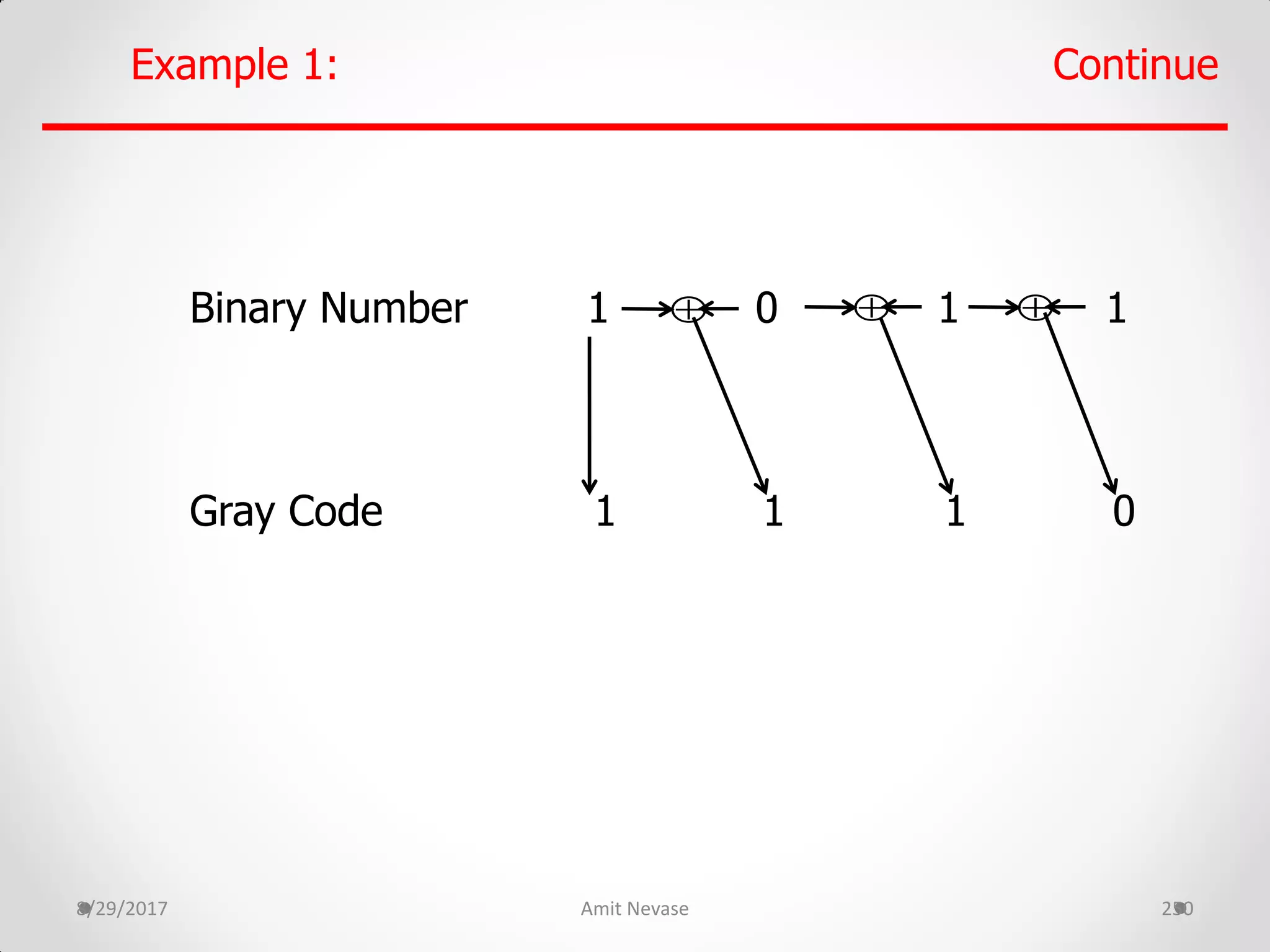
Example 1: Convert 1011 Binary Number into Gray Code
8/29/2017 Amit Nevase 245
Binary to Gray Code Conversion
Example 1: Convert 1011 Binary Number into Gray Code
Binary Number 1 0 1 1
8/29/2017 Amit Nevase 246
Binary Number 1 0 1 1
Gray Code 1
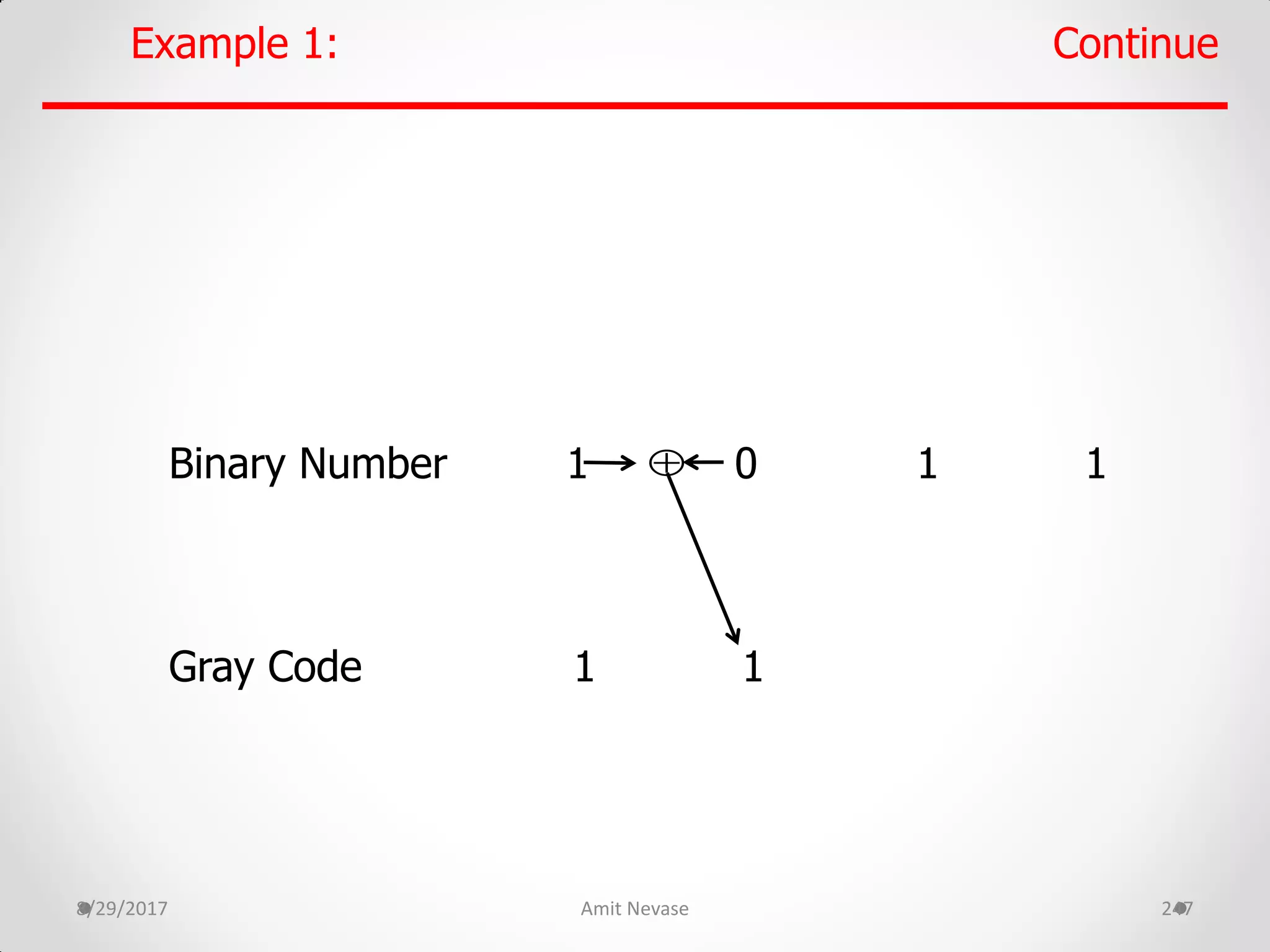
Example 1: Continue
8/29/2017 Amit Nevase 247
Example 1: Continue
Binary Number 1 0 1 1
Gray Code 1 1

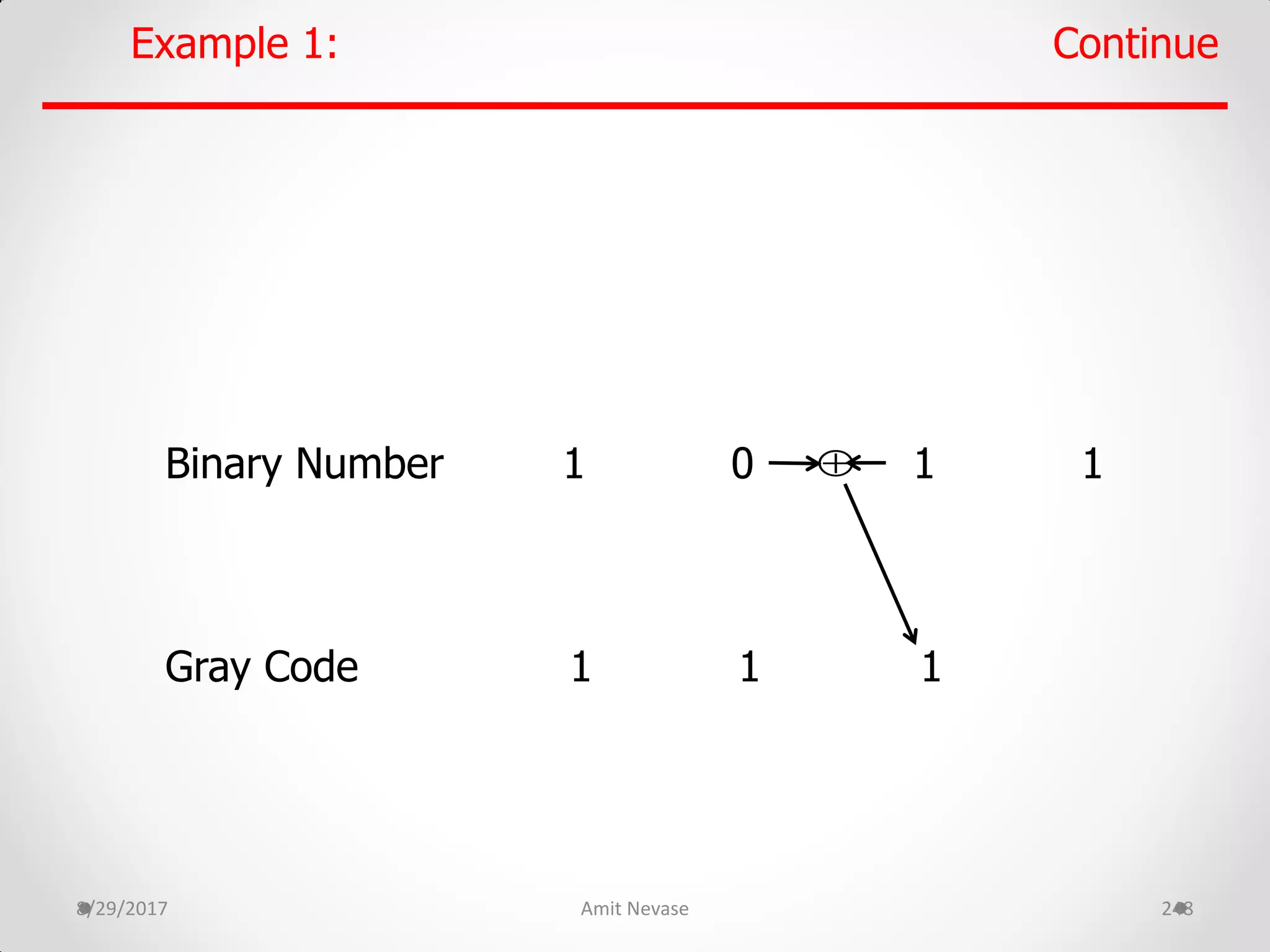
8/29/2017 Amit Nevase 248
Binary Number 1 0 1 1
Gray Code 1 1 1
Example 1: Continue

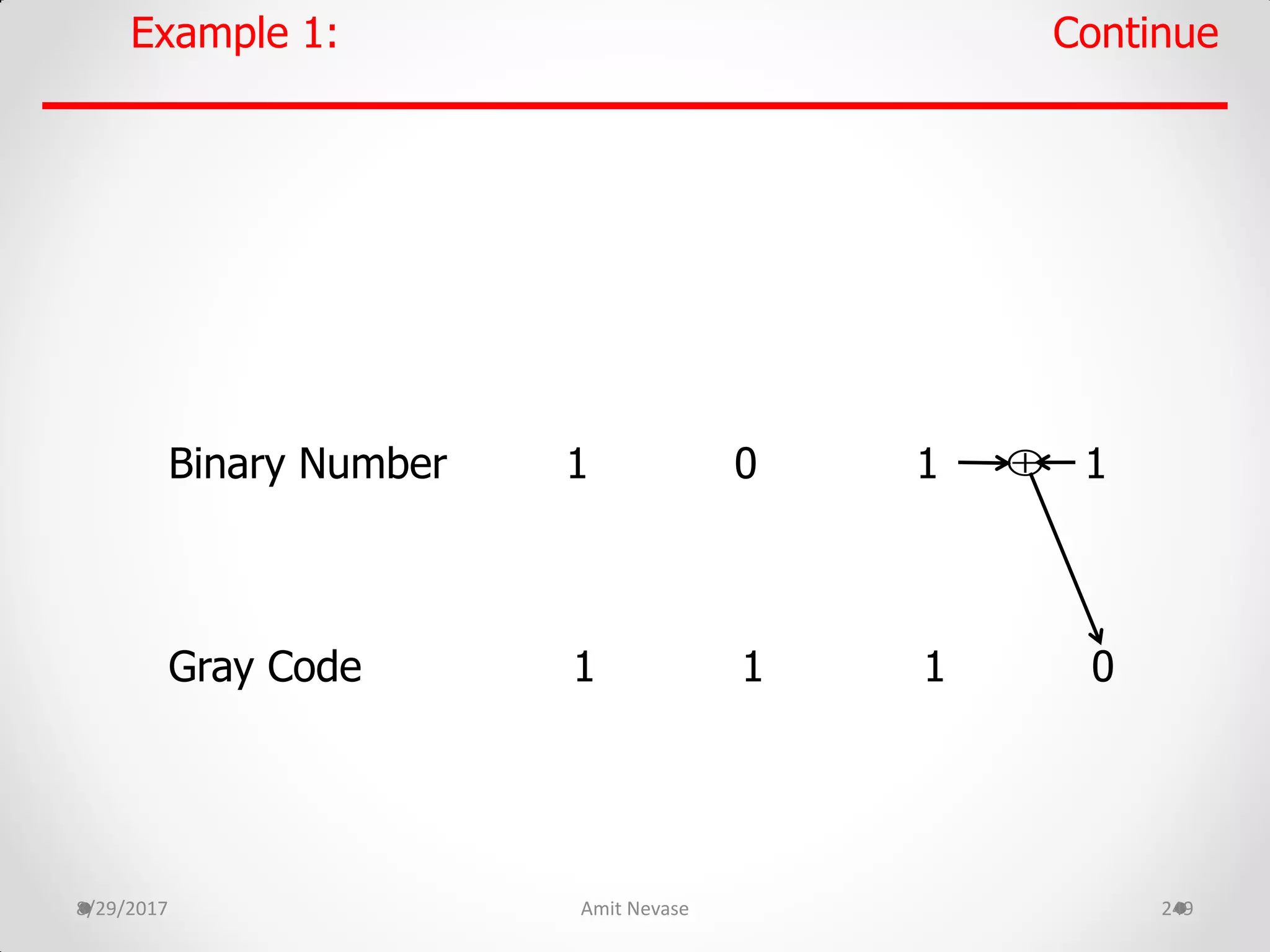
8/29/2017 Amit Nevase 249
Binary Number 1 0 1 1
Gray Code 1 1 1 0
Example 1: Continue

8/29/2017 Amit Nevase 250
Binary Number 1 0 1 1
Gray Code 1 1 1 0
Example 1: Continue
  
Binary to Gray Code Conversion
8/29/2017 251
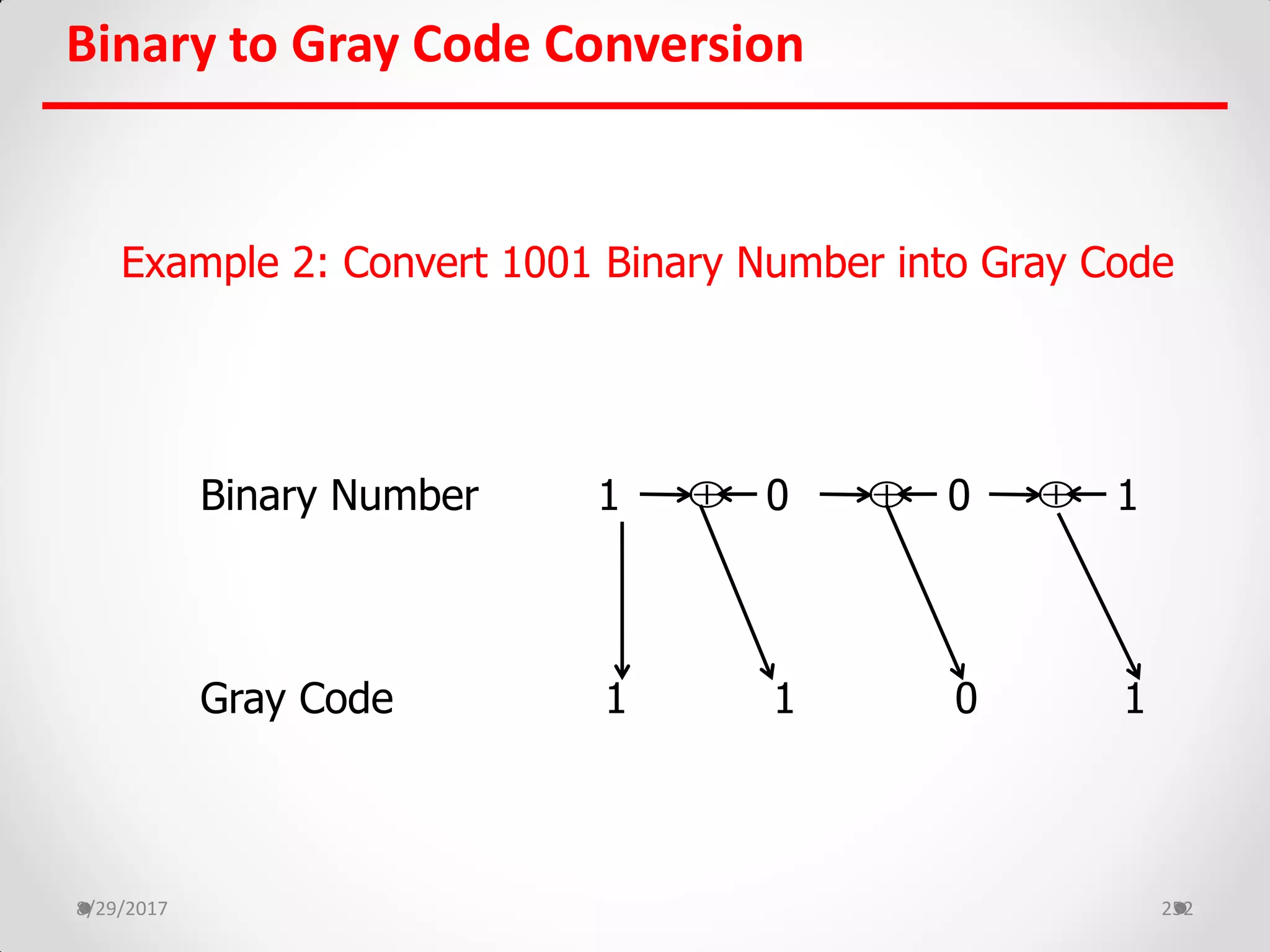
Example 2: Convert 1001 Binary Number into Gray Code
Binary to Gray Code Conversion
8/29/2017 252
Example 2: Convert 1001 Binary Number into Gray Code
Binary Number 1 0 0 1
Gray Code 1 1 0 1
  
Binary to Gray Code Conversion
8/29/2017 Amit Nevase 253
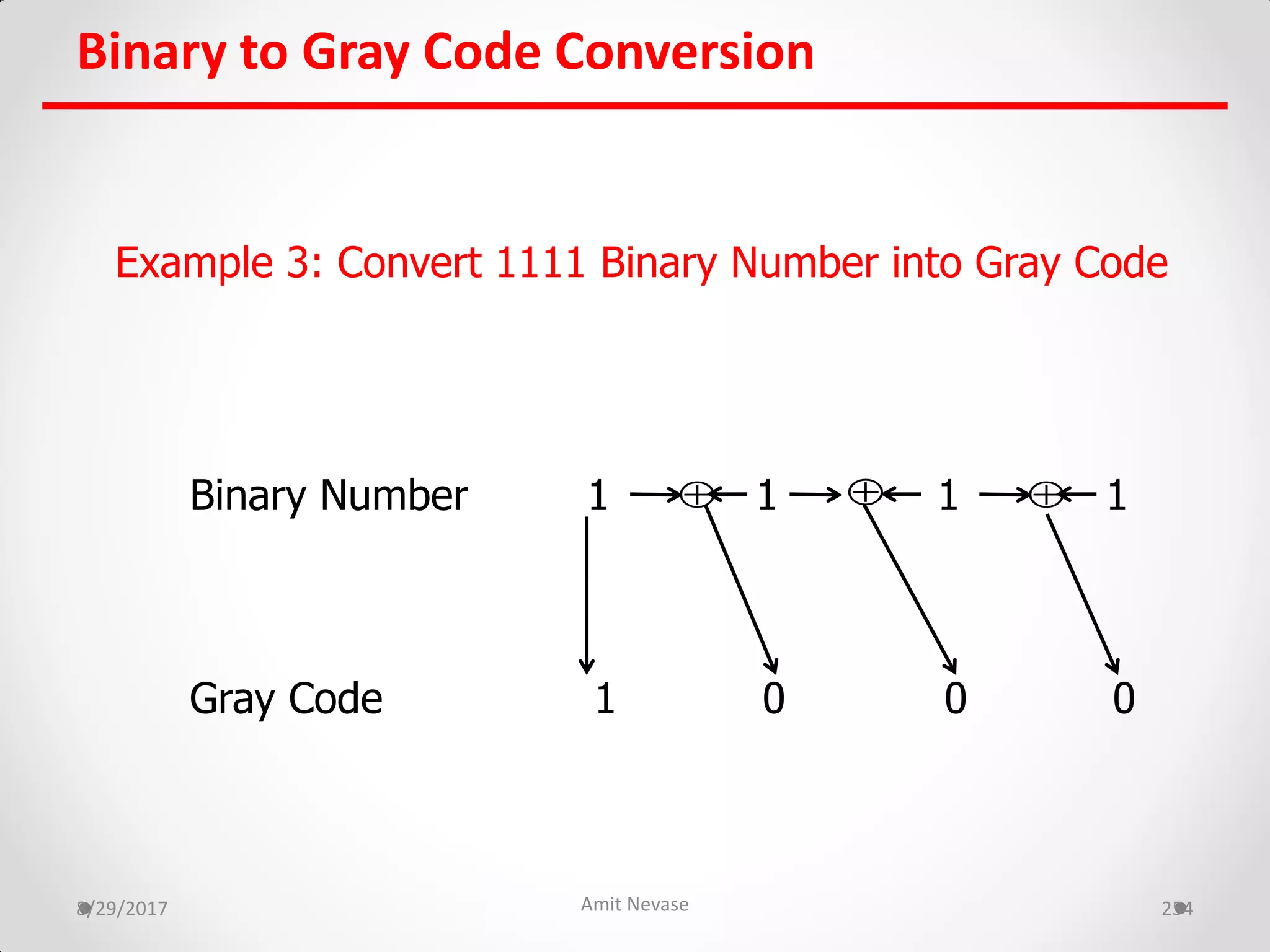
Example 3: Convert 1111 Binary Number into Gray Code
Binary to Gray Code Conversion
8/29/2017 Amit Nevase 254
Example 3: Convert 1111 Binary Number into Gray Code
Binary Number 1 1 1 1
Gray Code 1 0 0 0
  
Binary to Gray Code Conversion
8/29/2017 Amit Nevase 255
Example 4: Convert 1010 Binary Number into Gray Code
Binary to Gray Code Conversion
8/29/2017 Amit Nevase 256
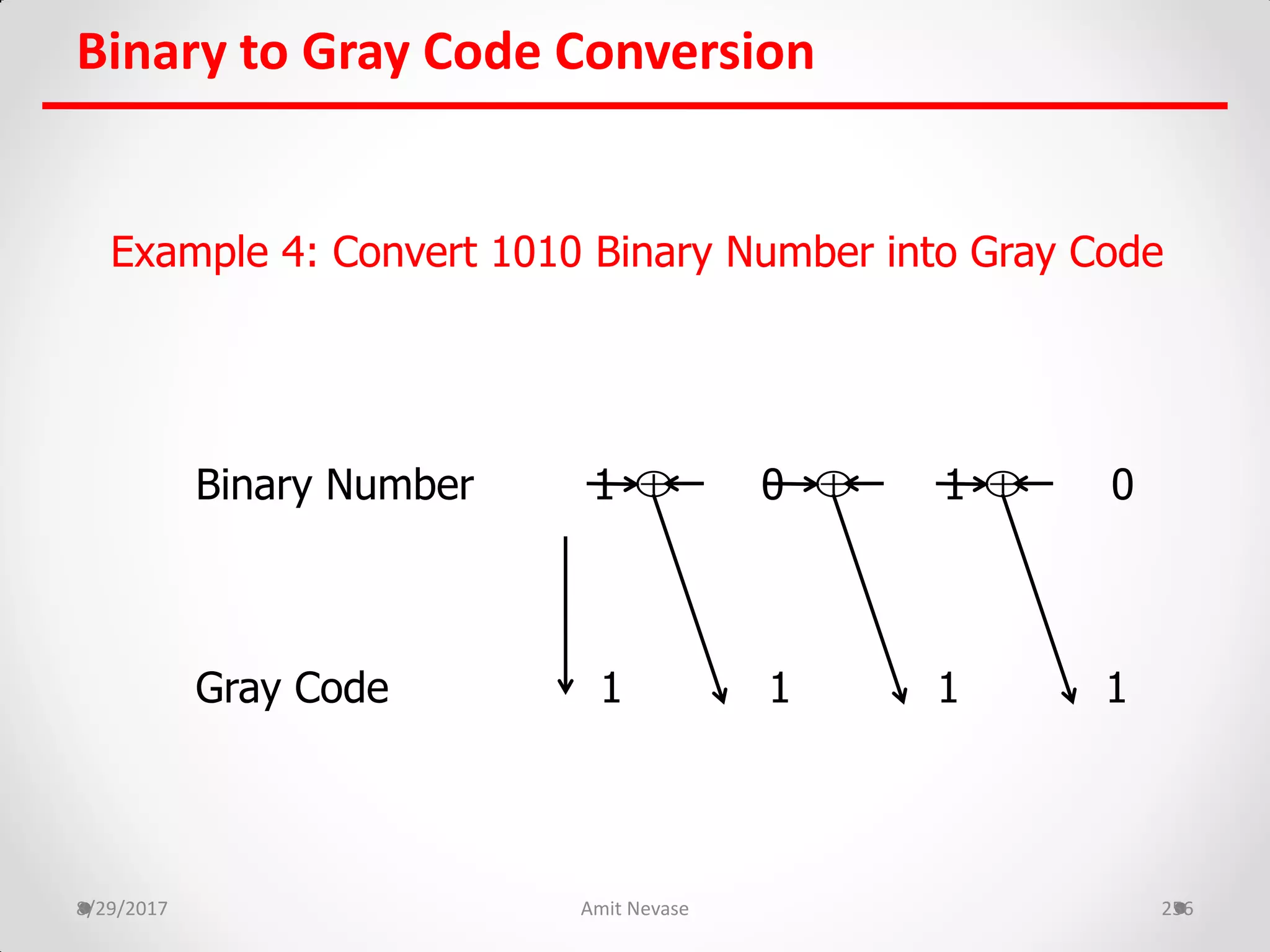
Example 4: Convert 1010 Binary Number into Gray Code
Binary Number 1 0 1 0
Gray Code 1 1 1 1
  
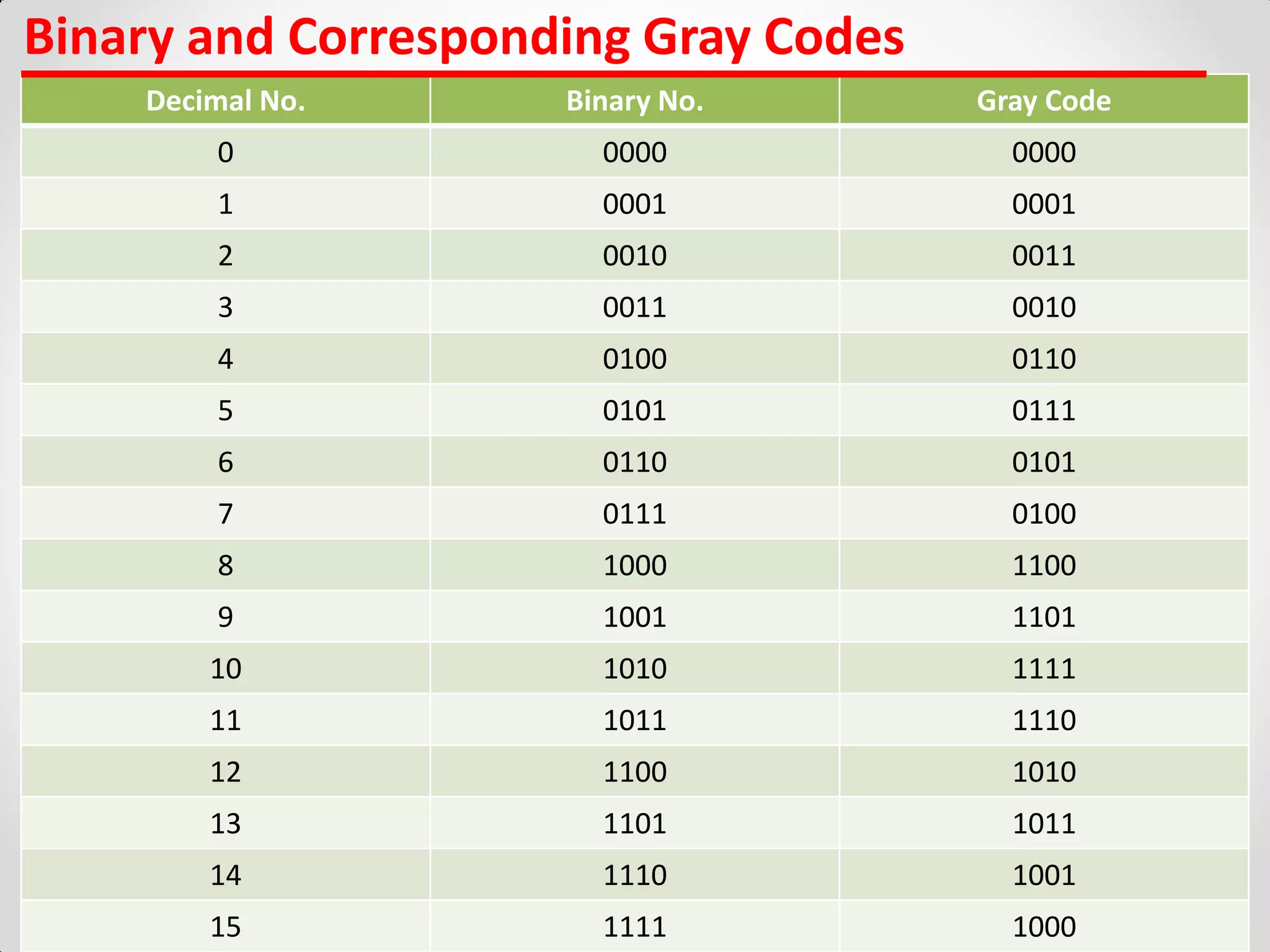
Binary and Corresponding Gray Codes
8/29/2017 Amit Nevase 257
Decimal No. Binary No. Gray Code
0 0000 0000
1 0001 0001
2 0010 0011
3 0011 0010
4 0100 0110
5 0101 0111
6 0110 0101
7 0111 0100
8 1000 1100
9 1001 1101
10 1010 1111
11 1011 1110
12 1100 1010
13 1101 1011
14 1110 1001
15 1111 1000
8/29/2017 Amit Nevase 258
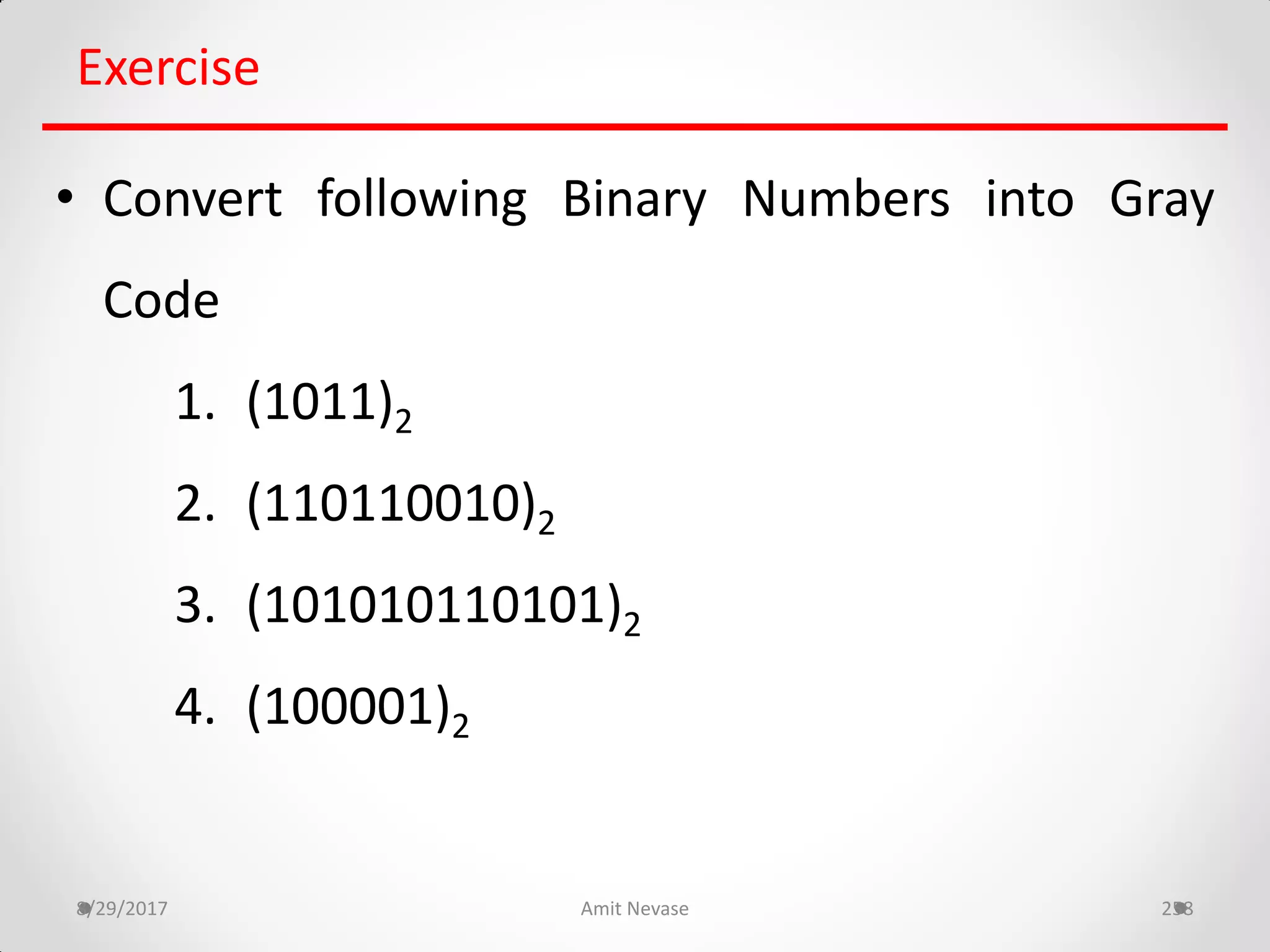
Exercise
• Convert following Binary Numbers into Gray
Code
1. (1011)2
2. (110110010)2
3. (101010110101)2
4. (100001)2
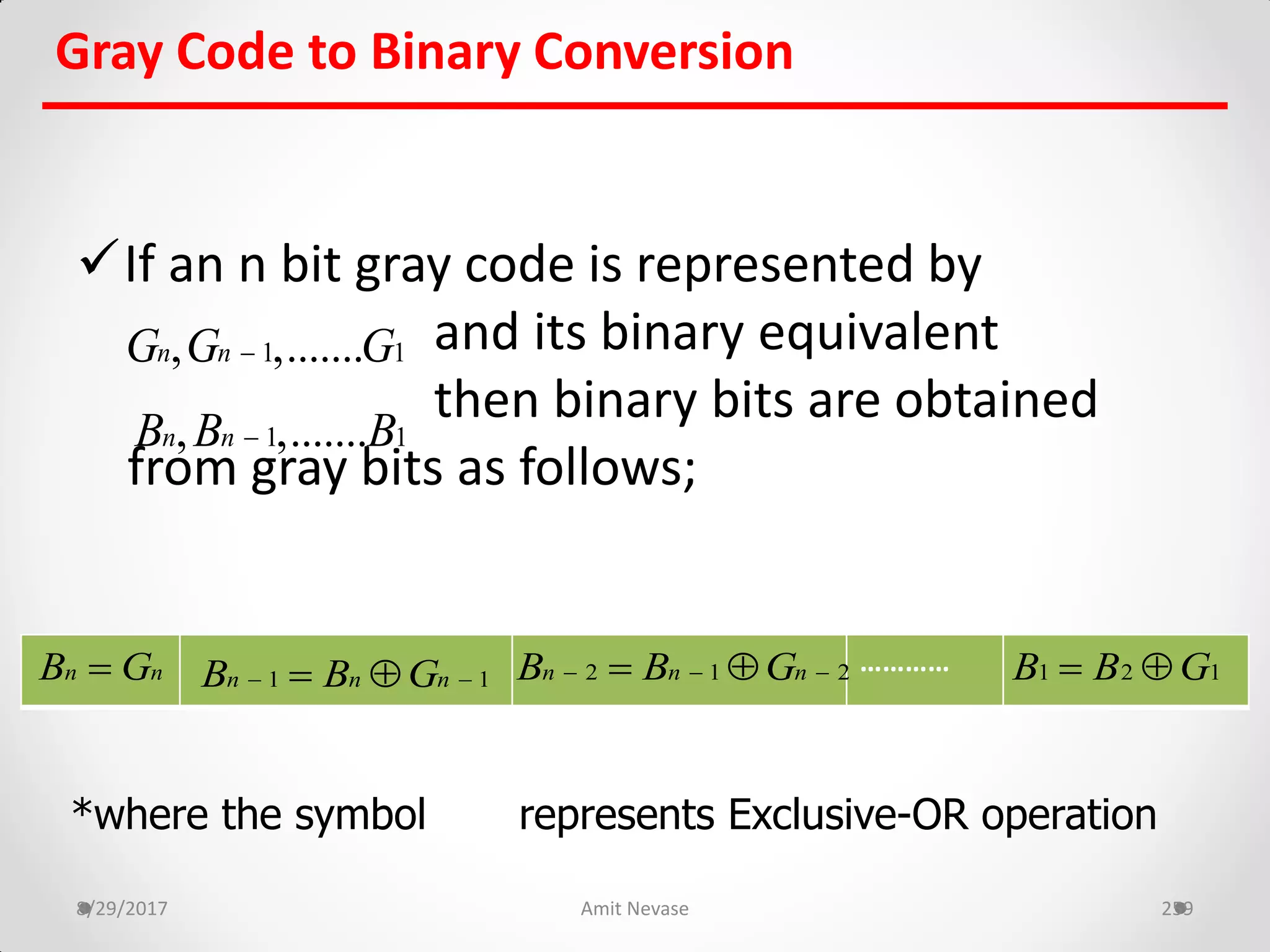
Gray Code to Binary Conversion
If an n bit gray code is represented by
and its binary equivalent
then binary bits are obtained
from gray bits as follows;
8/29/2017 Amit Nevase 259
…………
*where the symbol represents Exclusive-OR operation
1 1, ,.......n nG G G
1 1, ,.......n nB B B
n nB G 1 1n n nB B G   2 1 2n n nB B G    1 2 1B B G 
Gray Code to Binary Conversion
8/29/2017 Amit Nevase 260
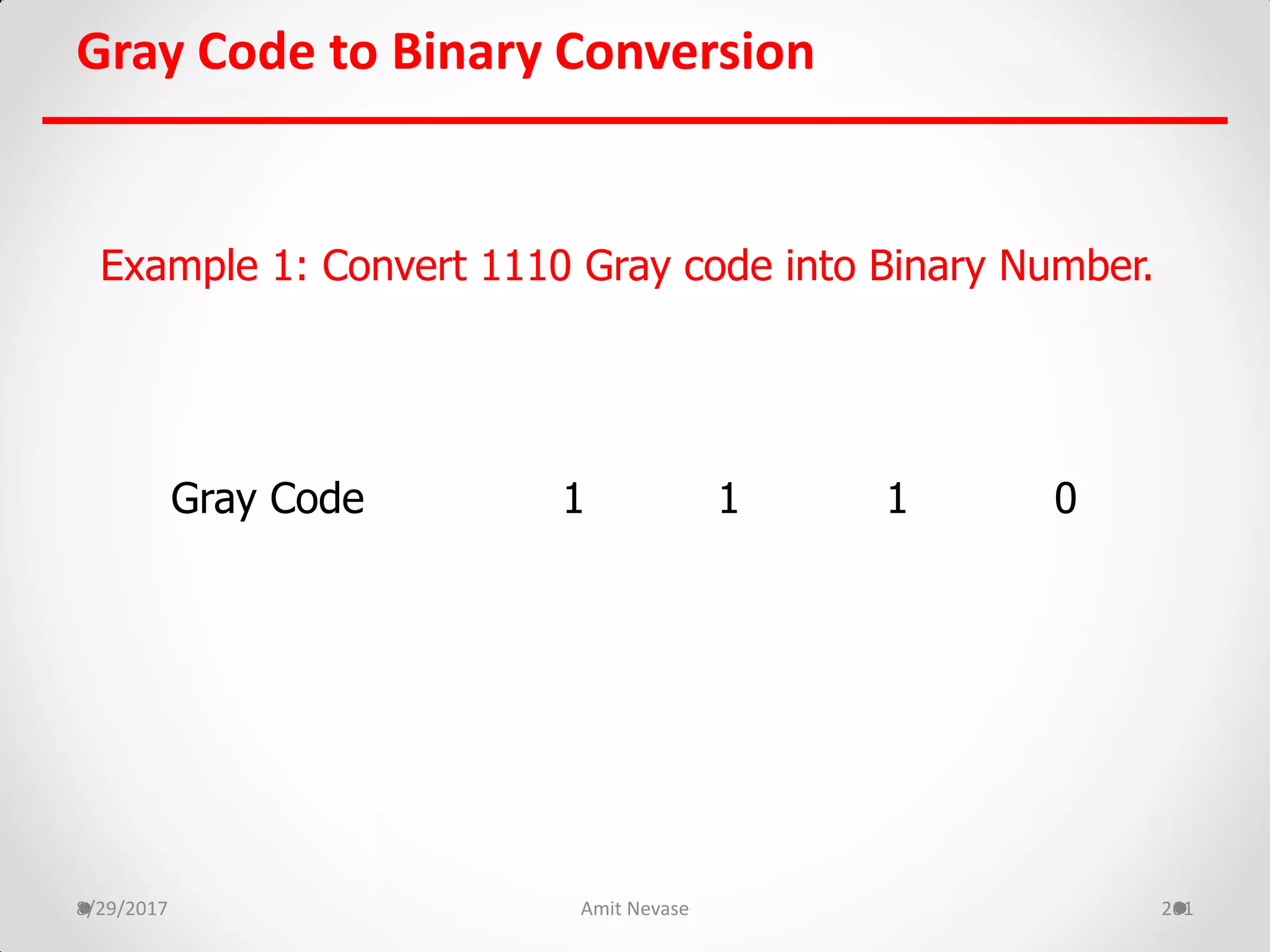
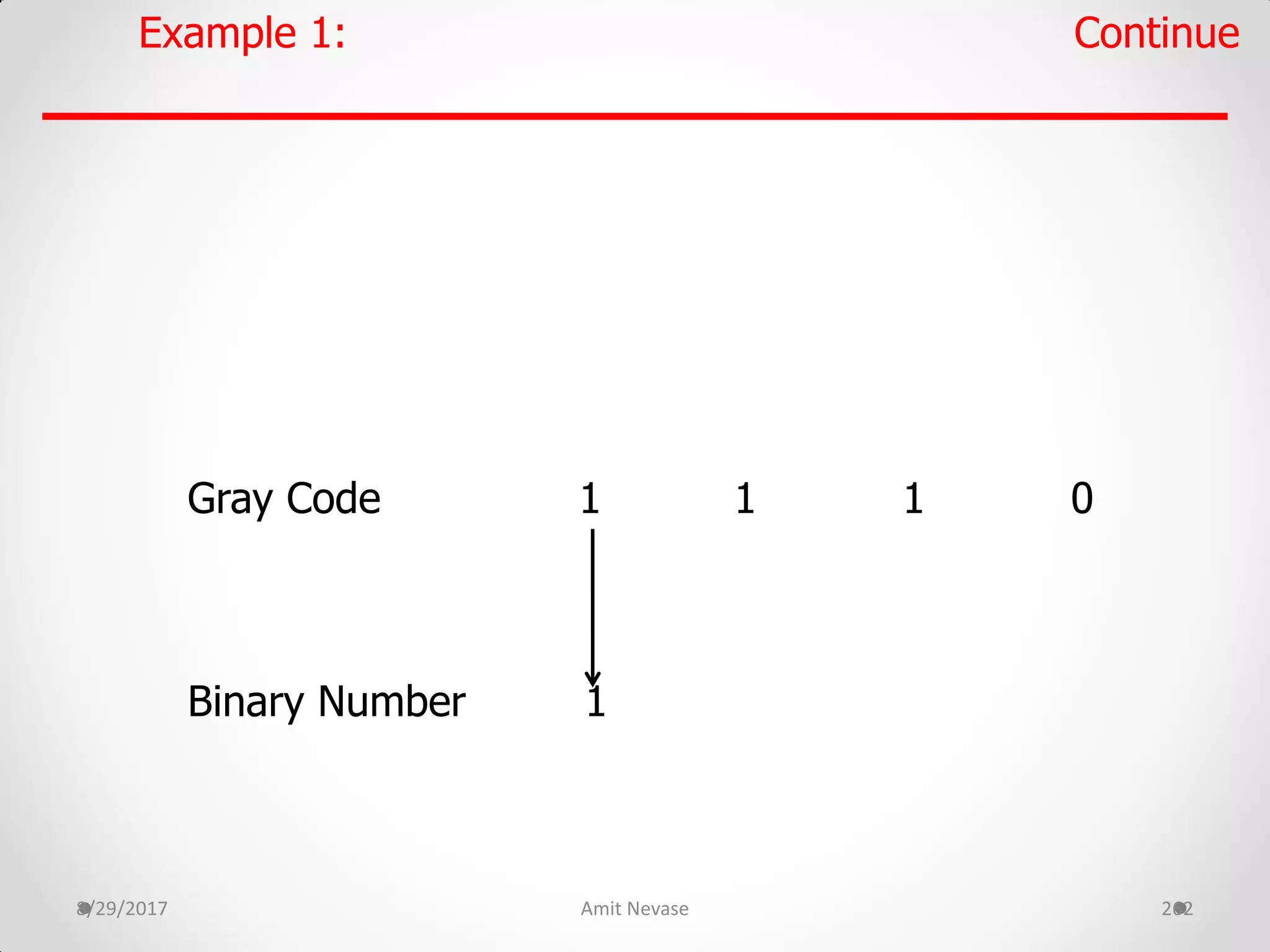
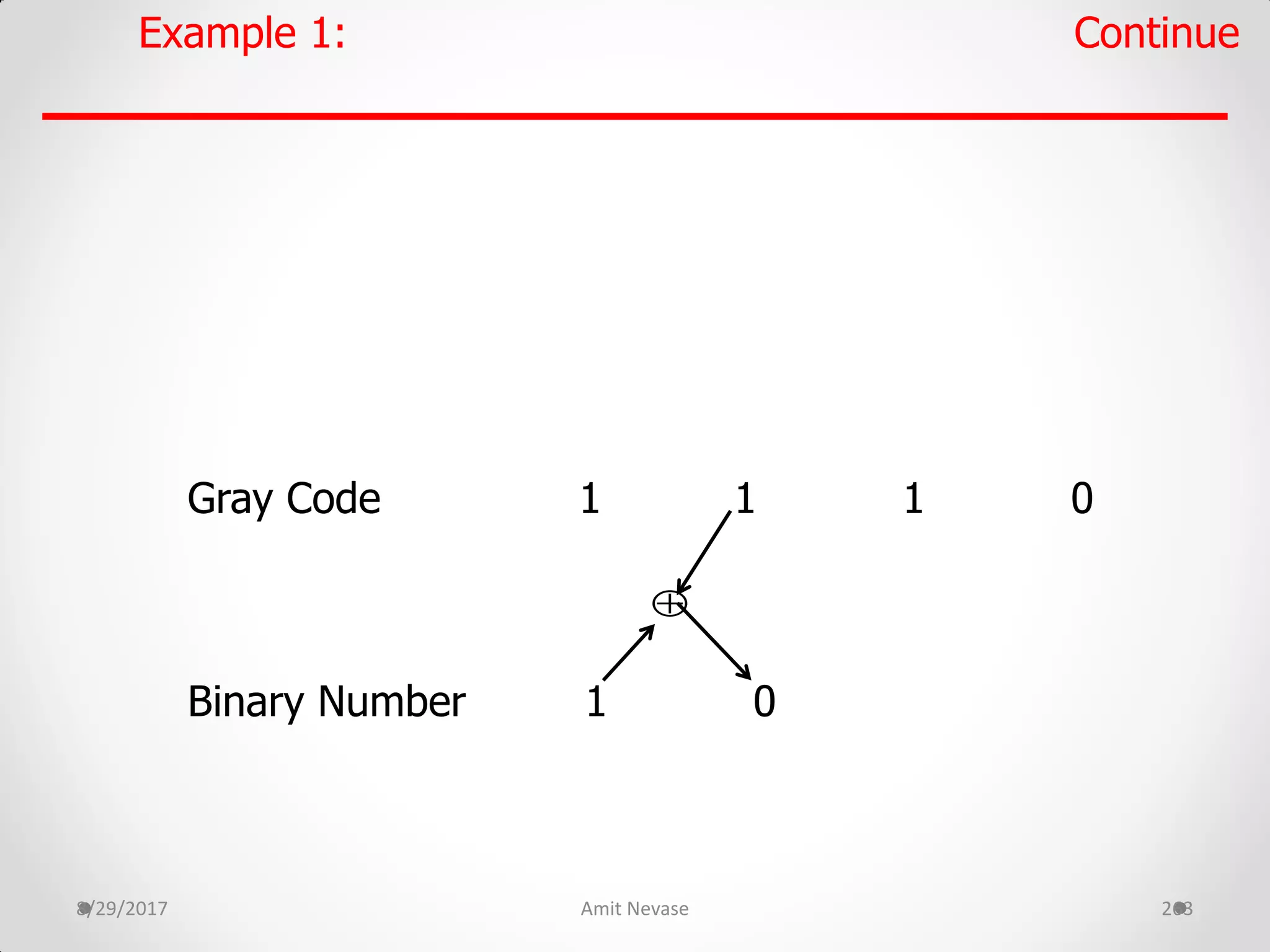
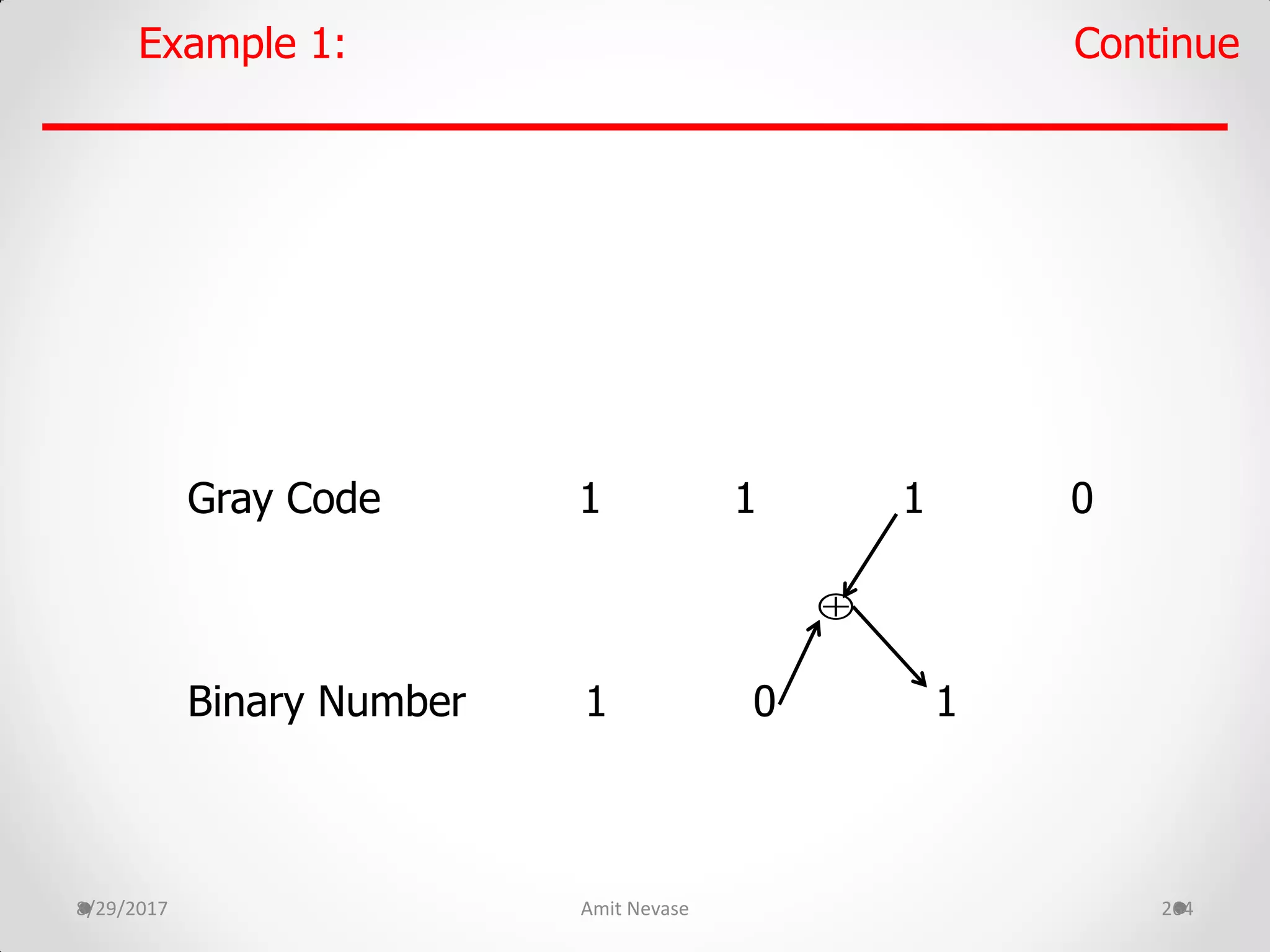
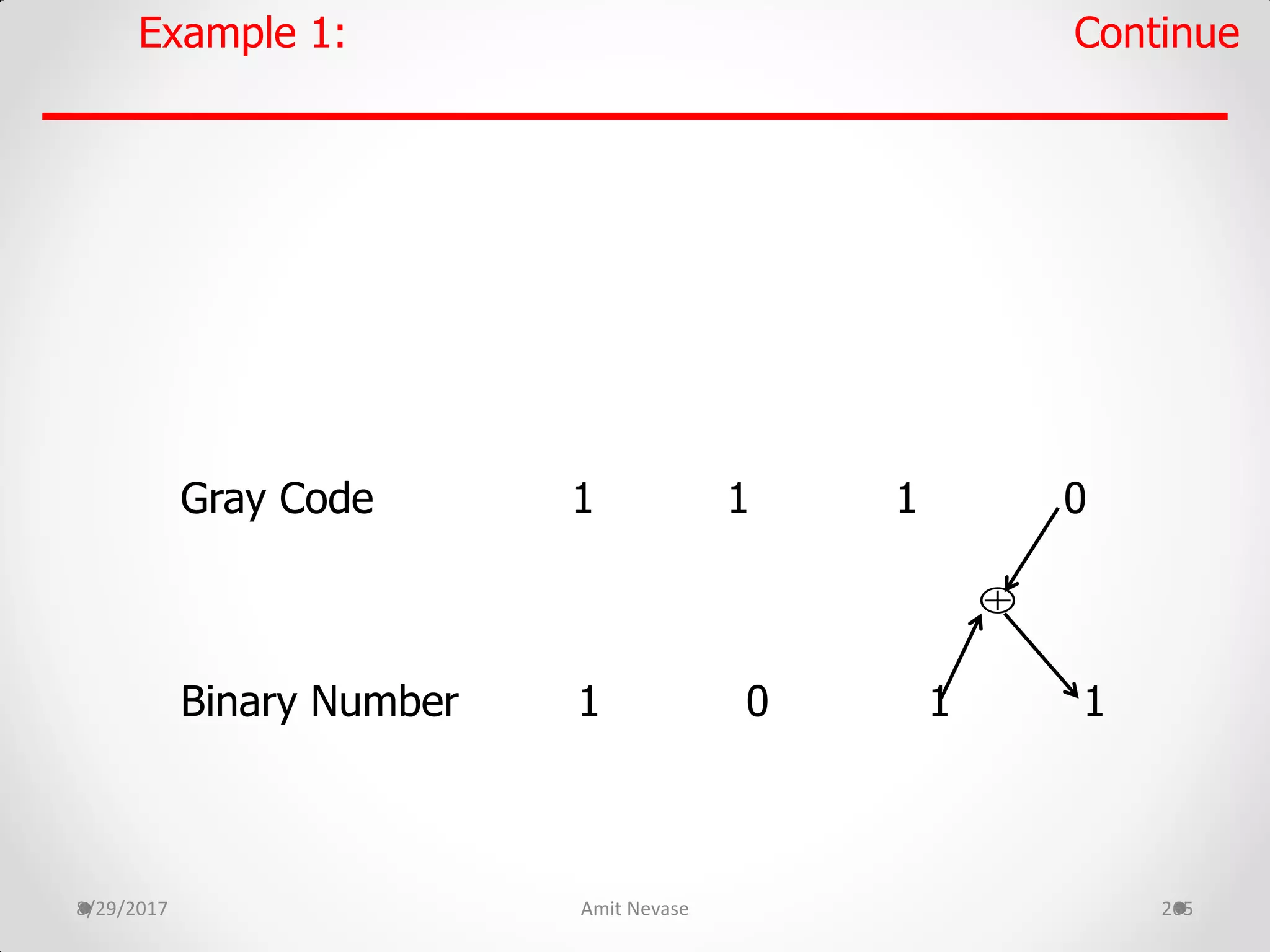
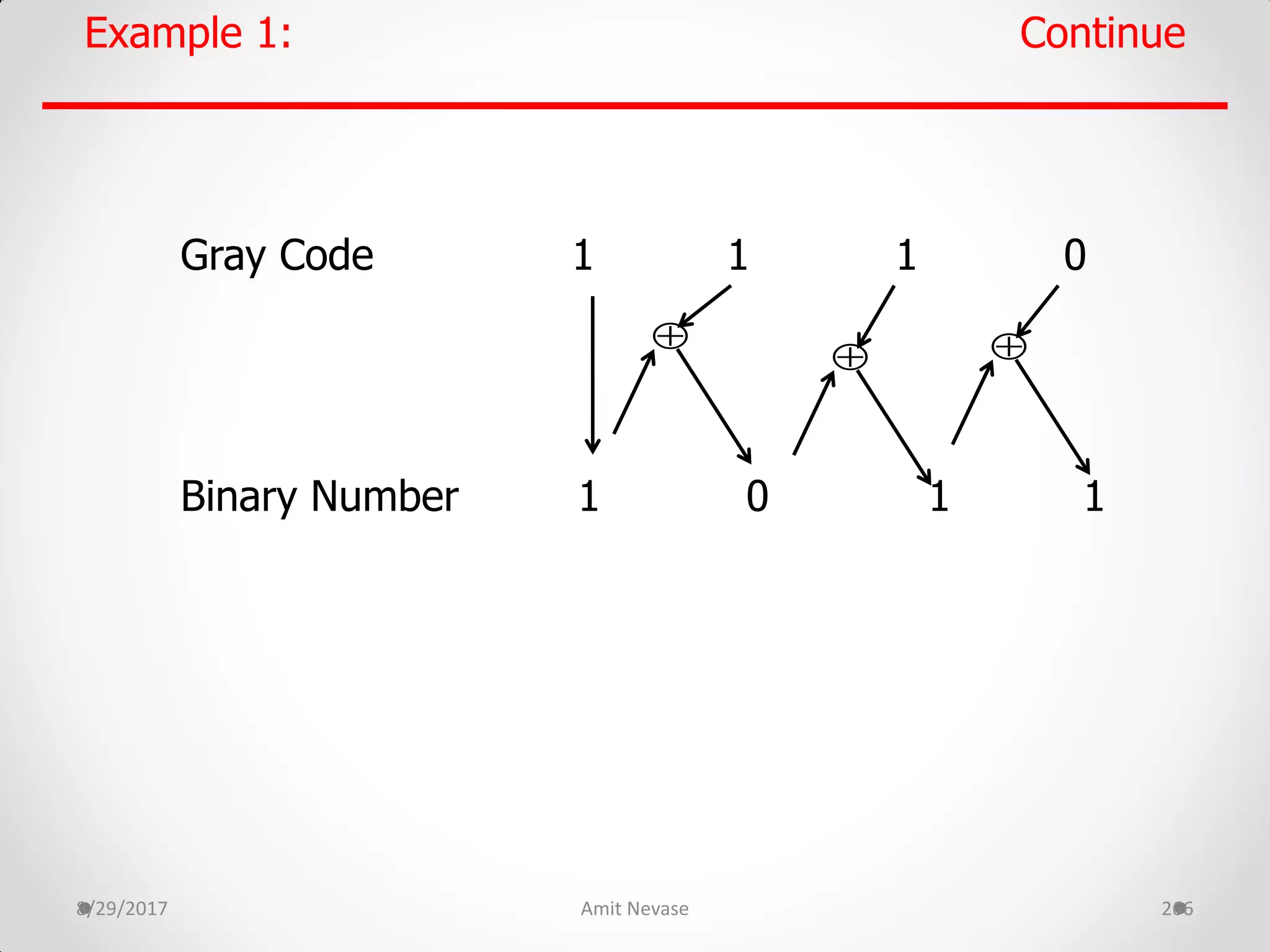
Example 1: Convert 1110 Gray code into Binary Number.
Gray Code to Binary Conversion
8/29/2017 Amit Nevase 261
Example 1: Convert 1110 Gray code into Binary Number.
Gray Code 1 1 1 0
8/29/2017 Amit Nevase 262
Example 1: Continue
Gray Code 1 1 1 0
Binary Number 1
8/29/2017 Amit Nevase 263
Gray Code 1 1 1 0
Binary Number 1 0
Example 1: Continue

8/29/2017 Amit Nevase 264
Gray Code 1 1 1 0
Binary Number 1 0 1
Example 1: Continue

8/29/2017 Amit Nevase 265
Gray Code 1 1 1 0
Binary Number 1 0 1 1
Example 1: Continue

8/29/2017 Amit Nevase 266
Gray Code 1 1 1 0
Binary Number 1 0 1 1
Example 1: Continue

 
Gray Code to Binary Conversion
8/29/2017 Amit Nevase 267
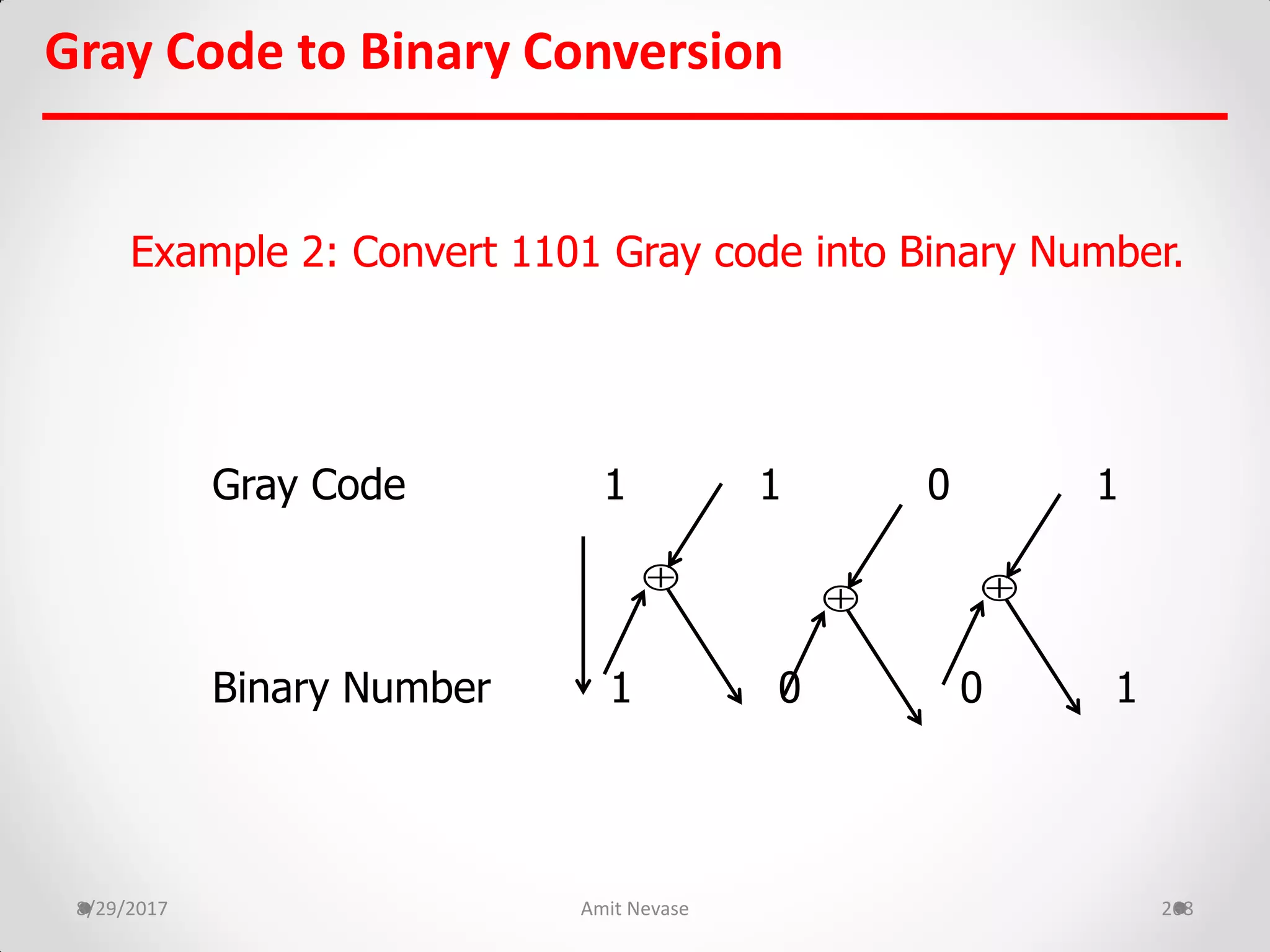
Example 2: Convert 1101 Gray code into Binary Number.
Gray Code to Binary Conversion
8/29/2017 Amit Nevase 268
Example 2: Convert 1101 Gray code into Binary Number.
Gray Code 1 1 0 1
Binary Number 1 0 0 1

 
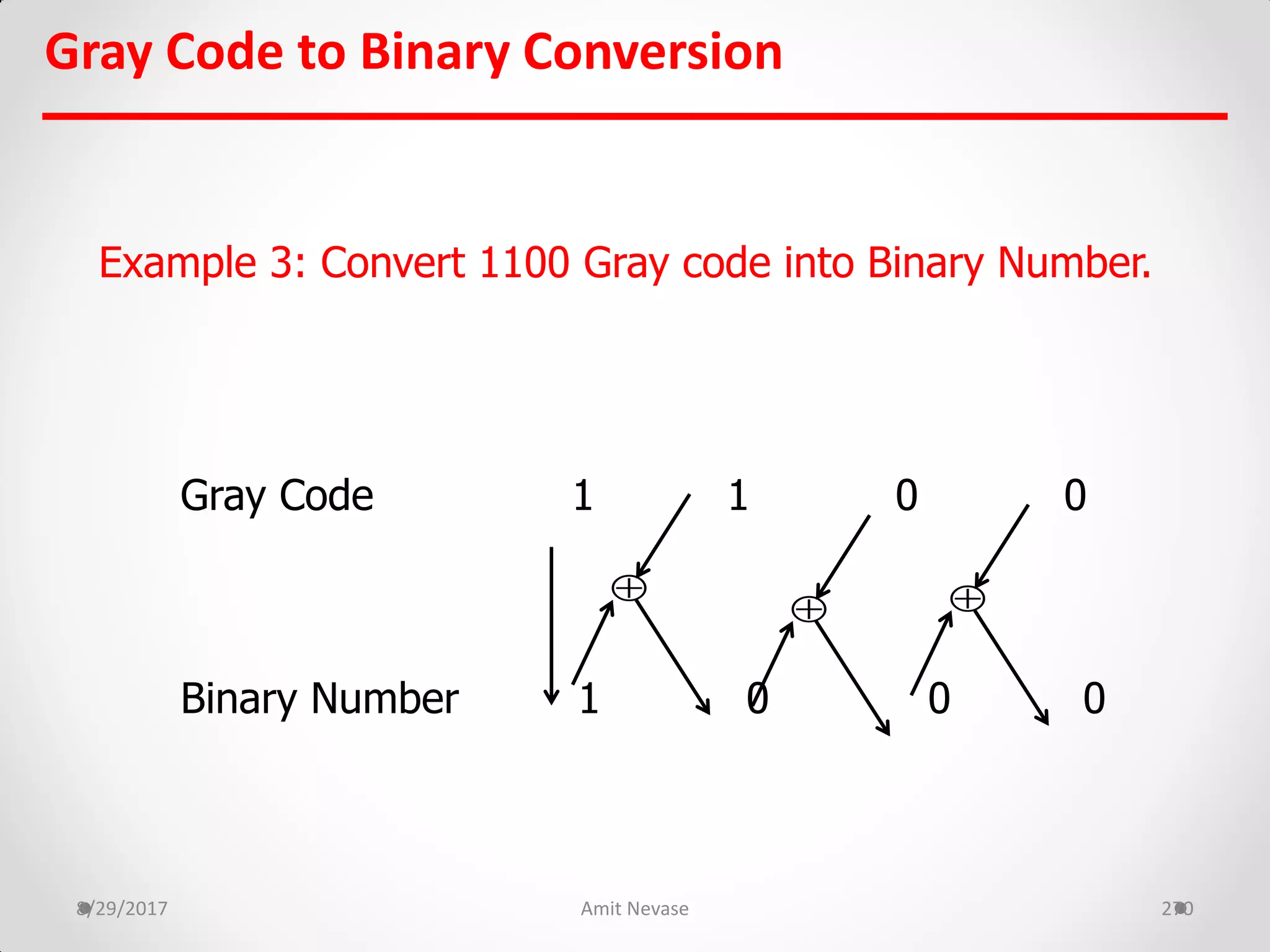
8/29/2017 Amit Nevase 269
Gray Code to Binary Conversion
Example 3: Convert 1100 Gray code into Binary Number.
8/29/2017 Amit Nevase 270
Gray Code to Binary Conversion
Example 3: Convert 1100 Gray code into Binary Number.
Gray Code 1 1 0 0
Binary Number 1 0 0 0

 
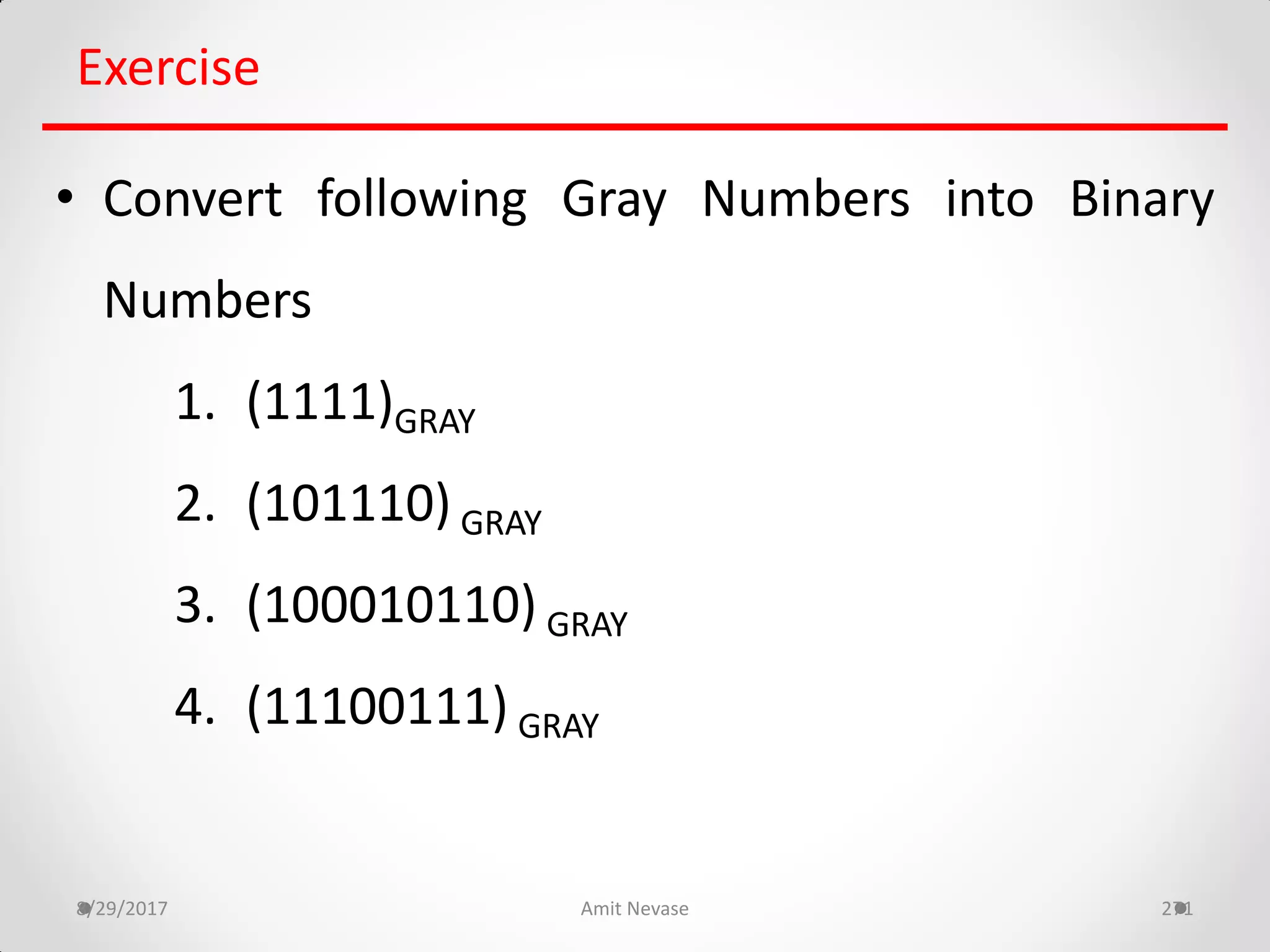
8/29/2017 Amit Nevase 271
Exercise
• Convert following Gray Numbers into Binary
Numbers
1. (1111)GRAY
2. (101110) GRAY
3. (100010110) GRAY
4. (11100111) GRAY
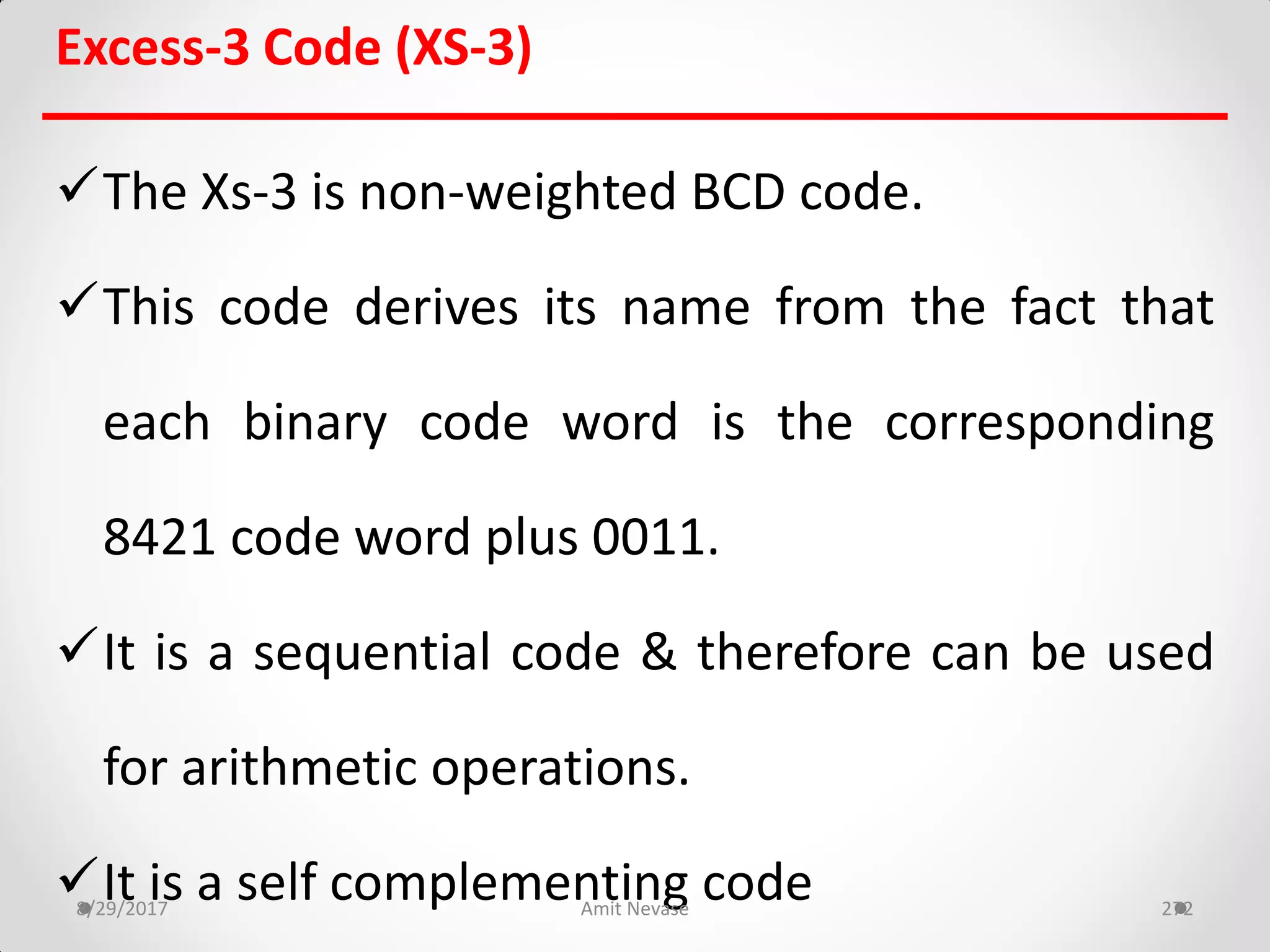
Excess-3 Code (XS-3)
The Xs-3 is non-weighted BCD code.
This code derives its name from the fact that
each binary code word is the corresponding
8421 code word plus 0011.
It is a sequential code & therefore can be used
for arithmetic operations.
It is a self complementing code8/29/2017 Amit Nevase 272
8/29/2017 Amit Nevase 273
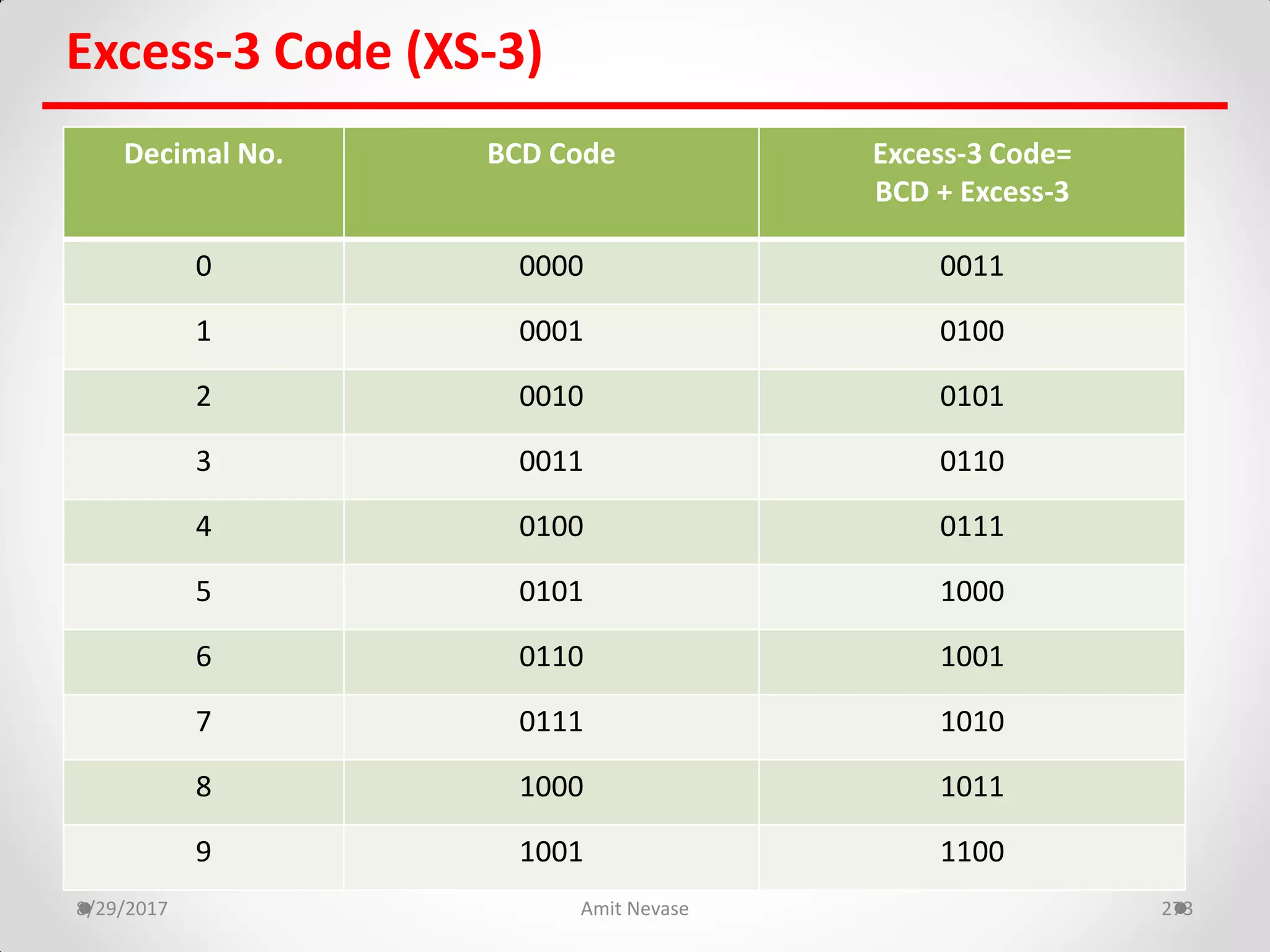
Excess-3 Code (XS-3)
Decimal No. BCD Code Excess-3 Code=
BCD + Excess-3
0 0000 0011
1 0001 0100
2 0010 0101
3 0011 0110
4 0100 0111
5 0101 1000
6 0110 1001
7 0111 1010
8 1000 1011
9 1001 1100
8/29/2017 Amit Nevase 274
Excess-3 Code (XS-3)
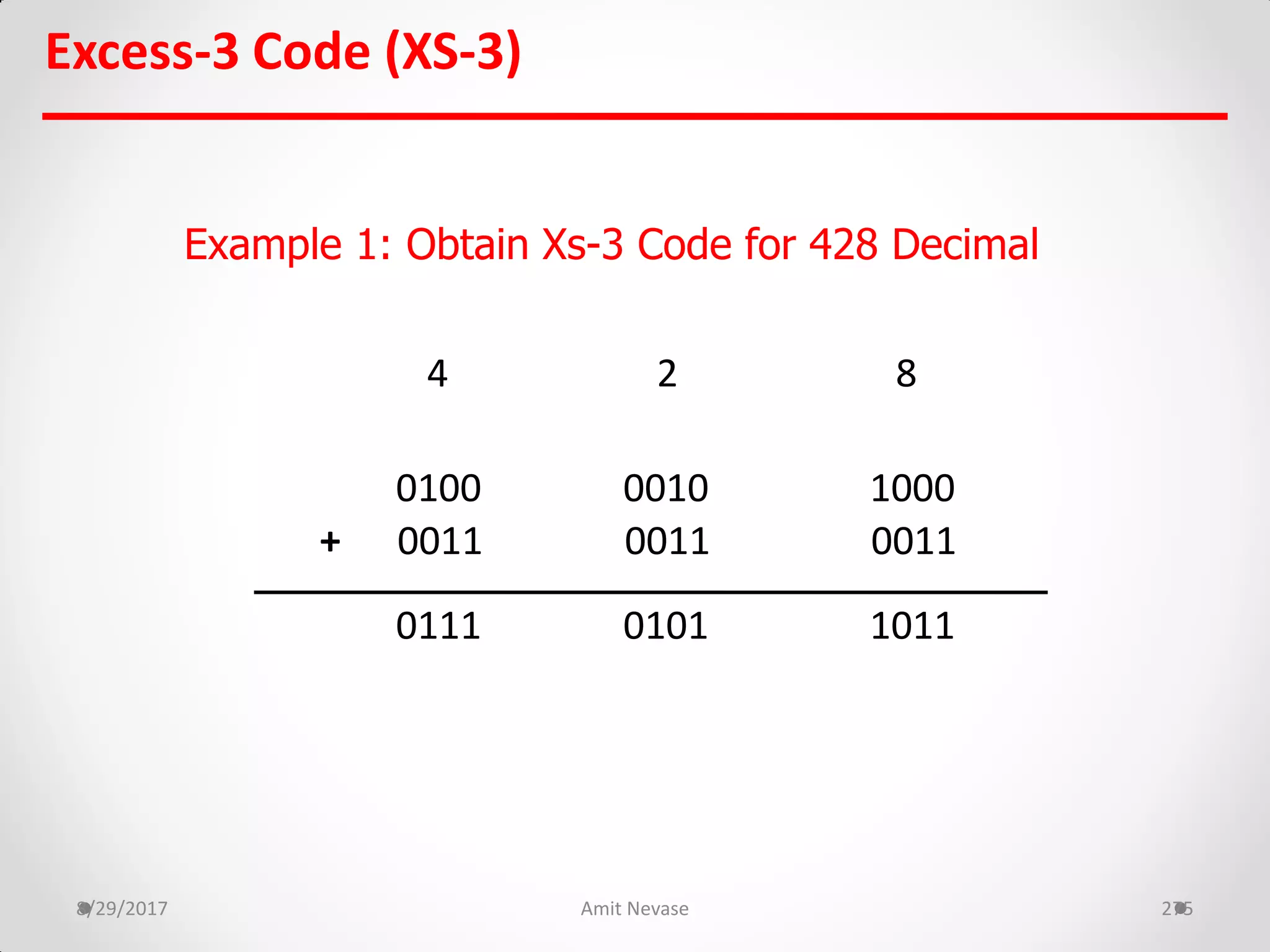
Example 1: Obtain Xs-3 Code for 428 Decimal
8/29/2017 Amit Nevase 275
Excess-3 Code (XS-3)
Example 1: Obtain Xs-3 Code for 428 Decimal
4 2 8
0100 0010 1000
+ 0011 0011 0011
0111 0101 1011
8/29/2017 Amit Nevase 276
Exercise
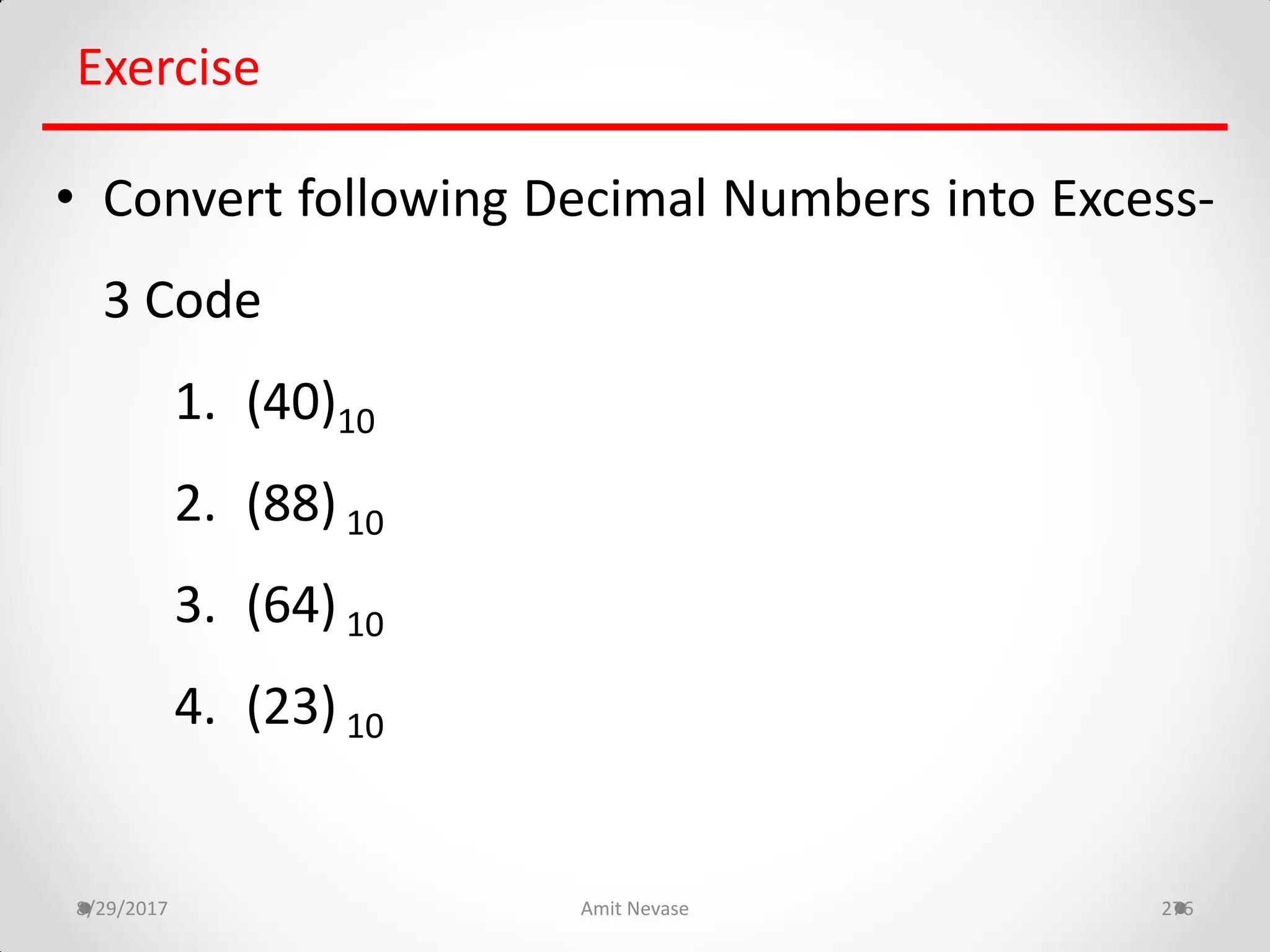
• Convert following Decimal Numbers into Excess-
3 Code
1. (40)10
2. (88) 10
3. (64) 10
4. (23) 10
ASCII Codes
The American Standard Code for Information
Interchange is a character-encoding scheme
originally based on the English alphabet.
ASCII codes represent text in computers,
communications equipment, and other devices
that use text.
Most modern character-encoding schemes are
based on ASCII, though they support many
additional characters.
8/29/2017 Amit Nevase 277
ASCII developed from telegraphic codes. Its first
commercial use was as a seven-bit tele-printer
code promoted by Bell data services.
Work on the ASCII standard began on October 6,
1960, with the first meeting of the American
Standards Association's (ASA) X3.2
subcommittee.
The first edition of the standard was published
during 1963.
8/29/2017 Amit Nevase 278
ASCII Codes
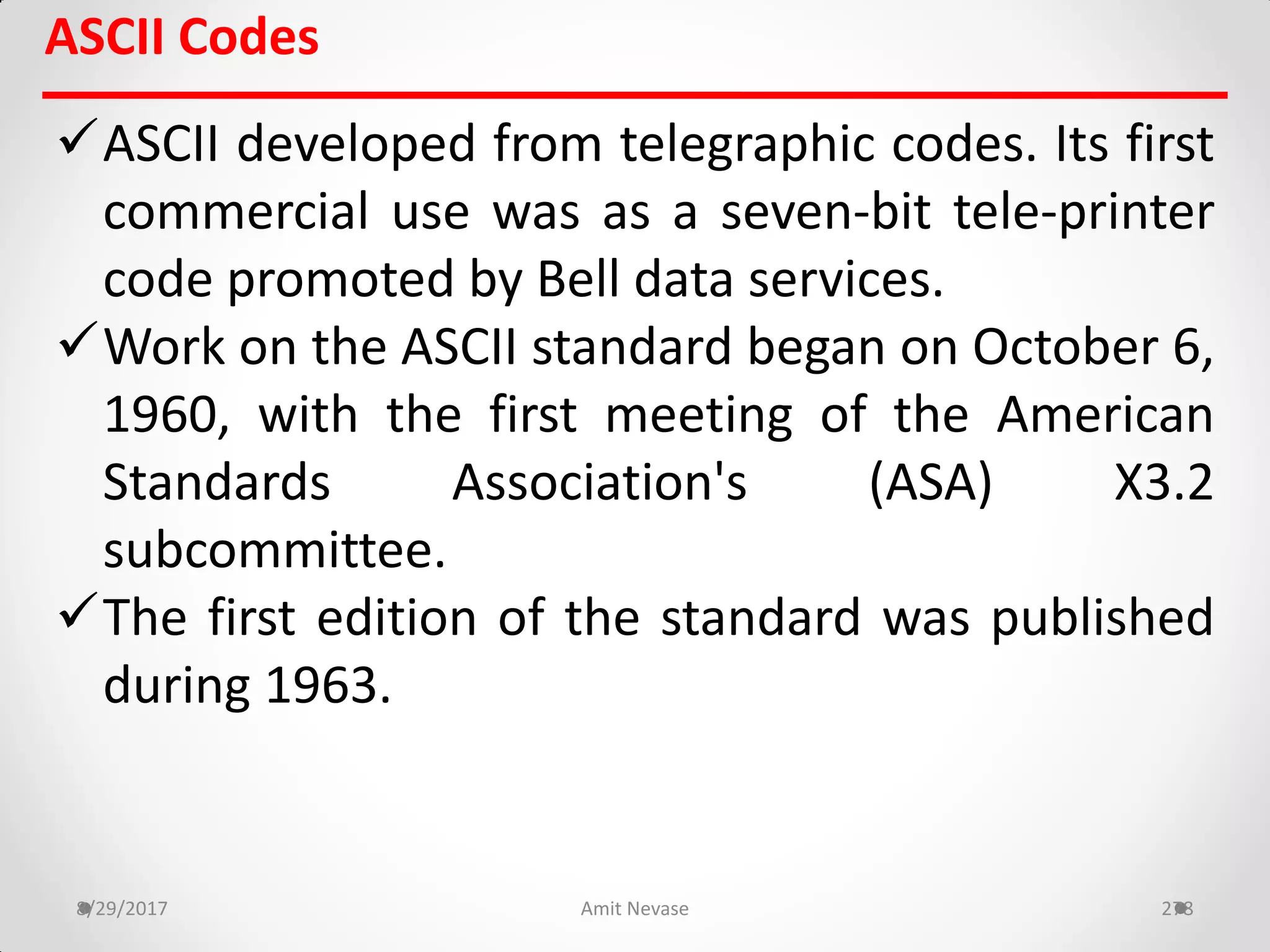
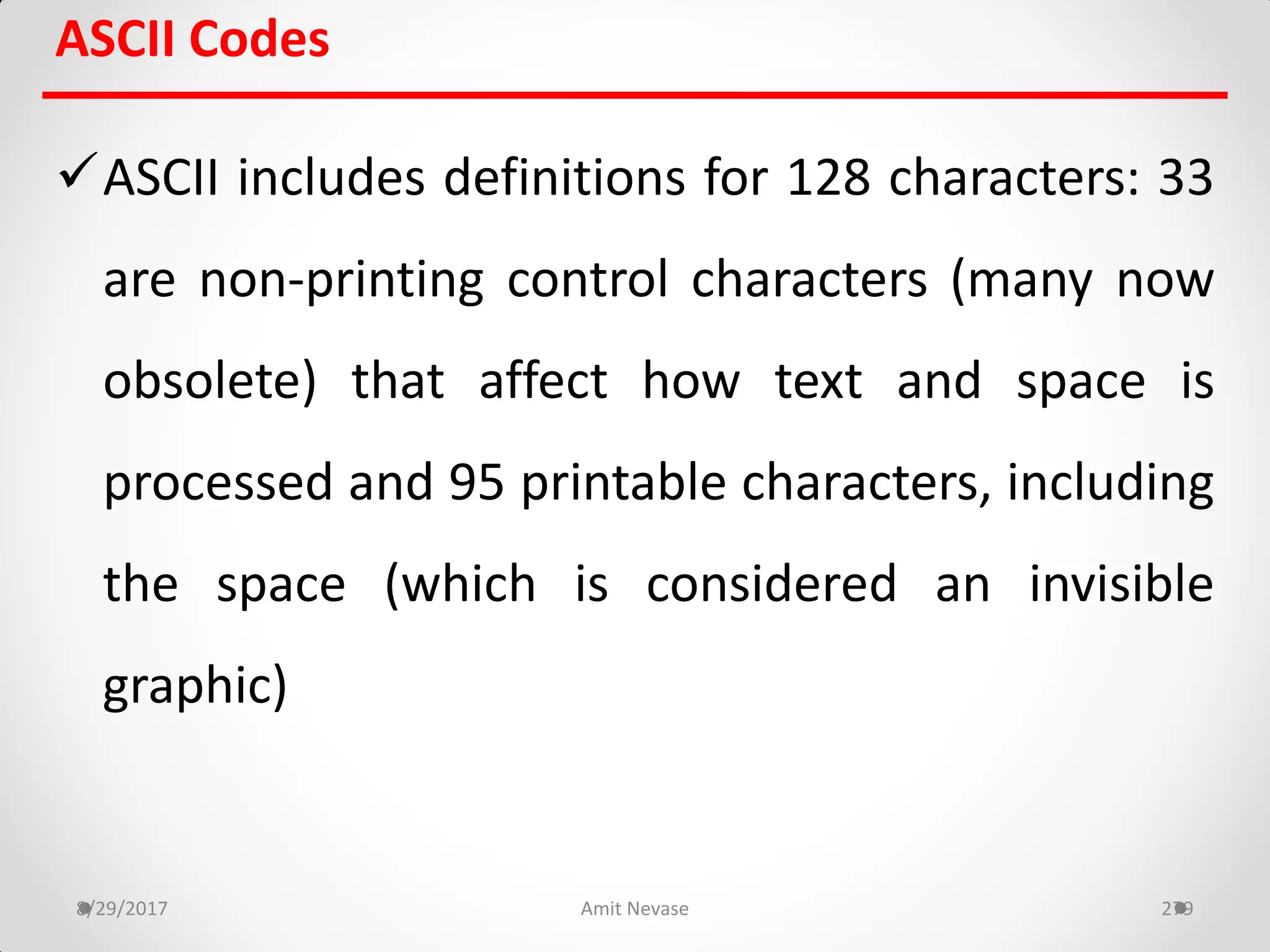
ASCII includes definitions for 128 characters: 33
are non-printing control characters (many now
obsolete) that affect how text and space is
processed and 95 printable characters, including
the space (which is considered an invisible
graphic)
8/29/2017 Amit Nevase 279
ASCII Codes
8/29/2017 Amit Nevase 280
ASCII Codes
B7 0 0 0 0 1 1 1 1
B6 0 0 1 1 0 0 1 1
B5 0 1 0 1 0 1 0 1
B4 B3 B2 B1 0 1 2 3 4 5 6 7
0 0 0 0 0 NUL DLE SP 0 @ P ‘ p
0 0 0 1 1 SOH DC1 | 1 A Q a q
0 0 1 0 2 STX DC2 “ 2 B R b r
0 0 1 1 3 ETX DC3 # 3 C S c s
0 1 0 0 4 EOT DC4 $ 4 D T d t
0 1 0 1 5 ENQ NAK % 5 E U e u
0 1 1 0 6 ACK SYN & 6 F V f v
0 1 1 1 7 BEL ETB ‘ 7 G W g w
1 0 0 0 8 BS CAN ( 8 H X h x
1 0 0 1 9 HT EM ) 9 I Y i y
1 0 1 0 10 LF SUB “ : J Z j z
1 0 1 1 11 VT ESC + ; K [ k {
1 1 0 0 12 FF FC , < L  l !
1 1 0 1 13 CR GS = M ] m }
1 1 1 0 14 SO RS . > N ^ n ~
References
Digital Principles by
Malvino Leach
Modern Digital
Electronics by R.P. Jain
Digital Electronics,
Principles and Integrated
Circuits by Anil K. Maini
Digital Techniques by A.
Anand Kumar
8/29/2017 Amit Nevase 281
Online Tutorials
http://nptel.ac.in/video.
php?subjectId=1171060
86
http://www.electronics-
tutorials.ws/binary/bin_
1.html
8/29/2017 Amit Nevase 282
Thank You
8/29/2017 283

NUMBER SYSTEM

  • 1.
    Pune Vidyarthi Griha’s COLLEGEOF ENGINEERING, NASHIK – 3. “Number System” By Prof. Anand N. Gharu (Assistant Professor) PVGCOE Computer Dept. 30th June 2017 .
  • 2.
    Chapter I –Number System  Introduction to digital signal, Advantages of Digital System over analog systems  Number Systems: Different types of number systems( Binary, Octal, Hexadecimal ), conversion of number systems,  Binary arithmetic: Addition, Subtraction, Multiplication, Division.  Subtraction using 1’s complement and 2’s complement  Codes  Codes -BCD, Gray Code, Excess-3, ASCII code  BCD addition, BCD subtraction using 9’s and 10’ complement  (Numericals based on above topic). 8/29/2017 2
  • 3.
    Chapter - I NumberSystem 8/29/2017 Amit Nevase 3
  • 4.
    Chapter I –Number System  Introduction to digital signal, Advantages of Digital System over analog systems (8 Marks)  Number Systems: Different types of number systems( Binary, Octal, Hexadecimal ), conversion of number systems,  Binary arithmetic: Addition, Subtraction, Multiplication, Division.  Subtraction using 1’s complement and 2’s complement  Codes (4 Marks)  Codes -BCD, Gray Code, Excess-3, ASCII code  BCD addition, BCD subtraction using 9’s and 10’ complement  (Numericals based on above topic). 8/29/2017 Amit Nevase 4
  • 5.
    Analog Vs Digital Analogsystem The physical quantities or signals may vary continuously over a specified range. Digital system The physical quantities or signals can assume only discrete values. Greater accuracy 8/29/2017 Amit Nevase 5
  • 6.
    8/29/2017 Amit Nevase6 t X(t) Analog signal t X(t) Digital signal Analog Vs Digital
  • 7.
    Advantages of DigitalSystem over Analog System 8/29/2017 Amit Nevase 7 Digital Systems are easier to design Information storage is easy Accuracy & Precision are greater Digital systems are more versatile Digital circuits are less affected by noise More digital circuitry can be fabricated on IC chips
  • 8.
    Chapter I –Number System  Introduction to digital signal, Advantages of Digital System over analog systems  Number Systems: Different types of number systems( Binary, Octal, Hexadecimal ), conversion of number systems,  Binary arithmetic: Addition, Subtraction, Multiplication, Division.  Subtraction using 1’s complement and 2’s complement  Codes  Codes -BCD, Gray Code, Excess-3, ASCII code  BCD addition, BCD subtraction using 9’s and 10’ complement  (Numericals based on above topic). 8/29/2017 Amit Nevase 8
  • 9.
    Number System A numbersystem defines a set of values used to represent quantity. 8/29/2017 Amit Nevase 9
  • 10.
    Different Number Systems DecimalNumber System - Base 10 Binary Number System - Base 2 Octal Number System - Base 8 Hexadecimal Number System 8/29/2017 Amit Nevase 10
  • 11.
    Decimal Number System Decimalnumber system contains ten unique symbols 0,1,2,3,4,5,6,7,8 and 9 Since counting in decimal involves ten symbols, we can say that its base or radix is ten. It is a positional weighted system 8/29/2017 Amit Nevase 11
  • 12.
    Decimal Number System 8/29/2017Amit Nevase 12 In this system, any number (integer, fraction or mixed) of any magnitude can be represented by the use of these ten symbols only Each symbols in the number is called a “Digit”
  • 13.
    Decimal Number System 8/29/2017Amit Nevase 13 Structure: Decimal No. Positional Weights ....... .... Decimal Point MSD LSD 1d2d3d 1d  2d 0d 0 101 102 103 10 1 10 2 10
  • 14.
    Decimal Number System MSD:The leftmost digit in any number representation, which has the greatest positional weight out of all the digits present in that number is called the “Most Significant Digit” (MSD) LSD: The rightmost digit in any number representation, which has the least positional weight out of all the digits present in that number is called the “Least Significant Digit”8/29/2017 Amit Nevase 14
  • 15.
  • 16.
    Binary Number System Binarynumber system is a positional weighted system It contains two unique symbols 0 and 1 Since counting in binary involves two symbols, we can say that its base or radix is two. 8/29/2017 Amit Nevase 16
  • 17.
    A binary digitis called a “Bit” A binary number consists of a sequence of bits, each of which is either a 0 or a 1. The binary point separates the integer and fraction parts 8/29/2017 Amit Nevase 17 Binary Number System
  • 18.
    8/29/2017 Amit Nevase18 Binary Number System Structure: Binary No. Positional Weights ....... .... Binary Point MSB LSB 1b2b3b 1b  2b 0b 0 21 22 23 2 1 2 2 2
  • 19.
    MSB: The leftmostbit in a given binary number with the highest positional weight is called the “Most Significant Bit” (MSB) LSB: The rightmost bit in a given binary number with the lowest positional weight is called the “Least Significant Bit” (LSB) 8/29/2017 Amit Nevase 19 Binary Number System
  • 20.
    8/29/2017 Amit Nevase20 Binary Number System Decimal No. Binary No. 0 0000 1 0001 2 0010 3 0011 4 0100 5 0101 6 0110 7 0111 Decimal No. Binary No. 8 1000 9 1001 10 1010 11 1011 12 1100 13 1101 14 1110 15 1111
  • 21.
    BIT: The binarydigits (0 and 1) are called bits. - Single unit in binary digit is called “Bit” - Example 1 0 8/29/2017 Amit Nevase 21 Terms related to Binary Numbers
  • 22.
    NIBBLE: A nibbleis a combination of 4 binary bits. Examples, 1110 0000 1001 0101 8/29/2017 Amit Nevase 22 Terms related to Binary Numbers
  • 23.
    BYTE: A byteis a combination of 8 binary bits. The number of distinct values represented by a byte is 256 ranging from 0000 0000 to 1111 1111. 8/29/2017 Amit Nevase 23 Terms related to Binary Numbers MSB LSB Higher order nibble Lower order nibble 0b1b2b3b7b 6b 5b 4b
  • 24.
    WORD: A wordis a combination of 16 binary bits. Hence it consists of two bytes. 8/29/2017 Amit Nevase 24 Terms related to Binary Numbers MSB LSB Higher order byte Lower order byte 0b1b2b3b6b 5b15b 14b 13b 12b 11b 10b 9b 8b 7b 4b
  • 25.
    DOUBLE WORD: Adouble word is exactly what its name implies, two words -It is a combination of 32 binary bits. 8/29/2017 Amit Nevase 25 Terms related to Binary Numbers
  • 26.
    Octal Number System Octalnumber system is a positional weighted system It contains eight unique symbols 0,1,2,3,4,5,6 and 7 Since counting in octal involves eight symbols, we can say that its base or radix is eight. 8/29/2017 Amit Nevase 26
  • 27.
    The largest valueof a digit in the octal system will be 7. That means the octal number higher than 7 will not be 8, instead of that it will be 10. 8/29/2017 Amit Nevase 27 Octal Number System
  • 28.
    8/29/2017 Amit Nevase28 Octal Number System Structure: Octal No. Positional Weights ....... .... Radix Point MSD LSD 1O2O3O 1O  2O 0O 0 81 82 83 8 1 8 2 8
  • 29.
    Since its base, every 3 bit group of binary can be represented by an octal digit. An octal number is thus 1/3rd the length of the corresponding binary number 8/29/2017 Amit Nevase 29 Octal Number System 3 8 2
  • 30.
    8/29/2017 Amit Nevase30 Octal Number System Decimal No. Binary No. Octal No. 0 0000 0 1 0001 1 2 0010 2 3 0011 3 4 0100 4 5 0101 5 6 0110 6 7 0111 7 8 1000 10 9 1001 11 10 1010 12 11 1011 13 12 1100 14 13 1101 15
  • 31.
    Hexadecimal Number System(HEX) Binary numbers are long. These numbers are fine for machines but are too lengthy to be handled by human beings. So there is a need to represent the binary numbers concisely. One number system developed with this objective is the hexadecimal number system (or Hex) 8/29/2017 Amit Nevase 31
  • 32.
    Hex number systemis a positional weighted system It contains sixteen unique symbols 0,1,2,3,4,5,6,7,8,9,A,B,C,D,E and F. Since counting in hex involves sixteen symbols, we can say that its base or radix is sixteen. 8/29/2017 Amit Nevase 32 Hexadecimal Number System (HEX)
  • 33.
    8/29/2017 Amit Nevase33 Hexadecimal Number System (HEX) Structure: Hex No. Positional Weights ....... .... Radix Point MSD LSD 1H2H3H 1H  2H 0H 0 161 162 163 16 1 16 2 16
  • 34.
    Since its base, every 4 bit group of binary can be represented by an hex digit. An hex number is thus 1/4th the length of the corresponding binary number The hex system is particularly useful for human communications with computer 8/29/2017 Amit Nevase 34 Hexadecimal Number System (HEX) 4 16 2
  • 35.
    8/29/2017 Amit Nevase35 Hexadecimal Number System (HEX) Decimal No. Binary No. Hex No. 0 0000 0 1 0001 1 2 0010 2 3 0011 3 4 0100 4 5 0101 5 6 0110 6 7 0111 7 Decimal No. Binary No. Hex No. 8 1000 8 9 1001 9 10 1010 A 11 1011 B 12 1100 C 13 1101 D 14 1110 E 15 1111 F
  • 36.
    Chapter I –Number System  Introduction to digital signal, Advantages of Digital System over analog systems  Number Systems: Different types of number systems( Binary, Octal, Hexadecimal ), Conversion of number systems,  Binary arithmetic: Addition, Subtraction, Multiplication, Division.  Subtraction using 1’s complement and 2’s complement  Codes  Codes -BCD, Gray Code, Excess-3, ASCII code  BCD addition, BCD subtraction using 9’s and 10’ complement  (Numericals based on above topic). 8/29/2017 Amit Nevase 36
  • 37.
    8/29/2017 Amit Nevase37 Conversion Among Bases Hexadecimal Decimal Octal Binary Possibilities
  • 38.
    8/29/2017 Amit Nevase38 Conversion from Decimal Number to Binary Number Hexadecimal Decimal Octal Binary
  • 39.
    Conversion of Decimalnumber into Binary number (Integer Number) Procedure: 1. Divide the decimal no by the base 2, noting the remainder. 2. Continue to divide the quotient by 2 until there is nothing left, keeping the track of the remainders from each step. 3. List the remainder values in reverse order to find the number’s binary equivalent8/29/2017 Amit Nevase 39
  • 40.
    Example: Convert 105decimal number in to it’s equivalent binary number. 8/29/2017 Amit Nevase 40
  • 41.
    Example: Convert 105decimal number in to it’s equivalent binary number. 8/29/2017 Amit Nevase 41 1052
  • 42.
    Example: Convert 105decimal number in to it’s equivalent binary number. 8/29/2017 Amit Nevase 42 105 52 2 2 1
  • 43.
    Example: Convert 105decimal number in to it’s equivalent binary number. 8/29/2017 Amit Nevase 43 105 52 26 2 2 2 1 0
  • 44.
    Example: Convert 105decimal number in to it’s equivalent binary number. 8/29/2017 Amit Nevase 44 105 52 26 13 2 2 2 2 1 0 0
  • 45.
    Example: Convert 105decimal number in to it’s equivalent binary number. 8/29/2017 Amit Nevase 45 105 52 26 13 6 2 2 2 2 2 1 0 0 1
  • 46.
    Example: Convert 105decimal number in to it’s equivalent binary number. 8/29/2017 Amit Nevase 46 105 52 26 13 6 3 2 2 2 2 2 2 1 0 0 0 1
  • 47.
    Example: Convert 105decimal number in to it’s equivalent binary number. 8/29/2017 Amit Nevase 47 105 52 26 13 6 3 1 2 2 2 2 2 2 2 1 0 0 0 1 1
  • 48.
    Example: Convert 105decimal number in to it’s equivalent binary number. 8/29/2017 Amit Nevase 48 105 52 26 13 6 3 1 0 2 2 2 2 2 2 2 1 0 0 0 1 1 1
  • 49.
    Example: Convert 105decimal number in to it’s equivalent binary number. 8/29/2017 Amit Nevase 49 105 52 26 13 6 3 1 0 2 2 2 2 2 2 2 1 0 0 0 1 1 1 LSB MSB 10 2(105) (1101001)
  • 50.
    Procedure: 1. Multiply thegiven fractional number by base 2. 2. Record the carry generated in this multiplication as MSB. 3. Multiply only the fractional number of the product in step 2 by 2 and record the carry as the next bit to MSB. 4. Repeat the steps 2 and 3 up to 5 bits. The last carry will represent the LSB of equivalent binary number 8/29/2017 Amit Nevase 50 Conversion of Decimal number into Binary number (Fractional Number)
  • 51.
    8/29/2017 Amit Nevase51 Example: Convert 0.42 decimal number in to it’s equivalent binary number.
  • 52.
    8/29/2017 Amit Nevase52 Example: Convert 0.42 decimal number in to it’s equivalent binary number. 0.42 X 2 = 0.84 0
  • 53.
    8/29/2017 Amit Nevase53 Example: Convert 0.42 decimal number in to it’s equivalent binary number. 0.42 X 2 = 0.84 0 0.84 X 2 = 1.68 1
  • 54.
    8/29/2017 Amit Nevase54 Example: Convert 0.42 decimal number in to it’s equivalent binary number. 0.42 X 2 = 0.84 0 0.84 X 2 = 1.68 1 0.68 X 2 = 1.36 1
  • 55.
    8/29/2017 Amit Nevase55 Example: Convert 0.42 decimal number in to it’s equivalent binary number. 0.42 X 2 = 0.84 0 0.84 X 2 = 1.68 1 0.68 X 2 = 1.36 1 0.36 X 2 = 0.72 0
  • 56.
    8/29/2017 Amit Nevase56 Example: Convert 0.42 decimal number in to it’s equivalent binary number. 0.42 X 2 = 0.84 0 0.84 X 2 = 1.68 1 0.68 X 2 = 1.36 1 0.36 X 2 = 0.72 0 0.72 X 2 = 1.44 1
  • 57.
    8/29/2017 Amit Nevase57 Example: Convert 0.42 decimal number in to it’s equivalent binary number. 0.42 X 2 = 0.84 0 0.84 X 2 = 1.68 1 0.68 X 2 = 1.36 1 0.36 X 2 = 0.72 0 0.72 X 2 = 1.44 1 LSB MSB 10 2(0.42) (0.01101)
  • 58.
    8/29/2017 Amit Nevase58 Exercise • Convert following Decimal Numbers in to its equivalent Binary Number: 1. (1248.56)10 = ( ? )2 2. (8957.75)10 = ( ? )2 3. (420.6)10 = ( ? )2 4. (8476.47)10 = ( ? )2
  • 59.
    8/29/2017 Amit Nevase59 Conversion from Decimal Number to Octal Number Hexadecimal Decimal Octal Binary
  • 60.
    Conversion of DecimalNumber into Octal Number (Integer Number) Procedure: 1. Divide the decimal no by the base 8, noting the remainder. 2. Continue to divide the quotient by 8 until there is nothing left, keeping the track of the remainders from each step. 3. List the remainder values in reverse order to find the number’s octal equivalent8/29/2017 Amit Nevase 60
  • 61.
    Example: Convert 204decimal number in to it’s equivalent octal number. 8/29/2017 Amit Nevase 61
  • 62.
    Example: Convert 204decimal number in to it’s equivalent octal number. 8/29/2017 Amit Nevase 62 2048
  • 63.
    Example: Convert 204decimal number in to it’s equivalent octal number. 8/29/2017 Amit Nevase 63 2048 48 25 2048 2 5 - 16 44 - 40 4
  • 64.
    Example: Convert 204decimal number in to it’s equivalent octal number. 8/29/2017 Amit Nevase 64 2048 4 1 8 8 25 3 258 3 - 24 1
  • 65.
    Example: Convert 204decimal number in to it’s equivalent octal number. 8/29/2017 Amit Nevase 65 2048 4 3 1 8 8 25 3 0
  • 66.
    Example: Convert 204decimal number in to it’s equivalent octal number. 8/29/2017 Amit Nevase 66 2048 4 3 1 LSB MSB 8 8 25 3 0 10 8(204) (314)
  • 67.
    Procedure: 1. Multiply thegiven fractional number by base 8. 2. Record the carry generated in this multiplication as MSB. 3. Multiply only the fractional number of the product in step 2 by 8 and record the carry as the next bit to MSB. 4. Repeat the steps 2 and 3 up to 5 bits. The last carry will represent the LSB of equivalent octal number 8/29/2017 Amit Nevase 67 Conversion of Decimal Number into Octal Number (Fractional Number)
  • 68.
    Example: Convert 0.6234decimal number in to it’s equivalent Octal number. 8/29/2017 Amit Nevase 68
  • 69.
    Example: Convert 0.6234decimal number in to it’s equivalent Octal number. 8/29/2017 Amit Nevase 69 0.6234 X 8 = 4.9872 4
  • 70.
    Example: Convert 0.6234decimal number in to it’s equivalent Octal number. 8/29/2017 Amit Nevase 70 0.6234 X 8 = 4.9872 4 0.9872 X 8 = 7.8976 7
  • 71.
    Example: Convert 0.6234decimal number in to it’s equivalent Octal number. 8/29/2017 Amit Nevase 71 0.6234 X 8 = 4.9872 4 0.9872 X 8 = 7.8976 7 0.8976 X 8 = 7.1808 7
  • 72.
    Example: Convert 0.6234decimal number in to it’s equivalent Octal number. 8/29/2017 Amit Nevase 72 0.6234 X 8 = 4.9872 4 0.9872 X 8 = 7.8976 7 0.8976 X 8 = 7.1808 7 0.1808 X 8 = 1.4464 1
  • 73.
    Example: Convert 0.6234decimal number in to it’s equivalent Octal number. 8/29/2017 Amit Nevase 73 0.6234 X 8 = 4.9872 4 0.9872 X 8 = 7.8976 7 0.8976 X 8 = 7.1808 7 0.1808 X 8 = 1.4464 1 0.4464 X 8 = 3.5712 3
  • 74.
    Example: Convert 0.6234decimal number in to it’s equivalent Octal number. 8/29/2017 Amit Nevase 74 0.6234 X 8 = 4.9872 4 0.9872 X 8 = 7.8976 7 0.8976 X 8 = 7.1808 7 0.1808 X 8 = 1.4464 1 0.4464 X 8 = 3.5712 3 LSB MSB 10 8(0.6234) (0.47713)
  • 75.
    8/29/2017 Amit Nevase75 Exercise • Convert following Decimal Numbers in to its equivalent Octal Number: 1. (1248.56)10 = ( ? )8 2. (8957.75)10 = ( ? )8 3. (420.6)10 = ( ? )8 4. (8476.47)10 = ( ? )8
  • 76.
    8/29/2017 Amit Nevase76 Conversion from Decimal Number to Hex Number Hexadecimal Decimal Octal Binary
  • 77.
    Conversion of DecimalNumber into Hexadecimal Number (Integer Number) Procedure: 1. Divide the decimal no by the base 16, noting the remainder. 2. Continue to divide the quotient by 16 until there is nothing left, keeping the track of the remainders from each step. 3. List the remainder values in reverse order to find the number’s hex equivalent8/29/2017 Amit Nevase 77
  • 78.
    Example: Convert 2003decimal number in to it’s equivalent Hex number. 8/29/2017 Amit Nevase 78
  • 79.
    Example: Convert 2003decimal number in to it’s equivalent Hex number. 8/29/2017 Amit Nevase 79 200316
  • 80.
    Example: Convert 2003decimal number in to it’s equivalent Hex number. 8/29/2017 Amit Nevase 80 200316 316 125 3 200316 1 2 5 - 16 40 - 32 83 - 80 3
  • 81.
    Example: Convert 2003decimal number in to it’s equivalent Hex number. 8/29/2017 Amit Nevase 81 200316 3 13 16 16 125 7 3 D 12516 7 - 112 13
  • 82.
    Example: Convert 2003decimal number in to it’s equivalent Hex number. 8/29/2017 Amit Nevase 82 200316 3 7 13 16 16 125 7 0 3 7 D
  • 83.
    Example: Convert 2003decimal number in to it’s equivalent Hex number. 8/29/2017 Amit Nevase 83 200316 3 7 13 LSB MSB 16 16 125 7 0 3 7 D 10 16(2003) (7D3)
  • 84.
    Conversion of DecimalNumber into Hexadecimal Number (Fractional Number) Procedure: 1. Multiply the given fractional number by base 16. 2. Record the carry generated in this multiplication as MSB. 3. Multiply only the fractional number of the product in step 2 by 16 and record the carry as the next bit to MSB. 4. Repeat the steps 2 and 3 up to 5 bits. The last carry will represent the LSB of equivalent hex number8/29/2017 Amit Nevase 84
  • 85.
    Example: Convert 0.122decimal number in to it’s equivalent Hex number. 8/29/2017 Amit Nevase 85
  • 86.
    Example: Convert 0.122decimal number in to it’s equivalent Hex number. 8/29/2017 Amit Nevase 86 0.122 X 16 = 1.952 1 1
  • 87.
    Example: Convert 0.122decimal number in to it’s equivalent Hex number. 8/29/2017 Amit Nevase 87 0.122 X 16 = 1.952 1 1 0.952 X 16 = 15.232 15 F
  • 88.
    Example: Convert 0.122decimal number in to it’s equivalent Hex number. 8/29/2017 Amit Nevase 88 0.122 X 16 = 1.952 1 1 0.952 X 16 = 15.232 15 F 0.232 X 16 = 3.712 3 3
  • 89.
    Example: Convert 0.122decimal number in to it’s equivalent Hex number. 8/29/2017 Amit Nevase 89 0.122 X 16 = 1.952 1 1 0.952 X 16 = 15.232 15 F 0.232 X 16 = 3.712 3 3 0.712 X 16 = 11.392 11 B
  • 90.
    Example: Convert 0.122decimal number in to it’s equivalent Hex number. 8/29/2017 Amit Nevase 90 0.122 X 16 = 1.952 1 1 0.952 X 16 = 15.232 15 F 0.232 X 16 = 3.712 3 3 0.712 X 16 = 11.392 11 B 0.392 X 16 = 6.272 6 6
  • 91.
    Example: Convert 0.122decimal number in to it’s equivalent Hex number. 8/29/2017 Amit Nevase 91 0.122 X 16 = 1.952 1 1 0.952 X 16 = 15.232 15 F 0.232 X 16 = 3.712 3 3 0.712 X 16 = 11.392 11 B 0.392 X 16 = 6.272 6 6 LSB MSB 10 16(0.122) (0.1F3B6)
  • 92.
    8/29/2017 Amit Nevase92 Exercise • Convert following Decimal Numbers in to its equivalent Hex Number: 1. (1248.56)10 = ( ? )16 2. (8957.75)10 = ( ? )16 3. (420.6)10 = ( ? )16 4. (8476.47)10 = ( ? )16
  • 93.
    8/29/2017 Amit Nevase93 Conversion from Binary Number to Decimal Number Hexadecimal Decimal Octal Binary
  • 94.
    Procedure: 1. Write downthe binary number. 2. Write down the weights for different positions. 3. Multiply each bit in the binary number with the corresponding weight to obtain product numbers to get the decimal numbers. 4. Add all the product numbers to get the decimal equivalent8/29/2017 Amit Nevase 94 Conversion of Binary Number into Decimal Number
  • 95.
    Example: Convert 1011.01binary number in to it’s equivalent decimal number. 8/29/2017 Amit Nevase 95
  • 96.
    Example: Convert 1011.01binary number in to it’s equivalent decimal number. 8/29/2017 Amit Nevase 96 Binary No. .101 0 11
  • 97.
    Example: Convert 1011.01binary number in to it’s equivalent decimal number. 8/29/2017 Amit Nevase 97 Binary No. Positional Weights .101 0 11 0 21 22 23 2 1 2 2 2
  • 98.
    Example: Convert 1011.01binary number in to it’s equivalent decimal number. 8/29/2017 Amit Nevase 98 Binary No. Positional Weights .101 0 11 0 21 22 23 2 1 2 2 2 3 2 1 0 1 2 (1 2 ) (0 2 ) (1 2 ) (1 2 ).(0 2 ) (1 2 )            
  • 99.
    Example: Convert 1011.01binary number in to it’s equivalent decimal number. 8/29/2017 Amit Nevase 99 Binary No. Positional Weights . = 8 + 0 + 2 + 1 . 0 + 0.25 101 0 11 0 21 22 23 2 1 2 2 2 3 2 1 0 1 2 (1 2 ) (0 2 ) (1 2 ) (1 2 ).(0 2 ) (1 2 )            
  • 100.
    Example: Convert 1011.01binary number in to it’s equivalent decimal number. 8/29/2017 Amit Nevase 100 Binary No. Positional Weights . = 8 + 0 + 2 + 1 . 0 + 0.25 = 11.25 101 0 11 0 21 22 23 2 1 2 2 2 3 2 1 0 1 2 (1 2 ) (0 2 ) (1 2 ) (1 2 ).(0 2 ) (1 2 )            
  • 101.
    Example: Convert 1011.01binary number in to it’s equivalent decimal number. 8/29/2017 Amit Nevase 101 Binary No. Positional Weights . = 8 + 0 + 2 + 1 . 0 + 0.25 = 11.25 101 0 11 0 21 22 23 2 1 2 2 2 3 2 1 0 1 2 (1 2 ) (0 2 ) (1 2 ) (1 2 ).(0 2 ) (1 2 )             2 10(1011.01) (11.25)
  • 102.
    8/29/2017 Amit Nevase102 Exercise • Convert following Binary Numbers in to its equivalent Decimal Number: 1. (1101110.011)2 = ( ? )10 2. (1101.11)2 = ( ? )10 3. (10001.01)2 = ( ? )10
  • 103.
    8/29/2017 Amit Nevase103 Conversion from Octal Number to Decimal Number Hexadecimal Decimal Octal Binary
  • 104.
    Procedure: 1. Write downthe octal number. 2. Write down the weights for different positions. 3. Multiply each bit in the binary number with the corresponding weight to obtain product numbers to get the decimal numbers. 4. Add all the product numbers to get the decimal equivalent8/29/2017 Amit Nevase 104 Conversion of Octal Number into Decimal Number
  • 105.
    Example: Convert 365.24octal number in to it’s equivalent decimal number. 8/29/2017 Amit Nevase 105
  • 106.
    Example: Convert 365.24octal number in to it’s equivalent decimal number. 8/29/2017 Amit Nevase 106 Octal No. .63 2 45
  • 107.
    Example: Convert 365.24octal number in to it’s equivalent decimal number. 8/29/2017 Amit Nevase 107 Octal No. Positional Weights .63 2 45 0 81 82 8 1 8 2 8
  • 108.
    Example: Convert 365.24octal number in to it’s equivalent decimal number. 8/29/2017 Amit Nevase 108 Octal No. Positional Weights .63 2 45 0 81 82 8 1 8 2 8 2 1 0 1 2 (3 8 ) (6 8 ) (5 8 ).(2 8 ) (4 8 )          
  • 109.
    Example: Convert 365.24octal number in to it’s equivalent decimal number. 8/29/2017 Amit Nevase 109 Octal No. Positional Weights . = 192 + 48 + 5 . 0.25 +0.0625 63 2 45 0 81 82 8 1 8 2 8 2 1 0 1 2 (3 8 ) (6 8 ) (5 8 ).(2 8 ) (4 8 )          
  • 110.
    Example: Convert 365.24octal number in to it’s equivalent decimal number. 8/29/2017 Amit Nevase 110 Octal No. Positional Weights . = 192 + 48 + 5 . 0.25 +0.0625 = 245.3125 63 2 45 0 81 82 8 1 8 2 8 2 1 0 1 2 (3 8 ) (6 8 ) (5 8 ).(2 8 ) (4 8 )          
  • 111.
    Example: Convert 365.24octal number in to it’s equivalent decimal number. 8/29/2017 Amit Nevase 111 Octal No. Positional Weights . = 192 + 48 + 5 . 0.25 +0.0625 = 245.3125 63 2 45 0 81 82 8 1 8 2 8 2 1 0 1 2 (3 8 ) (6 8 ) (5 8 ).(2 8 ) (4 8 )           8 10(365.24) (245.3125)
  • 112.
    8/29/2017 Amit Nevase112 Exercise • Convert following Octal Numbers in to its equivalent Decimal Number: 1. (3006.05)8 = ( ? )10 2. (273.56)8 = ( ? )10 3. (6534.04)8 = ( ? )10
  • 113.
    8/29/2017 Amit Nevase113 Conversion from Hex Number to Decimal Number Hexadecimal Decimal Octal Binary
  • 114.
    Procedure: 1. Write downthe hex number. 2. Write down the weights for different positions. 3. Multiply each bit in the binary number with the corresponding weight to obtain product numbers to get the decimal numbers. 4. Add all the product numbers to get the 8/29/2017 Amit Nevase 114 Conversion of Hexadecimal Number into Decimal Number
  • 115.
    Example: Convert 5826hex number in to it’s equivalent decimal number. 8/29/2017 Amit Nevase 115
  • 116.
    Example: Convert 5826hex number in to it’s equivalent decimal number. 8/29/2017 Amit Nevase 116 Hex No. 85 62
  • 117.
    Example: Convert 5826hex number in to it’s equivalent decimal number. 8/29/2017 Amit Nevase 117 Hex No. Positional Weights 85 62 1 162 163 16 0 16
  • 118.
    Example: Convert 5826hex number in to it’s equivalent decimal number. 8/29/2017 Amit Nevase 118 Hex No. Positional Weights 85 62 1 162 163 16 0 16 3 2 1 0 (5 16 ) (8 16 ) (2 16 ) (6 16 )       
  • 119.
    Example: Convert 5826hex number in to it’s equivalent decimal number. 8/29/2017 Amit Nevase 119 Hex No. Positional Weights =20480 + 2048 + 32 + 6 85 62 1 162 163 16 0 16 3 2 1 0 (5 16 ) (8 16 ) (2 16 ) (6 16 )       
  • 120.
    Example: Convert 5826hex number in to it’s equivalent decimal number. 8/29/2017 Amit Nevase 120 Hex No. Positional Weights =20480 + 2048 + 32 + 6 = 22566 85 62 1 162 163 16 0 16 3 2 1 0 (5 16 ) (8 16 ) (2 16 ) (6 16 )       
  • 121.
    Example: Convert 5826hex number in to it’s equivalent decimal number. 8/29/2017 Amit Nevase 121 Hex No. Positional Weights =20480 + 2048 + 32 + 6 = 22566 85 62 1 162 163 16 0 16 3 2 1 0 (5 16 ) (8 16 ) (2 16 ) (6 16 )        16 10(5826) (22566)
  • 122.
    8/29/2017 Amit Nevase122 Exercise • Convert following Hexadecimal Numbers in to its equivalent Decimal Number: 1. (4056)16 = ( ? )10 2. (6B7)16 = ( ? )10 3. (8E47.AB)16 = ( ? )10
  • 123.
    8/29/2017 Amit Nevase123 Conversion from Binary Number to Octal Number Hexadecimal Decimal Octal Binary
  • 124.
    Procedure: 1. Group thebinary bits into groups of 3 starting from LSB. 2. Convert each group into its equivalent decimal. As the number of bits in each group is restricted to 3, the decimal number will be same as octal number 8/29/2017 Amit Nevase 124 Conversion of Binary Number into Octal Number
  • 125.
    Example: Convert 11010010binary number in to it’s equivalent octal number. 8/29/2017 Amit Nevase 125
  • 126.
    Example: Convert 11010010binary number in to it’s equivalent octal number. 8/29/2017 Amit Nevase 126 0 1 1 0 1 0 0 1 0
  • 127.
    Example: Convert 11010010binary number in to it’s equivalent octal number. 8/29/2017 Amit Nevase 127 0 1 1 0 1 0 0 1 0 LSB
  • 128.
    Example: Convert 11010010binary number in to it’s equivalent octal number. 8/29/2017 Amit Nevase 128 0 1 1 0 1 0 0 1 0 3 2 2
  • 129.
    8/29/2017 Amit Nevase129 Example: Convert 11010010 binary number in to it’s equivalent octal number. 0 1 1 0 1 0 0 1 0 3 2 2 2 8(11010010) (322)
  • 130.
    8/29/2017 Amit Nevase130 Exercise • Convert following Binary Numbers in to its equivalent Octal Number: 1. (1101110.011)2 = ( ? )8 2. (1101.11)2 = ( ? )8 3. (10001.01)2 = ( ? )8
  • 131.
    8/29/2017 Amit Nevase131 Conversion from Binary Number to Hexadecimal Number Hexadecimal Decimal Octal Binary
  • 132.
    Procedure: 1. Group thebinary bits into groups of 4 starting from LSB. 2. Convert each group into its equivalent decimal. As the number of bits in each group is restricted to 4, the decimal number will be same as hex number 8/29/2017 Amit Nevase 132 Conversion of Binary Number to Hexadecimal Number
  • 133.
    Example: Convert 11010010binary number in to it’s equivalent hex number. 8/29/2017 Amit Nevase 133
  • 134.
    Example: Convert 11010010binary number in to it’s equivalent hex number. 8/29/2017 Amit Nevase 134 1 1 0 1 0 0 1 0 LSB
  • 135.
    Example: Convert 11010010binary number in to it’s equivalent hex number. 8/29/2017 Amit Nevase 135 1 1 0 1 0 0 1 0 LSB
  • 136.
    Example: Convert 11010010binary number in to it’s equivalent hex number. 8/29/2017 Amit Nevase 136 1 1 0 1 0 0 1 0 D 2
  • 137.
    Example: Convert 11010010binary number in to it’s equivalent hex number. 8/29/2017 Amit Nevase 137 1 1 0 1 0 0 1 0 D 2 2 16(11010010) (D2)
  • 138.
    8/29/2017 Amit Nevase138 Exercise • Convert following Binary Numbers in to its equivalent Hexadecimal Number: 1. (1101110.011)2 = ( ? )16 2. (1101.11)2 = ( ? )16 3. (10001.01)2 = ( ? )16
  • 139.
    8/29/2017 Amit Nevase139 Conversion from Octal Number to Binary Number Hexadecimal Decimal Octal Binary
  • 140.
    To get thebinary equivalent of the given octal number we have to convert each octal digit into its equivalent 3 bit binary number 8/29/2017 Amit Nevase 140 Conversion of Octal Number into Binary Number
  • 141.
    Example: Convert 364octal number in to it’s equivalent binary number. 8/29/2017 Amit Nevase 141
  • 142.
    Example: Convert 364octal number in to it’s equivalent binary number. 8/29/2017 Amit Nevase 142 3 6 4
  • 143.
    Example: Convert 364octal number in to it’s equivalent binary number. 8/29/2017 Amit Nevase 143 3 6 4 011 110 100
  • 144.
    Example: Convert 364octal number in to it’s equivalent binary number. 8/29/2017 Amit Nevase 144 3 6 4 011 110 100 8 2(364) (0111101100)
  • 145.
    Example: Convert 364octal number in to it’s equivalent binary number. 8/29/2017 Amit Nevase 145 3 6 4 011 110 100 OR 8 2(364) (0111101100) 8 2(364) (111101100)
  • 146.
    8/29/2017 Amit Nevase146 Exercise • Convert following Octal Numbers in to its equivalent Binary Number: 1. (3006.05)8 = ( ? )2 2. (273.56)8 = ( ? )2 3. (6534.04)8 = ( ? )2
  • 147.
    8/29/2017 Amit Nevase147 Conversion from Hex Number to Binary Number Hexadecimal Decimal Octal Binary
  • 148.
    To get thebinary equivalent of the given hex number we have to convert each hex digit into its equivalent 4 bit binary number 8/29/2017 Amit Nevase 148 Conversion of Hexadecimal Number into Binary Number
  • 149.
    Example: Convert AFB2hex number in to it’s equivalent binary number. 8/29/2017 Amit Nevase 149
  • 150.
    Example: Convert AFB2hex number in to it’s equivalent binary number. 8/29/2017 Amit Nevase 150 A F B 2
  • 151.
    Example: Convert AFB2hex number in to it’s equivalent binary number. 8/29/2017 Amit Nevase 151 A F B 2 1010 1111 1011 0010
  • 152.
    Example: Convert AFB2hex number in to it’s equivalent binary number. 8/29/2017 Amit Nevase 152 A F B 2 1010 1111 1011 0010 16 2(AFB2) (1010111110110010)
  • 153.
    8/29/2017 Amit Nevase153 Exercise • Convert following Hexadecimal Numbers in to its equivalent Binary Number: 1. (4056)16 = ( ? )2 2. (6B7)16 = ( ? )2 3. (8E47.AB)16 = ( ? )2
  • 154.
    8/29/2017 Amit Nevase154 Conversion from Octal Number to Hex Number Hexadecimal Decimal Octal Binary
  • 155.
    To get hexequivalent number of given octal number, first we have to convert octal number into its 3 bit binary equivalent and then convert binary number into its hex equivalent. 8/29/2017 Amit Nevase 155 Conversion of Octal Number into Hexadecimal Number
  • 156.
    Example: Convert 364octal number in to it’s equivalent hex number. 8/29/2017 Amit Nevase 156
  • 157.
    Example: Convert 364octal number in to it’s equivalent hex number. 8/29/2017 Amit Nevase 157 3 6 4 Octal Number
  • 158.
    Example: Convert 364octal number in to it’s equivalent hex number. 8/29/2017 Amit Nevase 158 3 6 4 Octal Number 011 110 100 Binary Number
  • 159.
    Example: Convert 364octal number in to it’s equivalent hex number. 8/29/2017 Amit Nevase 159 3 6 4 Octal Number 011 110 100 Binary Number 011110100 Binary Number
  • 160.
    Example: Convert 364octal number in to it’s equivalent hex number. 8/29/2017 Amit Nevase 160 3 6 4 Octal Number 011 110 100 Binary Number 011110100 Binary Number 0 F 4 Hex Number
  • 161.
    Example: Convert 364octal number in to it’s equivalent hex number. 8/29/2017 Amit Nevase 161 3 6 4 Octal Number 011 110 100 Binary Number 011110100 Binary Number 0 F 4 Hex Number 8 16(364) (F4)
  • 162.
    8/29/2017 Amit Nevase162 Exercise • Convert following Octal Numbers in to its equivalent Hex Number: 1. (3006.05)8 = ( ? )16 2. (273.56)8 = ( ? )16 3. (6534.04)8 = ( ? )16
  • 163.
    8/29/2017 Amit Nevase163 Conversion from Hex Number to Octal Number Hexadecimal Decimal Octal Binary
  • 164.
    To get octalequivalent number of given hex number, first we have to convert hex number into its 4 bit binary equivalent and then convert binary number into its octal equivalent. 8/29/2017 Amit Nevase 164 Conversion of Hexadecimal Number into Octal Number
  • 165.
    Example: Convert 4CAhex number in to it’s equivalent octal number. 8/29/2017 Amit Nevase 165
  • 166.
    Example: Convert 4CAhex number in to it’s equivalent octal number. 8/29/2017 Amit Nevase 166 4 C A Hex Number
  • 167.
    Example: Convert 4CAhex number in to it’s equivalent octal number. 8/29/2017 Amit Nevase 167 4 C A Hex Number 0100 1100 1010 Binary Number
  • 168.
    Example: Convert 4CAhex number in to it’s equivalent octal number. 8/29/2017 Amit Nevase 168 4 C A Hex Number 0100 1100 1010 Binary Number 010011001010 Binary Number
  • 169.
    Example: Convert 4CAhex number in to it’s equivalent octal number. 8/29/2017 Amit Nevase 169 4 C A Hex Number 0100 1100 1010 Binary Number 010011001010 Binary Number 2 3 1 2 Octal Number
  • 170.
    Example: Convert 4CAhex number in to it’s equivalent octal number. 8/29/2017 Amit Nevase 170 4 C A Hex Number 0100 1100 1010 Binary Number 010011001010 Binary Number 2 3 1 2 Octal Number 16 8(4 ) (2312)CA 
  • 171.
    8/29/2017 Amit Nevase171 Exercise • Convert following Hexadecimal Numbers in to its equivalent Octal Number: 1. (4056)16 = ( ? )8 2. (6B7)16 = ( ? )8 3. (8E47.AB)16 = ( ? )8
  • 172.
    Chapter I –Number System  Introduction to digital signal, Advantages of Digital System over analog systems)Number Systems: Different types of number systems( Binary, Octal, Hexadecimal ), Conversion of number systems, Binary arithmetic: Addition, Subtraction, Multiplication, Division.  Subtraction using 1’s complement and 2’s complement  Codes  Codes -BCD, Gray Code, Excess-3, ASCII code  BCD addition, BCD subtraction using 9’s and 10’ complement  (Numericals based on above topic). 8/29/2017 Amit Nevase 172
  • 173.
    Binary Addition Following arethe four most basic cases for binary addition 0 + 0 = 0 0 + 1 = 1 1 + 0 = 1 1 + 1 = 10 i.e. 0 with carry 1 8/29/2017 Amit Nevase 173
  • 174.
    Binary Addition 8/29/2017 AmitNevase 174 Example: Perform 2 2(10111) (11001)
  • 175.
    Binary Addition 8/29/2017 AmitNevase 175 Example: Perform 1 1 0 1 1 1 1 1 0 0 1 0 2 2(10111) (11001)
  • 176.
    Binary Addition 8/29/2017 AmitNevase 176 Example: Perform 1 1 1 0 1 1 1 1 1 0 0 1 0 0 2 2(10111) (11001)
  • 177.
    Binary Addition 8/29/2017 AmitNevase 177 Example: Perform 1 1 1 0 1 1 1 1 1 0 0 1 0 0 0 2 2(10111) (11001)
  • 178.
    Binary Addition 8/29/2017 AmitNevase 178 Example: Perform 1 1 1 0 1 1 1 1 1 0 0 1 0 0 0 0 2 2(10111) (11001)
  • 179.
    Binary Addition 8/29/2017 AmitNevase 179 Example: Perform 1 1 0 1 1 1 1 1 0 0 1 1 1 0 0 0 0 2 2(10111) (11001)
  • 180.
    Binary Addition 8/29/2017 AmitNevase 180 Example: Perform 1 1 1 1 1 0 1 1 1 1 1 0 0 1 1 1 0 0 0 0 2 2(10111) (11001) 2 2 2(10111) (11001) (110000) 
  • 181.
    Binary Addition 8/29/2017 AmitNevase 181 Example: Perform 2 2(1101.101) (111.011)
  • 182.
    Binary Addition 8/29/2017 AmitNevase 182 Example: Perform 1 1 1 1 1 1 1 1 0 1 . 1 0 1 1 1 1 . 0 1 1 1 0 1 0 1 . 0 0 0 2 2(1101.101) (111.011) 2 2 2(1101.101) (111.011) (10101.000) 
  • 183.
    8/29/2017 Amit Nevase183 Exercise • Perform Binary Addition of following: 1. (11011)2+(1101)2 2. (1011)2+(1101)2+(1001)2+(1111)2 3. (1010.11)2+(1101.10)2+(1001.11)2+(1111.11)2 4. (10111.101)2+(110111.01)2
  • 184.
    Binary Subtraction Following arethe four most basic cases for binary subtraction Subtraction Borrow 0 - 0 = 0 0 0 - 1 = 1 1 1 - 0 = 1 0 1 - 1 = 0 0 8/29/2017 Amit Nevase 184
  • 185.
    Binary Subtraction 8/29/2017 AmitNevase 185 Example: Perform 2 2(1010.010) (111.111)
  • 186.
    Binary Subtraction 8/29/2017 AmitNevase 186 Example: Perform 1 1 1 10 0 10 0 10 10 0 10 1 0 1 0 . 0 1 0 1 1 1 . 1 1 1 0 0 1 0 . 0 1 1 2 2(1010.010) (111.111) 2 2 2(1010.010) (111.111) (0010.011) 
  • 187.
    8/29/2017 Amit Nevase187 Exercise • Perform Binary Subtraction of following: 1. (1011)2- (101)2 2. (1100.10)2- (111.01)2 3. (10110)2- (1011)2 4. (10001.01)2- (1111.11)2
  • 188.
    Binary Multiplication Following arethe four most basic cases for binary multiplication 0 X 0 = 0 0 X 1 = 0 1 X 0 = 0 1 X 1 = 1 8/29/2017 Amit Nevase 188
  • 189.
    Binary Multiplication 8/29/2017 AmitNevase 189 Example: Perform 2 2(1001) (1000)
  • 190.
    Binary Multiplication 8/29/2017 AmitNevase 190 Example: Perform 1 0 0 1 1 0 0 0 0 0 0 0 0 0 0 0 x 0 0 0 0 x x 1 0 0 1 x x x 1 0 0 1 0 0 0 2 2(1001) (1000) 2 2 2(1001) (1000) (1001000) 
  • 191.
    8/29/2017 Amit Nevase191 Exercise • Perform Binary Multiplication of following: 1. (1101)2 X (101)2 2. (1101.11)2 X (101.1)2 3. (11001)2 X (10)2 4. (10110)2 X (10.1)2
  • 192.
    Binary Division 8/29/2017 AmitNevase 192 Example: Perform 2 2(110110) / (101)
  • 193.
    Binary Division 8/29/2017 AmitNevase 193 Example: Perform 1 1 0 1 1 0101 -1 0 1 0 0 1 1 -0 0 1 1 1 -1 0 1 0 1 0 0 -0 0 0 1 0 0 1 0 1 0 2 2(110110) / (101)
  • 194.
    8/29/2017 Amit Nevase194 Exercise • Perform Binary Division of following: 1. (1010)2 by (11)2 2. (11110)2 by (101)2 3. (11011)2 by (10.1)2 4. (110111.1)2 by (101)2
  • 195.
    Chapter I –Number System  Introduction to digital signal, Advantages of Digital System over analog systems  Number Systems: Different types of number systems( Binary, Octal, Hexadecimal ), Conversion of number systems,  Binary arithmetic: Addition, Subtraction, Multiplication, Division. Subtraction using 1’s complement and 2’s complement  Codes  Codes -BCD, Gray Code, Excess-3, ASCII code  BCD addition, BCD subtraction using 9’s and 10’ complement  (Numericals based on above topic). 8/29/2017 Amit Nevase 195
  • 196.
    1’s Complement The 1’scomplement of a number is obtained by simply complementing each bit of the number that is by changing all 0’s to 1’s and all 1’s to 0’s. This system is called as 1’s complement because the number can be subtracted from 1 to obtain result 8/29/2017 Amit Nevase 196
  • 197.
    1’s Complement 8/29/2017 AmitNevase 197 Example: Obtain 1’s complement of the 1010 1 1 1 1 1 0 1 0 0 1 0 1 1’s complement of the 1010 is 0101
  • 198.
    1’s Complement 8/29/2017 AmitNevase 198 Sr. No. Binary Number 1’s Complement 1 1101 0101 0010 1010 2 1001 0110 3 1011 1111 0100 0000 4 1101 1010 0001 0010 0101 1110 5 1110 0111 0101 0001 1000 1010 6 1011 0100 1001 0100 1011 0110 7 1100 0011 0010 0011 1100 1101 8 0001 0010 1000 1110 1101 0111
  • 199.
    Subtraction Using 1’sComplement In 1’s complement subtraction, add the 1’s complement of subtrahend to the minuend. If there is carry out, bring the carry around and add it to LSB. Look at the sing bit (MSB), if this is 0, the result is positive and is in its true binary form. If the MSB is 1(whether there is a carry or no carry at all), the result is negative & is in its 1’s complement form. So take 1’s complement to obtain result. 8/29/2017 Amit Nevase 199
  • 200.
    Subtraction using 1’sComplement 8/29/2017 Amit Nevase 200 Example: Perform using 1’ complement 10 10(9) (4)
  • 201.
    Subtraction using 1’sComplement 8/29/2017 Amit Nevase 201 Example: Perform using 1’ complement Step 1: Take 1’ complement of Step 2: Add 9 with 1’ complement of 4 1 0 0 1 1 0 1 1 1 0 1 0 0 Step 3:If carry is generated add final carry to the result final carry Result 10 10(9) (4) 10 2(4) (0100) 1011
  • 202.
    Example Continue 8/29/2017 Amit Nevase202 1 0 0 1 1 0 1 1 1 0 1 0 0 1 0 1 0 1 When the final carry is produced the answer is positive and is in its true binary form final carry Result Final Result
  • 203.
    8/29/2017 Amit Nevase203 Exercise • Perform Binary Subtraction using 1’s Complement method 1. (52)10 - (17)10 2. (46)10 - (84)10 3. (63.75)10-(17.5)10 4. (73.5)10-(112.75)10
  • 204.
    2’s Complement The 2’scomplement of a number is obtained by adding 1 to the 1’s complement of that number 8/29/2017 Amit Nevase 204
  • 205.
    2’s Complement 8/29/2017 AmitNevase 205 Example: Obtain 2’s complement of the 1010
  • 206.
    2’s Complement 8/29/2017 AmitNevase 206 Example: Obtain 2’s complement of the 1010 1 1 1 1 1 0 1 0 0 1 0 1 ---1’s complement 1 0 1 1 0 ----2’s complement 2’s complement of the 1010 is 0110
  • 207.
    2’s Complement 8/29/2017 AmitNevase 207 Sr. No. Binary Number 1’s Complement 2’s Complement 1 1101 0101 0010 1010 0010 1011 2 1001 0110 0111 3 1011 1111 0100 0000 0100 0001 4 1101 1010 0001 0010 0101 1110 0010 0101 1111 5 1110 0111 0101 0001 1000 1010 0001 1000 1011
  • 208.
    Subtraction Using 2’sComplement In 2’s complement subtraction, add the 2’s complement of subtrahend to the minuend. If carry is generated then the result is positive and in its true form. If the carry is not produced, then the result is negative and in its 2’s complement form. *Carry is always to be discarded 8/29/2017 Amit Nevase 208
  • 209.
    Subtraction Using 2’sComplement 8/29/2017 Amit Nevase 209 Example: Perform using 2’ complement 10 10(9) (4)
  • 210.
    Subtraction Using 2’sComplement 8/29/2017 Amit Nevase 210 Example: Perform using 2’ complement Step 1: Take 2’ complement of Step 2: Add 9 with 2’ complement of 4 1 0 0 1 1 1 0 0 1 0 1 0 1 If Carry is generated, discard carry. The result is positive and its true binary form final carry Discard Final Result 10 10(9) (4) 10 2(4) (0100) 1011 1 1100  
  • 211.
    8/29/2017 Amit Nevase211 Exercise • Perform Binary Subtraction using 2’s Complement method 1. (46)10 - (19)10 2. (27)10 - (75)10 3. (125.3)10-(46.7)10 4. (36.75)10-(89.5)10
  • 212.
    Chapter I –Number System  Introduction to digital signal, Advantages of Digital System over analog systems  Number Systems: Different types of number systems( Binary, Octal, Hexadecimal ), Conversion of number systems,  Binary arithmetic: Addition, Subtraction, Multiplication, Division.  Subtraction using 1’s complement and 2’s complement  Codes Codes -BCD, Gray Code, Excess-3, ASCII code  BCD addition, BCD subtraction using 9’s and 10’ complement  (Numericals based on above topic). 8/29/2017 Amit Nevase 212
  • 213.
    BCD or 8421Code The smallest BCD number is (0000) and the largest is (1001). The next number to 9 will be 10 which is expressed as (0001 0000) in BCD. There are six illegal combinations 1010, 1011, 1100, 1101, 1110 and 1111 in this code i.e. they are not part of the 8421 BCD code 8/29/2017 Amit Nevase 213
  • 214.
    Decimal to BCDConversion 8/29/2017 Amit Nevase 214 Sr. No. Decimal Number BCD Code 1 8 1000 2 47 0100 0111 3 345 0011 0100 0101 4 99 1001 1001 5 10 0001 0000
  • 215.
    8/29/2017 Amit Nevase215 Exercise • Convert following Decimal Numbers into BCD 1. (286)10 2. (807)10 3. (429.5)10 4. (158.7)10
  • 216.
    Chapter I –Number System  Introduction to digital signal, Advantages of Digital System over analog systems  Number Systems: Different types of number systems( Binary, Octal, Hexadecimal ), Conversion of number systems,  Binary arithmetic: Addition, Subtraction, Multiplication, Division.  Subtraction using 1’s complement and 2’s complement  Codes Codes -BCD, Gray Code, Excess-3, ASCII code BCD addition, BCD subtraction using 9’s and 10’ complement  (Numericals based on above topic). 8/29/2017 Amit Nevase 216
  • 217.
    BCD Addition The BCDaddition is performed by individually adding the corresponding digits of the decimal number expressed in 4 bit binary groups starting from LSD. If there is no carry & the sum term is not an illegal code, no correction is needed. 8/29/2017 Amit Nevase 217
  • 218.
    BCD Addition If thereis a carry out of one group to the next group or if the sum term is an illegal code then 6 i.e. 0110 is added to the sum term of that group and resulting carry is added to the next group. This is done to skip the six illegal states. 8/29/2017 Amit Nevase 218
  • 219.
    BCD Addition 8/29/2017 AmitNevase 219 Addition of two BCD numbers Sum≤9, Carry=0 Sum≤9, Carry=1 Sum>9, Carry=0 Answer is correct. No correction required. Add 6 to the sum term to get the correct answer Add 6 to the sum term to get the correct answer
  • 220.
    BCD Addition 8/29/2017 AmitNevase 220 Example: Perform in BCD 10 10(57) (26)
  • 221.
    BCD Addition 8/29/2017 AmitNevase 221 Example: Perform in BCD 57 0 1 0 1 0 1 1 1 26 0 0 1 0 0 1 1 0 83 0 0 1 1 1 1 1 0 1 Invalid BCD Code Valid BCD Code Final Carry 0 Thus we have to add 0110 in illegal BCD code 10 10(57) (26)
  • 222.
    Example Continue 8/29/2017 AmitNevase 222 0 1 1 1 1 1 0 1 0 0 0 0 0 1 1 0 1 0 0 0 0 0 1 1 Add 0110 in only invalid code 10 10 10(57) (26) (83) 
  • 223.
    8/29/2017 Amit Nevase223 Exercise • Perform BCD Addition 1. (275)10 +(493)10 2. (109)10 +(778)10 3. (88.7)10 +(265.8)10 4. (204.6)10 +(185.56)10
  • 224.
    BCD Subtraction The BCDsubtraction is performed by subtracting the digits of each 4 bit group of the subtrahend from the corresponding 4 bit group of the minuend in binary starting from the LSD. 8/29/2017 Amit Nevase 224
  • 225.
    BCD Subtraction If thereis no borrow from the next higher group then no correction is required . If there is a borrow from the next group, then 0110 is subtracted from the difference term of this group. 8/29/2017 Amit Nevase 225
  • 226.
    BCD Subtraction 8/29/2017 AmitNevase 226 Example: Perform in BCD 10 10(38) (15)
  • 227.
    BCD Subtraction 8/29/2017 AmitNevase 227 Example: Perform in BCD 38 0 0 1 1 1 0 0 0 15 0 0 0 1 0 1 0 1 23 0 0 0 1 0 0 0 1 1 Valid BCD Code Valid BCD Code Final Borrow 0 No borrow, hence difference is correct 10 10(38) (15)
  • 228.
    8/29/2017 Amit Nevase228 Exercise • Perform BCD Subtraction 1. (920)10 - (356)10 2. (79)10 - (27)10 3. (476.7)10 - (258.9)10 4. (634.6)10 - (328.7)10
  • 229.
    9’s Complement The nine’scomplement of a BCD number can be obtained by subtracting each digit of BCD from 9. Ex. Nine’s complement of 168 9 9 9 1 6 8 8 3 1 9’s complement of 168 is 831 8/29/2017 Amit Nevase 229
  • 230.
    BCD Subtraction using9’sComplement Obtain 9’s complement of subtrahend Add minuend with 9’s complement of subtrahend If a carry is generated then add it to the sum to obtain the final result. If a carry is not produced then the result is negative hence take the 9’s complement of the result.8/29/2017 Amit Nevase 230
  • 231.
    BCD Subtraction using9’s Complement 8/29/2017 Amit Nevase 231 Example: Perform in BCD using 9’s complement 10 10(83) (21)
  • 232.
    BCD Subtraction using9’s Complement 8/29/2017 Amit Nevase 232 Example: Perform in BCD using 9’s complement 9’s complement of 21 99-21=78 Add 83 with 9’s complement of 21 i.e. 78 83 1 0 0 0 0 0 1 1 78 0 1 1 1 1 0 0 0 1 1 1 1 1 0 1 1 Invalid BCD Code Invalid BCD Code Thus we have to add 0110 in illegal BCD code 10 10(83) (21)
  • 233.
    8/29/2017 Amit Nevase233 Example: continue………. 1 1 1 1 1 0 1 1 0 1 1 0 0 1 1 0 1 1 0 1 1 0 1 0 0 0 1 1 0 1 1 0 0 0 1 0 10 10 10(83) (21) (62) 
  • 234.
    8/29/2017 Amit Nevase234 Exercise • Perform BCD Subtraction using 9’s Complement 1. (274)10 - (86)10 2. (93)10 - (615)10 3. (574.6)10 - (279.7)10 4. (376.3)10 - (765.6)10
  • 235.
    10’s Complement The 10’scomplement of a BCD number can be obtained by adding 1 in 9’s complement. Ex. 10’s complement of 168 9 9 9 1 6 8 8 3 1 1 8 3 2 10’s complement of 168 is 832 8/29/2017 Amit Nevase 235
  • 236.
    BCD Subtraction using10’s Complement Obtain 10’s complement of subtrahend Add minuend with 10’s complement of subtrahend If a carry is generated, discard carry and result is positive and in its true form. If a carry is not produced then the result is negative hence take the 10’s complement of the result.8/29/2017 Amit Nevase 236
  • 237.
    BCD Subtraction using10’s Complement 8/29/2017 Amit Nevase 237 Example: Perform in BCD using 10’s complement 10 10(83) (21)
  • 238.
    BCD Subtraction using10’s Complement 8/29/2017 Amit Nevase 238 Example: Perform in BCD using 10’s complement 9’s complement of 21 99-21=78 Add 83 with 10’s complement of 21 i.e. 79 83 1 0 0 0 0 0 1 1 79 0 1 1 1 1 0 0 1 1 1 1 1 1 1 0 0 Invalid BCD Code Invalid BCD Code Thus we have to add 0110 in illegal BCD code 10’s complement of 21 78+1=79 10 10(83) (21)
  • 239.
    8/29/2017 Amit Nevase239 Example: continue……. 1 1 1 1 1 1 0 0 0 1 1 0 0 1 1 0 1 1 0 1 1 0 1 0 0 1 0 0 1 1 0 0 0 1 0 10 10 10(83) (21) (62) 
  • 240.
    8/29/2017 Amit Nevase240 Exercise • Perform BCD Subtraction using 10’s Complement 1. (274)10 - (86)10 2. (93)10 - (615)10 3. (574.6)10 - (279.7)10 4. (376.3)10 - (765.6)10
  • 241.
    Chapter I –Number System  Introduction to digital signal, Advantages of Digital System over analog systems  Number Systems: Different types of number systems( Binary, Octal, Hexadecimal ), Conversion of number systems,  Binary arithmetic: Addition, Subtraction, Multiplication, Division.  Subtraction using 1’s complement and 2’s complement  Codes Codes -BCD, Gray Code, Excess-3, ASCII code  BCD addition, BCD subtraction using 9’s and 10’ complement  (Numericals based on above topic). 8/29/2017 Amit Nevase 241
  • 242.
    Gray Code The graycode is non-weighted code. It is not suitable for arithmetic operations. It is a cyclic code because successive code words in this code differ in one bit position only i.e. unit distance code 8/29/2017 Amit Nevase 242
  • 243.
    Binary to GrayCode Conversion If an n bit binary number is represented by and its gray code equivalent by where and are the MSBs, then gray code bits are obtained from the binary code as follows; 8/29/2017 Amit Nevase 243 ………… *where the symbol represents Exclusive-OR operation 1 1, ,.......n nB B B 1 1, ,.......n nG G G
  • 244.
    8/29/2017 Amit Nevase244 Binary to Gray Code Conversion Example 1: Convert 1011 Binary Number into Gray Code
  • 245.
    8/29/2017 Amit Nevase245 Binary to Gray Code Conversion Example 1: Convert 1011 Binary Number into Gray Code Binary Number 1 0 1 1
  • 246.
    8/29/2017 Amit Nevase246 Binary Number 1 0 1 1 Gray Code 1 Example 1: Continue
  • 247.
    8/29/2017 Amit Nevase247 Example 1: Continue Binary Number 1 0 1 1 Gray Code 1 1 
  • 248.
    8/29/2017 Amit Nevase248 Binary Number 1 0 1 1 Gray Code 1 1 1 Example 1: Continue 
  • 249.
    8/29/2017 Amit Nevase249 Binary Number 1 0 1 1 Gray Code 1 1 1 0 Example 1: Continue 
  • 250.
    8/29/2017 Amit Nevase250 Binary Number 1 0 1 1 Gray Code 1 1 1 0 Example 1: Continue   
  • 251.
    Binary to GrayCode Conversion 8/29/2017 251 Example 2: Convert 1001 Binary Number into Gray Code
  • 252.
    Binary to GrayCode Conversion 8/29/2017 252 Example 2: Convert 1001 Binary Number into Gray Code Binary Number 1 0 0 1 Gray Code 1 1 0 1   
  • 253.
    Binary to GrayCode Conversion 8/29/2017 Amit Nevase 253 Example 3: Convert 1111 Binary Number into Gray Code
  • 254.
    Binary to GrayCode Conversion 8/29/2017 Amit Nevase 254 Example 3: Convert 1111 Binary Number into Gray Code Binary Number 1 1 1 1 Gray Code 1 0 0 0   
  • 255.
    Binary to GrayCode Conversion 8/29/2017 Amit Nevase 255 Example 4: Convert 1010 Binary Number into Gray Code
  • 256.
    Binary to GrayCode Conversion 8/29/2017 Amit Nevase 256 Example 4: Convert 1010 Binary Number into Gray Code Binary Number 1 0 1 0 Gray Code 1 1 1 1   
  • 257.
    Binary and CorrespondingGray Codes 8/29/2017 Amit Nevase 257 Decimal No. Binary No. Gray Code 0 0000 0000 1 0001 0001 2 0010 0011 3 0011 0010 4 0100 0110 5 0101 0111 6 0110 0101 7 0111 0100 8 1000 1100 9 1001 1101 10 1010 1111 11 1011 1110 12 1100 1010 13 1101 1011 14 1110 1001 15 1111 1000
  • 258.
    8/29/2017 Amit Nevase258 Exercise • Convert following Binary Numbers into Gray Code 1. (1011)2 2. (110110010)2 3. (101010110101)2 4. (100001)2
  • 259.
    Gray Code toBinary Conversion If an n bit gray code is represented by and its binary equivalent then binary bits are obtained from gray bits as follows; 8/29/2017 Amit Nevase 259 ………… *where the symbol represents Exclusive-OR operation 1 1, ,.......n nG G G 1 1, ,.......n nB B B n nB G 1 1n n nB B G   2 1 2n n nB B G    1 2 1B B G 
  • 260.
    Gray Code toBinary Conversion 8/29/2017 Amit Nevase 260 Example 1: Convert 1110 Gray code into Binary Number.
  • 261.
    Gray Code toBinary Conversion 8/29/2017 Amit Nevase 261 Example 1: Convert 1110 Gray code into Binary Number. Gray Code 1 1 1 0
  • 262.
    8/29/2017 Amit Nevase262 Example 1: Continue Gray Code 1 1 1 0 Binary Number 1
  • 263.
    8/29/2017 Amit Nevase263 Gray Code 1 1 1 0 Binary Number 1 0 Example 1: Continue 
  • 264.
    8/29/2017 Amit Nevase264 Gray Code 1 1 1 0 Binary Number 1 0 1 Example 1: Continue 
  • 265.
    8/29/2017 Amit Nevase265 Gray Code 1 1 1 0 Binary Number 1 0 1 1 Example 1: Continue 
  • 266.
    8/29/2017 Amit Nevase266 Gray Code 1 1 1 0 Binary Number 1 0 1 1 Example 1: Continue   
  • 267.
    Gray Code toBinary Conversion 8/29/2017 Amit Nevase 267 Example 2: Convert 1101 Gray code into Binary Number.
  • 268.
    Gray Code toBinary Conversion 8/29/2017 Amit Nevase 268 Example 2: Convert 1101 Gray code into Binary Number. Gray Code 1 1 0 1 Binary Number 1 0 0 1   
  • 269.
    8/29/2017 Amit Nevase269 Gray Code to Binary Conversion Example 3: Convert 1100 Gray code into Binary Number.
  • 270.
    8/29/2017 Amit Nevase270 Gray Code to Binary Conversion Example 3: Convert 1100 Gray code into Binary Number. Gray Code 1 1 0 0 Binary Number 1 0 0 0   
  • 271.
    8/29/2017 Amit Nevase271 Exercise • Convert following Gray Numbers into Binary Numbers 1. (1111)GRAY 2. (101110) GRAY 3. (100010110) GRAY 4. (11100111) GRAY
  • 272.
    Excess-3 Code (XS-3) TheXs-3 is non-weighted BCD code. This code derives its name from the fact that each binary code word is the corresponding 8421 code word plus 0011. It is a sequential code & therefore can be used for arithmetic operations. It is a self complementing code8/29/2017 Amit Nevase 272
  • 273.
    8/29/2017 Amit Nevase273 Excess-3 Code (XS-3) Decimal No. BCD Code Excess-3 Code= BCD + Excess-3 0 0000 0011 1 0001 0100 2 0010 0101 3 0011 0110 4 0100 0111 5 0101 1000 6 0110 1001 7 0111 1010 8 1000 1011 9 1001 1100
  • 274.
    8/29/2017 Amit Nevase274 Excess-3 Code (XS-3) Example 1: Obtain Xs-3 Code for 428 Decimal
  • 275.
    8/29/2017 Amit Nevase275 Excess-3 Code (XS-3) Example 1: Obtain Xs-3 Code for 428 Decimal 4 2 8 0100 0010 1000 + 0011 0011 0011 0111 0101 1011
  • 276.
    8/29/2017 Amit Nevase276 Exercise • Convert following Decimal Numbers into Excess- 3 Code 1. (40)10 2. (88) 10 3. (64) 10 4. (23) 10
  • 277.
    ASCII Codes The AmericanStandard Code for Information Interchange is a character-encoding scheme originally based on the English alphabet. ASCII codes represent text in computers, communications equipment, and other devices that use text. Most modern character-encoding schemes are based on ASCII, though they support many additional characters. 8/29/2017 Amit Nevase 277
  • 278.
    ASCII developed fromtelegraphic codes. Its first commercial use was as a seven-bit tele-printer code promoted by Bell data services. Work on the ASCII standard began on October 6, 1960, with the first meeting of the American Standards Association's (ASA) X3.2 subcommittee. The first edition of the standard was published during 1963. 8/29/2017 Amit Nevase 278 ASCII Codes
  • 279.
    ASCII includes definitionsfor 128 characters: 33 are non-printing control characters (many now obsolete) that affect how text and space is processed and 95 printable characters, including the space (which is considered an invisible graphic) 8/29/2017 Amit Nevase 279 ASCII Codes
  • 280.
    8/29/2017 Amit Nevase280 ASCII Codes B7 0 0 0 0 1 1 1 1 B6 0 0 1 1 0 0 1 1 B5 0 1 0 1 0 1 0 1 B4 B3 B2 B1 0 1 2 3 4 5 6 7 0 0 0 0 0 NUL DLE SP 0 @ P ‘ p 0 0 0 1 1 SOH DC1 | 1 A Q a q 0 0 1 0 2 STX DC2 “ 2 B R b r 0 0 1 1 3 ETX DC3 # 3 C S c s 0 1 0 0 4 EOT DC4 $ 4 D T d t 0 1 0 1 5 ENQ NAK % 5 E U e u 0 1 1 0 6 ACK SYN & 6 F V f v 0 1 1 1 7 BEL ETB ‘ 7 G W g w 1 0 0 0 8 BS CAN ( 8 H X h x 1 0 0 1 9 HT EM ) 9 I Y i y 1 0 1 0 10 LF SUB “ : J Z j z 1 0 1 1 11 VT ESC + ; K [ k { 1 1 0 0 12 FF FC , < L l ! 1 1 0 1 13 CR GS = M ] m } 1 1 1 0 14 SO RS . > N ^ n ~
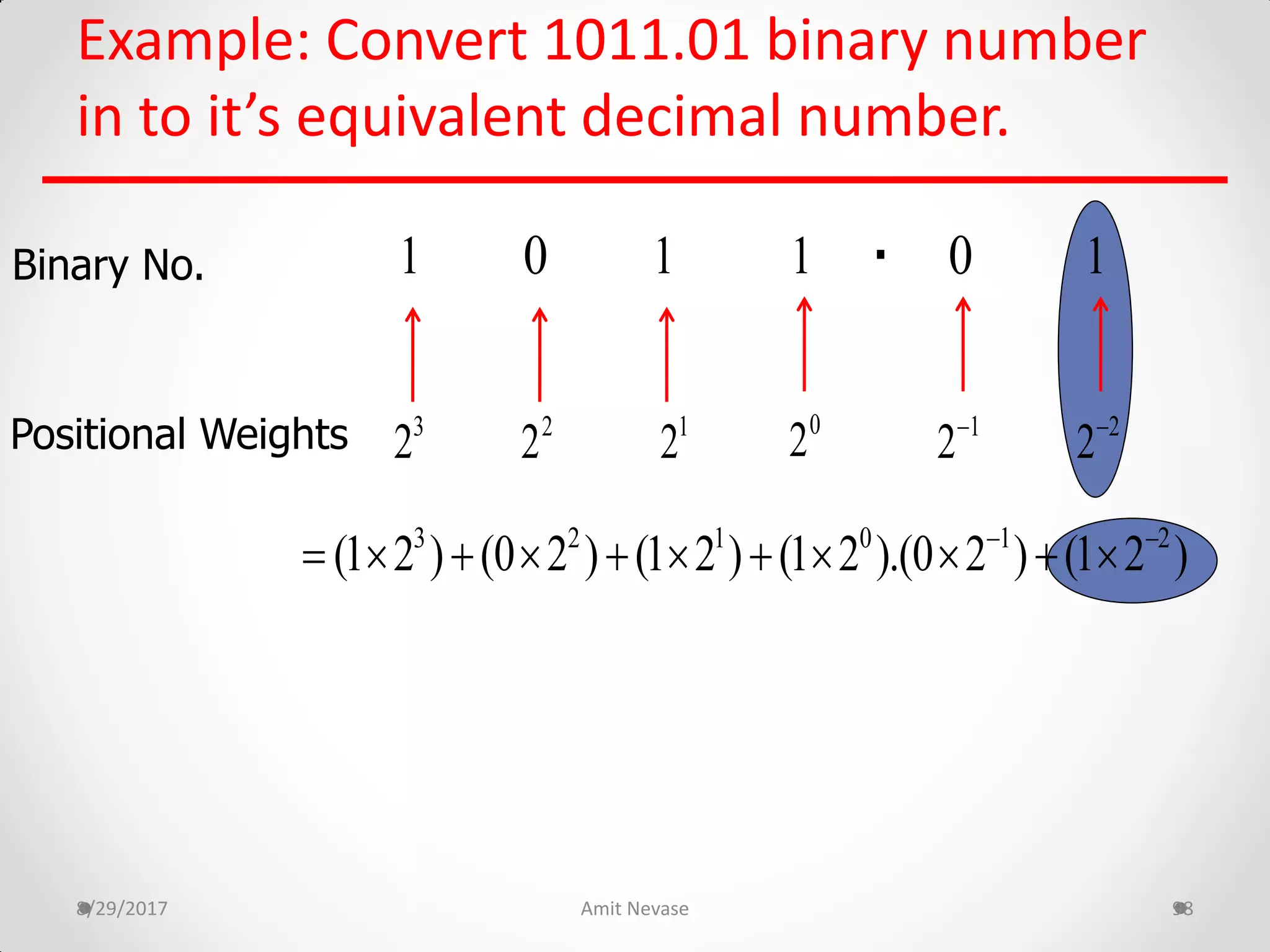
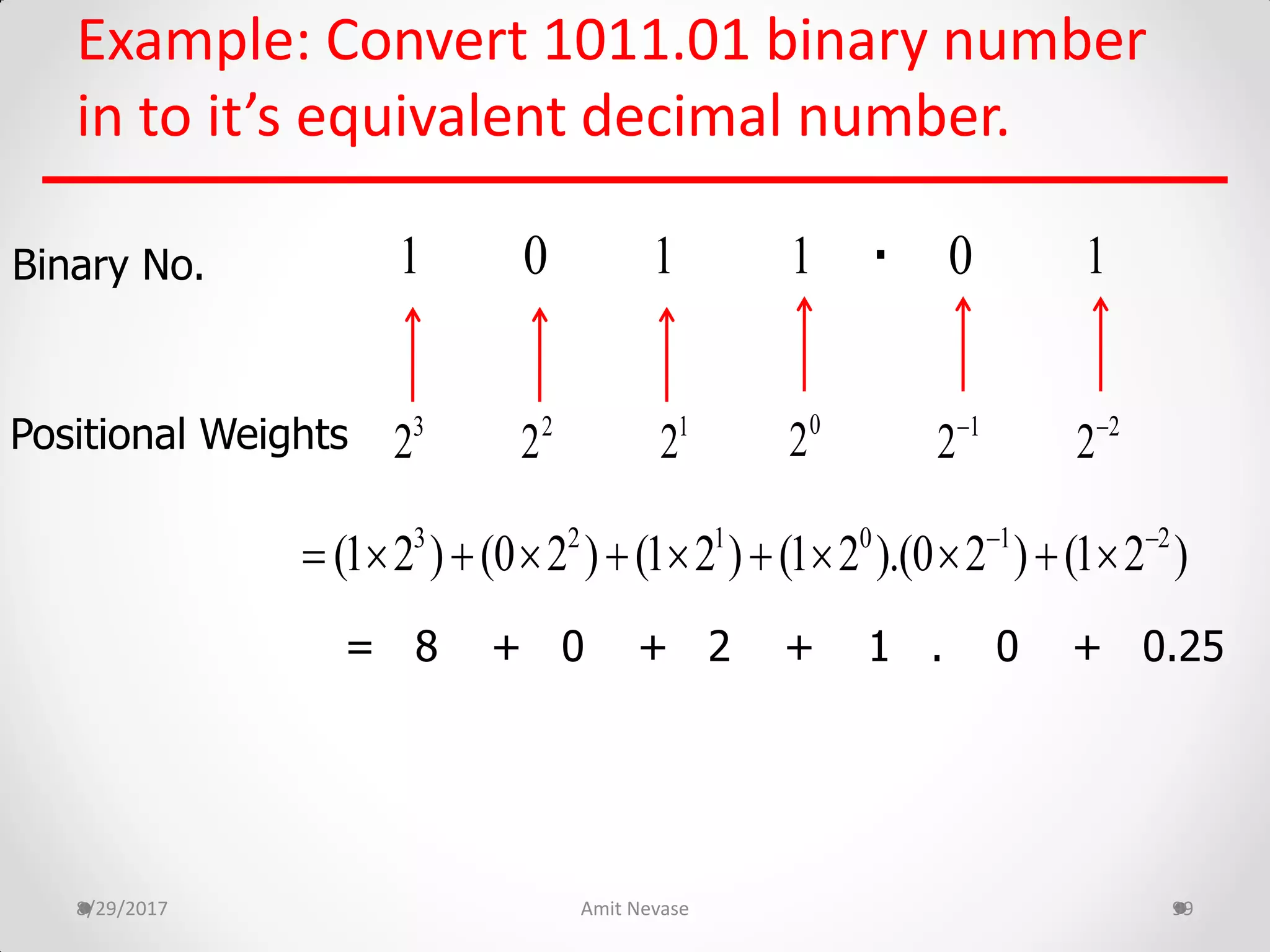
  • 281.
    References Digital Principles by MalvinoLeach Modern Digital Electronics by R.P. Jain Digital Electronics, Principles and Integrated Circuits by Anil K. Maini Digital Techniques by A. Anand Kumar 8/29/2017 Amit Nevase 281
  • 282.
  • 283.