
UNIVERSITY OF MYSORE
MANASAGANGOTHRI
SECOND SEMESTER
Paper : Fundamentals of Information Technology
Seminar on :Binary Numbers addition subtraction
multiplication division
Presented to,
Dr.Chandrashekar .M
Professor
DOS in Library and Information Science
Manasagangothri, Mysore
Presented by
Kanthamani H D
 Contents
 Introduction
 Definition
 Some Binary Arithmetic
 Addition
 Subtraction
 ◦ Signed magnitude numbers
 ◦ 2’s complement numbers
 Multiplication
 Division
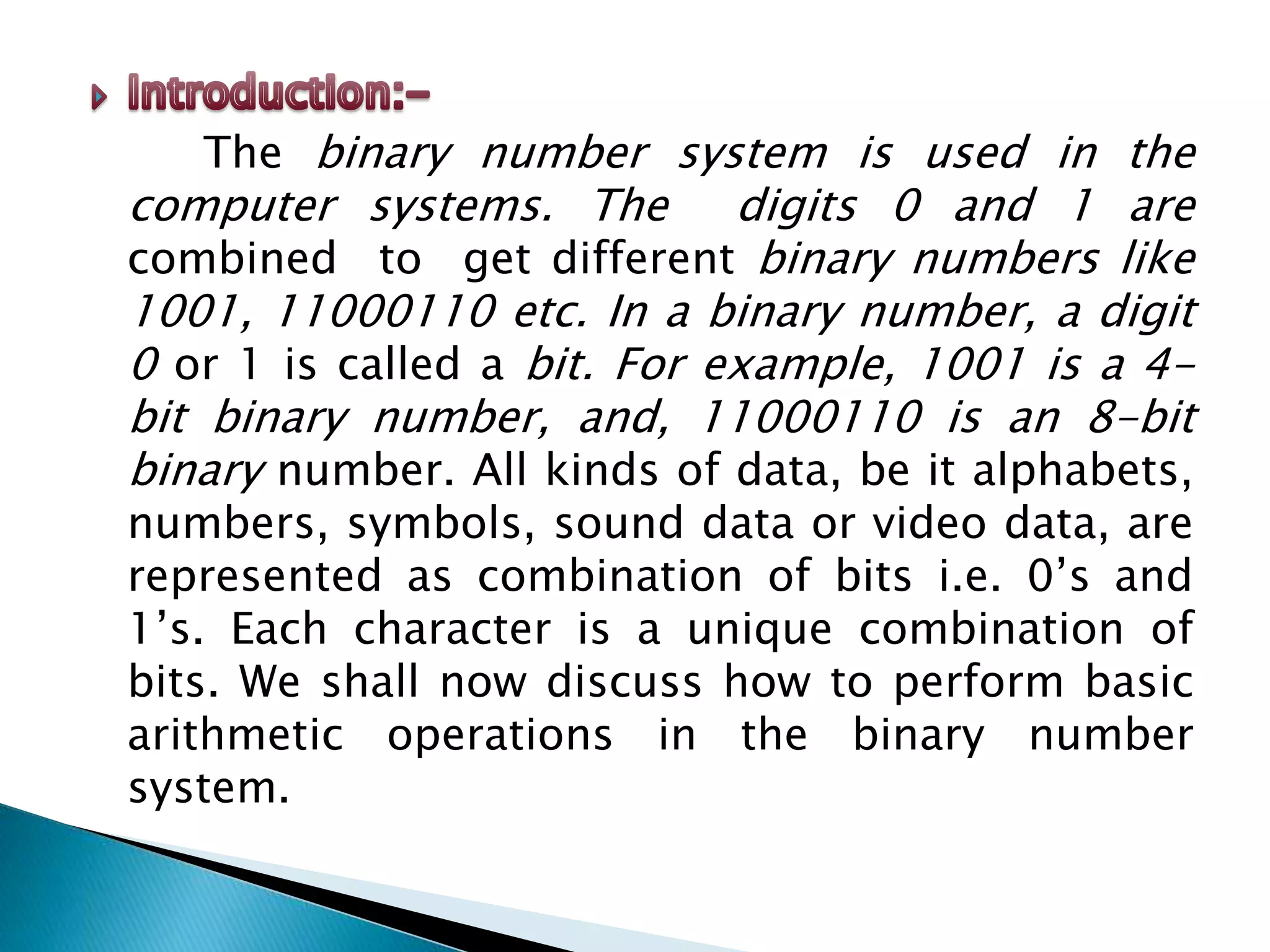
The binary number system is used in the
computer systems. The digits 0 and 1 are
combined to get different binary numbers like
1001, 11000110 etc. In a binary number, a digit
0 or 1 is called a bit. For example, 1001 is a 4-
bit binary number, and, 11000110 is an 8-bit
binary number. All kinds of data, be it alphabets,
numbers, symbols, sound data or video data, are
represented as combination of bits i.e. 0’s and
1’s. Each character is a unique combination of
bits. We shall now discuss how to perform basic
arithmetic operations in the binary number
system.
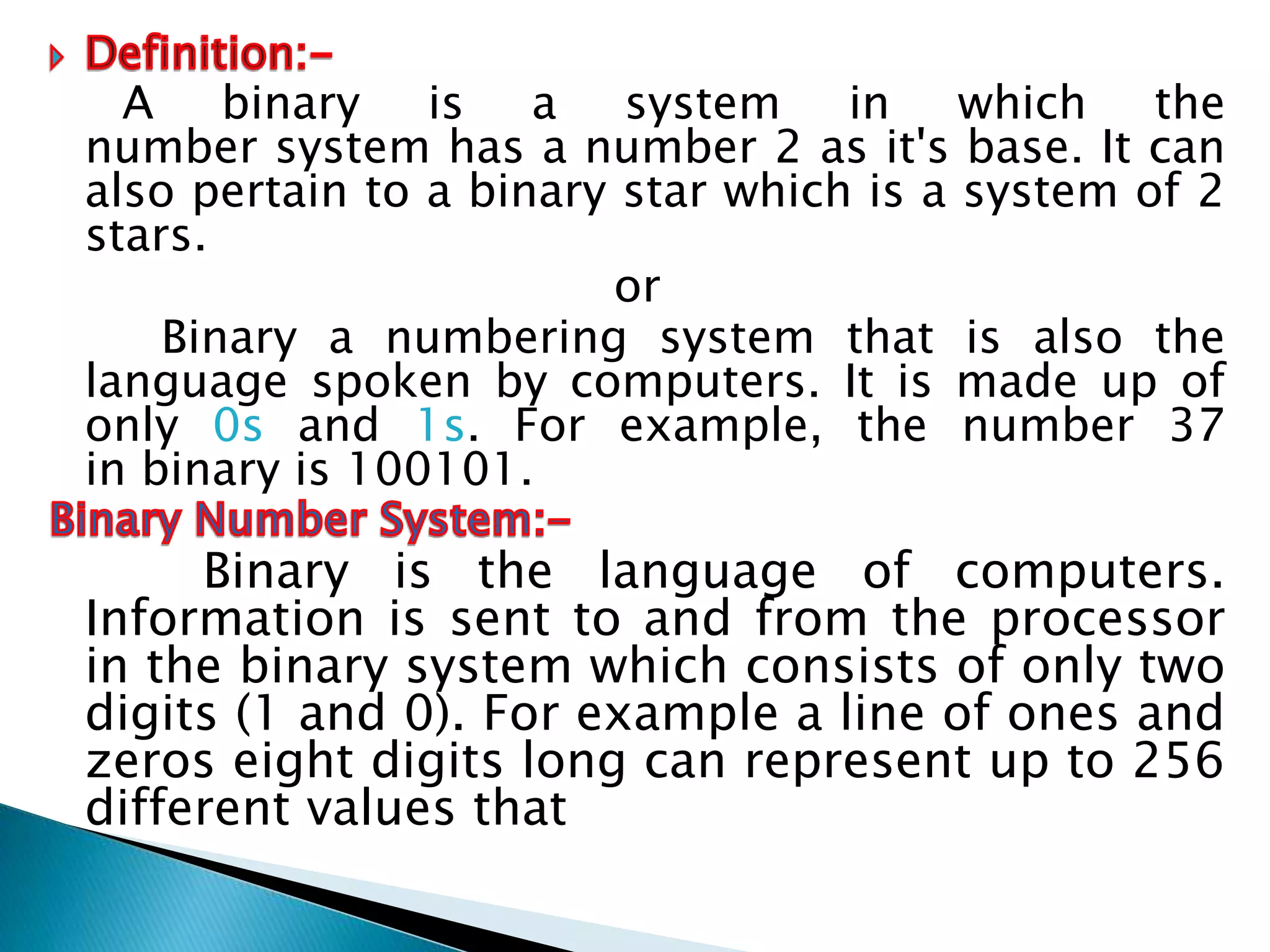
A binary is a system in which the
number system has a number 2 as it's base. It can
also pertain to a binary star which is a system of 2
stars.
or
Binary a numbering system that is also the
language spoken by computers. It is made up of
only 0s and 1s. For example, the number 37
in binary is 100101.
Binary is the language of computers.
Information is sent to and from the processor
in the binary system which consists of only two
digits (1 and 0). For example a line of ones and
zeros eight digits long can represent up to 256
different values that
 Addition
 Subtraction
 ◦ Signed magnitude numbers
 ◦ 2’s complement numbers
 Multiplication
 Division
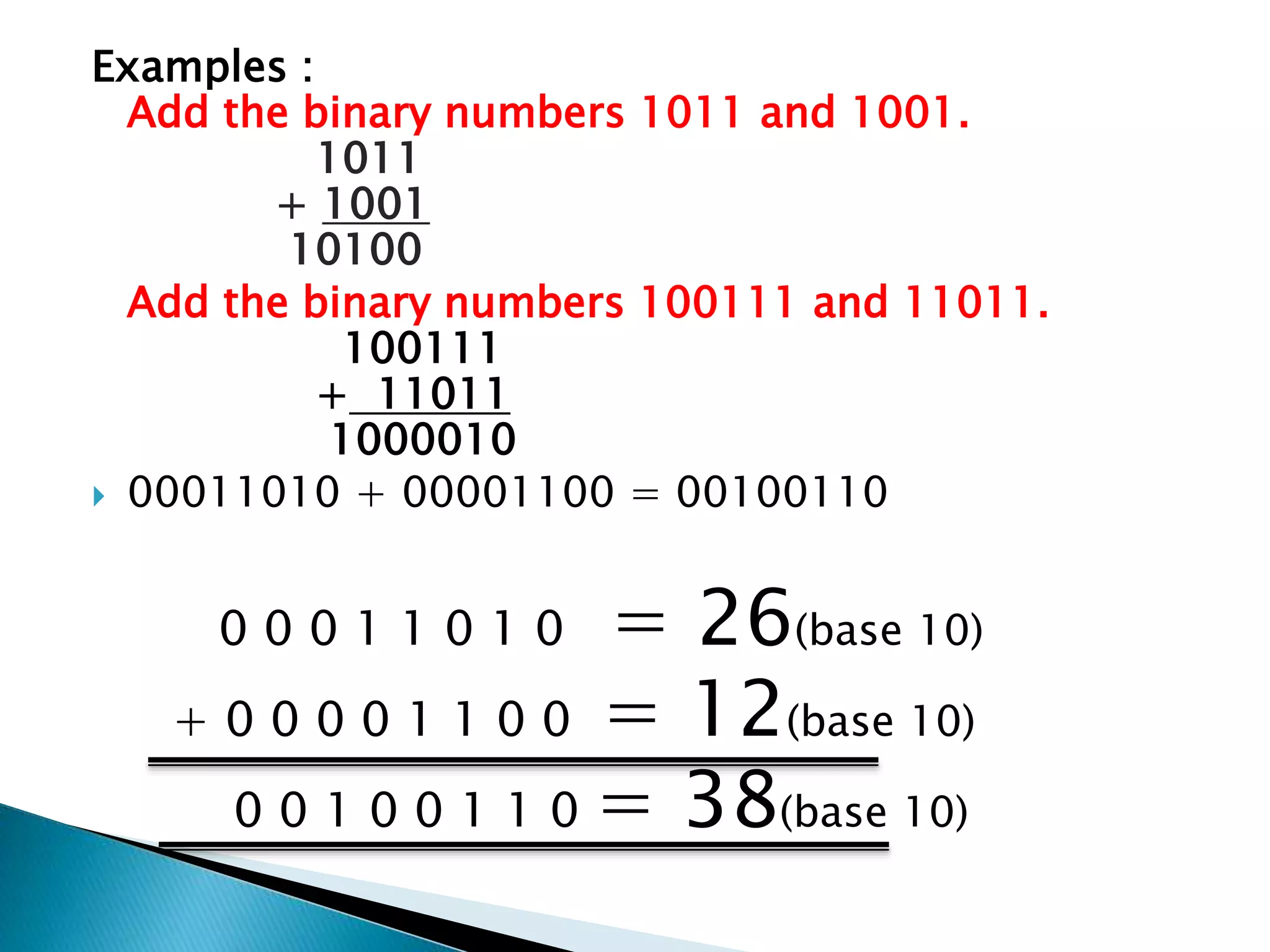
Examples :
Add the binary numbers 1011 and 1001.
1011
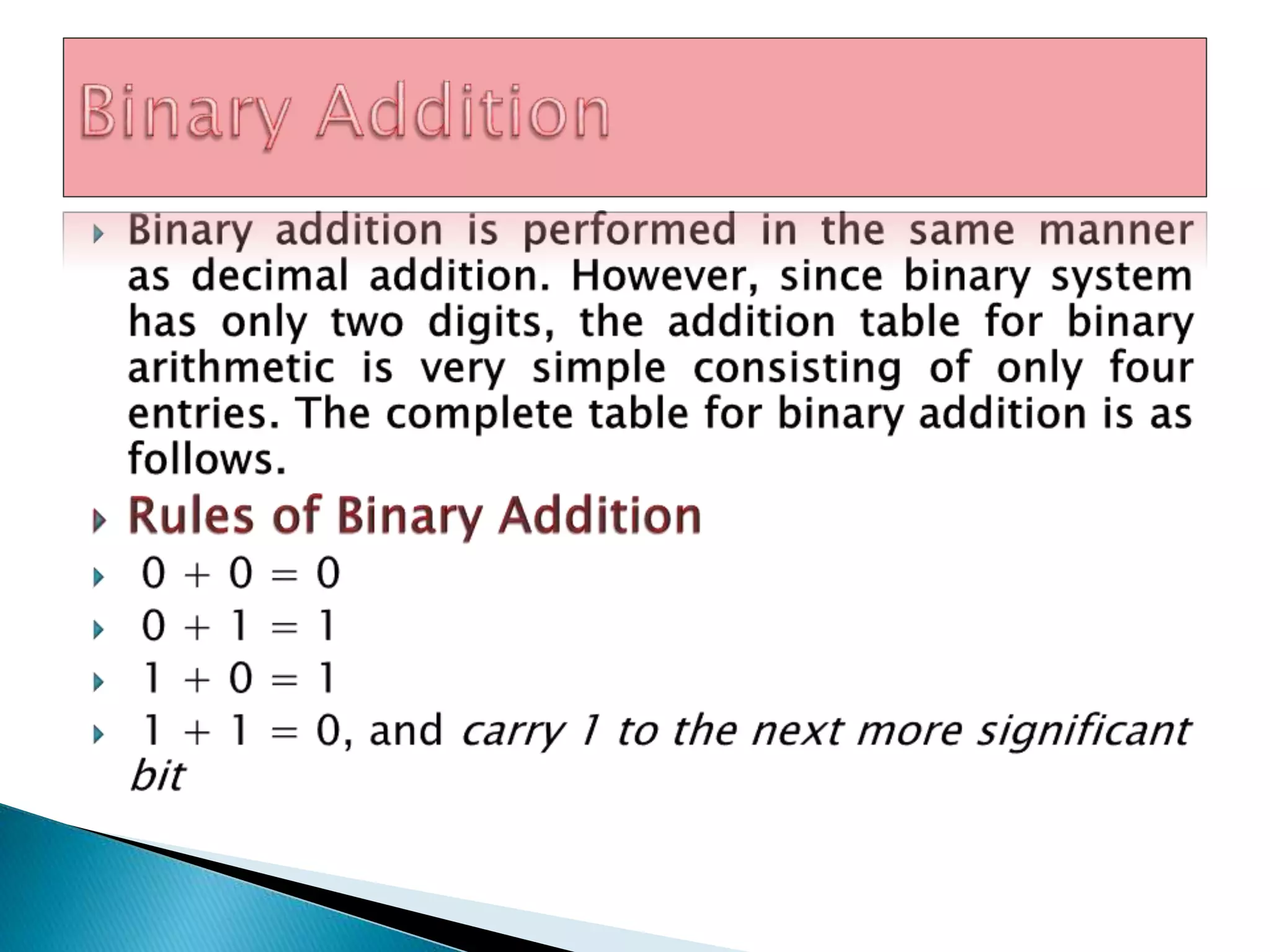
+ 1001
10100
Add the binary numbers 100111 and 11011.
100111
+ 11011
1000010
 00011010 + 00001100 = 00100110
0 0 0 1 1 0 1 0 = 26(base 10)
+ 0 0 0 0 1 1 0 0 = 12(base 10)
0 0 1 0 0 1 1 0 = 38(base 10)
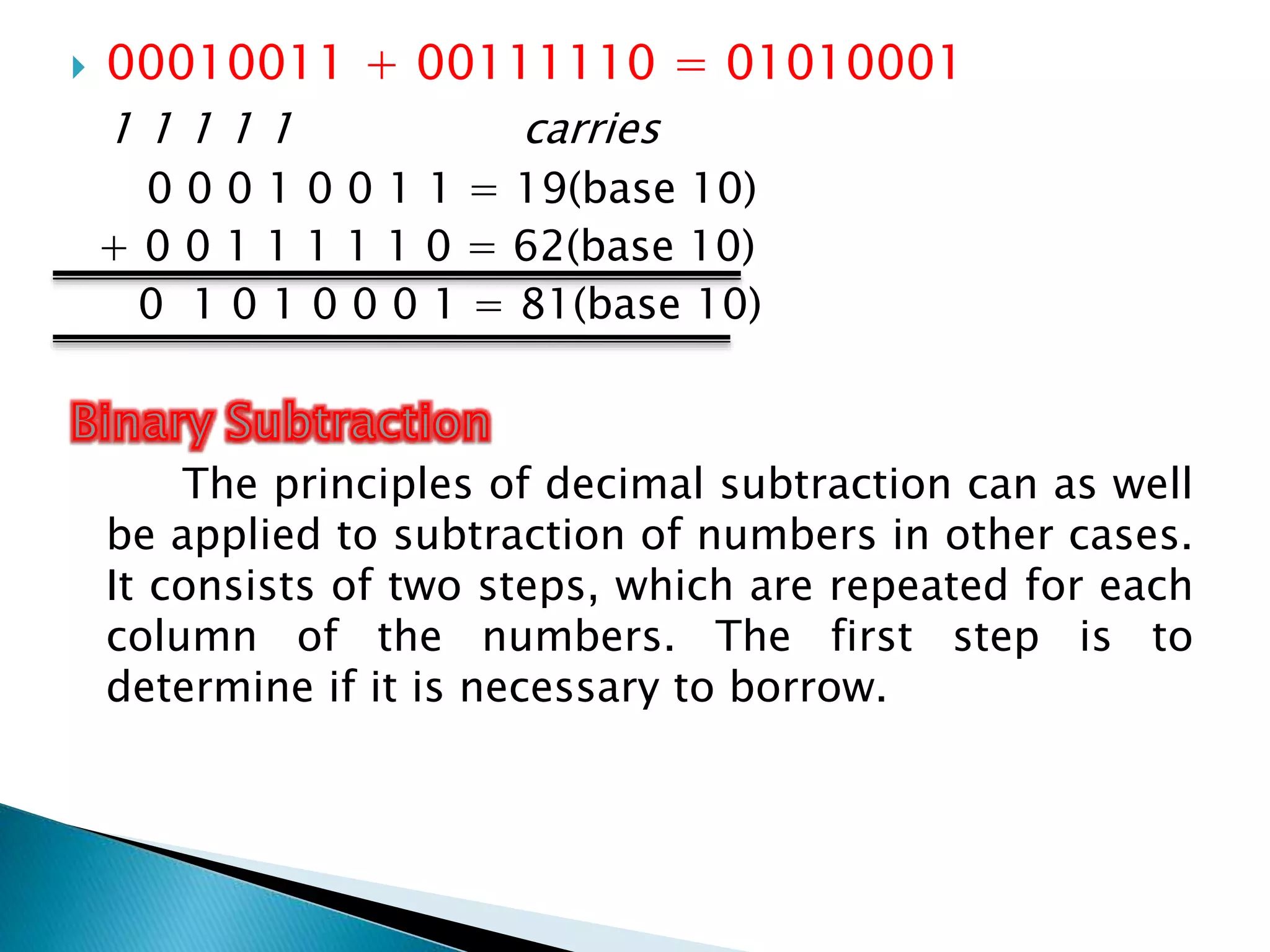
 00010011 + 00111110 = 01010001
1 1 1 1 1 carries
0 0 0 1 0 0 1 1 = 19(base 10)
+ 0 0 1 1 1 1 1 0 = 62(base 10)
0 1 0 1 0 0 0 1 = 81(base 10)
The principles of decimal subtraction can as well
be applied to subtraction of numbers in other cases.
It consists of two steps, which are repeated for each
column of the numbers. The first step is to
determine if it is necessary to borrow.
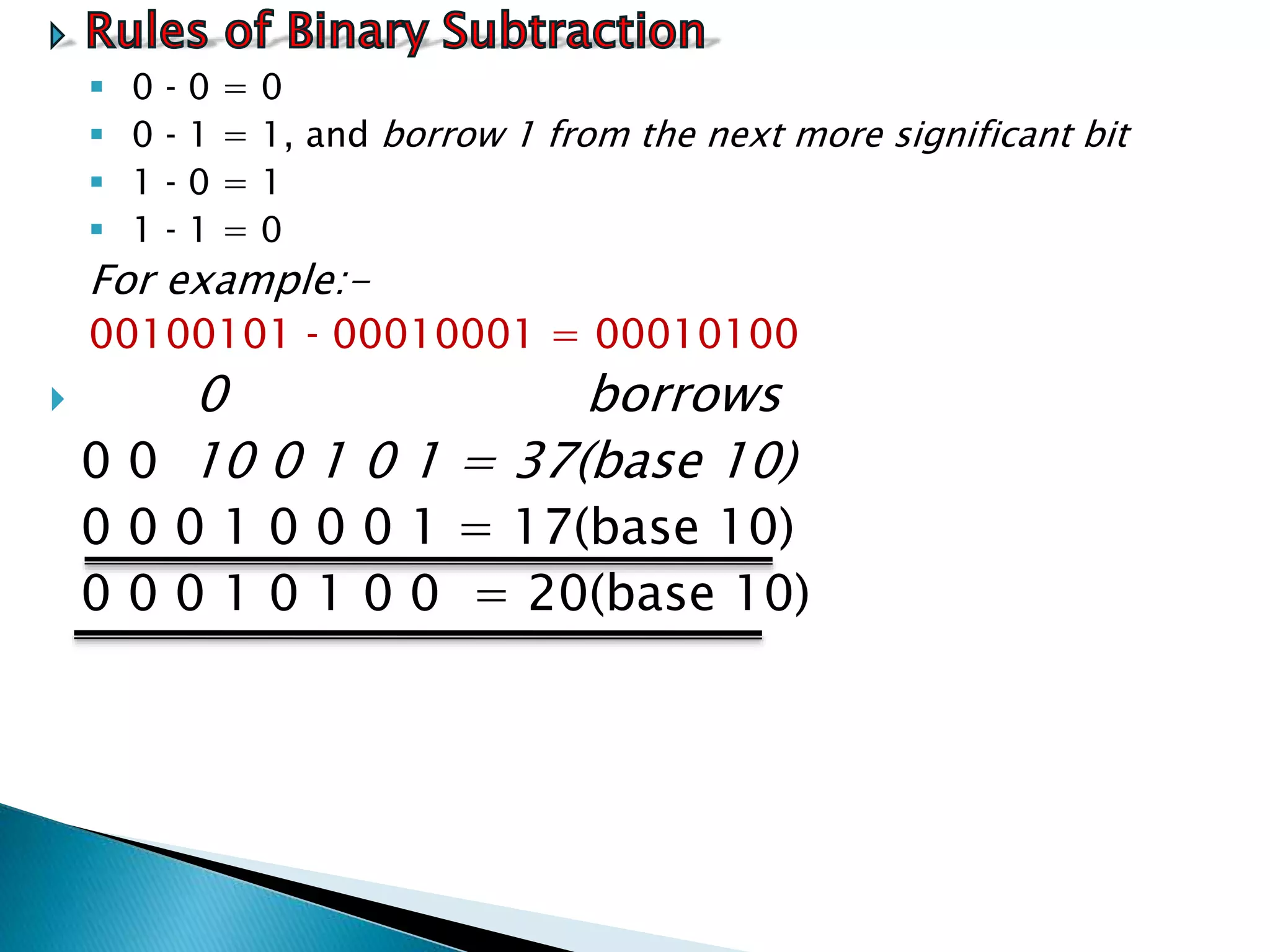
 0 ‐ 0 = 0
 0 ‐ 1 = 1, and borrow 1 from the next more significant bit
 1 ‐ 0 = 1
 1 ‐ 1 = 0
For example:-
00100101 ‐ 00010001 = 00010100
 0 borrows
0 0 10 0 1 0 1 = 37(base 10)
0 0 0 1 0 0 0 1 = 17(base 10)
0 0 0 1 0 1 0 0 = 20(base 10)
Complements are used in computer for the
simplification of the subtraction operation. We
now see, how to find the complement of a
binary number. There are two types of
complements for the binary number system –
1’scomplement and 2’scomplement.
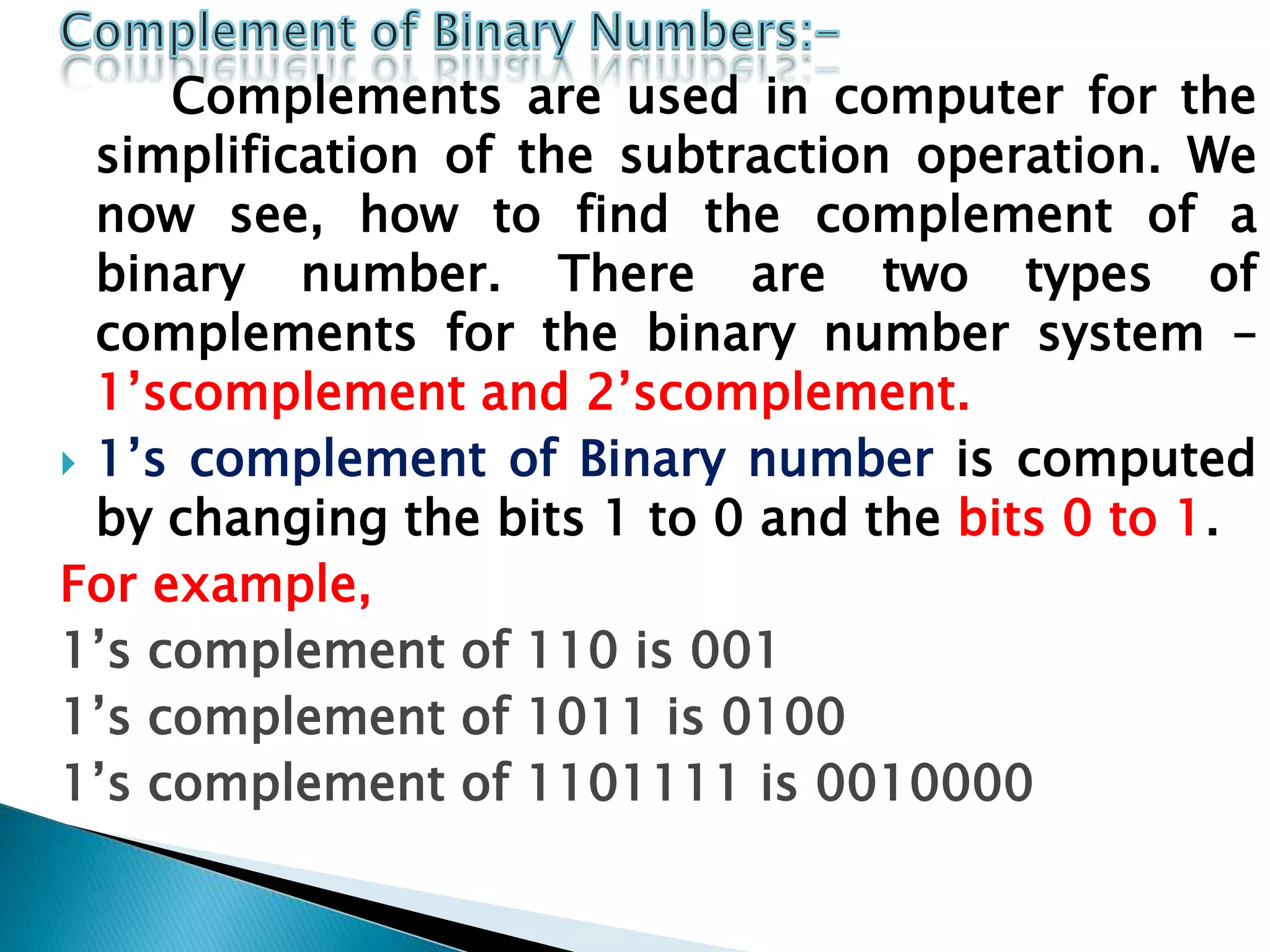
 1’s complement of Binary number is computed
by changing the bits 1 to 0 and the bits 0 to 1.
For example,
1’s complement of 110 is 001
1’s complement of 1011 is 0100
1’s complement of 1101111 is 0010000
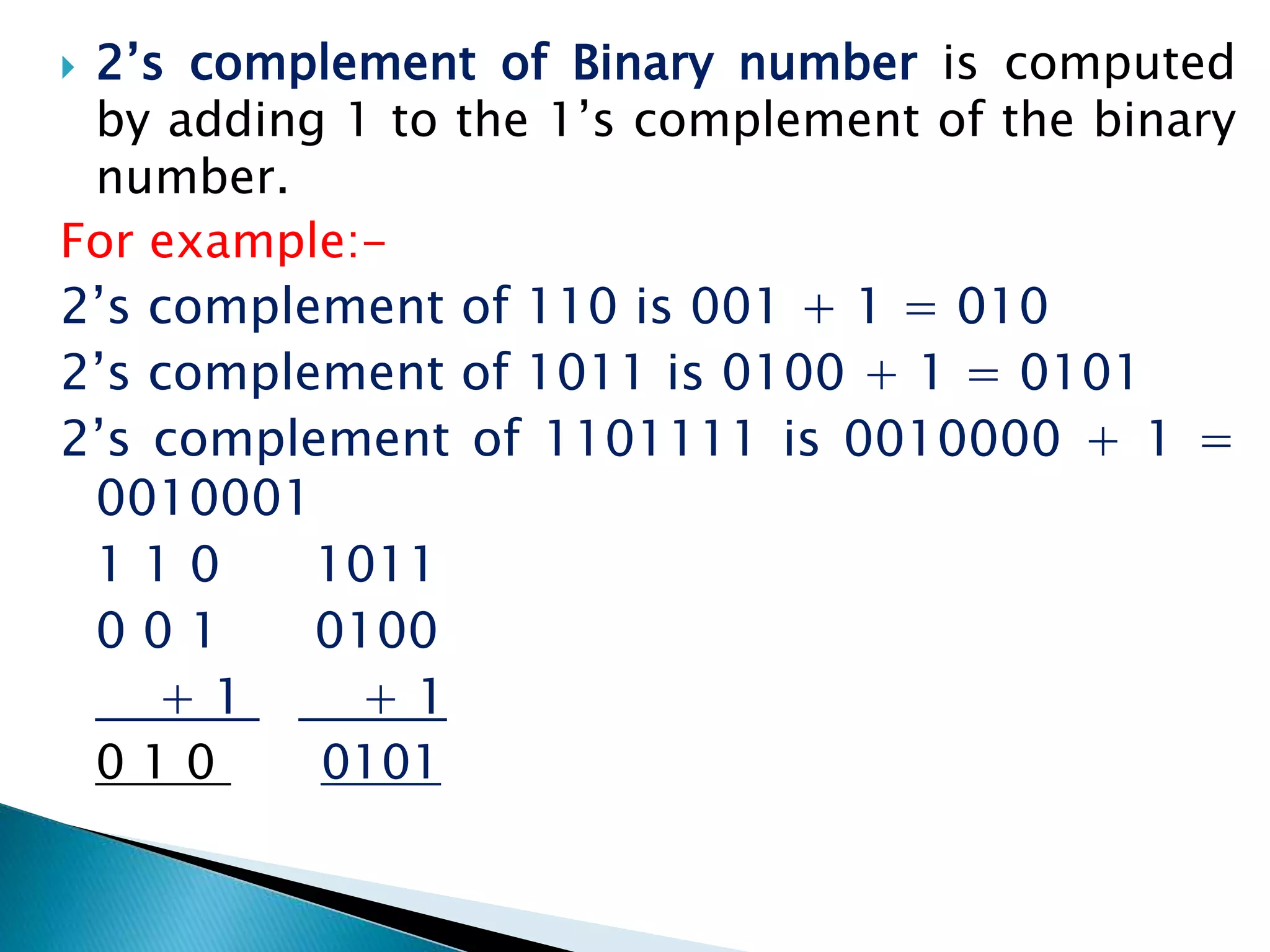
 2’s complement of Binary number is computed
by adding 1 to the 1’s complement of the binary
number.
For example:-
2’s complement of 110 is 001 + 1 = 010
2’s complement of 1011 is 0100 + 1 = 0101
2’s complement of 1101111 is 0010000 + 1 =
0010001
1 1 0 1011
0 0 1 0100
+ 1 + 1
0 1 0 0101
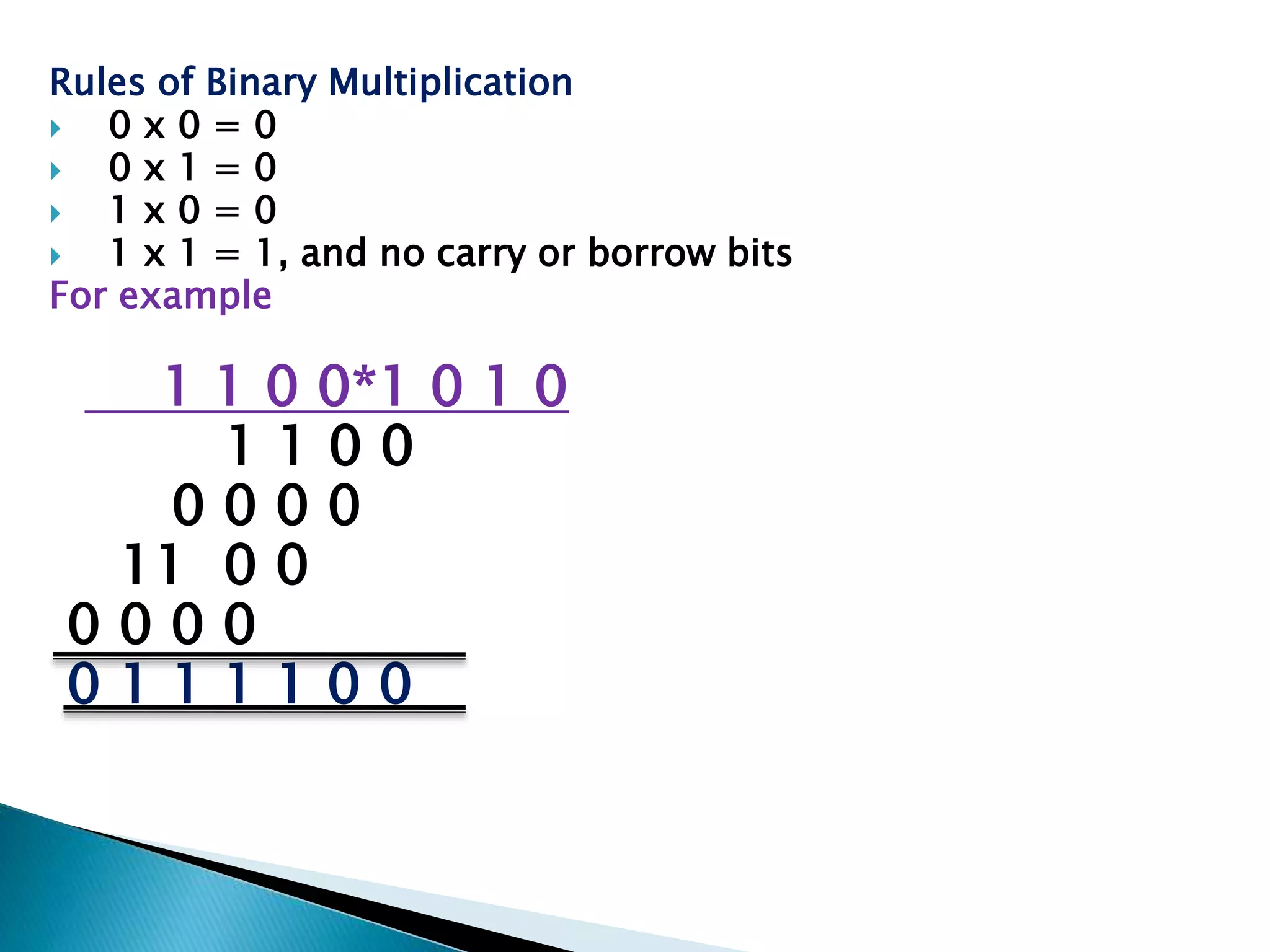
Rules of Binary Multiplication
 0 x 0 = 0
 0 x 1 = 0
 1 x 0 = 0
 1 x 1 = 1, and no carry or borrow bits
For example
1 1 0 0*1 0 1 0
1 1 0 0
0 0 0 0
11 0 0
0 0 0 0
0 1 1 1 1 0 0
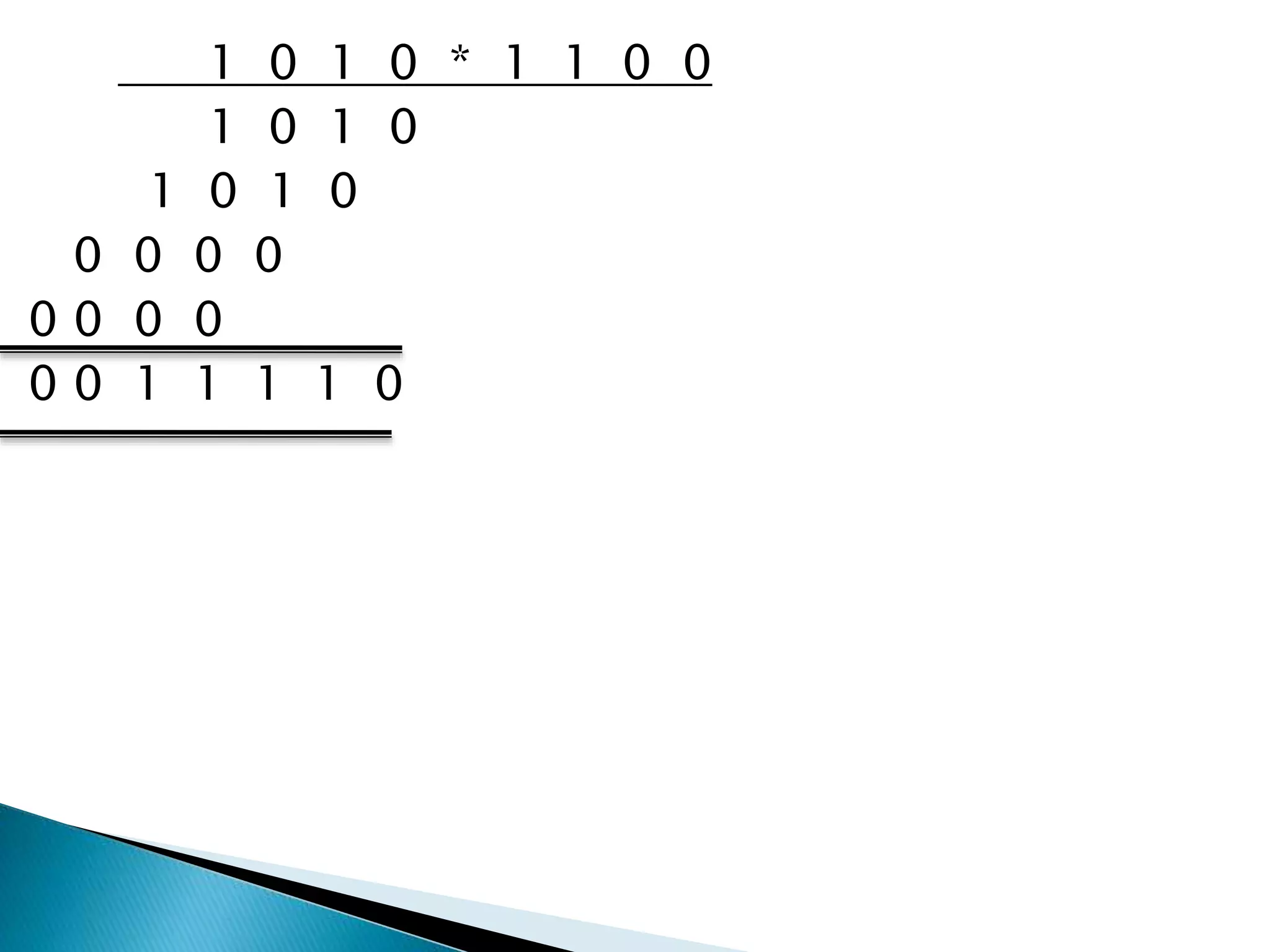
1 0 1 0 * 1 1 0 0
1 0 1 0
1 0 1 0
0 0 0 0
0 0 0 0
0 0 1 1 1 1 0
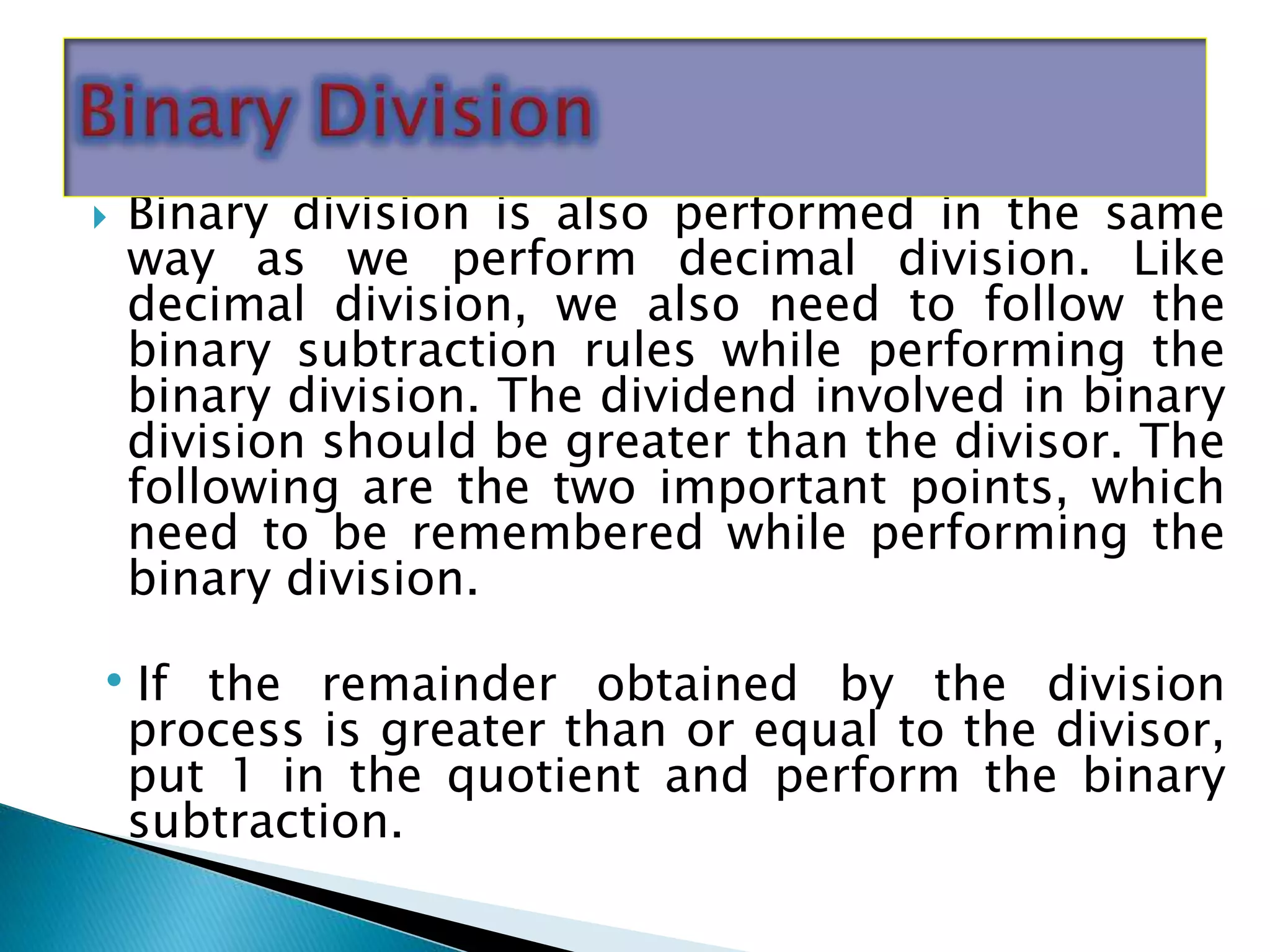
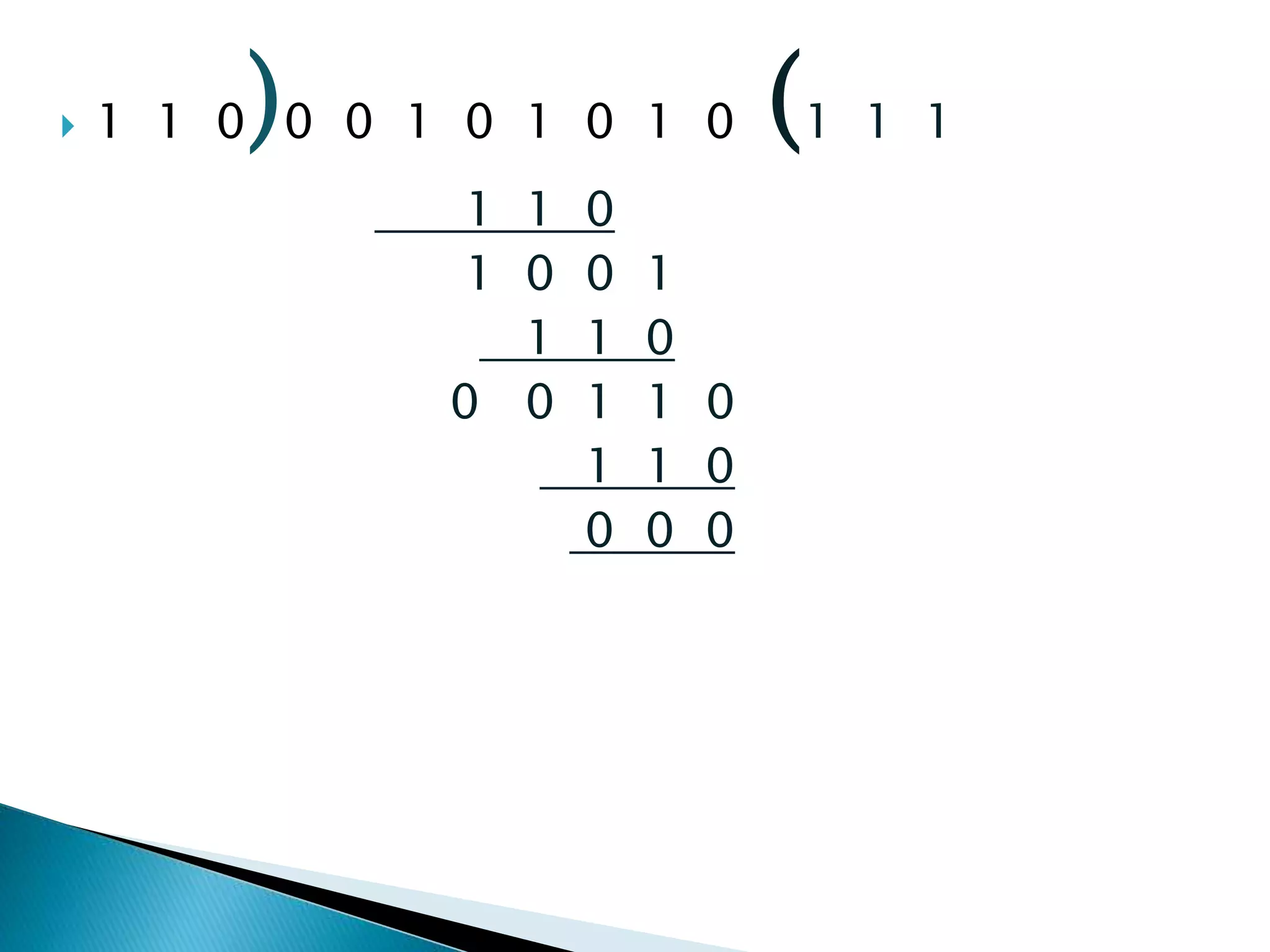
 Binary division is also performed in the same
way as we perform decimal division. Like
decimal division, we also need to follow the
binary subtraction rules while performing the
binary division. The dividend involved in binary
division should be greater than the divisor. The
following are the two important points, which
need to be remembered while performing the
binary division.
•If the remainder obtained by the division
process is greater than or equal to the divisor,
put 1 in the quotient and perform the binary
subtraction.
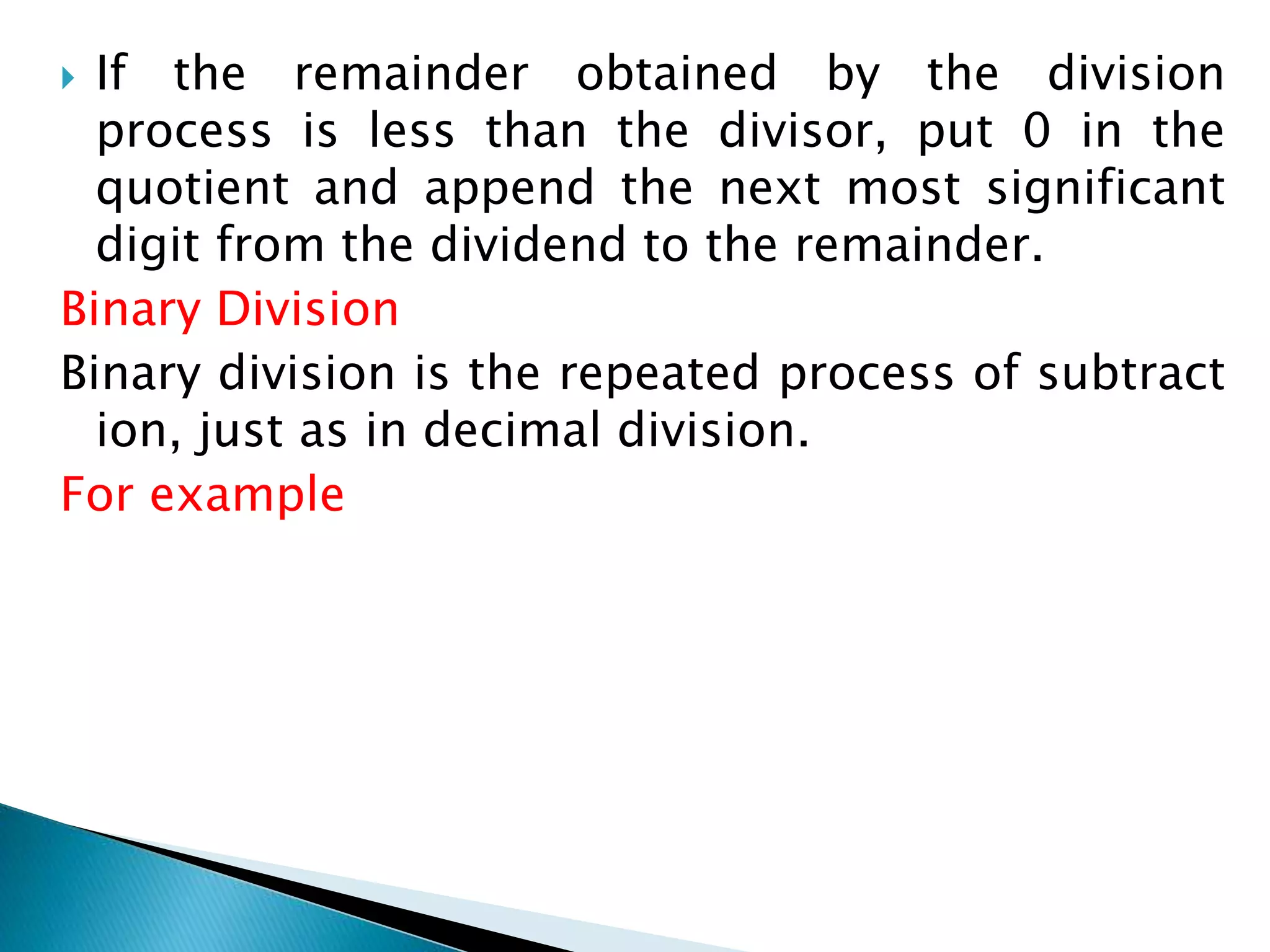
 If the remainder obtained by the division
process is less than the divisor, put 0 in the
quotient and append the next most significant
digit from the dividend to the remainder.
Binary Division
Binary division is the repeated process of subtract
ion, just as in decimal division.
For example
 1 1 0)0 0 1 0 1 0 1 0 (1 1 1
1 1 0
1 0 0 1
1 1 0
0 0 1 1 0
1 1 0
0 0 0
The binary number system, base two, uses only
two symbols, 0 and 1. Two is the smallest whole
number that can be used as the base of a number
system. For many years, mathematicians saw base
two as a primitive system and overlooked the
potential of the binary system as a tool for
developing computer science and many electrical
devices.
Base two has several other names, including the
binary positional numeration system and the dyadic
system. Many civilizations have used the binary
system in some form, including inhabitants of
Australia, Polynesia, South America, and Africa.
Ancient Egyptian arithmetic depended on the binary
system.
Binary true ppt

Binary true ppt

  • 1.
    UNIVERSITY OF MYSORE MANASAGANGOTHRI SECONDSEMESTER Paper : Fundamentals of Information Technology Seminar on :Binary Numbers addition subtraction multiplication division Presented to, Dr.Chandrashekar .M Professor DOS in Library and Information Science Manasagangothri, Mysore Presented by Kanthamani H D
  • 2.
     Contents  Introduction Definition  Some Binary Arithmetic  Addition  Subtraction  ◦ Signed magnitude numbers  ◦ 2’s complement numbers  Multiplication  Division
  • 3.
    The binary numbersystem is used in the computer systems. The digits 0 and 1 are combined to get different binary numbers like 1001, 11000110 etc. In a binary number, a digit 0 or 1 is called a bit. For example, 1001 is a 4- bit binary number, and, 11000110 is an 8-bit binary number. All kinds of data, be it alphabets, numbers, symbols, sound data or video data, are represented as combination of bits i.e. 0’s and 1’s. Each character is a unique combination of bits. We shall now discuss how to perform basic arithmetic operations in the binary number system.
  • 4.
    A binary isa system in which the number system has a number 2 as it's base. It can also pertain to a binary star which is a system of 2 stars. or Binary a numbering system that is also the language spoken by computers. It is made up of only 0s and 1s. For example, the number 37 in binary is 100101. Binary is the language of computers. Information is sent to and from the processor in the binary system which consists of only two digits (1 and 0). For example a line of ones and zeros eight digits long can represent up to 256 different values that
  • 5.
     Addition  Subtraction ◦ Signed magnitude numbers  ◦ 2’s complement numbers  Multiplication  Division
  • 7.
    Examples : Add thebinary numbers 1011 and 1001. 1011 + 1001 10100 Add the binary numbers 100111 and 11011. 100111 + 11011 1000010  00011010 + 00001100 = 00100110 0 0 0 1 1 0 1 0 = 26(base 10) + 0 0 0 0 1 1 0 0 = 12(base 10) 0 0 1 0 0 1 1 0 = 38(base 10)
  • 8.
     00010011 +00111110 = 01010001 1 1 1 1 1 carries 0 0 0 1 0 0 1 1 = 19(base 10) + 0 0 1 1 1 1 1 0 = 62(base 10) 0 1 0 1 0 0 0 1 = 81(base 10) The principles of decimal subtraction can as well be applied to subtraction of numbers in other cases. It consists of two steps, which are repeated for each column of the numbers. The first step is to determine if it is necessary to borrow.
  • 9.
     0 ‐0 = 0  0 ‐ 1 = 1, and borrow 1 from the next more significant bit  1 ‐ 0 = 1  1 ‐ 1 = 0 For example:- 00100101 ‐ 00010001 = 00010100  0 borrows 0 0 10 0 1 0 1 = 37(base 10) 0 0 0 1 0 0 0 1 = 17(base 10) 0 0 0 1 0 1 0 0 = 20(base 10)
  • 10.
    Complements are usedin computer for the simplification of the subtraction operation. We now see, how to find the complement of a binary number. There are two types of complements for the binary number system – 1’scomplement and 2’scomplement.  1’s complement of Binary number is computed by changing the bits 1 to 0 and the bits 0 to 1. For example, 1’s complement of 110 is 001 1’s complement of 1011 is 0100 1’s complement of 1101111 is 0010000
  • 11.
     2’s complementof Binary number is computed by adding 1 to the 1’s complement of the binary number. For example:- 2’s complement of 110 is 001 + 1 = 010 2’s complement of 1011 is 0100 + 1 = 0101 2’s complement of 1101111 is 0010000 + 1 = 0010001 1 1 0 1011 0 0 1 0100 + 1 + 1 0 1 0 0101
  • 13.
    Rules of BinaryMultiplication  0 x 0 = 0  0 x 1 = 0  1 x 0 = 0  1 x 1 = 1, and no carry or borrow bits For example 1 1 0 0*1 0 1 0 1 1 0 0 0 0 0 0 11 0 0 0 0 0 0 0 1 1 1 1 0 0
  • 14.
    1 0 10 * 1 1 0 0 1 0 1 0 1 0 1 0 0 0 0 0 0 0 0 0 0 0 1 1 1 1 0
  • 15.
     Binary divisionis also performed in the same way as we perform decimal division. Like decimal division, we also need to follow the binary subtraction rules while performing the binary division. The dividend involved in binary division should be greater than the divisor. The following are the two important points, which need to be remembered while performing the binary division. •If the remainder obtained by the division process is greater than or equal to the divisor, put 1 in the quotient and perform the binary subtraction.
  • 16.
     If theremainder obtained by the division process is less than the divisor, put 0 in the quotient and append the next most significant digit from the dividend to the remainder. Binary Division Binary division is the repeated process of subtract ion, just as in decimal division. For example
  • 18.
     1 10)0 0 1 0 1 0 1 0 (1 1 1 1 1 0 1 0 0 1 1 1 0 0 0 1 1 0 1 1 0 0 0 0
  • 19.
    The binary numbersystem, base two, uses only two symbols, 0 and 1. Two is the smallest whole number that can be used as the base of a number system. For many years, mathematicians saw base two as a primitive system and overlooked the potential of the binary system as a tool for developing computer science and many electrical devices. Base two has several other names, including the binary positional numeration system and the dyadic system. Many civilizations have used the binary system in some form, including inhabitants of Australia, Polynesia, South America, and Africa. Ancient Egyptian arithmetic depended on the binary system.