DEPARTMENT OF COMPUTER
SCIENCE & APPLICATIONS
BCA070 – DIGITAL ELECTRONICS
By: Prof. Ram Pratap Singh
Number System
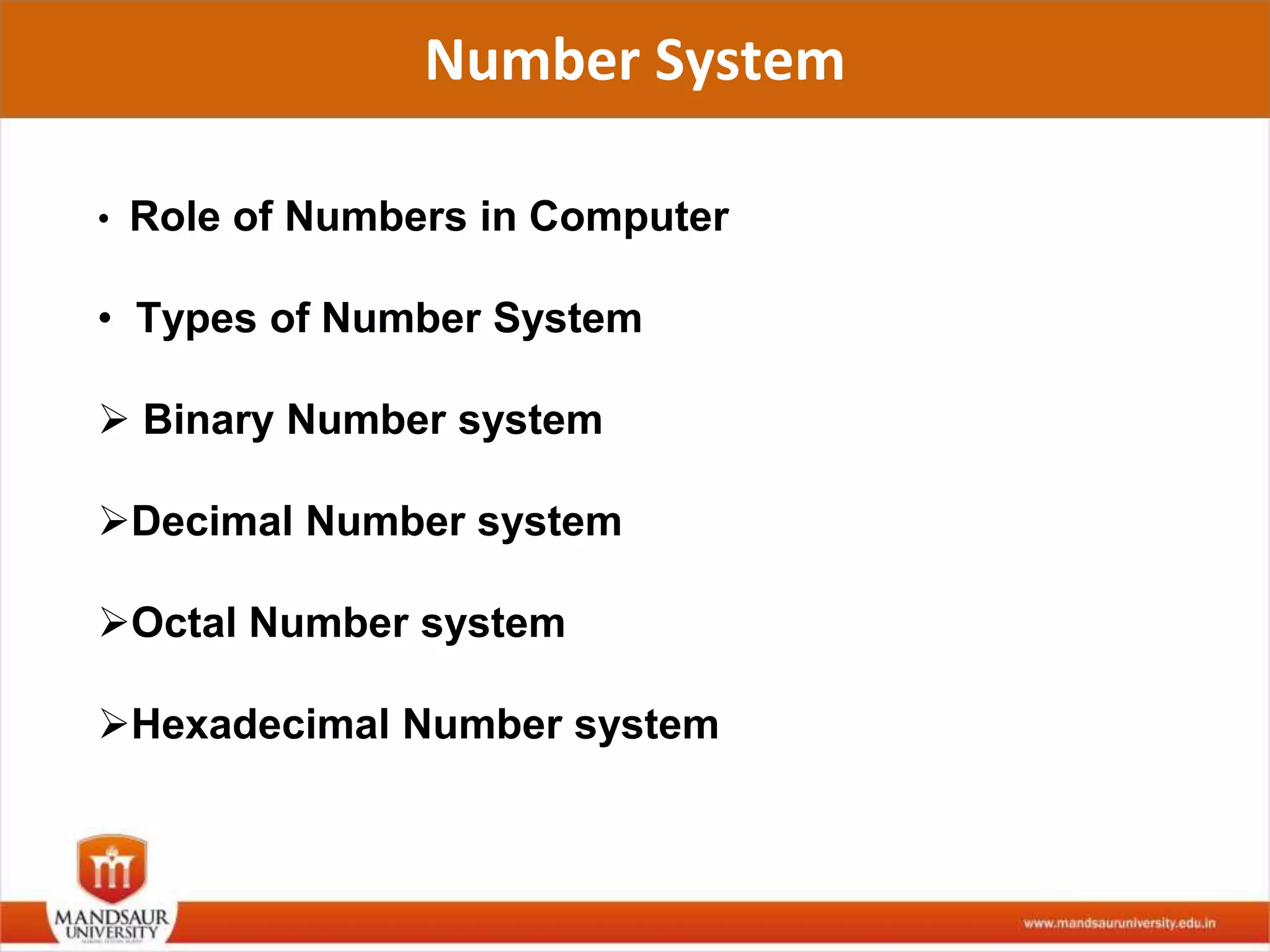
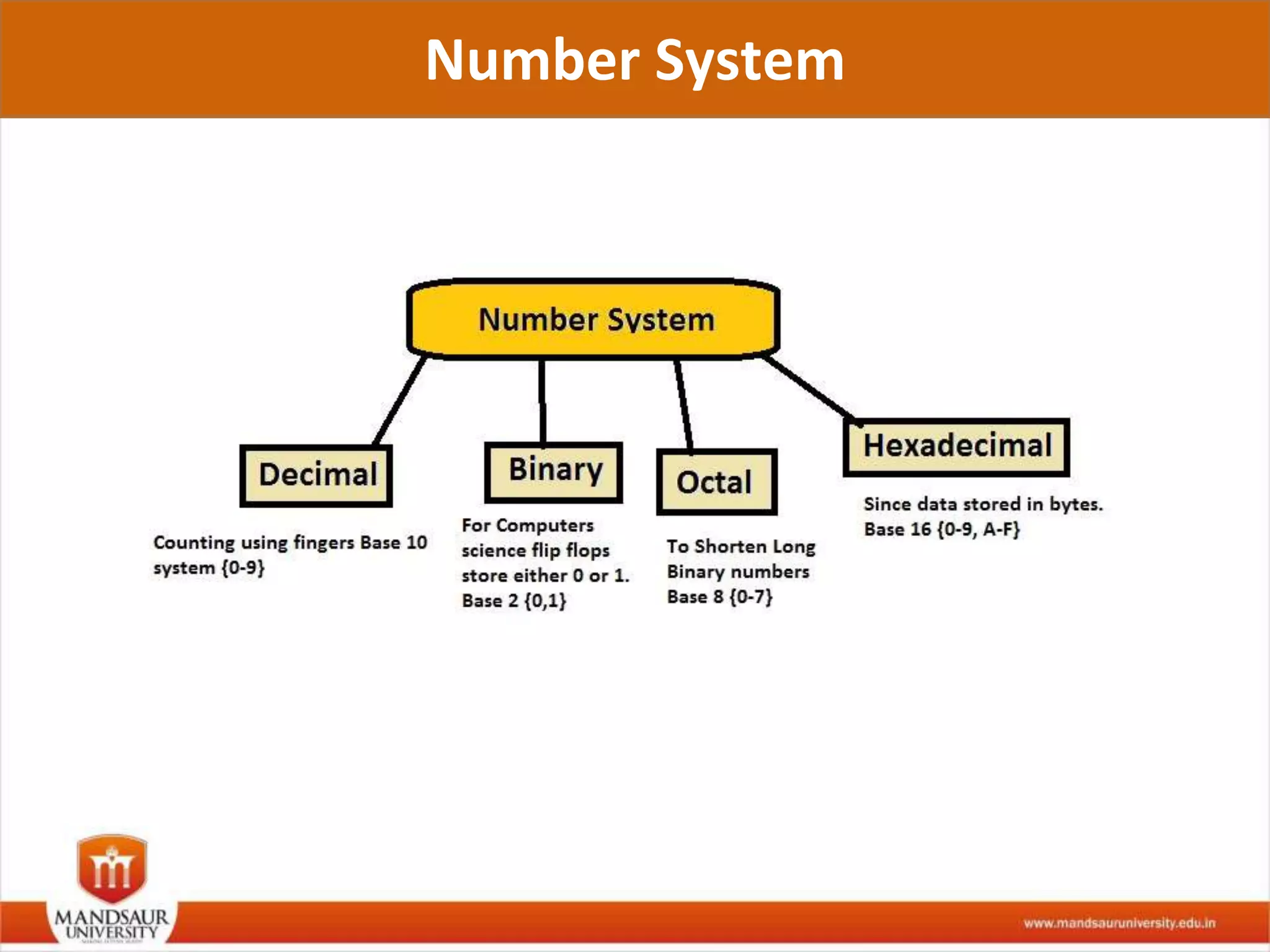
• Role of Numbers in Computer
• Types of Number System
 Binary Number system
Decimal Number system
Octal Number system
Hexadecimal Number system
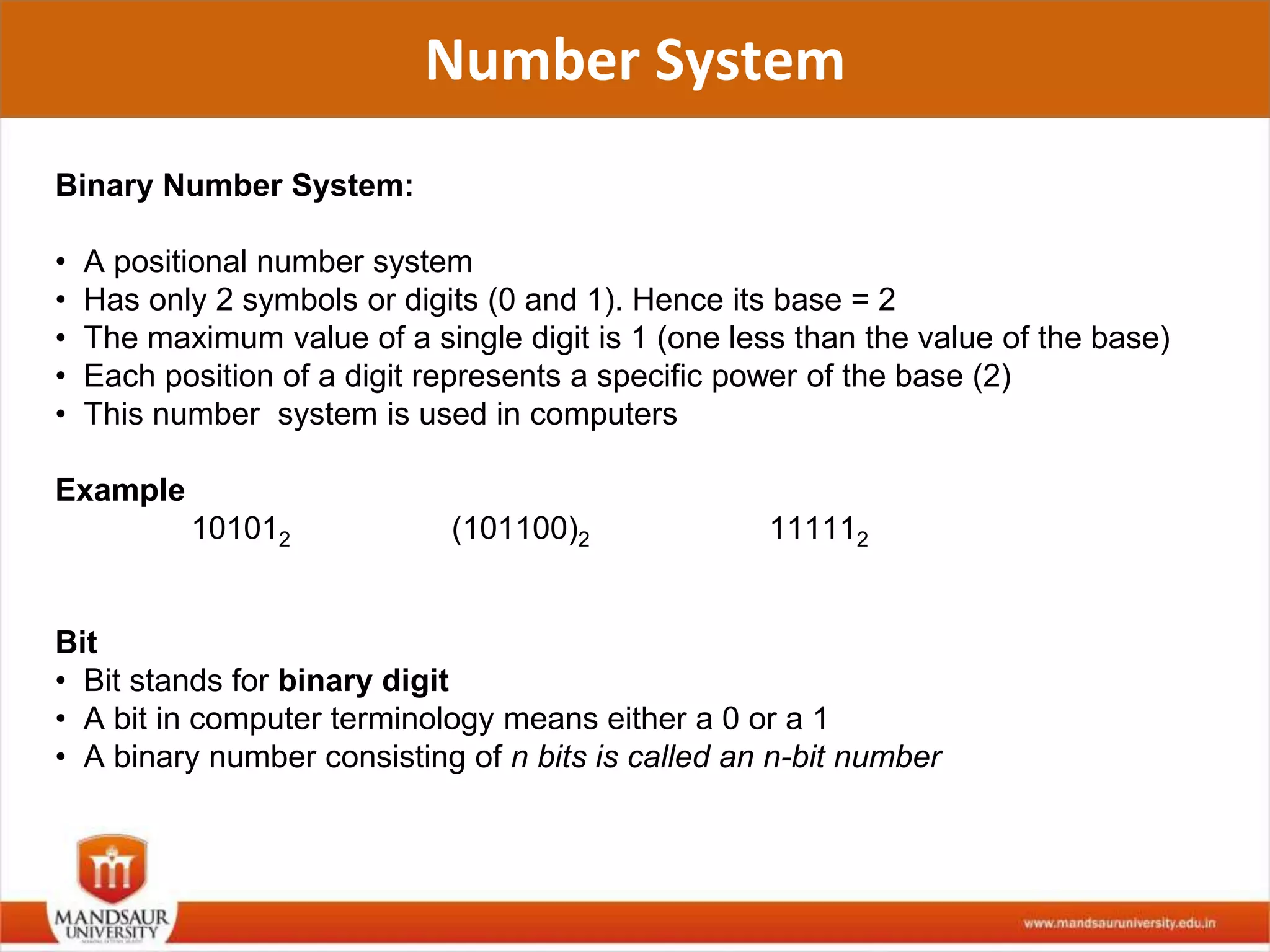
Binary Number System:
• A positional number system
• Has only 2 symbols or digits (0 and 1). Hence its base = 2
• The maximum value of a single digit is 1 (one less than the value of the base)
• Each position of a digit represents a specific power of the base (2)
• This number system is used in computers
Example
101012 (101100)2 111112
Bit
• Bit stands for binary digit
• A bit in computer terminology means either a 0 or a 1
• A binary number consisting of n bits is called an n-bit number
Number System
Number System
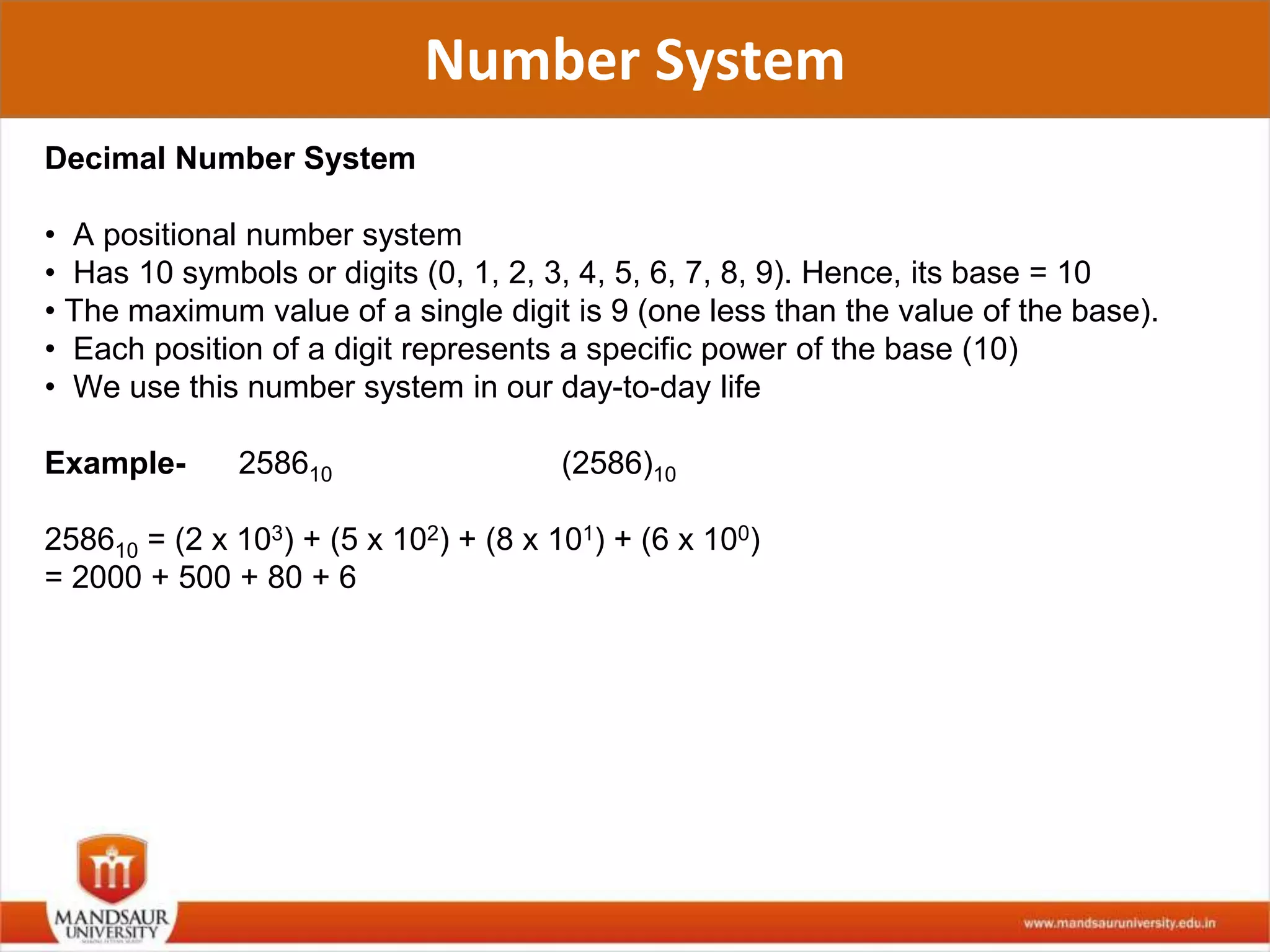
Decimal Number System
• A positional number system
• Has 10 symbols or digits (0, 1, 2, 3, 4, 5, 6, 7, 8, 9). Hence, its base = 10
• The maximum value of a single digit is 9 (one less than the value of the base).
• Each position of a digit represents a specific power of the base (10)
• We use this number system in our day-to-day life
Example- 258610 (2586)10
258610 = (2 x 10³) + (5 x 10²) + (8 x 101) + (6 x 100)
= 2000 + 500 + 80 + 6
Number System
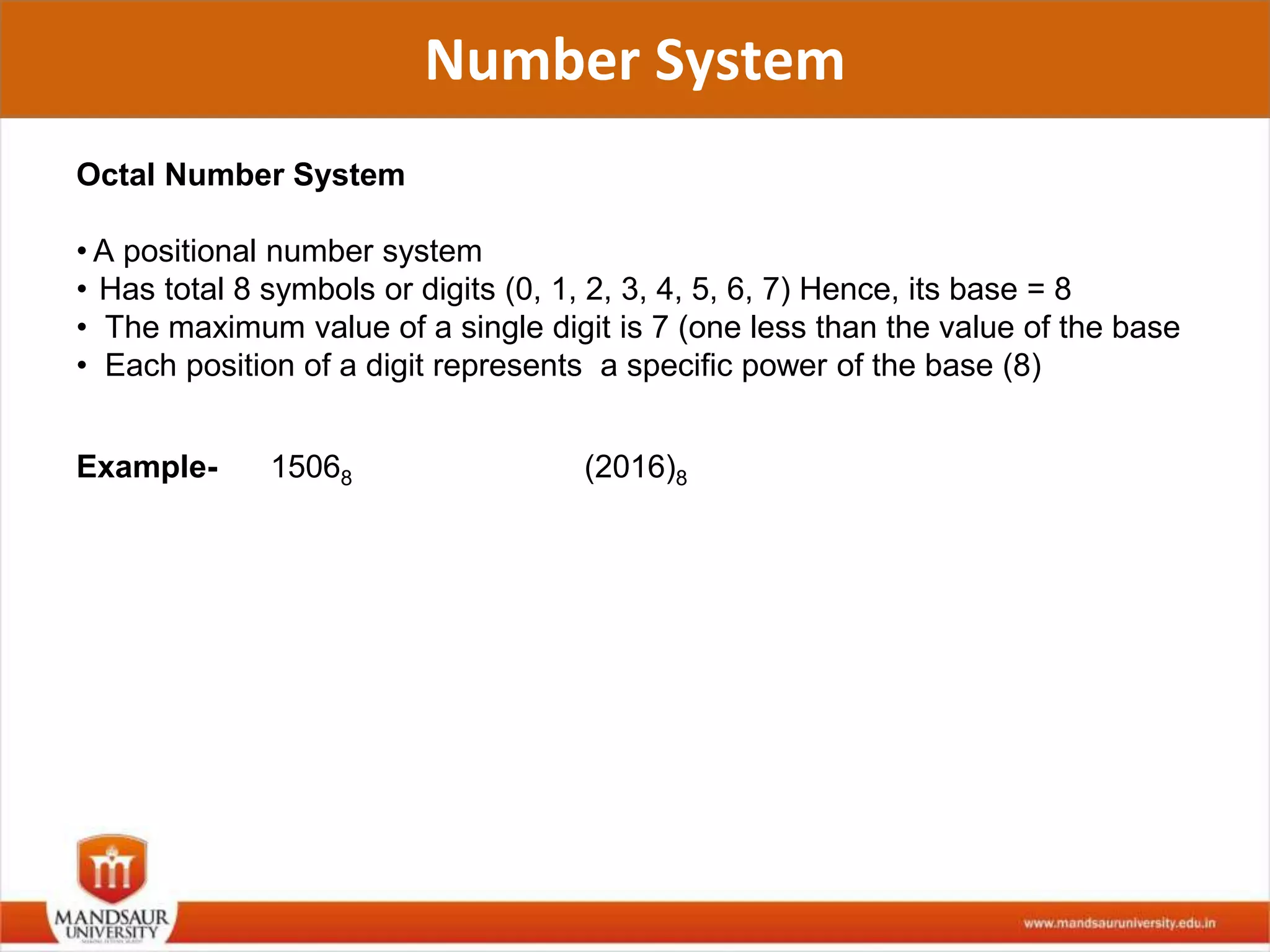
Octal Number System
• A positional number system
• Has total 8 symbols or digits (0, 1, 2, 3, 4, 5, 6, 7) Hence, its base = 8
• The maximum value of a single digit is 7 (one less than the value of the base
• Each position of a digit represents a specific power of the base (8)
Example- 15068 (2016)8
Number System
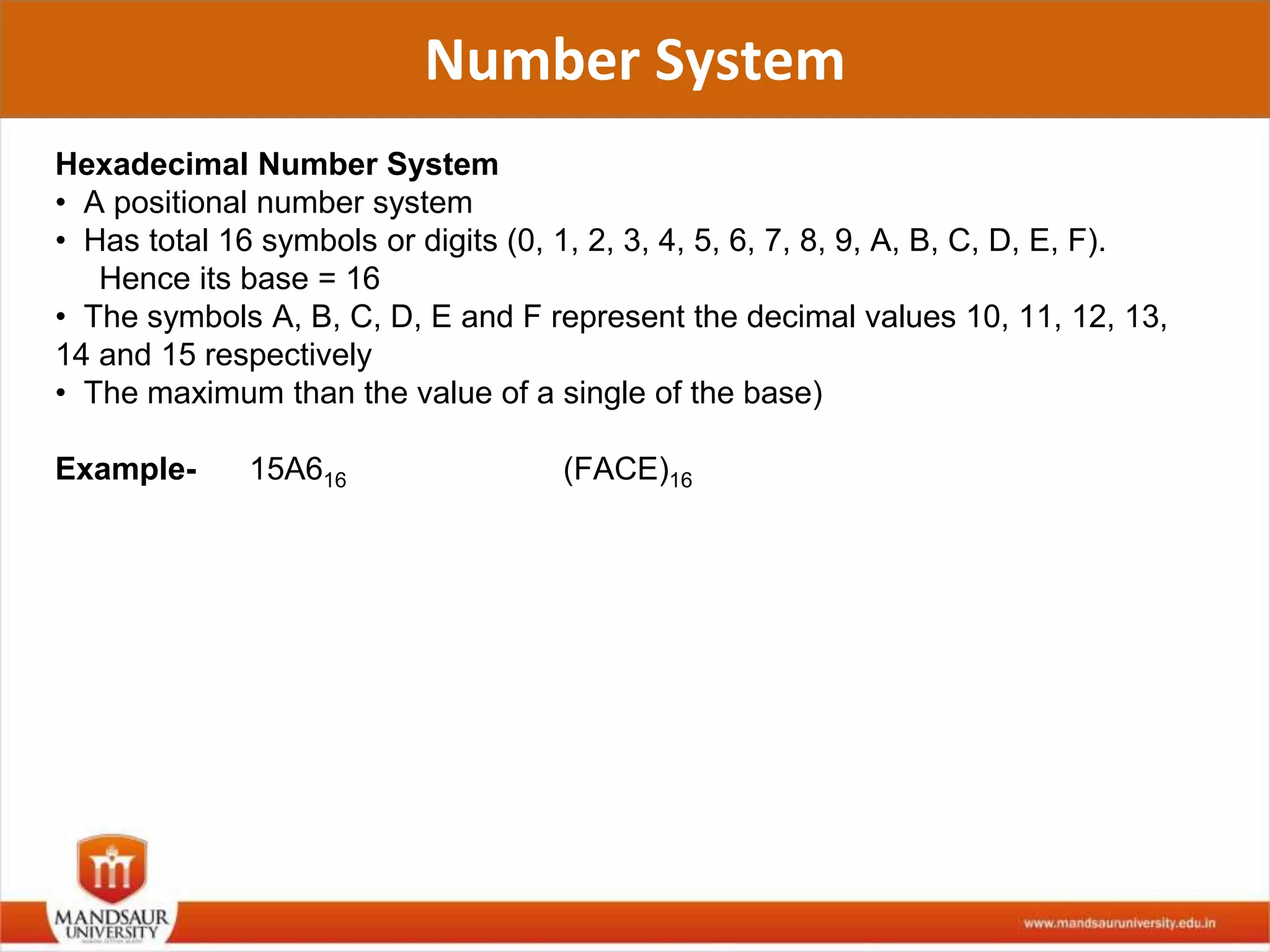
Hexadecimal Number System
• A positional number system
• Has total 16 symbols or digits (0, 1, 2, 3, 4, 5, 6, 7, 8, 9, A, B, C, D, E, F).
Hence its base = 16
• The symbols A, B, C, D, E and F represent the decimal values 10, 11, 12, 13,
14 and 15 respectively
• The maximum than the value of a single of the base)
Example- 15A616 (FACE)16
Number System
Number System
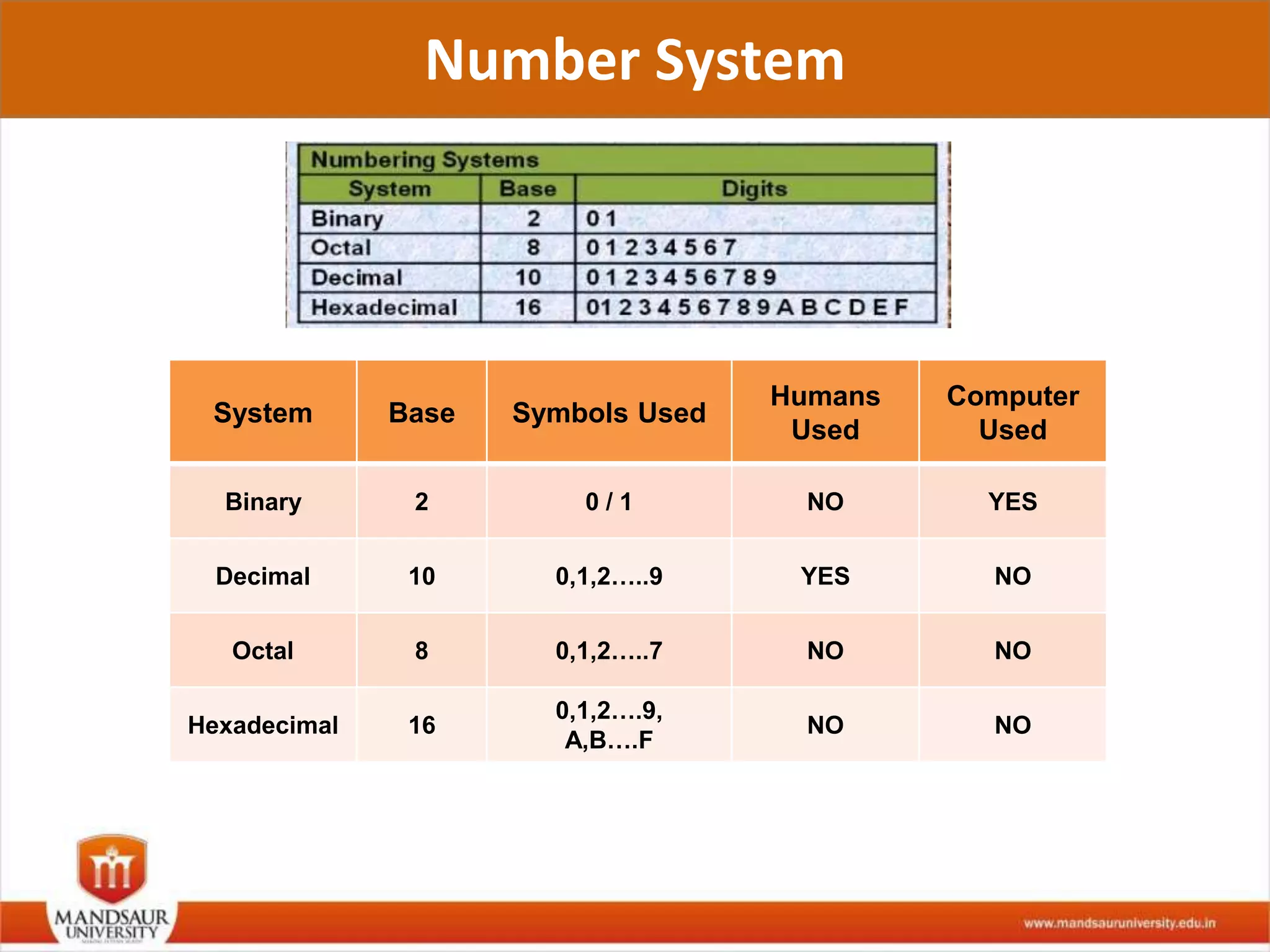
System Base Symbols Used
Humans
Used
Computer
Used
Binary 2 0 / 1 NO YES
Decimal 10 0,1,2…..9 YES NO
Octal 8 0,1,2…..7 NO NO
Hexadecimal 16
0,1,2….9,
A,B….F
NO NO
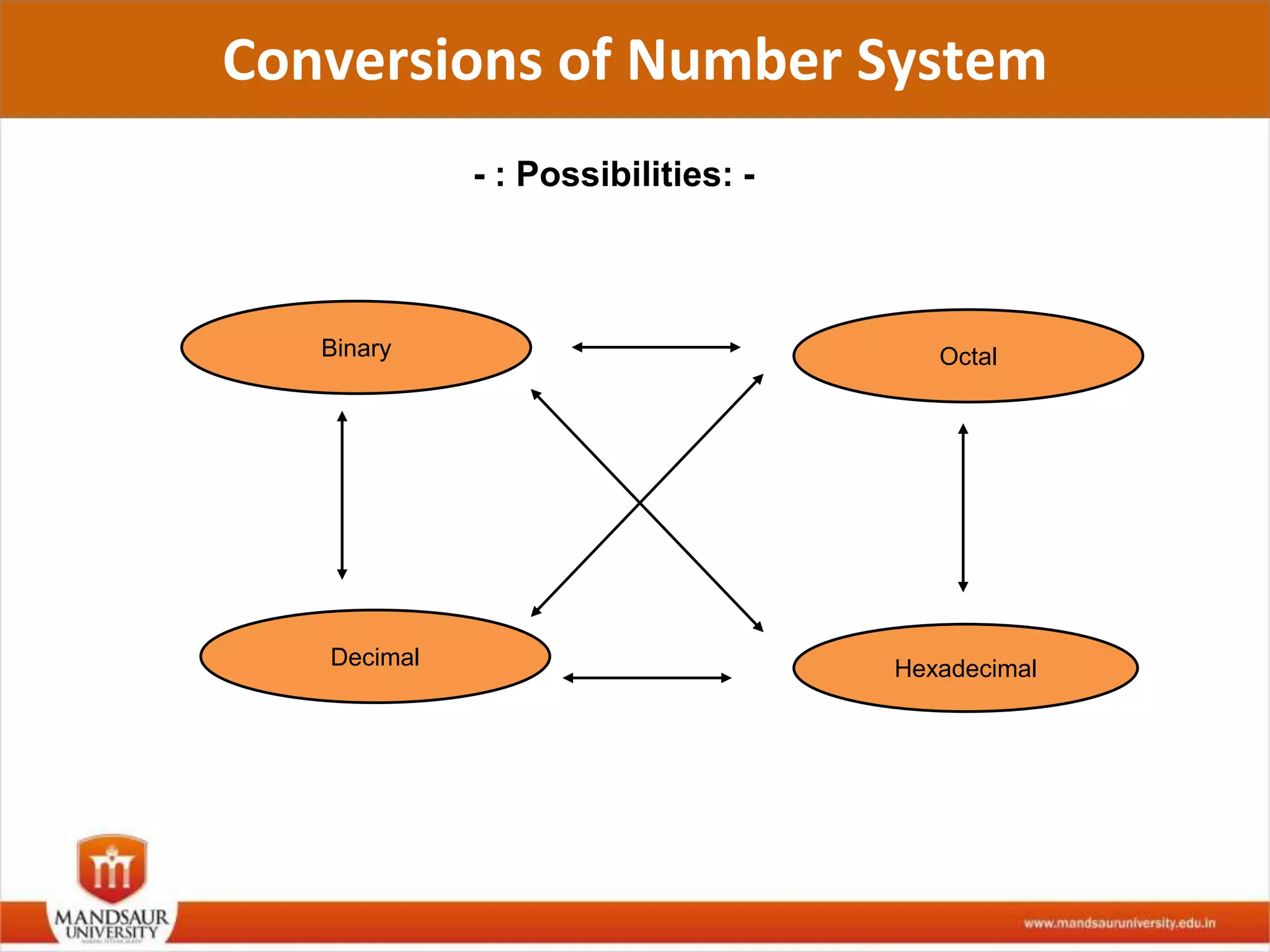
Conversions of Number System
- : Possibilities: -
Decimal
OctalBinary
Hexadecimal
Conversions of Number System
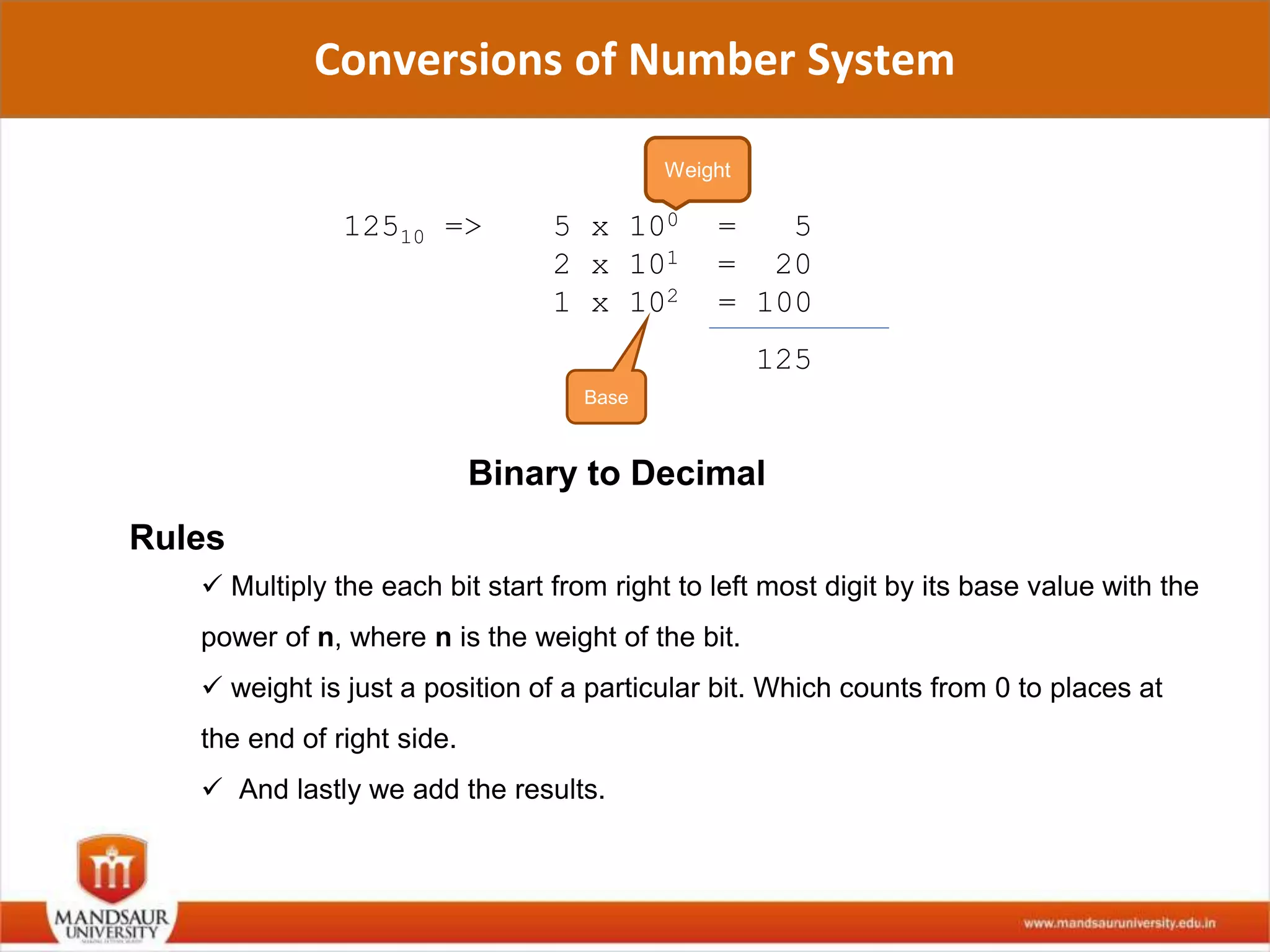
12510 =>
Weight
Base
Binary to Decimal
Rules
 Multiply the each bit start from right to left most digit by its base value with the
power of n, where n is the weight of the bit.
 weight is just a position of a particular bit. Which counts from 0 to places at
the end of right side.
 And lastly we add the results.
5 x 100 = 5
2 x 101 = 20
1 x 102 = 100
125
Conversions of Number System
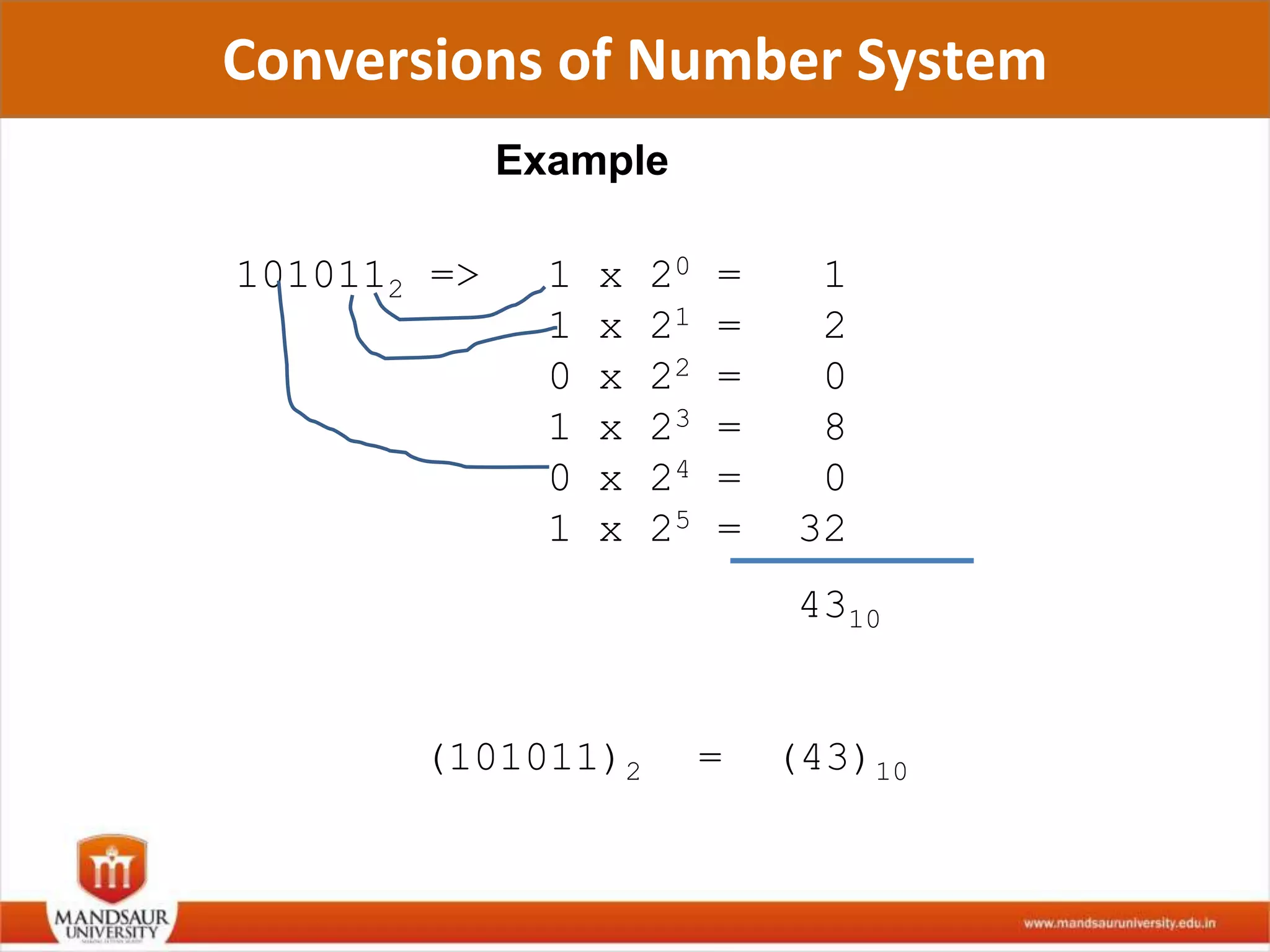
Example
1010112 => 1 x 20 = 1
1 x 21 = 2
0 x 22 = 0
1 x 23 = 8
0 x 24 = 0
1 x 25 = 32
4310
(101011)2 = (43)10
Conversions of Number System
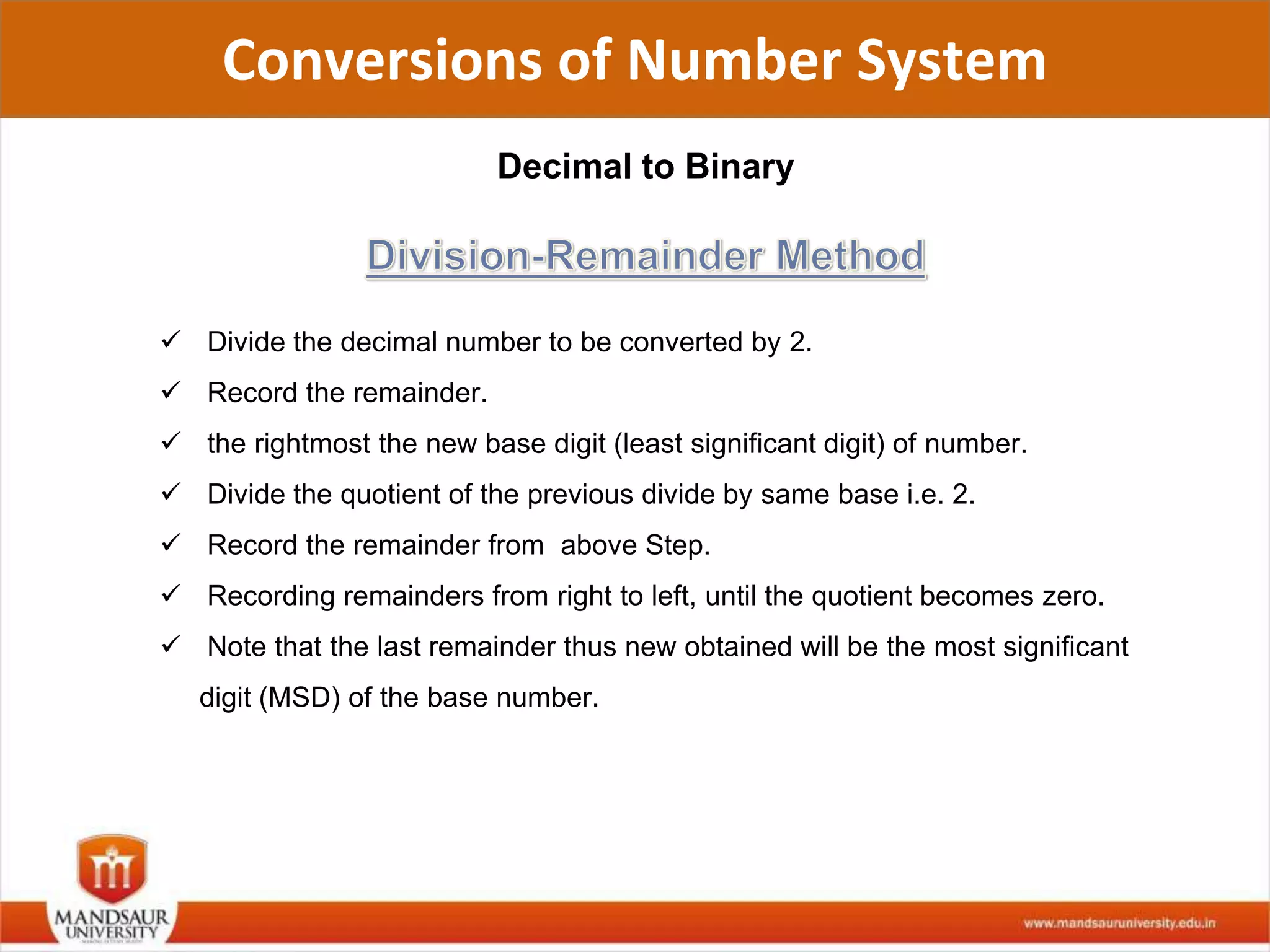
Decimal to Binary
 Divide the decimal number to be converted by 2.
 Record the remainder.
 the rightmost the new base digit (least significant digit) of number.
 Divide the quotient of the previous divide by same base i.e. 2.
 Record the remainder from above Step.
 Recording remainders from right to left, until the quotient becomes zero.
 Note that the last remainder thus new obtained will be the most significant
digit (MSD) of the base number.
Conversions of Number System
Decimal to Binary
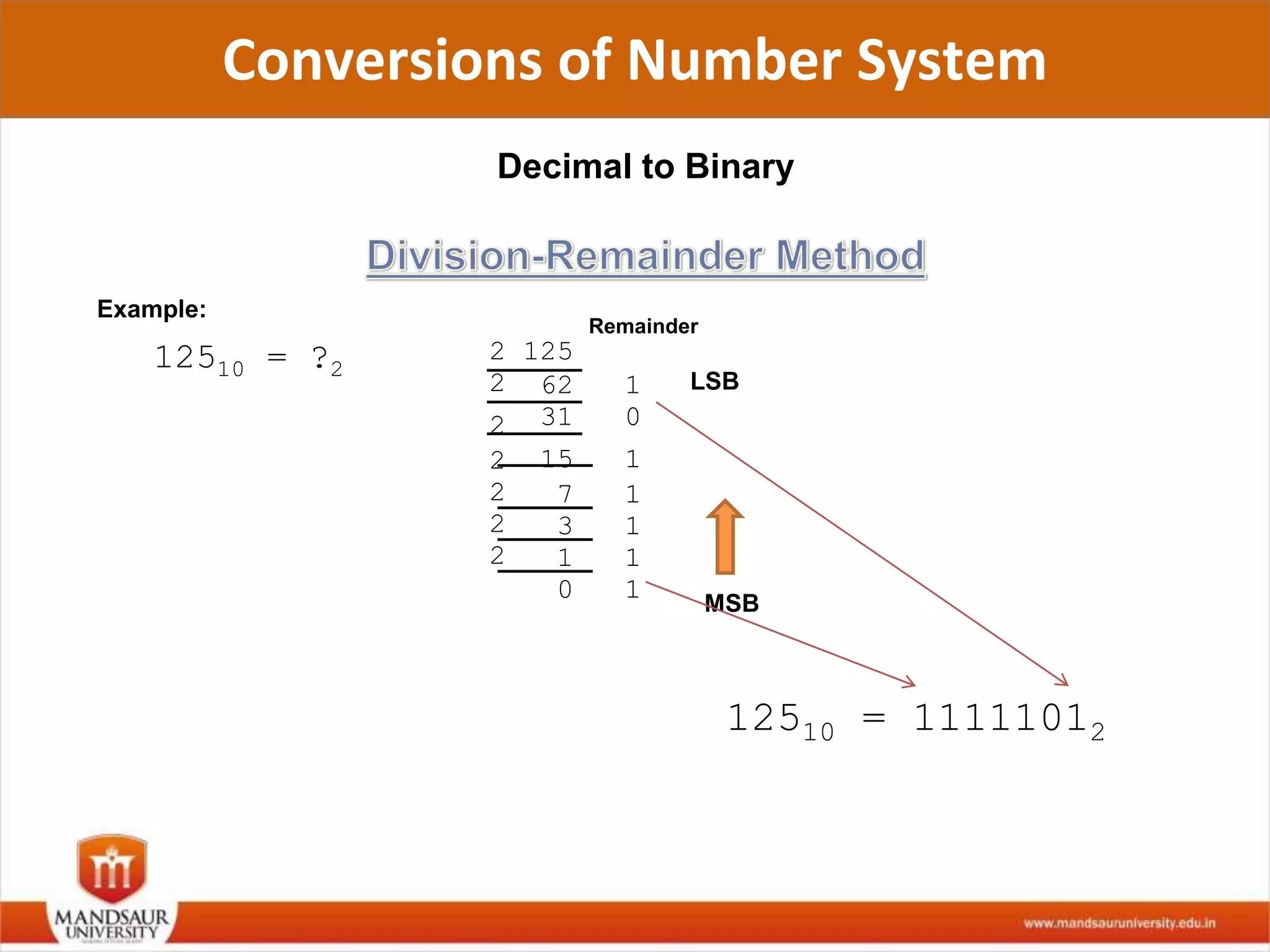
Example:
12510 = ?2
2 125
62 1
2
15 1
2
31 0
2
7 12
3 12
1 12
0 1
LSB
MSB
12510 = 11111012
Remainder
Conversions of Number System
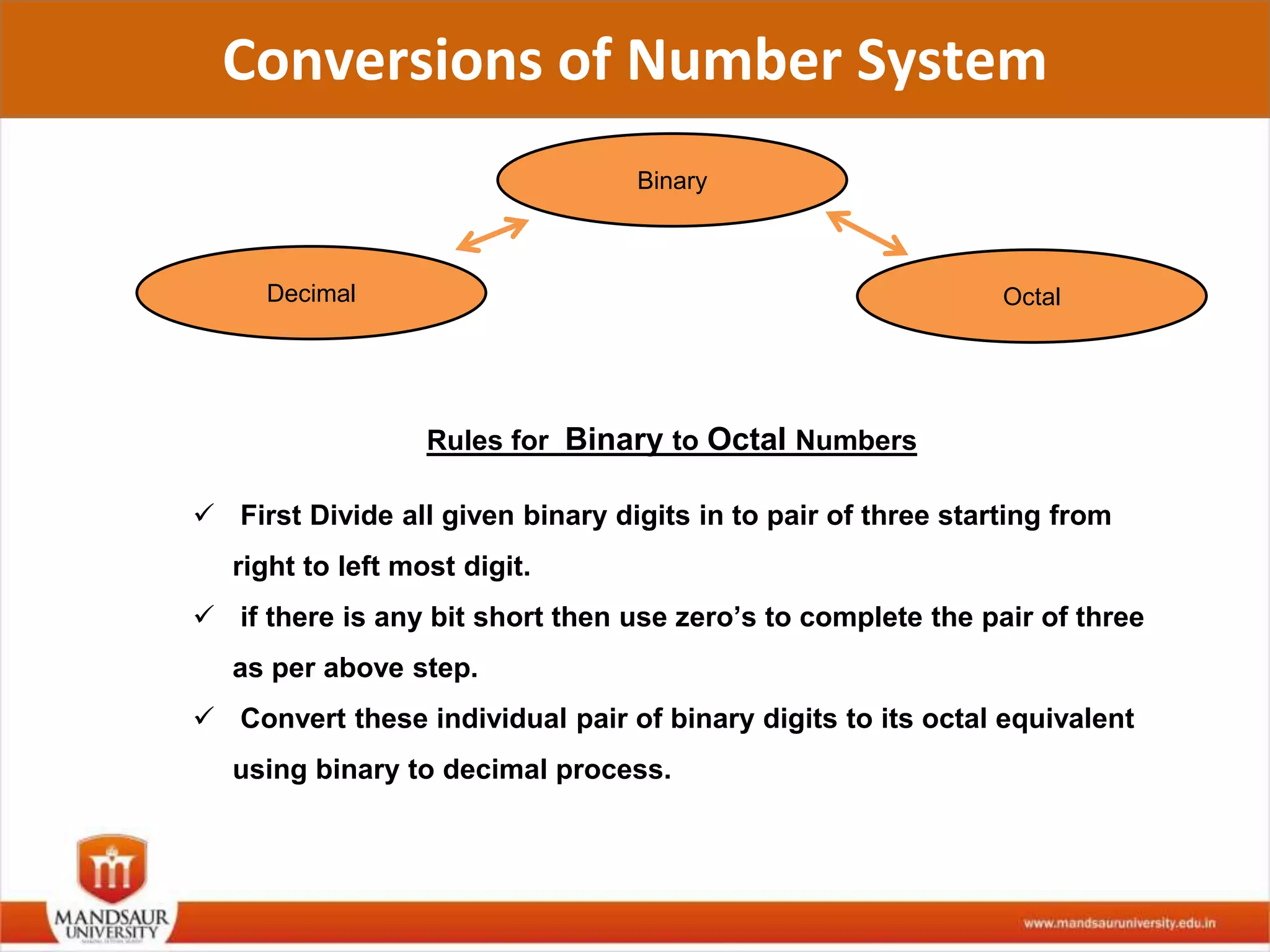
Octal
Binary
Decimal
Rules for Binary to Octal Numbers
 First Divide all given binary digits in to pair of three starting from
right to left most digit.
 if there is any bit short then use zero’s to complete the pair of three
as per above step.
 Convert these individual pair of binary digits to its octal equivalent
using binary to decimal process.
Conversions of Number System
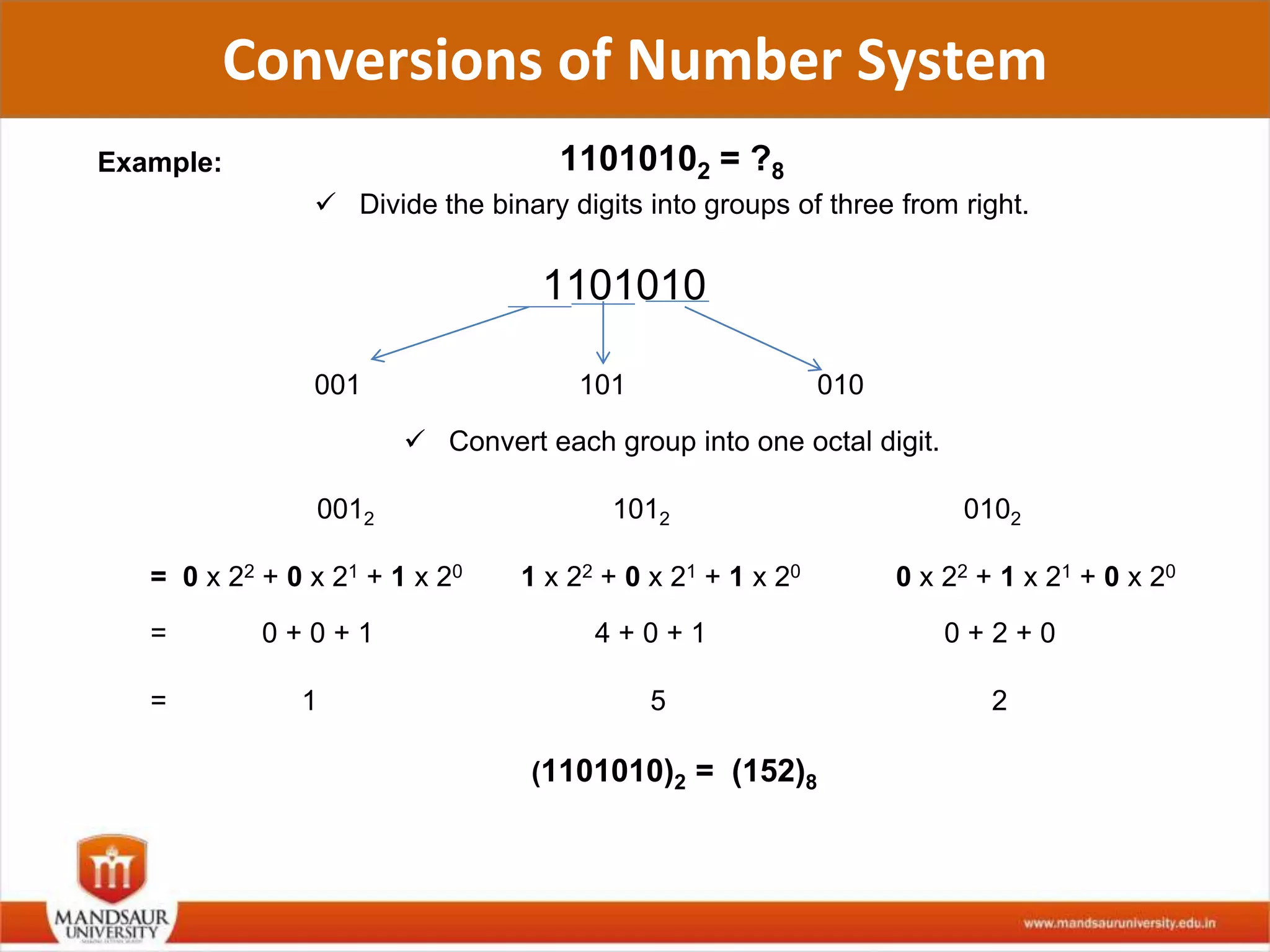
Example: 11010102 = ?8
 Divide the binary digits into groups of three from right.
1101010
001 101 010
 Convert each group into one octal digit.
0012 1012 0102
= 0 x 22 + 0 x 21 + 1 x 20 1 x 22 + 0 x 21 + 1 x 20 0 x 22 + 1 x 21 + 0 x 20
= 0 + 0 + 1 4 + 0 + 1 0 + 2 + 0
= 1 5 2
(1101010)2 = (152)8
Conversions of Number System
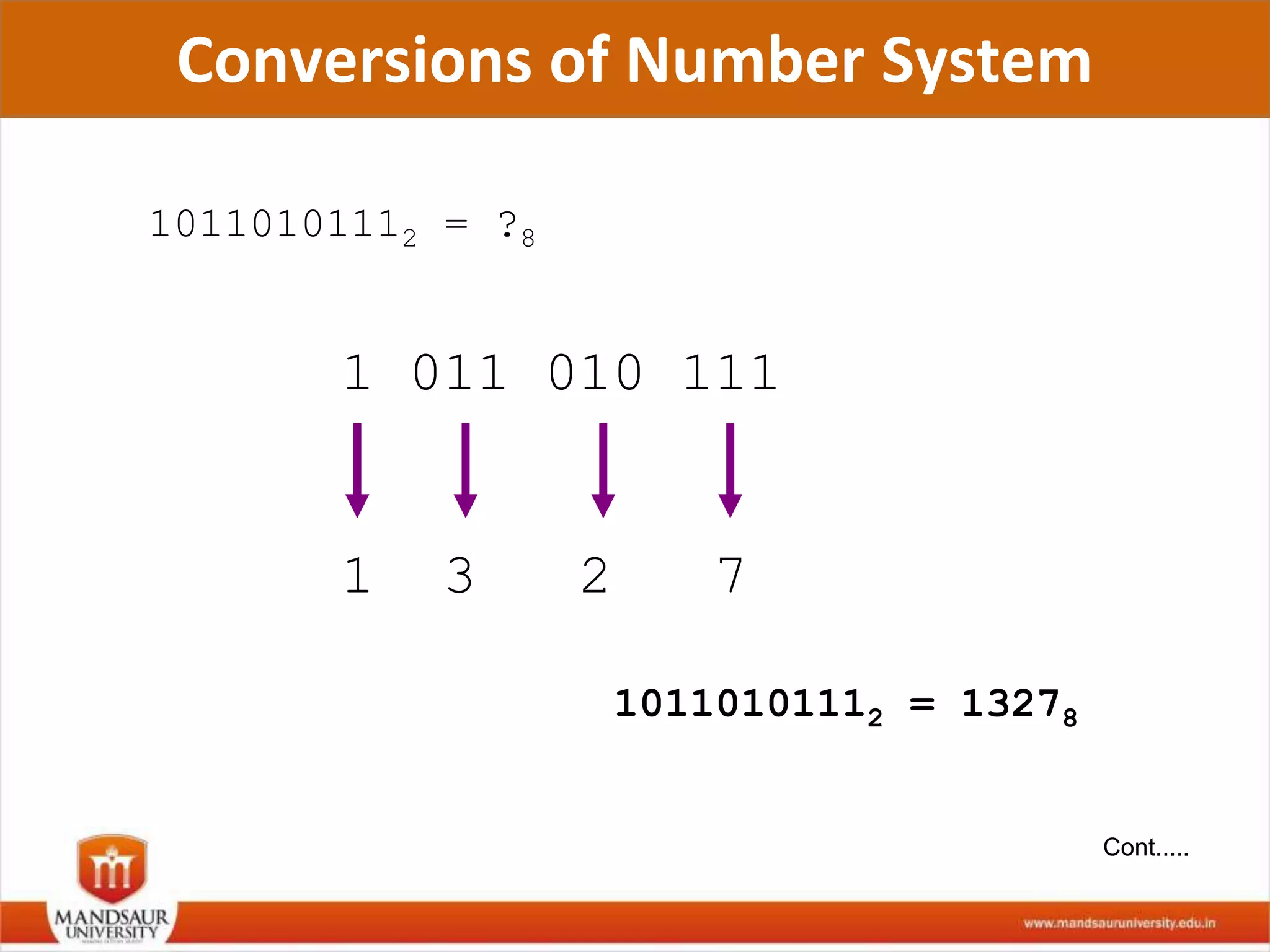
10110101112 = ?8
1 011 010 111
1 3 2 7
10110101112 = 13278
Cont.....
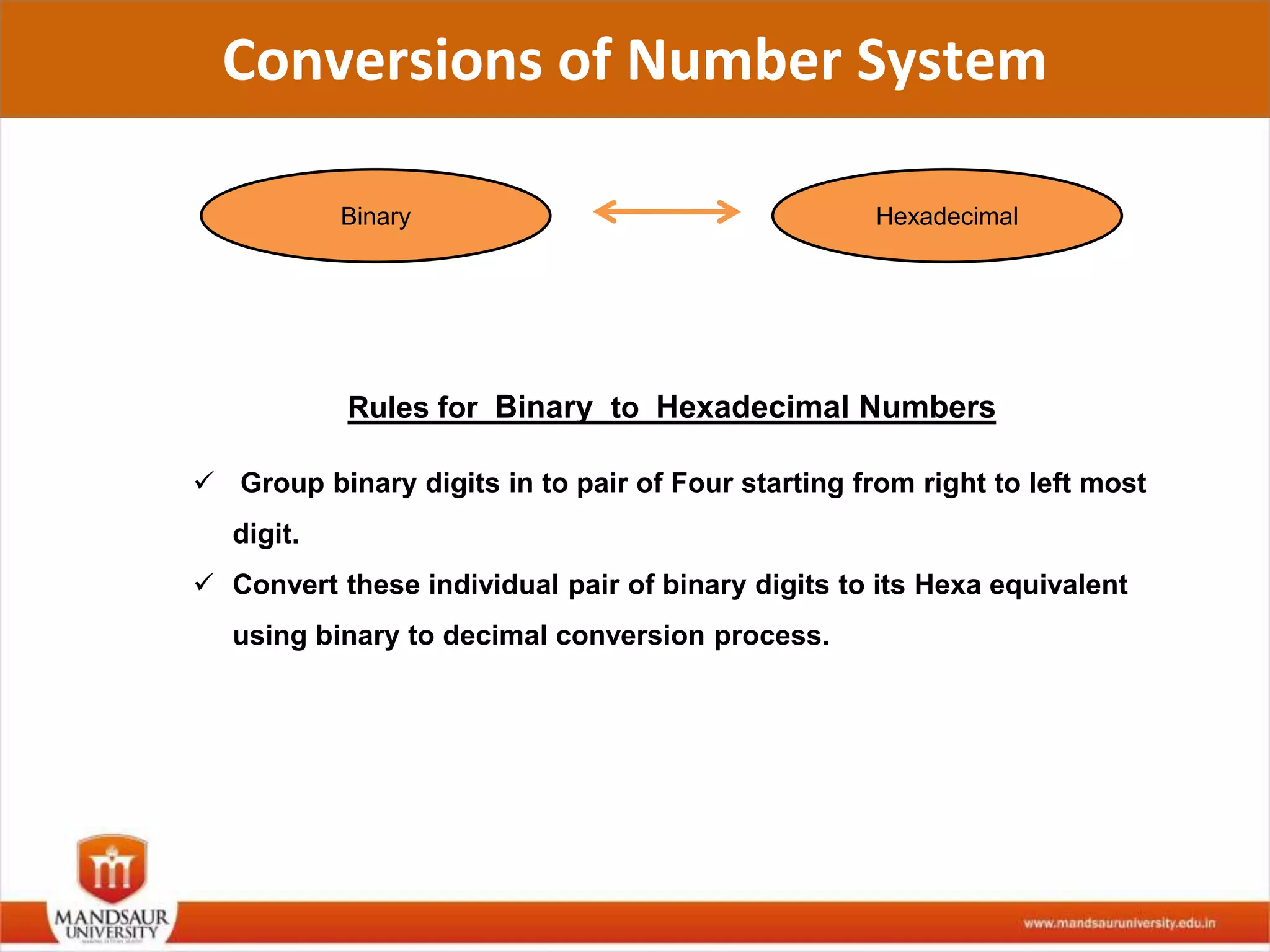
Conversions of Number System
HexadecimalBinary
Rules for Binary to Hexadecimal Numbers
 Group binary digits in to pair of Four starting from right to left most
digit.
 Convert these individual pair of binary digits to its Hexa equivalent
using binary to decimal conversion process.
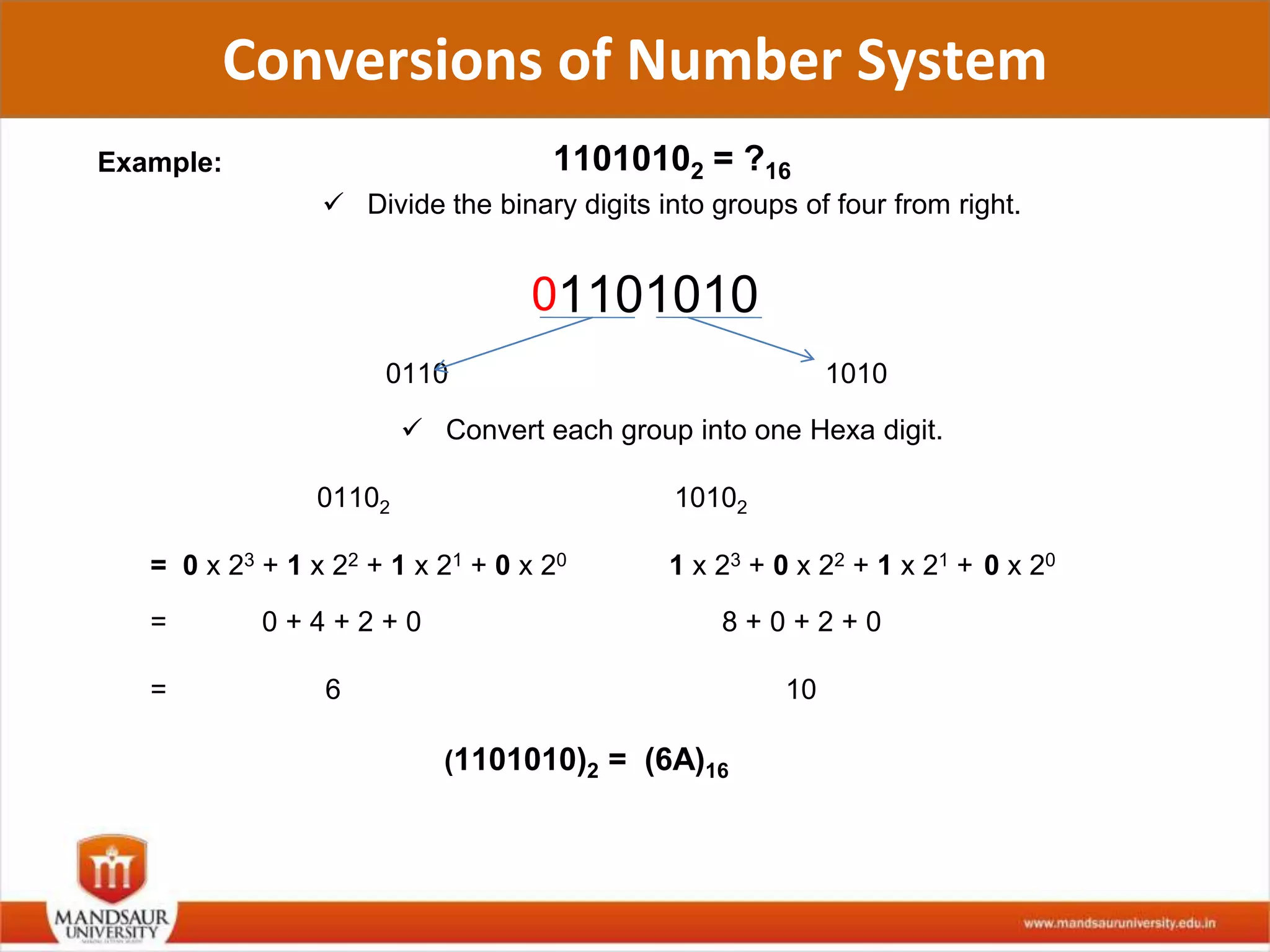
Conversions of Number System
Example: 11010102 = ?16
 Divide the binary digits into groups of four from right.
01101010
0110 1010
 Convert each group into one Hexa digit.
01102 10102
= 0 x 23 + 1 x 22 + 1 x 21 + 0 x 20 1 x 23 + 0 x 22 + 1 x 21 + 0 x 20
= 0 + 4 + 2 + 0 8 + 0 + 2 + 0
= 6 10
(1101010)2 = (6A)16
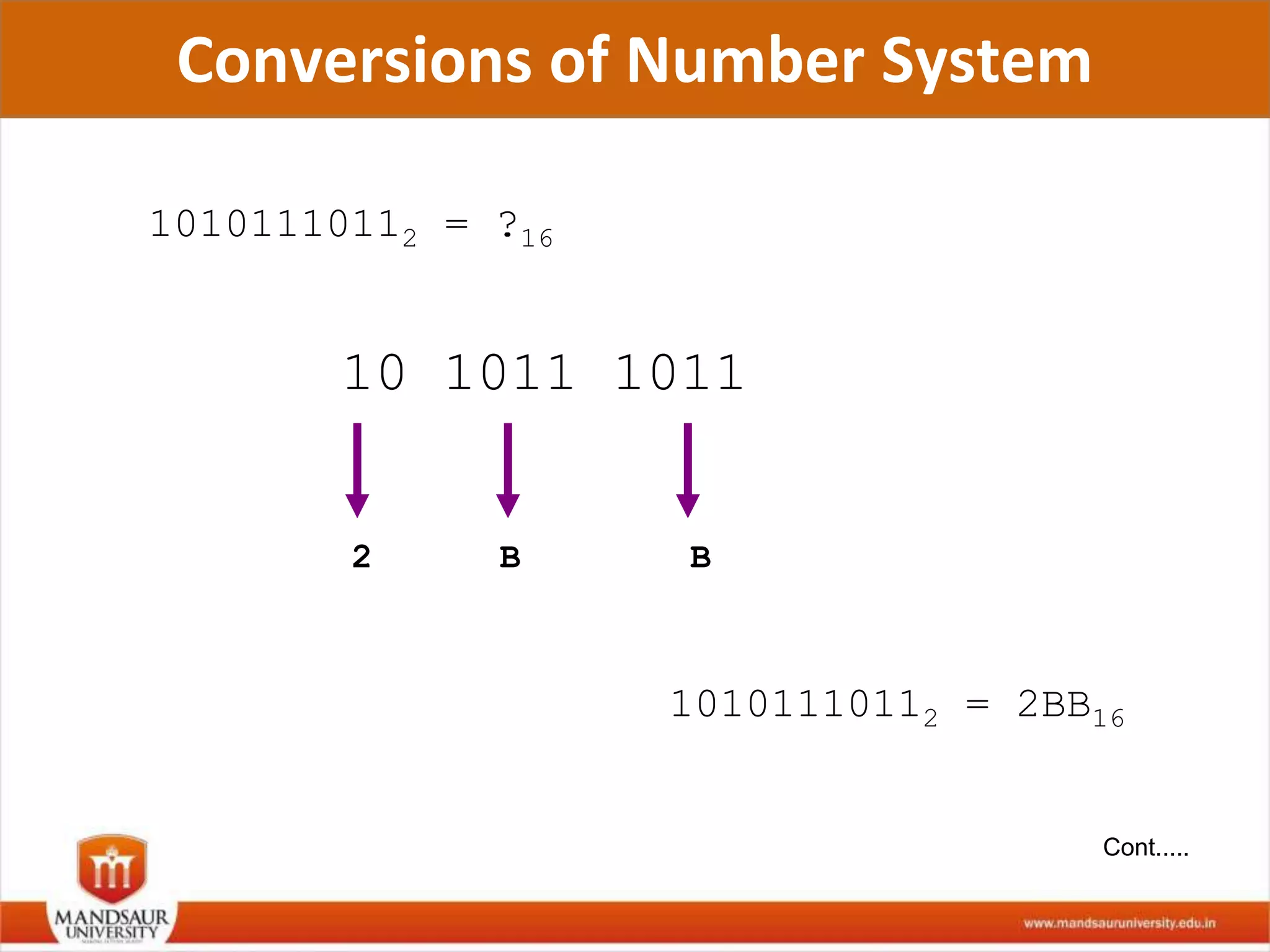
Conversions of Number System
10101110112 = ?16
10 1011 1011
10101110112 = 2BB16
Cont.....
2 B B
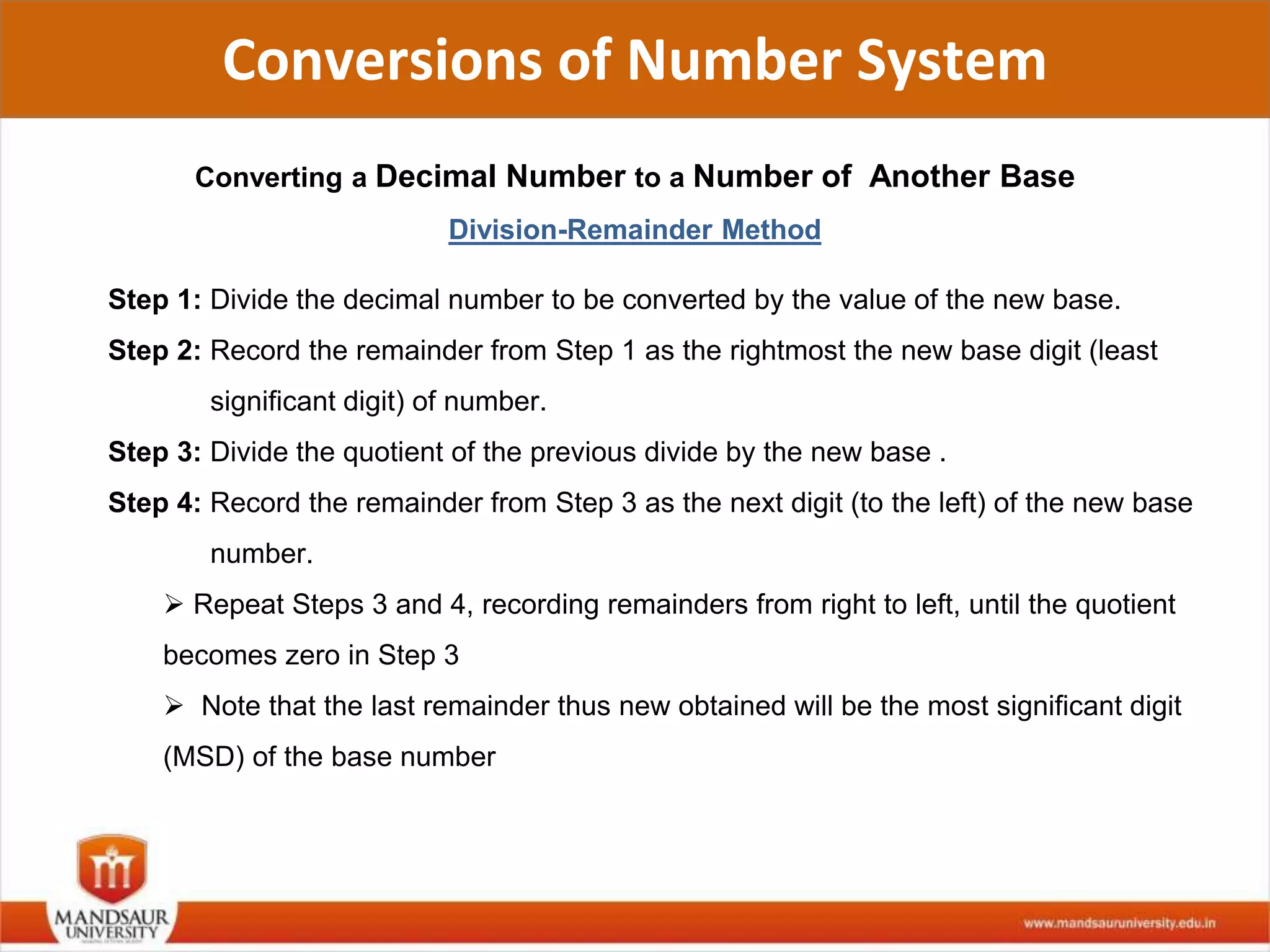
Conversions of Number System
Converting a Decimal Number to a Number of Another Base
Division-Remainder Method
Step 1: Divide the decimal number to be converted by the value of the new base.
Step 2: Record the remainder from Step 1 as the rightmost the new base digit (least
significant digit) of number.
Step 3: Divide the quotient of the previous divide by the new base .
Step 4: Record the remainder from Step 3 as the next digit (to the left) of the new base
number.
 Repeat Steps 3 and 4, recording remainders from right to left, until the quotient
becomes zero in Step 3
 Note that the last remainder thus new obtained will be the most significant digit
(MSD) of the base number
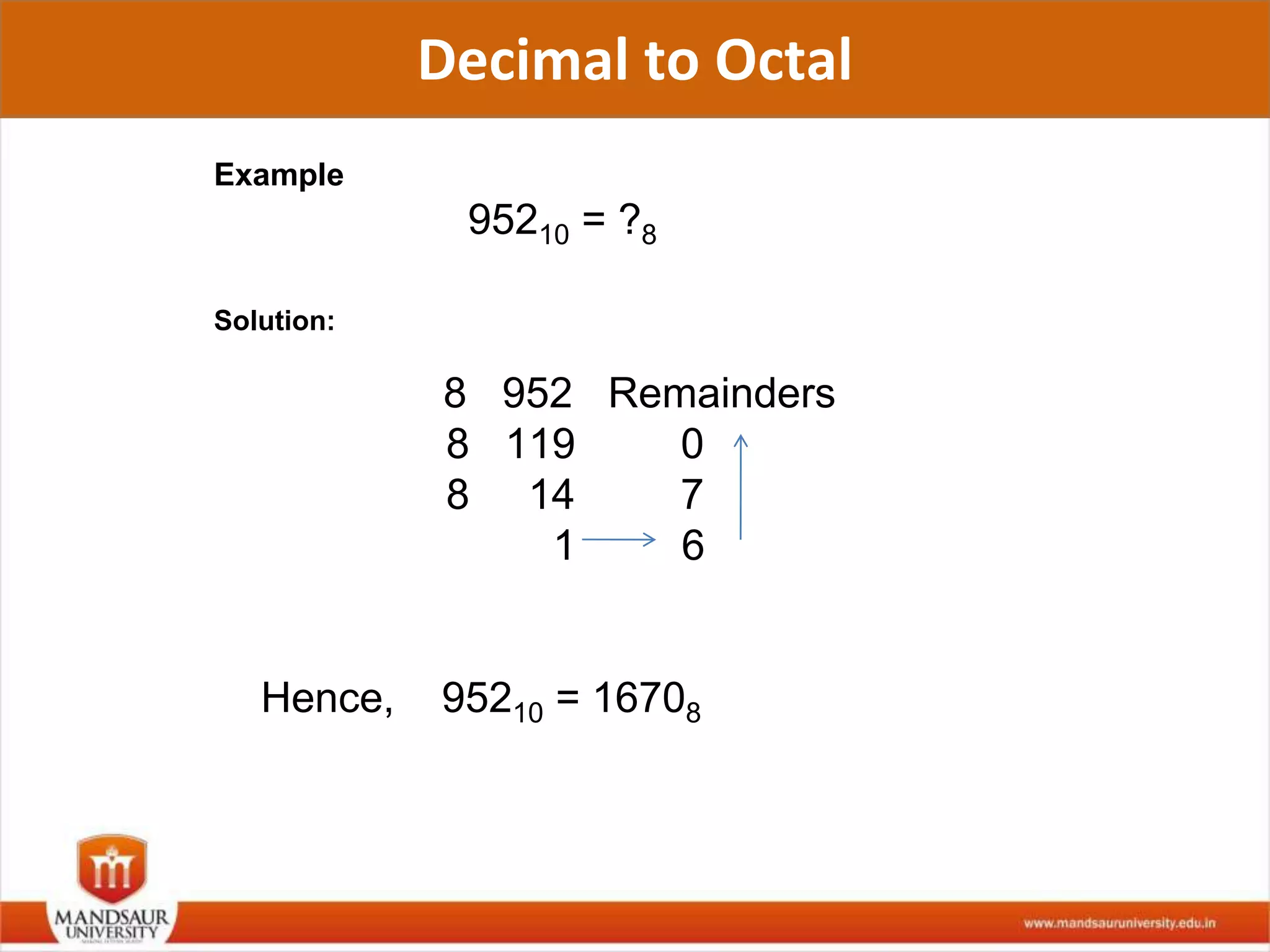
Decimal to Octal
Example
95210 = ?8
Solution:
8 952 Remainders
8 119 0
8 14 7
1 6
Hence, 95210 = 16708
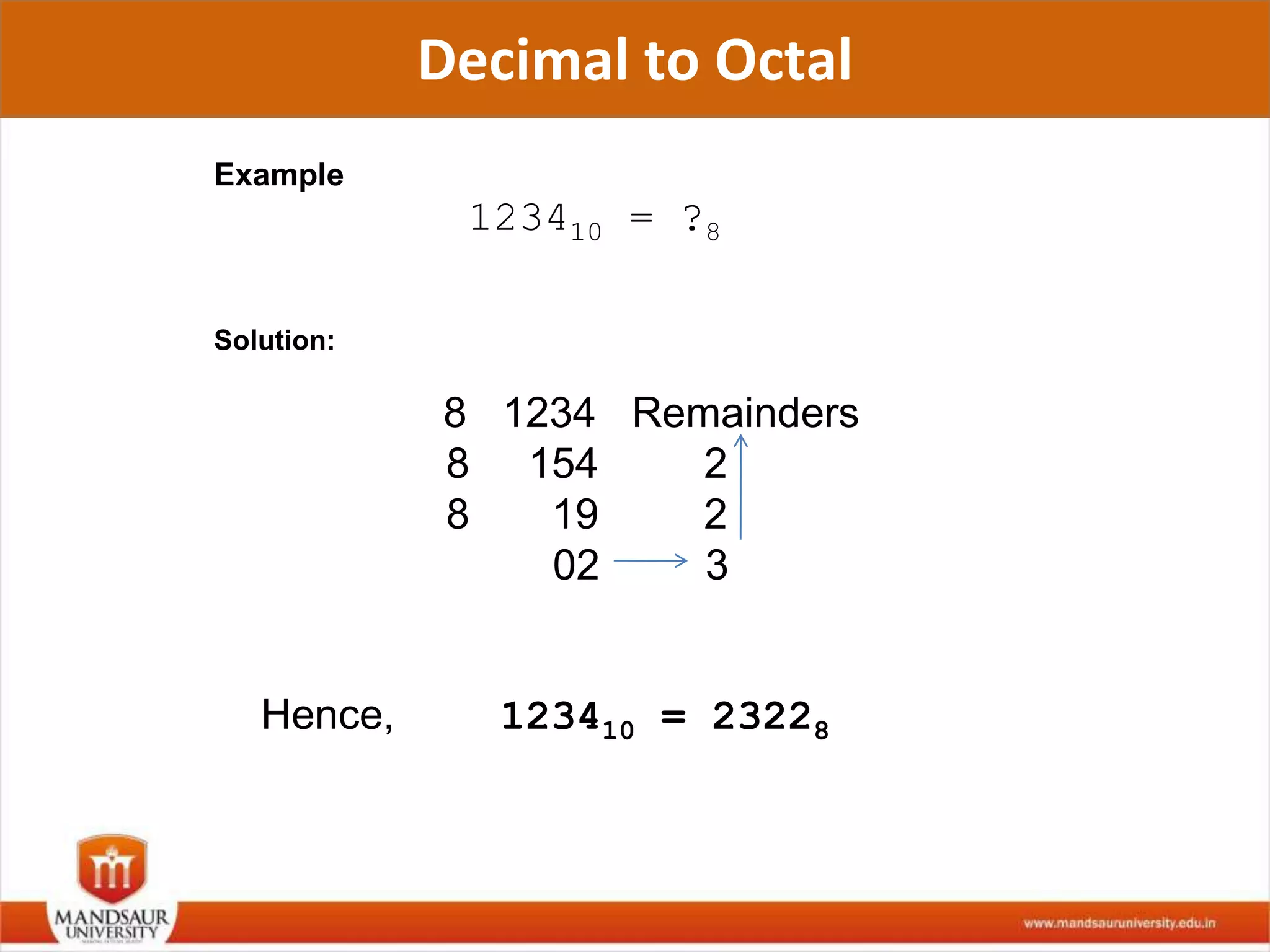
Decimal to Octal
Example
123410 = ?8
Solution:
8 1234 Remainders
8 154 2
8 19 2
02 3
Hence, 123410 = 23228
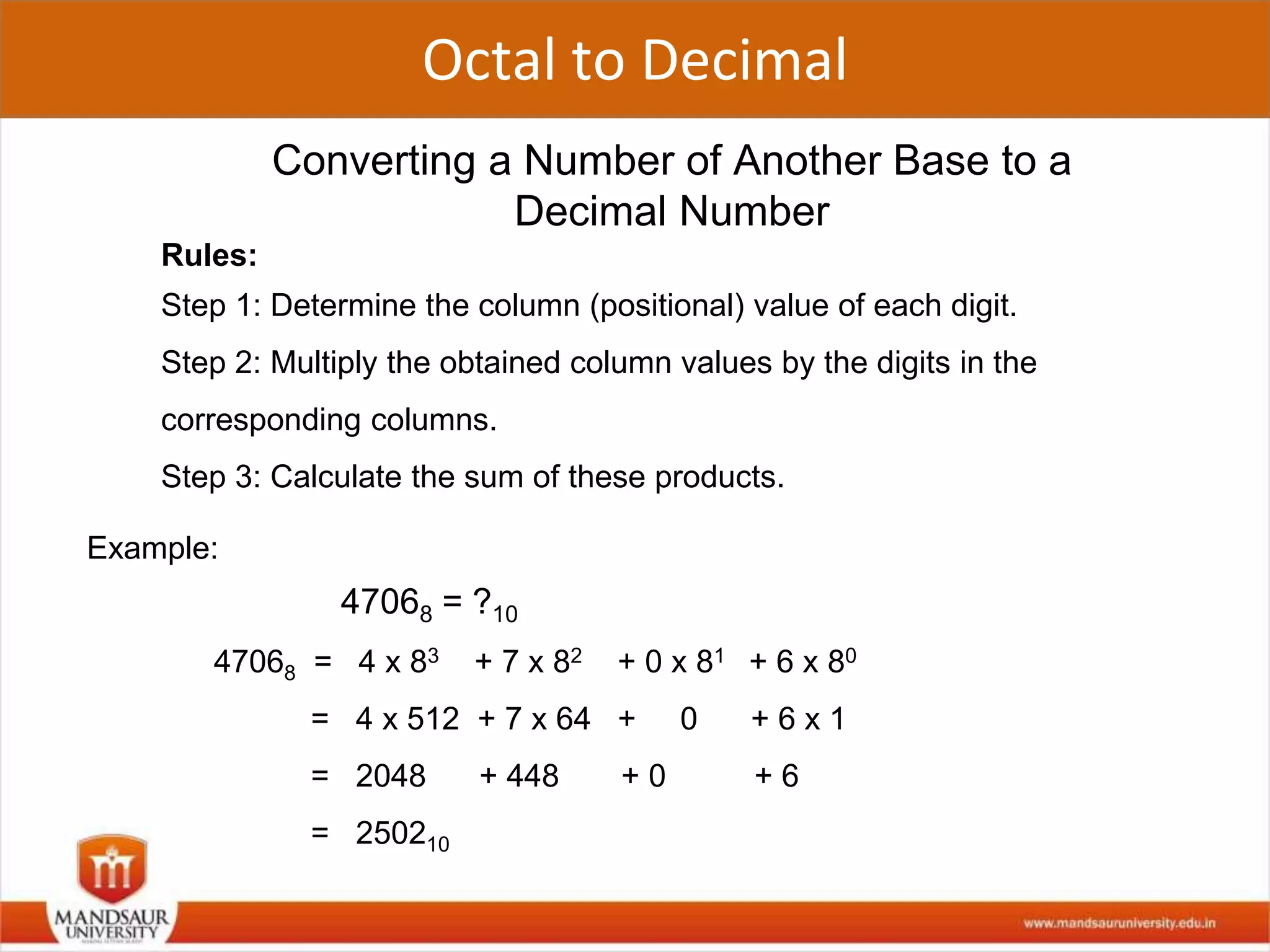
Octal to Decimal
Converting a Number of Another Base to a
Decimal Number
Rules:
Step 1: Determine the column (positional) value of each digit.
Step 2: Multiply the obtained column values by the digits in the
corresponding columns.
Step 3: Calculate the sum of these products.
Example:
47068 = ?10
47068 = 4 x 83 + 7 x 82 + 0 x 81 + 6 x 80
= 4 x 512 + 7 x 64 + 0 + 6 x 1
= 2048 + 448 + 0 + 6
= 250210
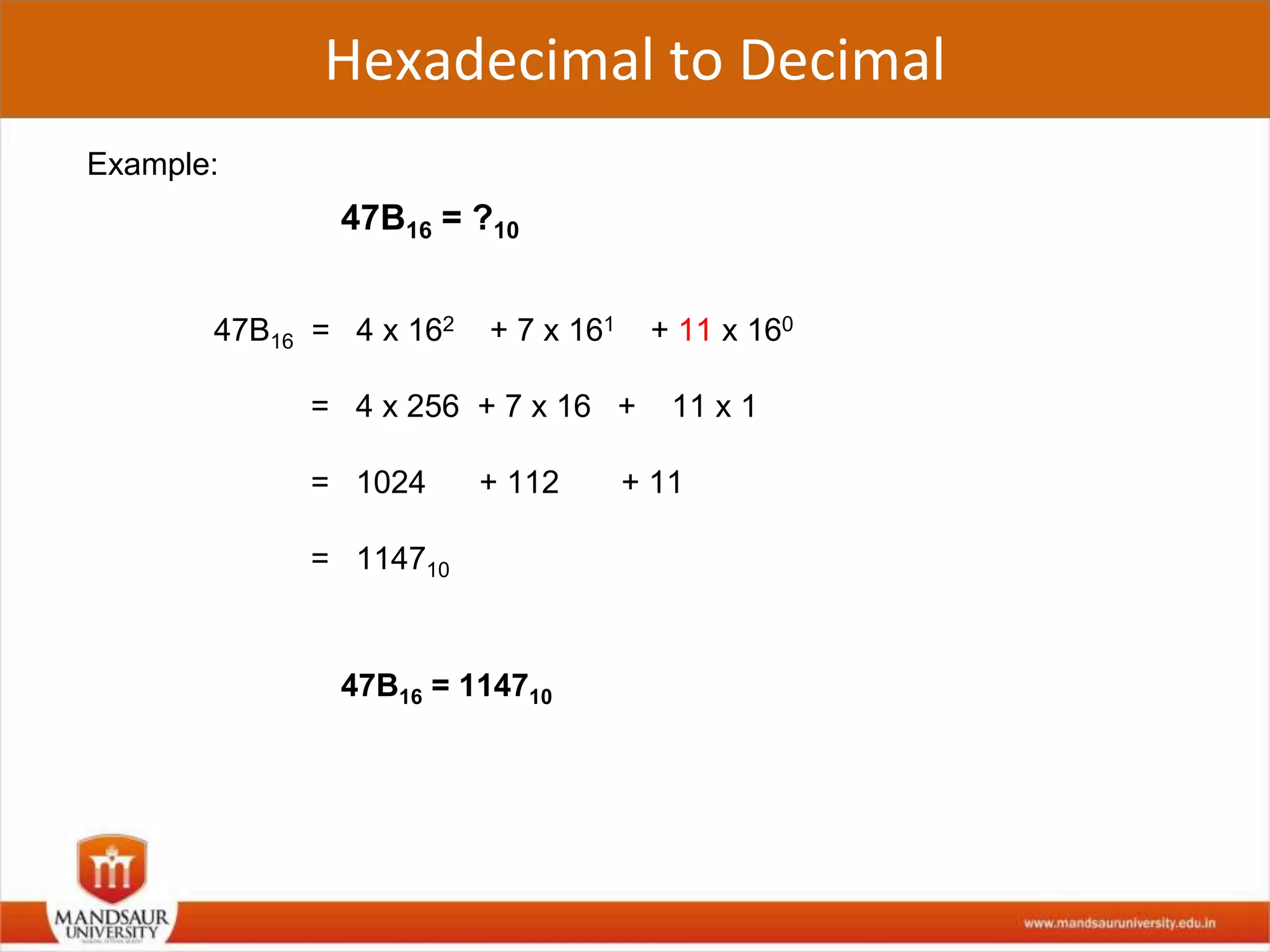
Hexadecimal to Decimal
Example:
47B16 = ?10
47B16 = 4 x 162 + 7 x 161 + 11 x 160
= 4 x 256 + 7 x 16 + 11 x 1
= 1024 + 112 + 11
= 114710
47B16 = 114710
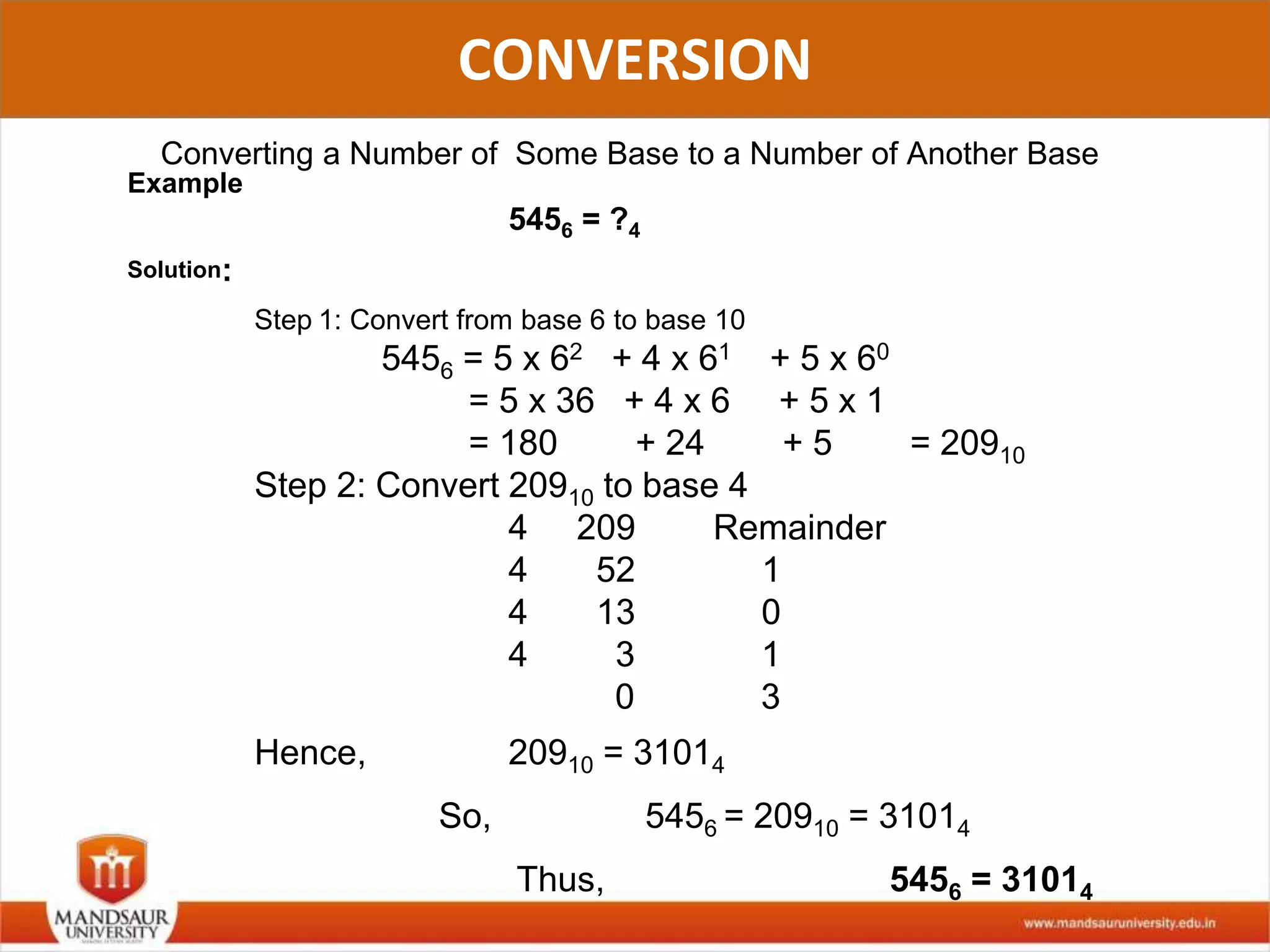
CONVERSION
Converting a Number of Some Base to a Number of Another Base
Example
5456 = ?4
Solution:
Step 1: Convert from base 6 to base 10
5456 = 5 x 62 + 4 x 61 + 5 x 60
= 5 x 36 + 4 x 6 + 5 x 1
= 180 + 24 + 5 = 20910
Step 2: Convert 20910 to base 4
4 209 Remainder
4 52 1
4 13 0
4 3 1
0 3
Hence, 20910 = 31014
So, 5456 = 20910 = 31014
Thus, 5456 = 31014
Conversions of Number System
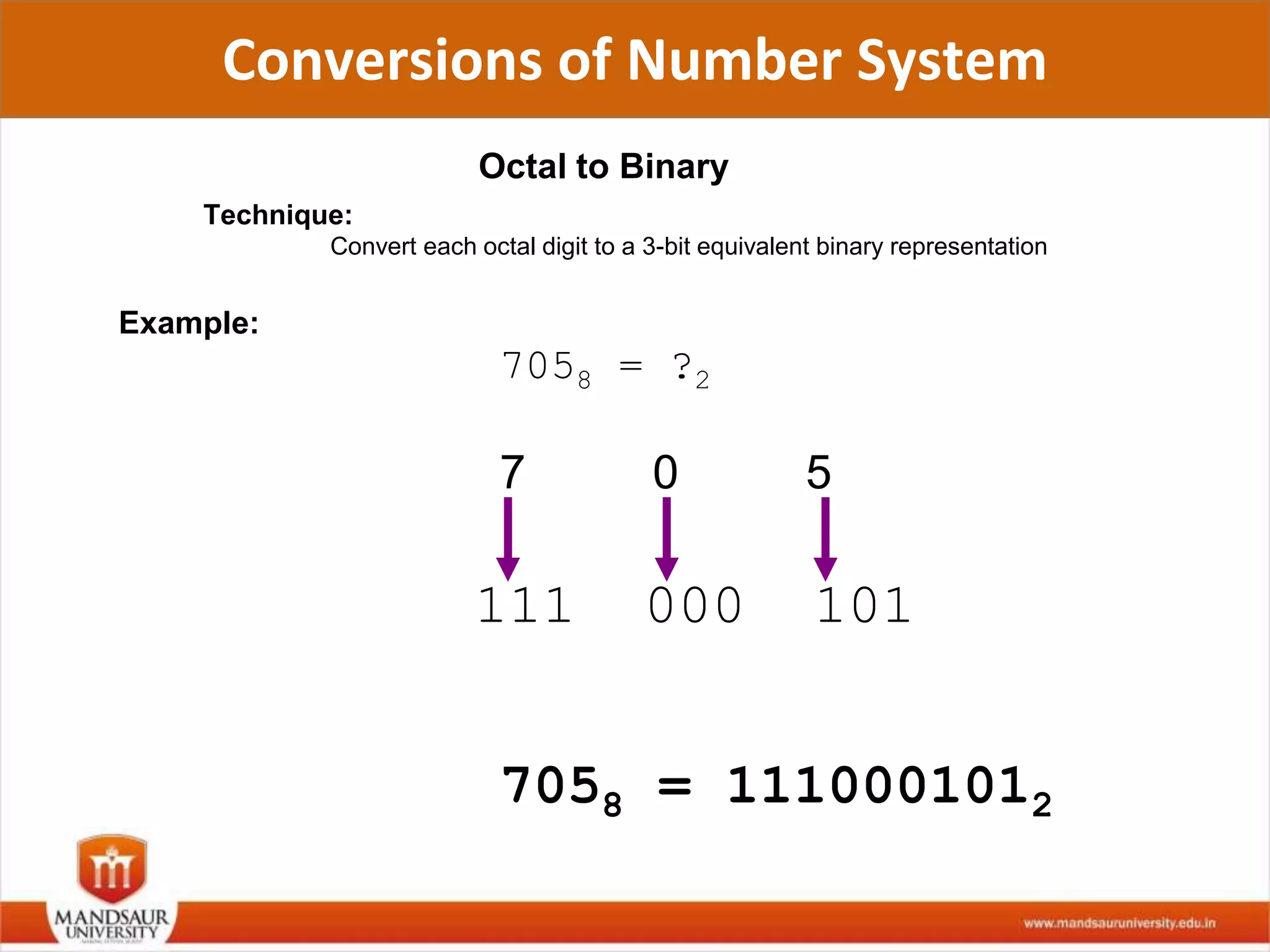
Octal to Binary
Technique:
Convert each octal digit to a 3-bit equivalent binary representation
Example:
7058 = ?2
7 0 5
111 000 101
7058 = 1110001012
Conversions of Number System
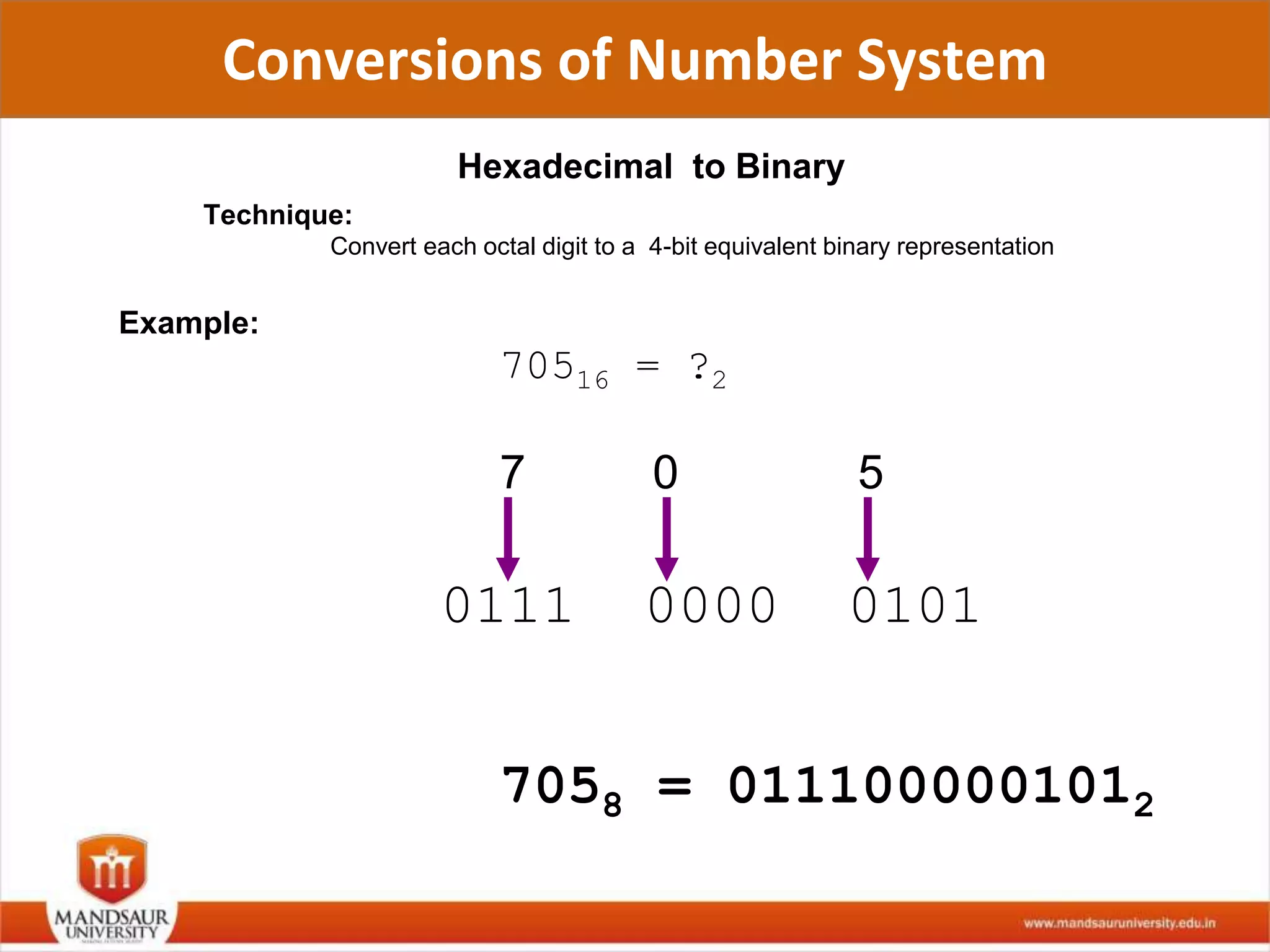
Hexadecimal to Binary
Technique:
Convert each octal digit to a 4-bit equivalent binary representation
Example:
70516 = ?2
7 0 5
0111 0000 0101
7058 = 0111000001012
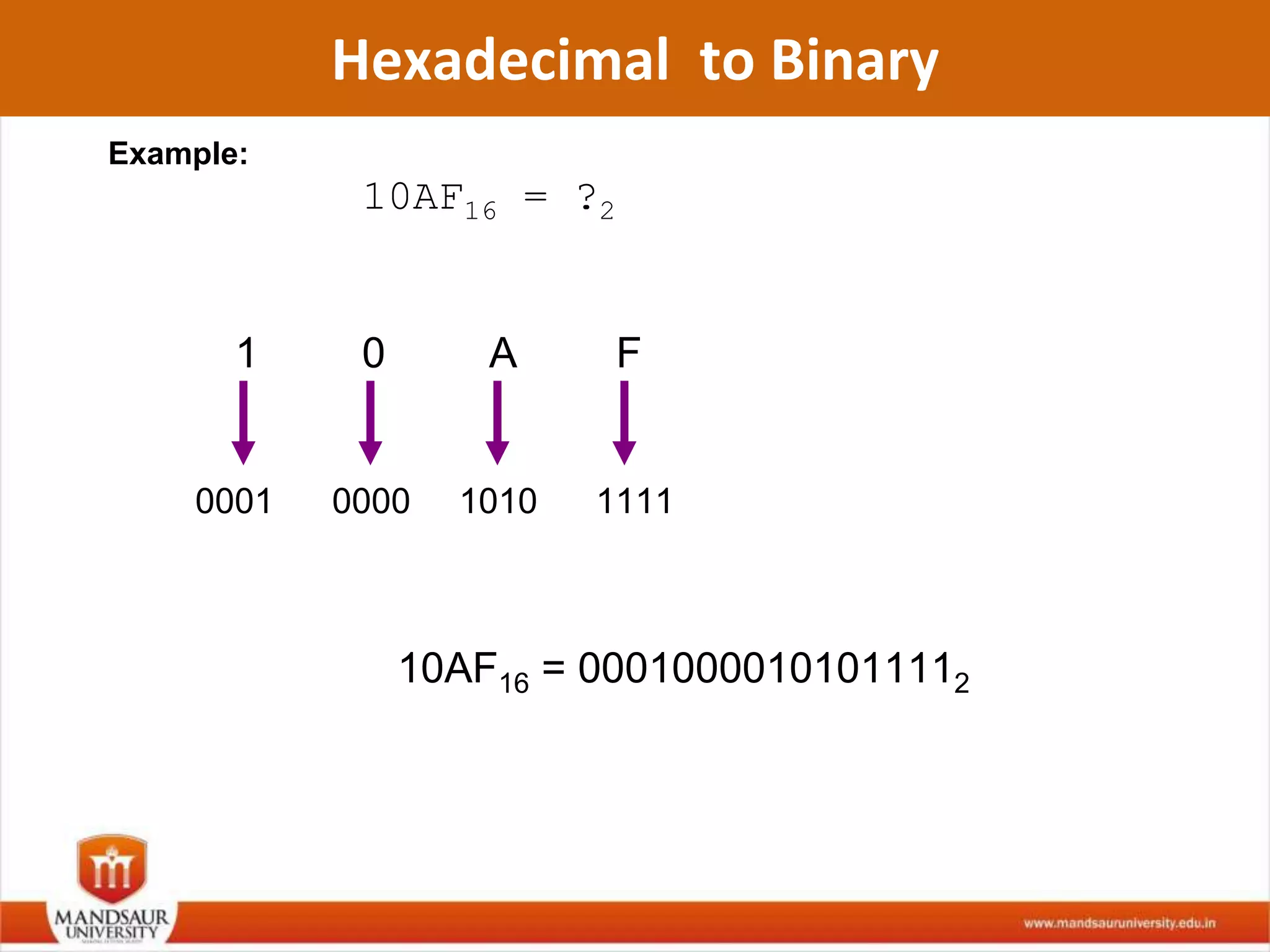
Hexadecimal to Binary
Example:
10AF16 = ?2
1 0 A F
0001 0000 1010 1111
10AF16 = 00010000101011112
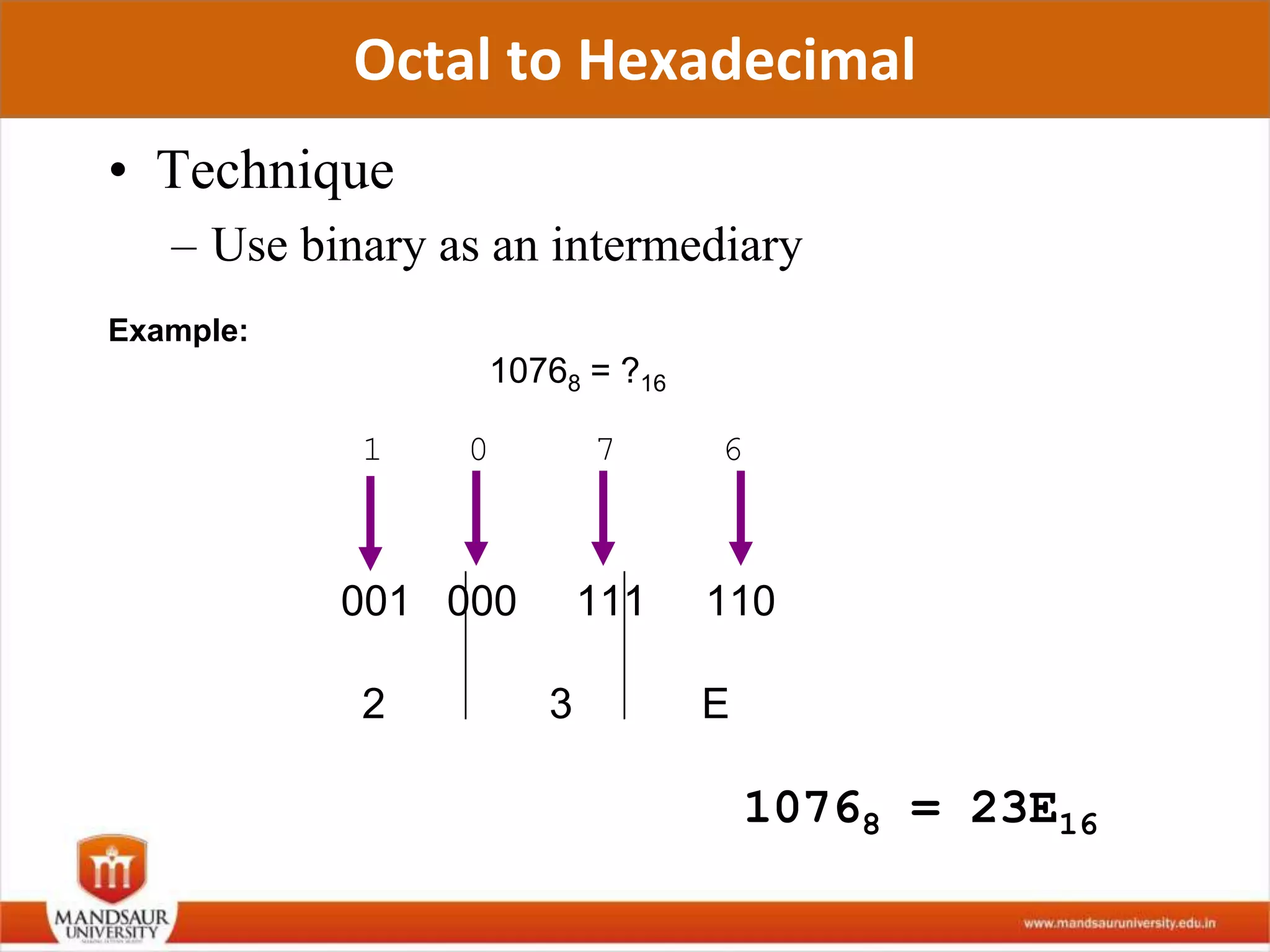
Octal to Hexadecimal
• Technique
– Use binary as an intermediary
Example:
10768 = ?16
1 0 7 6
001 000 111 110
2 3 E
10768 = 23E16
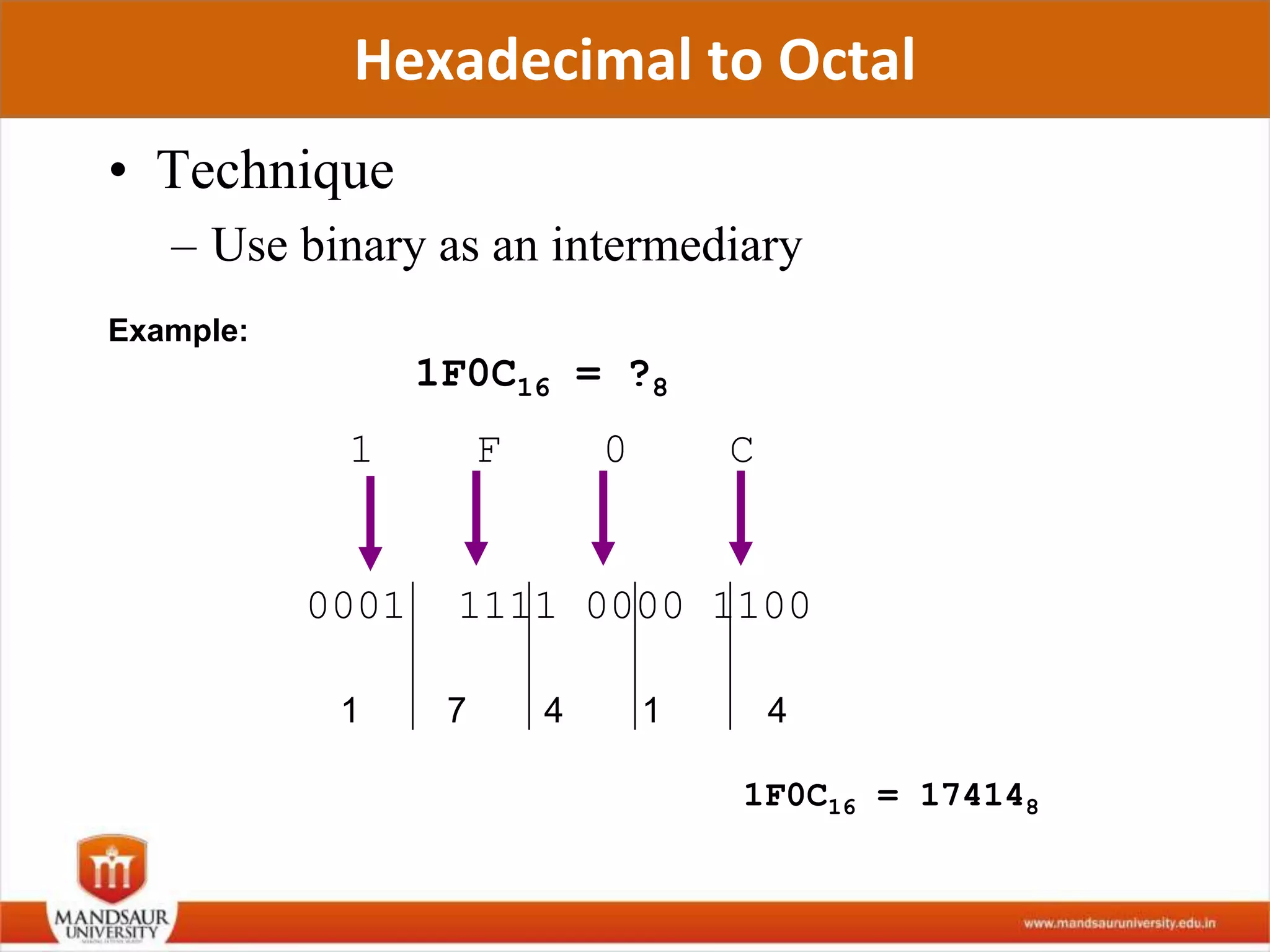
Hexadecimal to Octal
• Technique
– Use binary as an intermediary
Example:
1F0C16 = ?8
1 F 0 C
0001 1111 0000 1100
1 7 4 1 4
1F0C16 = 174148
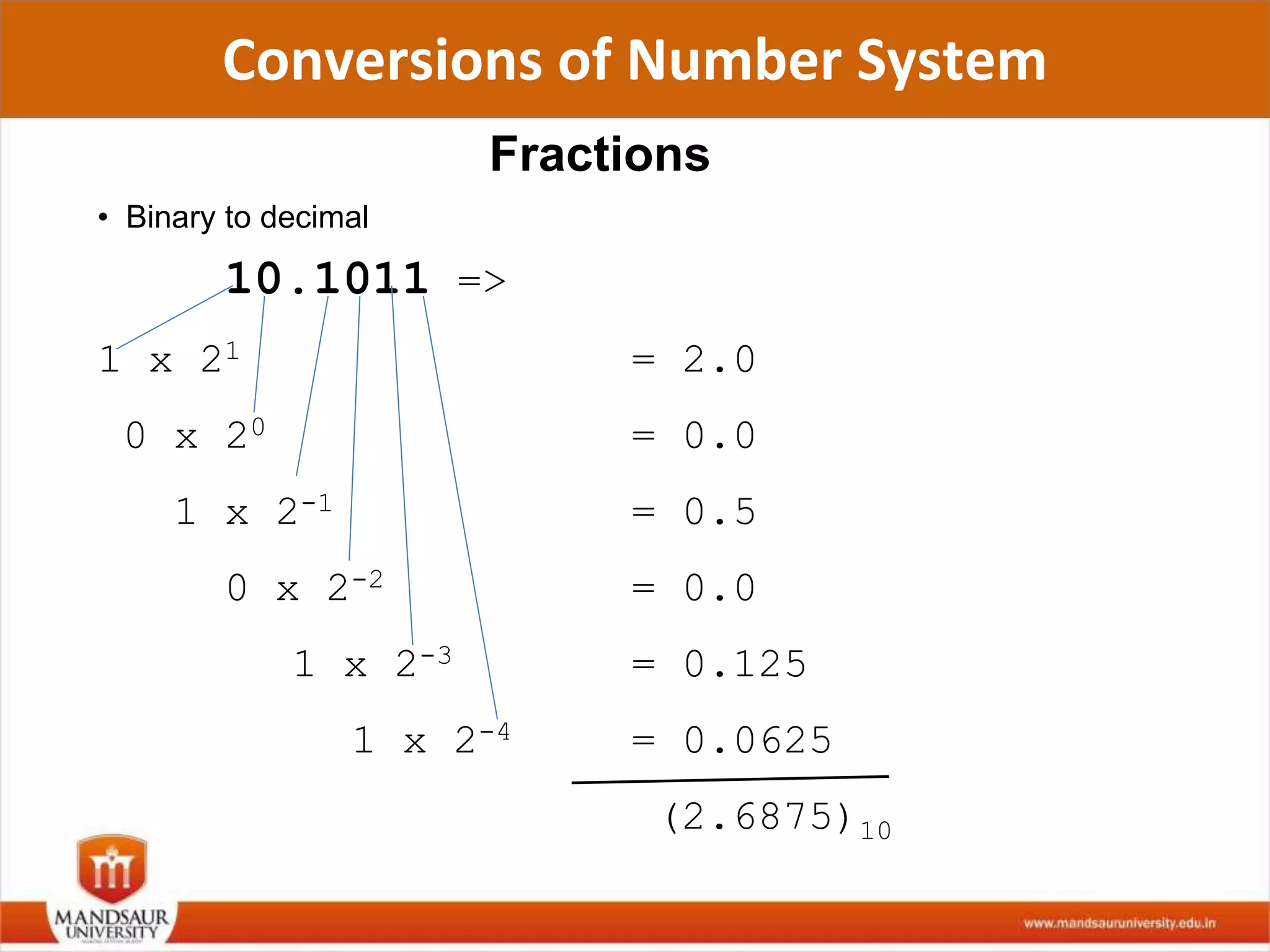
Conversions of Number System
Fractions
• Binary to decimal
10.1011 =>
1 x 21 = 2.0
0 x 20 = 0.0
1 x 2-1 = 0.5
0 x 2-2 = 0.0
1 x 2-3 = 0.125
1 x 2-4 = 0.0625
(2.6875)10
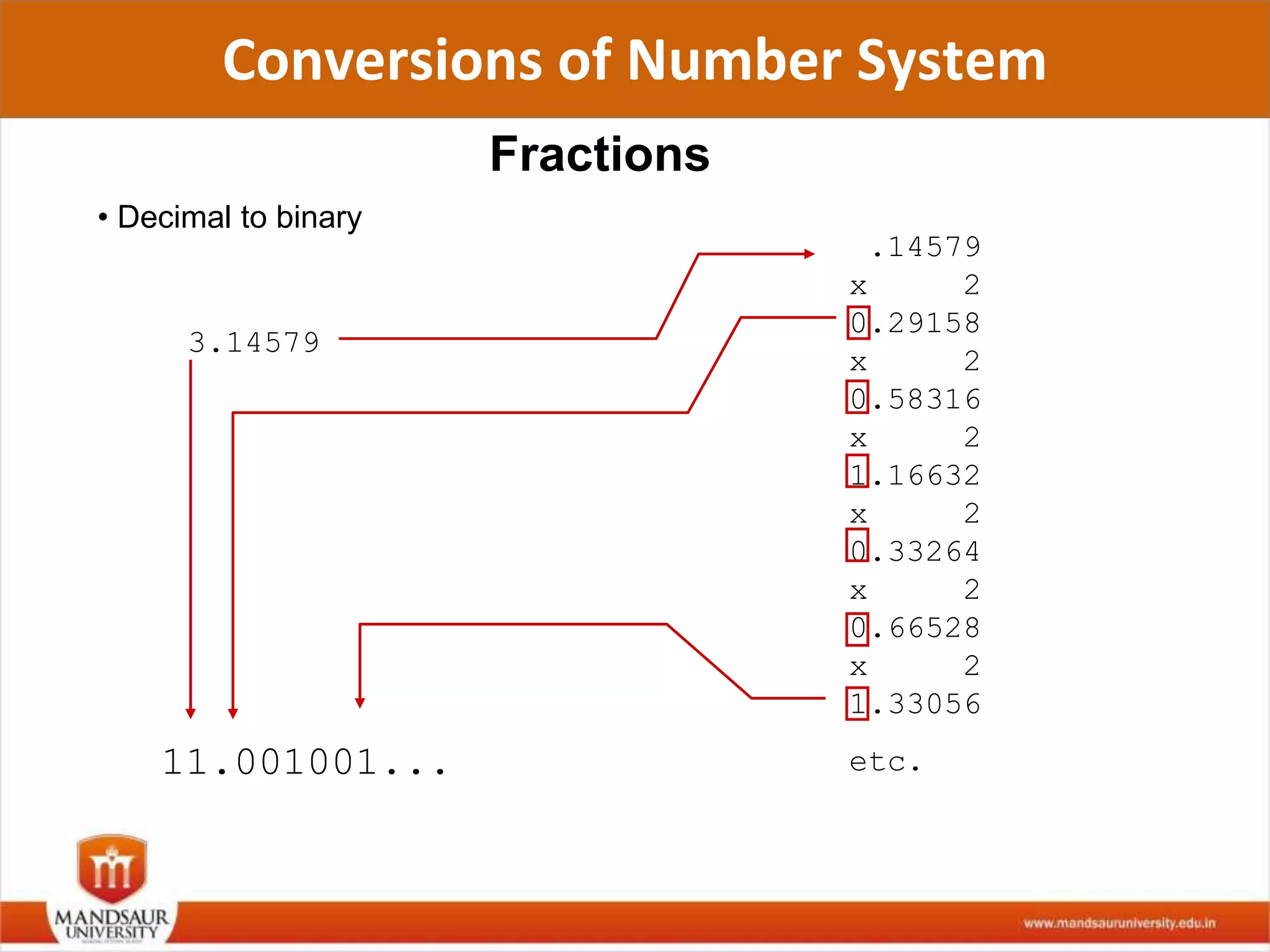
Conversions of Number System
Fractions
• Decimal to binary
3.14579
.14579
x 2
0.29158
x 2
0.58316
x 2
1.16632
x 2
0.33264
x 2
0.66528
x 2
1.33056
etc.11.001001...
Number system and their conversion

Number system and their conversion

  • 1.
    DEPARTMENT OF COMPUTER SCIENCE& APPLICATIONS BCA070 – DIGITAL ELECTRONICS By: Prof. Ram Pratap Singh
  • 2.
    Number System • Roleof Numbers in Computer • Types of Number System  Binary Number system Decimal Number system Octal Number system Hexadecimal Number system
  • 3.
    Binary Number System: •A positional number system • Has only 2 symbols or digits (0 and 1). Hence its base = 2 • The maximum value of a single digit is 1 (one less than the value of the base) • Each position of a digit represents a specific power of the base (2) • This number system is used in computers Example 101012 (101100)2 111112 Bit • Bit stands for binary digit • A bit in computer terminology means either a 0 or a 1 • A binary number consisting of n bits is called an n-bit number Number System
  • 4.
    Number System Decimal NumberSystem • A positional number system • Has 10 symbols or digits (0, 1, 2, 3, 4, 5, 6, 7, 8, 9). Hence, its base = 10 • The maximum value of a single digit is 9 (one less than the value of the base). • Each position of a digit represents a specific power of the base (10) • We use this number system in our day-to-day life Example- 258610 (2586)10 258610 = (2 x 10³) + (5 x 10²) + (8 x 101) + (6 x 100) = 2000 + 500 + 80 + 6
  • 5.
    Number System Octal NumberSystem • A positional number system • Has total 8 symbols or digits (0, 1, 2, 3, 4, 5, 6, 7) Hence, its base = 8 • The maximum value of a single digit is 7 (one less than the value of the base • Each position of a digit represents a specific power of the base (8) Example- 15068 (2016)8
  • 6.
    Number System Hexadecimal NumberSystem • A positional number system • Has total 16 symbols or digits (0, 1, 2, 3, 4, 5, 6, 7, 8, 9, A, B, C, D, E, F). Hence its base = 16 • The symbols A, B, C, D, E and F represent the decimal values 10, 11, 12, 13, 14 and 15 respectively • The maximum than the value of a single of the base) Example- 15A616 (FACE)16
  • 7.
  • 8.
    Number System System BaseSymbols Used Humans Used Computer Used Binary 2 0 / 1 NO YES Decimal 10 0,1,2…..9 YES NO Octal 8 0,1,2…..7 NO NO Hexadecimal 16 0,1,2….9, A,B….F NO NO
  • 9.
    Conversions of NumberSystem - : Possibilities: - Decimal OctalBinary Hexadecimal
  • 10.
    Conversions of NumberSystem 12510 => Weight Base Binary to Decimal Rules  Multiply the each bit start from right to left most digit by its base value with the power of n, where n is the weight of the bit.  weight is just a position of a particular bit. Which counts from 0 to places at the end of right side.  And lastly we add the results. 5 x 100 = 5 2 x 101 = 20 1 x 102 = 100 125
  • 11.
    Conversions of NumberSystem Example 1010112 => 1 x 20 = 1 1 x 21 = 2 0 x 22 = 0 1 x 23 = 8 0 x 24 = 0 1 x 25 = 32 4310 (101011)2 = (43)10
  • 12.
    Conversions of NumberSystem Decimal to Binary  Divide the decimal number to be converted by 2.  Record the remainder.  the rightmost the new base digit (least significant digit) of number.  Divide the quotient of the previous divide by same base i.e. 2.  Record the remainder from above Step.  Recording remainders from right to left, until the quotient becomes zero.  Note that the last remainder thus new obtained will be the most significant digit (MSD) of the base number.
  • 13.
    Conversions of NumberSystem Decimal to Binary Example: 12510 = ?2 2 125 62 1 2 15 1 2 31 0 2 7 12 3 12 1 12 0 1 LSB MSB 12510 = 11111012 Remainder
  • 14.
    Conversions of NumberSystem Octal Binary Decimal Rules for Binary to Octal Numbers  First Divide all given binary digits in to pair of three starting from right to left most digit.  if there is any bit short then use zero’s to complete the pair of three as per above step.  Convert these individual pair of binary digits to its octal equivalent using binary to decimal process.
  • 15.
    Conversions of NumberSystem Example: 11010102 = ?8  Divide the binary digits into groups of three from right. 1101010 001 101 010  Convert each group into one octal digit. 0012 1012 0102 = 0 x 22 + 0 x 21 + 1 x 20 1 x 22 + 0 x 21 + 1 x 20 0 x 22 + 1 x 21 + 0 x 20 = 0 + 0 + 1 4 + 0 + 1 0 + 2 + 0 = 1 5 2 (1101010)2 = (152)8
  • 16.
    Conversions of NumberSystem 10110101112 = ?8 1 011 010 111 1 3 2 7 10110101112 = 13278 Cont.....
  • 17.
    Conversions of NumberSystem HexadecimalBinary Rules for Binary to Hexadecimal Numbers  Group binary digits in to pair of Four starting from right to left most digit.  Convert these individual pair of binary digits to its Hexa equivalent using binary to decimal conversion process.
  • 18.
    Conversions of NumberSystem Example: 11010102 = ?16  Divide the binary digits into groups of four from right. 01101010 0110 1010  Convert each group into one Hexa digit. 01102 10102 = 0 x 23 + 1 x 22 + 1 x 21 + 0 x 20 1 x 23 + 0 x 22 + 1 x 21 + 0 x 20 = 0 + 4 + 2 + 0 8 + 0 + 2 + 0 = 6 10 (1101010)2 = (6A)16
  • 19.
    Conversions of NumberSystem 10101110112 = ?16 10 1011 1011 10101110112 = 2BB16 Cont..... 2 B B
  • 20.
    Conversions of NumberSystem Converting a Decimal Number to a Number of Another Base Division-Remainder Method Step 1: Divide the decimal number to be converted by the value of the new base. Step 2: Record the remainder from Step 1 as the rightmost the new base digit (least significant digit) of number. Step 3: Divide the quotient of the previous divide by the new base . Step 4: Record the remainder from Step 3 as the next digit (to the left) of the new base number.  Repeat Steps 3 and 4, recording remainders from right to left, until the quotient becomes zero in Step 3  Note that the last remainder thus new obtained will be the most significant digit (MSD) of the base number
  • 21.
    Decimal to Octal Example 95210= ?8 Solution: 8 952 Remainders 8 119 0 8 14 7 1 6 Hence, 95210 = 16708
  • 22.
    Decimal to Octal Example 123410= ?8 Solution: 8 1234 Remainders 8 154 2 8 19 2 02 3 Hence, 123410 = 23228
  • 23.
    Octal to Decimal Convertinga Number of Another Base to a Decimal Number Rules: Step 1: Determine the column (positional) value of each digit. Step 2: Multiply the obtained column values by the digits in the corresponding columns. Step 3: Calculate the sum of these products. Example: 47068 = ?10 47068 = 4 x 83 + 7 x 82 + 0 x 81 + 6 x 80 = 4 x 512 + 7 x 64 + 0 + 6 x 1 = 2048 + 448 + 0 + 6 = 250210
  • 24.
    Hexadecimal to Decimal Example: 47B16= ?10 47B16 = 4 x 162 + 7 x 161 + 11 x 160 = 4 x 256 + 7 x 16 + 11 x 1 = 1024 + 112 + 11 = 114710 47B16 = 114710
  • 25.
    CONVERSION Converting a Numberof Some Base to a Number of Another Base Example 5456 = ?4 Solution: Step 1: Convert from base 6 to base 10 5456 = 5 x 62 + 4 x 61 + 5 x 60 = 5 x 36 + 4 x 6 + 5 x 1 = 180 + 24 + 5 = 20910 Step 2: Convert 20910 to base 4 4 209 Remainder 4 52 1 4 13 0 4 3 1 0 3 Hence, 20910 = 31014 So, 5456 = 20910 = 31014 Thus, 5456 = 31014
  • 26.
    Conversions of NumberSystem Octal to Binary Technique: Convert each octal digit to a 3-bit equivalent binary representation Example: 7058 = ?2 7 0 5 111 000 101 7058 = 1110001012
  • 27.
    Conversions of NumberSystem Hexadecimal to Binary Technique: Convert each octal digit to a 4-bit equivalent binary representation Example: 70516 = ?2 7 0 5 0111 0000 0101 7058 = 0111000001012
  • 28.
    Hexadecimal to Binary Example: 10AF16= ?2 1 0 A F 0001 0000 1010 1111 10AF16 = 00010000101011112
  • 29.
    Octal to Hexadecimal •Technique – Use binary as an intermediary Example: 10768 = ?16 1 0 7 6 001 000 111 110 2 3 E 10768 = 23E16
  • 30.
    Hexadecimal to Octal •Technique – Use binary as an intermediary Example: 1F0C16 = ?8 1 F 0 C 0001 1111 0000 1100 1 7 4 1 4 1F0C16 = 174148
  • 31.
    Conversions of NumberSystem Fractions • Binary to decimal 10.1011 => 1 x 21 = 2.0 0 x 20 = 0.0 1 x 2-1 = 0.5 0 x 2-2 = 0.0 1 x 2-3 = 0.125 1 x 2-4 = 0.0625 (2.6875)10
  • 32.
    Conversions of NumberSystem Fractions • Decimal to binary 3.14579 .14579 x 2 0.29158 x 2 0.58316 x 2 1.16632 x 2 0.33264 x 2 0.66528 x 2 1.33056 etc.11.001001...