Number System-
Introduction
By
Ms.S.Y.Salunkhe(SITCOE)
About this template
INTRODUCTION ABOUT DIGITAL SYSTEM
A Digital system is an interconnection of digital modules and it is a system
that manipulates discrete elements of information that is represented
internally in the binary form.
Now a day’s digital systems are used in wide variety of industrial and
consumer products such as automated industrial machinery, pocket
calculators, microprocessors, digital computers, digital watches, TV games
and signal processing and so on.
2
About this template
Characteristics of Digital systems
Digital systems manipulate discrete elements of information.
Discrete elements are nothing but the digits such as 10 decimal digits or 26 letters of
alphabets and so on.
Digital systems use physical quantities called signals to represent discrete elements.
In digital systems, the signals have two discrete values and are therefore said to be
binary.
A signal in digital system represents one binary digit called a bit. The bit has a value
either 0 or 1.
3
About this template
Analog systems vs Digital systems
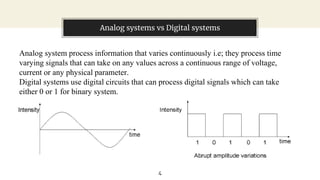
Analog system process information that varies continuously i.e; they process time
varying signals that can take on any values across a continuous range of voltage,
current or any physical parameter.
Digital systems use digital circuits that can process digital signals which can take
either 0 or 1 for binary system.
4
About this template
Advantages of Digital system over Analog system
1. Ease of programmability
2. Reduction in cost of hardware
3. High speed
4. High Reliability
5. Design is easy
6. Result can be reproduced easily
5
About this template
Disadvantages of Digital Systems
• Use more energy than analog circuits to accomplish the same tasks, thus producing
more heat as well.
• Digital circuits are often fragile, in that if a single piece of digital data is lost or
misinterpreted the meaning of large blocks of related data can completely change.
• Digital computer manipulates discrete elements of information by means of a binary
code.
• Quantization error during analog signal sampling.
6
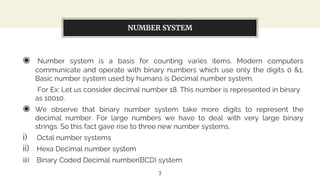
◉ Number system is a basis for counting varies items. Modern computers
communicate and operate with binary numbers which use only the digits 0 &1.
Basic number system used by humans is Decimal number system.
For Ex: Let us consider decimal number 18. This number is represented in binary
as 10010.
◉ We observe that binary number system take more digits to represent the
decimal number. For large numbers we have to deal with very large binary
strings. So this fact gave rise to three new number systems.
i) Octal number systems
ii) Hexa Decimal number system
iii) Binary Coded Decimal number(BCD) system
NUMBER SYSTEM
7
◉ To define any number system we have to specify
◉ Base of the number system such as 2,8,10 or 16. • The base
decides the total number of digits available in that number
system.
◉ First digit in the number system is always zero and last digit in
the number system is always base-1.
Number System
8
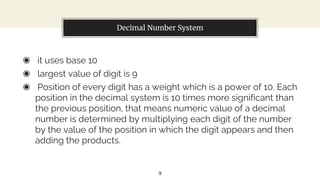
◉ it uses base 10
◉ largest value of digit is 9
◉ Position of every digit has a weight which is a power of 10. Each
position in the decimal system is 10 times more significant than
the previous position, that means numeric value of a decimal
number is determined by multiplying each digit of the number
by the value of the position in which the digit appears and then
adding the products.
Decimal Number System
9
Example
10
11
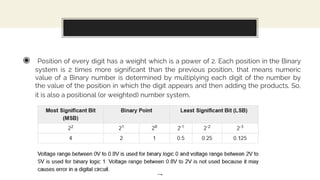
◉ The binary number has a radix of 2. As r = 2, only two digits are
needed, and these are 0 and 1. In binary system weight is
expressed as power of 2.
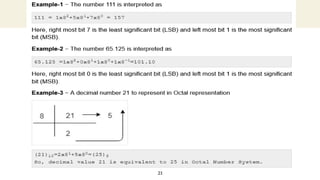
◉ The left most bit, which has the greatest weight is called the
Most Significant Bit (MSB). And the right most bit which has the
least weight is called Least Significant Bit (LSB).
Binary number system:
12
◉ Binary Number System is one the type of Number Representation
techniques. It is most popular and used in digital systems. Binary system is
used for representing binary quantities which can be represented by any
device that has only two operating states or possible conditions. For
example, a switch has only two states: open or close.
◉ In the Binary System, there are only two symbols or possible digit values,
i.e., 0 and 1. Represented by any device that only 2 operating states or
possible conditions. Binary numbers are indicated by the addition of either
an 0b prefix or an 2 suffix.
13
◉ Position of every digit has a weight which is a power of 2. Each position in the Binary
system is 2 times more significant than the previous position, that means numeric
value of a Binary number is determined by multiplying each digit of the number by
the value of the position in which the digit appears and then adding the products. So,
it is also a positional (or weighted) number system.
14
example
15
◉
Example
16
Application
17
◉ Digital systems operate only on binary numbers. Since binary numbers
are often very long, two shorthand notations, octal and hexadecimal, are
used for representing large binary numbers. Octal systems use a base
or radix of 8. It uses first eight digits of decimal number system. Thus it
has digits from 0 to 7.
◉ Position of every digit has a weight which is a power of 8. Each position
in the Octal system is 8 times more significant than the previous
position, that means numeric value of an octal number is determined by
multiplying each digit of the number by the value of the position in
which the digit appears and then adding the products. So, it is also a
positional (or weighted) number system.
Octal Number System
18
19
Octal Number System
20
21
22
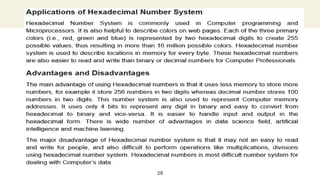
◉ The hexadecimal numbering system has a base of 16. There are 16
symbols. The decimal digits 0 to 9 are used as the first ten digits as in
the decimal system, followed by the letters A, B, C, D, E and F, which
represent the values 10, 11,12,13,14 and 15 respectively.
◉ Position of every digit has a weight which is a power of 16. Each position
in the Hexadecimal system is 16 times more significant than the previous
position, that means numeric value of an hexadecimal number is
determined by multiplying each digit of the number by the value of the
position in which the digit appears and then adding the products. So, it is
also a positional (or weighted) number system.
Hexa Decimal Number System
23
Representation
24
25
26
27
28
29
◉ The human beings use decimal number system while computer uses binary
number system. Therefore it is necessary to convert decimal number system
into its equivalent binary.
i) Binary to octal number conversion
ii) Binary to hexa decimal number conversion
Number Base conversions
30
iii) Octal to binary Conversion
31
◉
Example
32
33
Examples
34
35
◉ Binary Addition
Binary Arithmetic
36
Binary Subtraction
37
Binary Multiplication
38
Binary Division
39
◉ Variables such as integers can be represent in two ways, i.e., signed and unsigned.
Signed numbers use sign flag or can be distinguish between negative values and positive
values. Whereas unsigned numbers stored only positive numbers but not negative
numbers.
◉ Number representation techniques like: Binary, Octal, Decimal and Hexadecimal number
representation techniques can represent numbers in both signed and unsigned ways.
Binary Number System is one the type of Number Representation techniques. It is most
popular and used in digital systems. Binary system is used for representing binary
quantities which can be represented by any device that has only two operating states or
possible conditions. For example, a switch has only two states: open or close.
◉ In the Binary System, there are only two symbols or possible digit values, i.e., 0 and
1. Represented by any device that only 2 operating states or possible conditions.
Binary numbers are indicated by the addition of either an 0b prefix or an 2 suffix.
Unsigned and Signed Binary Numbers
40
◉ Binary numbers can be represented in signed and unsigned way. Unsigned binary
numbers do not have sign bit, whereas signed binary numbers uses signed bit as well
or these can be distinguishable between positive and negative numbers. A signed
binary is a specific data type of a signed variable.
Representation of Binary Numbers:
41
◉ Unsigned numbers don’t have any sign, these can contain only
magnitude of the number. So, representation of unsigned binary
numbers are all positive numbers only. For example, representation of
positive decimal numbers are positive by default. We always assume
that there is a positive sign symbol in front of every number.
1. Unsigned Numbers:
42
Thanks!
ANY QUESTIONS?
You can find me at:
@username
user@mail.me
43

number system1.pptx

  • 1.
  • 2.
    About this template INTRODUCTIONABOUT DIGITAL SYSTEM A Digital system is an interconnection of digital modules and it is a system that manipulates discrete elements of information that is represented internally in the binary form. Now a day’s digital systems are used in wide variety of industrial and consumer products such as automated industrial machinery, pocket calculators, microprocessors, digital computers, digital watches, TV games and signal processing and so on. 2
  • 3.
    About this template Characteristicsof Digital systems Digital systems manipulate discrete elements of information. Discrete elements are nothing but the digits such as 10 decimal digits or 26 letters of alphabets and so on. Digital systems use physical quantities called signals to represent discrete elements. In digital systems, the signals have two discrete values and are therefore said to be binary. A signal in digital system represents one binary digit called a bit. The bit has a value either 0 or 1. 3
  • 4.
    About this template Analogsystems vs Digital systems Analog system process information that varies continuously i.e; they process time varying signals that can take on any values across a continuous range of voltage, current or any physical parameter. Digital systems use digital circuits that can process digital signals which can take either 0 or 1 for binary system. 4
  • 5.
    About this template Advantagesof Digital system over Analog system 1. Ease of programmability 2. Reduction in cost of hardware 3. High speed 4. High Reliability 5. Design is easy 6. Result can be reproduced easily 5
  • 6.
    About this template Disadvantagesof Digital Systems • Use more energy than analog circuits to accomplish the same tasks, thus producing more heat as well. • Digital circuits are often fragile, in that if a single piece of digital data is lost or misinterpreted the meaning of large blocks of related data can completely change. • Digital computer manipulates discrete elements of information by means of a binary code. • Quantization error during analog signal sampling. 6
  • 7.
    ◉ Number systemis a basis for counting varies items. Modern computers communicate and operate with binary numbers which use only the digits 0 &1. Basic number system used by humans is Decimal number system. For Ex: Let us consider decimal number 18. This number is represented in binary as 10010. ◉ We observe that binary number system take more digits to represent the decimal number. For large numbers we have to deal with very large binary strings. So this fact gave rise to three new number systems. i) Octal number systems ii) Hexa Decimal number system iii) Binary Coded Decimal number(BCD) system NUMBER SYSTEM 7
  • 8.
    ◉ To defineany number system we have to specify ◉ Base of the number system such as 2,8,10 or 16. • The base decides the total number of digits available in that number system. ◉ First digit in the number system is always zero and last digit in the number system is always base-1. Number System 8
  • 9.
    ◉ it usesbase 10 ◉ largest value of digit is 9 ◉ Position of every digit has a weight which is a power of 10. Each position in the decimal system is 10 times more significant than the previous position, that means numeric value of a decimal number is determined by multiplying each digit of the number by the value of the position in which the digit appears and then adding the products. Decimal Number System 9
  • 10.
  • 11.
  • 12.
    ◉ The binarynumber has a radix of 2. As r = 2, only two digits are needed, and these are 0 and 1. In binary system weight is expressed as power of 2. ◉ The left most bit, which has the greatest weight is called the Most Significant Bit (MSB). And the right most bit which has the least weight is called Least Significant Bit (LSB). Binary number system: 12
  • 13.
    ◉ Binary NumberSystem is one the type of Number Representation techniques. It is most popular and used in digital systems. Binary system is used for representing binary quantities which can be represented by any device that has only two operating states or possible conditions. For example, a switch has only two states: open or close. ◉ In the Binary System, there are only two symbols or possible digit values, i.e., 0 and 1. Represented by any device that only 2 operating states or possible conditions. Binary numbers are indicated by the addition of either an 0b prefix or an 2 suffix. 13
  • 14.
    ◉ Position ofevery digit has a weight which is a power of 2. Each position in the Binary system is 2 times more significant than the previous position, that means numeric value of a Binary number is determined by multiplying each digit of the number by the value of the position in which the digit appears and then adding the products. So, it is also a positional (or weighted) number system. 14
  • 15.
  • 16.
  • 17.
  • 18.
    ◉ Digital systemsoperate only on binary numbers. Since binary numbers are often very long, two shorthand notations, octal and hexadecimal, are used for representing large binary numbers. Octal systems use a base or radix of 8. It uses first eight digits of decimal number system. Thus it has digits from 0 to 7. ◉ Position of every digit has a weight which is a power of 8. Each position in the Octal system is 8 times more significant than the previous position, that means numeric value of an octal number is determined by multiplying each digit of the number by the value of the position in which the digit appears and then adding the products. So, it is also a positional (or weighted) number system. Octal Number System 18
  • 19.
  • 20.
  • 21.
  • 22.
  • 23.
    ◉ The hexadecimalnumbering system has a base of 16. There are 16 symbols. The decimal digits 0 to 9 are used as the first ten digits as in the decimal system, followed by the letters A, B, C, D, E and F, which represent the values 10, 11,12,13,14 and 15 respectively. ◉ Position of every digit has a weight which is a power of 16. Each position in the Hexadecimal system is 16 times more significant than the previous position, that means numeric value of an hexadecimal number is determined by multiplying each digit of the number by the value of the position in which the digit appears and then adding the products. So, it is also a positional (or weighted) number system. Hexa Decimal Number System 23
  • 24.
  • 25.
  • 26.
  • 27.
  • 28.
  • 29.
  • 30.
    ◉ The humanbeings use decimal number system while computer uses binary number system. Therefore it is necessary to convert decimal number system into its equivalent binary. i) Binary to octal number conversion ii) Binary to hexa decimal number conversion Number Base conversions 30
  • 31.
    iii) Octal tobinary Conversion 31
  • 32.
  • 33.
  • 34.
  • 35.
  • 36.
  • 37.
  • 38.
  • 39.
  • 40.
    ◉ Variables suchas integers can be represent in two ways, i.e., signed and unsigned. Signed numbers use sign flag or can be distinguish between negative values and positive values. Whereas unsigned numbers stored only positive numbers but not negative numbers. ◉ Number representation techniques like: Binary, Octal, Decimal and Hexadecimal number representation techniques can represent numbers in both signed and unsigned ways. Binary Number System is one the type of Number Representation techniques. It is most popular and used in digital systems. Binary system is used for representing binary quantities which can be represented by any device that has only two operating states or possible conditions. For example, a switch has only two states: open or close. ◉ In the Binary System, there are only two symbols or possible digit values, i.e., 0 and 1. Represented by any device that only 2 operating states or possible conditions. Binary numbers are indicated by the addition of either an 0b prefix or an 2 suffix. Unsigned and Signed Binary Numbers 40
  • 41.
    ◉ Binary numberscan be represented in signed and unsigned way. Unsigned binary numbers do not have sign bit, whereas signed binary numbers uses signed bit as well or these can be distinguishable between positive and negative numbers. A signed binary is a specific data type of a signed variable. Representation of Binary Numbers: 41
  • 42.
    ◉ Unsigned numbersdon’t have any sign, these can contain only magnitude of the number. So, representation of unsigned binary numbers are all positive numbers only. For example, representation of positive decimal numbers are positive by default. We always assume that there is a positive sign symbol in front of every number. 1. Unsigned Numbers: 42
  • 43.
    Thanks! ANY QUESTIONS? You canfind me at: @username user@mail.me 43