PI-RNA
Presented by :
Sasmita Behura
MBT – I
Roll No - 1361024
The discovery of PI-RNAs
 In male flies, small RNAs derived from the supressor of stellate locus on the

y-chromosome silence the x-linked stellate locus during spermatogenesis.
 In su (ste) mutants , small RNAs targeting stellate are lost causing stellate

protein crystals to form in the primary spermatocytes and reduced fertility .
 Subsequent small RNA profiling studies in Drosophila reveal that su(ste)

small RNAs only represent a small subset of a class of small RNAs with a size
range 24-26nt and named as repeat associated small interfering RNAs
(rasiRNAs).
 And in mammals it has been seen that piwi protein associate with a class of

endogenous RNAs termed as Pi-RNAs.
 Thus Droshophila rasiRNAs were renamed as Pi-RNAs .
Piwi- interacting RNAs(knowns of
the unknown)
• Piwi - interacting RNA is the largest class of small non-coding RNA

molecules expressed in both vertebrates and invertebrates.
• Piwi- proteins are predominantly found in germline cells and associate

with a novel class of small RNAs known as pi-RNAs.
• Different types of piwi- proteins are found i.e MILI, MIWI1 and MIWI2

in mice, ZIWI1 and ZIWI2 in zebra fish and Ago3 and Aub in mammals.
• Piwi is a class of gene was originally identified as encoding regulatory

proteins responsible for maintaining the stability of cell division in
germline cells.
Location of pi-rna
 Pi-RNAs are mainly found in clusters through out the genomes and

they may contains 10 up-to many thousands of pi- RNAs and piwi
protein mainly found in germ cell and gonodial cell.
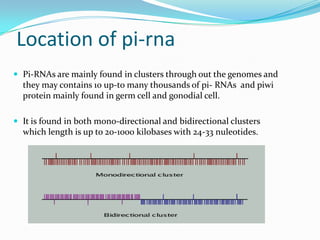
 It is found in both mono-directional and bidirectional clusters

which length is up to 20-1000 kilobases with 24-33 nuleotides.
Biogenesis
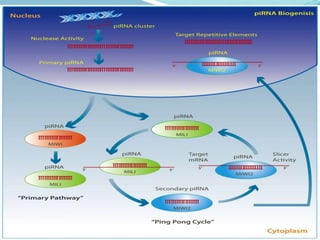
 Exact biogenetic process of pi-RNA is not yet fully understood. But

there is a” ping-pong”-mechanism which gives an overall view about its
biogenesis.
 Pi-RNAs involved in the ping-pong cycle directs its attack on

transposon transcripts and this cycle only acts at the level of
transcription.
 Pi-RNA production is a dicer- independent process.
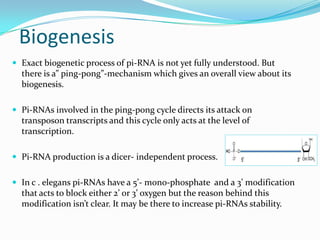
 In c . elegans pi-RNAs have a 5’- mono-phosphate and a 3’ modification

that acts to block either 2’ or 3’ oxygen but the reason behind this
modification isn’t clear. It may be there to increase pi-RNAs stability.
Ping-Pong mechanism
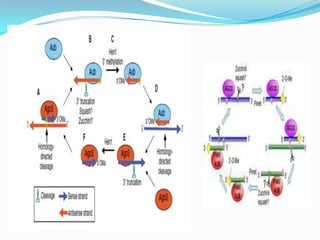
 Pi-RNAs consists of 2-strands i.e sense strand and antisense strand.
 Ago3(argonaute protein) bound to sense strand pi-RNAs and catalyzes

antisense strand cleavage at an A:U base-pair that generate the 5’ end
of antisense strand.
 Then 5’end of the resulting cleavage associate with Aub or piwi which

generate mature 23-30nt antisense pi-RNAs.
 Then the mature antisense pi-RNA argonaute complexes are then

cleaved sense strand pi-RNA which associate with Ago3.
 Then production of mature sense strand complete the cycle.
 3’ methylation occures at both antisense and sense strand which is

carried out by Hen1 RNA methyl transferse.

 Mutation in Drosophila Hen1 reduces the length of pi-RNAs.
 In Drosophila some genes like armitage and spindle E encodes putative

helicase that required for pi-RNAs production.

 As antisense pi-RNAs guide Aub or piwi to cleave the transposon m-

RNAs and trigger the production of new antisense pi-RNAs.

 So Ping-Pong model proposes a target dependent amplification of

antisense pi-RNAs which depends on Ago3.
Compartmentalization of pi-RNAs
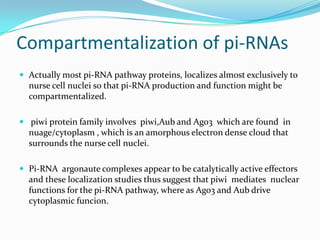
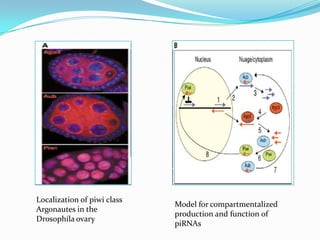
 Actually most pi-RNA pathway proteins, localizes almost exclusively to

nurse cell nuclei so that pi-RNA production and function might be
compartmentalized.
 piwi protein family involves piwi,Aub and Ago3 which are found in

nuage/cytoplasm , which is an amorphous electron dense cloud that
surrounds the nurse cell nuclei.
 Pi-RNA argonaute complexes appear to be catalytically active effectors

and these localization studies thus suggest that piwi mediates nuclear
functions for the pi-RNA pathway, where as Ago3 and Aub drive
cytoplasmic funcion.
Localization of piwi class
Argonautes in the
Drosophila ovary

Model for compartmentalized
production and function of
piRNAs
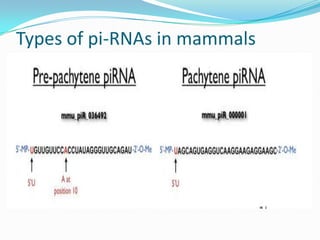
Types of pi-RNAs in mammals
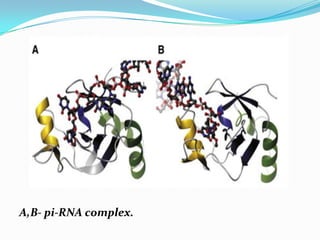
A,B- pi-RNA complex.
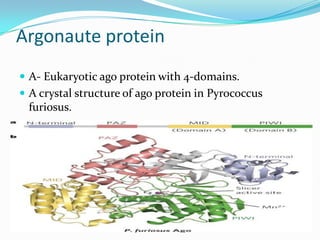
Argonaute protein
 A- Eukaryotic ago protein with 4-domains.
 A crystal structure of ago protein in Pyrococcus

furiosus.
Functions
 Pi-RNA complexes linked to both epigenetic ,post –translational gene

silencing and maintain germline DNA integrity.
 Pi-RNAs also regulate the expression of protein coding genes.
 Piwi target RNA cleavage by silencing.
 Piwi required for the self renewing division of germline cells during

oogenesis.
 Mutation in any members of pi-RNA pathway causes derepression of

transposons and also leads to the loss of fertility.
 Piwi – complexes are imported to nucleus and mediate heterochromatin

assembly.
Unknown factors about pi-RNAs
 It is still unknown that how a new pi-RNA response is initiated and

why some regions of our genome are so uniquely poised to proudce piRNAs.
 The transcriptional region of pi-RNA cluster is still unknown.
 There are also various proteins rather than piwi- family which are

involves in ping-pong mechanism but there mode of action is also not
understood.
Pi rna-ppt, sasmita behura

Pi rna-ppt, sasmita behura

  • 1.
    PI-RNA Presented by : SasmitaBehura MBT – I Roll No - 1361024
  • 2.
    The discovery ofPI-RNAs  In male flies, small RNAs derived from the supressor of stellate locus on the y-chromosome silence the x-linked stellate locus during spermatogenesis.  In su (ste) mutants , small RNAs targeting stellate are lost causing stellate protein crystals to form in the primary spermatocytes and reduced fertility .  Subsequent small RNA profiling studies in Drosophila reveal that su(ste) small RNAs only represent a small subset of a class of small RNAs with a size range 24-26nt and named as repeat associated small interfering RNAs (rasiRNAs).  And in mammals it has been seen that piwi protein associate with a class of endogenous RNAs termed as Pi-RNAs.  Thus Droshophila rasiRNAs were renamed as Pi-RNAs .
  • 3.
    Piwi- interacting RNAs(knownsof the unknown) • Piwi - interacting RNA is the largest class of small non-coding RNA molecules expressed in both vertebrates and invertebrates. • Piwi- proteins are predominantly found in germline cells and associate with a novel class of small RNAs known as pi-RNAs. • Different types of piwi- proteins are found i.e MILI, MIWI1 and MIWI2 in mice, ZIWI1 and ZIWI2 in zebra fish and Ago3 and Aub in mammals. • Piwi is a class of gene was originally identified as encoding regulatory proteins responsible for maintaining the stability of cell division in germline cells.
  • 4.
    Location of pi-rna Pi-RNAs are mainly found in clusters through out the genomes and they may contains 10 up-to many thousands of pi- RNAs and piwi protein mainly found in germ cell and gonodial cell.  It is found in both mono-directional and bidirectional clusters which length is up to 20-1000 kilobases with 24-33 nuleotides.
  • 5.
    Biogenesis  Exact biogeneticprocess of pi-RNA is not yet fully understood. But there is a” ping-pong”-mechanism which gives an overall view about its biogenesis.  Pi-RNAs involved in the ping-pong cycle directs its attack on transposon transcripts and this cycle only acts at the level of transcription.  Pi-RNA production is a dicer- independent process.  In c . elegans pi-RNAs have a 5’- mono-phosphate and a 3’ modification that acts to block either 2’ or 3’ oxygen but the reason behind this modification isn’t clear. It may be there to increase pi-RNAs stability.
  • 6.
    Ping-Pong mechanism  Pi-RNAsconsists of 2-strands i.e sense strand and antisense strand.  Ago3(argonaute protein) bound to sense strand pi-RNAs and catalyzes antisense strand cleavage at an A:U base-pair that generate the 5’ end of antisense strand.  Then 5’end of the resulting cleavage associate with Aub or piwi which generate mature 23-30nt antisense pi-RNAs.  Then the mature antisense pi-RNA argonaute complexes are then cleaved sense strand pi-RNA which associate with Ago3.
  • 7.
     Then productionof mature sense strand complete the cycle.  3’ methylation occures at both antisense and sense strand which is carried out by Hen1 RNA methyl transferse.  Mutation in Drosophila Hen1 reduces the length of pi-RNAs.  In Drosophila some genes like armitage and spindle E encodes putative helicase that required for pi-RNAs production.  As antisense pi-RNAs guide Aub or piwi to cleave the transposon m- RNAs and trigger the production of new antisense pi-RNAs.  So Ping-Pong model proposes a target dependent amplification of antisense pi-RNAs which depends on Ago3.
  • 9.
    Compartmentalization of pi-RNAs Actually most pi-RNA pathway proteins, localizes almost exclusively to nurse cell nuclei so that pi-RNA production and function might be compartmentalized.  piwi protein family involves piwi,Aub and Ago3 which are found in nuage/cytoplasm , which is an amorphous electron dense cloud that surrounds the nurse cell nuclei.  Pi-RNA argonaute complexes appear to be catalytically active effectors and these localization studies thus suggest that piwi mediates nuclear functions for the pi-RNA pathway, where as Ago3 and Aub drive cytoplasmic funcion.
  • 10.
    Localization of piwiclass Argonautes in the Drosophila ovary Model for compartmentalized production and function of piRNAs
  • 12.
    Types of pi-RNAsin mammals
  • 13.
  • 14.
    Argonaute protein  A-Eukaryotic ago protein with 4-domains.  A crystal structure of ago protein in Pyrococcus furiosus.
  • 15.
    Functions  Pi-RNA complexeslinked to both epigenetic ,post –translational gene silencing and maintain germline DNA integrity.  Pi-RNAs also regulate the expression of protein coding genes.  Piwi target RNA cleavage by silencing.  Piwi required for the self renewing division of germline cells during oogenesis.  Mutation in any members of pi-RNA pathway causes derepression of transposons and also leads to the loss of fertility.  Piwi – complexes are imported to nucleus and mediate heterochromatin assembly.
  • 16.
    Unknown factors aboutpi-RNAs  It is still unknown that how a new pi-RNA response is initiated and why some regions of our genome are so uniquely poised to proudce piRNAs.  The transcriptional region of pi-RNA cluster is still unknown.  There are also various proteins rather than piwi- family which are involves in ping-pong mechanism but there mode of action is also not understood.

Editor's Notes

  • #16 For example- in testis Su pi-RNAs repress the expression of stellate that encodes a caesin kinase II beta- subunit like protein, so in Su mutation small RNAs targeting stellate are lost and cause formation of crystals in spermatocytes and reduced fertility.