What is DNA?
•Deoxyribonucleic acid
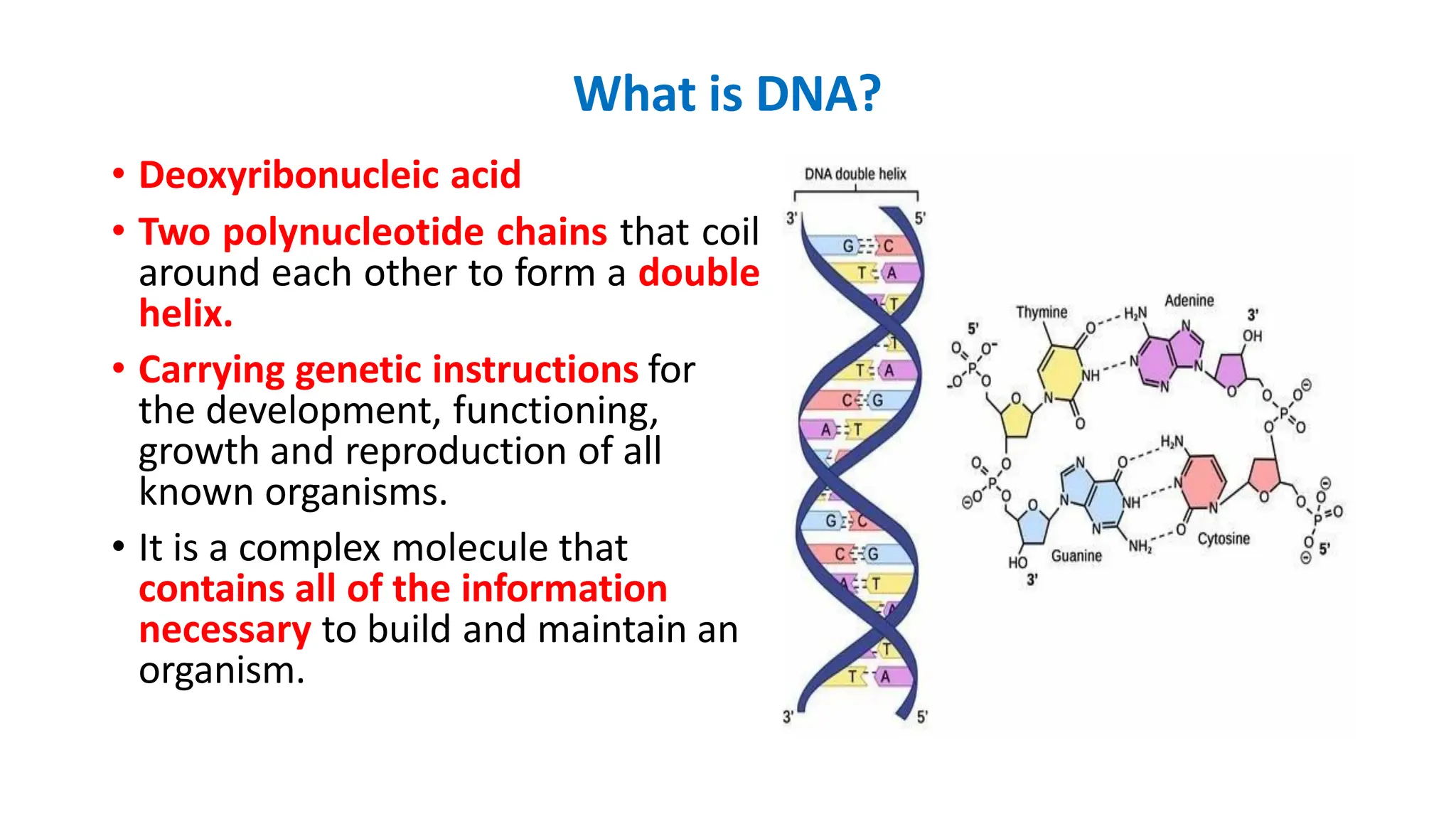
• Two polynucleotide chains that coil
around each other to form a double
helix.
• Carrying genetic instructions for
the development, functioning,
growth and reproduction of all
known organisms.
• It is a complex molecule that
contains all of the information
necessary to build and maintain an
organism.
3.
Discovery of DNA
•In 1869, Friedrich Miescher discovered in
the cell nucleus a mixture of compounds
that he called nuclein.
• The major component of nuclein is
deoxyribonucleic acid (DNA).
• By the end of the 19th century, chemists
learned the general structure of DNA and
of a related compound, ribonucleic acid
(RNA).
4.
Cont….
• Both arelong polymers — chains of small
compounds called nucleotides.
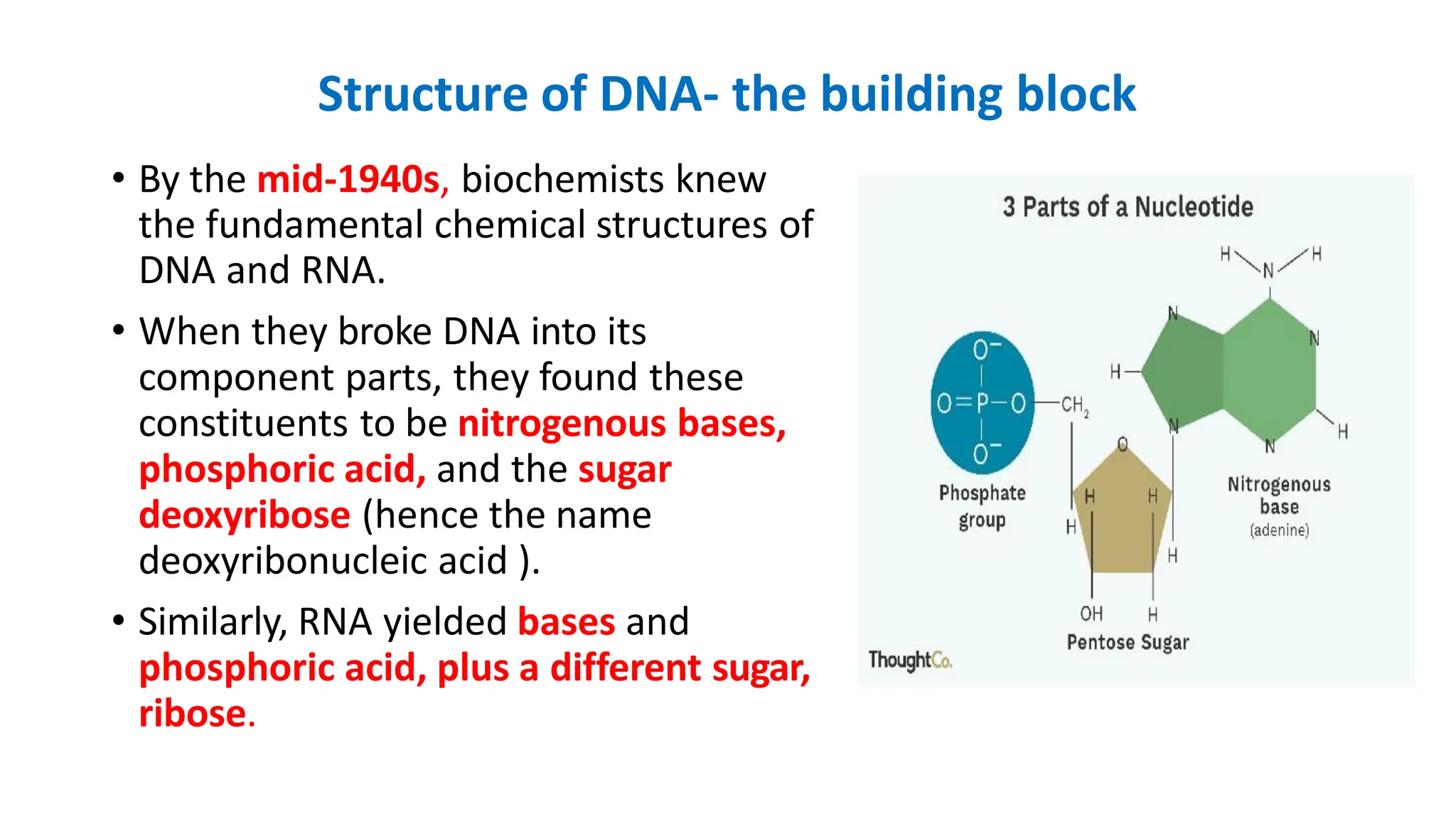
• Each nucleotide is composed of a sugar, a
phosphate group, and a base.
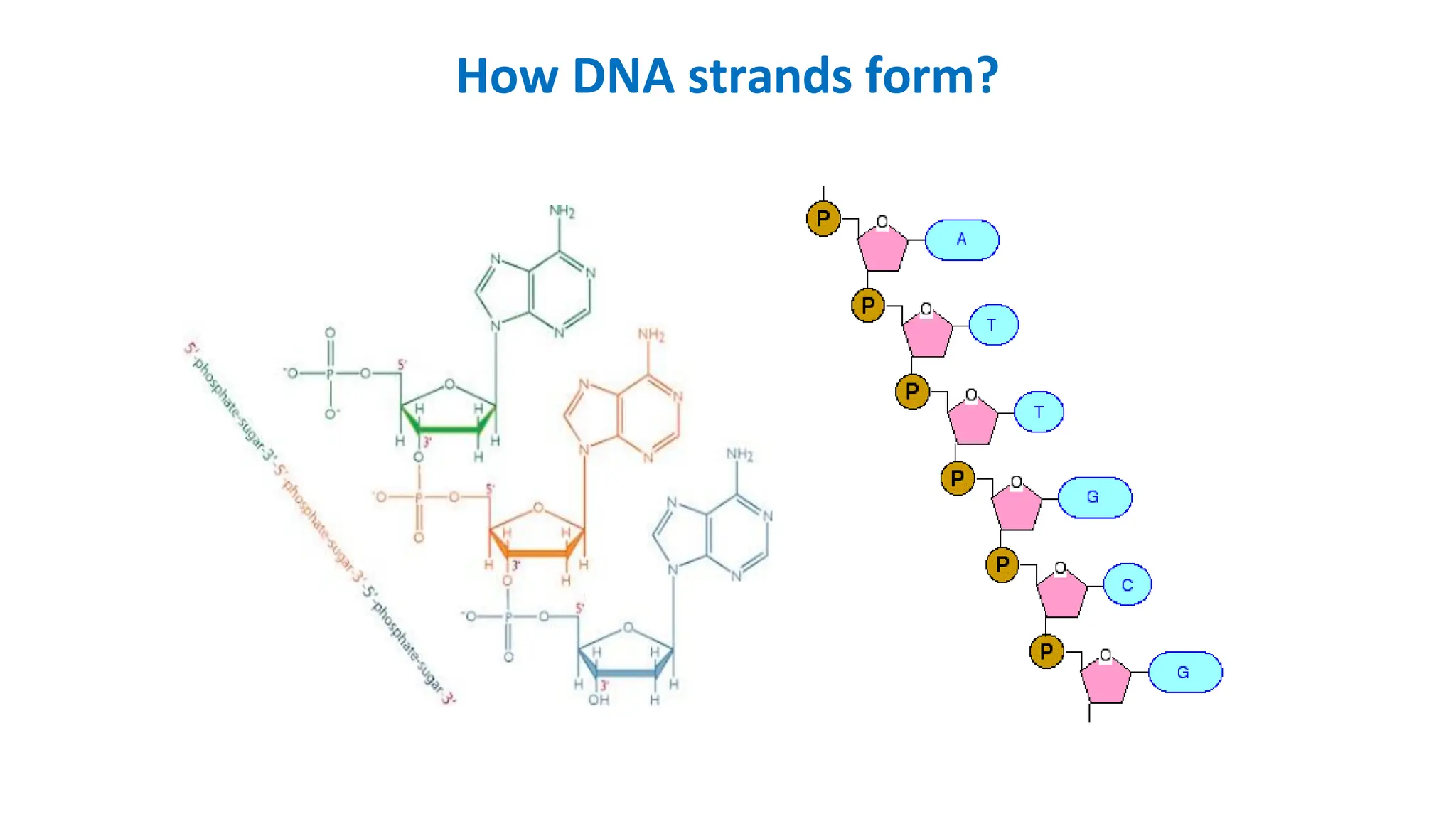
• The chain is formed by linking the sugars
to one another through their phosphate
groups.
5.
Structure of DNA-the building block
• By the mid-1940s, biochemists knew
the fundamental chemical structures of
DNA and RNA.
• When they broke DNA into its
component parts, they found these
constituents to be nitrogenous bases,
phosphoric acid, and the sugar
deoxyribose (hence the name
deoxyribonucleic acid ).
• Similarly, RNA yielded bases and
phosphoric acid, plus a different sugar,
ribose.
6.
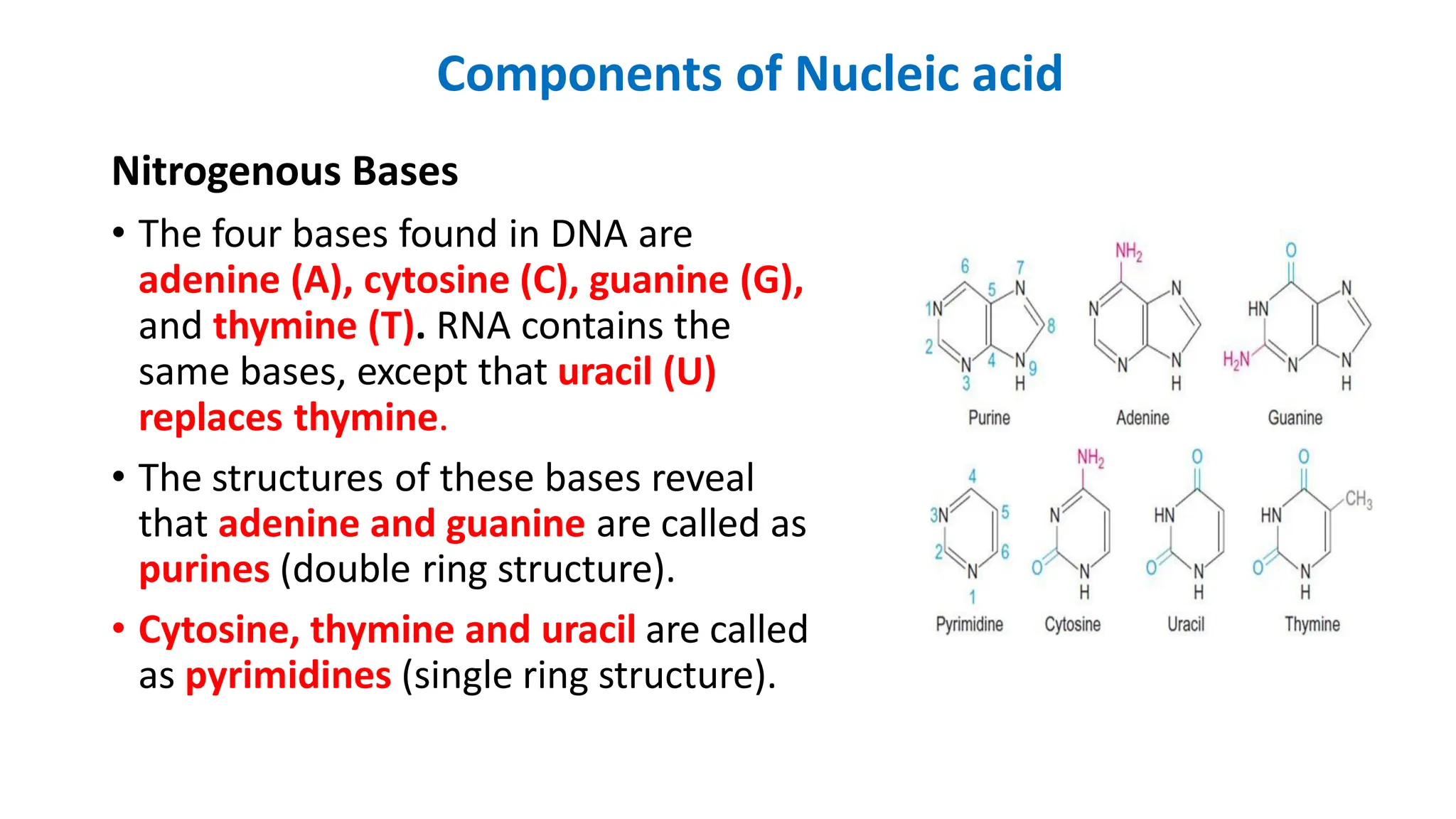
Components of Nucleicacid
Nitrogenous Bases
• The four bases found in DNA are
adenine (A), cytosine (C), guanine (G),
and thymine (T). RNA contains the
same bases, except that uracil (U)
replaces thymine.
• The structures of these bases reveal
that adenine and guanine are called as
purines (double ring structure).
• Cytosine, thymine and uracil are called
as pyrimidines (single ring structure).
7.
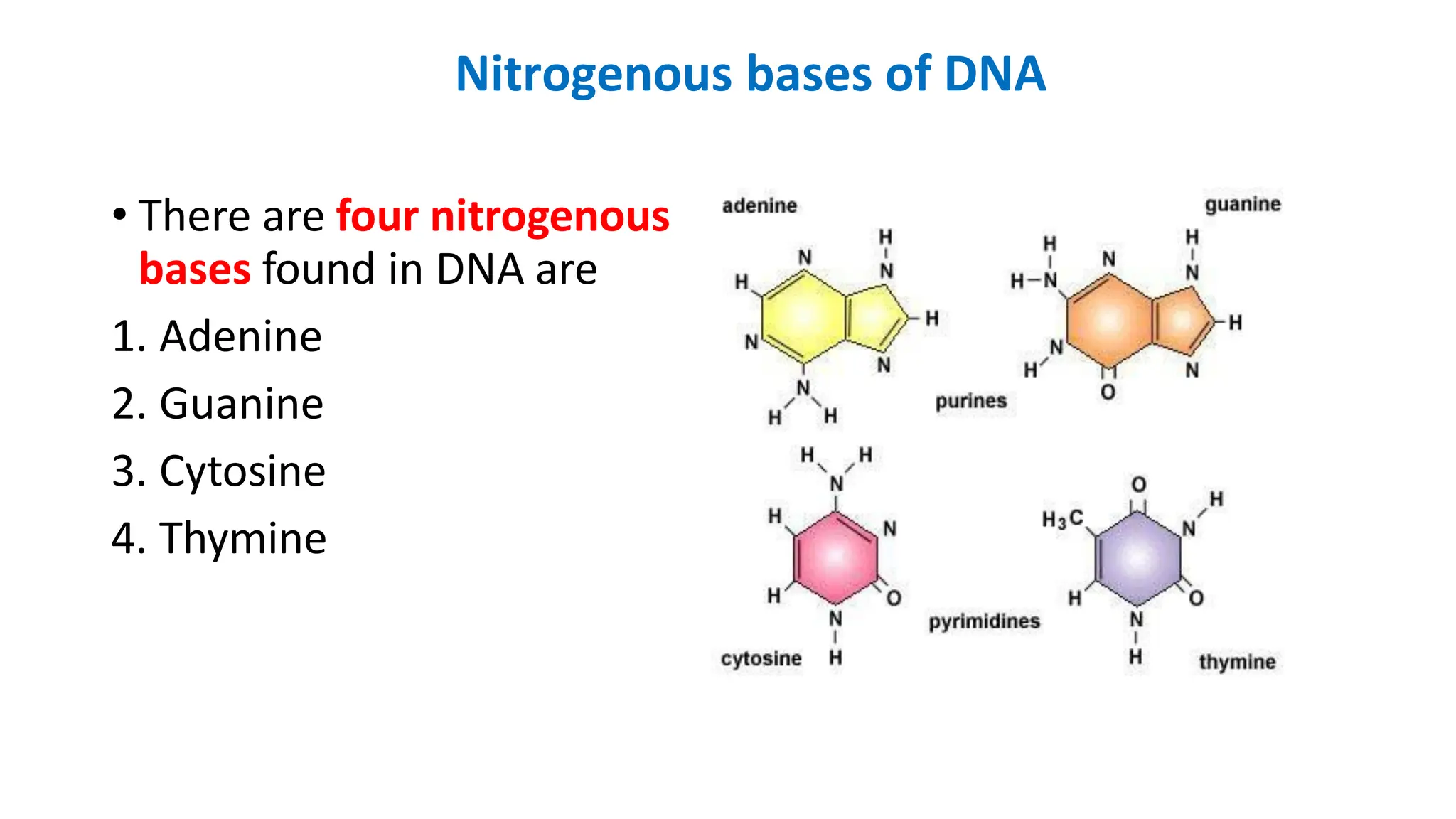
Nitrogenous bases ofDNA
• There are four nitrogenous
bases found in DNA are
1. Adenine
2. Guanine
3. Cytosine
4. Thymine
8.
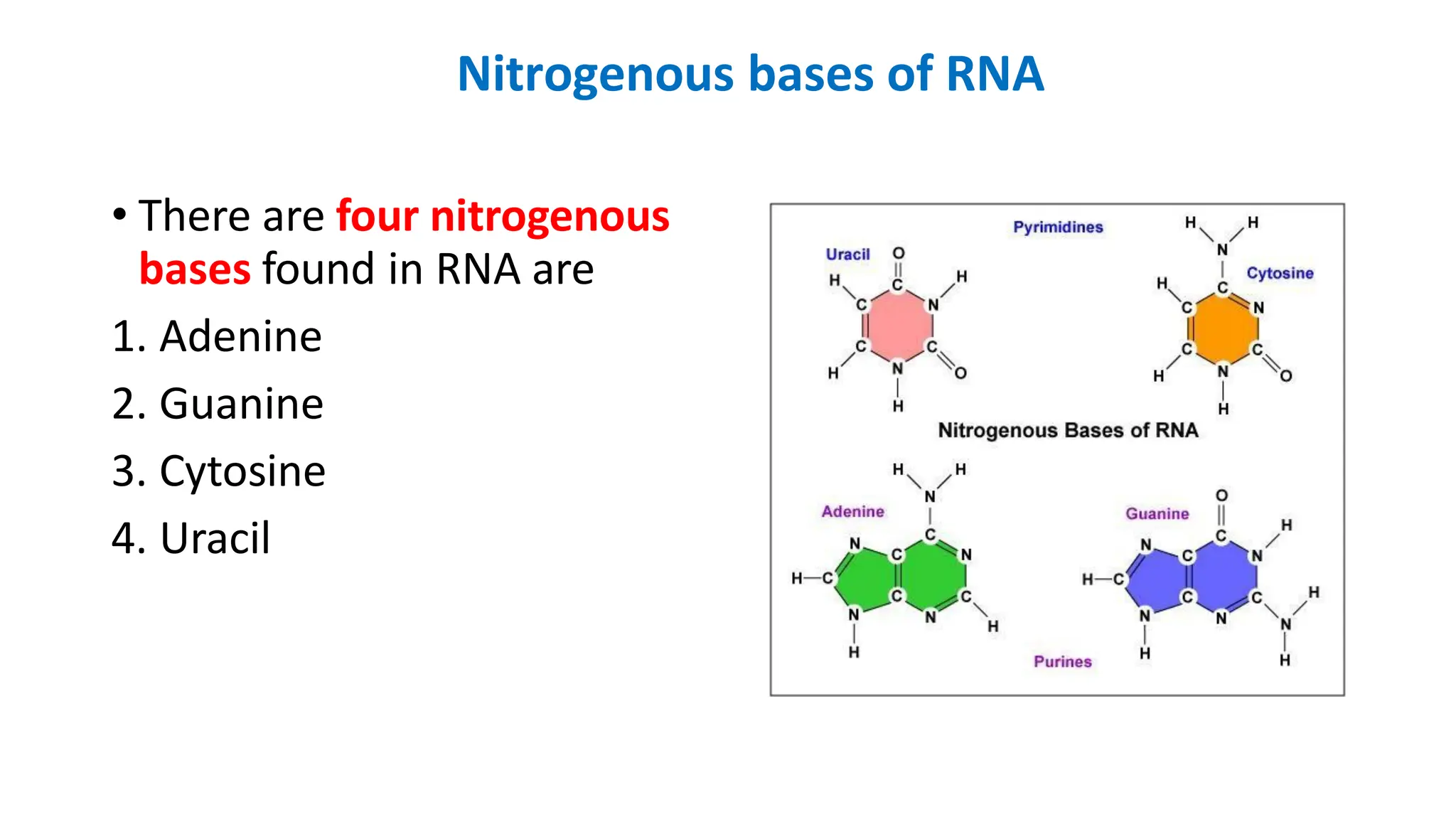
Nitrogenous bases ofRNA
• There are four nitrogenous
bases found in RNA are
1. Adenine
2. Guanine
3. Cytosine
4. Uracil
9.
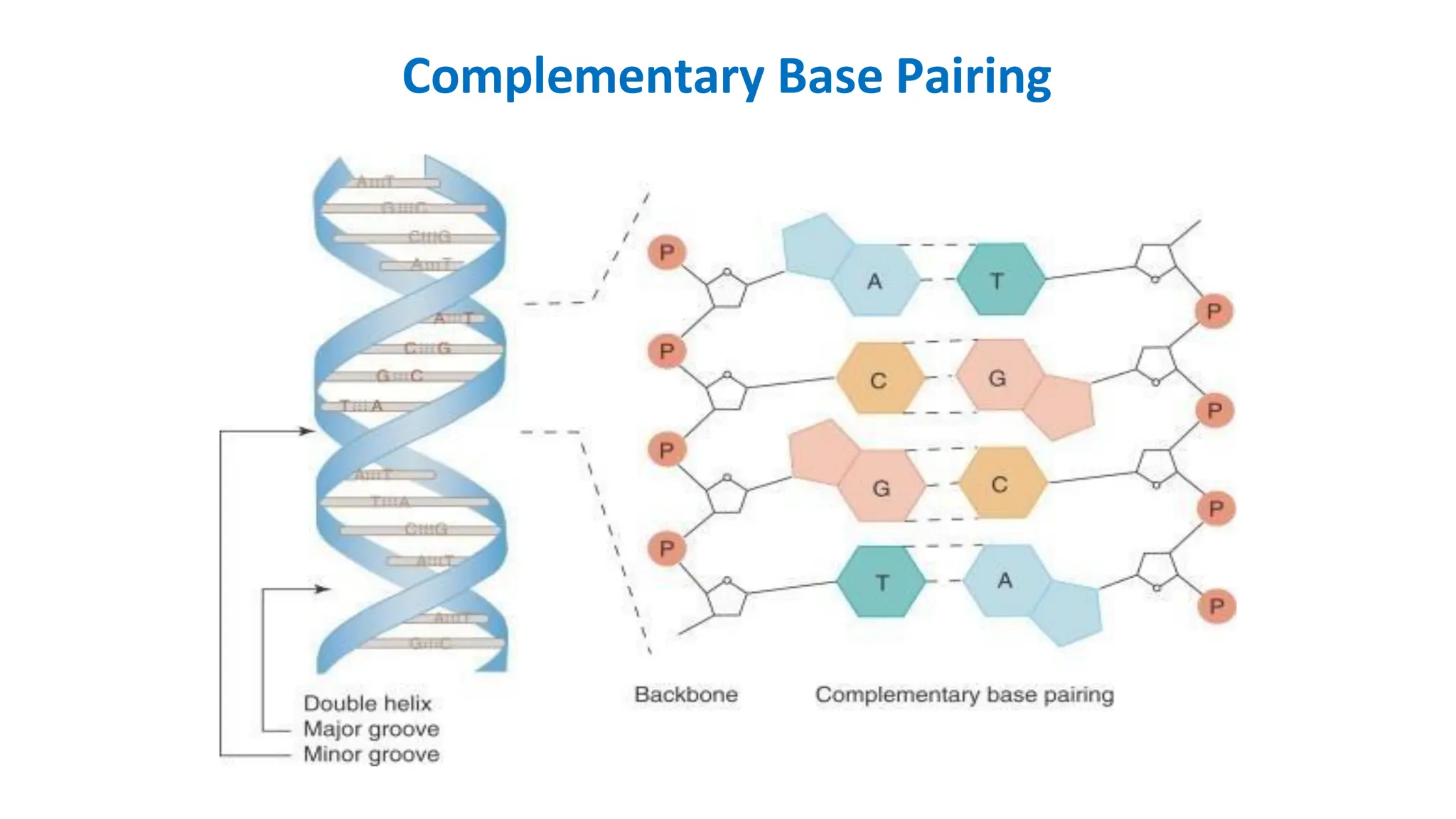
Complementary Bases
The nitrogenousbases in DNA are:
• Adenine always makes pair with thymine (complementary
to each other).
• Guanine always makes pair with cytosine (complementary
to each other).
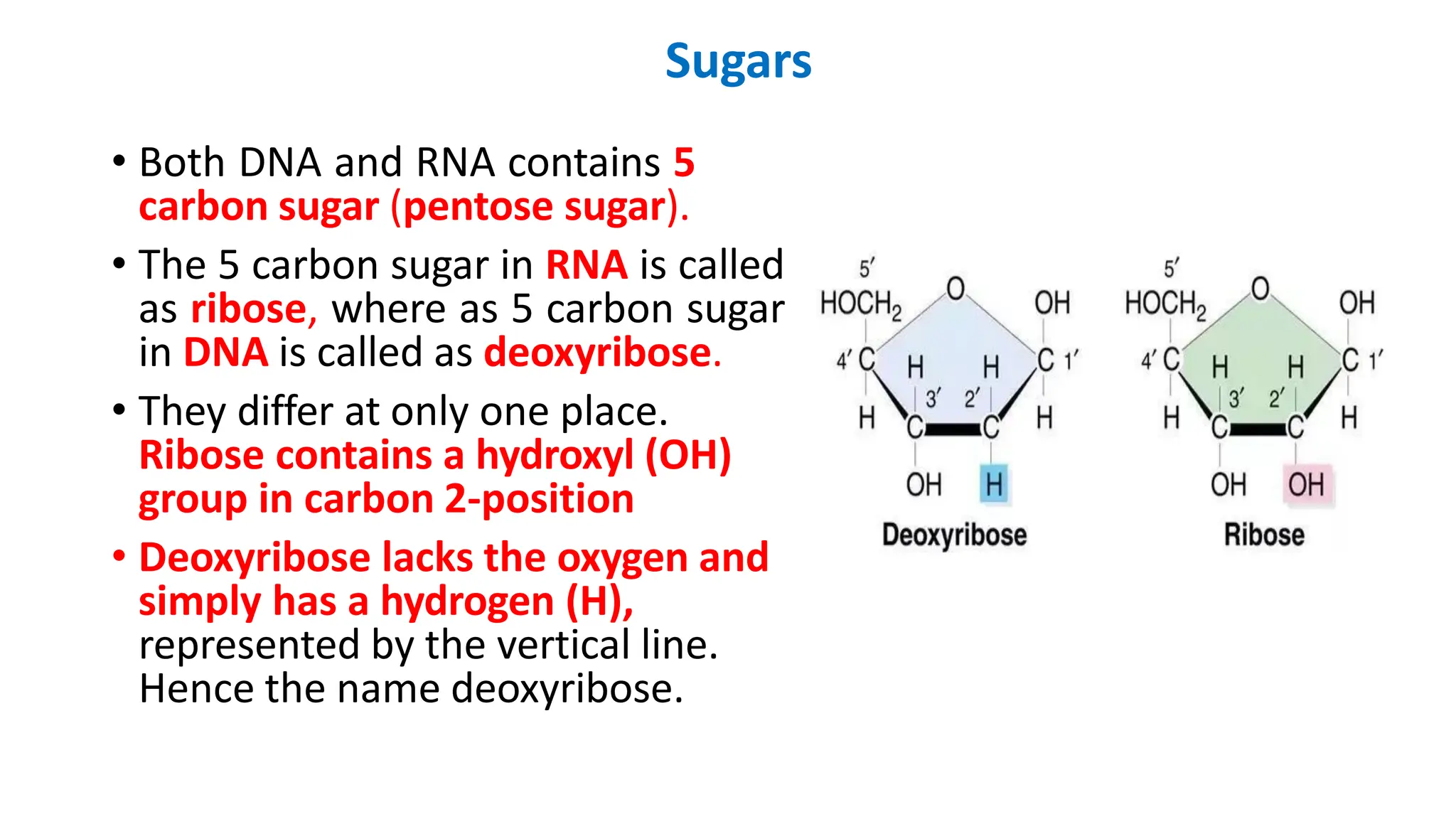
Sugars
• Both DNAand RNA contains 5
carbon sugar (pentose sugar).
• The 5 carbon sugar in RNA is called
as ribose, where as 5 carbon sugar
in DNA is called as deoxyribose.
• They differ at only one place.
Ribose contains a hydroxyl (OH)
group in carbon 2-position
• Deoxyribose lacks the oxygen and
simply has a hydrogen (H),
represented by the vertical line.
Hence the name deoxyribose.
12.
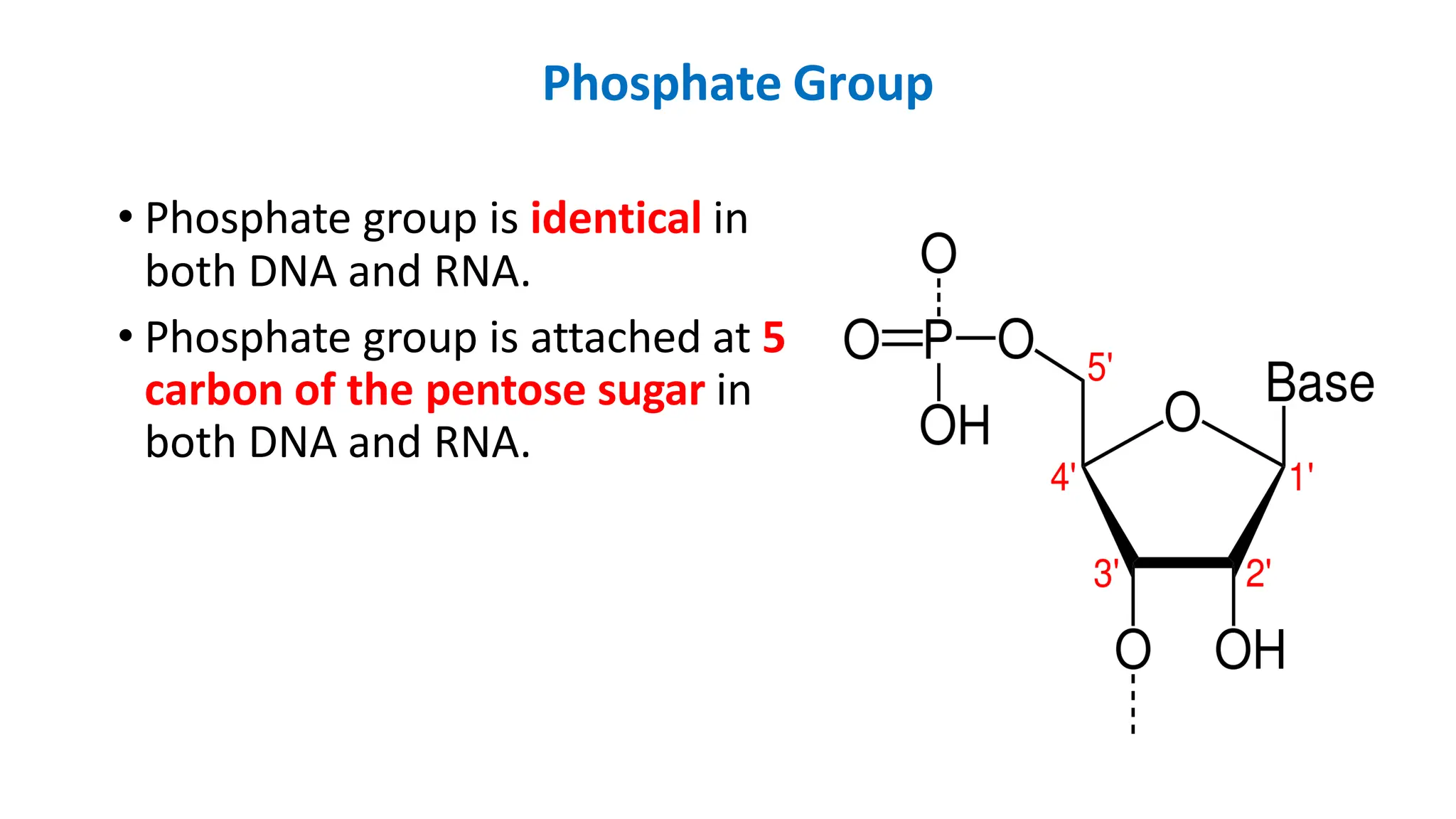
Phosphate Group
• Phosphategroup is identical in
both DNA and RNA.
• Phosphate group is attached at 5
carbon of the pentose sugar in
both DNA and RNA.
13.
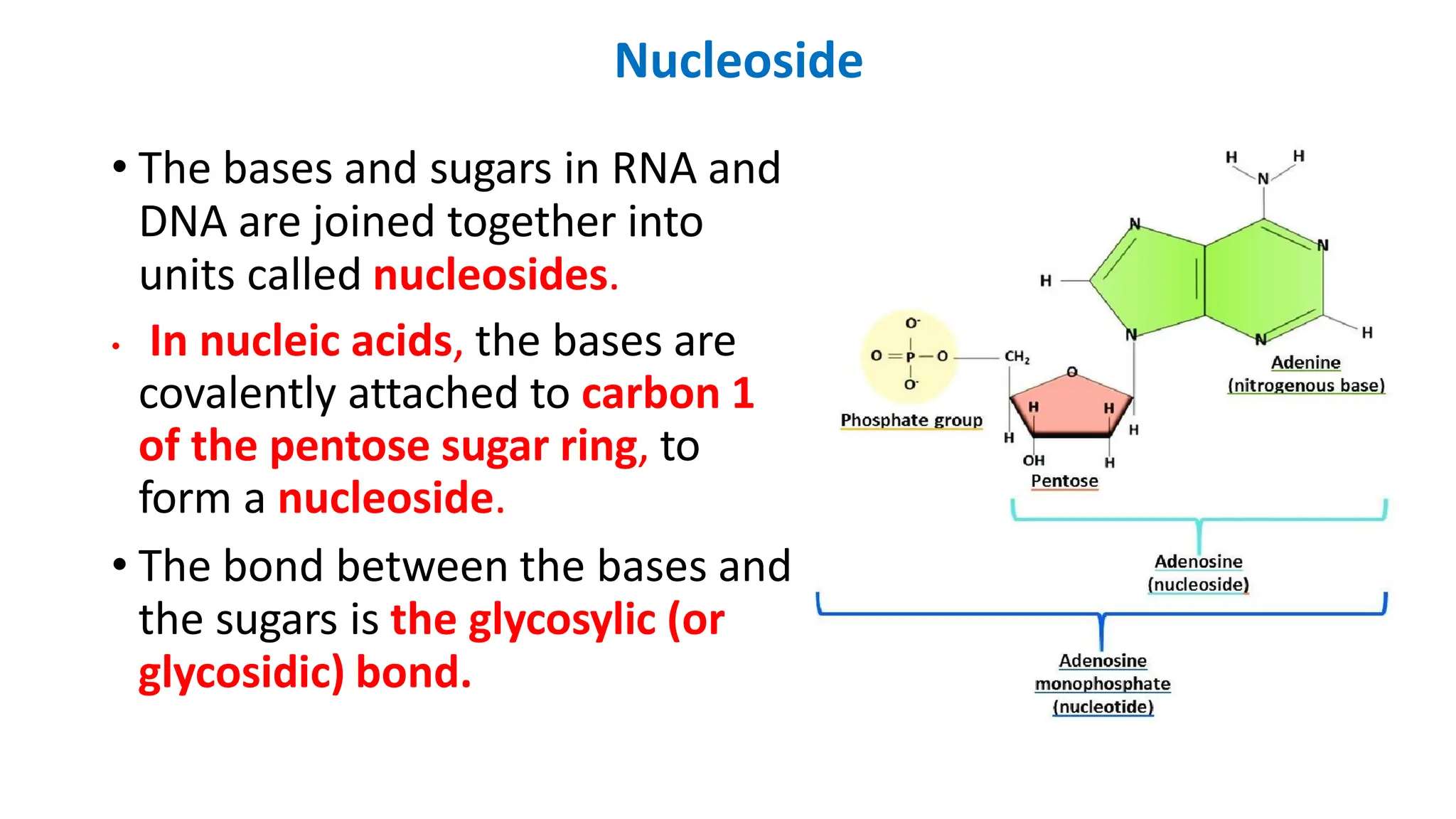
Nucleoside
• The basesand sugars in RNA and
DNA are joined together into
units called nucleosides.
• In nucleic acids, the bases are
covalently attached to carbon 1
of the pentose sugar ring, to
form a nucleoside.
• The bond between the bases and
the sugars is the glycosylic (or
glycosidic) bond.
14.
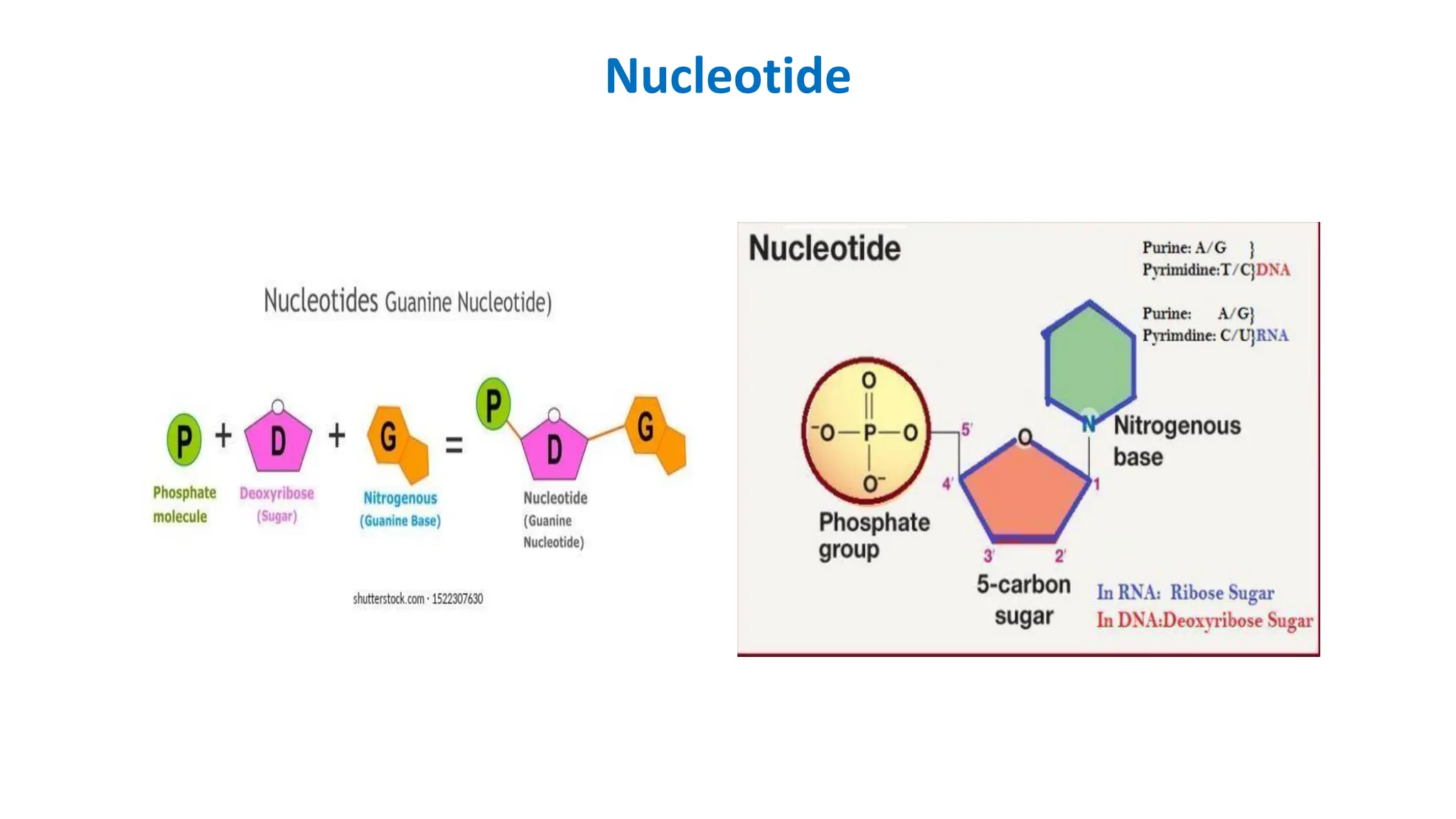
Nucleotide
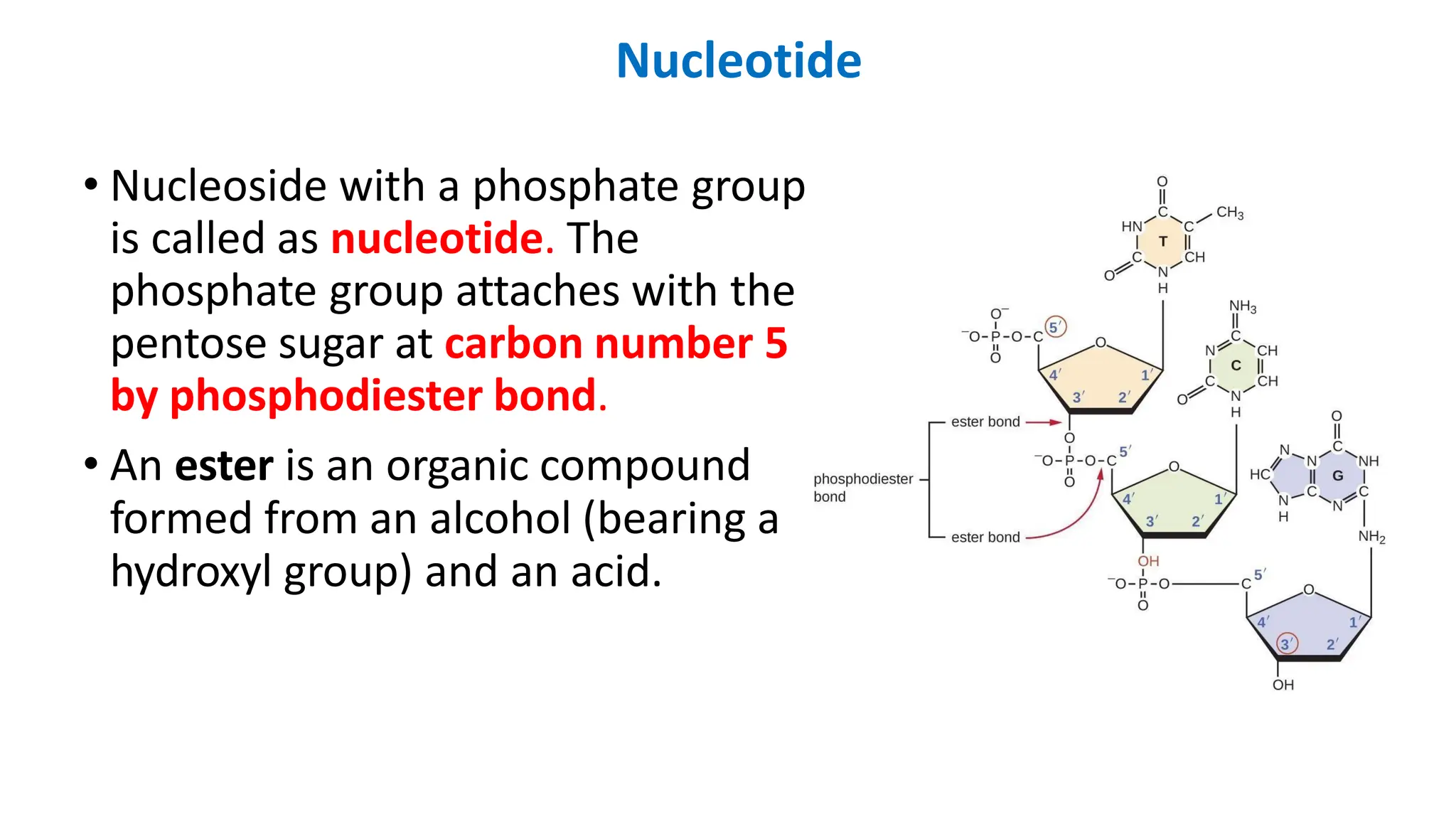
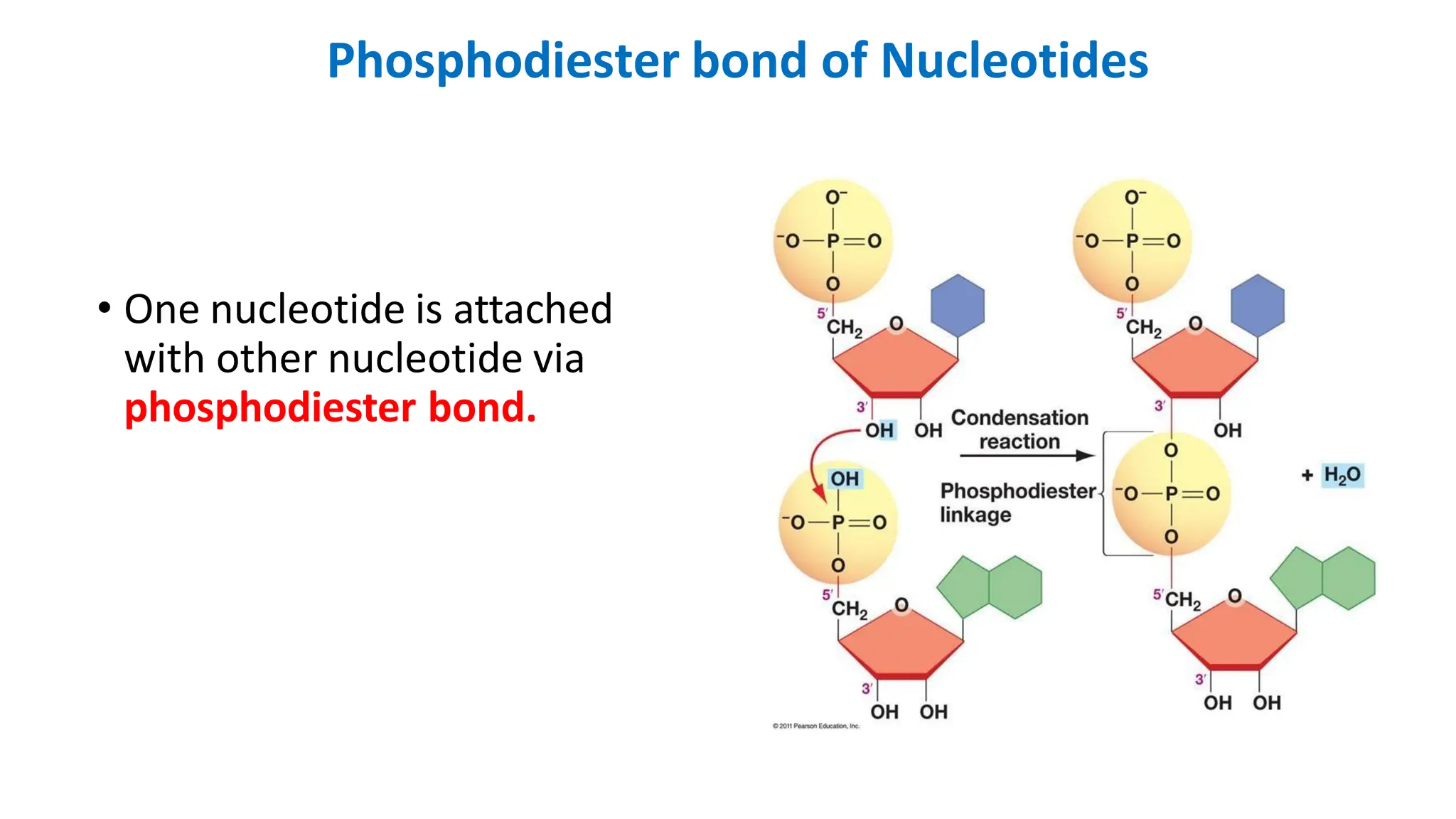
• Nucleoside witha phosphate group
is called as nucleotide. The
phosphate group attaches with the
pentose sugar at carbon number 5
by phosphodiester bond.
• An ester is an organic compound
formed from an alcohol (bearing a
hydroxyl group) and an acid.
15.
Cont….
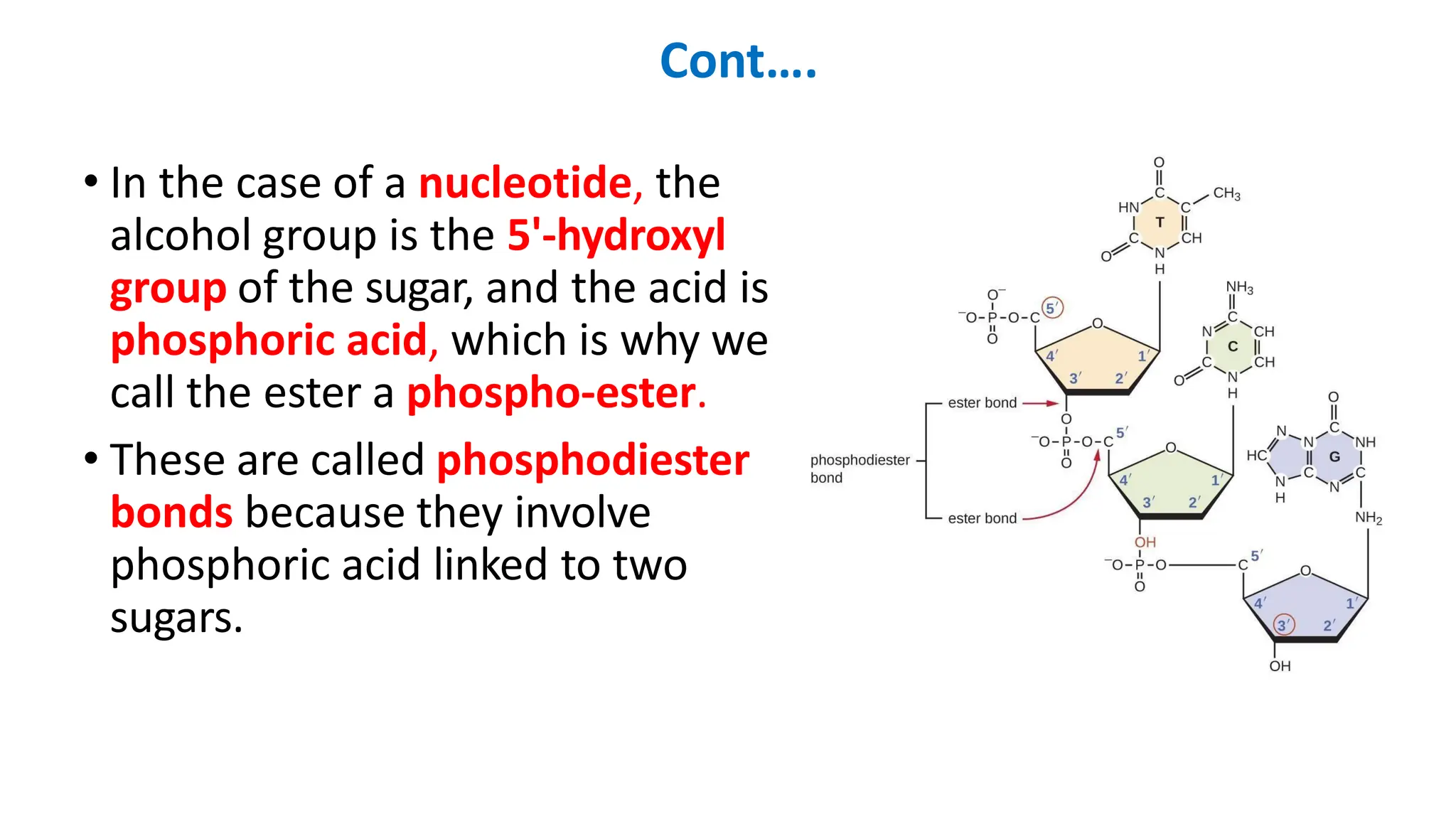
• In thecase of a nucleotide, the
alcohol group is the 5'-hydroxyl
group of the sugar, and the acid is
phosphoric acid, which is why we
call the ester a phospho-ester.
• These are called phosphodiester
bonds because they involve
phosphoric acid linked to two
sugars.
16.
Position of phosphategroup and nitrogenous base
with pentose sugar
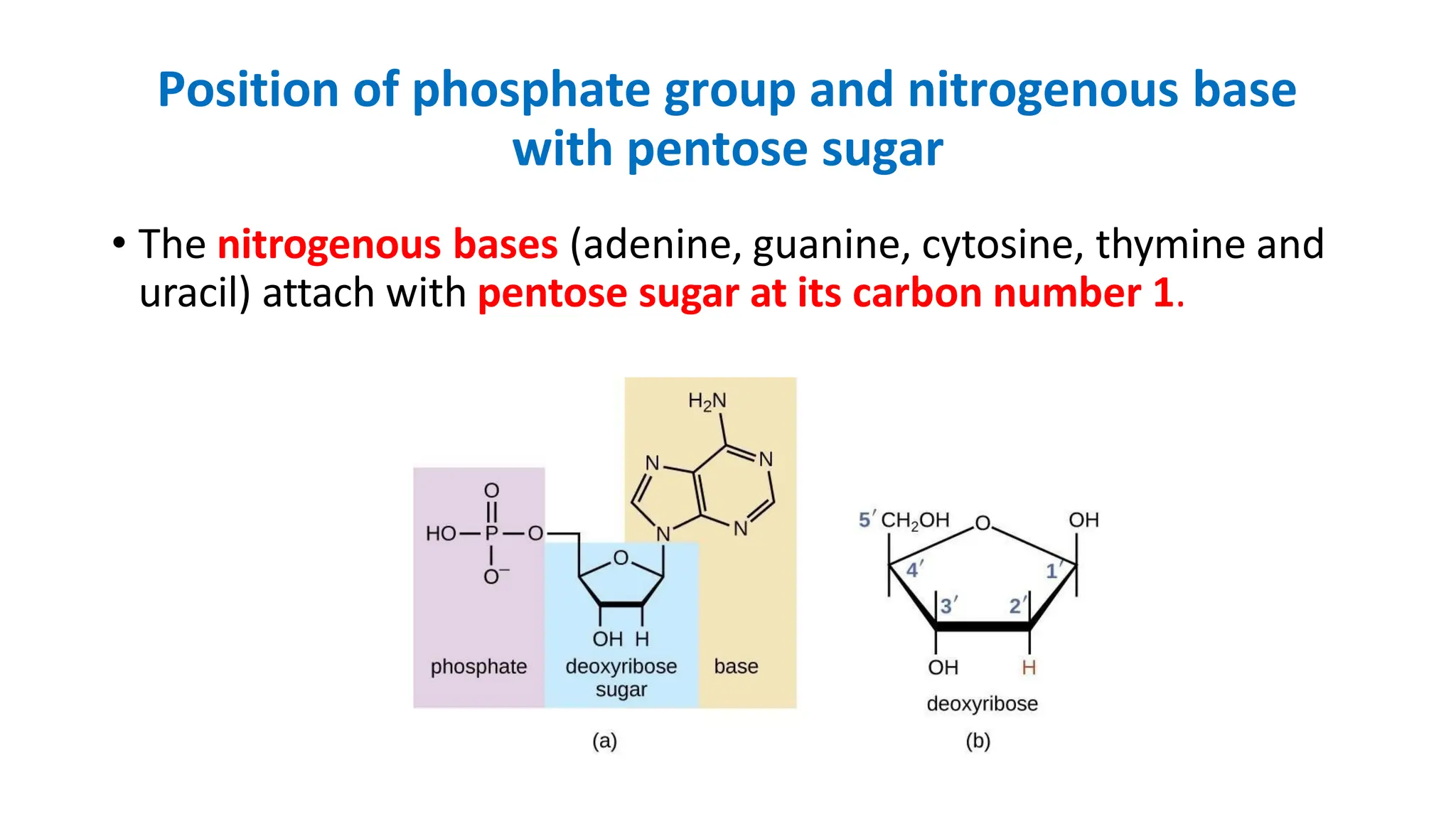
• The nitrogenous bases (adenine, guanine, cytosine, thymine and
uracil) attach with pentose sugar at its carbon number 1.
17.
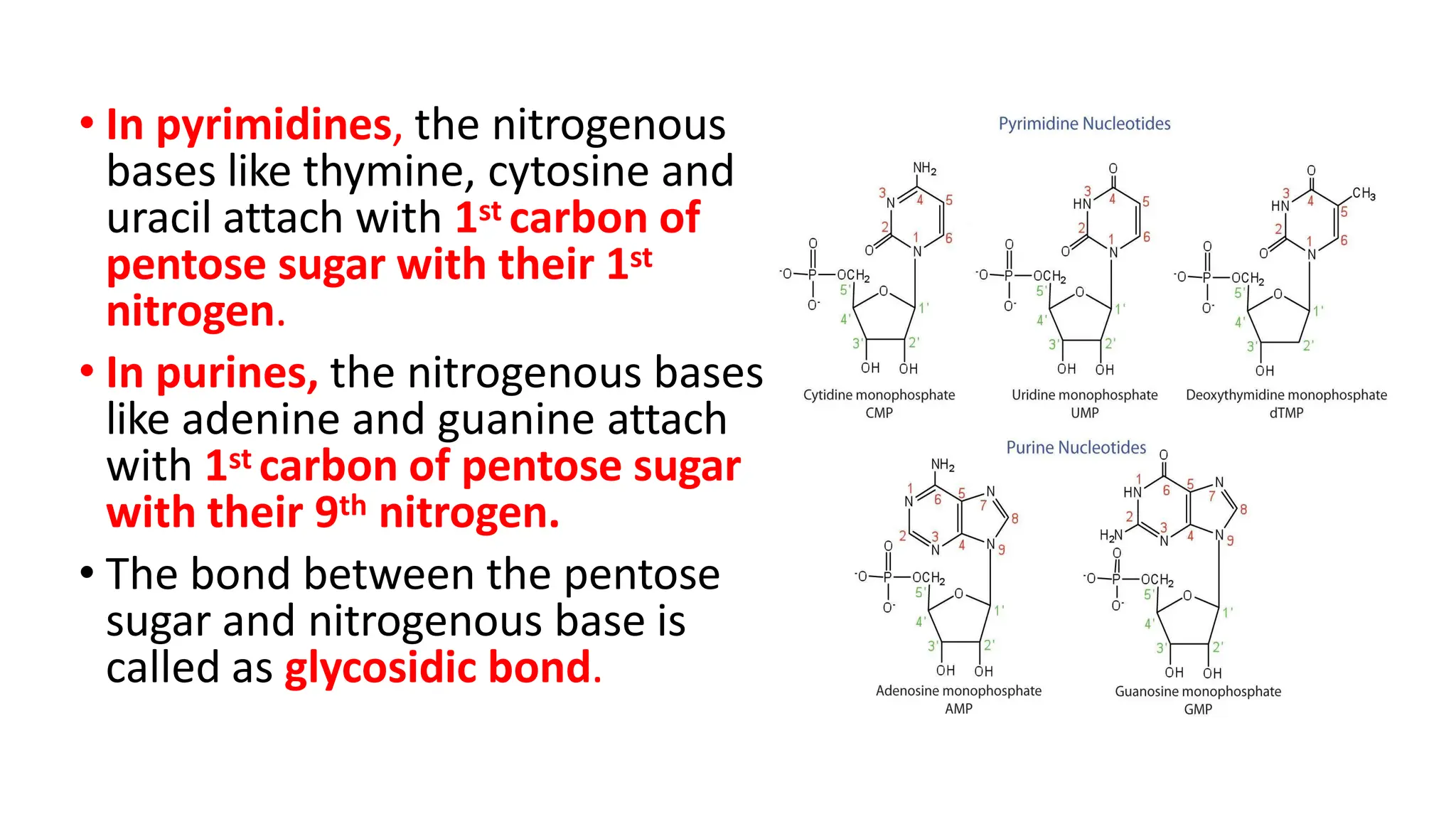
• In pyrimidines,the nitrogenous
bases like thymine, cytosine and
uracil attach with 1st carbon of
pentose sugar with their 1st
nitrogen.
• In purines, the nitrogenous bases
like adenine and guanine attach
with 1st carbon of pentose sugar
with their 9th nitrogen.
• The bond between the pentose
sugar and nitrogenous base is
called as glycosidic bond.
18.
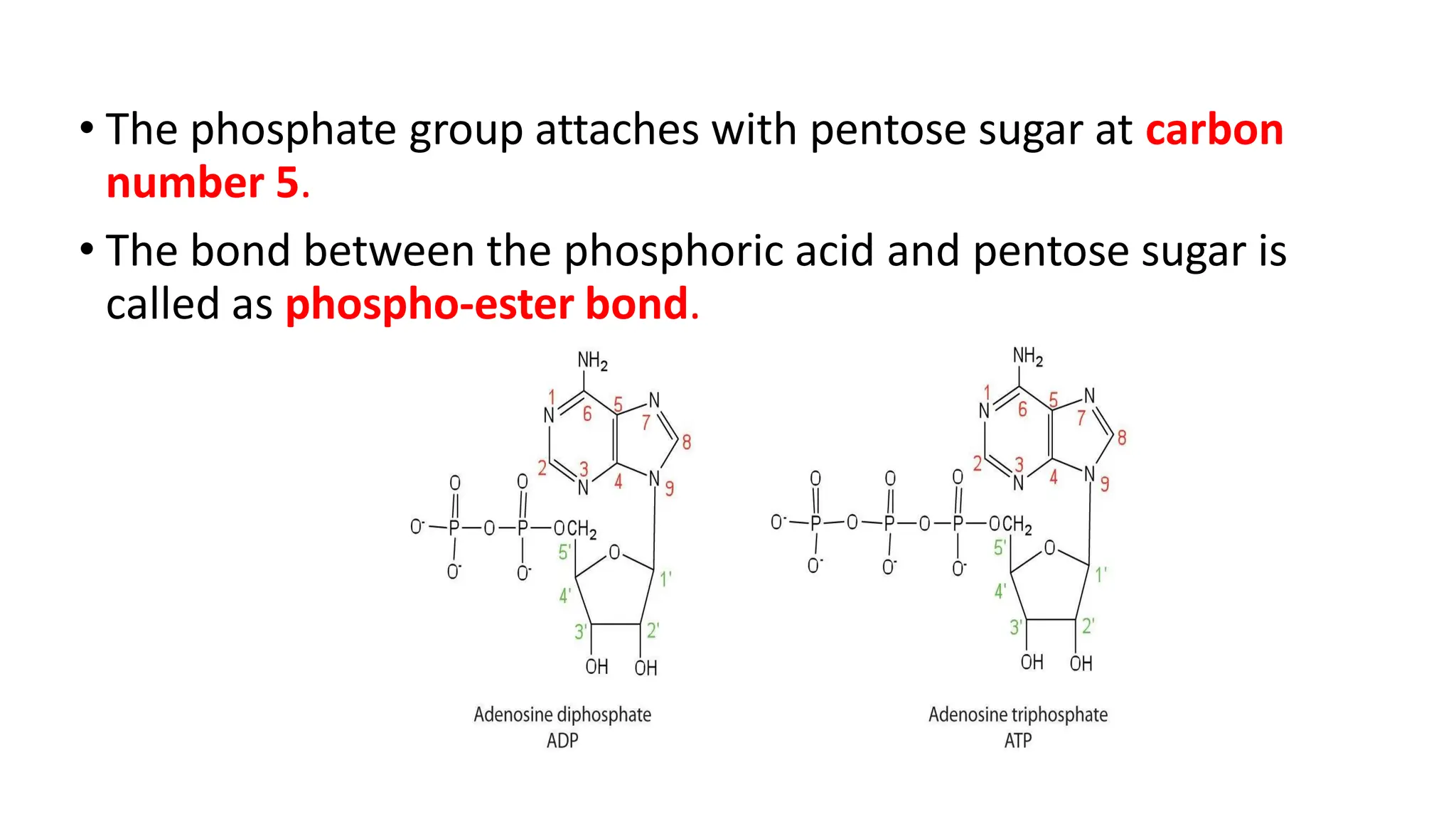
• The phosphategroup attaches with pentose sugar at carbon
number 5.
• The bond between the phosphoric acid and pentose sugar is
called as phospho-ester bond.
DNA, a doublehelical structure..
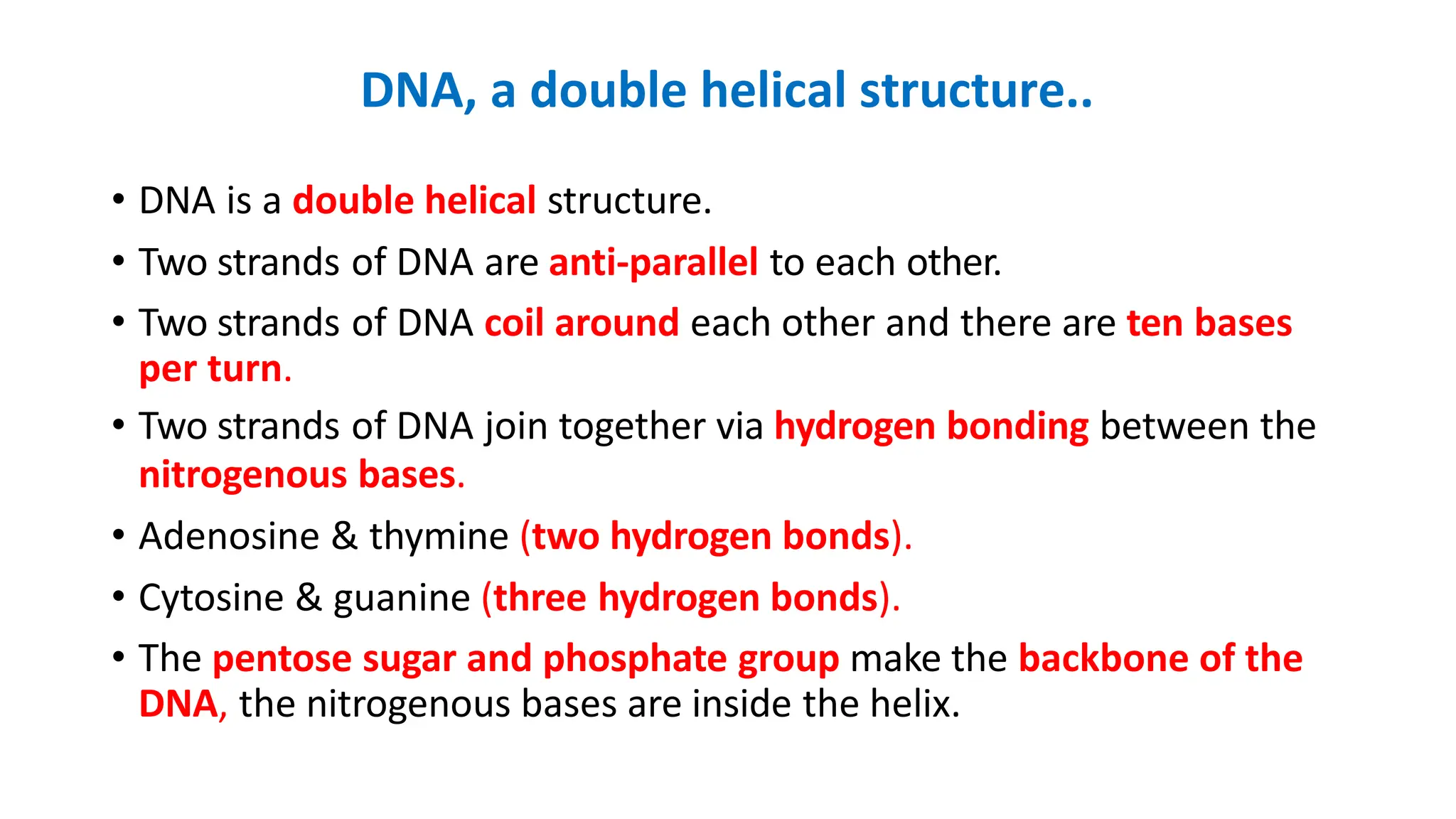
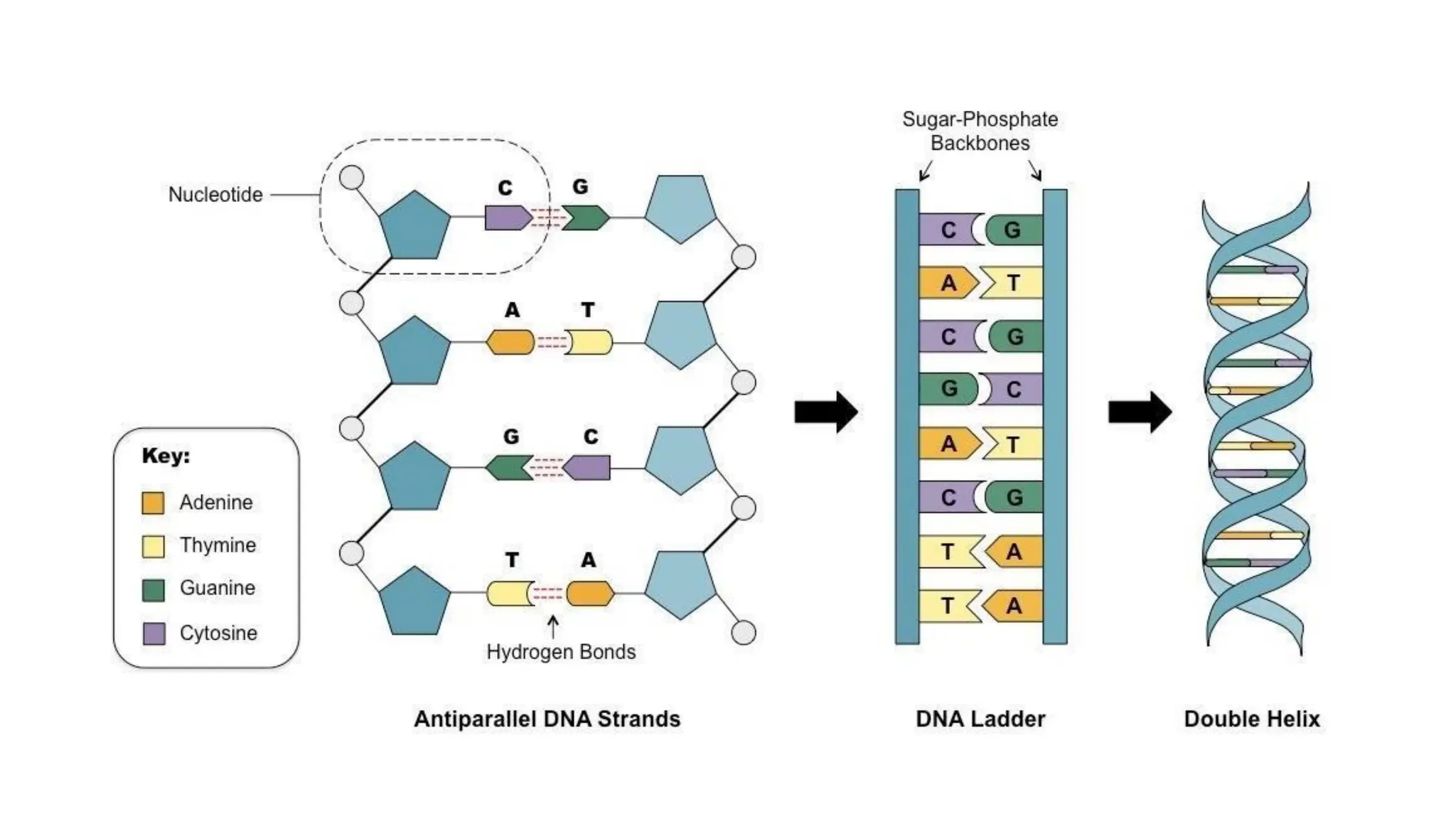
• DNA is a double helical structure.
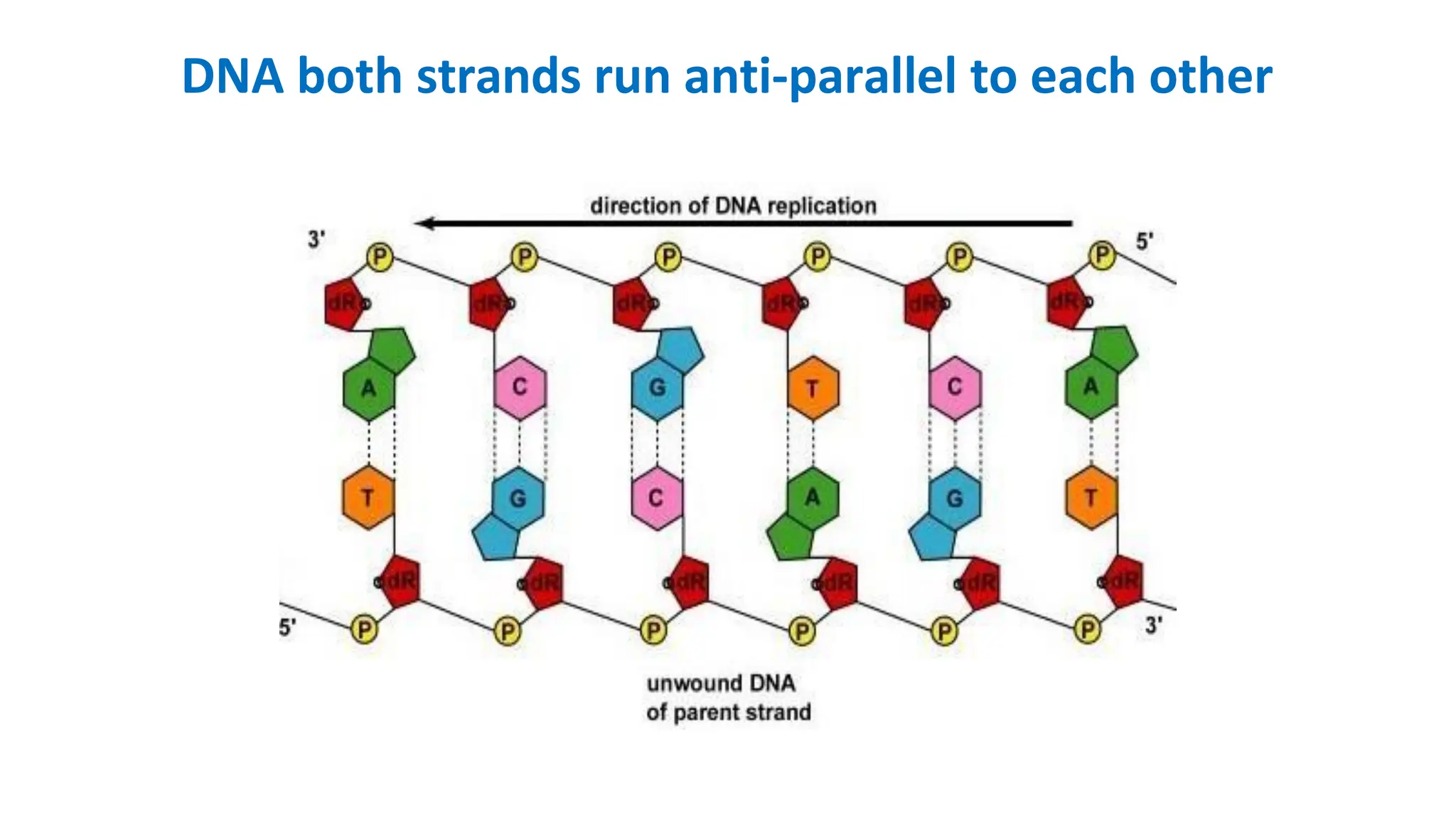
• Two strands of DNA are anti-parallel to each other.
• Two strands of DNA coil around each other and there are ten bases
per turn.
• Two strands of DNA join together via hydrogen bonding between the
nitrogenous bases.
• Adenosine & thymine (two hydrogen bonds).
• Cytosine & guanine (three hydrogen bonds).
• The pentose sugar and phosphate group make the backbone of the
DNA, the nitrogenous bases are inside the helix.