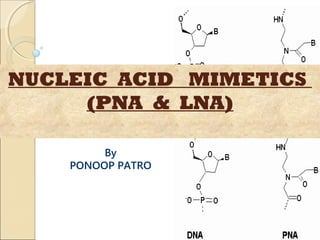
NUCLEIC ACID MIMETICS 
(PNA & LNA) 
By 
Amit Patro
NNuucclleeiicc AAcciidd MMiimmeettiiccss 
It is the phenomenon of imitating the 
behavior or function of natural occurring 
nucleic acids (i.e.- DNA and RNA) by some 
chemical compounds or oligo-nucleotides. 
PNA LNA
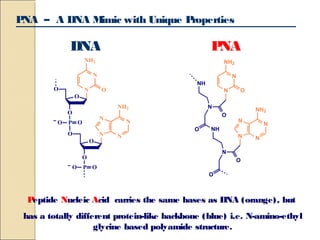
PNA – A DNA Mimic with Unique Properties 
DNA 
N 
N 
NH2 
N 
N 
N 
NH2 
Peptide Nucleic Acid carries the same bases as DNA (orange), but 
has a totally different protein-like backbone (blue) i.e. N-amino-ethyl 
glycine based polyamide structure. 
N 
N 
O 
NH2 
O 
O 
O 
P 
O 
O O 
O 
O 
O P O 
N 
O 
NH 
O NH 
N 
N 
O 
NH2 
N 
O 
O 
N 
N 
N 
PNA 
Nielsen et al. 1991
PPNNAA ffeeaattuurreess 
¨ Neutral backbone 
¨ Stronger and faster binding to nucleic acids 
¨ High sequence-specificity 
¨ No nucleic acid Þ no degradation by nucleases 
¨ No peptide Þ no degradation by protease 
¨ Strand invasion into duplex DNA
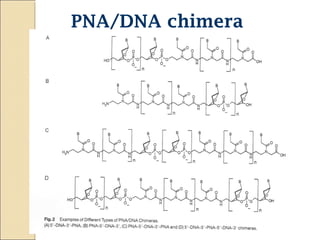
PNA/DNA chimera
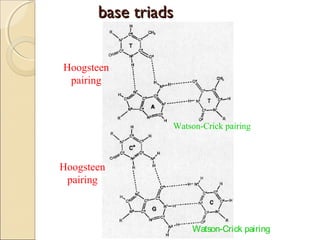
bbaassee ttrriiaaddss 
Hoogsteen 
pairing 
Watson-Crick pairing 
Hoogsteen 
pairing 
Watson-Crick pairing
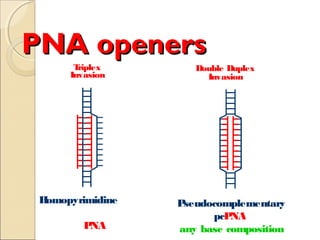
PPNNAA ooppeenneerrss 
Triplex 
Invasion 
Double Duplex 
Invasion 
Pseudocomplementary 
pcPNA 
any base composition 
Homopyrimidine 
PNA
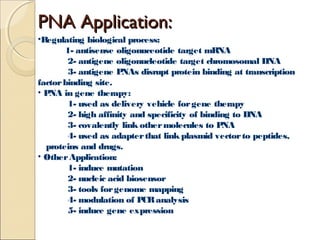
PPNNAA AApppplliiccaattiioonn:: 
•Regulating biological process: 
1- antisense oligonuceotide target mRNA 
2- antigene oligonucleotide target chromosomal DNA 
3- antigene PNAs disrupt protein binding at transcription 
factor binding site. 
• PNA in gene therapy: 
1- used as delivery vehicle for gene therapy 
2- high affinity and specificity of binding to DNA 
3- covalently link other molecules to PNA 
4- used as adapter that link plasmid vector to peptides, 
proteins and drugs. 
• Other Application: 
1- induce mutation 
2- nucleic acid biosensor 
3- tools for genome mapping 
4- modulation of PCR analysis 
5- induce gene expression
E.coli 
B.subtilis S.mutans 
AEM 2007
LLoocckkeedd NNuucclleeiicc AAcciiddss 
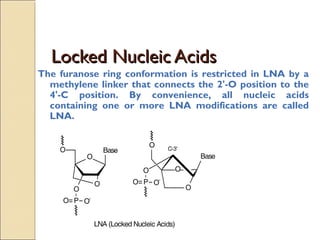
The furanose ring conformation is restricted in LNA by a 
methylene linker that connects the 2'-O position to the 
4'-C position. By convenience, all nucleic acids 
containing one or more LNA modifications are called 
LNA.
FFeeaattuurreess ooff LLNNAA 
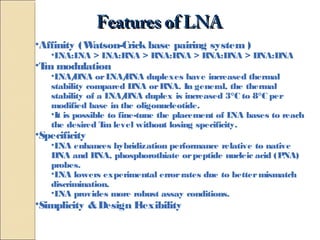
•Affinity (Watson-Crick base pairing system ) 
•LNA:LNA > LNA:RNA > RNA:RNA > RNA:DNA > DNA:DNA 
•Tm modulation 
•LNA/DNA or LNA/RNA duplexes have increased thermal 
stability compared DNA or RNA. In general, the thermal 
stability of a LNA/DNA duplex is increased 3°C to 8°C per 
modified base in the oligonucleotide. 
•It is possible to fine-tune the placement of LNA bases to reach 
the desired Tm level without losing specificity. 
•Specificity 
•LNA enhances hybridization performance relative to native 
DNA and RNA, phosphorothiate or peptide nucleic acid (PNA) 
probes. 
•LNA lowers experimental error rates due to better mismatch 
discrimination. 
•LNA provides more robust assay conditions. 
•Simplicity & Design Flexibility
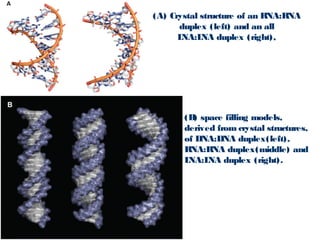
(A) Crystal structure of an RNA:RNA 
duplex (left) and an all 
LNA:LNA duplex (right), 
(B) space filling models, 
derived from crystal structures, 
of DNA:DNA duplex(left), 
RNA:RNA duplex(middle) and 
LNA:LNA duplex (right).
Application 
• Hybridization probes 
• Strand invasion 
• In-situ hybridization 
• Triple-helix forming 
oligos 
• Nuclease protection 
assays 
• Capture probes 
• Sample preparation 
(mRNA) 
• SNP analysis 
• Mutation analysis 
• Allele specific PCR 
• Antisense Target 
Validation
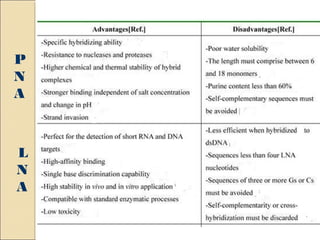
P 
N 
A 
L 
N 
A
References 
Nielsen JT, Stein PC, Petersen M; NMR structure of an alpha-L-LNA:RNA 
hybrid: structural implications for RNase H recognition, Nucleic Acids Res. 
2003; 31(20):5858-67 
Campbell M A. and Wengel J; Locked vs. unlocked nucleic acids (LNA vs. 
UNA): contrasting structures work towards common therapeutic goals, 
Chem. Soc. Rev., 2011, 40, 5680–5689. 
Uhalmann E; Peptide nucleic acid (PNA) & PNA-DNA chimeras; from high 
binding affinity towards biological function; Biol. Chem., 1998, 379, 1045- 
1052 
Nielsen P. E.; Peptide Nucleic Acid, a molecule with two identities; 
Accounts of chemical Research, 1999, 32, 624-630. 
Betts L, Josey JA, Veal JM, Jordan SR. A nucleic acid triple helix formed by 
a peptide nucleic acid-DNA complex. Science, 1995; 270(5243): 1838-41
Nucleic mimetics (PNA, LNA)

Nucleic mimetics (PNA, LNA)

  • 1.
    NUCLEIC ACID MIMETICS (PNA & LNA) By Amit Patro
  • 2.
    NNuucclleeiicc AAcciidd MMiimmeettiiccss It is the phenomenon of imitating the behavior or function of natural occurring nucleic acids (i.e.- DNA and RNA) by some chemical compounds or oligo-nucleotides. PNA LNA
  • 3.
    PNA – ADNA Mimic with Unique Properties DNA N N NH2 N N N NH2 Peptide Nucleic Acid carries the same bases as DNA (orange), but has a totally different protein-like backbone (blue) i.e. N-amino-ethyl glycine based polyamide structure. N N O NH2 O O O P O O O O O O P O N O NH O NH N N O NH2 N O O N N N PNA Nielsen et al. 1991
  • 4.
    PPNNAA ffeeaattuurreess ¨Neutral backbone ¨ Stronger and faster binding to nucleic acids ¨ High sequence-specificity ¨ No nucleic acid Þ no degradation by nucleases ¨ No peptide Þ no degradation by protease ¨ Strand invasion into duplex DNA
  • 6.
  • 7.
    bbaassee ttrriiaaddss Hoogsteen pairing Watson-Crick pairing Hoogsteen pairing Watson-Crick pairing
  • 9.
    PPNNAA ooppeenneerrss Triplex Invasion Double Duplex Invasion Pseudocomplementary pcPNA any base composition Homopyrimidine PNA
  • 10.
    PPNNAA AApppplliiccaattiioonn:: •Regulatingbiological process: 1- antisense oligonuceotide target mRNA 2- antigene oligonucleotide target chromosomal DNA 3- antigene PNAs disrupt protein binding at transcription factor binding site. • PNA in gene therapy: 1- used as delivery vehicle for gene therapy 2- high affinity and specificity of binding to DNA 3- covalently link other molecules to PNA 4- used as adapter that link plasmid vector to peptides, proteins and drugs. • Other Application: 1- induce mutation 2- nucleic acid biosensor 3- tools for genome mapping 4- modulation of PCR analysis 5- induce gene expression
  • 11.
  • 12.
    LLoocckkeedd NNuucclleeiicc AAcciiddss The furanose ring conformation is restricted in LNA by a methylene linker that connects the 2'-O position to the 4'-C position. By convenience, all nucleic acids containing one or more LNA modifications are called LNA.
  • 13.
    FFeeaattuurreess ooff LLNNAA •Affinity (Watson-Crick base pairing system ) •LNA:LNA > LNA:RNA > RNA:RNA > RNA:DNA > DNA:DNA •Tm modulation •LNA/DNA or LNA/RNA duplexes have increased thermal stability compared DNA or RNA. In general, the thermal stability of a LNA/DNA duplex is increased 3°C to 8°C per modified base in the oligonucleotide. •It is possible to fine-tune the placement of LNA bases to reach the desired Tm level without losing specificity. •Specificity •LNA enhances hybridization performance relative to native DNA and RNA, phosphorothiate or peptide nucleic acid (PNA) probes. •LNA lowers experimental error rates due to better mismatch discrimination. •LNA provides more robust assay conditions. •Simplicity & Design Flexibility
  • 16.
    (A) Crystal structureof an RNA:RNA duplex (left) and an all LNA:LNA duplex (right), (B) space filling models, derived from crystal structures, of DNA:DNA duplex(left), RNA:RNA duplex(middle) and LNA:LNA duplex (right).
  • 17.
    Application • Hybridizationprobes • Strand invasion • In-situ hybridization • Triple-helix forming oligos • Nuclease protection assays • Capture probes • Sample preparation (mRNA) • SNP analysis • Mutation analysis • Allele specific PCR • Antisense Target Validation
  • 18.
    P N A L N A
  • 19.
    References Nielsen JT,Stein PC, Petersen M; NMR structure of an alpha-L-LNA:RNA hybrid: structural implications for RNase H recognition, Nucleic Acids Res. 2003; 31(20):5858-67 Campbell M A. and Wengel J; Locked vs. unlocked nucleic acids (LNA vs. UNA): contrasting structures work towards common therapeutic goals, Chem. Soc. Rev., 2011, 40, 5680–5689. Uhalmann E; Peptide nucleic acid (PNA) & PNA-DNA chimeras; from high binding affinity towards biological function; Biol. Chem., 1998, 379, 1045- 1052 Nielsen P. E.; Peptide Nucleic Acid, a molecule with two identities; Accounts of chemical Research, 1999, 32, 624-630. Betts L, Josey JA, Veal JM, Jordan SR. A nucleic acid triple helix formed by a peptide nucleic acid-DNA complex. Science, 1995; 270(5243): 1838-41