Nucleic acid and Nucleotide
By Mr. Biswanath prusty
Assistant professor
• There are two types of nucleic acids, namely deoxyribonucleic acid (DNA) and ribonucleic acid
(RNA). Primarily, nucleic acids serve as repositories and transmitters of genetic information.
• DNA was discovered in 1869 by Johann Friedrich Miescher, a Swiss researcher. The demonstration
that DNA contained genetic information was first made in 1944, by Avery, Macleod and MacCary.
• Functions of nucleic acids
• DNA is the chemical basis of heredity and may be regarded as the reserve bank of genetic
information. DNA is exclusively responsible for maintaining the identity of different species of
organisms over millions of years.
• Components of nucleic acids
• Nucleic acids are the polymers of nucleotides (polynucleotides) held by 3′and 5′phosphate bridges.
In other words, nucleic acids are built up by the monomeric units—nucleotides (It may be recalled
that protein is a polymer of amino acids).
• Nucleotides
• Nucleotides are composed of a nitrogenous base, a pentose sugar and a phosphate. Nucleotides
perform a wide variety of functions in the living cells, besides being the building blocks or
monomeric units in the nucleic acid (DNA and RNA) structure.
• Composition of Nucleotides
• A nucleotide is made up of 3
components:
• a. Nitrogenous base (a purine or a
pyrimidine)
• b. Pentose sugar, either ribose or
deoxyribose
• c. Phosphate groups esterified to the
sugar.
• When a base combines with a
pentose sugar, a nucleoside is
formed.
• When the nucleoside is esterified to
a phosphate group, it is called a
nucleotide or nucleoside
monophosphate. When a second
phosphate gets esterified to the
existing phosphate group, a
nucleoside diphosphate is
generated.
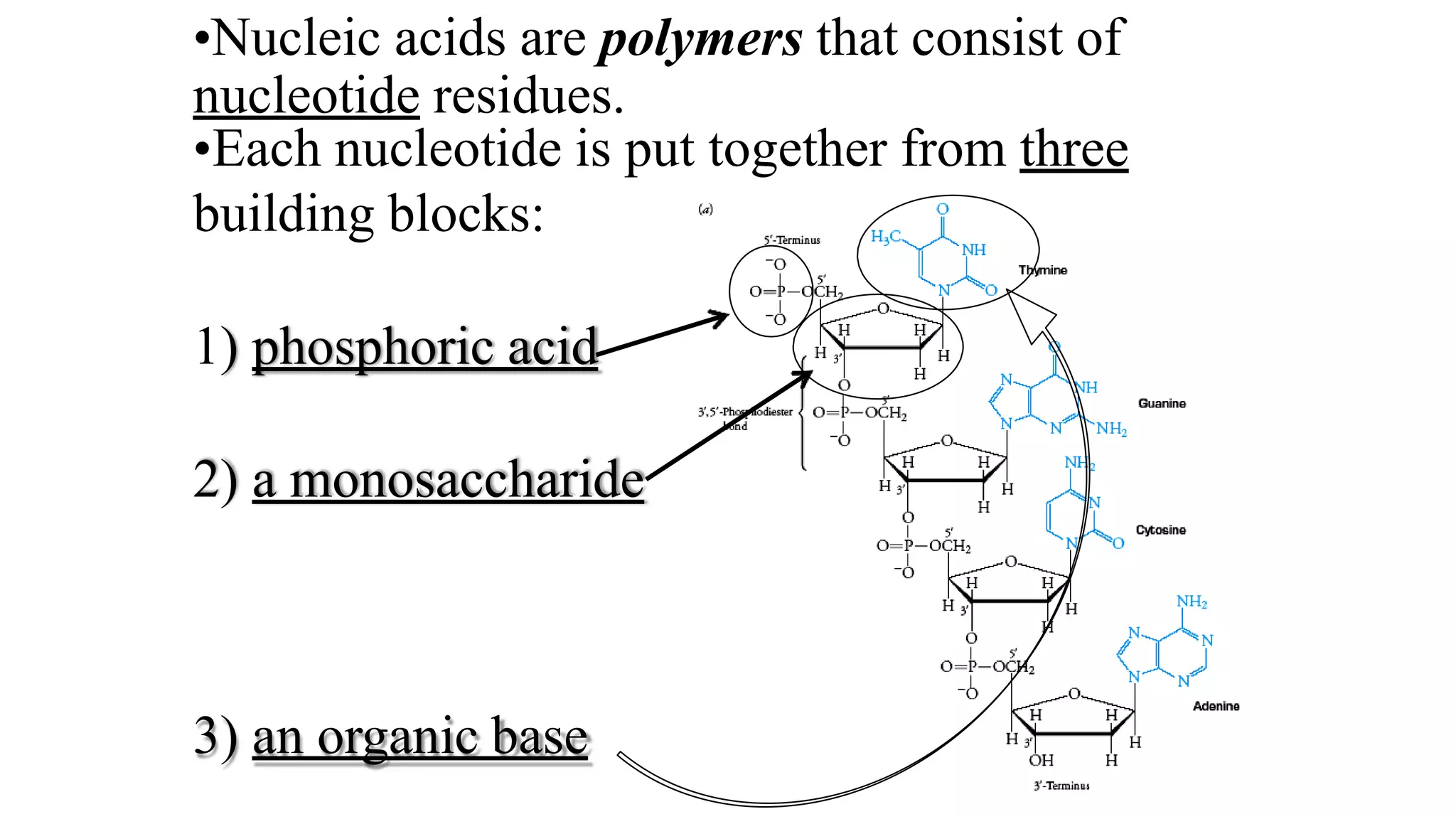
•Nucleic acids are polymers that consist of
nucleotide residues.
•Each nucleotide is put together from three
building blocks:
1) phosphoric acid
2) a monosaccharide
3) an organic base
1) Phosphoric Acid
2) Monosaccharides
All nucleotides are constructed from
one of these two monosaccharides:
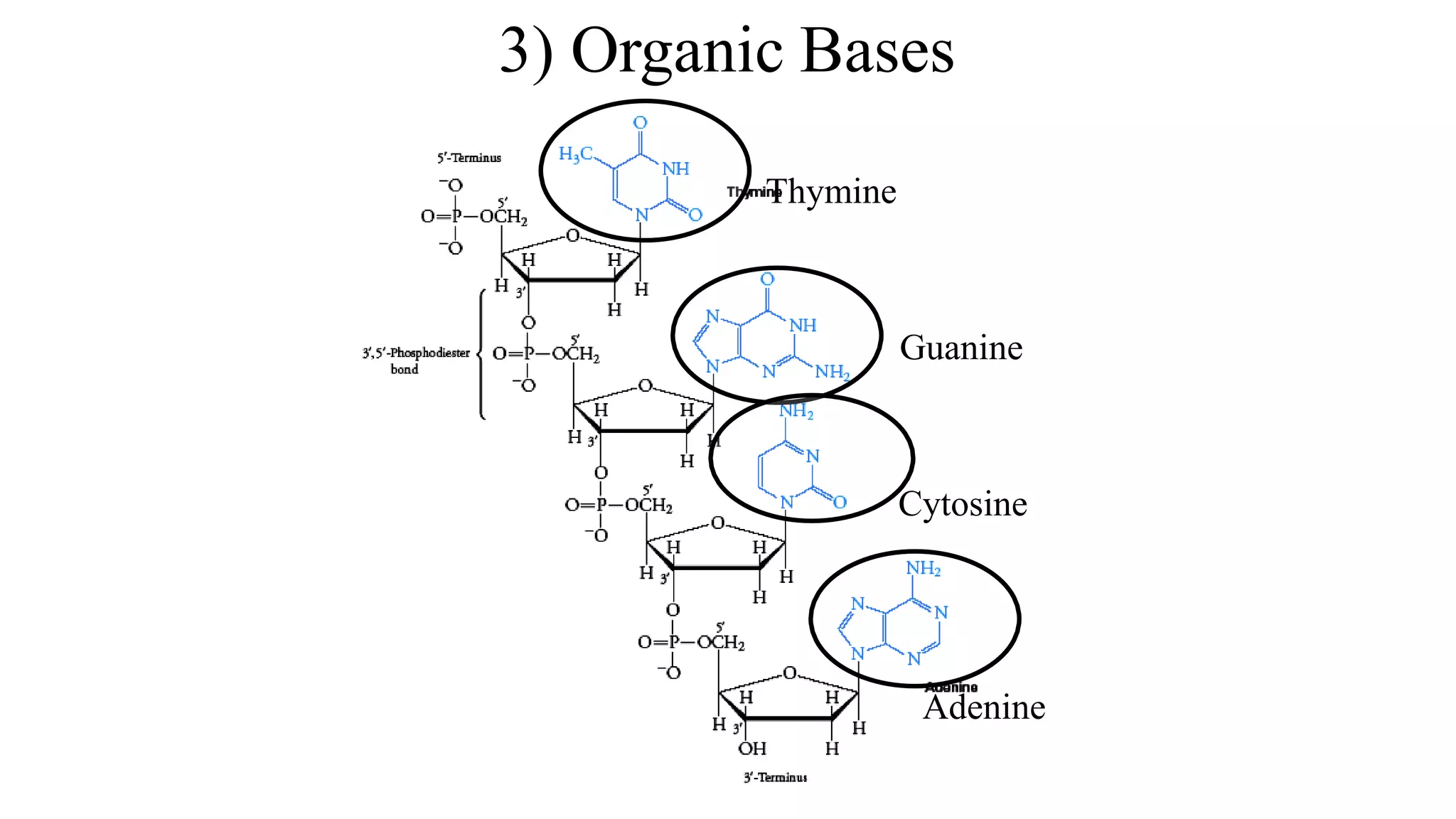
3) Organic Bases
Thymine
Guanine
Cytosine
Adenine
Organic Bases
There are two types of organic bases (amines)
that are incorporated into nucleic acids:
1) purines
2) pyrimidines
Organic Bases
2) pyrimidines
U
Nucleosides
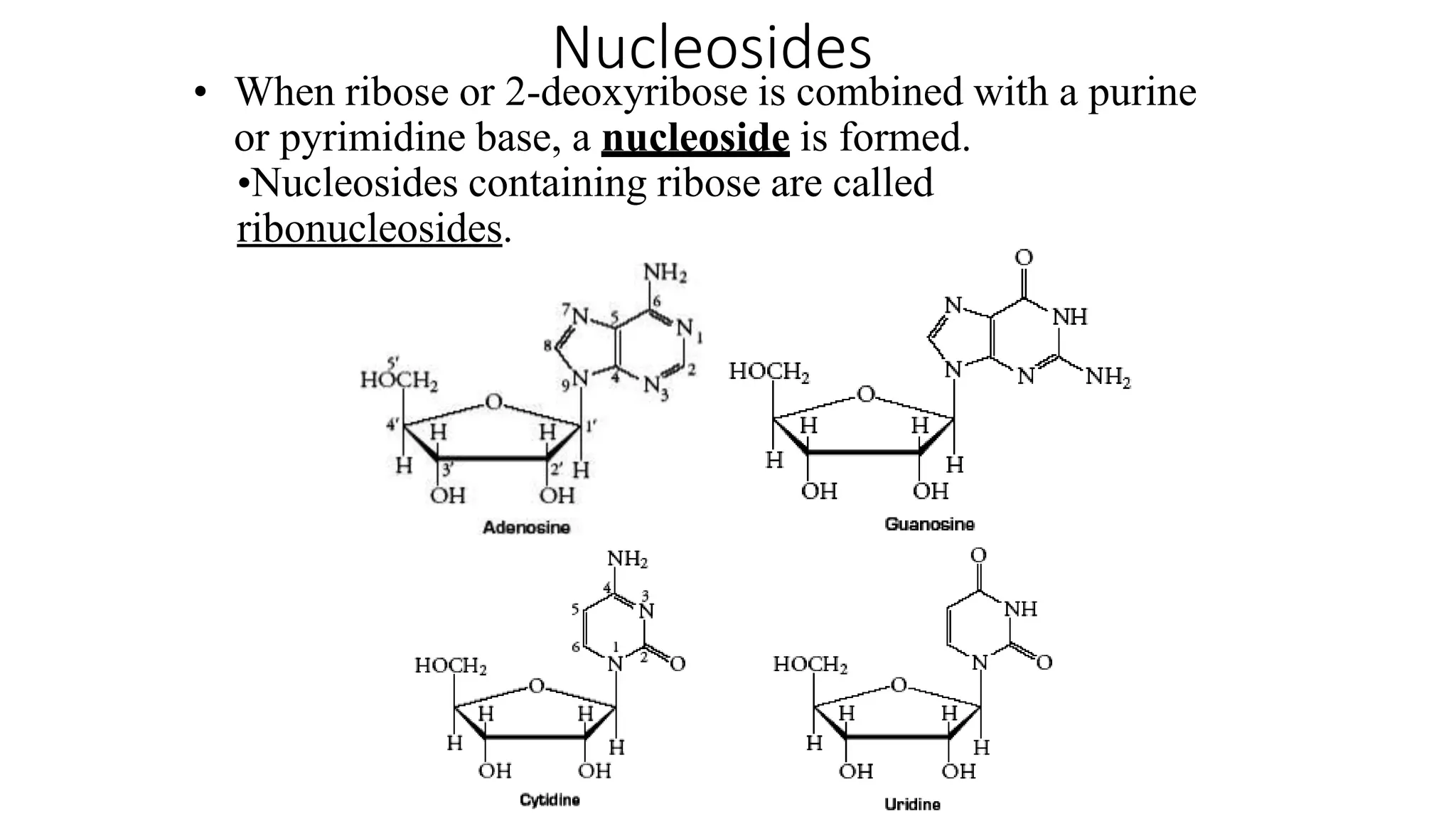
• When ribose or 2-deoxyribose is combined with a purine
or pyrimidine base, a nucleoside is formed.
•Nucleosides containing ribose are called
ribonucleosides.
Nucleosides
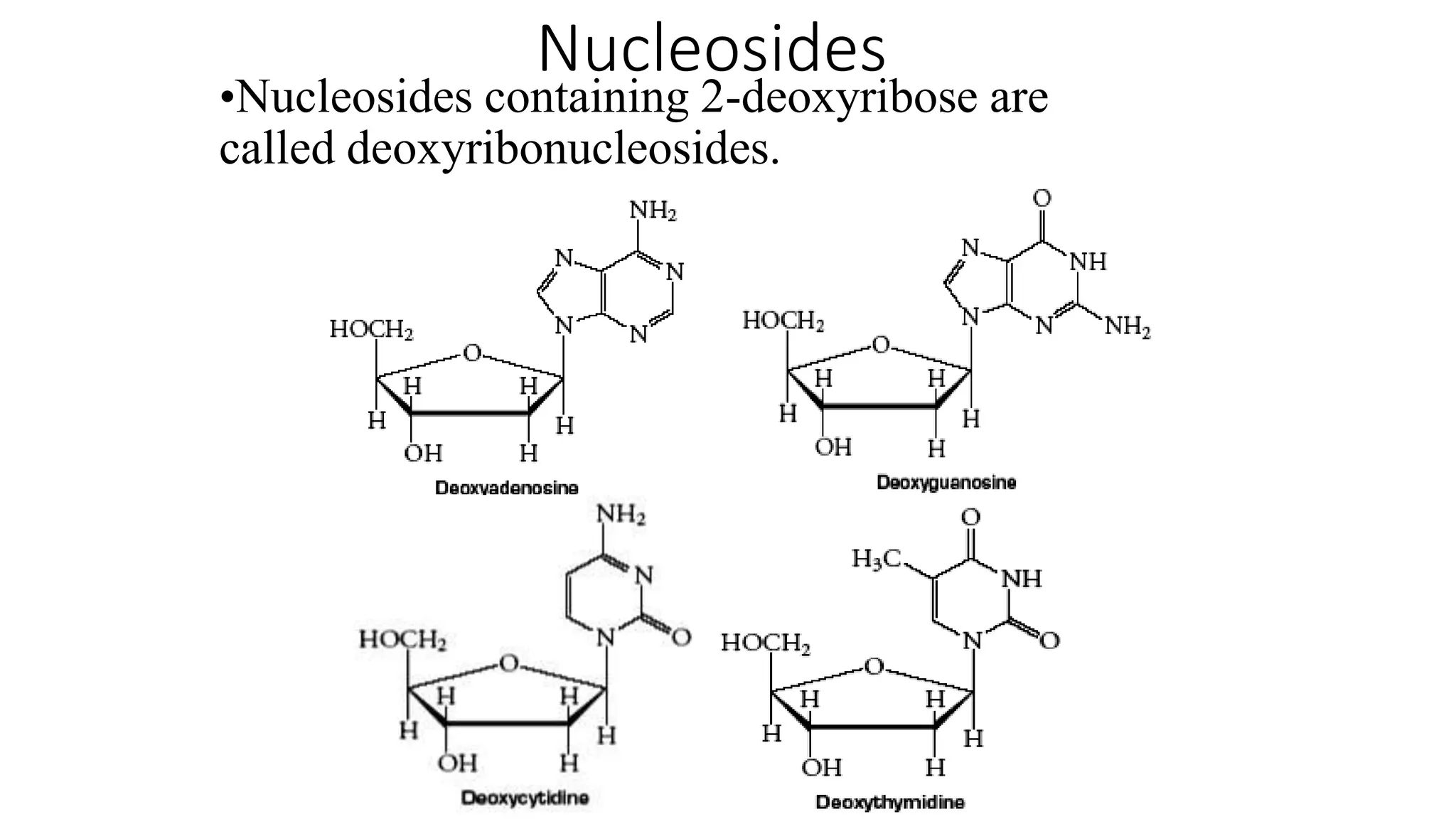
•Nucleosides containing 2-deoxyribose are
called deoxyribonucleosides.
Nucleosides
2’ Oxy 2’ Deoxy
Purine, pyrimidine and nucleotide analogs / Synthetic
Nucleotide Analogs
It is possible to alter heterocyclic ring or sugar moiety, and produce synthetic analogs
of purines, pyrimidines, nucleosides and nucleotides. Some of the synthetic analogs
are highly useful in clinical medicine. The structures of selected purine and pyrimidine
analogs are given in Fig.5.7.
The pharmacological applications of certain analogs are listed below
1. Allopurinol is used in the treatment of hyperuricemia and gout.
2. 5-Fluorouracil, 6-mercaptopurine, 8-azaguanine, 3-deoxyuridine, 5-or 6-
azauridine, 5-or 6-azacytidine and 5-idouracil are employed in the treatment of
cancers. These compounds get incorporated into DNA and block cell proliferation.
3. Azathioprine (which gets degraded to 6-mercaptopurine) is used to suppress
immunological rejection during transplantation.
4. Arabinosyladenine is used for the treatment of neurological disease, viral
encephalitis.
5. Arabinosylcytosine is being used in cancer therapy as it interferes with DNA
replication.
6. The drugs employed in the treatment of AIDS namely zidovudine or AZT (3- azido
2′,3′-dideoxythymidine) and didanosine (dideoxyinosine) are sugar modified synthetic
nucleotide analogs.
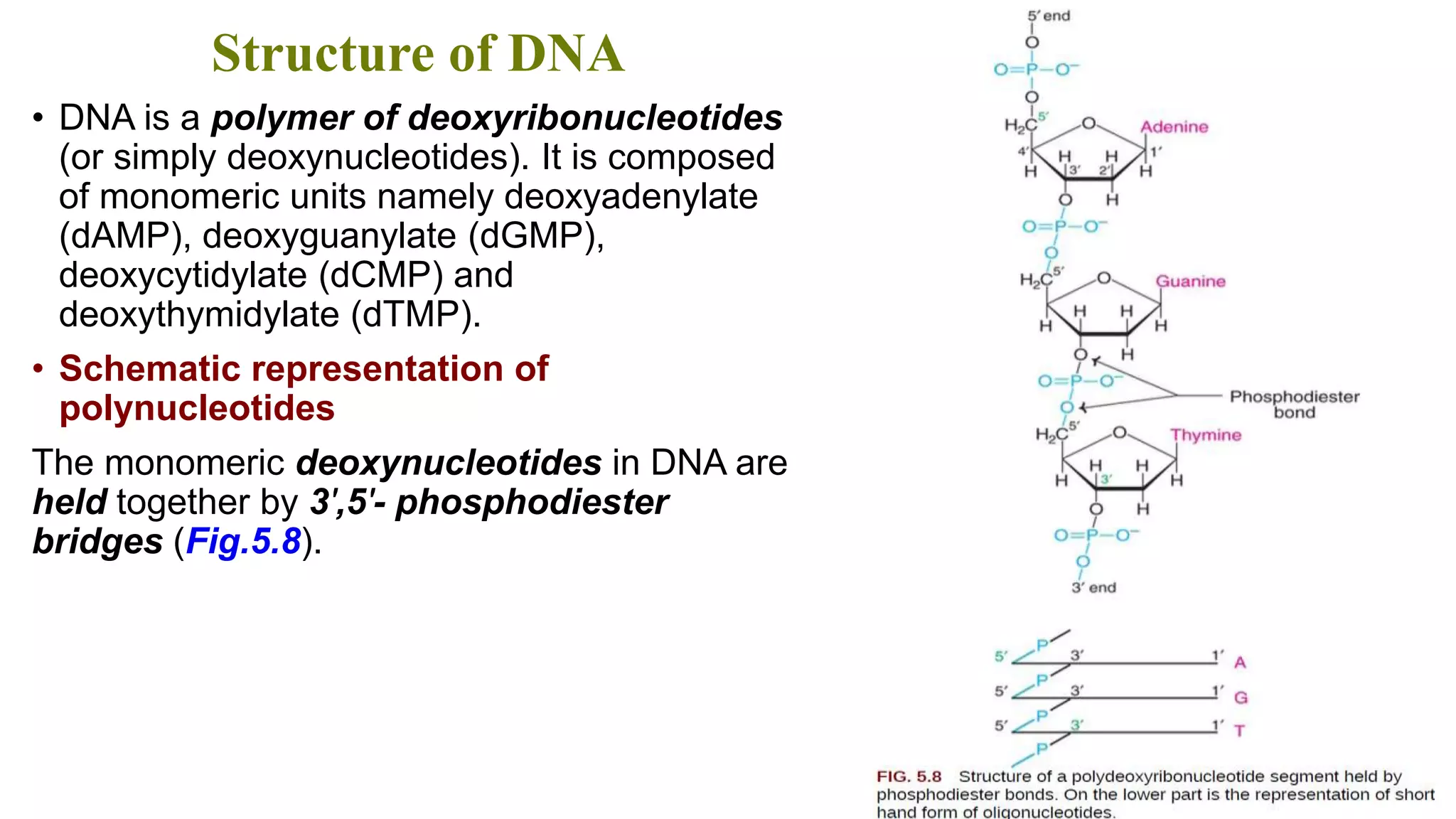
Structure of DNA
• DNA is a polymer of deoxyribonucleotides
(or simply deoxynucleotides). It is composed
of monomeric units namely deoxyadenylate
(dAMP), deoxyguanylate (dGMP),
deoxycytidylate (dCMP) and
deoxythymidylate (dTMP).
• Schematic representation of
polynucleotides
The monomeric deoxynucleotides in DNA are
held together by 3′,5′- phosphodiester
bridges (Fig.5.8).
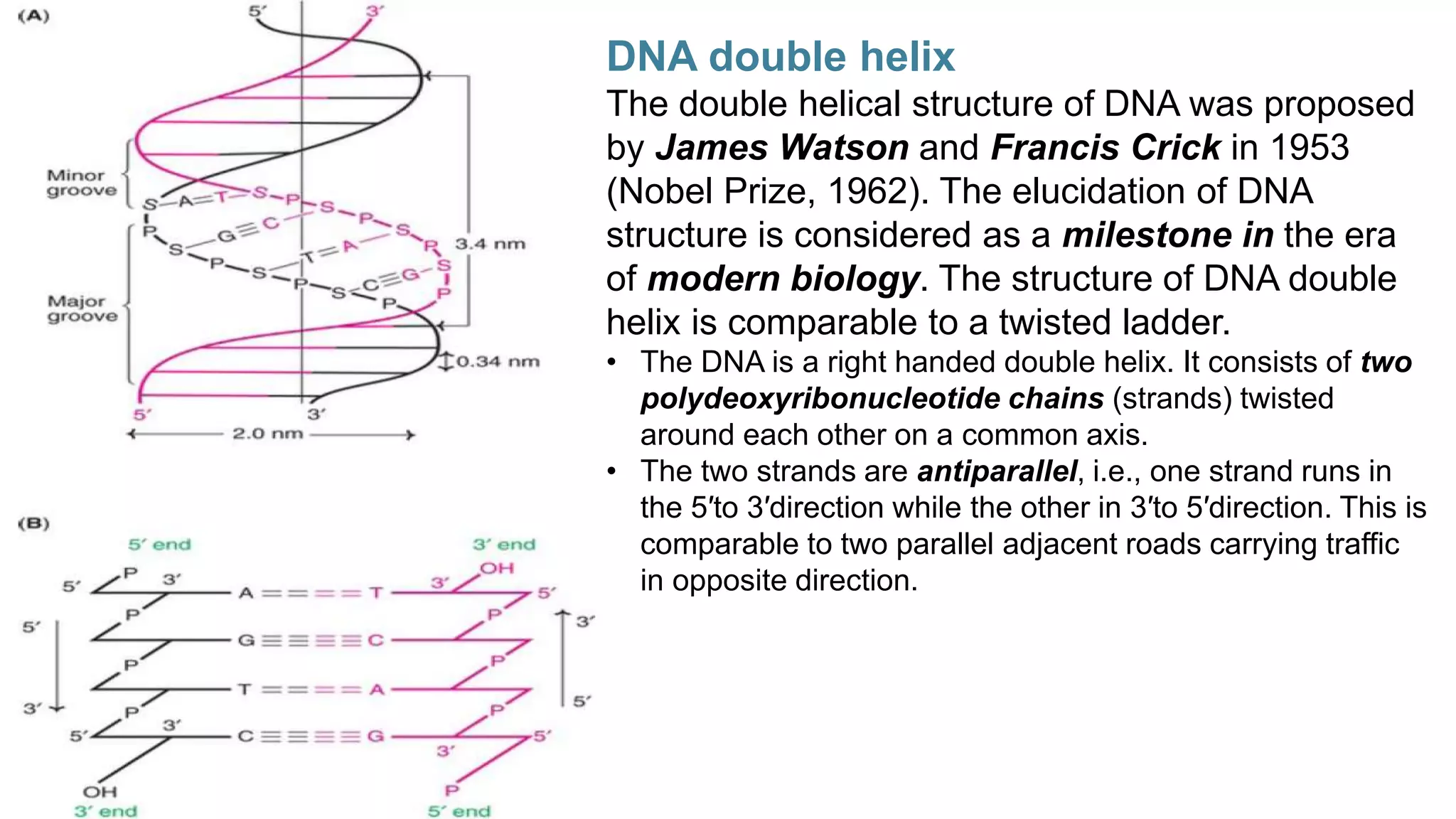
DNA double helix
The double helical structure of DNA was proposed
by James Watson and Francis Crick in 1953
(Nobel Prize, 1962). The elucidation of DNA
structure is considered as a milestone in the era
of modern biology. The structure of DNA double
helix is comparable to a twisted ladder.
• The DNA is a right handed double helix. It consists of two
polydeoxyribonucleotide chains (strands) twisted
around each other on a common axis.
• The two strands are antiparallel, i.e., one strand runs in
the 5′to 3′direction while the other in 3′to 5′direction. This is
comparable to two parallel adjacent roads carrying traffic
in opposite direction.
Structure of RNA
• RNA is a polymer of ribonucleotides held together by 3′,5′-phosphodiester bridges. Although RNA has certain
similarities with DNA structure, they have specific differences
1. Pentose : The sugar in RNA is ribose in contrast to deoxyribose in DNA.
2. Pyrimidine : RNA contains the pyrimidine uracil in place of thymine (in DNA).
3. Single strand : RNA is usually a singlestranded polynucleotide. However, this strand may fold at certain places
to give a doublestranded structure, if complementary base pairs are in close proximity.
• Types of RNA
• The three major types of RNAs with their respective cellular composition are given below
1. Messenger RNA (mRNA) : 5–10%
2. Transfer RNA (tRNA) : 10–20%
3. Ribosomal RNA (rRNA) : 50–80%
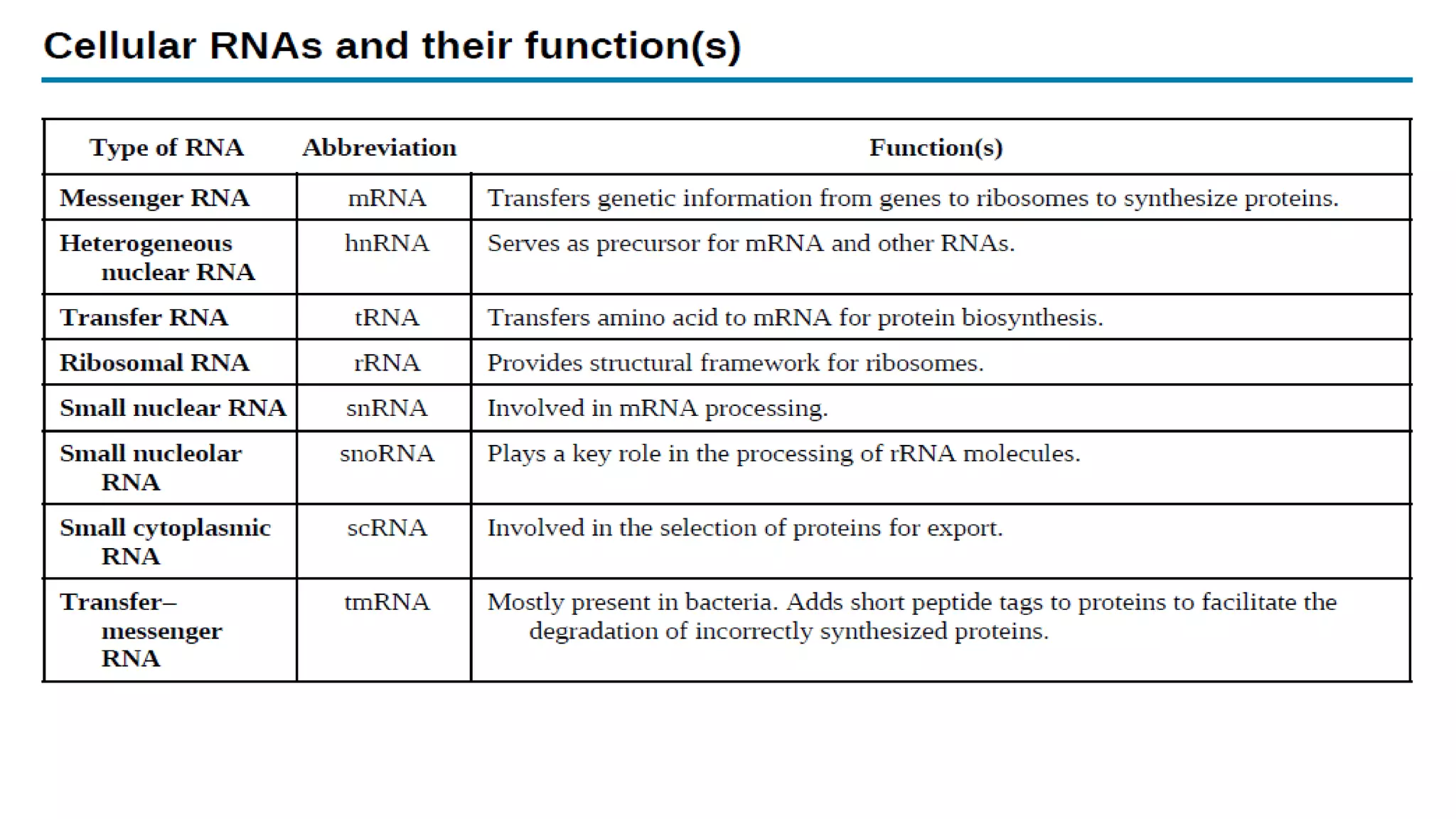
• Besides the three RNAs referred above, other RNAs are also present in the cells. These include heterogeneous
nuclear RNA (hnRNA), small nuclear RNA (snRNA), small nucleolar RNA (snoRNA) and small cytoplasmic RNA
(scRNA).
• DNA is often called the blueprint for life
because it contains all of the information
necessary for making the proteins required
by living things.
• This information is carried in the primary
structure of DNA.
• To pass the information stored in DNA to a
new generation of cells, DNA replication
must take place.
DNA Replication
DNA Replication
• When DNA is replicated, each strand of the double
helix serves as a template for the manufacture of a
new strand of DNA.
• In each of the daughter DNA
strands, one strand from the
parent DNA is present.
• This is called
semiconservative replication.
• The production of new DNA is
carried out by enzymes called DNA
polymerases.
• DNA polymerase catalyzes the
addition of deoxyribonucleotide
residues to a growing DNA strand.
DNA Replication
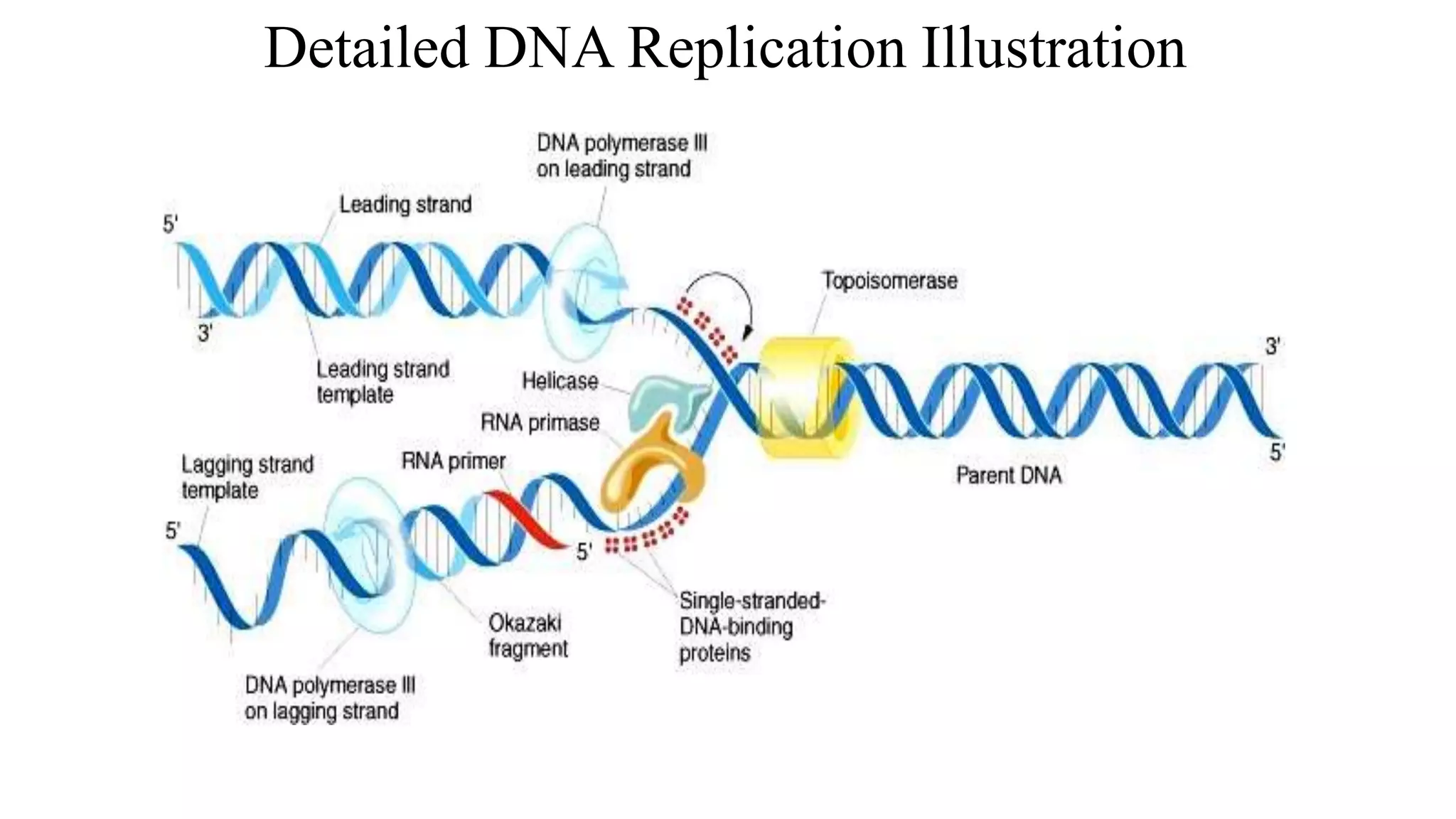
Detailed DNA Replication Illustration
Bond Formation DNA Replication
The following three processes are involved in
duplication, transfer, and use of genetic information:
1) Replication: The process by which a replica, or
identical copy, of DNA is made when a cell divides.
Replication
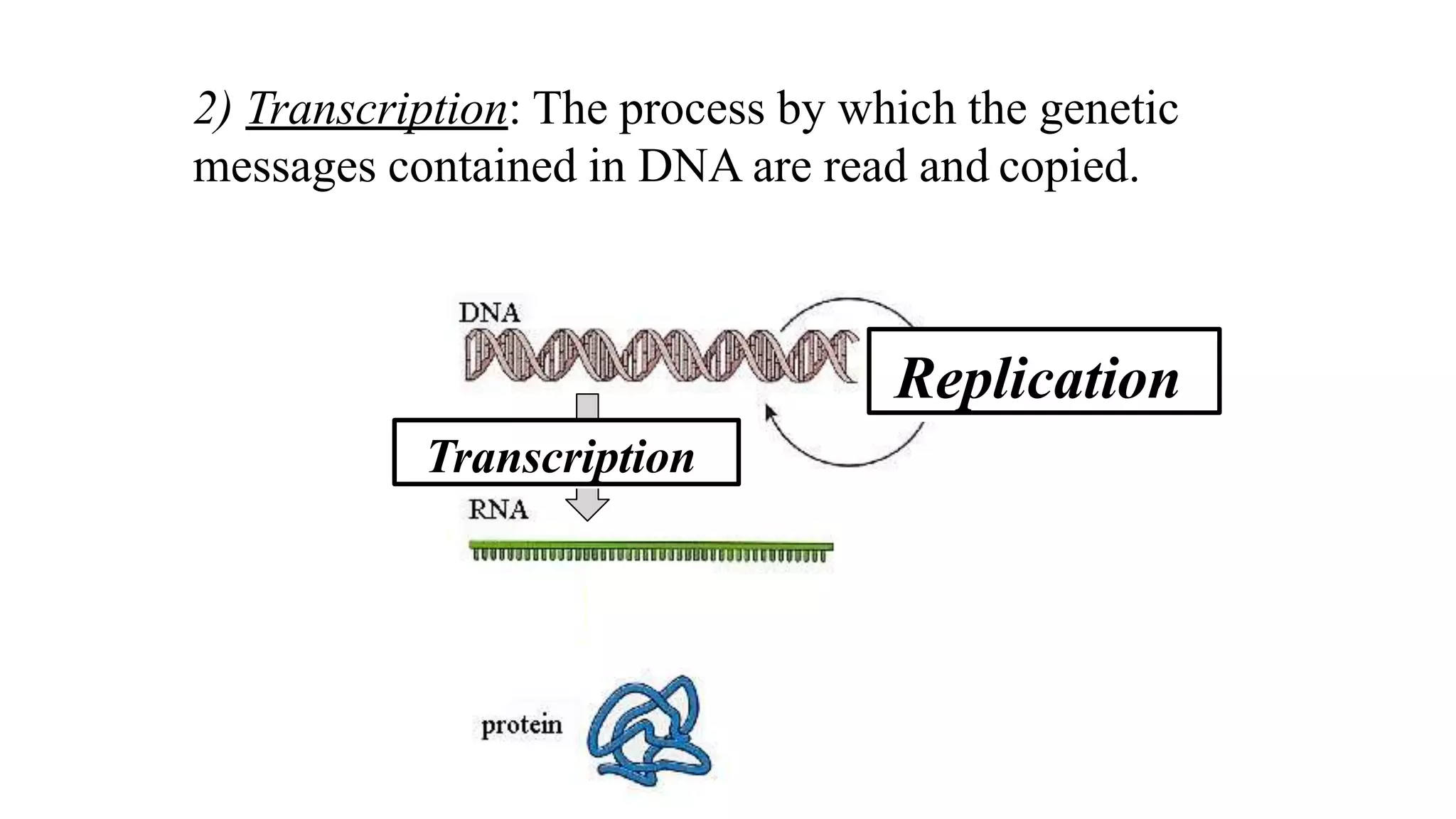
2) Transcription: The process by which the genetic
messages contained in DNA are read and copied.
Replication
Transcription
3) Translation: The process by which the genetic
messages carried by RNA are decoded and used to
build proteins.
Replication
Transcription
Translation

Nucleic acid and Nucleotide By BNP.pptx

  • 1.
    Nucleic acid andNucleotide By Mr. Biswanath prusty Assistant professor
  • 2.
    • There aretwo types of nucleic acids, namely deoxyribonucleic acid (DNA) and ribonucleic acid (RNA). Primarily, nucleic acids serve as repositories and transmitters of genetic information. • DNA was discovered in 1869 by Johann Friedrich Miescher, a Swiss researcher. The demonstration that DNA contained genetic information was first made in 1944, by Avery, Macleod and MacCary. • Functions of nucleic acids • DNA is the chemical basis of heredity and may be regarded as the reserve bank of genetic information. DNA is exclusively responsible for maintaining the identity of different species of organisms over millions of years. • Components of nucleic acids • Nucleic acids are the polymers of nucleotides (polynucleotides) held by 3′and 5′phosphate bridges. In other words, nucleic acids are built up by the monomeric units—nucleotides (It may be recalled that protein is a polymer of amino acids). • Nucleotides • Nucleotides are composed of a nitrogenous base, a pentose sugar and a phosphate. Nucleotides perform a wide variety of functions in the living cells, besides being the building blocks or monomeric units in the nucleic acid (DNA and RNA) structure.
  • 3.
    • Composition ofNucleotides • A nucleotide is made up of 3 components: • a. Nitrogenous base (a purine or a pyrimidine) • b. Pentose sugar, either ribose or deoxyribose • c. Phosphate groups esterified to the sugar. • When a base combines with a pentose sugar, a nucleoside is formed. • When the nucleoside is esterified to a phosphate group, it is called a nucleotide or nucleoside monophosphate. When a second phosphate gets esterified to the existing phosphate group, a nucleoside diphosphate is generated.
  • 4.
    •Nucleic acids arepolymers that consist of nucleotide residues. •Each nucleotide is put together from three building blocks: 1) phosphoric acid 2) a monosaccharide 3) an organic base
  • 5.
  • 6.
    2) Monosaccharides All nucleotidesare constructed from one of these two monosaccharides:
  • 7.
  • 8.
    Organic Bases There aretwo types of organic bases (amines) that are incorporated into nucleic acids: 1) purines 2) pyrimidines
  • 9.
  • 10.
    Nucleosides • When riboseor 2-deoxyribose is combined with a purine or pyrimidine base, a nucleoside is formed. •Nucleosides containing ribose are called ribonucleosides.
  • 11.
  • 12.
  • 13.
    Purine, pyrimidine andnucleotide analogs / Synthetic Nucleotide Analogs It is possible to alter heterocyclic ring or sugar moiety, and produce synthetic analogs of purines, pyrimidines, nucleosides and nucleotides. Some of the synthetic analogs are highly useful in clinical medicine. The structures of selected purine and pyrimidine analogs are given in Fig.5.7.
  • 14.
    The pharmacological applicationsof certain analogs are listed below 1. Allopurinol is used in the treatment of hyperuricemia and gout. 2. 5-Fluorouracil, 6-mercaptopurine, 8-azaguanine, 3-deoxyuridine, 5-or 6- azauridine, 5-or 6-azacytidine and 5-idouracil are employed in the treatment of cancers. These compounds get incorporated into DNA and block cell proliferation. 3. Azathioprine (which gets degraded to 6-mercaptopurine) is used to suppress immunological rejection during transplantation. 4. Arabinosyladenine is used for the treatment of neurological disease, viral encephalitis. 5. Arabinosylcytosine is being used in cancer therapy as it interferes with DNA replication. 6. The drugs employed in the treatment of AIDS namely zidovudine or AZT (3- azido 2′,3′-dideoxythymidine) and didanosine (dideoxyinosine) are sugar modified synthetic nucleotide analogs.
  • 17.
    Structure of DNA •DNA is a polymer of deoxyribonucleotides (or simply deoxynucleotides). It is composed of monomeric units namely deoxyadenylate (dAMP), deoxyguanylate (dGMP), deoxycytidylate (dCMP) and deoxythymidylate (dTMP). • Schematic representation of polynucleotides The monomeric deoxynucleotides in DNA are held together by 3′,5′- phosphodiester bridges (Fig.5.8).
  • 18.
    DNA double helix Thedouble helical structure of DNA was proposed by James Watson and Francis Crick in 1953 (Nobel Prize, 1962). The elucidation of DNA structure is considered as a milestone in the era of modern biology. The structure of DNA double helix is comparable to a twisted ladder. • The DNA is a right handed double helix. It consists of two polydeoxyribonucleotide chains (strands) twisted around each other on a common axis. • The two strands are antiparallel, i.e., one strand runs in the 5′to 3′direction while the other in 3′to 5′direction. This is comparable to two parallel adjacent roads carrying traffic in opposite direction.
  • 19.
    Structure of RNA •RNA is a polymer of ribonucleotides held together by 3′,5′-phosphodiester bridges. Although RNA has certain similarities with DNA structure, they have specific differences 1. Pentose : The sugar in RNA is ribose in contrast to deoxyribose in DNA. 2. Pyrimidine : RNA contains the pyrimidine uracil in place of thymine (in DNA). 3. Single strand : RNA is usually a singlestranded polynucleotide. However, this strand may fold at certain places to give a doublestranded structure, if complementary base pairs are in close proximity. • Types of RNA • The three major types of RNAs with their respective cellular composition are given below 1. Messenger RNA (mRNA) : 5–10% 2. Transfer RNA (tRNA) : 10–20% 3. Ribosomal RNA (rRNA) : 50–80% • Besides the three RNAs referred above, other RNAs are also present in the cells. These include heterogeneous nuclear RNA (hnRNA), small nuclear RNA (snRNA), small nucleolar RNA (snoRNA) and small cytoplasmic RNA (scRNA).
  • 21.
    • DNA isoften called the blueprint for life because it contains all of the information necessary for making the proteins required by living things. • This information is carried in the primary structure of DNA. • To pass the information stored in DNA to a new generation of cells, DNA replication must take place. DNA Replication
  • 22.
    DNA Replication • WhenDNA is replicated, each strand of the double helix serves as a template for the manufacture of a new strand of DNA. • In each of the daughter DNA strands, one strand from the parent DNA is present. • This is called semiconservative replication.
  • 23.
    • The productionof new DNA is carried out by enzymes called DNA polymerases. • DNA polymerase catalyzes the addition of deoxyribonucleotide residues to a growing DNA strand. DNA Replication
  • 25.
  • 26.
    Bond Formation DNAReplication
  • 28.
    The following threeprocesses are involved in duplication, transfer, and use of genetic information: 1) Replication: The process by which a replica, or identical copy, of DNA is made when a cell divides. Replication
  • 29.
    2) Transcription: Theprocess by which the genetic messages contained in DNA are read and copied. Replication Transcription
  • 30.
    3) Translation: Theprocess by which the genetic messages carried by RNA are decoded and used to build proteins. Replication Transcription Translation