Education And Training
Program In The Hospital
By
Mr. Biswanath prusty
Assistant professor
PHARMACY PRACTICE
It is scientific process of improving the knowledgeand
skills of employee for doing a particular job.
The main purpose of training is to mould the behaviourof
new recruits so that they can do their job in a more
efficient way
In hospitals education and training activity includes
undergraduate and graduate programme in medicine,
teaching student nurses, training of technologist,
physiotherapist, dietician, administrative residents, social
service worker and pharmacist
1 Introduction
2 Education and training
There are many reasons why it is essential to examine education when
striving for safer primary care. Key reasons include:
• providing education about the core principles of primary care to all
health care providers creates a foundation of values upon which to
develop a positive safety culture;
• having an adequate and well-trained primary care health workforce
is essential for providing safe, high quality care;
• educating the workforce about safety skills has the potential to
further improve patient outcomes.
Primary care is guided by eight core principles:
➢ access or first-contact care;
➢ comprehensiveness;
➢ continuity of care;
➢ coordination;
➢ prevention;
➢ family orientation;
➢ community orientation;
➢ and person-centredness
Types of education
This section briefly outlines various types of education for providers
and why they are important. It is important to review what type of
education is available and identify any gaps in provision.
The main types of education that may support safer primary care
include:
• undergraduate and postgraduate pre-service education for trainee
providers;
• in-service education programmes for practising providers;
• patient education and awareness raising.
This monograph covers the education of providers, but it
acknowledges that the education and awareness raising of patients as
key members of care teams are equally important.
1. Offering continuous education CE programs to pharmacist,
physicians, nurses.
2. Training pharmacy students (internship).
3. Providing residency programs.
4. Hospital pharmacists may participate in research conducted in the
hospital.
5. Publishing newsletters accessible to staff & public.
Role of Pharmacist
Educating the medical and allied health professional aswell as
the patients
Participate in education program related to different need area
such as psychiatric, physical, rehabilitation, special
education program like diabetic or cardiac patient
Involve in education of student nurses, training of graduate
nurses, undergraduate as well as graduate pharmacy student
or students in hospital pharmacy programmes
Involve in internal and external teaching activity
Educate general public through lecture or demonstration
about the rational use of drugs and their dosages
3
Internal Teaching Programme
Training of students nurses
Seminar for graduate nurses, house staff and nursing
staff
Training undergraduate students in hospital pharmacy
Patient teaching programme
Training clinical pharmacist
Training residents in hospital administration
Teaching of Attendants.
4
External Teaching Programme
Any teaching activity performed by pharmacist outside the
hospital
Participation in seminar, refresher course
Participation in activities of nursing, dietary, oxygen therapyand
medical technology
Preparation of manuscript for publication in professional article.
Obtain various grant-in-aid to support research in drug
distribution techniques or prescription techniques
Participate in educational activities organized during and a
session of professional bodies such as Indian Pharmaceutical
congress
Community health education and training.
5
Content of pharmaceutical education
• Pharmacy professoin must serve needs of society and individual
patient through the world.
• Pharmacy profession plays main role in discovery, development
production and distribution of drug products and in the creation
dissemination of related knowledge.
• In addition pharmacist are involved in direct patient care and are
taking resposibility for the resolution of drug therapy problems of
individuals.
Education and training division
1. Coordinate programs of undergraduate and graduate pharmacy
student.
2. Participate in hospitals- wide educational programs involving
nurses, doctors, etc.
3. Train newly employed pharmacy department personnel.
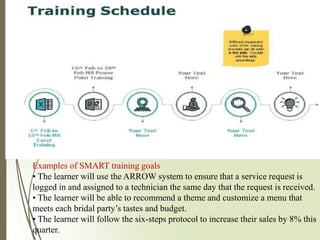
Examples of SMART training goals
• The learner will use the ARROW system to ensure that a service request is
logged in and assigned to a technician the same day that the request is received.
• The learner will be able to recommend a theme and customize a menu that
meets each bridal party’s tastes and budget.
• The learner will follow the six-steps protocol to increase their sales by 8% this
quarter.
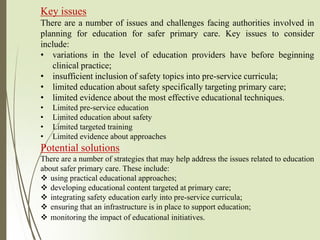
Key issues
There are a number of issues and challenges facing authorities involved in
planning for education for safer primary care. Key issues to consider
include:
• variations in the level of education providers have before beginning
clinical practice;
• insufficient inclusion of safety topics into pre-service curricula;
• limited education about safety specifically targeting primary care;
• limited evidence about the most effective educational techniques.
• Limited pre-service education
• Limited education about safety
• Limited targeted training
• Limited evidence about approaches
Potential solutions
There are a number of strategies that may help address the issues related to education
about safer primary care. These include:
❖ using practical educational approaches;
❖ developing educational content targeted at primary care;
❖ integrating safety education early into pre-service curricula;
❖ ensuring that an infrastructure is in place to support education;
❖ monitoring the impact of educational initiatives.
The code defines and seeks to clarify the obligations of
pharmacist to use their own knowledge and skills for the
benefit of others, to minimize harm, to respect patient
autonomy and to provide fair and just pharmacy care for their
patients
For those entering the profession, the code identifies the basic
moral commitments of pharmacy care and serves as a source
for education and reflection
Professional ethics are defined as rules of “conduct or
standards by which a professional community regulates its
actions and sets standards for its members”
6 Code of Ethics for Community
Pharmacy
Code of Ethics Principle
Principles 1 –Pharmacists respect the professional
relationship with the patient and acts with honesty,
integrity and compassion.
Principle 2. Pharmacists honor the individual need
values and dignity of the patient
Principle 3- Pharmacists support the right of the patient of
make personal choices about pharmacy care
Principle 4- Pharmacist provide a complete care to the
patients and actively supports the patients right to receive
competent and ethical care
7
Principle 5- Pharmacists protects the patients
right of confidentiality
Principle 6- Pharmacists respect the values and abilities of
the colleagues and other health professionals
Principle 7- Pharmacists Endeavour to ensure that the
practice environment contributes to safe and effective
pharmacy care
Principle 8- Pharmacists ensure continuity of care i
n the
event of job action, pharmacy closure or conflict with
moral benefits
8
Advantages of code of ethics
The code provide clear direction for avoiding ethical
violations
The code tries to provide guidance for those pharmacists
who face ethical problems
Fair price structure.
Far trade practice
Purchase of drugs
Hawking of drugs ( self-service)
Advertising and displays.
9
Role of pharmacist in interdepartmental
communication
Departmental administration
Interdepartmental activity
Inpatient drug distribution and control
Ambulatory patient services
Clinical services
Drug information services
Education and training
Technology and quality control activity
10
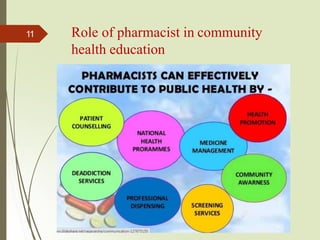
Role of pharmacist in community
health education
Dr. Subhash R. Yende, GNCP, Nagpur
11
• Needed facilities-
We require 500 square feet area to setup training program classes in the
hospital.
Complete training session equipments like projector, laptop, highspeed
internet with computer
• Spacious two halls with separate ladies teaching facilities.
• Transportation facilities for students/ employees.
• Nearby cafeteria for our allocated building.
Medical Education, Training & Research Working committees
1. Medical Council of India (MCI)
2. Dental Council of India (DCI)
3. Schemes for Medical Education
4. Pharmacy Council of India (PCI)
5. Development of Allied Health Science
6. Indian Nursing Council
7. Development of Nursing Services
8. Rajkumari Amrit Kaur (RAK), College of Nursing, New Delhi
9. All India Pre-Medical/Pre-Dental (UG) Examination
10. All India Post Graduate Medical Entrance Examination
11. All India Post Graduate Dental Entrance Examination
12. Allocation of Medical/Dental Seats from Central Pool
13. National Board of Examinations (NBE)
14. National Academy of Medical Sciences, New Delhi
15. All India Institute of Medical Sciences (AIIMS), New Delhi
16. Jawaharlal Institute of Postgraduate Medical Education & Research (JIPMER), Puducherry
17. Postgraduate Institute of Medical Education and Research (PGIMER), Chandigarh
18. Lady Hardinge Medical College& Smt. S.K. Hospital, New Delhi
19. Kalawati Saran Children’s Hospital, New Delhi
20. Mahatma Gandhi Institute of Medical Sciences, Sevagram, Maharashtra
21. National Centre for Disease Control (NCDC), New Delhi
22. Lady Reading Health School, Delhi
23. Pasteur Institute of India (PII), Coonoor

Education & training program in the hospital by BNP.pdf

  • 1.
    Education And Training ProgramIn The Hospital By Mr. Biswanath prusty Assistant professor PHARMACY PRACTICE
  • 2.
    It is scientificprocess of improving the knowledgeand skills of employee for doing a particular job. The main purpose of training is to mould the behaviourof new recruits so that they can do their job in a more efficient way In hospitals education and training activity includes undergraduate and graduate programme in medicine, teaching student nurses, training of technologist, physiotherapist, dietician, administrative residents, social service worker and pharmacist 1 Introduction
  • 3.
    2 Education andtraining There are many reasons why it is essential to examine education when striving for safer primary care. Key reasons include: • providing education about the core principles of primary care to all health care providers creates a foundation of values upon which to develop a positive safety culture; • having an adequate and well-trained primary care health workforce is essential for providing safe, high quality care; • educating the workforce about safety skills has the potential to further improve patient outcomes. Primary care is guided by eight core principles: ➢ access or first-contact care; ➢ comprehensiveness; ➢ continuity of care; ➢ coordination; ➢ prevention; ➢ family orientation; ➢ community orientation; ➢ and person-centredness
  • 4.
    Types of education Thissection briefly outlines various types of education for providers and why they are important. It is important to review what type of education is available and identify any gaps in provision. The main types of education that may support safer primary care include: • undergraduate and postgraduate pre-service education for trainee providers; • in-service education programmes for practising providers; • patient education and awareness raising. This monograph covers the education of providers, but it acknowledges that the education and awareness raising of patients as key members of care teams are equally important. 1. Offering continuous education CE programs to pharmacist, physicians, nurses. 2. Training pharmacy students (internship). 3. Providing residency programs. 4. Hospital pharmacists may participate in research conducted in the hospital. 5. Publishing newsletters accessible to staff & public.
  • 5.
    Role of Pharmacist Educatingthe medical and allied health professional aswell as the patients Participate in education program related to different need area such as psychiatric, physical, rehabilitation, special education program like diabetic or cardiac patient Involve in education of student nurses, training of graduate nurses, undergraduate as well as graduate pharmacy student or students in hospital pharmacy programmes Involve in internal and external teaching activity Educate general public through lecture or demonstration about the rational use of drugs and their dosages 3
  • 6.
    Internal Teaching Programme Trainingof students nurses Seminar for graduate nurses, house staff and nursing staff Training undergraduate students in hospital pharmacy Patient teaching programme Training clinical pharmacist Training residents in hospital administration Teaching of Attendants. 4
  • 7.
    External Teaching Programme Anyteaching activity performed by pharmacist outside the hospital Participation in seminar, refresher course Participation in activities of nursing, dietary, oxygen therapyand medical technology Preparation of manuscript for publication in professional article. Obtain various grant-in-aid to support research in drug distribution techniques or prescription techniques Participate in educational activities organized during and a session of professional bodies such as Indian Pharmaceutical congress Community health education and training. 5
  • 8.
    Content of pharmaceuticaleducation • Pharmacy professoin must serve needs of society and individual patient through the world. • Pharmacy profession plays main role in discovery, development production and distribution of drug products and in the creation dissemination of related knowledge. • In addition pharmacist are involved in direct patient care and are taking resposibility for the resolution of drug therapy problems of individuals. Education and training division 1. Coordinate programs of undergraduate and graduate pharmacy student. 2. Participate in hospitals- wide educational programs involving nurses, doctors, etc. 3. Train newly employed pharmacy department personnel.
  • 11.
    Examples of SMARTtraining goals • The learner will use the ARROW system to ensure that a service request is logged in and assigned to a technician the same day that the request is received. • The learner will be able to recommend a theme and customize a menu that meets each bridal party’s tastes and budget. • The learner will follow the six-steps protocol to increase their sales by 8% this quarter.
  • 12.
    Key issues There area number of issues and challenges facing authorities involved in planning for education for safer primary care. Key issues to consider include: • variations in the level of education providers have before beginning clinical practice; • insufficient inclusion of safety topics into pre-service curricula; • limited education about safety specifically targeting primary care; • limited evidence about the most effective educational techniques. • Limited pre-service education • Limited education about safety • Limited targeted training • Limited evidence about approaches Potential solutions There are a number of strategies that may help address the issues related to education about safer primary care. These include: ❖ using practical educational approaches; ❖ developing educational content targeted at primary care; ❖ integrating safety education early into pre-service curricula; ❖ ensuring that an infrastructure is in place to support education; ❖ monitoring the impact of educational initiatives.
  • 13.
    The code definesand seeks to clarify the obligations of pharmacist to use their own knowledge and skills for the benefit of others, to minimize harm, to respect patient autonomy and to provide fair and just pharmacy care for their patients For those entering the profession, the code identifies the basic moral commitments of pharmacy care and serves as a source for education and reflection Professional ethics are defined as rules of “conduct or standards by which a professional community regulates its actions and sets standards for its members” 6 Code of Ethics for Community Pharmacy
  • 14.
    Code of EthicsPrinciple Principles 1 –Pharmacists respect the professional relationship with the patient and acts with honesty, integrity and compassion. Principle 2. Pharmacists honor the individual need values and dignity of the patient Principle 3- Pharmacists support the right of the patient of make personal choices about pharmacy care Principle 4- Pharmacist provide a complete care to the patients and actively supports the patients right to receive competent and ethical care 7
  • 15.
    Principle 5- Pharmacistsprotects the patients right of confidentiality Principle 6- Pharmacists respect the values and abilities of the colleagues and other health professionals Principle 7- Pharmacists Endeavour to ensure that the practice environment contributes to safe and effective pharmacy care Principle 8- Pharmacists ensure continuity of care i n the event of job action, pharmacy closure or conflict with moral benefits 8
  • 16.
    Advantages of codeof ethics The code provide clear direction for avoiding ethical violations The code tries to provide guidance for those pharmacists who face ethical problems Fair price structure. Far trade practice Purchase of drugs Hawking of drugs ( self-service) Advertising and displays. 9
  • 17.
    Role of pharmacistin interdepartmental communication Departmental administration Interdepartmental activity Inpatient drug distribution and control Ambulatory patient services Clinical services Drug information services Education and training Technology and quality control activity 10
  • 18.
    Role of pharmacistin community health education Dr. Subhash R. Yende, GNCP, Nagpur 11
  • 19.
    • Needed facilities- Werequire 500 square feet area to setup training program classes in the hospital. Complete training session equipments like projector, laptop, highspeed internet with computer • Spacious two halls with separate ladies teaching facilities. • Transportation facilities for students/ employees. • Nearby cafeteria for our allocated building.
  • 20.
    Medical Education, Training& Research Working committees 1. Medical Council of India (MCI) 2. Dental Council of India (DCI) 3. Schemes for Medical Education 4. Pharmacy Council of India (PCI) 5. Development of Allied Health Science 6. Indian Nursing Council 7. Development of Nursing Services 8. Rajkumari Amrit Kaur (RAK), College of Nursing, New Delhi 9. All India Pre-Medical/Pre-Dental (UG) Examination 10. All India Post Graduate Medical Entrance Examination 11. All India Post Graduate Dental Entrance Examination 12. Allocation of Medical/Dental Seats from Central Pool 13. National Board of Examinations (NBE) 14. National Academy of Medical Sciences, New Delhi 15. All India Institute of Medical Sciences (AIIMS), New Delhi 16. Jawaharlal Institute of Postgraduate Medical Education & Research (JIPMER), Puducherry 17. Postgraduate Institute of Medical Education and Research (PGIMER), Chandigarh 18. Lady Hardinge Medical College& Smt. S.K. Hospital, New Delhi 19. Kalawati Saran Children’s Hospital, New Delhi 20. Mahatma Gandhi Institute of Medical Sciences, Sevagram, Maharashtra 21. National Centre for Disease Control (NCDC), New Delhi 22. Lady Reading Health School, Delhi 23. Pasteur Institute of India (PII), Coonoor