Nucleotides
Nucleotides are precursors of the nucleic
acids, deoxy-ribonucleic acid (DNA) and
ribonucleic acid (RNA).
Nucleic acids are concerned with the storage
and transfer of genetic information.
The universal currency of energy, namely ATP,
is a nucleotide derivative.
Nucleotides are also components of important
co enzymes like NAD+ and FAD, and metabolic
regulators such as AMP
Composition of Nucleotides
A nucleotide is made up of 3
components:
1.Nitrogenous base, (a purine or a pyrimidine)
2.Pentose sugar, either ribose or deoxyribose;
3.Phosphate groups esterified to the sugar.
When a base combines with a
pentose sugar, a nucleoside is
formed.
Composition of Nucleotides
When the nucleoside is esterified to a
phosphate group, it is called a nucleotide or
nucleoside mono-phosphate.
When a second phosphate gets esterified to
the existing phosphate group, a nucleoside
diphosphate is generated.
The attachment of a 3rd phosphate group
results in the formation of a nucleoside
triphosphate.
The nucleic acids (DNA and RNA) are
polymers of nucleoside monophosphates
Bases Present in the Nucleic Acids
Purine Bases
The purine bases present in RNA and DNA are the
same; adenine (6-amino purine) and guanine (2-
amino, 6-oxypurine). (hypoxanthine, Xanthine and uric
acids are Micro-purine bases <purine Catabolic end
products>)
Bases Present in the Nucleic Acids
Pyrimidine Bases
The pyrimidine bases present in nucleic acids
are cytosine, thymine and uracil.
Cytosine is present in both DNA and RNA.
Thymine is present in DNA and
uracil in RNA.
Nucleosides
Nucleosides are formed when bases are attached
to the pentose sugar
Base and sugar are attached by a beta-N-glycosidic
bond between the 1st carbon of the pentose sugar and
N9 of a purine or N1 of a pyrimidine. (Deoxy
nucleosides are denoted by adding the prefix d-
before the nucleoside).
Nucleosides
Purine Nucleosides bases end with –sine.
Adenine + Ribose → Adenosine
Guanine + Ribose → Guanosine
while pyrimidine nucleosides end with -dine.
Uracil + Ribose → Uridine
Cytosine + Ribose → Cytidine
Uracil combines with ribose (RNA) only
Thymine with deoxy ribose (DNA) only
Nucleotides
These are phosphate esters of nucleosides. Base
plus pentose sugar plus phosphoric acid is a
nucleotide.
The esterification occurs at the 5th or 3rd
hydroxyl
group of the pentose sugar. Most of the nucleoside
phosphates involved in biological function are 5'-
phosphates.
Nucleotides
Nucleoside Diphosphate contains
one high energy bond and
Triphosphates have 2 high energy
bonds.
ATP is the universal energy
currency
Deoxy ribonucleotides are used for
synthesis of DNA and ribonucleotides
for RNA.
Digestion of Nucleic Acids
The nucleic acids in the diet are
hydrolyzed to a mixture of nucleotides by
ribonuclease and deoxy ribonuclease
present in pancreatic and intestinal
secretions.
Then nucleotidases liberate the
phosphate from nucleotides.
Digestion of Nucleic Acids
The resulting nucleosides are hydrolyzed
by nucleosidases forming free bases and
pentose sugars.
However dietary purines and pyrimidines
are neither converted to nucleotides nor
incorporated Into nucleic acids. They are
directly catabolized.Purines------- Uric Acid
Normal blood level of uric acid ranges
from 2-5 mg/dl in females and 3-7 mg/dl in
males.
NUCLEIC ACIDS
OCCURRENCE
Two types of nucleic acids are present
in all mammalian cells including humans.
1)DNA-deoxy ribonucleic acid= is
present in nucleus and mitochondria.
2)RNA-ribonucleic acid= is present in
nucleus and cytoplasm.
MEDICAL AND BIOLOGICAL IMPORTANCE
Nucleic acids serve as genetic material of
living organisms including humans.
Nucleic acids are involved in the storage,
transfer and expression of genetic
information.
Nucleic acids contain all the necessary
information required for the formation of
individual or organism.
Nucleic acids determines physical fitness
of an individual to life.
BIOSYNTHESIS OF NUCLEIC ACIDS
Genetic information stored in DNA in the
form of nucleotide sequence flows from
different processes.
1)DNA to DNA.
2)DNA to RNA.
3)RNA to protein.
This genetic information flow is popularly
called as central dogma of molecular
genetics.
BIOSYNTHESIS OF NUCLEIC ACIDS
Central dogma of molecular genetics involves three
different processes.
1)Replication: Synthesis of new DNA or
information copying is known as replication. In this
process information is transmitted from parent to
daughter cells.
2)Transcription: Synthesis of RNA from DNA. In
this process, information is transferred from DNA to
RNA
3)Translation: Synthesis of proteins using
information present in RNAs or information
decoding is known as translation.
STRUCTURE OF DNA
Deoxyribonucleic acid (DNA) is composed of four
deoxy ribonucleotides.
1)Deoxyadenylate (A)
2)Deoxyguanylate (G)
3)Deoxycytidylate (C)
4)Thymidylate (T)
The 3'-hydroxyl of one sugar is combined to the 5'-
hydroxyl of another sugar through a phosphate group.
The genetic information is coded in the specific
sequence of bases; if the base is altered, the
information is also altered.
STRUCTURE OF DNA
In the case of DNA, the base sequence is always
written from the 5' end to the 3' end. This is called the
polarity of the DNA chain.
Watson-Crick Model of DNA Structure
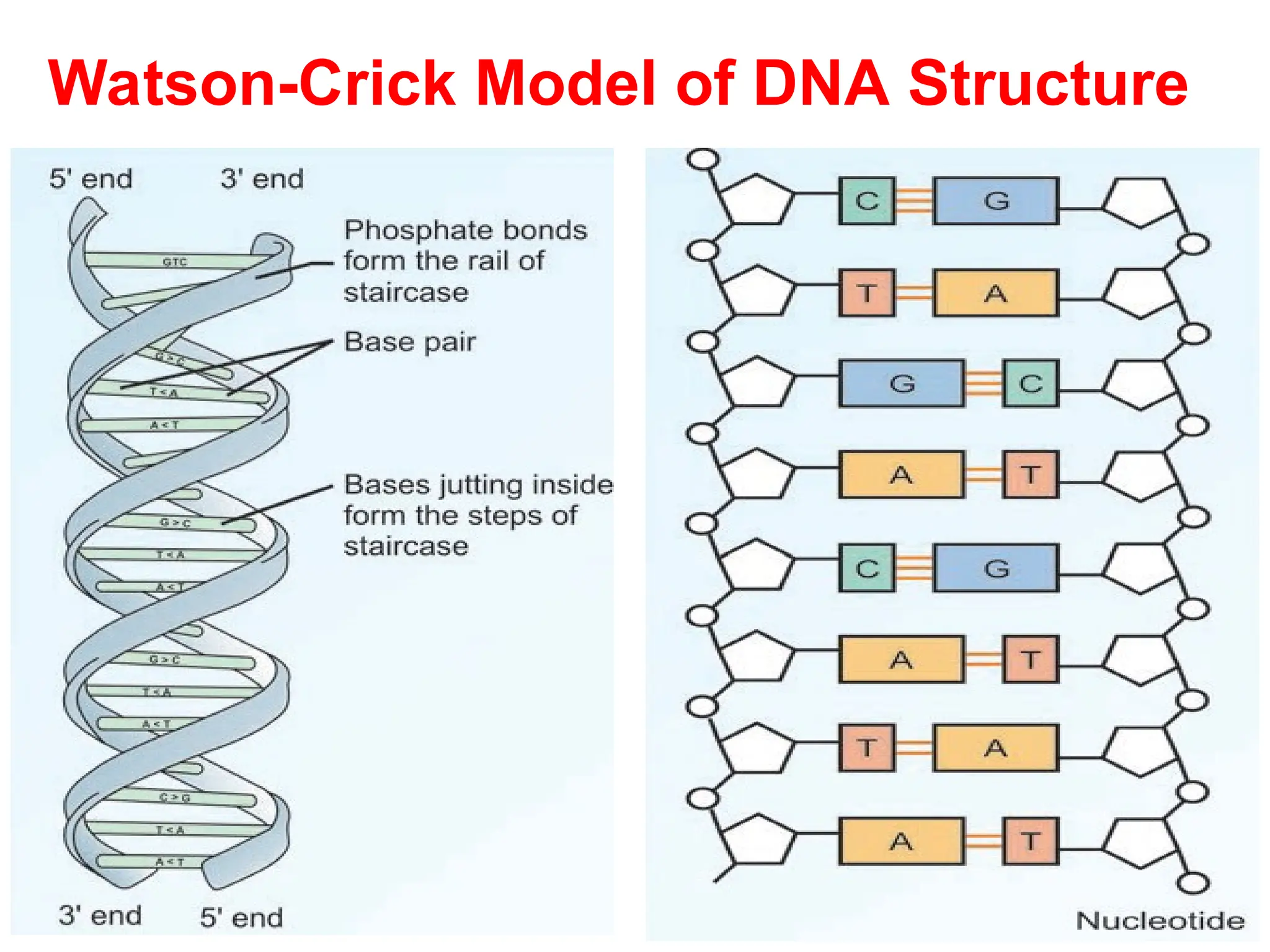
1)Right handed double helix
2)The base pairing rule
3)Hydrogen bonding
4)Antiparallel
Watson-Crick Model of DNA Structure
Right handed double helix
DNA consists of two polydeoxy
ribonucleotide chains twisted around
one another in a right handed double
Helix
The bases are located perpendicular
to the helix axis, whereas the sugars
are nearly at right angles to the axis
Watson-Crick Model of DNA Structure
The base pairing rule
According to Chargaff's rule the
adenine of one strand will pair with
thymine of the opposite strand, while
guanine will pair with cytosine.
The base pairing (A with T; G with
C) the Chargaff's rule as shown in
above figure
Watson-Crick Model of DNA Structure
Hydrogen bonding
 The DNA strands are held together
mainly by hydrogen bonds between the
purine and pyrimidine bases.
 There are two hydrogen bonds between
A and T.
 There are three hydrogen bonds
between C and G.
 The GC bond is therefore stronger than
the AT bond as shown in above figure
Watson-Crick Model of DNA Structure
Antiparallel
The two strands in a DNA
molecule run antiparallel, which
means that
one strand runs in the 5' to 3‘
direction.
2nd
strand runs in the 3' to 5'
direction. As shown in fig:
Higher Organization of DNA
Double stranded DNA is first wound over
Histones (Histones are basic proteins that associate
with DNA in the nucleus and help condense it into
chromatin, There are 5 classes; H1, H2A, H2B, H3
and H4. The H1 histone is loosely attached to the
DNA Others are called core histones because they
form the nucleosome) this is called nucleosomes.
Chromatin is then further and further condensed
to form chromosomes .
Similarly, the DNA molecule is folded and
compressed to 10,000 fold to generate
chromosomes
Higher Organization of DNA
Ribonucleic acids (RNAs)
RNA are present in nucleus and
cytoplasm of eukaryotic cells. They
are also present in prokaryotes.
They are involved in the transfer
and expression of genetic information.
They act as primers for DNA
formation.
Some RNA act as enzymes as well
as coenzymes.
Chemical nature of RNA
RNAs Like DNA are also poly nucleotides. In
RNA polymer, purine and pyrimidine
nucleotides are linked together through
phosphodiester linkage. The sugar present in a
RNA is ribosee
The nitrogenous bases in RNA are
1)Adenine.
2)Guanine.
3)Cytosine.
4)Uracil.
Chemical nature of RNA
There are mainly three types of RNAs in all
prokaryotic and eukaryotic cells.
1)Messenger RNA or m-RNA.
2)Transfer RNA or t-RNA.
3)Ribosmal RNA or r-RNA
Messenger RNA
It accounts for 1-5% of cellular RNA.
Majority of mRNA has primary structure
They are single-stranded linear molecules.
They consist of 1000-10,000 nucleotides
Messenger RNA
mRNA molecules have different life spans. Their life
span ranges from few minutes to days.
Functions
mRNA is direct carrier of genetic information from
the nucleus to the cytoplasm. Usually It contains
information required for the formation of one protein
molecule.
Genetic information is present in mRNA in the form
of genetic code.
Some times single mRNA may contain information
for the formation of more than one protein.
Transfer RNA
t-RNA accounts for 10-15% of total cell RNA.
They are the smallest of all the RNAs.
Usually they consist of 50-100 nucleotides.
They are single strand molecules.
t-RNA pertain secondary and tertiary structures
Functions
It is the carrier of amino acids to the site of
protein synthesis.
There is at least one t-RNA molecule to
each of 20 amino acids required for protein
synthesis.
Ribosomal RNA
r-RNA accounts for 80% of total cellular
RNA.
It is present in ribosomes.
In ribosomes, r-RNA is found in
combination with protein.
It is known as ribonucleoprotein.
The length of r-RNA ranges form 100-
600 nucleotides
rRNA pertain secondary structure
Ribosomal RNA
There are four types of r-RNAs in
eukaryotes. They are 5, 5.8, 18 and 28S r-
RNA molecules
Functions
r-RNAs are required for the formation of
ribosomes.
16S RNA is involved in initiation of
protein synthesis.
NUCLEIC ACIDS.ppt... biochemistry for nurses

NUCLEIC ACIDS.ppt... biochemistry for nurses

  • 1.
    Nucleotides Nucleotides are precursorsof the nucleic acids, deoxy-ribonucleic acid (DNA) and ribonucleic acid (RNA). Nucleic acids are concerned with the storage and transfer of genetic information. The universal currency of energy, namely ATP, is a nucleotide derivative. Nucleotides are also components of important co enzymes like NAD+ and FAD, and metabolic regulators such as AMP
  • 2.
    Composition of Nucleotides Anucleotide is made up of 3 components: 1.Nitrogenous base, (a purine or a pyrimidine) 2.Pentose sugar, either ribose or deoxyribose; 3.Phosphate groups esterified to the sugar. When a base combines with a pentose sugar, a nucleoside is formed.
  • 3.
    Composition of Nucleotides Whenthe nucleoside is esterified to a phosphate group, it is called a nucleotide or nucleoside mono-phosphate. When a second phosphate gets esterified to the existing phosphate group, a nucleoside diphosphate is generated. The attachment of a 3rd phosphate group results in the formation of a nucleoside triphosphate. The nucleic acids (DNA and RNA) are polymers of nucleoside monophosphates
  • 4.
    Bases Present inthe Nucleic Acids Purine Bases The purine bases present in RNA and DNA are the same; adenine (6-amino purine) and guanine (2- amino, 6-oxypurine). (hypoxanthine, Xanthine and uric acids are Micro-purine bases <purine Catabolic end products>)
  • 5.
    Bases Present inthe Nucleic Acids Pyrimidine Bases The pyrimidine bases present in nucleic acids are cytosine, thymine and uracil. Cytosine is present in both DNA and RNA. Thymine is present in DNA and uracil in RNA.
  • 6.
    Nucleosides Nucleosides are formedwhen bases are attached to the pentose sugar Base and sugar are attached by a beta-N-glycosidic bond between the 1st carbon of the pentose sugar and N9 of a purine or N1 of a pyrimidine. (Deoxy nucleosides are denoted by adding the prefix d- before the nucleoside).
  • 7.
    Nucleosides Purine Nucleosides basesend with –sine. Adenine + Ribose → Adenosine Guanine + Ribose → Guanosine while pyrimidine nucleosides end with -dine. Uracil + Ribose → Uridine Cytosine + Ribose → Cytidine Uracil combines with ribose (RNA) only Thymine with deoxy ribose (DNA) only
  • 8.
    Nucleotides These are phosphateesters of nucleosides. Base plus pentose sugar plus phosphoric acid is a nucleotide. The esterification occurs at the 5th or 3rd hydroxyl group of the pentose sugar. Most of the nucleoside phosphates involved in biological function are 5'- phosphates.
  • 9.
    Nucleotides Nucleoside Diphosphate contains onehigh energy bond and Triphosphates have 2 high energy bonds. ATP is the universal energy currency Deoxy ribonucleotides are used for synthesis of DNA and ribonucleotides for RNA.
  • 10.
    Digestion of NucleicAcids The nucleic acids in the diet are hydrolyzed to a mixture of nucleotides by ribonuclease and deoxy ribonuclease present in pancreatic and intestinal secretions. Then nucleotidases liberate the phosphate from nucleotides.
  • 11.
    Digestion of NucleicAcids The resulting nucleosides are hydrolyzed by nucleosidases forming free bases and pentose sugars. However dietary purines and pyrimidines are neither converted to nucleotides nor incorporated Into nucleic acids. They are directly catabolized.Purines------- Uric Acid Normal blood level of uric acid ranges from 2-5 mg/dl in females and 3-7 mg/dl in males.
  • 12.
    NUCLEIC ACIDS OCCURRENCE Two typesof nucleic acids are present in all mammalian cells including humans. 1)DNA-deoxy ribonucleic acid= is present in nucleus and mitochondria. 2)RNA-ribonucleic acid= is present in nucleus and cytoplasm.
  • 13.
    MEDICAL AND BIOLOGICALIMPORTANCE Nucleic acids serve as genetic material of living organisms including humans. Nucleic acids are involved in the storage, transfer and expression of genetic information. Nucleic acids contain all the necessary information required for the formation of individual or organism. Nucleic acids determines physical fitness of an individual to life.
  • 14.
    BIOSYNTHESIS OF NUCLEICACIDS Genetic information stored in DNA in the form of nucleotide sequence flows from different processes. 1)DNA to DNA. 2)DNA to RNA. 3)RNA to protein. This genetic information flow is popularly called as central dogma of molecular genetics.
  • 15.
    BIOSYNTHESIS OF NUCLEICACIDS Central dogma of molecular genetics involves three different processes. 1)Replication: Synthesis of new DNA or information copying is known as replication. In this process information is transmitted from parent to daughter cells. 2)Transcription: Synthesis of RNA from DNA. In this process, information is transferred from DNA to RNA 3)Translation: Synthesis of proteins using information present in RNAs or information decoding is known as translation.
  • 16.
    STRUCTURE OF DNA Deoxyribonucleicacid (DNA) is composed of four deoxy ribonucleotides. 1)Deoxyadenylate (A) 2)Deoxyguanylate (G) 3)Deoxycytidylate (C) 4)Thymidylate (T) The 3'-hydroxyl of one sugar is combined to the 5'- hydroxyl of another sugar through a phosphate group. The genetic information is coded in the specific sequence of bases; if the base is altered, the information is also altered.
  • 18.
    STRUCTURE OF DNA Inthe case of DNA, the base sequence is always written from the 5' end to the 3' end. This is called the polarity of the DNA chain. Watson-Crick Model of DNA Structure 1)Right handed double helix 2)The base pairing rule 3)Hydrogen bonding 4)Antiparallel
  • 19.
    Watson-Crick Model ofDNA Structure Right handed double helix DNA consists of two polydeoxy ribonucleotide chains twisted around one another in a right handed double Helix The bases are located perpendicular to the helix axis, whereas the sugars are nearly at right angles to the axis
  • 20.
    Watson-Crick Model ofDNA Structure
  • 21.
    Watson-Crick Model ofDNA Structure The base pairing rule According to Chargaff's rule the adenine of one strand will pair with thymine of the opposite strand, while guanine will pair with cytosine. The base pairing (A with T; G with C) the Chargaff's rule as shown in above figure
  • 22.
    Watson-Crick Model ofDNA Structure Hydrogen bonding  The DNA strands are held together mainly by hydrogen bonds between the purine and pyrimidine bases.  There are two hydrogen bonds between A and T.  There are three hydrogen bonds between C and G.  The GC bond is therefore stronger than the AT bond as shown in above figure
  • 23.
    Watson-Crick Model ofDNA Structure Antiparallel The two strands in a DNA molecule run antiparallel, which means that one strand runs in the 5' to 3‘ direction. 2nd strand runs in the 3' to 5' direction. As shown in fig:
  • 24.
    Higher Organization ofDNA Double stranded DNA is first wound over Histones (Histones are basic proteins that associate with DNA in the nucleus and help condense it into chromatin, There are 5 classes; H1, H2A, H2B, H3 and H4. The H1 histone is loosely attached to the DNA Others are called core histones because they form the nucleosome) this is called nucleosomes. Chromatin is then further and further condensed to form chromosomes . Similarly, the DNA molecule is folded and compressed to 10,000 fold to generate chromosomes
  • 25.
  • 26.
    Ribonucleic acids (RNAs) RNAare present in nucleus and cytoplasm of eukaryotic cells. They are also present in prokaryotes. They are involved in the transfer and expression of genetic information. They act as primers for DNA formation. Some RNA act as enzymes as well as coenzymes.
  • 27.
    Chemical nature ofRNA RNAs Like DNA are also poly nucleotides. In RNA polymer, purine and pyrimidine nucleotides are linked together through phosphodiester linkage. The sugar present in a RNA is ribosee The nitrogenous bases in RNA are 1)Adenine. 2)Guanine. 3)Cytosine. 4)Uracil.
  • 28.
    Chemical nature ofRNA There are mainly three types of RNAs in all prokaryotic and eukaryotic cells. 1)Messenger RNA or m-RNA. 2)Transfer RNA or t-RNA. 3)Ribosmal RNA or r-RNA Messenger RNA It accounts for 1-5% of cellular RNA. Majority of mRNA has primary structure They are single-stranded linear molecules. They consist of 1000-10,000 nucleotides
  • 29.
    Messenger RNA mRNA moleculeshave different life spans. Their life span ranges from few minutes to days. Functions mRNA is direct carrier of genetic information from the nucleus to the cytoplasm. Usually It contains information required for the formation of one protein molecule. Genetic information is present in mRNA in the form of genetic code. Some times single mRNA may contain information for the formation of more than one protein.
  • 30.
    Transfer RNA t-RNA accountsfor 10-15% of total cell RNA. They are the smallest of all the RNAs. Usually they consist of 50-100 nucleotides. They are single strand molecules. t-RNA pertain secondary and tertiary structures Functions It is the carrier of amino acids to the site of protein synthesis. There is at least one t-RNA molecule to each of 20 amino acids required for protein synthesis.
  • 31.
    Ribosomal RNA r-RNA accountsfor 80% of total cellular RNA. It is present in ribosomes. In ribosomes, r-RNA is found in combination with protein. It is known as ribonucleoprotein. The length of r-RNA ranges form 100- 600 nucleotides rRNA pertain secondary structure
  • 32.
    Ribosomal RNA There arefour types of r-RNAs in eukaryotes. They are 5, 5.8, 18 and 28S r- RNA molecules Functions r-RNAs are required for the formation of ribosomes. 16S RNA is involved in initiation of protein synthesis.