Drug information services
By
Biswanath prusty
Assistant professor
India is country with significant drug use problems. Irrational and unnecessary prescribing is common and
antibiotic resistance is widespread. These problems are as a result of variety of economic, social, political,
occupational, medical and regulatory factors. The most important of these includes:
• The lack of awareness about the drug information centers
• The availability of 80,000 plus formulation
• The national drug policy is industry focused rather than health focused
• The lack of awareness of principles of rational drug use of drugs amongst doctors and pharmacists The
widespread sale of prescription drug over the counter and
• A high-level illiteracy, poverty among patients.
The term ‘drug information’ developed in the early sixties. In 1962, the first drug information was opened at the
University of Kentucky Medical Center, in which an area separated from the pharmacy was dedicated in providing
drug information.
Drug information
It is defined as knowledge of fact through reading, study or practical
experience on chemical substance that is used in diagnosis, prevention and
treatment of diseases.
It covers all type of information including; objective and subjective
information as well as information gathered by scientific observation or practical
experience.
Drug information services (DIS)
❖Drug information service (DIS) is the service that encompasses the activities of specially
trained individuals to provide accurate, unbiased, factual information, primarily in response
to patient-oriented problems occurred from the healthcare teams.
❖Drug information is the provision of written and/or verbal information about drugs and drug
therapy in response to a request from other healthcare providing organizations, committees,
patients, and public community.
❖DI is also defined as the knowledge of facts acquired through reading, study, or practical
experience concerning any chemical substance intended for use in diagnosis, prevention, or
treatment of disease. It covers all types of information provision including subjective and
objective information, as well as information gathered by scientific observation or practical
experience.
❖WHO recognizes independent drug information centers as a core component of national
programs to promote the rational use of drugs.
❖The provision of unbiased, well-referenced, and critically evaluated information on any
aspect of pharmacy practice.
Origin of DIC / History of DIC
➢ In1960, at the University of Kentucky Medical Centre, the first drug information center was started which was intended to
be utilized as a source of accurate, unbiased, selected, comprehensive drug information to cater to the needs of the
healthcare team.
➢ In Australia and the United Kingdom, the first drug information centers were established in 1968 at the Royal Melbourne
hospital, Victoria and in 1969 at the London hospital respectively.
➢ In India, Rosemary sharp, a missionary from UK, started the first drug information center at Christian medical college,
Vellore.
➢ In the early1970s. In India, the concept of rational drug use is yet a long way to go. Irrational use of drugs is common and
this has led to antibiotic resistance, adverse drug reactions, drug interactions and other drug related problems. Among the
many factors that make clinicians unable to update their knowledge about drugs, lack of unbiased drug information,
availability of more than 60,000 formulations and lack of time are few notable reasons which ultimately lead to an
increasing demand for independent, specific and unbiased drug information for better patient care.
➢ Most of the developing countries suffer from lack of drug information due to limited availability of current literature, poor
documentation and less dissemination of little information available.
➢ Clinical pharmacists are referred as “Medicines Experts” and hence are well trained for this service. Provision of drugs and
therapeutic information (DTI) to clinicians is one of the fundamental responsibilities of clinical pharmacists. However in
the current scenario of health care system, DTI services are sounds to be necessary due to increased patient load with co-
morbid conditions and availability of more number of drug molecules in the market and polypharmacy. Thus, provision of
DTI helps practitioners to rationalize the therapy for their patients care.
NEED FOR DRUG INFORMATION:
❑ In the past, the smaller range of available drugs limited need for drug information but now new drugs and new
modalities of the treatment being introduced. There are more than 20,000 biomedical journals available and more
than 6,000 journal published every day. It is a Herculean task for health care professional to keep themselves up-
to-date with available drug information.
❑ In addition, most developing countries like India suffer from lack of adequate drug information due to limited
availability of current literature and also poor documentation, poor funding available. The lack of unbiased drug
information service in India poses problem and doctors in general get their information from medical
representative who obviously are partially biased towards their product.
❑ In India, low income levels populations, the multiple health care systems and lack of awareness about the risks
and benefits of drug therapy make good clinical pharmacy practice all the more relevant and important. Due to
increasing population and limited number of doctors, their practices are loaded and creates too much of stress. As
a result, the quality suffers. There is potential of clinical pharmacist to fill this gap.
❑ To introduce a new drug into the practice need to evaluate the given information.
❑ A simple, quick reference pharmacopeia or formulary is no longer sufficient.
Objectives of a Drug Information Service
A drug information service shall support the high-quality, safe, and effective use of
medications, and shall discourage the use of questionable, unproven therapies. It shall improve
the quality of patient care and patient outcomes through the timely provision of drug
information and advice on the therapeutic use of drugs. The drug information provided shall
be well organized, current, objective, independent, comprehensive, and accurate, and it shall
be presented in a useful format.
1. Promote evidence based practice
2. Meet the patient’s needs while providing pharmaceutical care.
3. Improve the patient adherence
4. To provide accurate and unbiased information
5. To provide as organized database
6. To develop and participate in continuing education programs.
7. To prepare and distribute material on drugs to health personnel in the form of a drug
information bulletin and/ or other media.
8. To develop and participate in research programs.
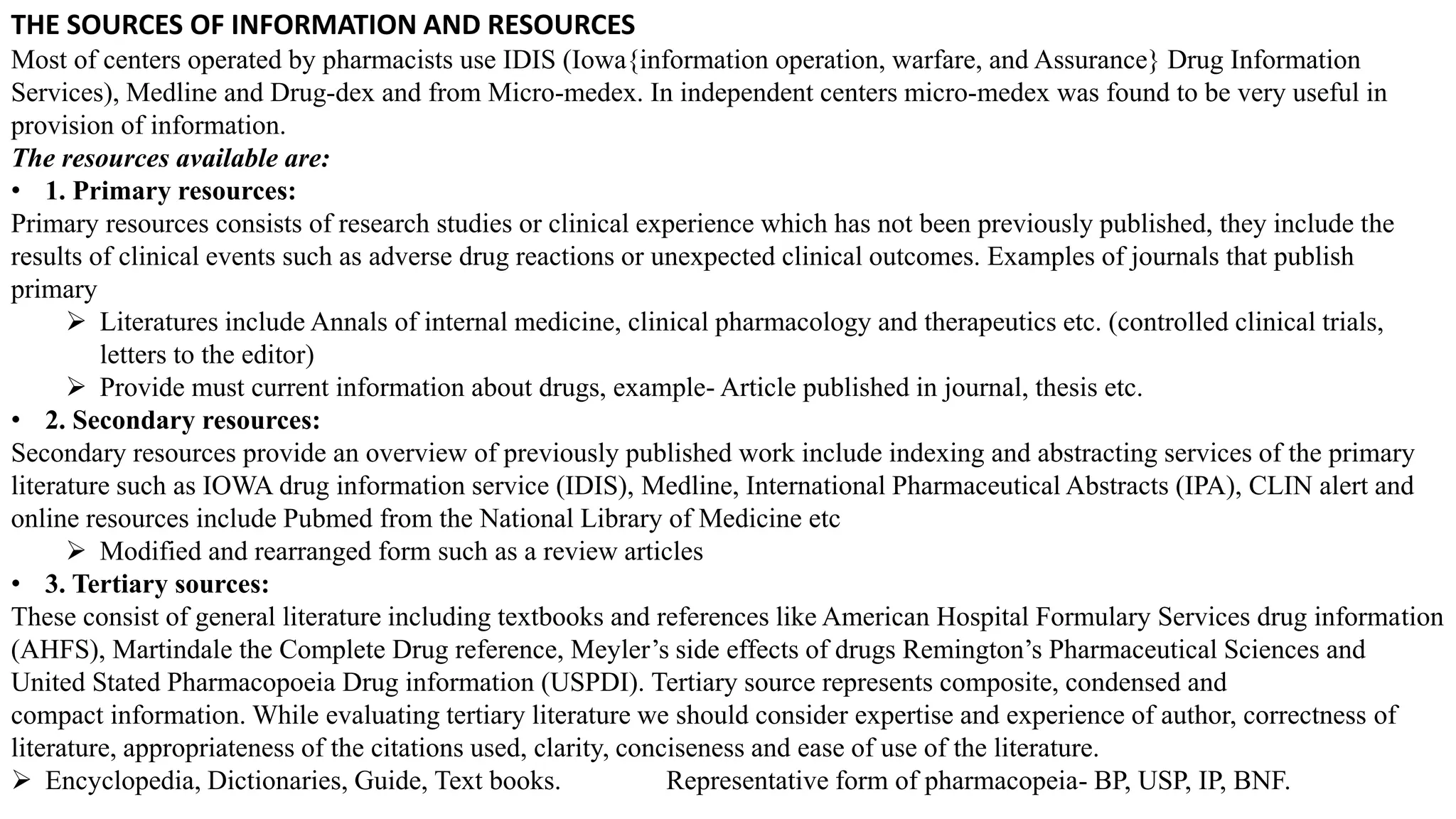
THE SOURCES OF INFORMATION AND RESOURCES
Most of centers operated by pharmacists use IDIS (Iowa{information operation, warfare, and Assurance} Drug Information
Services), Medline and Drug-dex and from Micro-medex. In independent centers micro-medex was found to be very useful in
provision of information.
The resources available are:
• 1. Primary resources:
Primary resources consists of research studies or clinical experience which has not been previously published, they include the
results of clinical events such as adverse drug reactions or unexpected clinical outcomes. Examples of journals that publish
primary
➢ Literatures include Annals of internal medicine, clinical pharmacology and therapeutics etc. (controlled clinical trials,
letters to the editor)
➢ Provide must current information about drugs, example- Article published in journal, thesis etc.
• 2. Secondary resources:
Secondary resources provide an overview of previously published work include indexing and abstracting services of the primary
literature such as IOWA drug information service (IDIS), Medline, International Pharmaceutical Abstracts (IPA), CLIN alert and
online resources include Pubmed from the National Library of Medicine etc
➢ Modified and rearranged form such as a review articles
• 3. Tertiary sources:
These consist of general literature including textbooks and references like American Hospital Formulary Services drug information
(AHFS), Martindale the Complete Drug reference, Meyler’s side effects of drugs Remington’s Pharmaceutical Sciences and
United Stated Pharmacopoeia Drug information (USPDI). Tertiary source represents composite, condensed and
compact information. While evaluating tertiary literature we should consider expertise and experience of author, correctness of
literature, appropriateness of the citations used, clarity, conciseness and ease of use of the literature.
➢ Encyclopedia, Dictionaries, Guide, Text books. Representative form of pharmacopeia- BP, USP, IP, BNF.
• Electronic bulletin boards:
Electronic bulletin boards are local bulletin boards, which are posted through a server and can be accessed using a computer and
a modem.
Examples are Clinnet, Pharmline and pharmnet. They expand the ability to monitor therapies recently published or
discussed in the media and prevent duplication of drug information searches.
• Other drug information resources:
When queries cannot be answered using the above- mentioned resources,
1. Alternate sources of drug information can be used. They include internet, list serves, local and national, professionals and
government organization and pharmaceutical manufacturers.
2. The ability to assess the quality of information obtained from the web is increasingly important for pharmacists not just for
their own information but also for the benefit of patients. In order to ensure the quality of information obtained through the web,
pharmacy professionals need to be aware of the criteria to evaluate the web as they are for other traditional sources.
Some useful Internet Web resources:
1 World Health Organization Library site:
http://www.who.int/hlt/virtuallibrary/english/ subject.htm
2. Australian Prescriber:
http://www.australianprescriber.com
3. British Medical Journal:
http://www.bmj.com/
4. The Free Medical Journal Site:
http://www.freemedicaljournals.com
The searching for answering the drug information queries should be in the following
order: Tertiary source -> Secondary source -> Primary literature
Services offered by DIS:
❖ Information about drugs
❖ Poison management information
❖ Patient education service
❖ Assistance on drug usage in patients.
❖ Professional assistance for investigations in drug usage
❖ Drug related information to hospital staff.
❖ Reporting and investigating ADR
Drug information bulletin:
❖ For transmission of information to the members of health care team
❖ Regular publication is needed on the latest developments.
Illegal DIC:
❖ Report the abused drugs for victimizing some innocent.
❖ Illinois State Police has started this to report such cases of drug abuse & spread awareness in both public & US official
to ban such drugs OTC selling
❖ Governed by DEA (Drug Enforcement Administration)
Summary:
• DIC are regarded as a gateway of drug information.
• They have responsibility to provide highest possible standard information.
• Sources of information.
• DICs aim at rational use of drugs.
• A proper working DIC is necessary to make best use of its services.
Policies and Procedures
Written policies and procedures shall be established to promote the consistent delivery of high-quality drug information services
that meet the needs of the clients and the organization and that comply with regulatory requirements. The policies and procedures
should be kept up to date and should be reviewed at least every two years.
Policies and procedures shall be developed and implemented to address the following issues:
a) setting the hours of service;
b) providing after-hours access to the service;
c) defining the population served;
d) defining the range of services that will and will not be provided;
e) selecting the information resources to be made available;
f) receiving and prioritizing requests;
g) designing and executing search strategies;
h) evaluating information;
i) preparing responses, including the chosen style to cite references used (e.g., the most recent reference style used by the
Canadian Journal of Hospital Pharmacy);
j) communicating responses;
k) providing drug information education to pharmacy undergraduate and graduate students, residents, and staff pharmacists;
l) defining methods to obtain literature reprints and other information;
m) identifying and removing outdated resources from circulation;
n) reporting adverse drug reactions;
o) handling of Special Access Programmed drugs and investigational drugs, where this is part of the responsibility of the
drug information service;
p) establishing methods to manage drug information requests and statistics;
q) interpreting ethical principles for use in working through ethical dilemmas;
r) identifying and working through medicolegal issues, including liability;
s) developing indicators and plans for quality assessment and improvement;
t) defining borrowing privileges and procedures for access to and use of drug information resources by personnel outside
the drug information centre;
u) setting a fee structure for information requests and surcharges for extraordinary requests;
v) establishing criteria for referring queries to another group of experts or another organization; and
w) handling media relations.
BASIC REQUIREMENTS FOR
SETTING UP A POISON/DRUG
INFORMATION CENTRE
 Human Power – people with the right
mind / attitude and training
 Poison/Drug Information Sources/References
 Other Facilities – communication lines
(telephone, computers, internet access,
office space etc.)
Pharmacists are preferably trained in
areas of pharmacotherapeutics, know the
types of literature sources, search techniques
and literature appraisal
Pharmacist must also be able to obtain appropriate
background information pertaining to PI/DI query,
know how to formulate and communicate
the response effectively
SCOTTISH INTERCOLLEGIATE
GUIDELINES NETWORK (SIGN)
Classification for grading evidence
1++ High quality meta-analyses, systematic review of RCTs, or RCTs with a very low risk of
bias
1+ Well-conducted meta-analyses, systematic review s, or RCTs with a low risk of bias
1- Meta-analyses, systematic reviews, or RCTs with a high risk of bias
2++ High quality systematic reviews of case-control or cohort studies with a very low risk of
confounding or bias and a high probability that the relationship is causal
2+ Well conducted case-control or cohort studies with a low risk of confounding or bias and
a moderate probability that the relationship is causal
2- Case-control or cohort studies with a high risk of confounding or bias and a significant
risk that the relationship is not causal
3 Non-analytic studies; for example, case reports, case series
4 Expert opinion
Drug/Poison Information Pharmacist should appreciate
and promote EBM as well as having the ability to evaluate
DI literature critically.
CLASSIFICATION for GRADING EVIDENCE
POISON/DRUG INFORMATION SOURCES
TT
PRIMARY LITERATURE
SECONDARY LITERATURE
TERTIARY LITERATURE
Least up-to-date
Most up-to-date
TYPES OF LITERATURES
TERTIARY LITERATURES
• Core knowledge established from primary sources
• Compile information from primary or secondary sources
• Important: information may be out-dated; if the
information is based on flawed primary literature
(e.g. poorly conducted studies are referenced), then
the tertiary information may be queried.
A. TEXTBOOKS
PI: GOLDFRANK’S TOXICOLOGIC
EMERGENCIES, DREISBACH’S
HANDBOOK OF POISONING,
POISONING & DRUG OVERDOSE
DI: USP-DI, FACTS AND COMPARISON,
AMERICAN FORMULARY,
MARTINDALE, MYLER’S SIDE
EFFECTS, GOODMAN & GILMAN
Core titles
1. Martindale-The Extra Pharmacopoeia
2. USPDI
3. BNF
4. Local compendia
A B D E F G
A B C D E F
A B C D E
variable
Optional titles
5. Facts and Comparisons
6. AHFS
7. Avery's Drug Treatment
8. Harrison's Principles of Internal Medicine
9. Drug Interactions (Hansten's)
10. Evaluation of Drug Interactions (APhA's)
11. Handbook of Injectable Drugs (Trissel's)
12. Handbook of Non-Prescription Drugs
A B C D E F
A B C D E F
E
E
C
C
C
A D E
B: Drug Dosing
D: Adverse Drug Reactions
F: Pharmacology & Pharmacokinetics
A: Identification, Availability & Manufacturer
C: Drug Interactions/Incompatabilities
E: Therapeutic Use
G: Poisoning
TABULATION OF SELECTED REFERENCE SOURCES
Others
D E F
B C D F
E
E
E
E
D
D
A B D
13. AMA Drug Evaluation
14. Handbook of Clinical Drug Data
15. Manual of Medical Therapeutics
16. Applied Therapeutics
17. Clinical Pharmacy & Therapeutics
18. Current Therapy
19. Meyler's Side-Effects of Drugs
20. Meyler's Drug-Induced Diseases
21. Physicians Desk References
22. The Pharmacological Basis of
Therapeutics (Goodman & Gilman)
23. Drugdex
24. Poisondex
D E F
A B C D E F
C G
B: Drug Dosing
D: Adverse Drug Reactions
F: Pharmacology & Pharmacokinetics
A: Identification, Availability and Manufacturer
C: Drug Interactions/Incompatabilities
E: Therapeutic Use
G: Poisoning
TABULATION OF SELECTED REFERENCE SOURCES
TERTIARY LITERATURES
B. MONOGRAPHS (INCLUDING COMPUTER
DATABASES)
DI: DRUGDEX, DRUGS FACTS AND COMPARISON
PI: POISINDEX, TOXINZ, HYPERTOX
CHEMICALS: *INTERNATIONAL AGENCY FOR RESEARCH
ON CANCER (IARC)
http://toxnet.nlm.nih.gov/
Pitfall:
Updated?
http://inchem.org/
http://inchem.org/
➢ Indexing and abstracting services of
primary sources (indexes & bibliographies)
➢ It must utilized specific search terms and
we must be proficient with a particular
database's search techniques.
EXAMPLES:
 PubMed (> than 25 million citations for biomedical literature
from MEDLINE, life science journals, and online books)
 TOXLINE
 COCHRANE DATABASE of SYSTEMATIC REVIEW
 IOWA DRUG INFORMATION SERVICE (IDIS-from1995)
 INTERNATIONAL PHARMACEUTICAL ABSTRACTS (IPA)
SECONDARY LITERATURES
 Original research work published in the journal for the first time (journal
article).
 Contains detailed information about the study/research: objectives,
methodology, results, syntheses of data, discussions and conclusion.
 It may include descriptive as well as evaluative research work.
 Often “peer-reviewed” by other experts who evaluate the work and
findings before publication.
 Important: The quality of the literature-the reader should be able to
critique and analyze the study in order to develop a conclusion.
 Original research work on which other research is based.
 May also be in the form of case reports, technical reports, theses,
dissertations, etc.)
PRIMARY LITERATURES
INTERNET AS A SOURCE FOR DRUG/POISON
INFORMATION
With the internet, pharmacist needs to know:
(a) How to carry out a reliable search
(b) How to differentiate between reliable
information source and the unreliable ones
WEB SITE EVALUATION
Authority
• Authority of site (individual/institutional affiliation, organization)
• Credentials, expertise, experience with the topic
• Contact information (name, e-mail, postal address)
Objectivity
• Purpose & scope stated
• Who is the intended audience
• Information presented as factual or opinion, primary or secondary in
origin
• Any sponsorship/underwriting disclosed
Accuracy
• Facts documented or well-researched
• Links provided to quality web resources
http://www.library.kent.edu/criteria-evaluating-web-resources
WEB SITE EVALUATION
Currency
• Content current
• Pages date-stamped with last update
Usability
• Site well-designed & stable
• Site of organization logical
• Level of content readable by intended audience
• Attention paid to presenting the info as error-free
• Reliably accessible
• Readily identifiable link to the organizational home page
Drug information services by BNP.pdf

Drug information services by BNP.pdf

  • 1.
    Drug information services By Biswanathprusty Assistant professor
  • 2.
    India is countrywith significant drug use problems. Irrational and unnecessary prescribing is common and antibiotic resistance is widespread. These problems are as a result of variety of economic, social, political, occupational, medical and regulatory factors. The most important of these includes: • The lack of awareness about the drug information centers • The availability of 80,000 plus formulation • The national drug policy is industry focused rather than health focused • The lack of awareness of principles of rational drug use of drugs amongst doctors and pharmacists The widespread sale of prescription drug over the counter and • A high-level illiteracy, poverty among patients. The term ‘drug information’ developed in the early sixties. In 1962, the first drug information was opened at the University of Kentucky Medical Center, in which an area separated from the pharmacy was dedicated in providing drug information. Drug information It is defined as knowledge of fact through reading, study or practical experience on chemical substance that is used in diagnosis, prevention and treatment of diseases. It covers all type of information including; objective and subjective information as well as information gathered by scientific observation or practical experience.
  • 3.
    Drug information services(DIS) ❖Drug information service (DIS) is the service that encompasses the activities of specially trained individuals to provide accurate, unbiased, factual information, primarily in response to patient-oriented problems occurred from the healthcare teams. ❖Drug information is the provision of written and/or verbal information about drugs and drug therapy in response to a request from other healthcare providing organizations, committees, patients, and public community. ❖DI is also defined as the knowledge of facts acquired through reading, study, or practical experience concerning any chemical substance intended for use in diagnosis, prevention, or treatment of disease. It covers all types of information provision including subjective and objective information, as well as information gathered by scientific observation or practical experience. ❖WHO recognizes independent drug information centers as a core component of national programs to promote the rational use of drugs. ❖The provision of unbiased, well-referenced, and critically evaluated information on any aspect of pharmacy practice.
  • 4.
    Origin of DIC/ History of DIC ➢ In1960, at the University of Kentucky Medical Centre, the first drug information center was started which was intended to be utilized as a source of accurate, unbiased, selected, comprehensive drug information to cater to the needs of the healthcare team. ➢ In Australia and the United Kingdom, the first drug information centers were established in 1968 at the Royal Melbourne hospital, Victoria and in 1969 at the London hospital respectively. ➢ In India, Rosemary sharp, a missionary from UK, started the first drug information center at Christian medical college, Vellore. ➢ In the early1970s. In India, the concept of rational drug use is yet a long way to go. Irrational use of drugs is common and this has led to antibiotic resistance, adverse drug reactions, drug interactions and other drug related problems. Among the many factors that make clinicians unable to update their knowledge about drugs, lack of unbiased drug information, availability of more than 60,000 formulations and lack of time are few notable reasons which ultimately lead to an increasing demand for independent, specific and unbiased drug information for better patient care. ➢ Most of the developing countries suffer from lack of drug information due to limited availability of current literature, poor documentation and less dissemination of little information available. ➢ Clinical pharmacists are referred as “Medicines Experts” and hence are well trained for this service. Provision of drugs and therapeutic information (DTI) to clinicians is one of the fundamental responsibilities of clinical pharmacists. However in the current scenario of health care system, DTI services are sounds to be necessary due to increased patient load with co- morbid conditions and availability of more number of drug molecules in the market and polypharmacy. Thus, provision of DTI helps practitioners to rationalize the therapy for their patients care.
  • 5.
    NEED FOR DRUGINFORMATION: ❑ In the past, the smaller range of available drugs limited need for drug information but now new drugs and new modalities of the treatment being introduced. There are more than 20,000 biomedical journals available and more than 6,000 journal published every day. It is a Herculean task for health care professional to keep themselves up- to-date with available drug information. ❑ In addition, most developing countries like India suffer from lack of adequate drug information due to limited availability of current literature and also poor documentation, poor funding available. The lack of unbiased drug information service in India poses problem and doctors in general get their information from medical representative who obviously are partially biased towards their product. ❑ In India, low income levels populations, the multiple health care systems and lack of awareness about the risks and benefits of drug therapy make good clinical pharmacy practice all the more relevant and important. Due to increasing population and limited number of doctors, their practices are loaded and creates too much of stress. As a result, the quality suffers. There is potential of clinical pharmacist to fill this gap. ❑ To introduce a new drug into the practice need to evaluate the given information. ❑ A simple, quick reference pharmacopeia or formulary is no longer sufficient.
  • 6.
    Objectives of aDrug Information Service A drug information service shall support the high-quality, safe, and effective use of medications, and shall discourage the use of questionable, unproven therapies. It shall improve the quality of patient care and patient outcomes through the timely provision of drug information and advice on the therapeutic use of drugs. The drug information provided shall be well organized, current, objective, independent, comprehensive, and accurate, and it shall be presented in a useful format. 1. Promote evidence based practice 2. Meet the patient’s needs while providing pharmaceutical care. 3. Improve the patient adherence 4. To provide accurate and unbiased information 5. To provide as organized database 6. To develop and participate in continuing education programs. 7. To prepare and distribute material on drugs to health personnel in the form of a drug information bulletin and/ or other media. 8. To develop and participate in research programs.
  • 7.
    THE SOURCES OFINFORMATION AND RESOURCES Most of centers operated by pharmacists use IDIS (Iowa{information operation, warfare, and Assurance} Drug Information Services), Medline and Drug-dex and from Micro-medex. In independent centers micro-medex was found to be very useful in provision of information. The resources available are: • 1. Primary resources: Primary resources consists of research studies or clinical experience which has not been previously published, they include the results of clinical events such as adverse drug reactions or unexpected clinical outcomes. Examples of journals that publish primary ➢ Literatures include Annals of internal medicine, clinical pharmacology and therapeutics etc. (controlled clinical trials, letters to the editor) ➢ Provide must current information about drugs, example- Article published in journal, thesis etc. • 2. Secondary resources: Secondary resources provide an overview of previously published work include indexing and abstracting services of the primary literature such as IOWA drug information service (IDIS), Medline, International Pharmaceutical Abstracts (IPA), CLIN alert and online resources include Pubmed from the National Library of Medicine etc ➢ Modified and rearranged form such as a review articles • 3. Tertiary sources: These consist of general literature including textbooks and references like American Hospital Formulary Services drug information (AHFS), Martindale the Complete Drug reference, Meyler’s side effects of drugs Remington’s Pharmaceutical Sciences and United Stated Pharmacopoeia Drug information (USPDI). Tertiary source represents composite, condensed and compact information. While evaluating tertiary literature we should consider expertise and experience of author, correctness of literature, appropriateness of the citations used, clarity, conciseness and ease of use of the literature. ➢ Encyclopedia, Dictionaries, Guide, Text books. Representative form of pharmacopeia- BP, USP, IP, BNF.
  • 8.
    • Electronic bulletinboards: Electronic bulletin boards are local bulletin boards, which are posted through a server and can be accessed using a computer and a modem. Examples are Clinnet, Pharmline and pharmnet. They expand the ability to monitor therapies recently published or discussed in the media and prevent duplication of drug information searches. • Other drug information resources: When queries cannot be answered using the above- mentioned resources, 1. Alternate sources of drug information can be used. They include internet, list serves, local and national, professionals and government organization and pharmaceutical manufacturers. 2. The ability to assess the quality of information obtained from the web is increasingly important for pharmacists not just for their own information but also for the benefit of patients. In order to ensure the quality of information obtained through the web, pharmacy professionals need to be aware of the criteria to evaluate the web as they are for other traditional sources. Some useful Internet Web resources: 1 World Health Organization Library site: http://www.who.int/hlt/virtuallibrary/english/ subject.htm 2. Australian Prescriber: http://www.australianprescriber.com 3. British Medical Journal: http://www.bmj.com/ 4. The Free Medical Journal Site: http://www.freemedicaljournals.com The searching for answering the drug information queries should be in the following order: Tertiary source -> Secondary source -> Primary literature
  • 9.
    Services offered byDIS: ❖ Information about drugs ❖ Poison management information ❖ Patient education service ❖ Assistance on drug usage in patients. ❖ Professional assistance for investigations in drug usage ❖ Drug related information to hospital staff. ❖ Reporting and investigating ADR Drug information bulletin: ❖ For transmission of information to the members of health care team ❖ Regular publication is needed on the latest developments. Illegal DIC: ❖ Report the abused drugs for victimizing some innocent. ❖ Illinois State Police has started this to report such cases of drug abuse & spread awareness in both public & US official to ban such drugs OTC selling ❖ Governed by DEA (Drug Enforcement Administration) Summary: • DIC are regarded as a gateway of drug information. • They have responsibility to provide highest possible standard information. • Sources of information. • DICs aim at rational use of drugs. • A proper working DIC is necessary to make best use of its services.
  • 10.
    Policies and Procedures Writtenpolicies and procedures shall be established to promote the consistent delivery of high-quality drug information services that meet the needs of the clients and the organization and that comply with regulatory requirements. The policies and procedures should be kept up to date and should be reviewed at least every two years. Policies and procedures shall be developed and implemented to address the following issues: a) setting the hours of service; b) providing after-hours access to the service; c) defining the population served; d) defining the range of services that will and will not be provided; e) selecting the information resources to be made available; f) receiving and prioritizing requests; g) designing and executing search strategies; h) evaluating information; i) preparing responses, including the chosen style to cite references used (e.g., the most recent reference style used by the Canadian Journal of Hospital Pharmacy); j) communicating responses; k) providing drug information education to pharmacy undergraduate and graduate students, residents, and staff pharmacists; l) defining methods to obtain literature reprints and other information; m) identifying and removing outdated resources from circulation; n) reporting adverse drug reactions; o) handling of Special Access Programmed drugs and investigational drugs, where this is part of the responsibility of the drug information service;
  • 11.
    p) establishing methodsto manage drug information requests and statistics; q) interpreting ethical principles for use in working through ethical dilemmas; r) identifying and working through medicolegal issues, including liability; s) developing indicators and plans for quality assessment and improvement; t) defining borrowing privileges and procedures for access to and use of drug information resources by personnel outside the drug information centre; u) setting a fee structure for information requests and surcharges for extraordinary requests; v) establishing criteria for referring queries to another group of experts or another organization; and w) handling media relations.
  • 12.
    BASIC REQUIREMENTS FOR SETTINGUP A POISON/DRUG INFORMATION CENTRE  Human Power – people with the right mind / attitude and training  Poison/Drug Information Sources/References  Other Facilities – communication lines (telephone, computers, internet access, office space etc.)
  • 13.
    Pharmacists are preferablytrained in areas of pharmacotherapeutics, know the types of literature sources, search techniques and literature appraisal Pharmacist must also be able to obtain appropriate background information pertaining to PI/DI query, know how to formulate and communicate the response effectively
  • 14.
    SCOTTISH INTERCOLLEGIATE GUIDELINES NETWORK(SIGN) Classification for grading evidence 1++ High quality meta-analyses, systematic review of RCTs, or RCTs with a very low risk of bias 1+ Well-conducted meta-analyses, systematic review s, or RCTs with a low risk of bias 1- Meta-analyses, systematic reviews, or RCTs with a high risk of bias 2++ High quality systematic reviews of case-control or cohort studies with a very low risk of confounding or bias and a high probability that the relationship is causal 2+ Well conducted case-control or cohort studies with a low risk of confounding or bias and a moderate probability that the relationship is causal 2- Case-control or cohort studies with a high risk of confounding or bias and a significant risk that the relationship is not causal 3 Non-analytic studies; for example, case reports, case series 4 Expert opinion Drug/Poison Information Pharmacist should appreciate and promote EBM as well as having the ability to evaluate DI literature critically. CLASSIFICATION for GRADING EVIDENCE
  • 15.
    POISON/DRUG INFORMATION SOURCES TT PRIMARYLITERATURE SECONDARY LITERATURE TERTIARY LITERATURE Least up-to-date Most up-to-date TYPES OF LITERATURES
  • 16.
    TERTIARY LITERATURES • Coreknowledge established from primary sources • Compile information from primary or secondary sources • Important: information may be out-dated; if the information is based on flawed primary literature (e.g. poorly conducted studies are referenced), then the tertiary information may be queried. A. TEXTBOOKS PI: GOLDFRANK’S TOXICOLOGIC EMERGENCIES, DREISBACH’S HANDBOOK OF POISONING, POISONING & DRUG OVERDOSE DI: USP-DI, FACTS AND COMPARISON, AMERICAN FORMULARY, MARTINDALE, MYLER’S SIDE EFFECTS, GOODMAN & GILMAN
  • 17.
    Core titles 1. Martindale-TheExtra Pharmacopoeia 2. USPDI 3. BNF 4. Local compendia A B D E F G A B C D E F A B C D E variable Optional titles 5. Facts and Comparisons 6. AHFS 7. Avery's Drug Treatment 8. Harrison's Principles of Internal Medicine 9. Drug Interactions (Hansten's) 10. Evaluation of Drug Interactions (APhA's) 11. Handbook of Injectable Drugs (Trissel's) 12. Handbook of Non-Prescription Drugs A B C D E F A B C D E F E E C C C A D E B: Drug Dosing D: Adverse Drug Reactions F: Pharmacology & Pharmacokinetics A: Identification, Availability & Manufacturer C: Drug Interactions/Incompatabilities E: Therapeutic Use G: Poisoning TABULATION OF SELECTED REFERENCE SOURCES
  • 18.
    Others D E F BC D F E E E E D D A B D 13. AMA Drug Evaluation 14. Handbook of Clinical Drug Data 15. Manual of Medical Therapeutics 16. Applied Therapeutics 17. Clinical Pharmacy & Therapeutics 18. Current Therapy 19. Meyler's Side-Effects of Drugs 20. Meyler's Drug-Induced Diseases 21. Physicians Desk References 22. The Pharmacological Basis of Therapeutics (Goodman & Gilman) 23. Drugdex 24. Poisondex D E F A B C D E F C G B: Drug Dosing D: Adverse Drug Reactions F: Pharmacology & Pharmacokinetics A: Identification, Availability and Manufacturer C: Drug Interactions/Incompatabilities E: Therapeutic Use G: Poisoning TABULATION OF SELECTED REFERENCE SOURCES
  • 19.
    TERTIARY LITERATURES B. MONOGRAPHS(INCLUDING COMPUTER DATABASES) DI: DRUGDEX, DRUGS FACTS AND COMPARISON PI: POISINDEX, TOXINZ, HYPERTOX CHEMICALS: *INTERNATIONAL AGENCY FOR RESEARCH ON CANCER (IARC)
  • 27.
  • 28.
  • 29.
  • 30.
  • 31.
    ➢ Indexing andabstracting services of primary sources (indexes & bibliographies) ➢ It must utilized specific search terms and we must be proficient with a particular database's search techniques. EXAMPLES:  PubMed (> than 25 million citations for biomedical literature from MEDLINE, life science journals, and online books)  TOXLINE  COCHRANE DATABASE of SYSTEMATIC REVIEW  IOWA DRUG INFORMATION SERVICE (IDIS-from1995)  INTERNATIONAL PHARMACEUTICAL ABSTRACTS (IPA) SECONDARY LITERATURES
  • 37.
     Original researchwork published in the journal for the first time (journal article).  Contains detailed information about the study/research: objectives, methodology, results, syntheses of data, discussions and conclusion.  It may include descriptive as well as evaluative research work.  Often “peer-reviewed” by other experts who evaluate the work and findings before publication.  Important: The quality of the literature-the reader should be able to critique and analyze the study in order to develop a conclusion.  Original research work on which other research is based.  May also be in the form of case reports, technical reports, theses, dissertations, etc.) PRIMARY LITERATURES
  • 38.
    INTERNET AS ASOURCE FOR DRUG/POISON INFORMATION With the internet, pharmacist needs to know: (a) How to carry out a reliable search (b) How to differentiate between reliable information source and the unreliable ones
  • 39.
    WEB SITE EVALUATION Authority •Authority of site (individual/institutional affiliation, organization) • Credentials, expertise, experience with the topic • Contact information (name, e-mail, postal address) Objectivity • Purpose & scope stated • Who is the intended audience • Information presented as factual or opinion, primary or secondary in origin • Any sponsorship/underwriting disclosed Accuracy • Facts documented or well-researched • Links provided to quality web resources http://www.library.kent.edu/criteria-evaluating-web-resources
  • 40.
    WEB SITE EVALUATION Currency •Content current • Pages date-stamped with last update Usability • Site well-designed & stable • Site of organization logical • Level of content readable by intended audience • Attention paid to presenting the info as error-free • Reliably accessible • Readily identifiable link to the organizational home page