NUCLEIC ACIDS (DNA & RNA)
• Nucleic acids are large biomolecules which function in
encoding, transmitting and expressing genetic information.
Nucleotides are building blocks of nucleic acids as the
proteins are made of amino acids.
Structure of Nucleotides:
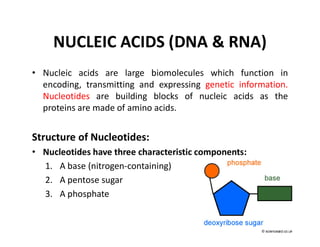
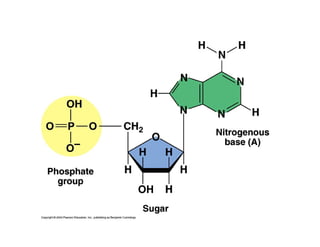
• Nucleotides have three characteristic components:
1. A base (nitrogen-containing)
2. A pentose sugar
3. A phosphate
A nitrogenous base
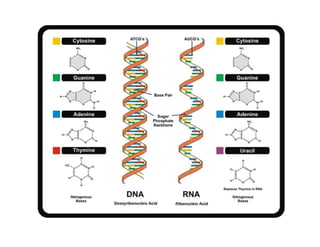
• The nitrogenous bases in nucleotides are derivatives of two
parent compounds -- pyrimidine and purine.
• Purines: Adenine & Guanine (A & G)
• Pyrimidines: Cytosin, Thymine & Uracil (C, T and U)
• Both DNA and RNA contain two major purine bases, Adenine
(A) and guanine (G)
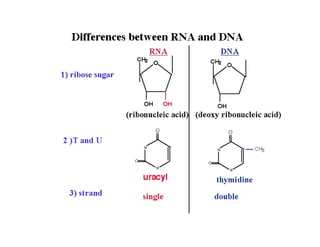
• Pyrimidines in DNA are cytosine (C) and thymine (T).
• Pyrimidines in RNA are cytosine (C) and uracil (U).
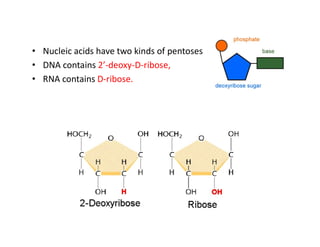
• Nucleic acids have two kinds of pentoses
• DNA contains 2’-deoxy-D-ribose,
• RNA contains D-ribose.
Four major deoxyribonucleotides (deoxyribonucleoside 5’
monophosphates) --
• Deoxyadenylate (deoxyadenosine 5’-monophosphate) Symbols : dAMP
• Deoxyguanylate (deoxyguanosine 5’-monophosphate) Symbols : dGMP
• Deoxythymidylate (deoxythymidine 5’-monophosphate) Symbols: dTMP
• Deoxycytidylate (deoxycytidine 5’-monophosphate) Symbols : dCMP
• Four major ribonucleotides (ribonucleoside 5’-
monophosphates) ---
• Adenylate (adenosine 5’-monophosphate) Symbols : AMP
• Guanylate (guanosine 5’-monophosphate) Symbols : GMP
• Uridylate (uridine 5’-monophosphate) Symbols : UMP
• Cytidylate (cytidine 5’-monophosphate) Symbols : CMP
Phosphate “Bridges”
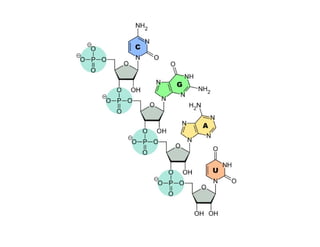
• The successive nucleotides of both DNA and RNA are
covalently linked through phosphate-group “bridges
• The 5’-phosphate group of one nucleotide unit is joined to the
3’-hydroxyl group of the next nucleotide, creating a
phosphodiester linkage.
• Thus the covalent backbones of nucleic acids consist of
alternating phosphate and pentose residues, and the
nitrogenous bases may be regarded as side groups joined to
the backbone at regular intervals.
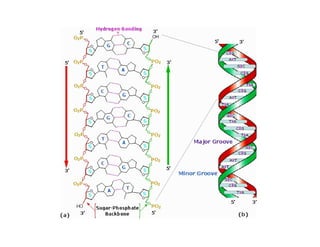
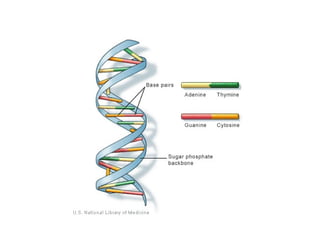
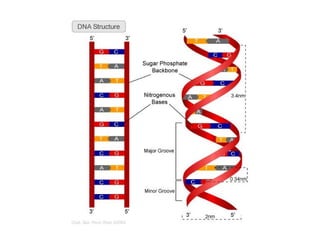
• DNA consists of two helical chains of nucleotides wound around
the same axis to form double helix. The two DNA strands are
organized in an anti-parallel arrangement i.e. one strand is
oriented 5’-3’ and other is oriented 3’-5’.
• The hydrophilic backbones of alternating deoxyribose and
phosphate groups are on the outside of the double helix, facing
the surrounding water.
• The purine and pyrimidine bases of both strands are stacked
inside the double helix, with their hydrophobic and nearly
planar ring structures very close together and perpendicular to
the long axis.
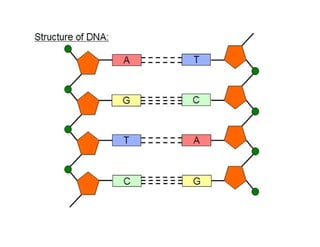
• Each nucleotide base of one strand is paired in the same
plane with a base of the other strand. G with C and A with T,
are those that fit best within the structure. This is called
complementary base pairing. Three hydrogen bonds can form
between G and C, but only two can form between A and T.
RNA
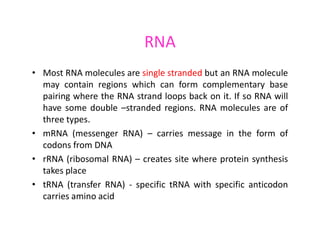
• Most RNA molecules are single stranded but an RNA molecule
may contain regions which can form complementary base
pairing where the RNA strand loops back on it. If so RNA will
have some double –stranded regions. RNA molecules are of
three types.
three types.
• mRNA (messenger RNA) – carries message in the form of
codons from DNA
• rRNA (ribosomal RNA) – creates site where protein synthesis
takes place
• tRNA (transfer RNA) - specific tRNA with specific anticodon
carries amino acid
Nucleic acid and it's classification

Nucleic acid and it's classification

  • 1.
    NUCLEIC ACIDS (DNA& RNA) • Nucleic acids are large biomolecules which function in encoding, transmitting and expressing genetic information. Nucleotides are building blocks of nucleic acids as the proteins are made of amino acids. Structure of Nucleotides: • Nucleotides have three characteristic components: 1. A base (nitrogen-containing) 2. A pentose sugar 3. A phosphate
  • 3.
    A nitrogenous base •The nitrogenous bases in nucleotides are derivatives of two parent compounds -- pyrimidine and purine. • Purines: Adenine & Guanine (A & G) • Pyrimidines: Cytosin, Thymine & Uracil (C, T and U) • Pyrimidines: Cytosin, Thymine & Uracil (C, T and U) • Both DNA and RNA contain two major purine bases, Adenine (A) and guanine (G) • Pyrimidines in DNA are cytosine (C) and thymine (T). • Pyrimidines in RNA are cytosine (C) and uracil (U).
  • 4.
    • Nucleic acidshave two kinds of pentoses • DNA contains 2’-deoxy-D-ribose, • RNA contains D-ribose.
  • 5.
    Four major deoxyribonucleotides(deoxyribonucleoside 5’ monophosphates) -- • Deoxyadenylate (deoxyadenosine 5’-monophosphate) Symbols : dAMP • Deoxyguanylate (deoxyguanosine 5’-monophosphate) Symbols : dGMP • Deoxythymidylate (deoxythymidine 5’-monophosphate) Symbols: dTMP • Deoxycytidylate (deoxycytidine 5’-monophosphate) Symbols : dCMP
  • 6.
    • Four majorribonucleotides (ribonucleoside 5’- monophosphates) --- • Adenylate (adenosine 5’-monophosphate) Symbols : AMP • Guanylate (guanosine 5’-monophosphate) Symbols : GMP • Uridylate (uridine 5’-monophosphate) Symbols : UMP • Cytidylate (cytidine 5’-monophosphate) Symbols : CMP
  • 7.
    Phosphate “Bridges” • Thesuccessive nucleotides of both DNA and RNA are covalently linked through phosphate-group “bridges • The 5’-phosphate group of one nucleotide unit is joined to the 3’-hydroxyl group of the next nucleotide, creating a 3’-hydroxyl group of the next nucleotide, creating a phosphodiester linkage. • Thus the covalent backbones of nucleic acids consist of alternating phosphate and pentose residues, and the nitrogenous bases may be regarded as side groups joined to the backbone at regular intervals.
  • 9.
    • DNA consistsof two helical chains of nucleotides wound around the same axis to form double helix. The two DNA strands are organized in an anti-parallel arrangement i.e. one strand is oriented 5’-3’ and other is oriented 3’-5’. • The hydrophilic backbones of alternating deoxyribose and phosphate groups are on the outside of the double helix, facing the surrounding water. the surrounding water. • The purine and pyrimidine bases of both strands are stacked inside the double helix, with their hydrophobic and nearly planar ring structures very close together and perpendicular to the long axis.
  • 10.
    • Each nucleotidebase of one strand is paired in the same plane with a base of the other strand. G with C and A with T, are those that fit best within the structure. This is called complementary base pairing. Three hydrogen bonds can form between G and C, but only two can form between A and T. between G and C, but only two can form between A and T.
  • 14.
    RNA • Most RNAmolecules are single stranded but an RNA molecule may contain regions which can form complementary base pairing where the RNA strand loops back on it. If so RNA will have some double –stranded regions. RNA molecules are of three types. three types. • mRNA (messenger RNA) – carries message in the form of codons from DNA • rRNA (ribosomal RNA) – creates site where protein synthesis takes place • tRNA (transfer RNA) - specific tRNA with specific anticodon carries amino acid