Intravenous urogram
Sukhdev, CMC Vellore
Terminology
• Intravenous urogram
• Pyelogram = RGP
• Intravenous pyelogram ≠ Intravenous urogram
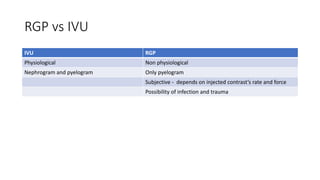
RGP vs IVU
IVU RGP
Physiological Non physiological
Nephrogram and pyelogram Only pyelogram
Subjective - depends on injected contrast’s rate and force
Possibility of infection and trauma
Physiological effects of IVU
• Osmolar shifts occur and so, influx of water from interstitium to blood
stream – cardiac output increases by 16%
• Peripheral vasodilatation can occur
• Chelation of calcium by the contrast – clinical tetany can occur
Preparation of patients
• Catharsis
• Dehydration
• Both are not recommended now
Exceptions:
• In elderly gentlemen with constipation, catharsis – oral and rectal – is
recommended
Rationale of dehydration
• Dehydration > ↑ ADH > ↑ water reabsorption in tubules > ↑ density
of contrast in tubules
Risks of dehydration
• AKI - Protein precipitates in tubules
• Renal vein thrombosis
Technique and phases
• Scout
• 1 minute film
• 3 minute film followed by ureteral compression
• Three tomograms
• 10 minute film
• 20 minute film – supine
• 20 minute film - prone
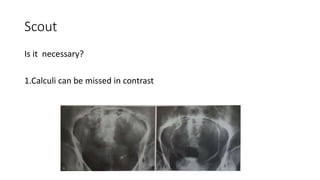
Scout
Is it necessary?
1.Calculi can be missed in contrast
2. Skeletal abnormalities are well observed in scout
3. Intestinal gas patterns – like ileus- can be well seen
4.Foreign bodies
Contrast injection
• Ionic vs non ionic contrast media
• Non ionic contrast media – lesser reactions, but more expensive
Types of administration
1. Bolus
2. Drip infusion
Bolus:
• Average adult dose is 20-30 g of iodine
• Do not exceed 30 g
• For e.g: iohexol – 180 mg of iodine/ml
• 100-150 ml of contrast which is injected antecubitally
• Rapid injection α better nephrogram
• Slow injection α less dense nephrogram
• More iodine α more dense nephrogram
• So, nephrogram quality depends on rate and quantity of contrast injection
Drip infusion technique:
Advantages:
• Prolonged nephrogram
• Enhanced diuresis which distends the collecting system
• And so, ureteral compression may not be necessary
• Longer collecting system visualisation
• Easy administration
Disadvantages:
• Not advisable in cardiac patients
• False calyceal blunting due to distention
• This can lead to pyelosinus extravasation
Post contrast sequences
• 1 minute film
• 3 minute film followed by ureteral compression
• Three tomograms
• 10 minute film
• 20 minute film – supine
• 20 minute film - prone
Post contrast sequences
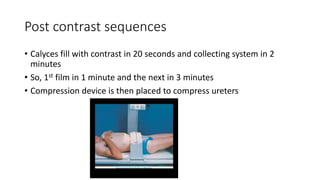
• Calyces fill with contrast in 20 seconds and collecting system in 2
minutes
• So, 1st film in 1 minute and the next in 3 minutes
• Compression device is then placed to compress ureters
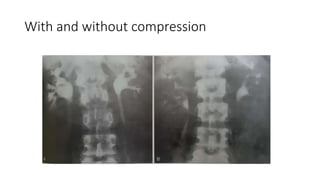
With and without compression
Contraindications of compression:
• Ureteral calculi with obstruction
• Recent surgery
• Nephrostomy
• Severe hypertension
• AAA
Tomgrams
Used routinely in patients older than 40
• Average patients : 8,9,10 cm from tabletop
• Heavy patients : 9,10,11 cm from tabletop
• Lean patients : 7,8,9 cm from tabletop
Prone film
• Better visualisation of distal ureters
• Lesions on anterior bladder wall well seen
• Bladder hernias well seen
Rationale of a prone film:
Contrast is denser
• Upper pole is posterior than the lower pole in supine position and so,
drainage is hindered. In prone, it is reversed
• Ureters are anterior to renal pelvic plane in supine position and in prone, it
is reversed
SUPINE PRONE
Delayed films:
• May be obtained 1 hr-2 days after injection
• Valuable ONLY when nephrogram is seen but the collecting system
visualised
Erect film:
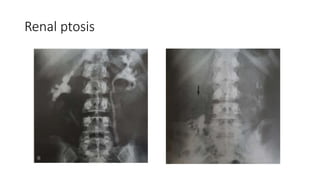
• Renal ptosis, bladder hernias, cystoscelces
• Layering of calculi in cysts
Post voiding film:
• Usually not necessary unless you need to know about residual urine
Renal ptosis
RENAL ANATOMY IN IVU
Renal Size
• Average in autopsy : 11.25*(5-7.5)*(2-3.5) cm
• In IVU, apparent nephromegaly due to:
1. Radiographic magnification(18%)
2. Diuresis induced nephromegaly
Some numbers
• Men’s kidneys longer than women’s kidneys due to larger BSA
• Average renal length = 3-4 lumbar vertebral bodies
• Right kidney 0.5 cm smaller than left kidney
• To say that a kidney is large:
1. Right kidney should be 0.5 cm larger than left
2. Left kidney should be 0.5 cm larger than right
• Respiratory excursion can occur upto 1-4 cm
• So, urograms are best done in expiratory phase, because inspiration
can kink the ureters
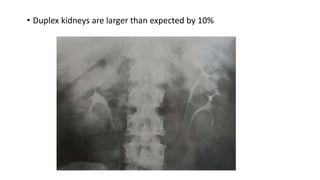
• Duplex kidneys are larger than expected by 10%
Renal location
• Non visualisation vs non excreting and non functional
• Right renal pelvis is at the level of L2
• Left renal pelvis is 0.5-1 cm higher
Variations in renal location
Cephalocaudal axis:
• Excursion of upto 2 lumbar vertebrae is normal
• DD: ectopia vs ptosis
• In ptosis, ureters will be of normal length or might be even kinked
• In ectopia, ureters are short
Coronal axis:
Lateral displaced kidney
Cont’d
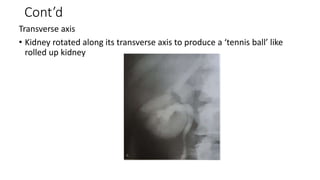
Transverse axis
• Kidney rotated along its transverse axis to produce a ‘tennis ball’ like
rolled up kidney
Anatomical relationship of ureters
• Ureters are lined along tips of transverse processes
• Lateral deviation if >1.5 cm from tip of transverse process
• Medial deviation if ureter overlies the vertebral pedicle
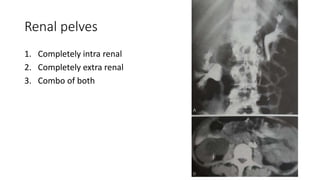
Renal pelves
1. Completely intra renal
2. Completely extra renal
3. Combo of both
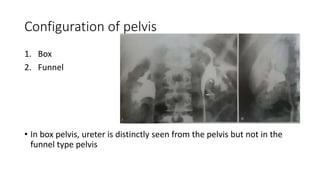
Configuration of pelvis
1. Box
2. Funnel
• In box pelvis, ureter is distinctly seen from the pelvis but not in the
funnel type pelvis
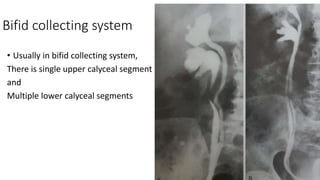
Bifid collecting system
• Usually in bifid collecting system,
There is single upper calyceal segment
and
Multiple lower calyceal segments
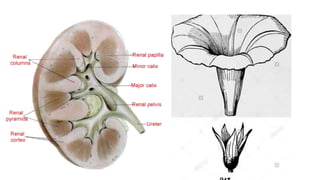
Calyces
• Anatomy textbooks : minor calyces > major calyces > infundibular
• Practically : calyces > infundibula
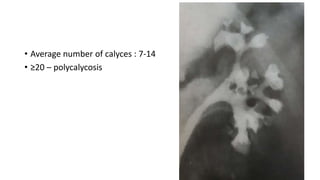
• Average number of calyces : 7-14
• ≥20 – polycalycosis
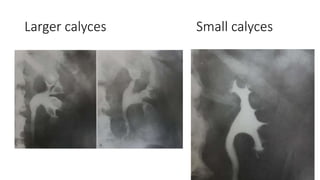
• Calyx is physiologically active
• Larger the papilla, larger is the calyx
• Smaller the papilla, smaller is the calyx
Larger calyces Small calyces
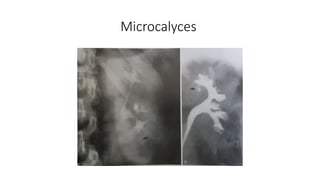
Microcalyces
Infundibular variations
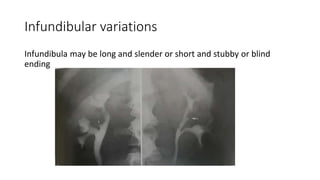
Infundibula may be long and slender or short and stubby or blind
ending
50%
35%
15%
cortex medulla sinus fat
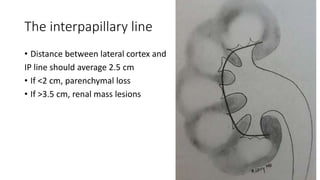
The interpapillary line
• Distance between lateral cortex and
IP line should average 2.5 cm
• If <2 cm, parenchymal loss
• If >3.5 cm, renal mass lesions

Intravenous urogram.pptx

  • 1.
  • 2.
    Terminology • Intravenous urogram •Pyelogram = RGP • Intravenous pyelogram ≠ Intravenous urogram
  • 3.
    RGP vs IVU IVURGP Physiological Non physiological Nephrogram and pyelogram Only pyelogram Subjective - depends on injected contrast’s rate and force Possibility of infection and trauma
  • 4.
    Physiological effects ofIVU • Osmolar shifts occur and so, influx of water from interstitium to blood stream – cardiac output increases by 16% • Peripheral vasodilatation can occur • Chelation of calcium by the contrast – clinical tetany can occur
  • 5.
    Preparation of patients •Catharsis • Dehydration • Both are not recommended now Exceptions: • In elderly gentlemen with constipation, catharsis – oral and rectal – is recommended
  • 6.
    Rationale of dehydration •Dehydration > ↑ ADH > ↑ water reabsorption in tubules > ↑ density of contrast in tubules Risks of dehydration • AKI - Protein precipitates in tubules • Renal vein thrombosis
  • 7.
    Technique and phases •Scout • 1 minute film • 3 minute film followed by ureteral compression • Three tomograms • 10 minute film • 20 minute film – supine • 20 minute film - prone
  • 8.
    Scout Is it necessary? 1.Calculican be missed in contrast
  • 9.
    2. Skeletal abnormalitiesare well observed in scout 3. Intestinal gas patterns – like ileus- can be well seen 4.Foreign bodies
  • 10.
    Contrast injection • Ionicvs non ionic contrast media • Non ionic contrast media – lesser reactions, but more expensive Types of administration 1. Bolus 2. Drip infusion
  • 11.
    Bolus: • Average adultdose is 20-30 g of iodine • Do not exceed 30 g • For e.g: iohexol – 180 mg of iodine/ml • 100-150 ml of contrast which is injected antecubitally • Rapid injection α better nephrogram • Slow injection α less dense nephrogram • More iodine α more dense nephrogram • So, nephrogram quality depends on rate and quantity of contrast injection
  • 12.
    Drip infusion technique: Advantages: •Prolonged nephrogram • Enhanced diuresis which distends the collecting system • And so, ureteral compression may not be necessary • Longer collecting system visualisation • Easy administration Disadvantages: • Not advisable in cardiac patients • False calyceal blunting due to distention • This can lead to pyelosinus extravasation
  • 13.
    Post contrast sequences •1 minute film • 3 minute film followed by ureteral compression • Three tomograms • 10 minute film • 20 minute film – supine • 20 minute film - prone
  • 14.
    Post contrast sequences •Calyces fill with contrast in 20 seconds and collecting system in 2 minutes • So, 1st film in 1 minute and the next in 3 minutes • Compression device is then placed to compress ureters
  • 15.
    With and withoutcompression
  • 16.
    Contraindications of compression: •Ureteral calculi with obstruction • Recent surgery • Nephrostomy • Severe hypertension • AAA
  • 17.
    Tomgrams Used routinely inpatients older than 40 • Average patients : 8,9,10 cm from tabletop • Heavy patients : 9,10,11 cm from tabletop • Lean patients : 7,8,9 cm from tabletop
  • 18.
    Prone film • Bettervisualisation of distal ureters • Lesions on anterior bladder wall well seen • Bladder hernias well seen Rationale of a prone film: Contrast is denser • Upper pole is posterior than the lower pole in supine position and so, drainage is hindered. In prone, it is reversed • Ureters are anterior to renal pelvic plane in supine position and in prone, it is reversed
  • 19.
  • 20.
    Delayed films: • Maybe obtained 1 hr-2 days after injection • Valuable ONLY when nephrogram is seen but the collecting system visualised Erect film: • Renal ptosis, bladder hernias, cystoscelces • Layering of calculi in cysts Post voiding film: • Usually not necessary unless you need to know about residual urine
  • 22.
  • 23.
  • 24.
    Renal Size • Averagein autopsy : 11.25*(5-7.5)*(2-3.5) cm • In IVU, apparent nephromegaly due to: 1. Radiographic magnification(18%) 2. Diuresis induced nephromegaly
  • 25.
    Some numbers • Men’skidneys longer than women’s kidneys due to larger BSA • Average renal length = 3-4 lumbar vertebral bodies • Right kidney 0.5 cm smaller than left kidney • To say that a kidney is large: 1. Right kidney should be 0.5 cm larger than left 2. Left kidney should be 0.5 cm larger than right • Respiratory excursion can occur upto 1-4 cm • So, urograms are best done in expiratory phase, because inspiration can kink the ureters
  • 26.
    • Duplex kidneysare larger than expected by 10%
  • 27.
    Renal location • Nonvisualisation vs non excreting and non functional • Right renal pelvis is at the level of L2 • Left renal pelvis is 0.5-1 cm higher
  • 28.
    Variations in renallocation Cephalocaudal axis: • Excursion of upto 2 lumbar vertebrae is normal • DD: ectopia vs ptosis • In ptosis, ureters will be of normal length or might be even kinked • In ectopia, ureters are short Coronal axis: Lateral displaced kidney
  • 29.
    Cont’d Transverse axis • Kidneyrotated along its transverse axis to produce a ‘tennis ball’ like rolled up kidney
  • 30.
    Anatomical relationship ofureters • Ureters are lined along tips of transverse processes • Lateral deviation if >1.5 cm from tip of transverse process • Medial deviation if ureter overlies the vertebral pedicle
  • 31.
    Renal pelves 1. Completelyintra renal 2. Completely extra renal 3. Combo of both
  • 32.
    Configuration of pelvis 1.Box 2. Funnel • In box pelvis, ureter is distinctly seen from the pelvis but not in the funnel type pelvis
  • 33.
    Bifid collecting system •Usually in bifid collecting system, There is single upper calyceal segment and Multiple lower calyceal segments
  • 34.
    Calyces • Anatomy textbooks: minor calyces > major calyces > infundibular • Practically : calyces > infundibula
  • 36.
    • Average numberof calyces : 7-14 • ≥20 – polycalycosis
  • 37.
    • Calyx isphysiologically active • Larger the papilla, larger is the calyx • Smaller the papilla, smaller is the calyx
  • 38.
  • 39.
  • 40.
    Infundibular variations Infundibula maybe long and slender or short and stubby or blind ending
  • 41.
  • 42.
    The interpapillary line •Distance between lateral cortex and IP line should average 2.5 cm • If <2 cm, parenchymal loss • If >3.5 cm, renal mass lesions