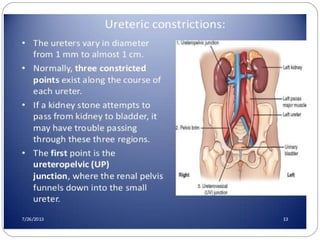
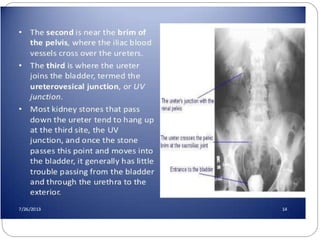
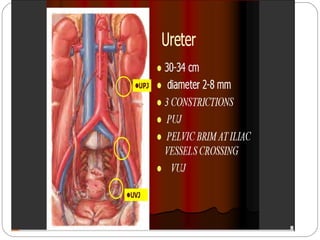
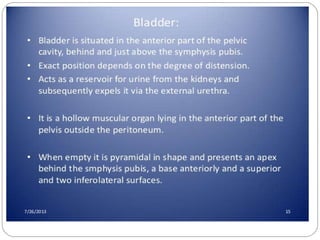
Dr. Uttam Laudari
JR III
Kathmandu Medical college
Intravenous Urography
Definition
It is the radiographic examination of the
urinary tract including the renal parenchyma,
calyces and pelvis after the intravenous
injection of the contrast media.
Intravenous Urography
Use decreased significantly in recent years
CT, US, MR is replacing
Remains primary modality for visualization
of pelvicalyceal system and ureter
1937-Berger made several recommendations
•Routine tomography
•High dose of contrast agents
•Ureteral compression
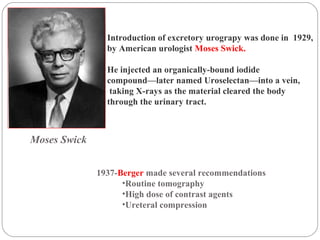
Introduction of excretory urograpy was done in 1929,
by American urologist Moses Swick.
He injected an organically-bound iodide
compound—later named Uroselectan—into a vein,
taking X-rays as the material cleared the body
through the urinary tract.
Moses Swick
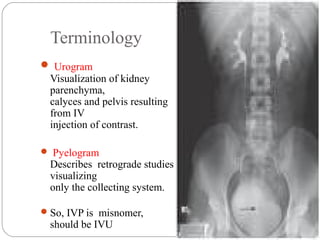
Terminology
 Urogram
Visualization of kidney
parenchyma,
calyces and pelvis resulting
from IV
injection of contrast.
 Pyelogram
Describes retrograde studies
visualizing
only the collecting system.
So, IVP is misnomer,
should be IVU
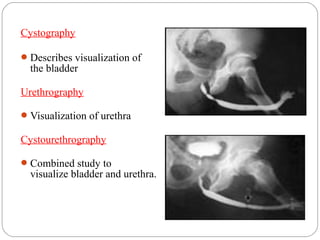
Cystography
Describes visualization of
the bladder
Urethrography
Visualization of urethra
Cystourethrography
Combined study to
visualize bladder and urethra.
Contrast is what we give intravenously.
Dye is used on clothes and in cooking to
change the color of things—it is not given IV
to patients!
Indications
American College of Radiology (ACR)
guidelines published in 2010
To evaluate the presence or continuing presence
of suspected or known ureteral obstruction.
To assess the integrity of the urinary tract status
post trauma.
To assess the urinary tract for suspected
congenital anomalies.
To assess the urinary tract for lesions that may
explain hematuria or infection
Investigation of HTN in young adults not
controlled
contraindications
No absolute contraindication
Relative contraindications
Renal failure (raised serum creatinine level >1.5
mg/dL)
Hepatorenal syndrome
Previous allergy to the contrast agent/iodine
Generalized allergic conditions
 Multiple myeloma
Pregnancy
Infancy
Thyrotoxicosis
Diabetes
Advantages
 Clear outline of the entire urinary system so can see even mild
hydronephrosis.
 Easier to pick out obstructing stone when there are multiple pelvic
calcifications.
 Can show non-opaque stones as filling defects.
 Demonstrate renal function and allow for verification that the opposite
kidney is functioning normally.
Disadvantages
 need for IV contrast material
 may provoke an allergic response
 multiple delayed films (Can take hours as contrast passes quite slowly into the
blocked renal unit and ureter.)
 May not have sufficient opacification to define the anatomy and point of
obstruction.
 Requires a significant amount of radiation exposure and may not be ideal for
young children or pregnant women
Internal structure
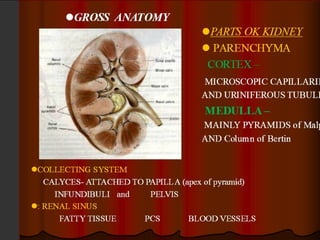
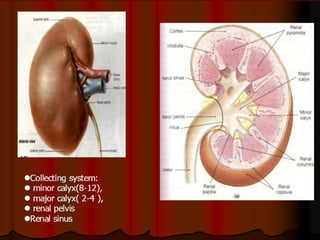
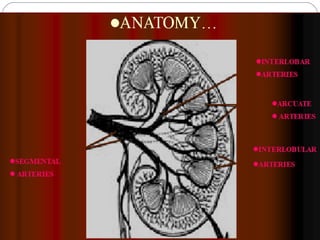
The parenchyma of the kidney is divided into two
major structures: superficial is the renal cortex and
deep is the renal medulla.
Grossly, these structures take the shape of 8 to 18
cone-shaped renal lobes, each containing renal
cortex surrounding a portion of medulla called a
renal pyramid (of Malpighi).
 Between the renal pyramids are projections of
cortex called renal columns (of Bertin).
Nephrons, the urine-producing functional
structures of the kidney, span the cortex and
medulla.
The tip, or papilla, of each pyramid empties urine
into a minor calyx
 minor calyces empty into major calyces, and
major calyces empty into the renal pelvis, which
becomes the ureter.
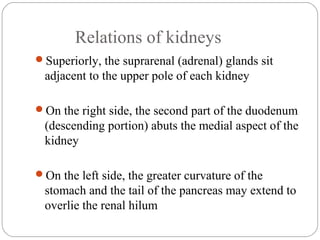
Relations of kidneys
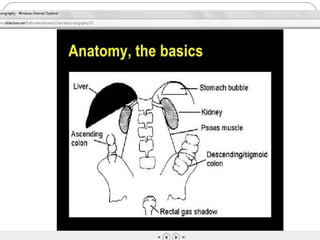
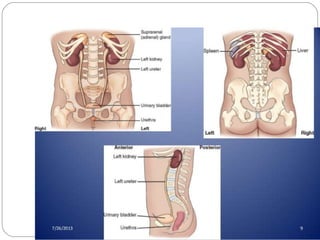
Superiorly, the suprarenal (adrenal) glands sit
adjacent to the upper pole of each kidney
On the right side, the second part of the duodenum
(descending portion) abuts the medial aspect of the
kidney
On the left side, the greater curvature of the
stomach and the tail of the pancreas may extend to
overlie the renal hilum
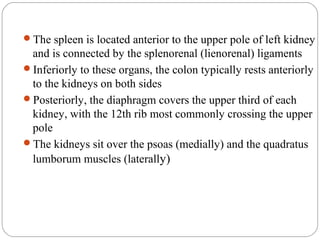
The spleen is located anterior to the upper pole of left kidney
and is connected by the splenorenal (lienorenal) ligaments
Inferiorly to these organs, the colon typically rests anteriorly
to the kidneys on both sides
Posteriorly, the diaphragm covers the upper third of each
kidney, with the 12th rib most commonly crossing the upper
pole
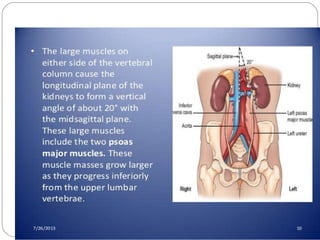
The kidneys sit over the psoas (medially) and the quadratus
lumborum muscles (laterally)
Contrast
High osmolar contrast media
Low osmolar contrast media
Iso osmolar contrast media
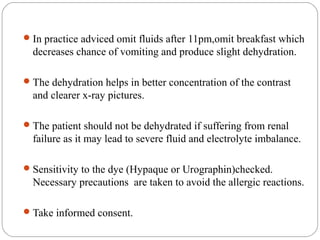
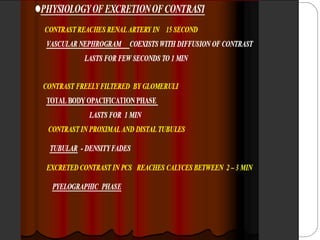
In practice adviced omit fluids after 11pm,omit breakfast which
decreases chance of vomiting and produce slight dehydration.
The dehydration helps in better concentration of the contrast
and clearer x-ray pictures.
The patient should not be dehydrated if suffering from renal
failure as it may lead to severe fluid and electrolyte imbalance.
Sensitivity to the dye (Hypaque or Urographin)checked.
Necessary precautions are taken to avoid the allergic reactions.
Take informed consent.
Extra renal routes for contrast excretion:
Hepatic
Small bowel
Sweat
 saliva
Tears
Gastric juice
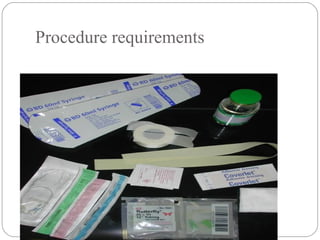
Procedure requirements
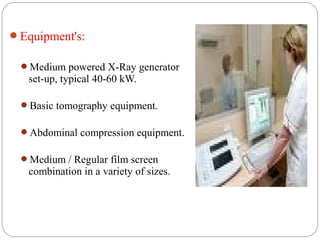
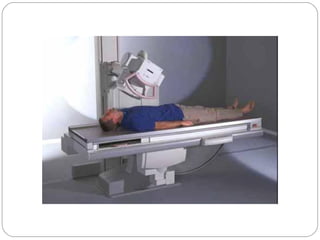
Equipment's:
Medium powered X-Ray generator
set-up, typical 40-60 kW.
Basic tomography equipment.
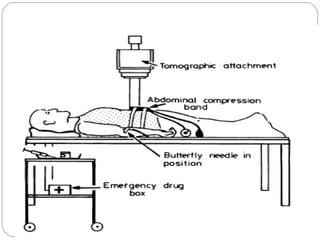
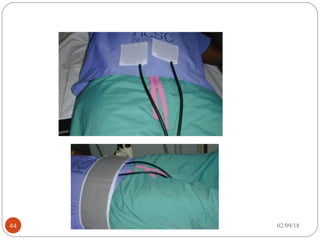
Abdominal compression equipment.
Medium / Regular film screen
combination in a variety of sizes.
Pads and immobilisation aids.
Intravenous administration equipment:
50 ml syringe, filling needle, skin prep, sticky tape,
Selection of needles, straight/'Butterfly' 16, 19, 21,23
gauge.
Tourniquet or blood pressure cuff.
Emergency drugs and equipment.
02/09/1844
Technique
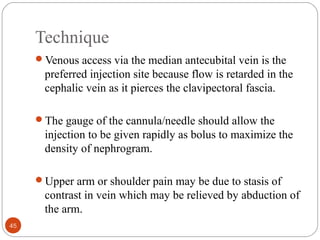
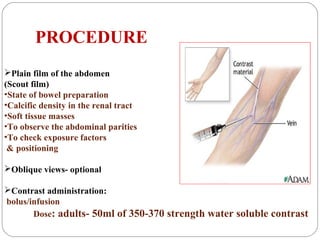
Venous access via the median antecubital vein is the
preferred injection site because flow is retarded in the
cephalic vein as it pierces the clavipectoral fascia.
The gauge of the cannula/needle should allow the
injection to be given rapidly as bolus to maximize the
density of nephrogram.
Upper arm or shoulder pain may be due to stasis of
contrast in vein which may be relieved by abduction of
the arm.
45
PROCEDURE
Plain film of the abdomen
(Scout film)
•State of bowel preparation
•Calcific density in the renal tract
•Soft tissue masses
•To observe the abdominal parities
•To check exposure factors
& positioning
Oblique views- optional
Contrast administration:
bolus/infusion
Dose: adults- 50ml of 350-370 strength water soluble contrast
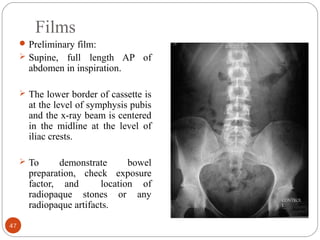
Films
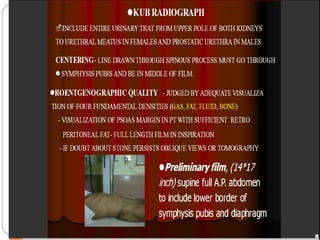
Preliminary film:
 Supine, full length AP of
abdomen in inspiration.
 The lower border of cassette is
at the level of symphysis pubis
and the x-ray beam is centered
in the midline at the level of
iliac crests.
 To demonstrate bowel
preparation, check exposure
factor, and location of
radiopaque stones or any
radiopaque artifacts.
47
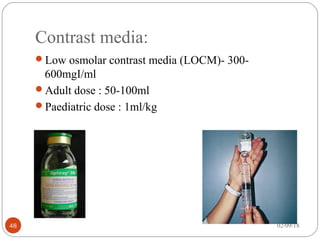
Contrast media:
Low osmolar contrast media (LOCM)- 300-
600mgI/ml
Adult dose : 50-100ml
Paediatric dose : 1ml/kg
02/09/1848
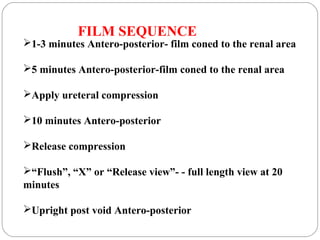
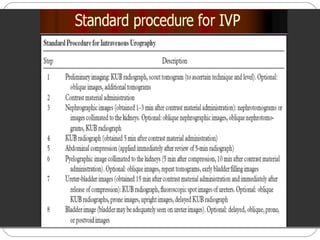
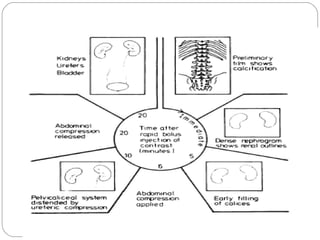
FILM SEQUENCE
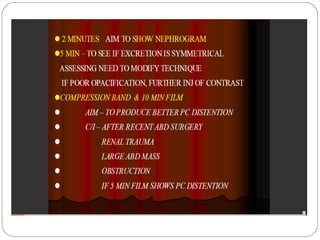
1-3 minutes Antero-posterior- film coned to the renal area
5 minutes Antero-posterior-film coned to the renal area
Apply ureteral compression
10 minutes Antero-posterior
Release compression
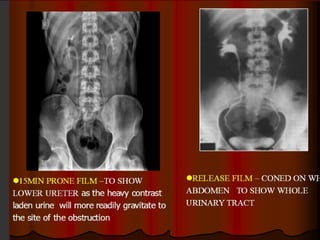
“Flush”, “X” or “Release view”- - full length view at 20
minutes
Upright post void Antero-posterior
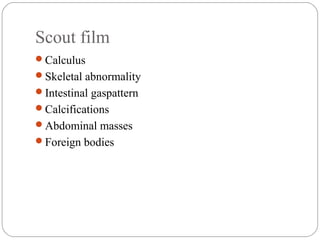
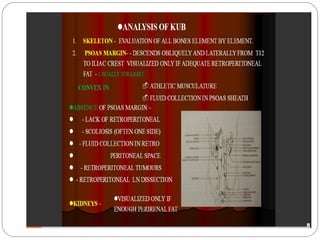
Scout film
Calculus
Skeletal abnormality
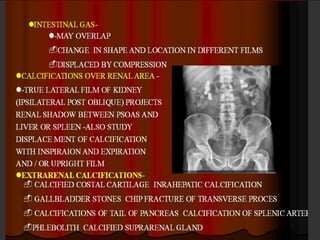
Intestinal gaspattern
Calcifications
Abdominal masses
Foreign bodies
Contraindications to ureteral
compression
Evidence of obstruction on the 5-minute image
Abdominal aortic aneurysm or other
abdominal mass
Severe abdominal pain
Recent abdominal surgery
Suspected urinary tract trauma
Presence of a urinary diversion
Presence of a renal transplant
WHAT TO LOOK FOR IN IVU
Size, shape, position and axis of kidneys
External cortex and inner medulla
Calyceal system
Renal pelvis and ureteropelvic junction
Ureter
Uretero-vesical junction
Urinary bladder
Relation of ureter to spine and psoas muscle
RADIATION DOSE FROM IVU
1,465 mR/projection for males
1,047 mR for females
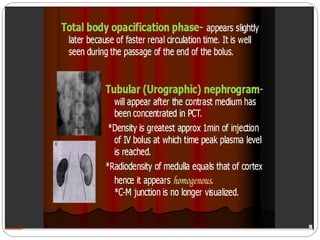
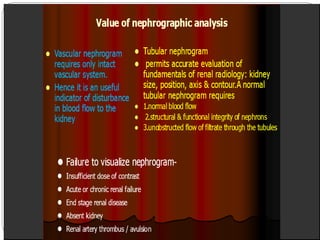
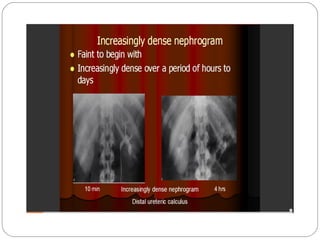
The size of the kidneys should be assesed during
neprographic phase
The normal kidney may range from 9 to13 cm in
cephalocaudal length, with the left kidney inherently larger
than the right by 0.5 cm and the kidneys slightly larger in
men than in women
Significant discrepancies (right kidney 1.5 cm larger than
the left kidney,left kidney 2 cm larger than the right
kidney) require explanation.
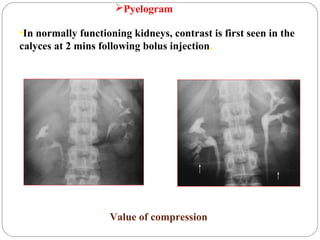
Pyelogram
Value of compression
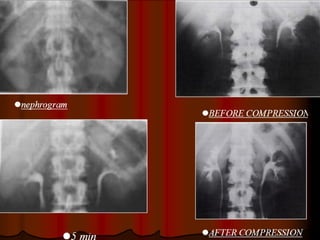
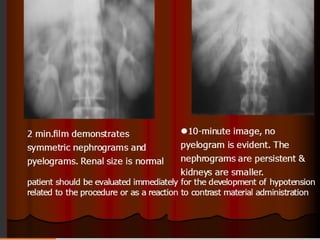
•In normally functioning kidneys, contrast is first seen in the
calyces at 2 mins following bolus injection.
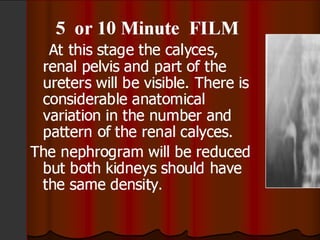
On the 5-minute image, the nephrogram should be
receding as the collecting system becomes opacified.
On the 10-minute image, the pyelogram is the
dominant urographic element.
Alterations in this temporal sequence require
explanation.
Visualization of the collecting system and renal pelvis
can be augmented with the use of abdominal
compression, Trendelenburg position, and other
gravity maneuvers such
as placing the patient with the side of interest in the
ipsilateral posterior oblique position
The appearance of the calices and renal pelvis should
be examined closely
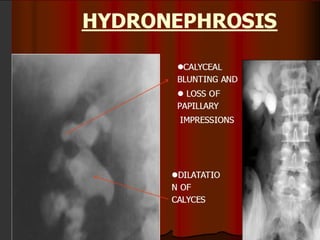
Early and mild obstruction is indicated by subtle
rounding of the forniceal margins
more severe and prolonged obstruction evidenced by
progressive loss of the papillary impression and
eventual clubbing of calices.
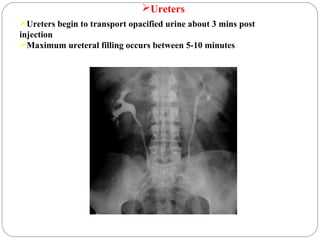
Ureters
Ureters begin to transport opacified urine about 3 mins post
injection
Maximum ureteral filling occurs between 5-10 minutes.
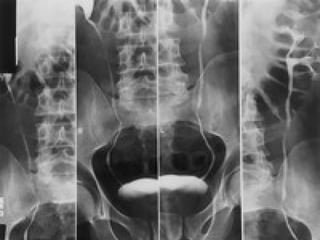
At the release of compression, the bolus of contrast
material–laden urine entering the ureters provides
optimal visualization throughout their length
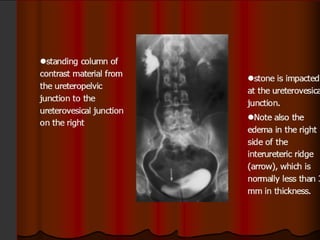
Persistence of a standing column of contrast material on
several images may indicate obstruction or ureteral ileus
(nonobstructive dilatation).
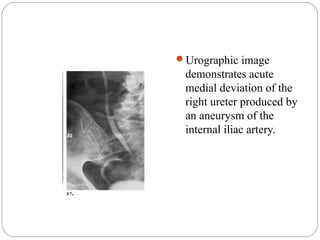
Medial deviation of the ureter should be considered
when the ureter overlies the ipsilateral lumbar pedicle.
lateral deviation should be considered when the ureter lies more
than 1.5 cm beyond the tip of the transverse process, but
comparison with the position of the contralateral ureter should
always be made
Urographic image
demonstrates acute
medial deviation of the
right ureter produced by
an aneurysm of the
internal iliac artery.
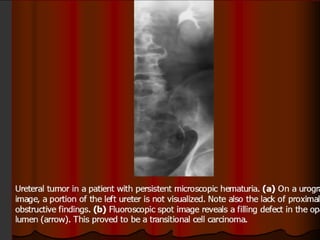
Ureteral filling defects may be single or multiple and
can usually be attributed to luminal, mural, or extrinsic
causes.
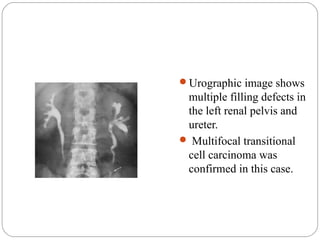
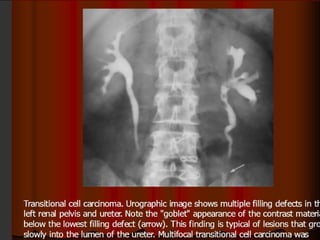
Urographic image shows
multiple filling defects in
the left renal pelvis and
ureter.
 Multifocal transitional
cell carcinoma was
confirmed in this case.
An absolute ureteral diameter exceeding 8 mm
is considered a criterion for dilatation
Asymmetry of ureteral caliber is a more significant
finding.
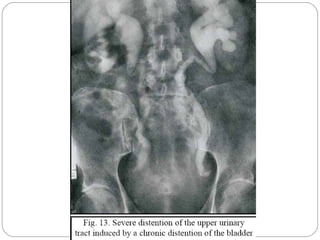
Early in its course, high-grade ureteral obstruction may
be associated with only minimal ureteral dilatation.
More chronic forms of obstruction and other chronic
ureteral conditions are typically associated with greater
degrees of ureteral dilatation
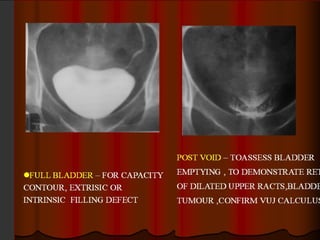
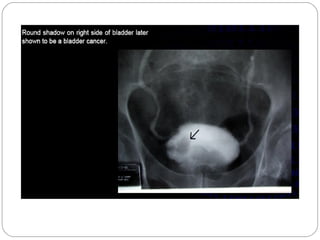
Bladder
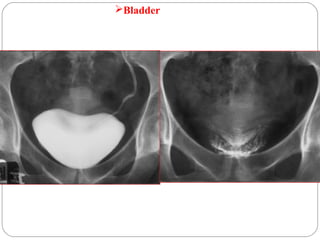
By 15–30 minutes after the injection of contrast
material, the bladder is often sufficiently filled, and the
15-minute KUB radiograph may be adequate for
evaluation.
 As the bladder distends with contrast the intraluminal
contrast material should be spheric and smoothly
marginated and the wall progressively less evident.
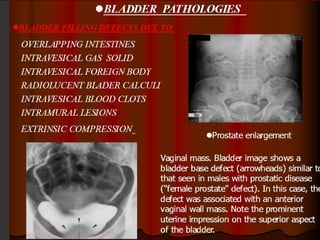
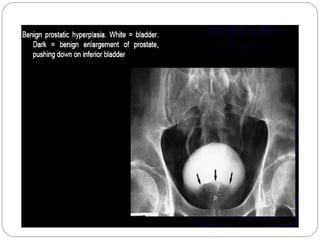
Bladder wall thickening and irregularity of the luminal
contrast material associated with a bladder base defect
is typical of changes of bladder outlet obstruction from
prostatic disease.
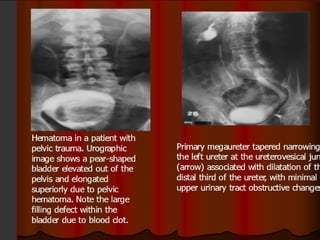
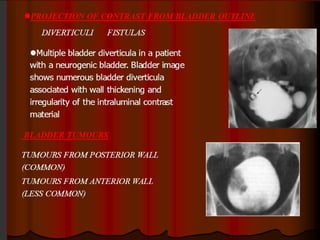
Contour abnormalities from cellule or diverticulum
formation.
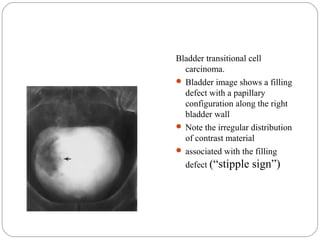
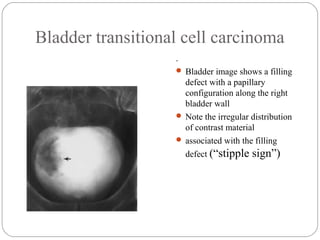
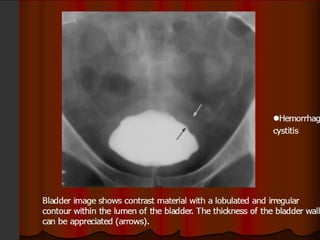
Bladder transitional cell
carcinoma.
 Bladder image shows a filling
defect with a papillary
configuration along the right
bladder wall
 Note the irregular distribution
of contrast material
 associated with the filling
defect (“stipple sign”)
The postvoid image may also be helpful in evaluating
patients with upper urinary tract dilatation.
Persistence of the dilatation on the postvoid image
suggests fixed obstruction,
The postvoid image is most helpful in assessing
residual volume.
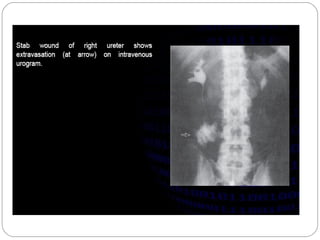
Extravasation of contrast medium
Local pain, erythema, swelling
Usually resolve with local therapy
Rarely, significant tissue necrosis and skin-
sloughing occur (even with small amounts)
 severe, may lead to compartment
syndrome
Severe edema, loss of pulses, necrosis
More common with injection in hand or foot
Initial recommended treatment of
extravasation

- Elevation of affected extremity above heart

- Ice packs (15-60min/3 times per day)
- Close observation for 2-4 hrs
 Immediate plastic surgery consultation
for the following indications
Extravasated volume exceeds 100 cc of nonionic
contrast
Skin blistering
Altered tissue perfusion
Decreased capillary refill over or distal to injection site
Increasing pain after 2-4 hours
Change in sensation distal to site extravasation
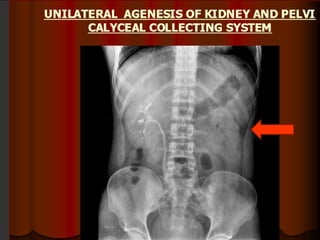
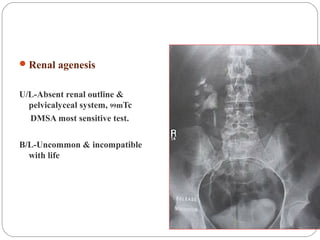
Renal agenesis
U/L-Absent renal outline &
pelvicalyceal system, 99mTc
DMSA most sensitive test.
B/L-Uncommon & incompatible
with life
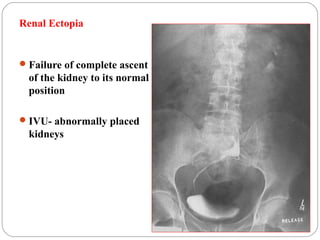
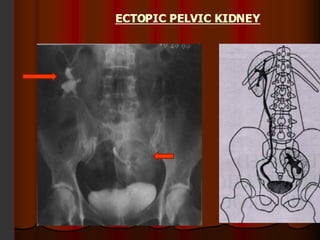
Renal Ectopia
Failure of complete ascent
of the kidney to its normal
position
IVU- abnormally placed
kidneys
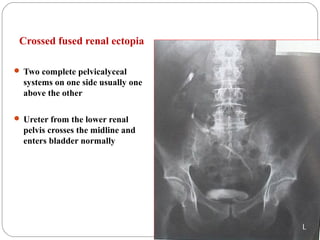
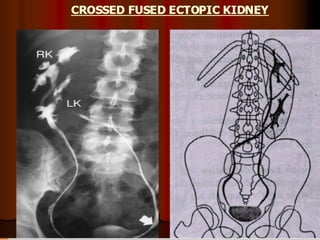
Crossed fused renal ectopia
 Two complete pelvicalyceal
systems on one side usually one
above the other
 Ureter from the lower renal
pelvis crosses the midline and
enters bladder normally
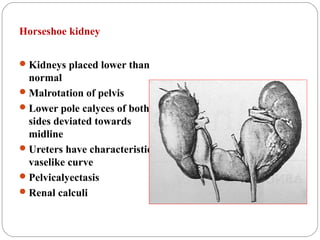
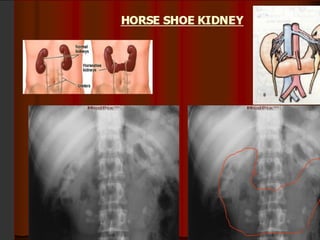
Horseshoe kidney
Kidneys placed lower than
normal
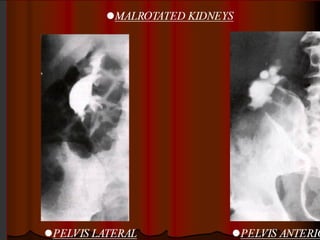
Malrotation of pelvis
Lower pole calyces of both
sides deviated towards
midline
Ureters have characteristic
vaselike curve
Pelvicalyectasis
Renal calculi
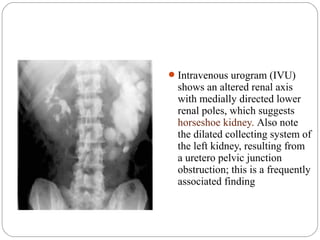
Intravenous urogram (IVU)
shows an altered renal axis
with medially directed lower
renal poles, which suggests
horseshoe kidney. Also note
the dilated collecting system of
the left kidney, resulting from
a uretero pelvic junction
obstruction; this is a frequently
associated finding
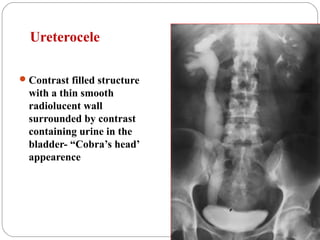
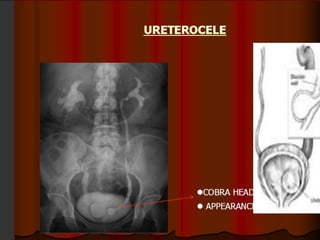
Ureterocele
Contrast filled structure
with a thin smooth
radiolucent wall
surrounded by contrast
containing urine in the
bladder- “Cobra’s head’
appearence
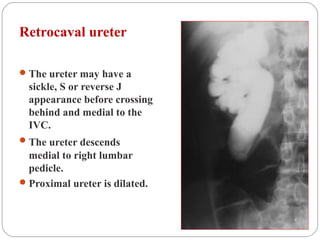
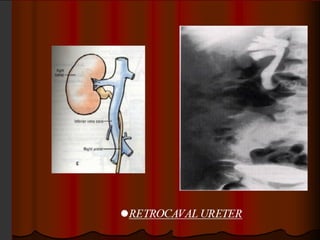
Retrocaval ureter
The ureter may have a
sickle, S or reverse J
appearance before crossing
behind and medial to the
IVC.
The ureter descends
medial to right lumbar
pedicle.
Proximal ureter is dilated.
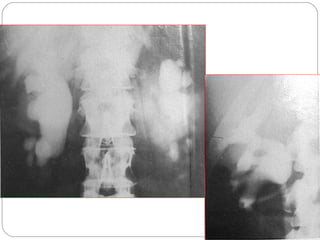
Grading of hydronephrosis
 Gr 1-dilatation of renal pelvis without dilatation of calices, prominent
reflex of renal sinus without signs of parenchymal atrophy.
 Gr2-dilatation of renal pelvis and calices ,pelvicalyceal pattern is
maintained, no signs of parenchymal atrophy
 Gr3-moderate dilatation of renal pelvis and calyces ,blunting of
fornices and flattening of papillae, mild cortical thinning may be seen
 Gr4-gross dilatation of renal pelvis and calyces which appear ballooned
,loss of borders between renal pelvis and calyces,renal atrophy seen as
cortical thinning.
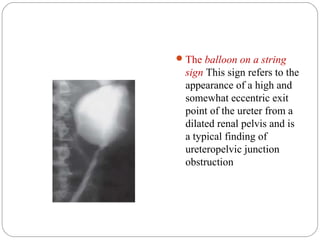
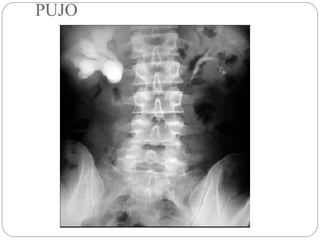
The balloon on a string
sign This sign refers to the
appearance of a high and
somewhat eccentric exit
point of the ureter from a
dilated renal pelvis and is
a typical finding of
ureteropelvic junction
obstruction
PUJO
Renal CT scan
Renal CT is most commonly used in the evaluation of acute
flank pain, hematuria, renal infection (search for abscess) and
renal trauma, and in the characterization and staging of renal
neoplasm.
CT evaluation of renal anatomy and pathology generally
requires intravenous injection of iodinated contrast media
Renal Ct scan
noncontrast scans are needed, when renal or perirenal
calcification, hemorrhage, or urine extravasation is
suspected, since scans obtained after the administration of
contrast media may mask these abnormalities.
Also, pre- and postcontrast scans are required to determine
whether a mass is solid or cystic
RENAL CT SCAN
 Using a bolus injection and rapid sequence scanning, renal
arterial opacification is followed immediately by
enhancement of the cortex.
A nephrogram phase with medullary enhancement is reached
within 60 seconds.
Excretion of contrast material into the collecting structures
can be expected within 2–3 minutes after initiation of
contrast administration
RENAL CT SCAN- for ureters
Suspected urolithiasis -Helical CT without oral or
intravenous contrast is the preferred imaging
Ureteral tumors
Staging and level of obstruction
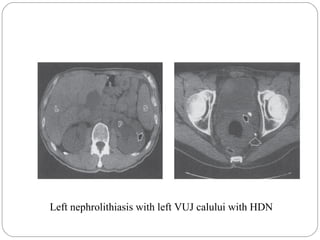
Left nephrolithiasis with left VUJ calului with HDN
Urinary bladder Tumor
primarily in staging bladder tumors and in diagnosing
bladder rupture following trauma
Performing CT after filling the bladder with dilute contrast
medium (CT cystography) improves the sensitivity of this
modality for detecting tumors and bladder rupture
Prostate - CT
For prostate diseases, CT is used for detection of
lymphadenopathy and to delineate prostatic abscesses.
Also for
abdominal location of suspected undescended testes
for staging of testicular tumors
and in the search for nodal or distant metastasis
CT- adrenal lesion
The addition of delayed CT imaging 10–15 minutes
postintravenous contrast–enhanced CT shows high sensitivity
and specificity in characterizing adrenal lesions.
Benign adenomas, including lipid poor adenomas, show brisk
contrast washout.
Advantages of CT
 a wide field of view
the ability to detect subtle differences in the x-ray
attenuation properties of various tissues
good spatial resolution, anatomical cross-sectional images
Reformatted helical image data in different planes and
in 3D has made renal CT imaging, with renal angiography and
urography
valuable in preoperative planning, such as for partial
nephrectomy
Renal CT limitations
restriction to the transaxial plane for direct imaging,
tissue nonspecificity
low soft-tissue contrast resolution
and the need for contrast media (both oral and intravenous).
Finally, radiation exposure is a consideration with
multisequence CT imaging.
approximately 1.5 times the radiation dose of conventional
urography.
Magnetic Resonance Imaging
Clinical MRI has its basis in the nuclear properties of the
hydrogen atoms in the body.
Hydrogen nuclei, when considered as aggregates, sometimes
referred to as “protons,” behave like tiny magnets, with net
polarity (positive one direction, negative opposite) oriented
along an axis at any given point in space.
Ordinarily, the axes of the hydrogen nuclei in the body are
randomly oriented.
However, if the nuclei are placed in a strong magnetic field
(like that produced in an MRI scanner), they precess and
wobble like a spinning top around the lines of magnetic
force.
When hydrogen nuclei in a strong magnetic field are
additionally stimulated by short, pulsed radio waves of
appropriate frequency, they absorb energy and invert their
orientation with respect to the magnetic field.
At the termination of radiofrequency pulses, the hydrogen
nuclei return at various rates to their original orientation
within the magnetic field, emitting energy in the form of
radio waves.
This phenomenon is called nuclear magnetic resonance
(NMR).The emitted weak radio signals from the resonating
hydrogen nuclei are received by sophisticated antenna, or
coils, and transformed with various computer programs into
cross-sectional images.
Renal MRI- applications
demonstration of congenital anomalies
diagnosis of renal vein thrombosis
diagnosis and staging of renal cell carcinoma
MR angiography is useful in evaluating renal transplant
vessels, renal vein tumor or thrombosis, and renal artery
stenosis
Using bolus injection of gadolinium and rapid sequence
imaging, both anatomyand function of the kidney can be
assessed.
Gadolinium, similar to iodine contrast media, is an
extracellular contrast agent primarily excreted by glomerular
filtration.
Compared to iodinated contrast media, gadolinium has
superior renal tolerance in patients with preexisting
renal failure
Recently, cases of nephrogenic system fibrosis have been
reported in patients with renal failure who have received
gadolinium.
The effect of gadolinium on MR tissue signal intensity is
more complex, though in general at lower concentrations
gadolinium causes an increase in signal intensity
The use of gadolinium has extended the application of MRI
to the evaluation of renal obstruction (MRU may be used
when other studies are inconclusive)
and the detection and characterization of renal tumors.
gadolinium bolus followed by rapid imaging is less
susceptible to flow direction and overestimation of stenosis,
which can be seen in noncontrast MRA imaging.
 Gadoliniumenhanced MRA is useful for assessing renal
artery stenosis and for evaluating potential renal donors
Bladder tumor- MRI
stage bladder tumors and to differentiate between benign
bladder wall hypertrophy and infiltrating malignant
neoplasm.
..
Prostate CA/Testis
In imaging the prostate gland, MRI is principally used to
stage patients with prostate cancer
 MR spectroscopy increases specificity and reduces
interobserver variability in this setting
MRI of the testis is appropriate when other imaging studies
are inconclusive and is applicable to the evaluation of
undescended testis, trauma, epididymoorchitis, and tumors
MRI- Adrenal
 modified technique-chemical shift imaging
can detect microscopic amounts of fat within lesions
commonly used to characterize adrenal masses
Adrenal masses containing fat are either adrenal adenomas or
myelolipomas
so the CT or MRI demonstration of fat in an adrenal lesion
characterizes it as a benign lesion, even in the oncologic patient
MR - urography
MR urography utilizes the sensitivity of MR imaging to
demonstrate fluid (urine), producing urogram-like pictures
without the need for contrast media.
This technique is sensitive in the detection of
ureterohydronephrosis and is particularly useful in patients in
whom contrast material is contraindicated, such as patients
with prior contrast reactions or renal failure.
Advantage of MRI
direct imaging in any plane desired (though transverse,
sagittal, and coronal are most standard)
 choice of large or small field of view
excellent soft-tissue contrast
 imaging without exposure to ionizing radiation
image blood vessels and the urinary tract without contrast
material.
Disadvantage
scanning time is relatively slow and as a result image clarity is
often inferior compared with CT
Contraindications
intracranial aneurysm clips ( not for titanium clips)
 intraorbital metal fragments
 any electrically, magnetically, or mechanically activated
implants (including cardiac pacemakers, biostimulators,
neurostimulators, cochlear implants, and hearing aids
Thank you
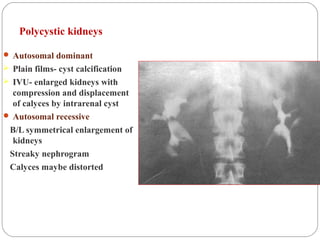
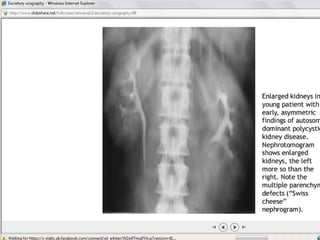
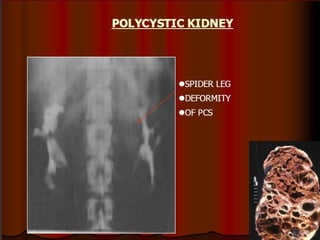
Polycystic kidneys
 Autosomal dominant
 Plain films- cyst calcification
 IVU- enlarged kidneys with
compression and displacement
of calyces by intrarenal cyst
 Autosomal recessive
B/L symmetrical enlargement of
kidneys
Streaky nephrogram
Calyces maybe distorted
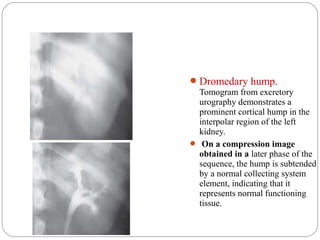
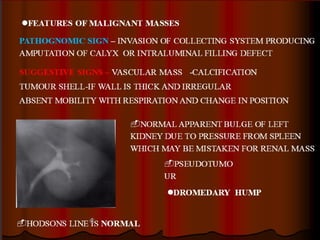
Dromedary hump.
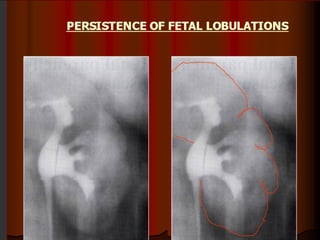
Tomogram from excretory
urography demonstrates a
prominent cortical hump in the
interpolar region of the left
kidney.
 On a compression image
obtained in a later phase of the
sequence, the hump is subtended
by a normal collecting system
element, indicating that it
represents normal functioning
tissue.
02/09/18155
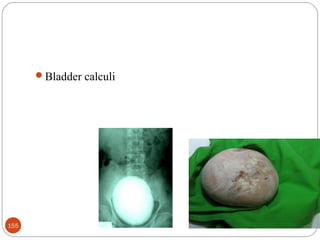
Bladder calculi
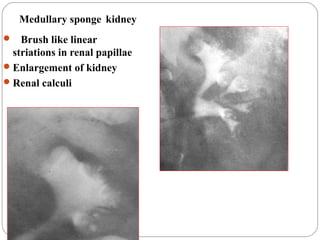
Medullary sponge kidney
 Brush like linear
striations in renal papillae
Enlargement of kidney
Renal calculi
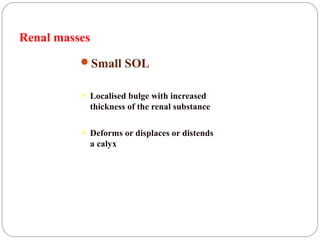
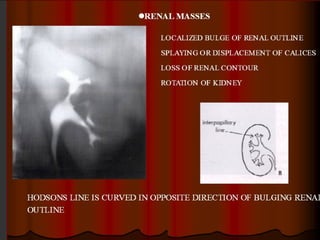
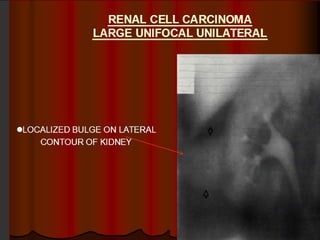
Renal masses
Small SOL
 Localised bulge with increased
thickness of the renal substance
 Deforms or displaces or distends
a calyx
Medium sized lesions
Localized or generalized enlargement
of the kidneys
Displacement or distortion of renal
pelvis, ureter or adjacent structures
Malrotation
Very large lesions
Non functioning kidneys
Calycine spreading
Visceral displacement
Bladder transitional cell carcinoma
.
 Bladder image shows a filling
defect with a papillary
configuration along the right
bladder wall
 Note the irregular distribution
of contrast material
 associated with the filling
defect (“stipple sign”)
GU Tb-plain KUB
Disparity in renal size on plain films may indicate
early increase in size of the affected kidney due to
caseous lesions or a shrunken fibrotic kidney of
autonephrectomy.
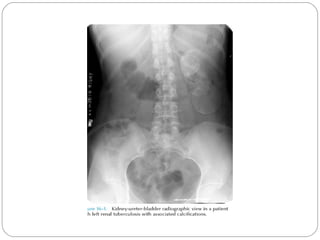
Calcifications are seen in 30% to 50%
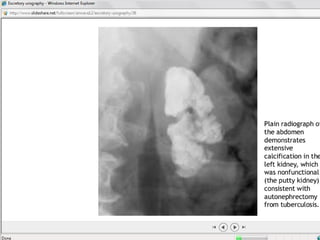
A characteristic diffuse, uniform,extensive
parenchymal, putty-like calcification, forming a lobar
cast of the kidney is seen with autonephrectomy
Calculi may also be seen in the collecting system or
ureter secondary to stricture formation.
 Ureteral calcifications are rare and are
characteristically intraluminal as opposed to the mural
. Bladder wall calcifications seen in late cases of
bladder contraction.
 Calcifications of the prostate and seminal vesicles are
seen in 10% of cases .
Plain film findings suggestive of tuberculosis may be
seen in surrounding tissues such as erosions of the
vertebral bodies or calcifications in a cold abscess of
the psoas muscle.
GU Tb-IVU
The most common findings being
hydrocalycosis,hydronephrosis, or hydroureter due to
stricture formation .
 Early signs include the moth-eaten appearance of
calyceal erosion and papillary irregularity- signs are
best seen on early excretory films.
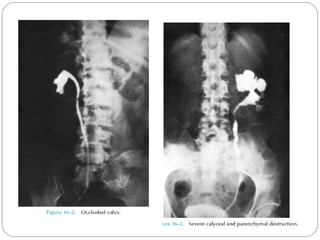
Cavitary lesions communicating with the collecting
system are characteristic of TB.
 These lesions eventually enlarge as parenchymal
destruction ensues.
Fibrotic distortion of the collecting system and ureter
is also seen.
Calyceal obliteration and amputation, hydrocalycosis,
segmental or total hydronephrosis, and a shriveled
reduced capacity renal pelvis may all be signs of renal
tuberculosis
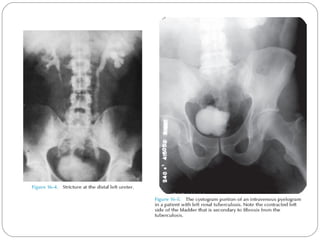
Scarring and angulation of the ureteropelvic junction
(UPJ) may also occur, the so-called “Kerr’s kink” .
Tuberculosis of the ureter is commonly seen as a rigid,
straightened “pipe-stem” ureter also beaded,
corkscrew appearance.
 Ureterovesical junction obstruction is caused by
tuberculous cystitis or strictures of the distal third of
the ureter. secondary stone formation on top of this
stricture .
The cystogram films may show a small contracted
bladder due to excessive fibrosis
“A tailored urographic study allowing optimal visualization of
sequentially opacified portions of the urinary tract may provide
diagnostic detail in certain portions of the urinary system beyond the
current capabilities of other imaging modalities. This can be
accomplished only with good technique, an understanding of the
limitations of the procedure, and adherence to basic rules of
interpretation. The ability to correlate urographic findings with those
from other imaging modalities will remain an important skill until an
ideal "global" urinary tract imaging technique emerges.”
The professors of forensic medicine, Derobert and
Dehouve (who also was a radiologist), together with
Wolfromm, an allergologist, wrote in 1964: “More
patients died from lack of an IVU than patients died
because they were submitted for an IVU”
However,urography now faced the challenge of the
alternative methods of US and CT, and the new
generation of uroradiologists needed to develop
strategies for using them optimally.
Thank you
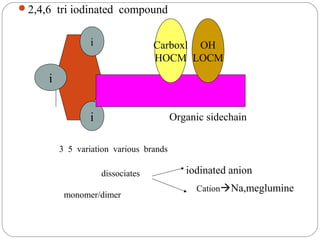
2,4,6 tri iodinated compound
i
i
i
Organic sidechain
3 5 variation various brands
Carboxl
HOCM
OH
LOCM
dissociates iodinated anion
CationNa,meglumine
monomer/dimer
HOCM
High-osmolar contrast media (HOCM) are the oldest
agents.
 They are relatively inexpensive, but their utility is
limited.
They are monomers (single benzene ring)
that ionize in solution with a valence of -1.
 Their cation is either sodium or meglumine.
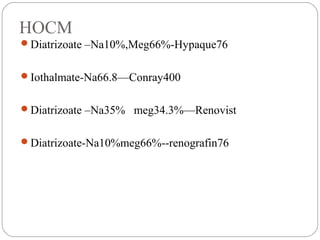
HOCM
Diatrizoate –Na10%,Meg66%-Hypaque76
Iothalmate-Na66.8—Conray400
Diatrizoate –Na35% meg34.3%—Renovist
Diatrizoate-Na10%meg66%--renografin76
LOCM
major advance was the development of non ionic
compounds.
They are monomers that dissolve in water but do not
dissociate.
 Hence, with fewer particles in solution,
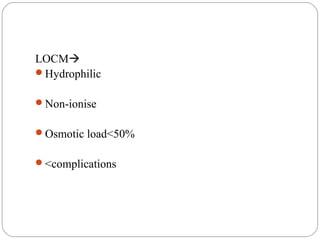
LOCM
Hydrophilic
Non-ionise
Osmotic load<50%
<complications
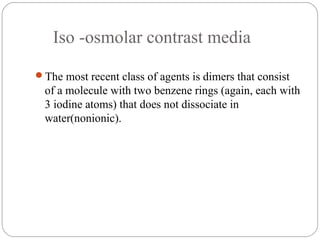
Iso -osmolar contrast media
The most recent class of agents is dimers that consist
of a molecule with two benzene rings (again, each with
3 iodine atoms) that does not dissociate in
water(nonionic).
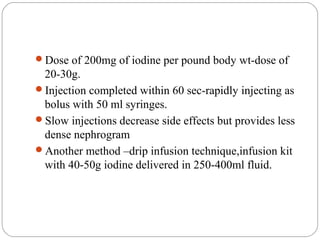
Dose of 200mg of iodine per pound body wt-dose of
20-30g.
Injection completed within 60 sec-rapidly injecting as
bolus with 50 ml syringes.
Slow injections decrease side effects but provides less
dense nephrogram
Another method –drip infusion technique,infusion kit
with 40-50g iodine delivered in 250-400ml fluid.
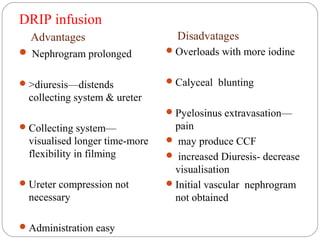
DRIP infusion
Advantages
 Nephrogram prolonged
>diuresis—distends
collecting system & ureter
Collecting system—
visualised longer time-more
flexibility in filming
Ureter compression not
necessary
Administration easy
Disadvatages
Overloads with more iodine
Calyceal blunting
Pyelosinus extravasation—
pain
 may produce CCF
 increased Diuresis- decrease
visualisation
Initial vascular nephrogram
not obtained
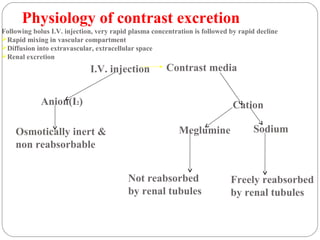
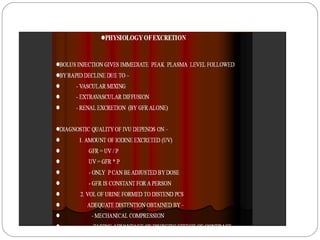
Physiology of contrast excretion
I.V. injection Contrast media
Anion(I2)
Osmotically inert &
non reabsorbable
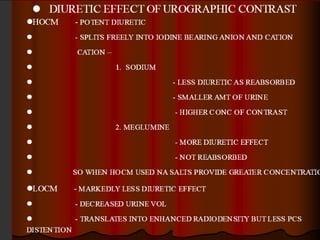
Cation
Meglumine
Not reabsorbed
by renal tubules
Sodium
Freely reabsorbed
by renal tubules
Following bolus I.V. injection, very rapid plasma concentration is followed by rapid decline
Rapid mixing in vascular compartment
Diffusion into extravascular, extracellular space
Renal excretion
If necessary the position of overlying opacities may be further
demonstrated by:
Supine AP of renal areas, in expiration. The x-ray beam is centred in
the mid-line at the level of lower costal margin
Or
35°
posterior oblique views, or,
Tomography of the kidneys at the level of a third of the AP diameter
of the patient (app.8-11 cm). The optimal angle of swing is 25-40°.
The examination should not proceed until these films are reviewed
by radiologist and claimed satisfactory.
02/09/18205
Intravenous Urography

Intravenous Urography

  • 1.
    Dr. Uttam Laudari JRIII Kathmandu Medical college Intravenous Urography
  • 2.
    Definition It is theradiographic examination of the urinary tract including the renal parenchyma, calyces and pelvis after the intravenous injection of the contrast media.
  • 3.
    Intravenous Urography Use decreasedsignificantly in recent years CT, US, MR is replacing Remains primary modality for visualization of pelvicalyceal system and ureter
  • 4.
    1937-Berger made severalrecommendations •Routine tomography •High dose of contrast agents •Ureteral compression Introduction of excretory urograpy was done in 1929, by American urologist Moses Swick. He injected an organically-bound iodide compound—later named Uroselectan—into a vein, taking X-rays as the material cleared the body through the urinary tract. Moses Swick
  • 5.
    Terminology  Urogram Visualization ofkidney parenchyma, calyces and pelvis resulting from IV injection of contrast.  Pyelogram Describes retrograde studies visualizing only the collecting system. So, IVP is misnomer, should be IVU
  • 6.
    Cystography Describes visualization of thebladder Urethrography Visualization of urethra Cystourethrography Combined study to visualize bladder and urethra.
  • 7.
    Contrast is whatwe give intravenously. Dye is used on clothes and in cooking to change the color of things—it is not given IV to patients!
  • 8.
    Indications American College ofRadiology (ACR) guidelines published in 2010 To evaluate the presence or continuing presence of suspected or known ureteral obstruction. To assess the integrity of the urinary tract status post trauma. To assess the urinary tract for suspected congenital anomalies. To assess the urinary tract for lesions that may explain hematuria or infection Investigation of HTN in young adults not controlled
  • 9.
    contraindications No absolute contraindication Relativecontraindications Renal failure (raised serum creatinine level >1.5 mg/dL) Hepatorenal syndrome Previous allergy to the contrast agent/iodine Generalized allergic conditions  Multiple myeloma Pregnancy Infancy Thyrotoxicosis Diabetes
  • 10.
    Advantages  Clear outlineof the entire urinary system so can see even mild hydronephrosis.  Easier to pick out obstructing stone when there are multiple pelvic calcifications.  Can show non-opaque stones as filling defects.  Demonstrate renal function and allow for verification that the opposite kidney is functioning normally.
  • 11.
    Disadvantages  need forIV contrast material  may provoke an allergic response  multiple delayed films (Can take hours as contrast passes quite slowly into the blocked renal unit and ureter.)  May not have sufficient opacification to define the anatomy and point of obstruction.  Requires a significant amount of radiation exposure and may not be ideal for young children or pregnant women
  • 13.
    Internal structure The parenchymaof the kidney is divided into two major structures: superficial is the renal cortex and deep is the renal medulla. Grossly, these structures take the shape of 8 to 18 cone-shaped renal lobes, each containing renal cortex surrounding a portion of medulla called a renal pyramid (of Malpighi).  Between the renal pyramids are projections of cortex called renal columns (of Bertin).
  • 14.
    Nephrons, the urine-producingfunctional structures of the kidney, span the cortex and medulla. The tip, or papilla, of each pyramid empties urine into a minor calyx  minor calyces empty into major calyces, and major calyces empty into the renal pelvis, which becomes the ureter.
  • 17.
    Relations of kidneys Superiorly,the suprarenal (adrenal) glands sit adjacent to the upper pole of each kidney On the right side, the second part of the duodenum (descending portion) abuts the medial aspect of the kidney On the left side, the greater curvature of the stomach and the tail of the pancreas may extend to overlie the renal hilum
  • 18.
    The spleen islocated anterior to the upper pole of left kidney and is connected by the splenorenal (lienorenal) ligaments Inferiorly to these organs, the colon typically rests anteriorly to the kidneys on both sides Posteriorly, the diaphragm covers the upper third of each kidney, with the 12th rib most commonly crossing the upper pole The kidneys sit over the psoas (medially) and the quadratus lumborum muscles (laterally)
  • 34.
    Contrast High osmolar contrastmedia Low osmolar contrast media Iso osmolar contrast media
  • 35.
    In practice advicedomit fluids after 11pm,omit breakfast which decreases chance of vomiting and produce slight dehydration. The dehydration helps in better concentration of the contrast and clearer x-ray pictures. The patient should not be dehydrated if suffering from renal failure as it may lead to severe fluid and electrolyte imbalance. Sensitivity to the dye (Hypaque or Urographin)checked. Necessary precautions are taken to avoid the allergic reactions. Take informed consent.
  • 38.
    Extra renal routesfor contrast excretion: Hepatic Small bowel Sweat  saliva Tears Gastric juice
  • 39.
  • 40.
    Equipment's: Medium powered X-Raygenerator set-up, typical 40-60 kW. Basic tomography equipment. Abdominal compression equipment. Medium / Regular film screen combination in a variety of sizes.
  • 41.
    Pads and immobilisationaids. Intravenous administration equipment: 50 ml syringe, filling needle, skin prep, sticky tape, Selection of needles, straight/'Butterfly' 16, 19, 21,23 gauge. Tourniquet or blood pressure cuff. Emergency drugs and equipment.
  • 44.
  • 45.
    Technique Venous access viathe median antecubital vein is the preferred injection site because flow is retarded in the cephalic vein as it pierces the clavipectoral fascia. The gauge of the cannula/needle should allow the injection to be given rapidly as bolus to maximize the density of nephrogram. Upper arm or shoulder pain may be due to stasis of contrast in vein which may be relieved by abduction of the arm. 45
  • 46.
    PROCEDURE Plain film ofthe abdomen (Scout film) •State of bowel preparation •Calcific density in the renal tract •Soft tissue masses •To observe the abdominal parities •To check exposure factors & positioning Oblique views- optional Contrast administration: bolus/infusion Dose: adults- 50ml of 350-370 strength water soluble contrast
  • 47.
    Films Preliminary film:  Supine,full length AP of abdomen in inspiration.  The lower border of cassette is at the level of symphysis pubis and the x-ray beam is centered in the midline at the level of iliac crests.  To demonstrate bowel preparation, check exposure factor, and location of radiopaque stones or any radiopaque artifacts. 47
  • 48.
    Contrast media: Low osmolarcontrast media (LOCM)- 300- 600mgI/ml Adult dose : 50-100ml Paediatric dose : 1ml/kg 02/09/1848
  • 49.
    FILM SEQUENCE 1-3 minutesAntero-posterior- film coned to the renal area 5 minutes Antero-posterior-film coned to the renal area Apply ureteral compression 10 minutes Antero-posterior Release compression “Flush”, “X” or “Release view”- - full length view at 20 minutes Upright post void Antero-posterior
  • 52.
    Scout film Calculus Skeletal abnormality Intestinalgaspattern Calcifications Abdominal masses Foreign bodies
  • 58.
    Contraindications to ureteral compression Evidenceof obstruction on the 5-minute image Abdominal aortic aneurysm or other abdominal mass Severe abdominal pain Recent abdominal surgery Suspected urinary tract trauma Presence of a urinary diversion Presence of a renal transplant
  • 59.
    WHAT TO LOOKFOR IN IVU Size, shape, position and axis of kidneys External cortex and inner medulla Calyceal system Renal pelvis and ureteropelvic junction Ureter Uretero-vesical junction Urinary bladder Relation of ureter to spine and psoas muscle RADIATION DOSE FROM IVU 1,465 mR/projection for males 1,047 mR for females
  • 68.
    The size ofthe kidneys should be assesed during neprographic phase The normal kidney may range from 9 to13 cm in cephalocaudal length, with the left kidney inherently larger than the right by 0.5 cm and the kidneys slightly larger in men than in women Significant discrepancies (right kidney 1.5 cm larger than the left kidney,left kidney 2 cm larger than the right kidney) require explanation.
  • 69.
    Pyelogram Value of compression •Innormally functioning kidneys, contrast is first seen in the calyces at 2 mins following bolus injection.
  • 70.
    On the 5-minuteimage, the nephrogram should be receding as the collecting system becomes opacified. On the 10-minute image, the pyelogram is the dominant urographic element. Alterations in this temporal sequence require explanation.
  • 71.
    Visualization of thecollecting system and renal pelvis can be augmented with the use of abdominal compression, Trendelenburg position, and other gravity maneuvers such as placing the patient with the side of interest in the ipsilateral posterior oblique position The appearance of the calices and renal pelvis should be examined closely
  • 72.
    Early and mildobstruction is indicated by subtle rounding of the forniceal margins more severe and prolonged obstruction evidenced by progressive loss of the papillary impression and eventual clubbing of calices.
  • 73.
    Ureters Ureters begin totransport opacified urine about 3 mins post injection Maximum ureteral filling occurs between 5-10 minutes.
  • 75.
    At the releaseof compression, the bolus of contrast material–laden urine entering the ureters provides optimal visualization throughout their length Persistence of a standing column of contrast material on several images may indicate obstruction or ureteral ileus (nonobstructive dilatation). Medial deviation of the ureter should be considered when the ureter overlies the ipsilateral lumbar pedicle.
  • 76.
    lateral deviation shouldbe considered when the ureter lies more than 1.5 cm beyond the tip of the transverse process, but comparison with the position of the contralateral ureter should always be made
  • 77.
    Urographic image demonstrates acute medialdeviation of the right ureter produced by an aneurysm of the internal iliac artery.
  • 78.
    Ureteral filling defectsmay be single or multiple and can usually be attributed to luminal, mural, or extrinsic causes.
  • 79.
    Urographic image shows multiplefilling defects in the left renal pelvis and ureter.  Multifocal transitional cell carcinoma was confirmed in this case.
  • 80.
    An absolute ureteraldiameter exceeding 8 mm is considered a criterion for dilatation Asymmetry of ureteral caliber is a more significant finding. Early in its course, high-grade ureteral obstruction may be associated with only minimal ureteral dilatation. More chronic forms of obstruction and other chronic ureteral conditions are typically associated with greater degrees of ureteral dilatation
  • 81.
  • 82.
    By 15–30 minutesafter the injection of contrast material, the bladder is often sufficiently filled, and the 15-minute KUB radiograph may be adequate for evaluation.  As the bladder distends with contrast the intraluminal contrast material should be spheric and smoothly marginated and the wall progressively less evident.
  • 84.
    Bladder wall thickeningand irregularity of the luminal contrast material associated with a bladder base defect is typical of changes of bladder outlet obstruction from prostatic disease. Contour abnormalities from cellule or diverticulum formation.
  • 86.
    Bladder transitional cell carcinoma. Bladder image shows a filling defect with a papillary configuration along the right bladder wall  Note the irregular distribution of contrast material  associated with the filling defect (“stipple sign”)
  • 88.
    The postvoid imagemay also be helpful in evaluating patients with upper urinary tract dilatation. Persistence of the dilatation on the postvoid image suggests fixed obstruction, The postvoid image is most helpful in assessing residual volume.
  • 91.
    Extravasation of contrastmedium Local pain, erythema, swelling Usually resolve with local therapy Rarely, significant tissue necrosis and skin- sloughing occur (even with small amounts)  severe, may lead to compartment syndrome Severe edema, loss of pulses, necrosis More common with injection in hand or foot
  • 92.
    Initial recommended treatmentof extravasation  - Elevation of affected extremity above heart  - Ice packs (15-60min/3 times per day) - Close observation for 2-4 hrs
  • 93.
     Immediate plasticsurgery consultation for the following indications Extravasated volume exceeds 100 cc of nonionic contrast Skin blistering Altered tissue perfusion Decreased capillary refill over or distal to injection site Increasing pain after 2-4 hours Change in sensation distal to site extravasation
  • 100.
    Renal agenesis U/L-Absent renaloutline & pelvicalyceal system, 99mTc DMSA most sensitive test. B/L-Uncommon & incompatible with life
  • 101.
    Renal Ectopia Failure ofcomplete ascent of the kidney to its normal position IVU- abnormally placed kidneys
  • 103.
    Crossed fused renalectopia  Two complete pelvicalyceal systems on one side usually one above the other  Ureter from the lower renal pelvis crosses the midline and enters bladder normally
  • 105.
    Horseshoe kidney Kidneys placedlower than normal Malrotation of pelvis Lower pole calyces of both sides deviated towards midline Ureters have characteristic vaselike curve Pelvicalyectasis Renal calculi
  • 106.
    Intravenous urogram (IVU) showsan altered renal axis with medially directed lower renal poles, which suggests horseshoe kidney. Also note the dilated collecting system of the left kidney, resulting from a uretero pelvic junction obstruction; this is a frequently associated finding
  • 108.
    Ureterocele Contrast filled structure witha thin smooth radiolucent wall surrounded by contrast containing urine in the bladder- “Cobra’s head’ appearence
  • 110.
    Retrocaval ureter The uretermay have a sickle, S or reverse J appearance before crossing behind and medial to the IVC. The ureter descends medial to right lumbar pedicle. Proximal ureter is dilated.
  • 112.
    Grading of hydronephrosis Gr 1-dilatation of renal pelvis without dilatation of calices, prominent reflex of renal sinus without signs of parenchymal atrophy.  Gr2-dilatation of renal pelvis and calices ,pelvicalyceal pattern is maintained, no signs of parenchymal atrophy  Gr3-moderate dilatation of renal pelvis and calyces ,blunting of fornices and flattening of papillae, mild cortical thinning may be seen  Gr4-gross dilatation of renal pelvis and calyces which appear ballooned ,loss of borders between renal pelvis and calyces,renal atrophy seen as cortical thinning.
  • 115.
    The balloon ona string sign This sign refers to the appearance of a high and somewhat eccentric exit point of the ureter from a dilated renal pelvis and is a typical finding of ureteropelvic junction obstruction
  • 116.
  • 117.
    Renal CT scan RenalCT is most commonly used in the evaluation of acute flank pain, hematuria, renal infection (search for abscess) and renal trauma, and in the characterization and staging of renal neoplasm. CT evaluation of renal anatomy and pathology generally requires intravenous injection of iodinated contrast media
  • 118.
    Renal Ct scan noncontrastscans are needed, when renal or perirenal calcification, hemorrhage, or urine extravasation is suspected, since scans obtained after the administration of contrast media may mask these abnormalities. Also, pre- and postcontrast scans are required to determine whether a mass is solid or cystic
  • 119.
    RENAL CT SCAN Using a bolus injection and rapid sequence scanning, renal arterial opacification is followed immediately by enhancement of the cortex. A nephrogram phase with medullary enhancement is reached within 60 seconds. Excretion of contrast material into the collecting structures can be expected within 2–3 minutes after initiation of contrast administration
  • 120.
    RENAL CT SCAN-for ureters Suspected urolithiasis -Helical CT without oral or intravenous contrast is the preferred imaging Ureteral tumors Staging and level of obstruction
  • 121.
    Left nephrolithiasis withleft VUJ calului with HDN
  • 122.
    Urinary bladder Tumor primarilyin staging bladder tumors and in diagnosing bladder rupture following trauma Performing CT after filling the bladder with dilute contrast medium (CT cystography) improves the sensitivity of this modality for detecting tumors and bladder rupture
  • 123.
    Prostate - CT Forprostate diseases, CT is used for detection of lymphadenopathy and to delineate prostatic abscesses. Also for abdominal location of suspected undescended testes for staging of testicular tumors and in the search for nodal or distant metastasis
  • 124.
    CT- adrenal lesion Theaddition of delayed CT imaging 10–15 minutes postintravenous contrast–enhanced CT shows high sensitivity and specificity in characterizing adrenal lesions. Benign adenomas, including lipid poor adenomas, show brisk contrast washout.
  • 125.
    Advantages of CT a wide field of view the ability to detect subtle differences in the x-ray attenuation properties of various tissues good spatial resolution, anatomical cross-sectional images Reformatted helical image data in different planes and in 3D has made renal CT imaging, with renal angiography and urography valuable in preoperative planning, such as for partial nephrectomy
  • 126.
    Renal CT limitations restrictionto the transaxial plane for direct imaging, tissue nonspecificity low soft-tissue contrast resolution and the need for contrast media (both oral and intravenous). Finally, radiation exposure is a consideration with multisequence CT imaging. approximately 1.5 times the radiation dose of conventional urography.

  • 127.
    Magnetic Resonance Imaging ClinicalMRI has its basis in the nuclear properties of the hydrogen atoms in the body. Hydrogen nuclei, when considered as aggregates, sometimes referred to as “protons,” behave like tiny magnets, with net polarity (positive one direction, negative opposite) oriented along an axis at any given point in space.

  • 128.
    Ordinarily, the axesof the hydrogen nuclei in the body are randomly oriented. However, if the nuclei are placed in a strong magnetic field (like that produced in an MRI scanner), they precess and wobble like a spinning top around the lines of magnetic force.

  • 129.
    When hydrogen nucleiin a strong magnetic field are additionally stimulated by short, pulsed radio waves of appropriate frequency, they absorb energy and invert their orientation with respect to the magnetic field.
  • 130.
    At the terminationof radiofrequency pulses, the hydrogen nuclei return at various rates to their original orientation within the magnetic field, emitting energy in the form of radio waves. This phenomenon is called nuclear magnetic resonance (NMR).The emitted weak radio signals from the resonating hydrogen nuclei are received by sophisticated antenna, or coils, and transformed with various computer programs into cross-sectional images.
  • 131.
    Renal MRI- applications demonstrationof congenital anomalies diagnosis of renal vein thrombosis diagnosis and staging of renal cell carcinoma MR angiography is useful in evaluating renal transplant vessels, renal vein tumor or thrombosis, and renal artery stenosis
  • 132.
    Using bolus injectionof gadolinium and rapid sequence imaging, both anatomyand function of the kidney can be assessed. Gadolinium, similar to iodine contrast media, is an extracellular contrast agent primarily excreted by glomerular filtration. Compared to iodinated contrast media, gadolinium has superior renal tolerance in patients with preexisting renal failure
  • 133.
    Recently, cases ofnephrogenic system fibrosis have been reported in patients with renal failure who have received gadolinium.
  • 134.
    The effect ofgadolinium on MR tissue signal intensity is more complex, though in general at lower concentrations gadolinium causes an increase in signal intensity
  • 135.
    The use ofgadolinium has extended the application of MRI to the evaluation of renal obstruction (MRU may be used when other studies are inconclusive) and the detection and characterization of renal tumors. gadolinium bolus followed by rapid imaging is less susceptible to flow direction and overestimation of stenosis, which can be seen in noncontrast MRA imaging.  Gadoliniumenhanced MRA is useful for assessing renal artery stenosis and for evaluating potential renal donors
  • 136.
    Bladder tumor- MRI stagebladder tumors and to differentiate between benign bladder wall hypertrophy and infiltrating malignant neoplasm. ..
  • 137.
    Prostate CA/Testis In imagingthe prostate gland, MRI is principally used to stage patients with prostate cancer  MR spectroscopy increases specificity and reduces interobserver variability in this setting MRI of the testis is appropriate when other imaging studies are inconclusive and is applicable to the evaluation of undescended testis, trauma, epididymoorchitis, and tumors
  • 138.
    MRI- Adrenal  modifiedtechnique-chemical shift imaging can detect microscopic amounts of fat within lesions commonly used to characterize adrenal masses Adrenal masses containing fat are either adrenal adenomas or myelolipomas so the CT or MRI demonstration of fat in an adrenal lesion characterizes it as a benign lesion, even in the oncologic patient
  • 139.
    MR - urography MRurography utilizes the sensitivity of MR imaging to demonstrate fluid (urine), producing urogram-like pictures without the need for contrast media. This technique is sensitive in the detection of ureterohydronephrosis and is particularly useful in patients in whom contrast material is contraindicated, such as patients with prior contrast reactions or renal failure.
  • 140.
    Advantage of MRI directimaging in any plane desired (though transverse, sagittal, and coronal are most standard)  choice of large or small field of view excellent soft-tissue contrast  imaging without exposure to ionizing radiation image blood vessels and the urinary tract without contrast material.
  • 141.
    Disadvantage scanning time isrelatively slow and as a result image clarity is often inferior compared with CT
  • 142.
    Contraindications intracranial aneurysm clips( not for titanium clips)  intraorbital metal fragments  any electrically, magnetically, or mechanically activated implants (including cardiac pacemakers, biostimulators, neurostimulators, cochlear implants, and hearing aids
  • 143.
  • 145.
    Polycystic kidneys  Autosomaldominant  Plain films- cyst calcification  IVU- enlarged kidneys with compression and displacement of calyces by intrarenal cyst  Autosomal recessive B/L symmetrical enlargement of kidneys Streaky nephrogram Calyces maybe distorted
  • 150.
    Dromedary hump. Tomogram fromexcretory urography demonstrates a prominent cortical hump in the interpolar region of the left kidney.  On a compression image obtained in a later phase of the sequence, the hump is subtended by a normal collecting system element, indicating that it represents normal functioning tissue.
  • 155.
  • 160.
    Medullary sponge kidney Brush like linear striations in renal papillae Enlargement of kidney Renal calculi
  • 161.
    Renal masses Small SOL Localised bulge with increased thickness of the renal substance  Deforms or displaces or distends a calyx
  • 162.
    Medium sized lesions Localizedor generalized enlargement of the kidneys Displacement or distortion of renal pelvis, ureter or adjacent structures Malrotation Very large lesions Non functioning kidneys Calycine spreading Visceral displacement
  • 168.
    Bladder transitional cellcarcinoma .  Bladder image shows a filling defect with a papillary configuration along the right bladder wall  Note the irregular distribution of contrast material  associated with the filling defect (“stipple sign”)
  • 181.
    GU Tb-plain KUB Disparityin renal size on plain films may indicate early increase in size of the affected kidney due to caseous lesions or a shrunken fibrotic kidney of autonephrectomy. Calcifications are seen in 30% to 50% A characteristic diffuse, uniform,extensive parenchymal, putty-like calcification, forming a lobar cast of the kidney is seen with autonephrectomy Calculi may also be seen in the collecting system or ureter secondary to stricture formation.  Ureteral calcifications are rare and are characteristically intraluminal as opposed to the mural
  • 182.
    . Bladder wallcalcifications seen in late cases of bladder contraction.  Calcifications of the prostate and seminal vesicles are seen in 10% of cases . Plain film findings suggestive of tuberculosis may be seen in surrounding tissues such as erosions of the vertebral bodies or calcifications in a cold abscess of the psoas muscle.
  • 185.
    GU Tb-IVU The mostcommon findings being hydrocalycosis,hydronephrosis, or hydroureter due to stricture formation .  Early signs include the moth-eaten appearance of calyceal erosion and papillary irregularity- signs are best seen on early excretory films.
  • 186.
    Cavitary lesions communicatingwith the collecting system are characteristic of TB.  These lesions eventually enlarge as parenchymal destruction ensues. Fibrotic distortion of the collecting system and ureter is also seen. Calyceal obliteration and amputation, hydrocalycosis, segmental or total hydronephrosis, and a shriveled reduced capacity renal pelvis may all be signs of renal tuberculosis
  • 187.
    Scarring and angulationof the ureteropelvic junction (UPJ) may also occur, the so-called “Kerr’s kink” . Tuberculosis of the ureter is commonly seen as a rigid, straightened “pipe-stem” ureter also beaded, corkscrew appearance.  Ureterovesical junction obstruction is caused by tuberculous cystitis or strictures of the distal third of the ureter. secondary stone formation on top of this stricture . The cystogram films may show a small contracted bladder due to excessive fibrosis
  • 192.
    “A tailored urographicstudy allowing optimal visualization of sequentially opacified portions of the urinary tract may provide diagnostic detail in certain portions of the urinary system beyond the current capabilities of other imaging modalities. This can be accomplished only with good technique, an understanding of the limitations of the procedure, and adherence to basic rules of interpretation. The ability to correlate urographic findings with those from other imaging modalities will remain an important skill until an ideal "global" urinary tract imaging technique emerges.”
  • 193.
    The professors offorensic medicine, Derobert and Dehouve (who also was a radiologist), together with Wolfromm, an allergologist, wrote in 1964: “More patients died from lack of an IVU than patients died because they were submitted for an IVU” However,urography now faced the challenge of the alternative methods of US and CT, and the new generation of uroradiologists needed to develop strategies for using them optimally.
  • 194.
  • 195.
    2,4,6 tri iodinatedcompound i i i Organic sidechain 3 5 variation various brands Carboxl HOCM OH LOCM dissociates iodinated anion CationNa,meglumine monomer/dimer
  • 196.
    HOCM High-osmolar contrast media(HOCM) are the oldest agents.  They are relatively inexpensive, but their utility is limited. They are monomers (single benzene ring) that ionize in solution with a valence of -1.  Their cation is either sodium or meglumine.
  • 197.
  • 198.
    LOCM major advance wasthe development of non ionic compounds. They are monomers that dissolve in water but do not dissociate.  Hence, with fewer particles in solution,
  • 199.
  • 200.
    Iso -osmolar contrastmedia The most recent class of agents is dimers that consist of a molecule with two benzene rings (again, each with 3 iodine atoms) that does not dissociate in water(nonionic).
  • 201.
    Dose of 200mgof iodine per pound body wt-dose of 20-30g. Injection completed within 60 sec-rapidly injecting as bolus with 50 ml syringes. Slow injections decrease side effects but provides less dense nephrogram Another method –drip infusion technique,infusion kit with 40-50g iodine delivered in 250-400ml fluid.
  • 202.
    DRIP infusion Advantages  Nephrogramprolonged >diuresis—distends collecting system & ureter Collecting system— visualised longer time-more flexibility in filming Ureter compression not necessary Administration easy Disadvatages Overloads with more iodine Calyceal blunting Pyelosinus extravasation— pain  may produce CCF  increased Diuresis- decrease visualisation Initial vascular nephrogram not obtained
  • 203.
    Physiology of contrastexcretion I.V. injection Contrast media Anion(I2) Osmotically inert & non reabsorbable Cation Meglumine Not reabsorbed by renal tubules Sodium Freely reabsorbed by renal tubules Following bolus I.V. injection, very rapid plasma concentration is followed by rapid decline Rapid mixing in vascular compartment Diffusion into extravascular, extracellular space Renal excretion
  • 205.
    If necessary theposition of overlying opacities may be further demonstrated by: Supine AP of renal areas, in expiration. The x-ray beam is centred in the mid-line at the level of lower costal margin Or 35° posterior oblique views, or, Tomography of the kidneys at the level of a third of the AP diameter of the patient (app.8-11 cm). The optimal angle of swing is 25-40°. The examination should not proceed until these films are reviewed by radiologist and claimed satisfactory. 02/09/18205