URINARY SYSTEM
IMAGING TECHNIQUES & PROCEDURES
IMAGING MODALITIES
1. Plain film radiography
2. Excretion urography (intravenous urogram (IVU))
3. Ultrasound (US)
4. Computed tomography (CT)
5. Magnetic resonance imaging (MRI)
6. Renal arteriography
7. Renal scintigraphy
8. Interventional radiology
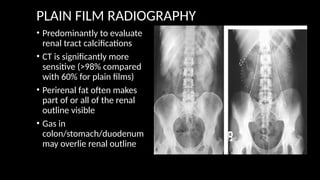
PLAIN FILM RADIOGRAPHY
• Predominantly to evaluate
renal tract calcifications
• CT is significantly more
sensitive (>98% compared
with 60% for plain films)
• Perirenal fat often makes
part of or all of the renal
outline visible
• Gas in
colon/stomach/duodenum
may overlie renal outline
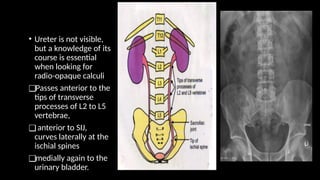
• Ureter is not visible,
but a knowledge of its
course is essential
when looking for
radio-opaque calculi
❑Passes anterior to the
tips of transverse
processes of L2 to L5
vertebrae,
❑anterior to SIJ,
curves laterally at the
ischial spines
❑medially again to the
urinary bladder.
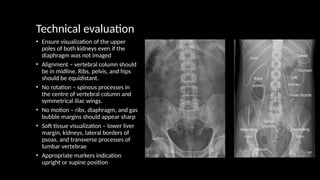
Technical evaluation
• Ensure visualization of the upper
poles of both kidneys even if the
diaphragm was not imaged
• Alignment – vertebral column should
be in midline. Ribs, pelvis, and hips
should be equidistant.
• No rotation – spinous processes in
the centre of vertebral column and
symmetrical iliac wings.
• No motion – ribs, diaphragm, and gas
bubble margins should appear sharp
• Soft tissue visualization – lower liver
margin, kidneys, lateral borders of
psoas, and transverse processes of
lumbar vertebrae
• Appropriate markers indication
upright or supine position
ULTRASOUND
• Renal mass lesion
• Renal parenchymal disease
• Renal obstruction/loin pain
• Hamaturia
• Hypertension
• Renal cystic disease
• Renal size measurement
• Bladder outflow obstruction
• Urinary tract infection
• Bladder tumour
• Following renal transplant
• Obstruction
• Patency of vessels
• Perirenal collections
• To guide needle placement in interventional procedures
• Renal vascular studies
INDICATIONS:
CONTRAINDICATIONS:
• NONE
PREPARATIONS
• Kidneys only – none
• Kidneys and bladder – prehydrate with oral fluid, patient attends with
full bladder
• Disadvantage: the collecting systems appear mildly hydronephrotic
premicturition
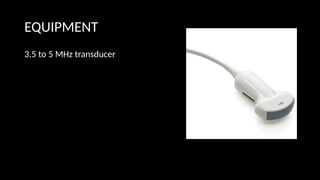
EQUIPMENT
3.5 to 5 MHz transducer
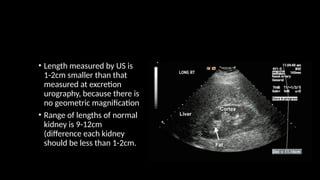
• Length measured by US is
1-2cm smaller than that
measured at excretion
urography, because there is
no geometric magnification
• Range of lengths of normal
kidney is 9-12cm
(difference each kidney
should be less than 1-2cm.
Computed tomography
INDICATIONS:
• Renal colic/renal stone disease
• Renal tumour
• Renal/perirenal collection
• Loin mass
• Staging and follow up of urinary tract malignancy
• Investigation of renal tract obstruction
• CTA to assess renal vessels for suspected renal artery stenosis or
arterio-venous fistula/malformation, active bleeding
TECHNIQUES: STANDARD DIAGNOSTIC CT
• Venous access is obtained
• Patient lies supine
• Scanogram is taken of chest, abdomen, and pelvis as appropriate
• 100ml IV LOCM given
• Scans obtained approximately 70s (portal venous phase) after IV
contrast
Techniques: renal lesion characterization
• Used to assess renal cysts or masses identified on another imaging
modality such as ultrasound
• Pre and post IV contrast scans are obtained through the kidneys in
order to assess precontrast attenuation and subsequent
enhancement patterns
• Plain CT is useful to assess possible stone disease
• Used in most centres as the primary investigation of renal colic
(replacing plain KUB radiograph)
• No IV or oral contrast is given
• Patient supine
• Scan from top of the kidneys to the bladder base
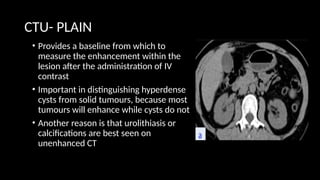
CTU- PLAIN
• Provides a baseline from which to
measure the enhancement within the
lesion after the administration of IV
contrast
• Important in distinguishing hyperdense
cysts from solid tumours, because most
tumours will enhance while cysts do not
• Another reason is that urolithiasis or
calcifications are best seen on
unenhanced CT
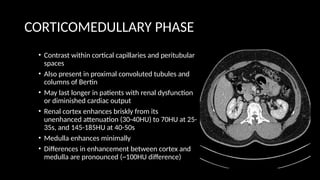
CORTICOMEDULLARY PHASE
• Contrast within cortical capillaries and peritubular
spaces
• Also present in proximal convoluted tubules and
columns of Bertin
• May last longer in patients with renal dysfunction
or diminished cardiac output
• Renal cortex enhances briskly from its
unenhanced attenuation (30-40HU) to 70HU at 25-
35s, and 145-185HU at 40-50s
• Medulla enhances minimally
• Differences in enhancement between cortex and
medulla are pronounced (~100HU difference)
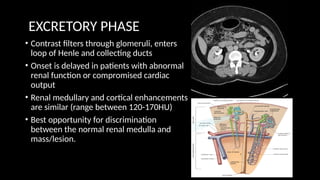
EXCRETORY PHASE
• Contrast filters through glomeruli, enters
loop of Henle and collecting ducts
• Onset is delayed in patients with abnormal
renal function or compromised cardiac
output
• Renal medullary and cortical enhancements
are similar (range between 120-170HU)
• Best opportunity for discrimination
between the normal renal medulla and
mass/lesion.
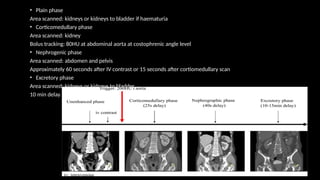
CT RENAL 4 PHASE
• Positioning – supine, arm positioned comfortably above head
• Topogram – craniocaudal, in inspiration
• IV contrast
• 80ml at 4ml/sec
• Ultravist 300 (LOCM – iopromide)
• Dose
• kV:120
• Effective mAs: autocalculated by machine depending on patient’s body
habitus
• Plain phase
Area scanned: kidneys or kidneys to bladder if haematuria
• Corticomedullary phase
Area scanned: kidney
Bolus tracking: 80HU at abdominal aorta at costophrenic angle level
• Nephrogenic phase
Area scanned: abdomen and pelvis
Approximately 60 seconds after IV contrast or 15 seconds after cortiomedullary scan
• Excretory phase
Area scanned: kidneys or kidneys to bladder
10 min delay
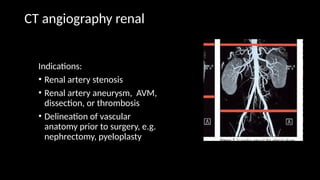
CT angiography renal
Indications:
• Renal artery stenosis
• Renal artery aneurysm, AVM,
dissection, or thrombosis
• Delineation of vascular
anatomy prior to surgery, e.g.
nephrectomy, pyeloplasty
• No oral iodinated contrast used
• Scan from upper pole of kidneys to the aortic bifurcation
• Narrow collimation (1mm)
• 100-150ml of IV contrast injected at 3-4ml/sec
• Use of bolus tracking/triggering devices or timing test injections is
recommended to ensure appropriate timing
MRU
Indication:
• To demonstrate the collecting system/determine level of obstruction
in a poorly functioning/obstructed kidney
• Urinary tract obstruction unrelated to urolithiasis
• Congenital anomalies
• Renal transplant donor assessment (combined with MR angiography)
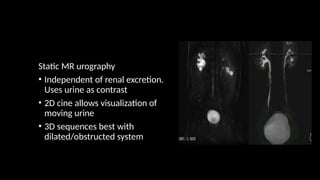
Static MR urography
• Independent of renal excretion.
Uses urine as contrast
• 2D cine allows visualization of
moving urine
• 3D sequences best with
dilated/obstructed system
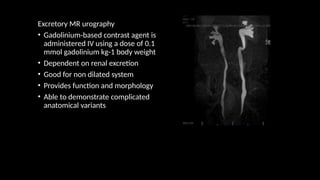
Excretory MR urography
• Gadolinium-based contrast agent is
administered IV using a dose of 0.1
mmol gadolinium kg-1 body weight
• Dependent on renal excretion
• Good for non dilated system
• Provides function and morphology
• Able to demonstrate complicated
anatomical variants
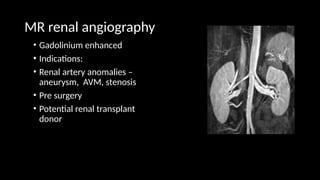
MR renal angiography
• Gadolinium enhanced
• Indications:
• Renal artery anomalies –
aneurysm, AVM, stenosis
• Pre surgery
• Potential renal transplant
donor
Renal scintigraphy
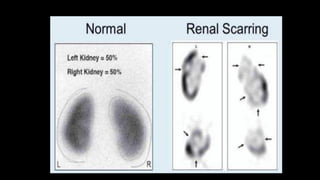
❑Static renal radionuclide scintigraphy
• Also known as renal cortical scan
• DMSA scan
❑Dynamic renal radionuclide scintigraphy
• Also known as renal perfusion scan
• MAG3, DTPA scan
STATIC RENAL RADIONUCLIDE SCINTIGRAPHY
Indications
• Assessment of individual and relative renal function
• Investigation of urinary tract infections, particularly in children for scarring
• Assessment of reflux nephropathy for scarring
• Identification of horseshoe, solitary, or ectopic kidney
• Differentiation of a pseudotumour due to hypertrophied column of Bertin from
a true tumour
Contraindication
• Pregnancy
Radiopharmaceuticals
• 99m
TC-dimercaptosuccinic acid (DMSA), 80 MBq max (0.7 mSv ED)
• Bound to plasma proteins
• Cleared by tubular absorption
• DMSA is retained in the renal cortex, with an uptake of 40%-65%
of the injected dose within 2H and no significant excretion during
the imaging period
• Gives the best morphological images of any renal
radiopharmaceutical, and is used for assessment of scarring
• Gives the most accurate assessment of differential renal function
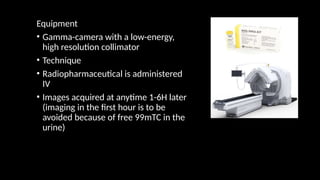
Equipment
• Gamma-camera with a low-energy,
high resolution collimator
• Technique
• Radiopharmaceutical is administered
IV
• Images acquired at anytime 1-6H later
(imaging in the first hour is to be
avoided because of free 99mTC in the
urine)
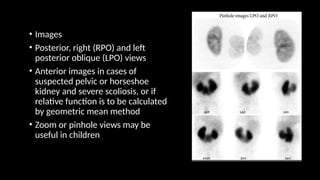
• Images
• Posterior, right (RPO) and left
posterior oblique (LPO) views
• Anterior images in cases of
suspected pelvic or horseshoe
kidney and severe scoliosis, or if
relative function is to be calculated
by geometric mean method
• Zoom or pinhole views may be
useful in children
DYNAMIC RENAL RADIONUCLIDE SCINTIGRAPHY
Indications
• Evaluation of obstruction
• Assessment of renal function following drainage procedures to the urinary tract
• Assessment of perfusion in acute native or transplant kidney failure
• Demonstration of vesicoureteric reflux
• Renal trauma
• Diagnosis of renal artery stenosis
• Contraindication
• None
• Radiopharmaceuticals
• 99mTc-MAG-3 (mercaptoacetyltriglycine)
• 100MBq max (0.7mSv ED)
• Highly protein bound
• 80% cleared by tubular secretion
• 20% by glomerular filtration
• Radiopharmaceutical of choice – better image quality, particularly in patients with
impaired renal function
• 99mTc-diethylene triamine-pentaceticacid (DTPA)
• 150MBq typical (1mSv ED)
• Cleared by glomerular filtration
• Poorer image quality due to lower kidney/background ration
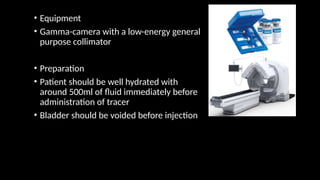
• Equipment
• Gamma-camera with a low-energy general
purpose collimator
• Preparation
• Patient should be well hydrated with
around 500ml of fluid immediately before
administration of tracer
• Bladder should be voided before injection
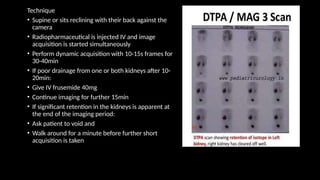
Technique
• Supine or sits reclining with their back against the
camera
• Radiopharmaceutical is injected IV and image
acquisition is started simultaneously
• Perform dynamic acquisition with 10-15s frames for
30-40min
• If poor drainage from one or both kidneys after 10-
20min:
• Give IV frusemide 40mg
• Continue imaging for further 15min
• If significant retention in the kidneys is apparent at
the end of the imaging period:
• Ask patient to void and
• Walk around for a minute before further short
acquisition is taken
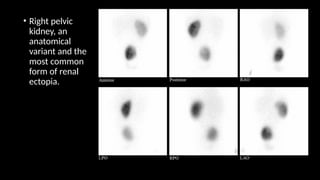
• Right pelvic
kidney, an
anatomical
variant and the
most common
form of renal
ectopia.
RENAL ARTERIOGRAPHY
INDICATIONS
• Renal artery stenosis prior to angioplasty or stent placement
• Diagnostic arteriography has been replaced generally by MRA or CTA
• Assessment of living related renal transplant donors
• Replaced generally by MRA or CTA
• Embolization of vascular renal tumour prior to surgery
• Haematuria particularly following trauma, including biopsy
• Prior to prophylactic embolization of an angiomyolipoma (AML)
or therapeutic embolization of a bleeding AML
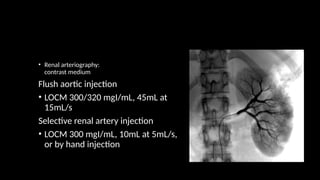
• Renal arteriography:
contrast medium
Flush aortic injection
• LOCM 300/320 mgI/mL, 45mL at
15mL/s
Selective renal artery injection
• LOCM 300 mgI/mL, 10mL at 5mL/s,
or by hand injection
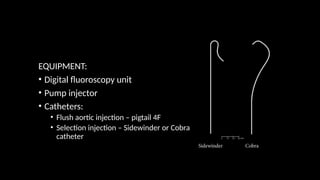
EQUIPMENT:
• Digital fluoroscopy unit
• Pump injector
• Catheters:
• Flush aortic injection – pigtail 4F
• Selection injection – Sidewinder or Cobra
catheter
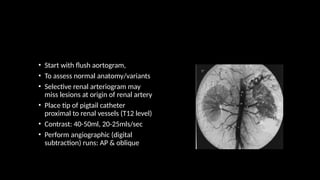
• Start with flush aortogram,
• To assess normal anatomy/variants
• Selective renal arteriogram may
miss lesions at origin of renal artery
• Place tip of pigtail catheter
proximal to renal vessels (T12 level)
• Contrast: 40-50ml, 20-25mls/sec
• Perform angiographic (digital
subtraction) runs: AP & oblique
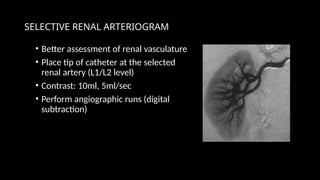
SELECTIVE RENAL ARTERIOGRAM
• Better assessment of renal vasculature
• Place tip of catheter at the selected
renal artery (L1/L2 level)
• Contrast: 10ml, 5ml/sec
• Perform angiographic runs (digital
subtraction)
INTERVENTIONAL RADIOLOGY
• Can be done under fluoroscopy, ultrasound, CT, and angiography
• Percutaneous renal biopsy
• Percutaneous nephrostomy
ANATOMY:
• Posterior relationship of the diaphragm
• Kidney moves with respiration
• Posterior relationship of pleura – lower pole safer than
upper pole
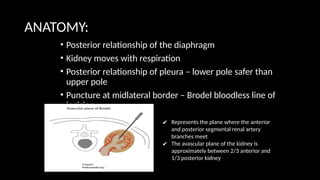
• Puncture at midlateral border – Brodel bloodless line of
incision
✔ Represents the plane where the anterior
and posterior segmental renal artery
branches meet
✔ The avascular plane of the kidney is
approximately between 2/3 anterior and
1/3 posterior kidney
PERCUTANEOUS RENAL BIOPSY
Indication
• Diagnostic biopsy: unexplained renal failure, mass
Contraindication
• Bleeding diathesis
Equipment
• USG or CT guidance
• Bard gun with core biopsy needle
Patient preparation
• Fasting for 4 hours
• Blood parameters
• Premedication/sedation as required
•
Complications
• Bleeding
• Arteriovenous fistula
• Pseudoaneurysm
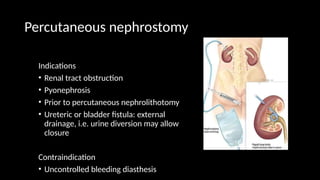
Percutaneous nephrostomy
Indications
• Renal tract obstruction
• Pyonephrosis
• Prior to percutaneous nephrolithotomy
• Ureteric or bladder fistula: external
drainage, i.e. urine diversion may allow
closure
Contraindication
• Uncontrolled bleeding diasthesis
• Contrast medium
• LOCM
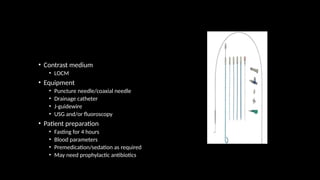
• Equipment
• Puncture needle/coaxial needle
• Drainage catheter
• J-guidewire
• USG and/or fluoroscopy
• Patient preparation
• Fasting for 4 hours
• Blood parameters
• Premedication/sedation as required
• May need prophylactic antibiotics
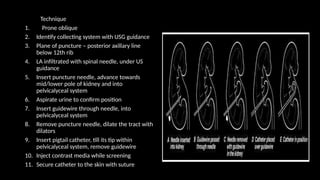
Technique
1. Prone oblique
2. Identify collecting system with USG guidance
3. Plane of puncture – posterior axillary line
below 12th rib
4. LA infiltrated with spinal needle, under US
guidance
5. Insert puncture needle, advance towards
mid/lower pole of kidney and into
pelvicalyceal system
6. Aspirate urine to confirm position
7. Insert guidewire through needle, into
pelvicalyceal system
8. Remove puncture needle, dilate the tract with
dilators
9. Insert pigtail catheter, till its tip within
pelvicalyceal system, remove guidewire
10. Inject contrast media while screening
11. Secure catheter to the skin with suture
Complications
• Septicemia
• Hemorrhage
• Perforation of collecting system with urine leak
• Unsuccessful drainage
• Injury to adjacent organs
• Catheter dislodgement
URINARY SYSTEM imaging in Radiology.pptx

  • 1.
  • 2.
    IMAGING MODALITIES 1. Plainfilm radiography 2. Excretion urography (intravenous urogram (IVU)) 3. Ultrasound (US) 4. Computed tomography (CT) 5. Magnetic resonance imaging (MRI) 6. Renal arteriography 7. Renal scintigraphy 8. Interventional radiology
  • 3.
    PLAIN FILM RADIOGRAPHY •Predominantly to evaluate renal tract calcifications • CT is significantly more sensitive (>98% compared with 60% for plain films) • Perirenal fat often makes part of or all of the renal outline visible • Gas in colon/stomach/duodenum may overlie renal outline
  • 4.
    • Ureter isnot visible, but a knowledge of its course is essential when looking for radio-opaque calculi ❑Passes anterior to the tips of transverse processes of L2 to L5 vertebrae, ❑anterior to SIJ, curves laterally at the ischial spines ❑medially again to the urinary bladder.
  • 5.
    Technical evaluation • Ensurevisualization of the upper poles of both kidneys even if the diaphragm was not imaged • Alignment – vertebral column should be in midline. Ribs, pelvis, and hips should be equidistant. • No rotation – spinous processes in the centre of vertebral column and symmetrical iliac wings. • No motion – ribs, diaphragm, and gas bubble margins should appear sharp • Soft tissue visualization – lower liver margin, kidneys, lateral borders of psoas, and transverse processes of lumbar vertebrae • Appropriate markers indication upright or supine position
  • 6.
    ULTRASOUND • Renal masslesion • Renal parenchymal disease • Renal obstruction/loin pain • Hamaturia • Hypertension • Renal cystic disease • Renal size measurement • Bladder outflow obstruction • Urinary tract infection • Bladder tumour • Following renal transplant • Obstruction • Patency of vessels • Perirenal collections • To guide needle placement in interventional procedures • Renal vascular studies INDICATIONS:
  • 7.
    CONTRAINDICATIONS: • NONE PREPARATIONS • Kidneysonly – none • Kidneys and bladder – prehydrate with oral fluid, patient attends with full bladder • Disadvantage: the collecting systems appear mildly hydronephrotic premicturition
  • 8.
    EQUIPMENT 3.5 to 5MHz transducer
  • 9.
    • Length measuredby US is 1-2cm smaller than that measured at excretion urography, because there is no geometric magnification • Range of lengths of normal kidney is 9-12cm (difference each kidney should be less than 1-2cm.
  • 11.
    Computed tomography INDICATIONS: • Renalcolic/renal stone disease • Renal tumour • Renal/perirenal collection • Loin mass • Staging and follow up of urinary tract malignancy • Investigation of renal tract obstruction • CTA to assess renal vessels for suspected renal artery stenosis or arterio-venous fistula/malformation, active bleeding
  • 12.
    TECHNIQUES: STANDARD DIAGNOSTICCT • Venous access is obtained • Patient lies supine • Scanogram is taken of chest, abdomen, and pelvis as appropriate • 100ml IV LOCM given • Scans obtained approximately 70s (portal venous phase) after IV contrast
  • 13.
    Techniques: renal lesioncharacterization • Used to assess renal cysts or masses identified on another imaging modality such as ultrasound • Pre and post IV contrast scans are obtained through the kidneys in order to assess precontrast attenuation and subsequent enhancement patterns
  • 14.
    • Plain CTis useful to assess possible stone disease • Used in most centres as the primary investigation of renal colic (replacing plain KUB radiograph) • No IV or oral contrast is given • Patient supine • Scan from top of the kidneys to the bladder base
  • 15.
    CTU- PLAIN • Providesa baseline from which to measure the enhancement within the lesion after the administration of IV contrast • Important in distinguishing hyperdense cysts from solid tumours, because most tumours will enhance while cysts do not • Another reason is that urolithiasis or calcifications are best seen on unenhanced CT
  • 16.
    CORTICOMEDULLARY PHASE • Contrastwithin cortical capillaries and peritubular spaces • Also present in proximal convoluted tubules and columns of Bertin • May last longer in patients with renal dysfunction or diminished cardiac output • Renal cortex enhances briskly from its unenhanced attenuation (30-40HU) to 70HU at 25- 35s, and 145-185HU at 40-50s • Medulla enhances minimally • Differences in enhancement between cortex and medulla are pronounced (~100HU difference)
  • 17.
    EXCRETORY PHASE • Contrastfilters through glomeruli, enters loop of Henle and collecting ducts • Onset is delayed in patients with abnormal renal function or compromised cardiac output • Renal medullary and cortical enhancements are similar (range between 120-170HU) • Best opportunity for discrimination between the normal renal medulla and mass/lesion.
  • 18.
    CT RENAL 4PHASE • Positioning – supine, arm positioned comfortably above head • Topogram – craniocaudal, in inspiration • IV contrast • 80ml at 4ml/sec • Ultravist 300 (LOCM – iopromide) • Dose • kV:120 • Effective mAs: autocalculated by machine depending on patient’s body habitus
  • 19.
    • Plain phase Areascanned: kidneys or kidneys to bladder if haematuria • Corticomedullary phase Area scanned: kidney Bolus tracking: 80HU at abdominal aorta at costophrenic angle level • Nephrogenic phase Area scanned: abdomen and pelvis Approximately 60 seconds after IV contrast or 15 seconds after cortiomedullary scan • Excretory phase Area scanned: kidneys or kidneys to bladder 10 min delay
  • 20.
    CT angiography renal Indications: •Renal artery stenosis • Renal artery aneurysm, AVM, dissection, or thrombosis • Delineation of vascular anatomy prior to surgery, e.g. nephrectomy, pyeloplasty
  • 21.
    • No oraliodinated contrast used • Scan from upper pole of kidneys to the aortic bifurcation • Narrow collimation (1mm) • 100-150ml of IV contrast injected at 3-4ml/sec • Use of bolus tracking/triggering devices or timing test injections is recommended to ensure appropriate timing
  • 22.
    MRU Indication: • To demonstratethe collecting system/determine level of obstruction in a poorly functioning/obstructed kidney • Urinary tract obstruction unrelated to urolithiasis • Congenital anomalies • Renal transplant donor assessment (combined with MR angiography)
  • 23.
    Static MR urography •Independent of renal excretion. Uses urine as contrast • 2D cine allows visualization of moving urine • 3D sequences best with dilated/obstructed system
  • 24.
    Excretory MR urography •Gadolinium-based contrast agent is administered IV using a dose of 0.1 mmol gadolinium kg-1 body weight • Dependent on renal excretion • Good for non dilated system • Provides function and morphology • Able to demonstrate complicated anatomical variants
  • 25.
    MR renal angiography •Gadolinium enhanced • Indications: • Renal artery anomalies – aneurysm, AVM, stenosis • Pre surgery • Potential renal transplant donor
  • 26.
    Renal scintigraphy ❑Static renalradionuclide scintigraphy • Also known as renal cortical scan • DMSA scan ❑Dynamic renal radionuclide scintigraphy • Also known as renal perfusion scan • MAG3, DTPA scan
  • 27.
    STATIC RENAL RADIONUCLIDESCINTIGRAPHY Indications • Assessment of individual and relative renal function • Investigation of urinary tract infections, particularly in children for scarring • Assessment of reflux nephropathy for scarring • Identification of horseshoe, solitary, or ectopic kidney • Differentiation of a pseudotumour due to hypertrophied column of Bertin from a true tumour Contraindication • Pregnancy
  • 28.
    Radiopharmaceuticals • 99m TC-dimercaptosuccinic acid(DMSA), 80 MBq max (0.7 mSv ED) • Bound to plasma proteins • Cleared by tubular absorption • DMSA is retained in the renal cortex, with an uptake of 40%-65% of the injected dose within 2H and no significant excretion during the imaging period • Gives the best morphological images of any renal radiopharmaceutical, and is used for assessment of scarring • Gives the most accurate assessment of differential renal function
  • 29.
    Equipment • Gamma-camera witha low-energy, high resolution collimator • Technique • Radiopharmaceutical is administered IV • Images acquired at anytime 1-6H later (imaging in the first hour is to be avoided because of free 99mTC in the urine)
  • 30.
    • Images • Posterior,right (RPO) and left posterior oblique (LPO) views • Anterior images in cases of suspected pelvic or horseshoe kidney and severe scoliosis, or if relative function is to be calculated by geometric mean method • Zoom or pinhole views may be useful in children
  • 32.
    DYNAMIC RENAL RADIONUCLIDESCINTIGRAPHY Indications • Evaluation of obstruction • Assessment of renal function following drainage procedures to the urinary tract • Assessment of perfusion in acute native or transplant kidney failure • Demonstration of vesicoureteric reflux • Renal trauma • Diagnosis of renal artery stenosis • Contraindication • None
  • 33.
    • Radiopharmaceuticals • 99mTc-MAG-3(mercaptoacetyltriglycine) • 100MBq max (0.7mSv ED) • Highly protein bound • 80% cleared by tubular secretion • 20% by glomerular filtration • Radiopharmaceutical of choice – better image quality, particularly in patients with impaired renal function • 99mTc-diethylene triamine-pentaceticacid (DTPA) • 150MBq typical (1mSv ED) • Cleared by glomerular filtration • Poorer image quality due to lower kidney/background ration
  • 34.
    • Equipment • Gamma-camerawith a low-energy general purpose collimator • Preparation • Patient should be well hydrated with around 500ml of fluid immediately before administration of tracer • Bladder should be voided before injection
  • 35.
    Technique • Supine orsits reclining with their back against the camera • Radiopharmaceutical is injected IV and image acquisition is started simultaneously • Perform dynamic acquisition with 10-15s frames for 30-40min • If poor drainage from one or both kidneys after 10- 20min: • Give IV frusemide 40mg • Continue imaging for further 15min • If significant retention in the kidneys is apparent at the end of the imaging period: • Ask patient to void and • Walk around for a minute before further short acquisition is taken
  • 36.
    • Right pelvic kidney,an anatomical variant and the most common form of renal ectopia.
  • 37.
    RENAL ARTERIOGRAPHY INDICATIONS • Renalartery stenosis prior to angioplasty or stent placement • Diagnostic arteriography has been replaced generally by MRA or CTA • Assessment of living related renal transplant donors • Replaced generally by MRA or CTA • Embolization of vascular renal tumour prior to surgery • Haematuria particularly following trauma, including biopsy • Prior to prophylactic embolization of an angiomyolipoma (AML) or therapeutic embolization of a bleeding AML
  • 38.
    • Renal arteriography: contrastmedium Flush aortic injection • LOCM 300/320 mgI/mL, 45mL at 15mL/s Selective renal artery injection • LOCM 300 mgI/mL, 10mL at 5mL/s, or by hand injection
  • 39.
    EQUIPMENT: • Digital fluoroscopyunit • Pump injector • Catheters: • Flush aortic injection – pigtail 4F • Selection injection – Sidewinder or Cobra catheter
  • 40.
    • Start withflush aortogram, • To assess normal anatomy/variants • Selective renal arteriogram may miss lesions at origin of renal artery • Place tip of pigtail catheter proximal to renal vessels (T12 level) • Contrast: 40-50ml, 20-25mls/sec • Perform angiographic (digital subtraction) runs: AP & oblique
  • 41.
    SELECTIVE RENAL ARTERIOGRAM •Better assessment of renal vasculature • Place tip of catheter at the selected renal artery (L1/L2 level) • Contrast: 10ml, 5ml/sec • Perform angiographic runs (digital subtraction)
  • 42.
    INTERVENTIONAL RADIOLOGY • Canbe done under fluoroscopy, ultrasound, CT, and angiography • Percutaneous renal biopsy • Percutaneous nephrostomy
  • 43.
    ANATOMY: • Posterior relationshipof the diaphragm • Kidney moves with respiration • Posterior relationship of pleura – lower pole safer than upper pole • Puncture at midlateral border – Brodel bloodless line of incision ✔ Represents the plane where the anterior and posterior segmental renal artery branches meet ✔ The avascular plane of the kidney is approximately between 2/3 anterior and 1/3 posterior kidney
  • 44.
    PERCUTANEOUS RENAL BIOPSY Indication •Diagnostic biopsy: unexplained renal failure, mass Contraindication • Bleeding diathesis Equipment • USG or CT guidance • Bard gun with core biopsy needle Patient preparation • Fasting for 4 hours • Blood parameters • Premedication/sedation as required
  • 45.
  • 46.
  • 47.
    Percutaneous nephrostomy Indications • Renaltract obstruction • Pyonephrosis • Prior to percutaneous nephrolithotomy • Ureteric or bladder fistula: external drainage, i.e. urine diversion may allow closure Contraindication • Uncontrolled bleeding diasthesis
  • 48.
    • Contrast medium •LOCM • Equipment • Puncture needle/coaxial needle • Drainage catheter • J-guidewire • USG and/or fluoroscopy • Patient preparation • Fasting for 4 hours • Blood parameters • Premedication/sedation as required • May need prophylactic antibiotics
  • 49.
    Technique 1. Prone oblique 2.Identify collecting system with USG guidance 3. Plane of puncture – posterior axillary line below 12th rib 4. LA infiltrated with spinal needle, under US guidance 5. Insert puncture needle, advance towards mid/lower pole of kidney and into pelvicalyceal system 6. Aspirate urine to confirm position 7. Insert guidewire through needle, into pelvicalyceal system 8. Remove puncture needle, dilate the tract with dilators 9. Insert pigtail catheter, till its tip within pelvicalyceal system, remove guidewire 10. Inject contrast media while screening 11. Secure catheter to the skin with suture
  • 50.
    Complications • Septicemia • Hemorrhage •Perforation of collecting system with urine leak • Unsuccessful drainage • Injury to adjacent organs • Catheter dislodgement