LEARNING
THEORIES By Hina Jalal
PhD scholar, Education
GCUF
LEARNING THEORIES
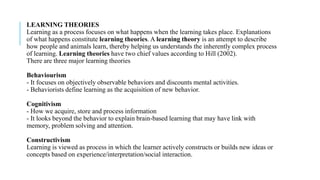
Learning as a process focuses on what happens when the learning takes place. Explanations
of what happens constitute learning theories. A learning theory is an attempt to describe
how people and animals learn, thereby helping us understands the inherently complex process
of learning. Learning theories have two chief values according to Hill (2002).
There are three major learning theories
Behaviourism
- It focuses on objectively observable behaviors and discounts mental activities.
- Behaviorists define learning as the acquisition of new behavior.
Cognitivism
- How we acquire, store and process information
- It looks beyond the behavior to explain brain-based learning that may have link with
memory, problem solving and attention.
Constructivism
Learning is viewed as process in which the learner actively constructs or builds new ideas or
concepts based on experience/interpretation/social interaction.
BEHAVIOURISM
(LEARNING IS A RESPONSE TO EXTERNAL STIMULI WITH
AND WITHOUT REINFORCEMENT)
BEHAVIOURISM INVOLVES REPEATED ACTIONS, VERBAL
REINFORCEMENT AND INCENTIVES TO TAKE PART. IT IS
GREAT FOR ESTABLISHING RULES, ESPECIALLY
FOR BEHAVIOUR MANAGEMENT.
Key Words
 Stimulus--Response
 Classical Conditioning
 Operant Conditioning
 Tabula Rasa [Clean Slate]
Key Figures
 Ivan Pavlov
 E. L. Thorndike
 John B. Watson
 B. F. Skinner
Cognitivism:
Learning is a process of acquiring and storing information.
Cognitivism focuses on the mind, and more specifically, mental processes such as
thinking, knowing, memory, and problem-solving, with the goal of opening the
“black box” of the human mind, the process of which is deemed valuable and
necessary for learning to occur. Knowledge is approached as schema
constructions, and learning is viewed as a change in the learner's schemata, or the
redefining of prior knowledge.
COGNITIVISM:
Key Concepts:
Mind as a "Black Box"
Learning is explained as a "recall"
of stored information
Instruction usually grabs the attention of learners and helps make sense of the information so it
can be stored more readily stored (learned) later for recall.
Key Words (and Definitions)
Schema Theory is defined as a mental representation of something previously known, including
actions, events, and perspectives. These are the building blocks of knowledge.
Gestalt Theory states that perceptions are entirely dependent upon the whole and not of the
individual parts. All of our understanding is built upon whole objects, events and not of their
small parts.
Equilibrium is the state in which our minds exists before we learn something new. The process,
called "adaption" by Piaget, flows as follows:
Equilibrium-->New Situation/Schema-->Disequilibrium-->Accomodation-->Assimilation
CONSTRUCTIVISM:
Learning is a process of building an understanding.
Constructivism, a derivative of cognitivism, focuses on the active role of the
learner in the process of learning. Constructivism has two major branches of
thought: Cognitivist constructivism that focuses on the individual's efforts to
acquire knowledge, and sociocultural constructivism that talks about the
acquisition or enculturation of knowledge by a social group. They are not
mutually exclusive, as learners are individuals who are part of society, and
can acquire knowledge through either channel.
CONSTRUCTIVISM
Key Words Defined
Metaphors of the Mind
Zone of Proximal Development is the difference between the developmental level
of a child and the developmental level a child could reach with the right amount of
guidance.
Scaffolding is the leveling of instructional material from a low to a high level of
cognition in order to support learner acquisition of knowledge.
Discovery Learning, as a means of inquiry-based learning, states that it is best for
learners themselves to discover facts and relationships.

Classification of Learning theories

  • 1.
    LEARNING THEORIES By HinaJalal PhD scholar, Education GCUF
  • 2.
    LEARNING THEORIES Learning asa process focuses on what happens when the learning takes place. Explanations of what happens constitute learning theories. A learning theory is an attempt to describe how people and animals learn, thereby helping us understands the inherently complex process of learning. Learning theories have two chief values according to Hill (2002). There are three major learning theories Behaviourism - It focuses on objectively observable behaviors and discounts mental activities. - Behaviorists define learning as the acquisition of new behavior. Cognitivism - How we acquire, store and process information - It looks beyond the behavior to explain brain-based learning that may have link with memory, problem solving and attention. Constructivism Learning is viewed as process in which the learner actively constructs or builds new ideas or concepts based on experience/interpretation/social interaction.
  • 3.
    BEHAVIOURISM (LEARNING IS ARESPONSE TO EXTERNAL STIMULI WITH AND WITHOUT REINFORCEMENT) BEHAVIOURISM INVOLVES REPEATED ACTIONS, VERBAL REINFORCEMENT AND INCENTIVES TO TAKE PART. IT IS GREAT FOR ESTABLISHING RULES, ESPECIALLY FOR BEHAVIOUR MANAGEMENT. Key Words  Stimulus--Response  Classical Conditioning  Operant Conditioning  Tabula Rasa [Clean Slate] Key Figures  Ivan Pavlov  E. L. Thorndike  John B. Watson  B. F. Skinner
  • 4.
    Cognitivism: Learning is aprocess of acquiring and storing information. Cognitivism focuses on the mind, and more specifically, mental processes such as thinking, knowing, memory, and problem-solving, with the goal of opening the “black box” of the human mind, the process of which is deemed valuable and necessary for learning to occur. Knowledge is approached as schema constructions, and learning is viewed as a change in the learner's schemata, or the redefining of prior knowledge.
  • 5.
    COGNITIVISM: Key Concepts: Mind asa "Black Box" Learning is explained as a "recall" of stored information Instruction usually grabs the attention of learners and helps make sense of the information so it can be stored more readily stored (learned) later for recall. Key Words (and Definitions) Schema Theory is defined as a mental representation of something previously known, including actions, events, and perspectives. These are the building blocks of knowledge. Gestalt Theory states that perceptions are entirely dependent upon the whole and not of the individual parts. All of our understanding is built upon whole objects, events and not of their small parts. Equilibrium is the state in which our minds exists before we learn something new. The process, called "adaption" by Piaget, flows as follows: Equilibrium-->New Situation/Schema-->Disequilibrium-->Accomodation-->Assimilation
  • 6.
    CONSTRUCTIVISM: Learning is aprocess of building an understanding. Constructivism, a derivative of cognitivism, focuses on the active role of the learner in the process of learning. Constructivism has two major branches of thought: Cognitivist constructivism that focuses on the individual's efforts to acquire knowledge, and sociocultural constructivism that talks about the acquisition or enculturation of knowledge by a social group. They are not mutually exclusive, as learners are individuals who are part of society, and can acquire knowledge through either channel.
  • 7.
    CONSTRUCTIVISM Key Words Defined Metaphorsof the Mind Zone of Proximal Development is the difference between the developmental level of a child and the developmental level a child could reach with the right amount of guidance. Scaffolding is the leveling of instructional material from a low to a high level of cognition in order to support learner acquisition of knowledge. Discovery Learning, as a means of inquiry-based learning, states that it is best for learners themselves to discover facts and relationships.