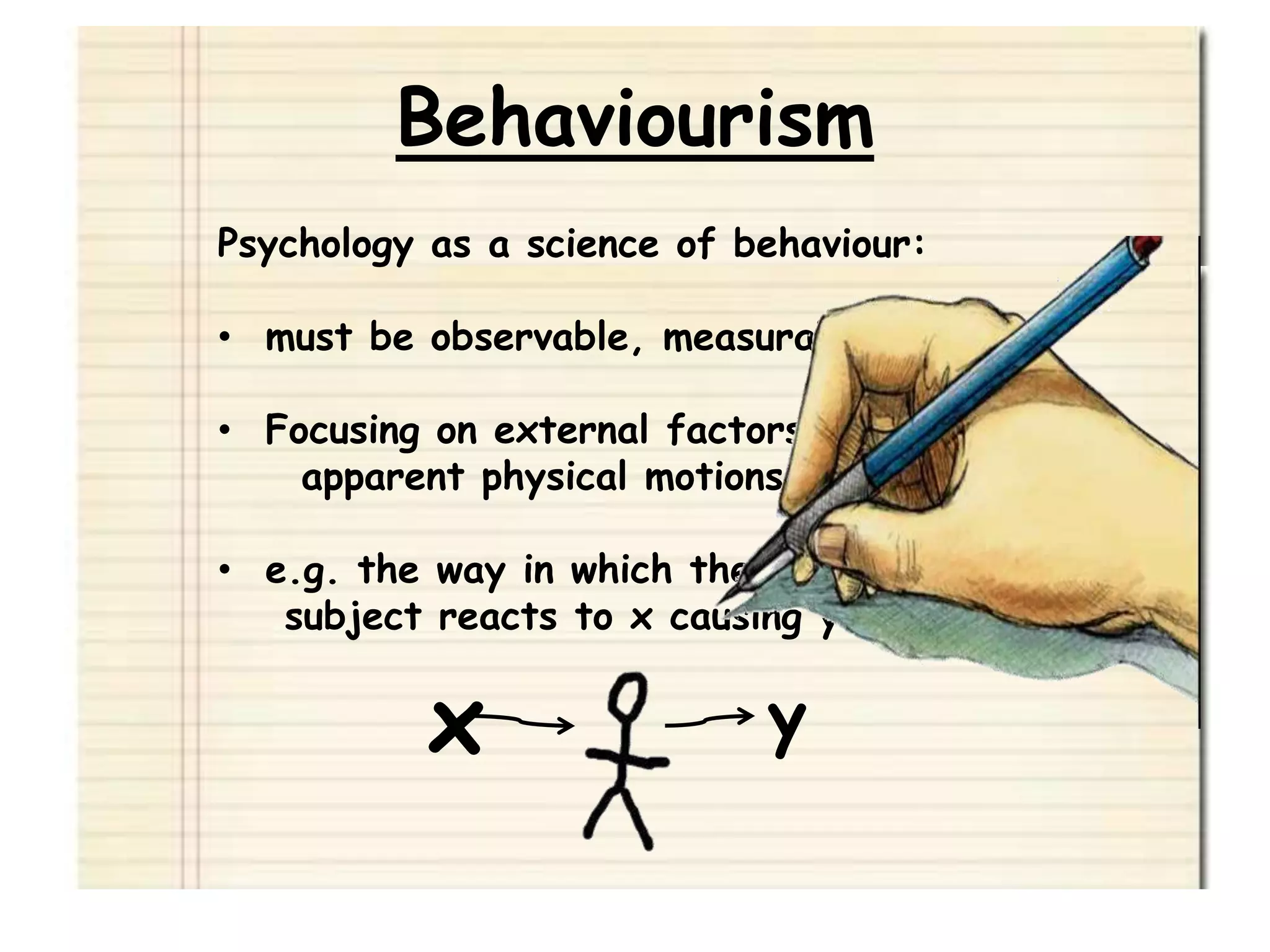

BehaviourismPsychology as a science of behaviour:must be observable, measurable;Focusing on external factors; apparent physical motions; e.g. the way in which the     subject reacts to x causing y.xy
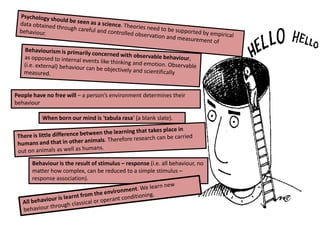
Psychology should be seen as a science. Theories need to be supported by empirical data obtained through careful and controlled observation and measurement of behaviour. Behaviourism is primarily concerned with observable behaviour, as opposed to internal events like thinking and emotion. Observable (i.e. external) behaviour can be objectively and scientifically measured. People have no free will – a person’s environment determines their behaviourWhen born our mind is 'tabula rasa' (a blank slate).There is little difference between the learning that takes place in humans and that in other animals. Therefore research can be carried out on animals as well as humans.Behaviour is the result of stimulus – response (i.e. all behaviour, no matter how complex, can be reduced to a simple stimulus – response association). All behaviour is learnt from the environment. We learn new behaviour through classical or operant conditioning.
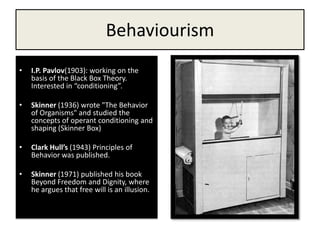
BehaviourismI.P. Pavlov(1903): working on the basis of the Black Box Theory. Interested in “conditioning”.Skinner (1936) wrote "The Behavior of Organisms" and studied the concepts of operant conditioning and shaping (Skinner Box)Clark Hull’s (1943) Principles of Behavior was published.Skinner (1971) published his book Beyond Freedom and Dignity, where he argues that free will is an illusion.
Although behaviourism is a world practiced/followed and respected psychology theory, it does not come without criticism
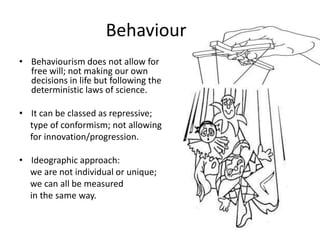
BehaviourismBehaviourism does not allow for free will; not making our own decisions in life but following the deterministic laws of science.It can be classed as repressive;     type of conformism; not allowing     for innovation/progression. Ideographic approach:      we are not individual or unique;      we can all be measured     in the same way.

Behaviourism

  • 1.
    BehaviourismPsychology as ascience of behaviour:must be observable, measurable;Focusing on external factors; apparent physical motions; e.g. the way in which the subject reacts to x causing y.xy
  • 3.
    Psychology should beseen as a science. Theories need to be supported by empirical data obtained through careful and controlled observation and measurement of behaviour. Behaviourism is primarily concerned with observable behaviour, as opposed to internal events like thinking and emotion. Observable (i.e. external) behaviour can be objectively and scientifically measured. People have no free will – a person’s environment determines their behaviourWhen born our mind is 'tabula rasa' (a blank slate).There is little difference between the learning that takes place in humans and that in other animals. Therefore research can be carried out on animals as well as humans.Behaviour is the result of stimulus – response (i.e. all behaviour, no matter how complex, can be reduced to a simple stimulus – response association). All behaviour is learnt from the environment. We learn new behaviour through classical or operant conditioning.
  • 4.
    BehaviourismI.P. Pavlov(1903): workingon the basis of the Black Box Theory. Interested in “conditioning”.Skinner (1936) wrote "The Behavior of Organisms" and studied the concepts of operant conditioning and shaping (Skinner Box)Clark Hull’s (1943) Principles of Behavior was published.Skinner (1971) published his book Beyond Freedom and Dignity, where he argues that free will is an illusion.
  • 5.
    Although behaviourism isa world practiced/followed and respected psychology theory, it does not come without criticism
  • 6.
    BehaviourismBehaviourism does notallow for free will; not making our own decisions in life but following the deterministic laws of science.It can be classed as repressive; type of conformism; not allowing for innovation/progression. Ideographic approach: we are not individual or unique; we can all be measured in the same way.

Editor's Notes

  • #7 For this psome info taken fromhttp://www.simplypsychology.pwp.blueyonder.co.uk/behaviourism.html