EBS Presentation
Effectiveness of optic nerve sheath
fenestration in idiopathic intracranial
hypertension
                                         Johnny Wong
                                             14th July, 2011


                   Advanced Scholar:   Prof Marcus Stoodley
Introduction

• “Benign intracranial hypertension”
• “Idiopathic intracranial hypertension”
• “Pseudotumour cerebri”

• Symptoms: Headaches and visual blurring
• Treatment options
   – Conservative: Weight loss, diet, diuretics, acetazolamide, corticosteroids,
     octreotide
   – Surgical procedures: Optic nerve sheath fenestration, CSF diversion –
     multiple lumbar punctures, LP or VP shunt, subtemporal decompressions
   – Venous stenting
Clinical Questions:


• Primary Question:
     What is the effectiveness of optic nerve sheath fenestration
     (ONSF) in patients with idiopathic intracranial hypertension?


•   Secondary Question:
     How does ONSF compare with other treatments for
     idiopathic intracranial hypertension?
Search strategy

• P = Idiopathic intracranial hypertension
• I = Optic nerve fenestration
• [C = Other surgical procedures (eg CSF shunting;
  sinus stenting) ]
• O = Treatment outcomes

• Cochrane, Ovid Medline, Scopus, Google Scholar
• MeSH terms: “Pseudotumour cerebri” ; “ophthalmologic surgical
  procedures”
Cochrane
           • Methods:
              – Searched for RCT only
              – 3 categories: Idiopathic patients
                with papilloedema; Idiopathic
                without papilloedema; IIH with
                underlying aetiology
              – 7 Interventions types
           • Results:
              – 85 studies relevant to IIH
              – 1 RCT found – poor
                randomisation (acetazolamide)
           • Recommendations:
              – Optic nerve fenestration or LP
                shunt for papilloedema
              – Further research required
Ovid Medline


               5 useful articles identified
Ovid Medline


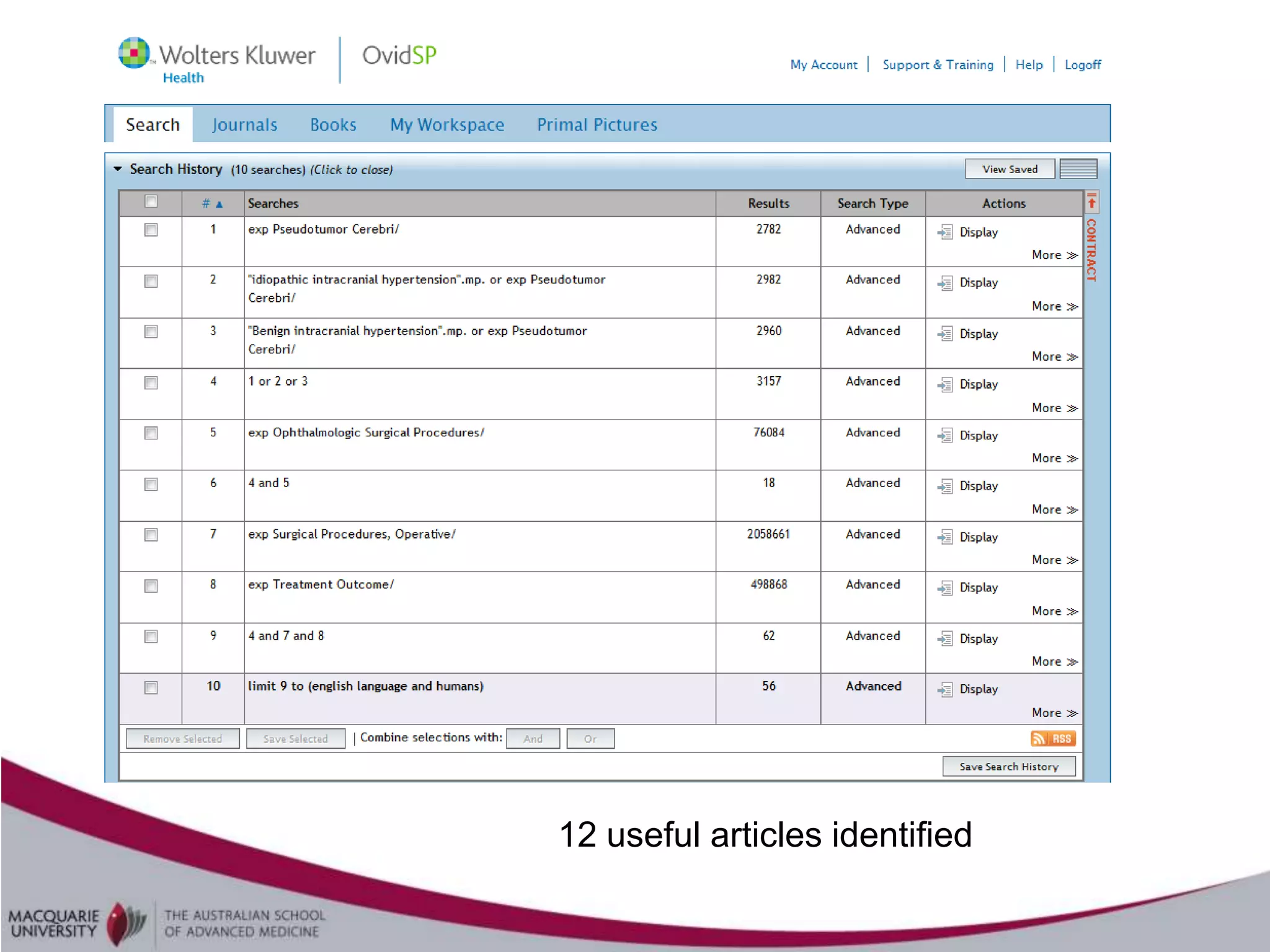
               12 useful articles identified
Scopus


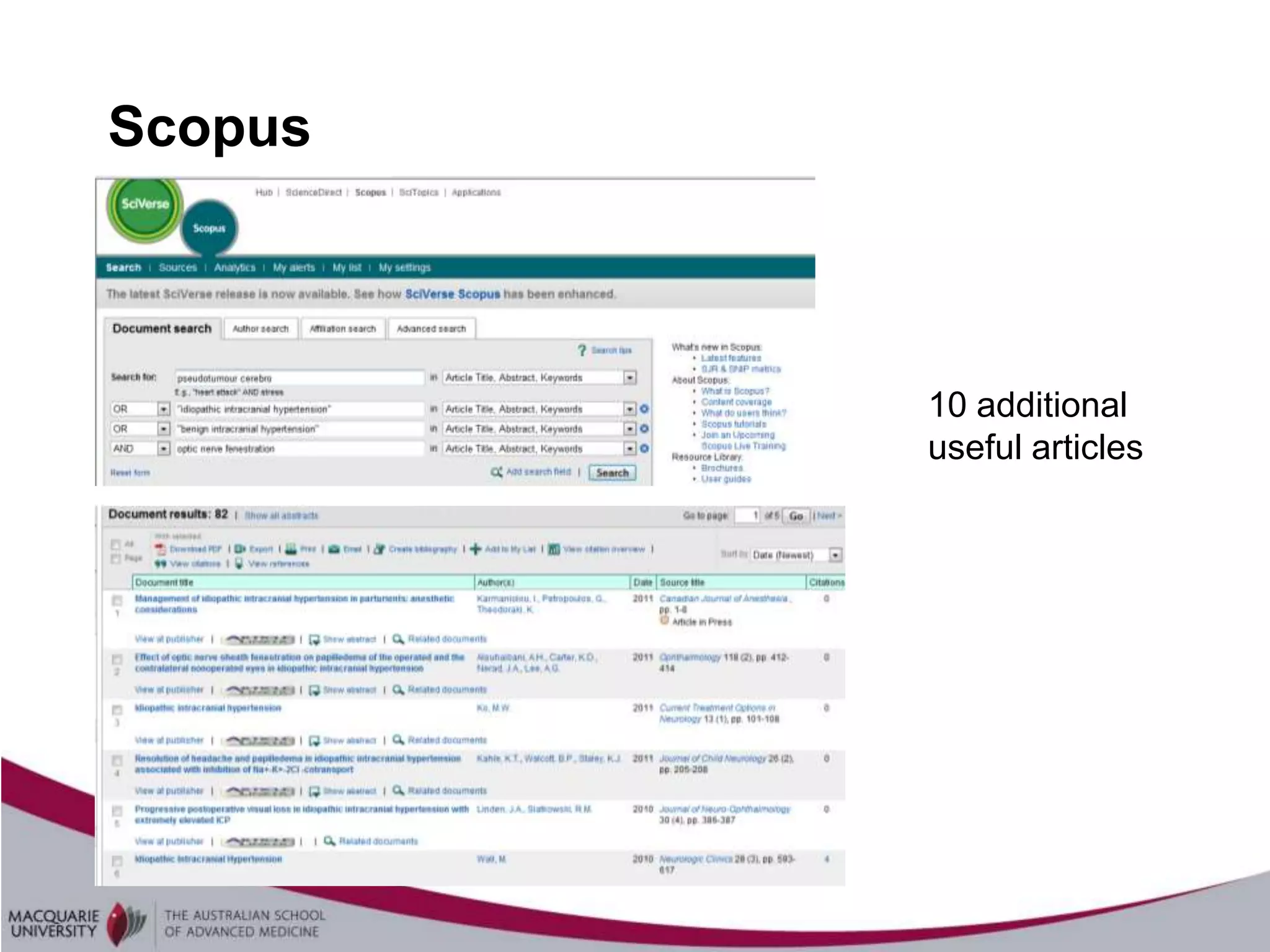
         10 additional
         useful articles
Primary Question – Efficacy of ONSF

• No RCT; Case series only;
• 3 review articles found
• Prevent visual deterioration; Improved VA,
  not HA (33-50% not relieved)
• Review by Brazis et al(2008), Uretzky et al.
  (2009)
  – Papilloedema: 86-97% resolved or sig. improved
  – VA: 85-91% Improved or stabilised
  – VF: 48-95% improved; 25-38% stabilised
Primary Question – Efficacy of ONSF

  –   Bilateral VA improvement from unilateral ONSF
  –   Better for acute papilloedema
  –   10-15% worsening vision
  –   4.5-45% complication rates
  –   Long-term (5 years):
       • 36% improvement
       • 32% stabilisation
       • 33% later deterioration after initial improvement
  – Maintenance of vision
       • 66% @ 12 months; 55% @ 3y, 38% @ 5y, 16% @ 6y
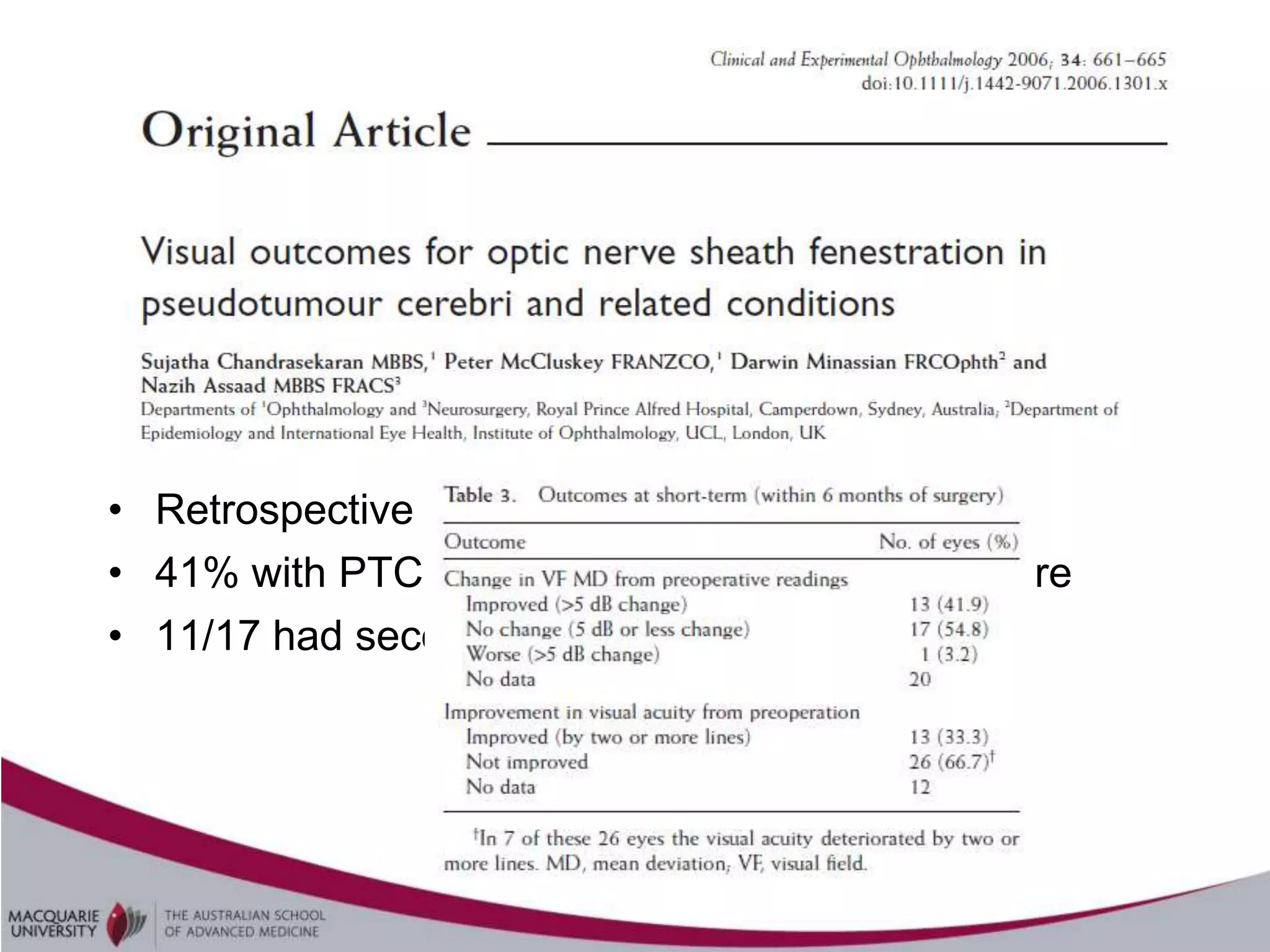
• Retrospective series of 32 patients, 51 eyes
• 41% with PTC; 47% ONSF as primary procedure
• 11/17 had second shunt procedure
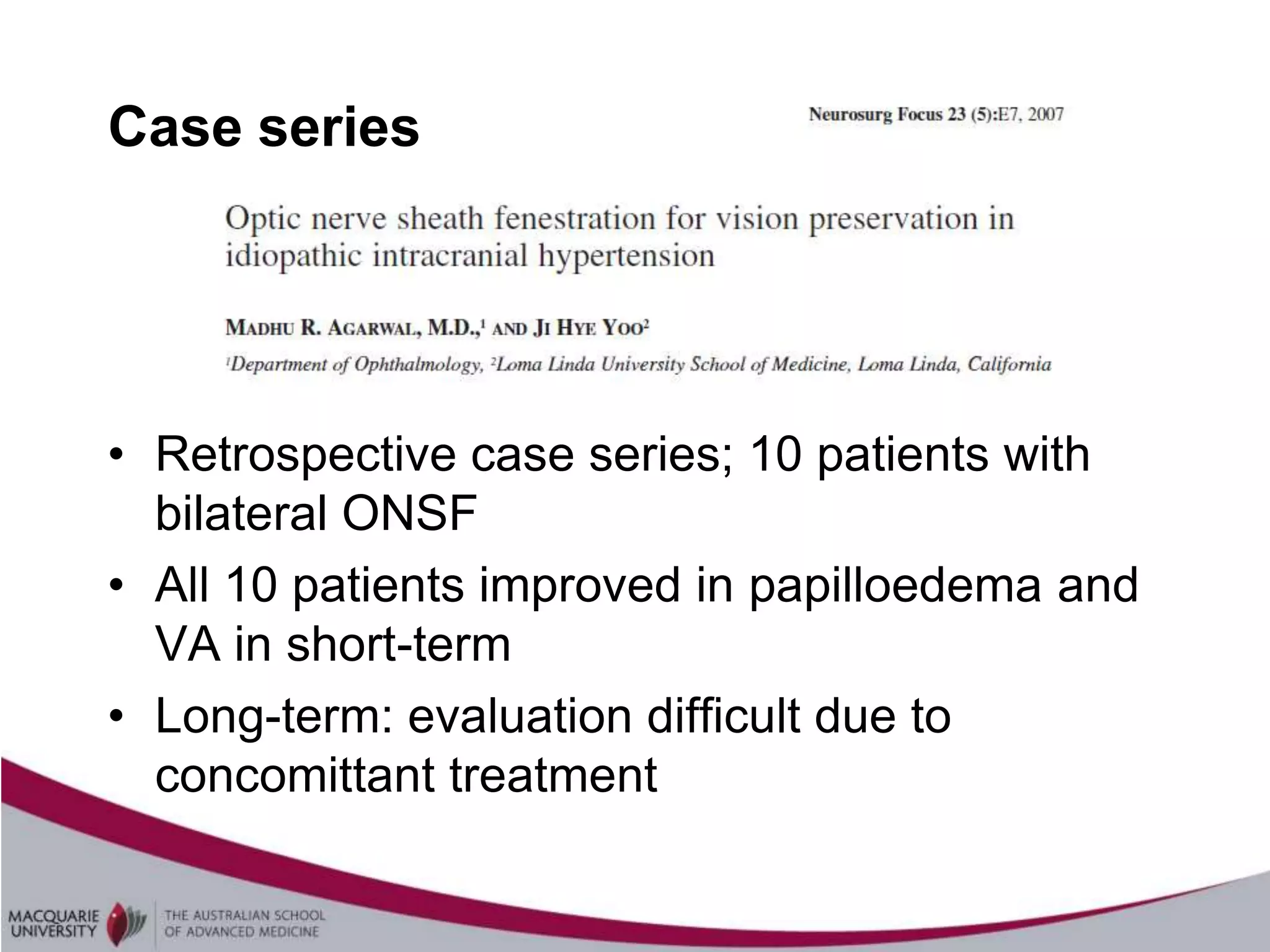
Case series


• Retrospective case series; 10 patients with
  bilateral ONSF
• All 10 patients improved in papilloedema and
  VA in short-term
• Long-term: evaluation difficult due to
  concomittant treatment
Case series: Alsuhaibani et al, 2011

Effect of Optic Nerve Sheath Fenestration on
  Papilloedema of the operated and
  contralateral non-operated eyes in idiopathic
  intracranial hypertension

• Retrospective series; 62 patients unilateral ONSF
• Pre-op papilloedema scores: Ipsi & contral – 3 & 2
• Post-op: 2 & 2 (2 wks); 1 & 1 (3 & 6 months); 0.5 & 1
  (12 months)
Secondary question: Comparison with
other treatments

• No RCT comparing surgical options or
  medical treatment
• Case series and review articles
• LPS – effective in treating symptoms, but high
  rates of revisions
• VPS – difficult ventriculostomy with small
  ventricles
LPS (Review articles – Brazis 2008)
  (Burgett 1997: 30 patients)
  – VA: 71% improvement of 2 lines; VF: stabilised in
    62%; Symptom resolution: 82%
  – Mean no. of revisions: 4.2;
  – Revision rate: 55-63%

  (Eggenberger 1996: 27 patients)
  – 100% improvement
  – 56% revisions (3 requiring 35 revisions)
LPS


• 40 patients; VAD in 21 patients
• 10 revision operations
• 7 intractable headaches
VPS (Review article – Brazis 2008)
  Bynke 2004: 17 patients
  – Symptom resolution: 100%
  – Mean FU: 6.5 years
  – Revision rate: 7/17 for 1 or 2 revisions

  Woodworth 2005: 21 patients
  – 100% initial improvement
  – Failure rates: 10% at 1 month, 20% at 2 months,
    50% at 12 months, 60% at 24 months
  – Revisions for distal obstruction (67%) &
    overdrainage
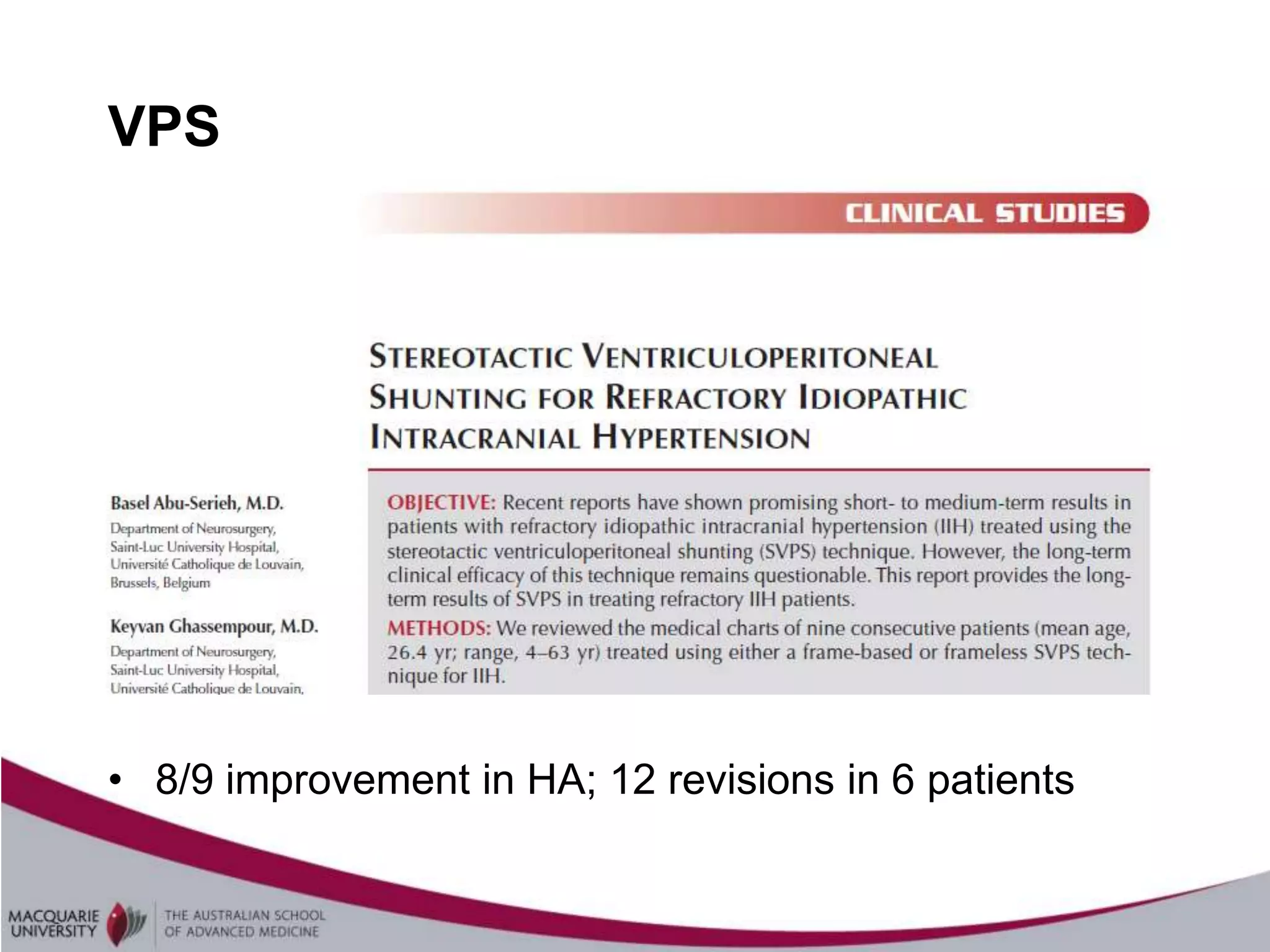
VPS


• 8/9 improvement in HA; 12 revisions in 6 patients
LPS vs VPS


• 115 shunt operations in 42 patients (79 LPS, 36 VPS)
• 95% improvement in headaches
• 19% and 48% recurrent HA despite functioning shunt
  at 12 and 36 months respectively
• 2.5 fold increased risk of revisions with LPS
• 3 fold increased risk of distal obstruction with LPS.
LPS vs VPS


• Retrospective; 25 patients
• 72% LPS – 11% failure rate, 60% revision
• 28% VPS – 14% failure rate, 30% revision
Conclusion

• ONSF effective in short term for papilloedema
  and visual deterioration (85-94%); not HA.
• Unilateral may be adequate;
• Long-term recurrence
• Efficacy similar to LP or VP shunts

• RCTs required for best treatment for IIH

Idiopathic intracranial hypertension

  • 1.
    EBS Presentation Effectiveness ofoptic nerve sheath fenestration in idiopathic intracranial hypertension Johnny Wong 14th July, 2011 Advanced Scholar: Prof Marcus Stoodley
  • 2.
    Introduction • “Benign intracranialhypertension” • “Idiopathic intracranial hypertension” • “Pseudotumour cerebri” • Symptoms: Headaches and visual blurring • Treatment options – Conservative: Weight loss, diet, diuretics, acetazolamide, corticosteroids, octreotide – Surgical procedures: Optic nerve sheath fenestration, CSF diversion – multiple lumbar punctures, LP or VP shunt, subtemporal decompressions – Venous stenting
  • 3.
    Clinical Questions: • PrimaryQuestion: What is the effectiveness of optic nerve sheath fenestration (ONSF) in patients with idiopathic intracranial hypertension? • Secondary Question: How does ONSF compare with other treatments for idiopathic intracranial hypertension?
  • 4.
    Search strategy • P= Idiopathic intracranial hypertension • I = Optic nerve fenestration • [C = Other surgical procedures (eg CSF shunting; sinus stenting) ] • O = Treatment outcomes • Cochrane, Ovid Medline, Scopus, Google Scholar • MeSH terms: “Pseudotumour cerebri” ; “ophthalmologic surgical procedures”
  • 5.
    Cochrane • Methods: – Searched for RCT only – 3 categories: Idiopathic patients with papilloedema; Idiopathic without papilloedema; IIH with underlying aetiology – 7 Interventions types • Results: – 85 studies relevant to IIH – 1 RCT found – poor randomisation (acetazolamide) • Recommendations: – Optic nerve fenestration or LP shunt for papilloedema – Further research required
  • 6.
    Ovid Medline 5 useful articles identified
  • 7.
    Ovid Medline 12 useful articles identified
  • 8.
    Scopus 10 additional useful articles
  • 9.
    Primary Question –Efficacy of ONSF • No RCT; Case series only; • 3 review articles found • Prevent visual deterioration; Improved VA, not HA (33-50% not relieved) • Review by Brazis et al(2008), Uretzky et al. (2009) – Papilloedema: 86-97% resolved or sig. improved – VA: 85-91% Improved or stabilised – VF: 48-95% improved; 25-38% stabilised
  • 10.
    Primary Question –Efficacy of ONSF – Bilateral VA improvement from unilateral ONSF – Better for acute papilloedema – 10-15% worsening vision – 4.5-45% complication rates – Long-term (5 years): • 36% improvement • 32% stabilisation • 33% later deterioration after initial improvement – Maintenance of vision • 66% @ 12 months; 55% @ 3y, 38% @ 5y, 16% @ 6y
  • 11.
    • Retrospective seriesof 32 patients, 51 eyes • 41% with PTC; 47% ONSF as primary procedure • 11/17 had second shunt procedure
  • 12.
    Case series • Retrospectivecase series; 10 patients with bilateral ONSF • All 10 patients improved in papilloedema and VA in short-term • Long-term: evaluation difficult due to concomittant treatment
  • 13.
    Case series: Alsuhaibaniet al, 2011 Effect of Optic Nerve Sheath Fenestration on Papilloedema of the operated and contralateral non-operated eyes in idiopathic intracranial hypertension • Retrospective series; 62 patients unilateral ONSF • Pre-op papilloedema scores: Ipsi & contral – 3 & 2 • Post-op: 2 & 2 (2 wks); 1 & 1 (3 & 6 months); 0.5 & 1 (12 months)
  • 14.
    Secondary question: Comparisonwith other treatments • No RCT comparing surgical options or medical treatment • Case series and review articles • LPS – effective in treating symptoms, but high rates of revisions • VPS – difficult ventriculostomy with small ventricles
  • 15.
    LPS (Review articles– Brazis 2008) (Burgett 1997: 30 patients) – VA: 71% improvement of 2 lines; VF: stabilised in 62%; Symptom resolution: 82% – Mean no. of revisions: 4.2; – Revision rate: 55-63% (Eggenberger 1996: 27 patients) – 100% improvement – 56% revisions (3 requiring 35 revisions)
  • 16.
    LPS • 40 patients;VAD in 21 patients • 10 revision operations • 7 intractable headaches
  • 17.
    VPS (Review article– Brazis 2008) Bynke 2004: 17 patients – Symptom resolution: 100% – Mean FU: 6.5 years – Revision rate: 7/17 for 1 or 2 revisions Woodworth 2005: 21 patients – 100% initial improvement – Failure rates: 10% at 1 month, 20% at 2 months, 50% at 12 months, 60% at 24 months – Revisions for distal obstruction (67%) & overdrainage
  • 18.
    VPS • 8/9 improvementin HA; 12 revisions in 6 patients
  • 19.
    LPS vs VPS •115 shunt operations in 42 patients (79 LPS, 36 VPS) • 95% improvement in headaches • 19% and 48% recurrent HA despite functioning shunt at 12 and 36 months respectively • 2.5 fold increased risk of revisions with LPS • 3 fold increased risk of distal obstruction with LPS.
  • 20.
    LPS vs VPS •Retrospective; 25 patients • 72% LPS – 11% failure rate, 60% revision • 28% VPS – 14% failure rate, 30% revision
  • 21.
    Conclusion • ONSF effectivein short term for papilloedema and visual deterioration (85-94%); not HA. • Unilateral may be adequate; • Long-term recurrence • Efficacy similar to LP or VP shunts • RCTs required for best treatment for IIH

Editor's Notes

  • #3 • increased intracranial pressure (ICP);• normal/small ventricles on neuro-imaging;• no evidence of intracranial mass;• normal CSF composition (a low CSF protein is acceptable).
  • #14 Recommended treatment compared with shunting: shorter OT time and lower complications; ? Unilateral ONSF is adequate