Gait
(normal & abnormal)


   Dr. P. Ratan Khuman (PT)
   M.P.T., (Ortho & Sports)
Definition
    Locomotion or gait –
         It is defined as a translatory progression of the body as a
          whole produce by coordinated, rotatory movements of
          body segments.
    Normal gait –
         It is a rhythmic & characterized by alternating propulsive
          & retropulsive motions of the lower extremities.


    22-Jun-12             P.R.Khuman(MPT,Ortho & Sports)                2
Task involves in walking
   According to “Rancho Los Amigos” (RLA), California
       Weight acceptance
       Single limb support
       Swing limb advance


    22-Jun-12           P.R.Khuman(MPT,Ortho & Sports)   3
Gait initiation
   A series of events occur from the initiation of
    body movt to beginning of gait cycle.
   It is stereotyped activity in both young & old
    healthy people.
   Total duration of this phase is about – 0.60sec


    22-Jun-12      P.R.Khuman(MPT,Ortho & Sports)   4
Kinematics of gait


22-Jun-12   P.R.Khuman(MPT,Ortho & Sports)   5
Phases of gait
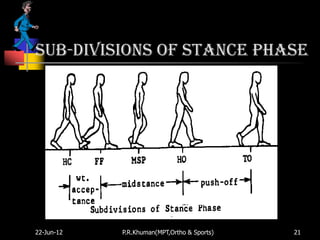
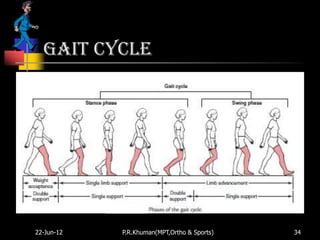
   Stance phase
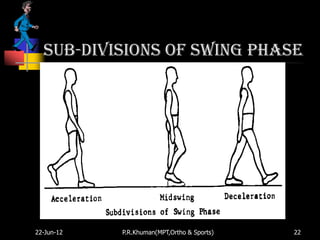
   Swing phase


    22-Jun-12      P.R.Khuman(MPT,Ortho & Sports)   6
Stance phase
   It begins at the instant that one extremity
    contacts the ground & continuous only as long
    as some portion of the foot is in contact with
    the ground.
   It is approx 60% of normal gait duration.


    22-Jun-12     P.R.Khuman(MPT,Ortho & Sports)   7
Swing phase
   It begins as soon as the toe of one extremity
    leaves the ground & ceases just before heel
    strike or contact of the same extremity.
   It makes up 40% of normal gait cycle.


    22-Jun-12      P.R.Khuman(MPT,Ortho & Sports)   8
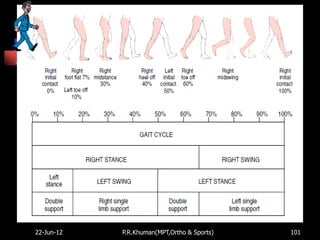
Double support
   Lower limb of one side of body is beginning its
    stance phase & the opposite side is ending its
    stance phase.
   During double support both the lower limb are in
    contact with the ground at the same time.
   It account approx 22% of gait cycle.
   This phase is absent in running


    22-Jun-12      P.R.Khuman(MPT,Ortho & Sports)   9
Subdivision of phases
Stance phase –                  Swing phase –
1)  Heel strike                 1) Acceleration
2)  Foot flat                   2) Mid-swing
3)  Mid-stance                  3) Deceleration
4)  Heel off
5)  Toe off


 22-Jun-12        P.R.Khuman(MPT,Ortho & Sports)   10
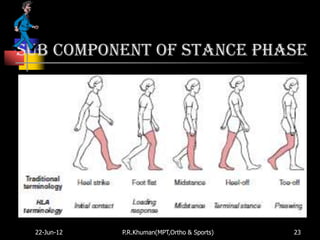
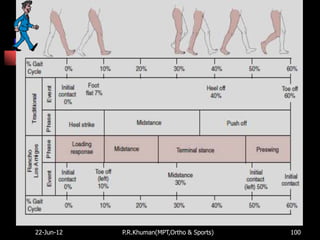
Comparison of gait terminology
    Traditional –                          RLA –
      1)   Heel strike                        1)   Initial contact
      2)   Foot flat                          2)   Loading response
      3)   Mid-stance                         3)   Mid-stance
      4)   Heel off                           4)   Terminal stance
      5)   Toe off                            5)   Pre-swing
      6)   Acceleration                       6)   Initial swing
      7)   Mid-swing                          7)   Mid-swing
      8)   Deceleration                       8)   Terminal swing


    22-Jun-12             P.R.Khuman(MPT,Ortho & Sports)              11
Traditional phases of gait


22-Jun-12   P.R.Khuman(MPT,Ortho & Sports)   12
Stance phase
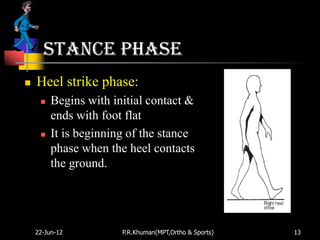
   Heel strike phase:
        Begins with initial contact &
         ends with foot flat
        It is beginning of the stance
         phase when the heel contacts
         the ground.


    22-Jun-12          P.R.Khuman(MPT,Ortho & Sports)   13
Stance phase
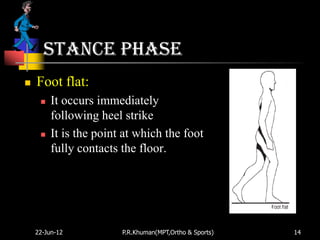
   Foot flat:
        It occurs immediately
         following heel strike
        It is the point at which the foot
         fully contacts the floor.


    22-Jun-12           P.R.Khuman(MPT,Ortho & Sports)   14
Stance phase
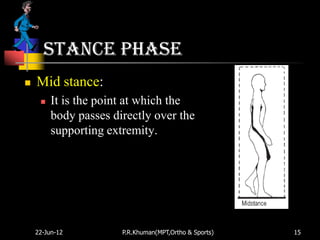
   Mid stance:
        It is the point at which the
         body passes directly over the
         supporting extremity.


    22-Jun-12          P.R.Khuman(MPT,Ortho & Sports)   15
Stance phase
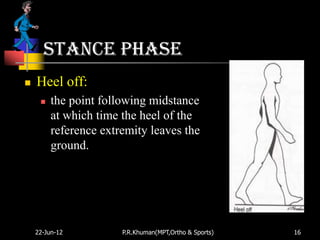
   Heel off:
        the point following midstance
         at which time the heel of the
         reference extremity leaves the
         ground.


    22-Jun-12          P.R.Khuman(MPT,Ortho & Sports)   16
Stance phase
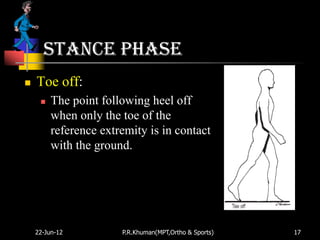
   Toe off:
        The point following heel off
         when only the toe of the
         reference extremity is in contact
         with the ground.


    22-Jun-12          P.R.Khuman(MPT,Ortho & Sports)   17
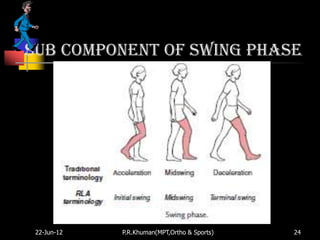
Swing phase
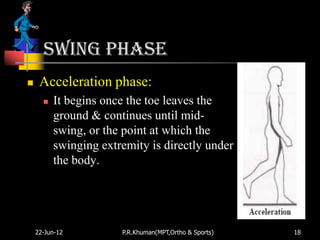
    Acceleration phase:
         It begins once the toe leaves the
          ground & continues until mid-
          swing, or the point at which the
          swinging extremity is directly under
          the body.


    22-Jun-12          P.R.Khuman(MPT,Ortho & Sports)   18
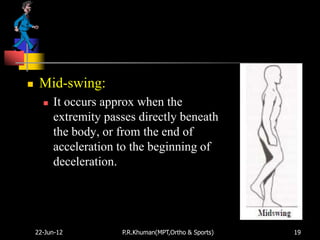
    Mid-swing:
         It occurs approx when the
          extremity passes directly beneath
          the body, or from the end of
          acceleration to the beginning of
          deceleration.


    22-Jun-12          P.R.Khuman(MPT,Ortho & Sports)   19
Swing phase
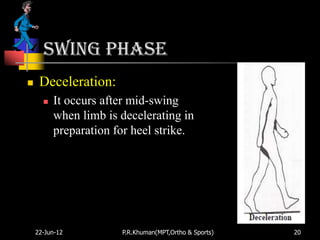
    Deceleration:
         It occurs after mid-swing
          when limb is decelerating in
          preparation for heel strike.


    22-Jun-12          P.R.Khuman(MPT,Ortho & Sports)   20
Sub-divisions of stance phase


22-Jun-12   P.R.Khuman(MPT,Ortho & Sports)   21
Sub-divisions of swing phase


22-Jun-12   P.R.Khuman(MPT,Ortho & Sports)   22
Sub component of stance phase


 22-Jun-12   P.R.Khuman(MPT,Ortho & Sports)   23
Sub component of swing phase


 22-Jun-12   P.R.Khuman(MPT,Ortho & Sports)   24
RLA phases of gait


22-Jun-12    P.R.Khuman(MPT,Ortho & Sports)   25
Initial contact
    It refer to the initial contact of the foot of
     leading lower limb.
    Normally the heel pointed first to contact.
    In abnormal gait it is possible to either
     whole foot or toes rather than the heel to
     strike.


    22-Jun-12        P.R.Khuman(MPT,Ortho & Sports)   26
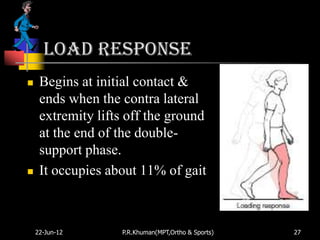
Load response
    Begins at initial contact &
     ends when the contra lateral
     extremity lifts off the ground
     at the end of the double-
     support phase.
    It occupies about 11% of gait


    22-Jun-12      P.R.Khuman(MPT,Ortho & Sports)   27
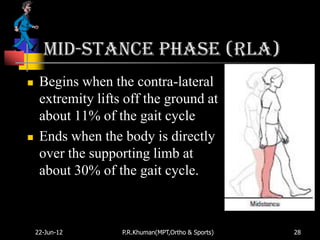
Mid-stance phase (RLA)
    Begins when the contra-lateral
     extremity lifts off the ground at
     about 11% of the gait cycle
    Ends when the body is directly
     over the supporting limb at
     about 30% of the gait cycle.


    22-Jun-12       P.R.Khuman(MPT,Ortho & Sports)   28
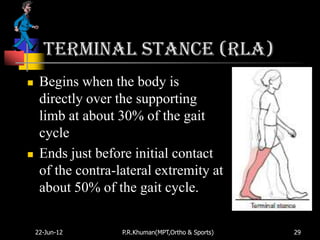
Terminal stance (RLA)
    Begins when the body is
     directly over the supporting
     limb at about 30% of the gait
     cycle
    Ends just before initial contact
     of the contra-lateral extremity at
     about 50% of the gait cycle.

    22-Jun-12       P.R.Khuman(MPT,Ortho & Sports)   29
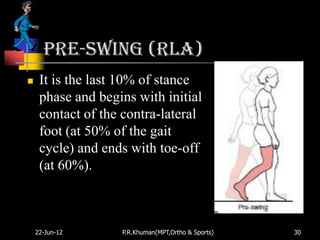
Pre-Swing (RLA)
    It is the last 10% of stance
     phase and begins with initial
     contact of the contra-lateral
     foot (at 50% of the gait
     cycle) and ends with toe-off
     (at 60%).


    22-Jun-12      P.R.Khuman(MPT,Ortho & Sports)   30
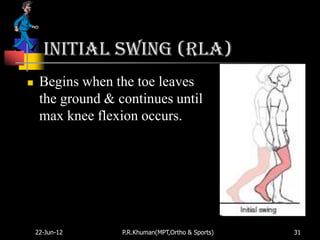
Initial swing (RLA)
    Begins when the toe leaves
     the ground & continues until
     max knee flexion occurs.


    22-Jun-12      P.R.Khuman(MPT,Ortho & Sports)   31
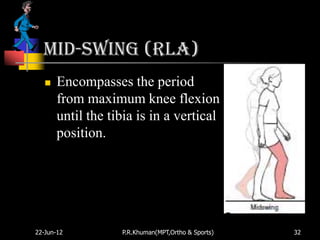
Mid-Swing (RLA)
      Encompasses the period
       from maximum knee flexion
       until the tibia is in a vertical
       position.


22-Jun-12          P.R.Khuman(MPT,Ortho & Sports)   32
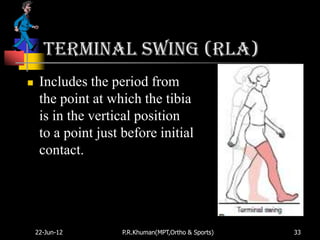
Terminal swing (RLA)
    Includes the period from
     the point at which the tibia
     is in the vertical position
     to a point just before initial
     contact.


    22-Jun-12        P.R.Khuman(MPT,Ortho & Sports)   33
Gait cycle


22-Jun-12   P.R.Khuman(MPT,Ortho & Sports)   34
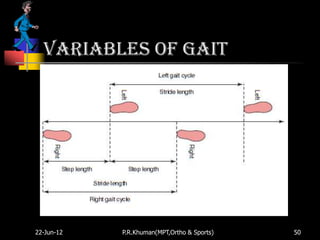
Variables of gait
    There are two basic variables which provide a basic
     description of human gait.
         Time/ Temporal variable & Distance variables.
    Provide essential quantitative information about gait


    22-Jun-12             P.R.Khuman(MPT,Ortho & Sports)     35
factors affecting variables
    Age,                             Joint mobility,
    Gender,                          Muscle strength,
    Height,                          Type of clothing &
    Size & shape of bony              footwear,
     components,                      Habit,
    Distribution of mass in          Psychological status.
     body segments,


    22-Jun-12        P.R.Khuman(MPT,Ortho & Sports)            36
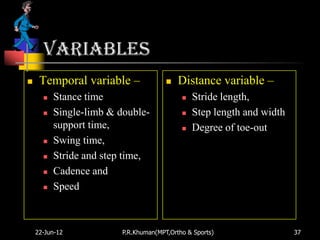
variables
    Temporal variable –                  Distance variable –
         Stance time                          Stride length,
         Single-limb & double-                Step length and width
          support time,                        Degree of toe-out
         Swing time,
         Stride and step time,
         Cadence and
         Speed


    22-Jun-12            P.R.Khuman(MPT,Ortho & Sports)                 37
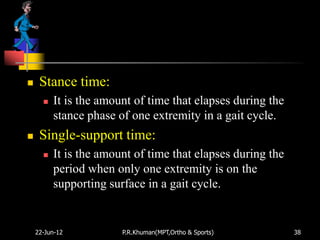
    Stance time:
         It is the amount of time that elapses during the
          stance phase of one extremity in a gait cycle.
    Single-support time:
         It is the amount of time that elapses during the
          period when only one extremity is on the
          supporting surface in a gait cycle.


    22-Jun-12           P.R.Khuman(MPT,Ortho & Sports)       38
    Double-support time:
         It is the amount of time spent with both feet on
          the ground during one gait cycle.
         The % of time spent increased in elderly
          persons and in those with balance disorders.
         The percentage of time spent decreases as the
          speed of walking increases.


    22-Jun-12           P.R.Khuman(MPT,Ortho & Sports)       39
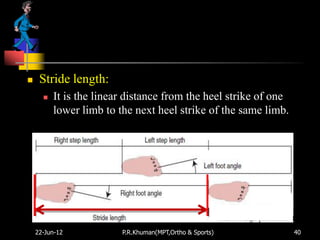
    Stride length:
         It is the linear distance from the heel strike of one
          lower limb to the next heel strike of the same limb.


    22-Jun-12            P.R.Khuman(MPT,Ortho & Sports)           40
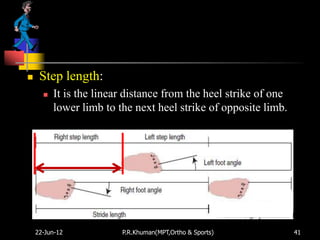
    Step length:
         It is the linear distance from the heel strike of one
          lower limb to the next heel strike of opposite limb.


    22-Jun-12            P.R.Khuman(MPT,Ortho & Sports)           41
    Stride duration:
         It refers to amount of time taken to accomplish
          one stride.
         Stride duration and gait cycle duration are
          synonymous.
         One stride, for a normal adult, lasts approx 1 sec


    22-Jun-12           P.R.Khuman(MPT,Ortho & Sports)     42
    Step duration:
         It refers to the amount of time spent during a
          single step.
         Measurement usually is expressed as sec/step.
         When weakness or pain in limb, step duration
          may be decreased on the affected side and
          increased on the unaffected side.


    22-Jun-12          P.R.Khuman(MPT,Ortho & Sports)      43
    Cadence:
         It is the no of steps taken by a person per unit
          of time.
         It is measured as the no of steps / sec or per
          minute.
           Cadence = Number of steps / Time


    22-Jun-12           P.R.Khuman(MPT,Ortho & Sports)       44
    Walking velocity:
         It is the rate of linear forward motion of the
          body, which can be measured in meters or
          cm/second, meters/minute, or miles/hour.

Walking velocity (meters/sec)=Distance walked (meters)/time (sec)


    22-Jun-12             P.R.Khuman(MPT,Ortho & Sports)            45
    Speed of gait:
         It is referred to as slow, free, and fast.
               Free speed of gait refers to a person‟s normal
                walking speed
               Slow & fast speeds of gait refer to speeds slower or
                faster than the person‟s normal comfortable walking
                speed, designated in a variety of ways.


    22-Jun-12               P.R.Khuman(MPT,Ortho & Sports)             46
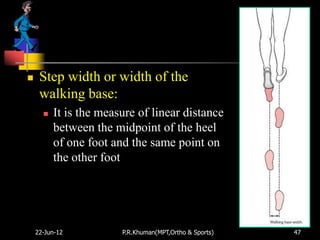
    Step width or width of the
     walking base:
         It is the measure of linear distance
          between the midpoint of the heel
          of one foot and the same point on
          the other foot


    22-Jun-12           P.R.Khuman(MPT,Ortho & Sports)   47
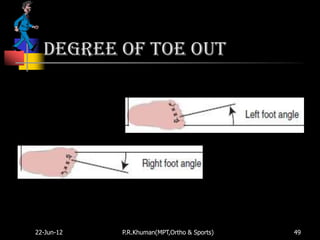
    Degree of toe-out (DTO):
         It represents the angle of foot formed by each
          foot‟s line of progression and a line intersecting the
          centre of the heel and the second toe.
         The angle for men is about 70 from the line of
          progression of each foot at free speed walking.
         The DTO decreases as the speed of walking
          increases in normal men.


    22-Jun-12            P.R.Khuman(MPT,Ortho & Sports)            48
Degree of toe out


22-Jun-12   P.R.Khuman(MPT,Ortho & Sports)   49
Variables of gait


22-Jun-12   P.R.Khuman(MPT,Ortho & Sports)   50
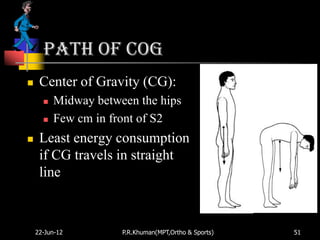
Path of COG
    Center of Gravity (CG):
         Midway between the hips
         Few cm in front of S2
    Least energy consumption
     if CG travels in straight
     line


    22-Jun-12         P.R.Khuman(MPT,Ortho & Sports)   51
22-Jun-12   P.R.Khuman(MPT,Ortho & Sports)   52
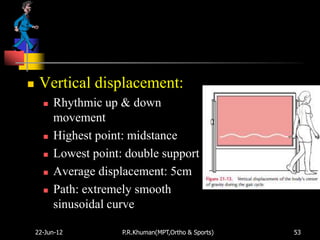
    Vertical displacement:
         Rhythmic up & down
          movement
         Highest point: midstance
         Lowest point: double support
         Average displacement: 5cm
         Path: extremely smooth
          sinusoidal curve

    22-Jun-12          P.R.Khuman(MPT,Ortho & Sports)   53
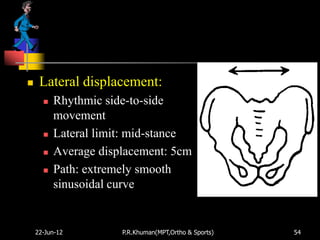
    Lateral displacement:
         Rhythmic side-to-side
          movement
         Lateral limit: mid-stance
         Average displacement: 5cm
         Path: extremely smooth
          sinusoidal curve


    22-Jun-12         P.R.Khuman(MPT,Ortho & Sports)   54
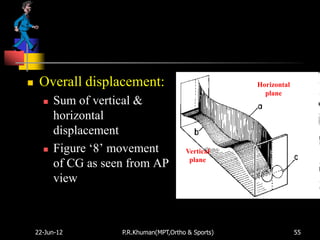
    Overall displacement:                             Horizontal
                                                         plane
         Sum of vertical &
          horizontal
          displacement
         Figure „8‟ movement             Vertical
                                           plane
          of CG as seen from AP
          view


    22-Jun-12         P.R.Khuman(MPT,Ortho & Sports)                55
SaunderS’ Determinants of gait
    Gait “determinants” was first described by
     “Saunders & Coworkers” in 1953.
    Six optimizations used to minimize
     excursion of CG in vertical & horizontal
     planes.


    22-Jun-12      P.R.Khuman(MPT,Ortho & Sports)   56
    The “determinants” represent adjustments
     made by the pelvis, hips, knees, and ankles
     that help to keep movt of the body‟s COG
     to a minimum.
    By decreasing the vertical & lateral
     excursions of the body‟s COM it was
     thought that energy expenditure would be
     less & gait more efficient.
    22-Jun-12      P.R.Khuman(MPT,Ortho & Sports)   57
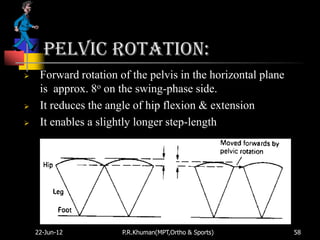
Pelvic rotation:
    Forward rotation of the pelvis in the horizontal plane
     is approx. 8o on the swing-phase side.
    It reduces the angle of hip flexion & extension
    It enables a slightly longer step-length


    22-Jun-12          P.R.Khuman(MPT,Ortho & Sports)         58
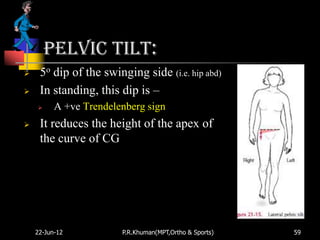
Pelvic tilt:
    5o dip of the swinging side (i.e. hip abd)
    In standing, this dip is –
         A +ve Trendelenberg sign
    It reduces the height of the apex of
     the curve of CG


    22-Jun-12           P.R.Khuman(MPT,Ortho & Sports)   59
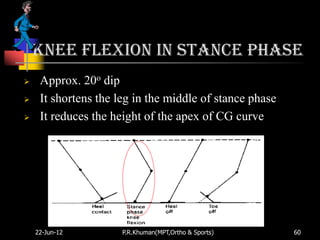
Knee flexion in stance phase
    Approx. 20o dip
    It shortens the leg in the middle of stance phase
    It reduces the height of the apex of CG curve


    22-Jun-12         P.R.Khuman(MPT,Ortho & Sports)     60
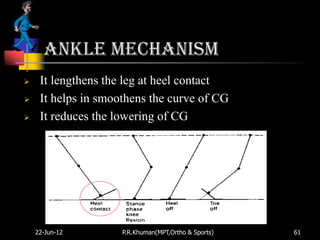
Ankle mechanism
    It lengthens the leg at heel contact
    It helps in smoothens the curve of CG
    It reduces the lowering of CG


    22-Jun-12        P.R.Khuman(MPT,Ortho & Sports)   61
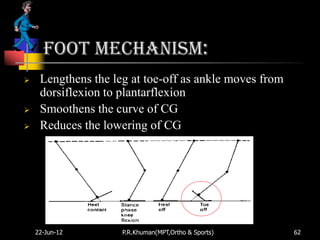
Foot mechanism:
    Lengthens the leg at toe-off as ankle moves from
     dorsiflexion to plantarflexion
    Smoothens the curve of CG
    Reduces the lowering of CG


    22-Jun-12        P.R.Khuman(MPT,Ortho & Sports)     62
Lateral displacement of body
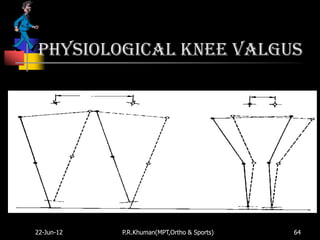
 Physiologic valgus of the knee reduce side-to-
  side movement of the COM in frontal plane.
 The normally narrow width of the walking

  base minimizes the lateral displacement of CG
 Reduced muscular energy consumption due to
   reduced lateral acceleration & deceleration


    22-Jun-12    P.R.Khuman(MPT,Ortho & Sports)    63
Physiological knee valgus


22-Jun-12   P.R.Khuman(MPT,Ortho & Sports)   64
Abnormal
(Atypical) Gait


22-Jun-12   P.R.Khuman(MPT,Ortho & Sports)   65
    There are numerous causes of abnormal gait.
    There can be great variation depending upon the
     severity of the problem.
         If a muscle is weak, how weak is it?
         If joint motion is limited, how limited is it?


    22-Jun-12           P.R.Khuman(MPT,Ortho & Sports)     66
Pathological gaits
    Abnormality in gait may be caused by –
         Pain
         Joint muscle range-of-motion (ROM) limitation
         Muscular weakness/paralysis
         Neurological involvement (UMNL/ LMNL)
         Leg length discrepancy


    22-Jun-12          P.R.Khuman(MPT,Ortho & Sports)     67
Types of pathological gait
    Due to pain –
       Antalgic or limping gait – (Psoatic Gait)

    Due to neurological disturbance –
       Muscular paralysis – both

               Spastic (Circumductory Gait, Scissoring Gait, Dragging or
                Paralytic Gait, Robotic Gait[Quadriplegic]) and
               Flaccid (Lurching Gait, Waddaling Gait, Gluteus Maximus
                Gait, Quadriceps Gait, Foot Drop or Stapping Gait,)
         Cerebellar dysfunction (Ataxic Gait)
         Loss of kinesthetic sensation (Stamping Gait)
         Basal ganglia dysfunction (FestinautGait)
    22-Jun-12                 P.R.Khuman(MPT,Ortho & Sports)                68
Types of pathological gait
    Due to abnormal deformities –
         Equinus gait
         Equinovarous gait
         Calcaneal gait
         Knock & bow knee gait
         Genurecurvatum gait
    Due to Leg Length Discrepancy (LLD) –
         Equinus gait


    22-Jun-12            P.R.Khuman(MPT,Ortho & Sports)   69
Antalgic gait
    This is a compensatory gait pattern adopted in
     order to remove or diminish the discomfort caused
     by pain in the LL or pelvis.
    Characteristic features:
         Decreased in duration of stance phase of the affected
          limb (unable of weight bear due to pain)
         There is a lack of weight shift laterally over the stance
          limb and also to keep weight off the involved limb
         Decrease in stance phase in affected side will result in a
          decrease in swing phase of sound limb.

    22-Jun-12             P.R.Khuman(MPT,Ortho & Sports)               70
Psoatic gait
      Psoas bursa may be inflamed & edematous, which
       cause limitation of movement due to pain &
       produce a atypical gait.
           Hip externally rotated
           Hip adducted
           Knee in slight flexion
      This process seems to relieve tension of the
       muscle & hence relieve the inflamed structures.


22-Jun-12               P.R.Khuman(MPT,Ortho & Sports)   71
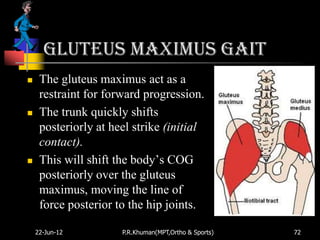
Gluteus maximus gait
    The gluteus maximus act as a
     restraint for forward progression.
    The trunk quickly shifts
     posteriorly at heel strike (initial
     contact).
    This will shift the body‟s COG
     posteriorly over the gluteus
     maximus, moving the line of
     force posterior to the hip joints.

    22-Jun-12         P.R.Khuman(MPT,Ortho & Sports)   72
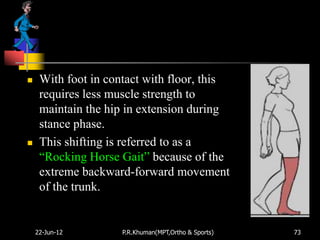
    With foot in contact with floor, this
     requires less muscle strength to
     maintain the hip in extension during
     stance phase.
    This shifting is referred to as a
     “Rocking Horse Gait” because of the
     extreme backward-forward movement
     of the trunk.


    22-Jun-12        P.R.Khuman(MPT,Ortho & Sports)   73
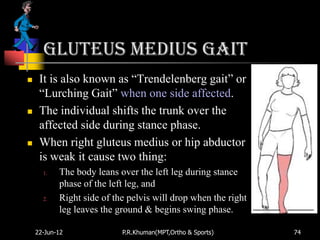
gluteus medius gait
    It is also known as “Trendelenberg gait” or
     “Lurching Gait” when one side affected.
    The individual shifts the trunk over the
     affected side during stance phase.
    When right gluteus medius or hip abductor
     is weak it cause two thing:
      1.   The body leans over the left leg during stance
           phase of the left leg, and
      2.   Right side of the pelvis will drop when the right
           leg leaves the ground & begins swing phase.

    22-Jun-12              P.R.Khuman(MPT,Ortho & Sports)      74
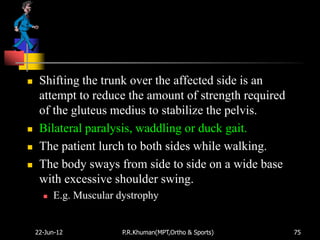
    Shifting the trunk over the affected side is an
     attempt to reduce the amount of strength required
     of the gluteus medius to stabilize the pelvis.
    Bilateral paralysis, waddling or duck gait.
    The patient lurch to both sides while walking.
    The body sways from side to side on a wide base
     with excessive shoulder swing.
         E.g. Muscular dystrophy


    22-Jun-12            P.R.Khuman(MPT,Ortho & Sports)   75
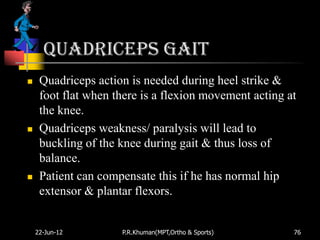
Quadriceps gait
    Quadriceps action is needed during heel strike &
     foot flat when there is a flexion movement acting at
     the knee.
    Quadriceps weakness/ paralysis will lead to
     buckling of the knee during gait & thus loss of
     balance.
    Patient can compensate this if he has normal hip
     extensor & plantar flexors.


    22-Jun-12        P.R.Khuman(MPT,Ortho & Sports)     76
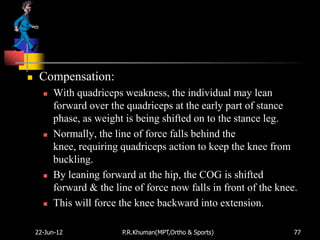
    Compensation:
         With quadriceps weakness, the individual may lean
          forward over the quadriceps at the early part of stance
          phase, as weight is being shifted on to the stance leg.
         Normally, the line of force falls behind the
          knee, requiring quadriceps action to keep the knee from
          buckling.
         By leaning forward at the hip, the COG is shifted
          forward & the line of force now falls in front of the knee.
         This will force the knee backward into extension.

    22-Jun-12             P.R.Khuman(MPT,Ortho & Sports)            77
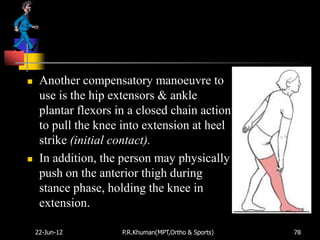
    Another compensatory manoeuvre to
     use is the hip extensors & ankle
     plantar flexors in a closed chain action
     to pull the knee into extension at heel
     strike (initial contact).
    In addition, the person may physically
     push on the anterior thigh during
     stance phase, holding the knee in
     extension.

    22-Jun-12         P.R.Khuman(MPT,Ortho & Sports)   78
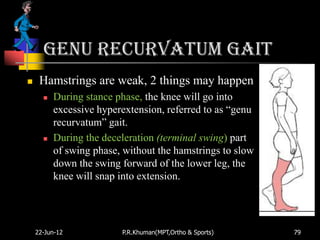
genu recurvatum gait
    Hamstrings are weak, 2 things may happen
         During stance phase, the knee will go into
          excessive hyperextension, referred to as “genu
          recurvatum” gait.
         During the deceleration (terminal swing) part
          of swing phase, without the hamstrings to slow
          down the swing forward of the lower leg, the
          knee will snap into extension.


    22-Jun-12            P.R.Khuman(MPT,Ortho & Sports)    79
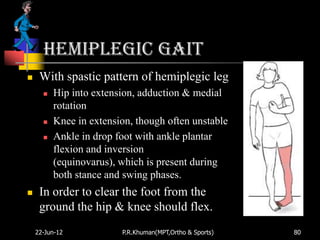
hemiplegic gait
    With spastic pattern of hemiplegic leg
         Hip into extension, adduction & medial
          rotation
         Knee in extension, though often unstable
         Ankle in drop foot with ankle plantar
          flexion and inversion
          (equinovarus), which is present during
          both stance and swing phases.
    In order to clear the foot from the
     ground the hip & knee should flex.
    22-Jun-12            P.R.Khuman(MPT,Ortho & Sports)   80
    But the spastic muscles won‟t allow the hip &
     knee to flex for the floor clearance.
    So the patient hikes hip & bring the affected leg
     by making a half circle i.e. circumducting the leg.
    Hence the gait is known as “Circumductory Gait”.
    Usually, there will be no reciprocal arm swing.
    Step length tends to be lengthened on the involved
     side & shortened on the uninvolved side.

    22-Jun-12        P.R.Khuman(MPT,Ortho & Sports)        81
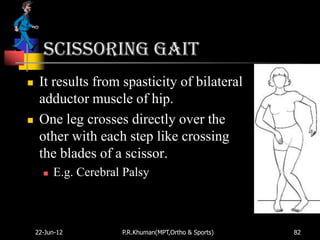
Scissoring gait
    It results from spasticity of bilateral
     adductor muscle of hip.
    One leg crosses directly over the
     other with each step like crossing
     the blades of a scissor.
         E.g. Cerebral Palsy


    22-Jun-12          P.R.Khuman(MPT,Ortho & Sports)   82
Dragging or paraplegic gait
    There is spasticity of both hip & knee
     extensors & ankle plantar flexors.
    In order to clear the ground the patient has
     to drag his both lower limb swings them &
     place it forward.


    22-Jun-12      P.R.Khuman(MPT,Ortho & Sports)   83
Cerebral Ataxic or
      drunkard’S gait
    Abnormal function of cerebellum result in a
     disturbance of normal mechanism controlling
     balance & therefore patient walks with wider BOS.
    The wider BOS creates a larger side to side
     deviation of COG.
    This result in irregularly swinging sideways to a
     tendency to fall with each steps.
    Hence it is known as “Reeling Gait”.

    22-Jun-12       P.R.Khuman(MPT,Ortho & Sports)       84
Sensory ataxic gait
    This is a typical gait pattern seen in patients
     affected by tabes dorsalis.
    It is a degenerative disease affecting the posterior
     horn cells & posterior column of the spinal cord.
    Because of lesion, the proprioceptive impulse
     won‟t reach the cerebellum.
    The patient will loss his joint sense & position for
     his limb on space.

    22-Jun-12         P.R.Khuman(MPT,Ortho & Sports)        85
    Because of loss of joint sense, the patient
     abnormally raises his leg (high step) jerks it
     forward to strike the ground with a stamp.
    So it is also called as “Stamping Gait”.
    The patient compensated this loss of joint position
     sense by vision.
    So his head will be down while he is walking.


    22-Jun-12        P.R.Khuman(MPT,Ortho & Sports)        86
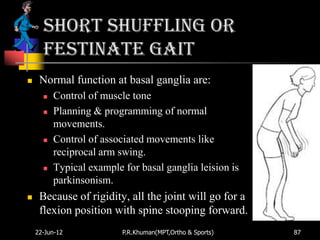
Short shuffling or
      festinate gait
    Normal function at basal ganglia are:
         Control of muscle tone
         Planning & programming of normal
          movements.
         Control of associated movements like
          reciprocal arm swing.
         Typical example for basal ganglia leision is
          parkinsonism.
    Because of rigidity, all the joint will go for a
     flexion position with spine stooping forward.
    22-Jun-12             P.R.Khuman(MPT,Ortho & Sports)   87
    This posture displaces the COG anteriorly.
    So in order to keep the COG within the BOS, the
     patient will no of small shuffling steps.
    Due to loss of voluntary control over the
     movement, they loses balance & walks faster as if
     he is chasing the COG.
    So it is called as “Festinate Gait”.
    Since his shuffling steps, it is otherwise called as
     “Shuffling Gait”.
    22-Jun-12         P.R.Khuman(MPT,Ortho & Sports)        88
Foot drop or slapping gait
    This is due to dorsiflexor weakness caused
     by paralysis of common peroneal nerve.
    There won‟t be normal heel strike, instead
     the foot comes in contact with ground as a
     whole with a slapping sound.
    So it is also known as “Slapping gait”.


    22-Jun-12      P.R.Khuman(MPT,Ortho & Sports)   89
    Due to plantarflexion of the ankle, there
     will be relatively lengthening at the leading
     extremity.
    So to clear the ground the patient lift the
     limb too high.
    Hence the gait get s its another name i.e.
     “High Stepping Gait”

    22-Jun-12       P.R.Khuman(MPT,Ortho & Sports)   90
Equinus gait
    Equinus = Horse
    Because of paralysis of dorsiflexor which result in
     plantar flexor contracture.
    The patients will walk on his toes (toe walking).
    Other cause may be compensation by plantar
     flexor for a short leg.


    22-Jun-12        P.R.Khuman(MPT,Ortho & Sports)        91
Unequal Leg Length
   We all have unequal leg length, usually a
    discrepancy of approx 1/4 inch between the right
    and left legs.
   Clinically, these smaller discrepancies are often
    corrected by inserting heel lifts of various
    thicknesses into the shoe.
   Leg length discrepancy (LLD) are divided in –
       Minimal leg length discrepancy
       Moderate leg length discrepancy
       Severe leg length discrepancy
22-Jun-12               P.R.Khuman(MPT,Ortho & Sports)   92
Minimal LLD
    Compensation occurs by dropping the
     pelvis on the affected side.
    The person may compensate by leaning
     over shorter leg (up to 3 inches can be
     accommodated with these tech).


    22-Jun-12      P.R.Khuman(MPT,Ortho & Sports)   93
Moderate LLD
    Approx between 3 & 5 cm, dropping the
     pelvis on the affected side will no longer be
     effective.
    A longer leg is needed, so the person
     usually walks on the ball of the foot on the
     involved (shorter) side.
    This is called an “Equinnus Gait”.

    22-Jun-12       P.R.Khuman(MPT,Ortho & Sports)   94
Severe LLD
    It is usually discrepancy of more than 5 inches.
    The person may compensate in a variety of ways.
    Dropping the pelvis and walking in an equinnus
     gait plus flexing the knee on the uninvolved side is
     often used.
    To gain an appreciation for how this may feel or
     look, walk down the street with one leg in the
     street and the other on the sidewalk.

    22-Jun-12         P.R.Khuman(MPT,Ortho & Sports)        95
Equinovarous gait
    There will be ankle plantar flexion &
     subtalar inversion.
    So the patient will be walking on the outer
     border of the foot.
         E.g. CETV


    22-Jun-12         P.R.Khuman(MPT,Ortho & Sports)   96
Calcaneal gait
    Result from paralysis plantar flexors causing
     dorsiflexor contracture.
    The patient will be walking on his heel (heel walking)
    It is characterized by greater amounts of ankle
     dorsiflexion & knee flexion during stance & a shorter
     step length on the affected side.
    Single-limb support duration is shortened because of
     the difficulty of stabilizing the tibia & the knee.

    22-Jun-12        P.R.Khuman(MPT,Ortho & Sports)     97
Knock knee gait
    It is also known as genu valgum gait.
    Due to decreased physiological valgus of knee.
    Both the knee face each other widening the BOS.


    22-Jun-12       P.R.Khuman(MPT,Ortho & Sports)     98
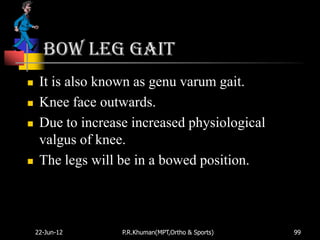
Bow leg gait
    It is also known as genu varum gait.
    Knee face outwards.
    Due to increase increased physiological
     valgus of knee.
    The legs will be in a bowed position.


    22-Jun-12      P.R.Khuman(MPT,Ortho & Sports)   99
22-Jun-12   P.R.Khuman(MPT,Ortho & Sports)   100
22-Jun-12   P.R.Khuman(MPT,Ortho & Sports)   101
Reference
    Lann S. Lippert, CLINICAL KINESIOLOGY and
     ANATOMY, 4th edition, 2006
    Cynthia C. Norkin, joint structure and function: A
     comprehensive analysis 4th edition, 2005
    Jacquelin perry, GAIT ANALYSIS normal and
     pathological function, 1992


    22-Jun-12        P.R.Khuman(MPT,Ortho & Sports)   102

Gait normal & abnormal

  • 1.
    Gait (normal & abnormal) Dr. P. Ratan Khuman (PT) M.P.T., (Ortho & Sports)
  • 2.
    Definition  Locomotion or gait –  It is defined as a translatory progression of the body as a whole produce by coordinated, rotatory movements of body segments.  Normal gait –  It is a rhythmic & characterized by alternating propulsive & retropulsive motions of the lower extremities. 22-Jun-12 P.R.Khuman(MPT,Ortho & Sports) 2
  • 3.
    Task involves inwalking  According to “Rancho Los Amigos” (RLA), California  Weight acceptance  Single limb support  Swing limb advance 22-Jun-12 P.R.Khuman(MPT,Ortho & Sports) 3
  • 4.
    Gait initiation  A series of events occur from the initiation of body movt to beginning of gait cycle.  It is stereotyped activity in both young & old healthy people.  Total duration of this phase is about – 0.60sec 22-Jun-12 P.R.Khuman(MPT,Ortho & Sports) 4
  • 5.
    Kinematics of gait 22-Jun-12 P.R.Khuman(MPT,Ortho & Sports) 5
  • 6.
    Phases of gait  Stance phase  Swing phase 22-Jun-12 P.R.Khuman(MPT,Ortho & Sports) 6
  • 7.
    Stance phase  It begins at the instant that one extremity contacts the ground & continuous only as long as some portion of the foot is in contact with the ground.  It is approx 60% of normal gait duration. 22-Jun-12 P.R.Khuman(MPT,Ortho & Sports) 7
  • 8.
    Swing phase  It begins as soon as the toe of one extremity leaves the ground & ceases just before heel strike or contact of the same extremity.  It makes up 40% of normal gait cycle. 22-Jun-12 P.R.Khuman(MPT,Ortho & Sports) 8
  • 9.
    Double support  Lower limb of one side of body is beginning its stance phase & the opposite side is ending its stance phase.  During double support both the lower limb are in contact with the ground at the same time.  It account approx 22% of gait cycle.  This phase is absent in running 22-Jun-12 P.R.Khuman(MPT,Ortho & Sports) 9
  • 10.
    Subdivision of phases Stancephase – Swing phase – 1) Heel strike 1) Acceleration 2) Foot flat 2) Mid-swing 3) Mid-stance 3) Deceleration 4) Heel off 5) Toe off 22-Jun-12 P.R.Khuman(MPT,Ortho & Sports) 10
  • 11.
    Comparison of gaitterminology  Traditional –  RLA – 1) Heel strike 1) Initial contact 2) Foot flat 2) Loading response 3) Mid-stance 3) Mid-stance 4) Heel off 4) Terminal stance 5) Toe off 5) Pre-swing 6) Acceleration 6) Initial swing 7) Mid-swing 7) Mid-swing 8) Deceleration 8) Terminal swing 22-Jun-12 P.R.Khuman(MPT,Ortho & Sports) 11
  • 12.
    Traditional phases ofgait 22-Jun-12 P.R.Khuman(MPT,Ortho & Sports) 12
  • 13.
    Stance phase  Heel strike phase:  Begins with initial contact & ends with foot flat  It is beginning of the stance phase when the heel contacts the ground. 22-Jun-12 P.R.Khuman(MPT,Ortho & Sports) 13
  • 14.
    Stance phase  Foot flat:  It occurs immediately following heel strike  It is the point at which the foot fully contacts the floor. 22-Jun-12 P.R.Khuman(MPT,Ortho & Sports) 14
  • 15.
    Stance phase  Mid stance:  It is the point at which the body passes directly over the supporting extremity. 22-Jun-12 P.R.Khuman(MPT,Ortho & Sports) 15
  • 16.
    Stance phase  Heel off:  the point following midstance at which time the heel of the reference extremity leaves the ground. 22-Jun-12 P.R.Khuman(MPT,Ortho & Sports) 16
  • 17.
    Stance phase  Toe off:  The point following heel off when only the toe of the reference extremity is in contact with the ground. 22-Jun-12 P.R.Khuman(MPT,Ortho & Sports) 17
  • 18.
    Swing phase  Acceleration phase:  It begins once the toe leaves the ground & continues until mid- swing, or the point at which the swinging extremity is directly under the body. 22-Jun-12 P.R.Khuman(MPT,Ortho & Sports) 18
  • 19.
    Mid-swing:  It occurs approx when the extremity passes directly beneath the body, or from the end of acceleration to the beginning of deceleration. 22-Jun-12 P.R.Khuman(MPT,Ortho & Sports) 19
  • 20.
    Swing phase  Deceleration:  It occurs after mid-swing when limb is decelerating in preparation for heel strike. 22-Jun-12 P.R.Khuman(MPT,Ortho & Sports) 20
  • 21.
    Sub-divisions of stancephase 22-Jun-12 P.R.Khuman(MPT,Ortho & Sports) 21
  • 22.
    Sub-divisions of swingphase 22-Jun-12 P.R.Khuman(MPT,Ortho & Sports) 22
  • 23.
    Sub component ofstance phase 22-Jun-12 P.R.Khuman(MPT,Ortho & Sports) 23
  • 24.
    Sub component ofswing phase 22-Jun-12 P.R.Khuman(MPT,Ortho & Sports) 24
  • 25.
    RLA phases ofgait 22-Jun-12 P.R.Khuman(MPT,Ortho & Sports) 25
  • 26.
    Initial contact  It refer to the initial contact of the foot of leading lower limb.  Normally the heel pointed first to contact.  In abnormal gait it is possible to either whole foot or toes rather than the heel to strike. 22-Jun-12 P.R.Khuman(MPT,Ortho & Sports) 26
  • 27.
    Load response  Begins at initial contact & ends when the contra lateral extremity lifts off the ground at the end of the double- support phase.  It occupies about 11% of gait 22-Jun-12 P.R.Khuman(MPT,Ortho & Sports) 27
  • 28.
    Mid-stance phase (RLA)  Begins when the contra-lateral extremity lifts off the ground at about 11% of the gait cycle  Ends when the body is directly over the supporting limb at about 30% of the gait cycle. 22-Jun-12 P.R.Khuman(MPT,Ortho & Sports) 28
  • 29.
    Terminal stance (RLA)  Begins when the body is directly over the supporting limb at about 30% of the gait cycle  Ends just before initial contact of the contra-lateral extremity at about 50% of the gait cycle. 22-Jun-12 P.R.Khuman(MPT,Ortho & Sports) 29
  • 30.
    Pre-Swing (RLA)  It is the last 10% of stance phase and begins with initial contact of the contra-lateral foot (at 50% of the gait cycle) and ends with toe-off (at 60%). 22-Jun-12 P.R.Khuman(MPT,Ortho & Sports) 30
  • 31.
    Initial swing (RLA)  Begins when the toe leaves the ground & continues until max knee flexion occurs. 22-Jun-12 P.R.Khuman(MPT,Ortho & Sports) 31
  • 32.
    Mid-Swing (RLA)  Encompasses the period from maximum knee flexion until the tibia is in a vertical position. 22-Jun-12 P.R.Khuman(MPT,Ortho & Sports) 32
  • 33.
    Terminal swing (RLA)  Includes the period from the point at which the tibia is in the vertical position to a point just before initial contact. 22-Jun-12 P.R.Khuman(MPT,Ortho & Sports) 33
  • 34.
    Gait cycle 22-Jun-12 P.R.Khuman(MPT,Ortho & Sports) 34
  • 35.
    Variables of gait  There are two basic variables which provide a basic description of human gait.  Time/ Temporal variable & Distance variables.  Provide essential quantitative information about gait 22-Jun-12 P.R.Khuman(MPT,Ortho & Sports) 35
  • 36.
    factors affecting variables  Age,  Joint mobility,  Gender,  Muscle strength,  Height,  Type of clothing &  Size & shape of bony footwear, components,  Habit,  Distribution of mass in  Psychological status. body segments, 22-Jun-12 P.R.Khuman(MPT,Ortho & Sports) 36
  • 37.
    variables  Temporal variable –  Distance variable –  Stance time  Stride length,  Single-limb & double-  Step length and width support time,  Degree of toe-out  Swing time,  Stride and step time,  Cadence and  Speed 22-Jun-12 P.R.Khuman(MPT,Ortho & Sports) 37
  • 38.
    Stance time:  It is the amount of time that elapses during the stance phase of one extremity in a gait cycle.  Single-support time:  It is the amount of time that elapses during the period when only one extremity is on the supporting surface in a gait cycle. 22-Jun-12 P.R.Khuman(MPT,Ortho & Sports) 38
  • 39.
    Double-support time:  It is the amount of time spent with both feet on the ground during one gait cycle.  The % of time spent increased in elderly persons and in those with balance disorders.  The percentage of time spent decreases as the speed of walking increases. 22-Jun-12 P.R.Khuman(MPT,Ortho & Sports) 39
  • 40.
    Stride length:  It is the linear distance from the heel strike of one lower limb to the next heel strike of the same limb. 22-Jun-12 P.R.Khuman(MPT,Ortho & Sports) 40
  • 41.
    Step length:  It is the linear distance from the heel strike of one lower limb to the next heel strike of opposite limb. 22-Jun-12 P.R.Khuman(MPT,Ortho & Sports) 41
  • 42.
    Stride duration:  It refers to amount of time taken to accomplish one stride.  Stride duration and gait cycle duration are synonymous.  One stride, for a normal adult, lasts approx 1 sec 22-Jun-12 P.R.Khuman(MPT,Ortho & Sports) 42
  • 43.
    Step duration:  It refers to the amount of time spent during a single step.  Measurement usually is expressed as sec/step.  When weakness or pain in limb, step duration may be decreased on the affected side and increased on the unaffected side. 22-Jun-12 P.R.Khuman(MPT,Ortho & Sports) 43
  • 44.
    Cadence:  It is the no of steps taken by a person per unit of time.  It is measured as the no of steps / sec or per minute. Cadence = Number of steps / Time 22-Jun-12 P.R.Khuman(MPT,Ortho & Sports) 44
  • 45.
    Walking velocity:  It is the rate of linear forward motion of the body, which can be measured in meters or cm/second, meters/minute, or miles/hour. Walking velocity (meters/sec)=Distance walked (meters)/time (sec) 22-Jun-12 P.R.Khuman(MPT,Ortho & Sports) 45
  • 46.
    Speed of gait:  It is referred to as slow, free, and fast.  Free speed of gait refers to a person‟s normal walking speed  Slow & fast speeds of gait refer to speeds slower or faster than the person‟s normal comfortable walking speed, designated in a variety of ways. 22-Jun-12 P.R.Khuman(MPT,Ortho & Sports) 46
  • 47.
    Step width or width of the walking base:  It is the measure of linear distance between the midpoint of the heel of one foot and the same point on the other foot 22-Jun-12 P.R.Khuman(MPT,Ortho & Sports) 47
  • 48.
    Degree of toe-out (DTO):  It represents the angle of foot formed by each foot‟s line of progression and a line intersecting the centre of the heel and the second toe.  The angle for men is about 70 from the line of progression of each foot at free speed walking.  The DTO decreases as the speed of walking increases in normal men. 22-Jun-12 P.R.Khuman(MPT,Ortho & Sports) 48
  • 49.
    Degree of toeout 22-Jun-12 P.R.Khuman(MPT,Ortho & Sports) 49
  • 50.
    Variables of gait 22-Jun-12 P.R.Khuman(MPT,Ortho & Sports) 50
  • 51.
    Path of COG  Center of Gravity (CG):  Midway between the hips  Few cm in front of S2  Least energy consumption if CG travels in straight line 22-Jun-12 P.R.Khuman(MPT,Ortho & Sports) 51
  • 52.
    22-Jun-12 P.R.Khuman(MPT,Ortho & Sports) 52
  • 53.
    Vertical displacement:  Rhythmic up & down movement  Highest point: midstance  Lowest point: double support  Average displacement: 5cm  Path: extremely smooth sinusoidal curve 22-Jun-12 P.R.Khuman(MPT,Ortho & Sports) 53
  • 54.
    Lateral displacement:  Rhythmic side-to-side movement  Lateral limit: mid-stance  Average displacement: 5cm  Path: extremely smooth sinusoidal curve 22-Jun-12 P.R.Khuman(MPT,Ortho & Sports) 54
  • 55.
    Overall displacement: Horizontal plane  Sum of vertical & horizontal displacement  Figure „8‟ movement Vertical plane of CG as seen from AP view 22-Jun-12 P.R.Khuman(MPT,Ortho & Sports) 55
  • 56.
    SaunderS’ Determinants ofgait  Gait “determinants” was first described by “Saunders & Coworkers” in 1953.  Six optimizations used to minimize excursion of CG in vertical & horizontal planes. 22-Jun-12 P.R.Khuman(MPT,Ortho & Sports) 56
  • 57.
    The “determinants” represent adjustments made by the pelvis, hips, knees, and ankles that help to keep movt of the body‟s COG to a minimum.  By decreasing the vertical & lateral excursions of the body‟s COM it was thought that energy expenditure would be less & gait more efficient. 22-Jun-12 P.R.Khuman(MPT,Ortho & Sports) 57
  • 58.
    Pelvic rotation:  Forward rotation of the pelvis in the horizontal plane is approx. 8o on the swing-phase side.  It reduces the angle of hip flexion & extension  It enables a slightly longer step-length 22-Jun-12 P.R.Khuman(MPT,Ortho & Sports) 58
  • 59.
    Pelvic tilt:  5o dip of the swinging side (i.e. hip abd)  In standing, this dip is –  A +ve Trendelenberg sign  It reduces the height of the apex of the curve of CG 22-Jun-12 P.R.Khuman(MPT,Ortho & Sports) 59
  • 60.
    Knee flexion instance phase  Approx. 20o dip  It shortens the leg in the middle of stance phase  It reduces the height of the apex of CG curve 22-Jun-12 P.R.Khuman(MPT,Ortho & Sports) 60
  • 61.
    Ankle mechanism  It lengthens the leg at heel contact  It helps in smoothens the curve of CG  It reduces the lowering of CG 22-Jun-12 P.R.Khuman(MPT,Ortho & Sports) 61
  • 62.
    Foot mechanism:  Lengthens the leg at toe-off as ankle moves from dorsiflexion to plantarflexion  Smoothens the curve of CG  Reduces the lowering of CG 22-Jun-12 P.R.Khuman(MPT,Ortho & Sports) 62
  • 63.
    Lateral displacement ofbody  Physiologic valgus of the knee reduce side-to- side movement of the COM in frontal plane.  The normally narrow width of the walking base minimizes the lateral displacement of CG  Reduced muscular energy consumption due to reduced lateral acceleration & deceleration 22-Jun-12 P.R.Khuman(MPT,Ortho & Sports) 63
  • 64.
    Physiological knee valgus 22-Jun-12 P.R.Khuman(MPT,Ortho & Sports) 64
  • 65.
    Abnormal (Atypical) Gait 22-Jun-12 P.R.Khuman(MPT,Ortho & Sports) 65
  • 66.
    There are numerous causes of abnormal gait.  There can be great variation depending upon the severity of the problem.  If a muscle is weak, how weak is it?  If joint motion is limited, how limited is it? 22-Jun-12 P.R.Khuman(MPT,Ortho & Sports) 66
  • 67.
    Pathological gaits  Abnormality in gait may be caused by –  Pain  Joint muscle range-of-motion (ROM) limitation  Muscular weakness/paralysis  Neurological involvement (UMNL/ LMNL)  Leg length discrepancy 22-Jun-12 P.R.Khuman(MPT,Ortho & Sports) 67
  • 68.
    Types of pathologicalgait  Due to pain –  Antalgic or limping gait – (Psoatic Gait)  Due to neurological disturbance –  Muscular paralysis – both  Spastic (Circumductory Gait, Scissoring Gait, Dragging or Paralytic Gait, Robotic Gait[Quadriplegic]) and  Flaccid (Lurching Gait, Waddaling Gait, Gluteus Maximus Gait, Quadriceps Gait, Foot Drop or Stapping Gait,)  Cerebellar dysfunction (Ataxic Gait)  Loss of kinesthetic sensation (Stamping Gait)  Basal ganglia dysfunction (FestinautGait) 22-Jun-12 P.R.Khuman(MPT,Ortho & Sports) 68
  • 69.
    Types of pathologicalgait  Due to abnormal deformities –  Equinus gait  Equinovarous gait  Calcaneal gait  Knock & bow knee gait  Genurecurvatum gait  Due to Leg Length Discrepancy (LLD) –  Equinus gait 22-Jun-12 P.R.Khuman(MPT,Ortho & Sports) 69
  • 70.
    Antalgic gait  This is a compensatory gait pattern adopted in order to remove or diminish the discomfort caused by pain in the LL or pelvis.  Characteristic features:  Decreased in duration of stance phase of the affected limb (unable of weight bear due to pain)  There is a lack of weight shift laterally over the stance limb and also to keep weight off the involved limb  Decrease in stance phase in affected side will result in a decrease in swing phase of sound limb. 22-Jun-12 P.R.Khuman(MPT,Ortho & Sports) 70
  • 71.
    Psoatic gait  Psoas bursa may be inflamed & edematous, which cause limitation of movement due to pain & produce a atypical gait.  Hip externally rotated  Hip adducted  Knee in slight flexion  This process seems to relieve tension of the muscle & hence relieve the inflamed structures. 22-Jun-12 P.R.Khuman(MPT,Ortho & Sports) 71
  • 72.
    Gluteus maximus gait  The gluteus maximus act as a restraint for forward progression.  The trunk quickly shifts posteriorly at heel strike (initial contact).  This will shift the body‟s COG posteriorly over the gluteus maximus, moving the line of force posterior to the hip joints. 22-Jun-12 P.R.Khuman(MPT,Ortho & Sports) 72
  • 73.
    With foot in contact with floor, this requires less muscle strength to maintain the hip in extension during stance phase.  This shifting is referred to as a “Rocking Horse Gait” because of the extreme backward-forward movement of the trunk. 22-Jun-12 P.R.Khuman(MPT,Ortho & Sports) 73
  • 74.
    gluteus medius gait  It is also known as “Trendelenberg gait” or “Lurching Gait” when one side affected.  The individual shifts the trunk over the affected side during stance phase.  When right gluteus medius or hip abductor is weak it cause two thing: 1. The body leans over the left leg during stance phase of the left leg, and 2. Right side of the pelvis will drop when the right leg leaves the ground & begins swing phase. 22-Jun-12 P.R.Khuman(MPT,Ortho & Sports) 74
  • 75.
    Shifting the trunk over the affected side is an attempt to reduce the amount of strength required of the gluteus medius to stabilize the pelvis.  Bilateral paralysis, waddling or duck gait.  The patient lurch to both sides while walking.  The body sways from side to side on a wide base with excessive shoulder swing.  E.g. Muscular dystrophy 22-Jun-12 P.R.Khuman(MPT,Ortho & Sports) 75
  • 76.
    Quadriceps gait  Quadriceps action is needed during heel strike & foot flat when there is a flexion movement acting at the knee.  Quadriceps weakness/ paralysis will lead to buckling of the knee during gait & thus loss of balance.  Patient can compensate this if he has normal hip extensor & plantar flexors. 22-Jun-12 P.R.Khuman(MPT,Ortho & Sports) 76
  • 77.
    Compensation:  With quadriceps weakness, the individual may lean forward over the quadriceps at the early part of stance phase, as weight is being shifted on to the stance leg.  Normally, the line of force falls behind the knee, requiring quadriceps action to keep the knee from buckling.  By leaning forward at the hip, the COG is shifted forward & the line of force now falls in front of the knee.  This will force the knee backward into extension. 22-Jun-12 P.R.Khuman(MPT,Ortho & Sports) 77
  • 78.
    Another compensatory manoeuvre to use is the hip extensors & ankle plantar flexors in a closed chain action to pull the knee into extension at heel strike (initial contact).  In addition, the person may physically push on the anterior thigh during stance phase, holding the knee in extension. 22-Jun-12 P.R.Khuman(MPT,Ortho & Sports) 78
  • 79.
    genu recurvatum gait  Hamstrings are weak, 2 things may happen  During stance phase, the knee will go into excessive hyperextension, referred to as “genu recurvatum” gait.  During the deceleration (terminal swing) part of swing phase, without the hamstrings to slow down the swing forward of the lower leg, the knee will snap into extension. 22-Jun-12 P.R.Khuman(MPT,Ortho & Sports) 79
  • 80.
    hemiplegic gait  With spastic pattern of hemiplegic leg  Hip into extension, adduction & medial rotation  Knee in extension, though often unstable  Ankle in drop foot with ankle plantar flexion and inversion (equinovarus), which is present during both stance and swing phases.  In order to clear the foot from the ground the hip & knee should flex. 22-Jun-12 P.R.Khuman(MPT,Ortho & Sports) 80
  • 81.
    But the spastic muscles won‟t allow the hip & knee to flex for the floor clearance.  So the patient hikes hip & bring the affected leg by making a half circle i.e. circumducting the leg.  Hence the gait is known as “Circumductory Gait”.  Usually, there will be no reciprocal arm swing.  Step length tends to be lengthened on the involved side & shortened on the uninvolved side. 22-Jun-12 P.R.Khuman(MPT,Ortho & Sports) 81
  • 82.
    Scissoring gait  It results from spasticity of bilateral adductor muscle of hip.  One leg crosses directly over the other with each step like crossing the blades of a scissor.  E.g. Cerebral Palsy 22-Jun-12 P.R.Khuman(MPT,Ortho & Sports) 82
  • 83.
    Dragging or paraplegicgait  There is spasticity of both hip & knee extensors & ankle plantar flexors.  In order to clear the ground the patient has to drag his both lower limb swings them & place it forward. 22-Jun-12 P.R.Khuman(MPT,Ortho & Sports) 83
  • 84.
    Cerebral Ataxic or drunkard’S gait  Abnormal function of cerebellum result in a disturbance of normal mechanism controlling balance & therefore patient walks with wider BOS.  The wider BOS creates a larger side to side deviation of COG.  This result in irregularly swinging sideways to a tendency to fall with each steps.  Hence it is known as “Reeling Gait”. 22-Jun-12 P.R.Khuman(MPT,Ortho & Sports) 84
  • 85.
    Sensory ataxic gait  This is a typical gait pattern seen in patients affected by tabes dorsalis.  It is a degenerative disease affecting the posterior horn cells & posterior column of the spinal cord.  Because of lesion, the proprioceptive impulse won‟t reach the cerebellum.  The patient will loss his joint sense & position for his limb on space. 22-Jun-12 P.R.Khuman(MPT,Ortho & Sports) 85
  • 86.
    Because of loss of joint sense, the patient abnormally raises his leg (high step) jerks it forward to strike the ground with a stamp.  So it is also called as “Stamping Gait”.  The patient compensated this loss of joint position sense by vision.  So his head will be down while he is walking. 22-Jun-12 P.R.Khuman(MPT,Ortho & Sports) 86
  • 87.
    Short shuffling or festinate gait  Normal function at basal ganglia are:  Control of muscle tone  Planning & programming of normal movements.  Control of associated movements like reciprocal arm swing.  Typical example for basal ganglia leision is parkinsonism.  Because of rigidity, all the joint will go for a flexion position with spine stooping forward. 22-Jun-12 P.R.Khuman(MPT,Ortho & Sports) 87
  • 88.
    This posture displaces the COG anteriorly.  So in order to keep the COG within the BOS, the patient will no of small shuffling steps.  Due to loss of voluntary control over the movement, they loses balance & walks faster as if he is chasing the COG.  So it is called as “Festinate Gait”.  Since his shuffling steps, it is otherwise called as “Shuffling Gait”. 22-Jun-12 P.R.Khuman(MPT,Ortho & Sports) 88
  • 89.
    Foot drop orslapping gait  This is due to dorsiflexor weakness caused by paralysis of common peroneal nerve.  There won‟t be normal heel strike, instead the foot comes in contact with ground as a whole with a slapping sound.  So it is also known as “Slapping gait”. 22-Jun-12 P.R.Khuman(MPT,Ortho & Sports) 89
  • 90.
    Due to plantarflexion of the ankle, there will be relatively lengthening at the leading extremity.  So to clear the ground the patient lift the limb too high.  Hence the gait get s its another name i.e. “High Stepping Gait” 22-Jun-12 P.R.Khuman(MPT,Ortho & Sports) 90
  • 91.
    Equinus gait  Equinus = Horse  Because of paralysis of dorsiflexor which result in plantar flexor contracture.  The patients will walk on his toes (toe walking).  Other cause may be compensation by plantar flexor for a short leg. 22-Jun-12 P.R.Khuman(MPT,Ortho & Sports) 91
  • 92.
    Unequal Leg Length  We all have unequal leg length, usually a discrepancy of approx 1/4 inch between the right and left legs.  Clinically, these smaller discrepancies are often corrected by inserting heel lifts of various thicknesses into the shoe.  Leg length discrepancy (LLD) are divided in –  Minimal leg length discrepancy  Moderate leg length discrepancy  Severe leg length discrepancy 22-Jun-12 P.R.Khuman(MPT,Ortho & Sports) 92
  • 93.
    Minimal LLD  Compensation occurs by dropping the pelvis on the affected side.  The person may compensate by leaning over shorter leg (up to 3 inches can be accommodated with these tech). 22-Jun-12 P.R.Khuman(MPT,Ortho & Sports) 93
  • 94.
    Moderate LLD  Approx between 3 & 5 cm, dropping the pelvis on the affected side will no longer be effective.  A longer leg is needed, so the person usually walks on the ball of the foot on the involved (shorter) side.  This is called an “Equinnus Gait”. 22-Jun-12 P.R.Khuman(MPT,Ortho & Sports) 94
  • 95.
    Severe LLD  It is usually discrepancy of more than 5 inches.  The person may compensate in a variety of ways.  Dropping the pelvis and walking in an equinnus gait plus flexing the knee on the uninvolved side is often used.  To gain an appreciation for how this may feel or look, walk down the street with one leg in the street and the other on the sidewalk. 22-Jun-12 P.R.Khuman(MPT,Ortho & Sports) 95
  • 96.
    Equinovarous gait  There will be ankle plantar flexion & subtalar inversion.  So the patient will be walking on the outer border of the foot.  E.g. CETV 22-Jun-12 P.R.Khuman(MPT,Ortho & Sports) 96
  • 97.
    Calcaneal gait  Result from paralysis plantar flexors causing dorsiflexor contracture.  The patient will be walking on his heel (heel walking)  It is characterized by greater amounts of ankle dorsiflexion & knee flexion during stance & a shorter step length on the affected side.  Single-limb support duration is shortened because of the difficulty of stabilizing the tibia & the knee. 22-Jun-12 P.R.Khuman(MPT,Ortho & Sports) 97
  • 98.
    Knock knee gait  It is also known as genu valgum gait.  Due to decreased physiological valgus of knee.  Both the knee face each other widening the BOS. 22-Jun-12 P.R.Khuman(MPT,Ortho & Sports) 98
  • 99.
    Bow leg gait  It is also known as genu varum gait.  Knee face outwards.  Due to increase increased physiological valgus of knee.  The legs will be in a bowed position. 22-Jun-12 P.R.Khuman(MPT,Ortho & Sports) 99
  • 100.
    22-Jun-12 P.R.Khuman(MPT,Ortho & Sports) 100
  • 101.
    22-Jun-12 P.R.Khuman(MPT,Ortho & Sports) 101
  • 102.
    Reference  Lann S. Lippert, CLINICAL KINESIOLOGY and ANATOMY, 4th edition, 2006  Cynthia C. Norkin, joint structure and function: A comprehensive analysis 4th edition, 2005  Jacquelin perry, GAIT ANALYSIS normal and pathological function, 1992 22-Jun-12 P.R.Khuman(MPT,Ortho & Sports) 102