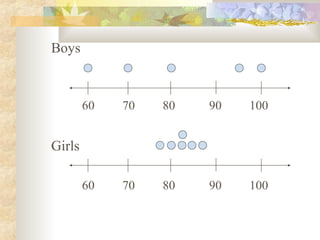
The document outlines objectives for students to learn about measures of variability, including range, mean deviation, variance, and standard deviation. It provides examples of calculating each measure for two data sets of boys' and girls' math scores. The results show the girls' data is more homogeneous, as the measures of variability are lower for the girls' data than the boys' data.
OBJECTIVES:
During the period,the students are
expected to:
1. identify the different Measures of
Variability;
2. give the formula to compute each
Measure of Variability;
3. solve problems involving Measures of
Variability ( ungrouped data ).
2.
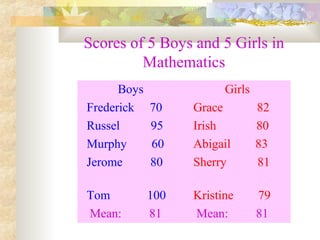
Boys Girls
Frederick 70Grace 82
Russel 95 Irish 80
Murphy 60 Abigail 83
Jerome 80 Sherry 81
Tom 100 Kristine 79
Mean: 81 Mean: 81
Scores of 5 Boys and 5 Girls in
Mathematics
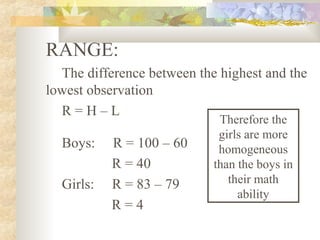
RANGE:
The difference betweenthe highest and the
lowest observation
R = H – L
Boys: R = 100 – 60
R = 40
Girls: R = 83 – 79
R = 4
Therefore the
girls are more
homogeneous
than the boys in
their math
ability
6.
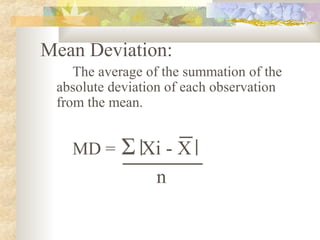
Mean Deviation:
The averageof the summation of the
absolute deviation of each observation
from the mean.
MD = Σ Xi - X
n
7.
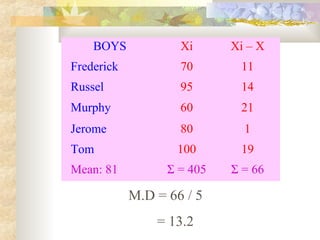
BOYS Xi Xi– X
Frederick 70 11
Russel 95 14
Murphy 60 21
Jerome 80 1
Tom 100 19
Mean: 81 Σ = 405 Σ = 66
M.D = 66 / 5
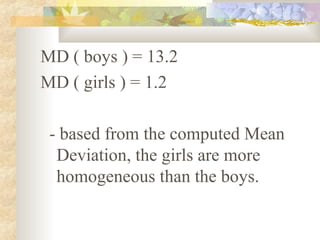
= 13.2
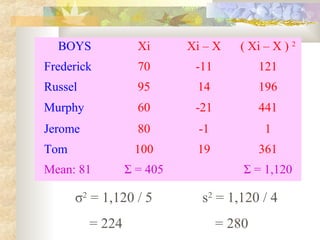
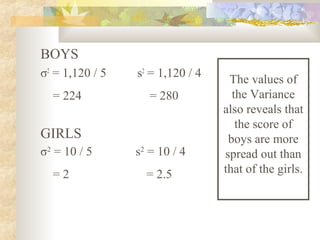
BOYS
σ2
= 1,120 /5 s2
= 1,120 / 4
= 224 = 280
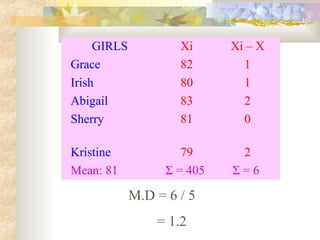
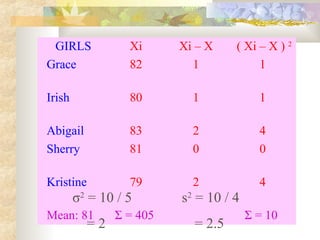
GIRLS
σ2
= 10 / 5 s2
= 10 / 4
= 2 = 2.5
The values of
the Variance
also reveals that
the score of
boys are more
spread out than
that of the girls.
14.
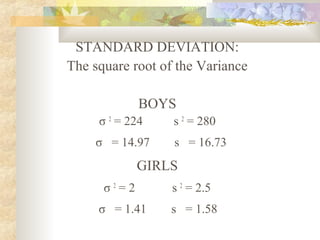
STANDARD DEVIATION:
The squareroot of the Variance
BOYS
σ 2
= 224 s 2
= 280
σ = 14.97 s = 16.73
GIRLS
σ 2
= 2 s 2
= 2.5
σ = 1.41 s = 1.58
15.
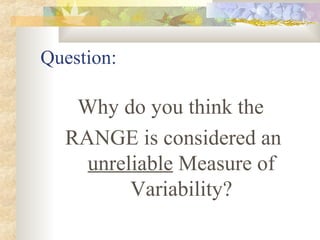
Question:
Why do youthink the
RANGE is considered an
unreliable Measure of
Variability?
16.
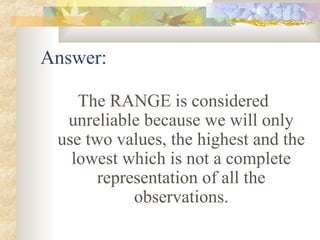
Answer:
The RANGE isconsidered
unreliable because we will only
use two values, the highest and the
lowest which is not a complete
representation of all the
observations.