A-between 37 and 42 weeks from the last
  menstrual period
B- Before 37 weeks gestation
C-After 42 weeks gestation
D- After 24 weeks gestation

            ANSWER            A
   Normal labour is the process by which
    contractions of the gravid uterus expel the
    fetus and the other products of conception
    between 37 and 42 weeks from the last
    menstrual period (Term Delivery)
Preterm labour : Preterm labor is that occurring
before 37 weeks of gestational age.
Postdate pregnancy : Postdate pregnancy occurs
after 42 weeks .
A.   – longitudinal axis of the fetus in relation to
     the oblique axis of the maternal uterus
B.   longitudinal axis of the fetus in relation to the
     transverse axis of the maternal uterus
C.   longitudinal axis of the fetus in relation to the
     long axis of the maternal uterus
D.   longitudinal axis of the fetus in relation to the
     long axis of the maternal pelvis
                    ANSWER        C
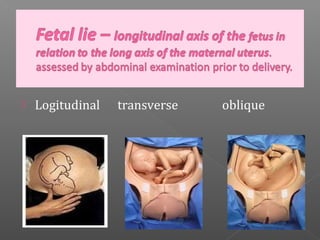
   Logitudinal   transverse   oblique
A.   Relates to right or left side of maternal pelvis
B.   presenting or is the closest in proximity to
     the birthing canal
C.   Ralated to long axis of mother
D.   First enter the pelvic cavity
E.   First felt by vaginal examination

                    ANSWER       B
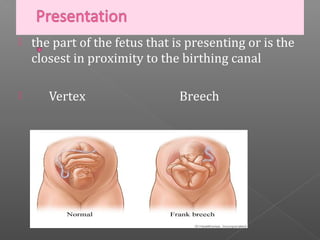
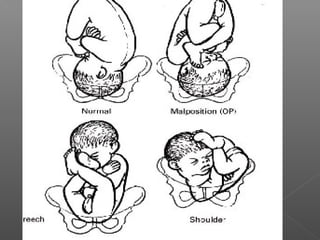
   the part of the fetus that is presenting or is the
    closest in proximity to the birthing canal

      Vertex                   Breech
A. position is either cephalic or breech
B. attitude is either flexion ,OR deflexion
C. position is the relationship of a landmark on
   the presenting part to the right or left side of
   the pelvis
D. Position is either oblique lognitudinal or
   treasverse
E .Attuide is landmark on presenting part that
   determine position
            ANSWER C
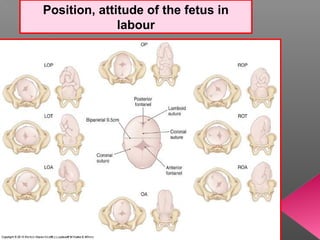
 The position of the baby is the relationship
  of a landmark on the presenting part to the
  right or left side of the pelvis i.e. LOA, LOP,
  LOT, OP, OA, ROA, ROP, ROT.
     The attitude describes the posture of
  the fetus i.e. flexion, deflexion, extension.
Position, attitude of the fetus in
              labour
A.   Passage of bloody show
B.   Occurance of uterine contraction
C.   Excessive fetal movement
D.   Cervical dilation and effacement
E.   Gush of vaginal fluid
                ANSWER    D
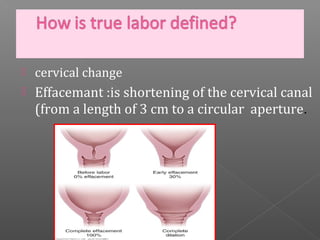
   cervical change
   Effacemant :is shortening of the cervical canal
    (from a length of 3 cm to a circular aperture.
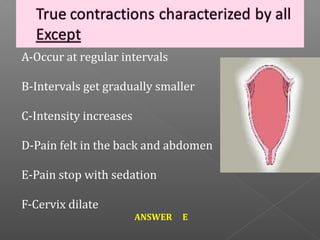
A-Occur at regular intervals

B-Intervals get gradually smaller

C-Intensity increases

D-Pain felt in the back and abdomen

E-Pain stop with sedation

F-Cervix dilate
                        ANSWER   E
A-Occur At Irregular Intervals
B-Intensity doesn't change
C-Pain primarily in lower abdomen
D-Pain usually relieved with sedation
E-Cervix dilate
ANSWER E
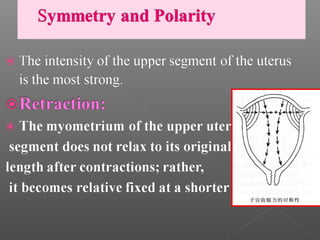
A-Relaxion after uterine contraction
B-Intensity of uterine contraction in upper and
  lower segment
C-The myometrium of the upper uterine become
  shorter after contraction
D- the pacemaker in the right cornu of the uterus
                   ANSWER C
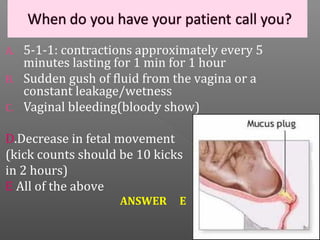
A.   5-1-1: contractions approximately every 5
     minutes lasting for 1 min for 1 hour
B.   Sudden gush of fluid from the vagina or a
     constant leakage/wetness
C.   Vaginal bleeding(bloody show)

D.Decrease in fetal movement
(kick counts should be 10 kicks
in 2 hours)
E All of the above
                     ANSWER    E
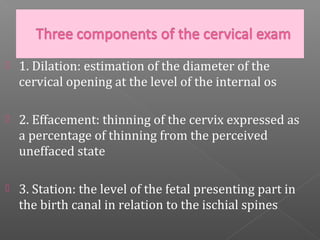
A.   Dilation ,presention and effacment
B.   Effacement ,station and position
C.   Dilation ,effacment ,and station
D.   Station ,dilation and descent
E.   Presentation ,station ,and dilation
                     ANSWER C
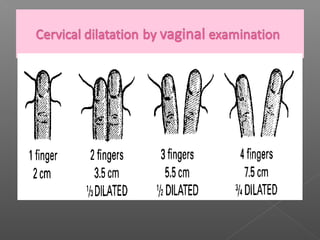
   1. Dilation: estimation of the diameter of the
    cervical opening at the level of the internal os

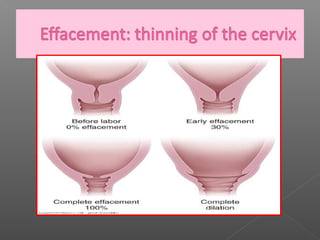
   2. Effacement: thinning of the cervix expressed as
    a percentage of thinning from the perceived
    uneffaced state

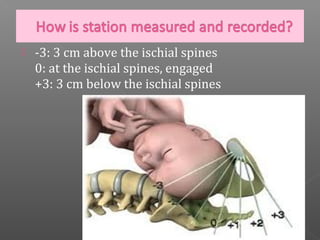
   3. Station: the level of the fetal presenting part in
    the birth canal in relation to the ischial spines
   -3: 3 cm above the ischial spines
    0: at the ischial spines, engaged
    +3: 3 cm below the ischial spines
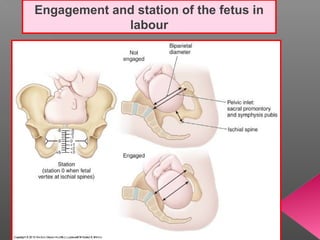
Engagement and station of the fetus in
             labour
A. First stage of labor ends with delivery of fetus
B. Second stage of labor is divded into latent and
   active phase
C. Third stage of labor lasts one hours
D.Third stage of labor begins immediately
after delivery of the infant and ends with
   placental delivery
                    ANSWER D
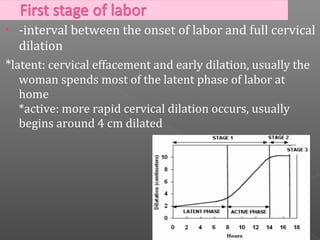
•   -interval between the onset of labor and full cervical
    dilation
*latent: cervical effacement and early dilation, usually the
    woman spends most of the latent phase of labor at
    home
    *active: more rapid cervical dilation occurs, usually
    begins around 4 cm dilated
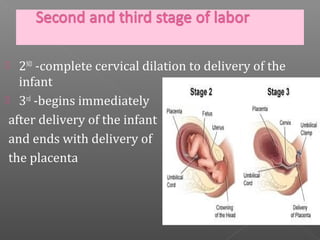
  2ND -complete cervical dilation to delivery of the
   infant
 3rd -begins immediately
 after delivery of the infant
 and ends with delivery of
 the placenta
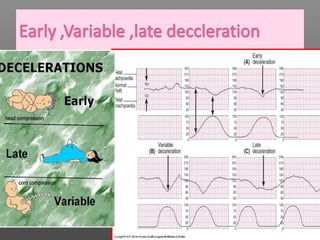
A. Relfied by maternal position on left side
B. Compression of fetal head mediated by vagus
C. Caused by umbilical cord compression
D. Is not worrisome if non recurrent
E. Is mostly due to placental insufficancy
                  ANSWER E
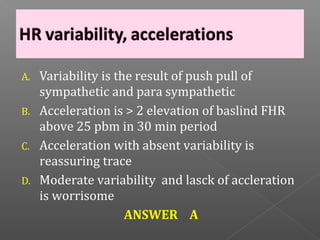
A.   Variability is the result of push pull of
     sympathetic and para sympathetic
B.   Acceleration is > 2 elevation of baslind FHR
     above 25 pbm in 30 min period
C.   Acceleration with absent variability is
     reassuring trace
D.   Moderate variability and lasck of accleration
     is worrisome
                      ANSWER A
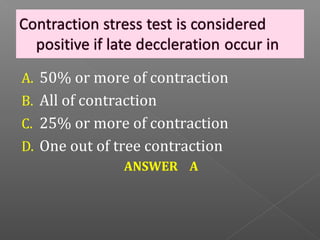
A. 50% or more of contraction
B. All of contraction
C. 25% or more of contraction
D. One out of tree contraction
               ANSWER A
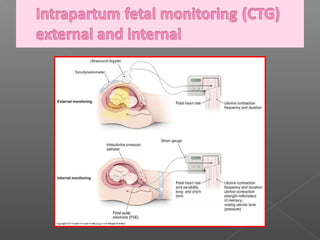
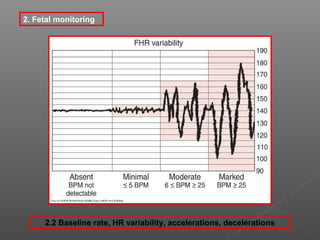
2. Fetal monitoring


     2.2 Baseline rate, HR variability, accelerations, decelerations
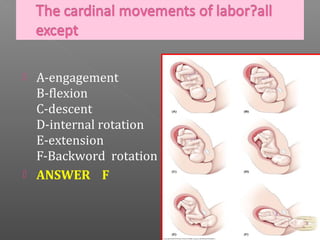
   A-engagement
    B-flexion
    C-descent
    D-internal rotation
    E-extension
    F-Backword rotation
   ANSWER F
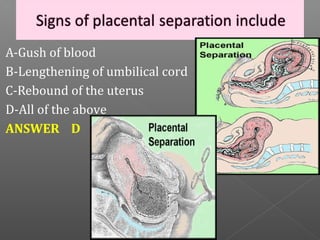
A-Gush of blood
B-Lengthening of umbilical cord
C-Rebound of the uterus
D-All of the above
ANSWER D
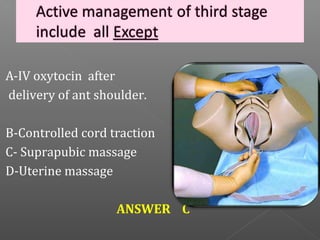
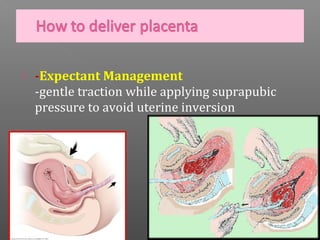
   -Expectant Management
    -gentle traction while applying suprapubic
    pressure to avoid uterine inversion
A-IV oxytocin after
delivery of ant shoulder.

B-Controlled cord traction
C- Suprapubic massage
D-Uterine massage

                   ANSWER C
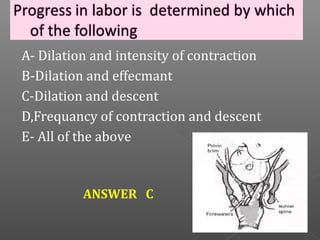
A- Dilation and intensity of contraction
B-Dilation and effecmant
C-Dilation and descent
D,Frequancy of contraction and descent
E- All of the above


          ANSWER C
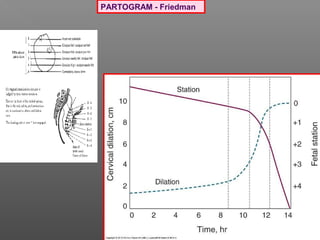
PARTOGRAM - Friedman
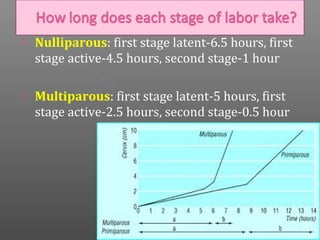
   Nulliparous: first stage latent-6.5 hours, first
    stage active-4.5 hours, second stage-1 hour

   Multiparous: first stage latent-5 hours, first
    stage active-2.5 hours, second stage-0.5 hour
THANK YOU

Normal and abnormal labor part 1

  • 2.
    A-between 37 and42 weeks from the last menstrual period B- Before 37 weeks gestation C-After 42 weeks gestation D- After 24 weeks gestation ANSWER A
  • 3.
    Normal labour is the process by which contractions of the gravid uterus expel the fetus and the other products of conception between 37 and 42 weeks from the last menstrual period (Term Delivery)
  • 4.
    Preterm labour :Preterm labor is that occurring before 37 weeks of gestational age. Postdate pregnancy : Postdate pregnancy occurs after 42 weeks .
  • 5.
    A. – longitudinal axis of the fetus in relation to the oblique axis of the maternal uterus B. longitudinal axis of the fetus in relation to the transverse axis of the maternal uterus C. longitudinal axis of the fetus in relation to the long axis of the maternal uterus D. longitudinal axis of the fetus in relation to the long axis of the maternal pelvis ANSWER C
  • 6.
    Logitudinal transverse oblique
  • 7.
    A. Relates to right or left side of maternal pelvis B. presenting or is the closest in proximity to the birthing canal C. Ralated to long axis of mother D. First enter the pelvic cavity E. First felt by vaginal examination ANSWER B
  • 8.
    the part of the fetus that is presenting or is the closest in proximity to the birthing canal  Vertex Breech
  • 9.
    A. position iseither cephalic or breech B. attitude is either flexion ,OR deflexion C. position is the relationship of a landmark on the presenting part to the right or left side of the pelvis D. Position is either oblique lognitudinal or treasverse E .Attuide is landmark on presenting part that determine position ANSWER C
  • 10.
     The positionof the baby is the relationship of a landmark on the presenting part to the right or left side of the pelvis i.e. LOA, LOP, LOT, OP, OA, ROA, ROP, ROT.  The attitude describes the posture of the fetus i.e. flexion, deflexion, extension.
  • 12.
    Position, attitude ofthe fetus in labour
  • 13.
    A. Passage of bloody show B. Occurance of uterine contraction C. Excessive fetal movement D. Cervical dilation and effacement E. Gush of vaginal fluid ANSWER D
  • 14.
    cervical change  Effacemant :is shortening of the cervical canal (from a length of 3 cm to a circular aperture.
  • 15.
    A-Occur at regularintervals B-Intervals get gradually smaller C-Intensity increases D-Pain felt in the back and abdomen E-Pain stop with sedation F-Cervix dilate ANSWER E
  • 16.
    A-Occur At IrregularIntervals B-Intensity doesn't change C-Pain primarily in lower abdomen D-Pain usually relieved with sedation E-Cervix dilate ANSWER E
  • 17.
    A-Relaxion after uterinecontraction B-Intensity of uterine contraction in upper and lower segment C-The myometrium of the upper uterine become shorter after contraction D- the pacemaker in the right cornu of the uterus ANSWER C
  • 19.
    A. 5-1-1: contractions approximately every 5 minutes lasting for 1 min for 1 hour B. Sudden gush of fluid from the vagina or a constant leakage/wetness C. Vaginal bleeding(bloody show) D.Decrease in fetal movement (kick counts should be 10 kicks in 2 hours) E All of the above ANSWER E
  • 20.
    A. Dilation ,presention and effacment B. Effacement ,station and position C. Dilation ,effacment ,and station D. Station ,dilation and descent E. Presentation ,station ,and dilation ANSWER C
  • 21.
    1. Dilation: estimation of the diameter of the cervical opening at the level of the internal os  2. Effacement: thinning of the cervix expressed as a percentage of thinning from the perceived uneffaced state  3. Station: the level of the fetal presenting part in the birth canal in relation to the ischial spines
  • 24.
    -3: 3 cm above the ischial spines 0: at the ischial spines, engaged +3: 3 cm below the ischial spines
  • 25.
    Engagement and stationof the fetus in labour
  • 26.
    A. First stageof labor ends with delivery of fetus B. Second stage of labor is divded into latent and active phase C. Third stage of labor lasts one hours D.Third stage of labor begins immediately after delivery of the infant and ends with placental delivery ANSWER D
  • 27.
    -interval between the onset of labor and full cervical dilation *latent: cervical effacement and early dilation, usually the woman spends most of the latent phase of labor at home *active: more rapid cervical dilation occurs, usually begins around 4 cm dilated
  • 28.
     2ND-complete cervical dilation to delivery of the infant  3rd -begins immediately after delivery of the infant and ends with delivery of the placenta
  • 29.
    A. Relfied bymaternal position on left side B. Compression of fetal head mediated by vagus C. Caused by umbilical cord compression D. Is not worrisome if non recurrent E. Is mostly due to placental insufficancy ANSWER E
  • 32.
    A. Variability is the result of push pull of sympathetic and para sympathetic B. Acceleration is > 2 elevation of baslind FHR above 25 pbm in 30 min period C. Acceleration with absent variability is reassuring trace D. Moderate variability and lasck of accleration is worrisome ANSWER A
  • 33.
    A. 50% ormore of contraction B. All of contraction C. 25% or more of contraction D. One out of tree contraction ANSWER A
  • 34.
    2. Fetal monitoring 2.2 Baseline rate, HR variability, accelerations, decelerations
  • 36.
    A-engagement B-flexion C-descent D-internal rotation E-extension F-Backword rotation  ANSWER F
  • 37.
    A-Gush of blood B-Lengtheningof umbilical cord C-Rebound of the uterus D-All of the above ANSWER D
  • 38.
    -Expectant Management -gentle traction while applying suprapubic pressure to avoid uterine inversion
  • 39.
    A-IV oxytocin after deliveryof ant shoulder. B-Controlled cord traction C- Suprapubic massage D-Uterine massage ANSWER C
  • 40.
    A- Dilation andintensity of contraction B-Dilation and effecmant C-Dilation and descent D,Frequancy of contraction and descent E- All of the above ANSWER C
  • 41.
  • 42.
    Nulliparous: first stage latent-6.5 hours, first stage active-4.5 hours, second stage-1 hour  Multiparous: first stage latent-5 hours, first stage active-2.5 hours, second stage-0.5 hour
  • 43.