Normal Labour
Shehr Bano
08-180
Batch-K
Final Year
Outline
 Definitions
 Criteria of normal labour
 Components of normal labour
 Overview of anatomy of female pelvis
& fetal skull
 Onset of Labour
 Stages of Labour
 Intrapartum monitoring
 Managment
Definitions
 Labour:
Event that takes place in the uterus and the birth canal to
expel the viable fetus through the vagina
 Delivery:
The expulsion of a viable fetus out of the uterus
 Normal Labour (eutocia):
Labour is considered normal when mature fetus presenting
by vertex delivers by natural efforts
Criteria for normal labour
Labour is considered to be Normal when it
meets the following criteria:
 Spontaneous expulsion
 Single ,Full term i.e mature fetus (37
completed weeks – 42 weeks)
 Through vagina
 Presented by vertex
 Within a reasonable time (not less then 3
hours or more then 18 hours)
 Without aid (episiotomy or oxytocin)
 Without complications to the mother or the
fetus.
Components of Normal labour
 Components of normal labour are denoted by “3 P’s” as the
Passage , Passenger & Power.
 Passage refers to the birth canal as a whole formed by soft
tissues covering the bony pelvis through which the fetus is
expelled during labour. This includes the pelvic inlet , pelvic
cavity and the pelvic outlet.
 Passenger refers to the fetus. This includes the fetus’s attitude,
lie, presentation and its position
 Power denotes the force exerted during the labour. This is of two
types
1. Primary force: actions of the uterine muscles
2. Secondary force: the involuntary contraction of muscles of
diaphragm and anterior abdominal wall (the bearing down effort)
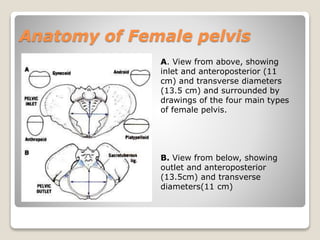
Anatomy of Female pelvis
A. View from above, showing
inlet and anteroposterior (11
cm) and transverse diameters
(13.5 cm) and surrounded by
drawings of the four main types
of female pelvis.
B. View from below, showing
outlet and anteroposterior
(13.5cm) and transverse
diameters(11 cm)
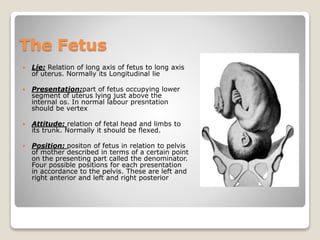
The Fetus
 Lie: Relation of long axis of fetus to long axis
of uterus. Normally its Longitudinal lie
 Presentation:part of fetus occupying lower
segment of uterus lying just above the
internal os. In normal labour presntation
should be vertex
 Attitude: relation of fetal head and limbs to
its trunk. Normally it should be flexed.
 Position: positon of fetus in relation to pelvis
of mother described in terms of a certain point
on the presenting part called the denominator.
Four possible positions for each presentation
in accordance to the pelvis. These are left and
right anterior and left and right posterior
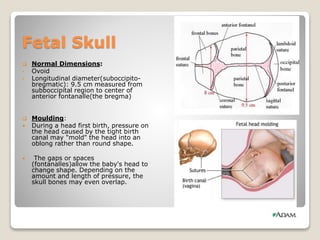
Fetal Skull
 Normal Dimensions:
• Ovoid
• Longitudinal diameter(suboccipito-
bregmatic): 9.5 cm measured from
subboccipital region to center of
anterior fontanalle(the bregma)
 Moulding:
 During a head first birth, pressure on
the head caused by the tight birth
canal may "mold" the head into an
oblong rather than round shape.
 The gaps or spaces
(fontanalles)allow the baby's head to
change shape. Depending on the
amount and length of pressure, the
skull bones may even overlap.
Fetal skull moulding
Onset of labour
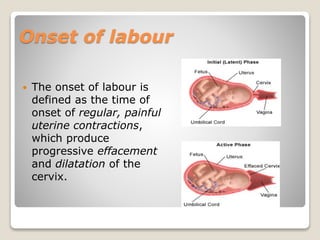
 The onset of labour is
defined as the time of
onset of regular, painful
uterine contractions,
which produce
progressive effacement
and dilatation of the
cervix.
The clinical signs of the onset
of labour
1. The onset of regular, painful contractions that produce
progressive cervical dilatation.
2. The exhibition of a vaginal show - the passage of blood
stained mucus.
3. Rupture of the fetal membranes - may occur at the time of
onset of contractions or it may be delayed until the delivery of
the fetus.
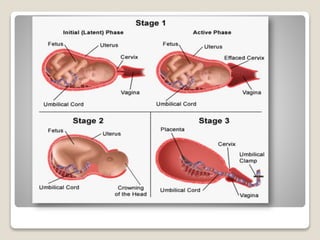
Stages of Labour
1st Stage
•Onset of labourStarts
with
•Cervix reaches full
dilation(10 cm)
•Lasts 2-6 hours
Ends at
2nd Stage
• Cervix reaches full dilation
Starts with
• Expulsion of fetus
• Lasts not more then 2 hours in
primigravida &1 hour in multiparaEnds at
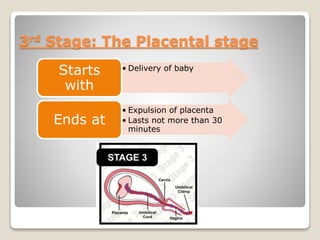
3rd Stage: The Placental stage
• Delivery of babyStarts
with
• Expulsion of placenta
• Lasts not more than 30
minutes
Ends at
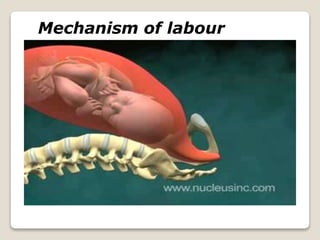
Mechanism Of Labour
 Refers to series of changes in position and attitude that
fetus undergoes during its passage through the birth
canal
 Engagement of the head(passage of widest part of
fetal head through the inlet) normally occurs before the
onset of labour in the primigravid woman but may not
occur until labour is well established in a multipara.
 Only 2/5th of the head will be palpable per abdomen
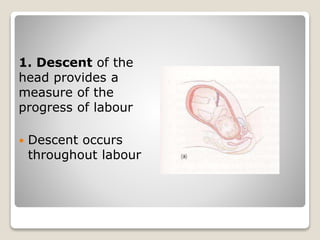
1. Descent of the
head provides a
measure of the
progress of labour
 Descent occurs
throughout labour
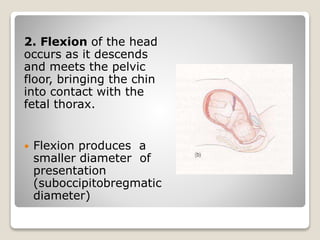
2. Flexion of the head
occurs as it descends
and meets the pelvic
floor, bringing the chin
into contact with the
fetal thorax.
 Flexion produces a
smaller diameter of
presentation
(suboccipitobregmatic
diameter)
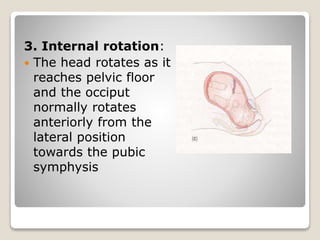
3. Internal rotation:
 The head rotates as it
reaches pelvic floor
and the occiput
normally rotates
anteriorly from the
lateral position
towards the pubic
symphysis
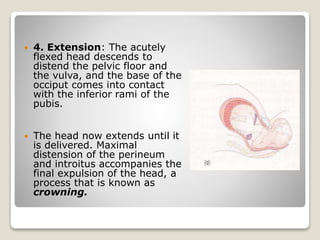
 4. Extension: The acutely
flexed head descends to
distend the pelvic floor and
the vulva, and the base of the
occiput comes into contact
with the inferior rami of the
pubis.
 The head now extends until it
is delivered. Maximal
distension of the perineum
and introitus accompanies the
final expulsion of the head, a
process that is known as
crowning.
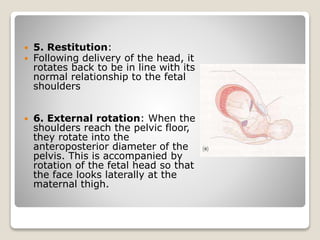
 5. Restitution:
 Following delivery of the head, it
rotates back to be in line with its
normal relationship to the fetal
shoulders
 6. External rotation: When the
shoulders reach the pelvic floor,
they rotate into the
anteroposterior diameter of the
pelvis. This is accompanied by
rotation of the fetal head so that
the face looks laterally at the
maternal thigh.
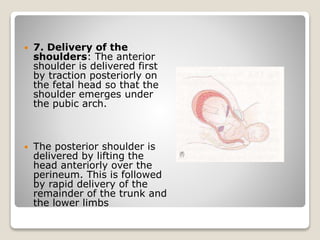
 7. Delivery of the
shoulders: The anterior
shoulder is delivered first
by traction posteriorly on
the fetal head so that the
shoulder emerges under
the pubic arch.
 The posterior shoulder is
delivered by lifting the
head anteriorly over the
perineum. This is followed
by rapid delivery of the
remainder of the trunk and
the lower limbs
Mechanism of labour
Intra partum Monitoring
 What to monitor?
 Mother
 Temperature
 Pulse rate
 Blood pressure
 Urine
 Fetus
 Auscultation
 Fetal CTG
 Fetal ECG
 Scalp stimulation test
 Acid-Base balance
 Others
 Partogram
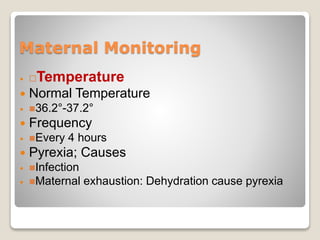
Maternal Monitoring
 Temperature
 Normal Temperature
 36.2°-37.2°
 Frequency
 Every 4 hours
 Pyrexia; Causes
 Infection
 Maternal exhaustion: Dehydration cause pyrexia
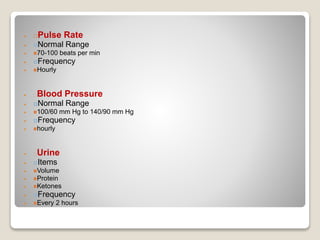
 Pulse Rate
 Normal Range
 70-100 beats per min
 Frequency
 Hourly
 Blood Pressure
 Normal Range
 100/60 mm Hg to 140/90 mm Hg
 Frequency
 hourly
 Urine
 Items
 Volume
 Protein
 Ketones
 Frequency
 Every 2 hours
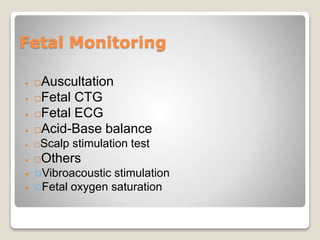
Fetal Monitoring
 Auscultation
 Fetal CTG
 Fetal ECG
 Acid-Base balance
 Scalp stimulation test
 Others
 Vibroacoustic stimulation
 Fetal oxygen saturation
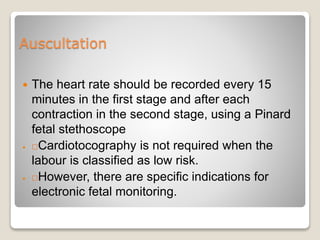
Auscultation
 The heart rate should be recorded every 15
minutes in the first stage and after each
contraction in the second stage, using a Pinard
fetal stethoscope
 Cardiotocography is not required when the
labour is classified as low risk.
 However, there are specific indications for
electronic fetal monitoring.
Indications for continuous electronic
fetal monitoring
 Maternal
 Previous caesarian section
 Pre-eclampsia
 Post-term pregnancy
 Premature rupture of the membranes
 Induced labour
 Diabetes
 Antepartum haemorrhage
 Other maternal medical diseases
 Fetal
 Fetal growth restriction
 Prematurity
 Oligohydramnios
 Multiple pregnancy
 Meconium-stained liquor
 Breech presentation
Partogram
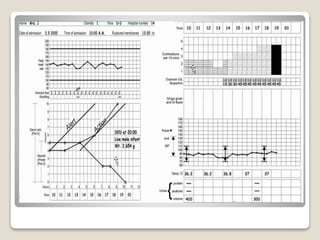
 Partogram is a graphical record of key data
(maternal and fetal) during labour entered
against time on a single sheet of paper
Components
 Fetal Parameters:
 FHR
 Status of membranes or Amniotic Fluid
 Moulding
 Caput
 Progress of Labor:
 Cervical dilatation
 Station of head
 Uterine contractions: Frequency & Duration
 Oxytocin:
 Concentration / L
 Infusion rate
 Any other medicine & IV fluid
Components of Partogram (Cont.)
 Maternal Parameters:
 Vital data:
 Pulse
 BP
 Temperature
 Urine:
 Output
 Acetone
 Protein / Glucose
Management Of Normal Labour
 General principles of the management of
the first stage of labour :
 Observation and intervention if the labour becomes
abnormal by partogram .
 Pain relief during labour and emotional support for
the mother ( Narcotic agents , inhalational analgesia
and regional analgesia )
 Adequate hydration throughout labour.
 Fetal monitoring in labour
 Fetal cardiotocography
 Basal heart rate
 Transitory changes
 The fetal electrocardiogram
 Fetal acid-base changes
 Scalp blood sampling
Management of the second stage
 Delivery of the head

 Controlled descent: mother should be adviced to take rapid shallow
breaths once the head has been crowned
 Minimizing perineal damage.
 Clamping the cord: no need of immediate clamping as about 80 ml
blood may be transferred to baby until the cord pulsations cease
 Evaluation of Apgar score.
 Vit-K first dose
Evaluation of the Apgar score
• Color
• Tone
• Pulse
(beats/
min)
• Respiration
• response
0
• White
• flaccid
• Impalpable
• Absent
• Absent
1
• Blue
• Rigid
• <100
• Irregular
• Poor
2
• pink
• Normal
• >100
• Regular
• Normal
Management of the third stage
 Recognition of placental separation:
signs:
1. lengthening of cord
2. small gush of blood that stops quickly
3. rising fundus of uterus to umbilicus
4. Fundus becomes hard and globular
 Controlled cord traction
1. Routine use of oxytocic agents with crowning of the head:
synthetic oxytocin or oxytocin + ergometrin (if mother is not HTN)
following delivery of shoulder. Causes uterus to contract after delivery
of baby.
2. Assisted delivery of the placenta with cord traction: cord
clamping after 1-2 mins after delivery of baby close to vulva to notice
lengthening. When contraction is felt, fundus should be elevated with
palm by the attendant with steady traction applied to the cord at the
same time ,so that placenta separates and delivers gently.
Thank You

Normal labour by Dr shehr bano

  • 1.
  • 2.
    Outline  Definitions  Criteriaof normal labour  Components of normal labour  Overview of anatomy of female pelvis & fetal skull  Onset of Labour  Stages of Labour  Intrapartum monitoring  Managment
  • 3.
    Definitions  Labour: Event thattakes place in the uterus and the birth canal to expel the viable fetus through the vagina  Delivery: The expulsion of a viable fetus out of the uterus  Normal Labour (eutocia): Labour is considered normal when mature fetus presenting by vertex delivers by natural efforts
  • 4.
    Criteria for normallabour Labour is considered to be Normal when it meets the following criteria:  Spontaneous expulsion  Single ,Full term i.e mature fetus (37 completed weeks – 42 weeks)  Through vagina  Presented by vertex  Within a reasonable time (not less then 3 hours or more then 18 hours)  Without aid (episiotomy or oxytocin)  Without complications to the mother or the fetus.
  • 5.
    Components of Normallabour  Components of normal labour are denoted by “3 P’s” as the Passage , Passenger & Power.  Passage refers to the birth canal as a whole formed by soft tissues covering the bony pelvis through which the fetus is expelled during labour. This includes the pelvic inlet , pelvic cavity and the pelvic outlet.  Passenger refers to the fetus. This includes the fetus’s attitude, lie, presentation and its position  Power denotes the force exerted during the labour. This is of two types 1. Primary force: actions of the uterine muscles 2. Secondary force: the involuntary contraction of muscles of diaphragm and anterior abdominal wall (the bearing down effort)
  • 6.
    Anatomy of Femalepelvis A. View from above, showing inlet and anteroposterior (11 cm) and transverse diameters (13.5 cm) and surrounded by drawings of the four main types of female pelvis. B. View from below, showing outlet and anteroposterior (13.5cm) and transverse diameters(11 cm)
  • 7.
    The Fetus  Lie:Relation of long axis of fetus to long axis of uterus. Normally its Longitudinal lie  Presentation:part of fetus occupying lower segment of uterus lying just above the internal os. In normal labour presntation should be vertex  Attitude: relation of fetal head and limbs to its trunk. Normally it should be flexed.  Position: positon of fetus in relation to pelvis of mother described in terms of a certain point on the presenting part called the denominator. Four possible positions for each presentation in accordance to the pelvis. These are left and right anterior and left and right posterior
  • 8.
    Fetal Skull  NormalDimensions: • Ovoid • Longitudinal diameter(suboccipito- bregmatic): 9.5 cm measured from subboccipital region to center of anterior fontanalle(the bregma)  Moulding:  During a head first birth, pressure on the head caused by the tight birth canal may "mold" the head into an oblong rather than round shape.  The gaps or spaces (fontanalles)allow the baby's head to change shape. Depending on the amount and length of pressure, the skull bones may even overlap.
  • 9.
  • 10.
    Onset of labour The onset of labour is defined as the time of onset of regular, painful uterine contractions, which produce progressive effacement and dilatation of the cervix.
  • 12.
    The clinical signsof the onset of labour 1. The onset of regular, painful contractions that produce progressive cervical dilatation. 2. The exhibition of a vaginal show - the passage of blood stained mucus. 3. Rupture of the fetal membranes - may occur at the time of onset of contractions or it may be delayed until the delivery of the fetus.
  • 13.
    Stages of Labour 1stStage •Onset of labourStarts with •Cervix reaches full dilation(10 cm) •Lasts 2-6 hours Ends at
  • 14.
    2nd Stage • Cervixreaches full dilation Starts with • Expulsion of fetus • Lasts not more then 2 hours in primigravida &1 hour in multiparaEnds at
  • 15.
    3rd Stage: ThePlacental stage • Delivery of babyStarts with • Expulsion of placenta • Lasts not more than 30 minutes Ends at
  • 17.
    Mechanism Of Labour Refers to series of changes in position and attitude that fetus undergoes during its passage through the birth canal  Engagement of the head(passage of widest part of fetal head through the inlet) normally occurs before the onset of labour in the primigravid woman but may not occur until labour is well established in a multipara.  Only 2/5th of the head will be palpable per abdomen
  • 18.
    1. Descent ofthe head provides a measure of the progress of labour  Descent occurs throughout labour
  • 19.
    2. Flexion ofthe head occurs as it descends and meets the pelvic floor, bringing the chin into contact with the fetal thorax.  Flexion produces a smaller diameter of presentation (suboccipitobregmatic diameter)
  • 20.
    3. Internal rotation: The head rotates as it reaches pelvic floor and the occiput normally rotates anteriorly from the lateral position towards the pubic symphysis
  • 21.
     4. Extension:The acutely flexed head descends to distend the pelvic floor and the vulva, and the base of the occiput comes into contact with the inferior rami of the pubis.  The head now extends until it is delivered. Maximal distension of the perineum and introitus accompanies the final expulsion of the head, a process that is known as crowning.
  • 22.
     5. Restitution: Following delivery of the head, it rotates back to be in line with its normal relationship to the fetal shoulders  6. External rotation: When the shoulders reach the pelvic floor, they rotate into the anteroposterior diameter of the pelvis. This is accompanied by rotation of the fetal head so that the face looks laterally at the maternal thigh.
  • 23.
     7. Deliveryof the shoulders: The anterior shoulder is delivered first by traction posteriorly on the fetal head so that the shoulder emerges under the pubic arch.  The posterior shoulder is delivered by lifting the head anteriorly over the perineum. This is followed by rapid delivery of the remainder of the trunk and the lower limbs
  • 24.
  • 25.
    Intra partum Monitoring What to monitor?  Mother  Temperature  Pulse rate  Blood pressure  Urine  Fetus  Auscultation  Fetal CTG  Fetal ECG  Scalp stimulation test  Acid-Base balance  Others  Partogram
  • 26.
    Maternal Monitoring  Temperature Normal Temperature  36.2°-37.2°  Frequency  Every 4 hours  Pyrexia; Causes  Infection  Maternal exhaustion: Dehydration cause pyrexia
  • 27.
     Pulse Rate Normal Range  70-100 beats per min  Frequency  Hourly  Blood Pressure  Normal Range  100/60 mm Hg to 140/90 mm Hg  Frequency  hourly  Urine  Items  Volume  Protein  Ketones  Frequency  Every 2 hours
  • 28.
    Fetal Monitoring  Auscultation Fetal CTG  Fetal ECG  Acid-Base balance  Scalp stimulation test  Others  Vibroacoustic stimulation  Fetal oxygen saturation
  • 29.
    Auscultation  The heartrate should be recorded every 15 minutes in the first stage and after each contraction in the second stage, using a Pinard fetal stethoscope  Cardiotocography is not required when the labour is classified as low risk.  However, there are specific indications for electronic fetal monitoring.
  • 30.
    Indications for continuouselectronic fetal monitoring  Maternal  Previous caesarian section  Pre-eclampsia  Post-term pregnancy  Premature rupture of the membranes  Induced labour  Diabetes  Antepartum haemorrhage  Other maternal medical diseases
  • 31.
     Fetal  Fetalgrowth restriction  Prematurity  Oligohydramnios  Multiple pregnancy  Meconium-stained liquor  Breech presentation
  • 32.
    Partogram  Partogram isa graphical record of key data (maternal and fetal) during labour entered against time on a single sheet of paper
  • 33.
    Components  Fetal Parameters: FHR  Status of membranes or Amniotic Fluid  Moulding  Caput  Progress of Labor:  Cervical dilatation  Station of head  Uterine contractions: Frequency & Duration  Oxytocin:  Concentration / L  Infusion rate  Any other medicine & IV fluid
  • 34.
    Components of Partogram(Cont.)  Maternal Parameters:  Vital data:  Pulse  BP  Temperature  Urine:  Output  Acetone  Protein / Glucose
  • 36.
    Management Of NormalLabour  General principles of the management of the first stage of labour :  Observation and intervention if the labour becomes abnormal by partogram .  Pain relief during labour and emotional support for the mother ( Narcotic agents , inhalational analgesia and regional analgesia )  Adequate hydration throughout labour.
  • 37.
     Fetal monitoringin labour  Fetal cardiotocography  Basal heart rate  Transitory changes  The fetal electrocardiogram  Fetal acid-base changes  Scalp blood sampling
  • 38.
    Management of thesecond stage  Delivery of the head   Controlled descent: mother should be adviced to take rapid shallow breaths once the head has been crowned  Minimizing perineal damage.  Clamping the cord: no need of immediate clamping as about 80 ml blood may be transferred to baby until the cord pulsations cease  Evaluation of Apgar score.  Vit-K first dose
  • 39.
    Evaluation of theApgar score • Color • Tone • Pulse (beats/ min) • Respiration • response 0 • White • flaccid • Impalpable • Absent • Absent 1 • Blue • Rigid • <100 • Irregular • Poor 2 • pink • Normal • >100 • Regular • Normal
  • 40.
    Management of thethird stage  Recognition of placental separation: signs: 1. lengthening of cord 2. small gush of blood that stops quickly 3. rising fundus of uterus to umbilicus 4. Fundus becomes hard and globular  Controlled cord traction 1. Routine use of oxytocic agents with crowning of the head: synthetic oxytocin or oxytocin + ergometrin (if mother is not HTN) following delivery of shoulder. Causes uterus to contract after delivery of baby. 2. Assisted delivery of the placenta with cord traction: cord clamping after 1-2 mins after delivery of baby close to vulva to notice lengthening. When contraction is felt, fundus should be elevated with palm by the attendant with steady traction applied to the cord at the same time ,so that placenta separates and delivers gently.
  • 41.