Normal labor
BY SHUKRI ELMI MOHAMED LECTURER KMTC
GARISA CAMPUS BSC /HND/KRCHN
OBJECTIVES
At the end of this discussion each student should be able to:
Define criteria of normal labor correctly
 Describe the structure and diameters of bony pelvis, fetal
head and distinguish between the anterior and posterior
fontanels
 Describe the structure and diameters of Describe
premonitory and sure signs of labor
Identify the stages of labor
Describe nursing care for each stage of labor
Identify problems in passage and passenger.
Discuss nursing management for abnormal labor
Introduction
During late pregnancy the woman and fetus prepare for the
labor process.
The fetus has grown and developed in preparation for
extrauterine life.
The woman has undergone various physiologic adaptations
during pregnancy that prepare her for birth and motherhood.
 Labor and birth represent the end of pregnancy, the
beginning of extrauterine life for the newborn, and a change
in the lives of the family.
Terminology
Primipara: The woman who delivers for the first time.
Multipara: The woman that delivers several times before.
Nulli para: The woman that hasn‘t past delivery.
Para X+O:
X: number of deliveries.
O: number of abortions.
Normal labor (eutocia): It is expulsion of mature viable fetus,
presenting by vertex through the birth canal, spontaneously
within reasonable time (24 hrs) without interference &
without fetal or maternal complications.
Immature labor: Termination of pregnancy between 20-28
wks (fetal weight 500-1000).
Premature labor: Termination of pregnancy between 28-38
weeks and fetal weight between (1000-2500gm).
Post maturity: Prolongation of pregnancy 2 weeks or more
over the E.D.D
Show: It is a blood stained cervical mucous (cervical mucus
plug which close the cervical canal during pregnancy to
prevent infection and noticed at the start of labor when cervix
starts to dilate).
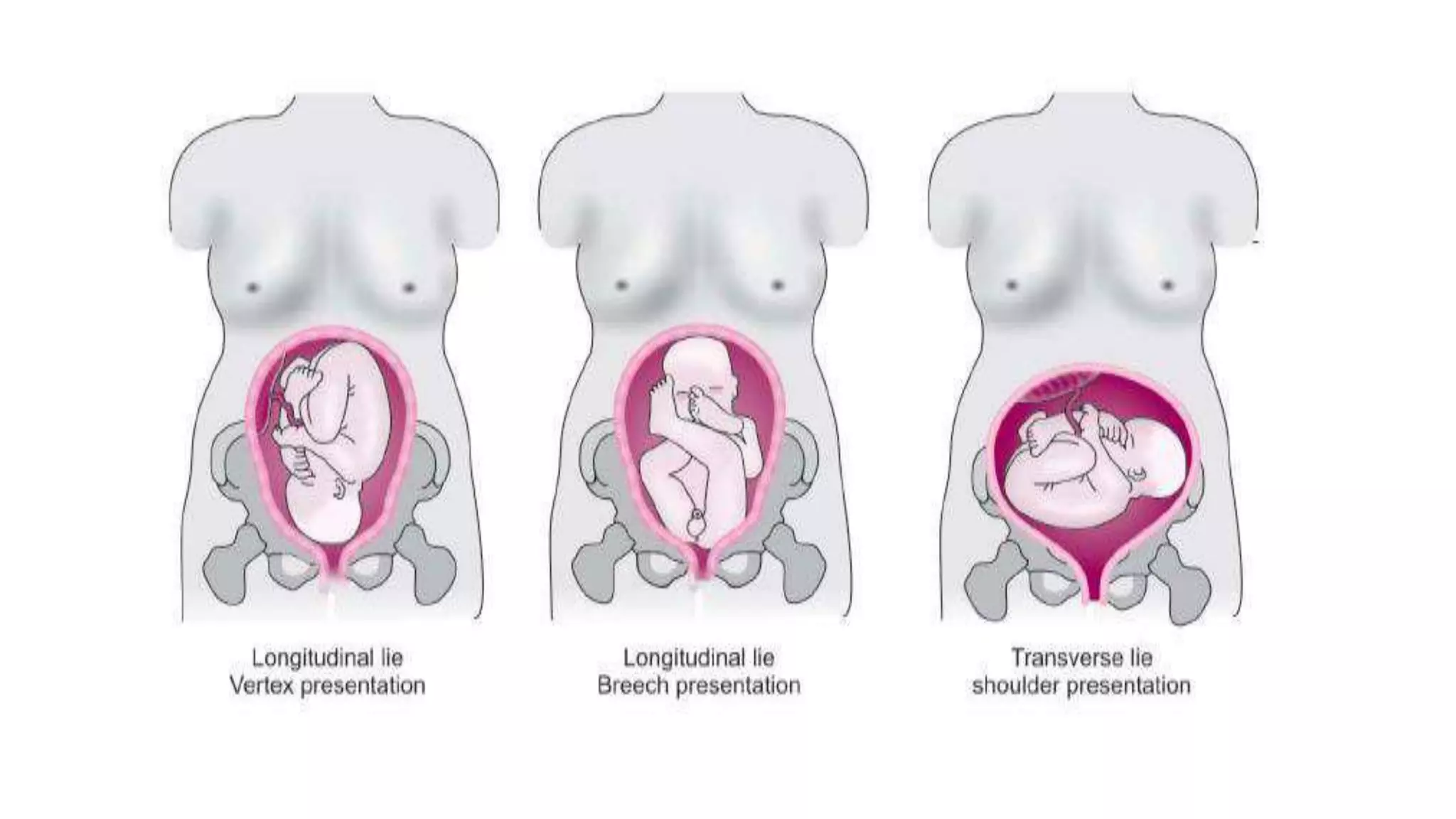
Lie: It is the relationship of the long axis of the fetus to the
long axis of the mother (Normally is longitudinal lie 99.5%),
but may be transverse or oblique 0.5%.
Attitude:
It is the relationship of the fetal parts to each other; normally
the fetus is in an attitude of generalization or complete
flexion.
Presentation: It refers to the first part of the fetus which
enters the pelvic brim or inlet and felt by vaginal examination
and it may be: (Cephalic: 96% / Breech: 3.5% / Shoulder:
0.5%)
Denominator: It is the landmark on the presenting part by
which the position of the fetus is known;
Vertex presentation, the dominator is the occiput.
Face presentation, the dominator is the chin (mentum).
Brow presentation, the dominator is the frontal bone.
Breech presentation, the dominator is the sacrum.
Shoulder presentation, the dominator is the scapula.
Position: It is the relationship of a certain point on the
presenting part of the fetus to the back of the mother.
Vertex presentation, the positions (R.O.A, R.O.P, L.O.A,
L.O.P).
Breech presentation, the positions (R.S.A, R.S.P, L.S.A,
L.S.P).
Crowning: It is distention of the vulva by the largest
diameter of the fetal skull bone (biparietal diameter) and not
return again after the end of uterine Contraction.
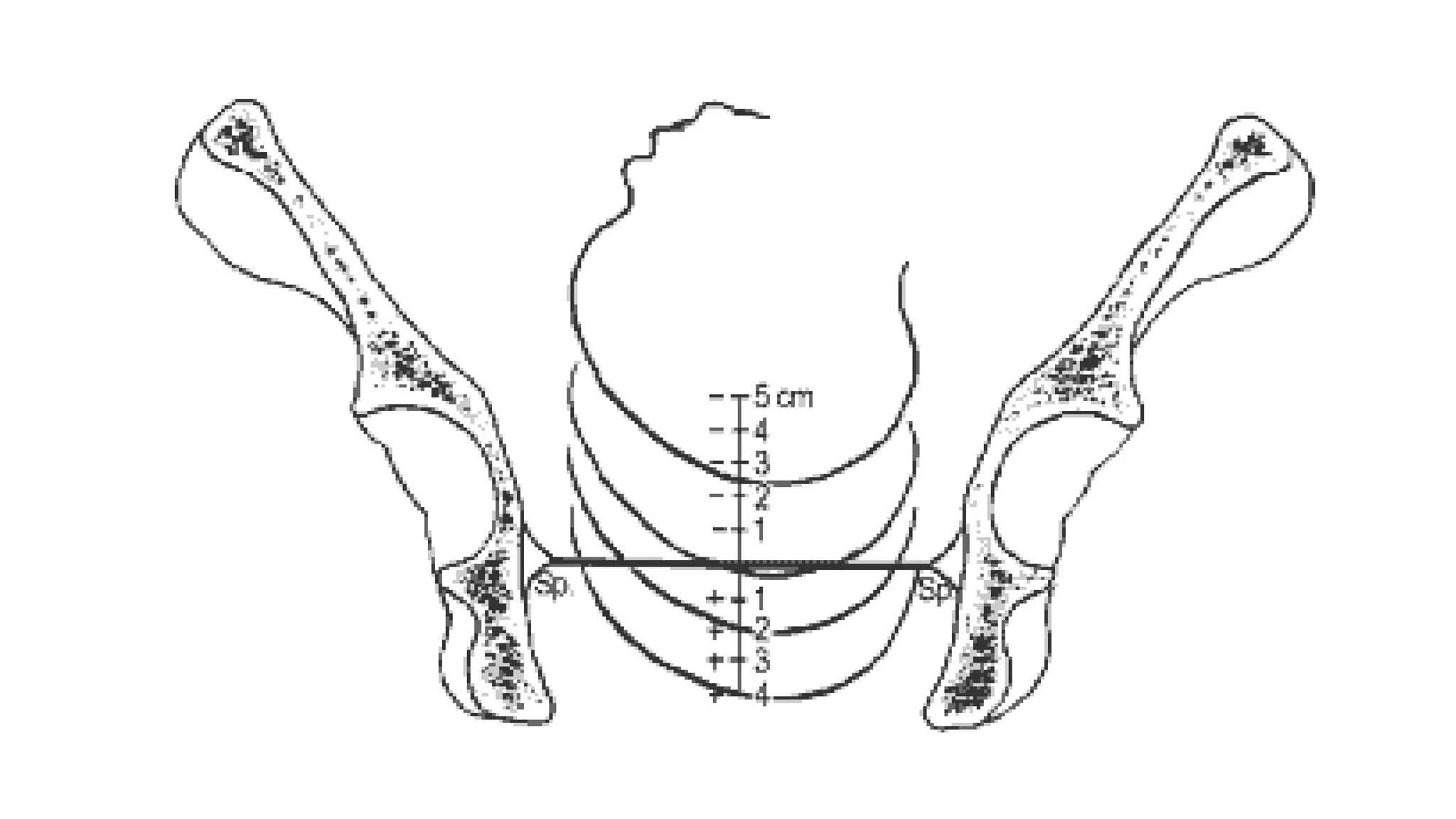
 Station: It is the relationship between the presenting part of
the fetus and the imaginary line between the two ischial
spines of the maternal pelvis (-2, -1, 0, +1, +2).
Moulding: It is decrease of the fetal head in size and shape by
overlapping of fetal skull bones to pass through the maternal
pelvis.
Degrees:
(0) = Bones are separated and sutures can be felt easily.
(+1) = Bones are just touching each other.
(+2) = Bones are overlapping each other but separate by
genital pressure.
(+3) = Bones are severely overlapping each other but not
separate by pressure and may make intracranial pressure.
Effacement:
It is the shortening or taking up of the cervical canal.
Lightening: It is descend of the fundal level of the uterus at 32 wks
level due to engagement of the fetal head in the maternal pelvis, (occur
in PG at 2 weeks before labor and MG at onset of labor) and this leads
to:
Relief of dyspnea and palpitation. Complain of frequency of
micturation.
Complain of heaviness in the pelvis and difficulty in walking.
Engagement: It is passage of biparietal diameter of fetal head through
pelvic brim. PG at 38 wks & MG at onset of labor or at 2nd stage of
labor.
Apgar score: It is the newborn observational check list that includes
five parameters (heart rate, respiration, color, muscle tone and
reflexes) and it is recorded at 1 min and 5 min after delivery.
Partogram: It is a graphic analysis tool to follow the progress of labor
(for cervical dilatation in the time spent in labor) and includes all
events occur during labor to the mother and fetus.
• Episiotomy: A surgically incision on the perineum and posterior
vaginal wall during the second stage of labor to widen the vaginal
orifice to facilitate passage of the fetus from the vagina.
• Caput succedaneum: Accumulation of fluid under fetal scalp due to
compression during labor of the fetal head , it usually not require
medical intervention as it resolve normally after one to two days after
birth
Criteria of normal labor:
Mature viable fetus
Vertex presentation
Through birth canal
Spontaneously
Within reasonable time
Without interference except episiotomy
Without complication for the mother and fetus
Premonitory S&S of labor
Lightening.
Greet pressure below.
Frequency of micturation.
False labor pain.
Sure S&S of labor
Sure S&S of labor:
True labor pain.
Show is present.
Cervical dilatation.
Factors Affecting Labor (5 Ps
Factors Affecting Labor (5 Ps):
Passage: (Bony pelvis & Soft tissue (Birth canal).
Passenger: ( Fetus& Placenta & membranes).
Power: (Primary (uterine contraction) & Secondary (Bearing
down).
Prejudice (place & personnel)
Psychological aspect
Stages of normal labor
1st stage (Dilatation): begins with true labor pain & ends with
fully cervical dilatation (10cm). PG: 16 hrs. MP: 8 hrs.
2nd stage (Birth): begins with fully cervical dilatation & ends
with complete delivery of the baby. PG: 45 min-1 hour hrs.
MP: 15-30 min.
3rdstage(Delivery of placenta): begins with complete
delivery of the baby & ends with complete delivery of
the placenta. PG: 10-20 min. MP: 10-20 min.
4th stage (Recovery): It is the first 2-4 hours
immediate after delivery of the placenta.
First stage of labor (Dilatation)
Phases of 1st stage: Latent phase: (0-3 cm)
Contractions become comes every 10-15 minutes and least 2/10
min with each lasting > 20 seconds, moderately strong and are
quite well tolerated without analgesia
Active phase: (4-10 cm)
Contraction comes every 3-5 minutes and at least 3 / 10 min, with
each lasting > 40 seconds.
Normal rate of CD in active phase is 1.2cm/hour in PG and
1.5cm/hour in MP.
Differentiate between true labor pain & false labor pain
True labor pain is regular while in false labour is irregular
In true labour increase in frequency, duration & intensity
while it is no in false labour
In true labour Interval between contraction gradually shorten
while in false labour it does not change
True labour not relieved by analgesics while in false labour
it can be relieved by analgesics
In true labour Spasmodic colicky pain begins in the lower
back & radiates around to abdomen while in false labour pain
is usually in the abdomen
In true labour the pain Productive and associated with
stretching & dilatation of cervix while in false labour it is not
productive
in true labour the pain Intensity and increases with walking
while it is not in false labour
Second stage (Birth)
Criteria of 2nd stage of labor:
Full dilatation, complete effacement of cervix.
Strong uterine contraction.
Spontaneous rupture of membranes
Urge to bear down.
Appearance of presenting part from the vulva.
Plugging of perineum.
Flushing of the face.
Changing in woman voice begin to cry.
Mechanism of normal labor:
Descent
 Engagement
Flexion
Internal rotation
Extension
Restitution
 External rotation
 Delivery of shoulder
Third stage of labor: (Delivery of placenta)
Signs of placental separation:
 The uterus becomes smaller, harder, higher, and more
globular.
A suprapubic bulge appears due to presence of the placenta
in the lower uterine segment.
. The passage of gush of blood per vagina.
 Elongation the umbilical cord.
Loss of pulsation in the cord.
Methods of placental separation:
Shultze method
Separation started at the center then at the edges as an inverted
umbrella.
Less liability for bleeding.
Less retention of membranes.
Duncan’s method
3% of cases.
The edges of placenta separated first.
More liability for bleeding
 Retention of membranes.
The fourth stage (Recovery) :
It is that the immediate postpartum period, as it is the 1st 2-4 hrs
after delivery of the placenta.
Nursing management of normal labor
Nursing care during the first stage of labor:
1- Assessment at admission: It is divided into:
 Initial assessment
Ongoing assessment
Initial assessments:
When the woman arrives to perinatal unite. Assessment is the
top priority of nursing care .it includes history taking,
physical examination and investigation.
1- History taking: ( subjective data)
A maternal health history should include:
Personal history, which involves (name, age and address).
Mother life-style; such as (Housing condition, daily living
activities, personal hygiene, nutrition and habits.
Medical history; chronic diseases such as cardiac disease,
liver disease & renal disease)
Family history; such as (twin pregnancies, diabetes mellitus,
hypertension and history of congenital malformation, any
operations, receiving blood transfusion and allergy to food or
drugs.
Surgical history: as appendectomy, ovarian cyst, caesarian
section. Obstetric history; which includes:
L.M.P, E.D.D, gravidity and parity
previous pregnancy& delivery history; which includes
(number of full term pregnancies, number of premature
pregnancies, number of abortion, all information concerning
the outcome of each of the previous pregnancies, duration of
pregnancy, duration of labor, mode of delivery, puererium and
the condition of the newborn.
History of current labor; this includes onset, frequency,
duration and intensity of uterine contraction, passage of show
and its amount and the status of membrane.
If the membrane ruptured, it is essential to ask about the time
of rupture and the color and amount of amniotic fluid.
Physical examination
A-General examination:
• The nurse should take and record the parturient vital signs.
(temperature / 4hrs after ROM /2hrpulse / 4hrs in latent phase
& 30 min in active phase- BP / 4 hrs in latent phase & 2hrs in
active phase.
• Respiration on admission. and FHR / 2hrs.in latent phase &
/30 min. in active phase), weight and hight. Then she checks
for the presence of edema, varicose vein
B- Local examination:
Abdominal examination; This includes assessment of
the pattern of contraction, "frequency, duration,
intensity & interval" as well as abdominal grips
through inspection, palpation and auscultation
Examination of the vulva:
Inspect gaping of introitus, observe color and odor of
amniotic fluid and check edema of the vulva.
Vaginal examination: to assess progress of labor, determine
cervical effacement & degree of dilatation, assess the
condition of membranes, determine presentation, position &
station of the fetus, and detect any abnormalities.
Contraindications of vaginal examination are;
Ante partum Hg
Premature rupture of membrane
Cord prolapse
Urinary tract infection
Previous history of abortion
Obstructed labour.
3- Investigation:
Hematology test, includes, "Hb, RH &Blood group".
Urine analysis; includes," Glucose, acetone, and albumin"
Ongoing assessment:
Continuity & follow up of all types of data, SD (complaints)/
OD (labor progress).
Planning management according to assessment:
1-Comfort measures:
a)Ambulation and positioning. Ambulation and a specific
maternal position is helpful to reduce discomfort and assist
the labor process.
Frequent change position sitting, walking, kneeling,
standing, lying down, getting on hands and knees, and using a
birthing ball: Reduce discomfort from constant pressure ,
Help the fetus adapt to the pelvic contours & Promote fetal
descent.
Supine and sitting positions should be avoided because it
may interfere with placental blood flow and consequently
with oxygenation of the fetus
VOIDING
Voiding.
The nurse should encourage the woman to void every 2 hours because
a distended bladder may impede descent of the presenting part, inhibit
uterine contractions, and lead to decreased bladder tone or atony after
birth.
The bladder is only catheterized if the parturient is unable to void after
some time and then only after the usual nursing measures have been
tried and failed. All urine passed during labor is charted and tested for
acetone.
GENERAL HYGIENE
Women in labor should be offered the use of showers or warm water
baths, if they are available, to enhance the feeling of well-being and to
minimize the discomfort of contractions.
 If the membranes have ruptured, a wash in bed is preferable,
necessary care is given to hair and nails.
Also, mouth care is important, especially if oral fluid intake is limited
because the dry mouth and lips can be very uncomfortable.
 The nurse should keep the women's clothes and bed dry and clean.
NUTRITION AND FLUID INTAKE
Nutrient and fluid intake:
The nurse should encourage the mother to eat soft diet
and fluid.
 like jelly, honey, juice jam, milk during early first
stage of labor and
Pain relievers measures:
Nonpharmacological pain relieve measures may include c
labor support, hydrotherapy, ambulation and position
changes, acupuncture and acupressure, attention focusing and
imagery, therapeutic touch and massage, and breathing
techniques and effleurage.
 Hydrotherapy: in which the woman immerses herself in
warm water for relaxation and relief of discomfort
Acupressure: It involves the application of a firm finger or
massage at the same trigger points to reduce the pain
sensation.
Attention Focusing and Imagery
Breathing techniques
Homeopathy. Homeopathic remedies are prepared from plant
extracts & from minerals such Aconitum to relieve anxiety &
Kali carbonicum to alleviate back pain during labor.
Observation of the progress of labor
Progress of labor should be noted through Partogram,
which is a tool to help the management of labor, it is
used to record all observation made on a woman in
labor, it provides a graphic method of recording the
silent features of labor.
Components of the pantograph:
Part I : Fetal condition: This part of the graph is used to
monitor and assess fetal condition Fetal heart rate , Membranes
and liquor & Moulding the fetal skull bones
Part II : Progress of labor: It includes: Cervical dilatation
Descent of the fetal head & Uterine contractions
Part III: Maternal condition Assess maternal condition
regularly by monitoring : Drugs , IV fluids , and oxytocin , if
labour is augmented , Pulse , blood pressure & Temperature
Urine volume , analysis for protein and acetone
Nursing management during 2nd stage of labor:
Nursing management during 2nd stage of labor: It
includes the following actions:
1. Preparation: (Place, attendant & mother)
2. Observation: V.S, UC, FHR, FD
3. Assist doctor during delivery:
4. Documentation
Nursing care during 3rd stage of labor
Assist with placental delivery
Inspect the placenta immediately for any missing lobe, which
may cause hemorrhage, sepsis and sub-involution.
Examine the placenta to be sure that the membranes are
completely.
Examine the cord to (2 arteries and one vein).
 Administering an oxytocic if ordered and indicated after
placental to prevent postpartum hemorrhage.
Help in repairing the episiotomy.
Be prepared to administer of blood or I.V fluids.
 The nurse should be assessed the contractility of the
uterus
 Check the height and degree of firmness of fundus.
 Observe the amount of blood loss and estimate
it.(normal 200 – 600 ml)
Perineal care by ante septic solution.
apply sterile pad on the perineal area
Health education about perineal care at home
Nurses role in fourth stage of labour
Observation: should be provided to mother and newborn, for the
following
Maternal :
Vital signs; should be assessed every 15 minutes in the first hour
Uterus; Assess the firmness, height, and positioning of the uterine
fundus with each vital sign assessment.
The fundus should be firm, in the midline, and below the umbilicus
(about the size of a large grapefruit).
If the fundus is firm, no massage is needed; if it is soft
(boggy), it should be massaged every 15 minutes until
it is firm.
Lochia; assess the amount, color and Oder of lochia
Perineal and Labial Areas. Observe these areas for
hematoma formation using REEDA scale.
The nurse should be alert for the danger signs during this stage
The nurse should be alert for the danger signs during this stage:
Sever perineal pain suggestive for hematoma formation.
Rapid pulse increases hypotension.
Sever headache hyperreflexia may precede eclampsia.
Distended bladder often visible will lead to enhanced uterine bleeding,
catheterization for retention when necessary.
Newborn: The nurse should observe VS, reflexes, cord,
defecation/urination, skin color of the newborn

Normal labour newest

  • 1.
    Normal labor BY SHUKRIELMI MOHAMED LECTURER KMTC GARISA CAMPUS BSC /HND/KRCHN
  • 2.
    OBJECTIVES At the endof this discussion each student should be able to: Define criteria of normal labor correctly  Describe the structure and diameters of bony pelvis, fetal head and distinguish between the anterior and posterior fontanels  Describe the structure and diameters of Describe premonitory and sure signs of labor
  • 3.
    Identify the stagesof labor Describe nursing care for each stage of labor Identify problems in passage and passenger. Discuss nursing management for abnormal labor
  • 4.
    Introduction During late pregnancythe woman and fetus prepare for the labor process. The fetus has grown and developed in preparation for extrauterine life. The woman has undergone various physiologic adaptations during pregnancy that prepare her for birth and motherhood.  Labor and birth represent the end of pregnancy, the beginning of extrauterine life for the newborn, and a change in the lives of the family.
  • 5.
    Terminology Primipara: The womanwho delivers for the first time. Multipara: The woman that delivers several times before. Nulli para: The woman that hasn‘t past delivery. Para X+O: X: number of deliveries. O: number of abortions.
  • 6.
    Normal labor (eutocia):It is expulsion of mature viable fetus, presenting by vertex through the birth canal, spontaneously within reasonable time (24 hrs) without interference & without fetal or maternal complications. Immature labor: Termination of pregnancy between 20-28 wks (fetal weight 500-1000). Premature labor: Termination of pregnancy between 28-38 weeks and fetal weight between (1000-2500gm).
  • 7.
    Post maturity: Prolongationof pregnancy 2 weeks or more over the E.D.D Show: It is a blood stained cervical mucous (cervical mucus plug which close the cervical canal during pregnancy to prevent infection and noticed at the start of labor when cervix starts to dilate). Lie: It is the relationship of the long axis of the fetus to the long axis of the mother (Normally is longitudinal lie 99.5%), but may be transverse or oblique 0.5%.
  • 9.
    Attitude: It is therelationship of the fetal parts to each other; normally the fetus is in an attitude of generalization or complete flexion. Presentation: It refers to the first part of the fetus which enters the pelvic brim or inlet and felt by vaginal examination and it may be: (Cephalic: 96% / Breech: 3.5% / Shoulder: 0.5%)
  • 12.
    Denominator: It isthe landmark on the presenting part by which the position of the fetus is known; Vertex presentation, the dominator is the occiput. Face presentation, the dominator is the chin (mentum). Brow presentation, the dominator is the frontal bone. Breech presentation, the dominator is the sacrum. Shoulder presentation, the dominator is the scapula.
  • 13.
    Position: It isthe relationship of a certain point on the presenting part of the fetus to the back of the mother. Vertex presentation, the positions (R.O.A, R.O.P, L.O.A, L.O.P). Breech presentation, the positions (R.S.A, R.S.P, L.S.A, L.S.P).
  • 14.
    Crowning: It isdistention of the vulva by the largest diameter of the fetal skull bone (biparietal diameter) and not return again after the end of uterine Contraction.  Station: It is the relationship between the presenting part of the fetus and the imaginary line between the two ischial spines of the maternal pelvis (-2, -1, 0, +1, +2).
  • 16.
    Moulding: It isdecrease of the fetal head in size and shape by overlapping of fetal skull bones to pass through the maternal pelvis. Degrees: (0) = Bones are separated and sutures can be felt easily. (+1) = Bones are just touching each other.
  • 17.
    (+2) = Bonesare overlapping each other but separate by genital pressure. (+3) = Bones are severely overlapping each other but not separate by pressure and may make intracranial pressure. Effacement: It is the shortening or taking up of the cervical canal.
  • 19.
    Lightening: It isdescend of the fundal level of the uterus at 32 wks level due to engagement of the fetal head in the maternal pelvis, (occur in PG at 2 weeks before labor and MG at onset of labor) and this leads to: Relief of dyspnea and palpitation. Complain of frequency of micturation. Complain of heaviness in the pelvis and difficulty in walking. Engagement: It is passage of biparietal diameter of fetal head through pelvic brim. PG at 38 wks & MG at onset of labor or at 2nd stage of labor.
  • 20.
    Apgar score: Itis the newborn observational check list that includes five parameters (heart rate, respiration, color, muscle tone and reflexes) and it is recorded at 1 min and 5 min after delivery. Partogram: It is a graphic analysis tool to follow the progress of labor (for cervical dilatation in the time spent in labor) and includes all events occur during labor to the mother and fetus.
  • 21.
    • Episiotomy: Asurgically incision on the perineum and posterior vaginal wall during the second stage of labor to widen the vaginal orifice to facilitate passage of the fetus from the vagina. • Caput succedaneum: Accumulation of fluid under fetal scalp due to compression during labor of the fetal head , it usually not require medical intervention as it resolve normally after one to two days after birth
  • 22.
    Criteria of normallabor: Mature viable fetus Vertex presentation Through birth canal Spontaneously Within reasonable time Without interference except episiotomy Without complication for the mother and fetus
  • 23.
    Premonitory S&S oflabor Lightening. Greet pressure below. Frequency of micturation. False labor pain.
  • 24.
    Sure S&S oflabor Sure S&S of labor: True labor pain. Show is present. Cervical dilatation.
  • 25.
    Factors Affecting Labor(5 Ps Factors Affecting Labor (5 Ps): Passage: (Bony pelvis & Soft tissue (Birth canal). Passenger: ( Fetus& Placenta & membranes). Power: (Primary (uterine contraction) & Secondary (Bearing down). Prejudice (place & personnel) Psychological aspect
  • 26.
    Stages of normallabor 1st stage (Dilatation): begins with true labor pain & ends with fully cervical dilatation (10cm). PG: 16 hrs. MP: 8 hrs. 2nd stage (Birth): begins with fully cervical dilatation & ends with complete delivery of the baby. PG: 45 min-1 hour hrs. MP: 15-30 min.
  • 27.
    3rdstage(Delivery of placenta):begins with complete delivery of the baby & ends with complete delivery of the placenta. PG: 10-20 min. MP: 10-20 min. 4th stage (Recovery): It is the first 2-4 hours immediate after delivery of the placenta.
  • 28.
    First stage oflabor (Dilatation) Phases of 1st stage: Latent phase: (0-3 cm) Contractions become comes every 10-15 minutes and least 2/10 min with each lasting > 20 seconds, moderately strong and are quite well tolerated without analgesia Active phase: (4-10 cm) Contraction comes every 3-5 minutes and at least 3 / 10 min, with each lasting > 40 seconds. Normal rate of CD in active phase is 1.2cm/hour in PG and 1.5cm/hour in MP.
  • 29.
    Differentiate between truelabor pain & false labor pain True labor pain is regular while in false labour is irregular In true labour increase in frequency, duration & intensity while it is no in false labour In true labour Interval between contraction gradually shorten while in false labour it does not change True labour not relieved by analgesics while in false labour it can be relieved by analgesics
  • 30.
    In true labourSpasmodic colicky pain begins in the lower back & radiates around to abdomen while in false labour pain is usually in the abdomen In true labour the pain Productive and associated with stretching & dilatation of cervix while in false labour it is not productive in true labour the pain Intensity and increases with walking while it is not in false labour
  • 31.
    Second stage (Birth) Criteriaof 2nd stage of labor: Full dilatation, complete effacement of cervix. Strong uterine contraction. Spontaneous rupture of membranes Urge to bear down.
  • 32.
    Appearance of presentingpart from the vulva. Plugging of perineum. Flushing of the face. Changing in woman voice begin to cry.
  • 33.
    Mechanism of normallabor: Descent  Engagement Flexion Internal rotation
  • 34.
  • 39.
    Third stage oflabor: (Delivery of placenta) Signs of placental separation:  The uterus becomes smaller, harder, higher, and more globular. A suprapubic bulge appears due to presence of the placenta in the lower uterine segment. . The passage of gush of blood per vagina.  Elongation the umbilical cord. Loss of pulsation in the cord.
  • 40.
    Methods of placentalseparation: Shultze method Separation started at the center then at the edges as an inverted umbrella. Less liability for bleeding. Less retention of membranes.
  • 41.
    Duncan’s method 3% ofcases. The edges of placenta separated first. More liability for bleeding  Retention of membranes. The fourth stage (Recovery) : It is that the immediate postpartum period, as it is the 1st 2-4 hrs after delivery of the placenta.
  • 42.
    Nursing management ofnormal labor Nursing care during the first stage of labor: 1- Assessment at admission: It is divided into:  Initial assessment Ongoing assessment Initial assessments: When the woman arrives to perinatal unite. Assessment is the top priority of nursing care .it includes history taking, physical examination and investigation.
  • 43.
    1- History taking:( subjective data) 1- History taking: ( subjective data) A maternal health history should include: Personal history, which involves (name, age and address). Mother life-style; such as (Housing condition, daily living activities, personal hygiene, nutrition and habits. Medical history; chronic diseases such as cardiac disease, liver disease & renal disease)
  • 44.
    Family history; suchas (twin pregnancies, diabetes mellitus, hypertension and history of congenital malformation, any operations, receiving blood transfusion and allergy to food or drugs. Surgical history: as appendectomy, ovarian cyst, caesarian section. Obstetric history; which includes: L.M.P, E.D.D, gravidity and parity
  • 45.
    previous pregnancy& deliveryhistory; which includes (number of full term pregnancies, number of premature pregnancies, number of abortion, all information concerning the outcome of each of the previous pregnancies, duration of pregnancy, duration of labor, mode of delivery, puererium and the condition of the newborn.
  • 46.
    History of currentlabor; this includes onset, frequency, duration and intensity of uterine contraction, passage of show and its amount and the status of membrane. If the membrane ruptured, it is essential to ask about the time of rupture and the color and amount of amniotic fluid.
  • 47.
    Physical examination A-General examination: •The nurse should take and record the parturient vital signs. (temperature / 4hrs after ROM /2hrpulse / 4hrs in latent phase & 30 min in active phase- BP / 4 hrs in latent phase & 2hrs in active phase. • Respiration on admission. and FHR / 2hrs.in latent phase & /30 min. in active phase), weight and hight. Then she checks for the presence of edema, varicose vein
  • 48.
    B- Local examination: Abdominalexamination; This includes assessment of the pattern of contraction, "frequency, duration, intensity & interval" as well as abdominal grips through inspection, palpation and auscultation
  • 49.
    Examination of thevulva: Inspect gaping of introitus, observe color and odor of amniotic fluid and check edema of the vulva. Vaginal examination: to assess progress of labor, determine cervical effacement & degree of dilatation, assess the condition of membranes, determine presentation, position & station of the fetus, and detect any abnormalities.
  • 50.
    Contraindications of vaginalexamination are; Ante partum Hg Premature rupture of membrane Cord prolapse Urinary tract infection Previous history of abortion Obstructed labour.
  • 51.
    3- Investigation: Hematology test,includes, "Hb, RH &Blood group". Urine analysis; includes," Glucose, acetone, and albumin" Ongoing assessment: Continuity & follow up of all types of data, SD (complaints)/ OD (labor progress).
  • 52.
    Planning management accordingto assessment: 1-Comfort measures: a)Ambulation and positioning. Ambulation and a specific maternal position is helpful to reduce discomfort and assist the labor process.
  • 53.
    Frequent change positionsitting, walking, kneeling, standing, lying down, getting on hands and knees, and using a birthing ball: Reduce discomfort from constant pressure , Help the fetus adapt to the pelvic contours & Promote fetal descent. Supine and sitting positions should be avoided because it may interfere with placental blood flow and consequently with oxygenation of the fetus
  • 54.
    VOIDING Voiding. The nurse shouldencourage the woman to void every 2 hours because a distended bladder may impede descent of the presenting part, inhibit uterine contractions, and lead to decreased bladder tone or atony after birth. The bladder is only catheterized if the parturient is unable to void after some time and then only after the usual nursing measures have been tried and failed. All urine passed during labor is charted and tested for acetone.
  • 55.
    GENERAL HYGIENE Women inlabor should be offered the use of showers or warm water baths, if they are available, to enhance the feeling of well-being and to minimize the discomfort of contractions.  If the membranes have ruptured, a wash in bed is preferable, necessary care is given to hair and nails. Also, mouth care is important, especially if oral fluid intake is limited because the dry mouth and lips can be very uncomfortable.  The nurse should keep the women's clothes and bed dry and clean.
  • 56.
    NUTRITION AND FLUIDINTAKE Nutrient and fluid intake: The nurse should encourage the mother to eat soft diet and fluid.  like jelly, honey, juice jam, milk during early first stage of labor and
  • 57.
    Pain relievers measures: Painrelievers measures: Nonpharmacological pain relieve measures may include c labor support, hydrotherapy, ambulation and position changes, acupuncture and acupressure, attention focusing and imagery, therapeutic touch and massage, and breathing techniques and effleurage.  Hydrotherapy: in which the woman immerses herself in warm water for relaxation and relief of discomfort
  • 58.
    Acupressure: It involvesthe application of a firm finger or massage at the same trigger points to reduce the pain sensation. Attention Focusing and Imagery Breathing techniques Homeopathy. Homeopathic remedies are prepared from plant extracts & from minerals such Aconitum to relieve anxiety & Kali carbonicum to alleviate back pain during labor.
  • 59.
    Observation of theprogress of labor Observation of the progress of labor Progress of labor should be noted through Partogram, which is a tool to help the management of labor, it is used to record all observation made on a woman in labor, it provides a graphic method of recording the silent features of labor.
  • 60.
    Components of thepantograph: Part I : Fetal condition: This part of the graph is used to monitor and assess fetal condition Fetal heart rate , Membranes and liquor & Moulding the fetal skull bones Part II : Progress of labor: It includes: Cervical dilatation Descent of the fetal head & Uterine contractions Part III: Maternal condition Assess maternal condition regularly by monitoring : Drugs , IV fluids , and oxytocin , if labour is augmented , Pulse , blood pressure & Temperature Urine volume , analysis for protein and acetone
  • 61.
    Nursing management during2nd stage of labor: Nursing management during 2nd stage of labor: It includes the following actions: 1. Preparation: (Place, attendant & mother) 2. Observation: V.S, UC, FHR, FD 3. Assist doctor during delivery: 4. Documentation
  • 62.
    Nursing care during3rd stage of labor Assist with placental delivery Inspect the placenta immediately for any missing lobe, which may cause hemorrhage, sepsis and sub-involution. Examine the placenta to be sure that the membranes are completely. Examine the cord to (2 arteries and one vein).  Administering an oxytocic if ordered and indicated after placental to prevent postpartum hemorrhage.
  • 63.
    Help in repairingthe episiotomy. Be prepared to administer of blood or I.V fluids.  The nurse should be assessed the contractility of the uterus  Check the height and degree of firmness of fundus.  Observe the amount of blood loss and estimate it.(normal 200 – 600 ml)
  • 64.
    Perineal care byante septic solution. apply sterile pad on the perineal area Health education about perineal care at home
  • 65.
    Nurses role infourth stage of labour Observation: should be provided to mother and newborn, for the following Maternal : Vital signs; should be assessed every 15 minutes in the first hour Uterus; Assess the firmness, height, and positioning of the uterine fundus with each vital sign assessment. The fundus should be firm, in the midline, and below the umbilicus (about the size of a large grapefruit).
  • 66.
    If the fundusis firm, no massage is needed; if it is soft (boggy), it should be massaged every 15 minutes until it is firm. Lochia; assess the amount, color and Oder of lochia Perineal and Labial Areas. Observe these areas for hematoma formation using REEDA scale.
  • 67.
    The nurse shouldbe alert for the danger signs during this stage The nurse should be alert for the danger signs during this stage: Sever perineal pain suggestive for hematoma formation. Rapid pulse increases hypotension. Sever headache hyperreflexia may precede eclampsia. Distended bladder often visible will lead to enhanced uterine bleeding, catheterization for retention when necessary. Newborn: The nurse should observe VS, reflexes, cord, defecation/urination, skin color of the newborn