Non-Woven Process
By
Mahesh Pratap Dubey
Contact @
+91-9453374288
anmpdubey@gmail.com
Non-Woven Fabrics
Contents
❑ Introduction
❑ Classification
❑ Productions
❑ Application
❑ Conclusion
❑ Reference
Introduction
➢ Nonwovens are known as engineered fabrics. They are created with a view to
targeted structure and properties by applying a set of scientific principles for a
variety of applications.
➢ Nonwovens are manufactured by high-speed and low-cost processes. As
compared to the traditional woven and knitting technology, a larger volume of
materials can be produced at a lower cost by using nonwoven technology.
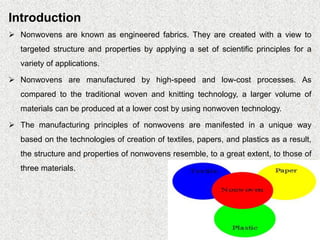
➢ The manufacturing principles of nonwovens are manifested in a unique way
based on the technologies of creation of textiles, papers, and plastics as a result,
the structure and properties of nonwovens resemble, to a great extent, to those of
three materials.
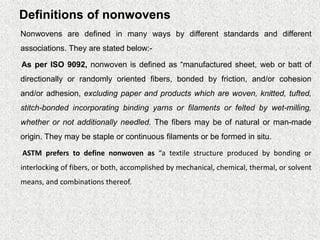
Definitions of nonwovens
Nonwovens are defined in many ways by different standards and different
associations. They are stated below:-
As per ISO 9092, nonwoven is defined as “manufactured sheet, web or batt of
directionally or randomly oriented fibers, bonded by friction, and/or cohesion
and/or adhesion, excluding paper and products which are woven, knitted, tufted,
stitch-bonded incorporating binding yarns or filaments or felted by wet-milling,
whether or not additionally needled. The fibers may be of natural or man-made
origin. They may be staple or continuous filaments or be formed in situ.
ASTM prefers to define nonwoven as “a textile structure produced by bonding or
interlocking of fibers, or both, accomplished by mechanical, chemical, thermal, or solvent
means, and combinations thereof.
Definition Contd.
In resent years
EDANA (The European Disposables and Nonwovens Association)-
Adopted the ISO 9092 definition of nonwoven.
INDA (The North America’s Association of the Nonwoven Fabrics
Industry).-
“Nonwoven fabrics are broadly defined as sheet or web structures bonded
together by entangling fibre or filaments (and by perforating films)
mechanically, thermally or chemically. They are flat, porous sheets that are
made directly from separate fibres or from molten plastic or plastic film. They
are not made by weaving or knitting and do not require converting the fibres to
yarn.”
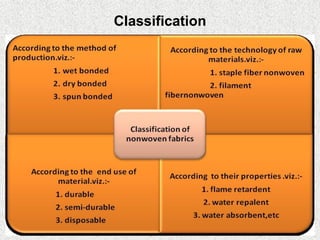
Classification
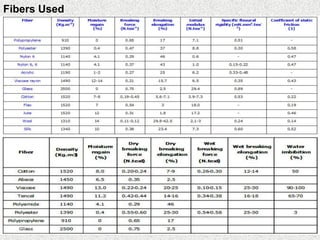
Fibers Used
Production Process
Nonwovens: How are they created?
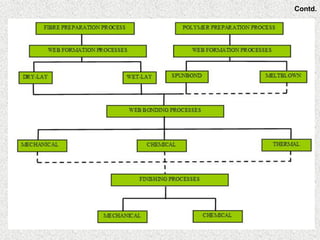
Let us take that the nonwoven manufacturing technology that produces
fibre-based nonwovens generally consists of four basic nonwoven
processes namely, fibre preparation process, web formation
process, web bonding process and finishing process. A brief
summary of the nonwoven processes is illustrated in Figure.
Contd.
Fibre Preparation Process
The fibre preparation process prepares fibres for web formation process. It includes
fibre opening and mixing and fibre feeding to carding machine.
The most natural fibers used to produce nonwovens are obtained directly in Staple
form from the nature, but manmade fibers are produced in filament form. Thus
manmade fibers are needed to be cut into the staple fibers. The preparatory
process of manmade fibers includes following steps:-
OPENING, CLEANING, MIXING & BLENDING
The different machines used for opening, cleaning and mixing are as mentioned in
sequence as follows:-
➢ Bale opener or bale pluckers
➢ Carding willow
➢ Cleaning machine ( mono cylinder or dicylinder)
➢ Oiling system
➢ Blending machine (uni-mix, uni-blend, mix master, etc.)
➢ Fine opener or line opener.
Carding
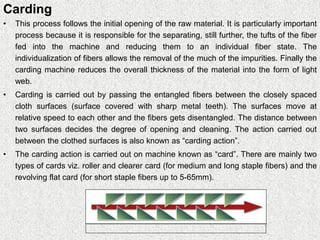
• This process follows the initial opening of the raw material. It is particularly important
process because it is responsible for the separating, still further, the tufts of the fiber
fed into the machine and reducing them to an individual fiber state. The
individualization of fibers allows the removal of the much of the impurities. Finally the
carding machine reduces the overall thickness of the material into the form of light
web.
• Carding is carried out by passing the entangled fibers between the closely spaced
cloth surfaces (surface covered with sharp metal teeth). The surfaces move at
relative speed to each other and the fibers gets disentangled. The distance between
two surfaces decides the degree of opening and cleaning. The action carried out
between the clothed surfaces is also known as “carding action”.
• The carding action is carried out on machine known as “card”. There are mainly two
types of cards viz. roller and clearer card (for medium and long staple fibers) and the
revolving flat card (for short staple fibers up to 5-65mm).
Web formation
WEB FORMATION
➢ Increasing the web mass
➢ Increasing the web width
➢ Determining the web strength in the length and cross directions
➢ Improving the end product quality
Tasks of the web-laying machine
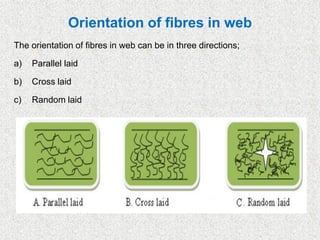
Orientation of fibres in web
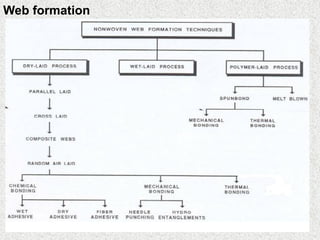
The orientation of fibres in web can be in three directions;
a) Parallel laid
b) Cross laid
c) Random laid
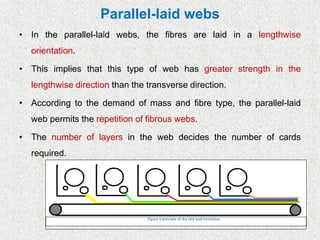
Parallel-laid webs
• In the parallel-laid webs, the fibres are laid in a lengthwise
orientation.
• This implies that this type of web has greater strength in the
lengthwise direction than the transverse direction.
• According to the demand of mass and fibre type, the parallel-laid
web permits the repetition of fibrous webs.
• The number of layers in the web decides the number of cards
required.
Figure 5 principle of dry laid web formation
Cross-laid webs
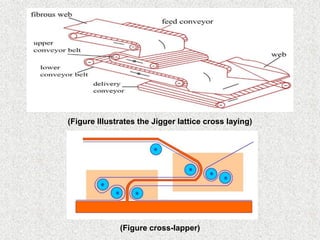
➢ Cross-laid webs are generally made by cross lapper which takes the
web from the card at a specific rate.
➢ The cross-laid web is laid in several layers with an oscillator carriage
on a take-off belt by means of a conveyor belt arrangement.
➢ Here the take-off belt moves at right angles to the carriage
discretion.
The cross-laid web has major two purposes:
✓ To obtain batt with higher basis weight than that of card web
✓ To obtain batt with higher width than that of card web
✓ To obtain batt with fibers preferentially oriented along the transverse
direction of it
✓ To obtain batt with layered structure
(Figure Illustrates the Jigger lattice cross laying)
(Figure cross-lapper)
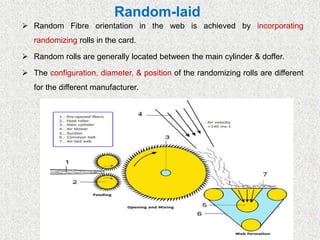
➢ Random Fibre orientation in the web is achieved by incorporating
randomizing rolls in the card.
➢ Random rolls are generally located between the main cylinder & doffer.
➢ The configuration, diameter, & position of the randomizing rolls are different
for the different manufacturer.
Random-laid
Air laid process
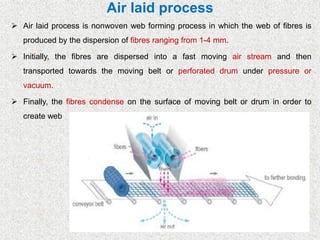
➢ Air laid process is nonwoven web forming process in which the web of fibres is
produced by the dispersion of fibres ranging from 1-4 mm.
➢ Initially, the fibres are dispersed into a fast moving air stream and then
transported towards the moving belt or perforated drum under pressure or
vacuum.
➢ Finally, the fibres condense on the surface of moving belt or drum in order to
create web
Wet laid process
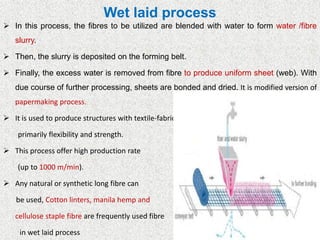
➢ In this process, the fibres to be utilized are blended with water to form water /fibre
slurry.
➢ Then, the slurry is deposited on the forming belt.
➢ Finally, the excess water is removed from fibre to produce uniform sheet (web). With
due course of further processing, sheets are bonded and dried. It is modified version of
papermaking process.
➢ It is used to produce structures with textile-fabric characteristics,
primarily flexibility and strength.
➢ This process offer high production rate
(up to 1000 m/min).
➢ Any natural or synthetic long fibre can
be used, Cotton linters, manila hemp and
cellulose staple fibre are frequently used fibre
in wet laid process
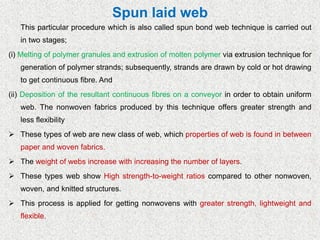
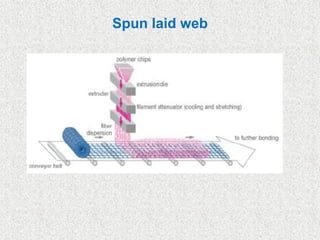
Spun laid web
This particular procedure which is also called spun bond web technique is carried out
in two stages;
(i) Melting of polymer granules and extrusion of molten polymer via extrusion technique for
generation of polymer strands; subsequently, strands are drawn by cold or hot drawing
to get continuous fibre. And
(ii) Deposition of the resultant continuous fibres on a conveyor in order to obtain uniform
web. The nonwoven fabrics produced by this technique offers greater strength and
less flexibility
➢ These types of web are new class of web, which properties of web is found in between
paper and woven fabrics.
➢ The weight of webs increase with increasing the number of layers.
➢ These types web show High strength-to-weight ratios compared to other nonwoven,
woven, and knitted structures.
➢ This process is applied for getting nonwovens with greater strength, lightweight and
flexible.
Spun laid web
Melt blown web
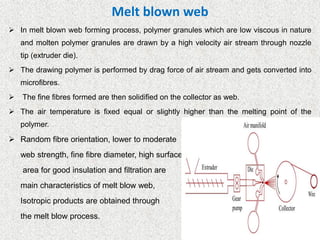
➢ In melt blown web forming process, polymer granules which are low viscous in nature
and molten polymer granules are drawn by a high velocity air stream through nozzle
tip (extruder die).
➢ The drawing polymer is performed by drag force of air stream and gets converted into
microfibres.
➢ The fine fibres formed are then solidified on the collector as web.
➢ The air temperature is fixed equal or slightly higher than the melting point of the
polymer.
➢ Random fibre orientation, lower to moderate
web strength, fine fibre diameter, high surface
area for good insulation and filtration are
main characteristics of melt blow web,
Isotropic products are obtained through
the melt blow process.
BONDING TECHNIQUES
Chemical Bonding
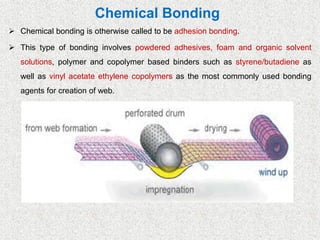
➢ Chemical bonding is otherwise called to be adhesion bonding.
➢ This type of bonding involves powdered adhesives, foam and organic solvent
solutions, polymer and copolymer based binders such as styrene/butadiene as
well as vinyl acetate ethylene copolymers as the most commonly used bonding
agents for creation of web.
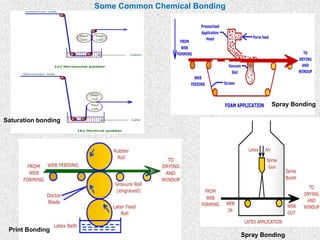
Some Common Chemical Bonding
Print Bonding
Spray Bonding
Spray Bonding
Saturation bonding
Mechanical Bonding
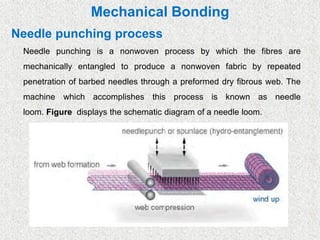
Needle punching process
Needle punching is a nonwoven process by which the fibres are
mechanically entangled to produce a nonwoven fabric by repeated
penetration of barbed needles through a preformed dry fibrous web. The
machine which accomplishes this process is known as needle
loom. Figure displays the schematic diagram of a needle loom.
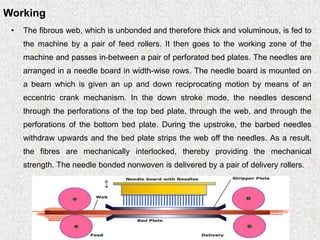
Working
• The fibrous web, which is unbonded and therefore thick and voluminous, is fed to
the machine by a pair of feed rollers. It then goes to the working zone of the
machine and passes in-between a pair of perforated bed plates. The needles are
arranged in a needle board in width-wise rows. The needle board is mounted on
a beam which is given an up and down reciprocating motion by means of an
eccentric crank mechanism. In the down stroke mode, the needles descend
through the perforations of the top bed plate, through the web, and through the
perforations of the bottom bed plate. During the upstroke, the barbed needles
withdraw upwards and the bed plate strips the web off the needles. As a result,
the fibres are mechanically interlocked, thereby providing the mechanical
strength. The needle bonded nonwoven is delivered by a pair of delivery rollers.
Hydroentanglement process
Principle
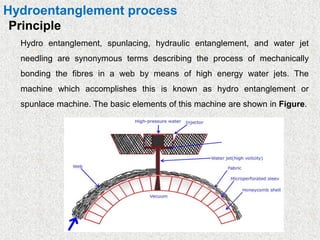
Hydro entanglement, spunlacing, hydraulic entanglement, and water jet
needling are synonymous terms describing the process of mechanically
bonding the fibres in a web by means of high energy water jets. The
machine which accomplishes this is known as hydro entanglement or
spunlace machine. The basic elements of this machine are shown in Figure.
Working
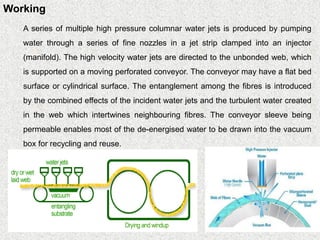
A series of multiple high pressure columnar water jets is produced by pumping
water through a series of fine nozzles in a jet strip clamped into an injector
(manifold). The high velocity water jets are directed to the unbonded web, which
is supported on a moving perforated conveyor. The conveyor may have a flat bed
surface or cylindrical surface. The entanglement among the fibres is introduced
by the combined effects of the incident water jets and the turbulent water created
in the web which intertwines neighbouring fibres. The conveyor sleeve being
permeable enables most of the de-energised water to be drawn into the vacuum
box for recycling and reuse.
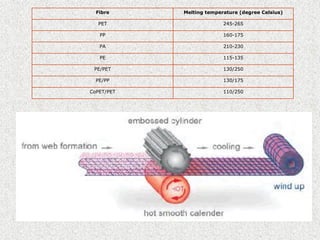
Thermal bonding
It is known that the fibres in the webs can be bonded thermally in order to have
sufficient resistance to mechanical deformation. The basic concept of thermal
bonding was introduced by Reed in 1942
Principle of Thermal Bonding
The formation of a bond during thermal bonding follows in sequence through
three critical steps:
1) Heating the web to partially melt the crystalline region,
2) Repetition of the newly released chain segments across the fibre-fibre interface,
and
3) Subsequent cooling of the web to re-solidify it and to trap the chain segments
that diffused across the fibre-fibre interface.
➢ Thermal bonding is otherwise termed as cohesion bonding.
➢ This type of bonding is completed under the application of heat.
➢ The two sub categories include (i) calendaring and (ii) air thermal
bonding.
➢ This classification is based on the difference in melting point of matrix web
materials.
➢ Temperature is applied to fuse the matrix web fibres.
➢ Hence, formation of bonding occurs between reinforced web and matrix
web.
Fibre Melting temperature (degree Celsius)
PET 245-265
PP 160-175
PA 210-230
PE 115-135
PE/PET 130/250
PE/PP 130/175
CoPET/PET 110/250
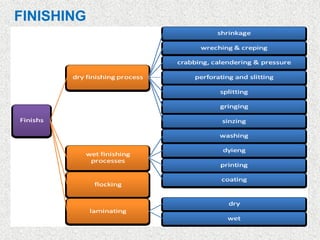
FINISHING OF NONWOVEN
FINISHING
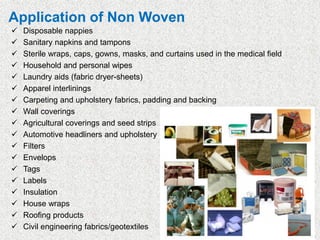
Application of Non Woven
✓ Disposable nappies
✓ Sanitary napkins and tampons
✓ Sterile wraps, caps, gowns, masks, and curtains used in the medical field
✓ Household and personal wipes
✓ Laundry aids (fabric dryer-sheets)
✓ Apparel interlinings
✓ Carpeting and upholstery fabrics, padding and backing
✓ Wall coverings
✓ Agricultural coverings and seed strips
✓ Automotive headliners and upholstery
✓ Filters
✓ Envelops
✓ Tags
✓ Labels
✓ Insulation
✓ House wraps
✓ Roofing products
✓ Civil engineering fabrics/geotextiles
✓ As conclusion, there is lot of development in nonwoven area.
✓ For example is an innovation about the additives from mineral sources that will
be apply in nonwoven production.
✓ There is a need for more study of the economic factors related to the
manufacture of nonwovens.
✓ Regarding increased usage of nonwovens, it seems that the prospects are
quite positive, especially in their expanded use in the disposable and flushable
technical market segments.
Conclusion
References
i. Batra, S., Pourdeyhimi, B., Shiffler, D., TT 305 Fibre Web and Nonwoven Production, Desk
Copy, North Carolina State University, USA, 2004.
ii. Neckar, B. and Das, D., Theory of structure and mechanics of fibrous assemblies, Woodhead
Publishing India Ltd., New Delhi, 2011.
iii. Simmonds, G. E., Bomberger, J. D., Bryner, M. A., Designing nonwovens to meet pore size
specifications, Journal of Engineered Fibres and Fabrics 2 (1), 1-15, 2007.
iv. K allmes, O. and Corte, H., TAPPI 43 (9), 737-752, 1960.
v. [1] Morton W. E. and Hearle, J. W. S., Physical properties of textile fibers, Woodhead Publishing
Ltd., UK, 2008.
vi. [2] Albrecht, W., Fuchs, H., and Kittelmann, W., Nonwoven fabrics: Raw materials, manufacture,
applications, characteristics, testing processes, Wiley-VCH, 2002 (Edited).
vii. [3] Russel, S. J., Handbook of nonwovens, Woodhead Publishing Ltd., 2006 (Edited).
viii. [4] Vaidya, N., Pourdeyhimi, B., Shiffler, D., The manufacturing of wet-laid hydroentangled glass
fibre composites: Preliminary results, International Journal of Nonwovens 2003, 55-59.
THANKS
?

Non woven Process

  • 1.
    Non-Woven Process By Mahesh PratapDubey Contact @ +91-9453374288 anmpdubey@gmail.com
  • 2.
    Non-Woven Fabrics Contents ❑ Introduction ❑Classification ❑ Productions ❑ Application ❑ Conclusion ❑ Reference
  • 3.
    Introduction ➢ Nonwovens areknown as engineered fabrics. They are created with a view to targeted structure and properties by applying a set of scientific principles for a variety of applications. ➢ Nonwovens are manufactured by high-speed and low-cost processes. As compared to the traditional woven and knitting technology, a larger volume of materials can be produced at a lower cost by using nonwoven technology. ➢ The manufacturing principles of nonwovens are manifested in a unique way based on the technologies of creation of textiles, papers, and plastics as a result, the structure and properties of nonwovens resemble, to a great extent, to those of three materials.
  • 4.
    Definitions of nonwovens Nonwovensare defined in many ways by different standards and different associations. They are stated below:- As per ISO 9092, nonwoven is defined as “manufactured sheet, web or batt of directionally or randomly oriented fibers, bonded by friction, and/or cohesion and/or adhesion, excluding paper and products which are woven, knitted, tufted, stitch-bonded incorporating binding yarns or filaments or felted by wet-milling, whether or not additionally needled. The fibers may be of natural or man-made origin. They may be staple or continuous filaments or be formed in situ. ASTM prefers to define nonwoven as “a textile structure produced by bonding or interlocking of fibers, or both, accomplished by mechanical, chemical, thermal, or solvent means, and combinations thereof.
  • 5.
    Definition Contd. In resentyears EDANA (The European Disposables and Nonwovens Association)- Adopted the ISO 9092 definition of nonwoven. INDA (The North America’s Association of the Nonwoven Fabrics Industry).- “Nonwoven fabrics are broadly defined as sheet or web structures bonded together by entangling fibre or filaments (and by perforating films) mechanically, thermally or chemically. They are flat, porous sheets that are made directly from separate fibres or from molten plastic or plastic film. They are not made by weaving or knitting and do not require converting the fibres to yarn.”
  • 6.
  • 7.
  • 8.
    Production Process Nonwovens: Howare they created? Let us take that the nonwoven manufacturing technology that produces fibre-based nonwovens generally consists of four basic nonwoven processes namely, fibre preparation process, web formation process, web bonding process and finishing process. A brief summary of the nonwoven processes is illustrated in Figure.
  • 9.
  • 10.
    Fibre Preparation Process Thefibre preparation process prepares fibres for web formation process. It includes fibre opening and mixing and fibre feeding to carding machine. The most natural fibers used to produce nonwovens are obtained directly in Staple form from the nature, but manmade fibers are produced in filament form. Thus manmade fibers are needed to be cut into the staple fibers. The preparatory process of manmade fibers includes following steps:- OPENING, CLEANING, MIXING & BLENDING The different machines used for opening, cleaning and mixing are as mentioned in sequence as follows:- ➢ Bale opener or bale pluckers ➢ Carding willow ➢ Cleaning machine ( mono cylinder or dicylinder) ➢ Oiling system ➢ Blending machine (uni-mix, uni-blend, mix master, etc.) ➢ Fine opener or line opener.
  • 11.
    Carding • This processfollows the initial opening of the raw material. It is particularly important process because it is responsible for the separating, still further, the tufts of the fiber fed into the machine and reducing them to an individual fiber state. The individualization of fibers allows the removal of the much of the impurities. Finally the carding machine reduces the overall thickness of the material into the form of light web. • Carding is carried out by passing the entangled fibers between the closely spaced cloth surfaces (surface covered with sharp metal teeth). The surfaces move at relative speed to each other and the fibers gets disentangled. The distance between two surfaces decides the degree of opening and cleaning. The action carried out between the clothed surfaces is also known as “carding action”. • The carding action is carried out on machine known as “card”. There are mainly two types of cards viz. roller and clearer card (for medium and long staple fibers) and the revolving flat card (for short staple fibers up to 5-65mm).
  • 12.
  • 13.
  • 14.
    ➢ Increasing theweb mass ➢ Increasing the web width ➢ Determining the web strength in the length and cross directions ➢ Improving the end product quality Tasks of the web-laying machine
  • 15.
    Orientation of fibresin web The orientation of fibres in web can be in three directions; a) Parallel laid b) Cross laid c) Random laid
  • 16.
    Parallel-laid webs • Inthe parallel-laid webs, the fibres are laid in a lengthwise orientation. • This implies that this type of web has greater strength in the lengthwise direction than the transverse direction. • According to the demand of mass and fibre type, the parallel-laid web permits the repetition of fibrous webs. • The number of layers in the web decides the number of cards required. Figure 5 principle of dry laid web formation
  • 17.
    Cross-laid webs ➢ Cross-laidwebs are generally made by cross lapper which takes the web from the card at a specific rate. ➢ The cross-laid web is laid in several layers with an oscillator carriage on a take-off belt by means of a conveyor belt arrangement. ➢ Here the take-off belt moves at right angles to the carriage discretion. The cross-laid web has major two purposes: ✓ To obtain batt with higher basis weight than that of card web ✓ To obtain batt with higher width than that of card web ✓ To obtain batt with fibers preferentially oriented along the transverse direction of it ✓ To obtain batt with layered structure
  • 18.
    (Figure Illustrates theJigger lattice cross laying) (Figure cross-lapper)
  • 19.
    ➢ Random Fibreorientation in the web is achieved by incorporating randomizing rolls in the card. ➢ Random rolls are generally located between the main cylinder & doffer. ➢ The configuration, diameter, & position of the randomizing rolls are different for the different manufacturer. Random-laid
  • 20.
    Air laid process ➢Air laid process is nonwoven web forming process in which the web of fibres is produced by the dispersion of fibres ranging from 1-4 mm. ➢ Initially, the fibres are dispersed into a fast moving air stream and then transported towards the moving belt or perforated drum under pressure or vacuum. ➢ Finally, the fibres condense on the surface of moving belt or drum in order to create web
  • 21.
    Wet laid process ➢In this process, the fibres to be utilized are blended with water to form water /fibre slurry. ➢ Then, the slurry is deposited on the forming belt. ➢ Finally, the excess water is removed from fibre to produce uniform sheet (web). With due course of further processing, sheets are bonded and dried. It is modified version of papermaking process. ➢ It is used to produce structures with textile-fabric characteristics, primarily flexibility and strength. ➢ This process offer high production rate (up to 1000 m/min). ➢ Any natural or synthetic long fibre can be used, Cotton linters, manila hemp and cellulose staple fibre are frequently used fibre in wet laid process
  • 22.
    Spun laid web Thisparticular procedure which is also called spun bond web technique is carried out in two stages; (i) Melting of polymer granules and extrusion of molten polymer via extrusion technique for generation of polymer strands; subsequently, strands are drawn by cold or hot drawing to get continuous fibre. And (ii) Deposition of the resultant continuous fibres on a conveyor in order to obtain uniform web. The nonwoven fabrics produced by this technique offers greater strength and less flexibility ➢ These types of web are new class of web, which properties of web is found in between paper and woven fabrics. ➢ The weight of webs increase with increasing the number of layers. ➢ These types web show High strength-to-weight ratios compared to other nonwoven, woven, and knitted structures. ➢ This process is applied for getting nonwovens with greater strength, lightweight and flexible.
  • 23.
  • 24.
    Melt blown web ➢In melt blown web forming process, polymer granules which are low viscous in nature and molten polymer granules are drawn by a high velocity air stream through nozzle tip (extruder die). ➢ The drawing polymer is performed by drag force of air stream and gets converted into microfibres. ➢ The fine fibres formed are then solidified on the collector as web. ➢ The air temperature is fixed equal or slightly higher than the melting point of the polymer. ➢ Random fibre orientation, lower to moderate web strength, fine fibre diameter, high surface area for good insulation and filtration are main characteristics of melt blow web, Isotropic products are obtained through the melt blow process.
  • 25.
  • 26.
    Chemical Bonding ➢ Chemicalbonding is otherwise called to be adhesion bonding. ➢ This type of bonding involves powdered adhesives, foam and organic solvent solutions, polymer and copolymer based binders such as styrene/butadiene as well as vinyl acetate ethylene copolymers as the most commonly used bonding agents for creation of web.
  • 27.
    Some Common ChemicalBonding Print Bonding Spray Bonding Spray Bonding Saturation bonding
  • 28.
    Mechanical Bonding Needle punchingprocess Needle punching is a nonwoven process by which the fibres are mechanically entangled to produce a nonwoven fabric by repeated penetration of barbed needles through a preformed dry fibrous web. The machine which accomplishes this process is known as needle loom. Figure displays the schematic diagram of a needle loom.
  • 29.
    Working • The fibrousweb, which is unbonded and therefore thick and voluminous, is fed to the machine by a pair of feed rollers. It then goes to the working zone of the machine and passes in-between a pair of perforated bed plates. The needles are arranged in a needle board in width-wise rows. The needle board is mounted on a beam which is given an up and down reciprocating motion by means of an eccentric crank mechanism. In the down stroke mode, the needles descend through the perforations of the top bed plate, through the web, and through the perforations of the bottom bed plate. During the upstroke, the barbed needles withdraw upwards and the bed plate strips the web off the needles. As a result, the fibres are mechanically interlocked, thereby providing the mechanical strength. The needle bonded nonwoven is delivered by a pair of delivery rollers.
  • 30.
    Hydroentanglement process Principle Hydro entanglement,spunlacing, hydraulic entanglement, and water jet needling are synonymous terms describing the process of mechanically bonding the fibres in a web by means of high energy water jets. The machine which accomplishes this is known as hydro entanglement or spunlace machine. The basic elements of this machine are shown in Figure.
  • 31.
    Working A series ofmultiple high pressure columnar water jets is produced by pumping water through a series of fine nozzles in a jet strip clamped into an injector (manifold). The high velocity water jets are directed to the unbonded web, which is supported on a moving perforated conveyor. The conveyor may have a flat bed surface or cylindrical surface. The entanglement among the fibres is introduced by the combined effects of the incident water jets and the turbulent water created in the web which intertwines neighbouring fibres. The conveyor sleeve being permeable enables most of the de-energised water to be drawn into the vacuum box for recycling and reuse.
  • 32.
    Thermal bonding It isknown that the fibres in the webs can be bonded thermally in order to have sufficient resistance to mechanical deformation. The basic concept of thermal bonding was introduced by Reed in 1942 Principle of Thermal Bonding The formation of a bond during thermal bonding follows in sequence through three critical steps: 1) Heating the web to partially melt the crystalline region, 2) Repetition of the newly released chain segments across the fibre-fibre interface, and 3) Subsequent cooling of the web to re-solidify it and to trap the chain segments that diffused across the fibre-fibre interface.
  • 33.
    ➢ Thermal bondingis otherwise termed as cohesion bonding. ➢ This type of bonding is completed under the application of heat. ➢ The two sub categories include (i) calendaring and (ii) air thermal bonding. ➢ This classification is based on the difference in melting point of matrix web materials. ➢ Temperature is applied to fuse the matrix web fibres. ➢ Hence, formation of bonding occurs between reinforced web and matrix web.
  • 34.
    Fibre Melting temperature(degree Celsius) PET 245-265 PP 160-175 PA 210-230 PE 115-135 PE/PET 130/250 PE/PP 130/175 CoPET/PET 110/250
  • 35.
  • 36.
  • 37.
    Application of NonWoven ✓ Disposable nappies ✓ Sanitary napkins and tampons ✓ Sterile wraps, caps, gowns, masks, and curtains used in the medical field ✓ Household and personal wipes ✓ Laundry aids (fabric dryer-sheets) ✓ Apparel interlinings ✓ Carpeting and upholstery fabrics, padding and backing ✓ Wall coverings ✓ Agricultural coverings and seed strips ✓ Automotive headliners and upholstery ✓ Filters ✓ Envelops ✓ Tags ✓ Labels ✓ Insulation ✓ House wraps ✓ Roofing products ✓ Civil engineering fabrics/geotextiles
  • 38.
    ✓ As conclusion,there is lot of development in nonwoven area. ✓ For example is an innovation about the additives from mineral sources that will be apply in nonwoven production. ✓ There is a need for more study of the economic factors related to the manufacture of nonwovens. ✓ Regarding increased usage of nonwovens, it seems that the prospects are quite positive, especially in their expanded use in the disposable and flushable technical market segments. Conclusion
  • 39.
    References i. Batra, S.,Pourdeyhimi, B., Shiffler, D., TT 305 Fibre Web and Nonwoven Production, Desk Copy, North Carolina State University, USA, 2004. ii. Neckar, B. and Das, D., Theory of structure and mechanics of fibrous assemblies, Woodhead Publishing India Ltd., New Delhi, 2011. iii. Simmonds, G. E., Bomberger, J. D., Bryner, M. A., Designing nonwovens to meet pore size specifications, Journal of Engineered Fibres and Fabrics 2 (1), 1-15, 2007. iv. K allmes, O. and Corte, H., TAPPI 43 (9), 737-752, 1960. v. [1] Morton W. E. and Hearle, J. W. S., Physical properties of textile fibers, Woodhead Publishing Ltd., UK, 2008. vi. [2] Albrecht, W., Fuchs, H., and Kittelmann, W., Nonwoven fabrics: Raw materials, manufacture, applications, characteristics, testing processes, Wiley-VCH, 2002 (Edited). vii. [3] Russel, S. J., Handbook of nonwovens, Woodhead Publishing Ltd., 2006 (Edited). viii. [4] Vaidya, N., Pourdeyhimi, B., Shiffler, D., The manufacturing of wet-laid hydroentangled glass fibre composites: Preliminary results, International Journal of Nonwovens 2003, 55-59.
  • 40.