Classification of Textiles
Textile
• Textile is a process of converting fiber or
polymer into sheet.
• Earlier it was just full fill the basic needs of
human being
• To protect from weather
• Then converted into 3d structures
• Now it goes beyond in clothing science
(comfort, vanity, functional)
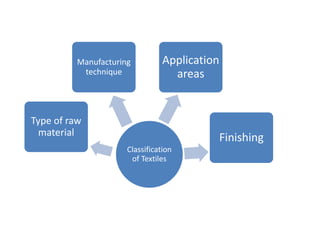
Classification
of Textiles
Type of raw
material
Manufacturing
technique
Application
areas
Finishing
Origin of Fibre
Two origins
Natural resources( non Thermo)
Man Made fibers(thermo plastic, thermo set)
Natural fibers there are limitation in properties
and having more variations
Manmade fibers produced according to the
requirement/ end use
Natural fibers
According to the source
• Plants (seeds, stem, leaf & seed)
• Animal (Hair, saliva)
• Mineral (basalt)
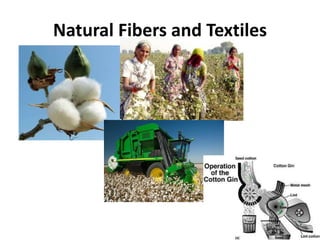
Natural Fibers and Textiles
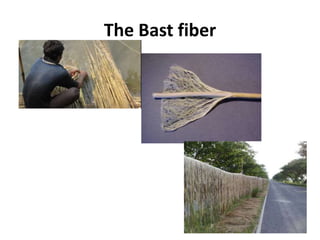
The Bast fiber
•
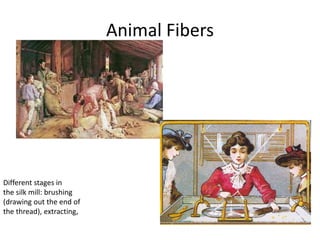
Animal Fibers
Different stages in
the silk mill: brushing
(drawing out the end of
the thread), extracting,
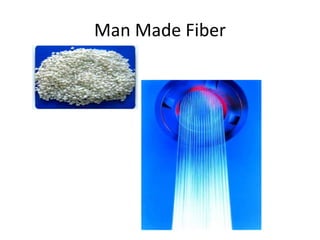
Man Made Fiber
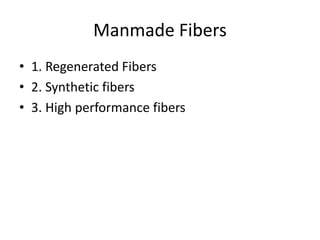
Manmade Fibers
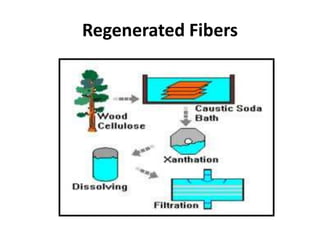
• 1. Regenerated Fibers
• 2. Synthetic fibers
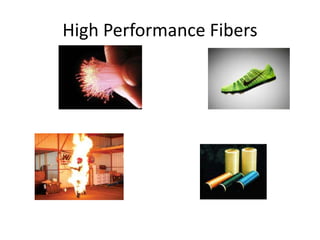
• 3. High performance fibers
Regenerated Fibers
High Performance Fibers
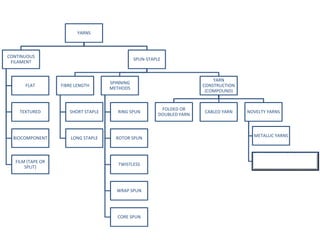
YARNS
CONTINUOUS
FILAMENT
FLAT
TEXTURED
BIOCOMPONENT
FILM (TAPE OR
SPLIT)
SPUN-STAPLE
FIBRE LENGTH
SHORT STAPLE
LONG STAPLE
SPINNING
METHODS
RING SPUN
ROTOR SPUN
TWISTLESS
WRAP SPUN
CORE SPUN
YARN
CONSTRUCTION
(COMPOUND)
FOLDED OR
DOUBLED YARN
CABLED YARN NOVELTY YARNS
METALLIC YARNS
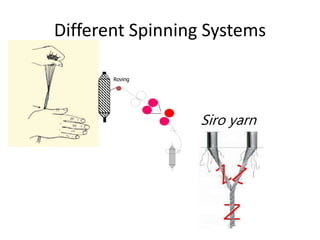
Different Spinning Systems
Roving
Siro yarn
Ring Yarns
• Ring Yarns further classified as
1.Warp yarn
More even and Highly twisted for high strength
2.Hosiery yarn
Soft bulkier yarn , Less twist
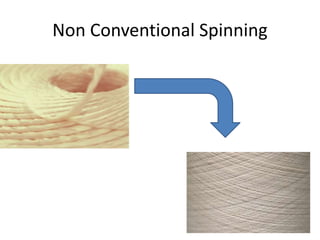
Non Conventional Spinning
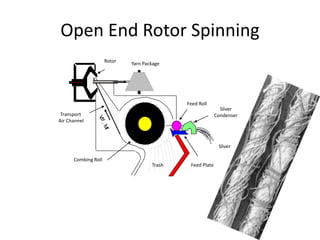
Open End Rotor Spinning
Transport
Air Channel
Rotor
Yarn Package
Feed Roll
Sliver
Condenser
Sliver
Feed Plate
Trash
Combing Roll
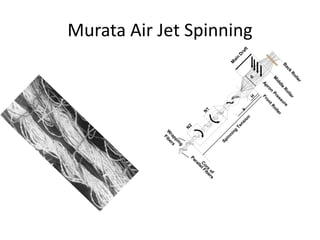
Murata Air Jet Spinning
b
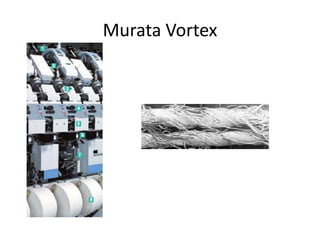
Murata Vortex
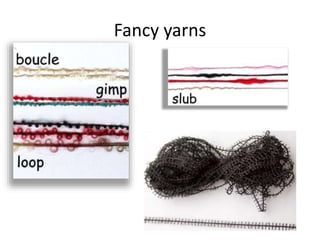
Fancy yarns
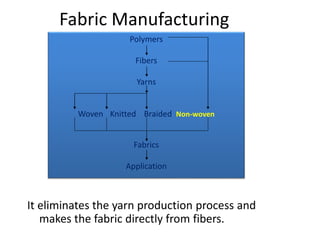
Fabric Manufacturing
It eliminates the yarn production process and
makes the fabric directly from fibers.
Polymers
Fibers
Yarns
Woven Knitted Braided Non-woven
Fabrics
Application
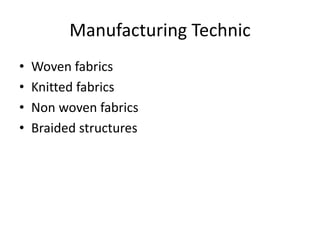
Manufacturing Technic
• Woven fabrics
• Knitted fabrics
• Non woven fabrics
• Braided structures
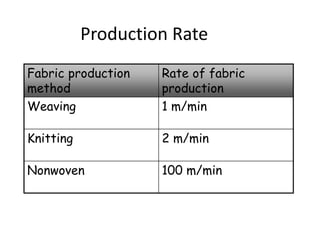
Production Rate
Fabric production
method
Rate of fabric
production
Weaving 1 m/min
Knitting 2 m/min
Nonwoven 100 m/min
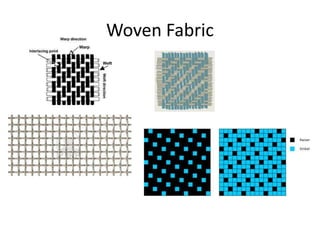
Woven Fabric
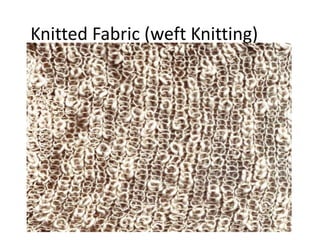
Knitted Fabric (weft Knitting)
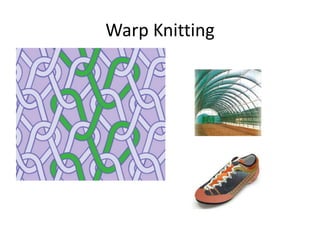
Warp Knitting
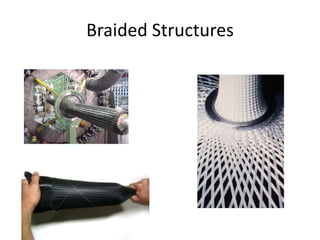
Braided Structures
Nonwoven Fabric
There are normally two steps for
making non-woven products.
1. Web formation
2. Bonding systems
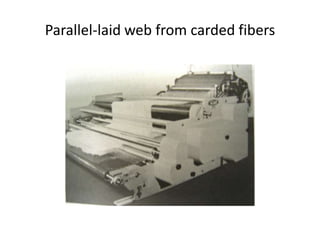
Parallel-laid web from carded fibers
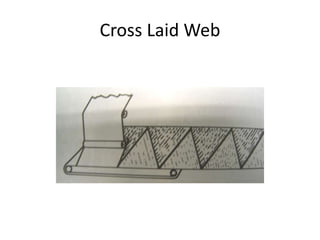
Cross Laid Web
Parellel laid /cross laid web
• Card webs are arranged one over another in a
parellel manner
• Strength is high in length wise direction than
cross direction
• By means of cross laper, delivery of web
turned to right angle
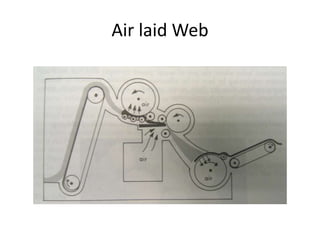
Air laid Web
Airlaid web wet laid
• Opened fibers are suspended in air and
deposited on a perforated sheet or drum
• Fibers dispersed in water and deposited on a
perforated felt and drain (Paper, Tea bag
technic)
Types of Bonding
– Needled felts
– Adhesives
– Heat bonding
– Stitch bonding
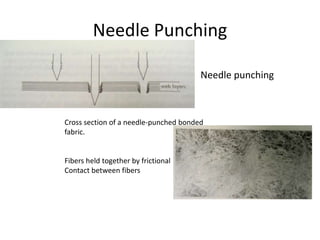
Needle Punching
Needle punching
Cross section of a needle-punched bonded
fabric.
Fibers held together by frictional
Contact between fibers
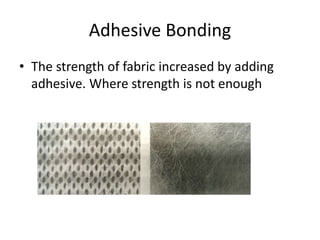
Adhesive Bonding
• The strength of fabric increased by adding
adhesive. Where strength is not enough
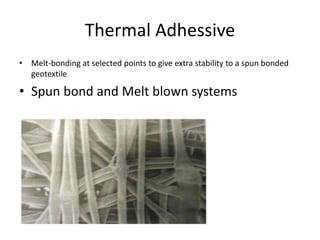
Thermal Adhessive
• Melt-bonding at selected points to give extra stability to a spun bonded
geotextile
• Spun bond and Melt blown systems
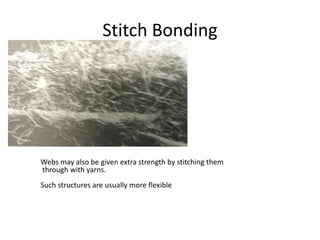
Stitch Bonding
.
Webs may also be given extra strength by stitching them
through with yarns.
Such structures are usually more flexible
Webs from filament
• It is possible to tangle filaments together to
form a web. Such webs are much stronger
than web made from staple fibres.
• The thermoplastic filaments are welded to
each other to form a strong fabric suitable for
curtains & tablecloths.
• Sometimes, the filaments are textured before
web formation. This allows greater
extensibility of the fabric in use.
Application of Textiles
• Domestic applications
• Shirting
• Intimate fabrics
• Vanity fabrics
• Technical Textiles
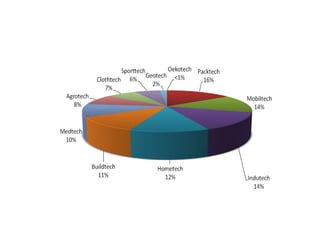
14 groups and 128 applications
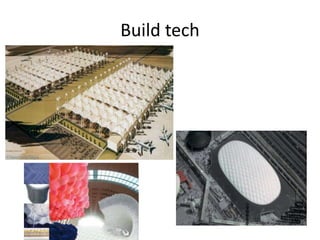
Build tech
GEO synthetics
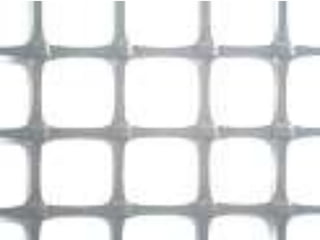
• Geogrids - reinforce slopes beneath the waste, walls, cover soils
above geomembranes;
• Geonets - in-plane drainage;
• Geomembranes – a barrier to liquids, gases and/or vapors and
landfill caps;
• Geocomposites –for separation, filtration or drainage;
• Geosynthetic clay liners (GCLs) - an infiltration/hydraulic barrier;
used also for mine rehabilitation, tunnels, secondary containment
• Geopipes - landfill applications to facilitate collection and rapid
drainage of the leachate to a sump and removal system;
• Geotextiles - filtration purpose or as cushion to protect the
geomembrane from puncture.
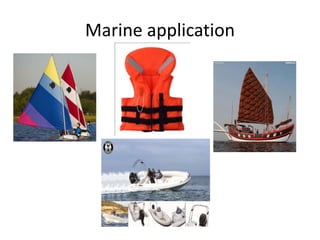
Marine application
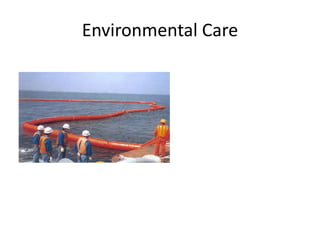
Environmental Care
Finishing of Fabrics
• General surface finishes (mechanical finishes,
chemical finishes)
• Functional Finishes
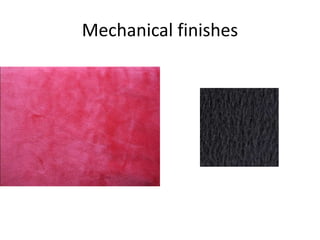
Mechanical finishes
ffffffCh
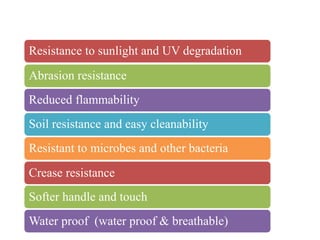
Resistance to sunlight and UV degradation
Abrasion resistance
Reduced flammability
Soil resistance and easy cleanability
Resistant to microbes and other bacteria
Crease resistance
Softer handle and touch
Water proof (water proof & breathable)
ffffff
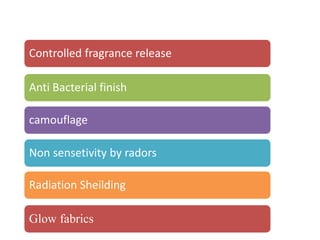
Controlled fragrance release
Anti Bacterial finish
camouflage
Non sensetivity by radors
Radiation Sheilding
Glow fabrics
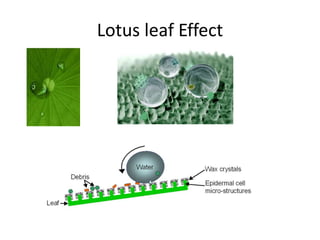
Lotus leaf Effect
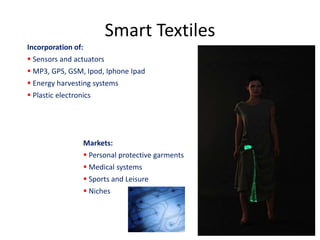
Smart Textiles
Incorporation of:
 Sensors and actuators
 MP3, GPS, GSM, Ipod, Iphone Ipad
 Energy harvesting systems
 Plastic electronics
Markets:
 Personal protective garments
 Medical systems
 Sports and Leisure
 Niches

Classification of Textiles.pptx