RESEARCH METHOD
in
Psychology
AMAN DHANDA
(S-RAES)
24/03/2020 1AMAN DHANDA (AEROSPACE ENGINEERING)
Case Study
It is an investigation contemporary cases for purposes of illumination and
understanding.
The case study method often involves simply observing what happens to, or
reconstructing ‘the case history’ of a single participant or group of individuals (such as a
school class or a specific social group), i.e. the idiographic approach. Case studies allow
a researcher to investigate a topic in far more detail than might be possible if they were
trying to deal with many research participants (nomothetic approach) with the aim of
‘averaging’.
Freud (1909a, 1909b) conducted very detailed investigations into the private lives of his
patients to both understand and help them overcome their illnesses. Even today case
histories are one of the main methods of investigation in abnormal psychology and
psychiatry.
This makes it clear that the case study is a method that should only be used by a
psychologist, therapist or psychiatrist, i.e. someone with a professional qualification.
24/03/2020 2AMAN DHANDA (AEROSPACE ENGINEERING)
Case Study
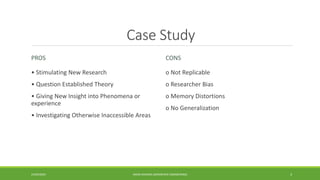
PROS
• Stimulating New Research
• Question Established Theory
• Giving New Insight into Phenomena or
experience
• Investigating Otherwise Inaccessible Areas
CONS
o Not Replicable
o Researcher Bias
o Memory Distortions
o No Generalization
24/03/2020 3AMAN DHANDA (AEROSPACE ENGINEERING)
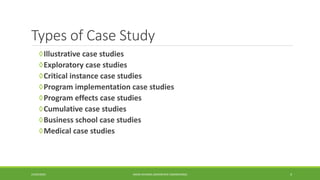
Types of Case Study
◊Illustrative case studies
◊Exploratory case studies
◊Critical instance case studies
◊Program implementation case studies
◊Program effects case studies
◊Cumulative case studies
◊Business school case studies
◊Medical case studies
24/03/2020 AMAN DHANDA (AEROSPACE ENGINEERING) 4
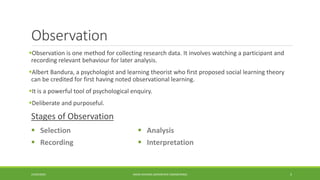
Observation
Observation is one method for collecting research data. It involves watching a participant and
recording relevant behaviour for later analysis.
Albert Bandura, a psychologist and learning theorist who first proposed social learning theory
can be credited for first having noted observational learning.
It is a powerful tool of psychological enquiry.
Deliberate and purposeful.
Stages of Observation
 Selection  Analysis
 Recording  Interpretation
24/03/2020 5AMAN DHANDA (AEROSPACE ENGINEERING)
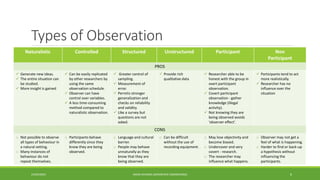
Types of Observation
Naturalistic Controlled Structured Unstructured Participant Non
Participant
PROS
 Generate new ideas.
 The entire situation can
be studied.
 More insight is gained
 Can be easily replicated
by other researchers by
using the same
observation schedule.
 Observer can have
control over variables.
 A less time-consuming
method compared to
naturalistic observation.
 Greater control of
sampling.
 Measurement of
error.
 Permits stronger
generalization and
checks on reliability
and validity.
 Like a survey but
questions are not
asked.
 Provide rich
qualitative data
 Researcher able to be
honest with the group in
overt participant
observation.
 Covert participant
observation - gather
knowledge (illegal
activity).
 Not knowing they are
being observed avoids
‘observer effect’.
 Participants tend to act
more realistically.
 Researcher has no
influence over the
situation
CONS
o Not possible to observe
all types of behaviour in
a natural setting.
o Many instances of
behaviour do not
repeat themselves.
o Participants behave
differently since they
know they are being
observed.
o Language and cultural
barrier.
o People may behave
unnaturally as they
know that they are
being observed.
o Can be difficult
without the use of
recording equipment.
o May lose objectivity and
become biased.
o Undercover and very
covert - research.
o The researcher may
influence what happens.
o Observer may not get a
feel of what is happening.
o Harder to find or back-up
a hypothesis without
influencing the
participants.
24/03/2020 6AMAN DHANDA (AEROSPACE ENGINEERING)
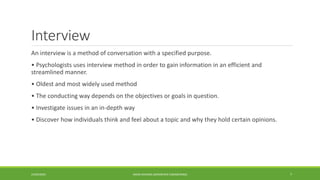
Interview
An interview is a method of conversation with a specified purpose.
• Psychologists uses interview method in order to gain information in an efficient and
streamlined manner.
• Oldest and most widely used method
• The conducting way depends on the objectives or goals in question.
• Investigate issues in an in-depth way
• Discover how individuals think and feel about a topic and why they hold certain opinions.
24/03/2020 7AMAN DHANDA (AEROSPACE ENGINEERING)
The Interviewer Effect
An interview is a social interaction the appearance or behaviour of the interviewer may
influence the answers of the respondent. This is a problem as it can bias the results of the study
and make them invalid.
For example, the gender, ethnicity, body language, age, and social status of the interview can all
create an interviewer effect.
For example, if a researcher was investigating sexism amongst males, would a female interview
be preferable than a male? It is possible that if a female interviewer was used male participants
may lie (i.e. pretend they are not sexist) to impress the interview, thus creating an interviewer
effect.
24/03/2020 AMAN DHANDA (AEROSPACE ENGINEERING) 8
MERITS
• Useful to obtain detailed information about
personal feelings, perceptions and opinions
• Usually achieve a high response rate
• Respondents' own words are recorded
• Interviewees are not influenced by others
• Enable teacher to tackle everyday
classroom problems
• Superior data collecting device
• Creates friendly atmosphere.
DEMERITS
oThis method is very time-consuming for
setting up, interviewing, transcribing,
analyzing, feedback, reporting.
oIt can be costly.
oDifferent interviewers may understand and
transcribe interviews in different ways.
oPreplanning is important i.e. to know who
you are going to interview, when and
where.
oIt is subjective and artificial.
oInterpretation is difficult.
24/03/2020 9AMAN DHANDA (AEROSPACE ENGINEERING)
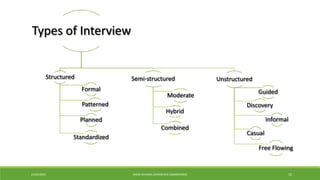
Types of Interview
Structured
Formal
Patterned
Planned
Standardized
Semi-structured
Moderate
Hybrid
Combined
Unstructured
Guided
Discovery
Informal
Casual
Free Flowing
24/03/2020 10AMAN DHANDA (AEROSPACE ENGINEERING)
Structured InterviewA structured interview isatype of interview in which the interviewer asksa set of predetermined questions.Instructured interviews, questionsare planned and
created in advance,which meansthat allcandidatesare askedthe samequestionsinthe sameorder. It useshighly systematizedtechniques of recording. It isa
method of quantitative research usedfor the purpose of the survey.
STRENGTHS
± Structured interviews have same questions for all, it’s easy to
compare their answers
± Evaluate candidates in a most objective and fair way
± Structured interviews are more legally defensible
± Can reach a large sample
± Can ensure questions are fully understood
± Pre-developed system or guide to check the results
± Easy to replicate, as a fixed set of closed questions are used
± Easy to test for reliability
± Can take place within a short amount of time
± Allows generalization of results
LIMITATION
± Structure interviews are not flexible. This means new
questions cannot be asked during the interview
± The answers from structured interviews lack detail
± Restrictive questioning leads to restrictive answers
± Structured interviews are harder and more complicated to
develop
± Before giving questions, we must write them, test them and
make sure interviewers stick to them
± Interview questions may be leaking out
± Cold and impersonalized
± Harder to provide an excellent candidate experience
24/03/2020 AMAN DHANDA (AEROSPACE ENGINEERING) 11
Semi-structured InterviewsAsemi-structuredinterviewisatypeof interviewinwhichtheinterviewerasksonlyafewpredeterminedquestionswhiletherestof thequestionsarenot planned.Insemi-
structuredinterviews,somequestionsarepredeterminedandaskedallcandidates,whileothersarisespontaneouslyinafree-flowingconversation. Open –endedquestionswith
answerssolicitedinwriting-typicallyintheforof shortessays.Respondentsarefreetowriteasmuchasoraslittleastheychoose.It hasageneralsetof questions,but theinterview
flowslikeconversationandtopicsarecoveredastheycomeup.
STRENGTH
± Secure objective comparison of candidates
± More personalized and spontaneous approach that allows
exploration of interesting points in a specific candidate.
± Less prone to interviewer’s bias.
± More information can be explored.
± Needed data is collected.
± Interviewer and the interviewee create the interview
together.
± Flexibility to follow up interviewee’s responses ad
interests.
± More detailed information.
± Relaxed atmosphere to collect data.
LIMITATION
± Spontaneous questioning makes answers difficult to
evaluate
± The outcome largely depend on the skill of the interviewer
± Highly time-consuming process
± Very expensive
± Sees to be unreliable
± Difficult to analyze the relevance of answers
± Some of the information may not be revealed
± Needs preparation
± Semi-structured interviews are less objective
± Legally harder to defend.
24/03/2020 AMAN DHANDA (AEROSPACE ENGINEERING) 12
Unstructured InterviewsA type of interview in which the interviewer asksquestionswhich are not prepared in advance.In unstructured interviews, questionsarisespontaneously ina free-
flowing conversation,which means that different candidatesare askeddifferent questions.Asthe interview isunplanned,ithas aninformal approach where a
friendly conversationtakes placebetween the interviewer and interviewee. They will contain open-ended questionsthat can beasked inany order.
STRENGTHS
± Personalized approach
± More casual and help candidates relax and feel more
comfortable during the interview.
± Observing direct behavior
± Allows control of extraneous variable
± Reliability of results by repetitive study
± Try to establish rapport ad trust
± Gently guide discussion towards goal
± Explorative and qualitative studies
± They have increased validity
LIMITATION
± Time consuming
± Employing and training interviewers is expensive
± Control can effect behavior
± Not possible to know intentions behind the behavior
± Unable to produce data a whole
± Information cannot be compared
± Analysis will be difficult
24/03/2020 AMAN DHANDA (AEROSPACE ENGINEERING) 13
Design of Interviews
 Gender and Age
This can have a big effect on respondent's answer, particularly on person issues.
 Personal characteristics
Some people are easier to get on with than others. Also, the accent and appearance (e.g. clothing) of
the interviewer can influence the rapport between the interviewer and interviewee.
 Ethnicity
People have difficulty interviewing people from a different ethnic group.
24/03/2020 AMAN DHANDA (AEROSPACE ENGINEERING) 14
THANK YOU
AQ
24/03/2020 15AMAN DHANDA (AEROSPACE ENGINEERING)

Research method in psychology

  • 1.
  • 2.
    Case Study It isan investigation contemporary cases for purposes of illumination and understanding. The case study method often involves simply observing what happens to, or reconstructing ‘the case history’ of a single participant or group of individuals (such as a school class or a specific social group), i.e. the idiographic approach. Case studies allow a researcher to investigate a topic in far more detail than might be possible if they were trying to deal with many research participants (nomothetic approach) with the aim of ‘averaging’. Freud (1909a, 1909b) conducted very detailed investigations into the private lives of his patients to both understand and help them overcome their illnesses. Even today case histories are one of the main methods of investigation in abnormal psychology and psychiatry. This makes it clear that the case study is a method that should only be used by a psychologist, therapist or psychiatrist, i.e. someone with a professional qualification. 24/03/2020 2AMAN DHANDA (AEROSPACE ENGINEERING)
  • 3.
    Case Study PROS • StimulatingNew Research • Question Established Theory • Giving New Insight into Phenomena or experience • Investigating Otherwise Inaccessible Areas CONS o Not Replicable o Researcher Bias o Memory Distortions o No Generalization 24/03/2020 3AMAN DHANDA (AEROSPACE ENGINEERING)
  • 4.
    Types of CaseStudy ◊Illustrative case studies ◊Exploratory case studies ◊Critical instance case studies ◊Program implementation case studies ◊Program effects case studies ◊Cumulative case studies ◊Business school case studies ◊Medical case studies 24/03/2020 AMAN DHANDA (AEROSPACE ENGINEERING) 4
  • 5.
    Observation Observation is onemethod for collecting research data. It involves watching a participant and recording relevant behaviour for later analysis. Albert Bandura, a psychologist and learning theorist who first proposed social learning theory can be credited for first having noted observational learning. It is a powerful tool of psychological enquiry. Deliberate and purposeful. Stages of Observation  Selection  Analysis  Recording  Interpretation 24/03/2020 5AMAN DHANDA (AEROSPACE ENGINEERING)
  • 6.
    Types of Observation NaturalisticControlled Structured Unstructured Participant Non Participant PROS  Generate new ideas.  The entire situation can be studied.  More insight is gained  Can be easily replicated by other researchers by using the same observation schedule.  Observer can have control over variables.  A less time-consuming method compared to naturalistic observation.  Greater control of sampling.  Measurement of error.  Permits stronger generalization and checks on reliability and validity.  Like a survey but questions are not asked.  Provide rich qualitative data  Researcher able to be honest with the group in overt participant observation.  Covert participant observation - gather knowledge (illegal activity).  Not knowing they are being observed avoids ‘observer effect’.  Participants tend to act more realistically.  Researcher has no influence over the situation CONS o Not possible to observe all types of behaviour in a natural setting. o Many instances of behaviour do not repeat themselves. o Participants behave differently since they know they are being observed. o Language and cultural barrier. o People may behave unnaturally as they know that they are being observed. o Can be difficult without the use of recording equipment. o May lose objectivity and become biased. o Undercover and very covert - research. o The researcher may influence what happens. o Observer may not get a feel of what is happening. o Harder to find or back-up a hypothesis without influencing the participants. 24/03/2020 6AMAN DHANDA (AEROSPACE ENGINEERING)
  • 7.
    Interview An interview isa method of conversation with a specified purpose. • Psychologists uses interview method in order to gain information in an efficient and streamlined manner. • Oldest and most widely used method • The conducting way depends on the objectives or goals in question. • Investigate issues in an in-depth way • Discover how individuals think and feel about a topic and why they hold certain opinions. 24/03/2020 7AMAN DHANDA (AEROSPACE ENGINEERING)
  • 8.
    The Interviewer Effect Aninterview is a social interaction the appearance or behaviour of the interviewer may influence the answers of the respondent. This is a problem as it can bias the results of the study and make them invalid. For example, the gender, ethnicity, body language, age, and social status of the interview can all create an interviewer effect. For example, if a researcher was investigating sexism amongst males, would a female interview be preferable than a male? It is possible that if a female interviewer was used male participants may lie (i.e. pretend they are not sexist) to impress the interview, thus creating an interviewer effect. 24/03/2020 AMAN DHANDA (AEROSPACE ENGINEERING) 8
  • 9.
    MERITS • Useful toobtain detailed information about personal feelings, perceptions and opinions • Usually achieve a high response rate • Respondents' own words are recorded • Interviewees are not influenced by others • Enable teacher to tackle everyday classroom problems • Superior data collecting device • Creates friendly atmosphere. DEMERITS oThis method is very time-consuming for setting up, interviewing, transcribing, analyzing, feedback, reporting. oIt can be costly. oDifferent interviewers may understand and transcribe interviews in different ways. oPreplanning is important i.e. to know who you are going to interview, when and where. oIt is subjective and artificial. oInterpretation is difficult. 24/03/2020 9AMAN DHANDA (AEROSPACE ENGINEERING)
  • 10.
  • 11.
    Structured InterviewA structuredinterview isatype of interview in which the interviewer asksa set of predetermined questions.Instructured interviews, questionsare planned and created in advance,which meansthat allcandidatesare askedthe samequestionsinthe sameorder. It useshighly systematizedtechniques of recording. It isa method of quantitative research usedfor the purpose of the survey. STRENGTHS ± Structured interviews have same questions for all, it’s easy to compare their answers ± Evaluate candidates in a most objective and fair way ± Structured interviews are more legally defensible ± Can reach a large sample ± Can ensure questions are fully understood ± Pre-developed system or guide to check the results ± Easy to replicate, as a fixed set of closed questions are used ± Easy to test for reliability ± Can take place within a short amount of time ± Allows generalization of results LIMITATION ± Structure interviews are not flexible. This means new questions cannot be asked during the interview ± The answers from structured interviews lack detail ± Restrictive questioning leads to restrictive answers ± Structured interviews are harder and more complicated to develop ± Before giving questions, we must write them, test them and make sure interviewers stick to them ± Interview questions may be leaking out ± Cold and impersonalized ± Harder to provide an excellent candidate experience 24/03/2020 AMAN DHANDA (AEROSPACE ENGINEERING) 11
  • 12.
    Semi-structured InterviewsAsemi-structuredinterviewisatypeof interviewinwhichtheinterviewerasksonlyafewpredeterminedquestionswhiletherestofthequestionsarenot planned.Insemi- structuredinterviews,somequestionsarepredeterminedandaskedallcandidates,whileothersarisespontaneouslyinafree-flowingconversation. Open –endedquestionswith answerssolicitedinwriting-typicallyintheforof shortessays.Respondentsarefreetowriteasmuchasoraslittleastheychoose.It hasageneralsetof questions,but theinterview flowslikeconversationandtopicsarecoveredastheycomeup. STRENGTH ± Secure objective comparison of candidates ± More personalized and spontaneous approach that allows exploration of interesting points in a specific candidate. ± Less prone to interviewer’s bias. ± More information can be explored. ± Needed data is collected. ± Interviewer and the interviewee create the interview together. ± Flexibility to follow up interviewee’s responses ad interests. ± More detailed information. ± Relaxed atmosphere to collect data. LIMITATION ± Spontaneous questioning makes answers difficult to evaluate ± The outcome largely depend on the skill of the interviewer ± Highly time-consuming process ± Very expensive ± Sees to be unreliable ± Difficult to analyze the relevance of answers ± Some of the information may not be revealed ± Needs preparation ± Semi-structured interviews are less objective ± Legally harder to defend. 24/03/2020 AMAN DHANDA (AEROSPACE ENGINEERING) 12
  • 13.
    Unstructured InterviewsA typeof interview in which the interviewer asksquestionswhich are not prepared in advance.In unstructured interviews, questionsarisespontaneously ina free- flowing conversation,which means that different candidatesare askeddifferent questions.Asthe interview isunplanned,ithas aninformal approach where a friendly conversationtakes placebetween the interviewer and interviewee. They will contain open-ended questionsthat can beasked inany order. STRENGTHS ± Personalized approach ± More casual and help candidates relax and feel more comfortable during the interview. ± Observing direct behavior ± Allows control of extraneous variable ± Reliability of results by repetitive study ± Try to establish rapport ad trust ± Gently guide discussion towards goal ± Explorative and qualitative studies ± They have increased validity LIMITATION ± Time consuming ± Employing and training interviewers is expensive ± Control can effect behavior ± Not possible to know intentions behind the behavior ± Unable to produce data a whole ± Information cannot be compared ± Analysis will be difficult 24/03/2020 AMAN DHANDA (AEROSPACE ENGINEERING) 13
  • 14.
    Design of Interviews Gender and Age This can have a big effect on respondent's answer, particularly on person issues.  Personal characteristics Some people are easier to get on with than others. Also, the accent and appearance (e.g. clothing) of the interviewer can influence the rapport between the interviewer and interviewee.  Ethnicity People have difficulty interviewing people from a different ethnic group. 24/03/2020 AMAN DHANDA (AEROSPACE ENGINEERING) 14
  • 15.
    THANK YOU AQ 24/03/2020 15AMANDHANDA (AEROSPACE ENGINEERING)

Editor's Notes

  • #5 Illustrative case studies Illustrative case studies describe a domain; they use one or two instances to analyze a situation. This helps interpret other data, especially when researchers have reason to believe that readers know too little about a program. These case studies serve to make the unfamiliar familiar and give readers a common language about the topic. The chosen site should typify important variations and contain a small number of cases to sustain readers' interest. The presentation of illustrative case studies may involve some pitfalls. Such studies require presentation of in-depth information on each illustration; but the researcher may lack time on-site for in-depth examination. The most serious problem involves the selection of instances. The case(s) must adequately represent the situation or program. Where significant diversity exists, no single individual site may cover the field adequately.. Exploratory case studies Exploratory case studies condense the case study process: researchers may undertake them before implementing a large-scale investigation. Where considerable uncertainty exists about program operations, goals, and results, exploratory case studies help identify questions, select measurement constructs, and develop measures; they also serve to safeguard investment in larger studies. The greatest pitfall in the exploratory study involves premature conclusions: the findings may seem convincing enough for inappropriate release as conclusions. Other pitfalls include the tendency to extend the exploratory phase, and inadequate representation of diversity. Critical instance case studies Critical instance case studies examine one or a few sites for one of two purposes. A very frequent application involves the examination of a situation of unique interest, with little or no interest in generalizability. A second, rarer, application entails calling into question a highly generalized or universal assertion and testing it by examining one instance. This method particularly suits answering cause-and-effect questions about the instance of concern. Inadequate specification of the evaluation question forms the most serious pitfall in this type of study. Correct application of the critical instance case study crucially involves probing the underlying concerns in a request. Program implementation case studies Program implementation case studies help discern whether implementation complies with intent. These case studies may also prove useful when concern exists about implementation problems. Extensive, longitudinal reports of what has happened over time can set a context for interpreting a finding of implementation variability. In either case, researchers aim for generalization and must carefully negotiate the evaluation questions with their customer. Good program implementation case studies must invest enough time to obtain longitudinal data and breadth of information. They typically require multiple sites to answer program implementation questions; this imposes demands on training and supervision needed for quality control. The demands of data management, quality control, validation procedures, and analytic modelling (within site, cross-site, etc.) may lead to cutting too many corners to maintain quality. Program effects case studies Program effects case studies can determine the impact of programs and provide inferences about reasons for success or failure. As with program implementation case studies, the evaluation questions usually require generalizability and, for a highly diverse program, it may become difficult to answer the questions adequately and retain a manageable number of sites. But methodological solutions to this problem exist. One approach involves first conducting the case studies in sites chosen for their representativeness, then verifying these findings through examination of administrative data, prior reports, or a survey. Another solution involves using other methods first. After identifying findings of specific interest, researchers may then implement case studies in selected sites to maximize the usefulness of the information. Cumulative case studies Cumulative case studies aggregate information from several sites collected at different times. The cumulative case study can have a retrospective focus, collecting information across studies done in the past, or a prospective outlook, structuring a series of investigations for different times in the future. Retrospective cumulation allows generalization without cost and time of conducting numerous new case studies; prospective cumulation also allows generalization without unmanageably large numbers of cases in process at any one time. The techniques for ensuring enough comparability and quality and for aggregating the information constitute the "cumulative" part of the methodology. Features of the cumulative case study include the case survey method (used as a means of aggregating findings) and backfill techniques. The latter aid in retrospective cumulation as a means of obtaining information from authors that permits use of otherwise insufficiently detailed case studies. Opinions vary as to the credibility of cumulative case studies for answering program implementation and effects questions. One authority notes that publication biases may favor programs that seem to work, which could lead to a misleading positive view (Berger, 1983). Others raise concerns about problems in verifying the quality of the original data and analyses (Yin, 1989). Business school case studies Case studies have been used in graduate and undergraduate business education for nearly one hundred years. Business cases are historical descriptions of actual business situations. Typically, information is presented about a business firm's products, markets, competition, financial structure, sales volumes, management, employees and other factors affecting the firm's success. The length of a business case study may range from two or three pages to 30 pages, or more. Leading exponents of the case study method of instruction include the Harvard Business School, the Darden School (University of Virginia), the Tuck School (Dartmouth), Stanford University Business School, Ivey School (University of Western Ontario) and INSEAD (France and Singapore). Examples of widely used case studies are "Lincoln Electric" and "Google, Inc.," both published by the Harvard Business School. Students are expected to scrutinize the case study and prepare to discuss strategies and tactics that the firm should employ in the future. Three different methods have been used in business case teaching: (1) prepared case-specific questions to be answered by the student, (2) problem-solving analysis and (3) a generally applicable strategic planning approach. The first method listed above is used with short cases intended for undergraduate students. The underlying concept is that such students need specific guidance to be able to analyze case studies. The second method, initiated by the Harvard Business School is by far the most widely used method in MBA and executive development programs. The underlying concept is that with enough practice (hundreds of case analyses) students develop intuitive skills for analyzing and resolving complex business situations. Successful implementation of this method depends heavily on the skills of the discussion leader. Only a few teachers are able to become truly great case discussion leaders. Jim Erskine at the Ivey School is a prime example of such a teacher. The third method does not require students to analyze hundreds of cases. A strategic planning model is provided and students are instructed to apply the steps of the model to six to a dozen cases during a semester. This is sufficient to develop their ability to analyze a complex situation, generate a variety of possible strategies and to select the best ones. In effect, students learn a generally applicable approach to analyzing cases studies and real situations. This approach does not make any extraordinary demands on the artistic and dramatic talents of the teacher. Consequently most professors are capable of supervising application of this method. Medical case studies In medical science case studies are considered "Class V" evidence and are thus the least suggestive of all forms of medical evidence. Reference Yin, Robert K. (1989). Case Study Research: Design and Methods. Beverly Hills, CA: Sage. Berger, Michael A. "Studying Enrollment Decline (and Other Timely Issues) via the Case Survey." Educational Evaluation and Policy Analysis, 5:3 (1983), 307-317.
  • #6  Selection: Selecting a particular aspect of observation.  Recording: To keep an account about the observed aspect in writing or some other permanent form.  Analysis: Examining the element or structure of the observed aspects in detail.  Interpretation: Explaining the aspects of the observation or providing measurements.
  • #11 A structured interview is a type of interview in which the interviewer asks a set of predetermined questions. In structured interviews, questions are planned and created in advance, which means that all candidates are asked the same questions in the same order. It uses highly systematized techniques of recording. It is a method of quantitative research used for the purpose of the survey. Steps of structured interview Develop and write down interview questions Develop and write down a scale that will be used to grade candidates' answers. Print out your questions and bring them with you to the interview site. Take detailed notes of each candidate’s answers. Grade your candidate’s answers according to previously determined scale. Structured interview questions can be open-ended or closed-ended. Semi-structured interview is a type of interview in which the interviewer asks only a few predetermined questions while the rest of the questions are not planned. In semi-structured interviews, some questions are predetermined and asked all candidates, while others arise spontaneously in a free-flowing conversation. Open –ended questions with answers solicited in writing- typically in the for of short essays. Respondents are free to write as much as or as little as they choose It has a general set of questions, but the interview flows like conversation and topics are covered as they come up. Steps of Semi-structured interview Write down most important questions that you want to ask all the candidates. Develop a few conversation starters to explore specific interesting points from your candidate’s resume. Depending on your candidates' answers, ask follow up questions to gain a more in-depth understanding of their qualifications and motivation. Follow the natural flow of conversation and feel free to explore Unstructured interview is a type of interview in which the interviewer asks questions which are not prepared in advance. In unstructured interviews, questions arise spontaneously in a free-flowing conversation, which means that different candidates are asked different questions. As the interview is unplanned, it has an informal approach where a friendly conversation takes place between the interviewer and interviewee. They will contain open-ended questions that can be asked in any order.  Steps of unstructured interview Keep in mind interview’s purpose and the general experiences and qualities you are looking to assess in candidates. The goal is to gather and record important information about candidates. Make sure you have a focus Be flexible to proceed based on the candidate’s responses. Explore specific interesting points