Correlation
Research
&
Inferential
by
Statistics A. Askar
Atheer L. Khamoo & Wissam
Table of Content
•
•
•
•
•
•
•

Definition
Purpose
Independent and dependent variables
Scatter plot
Correlation coefficient
Range of correlational coefficient
Types of correlational study
Correlational research
A correlational is the measurement of the
relationship between two variables.
Correlation is a statistical technique that can
show whether and how strongly pairs of
variables are related.
The Goal of Correlational Research
The goal of correlational research is to find out
whether one or more variables can predict other
variables.
Correlational research allows us to find out
what variables may be related. However, the fact
that two things are related or correlated
does not mean there is a causal relationship. It is
important to make a distinction between
correlation and causation. Two things can be
correlated without there being a causal relationship
Independent and Dependent Variables
• Independent variable: is a variable that can be
controlled or manipulated.
• Dependent variable: is a variable that cannot
be controlled or manipulated. Its values are
predicted from the independent variable
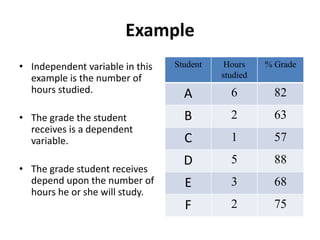
Example
• Independent variable in this
example is the number of
hours studied.
• The grade the student
receives is a dependent
variable.
• The grade student receives
depend upon the number of
hours he or she will study.

Student

Hours
studied

% Grade

A

6

82

B

2

63

C

1

57

D

5

88

E

3

68

F

2

75
Definition of 'Pearson Coefficient'
• A type of correlation coefficient that
represents the relationship between
two variables that are measured on the
same interval or ratio scale.
Pearson Correlation Coefficient
• A number between –1.0 and +1.0
describes the relationship between 2 variables:
•
•
•
•
•

direction (+ positive or – negative)
strength (from 0 to ±1)
r = +1.0 a very strong positive relationship
r = –1.0 a very strong negative relationship
r = 0 there is no relationship
Types of correlations
• A positive relationship exists when both
variables increase or decrease at the same
time. (Weight and height).
• A negative relationship exist when one
variable increases and the other variable
decreases or vice versa. (Strength and age).
• No Correlation indicates no relationship
between the two variables. A correlation
coefficient of 0 indicates no correlation
Scatter Plot
• The independent and dependent can be
plotted on a graph called a scatter plot.
• By convention, the independent variable is
plotted on the horizontal x-axis.
• The dependent variable is plotted on the
vertical y-axis.
Plotting correlations
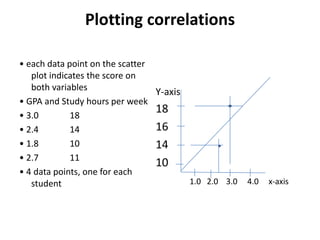
• each data point on the scatter
plot indicates the score on
both variables
Y-axis
• GPA and Study hours per week
18
• 3.0
18
16
• 2.4
14
• 1.8
10
14
• 2.7
11
10
• 4 data points, one for each
1.0 2.0 3.0
student

4.0

x-axis
Range of correlation coefficient
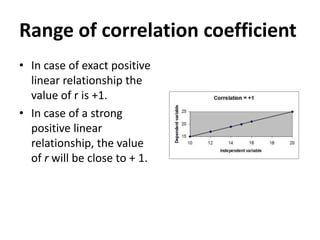
• In case of exact positive
linear relationship the
value of r is +1.
• In case of a strong
positive linear
relationship, the value
of r will be close to + 1.
Range of correlation coefficient
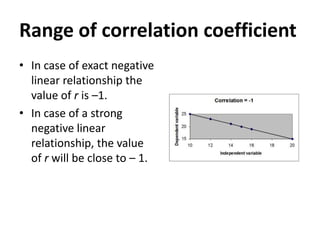
• In case of exact negative
linear relationship the
value of r is –1.
• In case of a strong
negative linear
relationship, the value
of r will be close to – 1.
Range of correlation coefficient
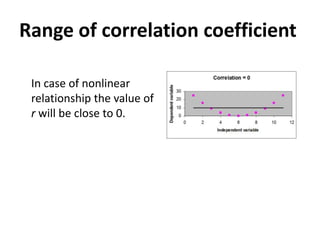
In case of nonlinear
relationship the value of
r will be close to 0.
Types of Correlational Studies:
1. The Survey Method
• Survey and questionnaires are one of the
most common methods used in educational
research. In this method, a random sample of
participants completes a survey, test, or
questionnaire that relates to the variables of
interest.
• Random sampling is a vital part of ensuring
the generalizability of the survey results.
Advantages of the survey method
• It’s fast, cheap, and easy. Researchers can
collect large amount of data in a relatively
short amount of time.

• More flexible than some other methods
Disadvantages of the Survey Method:
• Can be affected by an unrepresentative
sample or poor survey questions.
• Participants can affect the outcome. Some
participants try to please the researcher, lie to
make themselves look better, or have
mistaken memories.
2. Archival Research
• Archival research is the study of existing data.
The existing data is collected to answer research
questions. Existing data sources may include
statistical records, survey archives, and written
records.
Advantages of Archival Research:
• The experimenter cannot introduce changes in
participant behavior.
• Enormous amounts of data provide a better
view of trends, relationships, and outcomes.
• Often less expensive than other study
methods. Researchers can often access data
through free archives or records databases.
Disadvantages of Archival Research:
• The researchers have not control over how
data was collected.
• Important date may be missing from the
records.
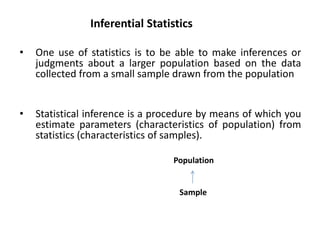
Inferential Statistics
•

One use of statistics is to be able to make inferences or
judgments about a larger population based on the data
collected from a small sample drawn from the population

•

Statistical inference is a procedure by means of which you
estimate parameters (characteristics of population) from
statistics (characteristics of samples).
Population

Sample
Rationale of sampling
• The inductive method involves making
observations and then drawing conclusions
from these observation.
• Samples must be representative if you are to
be able to generalize with reasonable
confidence from the sample to the population.
• An unrepresentative sample is termed a
biased sample
Steps in sampling
1. Probability sampling
It involves sample selection in which the
elements are drown by chance procedures.
2. Nonprobability sampling
It includes methods of selection in which
elements are not chosen by chance
procedure.
The types of probability sampling
1. Simple random sampling
2. Stratified sampling
3. Cluster sampling
4. Systematic sampling
1. Simple random sampling
It comprise the following steps:
1. Define the population
2. List all members of the population
3. Select the sample by employing a procedure
where sheer chance determines which
members on the list are drawn for the sample.
2. Stratified sampling
Population consists of a number of subgroups,
or strata, that may differ in the characteristics
being studied.
3. Cluster sampling
• With cluster sampling, the researcher divides
the population into separate groups, called
clusters. Then, a simple random sample of
clusters is selected from the population.
4. Systematic sampling
A common way of selecting members for a sample
population using systematic sampling is simply to
divide the total number of units in the general
population by the desired number of units for the
sample population.
For example, if you wanted to select a random
group of 1,000 people from a population of 50,000
using systematic sampling, you would simply select
every 50th person, since 50,000/1,000 = 50.
Non probability sampling
1- Convenience sampling, It is a sampling method in which
units are selected based on easy access/availability. which is
regarded as the weakest of all sampling procedures, involves
using available cases for study.
2- Purposive sampling a type of nonprobability sampling in
which the researcher consciously selects specific elements or
subjects for inclusion in a study in order to ensure that the
elements will have certain characteristics relevant to the
study.
3- Quota Sampling involves selecting typical cases from
diverse strata of a population. The quotas are based on known
characteristics ( age, gender, social class, etc.,) of the
population to which you wish to generalize.
Random Assignment
• When the primary goal of a study is to
compares the outcomes of two treatments
with the same dependent variable, random
assignments is used. Here a chance procedure
such as a table of random numbers is used to
divide the available subjects into groups.
• Then a chance procedure such as tossing a
coin is use to decide which group gets which
treatments.
The size of the sample
How large should a sample be?
• A larger sample is more likely to be a good
representative of the population than a smaller sample.
However, the most important characteristic of a sample
is its representativeness, not its size.
• A random sample of 200 is better than a random sample
of 100, but a random sample of 100 is better than biased
sample of 2500000.
The concept of sampling error
• The researcher has observed only a sample
and not the entire population.
• Sampling error is “the difference between a
population parameter and a sample statistic”.
Hypothesis Testing
A statistical hypothesis is an assumption about
a population parameter. This assumption may or
may not be true. Hypothesis testing refers to
the formal procedures used by statisticians to
accept or reject statistical hypotheses.
There are two types of statistical hypotheses.
• Null hypothesis. The null hypothesis, denoted by
H0, is usually the hypothesis that sample
observations result purely from chance.
The null always says there is no relationship or
difference

H0 (null) is that mean1=mean2, meaning the
mean scores are equal OR the difference
between the mean scores is zero .
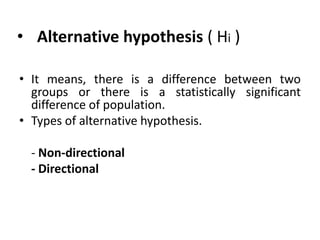
• Alternative hypothesis ( Hi )
• It means, there is a difference between two
groups or there is a statistically significant
difference of population.
• Types of alternative hypothesis.
- Non-directional
- Directional
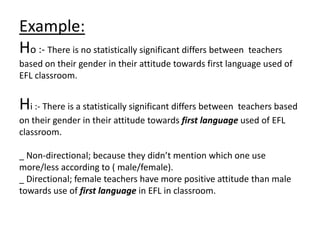
Example:
Ho :- There is no statistically significant differs between teachers
based on their gender in their attitude towards first language used of
EFL classroom.

Hi :- There is a statistically significant differs between teachers based
on their gender in their attitude towards first language used of EFL
classroom.
_ Non-directional; because they didn’t mention which one use
more/less according to ( male/female).
_ Directional; female teachers have more positive attitude than male
towards use of first language in EFL in classroom.
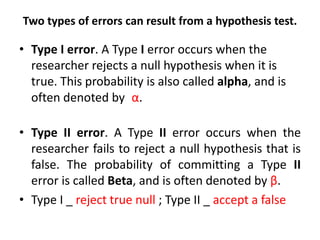
Two types of errors can result from a hypothesis test.

• Type I error. A Type I error occurs when the
researcher rejects a null hypothesis when it is
true. This probability is also called alpha, and is
often denoted by α.

• Type II error. A Type II error occurs when the
researcher fails to reject a null hypothesis that is
false. The probability of committing a Type II
error is called Beta, and is often denoted by β.
• Type I _ reject true null ; Type II _ accept a false
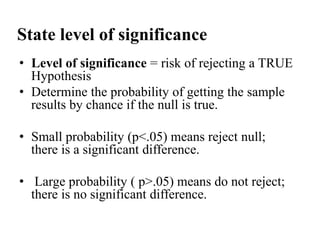
State level of significance
• Level of significance = risk of rejecting a TRUE
Hypothesis
• Determine the probability of getting the sample
results by chance if the null is true.

• Small probability (p<.05) means reject null;
there is a significant difference.
• Large probability ( p>.05) means do not reject;
there is no significant difference.
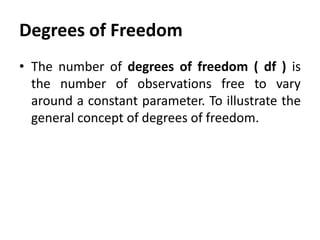
Degrees of Freedom
• The number of degrees of freedom ( df ) is
the number of observations free to vary
around a constant parameter. To illustrate the
general concept of degrees of freedom.
References
Anderson, A. (1990). Fundamentals of educational research. USA: The falmer.
Ary, D. & et al., (2006). Introduction to research in education .(7th ed.). USA: Thomson.
Best, J. W. & Kahn, J. V. (2006). Research in education.(10th ed.) : USA: Pearson.
Cherry, K. (2012). Correlational Studies . December 12, 2012 retrieved from
http://psychology.about.com/od/researchmethods/a/correlational.htm
Cherry, K. (2012). Introduction to Research Methods. December 12, 2012 retrieved from
http://psychology.about.com/od/researchmethods/ss/expdesintro_5.htm

Correlational research

  • 1.
  • 2.
    Table of Content • • • • • • • Definition Purpose Independentand dependent variables Scatter plot Correlation coefficient Range of correlational coefficient Types of correlational study
  • 3.
    Correlational research A correlationalis the measurement of the relationship between two variables. Correlation is a statistical technique that can show whether and how strongly pairs of variables are related.
  • 4.
    The Goal ofCorrelational Research The goal of correlational research is to find out whether one or more variables can predict other variables. Correlational research allows us to find out what variables may be related. However, the fact that two things are related or correlated does not mean there is a causal relationship. It is important to make a distinction between correlation and causation. Two things can be correlated without there being a causal relationship
  • 5.
    Independent and DependentVariables • Independent variable: is a variable that can be controlled or manipulated. • Dependent variable: is a variable that cannot be controlled or manipulated. Its values are predicted from the independent variable
  • 6.
    Example • Independent variablein this example is the number of hours studied. • The grade the student receives is a dependent variable. • The grade student receives depend upon the number of hours he or she will study. Student Hours studied % Grade A 6 82 B 2 63 C 1 57 D 5 88 E 3 68 F 2 75
  • 7.
    Definition of 'PearsonCoefficient' • A type of correlation coefficient that represents the relationship between two variables that are measured on the same interval or ratio scale.
  • 8.
    Pearson Correlation Coefficient •A number between –1.0 and +1.0 describes the relationship between 2 variables: • • • • • direction (+ positive or – negative) strength (from 0 to ±1) r = +1.0 a very strong positive relationship r = –1.0 a very strong negative relationship r = 0 there is no relationship
  • 9.
    Types of correlations •A positive relationship exists when both variables increase or decrease at the same time. (Weight and height). • A negative relationship exist when one variable increases and the other variable decreases or vice versa. (Strength and age). • No Correlation indicates no relationship between the two variables. A correlation coefficient of 0 indicates no correlation
  • 10.
    Scatter Plot • Theindependent and dependent can be plotted on a graph called a scatter plot. • By convention, the independent variable is plotted on the horizontal x-axis. • The dependent variable is plotted on the vertical y-axis.
  • 11.
    Plotting correlations • eachdata point on the scatter plot indicates the score on both variables Y-axis • GPA and Study hours per week 18 • 3.0 18 16 • 2.4 14 • 1.8 10 14 • 2.7 11 10 • 4 data points, one for each 1.0 2.0 3.0 student 4.0 x-axis
  • 12.
    Range of correlationcoefficient • In case of exact positive linear relationship the value of r is +1. • In case of a strong positive linear relationship, the value of r will be close to + 1.
  • 13.
    Range of correlationcoefficient • In case of exact negative linear relationship the value of r is –1. • In case of a strong negative linear relationship, the value of r will be close to – 1.
  • 14.
    Range of correlationcoefficient In case of nonlinear relationship the value of r will be close to 0.
  • 15.
    Types of CorrelationalStudies: 1. The Survey Method • Survey and questionnaires are one of the most common methods used in educational research. In this method, a random sample of participants completes a survey, test, or questionnaire that relates to the variables of interest. • Random sampling is a vital part of ensuring the generalizability of the survey results.
  • 16.
    Advantages of thesurvey method • It’s fast, cheap, and easy. Researchers can collect large amount of data in a relatively short amount of time. • More flexible than some other methods
  • 17.
    Disadvantages of theSurvey Method: • Can be affected by an unrepresentative sample or poor survey questions. • Participants can affect the outcome. Some participants try to please the researcher, lie to make themselves look better, or have mistaken memories.
  • 18.
    2. Archival Research •Archival research is the study of existing data. The existing data is collected to answer research questions. Existing data sources may include statistical records, survey archives, and written records.
  • 19.
    Advantages of ArchivalResearch: • The experimenter cannot introduce changes in participant behavior. • Enormous amounts of data provide a better view of trends, relationships, and outcomes. • Often less expensive than other study methods. Researchers can often access data through free archives or records databases.
  • 20.
    Disadvantages of ArchivalResearch: • The researchers have not control over how data was collected. • Important date may be missing from the records.
  • 22.
    Inferential Statistics • One useof statistics is to be able to make inferences or judgments about a larger population based on the data collected from a small sample drawn from the population • Statistical inference is a procedure by means of which you estimate parameters (characteristics of population) from statistics (characteristics of samples). Population Sample
  • 23.
    Rationale of sampling •The inductive method involves making observations and then drawing conclusions from these observation. • Samples must be representative if you are to be able to generalize with reasonable confidence from the sample to the population. • An unrepresentative sample is termed a biased sample
  • 24.
    Steps in sampling 1.Probability sampling It involves sample selection in which the elements are drown by chance procedures. 2. Nonprobability sampling It includes methods of selection in which elements are not chosen by chance procedure.
  • 25.
    The types ofprobability sampling 1. Simple random sampling 2. Stratified sampling 3. Cluster sampling 4. Systematic sampling
  • 26.
    1. Simple randomsampling It comprise the following steps: 1. Define the population 2. List all members of the population 3. Select the sample by employing a procedure where sheer chance determines which members on the list are drawn for the sample.
  • 27.
    2. Stratified sampling Populationconsists of a number of subgroups, or strata, that may differ in the characteristics being studied.
  • 28.
    3. Cluster sampling •With cluster sampling, the researcher divides the population into separate groups, called clusters. Then, a simple random sample of clusters is selected from the population.
  • 29.
    4. Systematic sampling Acommon way of selecting members for a sample population using systematic sampling is simply to divide the total number of units in the general population by the desired number of units for the sample population. For example, if you wanted to select a random group of 1,000 people from a population of 50,000 using systematic sampling, you would simply select every 50th person, since 50,000/1,000 = 50.
  • 30.
    Non probability sampling 1-Convenience sampling, It is a sampling method in which units are selected based on easy access/availability. which is regarded as the weakest of all sampling procedures, involves using available cases for study. 2- Purposive sampling a type of nonprobability sampling in which the researcher consciously selects specific elements or subjects for inclusion in a study in order to ensure that the elements will have certain characteristics relevant to the study. 3- Quota Sampling involves selecting typical cases from diverse strata of a population. The quotas are based on known characteristics ( age, gender, social class, etc.,) of the population to which you wish to generalize.
  • 31.
    Random Assignment • Whenthe primary goal of a study is to compares the outcomes of two treatments with the same dependent variable, random assignments is used. Here a chance procedure such as a table of random numbers is used to divide the available subjects into groups. • Then a chance procedure such as tossing a coin is use to decide which group gets which treatments.
  • 32.
    The size ofthe sample How large should a sample be? • A larger sample is more likely to be a good representative of the population than a smaller sample. However, the most important characteristic of a sample is its representativeness, not its size. • A random sample of 200 is better than a random sample of 100, but a random sample of 100 is better than biased sample of 2500000.
  • 33.
    The concept ofsampling error • The researcher has observed only a sample and not the entire population. • Sampling error is “the difference between a population parameter and a sample statistic”.
  • 34.
    Hypothesis Testing A statisticalhypothesis is an assumption about a population parameter. This assumption may or may not be true. Hypothesis testing refers to the formal procedures used by statisticians to accept or reject statistical hypotheses.
  • 35.
    There are twotypes of statistical hypotheses. • Null hypothesis. The null hypothesis, denoted by H0, is usually the hypothesis that sample observations result purely from chance. The null always says there is no relationship or difference H0 (null) is that mean1=mean2, meaning the mean scores are equal OR the difference between the mean scores is zero .
  • 36.
    • Alternative hypothesis( Hi ) • It means, there is a difference between two groups or there is a statistically significant difference of population. • Types of alternative hypothesis. - Non-directional - Directional
  • 37.
    Example: Ho :- Thereis no statistically significant differs between teachers based on their gender in their attitude towards first language used of EFL classroom. Hi :- There is a statistically significant differs between teachers based on their gender in their attitude towards first language used of EFL classroom. _ Non-directional; because they didn’t mention which one use more/less according to ( male/female). _ Directional; female teachers have more positive attitude than male towards use of first language in EFL in classroom.
  • 38.
    Two types oferrors can result from a hypothesis test. • Type I error. A Type I error occurs when the researcher rejects a null hypothesis when it is true. This probability is also called alpha, and is often denoted by α. • Type II error. A Type II error occurs when the researcher fails to reject a null hypothesis that is false. The probability of committing a Type II error is called Beta, and is often denoted by β. • Type I _ reject true null ; Type II _ accept a false
  • 39.
    State level ofsignificance • Level of significance = risk of rejecting a TRUE Hypothesis • Determine the probability of getting the sample results by chance if the null is true. • Small probability (p<.05) means reject null; there is a significant difference. • Large probability ( p>.05) means do not reject; there is no significant difference.
  • 40.
    Degrees of Freedom •The number of degrees of freedom ( df ) is the number of observations free to vary around a constant parameter. To illustrate the general concept of degrees of freedom.
  • 41.
    References Anderson, A. (1990).Fundamentals of educational research. USA: The falmer. Ary, D. & et al., (2006). Introduction to research in education .(7th ed.). USA: Thomson. Best, J. W. & Kahn, J. V. (2006). Research in education.(10th ed.) : USA: Pearson. Cherry, K. (2012). Correlational Studies . December 12, 2012 retrieved from http://psychology.about.com/od/researchmethods/a/correlational.htm Cherry, K. (2012). Introduction to Research Methods. December 12, 2012 retrieved from http://psychology.about.com/od/researchmethods/ss/expdesintro_5.htm