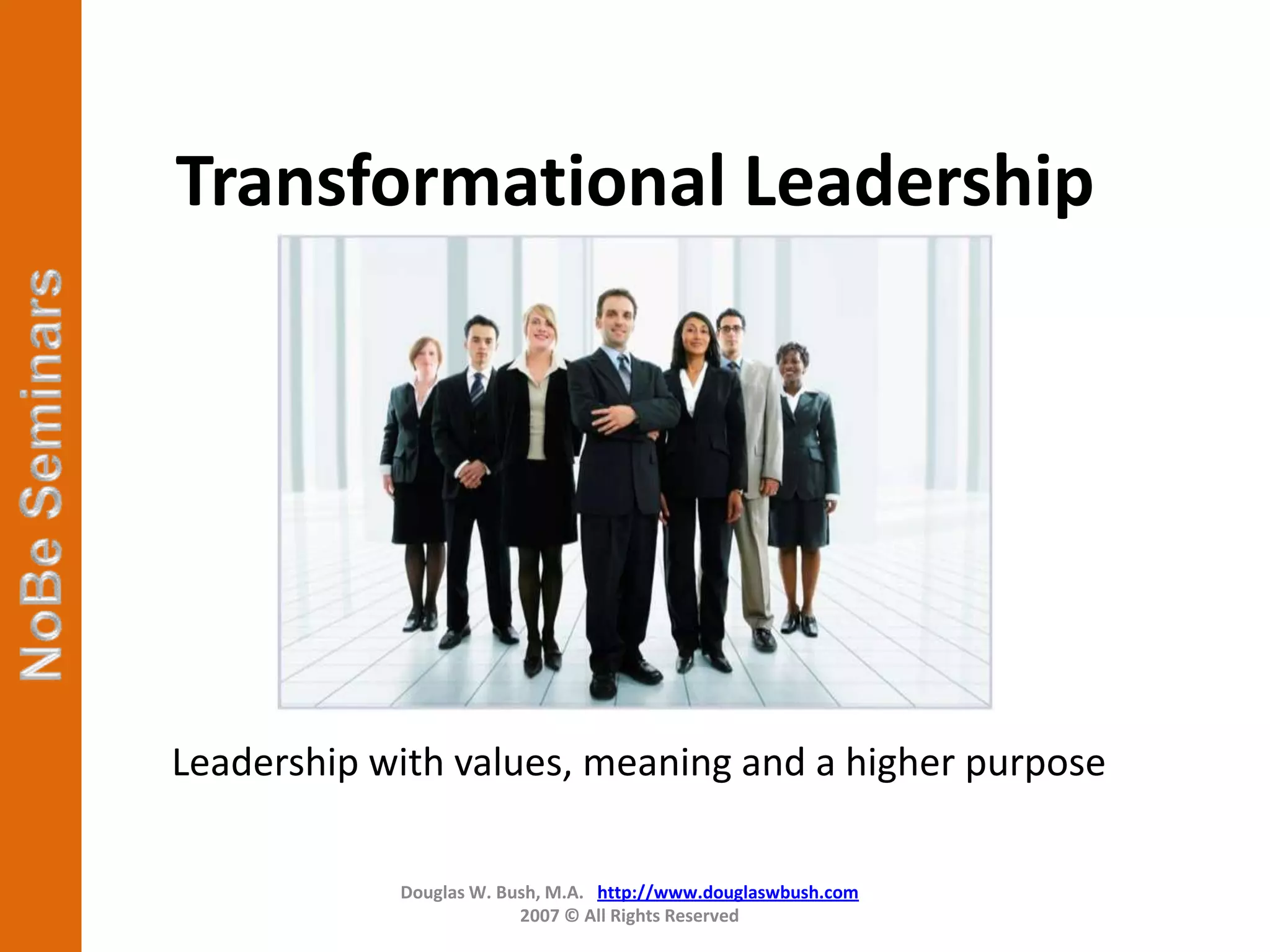


Transformational Leadership


Leadership with values, meaning and a higher purpose

            Douglas W. Bush, M.A. http://www.douglaswbush.com
                         2007 © All Rights Reserved
Objectives

1                           Definition


2                             History


3   Transformational vs. transactional leadership


4   Characteristics of a transformational leader


5     Support of transformational leadership


6              Applications for managers

    Douglas W. Bush, M.A. http://www.douglaswbush.com
                 2007 © All Rights Reserved
Think about leadership experiences you have had –
either as a leader or as a follower


                              - What leadership qualities did you
                                prefer the most? Least?

                             - How did your leadership style or
                               the style of your boss affect the
                               outcomes of your work?


         Douglas W. Bush, M.A. http://www.douglaswbush.com
                      2007 © All Rights Reserved
A Transformational Leader

Style of charismatic leadership in
which the leader identifies the
needed change, creates a vision to
guide and transform the organization;
inspires and challenges followers;
engages followers in driving the
change; develops them into leaders;
achieves levels of performance beyond
expectations.


    Douglas W. Bush, M.A. http://www.douglaswbush.com
                 2007 © All Rights Reserved
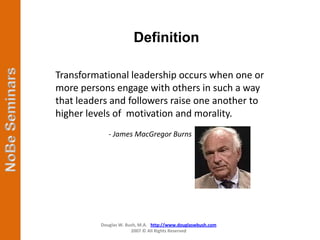
Definition

Transformational leadership occurs when one or
more persons engage with others in such a way
that leaders and followers raise one another to
higher levels of motivation and morality.
             - James MacGregor Burns


          Douglas W. Bush, M.A. http://www.douglaswbush.com
                       2007 © All Rights Reserved
History of Transformational Leadership

• James Burns introduced the concept of transforming
 and transactional leadership (1978)

• A process in which leaders and followers help each
 other advance to a higher level of motivation and morale.

• Differentiated between management and leadership
 claiming the differences are in characteristics and
 behaviors, and established two concepts:
             - transforming leadership
             - transactional leadership

• Transformational leadership creates significant change
  in the lives of people and organizations.


              Douglas W. Bush, M.A. http://www.douglaswbush.com
                           2007 © All Rights Reserved
History of Transformational
              Leadership
• It redesigns perceptions and values, and changes
 expectations and aspirations of followers.

• Dependent on the leader’s personality, traits and
 ability to change through example, articulation of an
 energizing vision and challenging goals.

• Provides a moral example of working towards the
 benefit of the individual, team and organization.

• Transforming and transactional leadership are
 mutually exclusive styles.


              Douglas W. Bush, M.A. http://www.douglaswbush.com
                           2007 © All Rights Reserved
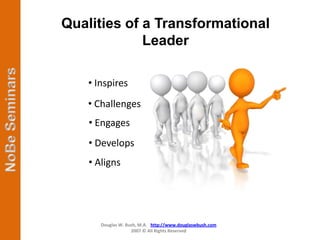
Qualities of a Transformational
             Leader

    • Inspires
   • Challenges
    • Engages
    • Develops
    • Aligns


       Douglas W. Bush, M.A. http://www.douglaswbush.com
                    2007 © All Rights Reserved
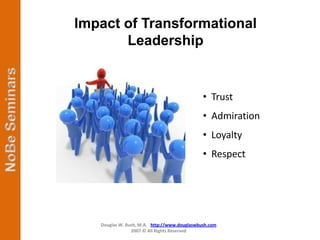
Impact of Transformational
       Leadership


                                              • Trust
                                              • Admiration
                                              • Loyalty
                                              • Respect


   Douglas W. Bush, M.A. http://www.douglaswbush.com
                2007 © All Rights Reserved
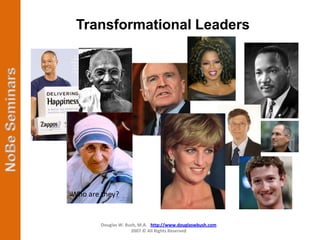
Transformational Leaders


Who are they?


        Douglas W. Bush, M.A. http://www.douglaswbush.com
                     2007 © All Rights Reserved
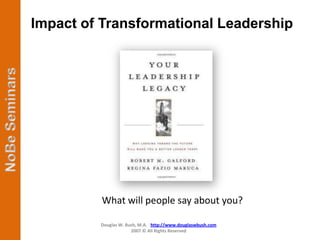
Impact of Transformational Leadership


          What will people say about you?

         Douglas W. Bush, M.A. http://www.douglaswbush.com
                      2007 © All Rights Reserved
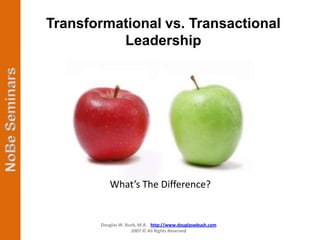
Transformational vs. Transactional
          Leadership


          What’s The Difference?


       Douglas W. Bush, M.A. http://www.douglaswbush.com
                    2007 © All Rights Reserved
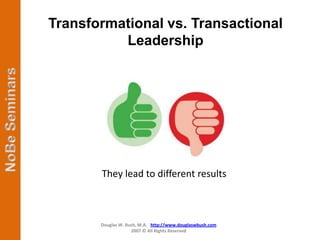
Transformational vs. Transactional
          Leadership


       They lead to different results


       Douglas W. Bush, M.A. http://www.douglaswbush.com
                    2007 © All Rights Reserved
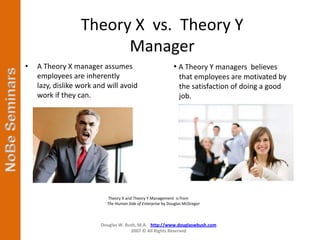
Theory X vs. Theory Y
                        Manager
•   A Theory X manager assumes                               • A Theory Y managers believes
    employees are inherently                                    that employees are motivated by
    lazy, dislike work and will avoid                           the satisfaction of doing a good
    work if they can.                                           job.


                           Theory X and Theory Y Management is from
                           The Human Side of Enterprise by Douglas McGregor


                        Douglas W. Bush, M.A. http://www.douglaswbush.com
                                     2007 © All Rights Reserved
Attitudes of The Theory X Manager
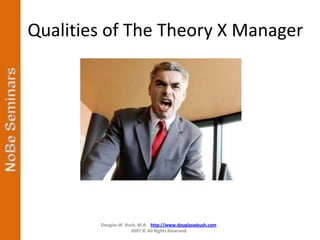
• A Theory X manager assumes employees are inherently lazy, dislike work
  and will avoid work if they can:

    – Workers need to be closely supervised with comprehensive systems of
      control.
    – Employees will show little ambition without an enticing incentive
      program and will avoid responsibility whenever they can.
    – Threat and coercion are needed to gain the employee's compliance.
    – The workplace is characterized by mistrust, highly restrictive
      supervision, and discipline.
    – Managers will blame the person first in most situations, without
      questioning whether it may be the system, policy, or lack of training that
      deserves the blame.
                                          Theory X and Theory Y Management is from
                                          The Human Side of Enterprise by Douglas McGregor


                     Douglas W. Bush, M.A. http://www.douglaswbush.com
                                  2007 © All Rights Reserved
Qualities of The Theory X Manager


        Douglas W. Bush, M.A. http://www.douglaswbush.com
                     2007 © All Rights Reserved
Qualities of The Theory Y Manager


                    Theory X and Theory Y Management is from
                    The Human Side of Enterprise by Douglas McGregor


             Douglas W. Bush, M.A. http://www.douglaswbush.com
17                        2007 © All Rights Reserved
Attitudes of The Theory Y Manager

• In Theory Y, managers believe that employees are motivated by the
  satisfaction of doing a good job:

    – They enjoy their mental and physical work duties.
    – They possess the ability for creative problem solving, but their talents
      are underused in most organizations.
    – Given the right conditions, employees will seek out and accept
      responsibility and exercise self-control and self-direction in
      accomplishing objectives to which they are committed.
    – Given the right conditions, most people want to do well at work.


                    Douglas W. Bush, M.A. http://www.douglaswbush.com
                                 2007 © All Rights Reserved
Theory X vs. Theory Y

• What is the predominant leadership style here?
   – At the manager team level?
   – At the supervisor level?

• Can you give some clear examples of either X or Y behavior?
   – In this work group?
   – In other parts of the organization?

• Is consistent Theory Y leadership possible here?


                 Douglas W. Bush, M.A. http://www.douglaswbush.com
                              2007 © All Rights Reserved
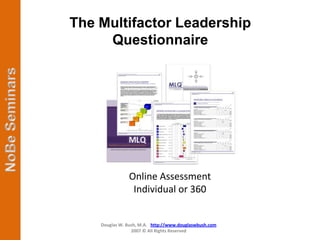
The Multifactor Leadership
     Questionnaire


               Online Assessment
                Individual or 360


    Douglas W. Bush, M.A. http://www.douglaswbush.com
                 2007 © All Rights Reserved
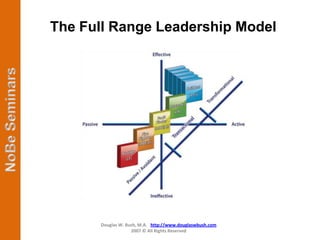
The Full Range Leadership Model


      Douglas W. Bush, M.A. http://www.douglaswbush.com
                   2007 © All Rights Reserved
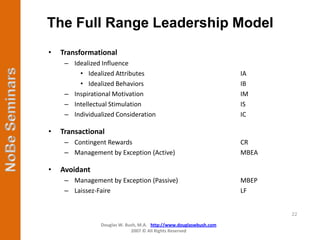
The Full Range Leadership Model
•   Transformational
     – Idealized Influence
         • Idealized Attributes                                     IA
         • Idealized Behaviors                                      IB
     – Inspirational Motivation                                     IM
     – Intellectual Stimulation                                     IS
     – Individualized Consideration                                 IC

•   Transactional
     – Contingent Rewards                                           CR
     – Management by Exception (Active)                             MBEA

•   Avoidant
     – Management by Exception (Passive)                            MBEP
     – Laissez-Faire                                                LF


                                                                           22
                Douglas W. Bush, M.A. http://www.douglaswbush.com
                             2007 © All Rights Reserved
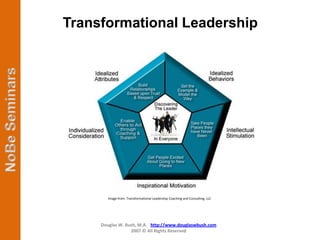
Transformational Leadership


        Image from: Transformational Leadership Coaching and Consulting, LLC


     Douglas W. Bush, M.A. http://www.douglaswbush.com
                  2007 © All Rights Reserved
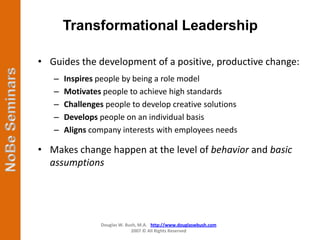
Transformational Leadership

• Guides the development of a positive, productive change:
   –   Inspires people by being a role model
   –   Motivates people to achieve high standards
   –   Challenges people to develop creative solutions
   –   Develops people on an individual basis
   –   Aligns company interests with employees needs

• Makes change happen at the level of behavior and basic
  assumptions


                 Douglas W. Bush, M.A. http://www.douglaswbush.com
                              2007 © All Rights Reserved
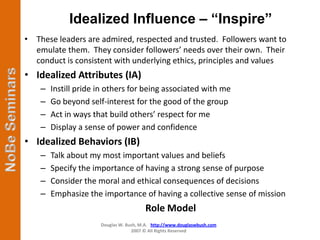
Idealized Influence – “Inspire”
• These leaders are admired, respected and trusted. Followers want to
  emulate them. They consider followers’ needs over their own. Their
  conduct is consistent with underlying ethics, principles and values
• Idealized Attributes (IA)
    –   Instill pride in others for being associated with me
    –   Go beyond self-interest for the good of the group
    –   Act in ways that build others’ respect for me
    –   Display a sense of power and confidence
• Idealized Behaviors (IB)
    –   Talk about my most important values and beliefs
    –   Specify the importance of having a strong sense of purpose
    –   Consider the moral and ethical consequences of decisions
    –   Emphasize the importance of having a collective sense of mission
                                        Role Model
                      Douglas W. Bush, M.A. http://www.douglaswbush.com
                                   2007 © All Rights Reserved
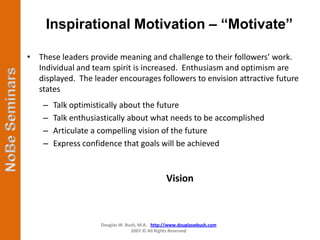
Inspirational Motivation – “Motivate”

• These leaders provide meaning and challenge to their followers’ work.
  Individual and team spirit is increased. Enthusiasm and optimism are
  displayed. The leader encourages followers to envision attractive future
  states
    –   Talk optimistically about the future
    –   Talk enthusiastically about what needs to be accomplished
    –   Articulate a compelling vision of the future
    –   Express confidence that goals will be achieved


                                               Vision


                    Douglas W. Bush, M.A. http://www.douglaswbush.com
                                 2007 © All Rights Reserved
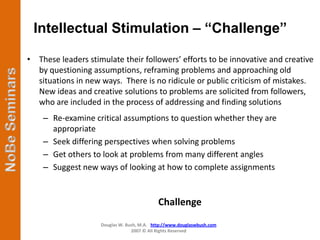
Intellectual Stimulation – “Challenge”

• These leaders stimulate their followers’ efforts to be innovative and creative
  by questioning assumptions, reframing problems and approaching old
  situations in new ways. There is no ridicule or public criticism of mistakes.
  New ideas and creative solutions to problems are solicited from followers,
  who are included in the process of addressing and finding solutions
    – Re-examine critical assumptions to question whether they are
      appropriate
    – Seek differing perspectives when solving problems
    – Get others to look at problems from many different angles
    – Suggest new ways of looking at how to complete assignments


                                            Challenge
                    Douglas W. Bush, M.A. http://www.douglaswbush.com
                                 2007 © All Rights Reserved
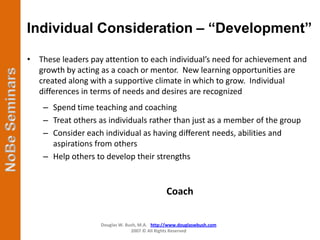
Individual Consideration – “Development”

• These leaders pay attention to each individual’s need for achievement and
  growth by acting as a coach or mentor. New learning opportunities are
  created along with a supportive climate in which to grow. Individual
  differences in terms of needs and desires are recognized
    – Spend time teaching and coaching
    – Treat others as individuals rather than just as a member of the group
    – Consider each individual as having different needs, abilities and
      aspirations from others
    – Help others to develop their strengths


                                              Coach

                   Douglas W. Bush, M.A. http://www.douglaswbush.com
                                2007 © All Rights Reserved
Transactional Leadership
•   These leaders display behaviors associated with constructive and corrective
    transactions. They define expectations and promote performance to achieve these
    levels

•   Contingent Reward: Establishes goals and agrees on what followers will do to achieve the
    stated objectives. Exchanges rewards for effort and recognizes accomplishments
      – Provide others with assistance in exchange for their efforts
      – Discuss in specific terms who is responsible for achieving performance targets
      – Make clear what one can expect to receive when performance goals are met

•   Management by Exception (active): Monitors deviations from rules and mistakes and takes
    corrective action
     – Focus attention on irregularities, mistakes, exceptions and deviations from standards
     – Concentrate full attention on dealing with mistakes, complaints and failures
     – Keep track of all mistakes


                          Douglas W. Bush, M.A. http://www.douglaswbush.com
                                       2007 © All Rights Reserved
Passive/Avoidant Behavior
• These leaders do not respond to situations and problems systematically.
  They avoid specifying agreements, clarifying expectations and providing
  goals and standards to be achieved.

• Management by Exception (passive): Takes action only if mistakes are
  made, standards are not met
   – Fail to intervene until problems become serious
   – Wait for things to go wrong before taking action
   – Show a firm belief in, “If it ain’t broke, don’t fix it”

• Laissez-Faire: lack of leadership
   – Avoid getting involved when important issues arise
   – Am absent when needed
   – Delay responding to urgent questions


                   Douglas W. Bush, M.A. http://www.douglaswbush.com
                                2007 © All Rights Reserved
The Transactional Leadership
• Dependent on the promise of rewards or the avoidance of penalties as
  motivation. Can work when:

    – The rewards are big enough
    – The leader actually has significant control over the rewards

• Concentrates on accomplishing the tasks at hand

• Satisfies the self-interest of high performers

• Focuses on the penalizing poor performers

• It’s about compliance


                   Douglas W. Bush, M.A. http://www.douglaswbush.com
                                2007 © All Rights Reserved
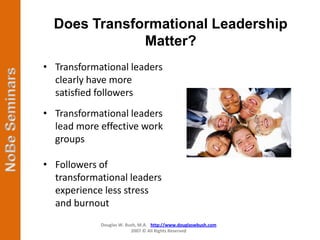
Does Transformational Leadership
              Matter?
• Transformational leaders
  clearly have more
  satisfied followers
• Transformational leaders
  lead more effective work
  groups

• Followers of
  transformational leaders
  experience less stress
  and burnout
            Douglas W. Bush, M.A. http://www.douglaswbush.com
                         2007 © All Rights Reserved
The Transformational Leader and Change

 • Start with an espoused value (i.e., transparency)

 • Identify the real-time moments when basic assumptions drive
   norms (i.e., lack of openness, dishonest behavior, etc.)

 • Through discussion, bring the basic underlying assumptions to
   light that support the behavior or norms

 • Question, challenge, or dispute the underlying assumptions and
   beliefs that support the behavior or norms

 • Reinforce the new value, which leads to new behavior (norm)

 • Chooses the coaching role instead of criticism and discipline

 • Recognize and reward the new positive behavior (norm)

                 Douglas W. Bush, M.A. http://www.douglaswbush.com
                              2007 © All Rights Reserved
Champion
• Does transformational leadership seem worthwhile?
• Would you consider becoming a transformational leader?
• What difference would it make?
   - to others? - to the organization? - to yourself?

• What will you do to champion transformational leadership?
   - List three things you’ll:
         Stop doing
         Start doing
         Continue doing
• What would be a big success in the next six months?
   – What will you expect to improve or be better?
   – What will you see or hear that you would like?

                  Douglas W. Bush, M.A. http://www.douglaswbush.com
                               2007 © All Rights Reserved
Summary
• Mission, Vision, or Cause
• Espoused Values
• Behavioral Expectations
• Strategy
  • Gain followers
  • Support a shared vision
  • Know and understand the challenge ahead
  • Committed to achieving the dream
  • Individual interests are aligned with the goals
  • “Life’s work” that provides purpose, direction and
    personal meaning
                Douglas W. Bush, M.A. http://www.douglaswbush.com
                             2007 © All Rights Reserved
Douglas W. Bush, M.A. http://www.douglaswbush.com
             2007 © All Rights Reserved

Transformational Leadership

  • 1.
    Transformational Leadership Leadership withvalues, meaning and a higher purpose Douglas W. Bush, M.A. http://www.douglaswbush.com 2007 © All Rights Reserved
  • 2.
    Objectives 1 Definition 2 History 3 Transformational vs. transactional leadership 4 Characteristics of a transformational leader 5 Support of transformational leadership 6 Applications for managers Douglas W. Bush, M.A. http://www.douglaswbush.com 2007 © All Rights Reserved
  • 3.
    Think about leadershipexperiences you have had – either as a leader or as a follower - What leadership qualities did you prefer the most? Least? - How did your leadership style or the style of your boss affect the outcomes of your work? Douglas W. Bush, M.A. http://www.douglaswbush.com 2007 © All Rights Reserved
  • 4.
    A Transformational Leader Styleof charismatic leadership in which the leader identifies the needed change, creates a vision to guide and transform the organization; inspires and challenges followers; engages followers in driving the change; develops them into leaders; achieves levels of performance beyond expectations. Douglas W. Bush, M.A. http://www.douglaswbush.com 2007 © All Rights Reserved
  • 5.
    Definition Transformational leadership occurswhen one or more persons engage with others in such a way that leaders and followers raise one another to higher levels of motivation and morality. - James MacGregor Burns Douglas W. Bush, M.A. http://www.douglaswbush.com 2007 © All Rights Reserved
  • 6.
    History of TransformationalLeadership • James Burns introduced the concept of transforming and transactional leadership (1978) • A process in which leaders and followers help each other advance to a higher level of motivation and morale. • Differentiated between management and leadership claiming the differences are in characteristics and behaviors, and established two concepts: - transforming leadership - transactional leadership • Transformational leadership creates significant change in the lives of people and organizations. Douglas W. Bush, M.A. http://www.douglaswbush.com 2007 © All Rights Reserved
  • 7.
    History of Transformational Leadership • It redesigns perceptions and values, and changes expectations and aspirations of followers. • Dependent on the leader’s personality, traits and ability to change through example, articulation of an energizing vision and challenging goals. • Provides a moral example of working towards the benefit of the individual, team and organization. • Transforming and transactional leadership are mutually exclusive styles. Douglas W. Bush, M.A. http://www.douglaswbush.com 2007 © All Rights Reserved
  • 8.
    Qualities of aTransformational Leader • Inspires • Challenges • Engages • Develops • Aligns Douglas W. Bush, M.A. http://www.douglaswbush.com 2007 © All Rights Reserved
  • 9.
    Impact of Transformational Leadership • Trust • Admiration • Loyalty • Respect Douglas W. Bush, M.A. http://www.douglaswbush.com 2007 © All Rights Reserved
  • 10.
    Transformational Leaders Who arethey? Douglas W. Bush, M.A. http://www.douglaswbush.com 2007 © All Rights Reserved
  • 11.
    Impact of TransformationalLeadership What will people say about you? Douglas W. Bush, M.A. http://www.douglaswbush.com 2007 © All Rights Reserved
  • 12.
    Transformational vs. Transactional Leadership What’s The Difference? Douglas W. Bush, M.A. http://www.douglaswbush.com 2007 © All Rights Reserved
  • 13.
    Transformational vs. Transactional Leadership They lead to different results Douglas W. Bush, M.A. http://www.douglaswbush.com 2007 © All Rights Reserved
  • 14.
    Theory X vs.Theory Y Manager • A Theory X manager assumes • A Theory Y managers believes employees are inherently that employees are motivated by lazy, dislike work and will avoid the satisfaction of doing a good work if they can. job. Theory X and Theory Y Management is from The Human Side of Enterprise by Douglas McGregor Douglas W. Bush, M.A. http://www.douglaswbush.com 2007 © All Rights Reserved
  • 15.
    Attitudes of TheTheory X Manager • A Theory X manager assumes employees are inherently lazy, dislike work and will avoid work if they can: – Workers need to be closely supervised with comprehensive systems of control. – Employees will show little ambition without an enticing incentive program and will avoid responsibility whenever they can. – Threat and coercion are needed to gain the employee's compliance. – The workplace is characterized by mistrust, highly restrictive supervision, and discipline. – Managers will blame the person first in most situations, without questioning whether it may be the system, policy, or lack of training that deserves the blame. Theory X and Theory Y Management is from The Human Side of Enterprise by Douglas McGregor Douglas W. Bush, M.A. http://www.douglaswbush.com 2007 © All Rights Reserved
  • 16.
    Qualities of TheTheory X Manager Douglas W. Bush, M.A. http://www.douglaswbush.com 2007 © All Rights Reserved
  • 17.
    Qualities of TheTheory Y Manager Theory X and Theory Y Management is from The Human Side of Enterprise by Douglas McGregor Douglas W. Bush, M.A. http://www.douglaswbush.com 17 2007 © All Rights Reserved
  • 18.
    Attitudes of TheTheory Y Manager • In Theory Y, managers believe that employees are motivated by the satisfaction of doing a good job: – They enjoy their mental and physical work duties. – They possess the ability for creative problem solving, but their talents are underused in most organizations. – Given the right conditions, employees will seek out and accept responsibility and exercise self-control and self-direction in accomplishing objectives to which they are committed. – Given the right conditions, most people want to do well at work. Douglas W. Bush, M.A. http://www.douglaswbush.com 2007 © All Rights Reserved
  • 19.
    Theory X vs.Theory Y • What is the predominant leadership style here? – At the manager team level? – At the supervisor level? • Can you give some clear examples of either X or Y behavior? – In this work group? – In other parts of the organization? • Is consistent Theory Y leadership possible here? Douglas W. Bush, M.A. http://www.douglaswbush.com 2007 © All Rights Reserved
  • 20.
    The Multifactor Leadership Questionnaire Online Assessment Individual or 360 Douglas W. Bush, M.A. http://www.douglaswbush.com 2007 © All Rights Reserved
  • 21.
    The Full RangeLeadership Model Douglas W. Bush, M.A. http://www.douglaswbush.com 2007 © All Rights Reserved
  • 22.
    The Full RangeLeadership Model • Transformational – Idealized Influence • Idealized Attributes IA • Idealized Behaviors IB – Inspirational Motivation IM – Intellectual Stimulation IS – Individualized Consideration IC • Transactional – Contingent Rewards CR – Management by Exception (Active) MBEA • Avoidant – Management by Exception (Passive) MBEP – Laissez-Faire LF 22 Douglas W. Bush, M.A. http://www.douglaswbush.com 2007 © All Rights Reserved
  • 23.
    Transformational Leadership Image from: Transformational Leadership Coaching and Consulting, LLC Douglas W. Bush, M.A. http://www.douglaswbush.com 2007 © All Rights Reserved
  • 24.
    Transformational Leadership • Guidesthe development of a positive, productive change: – Inspires people by being a role model – Motivates people to achieve high standards – Challenges people to develop creative solutions – Develops people on an individual basis – Aligns company interests with employees needs • Makes change happen at the level of behavior and basic assumptions Douglas W. Bush, M.A. http://www.douglaswbush.com 2007 © All Rights Reserved
  • 25.
    Idealized Influence –“Inspire” • These leaders are admired, respected and trusted. Followers want to emulate them. They consider followers’ needs over their own. Their conduct is consistent with underlying ethics, principles and values • Idealized Attributes (IA) – Instill pride in others for being associated with me – Go beyond self-interest for the good of the group – Act in ways that build others’ respect for me – Display a sense of power and confidence • Idealized Behaviors (IB) – Talk about my most important values and beliefs – Specify the importance of having a strong sense of purpose – Consider the moral and ethical consequences of decisions – Emphasize the importance of having a collective sense of mission Role Model Douglas W. Bush, M.A. http://www.douglaswbush.com 2007 © All Rights Reserved
  • 26.
    Inspirational Motivation –“Motivate” • These leaders provide meaning and challenge to their followers’ work. Individual and team spirit is increased. Enthusiasm and optimism are displayed. The leader encourages followers to envision attractive future states – Talk optimistically about the future – Talk enthusiastically about what needs to be accomplished – Articulate a compelling vision of the future – Express confidence that goals will be achieved Vision Douglas W. Bush, M.A. http://www.douglaswbush.com 2007 © All Rights Reserved
  • 27.
    Intellectual Stimulation –“Challenge” • These leaders stimulate their followers’ efforts to be innovative and creative by questioning assumptions, reframing problems and approaching old situations in new ways. There is no ridicule or public criticism of mistakes. New ideas and creative solutions to problems are solicited from followers, who are included in the process of addressing and finding solutions – Re-examine critical assumptions to question whether they are appropriate – Seek differing perspectives when solving problems – Get others to look at problems from many different angles – Suggest new ways of looking at how to complete assignments Challenge Douglas W. Bush, M.A. http://www.douglaswbush.com 2007 © All Rights Reserved
  • 28.
    Individual Consideration –“Development” • These leaders pay attention to each individual’s need for achievement and growth by acting as a coach or mentor. New learning opportunities are created along with a supportive climate in which to grow. Individual differences in terms of needs and desires are recognized – Spend time teaching and coaching – Treat others as individuals rather than just as a member of the group – Consider each individual as having different needs, abilities and aspirations from others – Help others to develop their strengths Coach Douglas W. Bush, M.A. http://www.douglaswbush.com 2007 © All Rights Reserved
  • 29.
    Transactional Leadership • These leaders display behaviors associated with constructive and corrective transactions. They define expectations and promote performance to achieve these levels • Contingent Reward: Establishes goals and agrees on what followers will do to achieve the stated objectives. Exchanges rewards for effort and recognizes accomplishments – Provide others with assistance in exchange for their efforts – Discuss in specific terms who is responsible for achieving performance targets – Make clear what one can expect to receive when performance goals are met • Management by Exception (active): Monitors deviations from rules and mistakes and takes corrective action – Focus attention on irregularities, mistakes, exceptions and deviations from standards – Concentrate full attention on dealing with mistakes, complaints and failures – Keep track of all mistakes Douglas W. Bush, M.A. http://www.douglaswbush.com 2007 © All Rights Reserved
  • 30.
    Passive/Avoidant Behavior • Theseleaders do not respond to situations and problems systematically. They avoid specifying agreements, clarifying expectations and providing goals and standards to be achieved. • Management by Exception (passive): Takes action only if mistakes are made, standards are not met – Fail to intervene until problems become serious – Wait for things to go wrong before taking action – Show a firm belief in, “If it ain’t broke, don’t fix it” • Laissez-Faire: lack of leadership – Avoid getting involved when important issues arise – Am absent when needed – Delay responding to urgent questions Douglas W. Bush, M.A. http://www.douglaswbush.com 2007 © All Rights Reserved
  • 31.
    The Transactional Leadership •Dependent on the promise of rewards or the avoidance of penalties as motivation. Can work when: – The rewards are big enough – The leader actually has significant control over the rewards • Concentrates on accomplishing the tasks at hand • Satisfies the self-interest of high performers • Focuses on the penalizing poor performers • It’s about compliance Douglas W. Bush, M.A. http://www.douglaswbush.com 2007 © All Rights Reserved
  • 32.
    Does Transformational Leadership Matter? • Transformational leaders clearly have more satisfied followers • Transformational leaders lead more effective work groups • Followers of transformational leaders experience less stress and burnout Douglas W. Bush, M.A. http://www.douglaswbush.com 2007 © All Rights Reserved
  • 33.
    The Transformational Leaderand Change • Start with an espoused value (i.e., transparency) • Identify the real-time moments when basic assumptions drive norms (i.e., lack of openness, dishonest behavior, etc.) • Through discussion, bring the basic underlying assumptions to light that support the behavior or norms • Question, challenge, or dispute the underlying assumptions and beliefs that support the behavior or norms • Reinforce the new value, which leads to new behavior (norm) • Chooses the coaching role instead of criticism and discipline • Recognize and reward the new positive behavior (norm) Douglas W. Bush, M.A. http://www.douglaswbush.com 2007 © All Rights Reserved
  • 34.
    Champion • Does transformationalleadership seem worthwhile? • Would you consider becoming a transformational leader? • What difference would it make? - to others? - to the organization? - to yourself? • What will you do to champion transformational leadership? - List three things you’ll:  Stop doing  Start doing  Continue doing • What would be a big success in the next six months? – What will you expect to improve or be better? – What will you see or hear that you would like? Douglas W. Bush, M.A. http://www.douglaswbush.com 2007 © All Rights Reserved
  • 35.
    Summary • Mission, Vision,or Cause • Espoused Values • Behavioral Expectations • Strategy • Gain followers • Support a shared vision • Know and understand the challenge ahead • Committed to achieving the dream • Individual interests are aligned with the goals • “Life’s work” that provides purpose, direction and personal meaning Douglas W. Bush, M.A. http://www.douglaswbush.com 2007 © All Rights Reserved
  • 36.
    Douglas W. Bush,M.A. http://www.douglaswbush.com 2007 © All Rights Reserved