Learners will beable to:
• Determine the different focus and approaches between
leaders & managers
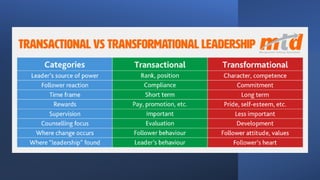
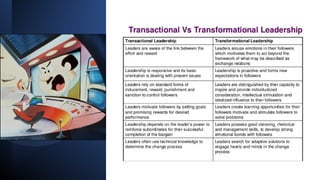
• Understand transactional vs. transformational leadership
• Learn Goleman’s Six Leadership Styles, know the pros
and cons and when to use them
• Determine their own leadership style
• Utilize Situational Leadership as an overall approach to
leadership
3.
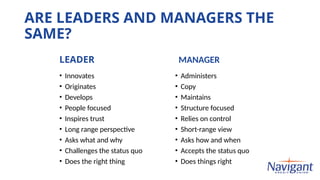
ARE LEADERS ANDMANAGERS THE
SAME?
MANAGER
• Administers
• Copy
• Maintains
• Structure focused
• Relies on control
• Short-range view
• Asks how and when
• Accepts the status quo
• Does things right
LEADER
• Innovates
• Originates
• Develops
• People focused
• Inspires trust
• Long range perspective
• Asks what and why
• Challenges the status quo
• Does the right thing
4.
INHERENTLY
DIFFERENT
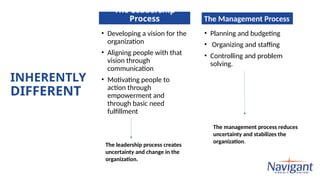
The Leadership
Process
• Developinga vision for the
organization
• Aligning people with that
vision through
communication
• Motivating people to
action through
empowerment and
through basic need
fulfillment
The Management Process
• Planning and budgeting
• Organizing and staffing
• Controlling and problem
solving.
The management process reduces
uncertainty and stabilizes the
organization.
The leadership process creates
uncertainty and change in the
organization.
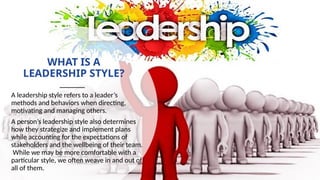
WHAT IS A
LEADERSHIPSTYLE?
A leadership style refers to a leader’s
methods and behaviors when directing,
motivating and managing others.
A person’s leadership style also determines
how they strategize and implement plans
while accounting for the expectations of
stakeholders and the wellbeing of their team.
While we may be more comfortable with a
particular style, we often weave in and out of
all of them.
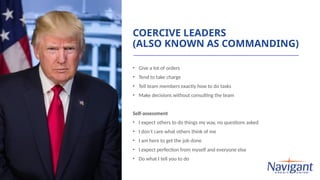
COERCIVE LEADERS
(ALSO KNOWNAS COMMANDING)
• Give a lot of orders
• Tend to take charge
• Tell team members exactly how to do tasks
• Make decisions without consulting the team
Self-assessment
• I expect others to do things my way, no questions asked
• I don’t care what others think of me
• I am here to get the job done
• I expect perfection from myself and everyone else
• Do what I tell you to do
12.
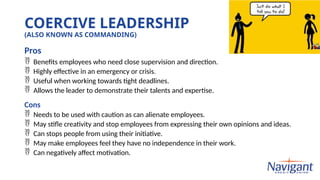
COERCIVE LEADERSHIP
(ALSO KNOWNAS COMMANDING)
Pros
Benefits employees who need close supervision and direction.
Highly effective in an emergency or crisis.
Useful when working towards tight deadlines.
Allows the leader to demonstrate their talents and expertise.
Cons
Needs to be used with caution as can alienate employees.
May stifle creativity and stop employees from expressing their own opinions and ideas.
Can stops people from using their initiative.
May make employees feel they have no independence in their work.
Can negatively affect motivation.
13.
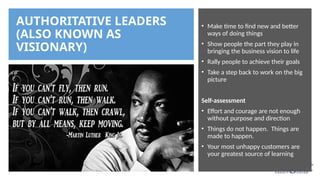
AUTHORITATIVE LEADERS
(ALSO KNOWNAS
VISIONARY)
• Make time to find new and better
ways of doing things
• Show people the part they play in
bringing the business vision to life
• Rally people to achieve their goals
• Take a step back to work on the big
picture
Self-assessment
• Effort and courage are not enough
without purpose and direction
• Things do not happen. Things are
made to happen.
• Your most unhappy customers are
your greatest source of learning
14.
AUTHORITATIVE LEADERSHIP
(ALSO KNOWNAS VISIONARY)
Pros
Useful when you need vision and a clear path for getting there.
Works well in almost any business situation.
Especially effective when the business is entering new territory (markets, products).
Most effective for getting people behind ideas, to perform well and act with integrity.
Motivates employees by giving their work a sense of worth.
Gives employees flexibility — the business vision and goals are clear, and employees
are free to find their own way to meet them.
Cons
Less effective if you’re working with a team of experts, or with people who are more
experienced than you.
15.
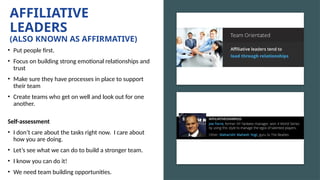
AFFILIATIVE
LEADERS
(ALSO KNOWN ASAFFIRMATIVE)
• Put people first.
• Focus on building strong emotional relationships and
trust
• Make sure they have processes in place to support
their team
• Create teams who get on well and look out for one
another.
Self-assessment
• I don’t care about the tasks right now. I care about
how you are doing.
• Let’s see what we can do to build a stronger team.
• I know you can do it!
• We need team building opportunities.
16.
AFFILIATIVE LEADERSHIP
(ALSO KNOWNAS AFFIRMATIVE)
Pros
• This style works when you’re facing conflict or turbulent times.
• Builds strong team relationships and trust.
• Employees feel loyal to the business.
• People feel confident experimenting and are more likely to be innovative.
Cons
• Always looking for agreement can mean you avoid conflict or making
hard decisions.
• Focusing on relationships can leave employees wondering what tasks
they’re meant to be doing.
• This style isn’t helpful when you just need to get things done.
• May not work well in a time of crisis or when something is urgent.
• Employees may perceive that “mediocrity is tolerated”.
17.
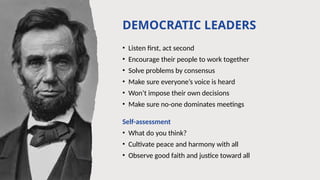
DEMOCRATIC LEADERS
• Listenfirst, act second
• Encourage their people to work together
• Solve problems by consensus
• Make sure everyone’s voice is heard
• Won’t impose their own decisions
• Make sure no-one dominates meetings
Self-assessment
• What do you think?
• Cultivate peace and harmony with all
• Observe good faith and justice toward all
18.
DEMOCRATIC LEADERSHIP
Pros
• Helpspeople take ownership of projects.
• People are more likely to have a vested interest in the project.
• Talking things through helps you uncover ways to keep staff motivated.
• Helps shape or establish a collective vision.
• Ensures people have a voice.
Cons
• Can be disastrous in times of crisis, when urgent events demand quick decisions.
• May be difficult for people who aren’t used to having a say in things.
• People can end up frustrated and unclear what they’re responsible for doing.
• Meetings can go on with no clear outcome.
• Can be time-consuming especially if it involves multiple stakeholders.
• Employees with limited communication and interpersonal skills may feel left out.
19.
PACESETTING
LEADERS
• Expect immediateresults
• Work quickly and too a high standard, and expect
others to do the same
• Are quick to point out weaknesses – in people and
processes and demand more
• Are more likely to set employees new goals to work
on than stop to offer feedback and rewards
Self-assessment
• I showed you how to do it, now do it.
• I expect perfection from myself and everyone else
• There is a proper place for every item
• Here is the checklist
20.
PACESETTING LEADERSHIP
Pros
Canwork well when people are highly motivated and competent.
Well suited to times when you have a lofty goal and very short
timeframe to achieve it.
Useful for situations when competition is fierce or when decisions and
actions needs to be made quickly.
Cons
Can only be sustained for relatively short periods — employees can feel
overwhelmed by demands and burn out trying to keep pace.
Tends to hurt culture, motivation and employee performance.
There’s no room for employees to develop.
People can feel lost if the leader leaves.
21.
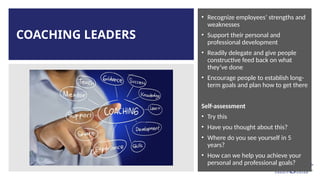
COACHING LEADERS
• Recognizeemployees’ strengths and
weaknesses
• Support their personal and
professional development
• Readily delegate and give people
constructive feed back on what
they’ve done
• Encourage people to establish long-
term goals and plan how to get there
Self-assessment
• Try this
• Have you thought about this?
• Where do you see yourself in 5
years?
• How can we help you achieve your
personal and professional goals?
22.
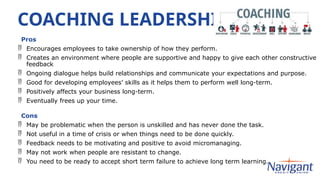
COACHING LEADERSHIP
Pros
Encouragesemployees to take ownership of how they perform.
Creates an environment where people are supportive and happy to give each other constructive
feedback
Ongoing dialogue helps build relationships and communicate your expectations and purpose.
Good for developing employees’ skills as it helps them to perform well long-term.
Positively affects your business long-term.
Eventually frees up your time.
Cons
May be problematic when the person is unskilled and has never done the task.
Not useful in a time of crisis or when things need to be done quickly.
Feedback needs to be motivating and positive to avoid micromanaging.
May not work when people are resistant to change.
You need to be ready to accept short term failure to achieve long term learning.
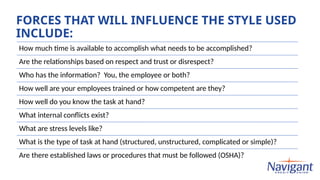
FORCES THAT WILLINFLUENCE THE STYLE USED
INCLUDE:
How much time is available to accomplish what needs to be accomplished?
Are the relationships based on respect and trust or disrespect?
Who has the information? You, the employee or both?
How well are your employees trained or how competent are they?
How well do you know the task at hand?
What internal conflicts exist?
What are stress levels like?
What is the type of task at hand (structured, unstructured, complicated or simple)?
Are there established laws or procedures that must be followed (OSHA)?
Hersey &
Blanchard’s
Situational
Leadership
Model
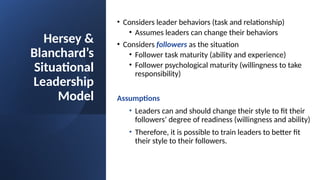
• Considersleader behaviors (task and relationship)
• Assumes leaders can change their behaviors
• Considers followers as the situation
• Follower task maturity (ability and experience)
• Follower psychological maturity (willingness to take
responsibility)
Assumptions
• Leaders can and should change their style to fit their
followers’ degree of readiness (willingness and ability)
• Therefore, it is possible to train leaders to better fit
their style to their followers.
28.
Hersey and Blanchard’sSituational Leadership Theory
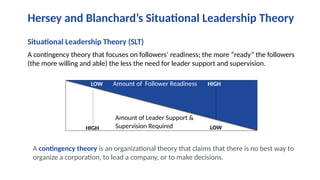
Situational Leadership Theory (SLT)
A contingency theory that focuses on followers’ readiness; the more “ready” the followers
(the more willing and able) the less the need for leader support and supervision.
LOW Amount of Follower Readiness HIGH
Amount of Leader Support &
Supervision Required
HIGH LOW
A contingency theory is an organizational theory that claims that there is no best way to
organize a corporation, to lead a company, or to make decisions.
29.
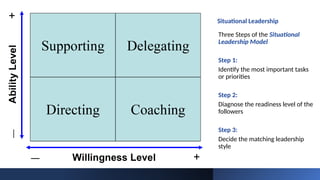
Situational Leadership
Three Stepsof the Situational
Leadership Model
Step 1:
Identify the most important tasks
or priorities
Step 2:
Diagnose the readiness level of the
followers
Step 3:
Decide the matching leadership
style
30.
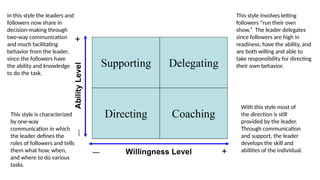
This style ischaracterized
by one-way
communication in which
the leader defines the
roles of followers and tells
them what how, when,
and where to do various
tasks.
This style involves letting
followers “run their own
show.” The leader delegates
since followers are high in
readiness, have the ability, and
are both willing and able to
take responsibility for directing
their own behavior.
In this style the leaders and
followers now share in
decision-making through
two-way communication
and much facilitating
behavior from the leader,
since the followers have
the ability and knowledge
to do the task.
With this style most of
the direction is still
provided by the leader.
Through communication
and support, the leader
develops the skill and
abilities of the individual.
#3 Discussion Points:
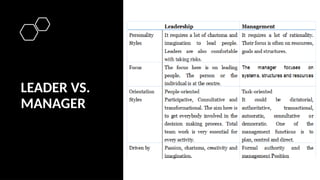
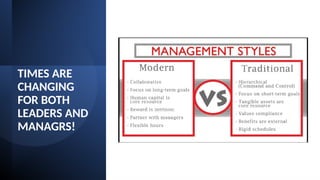
The difference between leaders and managers are in essence, the differences between those who master the context and those who surrender to it according to Warren Bennis, a long-time and well-respected author focused on leadership.
Leadership and management must go hand in hand.
Workers need their managers not just to assign tasks but to define purpose.
Managers must organize workers, not just to maximize efficiency, but to nurture skills, develop talent and inspire results.
#9 Discussion Points:
There are many different leadership styles. Most of us have a style that we tend to migrate to. This does not necessarily mean that we can’t “try on” other styles or employ different styles when needed. It simply means we have a preferred style that we tend to lean on most of the time.
Each leadership style has its pitfalls. Recognizing those pitfalls is half the battle as it may impact employee behavior, input and participation.
#10 Discussion Points:
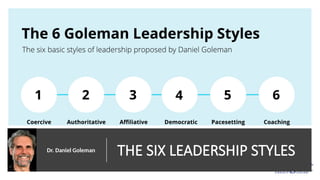
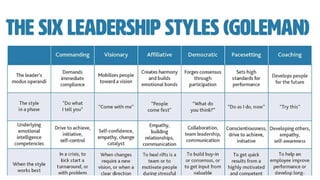
Dr. Daniel Goleman is well-known for his work in putting emotional intelligence on the map. He has several publications, videos, whitepapers attributed to him and is seen as the “god father” in this regard. He is an internationally known psychologist who lectures frequently to professional groups, business audiences, and on college campuses.
Goleman is lesser known for his work on leadership styles, based on the foundation of emotional leadership, of which he believes there are six and that leaders can decide to weave in and out of these styles. These six do include the 4 commonly known styles, although in some cases they are embedded in one of the styles and not as clear cut. These six styles are what Goleman calls micro level – they are not macro level such as transactional, transformational, servant or situational leadership which are more akin to leadership theories. We are going to explore each of them and then take a quick assessment to determine which of the six you migrate to.
#11 Discussion Points:
The coercive or command leader expects obedience. Coercive leaders take charge of a situation. They show initiative, self-control, self-determination, decisiveness, and a drive to succeed. Command and control leadership is authoritative and uses a top-down approach with power vested in senior management.
This leadership style works well in crisis situations. Command and control leaders do not ask if they can be in charge. They just do it. The negative side of the command leadership style is that others do not show initiative and the strong personality can eventually weaken morale.
#13 Discussion Points:
Authoritative leaders are experts and considered an authority in a specific field. They are able to articulate a plan and mobilize people toward a vision. Even though they are considered experts, they allow others a lot of room to identify solutions. This type of leadership is useful when a business or organization is drifting from its purpose. They create a positive and effective work environment.
#15 Discussion Points:
Affiliative leaders value strong emotional bonds and strive to create harmony. They believe ‘People come first.’ They demonstrate empathy, strong communication skills, and the ability to build strong relationships. Affiliative leaders know how to develop trust and motivation. They believe in team harmony. They are less goal-oriented and more people oriented.
#17 Discussion Points:
Democratic leaders build consensus through participation. They constantly ask for opinions from others. They value collaboration. Ideas are freely exchanged, and open discussions are encouraged. Democratic leaders demonstrate high levels of team leadership and strong communication skills. It can be effective long-term, but needs to build momentum to be effective.
#19 Discussion Points:
Pace-setters lead by example. They show initiative, ambition, and drive to succeed. They are good at organizing. They expect others to follow through with limited guidance. They have high standards and set a grueling pace. The pace-setter leadership style works best when subordinates are a highly-competent and well-motivated team that need to adapt and change quickly, such as in a medical office or legal firm. The negative side of the pace-setter leadership style is that subordinates can burn out quickly. There is such a high demand for success that many will walk away from the constant push.
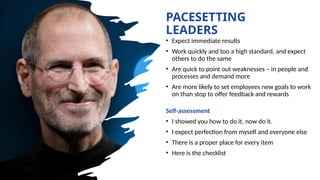
Image is of Steve Jobs who was a pioneer of the personal computer era. With Steve Wozniak, Jobs founded Apple Inc. in 1976 and transformed the company into a world leader in telecommunications. He oversaw the launch of such revolutionary products as the iPod and the iPhone.
#21 Discussion Points:
Coaching leaders develop people. They value long-term staff development and creative long-term solutions. They demonstrate high levels of empathy, self-awareness, and mentoring. Coaching leaders are excellent at helping others to advance their personal and professional goals. The biggest issue with this leadership style is that it takes time to see results.
#22 Discussion Points:
When you finish the Cons section share that we are going to watch six short movie snippets that will demonstrate each style. Click on the Coaching image at the top right side of the slide to launch. If it doesn’t launch, click the link below.
Emotional Intelligence Leadership Styles - following the Daniel Goleman Model for E.I. - YouTube
#24 Handout:
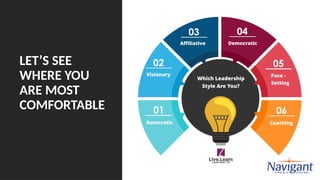
The Judgement Index. Share that we will replace Authoritative with Visionary and Coercive with Commanding. Ask them to take 10 minutes to complete the assessment.
Ask for volunteers and discuss out loud their highest score and lowest score. Any surprises?
#26 Discussion Points:
Has anyone heard of situational leadership?
What do you think it might be just by title alone?
The Situational Leadership Model by Ken Blanchard and Paul Hersey in Management of Organizational Behavior, ’96)
The Situational Leadership Model suggests that there is no “one size fits all” approach
to leadership. Depending on the situation, varying levels of “leadership” and
“management” are necessary. However, leaders must first identify their most important tasks or priorities. Second, leaders must consider the readiness level of their followers by analyzing the group’s ability and willingness. Depending on the level of these variables, leaders must apply the most appropriate leadership style to fit the given situation.
The four different types of situational leadership are:
Directing, Coaching, Supporting, Delegating
#29 Handout:
Situational Leadership and walk through the styles and approaches
#30
Video:
https://www.youtube.com/watch?v=5-YXqlTq7IE
Or click on image to start. Demonstrates the different types of styles. In some they will need to guess what kind of situational leadership this is.
#31 Discussion Points:
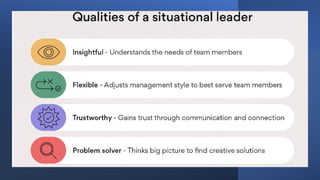
While the Situational Leadership approach is a good one, it’s not for everyone as there are certain qualities that the leader must possess to be successful as listed on the slide. Those leaders who are stuck in their ways – such as General Patton, the Commander – will have a great day of difficulty using this approach. This will hold true for leaders who adhere to a more traditional or transactional style of leadership.
Can you think of certain recent situations where you may have applied one of these approaches?
What were the elements that you considered when thinking about how to guide / support this employee?
What was the outcome?
Going forward, how many of you will give the Situational Leadership approach a try?
What do you think the benefits will be?