Transactional, Charismatic
and Transformational
Leadership.


     What leaders do.
Charisma


The quality of a leader that makes many
         people want to follow.
Charismatic leadership involves the
use of power
Power
 The ability to influence people to do things.
 Five types of power
    Coercive – based on punishment
    Reward – Based on rewards
    Legitimate –Based on a role
    Expert – Based on needed knowledge
    Referent – based on charisma
Halpert’s dimensions
 Charisma combines power with task
 orientation
   Referent Power
   Expert Power
   Job or task involvement
Use of power by leaders
 Socialized Charisma
     Power for social good
 Personalized charisma
     Power for personal benefit
 Office holder Charisma
     Combines legitimate power with task needs
 Personal charisma
     Use referent power to lead
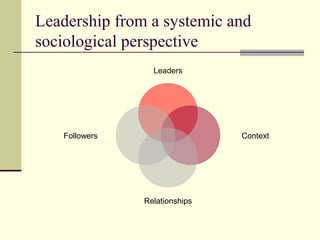
Leadership from a systemic and
sociological perspective
                 Leaders


   Followers                   Context


               Relationships
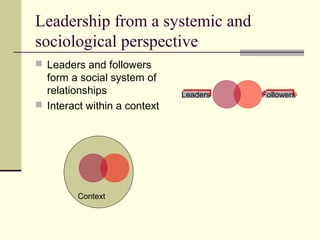
Leadership from a systemic and
sociological perspective
 Leaders and followers
  form a social system of
  relationships               Leaders
                              Leaders   Followers
                                        Followers
 Interact within a context


         Context
Charismatic Leadership
 Combines what the leader does
  (behavior) with what the leader is
  (characteristics)
 Focus on the relationship between
  the leader and the followers.
Charismatic Leadership
Characteristics
 Charismatic leaders high in
   Dominance
   Self confidence
   Need for influence
   Belief in own values
Charismatic Leadership Behaviors
 Goal Articulation
      A transcendent goal inspires a movement - I have a dream
   Personal Image Building
      Behaviors that create impression of competence/success
      Prove his competence to the followers
   Leader role modeling of value system
      Gandhi models self sacrificing behavior of non violence
   Leader motive arousal behavior
      Message inspires needs in the followers that are needed to
       complete the task. (message of love=needs for
       affiliation=required for bringing together
       Hindu/Moslems/Christians)
   Leader communication of high performance expectations of,
    and confidence in, followers
Follower Behaviors
 Characteristics and behaviors of the
  charismatic leader encourage behaviors in
  the followers
 Trust, loyalty, unquestioning acceptance,
  obedience to the leader
 Emulation of leader’s value system
 Acceptance by followers of challenging goals
 Enhanced self esteem and performance
  expectations by the followers
The Result
 Effective follower performance if the behavior
  is appropriate to the task being accomplished
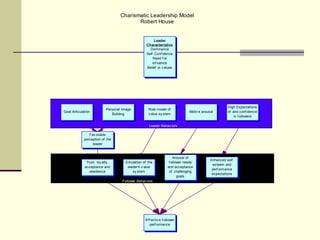
Charismatic Leadership Model
                                           Robert House


                                                         Leader
                                                    Characteristics
                                                      Dominance
                                                    Self Conf idence
                                                         Need f or
                                                        inf luence
                                                    Belief in v alues


                                                                                                       High Expectations
                            Personal Image           Role model of
Goal Articulation                                                               Motiv e arousal        of and conf idence
                               Building              v alue sy stem
                                                                                                           in f ollowers

                                                     Leader Behav iors

                Fav orable
             perception of the
                  leader


                                                                       Arousal of
                                                                                             Enhanced self
              Trust, loy alty ,        Emulation of the             f ollower needs
                                                                                              esteem and
             acceptance and             leader's v alue            and acceptance
                                                                                              perf ormance
                obedience                  sy stem                  of challenging
                                                                                              expectations
                                                                          goals
                                     Follower Behav iors


                                                   Ef f ectiv e f ollower
                                                      perf ormance
Leader-Follower
Relationships


  Transactional Leadership
Transactional Leadership
 Classical management
 Focus on the leader and the follower
 Transaction
   Work for pay
   Work for psychological benefits (status,
    recognition or esteem)
 Requires appropriate role behavior
 Requires clear goals and appropriate
  instructions
 Transactional leadership focuses on the task.
Transactional Leadership
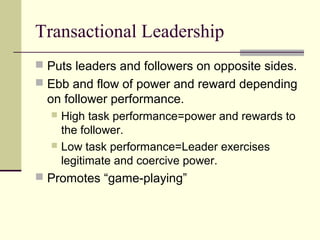
 Puts leaders and followers on opposite sides.
 Ebb and flow of power and reward depending
  on follower performance.
   High task performance=power and rewards to
    the follower.
   Low task performance=Leader exercises
    legitimate and coercive power.
 Promotes “game-playing”
Transactional Leadership


     A demonstration
Transformational Leadership
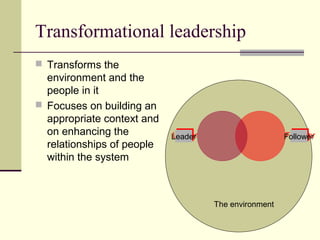
Transformational leadership
 Transforms the
  environment and the
  people in it
 Focuses on building an
  appropriate context and
  on enhancing the          Leader
                            Leader                     Follower
                                                       Follower
  relationships of people
  within the system


                                     The environment
Transforming the culture
 People can be trusted
 Everyone has a contribution to make
 Complex problems should be handled at the
  lowest level
 Norms are flexable adapting to changing
  environment
 Superiors are coaches, mentors, models
Transforming the leader’s behavior

 Identifying and articulating a vision‑Behavior on the part of the
  leader aimed at identifying new opportunities for his or her
  unit/division/company, and developing, articulating, and inspiring others
  with his or her vision of the future.
 Providing an appropriate model‑Behavior on the part of the leader
  that sets an example for employees to follow that is consistent with the
  values the leader espouses.

 Fostering the acceptance of group goals‑Behavior on the part of the
   leader aimed at promoting cooperation among employees and getting
   them to work together toward a common goal.
Transforming the leader’s behavior

 High performance expectations‑Behavior that demonstrates the
   leader's expectations for excellence, quality, and/or high performance
   on the part of followers.

 Providing individualized support‑Behavior on the part of the leader
   that indicates that he/she respects followers and is concerned about
   their personal feelings and needs.

 Intellectual stimulation‑Behavior on the part of the leader that
   challenges followers to re‑examine some of their assumptions about
   their work and rethink how it can be performed.
What is your leadership style-
Transactional or transformational?
Transactional and transformational leadership(1)

  • 1.
  • 2.
    Charisma The quality ofa leader that makes many people want to follow.
  • 3.
  • 4.
    Power  The abilityto influence people to do things.  Five types of power  Coercive – based on punishment  Reward – Based on rewards  Legitimate –Based on a role  Expert – Based on needed knowledge  Referent – based on charisma
  • 5.
    Halpert’s dimensions  Charismacombines power with task orientation  Referent Power  Expert Power  Job or task involvement
  • 6.
    Use of powerby leaders  Socialized Charisma  Power for social good  Personalized charisma  Power for personal benefit  Office holder Charisma  Combines legitimate power with task needs  Personal charisma  Use referent power to lead
  • 7.
    Leadership from asystemic and sociological perspective Leaders Followers Context Relationships
  • 8.
    Leadership from asystemic and sociological perspective  Leaders and followers form a social system of relationships Leaders Leaders Followers Followers  Interact within a context Context
  • 9.
    Charismatic Leadership  Combineswhat the leader does (behavior) with what the leader is (characteristics)  Focus on the relationship between the leader and the followers.
  • 10.
    Charismatic Leadership Characteristics  Charismaticleaders high in  Dominance  Self confidence  Need for influence  Belief in own values
  • 11.
    Charismatic Leadership Behaviors Goal Articulation  A transcendent goal inspires a movement - I have a dream  Personal Image Building  Behaviors that create impression of competence/success  Prove his competence to the followers  Leader role modeling of value system  Gandhi models self sacrificing behavior of non violence  Leader motive arousal behavior  Message inspires needs in the followers that are needed to complete the task. (message of love=needs for affiliation=required for bringing together Hindu/Moslems/Christians)  Leader communication of high performance expectations of, and confidence in, followers
  • 12.
    Follower Behaviors  Characteristicsand behaviors of the charismatic leader encourage behaviors in the followers  Trust, loyalty, unquestioning acceptance, obedience to the leader  Emulation of leader’s value system  Acceptance by followers of challenging goals  Enhanced self esteem and performance expectations by the followers
  • 13.
    The Result  Effectivefollower performance if the behavior is appropriate to the task being accomplished
  • 14.
    Charismatic Leadership Model Robert House Leader Characteristics Dominance Self Conf idence Need f or inf luence Belief in v alues High Expectations Personal Image Role model of Goal Articulation Motiv e arousal of and conf idence Building v alue sy stem in f ollowers Leader Behav iors Fav orable perception of the leader Arousal of Enhanced self Trust, loy alty , Emulation of the f ollower needs esteem and acceptance and leader's v alue and acceptance perf ormance obedience sy stem of challenging expectations goals Follower Behav iors Ef f ectiv e f ollower perf ormance
  • 15.
  • 16.
    Transactional Leadership  Classicalmanagement  Focus on the leader and the follower  Transaction  Work for pay  Work for psychological benefits (status, recognition or esteem)  Requires appropriate role behavior  Requires clear goals and appropriate instructions  Transactional leadership focuses on the task.
  • 17.
    Transactional Leadership  Putsleaders and followers on opposite sides.  Ebb and flow of power and reward depending on follower performance.  High task performance=power and rewards to the follower.  Low task performance=Leader exercises legitimate and coercive power.  Promotes “game-playing”
  • 18.
  • 19.
  • 20.
    Transformational leadership  Transformsthe environment and the people in it  Focuses on building an appropriate context and on enhancing the Leader Leader Follower Follower relationships of people within the system The environment
  • 21.
    Transforming the culture People can be trusted  Everyone has a contribution to make  Complex problems should be handled at the lowest level  Norms are flexable adapting to changing environment  Superiors are coaches, mentors, models
  • 22.
    Transforming the leader’sbehavior  Identifying and articulating a vision‑Behavior on the part of the leader aimed at identifying new opportunities for his or her unit/division/company, and developing, articulating, and inspiring others with his or her vision of the future.  Providing an appropriate model‑Behavior on the part of the leader that sets an example for employees to follow that is consistent with the values the leader espouses.  Fostering the acceptance of group goals‑Behavior on the part of the leader aimed at promoting cooperation among employees and getting them to work together toward a common goal.
  • 23.
    Transforming the leader’sbehavior  High performance expectations‑Behavior that demonstrates the leader's expectations for excellence, quality, and/or high performance on the part of followers.  Providing individualized support‑Behavior on the part of the leader that indicates that he/she respects followers and is concerned about their personal feelings and needs.  Intellectual stimulation‑Behavior on the part of the leader that challenges followers to re‑examine some of their assumptions about their work and rethink how it can be performed.
  • 24.
    What is yourleadership style- Transactional or transformational?