LEADERSHIP
STYLES
CHRIS MUCHATA
SALEM STATE UNIVERSITY
EDU 985B – PRACTICUM IN STUDENT AFFAIRS
LEADERSHIP
• Essential component of any organizational structure
• Provide guidance, accountability, and mentorship
• Different styles for different people
CHARISMATIC
LEADER
• Charismatic leaders influence others and incites passion
within their team
• They are great for increasing morale
• These types of leaders are energetic
• Without the leader, the team may flounder
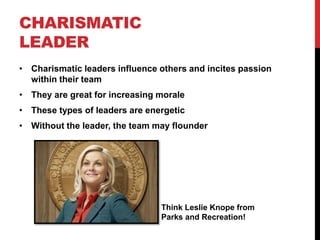
Think Leslie Knope from
Parks and Recreation!
INNOVATIVE OR
VISIONARY LEADER
• Think outside the box
• Brings new ideas and actions to the organization
• Can sometimes lead to big risk-taking or experimenting,
but creates a space where others’ ideas are respected and
encouraged
• Sees failure as an opportunity for
growth
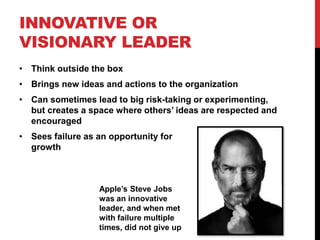
Apple’s Steve Jobs
was an innovative
leader, and when met
with failure multiple
times, did not give up
AUTHORITATIVE OR
COMMANDING LEADER
• Least effective style of leadership – creates low satisfaction
• High control and top-down behavior
• Effective during crisis
• Low praise, high criticism
• Limits skill development for subordinates
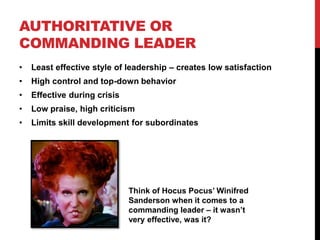
Think of Hocus Pocus’ Winifred
Sanderson when it comes to a
commanding leader – it wasn’t
very effective, was it?
LAISSEZ-FAIRE
LEADERS
• Have high trust in employees to complete tasks
• Not involved in the work directly—oversees the process
• More of a hands-off approach
• Effective when working with highly-trained and motivated
employees
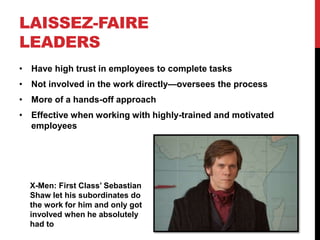
X-Men: First Class’ Sebastian
Shaw let his subordinates do
the work for him and only got
involved when he absolutely
had to
PACESETTING
LEADER
• Set high expectations for work performance
• Constantly seeking to improve the organization through
goal setting
• Can cause associates to feel as if they are failing or to
experience burnout because of fast pace
• Good to use if the staff is highly motivated
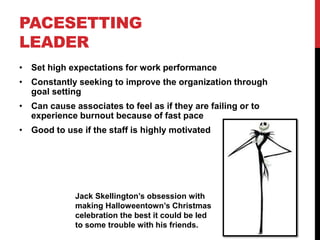
Jack Skellington’s obsession with
making Halloweentown’s Christmas
celebration the best it could be led
to some trouble with his friends.
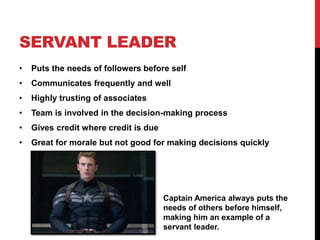
SERVANT LEADER
• Puts the needs of followers before self
• Communicates frequently and well
• Highly trusting of associates
• Team is involved in the decision-making process
• Gives credit where credit is due
• Great for morale but not good for making decisions quickly
Captain America always puts the
needs of others before himself,
making him an example of a
servant leader.
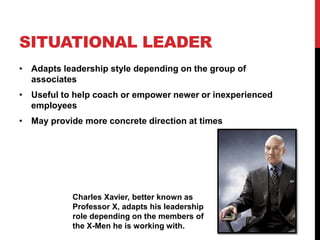
SITUATIONAL LEADER
• Adapts leadership style depending on the group of
associates
• Useful to help coach or empower newer or inexperienced
employees
• May provide more concrete direction at times
Charles Xavier, better known as
Professor X, adapts his leadership
role depending on the members of
the X-Men he is working with.
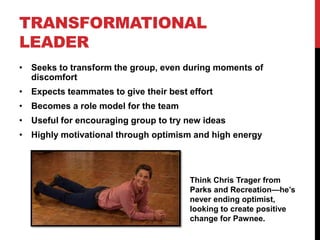
TRANSFORMATIONAL
LEADER
• Seeks to transform the group, even during moments of
discomfort
• Expects teammates to give their best effort
• Becomes a role model for the team
• Useful for encouraging group to try new ideas
• Highly motivational through optimism and high energy
Think Chris Trager from
Parks and Recreation—he’s
never ending optimist,
looking to create positive
change for Pawnee.
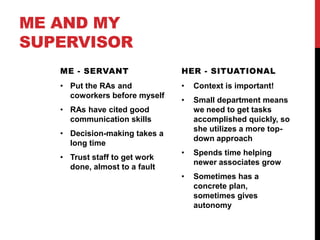
ME AND MY
SUPERVISOR
ME - SERVANT
• Put the RAs and
coworkers before myself
• RAs have cited good
communication skills
• Decision-making takes a
long time
• Trust staff to get work
done, almost to a fault
HER - SITUATIONAL
• Context is important!
• Small department means
we need to get tasks
accomplished quickly, so
she utilizes a more top-
down approach
• Spends time helping
newer associates grow
• Sometimes has a
concrete plan,
sometimes gives
autonomy
QUESTION ONE
Which style of leadership do you identify with most? Why is
that?
QUESTION TWO
Which style of leadership do you think is most effective?
What kinds of leadership do you look for in a supervisor?
RESOURCES
Blanken, R. (2013). 8 common leadership styles. Retrieved from
http://www.asaecenter.org/Resources/ANowDetail.cfm?ItemNumber=241
962
Brown, Q. (n.d.). Servant leadership: Making a difference in the world.
Retrieved from http://www.gbhem.org/article/servant-leadership-
making-difference-world
Leadership styles. Retrieved from
http://guides.wsj.com/management/developing-a-leadership-style/how-
to-develop-a-leadership-style/
Russel, R.F. and Stone, G. (2002). A review of servant leadership
attributes: Developing a practical model. Leadership & Organization
Development Journal, 23(3), 145-157.

Leadership Styles Introduction

  • 1.
    LEADERSHIP STYLES CHRIS MUCHATA SALEM STATEUNIVERSITY EDU 985B – PRACTICUM IN STUDENT AFFAIRS
  • 2.
    LEADERSHIP • Essential componentof any organizational structure • Provide guidance, accountability, and mentorship • Different styles for different people
  • 3.
    CHARISMATIC LEADER • Charismatic leadersinfluence others and incites passion within their team • They are great for increasing morale • These types of leaders are energetic • Without the leader, the team may flounder Think Leslie Knope from Parks and Recreation!
  • 4.
    INNOVATIVE OR VISIONARY LEADER •Think outside the box • Brings new ideas and actions to the organization • Can sometimes lead to big risk-taking or experimenting, but creates a space where others’ ideas are respected and encouraged • Sees failure as an opportunity for growth Apple’s Steve Jobs was an innovative leader, and when met with failure multiple times, did not give up
  • 5.
    AUTHORITATIVE OR COMMANDING LEADER •Least effective style of leadership – creates low satisfaction • High control and top-down behavior • Effective during crisis • Low praise, high criticism • Limits skill development for subordinates Think of Hocus Pocus’ Winifred Sanderson when it comes to a commanding leader – it wasn’t very effective, was it?
  • 6.
    LAISSEZ-FAIRE LEADERS • Have hightrust in employees to complete tasks • Not involved in the work directly—oversees the process • More of a hands-off approach • Effective when working with highly-trained and motivated employees X-Men: First Class’ Sebastian Shaw let his subordinates do the work for him and only got involved when he absolutely had to
  • 7.
    PACESETTING LEADER • Set highexpectations for work performance • Constantly seeking to improve the organization through goal setting • Can cause associates to feel as if they are failing or to experience burnout because of fast pace • Good to use if the staff is highly motivated Jack Skellington’s obsession with making Halloweentown’s Christmas celebration the best it could be led to some trouble with his friends.
  • 8.
    SERVANT LEADER • Putsthe needs of followers before self • Communicates frequently and well • Highly trusting of associates • Team is involved in the decision-making process • Gives credit where credit is due • Great for morale but not good for making decisions quickly Captain America always puts the needs of others before himself, making him an example of a servant leader.
  • 9.
    SITUATIONAL LEADER • Adaptsleadership style depending on the group of associates • Useful to help coach or empower newer or inexperienced employees • May provide more concrete direction at times Charles Xavier, better known as Professor X, adapts his leadership role depending on the members of the X-Men he is working with.
  • 10.
    TRANSFORMATIONAL LEADER • Seeks totransform the group, even during moments of discomfort • Expects teammates to give their best effort • Becomes a role model for the team • Useful for encouraging group to try new ideas • Highly motivational through optimism and high energy Think Chris Trager from Parks and Recreation—he’s never ending optimist, looking to create positive change for Pawnee.
  • 11.
    ME AND MY SUPERVISOR ME- SERVANT • Put the RAs and coworkers before myself • RAs have cited good communication skills • Decision-making takes a long time • Trust staff to get work done, almost to a fault HER - SITUATIONAL • Context is important! • Small department means we need to get tasks accomplished quickly, so she utilizes a more top- down approach • Spends time helping newer associates grow • Sometimes has a concrete plan, sometimes gives autonomy
  • 12.
    QUESTION ONE Which styleof leadership do you identify with most? Why is that?
  • 13.
    QUESTION TWO Which styleof leadership do you think is most effective? What kinds of leadership do you look for in a supervisor?
  • 14.
    RESOURCES Blanken, R. (2013).8 common leadership styles. Retrieved from http://www.asaecenter.org/Resources/ANowDetail.cfm?ItemNumber=241 962 Brown, Q. (n.d.). Servant leadership: Making a difference in the world. Retrieved from http://www.gbhem.org/article/servant-leadership- making-difference-world Leadership styles. Retrieved from http://guides.wsj.com/management/developing-a-leadership-style/how- to-develop-a-leadership-style/ Russel, R.F. and Stone, G. (2002). A review of servant leadership attributes: Developing a practical model. Leadership & Organization Development Journal, 23(3), 145-157.