The Supervisor  as Leader
Overview You and Your People The Nature of Leadership Choosing a Leadership Style
“ Managers are people who do  things right; Leaders are people who do  right things.”
“ Leadership is simply the process of influencing someone to do something that he or she might otherwise not do.” Dr. Paul Hersey Chairman, Center for Leadership Studies
Great people talk about ideas. Average people talk about things. Small people talk about other people.          -- Author: Unknown
Definitions Autocratic leader Carrot-and stick technique Coaching style Delegating style Directing style Formal authority Formal leader Generation X Informal leader Leader  Leadership style MBWA Power Real authority Situational leadership Supporting style Theory X Theory Y Transactional leader Transformational leader
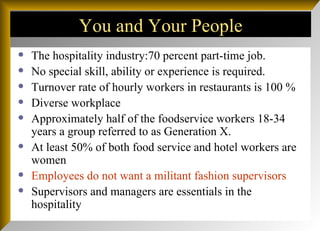
You and Your People The hospitality industry:70 percent part-time job. No special skill, ability or experience is required. Turnover rate of hourly workers in restaurants is 100 % Diverse workplace Approximately half of the foodservice workers 18-34 years a group referred to as Generation X. At least 50% of both food service and hotel workers are women Employees do not want a militant fashion supervisors Supervisors and managers are essentials in the hospitality
The Nature of Leadership Leader:  Someone who guides or influences the actions of his or her employees to reach certain goals. An important managerial function is to be a leader A leader is a person whom people follow voluntarily. You have to get people to work for you  willingly  and to  the best of their ability . Many leadership skills are innate; not all managers make great leaders.
The Jobs and the Workers Characteristics of the Hospitality Industry Many low-wage, entry level positions Semi-skilled or skilled positions Generation X ( born between 1964-1979) Generation Y (born between 1980-1990) Employees do not want supervisors to bark orders in a militant fashion, they want training and expect management to invest time and money on their training and development High turnover 60% women workers Minority workers
Characteristics of Leaders Characteristics of Leaders Drive Desire to influence others Honesty & Moral character Self-confidence Intelligence Relevant knowledge
Characteristics of Leaders Primary Sources of Power Legitimate power Reward Power Coercive power Expert power
Seven steps of establishing a foundation for leadership development:  Investing time, resources, and money to create a supportive culture Defining the differences between management skills and leadership abilities Developing quantifiable measurable that support leadership skills
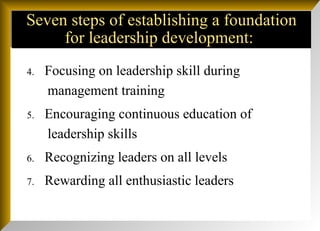
4.   Focusing on leadership skill during management training 5.   Encouraging continuous education of leadership skills 6.   Recognizing leaders on all levels 7.   Rewarding all enthusiastic leaders  Seven steps of establishing a foundation for leadership development:
Definitions Power Formal Leader The ability to command The person who act as leader Informal Leader Informal leaders are perceived by others as showing higher levels of leading than formal leaders overall. Formal Authority Right to command employees, given you by the organization MBWA Management by Wandering (Walking) Around more
Leadership Styles Autocratic Bureaucratic Making decisions without input from staff. Give orders without explanation “ Manage by the book”.  Be a “Police Officer” Democratic (Participative) Share decision making responsibility. Input from employees. Laissez-faire “ Lead as little as possible” more
Old-Style Boss  PROS Some workers respond to a command-obey style of direction Can be effective Can be necessary   CONS Average American does not respond to autocratic style More likely to increase problems than to lessen them Breeds resentment, low morale, and adversary relationship Customer service suffers and patrons go somewhere else
Theory X and Theory Y  Theory X’s Faulty Assumptions The “average human being” has an inborn dislike of work and will avoid it as much as possible. He or she must be “coerced, controlled, directed, threatened with punishment” to get the work done. He or she prefers to be led, avoids responsibility, lacks ambition, and wants security above all else.  Douglas McGregor
Theory X and Theory Y  Theory Y Propositions Work is as natural as play or rest; people do not inherently dislike it. People will work of their own accord toward objectives to which they feel committed without control or the threat of punishment. People become committed to objectives that fulfill their inner personal needs.
Theory X and Theory Y  Theory Y Propositions People can learn not only to accept responsibility but also to seek it. Lack of ambition, avoidance of responsibility, and the desire for security are not innate human characteristics. Capacity for applying imagination, ingenuity, and creativity to solving on-the-job problems is “widely, not narrowly, distributed in the population.” The modern industrial organization uses only a portion of the intellectual potential of the average human being.
Theory X & Y Theory X Work is natural Capable of self-direction Seek responsibility Can make good decisions Work avoiding  Need to control Avoid responsibility Workers seek security Theory Y
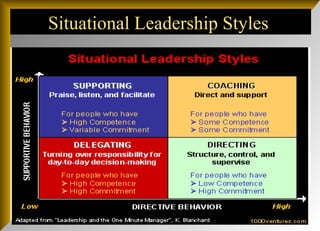
Situational Leadership Behaviors (Kenneth Blanchard and Paul Hersey) Directive Behaviors Supportive Behaviors
Situational Leadership Styles Directing Coaching Close supervision most effective for training or emergencies Direct supervision and support to build commitment Supportive Delegating Assists employees lacking commitment to improve performance “ Lead as little as possible” more
Situational Leadership Styles
Transactional Leadership ( Burns, 1978; Bass 1985) Transactional Leadership… Leadership is a process where a leader is able to bring about desired actions from others by using certain behaviors, rewards, or incentives Transactional leaders motivate workers by appealing to their self-interest
Transactional Leaders  Transactional leaders use conventional reward and punishment to gain compliance from their followers.  "Do as I say and you will get a raise." "Meet this quota or you will get fired." a typical statement:  «If you reach the quality goal, you‘ll get 5% of your annual wage as a bonus»
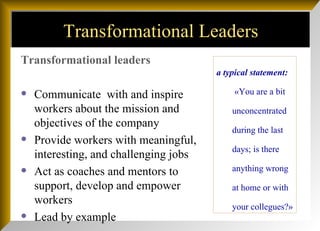
Transformational Leaders Transformational leaders Communicate  with and inspire workers about the mission and objectives of the company Provide workers with meaningful, interesting, and challenging jobs Act as coaches and mentors to support, develop and empower workers Lead by example  a typical statement:  «You are a bit unconcentrated during the last days; is there anything wrong at home or with your collegues?»
Transformational Leadership Transformational Leadership… Leadership is a process of eliciting performance above and beyond normal expectations Charisma Individual consideration Intellectual stimulation
Transformational Leadership Elements Transformational Leadership Communicating the Vision Modelling  the Vision Creating a Strategic Vision Building Commitment
Developing Your Own Style No one can teach you;   but  a lot of what the behavioral scientists are saying can be very useful to you.  Theory  X  makes people unproductive and worst counterproductive. Theory  Y  satisfy inner needs as self respect, achievement, independence, responsibility status, and growth. How you behave, your leadership style Who your followers are: their competence and motivation for a given task The match between how and who What leadership skills you can apply
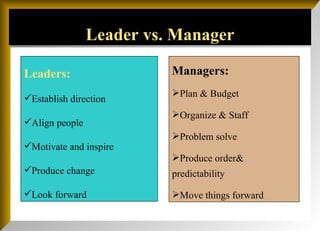
Leaders: Establish direction Align people Motivate and inspire Produce change Look forward Leader vs. Manager Managers: Plan & Budget Organize & Staff Problem solve Produce order& predictability Move things forward
.. L.E.A.D.E.R.S.H.I.P. L oyalty E xcellence A ttitude D etermination E nergy R esponsibility S tandards H onor I nspiration P erformance
Leaders and Managers:  Distinguishing their Roles Establish organizational mission Formulate Strategy for implementing mission Implement organizational strategy Leader’s Job Manager’s Job
Examples of Applying Theory Situation Leader Followers Outcomes Substandard performance (no rewards for performance) Reduced role ambiguity (clearer effort-to-performance links) Newly formed work unit Directive behaviors  (tell followers what to do and how to do it) Directive behaviors  (make rewards available and contingent on performance) Clearer performance-to-reward links (increased valence) Higher effort Higher satisfaction Higher effort Higher satisfaction
.. “ Always dream and shot higher than you know you can do. Don’t bother just to be better than your contemporaries or predecessors. Try to be better than yourself” Old Chinese Proverb
Thanking You By:- super VAR

Leader

  • 1.
    The Supervisor as Leader
  • 2.
    Overview You andYour People The Nature of Leadership Choosing a Leadership Style
  • 3.
    “ Managers arepeople who do things right; Leaders are people who do right things.”
  • 4.
    “ Leadership issimply the process of influencing someone to do something that he or she might otherwise not do.” Dr. Paul Hersey Chairman, Center for Leadership Studies
  • 5.
    Great people talkabout ideas. Average people talk about things. Small people talk about other people.        -- Author: Unknown
  • 6.
    Definitions Autocratic leaderCarrot-and stick technique Coaching style Delegating style Directing style Formal authority Formal leader Generation X Informal leader Leader Leadership style MBWA Power Real authority Situational leadership Supporting style Theory X Theory Y Transactional leader Transformational leader
  • 7.
    You and YourPeople The hospitality industry:70 percent part-time job. No special skill, ability or experience is required. Turnover rate of hourly workers in restaurants is 100 % Diverse workplace Approximately half of the foodservice workers 18-34 years a group referred to as Generation X. At least 50% of both food service and hotel workers are women Employees do not want a militant fashion supervisors Supervisors and managers are essentials in the hospitality
  • 8.
    The Nature ofLeadership Leader: Someone who guides or influences the actions of his or her employees to reach certain goals. An important managerial function is to be a leader A leader is a person whom people follow voluntarily. You have to get people to work for you willingly and to the best of their ability . Many leadership skills are innate; not all managers make great leaders.
  • 9.
    The Jobs andthe Workers Characteristics of the Hospitality Industry Many low-wage, entry level positions Semi-skilled or skilled positions Generation X ( born between 1964-1979) Generation Y (born between 1980-1990) Employees do not want supervisors to bark orders in a militant fashion, they want training and expect management to invest time and money on their training and development High turnover 60% women workers Minority workers
  • 10.
    Characteristics of LeadersCharacteristics of Leaders Drive Desire to influence others Honesty & Moral character Self-confidence Intelligence Relevant knowledge
  • 11.
    Characteristics of LeadersPrimary Sources of Power Legitimate power Reward Power Coercive power Expert power
  • 12.
    Seven steps ofestablishing a foundation for leadership development: Investing time, resources, and money to create a supportive culture Defining the differences between management skills and leadership abilities Developing quantifiable measurable that support leadership skills
  • 13.
    4. Focusing on leadership skill during management training 5. Encouraging continuous education of leadership skills 6. Recognizing leaders on all levels 7. Rewarding all enthusiastic leaders Seven steps of establishing a foundation for leadership development:
  • 14.
    Definitions Power FormalLeader The ability to command The person who act as leader Informal Leader Informal leaders are perceived by others as showing higher levels of leading than formal leaders overall. Formal Authority Right to command employees, given you by the organization MBWA Management by Wandering (Walking) Around more
  • 15.
    Leadership Styles AutocraticBureaucratic Making decisions without input from staff. Give orders without explanation “ Manage by the book”. Be a “Police Officer” Democratic (Participative) Share decision making responsibility. Input from employees. Laissez-faire “ Lead as little as possible” more
  • 16.
    Old-Style Boss PROS Some workers respond to a command-obey style of direction Can be effective Can be necessary CONS Average American does not respond to autocratic style More likely to increase problems than to lessen them Breeds resentment, low morale, and adversary relationship Customer service suffers and patrons go somewhere else
  • 17.
    Theory X andTheory Y Theory X’s Faulty Assumptions The “average human being” has an inborn dislike of work and will avoid it as much as possible. He or she must be “coerced, controlled, directed, threatened with punishment” to get the work done. He or she prefers to be led, avoids responsibility, lacks ambition, and wants security above all else. Douglas McGregor
  • 18.
    Theory X andTheory Y Theory Y Propositions Work is as natural as play or rest; people do not inherently dislike it. People will work of their own accord toward objectives to which they feel committed without control or the threat of punishment. People become committed to objectives that fulfill their inner personal needs.
  • 19.
    Theory X andTheory Y Theory Y Propositions People can learn not only to accept responsibility but also to seek it. Lack of ambition, avoidance of responsibility, and the desire for security are not innate human characteristics. Capacity for applying imagination, ingenuity, and creativity to solving on-the-job problems is “widely, not narrowly, distributed in the population.” The modern industrial organization uses only a portion of the intellectual potential of the average human being.
  • 20.
    Theory X &Y Theory X Work is natural Capable of self-direction Seek responsibility Can make good decisions Work avoiding Need to control Avoid responsibility Workers seek security Theory Y
  • 21.
    Situational Leadership Behaviors(Kenneth Blanchard and Paul Hersey) Directive Behaviors Supportive Behaviors
  • 22.
    Situational Leadership StylesDirecting Coaching Close supervision most effective for training or emergencies Direct supervision and support to build commitment Supportive Delegating Assists employees lacking commitment to improve performance “ Lead as little as possible” more
  • 23.
  • 24.
    Transactional Leadership (Burns, 1978; Bass 1985) Transactional Leadership… Leadership is a process where a leader is able to bring about desired actions from others by using certain behaviors, rewards, or incentives Transactional leaders motivate workers by appealing to their self-interest
  • 25.
    Transactional Leaders Transactional leaders use conventional reward and punishment to gain compliance from their followers. "Do as I say and you will get a raise." "Meet this quota or you will get fired." a typical statement: «If you reach the quality goal, you‘ll get 5% of your annual wage as a bonus»
  • 26.
    Transformational Leaders Transformationalleaders Communicate with and inspire workers about the mission and objectives of the company Provide workers with meaningful, interesting, and challenging jobs Act as coaches and mentors to support, develop and empower workers Lead by example a typical statement: «You are a bit unconcentrated during the last days; is there anything wrong at home or with your collegues?»
  • 27.
    Transformational Leadership TransformationalLeadership… Leadership is a process of eliciting performance above and beyond normal expectations Charisma Individual consideration Intellectual stimulation
  • 28.
    Transformational Leadership ElementsTransformational Leadership Communicating the Vision Modelling the Vision Creating a Strategic Vision Building Commitment
  • 29.
    Developing Your OwnStyle No one can teach you; but a lot of what the behavioral scientists are saying can be very useful to you. Theory X makes people unproductive and worst counterproductive. Theory Y satisfy inner needs as self respect, achievement, independence, responsibility status, and growth. How you behave, your leadership style Who your followers are: their competence and motivation for a given task The match between how and who What leadership skills you can apply
  • 30.
    Leaders: Establish directionAlign people Motivate and inspire Produce change Look forward Leader vs. Manager Managers: Plan & Budget Organize & Staff Problem solve Produce order& predictability Move things forward
  • 31.
    .. L.E.A.D.E.R.S.H.I.P. Loyalty E xcellence A ttitude D etermination E nergy R esponsibility S tandards H onor I nspiration P erformance
  • 32.
    Leaders and Managers: Distinguishing their Roles Establish organizational mission Formulate Strategy for implementing mission Implement organizational strategy Leader’s Job Manager’s Job
  • 33.
    Examples of ApplyingTheory Situation Leader Followers Outcomes Substandard performance (no rewards for performance) Reduced role ambiguity (clearer effort-to-performance links) Newly formed work unit Directive behaviors (tell followers what to do and how to do it) Directive behaviors (make rewards available and contingent on performance) Clearer performance-to-reward links (increased valence) Higher effort Higher satisfaction Higher effort Higher satisfaction
  • 34.
    .. “ Alwaysdream and shot higher than you know you can do. Don’t bother just to be better than your contemporaries or predecessors. Try to be better than yourself” Old Chinese Proverb
  • 35.