WHAT IS NITRIC ACID?
Nitric acid is the result of a number of chemical
reactions that produce a colorless corrosive and
toxic mineral acid which tends to have a yellow
color when stored for any length of time, due to an
accumulation of nitric oxides. It‟s scientific name is
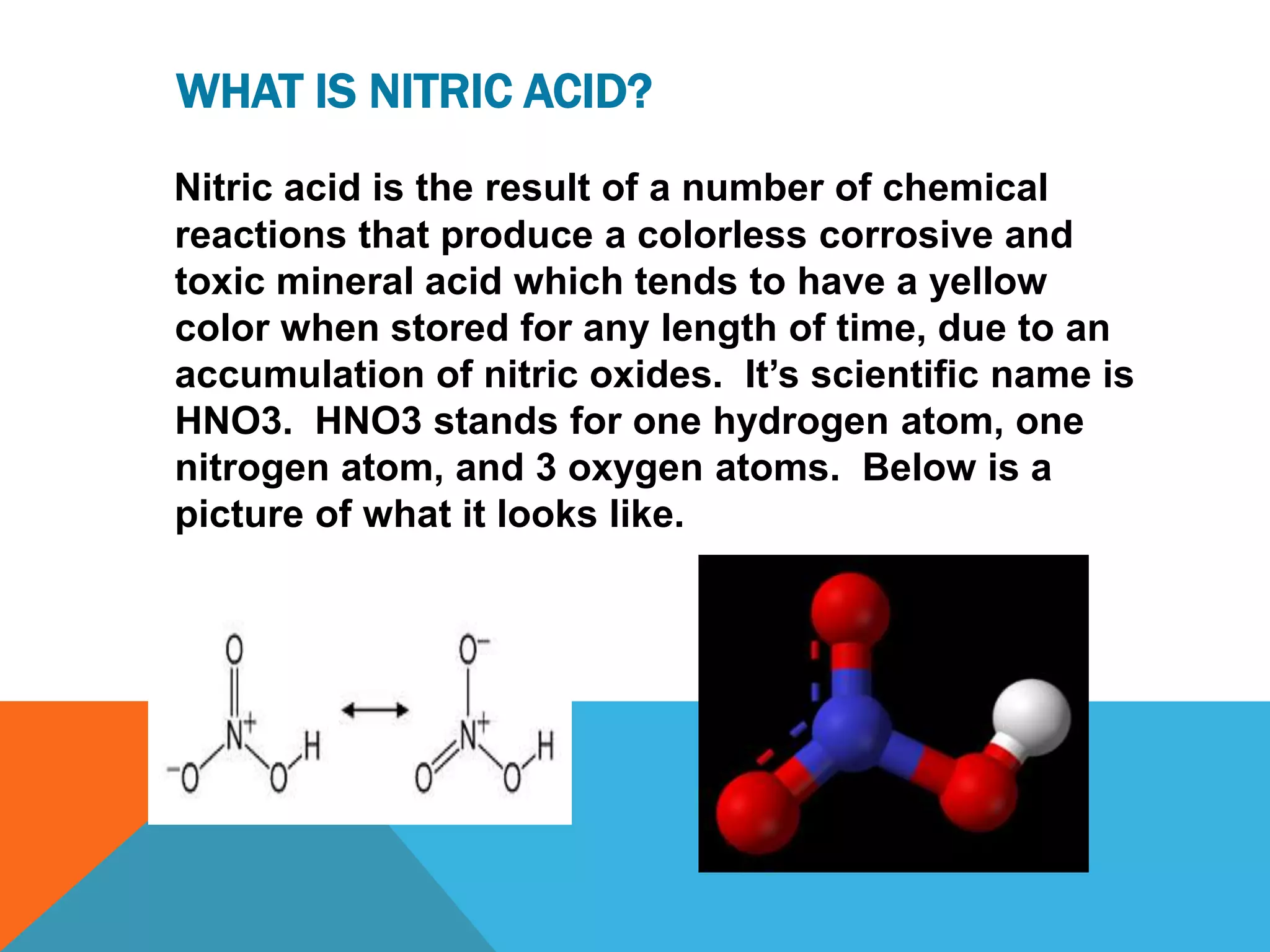
HNO3. HNO3 stands for one hydrogen atom, one
nitrogen atom, and 3 oxygen atoms. Below is a
picture of what it looks like.
NITRIC ACIDS HISTORY
Nitric Acid is thought to have been identified in the ninth
century by an Arabian alchemist and has had many
names such as “aqua fortis” and “spirit of niter”. It‟s
popularity or „‟rise to fame‟‟ if you will, was in the early
stages of the 20th century.
NITRIC ACID AND THE 20TH CENTURY
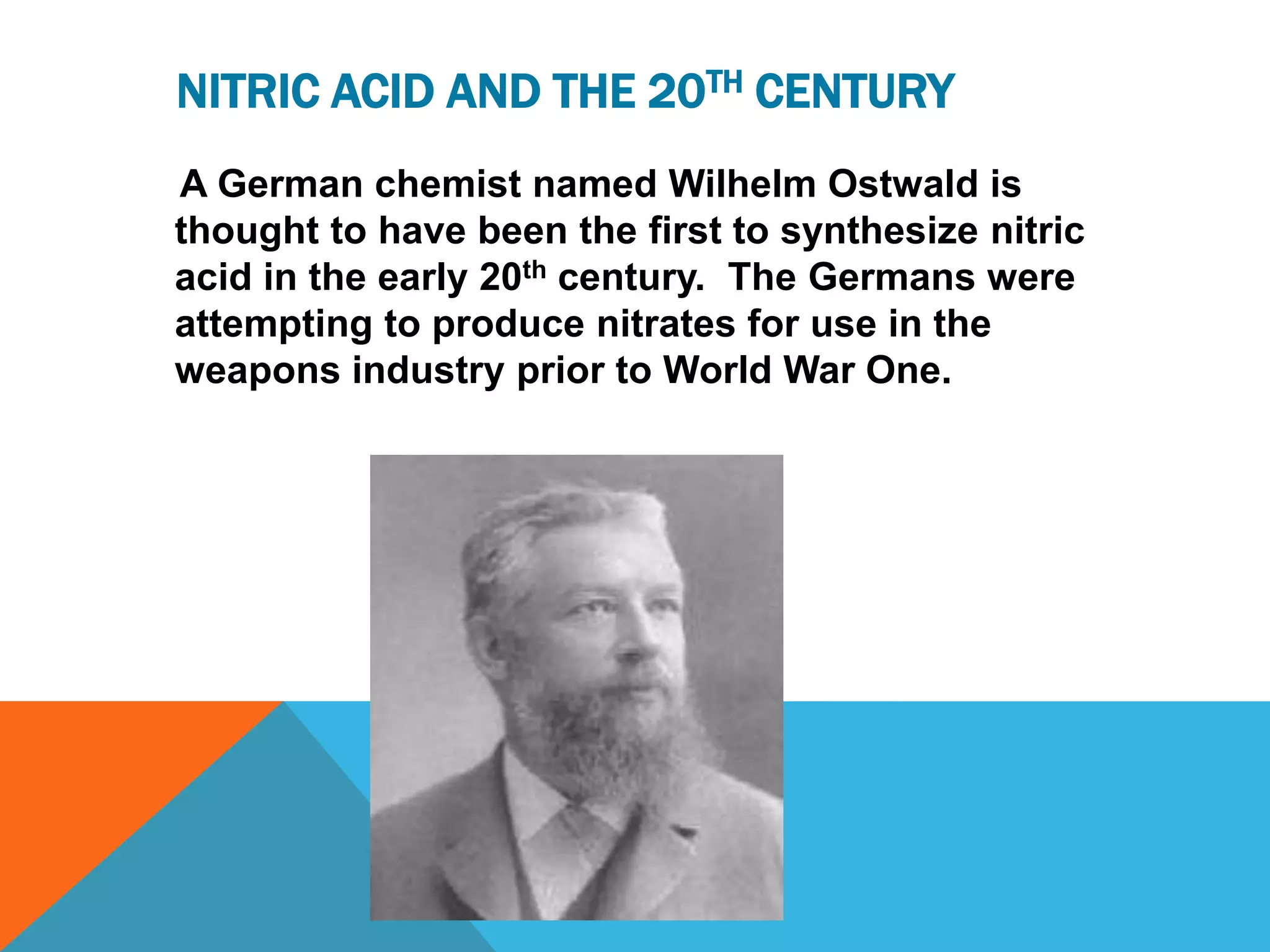
A German chemist named Wilhelm Ostwald is
thought to have been the first to synthesize nitric
acid in the early 20th century. The Germans were
attempting to produce nitrates for use in the
weapons industry prior to World War One.
NITRIC ACIDS CONCENTRATIONS
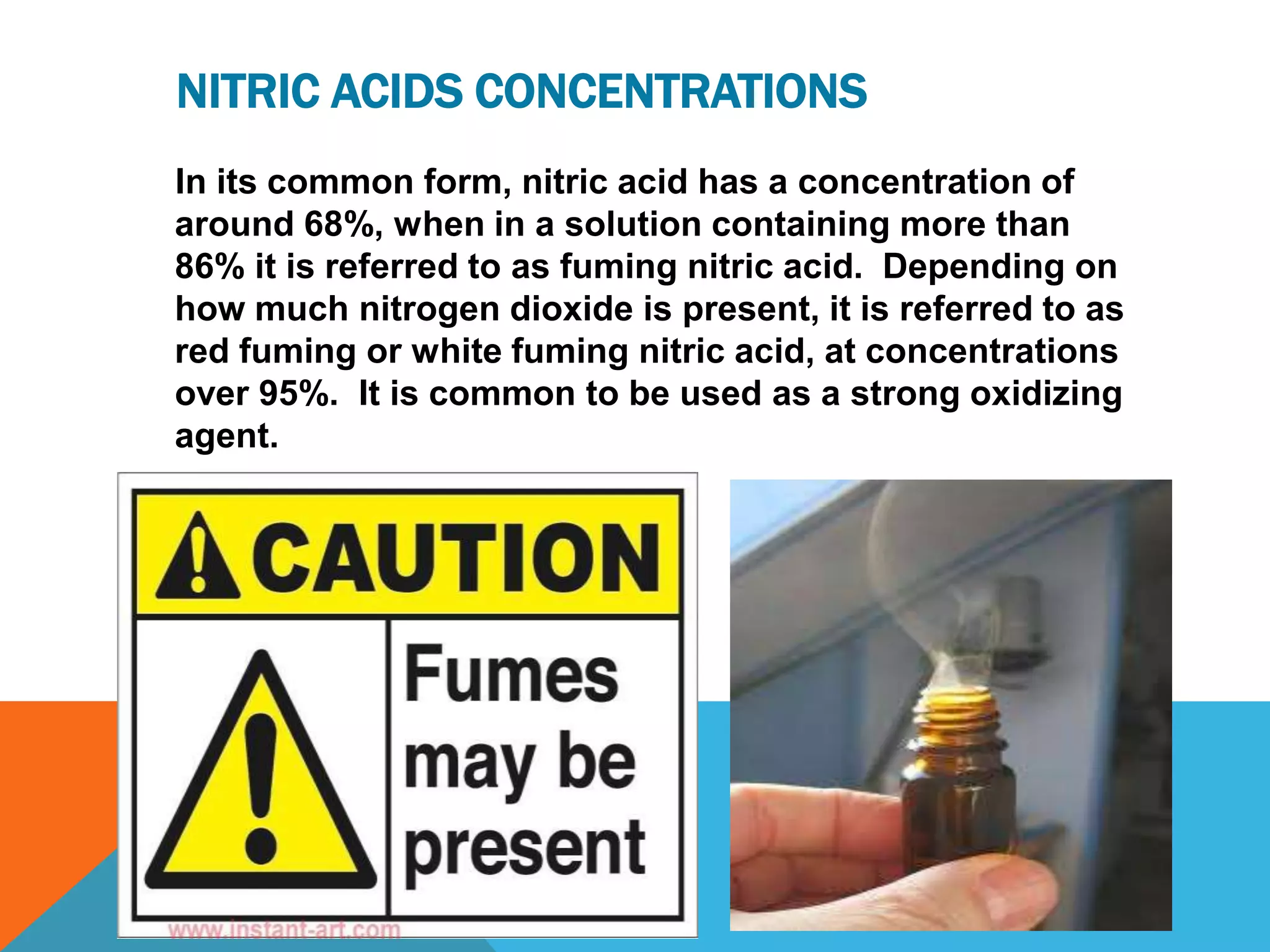
In its common form, nitric acid has a concentration of
around 68%, when in a solution containing more than
86% it is referred to as fuming nitric acid. Depending on
how much nitrogen dioxide is present, it is referred to as
red fuming or white fuming nitric acid, at concentrations
over 95%. It is common to be used as a strong oxidizing
agent.
NITRIC ACIDS PROPERTIES

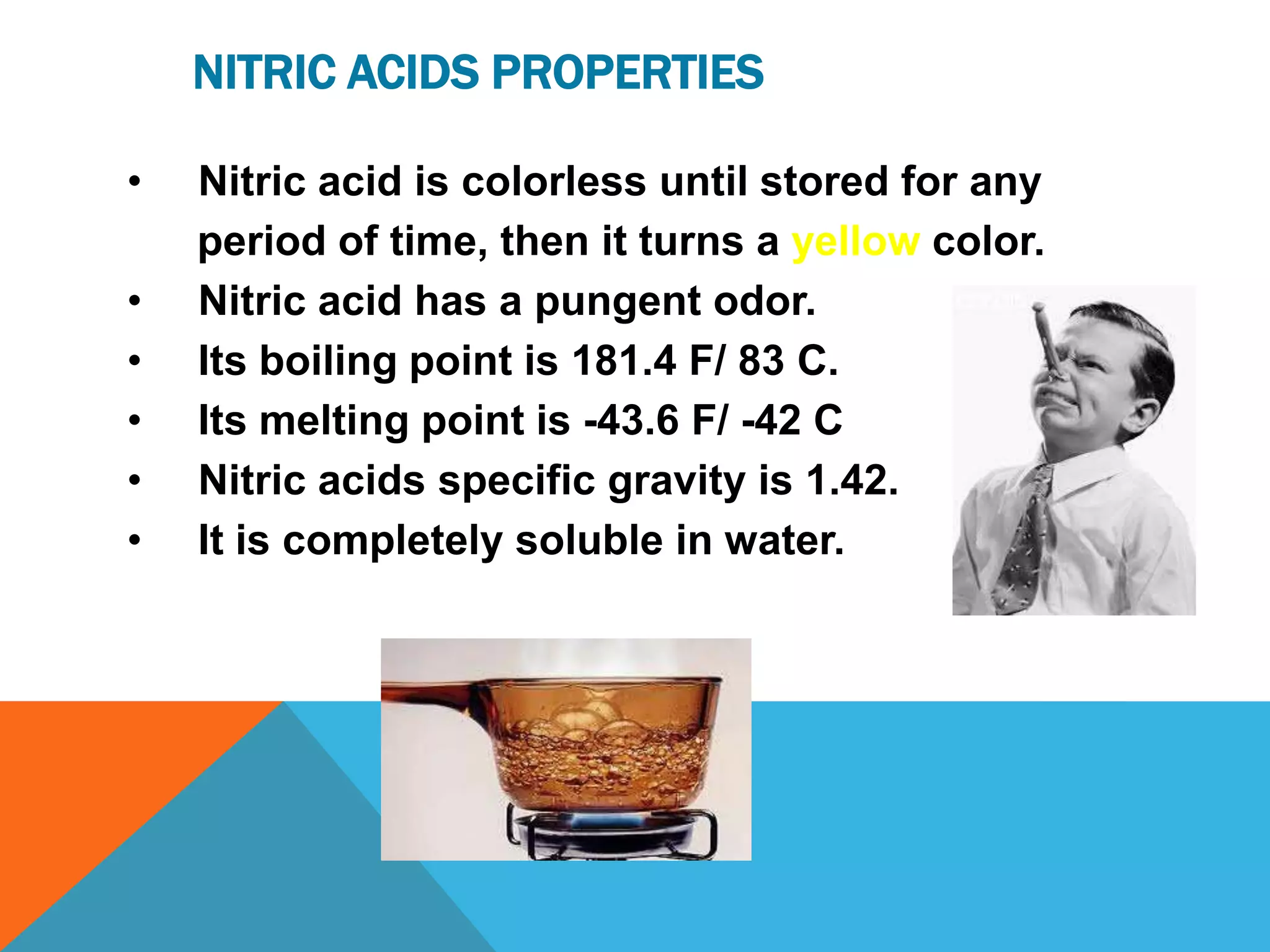
•   Nitric acid is colorless until stored for any
    period of time, then it turns a yellow color.
•   Nitric acid has a pungent odor.
•   Its boiling point is 181.4 F/ 83 C.
•   Its melting point is -43.6 F/ -42 C
•   Nitric acids specific gravity is 1.42.
•   It is completely soluble in water.
NITRIC ACIDS PROPERTIES
• Nitric acids odor threshold is 0.29 to 0.98 ppm
• Nitric acids molecular weight is 63.01 g/mol
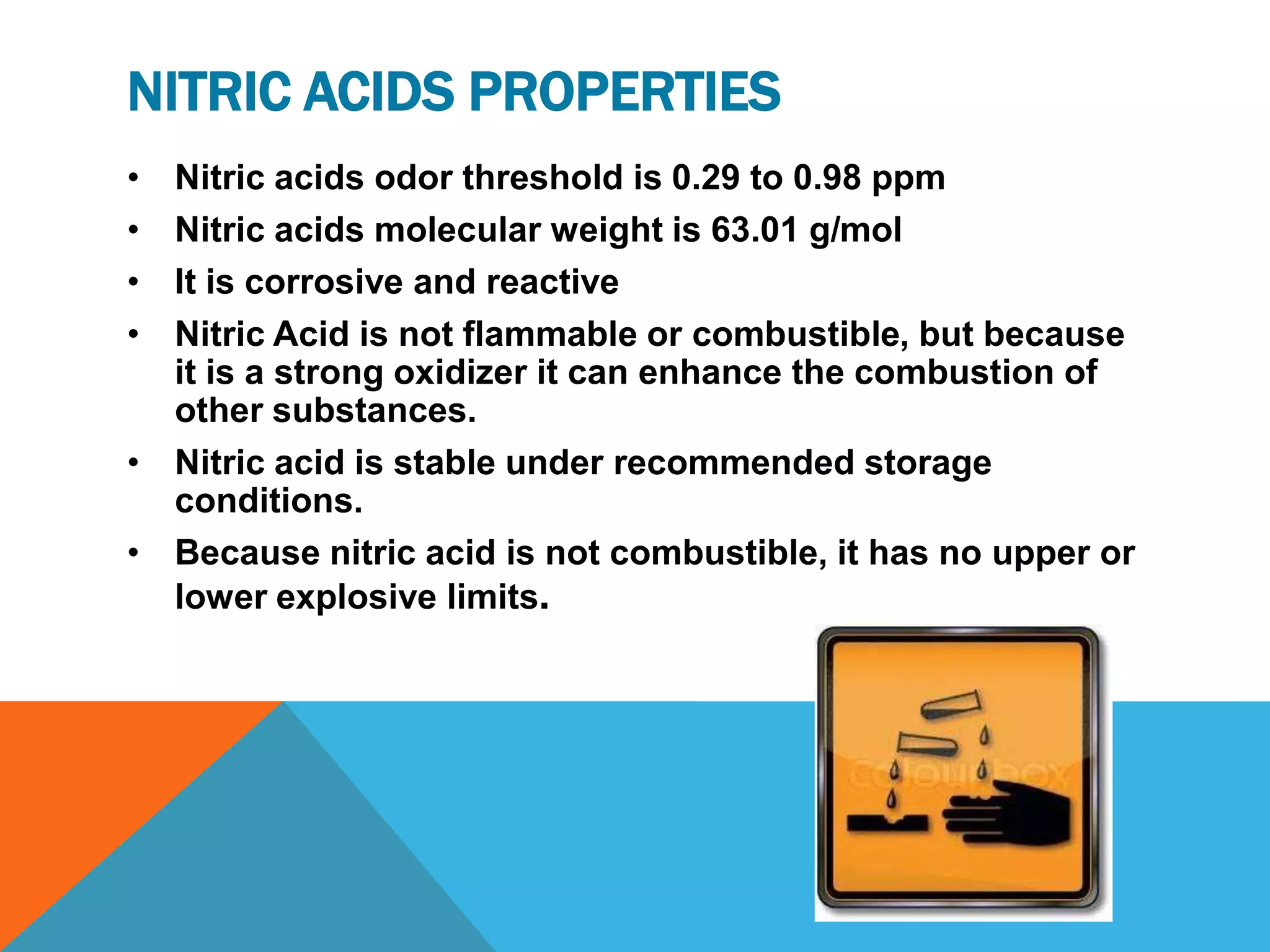
• It is corrosive and reactive
• Nitric Acid is not flammable or combustible, but because
  it is a strong oxidizer it can enhance the combustion of
  other substances.
• Nitric acid is stable under recommended storage
  conditions.
• Because nitric acid is not combustible, it has no upper or
  lower explosive limits.
FIREFIGHTER HAZARDS OF NITRIC ACID
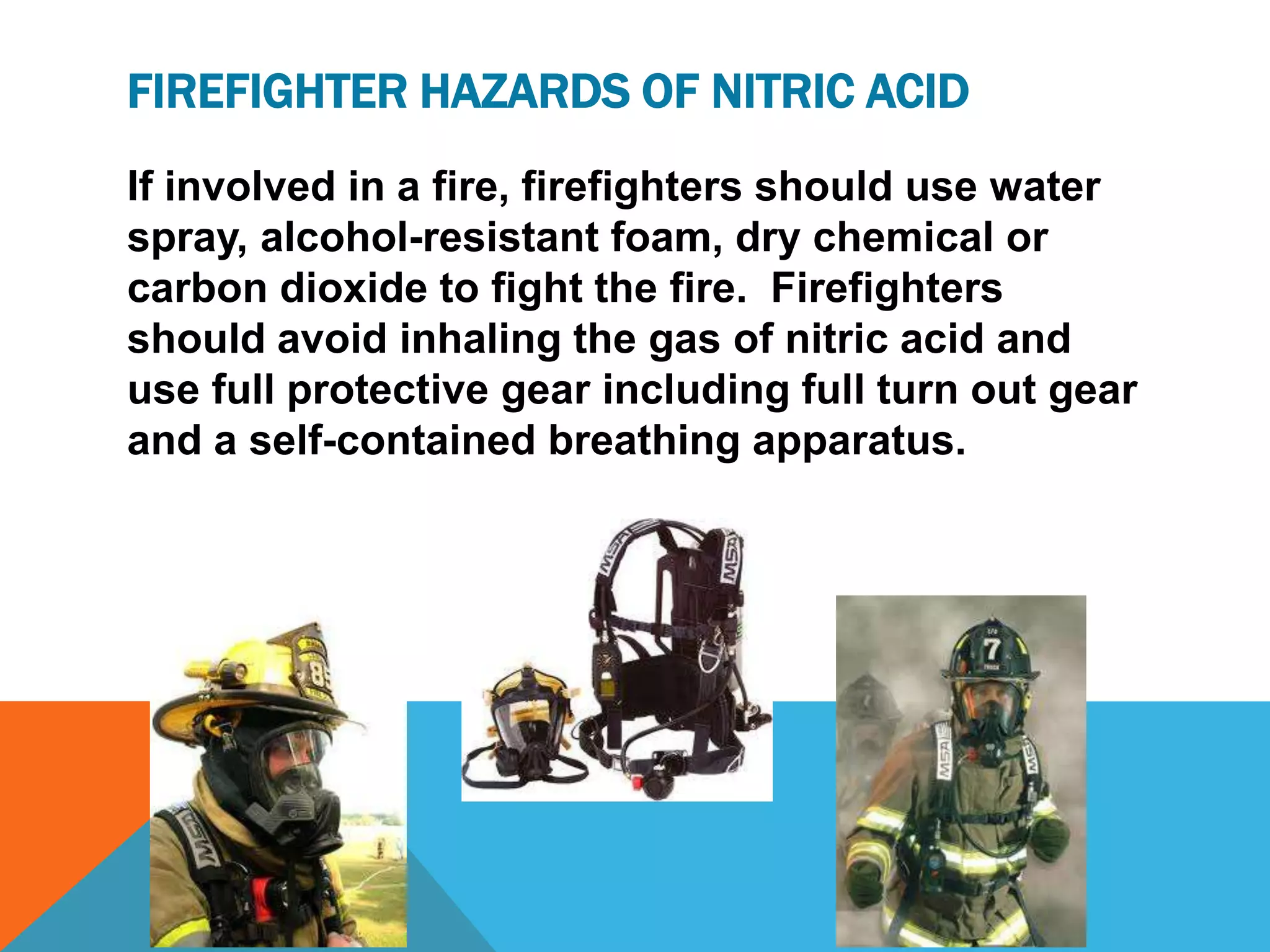
If involved in a fire, firefighters should use water
spray, alcohol-resistant foam, dry chemical or
carbon dioxide to fight the fire. Firefighters
should avoid inhaling the gas of nitric acid and
use full protective gear including full turn out gear
and a self-contained breathing apparatus.
PROPER PERSONAL PROTECTIVE EQUIPMENT
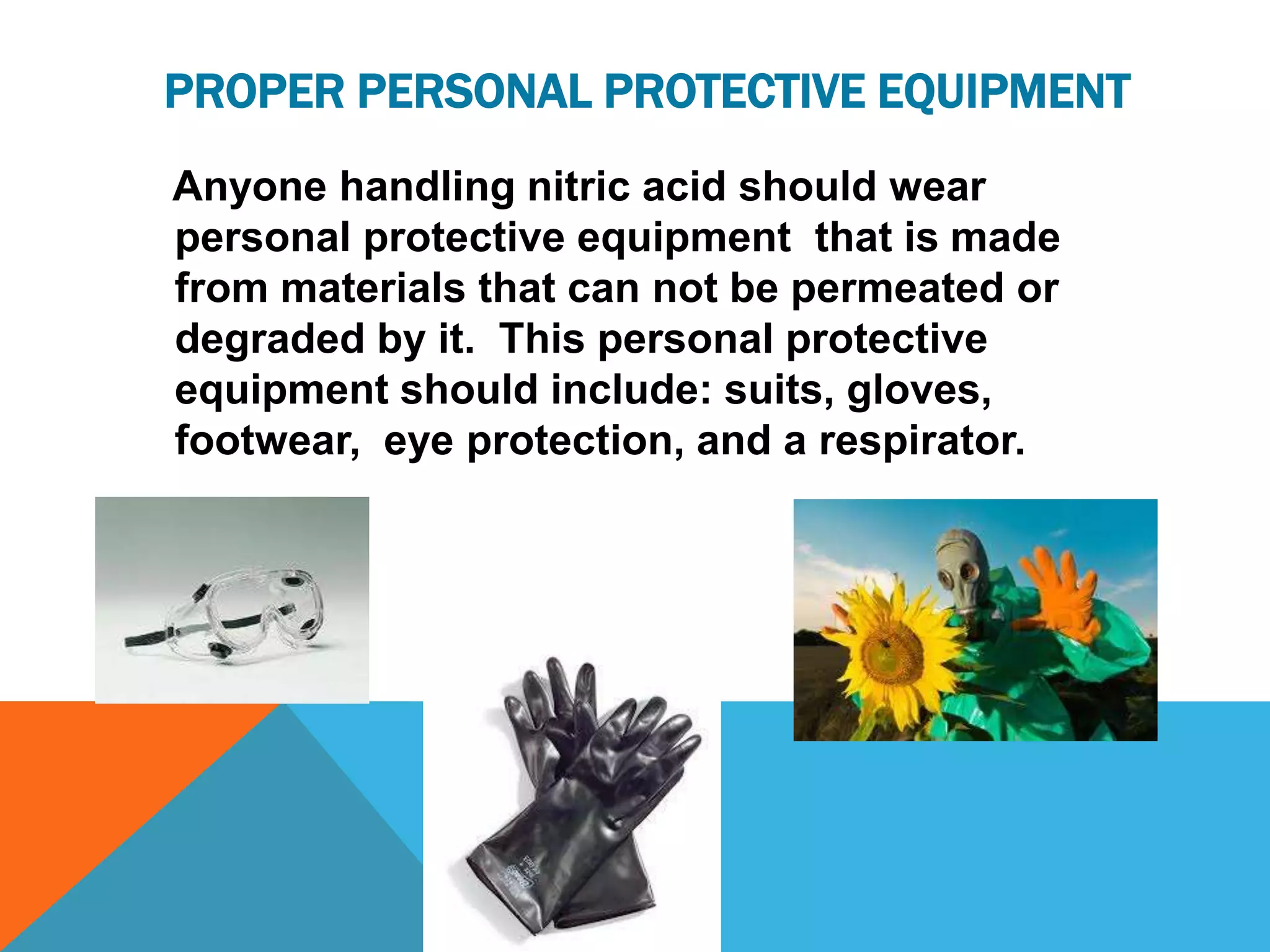
Anyone handling nitric acid should wear
personal protective equipment that is made
from materials that can not be permeated or
degraded by it. This personal protective
equipment should include: suits, gloves,
footwear, eye protection, and a respirator.
UNUSUAL FIRE AND EXPLOSION HAZARDS
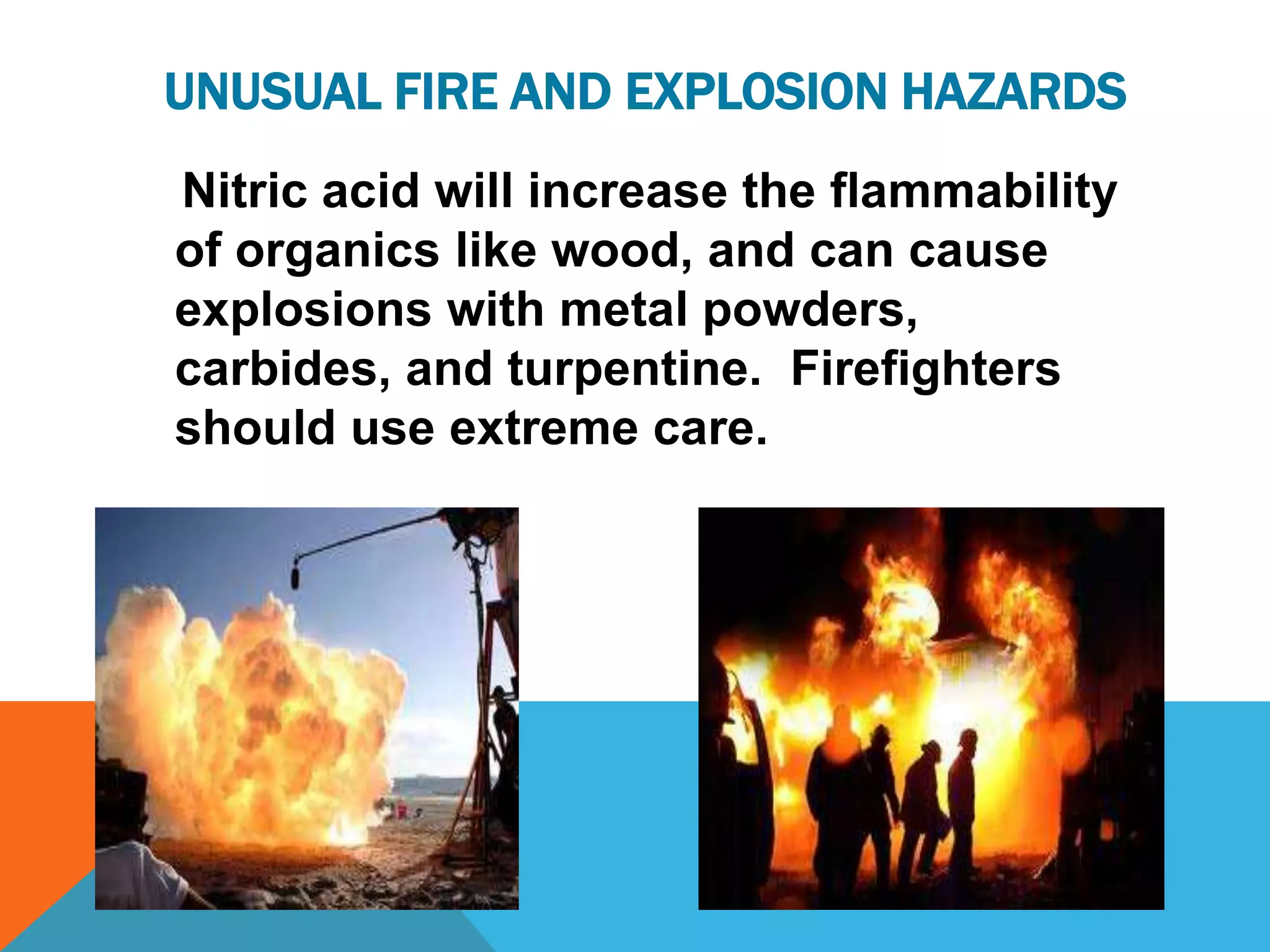
Nitric acid will increase the flammability
of organics like wood, and can cause
explosions with metal powders,
carbides, and turpentine. Firefighters
should use extreme care.
NITRIC ACIDS USES
• Nitric Acid is commonly used in industry and
  agriculture.
• It is highly used in the manufacturing of
  explosives.
• It is a component of solid rocket fuels, and acts
  as an oxidizer.
• It is used as a chemical reagent to identify
  various other metals.
NITRIC ACIDS USES
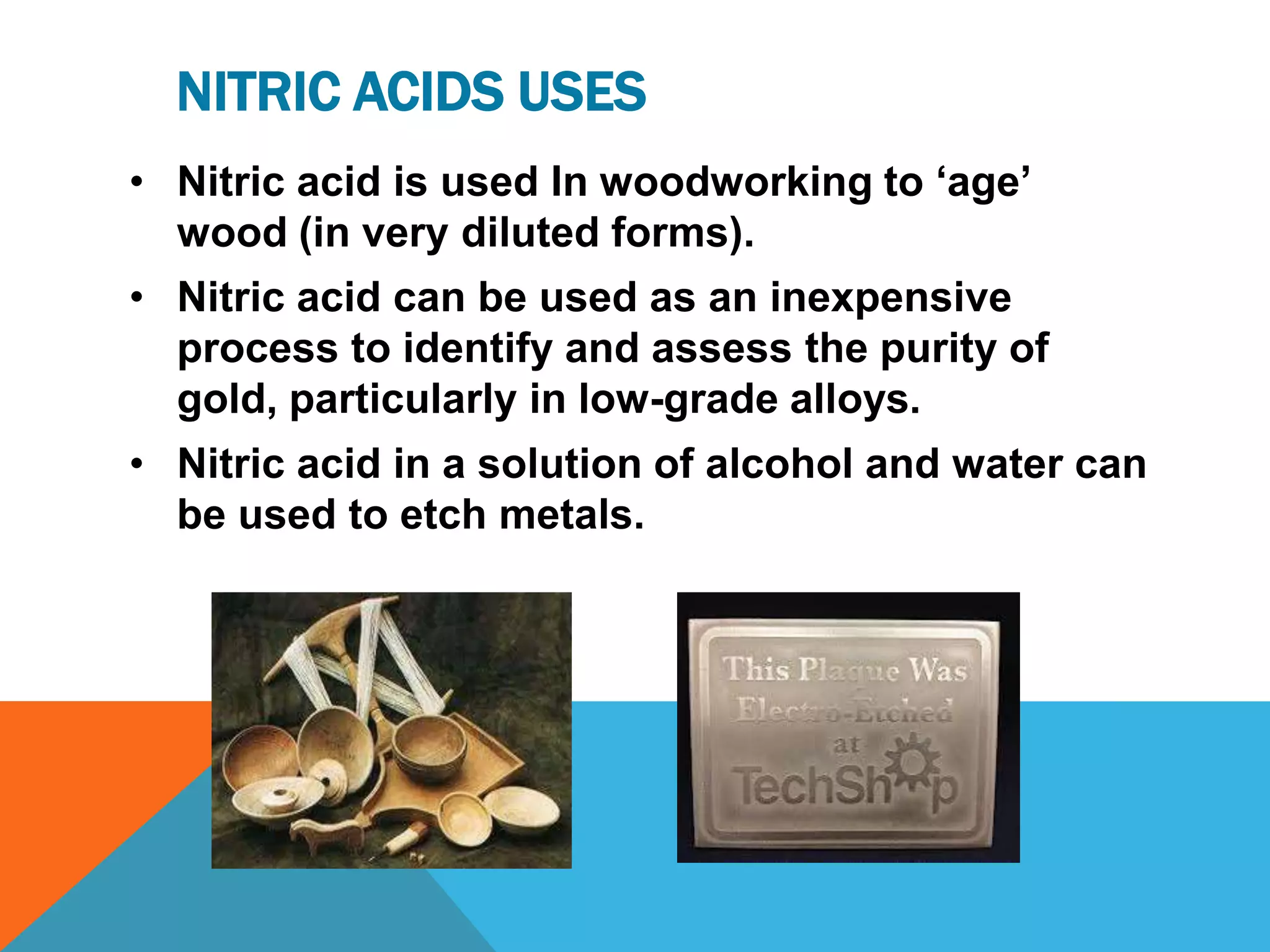
• Nitric acid is used In woodworking to „age‟
  wood (in very diluted forms).
• Nitric acid can be used as an inexpensive
  process to identify and assess the purity of
  gold, particularly in low-grade alloys.
• Nitric acid in a solution of alcohol and water can
  be used to etch metals.
NITRIC ACIDS USES
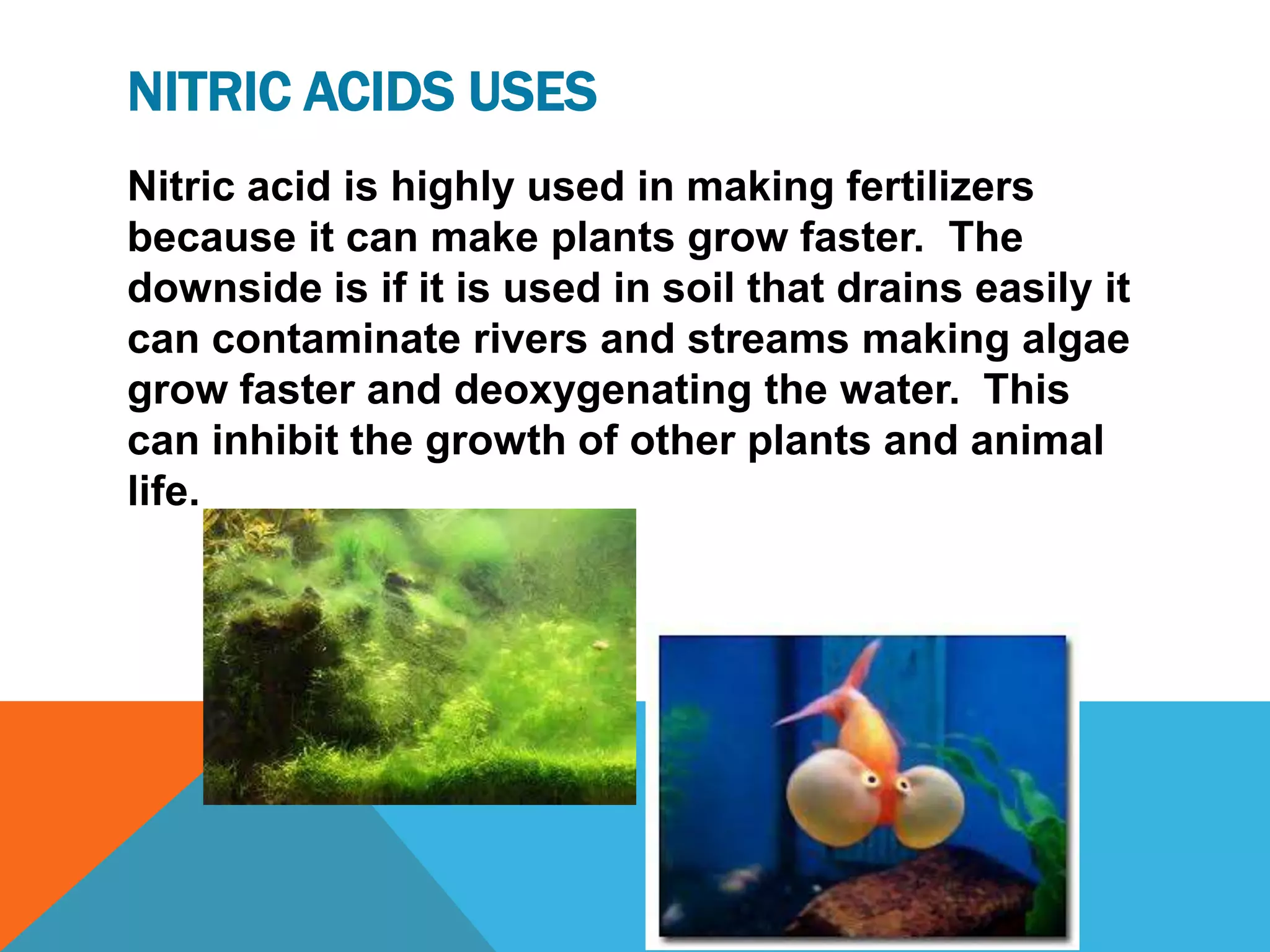
Nitric acid is highly used in making fertilizers
because it can make plants grow faster. The
downside is if it is used in soil that drains easily it
can contaminate rivers and streams making algae
grow faster and deoxygenating the water. This
can inhibit the growth of other plants and animal
life.
HEALTH HAZARDS OF NITRIC ACID

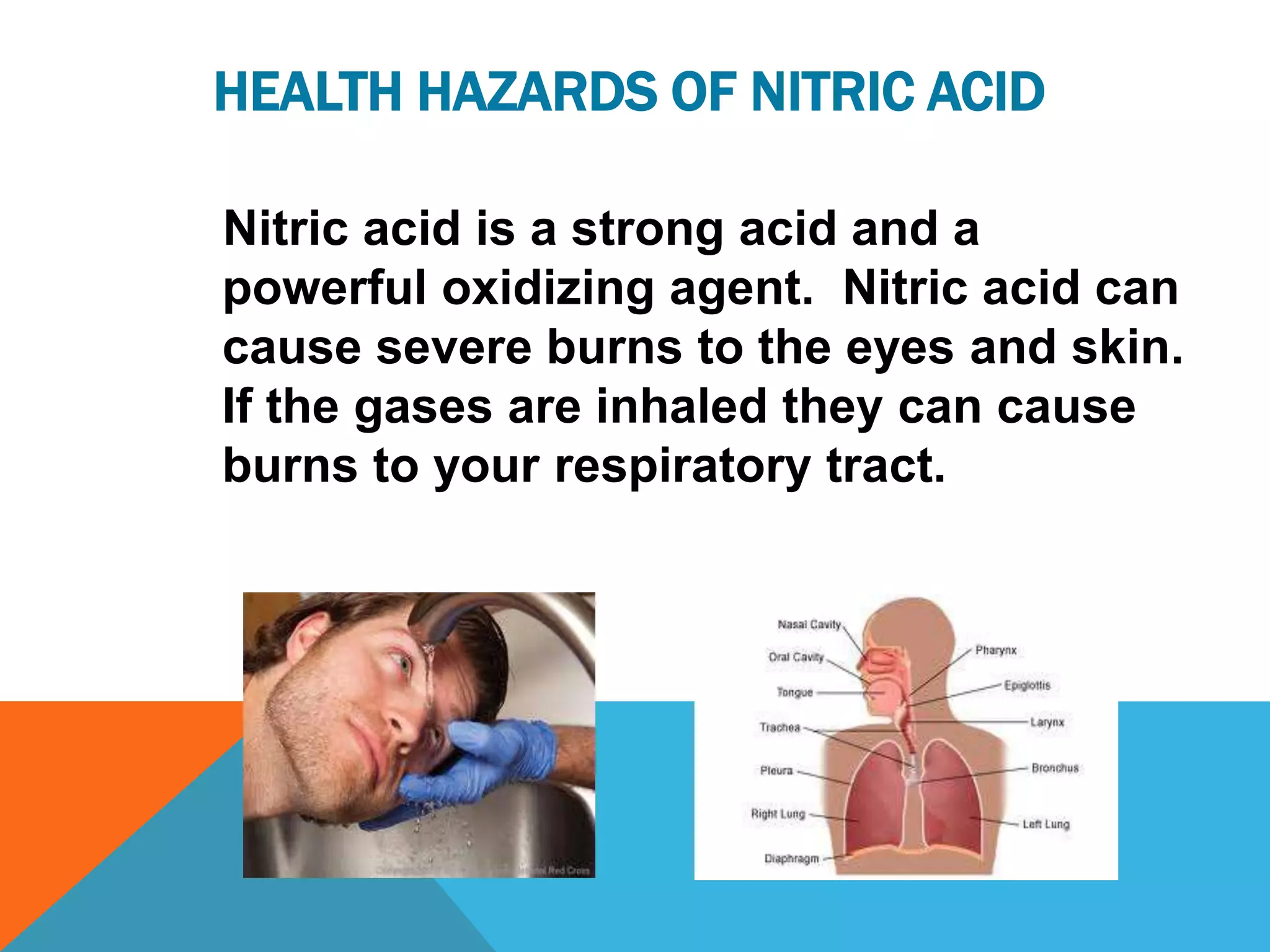
Nitric acid is a strong acid and a
powerful oxidizing agent. Nitric acid can
cause severe burns to the eyes and skin.
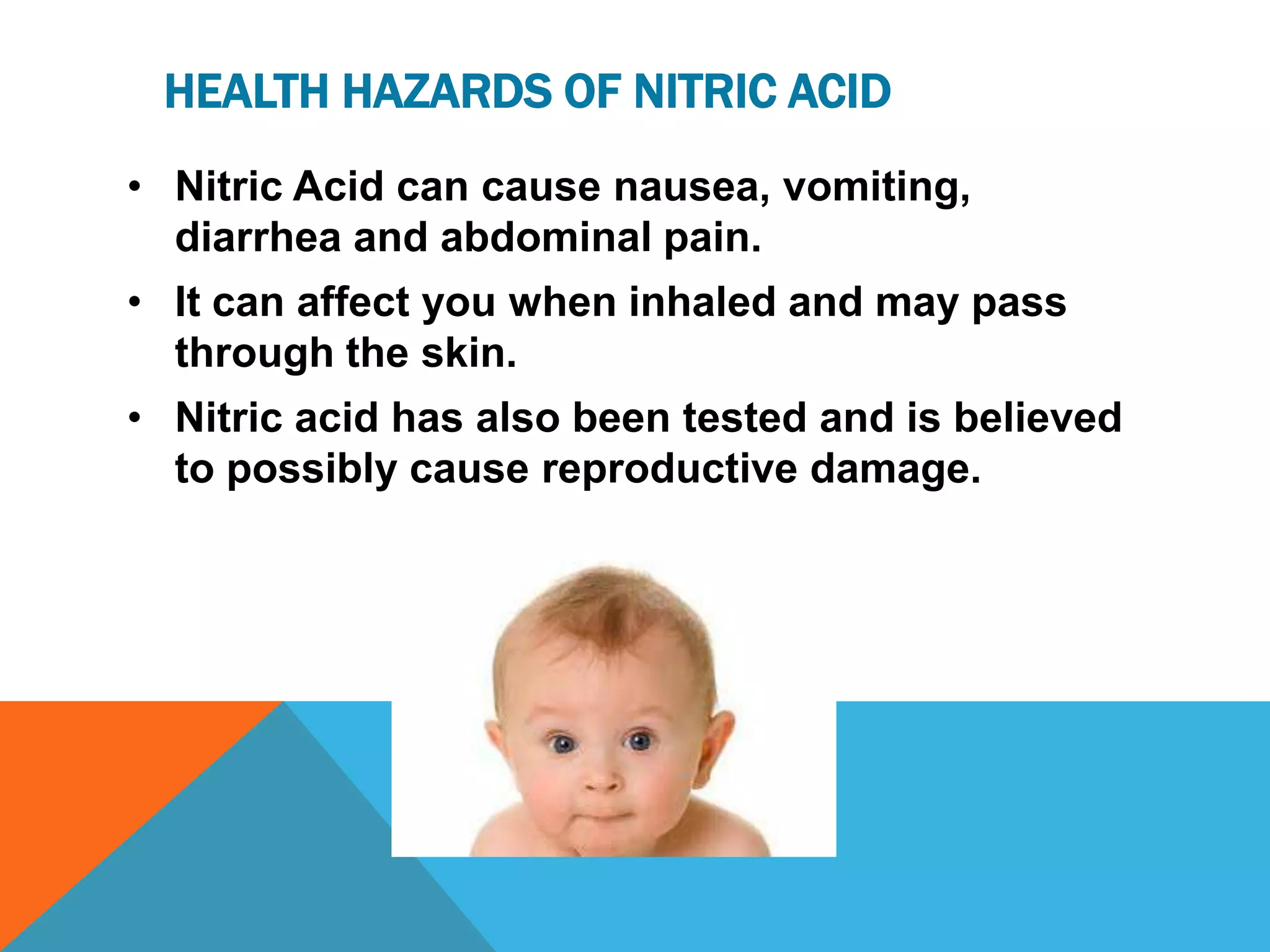
If the gases are inhaled they can cause
burns to your respiratory tract.
HEALTH HAZARDS OF NITRIC ACID
• Nitric Acid can cause nausea, vomiting,
  diarrhea and abdominal pain.
• It can affect you when inhaled and may pass
  through the skin.
• Nitric acid has also been tested and is believed
  to possibly cause reproductive damage.
HOW TO HANDLE SPILLS AND EMERGENCIES
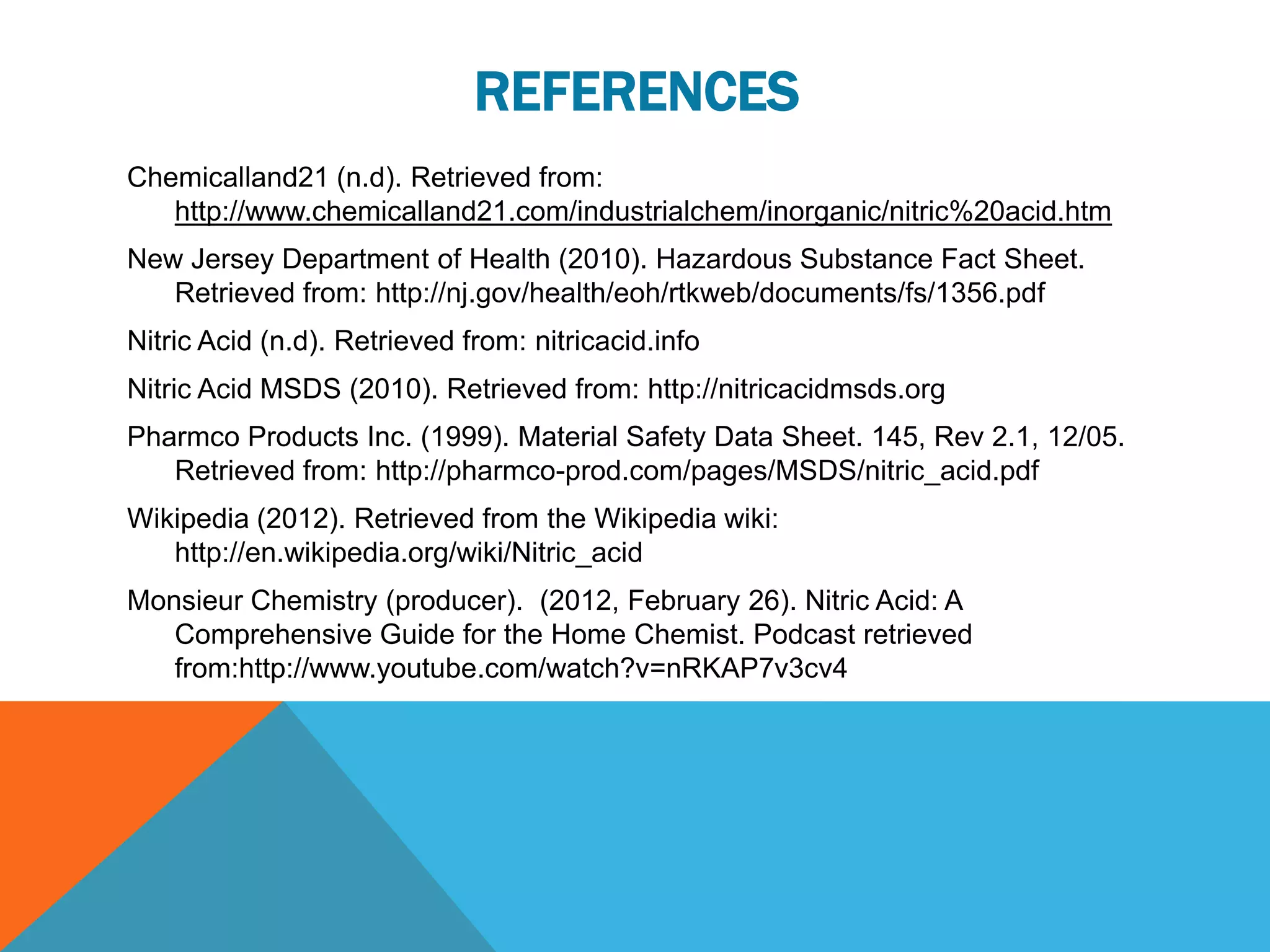
 If nitric acid is spilled or leaked and personnel are
involved you should evacuate them right away. Only
properly trained personnel should attempt to clean up
spills. You should ventilate the area of the spill or leak
and try to neutralize it with an alkaline. You should
absorb the liquid with a non-combustible material like
sand and put it in sealed containers. It may be necessary
to dispose of it as Hazardous Material.
MONSIEUR CHEMISTRY VIDEO
http://www.youtube.com/watch?v=nRKAP7v3cv4
REFERENCES
Chemicalland21 (n.d). Retrieved from:
   http://www.chemicalland21.com/industrialchem/inorganic/nitric%20acid.htm
New Jersey Department of Health (2010). Hazardous Substance Fact Sheet.
   Retrieved from: http://nj.gov/health/eoh/rtkweb/documents/fs/1356.pdf
Nitric Acid (n.d). Retrieved from: nitricacid.info
Nitric Acid MSDS (2010). Retrieved from: http://nitricacidmsds.org
Pharmco Products Inc. (1999). Material Safety Data Sheet. 145, Rev 2.1, 12/05.
   Retrieved from: http://pharmco-prod.com/pages/MSDS/nitric_acid.pdf
Wikipedia (2012). Retrieved from the Wikipedia wiki:
   http://en.wikipedia.org/wiki/Nitric_acid
Monsieur Chemistry (producer). (2012, February 26). Nitric Acid: A
   Comprehensive Guide for the Home Chemist. Podcast retrieved
   from:http://www.youtube.com/watch?v=nRKAP7v3cv4

Nitric acid presentation

  • 2.
    WHAT IS NITRICACID? Nitric acid is the result of a number of chemical reactions that produce a colorless corrosive and toxic mineral acid which tends to have a yellow color when stored for any length of time, due to an accumulation of nitric oxides. It‟s scientific name is HNO3. HNO3 stands for one hydrogen atom, one nitrogen atom, and 3 oxygen atoms. Below is a picture of what it looks like.
  • 3.
    NITRIC ACIDS HISTORY NitricAcid is thought to have been identified in the ninth century by an Arabian alchemist and has had many names such as “aqua fortis” and “spirit of niter”. It‟s popularity or „‟rise to fame‟‟ if you will, was in the early stages of the 20th century.
  • 4.
    NITRIC ACID ANDTHE 20TH CENTURY A German chemist named Wilhelm Ostwald is thought to have been the first to synthesize nitric acid in the early 20th century. The Germans were attempting to produce nitrates for use in the weapons industry prior to World War One.
  • 5.
    NITRIC ACIDS CONCENTRATIONS Inits common form, nitric acid has a concentration of around 68%, when in a solution containing more than 86% it is referred to as fuming nitric acid. Depending on how much nitrogen dioxide is present, it is referred to as red fuming or white fuming nitric acid, at concentrations over 95%. It is common to be used as a strong oxidizing agent.
  • 6.
    NITRIC ACIDS PROPERTIES • Nitric acid is colorless until stored for any period of time, then it turns a yellow color. • Nitric acid has a pungent odor. • Its boiling point is 181.4 F/ 83 C. • Its melting point is -43.6 F/ -42 C • Nitric acids specific gravity is 1.42. • It is completely soluble in water.
  • 7.
    NITRIC ACIDS PROPERTIES •Nitric acids odor threshold is 0.29 to 0.98 ppm • Nitric acids molecular weight is 63.01 g/mol • It is corrosive and reactive • Nitric Acid is not flammable or combustible, but because it is a strong oxidizer it can enhance the combustion of other substances. • Nitric acid is stable under recommended storage conditions. • Because nitric acid is not combustible, it has no upper or lower explosive limits.
  • 8.
    FIREFIGHTER HAZARDS OFNITRIC ACID If involved in a fire, firefighters should use water spray, alcohol-resistant foam, dry chemical or carbon dioxide to fight the fire. Firefighters should avoid inhaling the gas of nitric acid and use full protective gear including full turn out gear and a self-contained breathing apparatus.
  • 9.
    PROPER PERSONAL PROTECTIVEEQUIPMENT Anyone handling nitric acid should wear personal protective equipment that is made from materials that can not be permeated or degraded by it. This personal protective equipment should include: suits, gloves, footwear, eye protection, and a respirator.
  • 10.
    UNUSUAL FIRE ANDEXPLOSION HAZARDS Nitric acid will increase the flammability of organics like wood, and can cause explosions with metal powders, carbides, and turpentine. Firefighters should use extreme care.
  • 11.
    NITRIC ACIDS USES •Nitric Acid is commonly used in industry and agriculture. • It is highly used in the manufacturing of explosives. • It is a component of solid rocket fuels, and acts as an oxidizer. • It is used as a chemical reagent to identify various other metals.
  • 12.
    NITRIC ACIDS USES •Nitric acid is used In woodworking to „age‟ wood (in very diluted forms). • Nitric acid can be used as an inexpensive process to identify and assess the purity of gold, particularly in low-grade alloys. • Nitric acid in a solution of alcohol and water can be used to etch metals.
  • 13.
    NITRIC ACIDS USES Nitricacid is highly used in making fertilizers because it can make plants grow faster. The downside is if it is used in soil that drains easily it can contaminate rivers and streams making algae grow faster and deoxygenating the water. This can inhibit the growth of other plants and animal life.
  • 14.
    HEALTH HAZARDS OFNITRIC ACID Nitric acid is a strong acid and a powerful oxidizing agent. Nitric acid can cause severe burns to the eyes and skin. If the gases are inhaled they can cause burns to your respiratory tract.
  • 15.
    HEALTH HAZARDS OFNITRIC ACID • Nitric Acid can cause nausea, vomiting, diarrhea and abdominal pain. • It can affect you when inhaled and may pass through the skin. • Nitric acid has also been tested and is believed to possibly cause reproductive damage.
  • 16.
    HOW TO HANDLESPILLS AND EMERGENCIES If nitric acid is spilled or leaked and personnel are involved you should evacuate them right away. Only properly trained personnel should attempt to clean up spills. You should ventilate the area of the spill or leak and try to neutralize it with an alkaline. You should absorb the liquid with a non-combustible material like sand and put it in sealed containers. It may be necessary to dispose of it as Hazardous Material.
  • 17.
  • 18.
    REFERENCES Chemicalland21 (n.d). Retrievedfrom: http://www.chemicalland21.com/industrialchem/inorganic/nitric%20acid.htm New Jersey Department of Health (2010). Hazardous Substance Fact Sheet. Retrieved from: http://nj.gov/health/eoh/rtkweb/documents/fs/1356.pdf Nitric Acid (n.d). Retrieved from: nitricacid.info Nitric Acid MSDS (2010). Retrieved from: http://nitricacidmsds.org Pharmco Products Inc. (1999). Material Safety Data Sheet. 145, Rev 2.1, 12/05. Retrieved from: http://pharmco-prod.com/pages/MSDS/nitric_acid.pdf Wikipedia (2012). Retrieved from the Wikipedia wiki: http://en.wikipedia.org/wiki/Nitric_acid Monsieur Chemistry (producer). (2012, February 26). Nitric Acid: A Comprehensive Guide for the Home Chemist. Podcast retrieved from:http://www.youtube.com/watch?v=nRKAP7v3cv4