Nitric acid
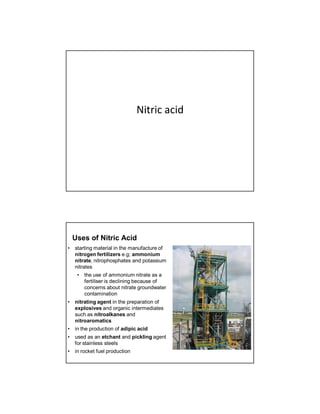
Uses of Nitric Acid
• starting material in the manufacture of
nitrogen fertilizers e.g; ammonium
nitrate, nitrophosphates and potassium
nitrates
• the use of ammonium nitrate as a
fertiliser is declining because of
concerns about nitrate groundwater
contamination
• nitrating agent in the preparation of
explosives and organic intermediates
such as nitroalkanes and
nitroaromatics
• in the production of adipic acid
• used as an etchant and pickling agent
for stainless steels
• in rocket fuel production
Nitric Acid Production
1. Chilean saltpeter or nitrate
2. Arc process or Birkeland and Eyde process
3. Ostwald's process or Ammonia oxidation process
Nitric Acid Production
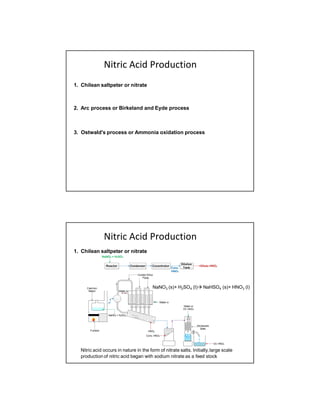
1. Chilean saltpeter or nitrate
Nitric acid occurs in nature in the form of nitrate salts. Initially,large scale
production of nitric acid began with sodium nitrate as a feed stock
NaNO3 (s)+ H2SO4 (l) NaHSO4 (s)+ HNO3 (l)
Nitric Acid Production
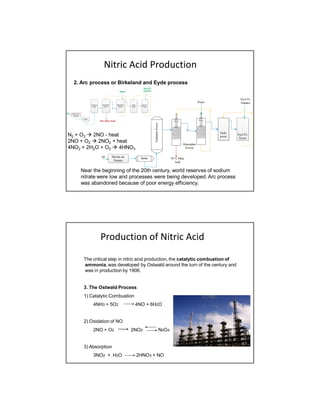
N2 + O2  2NO - heat
2NO + O2  2NO2 + heat
4NO2 + 2H2O + O2  4HNO3
2. Arc process or Birkeland and Eyde process
Near the beginning of the 20th century, world reserves of sodium
nitrate were low and processes were being developed. Arc process
was abandoned because of poor energy efficiency.
Production of Nitric Acid
The critical step in nitric acid production, the catalytic combustion of
ammonia,was developed by Ostwald around the turn of the century and
was in production by 1906.
3. The Ostwald Process
1) Catalytic Combustion
4NH3 + 5O2 4NO + 6H2O
2) Oxidation of NO
2NO + O2 2NO2 N2O4
3) Absorption
3NO2 + H2O 2HNO3 + NO
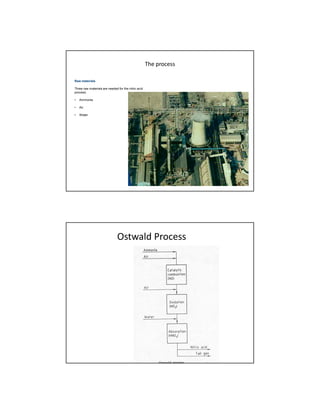
Raw materials
Three raw materials are needed for the nitric acid
process:
• Ammonia
• Air
• Water
The process
Ostwald Process
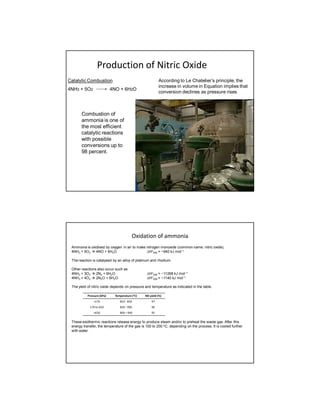
Production of Nitric Oxide
Catalytic Combustion
4NH3 + 5O2 4NO + 6H2O
According to Le Chatelier’s principle, the
increase in volume in Equation implies that
conversion declines as pressure rises
Combustion of
ammonia is one of
the most efficient
catalytic reactions
with possible
conversions up to
98 percent.
Oxidation of ammonia
Ammonia is oxidised by oxygen in air to make nitrogen monoxide (common name: nitric oxide),
4NH3 + 5O2  4NO + 6H2O ∆Ho
298 = −940 kJ mol−1
The reaction is catalysed by an alloy of platinum and rhodium.
Other reactions also occur such as
4NH3 + 3O2  2N2 + 6H2O ∆Ho
298 = −11268 kJ mol−1
4NH3 + 4O2  2N2O + 6H2O ∆Ho
298 = −1140 kJ mol−1
The yield of nitric oxide depends on pressure and temperature as indicated in the table.
These exothermic reactions release energy to produce steam and/or to preheat the waste gas. After this
energy transfer, the temperature of the gas is 100 to 200 oC, depending on the process. It is cooled further
with water.
Pressure (kPa) Temperature (oC) NO yield (%)
<170 810 - 850 97
170 to 650 850 - 900 96
>650 900 – 940 95
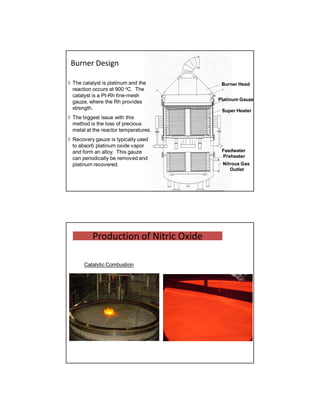
Burner Head
Platinum Gauze
Super Heater
Feedwater
Preheater
Nitrous Gas
Outlet
Burner Design
 The catalyst is platinum and the
reaction occurs at 900 oC. The
catalyst is a Pt-Rh fine-mesh
gauze, where the Rh provides
strength.
 The biggest issue with this
method is the loss of precious
metal at the reactor temperatures.
 Recovery gauze is typically used
to absorb platinum oxide vapor
and form an alloy. This gauze
can periodically be removed and
platinum recovered.
Production of Nitric Oxide
Catalytic Combustion
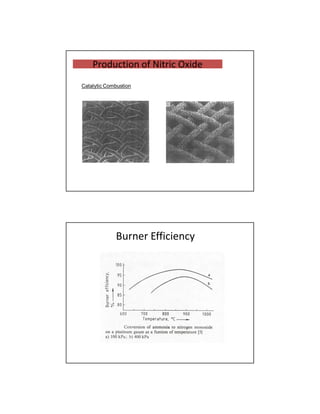
Production of Nitric Oxide
Catalytic Combustion
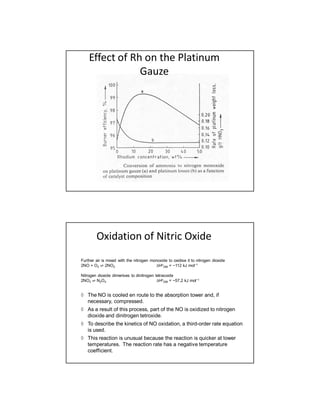
Burner Efficiency
Effect of Rh on the Platinum
Gauze
Oxidation of Nitric Oxide
Further air is mixed with the nitrogen monoxide to oxidise it to nitrogen dioxide
2NO + O2 ⇌ 2NO2 ∆Ho
298 = −112 kJ mol−1
Nitrogen dioxide dimerises to dinitrogen tetraoxide
2NO2 ⇌ N2O4 ∆Ho
298 = −57.2 kJ mol−1
 The NO is cooled en route to the absorption tower and, if
necessary, compressed.
 As a result of this process, part of the NO is oxidized to nitrogen
dioxide and dinitrogen tetroxide.
 To describe the kinetics of NO oxidation, a third-order rate equation
is used.
 This reaction is unusual because the reaction is quicker at lower
temperatures. The reaction rate has a negative temperature
coefficient.
Absorption
Dissolving oxides of nitrogen in water
The gas entering the absorption tower is a mixture of
nitrogen dioxide and dinitrogen tetraoxide.
A counter-current flow of water is used to absorb the
nitrogen dioxide. A number of reactions happen, but the
overall reaction may be summarised by the equations:
4NO2 + 2H2O + O2  4HNO3
2N2O4 + 2H2O + O2  4HNO3
The contributing reactions include:
3NO2 + H2O ⇌ 2HNO3 + NO
N2O4 + H2O  HNO2 + HNO3
3HNO2  HNO3 + H2O + 2NO
A secondary air stream is introduced to re-oxidise NO
and to remove move NO2 from the product acid.
Environmental improvements
Special reactors are included in most modern plant
and refitted into older plant to reduce emissions of
oxides of nitrogen. The reduction takes place over a
catalyst, and the reaction may be summarised as:
6NO2 + 8NH3  7N2 + 12H2O
Higher Concentrations of Nitric
Acid
 Nitric acid can be concentrated to about 68% in water with the above
described process.
 This concentration is adequate for most fertilizer applications but not for
chemical nitration reactions.
 However, there are ways to overcome the azeotrope (68% in water) and
go to higher acid concentrations.
Concentrated Acid Processes:
1) Direct - injecting or absorbing NOx into weak nitric acid under pressure.
2) Indirect - extractive distillation and rectification with sulfuric acid or
magnesium
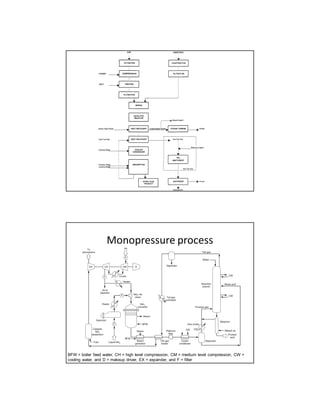
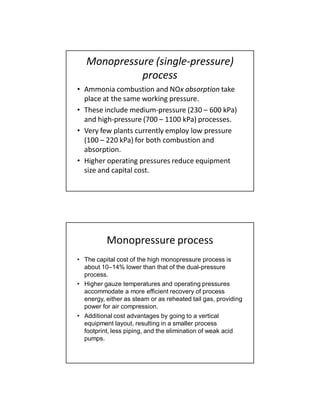
Monopressure process
BFW = boiler feed water, CH = high level compression, CM = medium level compression, CW =
cooling water, and D = makeup driver, EX = expander, and F = filter
Monopressure (single-pressure)
process
• Ammonia combustion and NOx absorption take
place at the same working pressure.
• These include medium-pressure (230 – 600 kPa)
and high-pressure (700 – 1100 kPa) processes.
• Very few plants currently employ low pressure
(100 – 220 kPa) for both combustion and
absorption.
• Higher operating pressures reduce equipment
size and capital cost.
Monopressure process
• The capital cost of the high monopressure process is
about 10–14% lower than that of the dual-pressure
process.
• Higher gauze temperatures and operating pressures
accommodate a more efficient recovery of process
energy, either as steam or as reheated tail gas, providing
power for air compression.
• Additional cost advantages by going to a vertical
equipment layout, resulting in a smaller process
footprint, less piping, and the elimination of weak acid
pumps.
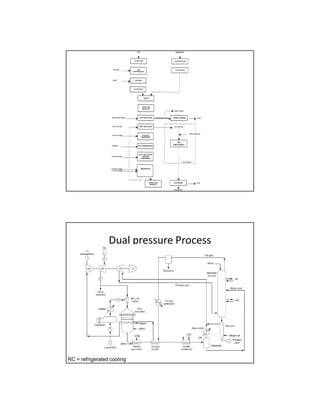
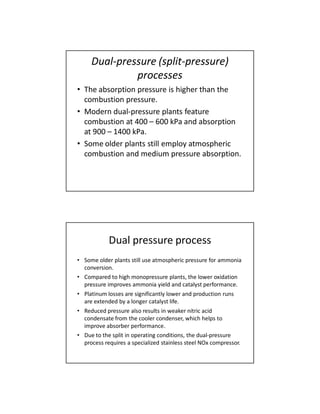
Dual pressure Process
RC = refrigerated cooling
Dual-pressure (split-pressure)
processes
• The absorption pressure is higher than the
combustion pressure.
• Modern dual-pressure plants feature
combustion at 400 – 600 kPa and absorption
at 900 – 1400 kPa.
• Some older plants still employ atmospheric
combustion and medium pressure absorption.
Dual pressure process
• Some older plants still use atmospheric pressure for ammonia
conversion.
• Compared to high monopressure plants, the lower oxidation
pressure improves ammonia yield and catalyst performance.
• Platinum losses are significantly lower and production runs
are extended by a longer catalyst life.
• Reduced pressure also results in weaker nitric acid
condensate from the cooler condenser, which helps to
improve absorber performance.
• Due to the split in operating conditions, the dual-pressure
process requires a specialized stainless steel NOx compressor.

Nitric acid Industries

  • 1.
    Nitric acid Uses ofNitric Acid • starting material in the manufacture of nitrogen fertilizers e.g; ammonium nitrate, nitrophosphates and potassium nitrates • the use of ammonium nitrate as a fertiliser is declining because of concerns about nitrate groundwater contamination • nitrating agent in the preparation of explosives and organic intermediates such as nitroalkanes and nitroaromatics • in the production of adipic acid • used as an etchant and pickling agent for stainless steels • in rocket fuel production
  • 2.
    Nitric Acid Production 1.Chilean saltpeter or nitrate 2. Arc process or Birkeland and Eyde process 3. Ostwald's process or Ammonia oxidation process Nitric Acid Production 1. Chilean saltpeter or nitrate Nitric acid occurs in nature in the form of nitrate salts. Initially,large scale production of nitric acid began with sodium nitrate as a feed stock NaNO3 (s)+ H2SO4 (l) NaHSO4 (s)+ HNO3 (l)
  • 3.
    Nitric Acid Production N2+ O2  2NO - heat 2NO + O2  2NO2 + heat 4NO2 + 2H2O + O2  4HNO3 2. Arc process or Birkeland and Eyde process Near the beginning of the 20th century, world reserves of sodium nitrate were low and processes were being developed. Arc process was abandoned because of poor energy efficiency. Production of Nitric Acid The critical step in nitric acid production, the catalytic combustion of ammonia,was developed by Ostwald around the turn of the century and was in production by 1906. 3. The Ostwald Process 1) Catalytic Combustion 4NH3 + 5O2 4NO + 6H2O 2) Oxidation of NO 2NO + O2 2NO2 N2O4 3) Absorption 3NO2 + H2O 2HNO3 + NO
  • 4.
    Raw materials Three rawmaterials are needed for the nitric acid process: • Ammonia • Air • Water The process Ostwald Process
  • 5.
    Production of NitricOxide Catalytic Combustion 4NH3 + 5O2 4NO + 6H2O According to Le Chatelier’s principle, the increase in volume in Equation implies that conversion declines as pressure rises Combustion of ammonia is one of the most efficient catalytic reactions with possible conversions up to 98 percent. Oxidation of ammonia Ammonia is oxidised by oxygen in air to make nitrogen monoxide (common name: nitric oxide), 4NH3 + 5O2  4NO + 6H2O ∆Ho 298 = −940 kJ mol−1 The reaction is catalysed by an alloy of platinum and rhodium. Other reactions also occur such as 4NH3 + 3O2  2N2 + 6H2O ∆Ho 298 = −11268 kJ mol−1 4NH3 + 4O2  2N2O + 6H2O ∆Ho 298 = −1140 kJ mol−1 The yield of nitric oxide depends on pressure and temperature as indicated in the table. These exothermic reactions release energy to produce steam and/or to preheat the waste gas. After this energy transfer, the temperature of the gas is 100 to 200 oC, depending on the process. It is cooled further with water. Pressure (kPa) Temperature (oC) NO yield (%) <170 810 - 850 97 170 to 650 850 - 900 96 >650 900 – 940 95
  • 6.
    Burner Head Platinum Gauze SuperHeater Feedwater Preheater Nitrous Gas Outlet Burner Design  The catalyst is platinum and the reaction occurs at 900 oC. The catalyst is a Pt-Rh fine-mesh gauze, where the Rh provides strength.  The biggest issue with this method is the loss of precious metal at the reactor temperatures.  Recovery gauze is typically used to absorb platinum oxide vapor and form an alloy. This gauze can periodically be removed and platinum recovered. Production of Nitric Oxide Catalytic Combustion
  • 7.
    Production of NitricOxide Catalytic Combustion Burner Efficiency
  • 8.
    Effect of Rhon the Platinum Gauze Oxidation of Nitric Oxide Further air is mixed with the nitrogen monoxide to oxidise it to nitrogen dioxide 2NO + O2 ⇌ 2NO2 ∆Ho 298 = −112 kJ mol−1 Nitrogen dioxide dimerises to dinitrogen tetraoxide 2NO2 ⇌ N2O4 ∆Ho 298 = −57.2 kJ mol−1  The NO is cooled en route to the absorption tower and, if necessary, compressed.  As a result of this process, part of the NO is oxidized to nitrogen dioxide and dinitrogen tetroxide.  To describe the kinetics of NO oxidation, a third-order rate equation is used.  This reaction is unusual because the reaction is quicker at lower temperatures. The reaction rate has a negative temperature coefficient.
  • 9.
    Absorption Dissolving oxides ofnitrogen in water The gas entering the absorption tower is a mixture of nitrogen dioxide and dinitrogen tetraoxide. A counter-current flow of water is used to absorb the nitrogen dioxide. A number of reactions happen, but the overall reaction may be summarised by the equations: 4NO2 + 2H2O + O2  4HNO3 2N2O4 + 2H2O + O2  4HNO3 The contributing reactions include: 3NO2 + H2O ⇌ 2HNO3 + NO N2O4 + H2O  HNO2 + HNO3 3HNO2  HNO3 + H2O + 2NO A secondary air stream is introduced to re-oxidise NO and to remove move NO2 from the product acid. Environmental improvements Special reactors are included in most modern plant and refitted into older plant to reduce emissions of oxides of nitrogen. The reduction takes place over a catalyst, and the reaction may be summarised as: 6NO2 + 8NH3  7N2 + 12H2O Higher Concentrations of Nitric Acid  Nitric acid can be concentrated to about 68% in water with the above described process.  This concentration is adequate for most fertilizer applications but not for chemical nitration reactions.  However, there are ways to overcome the azeotrope (68% in water) and go to higher acid concentrations. Concentrated Acid Processes: 1) Direct - injecting or absorbing NOx into weak nitric acid under pressure. 2) Indirect - extractive distillation and rectification with sulfuric acid or magnesium
  • 10.
    Monopressure process BFW =boiler feed water, CH = high level compression, CM = medium level compression, CW = cooling water, and D = makeup driver, EX = expander, and F = filter
  • 11.
    Monopressure (single-pressure) process • Ammoniacombustion and NOx absorption take place at the same working pressure. • These include medium-pressure (230 – 600 kPa) and high-pressure (700 – 1100 kPa) processes. • Very few plants currently employ low pressure (100 – 220 kPa) for both combustion and absorption. • Higher operating pressures reduce equipment size and capital cost. Monopressure process • The capital cost of the high monopressure process is about 10–14% lower than that of the dual-pressure process. • Higher gauze temperatures and operating pressures accommodate a more efficient recovery of process energy, either as steam or as reheated tail gas, providing power for air compression. • Additional cost advantages by going to a vertical equipment layout, resulting in a smaller process footprint, less piping, and the elimination of weak acid pumps.
  • 12.
    Dual pressure Process RC= refrigerated cooling
  • 13.
    Dual-pressure (split-pressure) processes • Theabsorption pressure is higher than the combustion pressure. • Modern dual-pressure plants feature combustion at 400 – 600 kPa and absorption at 900 – 1400 kPa. • Some older plants still employ atmospheric combustion and medium pressure absorption. Dual pressure process • Some older plants still use atmospheric pressure for ammonia conversion. • Compared to high monopressure plants, the lower oxidation pressure improves ammonia yield and catalyst performance. • Platinum losses are significantly lower and production runs are extended by a longer catalyst life. • Reduced pressure also results in weaker nitric acid condensate from the cooler condenser, which helps to improve absorber performance. • Due to the split in operating conditions, the dual-pressure process requires a specialized stainless steel NOx compressor.